
You are currently viewing a new version of our website. To view the old version click .
Crystals
  • Opinion
  • Open Access

6 February 2021

IsoStar Program Suite for Studies of Noncovalent Interactions in Crystals of Chemical Compounds

1
Institute of Chemistry, Saint Petersburg State University, Universitetskaya Nab., 7/9, 199034 Saint Petersburg, Russia
2
Infochemistry Scientific Center, ITMO University, Kronverksky Pr., 49, Bldg. A, 197101 Saint Petersburg, Russia
This article belongs to the Special Issue Non-covalent Interactions in Coordination and Organometallic Chemistry

Abstract

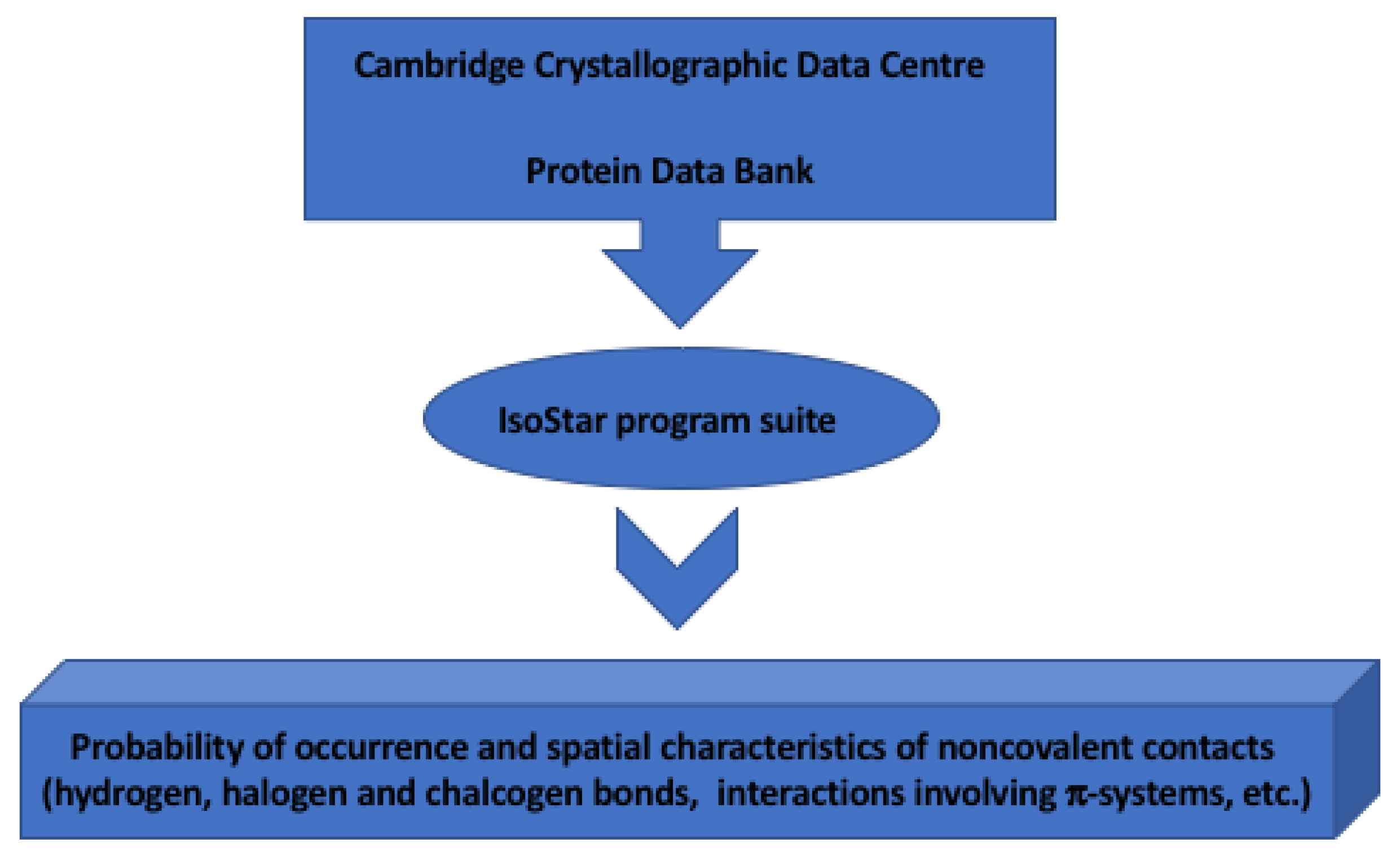
Both Cambridge Crystallographic Data Centre (CCDC) and Protein Data Bank (PDB) provide unique opportunities for finding information about the structures of chemical and biochemical compounds in the solid state. The IsoStar—a knowledge-based library of intermolecular interactions—is a very powerful tool for automatic analysis of a large amount of data from these databases. The IsoStar program suite could help chemists in understanding of probability of occurrence (frequencies) and spatial characteristics (directionalities) of noncovalent contacts (including hydrogen, halogen, and chalcogen bonds, as well as interactions involving π-systems) between pairs of chemical functional groups; this web application may also be useful for crystal engineers, crystallographers, medicinal chemists, and researchers in fields of computational chemistry and molecular modeling.
Obviously, the most accurate and objective idea about the structure of chemical compounds in the solid state can be obtained using X-ray crystallography. To date, there are two most extensive online databases on the structure of chemical compounds: Cambridge Crystallographic Data Centre (CCDC, https://www.ccdc.cam.ac.uk) and Protein Data Bank (PDB, http://www.wwpdb.org). The CCDC is a crystallographic organization focused on small molecule crystal structures (mainly organic and organometallic compounds), whereas PDB is a database for the three-dimensional structural data of large biological molecules, such as proteins and nucleic acids. Both these databases contain almost unlimited information about the different kinds of noncovalent contacts (including hydrogen, halogen, and chalcogen bonds, as well as interactions involving π-systems) between atoms and functional groups, and this information could be potentially ultimately interesting for crystal engineers, crystallographers, medicinal chemists, and researchers in fields of computational chemistry and molecular modelling. Unfortunately, manual extraction of the information about the noncovalent contacts from these databases could be very time consuming and subjective.
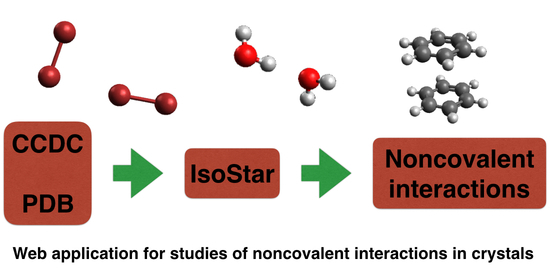
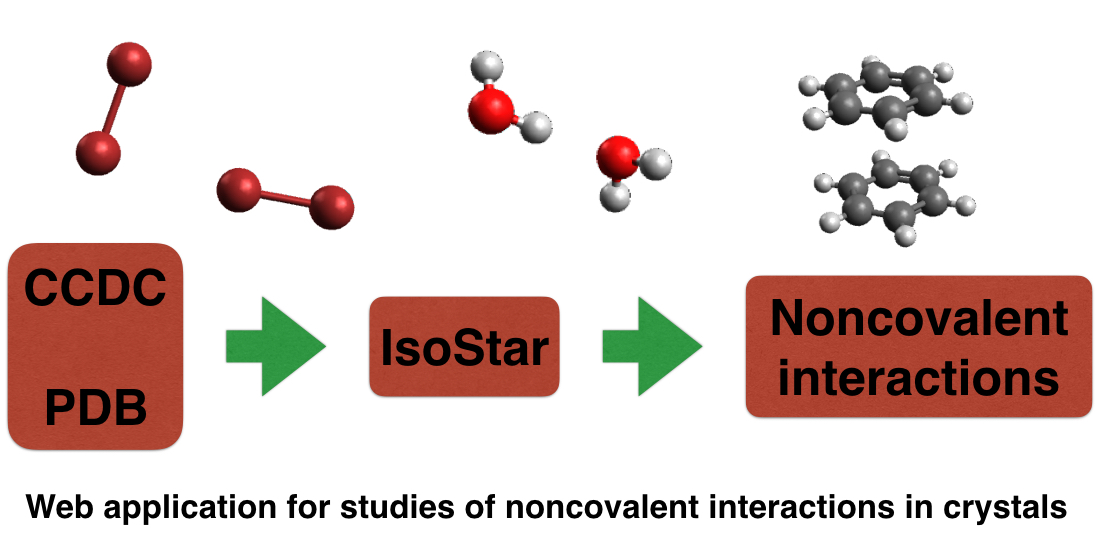
However, currently there is a brilliant automatic web application for these purposes—IsoStar program suite (https://isostar.ccdc.cam.ac.uk/html/isostar.html) [1,2] (Figure 1). Crystallographic information in IsoStar is presented in the form of three-dimensional scatterplots, which could be future converted to contoured density surfaces. Each scatterplot constructed based on the CCDC or PDB search for weak (long) contacts between a pair of functional groups X and Y and demonstrates the experimentally observed distribution of X (contact group) around Y (central group). Such scatterplots provide ideas about the probability of occurrence (frequencies) and spatial characteristics (directionalities) of noncovalent contacts between pairs of chemical functional groups (e.g., C, N, O, S, Si, P, Se, or H atom, hydrophobic groups like Me or Ph, halogen atoms, and amino acids). The IsoStar program suite also provide huge statistical information (e.g., the number of crystal structures that have both the central and contact groups present, the number of crystal structures in which the central group and contact group form a contact with distance less than the sum of van der Waals radii).
Figure 1. IsoStar program suite—an automatic web application for studies of noncovalent interactions in crystals of chemical compounds.
Inspection of the literature data reveals that the IsoStar program suite could be successfully used for studies of extended supramolecular architectures of co-crystals (up to four- and five-component assemblies) [3], smart and predictable design of molecular crystals via tunable site-specific intermolecular interactions, which provide hierarchical self-assembly [4,5,6], screening of metal–organic frameworks for materials discovery [7], and density functional theory supported analysis to assess the utility of σ- and π-hole interactions for crystal engineering [8].
Thus, I call the scientific community to pay attention to this useful tool for studying noncovalent interactions in the solid phase and widely use it in daily research work.

Funding

This research received no external funding.

Conflicts of Interest

The author declares no conflict of interest.

References

  1. Bruno, I.J.; Cole, J.C.; Lommerse, J.P.M.; Rowland, R.S.; Taylor, R.; Verdonk, M.L. IsoStar: A Library of Information About Nonbonded Interactions. J. Comput. Aided Mol. Des. 1997, 11, 525–537. [Google Scholar] [CrossRef] [PubMed]
  2. Battle, G.M.; Allen, F.H. Learning about Intermolecular Interactions from the Cambridge Structural Database. J. Chem. Educ. 2012, 89, 38–44. [Google Scholar] [CrossRef]
  3. Aakeröy, C.B.; Sinha, A.S. Chapter 1: Co-crystals: Introduction and Scope. In Co-crystals: Preparation, Characterization and Applications; Aakeröy, C.B., Sinha, A.S., Eds.; The Royal Society of Chemistry: London, UK, 2018; pp. 1–32. [Google Scholar] [CrossRef]
  4. Sinha, A.S.; Aakeröy, C.B. Design of Molecular Crystals Supramolecular Synthons. In Comprehensive Supramolecular Chemistry II; Elsevier: Amsterdam, The Netherlands, 2017; pp. 3–24. [Google Scholar] [CrossRef]
  5. Corpinot, M.K.; Bučar, D.-K. A Practical Guide to the Design of Molecular Crystals. Cryst. Growth Des. 2019, 19, 1426–1453. [Google Scholar] [CrossRef]
  6. Vologzhanina, A.V. Intermolecular Interactions in Functional Crystalline Materials: From Data to Knowledge. Crystals 2019, 9, 478. [Google Scholar] [CrossRef]
  7. Moghadam, P.Z.; Li, A.; Wiggin, S.B.; Tao, A.; Maloney, A.G.P.; Wood, P.A.; Ward, S.C.; Fairen-Jimenez, D. Development of a Cambridge Structural Database Subset: A Collection of Metal–Organic Frameworks for Past, Present, and Future. Chem. Mater. 2017, 29, 2618–2625. [Google Scholar] [CrossRef]
  8. Mooibroek, T.J. DFT and IsoStar Analyses to Assess the Utility of σ- and π-Hole Interactions for Crystal Engineering. ChemPhysChem 2021, 22, 141–153. [Google Scholar] [CrossRef] [PubMed]
Publisher’s Note: MDPI stays neutral with regard to jurisdictional claims in published maps and institutional affiliations.

Article Metrics

Citations

Article Access Statistics

Multiple requests from the same IP address are counted as one view.