Abstract
In highly anisotropic organic superconductor (TMTSF)ClO, superconducting (SC) phase coexists with metallic and spin-density wave phases in the form of domains. Using the Maxwell-Garnett approximation (MGA), we calculate the volume ratio and estimate the shape of these embedded SC domains from resistivity data at various temperature and anion disorder, controlled by the cooling rate or annealing time of (TMTSF)ClO samples. We found that the variation of cooling rate and of annealing time affect differently the shape of SC domains. In all cases the SC domains have oblate shape, being the shortest along the interlayer z-axis. This contradicts the widely assumed filamentary superconductivity along the z-axis, used to explain the anisotropic superconductivity onset. We show that anisotropic resistivity drop at the SC onset can be described by the analytical MGA theory with anisotropic background resistance, while the anisotropic can be explained by considering a finite size and flat shape of the samples. Due to a flat/needle sample shape, the probability of percolation via SC domains is the highest along the shortest sample dimension (z-axis), and the lowest along the sample length (x-axis). Our theory can be applied to other heterogeneous superconductors, where the size d of SC domains is much larger than the SC coherence length , e.g., cuprates, iron-based or organic superconductors. It is also applicable when the spin/charge-density wave domains are embedded inside a metallic background, or vice versa.
1. Introduction
Raising the superconducting transition temperature (Tc) has been the goal of active research for a century. Compounds like cuprates [1,2], iron-based superconductors [3], organic superconductors (hereafter denoted as OrS) [4] are some major high-Tc superconductors at ambient pressure. These materials have several common properties: (i) layered crystal structure and, hence, high conductivity anisotropy; (ii) interplay between various types of electron ordering, i.e., between spin/charge-density wave and superconductivity; (iii) spatial inhomogeneity. Therefore, many effects and methods, both experimental and theoretical, are common for these materials. A recent and good review of all these systems is given by Stewart [5]. Our paper concerns the OrS and is devoted to two problems: (i) show that Maxwell-Garnett approximation can be used to estimate superconducting volume fraction in coexistence regime of superconducting, metallic and spin/charge-density wave phases; (ii) analysis of corresponding experimental data [6,7] in the organic superconductor (TMTSF)ClO to study the effect of cooling rate and of disorder on the volume fraction, shape and size of SC domains.
(TMTSF)X series belongs to quasi-1D OrS and has been widely studied for 40 years [4,8,9,10]. Many important effects have been discovered and investigated on these compounds, e.g., angular magnetoresistance oscillations (AMRO) in quasi-1D metals [9,10,11], field-induced spin-density waves (FISDW) [12,13], etc. [9,10]. An interesting and puzzling property of these materials related to our subject is that with the increase of pressure for (TMTSF)PF or of anion ordering for (TMTSF)ClO, the superconductivity first appears along the least-conducting z-axis, while along the most conducting x-direction only in the last turn [6,7,14,15]. Recent experimental study on (TMTSF)PF [14,15,16,17] and (TMTSF)ClO [6,7] has shown that spin-density wave (SDW), superconducting (SC) and metallic phase coexist in form of segregated domains. With the increase in pressure (for (TMTSF)PF) [14,15,18] or in anion ordering (for (TMTSF)ClO) [6,7] the volume fraction of SC or metallic phase increases.
A few theories have been suggested to describe the coexistence regime in these materials, especially in (TMTSF)PF. One of them is the application of SO(4) symmetry that explains SDW and SC coexistence [19] but does not account for the observed hysteresis [16], for the strong enhancement of the upper critical field [20] and for the anisotropic SC onset [14,15,18] in the coexistence phase. Less exotic theories suggest a separation of SDW and SC in a coordinate [14,15,16,20,21,22,23,24] or momentum space [23]. The momentum SC-SDW separation assumes a semi-metallic state in a SDW phase, where, due to the imperfect nesting, small ungapped Fermi-surface pockets appear and become superconducting [23]. The enhancement can be explained in both scenarios [23,24], but the observed hysteresis suggests a spatial SDW/SC separation [16]. To explain the enhancement [20] the SC domain width must not exceed the in-plane SC penetration depth . In (TMTSF)ClO the in-plane penetration depth is [25,26,27] μm, and the out-of-plane penetration depth is [28] K) μm. One possible mechanism of the formation of such narrow domains in the SDW state could be the soliton phase [14,21,22,24,29]. It suggests that SDW order parameter becomes non-uniform with metallic domain appearing perpendicular to the highest conducting x-axis. However, the width of these soliton-wall domains, being of the order of SDW coherence length nm, is too small to be consistent with the recent observation of AMRO and FISDW in (TMTSF)PF [15] and in (TMTSF)ClO [30], suggesting the domain size μm. Moreover, the soliton-phase scenario accounts for the SC suppression along the most conducting x-axis only, but it could not explain why SC first appears along the least-conducting z-axis, because in this scenario the soliton walls are extended along both y and z-axes, which should result in SC along both these directions.
A probable explanation of this anisotropic SC onset was proposed recently [31]. It is based on two ideas. First, in anisotropic media the isolated SC islands increase conductivity much stronger along the least-conducting direction than along the others, as observed in FeSe [32,33] and described [32,33,34] using the Maxwell-Garnett approximation (MGA) [35] for small volume fraction of SC phase. However, this MGA theory cannot explain the anisotropic zero-resistance onset. For this we need the second idea, which takes into account the finite sample size L as compared to the size d of SC grains. If the sample shape is very anisotropic, e.g., a thin plate, then the current percolation via the SC grains, responsible for the zero-resistance onset, is most probable along the shortest sample dimension, [31] i.e., along the sample thickness, and least probable along the sample length. These two ideas were applied to explain [31] the experimental data [14,15,18] in PF6, taken on thin elongated samples with dimensions [14,18] mm. As (TMTSF)ClO samples are usually flat shaped either [6,7], similar ideas can be applied to analyze the resistivity experimental data there too. In this paper, using the MGA we find superconducting volume ratio and shape of inclusions from available experimental data. We also investigate how disorder and cooling rate affect the inclusions’ shape and size. This knowledge may help to better understand the microscopic structure and electronic properties of the SDW/SC coexistence phase in organic superconductors.
In Section 2 we briefly describe the important properties of (TMTSF)ClO and argue that MGA can be applied to estimate temperature dependence of SC volume ratio () in the presence of all 3 phases, i.e., metallic, SDW and SC. In Section 3 we describe the theoretical model in MGA. Furthermore, in Section 4 we apply our theoretical model to analyze the experimental data on (TMTSF)ClO. Using the experimental data from Ref. [7] we find out how cooling rate effects . Similarly, using the experiments of Ref. [6] we analyze the evolution of aspect ratio of SC inclusions with sample disorder. Finally, in Section 5 we discuss the main results of our investigation and their consequences.
2. Material and Method
2.1. Material
(TMTSF)ClO is the only member of Beechgard salts which becomes superconducting at ambient pressure [36,37]. It is a quasi-1D superconductor in which cooper-pair ordering (SC) coexists with insulating Pierels ordering (SDW) (The analysis below equally applies for a charge-density wave (CDW) or SDW Pierels ordering. Our current study is mainly devoted to SDW/SC coexistence in (TMTSF)ClO, therefore we keep SDW notation for the insulating phase. However, it may equally be applied to other compounds with CDW/SC mixed phase.). This very competition between SC and SDW is the key to understand the unconventional superconductivity [38,39,40,41]. Among quasi-1D superconductors (TMTSF)ClO is the only compound in which superconductivity can be controlled by the cooling rate of samples, which affects the disorderliness of ClO anions. Slowly cooled (TMTSF)ClO samples (relaxed state) undergo an SC transition at 1.3 K [42,43]. However, when cooled very fast (quenched state) (TMTSF)ClO has an insulating SDW transition at 4–5 K [44,45,46]. This behavior can be ascribed to structural change that occurs at the anion-ordering temperature [47] 24.5 K. For the noncentrosymmetric tetrahedral ClO anions, which are located at the inversion centers [48,49], preserve the inversion symmetry due to thermal motion of ClO anions. ClO anions randomly occupies one or other orientations, hence, on average the inversion symmetry is preserved [48]. For , if the sample is cooled fast enough then the randomness of orientation of anions is preserved [45]. However, if the sample is cooled slowly through , ClO anions along a,c-axes are ordered uniformly; and along b-axis ordered alternatively [47,50,51]. The anion ordering introduces the new wave vector and the Fermi-surface folding. It disturbs the Fermi-surface nesting, preventing the SDW and favoring SC.
Recent experiments strongly support the presence of SC inclusions embedded in the background of metallic/SDW phase when (TMTSF)ClO is cooled at intermediate rate [6,7]. This means granular superconductivity for partially ordered samples. From the crystallographic point of view, in this coexistence phase the domains of ordered ClO anions are embedded inside disordered background. In these domains the anions have alternating ordering pattern, being disordered outside the domains [6,7,47]. The electronic state inside these domains is assumed to remain metallic even at , and at these ClO-ordered grains become superconducting [7]. Here is the superconducting onset temperature. The volume fraction of superconducting phase increases with the decrease of temperature. For slow or intermediate cooling rate at the phase coherence of these SC islands establishes in the entire sample, leading to its zero resistance. In the temperature interval the effective medium model for highly anisotropic heterogeneous layered compounds [35], developed and applied by the authors to various anisotropic compounds in Refs. [32,33,34,52], can be used to estimate the volume fraction and the shape of SC inclusions inside the samples.
2.2. Method
To analyze the temperature dependence of resistivity at we use the Maxwell-Garnett approximation (MGA) [35], valid when the volume fraction of SC phase . Please note that the condition is fulfilled in a wide range of parameters, because in 3D anisotropic samples even the SC percolation threshold , corresponding to the onset of nearly zero resistance, is considerably smaller than unity. This is illustrated in our recent work [31], where in needle-shaped flat (TMTSF)PF samples from Refs. [14,18], typical for organic superconductors, was calculated numerically, assuming a rectangular sample shape and ellipsoidal SC inclusions of varying size at randomly distributed but fixed positions. This calculation has shown the strong anisotropy and small value of these (see Figures 3 and 4 of Ref. [31]). Thus, for SC domain size μm the percolation threshold along the x-axis ; for μm (see Figures 3 of Ref. [31]). For y- and z-axes is even smaller. In all these cases , suggesting a wide range where MGA can be applied. The (TMTSF)ClO samples, studied in the present paper and in Refs. [6,7], are also flat and needle-shaped, similar to (TMTSF)PF samples from Refs. [14,18].
In recent works [32,33,34,52] using MGA the superconducting volume ratio was found when SC inclusions were embedded inside metallic background. Similarly, here we also assume SC inclusions are embedded inside a background phase. However, here the background phase consists of SDW and metallic phases. This is permissible in MGA approximation as long as we know the effective conductivity of this mixed background phase. We make two more assumptions: (i) the SC inclusions are of ellipsoidal shape, which simplifies the calculations and allows deriving analytical formulas for conductivity; (ii) the size d and distance between SC inclusions l are much greater than the SC coherence length , so that the SC proximity effects and the Josephson coupling between the SC grains do not change the results considerably. Both in (TMTSF)PF and (TMTSF)ClO the size μm of metal/SC inclusions is indeed much larger than the SC coherence length [7,53] , and 2 nm along the , and c axes, respectively. Such a large metal/SC grain size is demonstrated by the observation [15,30] of angular magnetoresistance oscillations (AMRO) in the mixed phase of these compounds. If , one can also take .
Due to the proximity effect a shell of SC condensates around SC inclusions with thickness gets created, which changes the effective size and shape of SC islands. Another quantum mechanical effect is the Josephson coupling between SC grains. The Josephson coupling energy depends directly on Josephson junction current , , which exponentially decreases with the increase of distance l between neighboring SC grains: . If , the Josephson coupling can be disregarded [54]. As we assume , both these effects can be neglected.
The conductance through N-S boundaries of a normal metal and SC may increase, maximum two times, due to the Andreev reflection (See Section 11.5.1 of Ref. [54] for the basic description of Andreev reflection). However, this increase of the interface conductance should not considerably change the effective conductivity of the whole sample because the main voltage drop (at a given current) comes not from the N-S interfaces, but from the large non-SC parts of the sample. Even if we take an infinite N-S interface conductance, this does not much affect the total sample resistance.
Considering the above facts, we neglect these small quantum mechanical effects, and treat conductivity due to embedded SC inclusions using the classical MGA approximation and percolation.
3. Theory
We use the Maxwell-Garnett approximation (MGA) [55,56] to find the SC volume ratio . We derive a general formula for effective conductivity in anisotropic heterogeneous media, where unidirectional ellipsoidal SC (SDW) inclusions are embedded inside the background SDW/metallic (metallic) phase with anisotropic resistivity. We denote the diagonal effective conductivity tensor of this materials as diag. Similarly, the background conductivity tensor of this material is denoted as diag. Background phase consists of both metallic and SDW phase, or only of the metallic phase. Since the MGA in its standard form [35] can be applied only to an isotropic medium, we use the coordinate-space dilation to transform the initial problem with anisotropic conductivity into isotropic one [32,33,34] (see Appendix A for the details of this mapping and Equations (A4) and (A5) for the definition of dilation coefficients and ).
Before explaining the idea of MGA [35,55,56] we note that the stationary-current equation for electrostatic potential , coming from the continuity equation for the electric current in heterogeneous media with coordinate-dependent diagonal conductivity , (In Equations (1) and (2) the summation is assume over the repeated coordinate indices i and j.)
is completely equivalent to the electrostatic equation in heterogeneous media with coordinate-dependent dielectric constant , as comes from the Maxwell’s equations:
where and are the electric and displacement fields, and . Hence, the problem of an effective dielectric constant of such a medium with heterogeneous dielectric function is equivalent to the problem of effective conductivity of a heterogeneous medium with the same coordinate dependence of .
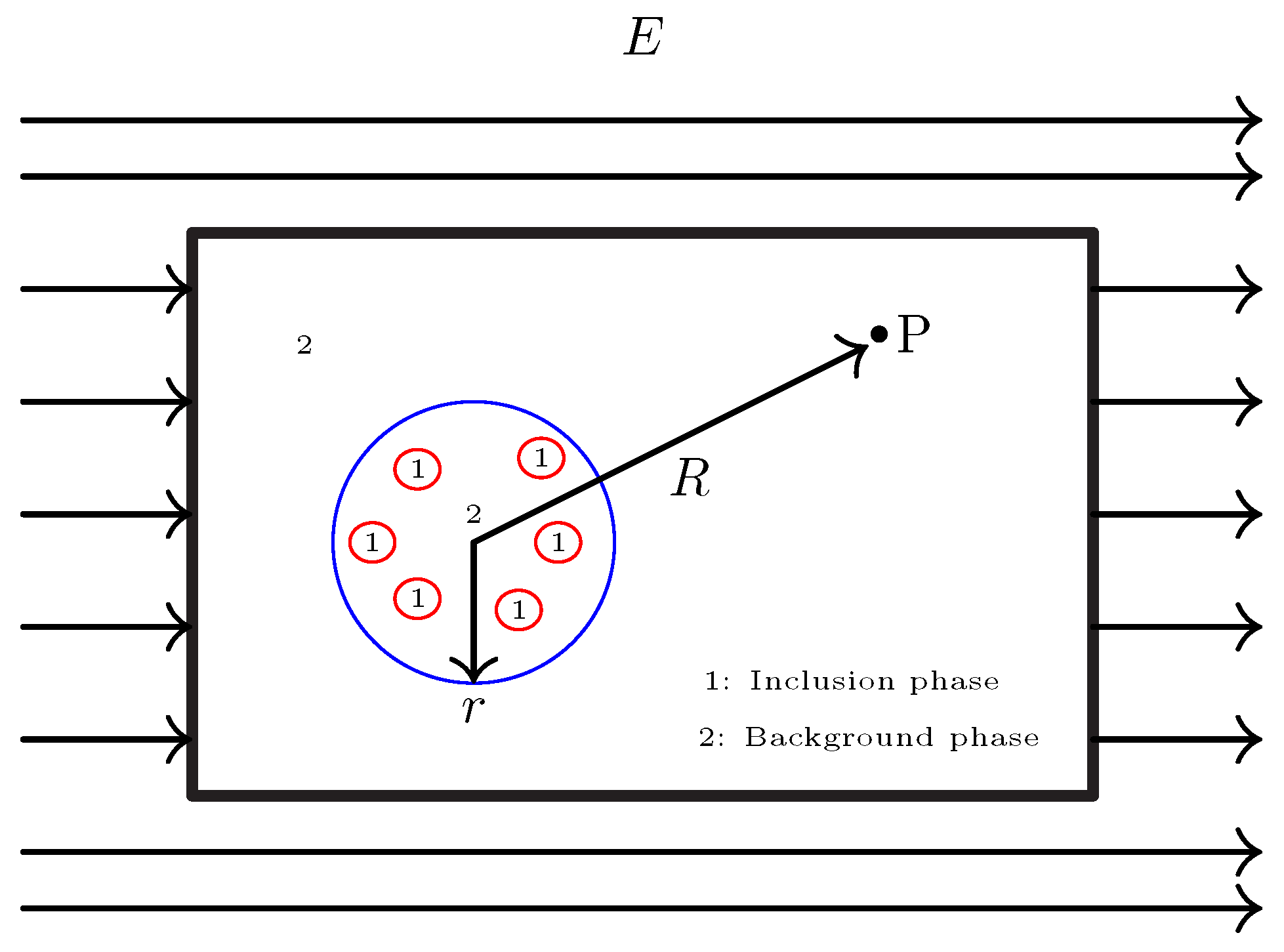
To explain the idea of MGA (Originally, MGA was formulated in 1904 only for spherical inclusions in isotropic medium [57].) [35,55,56] of calculating the effective dielectric constant of heterogeneous isotropic media with a small volume fraction of inclusions of the second phase, we refer to Figure 1. The background phase is represented as “2”, and the inclusion phase as “1” in the figure. We take a sphere of our heterogeneous media. Inside this sphere the inclusions are embedded as shown in Figure 1. Let this sphere be embedded in an infinite medium of background phase. An electric field E is applied to the infinite medium. Let be the electric field at a distant point P. includes polarization due to individual inclusions. We denote the inclusion volume ratio as and the background-phase volume ratio as (). We assume that the heterogeneous sphere with both inclusion and background phase can be substituted by a sphere of homogeneous phase with an effective dielectric constant . Then the electric field at point P can be found in two ways: (i) By summing the polarization effect due to individual inclusions; the corresponding electric field at point P we denote as . (ii) By taking the polarization effect at point P of homogeneous sphere with effective dielectric constant ; the corresponding electric field at point P we denote as . The MGA assumes these fields to be the same, i.e., , which gives an equation on (See Section 18.1.1 of Ref. [35] for complete discussion on MGA). Using the well-known formula for the polarization of dielectric ellipsoid in isotropic medium, and replacing by , we find the following equation (see Equations (18.9) and (18.10) of Ref. [35]) for the effective conductivity along main axis i in the mapped space: (Equations (3), (5) and (8) assume that in the mapped space the conductivities of both phases, and , are isotropic. For a generalization to anisotropic or in the mapped space see Refs. [58,59]. In the case of superconducting inclusions, applied in Section IV to analyze the experimental data, is naturally isotropic.)
Figure 1.
Schematic representation of Maxwell-Garnett approximation. The distance of point P from the center of sphere is very large compared to the sphere size, i.e., . E is the applied electric field.
Here are the depolarization factors of a dielectric ellipsoid with semiaxes in the mapped space:
The analytical solution of this integral can be found in terms of incomplete elliptic integrals of first and second kind (See Appendix B of Ref. [34]). If the inclusions have finite conductivity, then solving Equation (3) for we obtain
If the inclusions are superconducting, we take . Equation (3) in this case simplifies to
Solving Equation (6) for we obtain
Both Equations (5) and (7) gives the effective conductivity in the mapped space. Although the background conductivity in the mapped space is isotropic, the effective conductivity is anisotropic because of the anisotropic ellipsoidal shape of inclusions. The effective conductivity of original anisotropic material in real space is found by the reverse mapping. It is done via multiplying the effective conductivity matrix in the mapped space diag by the inverse mapping coefficient matrix diag. Hence, multiplying Equation (5) by diag, we find the effective conductivity in real space:
Here is the background conductivity along the axis i in real space. Similarly, multiplying Equation (7) by diag, we find the effective conductivity of original inhomogeneous material with SC inclusions of volume fraction :
From Equation (9) one can express the volume fraction via the effective and background conductivities and depolarization factor along the same axis:
Equation (8) is helpful when the conductivities of background and inclusion phases are both finite. Hence, it can be used to find the effective conductivity of heterogeneous material, when, e.g., SDW domains are embedded inside a metallic background, or vice versa. Equation (9) can be used when superconducting inclusions are embedded inside a background phase of finite conductivity. Below we use Equations (9) and (10) to analyze experimental resistivity data in (TMTSF)ClO in the mixed SC/SDW state. Here the background phase is made up of metallic as well as SDW phases. Resistivity along the corresponding axis is found by taking the inverse of Equations (8) and (9).
4. Analysis of Experimental Data in
We consider partially ordered (TMTSF)ClO samples. We denote as superconducting onset temperature. In these compounds for there is no superconductivity. However, for the domains containing ordered ClO anions partially transform to superconducting inclusions [7]. These ordered domains are embedded inside the phase of unordered ClO anions, where SDW prevails but may coexist with metallic phase. Further cooling results in the increase of SC volume fraction and in the formation of coherent clusters of SC inclusions. At a complete SC channel gets opened [6,7], i.e., the SC phase coherence establishes in the whole sample. In Section 4.1, we use our theory to calculate the SC volume ratio . In Section 4.2, we study the influence of cooling rate on SC volume ratio. In the end, in Section 4.3, we find the approximate shape of SC inclusions in various disordered samples.
4.1. Application of MGA Theory to Describe Resistivity and to Find Superconducting Volume Ratio
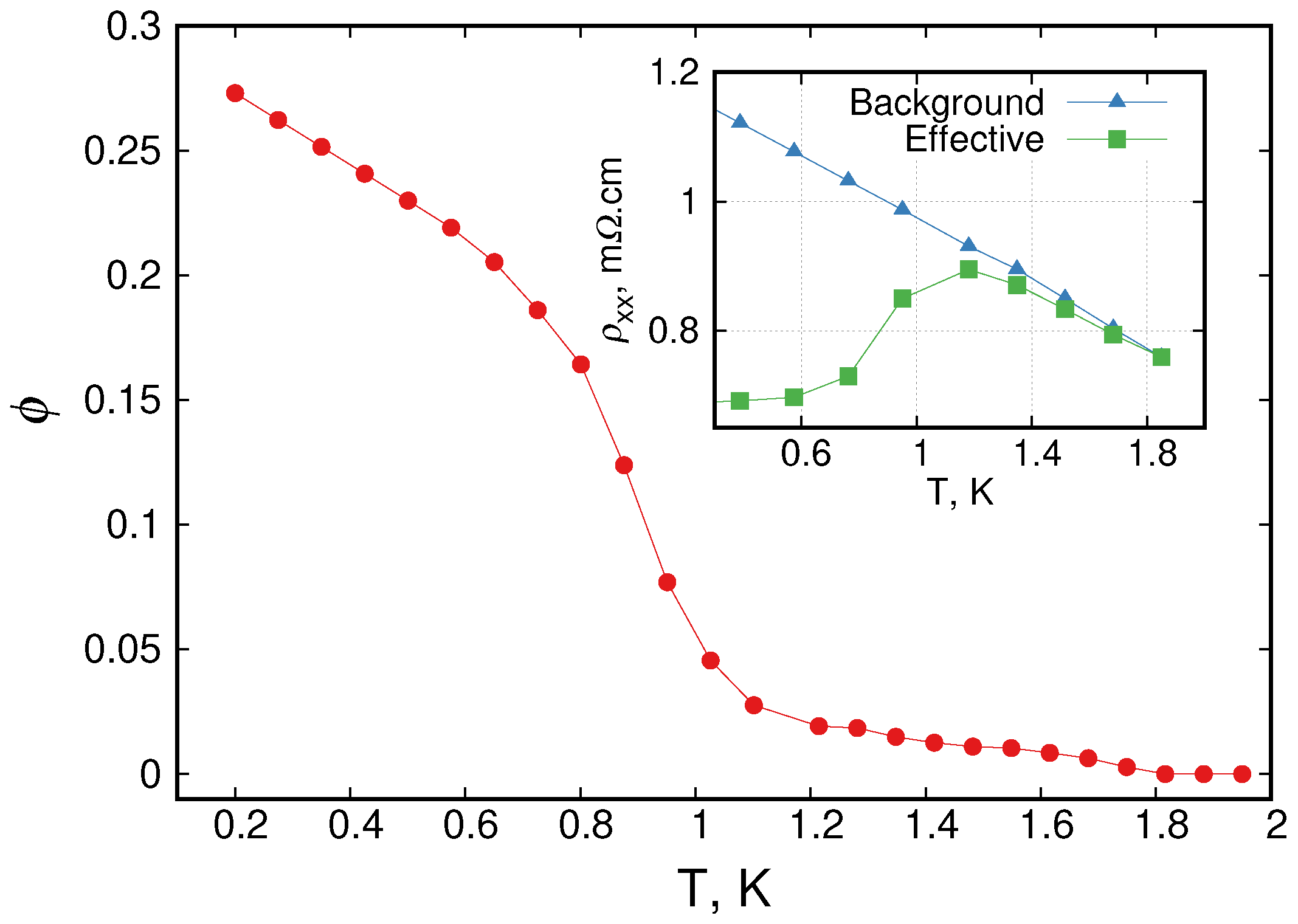
To find a typical temperature dependence of SC volume ratio in (TMTSF)ClO at cooling rate K/min we choose the sample #4 in Figure 2 of Ref. [6] (This sample #4 was cooled at rate K/min and then annealed for some time at varying temperature between 15 and 23 K. Therefore, its disorder, presumably, corresponds to a slower cooling rate.) due to the availability of experimental resistivity data on in a magnetic field , shown in Figure 2c of Ref. [6]. The magnetic field destroys superconductivity, and we can use these data to find the conductivity of background phase (see the inset in Figure 2), where the offset accounts for magnetoresistance of metallic phase at . A magnetic field is usually enough to destroy superconductivity in (TMTSF)ClO [60,61], but we take the data at where the SC effects can be safely ignored. Since the experimental data on under magnetic field for the same samples are absent, the background-phase conductivity along the z-axis is found by extrapolating the metallic resistivity to low temperature by a second-order polynomial, similar to Ref. [61]. Here the second-order term comes from the electron-electron scattering at low temperature [61,62]. We take the x-axis as the reference axis for mapping to isotropic medium, i.e., is taken as the background isotropic conductivity in the mapped space: . According to Equation (A4), the mapping coefficient along the z-axis is defined as .
Figure 2.
Dependence of SC volume ratio on temperature. (red,circle) is calculated using Equation (10) for and the experimental data on resistivity along the x-axis, taken from Figure 2c of Ref. [6] and shown in the inset. (inset) The effective medium resistivity containing SC, metallic and SDW phases (green squares), and the background resistivity in the absence of SC islands (blue triangles), taken from the data in Figure 2c of Ref. [6] in magnetic field.
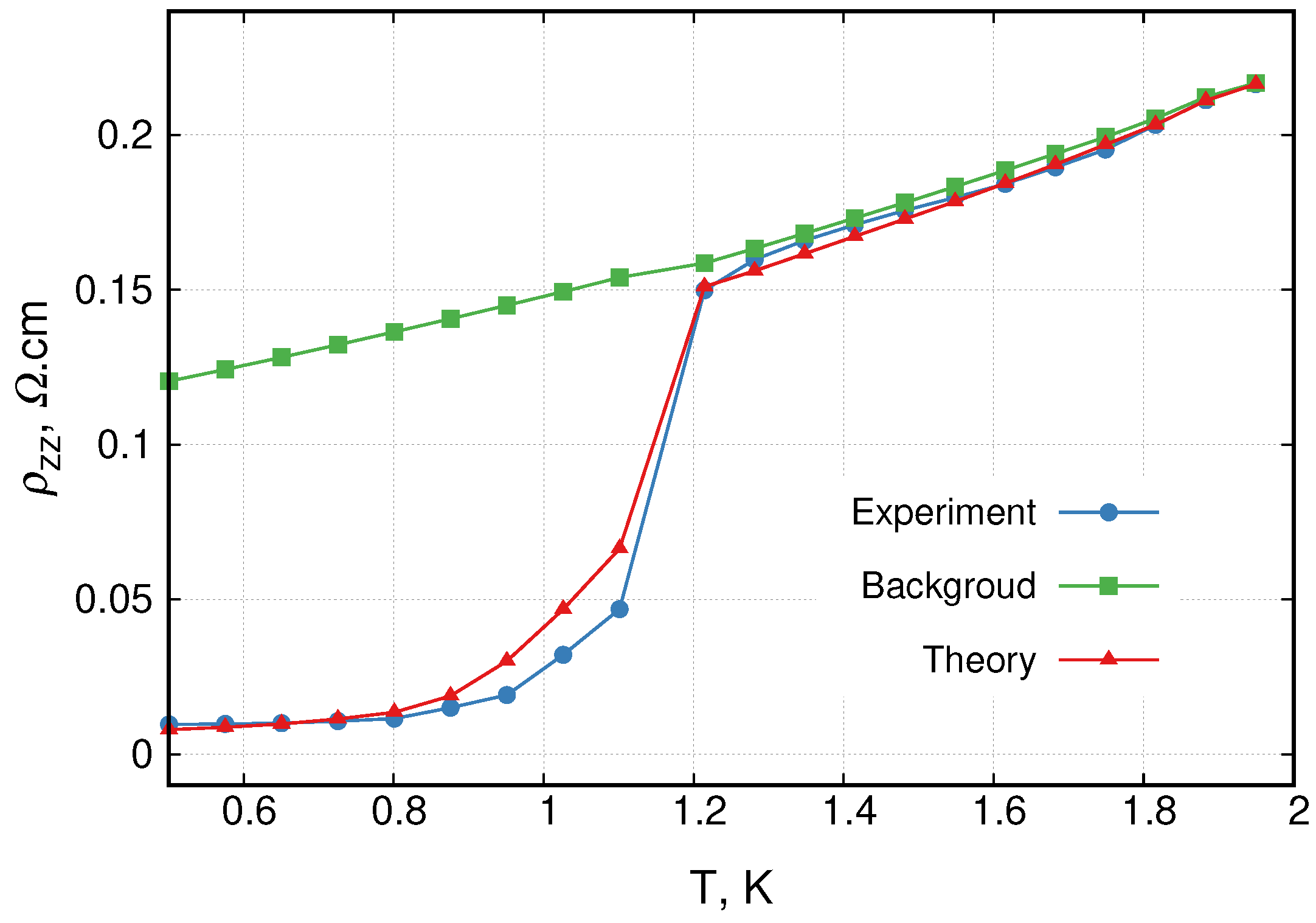
The SC volume ratio is found from Equation (10) for . The calculated volume ratio as a function of temperature is plotted in Figure 2. Substituting found from Equation (10) for to Equation (9) for , we predict the effective resistivity along the z-axis, . Its comparison with the experimental data from Figure 2b of Ref. [6] is shown in Figure 3. We see a rather good agreement. In this calculation we have one fitting parameter—the unknown ratio of the semiaxes and of ellipsoidal SC inclusions. We found that at high temperature K, typical inclusions have the aspect ratio . At low temperature K, the inclusions have aspect ratio . It means that with a decrease in temperature the SC inclusion becomes more isotropic along x and z-axes, i.e., . It may indicate the formation of large and almost isotropic clusters of small SC inclusions. Please note that at any temperature the found aspect ratio is much larger than the ratio of coherence lengths in (TMTSF)ClO, . This supports the fact that in (TMTSF)ClO the heterogeneity and SC islands originate from disorder and anion ordering rather than from usual SC fluctuations, because for SC fluctuations .
Figure 3.
Temperature dependence of resistivity along z-axis. Experimental values (blue circles) are taken for sample #4 from Figure 2b of Ref. [6]. Background-phase metallic resistivity (green squares) is found by second-order approximation, i.e., ·cm. Theoretical values (red triangles) are found from z-axis resistivity in Equation (9).
Figure 3 and the inset in Figure 2 show the temperature dependence of resistivity for the same sample along the z and x axes correspondingly. From their comparison one observes that the resistivity drop near for is much stronger than along for . This feature originates from the strong anisotropy of background-phase resistivity and is naturally described in generalized MGA theory [32,33,34]. The qualitative interpretation of this anisotropic resistivity drop due to SC onset is illustrated in Figure 1 of Refs. [32] or [33]. Because of high resistivity , the interlayer current mainly flows via the SC islands serving as shortcuts for this current direction. The effective resistivity is then determined by the much smaller intralayer resistivity and by the typical length of in-plane path between two close SC domains, which is inversely proportional to the SC volume fraction .
4.2. Effect of Cooling Rate on Superconducting Volume Ratio
The cooling rate of (TMTSF)ClO samples controls the fraction of ClO-ordered domains. At slow cooling, the ClO anions have enough time to relax into ordered state. At fast cooling the thermal disorder remains in the samples, so that both ordered and disordered domains coexist. It was corroborated by resistivity [63], specific heat [64] and x-ray scattering [65] experiments.
The volume fraction of anion-ordered domains as a function of cooling rate has been studied using the X-ray scattering [65,66] and, recently, by resistivity and magnetic susceptibility [7] measurements. The corresponding results are compared in Figure 4 of Ref. [7] in the range of cooling rate K/min. Several assumptions are made in extracting from these experiments [7,65]. First, (i) all these results assume that at the slowest cooling rate K/min all ClO are ordered at low temperature. It is not evident, as some degree of anion disorder may remain. Second, (ii) in the estimate of volume fraction from the resistivity measurements in the mixed SDW/metal phase in Ref. [7] the following equation (see Equation (1) of Ref. [7]) for the effective conductivity along z-axis has been used:
where ·cm is taken as a residual resistance of the sample with lowest cooling rate and ·cm is determined assuming that the difference ·cm is equal to the jump of resistivity at anion-ordering temperature K due to the scattering by anion disorder. In fact, at low temperature the anion disorder has much stronger effect on conductivity than just the electron scattering by this disorder itself, because it also favors the formation of insulating SDW state. Even if the fraction of insulating SDW domains is about one half, as in Figure 4 of Ref. [7], it may considerably affect the electron conductivity. In addition, (iii) Equation (11) does not take into account the conductivity anisotropy of (TMTSF)ClO, which strongly enhances the effect of metal/SC domains on resistivity along the least-conducting axis [32,33,34], as given by Equation (8). (iv) The extraction of from the magnetic susceptibility data, especially at rapid cooling rate when the SC volume fraction , depends strongly on the size and shape of SC domains [34,54]; therefore the assumption [7] that is not valid when the size of SC domains is smaller than the London penetration depth.
In this subsection we estimate the volume fraction of SC phase in (TMTSF)ClO using the resistivity data from Ref. [7] and applying Equations (9) and (10) derived in MGA. Please note that the volume fractions of SC phase and of anion-ordered phase may differ, e.g., because the former depends on temperature. Since the MGA approximation is valid only at , it can only give at . Thus, our method of estimating works better for higher cooling rate when is lower, therefore our results are rather complimentary to those in Ref. [7]. However, the cooling-rate dependence of also gives the general tendency. Please note that at cooling rate K/min and some annealing, by extrapolating the curve in Figure 3 to we obtain , which is in a good agreement with other data in Figure 4 of Ref. [7].
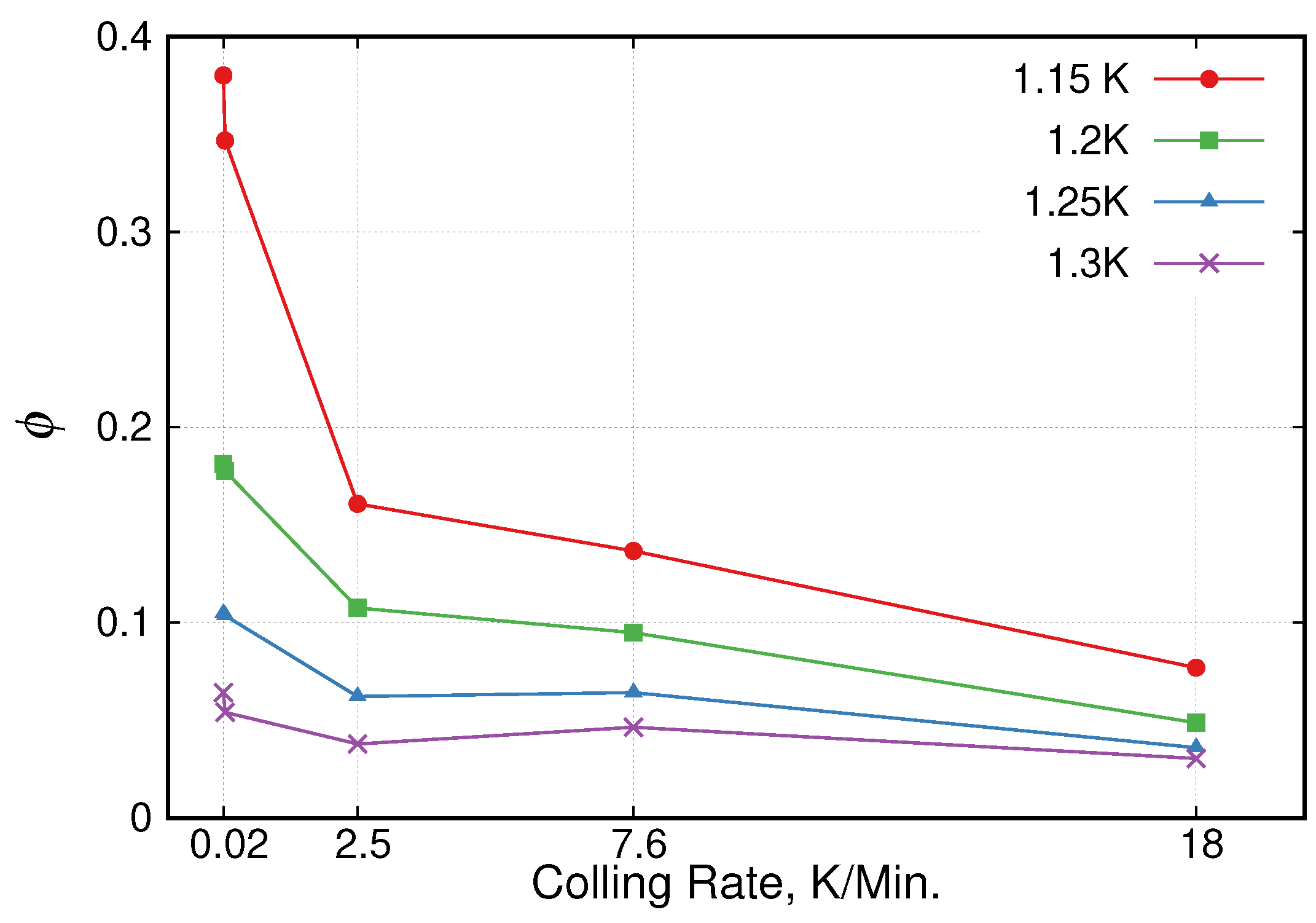
To observe the influence of cooling rate on SC volume ratio , we use resistivity data from the inset of Figure 1d of Ref. [7]. These experimental values are taken as the effective resistivity along z-axis for different cooling rates. For background-phase resistivity along the z-axis we use the 2nd order polynomial fit of metallic resistivity at . Substituting these and in Equation (10) we obtain for various cooling rates. Unfortunately, in Ref. [7] there is no resistivity data along other two axes which would allow us to find the ellipsoid aspect ratio. Therefore, in Figure 4 we take the depolarization factor , i.e., the spherical inclusions in the mapped space instead of ellipsoidal. This choice corresponds to ellipsoid semiaxes in real space, as one expects for SC fluctuations. (The metallic conductivity , where is the Fermi velocity along axis i, and the BCS coherence length .) The obtained at cooling rates 0.02 K/min, 0.052 K/min, 2.5 K/min, 7.6 K/min and 18 K/min are shown in Figure 4. The curves in Figure 4 are similar to those in Figure 4 of Ref. [7], but the values of SC volume fraction are expectedly smaller than in Ref. [7], because at only a fraction of ClO-ordered domains becomes superconducting. However, increases with decreasing temperature and, probably, reaches at .
Figure 4.
Dependence of SC volume ratio on cooling rate calculated using Equation (10) for different temperatures. For this calculation, the experimental data from the inset of Figure 1d in Ref. [7] are used.
4.3. Effect of Disorder on the Shape of Superconducting Inclusions
In Figure 4 we investigated the effect of cooling rate on . However, along with the shape of SC domains also plays an important role. Recent work [31] has shown that the probability of percolation along the shortest sample dimension, i.e., along sample thickness, is higher than along other directions. It was corroborated by the experiment on FeSe [33,52], where, by reducing the z-axis thickness of sample from 300 nm to ∼50 nm, one raised from 8 K to 12 K [52]. The (TMTSF)ClO samples are also usually flat. This effect of anisotropic superconductivity onset also depends on the shape of SC inclusions [31]. The knowledge of the shape of SC domains in (TMTSF)ClO is also helpful to better understand the mechanism of their formation. In Section 4.1 we found for sample # 4 in Ref. [6] at cooling rate 100 K/min. Below we find and for the samples cooled at rate 600 K/min with various times of subsequent annealing. This gives the effect of disorder on the shape of SC inclusions.
To study the evolution of aspect ratios :: with disorder we use the experimental data from Figures 3 and 4 of Ref. [6]. Unfortunately, the curves with equal numbers in these two figures correspond to different samples. Thus, we do not have the data on resistivity along all three axes for the same sample and parameters, required to determine the full shape of ellipsoidal inclusions. However, we use the fact that the depolarization factors in Equation (4) depend most strongly on the semiaxis along the same direction, which allows us to vary only one parameter for each fit.
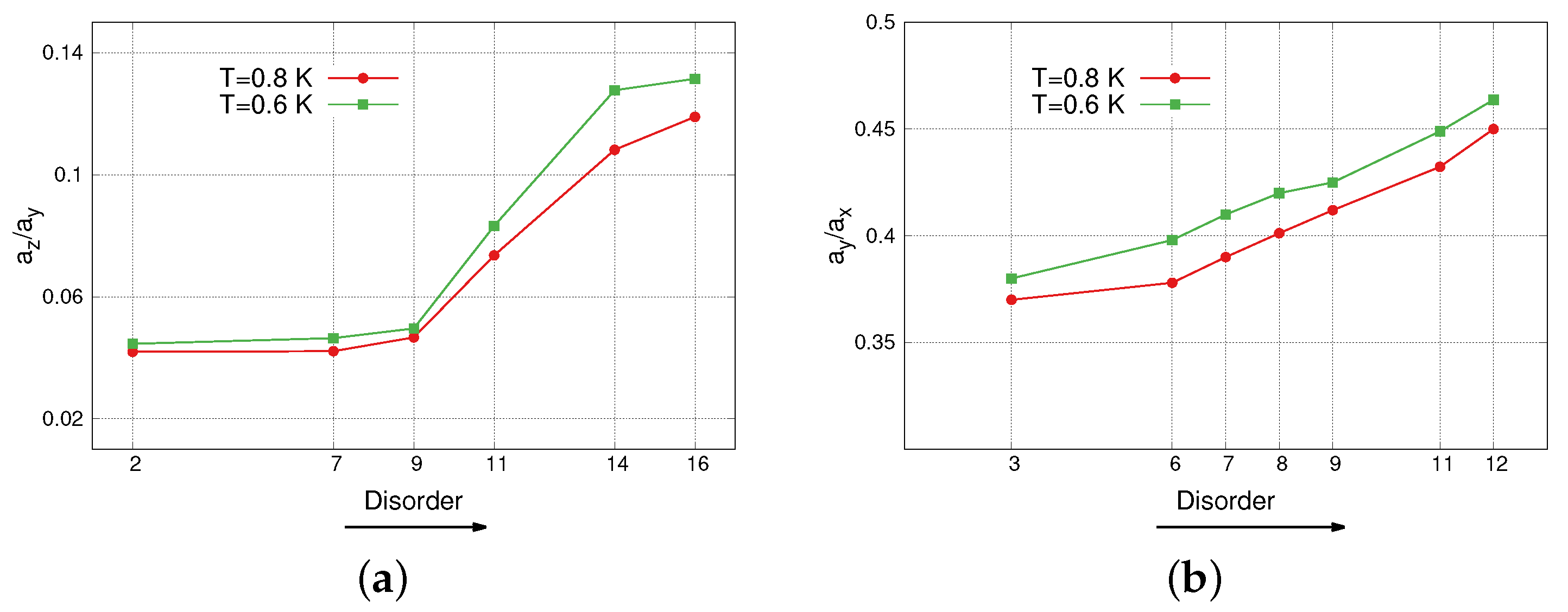
First we find the evolution of with disorder. From the resistivity data along the z-axis, given in Figure 4a of Ref. [6], using Equation (10) we find for different degrees of disorder. Using these in Equation (9) we predicted resistivity along y-axis. From best fit values of predicted and experimental resistivity along y-axis, given in Figure 4b of Ref. [6], we find the ratio for various degrees of disorder. The results are shown in Figure 5a and reveal that at low disorder, up to sample #9, the ratio almost remains same. However, at higher disorder the ratio increases.
Figure 5.
The dependence of aspect ratios (a) and (b) of superconducting domains in (TMTSF)ClO on disorder at two temperatures K and K, calculated using Equations (4), (9) and (10) and resistivity data from Figure 3 and 4 of Ref. [6], taken at cooling rate 600 K/min and various annealing times. At longer annealing time, i.e., at weaker disorder, the shape of SC domains is more anisotropic.
Similarly, to find the evolution of with disorder we use the data from Figure 3 of Ref. [6]. As before, from the resistivity data along y-axis using Equation (10) we find for different degrees of disorder. Using this we predict resistivity along x-axis. We change the semiaxes of ellipsoids along y- and x-direction, so that the theoretical and experimental values of resistivity agree. Thus, the obtained ratio of is shown in Figure 5b.
5. Discussion
In this paper, we propose a method based on MGA to investigate the microscopic parameters of heterogeneous superconductors from resistivity data. We apply this method to the organic superconductor (TMTSF)ClO, where SC coexists with SDW in the form of isolated domains. Using our method we study the SC volume fraction and the shape of SC islands as a function of external parameters, such as temperature and ClO anion disorder, which can be experimentally controlled by the cooling rate through the anion-ordering transition at K [7,65] or by the annealing of (TMTSF)ClO samples [6].
For the best use of proposed method, one needs the following experimental data: (i) Temperature dependence of resistivity along each of non-equivalent main crystal axes (If the crystal has orthorhombic or lower symmetry, one needs the data along all three axes. If two or three crystal main axes are equivalent by symmetry, one only needs the data along two or one axes correspondingly.); (ii) in a magnetic field destroying SC, to get the resistivity of the background homogeneous phase. In the absence of or in the case of non-SC inclusions, one needs to make an extrapolation of from to lower T to get , which is less accurate. In the case of SDW/CDW inclusions one can also apply an external pressure destroying SDW/CDW to get . If also (iii) magnetic susceptibility data are present, especially for all non-equivalent magnetic-field orientations, they help to independently check the obtained microscopic parameters and allow the estimate of the average size of SC inclusions as compared to the SC penetration depth [33,34]. Ideally, all these data are available for several values of external parameters that one is interested in, for example, at each studied cooling rate of (TMTSF)ClO. Unfortunately, despite an active experimental investigation of (TMTSF)ClO by resistivity measurements, e.g., performed recently in Refs. [6,7], this full set of data is absent. Nevertheless, we have analyzed the available data from Refs. [6,7] to make some physical predictions concerning the mixed SC/SDW phase in (TMTSF)ClO.
In Figure 2 and Figure 4 we show the obtained SC volume fraction for various cooling rates and temperatures . Figure 3 illustrates how well the MGA model typically fits the experimental data. Figure 5 and Figure 6 show the evolution of the shape of SC grains with the change of disorder by the annealing of rapidly cooled samples.
Figure 6.
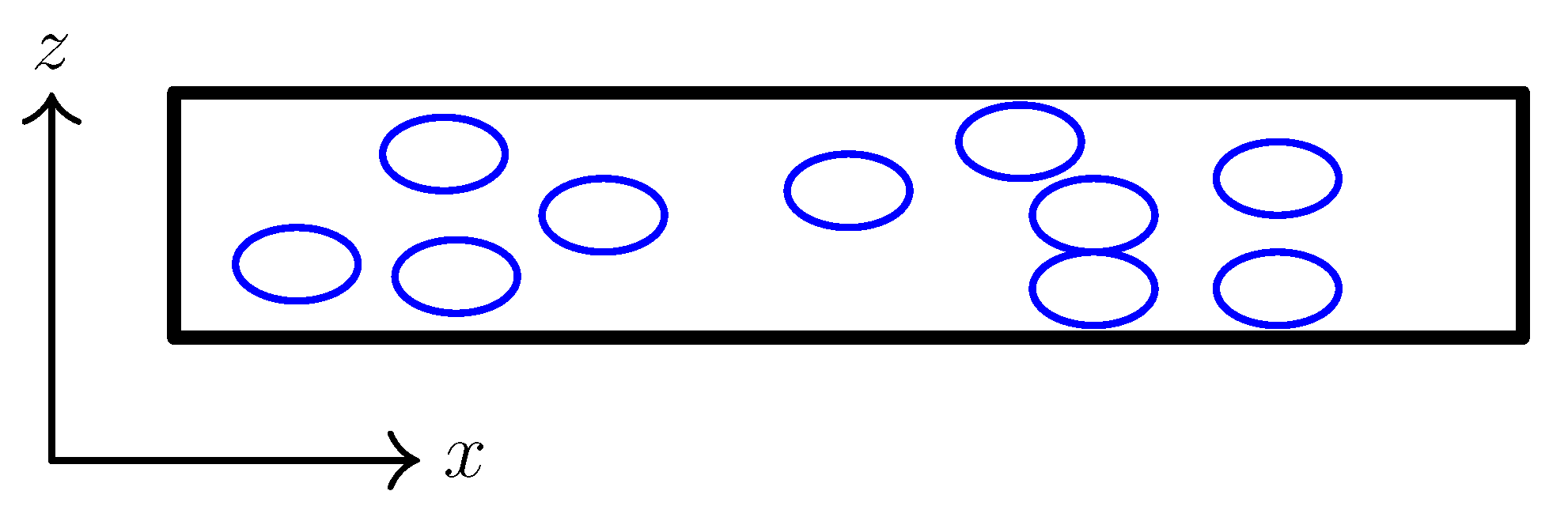
Schematic illustration of superconducting ellipsoid inclusions embedded inside a long thin conductor with dimensions . It shows that the percolation probability along z is higher than along x-axis if .
From Figure 5a we observe that for partially ordered samples #2, #7, #9 the aspect ratio of SC domains at temperature 0.6–0.8 K depends weakly on disorder. The corresponding SC volume ratio also weakly depends on disorder. At shorter annealing time, i.e., at larger disorder, the SC volume ratio decreases to , while the aspect ratio increases to . Another aspect ratio depends much weaker on disorder, as shown in Figure 5b. Please note that the obtained ratios :: at cooling rate 600 K/min are close to those of SC coherence length. In Figure 2 we found that for partially ordered sample #4 at cooling rate 100 K/min the aspect ratio of SC domains at temperature K, which differs considerably from what we get at 600 K/min even for long annealing time. This means that the decrease of cooling rate, as in Refs. [7,65] is not completely equivalent to the increase of annealing time at used in Ref. [6]: they have similar effect on SC volume fraction but different effect on the shape of SC domains. Therefore, it would be very interesting to study their effect on the SC domain size, which can be extracted from the simultaneous magnetic susceptibility measurements as done for other compounds [33,34].
In organic superconductors (TMTSF)ClO [6] and (TMTSF)PF [14,15] superconductivity onsets anisotropically, i.e., first along the highest conducting z-axis and only in the end along the lowest-conducting x-axis. This behavior was first explained by assuming filamentary SC inclusions elongated along z-axis [14], but this hypothesis received neither theoretical nor experimental proof till now. Our analysis also shows that the SC domains are not elongated along z-axis but, on contrary, are oblate. Nevertheless, we predict much stronger decrease of resistivity along the least-conducting direction (compare Figure 3 and the inset in Figure 2), similar to experimental observations in (TMTSF)ClO [6] and in many other heterogeneous anisotropic superconductors [32,33,34]. In our recent work [31] we proposed a simple model to explain the anisotropic zero-resistance onset also. We have shown [31] that the percolation probability along SC islands in needle or flat shaped samples is the highest along the shortest direction. A schematic illustration of this idea is given in Figure 6. The same idea can be applied to (TMTSF)ClO to explain the anisotropic onset of superconductivity. Usually, the (TMTSF)ClO samples are much shorter along the interlayer z-axis than along other two, e.g., the dimensions of samples in Ref. [6] are mm. Hence, the probability of percolation for the ellipsoidal inclusion, even with the obtained anisotropic aspect ratios and , will be the highest along the z-axis. Our preliminary calculations of percolation threshold for such flat elongated samples confirm this statement and show that the zero resistance, i.e., the percolation threshold, can be achieved even when the SC volume ratio . Hence, without invoking a filamentary SC one can easily explain the anisotropic onset of superconductivity in organic metals.
In our semi-classical theory based on MGA we neglect the dynamic fluctuations. Probably, the position and size of domains may fluctuate. However, in the studied organic metal the competition between SDW and superconductivity, leading to the domain formation, is governed by the disorder of ClO anion orientation, which is frozen well below the anion-ordering transition temperature K. Hence, below 4–5 K we may consider the metal/SC and SDW domains as time-independent.
For all our calculation in Section 4 we have used Equations (9) and (10) because the inclusions are superconducting. However, the similar approach and Equation (8) can be used when the conductivity of inclusions is finite, e.g., when SDW inclusions are embedded inside a metallic background or vice versa. This is a usual occurrence in organic superconductors [4]. Thus, instead of using Equation (11) or similar phenomenological formulas to analyze the resistivity data in mixed metal/SDW or metal/CDW phases in organic metals, we recommend using MGA Formulas (8) and (4), which take into account the strong anisotropy of layered organic metals and the actual shape of domains. Apart from that, in several high-Tc superconductors as BiSrCaCuO [67], LaSrCuO [68], Ba(FeCo)As [69,70,71], and in many other materials, e.g., HfTe [72], there is also a spatially separated coexistence of metallic and SC or SDW/CDW phases. Hence in all these heterogeneous materials, provided the conductivity of both metallic and SDW/CDW phases is known and the domain size exceeds the coherence length, one can estimate the second-phase volume ratio and the domain shape from resistivity data using the above method.
6. Conclusions
Using the Maxwell-Garnett approximation we estimate the volume fraction and the shape of superconducting domains from resistivity measurements. We apply this method to investigate the heterogeneous electronic structure in organic superconductor (TMTSF)ClO, where superconductivity coexists with the spin-density wave in the form of isolated domains. This material is especially important to study such coexistence because it appears even at ambient pressure and can be easily controlled by changing the cooling rate or annealing time of the samples. From available resistivity data we study the evolution of the volume fraction and of the shape of superconducting domains in (TMTSF)ClO with disorder and temperature. Our method applies not only to superconductors, but also when the density-wave or other-type domains are embedded inside a metallic background, or vice versa.
Author Contributions
P.D.G. conceptualized and developed the Methodology. Formal analysis, validation, manuscript writing and review was done by K.K.K., P.D.G. and V.D.K. All authors have read and agreed to the published version of the manuscript.
Funding
This article is partly supported by the Ministry of Science and Higher Education of the Russian Federation in the framework of Increase Competitiveness Program of MISiS, by RFBR grant No. 21-52-12027, and by the “Basis” Foundation for development of theoretical physics and mathematics. V. D. K. acknowledges the MISiS project No. K2-2020-001, and K. K. K. the MISiS support project for young research engineers and RFBR grants Nos. 19-32-90241 & 19-31-27001. P. D. G. acknowledges the State Assignment No. 0033-2019-0001 and RFBR grants Nos. 19-02-01000 & 21-52-12043.
Institutional Review Board Statement
Not applicable.
Informed Consent Statement
Not applicable.
Data Availability Statement
Data available on request.
Conflicts of Interest
The authors declare no conflict of interest.
Appendix A. Anisotropic Dilation of the Problem of Static Current Distribution
Anisotropic medium is converted to isotropic one by mapping the real space to a mapped space, where the solution is simpler. The mapping should satisfy the following conditions: (i) the conductivity of background phase in the mapped space should be isotropic, and (ii) the electrostatic continuity equation should be satisfied in the mapped space with the same solution.
In our notations, are the constant conductivity components of background phase in the original heterogeneous medium. Let J and V be the current density and the applied potential, respectively. The electrostatic continuity equation in the background phase is then written as
Heterogeneity is hidden in the boundary conditions on the surface of each grain and of the sample.
Let , and be the axes in mapped space, where conductivity should be isotropic: . If and are the current density and electrostatic potential respectively in the mapped space, the continuity equation in the mapped space is written as
The condition (ii) for our mapping means that the solution
of Equations (A1) and (A2) is the same. This solution completely determines the effective conductivity of heterogeneous medium, as it also gives the current density via . Equations (A1)–(A3) are consistent if the mapping is the anisotropic scaling, e.g.,
with constant mapping coefficients and determined by conductivity anisotropy in real space:
Instead of (A4) one could choose a product of the mapping (A4) and of any isotropic scaling by a factor with the simultaneous change of . We have chosen , so that .
The current components in the real space and in the mapped space are related as
The shapes of inclusions are not preserved during this mapping procedure. For example, a sphere with radius described by the equation in non-homogeneous medium will transform to an ellipsoid described by the equation in mapped space, where the semiaxes are given by
If z is the lowest-conducting axis, and the highest conducting axis is x, then a sphere in real space transforms to an ellipsoid elongated along z-axis. Due to the temperature dependence of conductivity anisotropy, the coefficients and the shape of inclusions change with temperature either. If in real space the inclusion is ellipsoid with semiaxes , and , then it transforms to ellipsoid in mapped space with semiaxes
In MGA we take ellipsoidal inclusions with fixed aspect ratios and , but varying size.
References
- Shen, K.M.; Davis, J.S. Cuprate High-Tc Superconductors. Mater. Today 2008, 11, 14–21. [Google Scholar] [CrossRef]
- Norman, M.R. Cuprates—An Overview. J. Supercond. Nov. Magn. 2012, 25, 2131–2134. [Google Scholar] [CrossRef]
- Hosono, H.; Kuroki, K. Iron-Based Superconductors: Current Status of Materials and Pairing Mechanism. Phys. C Supercond. Appl. 2015, 514, 399–422. [Google Scholar] [CrossRef]
- Jerome, D. Organic Conductors: From Charge Density Wave TTF-TCNQ to Superconducting (TMTSF)2PF6. Chem. Rev. 2004, 104, 5565–5591. [Google Scholar] [CrossRef] [PubMed]
- Stewart, G.R. Unconventional Superconductivity. Adv. Phys. 2017, 66, 75–196. [Google Scholar] [CrossRef]
- Gerasimenko, Y.A.; Sanduleanu, S.V.; Prudkoglyad, V.A.; Kornilov, A.V.; Yamada, J.; Qualls, J.S.; Pudalov, V.M. Coexistence of Superconductivity and Spin-Density Wave in (TMTSF)2 ClO4: Spatial Structure of the Two-Phase State. Phys. Rev. B 2014, 89, 054518. [Google Scholar] [CrossRef]
- Yonezawa, S.; Marrache-Kikuchi, C.A.; Bechgaard, K.; Jérome, D. Crossover from Impurity-Controlled to Granular Superconductivity in (TMTSF)2ClO4. Phys. Rev. B 2018, 97, 014521. [Google Scholar] [CrossRef]
- Jerome, D. Organic Superconductors: A Survey of Low Dimensional Phenomena. Mol. Cryst. Liq. Cryst. 1982, 79, 511–538. [Google Scholar] [CrossRef]
- Ishiguro, T.; Yamaji, K.; Saito, G. Organic Superconductors; Springer Series in Solid-State Sciences; Springer: Berlin/Heidelberg, Germany, 1998; Volume 88. [Google Scholar] [CrossRef]
- Lebed, A.; Hull, R.; Osgood, R.M.; Parisi, J.; Warlimon, H. (Eds.) The Physics of Organic Superconductors and Conductors; Springer Series in Materials Science; Springer: Berlin/Heidelberg, Germany, 2008; Volume 110. [Google Scholar] [CrossRef]
- Kartsovnik, M.V. High Magnetic Fields: A Tool for Studying Electronic Properties of Layered Organic Metals. Chem. Rev. 2004, 104, 5737–5782. [Google Scholar] [CrossRef]
- Chaikin, P.M. Magnetic-Field-Induced Transition in Quasi-Two-Dimensional Systems. Phys. Rev. B 1985, 31, 4770–4772. [Google Scholar] [CrossRef]
- Gor’kov, L.; Lebed’, A. On the Stability of the Quasi-Onedimensional Metallic Phase in Magnetic Fields against the Spin Density Wave Formation. J. Phys. Lett. 1984, 45, 433–440. [Google Scholar] [CrossRef]
- Kang, N.; Salameh, B.; Auban-Senzier, P.; Jérome, D.; Pasquier, C.R.; Brazovskii, S. Domain Walls at the Spin-Density-Wave Endpoint of the Organic Superconductor (TMTSF)2PF6 under Pressure. Phys. Rev. B 2010, 81, 100509. [Google Scholar] [CrossRef]
- Narayanan, A.; Kiswandhi, A.; Graf, D.; Brooks, J.; Chaikin, P. Coexistence of Spin Density Waves and Superconductivity in (TMTSF)2PF6. Phys. Rev. Lett. 2014, 112, 146402. [Google Scholar] [CrossRef] [PubMed]
- Vuletić, T.; Auban-Senzier, P.; Pasquier, C.; Tomić, S.; Jérome, D.; Héritier, M.; Bechgaard, K. Coexistence of Superconductivity and Spin Density Wave Orderings in the Organic Superconductor (TMTSF)2PF6. Eur. Phys. J. B 2002, 25, 319–331. [Google Scholar] [CrossRef]
- Kornilov, A.V.; Pudalov, V.M.; Kitaoka, Y.; Ishida, K.; Zheng, G.Q.; Mito, T.; Qualls, J.S. Macroscopically Inhomogeneous State at the Boundary between the Superconducting, Antiferromagnetic, and Metallic Phases in Quasi-One-Dimensional (TMTSF)2PF6. Phys. Rev. B 2004, 69, 224404. [Google Scholar] [CrossRef]
- Pasquier, C.; Kang, N.; Salameh, B.; Auban-Senzier, P.; Jérome, D.; Brazovskii, S. Evolution of the Spin-Density Wave-Superconductivity Texture in the Organic Superconductor (TMTSF)2PF6 under Pressure. Phys. B Condens. Matter 2012, 407, 1806–1809. [Google Scholar] [CrossRef]
- Podolsky, D.; Altman, E.; Rostunov, T.; Demler, E. SO(4) Theory of Antiferromagnetism and Superconductivity in Bechgaard Salts. Phys. Rev. Lett. 2004, 93, 246402. [Google Scholar] [CrossRef]
- Lee, I.J.; Chaikin, P.M.; Naughton, M.J. Critical Field Enhancement near a Superconductor-Insulator Transition. Phys. Rev. Lett. 2002, 88, 207002. [Google Scholar] [CrossRef]
- Gor’kov, L.P.; Grigoriev, P.D. Soliton Phase near Antiferromagnetic Quantum Critical Point in Q1D Conductors. EPL Europhys. Lett. 2005, 71, 425–430. [Google Scholar] [CrossRef]
- Gor’kov, L.P.; Grigoriev, P.D. Nature of the Superconducting State in the New Phase in (TMTSF)2 PF6 under Pressure. Phys. Rev. B 2007, 75, 020507. [Google Scholar] [CrossRef]
- Grigoriev, P.D. Properties of Superconductivity on a Density Wave Background with Small Ungapped Fermi Surface Parts. Phys. Rev. B 2008, 77, 224508. [Google Scholar] [CrossRef]
- Grigoriev, P. Superconductivity on the Density-Wave Background with Soliton-Wall Structure. Phys. B Condens. Matter 2009, 404, 513–516. [Google Scholar] [CrossRef]
- Dordevic, S.V.; Basov, D.N.; Homes, C.C. Do Organic and Other Exotic Superconductors Fail Universal Scaling Relations? Sci. Rep. 2013, 3, 1713. [Google Scholar] [CrossRef]
- Greer, A.; Harshman, D.; Kossler, W.; Goonewardene, A.; Williams, D.; Koster, E.; Kang, W.; Kleiman, R.; Haddon, R. Muon Spin Rotation Study of the (TMTSF)2ClO4 System. Phys. C Supercond. 2003, 400, 59–64. [Google Scholar] [CrossRef]
- Pratt, F.L.; Lancaster, T.; Blundell, S.J.; Baines, C. Low-Field Superconducting Phase of (TMTSF)2ClO4. Phys. Rev. Lett. 2013, 110, 107005. [Google Scholar] [CrossRef]
- Schwenk, H.; Andres, K.; Wudl, F.; Aharon-Shalom, E. Direct Observation of a Large London Penetration Depth in an Organic Superconductor. Solid State Commun. 1983, 45, 767–769. [Google Scholar] [CrossRef]
- Su, W.P.; Kivelson, S.; Schrieffer, J.R. Theory of Polymers Having Broken Symmetry Ground States. In Physics in One Dimension; Cardona, M., Fulde, P., Queisser, H.J., Bernasconi, J., Schneider, T., Eds.; Springer: Berlin/Heidelberg, Germany, 1981; Volume 23, pp. 201–211. [Google Scholar] [CrossRef]
- Gerasimenko, Y.A.; Prudkoglyad, V.A.; Kornilov, A.V.; Sanduleanu, S.V.; Qualls, J.S.; Pudalov, V.M. Role of anion ordering in the coexistence of spin-density-wave and superconductivity in (TMTSF)2ClO4. JETP Lett. 2013, 97, 419–424. [Google Scholar] [CrossRef]
- Kochev, V.D.; Kesharpu, K.K.; Grigoriev, P.D. Anisotropic Zero-Resistance Onset in Organic Superconductors. arXiv 2020, arXiv:cond-mat/2007.14388. [Google Scholar]
- Sinchenko, A.A.; Grigoriev, P.D.; Orlov, A.P.; Frolov, A.V.; Shakin, A.; Chareev, D.A.; Volkova, O.S.; Vasiliev, A.N. Gossamer High-Temperature Bulk Superconductivity in FeSe. Phys. Rev. B 2017, 95, 165120. [Google Scholar] [CrossRef]
- Grigoriev, P.D.; Sinchenko, A.A.; Kesharpu, K.K.; Shakin, A.; Mogilyuk, T.I.; Orlov, A.P.; Frolov, A.V.; Lyubshin, D.S.; Chareev, D.A.; Volkova, O.S.; et al. Anisotropic Effect of Appearing Superconductivity on the Electron Transport in FeSe. JETP Lett. 2017, 105, 786–791. [Google Scholar] [CrossRef]
- Seidov, S.S.; Kesharpu, K.K.; Karpov, P.I.; Grigoriev, P.D. Conductivity of Anisotropic Inhomogeneous Superconductors above the Critical Temperature. Phys. Rev. B 2018, 98, 014515. [Google Scholar] [CrossRef]
- Torquato, S. Random Heterogeneous Materials: Microstructure and Macroscopic Properties; Interdisciplinary Applied Mathematics; Springer: New York, NY, USA, 2002. [Google Scholar]
- Bechgaard, K.; Carneiro, K.; Olsen, M.; Rasmussen, F.B.; Jacobsen, C.S. Zero-Pressure Organic Superconductor: Di-(Tetramethyltetraselenafulvalenium)-Perchlorate (TMTSF)2ClO4. Phys. Rev. Lett. 1981, 46, 852–855. [Google Scholar] [CrossRef]
- Bechgaard, K.; Carneiro, K.; Eg, O.; Olsen, M.; Rasmussen, F.B.; Jacobsen, C.; Rindorf, G. Superconductivity in (TMTSF)2ClO4 at Zero Pressure. Mol. Cryst. Liq. Cryst. 1982, 79, 627–632. [Google Scholar] [CrossRef]
- Bychkov, Y.A.; Gor’kov, L.P.; Dzyaloshinskiǐ, I. Possibility of Superconductivity Type Phenomena in a One-Dimensional System. JETP 1966, 23, 489. [Google Scholar]
- Sólyom, J. The Fermi Gas Model of One-Dimensional Conductors. Adv. Phys. 1979, 28, 201–303. [Google Scholar] [CrossRef]
- Jérome, D.; Creuzet, F.; Bourbonnais, C. A Survey of the Physics of Organic Conductors and Superconductors. Phys. Scr. 1989, T27, 130–135. [Google Scholar] [CrossRef]
- Parkin, S.S.P.; Ribault, M.; Jerome, D.; Bechgaard, K. Superconductivity in the Family of Organic Salts Based on the Tetramethyltetraselenafulvalene (TMTSF) Molecule: (TMTSF)2X (X=ClO4, PF6, AsF6, SbF6, TaF6). J. Phys. C Solid State Phys. 1981, 14, 5305–5326. [Google Scholar] [CrossRef]
- Garoche, P.; Brusetti, R.; Jerome, D.; Bechgaard, K. Specific-Heat Measurements of Organic Superconductivity in (TMTSF)2ClO4. J. Phys. Lett. 1982, 43, L147–L152. [Google Scholar] [CrossRef]
- Schwenk, H.; Neumaier, K.; Andres, K.; Wudl, F.; Aharon-Shalom, E. Meissner Anisotropy in Deuterated (TMTSF)2ClO4. Mol. Cryst. Liq. Cryst. 1982, 79, 633–638. [Google Scholar] [CrossRef]
- Tomić, S.; Jérome, D.; Monod, P.; Bechgaard, K. EPR and Electrical Conductivity of the Organic Superconductor Di-Tetramethyltetraselenafulvalenium-Perchlorate, (TMTSF)2ClO4 and a Metastable Magnetic State Obtained by Fast Cooling. J. Phys. Lett. 1982, 43, 839–844. [Google Scholar] [CrossRef]
- Takahashi, T.; Jérome, D.; Bechgaard, K. Observation of a Magnetic State in the Organic Superconductor (TMTSF)2ClO4: Influence of the Cooling Rate. J. Phys. Lett. 1982, 43, 565–573. [Google Scholar] [CrossRef]
- Ishiguro, T.; Murata, K.; Kajimura, K.; Kinoshita, N.; Tokumoto, H.; Tokumoto, M.; Ukachi, T.; Anzai, H.; Saito, G. Superconductivity and Metal-Nonmetal Transitions in (TMTSF)2ClO4. J. Phys. Colloq. 1983, 44, C3–831–C3–838. [Google Scholar] [CrossRef]
- Pouget, J.P. Structural Aspects of the Bechgaard and Fabre Salts: An Update. Crystals 2012, 2, 466–520. [Google Scholar] [CrossRef]
- Bechgaard, K.; Carneiro, K.; Rasmussen, F.B.; Olsen, M.; Rindorf, G.; Jacobsen, C.S.; Pedersen, H.J.; Scott, J.C. Superconductivity in an Organic Solid. Synthesis, Structure, and Conductivity of Bis(Tetramethyltetraselenafulvalenium) Perchlorate, (TMTSF)2ClO4. J. Am. Chem. Soc. 1981, 103, 2440–2442. [Google Scholar] [CrossRef]
- Rindorf, G.; Soling, H.; Thorup, N. The Structures of Di(2,3,6,7-Tetramethyl-1,4,5,8-Tetraselenafulvalenium) Perrhenate, (TMTSF)2ReO4, and Perchlorate, (TMTSF)2ClO4. Acta Crystallogr. Sect. B Struct. Crystallogr. Cryst. Chem. 1982, 38, 2805–2808. [Google Scholar] [CrossRef]
- Pouget, J.P.; Shirane, G.; Bechgaard, K.; Fabre, J.M. X-Ray Evidence of a Structural Phase Transition in Di-Tetramethyltetraselenafulvalenium Perchlorate [(TMTSF)2ClO4 ], Pristine and Slightly Doped. Phys. Rev. B 1983, 27, 5203–5206. [Google Scholar] [CrossRef]
- Le Pévelen, D.; Gaultier, J.; Barrans, Y.; Chasseau, D.; Castet, F.; Ducasse, L. Temperature and Pressure Dependencies of the Crystal Structure of the Organic Superconductor (TMTSF)2ClO4. Eur. Phys. J. B 2001, 19, 363–373. [Google Scholar] [CrossRef]
- Mogilyuk, T.I.; Grigoriev, P.D.; Kesharpu, K.K.; Kolesnikov, I.A.; Sinchenko, A.A.; Frolov, A.V.; Orlov, A.P. Excess Conductivity of Anisotropic Inhomogeneous Superconductors Above the Critical Temperature. Phys. Solid State 2019, 61, 1549–1552. [Google Scholar] [CrossRef]
- Murata, K.; Tokumoto, M.; Anzai, H.; Kajimura, K.; Isiiiguro, T. Upper Critical Field of the Anisotropic Organic Superconductors, (TMTSF) 2 CIO 4. Jpn. J. Appl. Phys. 1987, 26, 1367. [Google Scholar] [CrossRef]
- Tinkham, M. Introduction to Superconductivity; Courier Corporation: Mineola, NY, USA, 2004. [Google Scholar]
- Markel, V.A. Introduction to the Maxwell Garnett Approximation: Tutorial. J. Opt. Soc. Am. A 2016, 33, 1244. [Google Scholar] [CrossRef]
- Markel, V.A. Maxwell Garnett Approximation (Advanced Topics): Tutorial. J. Opt. Soc. Am. A 2016, 33, 2237. [Google Scholar] [CrossRef] [PubMed]
- Maxwell Garnett, J.C. Colours in Metal Glasses and in Metallic Films. Philos. Trans. R. Soc. Lond. Ser. A 1904, 203, 385–420. [Google Scholar]
- Stroud, D. Generalized effective-medium approach to the conductivity of an inhomogeneous material. Phys. Rev. B 1975, 12, 3368–3373. [Google Scholar] [CrossRef]
- Apresyan, L.A.; Vlasov, D.V. On depolarization factors of anisotropic ellipsoids in an anisotropic medium. Tech. Phys. 2014, 59, 1760–1765. [Google Scholar] [CrossRef]
- Gubser, D.U.; Fuller, W.W.; Poehler, T.O.; Cowan, D.O.; Lee, M.; Potember, R.S.; Chiang, L.Y.; Bloch, A.N. Magnetic Susceptibility and Resistive Transitions of Superconducting (TMTSF)2ClO4: Critical Magnetic Fields. Phys. Rev. B 1981, 24, 478–480. [Google Scholar] [CrossRef]
- Auban-Senzier, P.; Jérome, D.; Doiron-Leyraud, N.; René de Cotret, S.; Sedeki, A.; Bourbonnais, C.; Taillefer, L.; Alemany, P.; Canadell, E.; Bechgaard, K. The Metallic Transport of (TMTSF) 2 X Organic Conductors Close to the Superconducting Phase. J. Physics: Condens. Matter 2011, 23, 345702. [Google Scholar] [CrossRef]
- Rice, M.J. Electron-Electron Scattering in Transition Metals. Phys. Rev. Lett. 1968, 20, 1439–1441. [Google Scholar] [CrossRef]
- Schwenk, H.; Andres, K.; Wudl, F. Resistivity of the Organic Superconductor Ditetramethyltetraselenafulvalenium Perchlorate, (TMTSF)2ClO4, in Its Relaxed, Quenched, and Intermediate State. Phys. Rev. B 1984, 29, 500–502. [Google Scholar] [CrossRef]
- Pesty, F.; Wang, K.; Garoche, P. Analysis of the Pair Breaking Effect of the Anion Disorder (TMTSF)2ClO4. Synth. Met. 1988, 27, 137–143. [Google Scholar] [CrossRef]
- Pouget, J.P.; Kagoshima, S.; Tamegai, T.; Nogami, Y.; Kubo, K.; Nakajima, T.; Bechgaard, K. High Resolution X-ray Scattering Study of the Anion Ordering Phase Transition of (TMTSF)2ClO4. J. Phys. Soc. Jpn. 1990, 59, 2036–2053. [Google Scholar] [CrossRef]
- Kagoshima, S.; Yasunaga, T.; Ishiguro, T.; Anzai, H.; Saito, G. Quenching effect of the anion ordering in the organic superconductor (TMTSF)2ClO4: An X-ray study. Solid State Commun. 1983, 46, 867–870. [Google Scholar] [CrossRef]
- Martin, S.; Fiory, A.T.; Fleming, R.M.; Schneemeyer, L.F.; Waszczak, J.V. Temperature Dependence of the Resistivity Tensor in Superconducting Bi2Sr2.2 Ca0.8Cu2O8 Crystals. Phys. Rev. Lett. 1988, 60, 2194–2197. [Google Scholar] [CrossRef] [PubMed]
- Nakamura, Y.; Uchida, S. Anisotropic Transport-Properties of Single-Crystal La2-xSrxCuO4—Evidence for the Dimensional Crossover. Phys. Rev. B 1993, 47, 8369–8372. [Google Scholar] [CrossRef] [PubMed]
- Ni, N.; Tillman, M.E.; Yan, J.Q.; Kracher, A.; Hannahs, S.T.; Bud’ko, S.L.; Canfield, P.C. Effects of Co Substitution on Thermodynamic and Transport Properties and Anisotropic Hc2 in Ba(Fe1-xCox)2 As2 Single Crystals. Phys. Rev. B 2008, 78, 214515. [Google Scholar] [CrossRef]
- Wang, X.F.; Wu, T.; Wu, G.; Liu, R.H.; Chen, H.; Xie, Y.L.; Chen, X.H. The Peculiar Physical Properties and Phase Diagram of BaFe2-xCoxAs2 Single Crystals. New J. Phys. 2009, 11, 045003. [Google Scholar] [CrossRef]
- Tanatar, M.A.; Ni, N.; Thaler, A.; Bud’ko, S.L.; Canfield, P.C.; Prozorov, R. Pseudogap and Its Critical Point in the Heavily Doped Ba(Fe1-xCox)2As2 from c-Axis Resistivity Measurements. Phys. Rev. B 2010, 82, 134528. [Google Scholar] [CrossRef]
- Li, J.; Peng, J.; Zhang, S.; Chen, G. Anisotropic Multichain Nature and Filamentary Superconductivity in the Charge Density Wave System HfTe3. Phys. Rev. B 2017, 96, 174510. [Google Scholar] [CrossRef]
Publisher’s Note: MDPI stays neutral with regard to jurisdictional claims in published maps and institutional affiliations. |
© 2021 by the authors. Licensee MDPI, Basel, Switzerland. This article is an open access article distributed under the terms and conditions of the Creative Commons Attribution (CC BY) license (http://creativecommons.org/licenses/by/4.0/).