“Free of Base” Sulfa-Michael Addition for Novel o-Carboranyl-DL-Cysteine Synthesis †



 and
and 
Abstract
1. Introduction
2. Materials and Methods
2.1. General
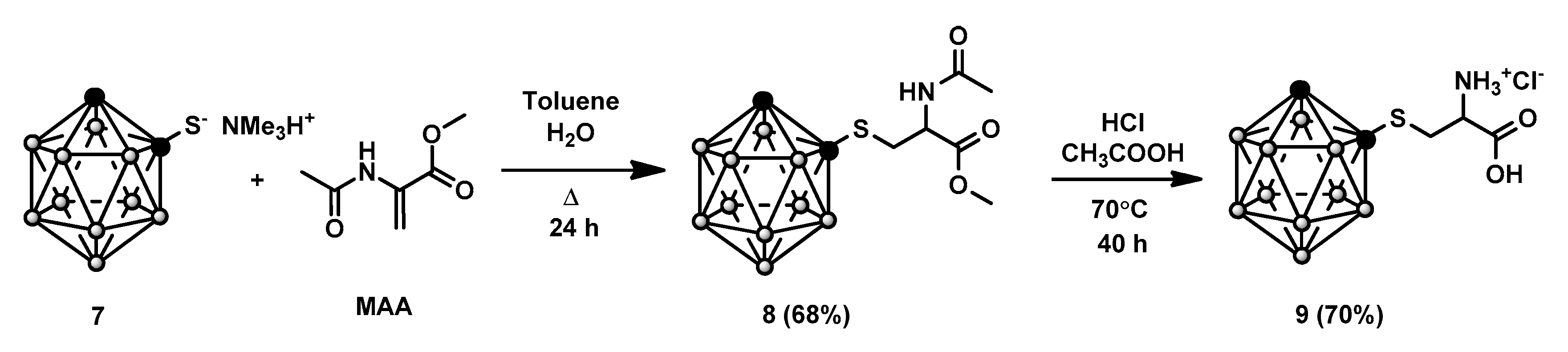
2.2. Synthesis of 1-CH3O(O)C(CH3(O)CHN)CHCH2S-1,2-C2B10H11 (8)
2.3. Synthesis of 1-HOOC(NH2)CHCH2S-1,2-C2B10H11 × HCl (9)
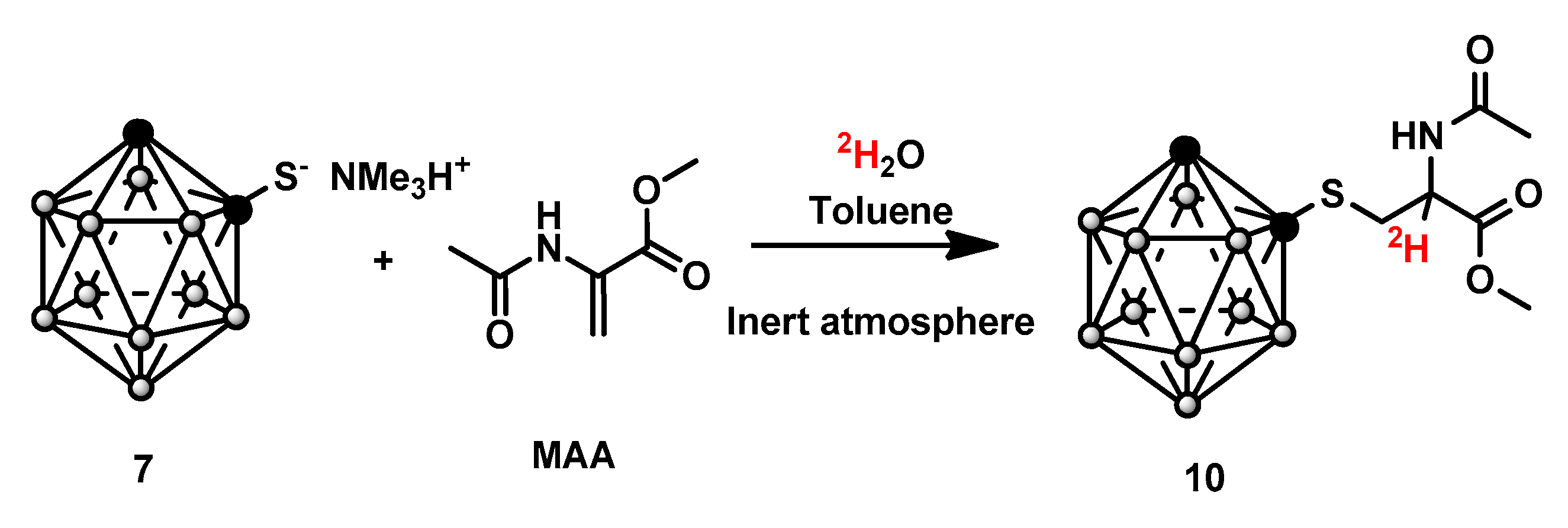
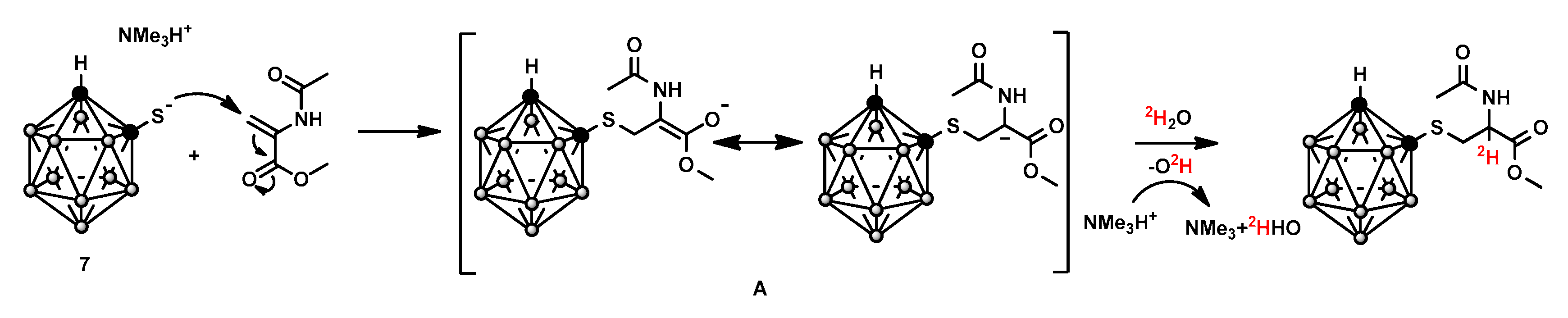
2.4. Synthesis of 1-CH3O(O)C(CH3(O)CHN)CDCH2S-1,2-C2B10H11 (10)
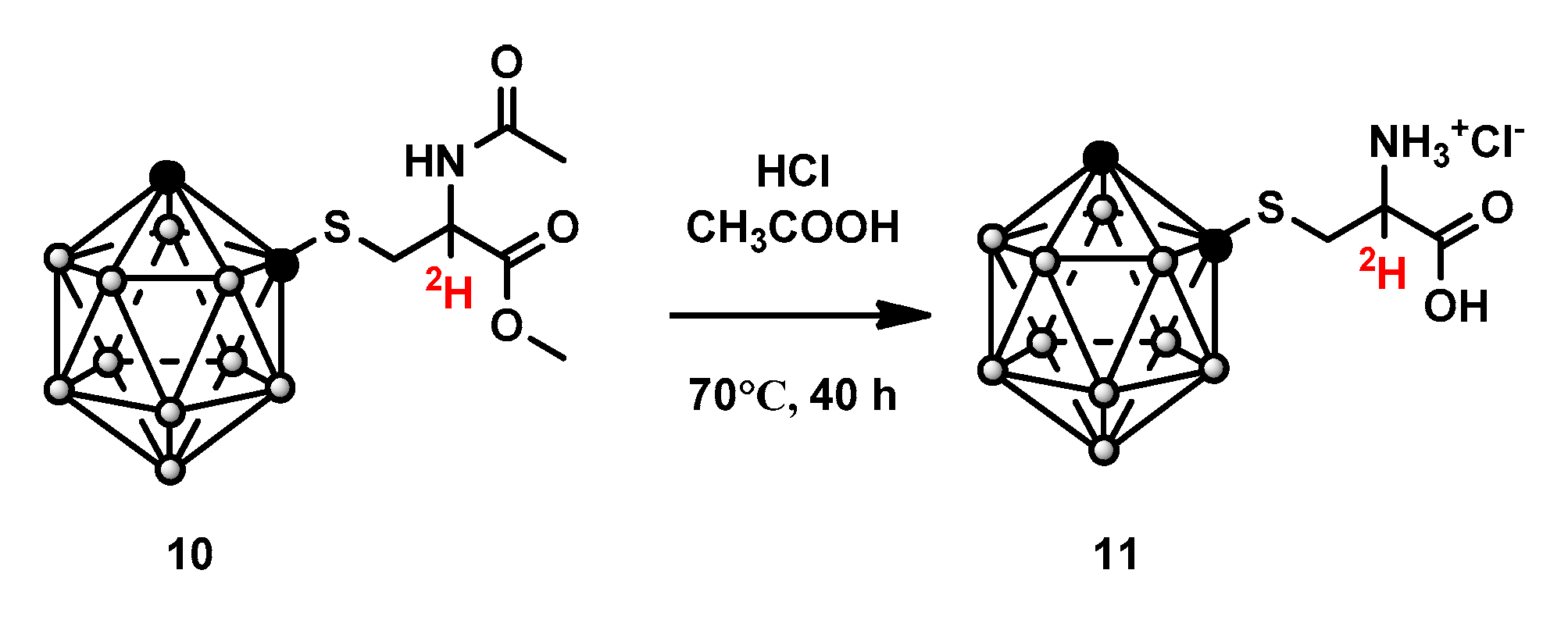
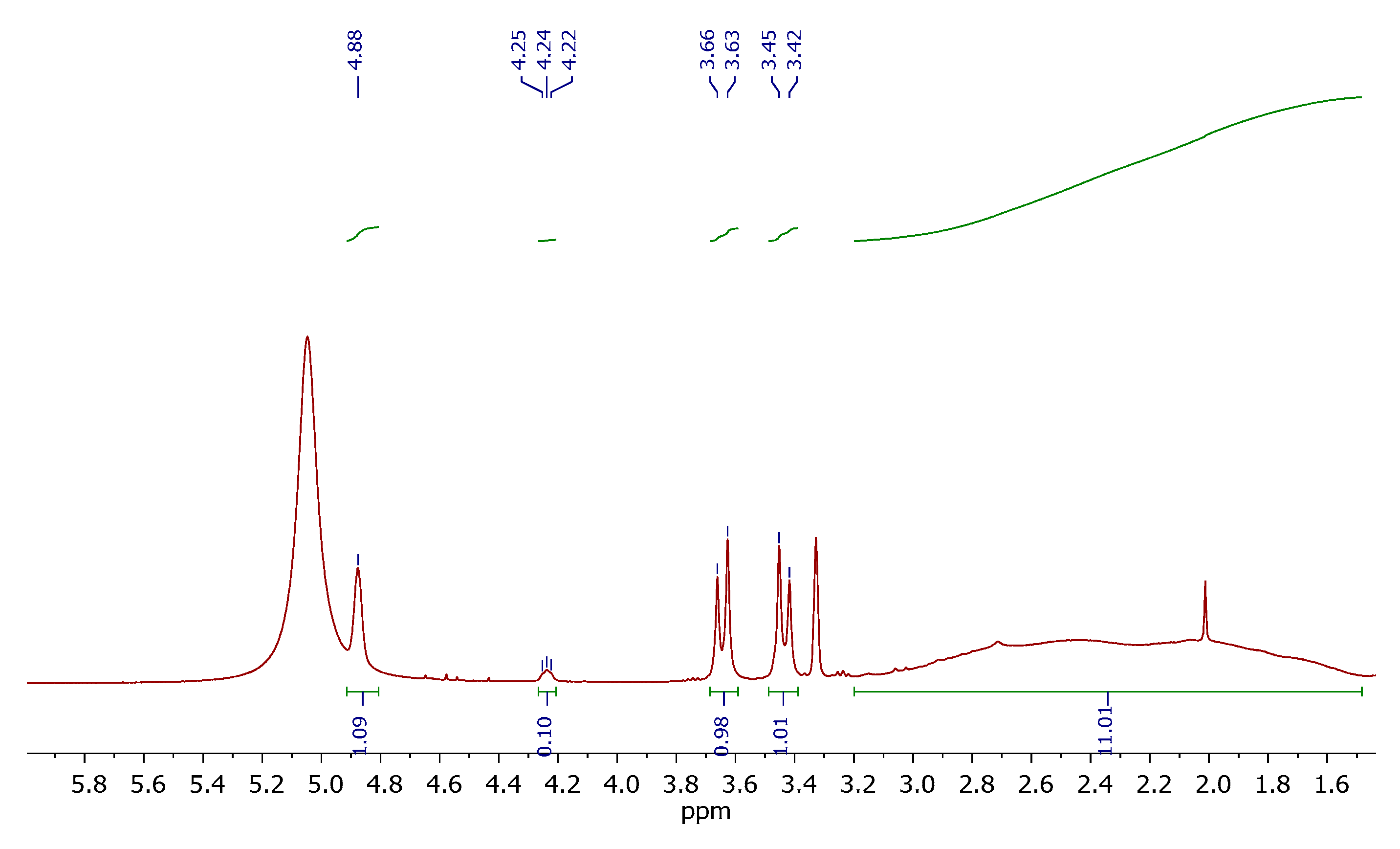
2.5. Synthesis of 1-HOOC(NH2)CDCH2S-1,2-C2B10H11 × HCl (11)
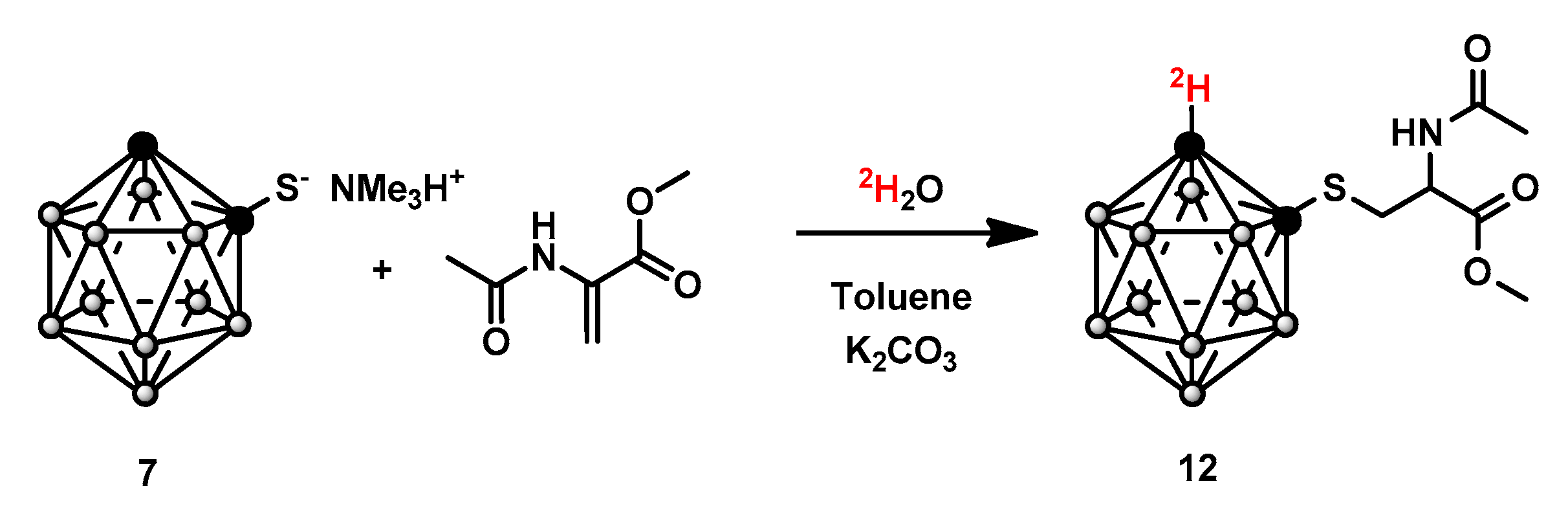
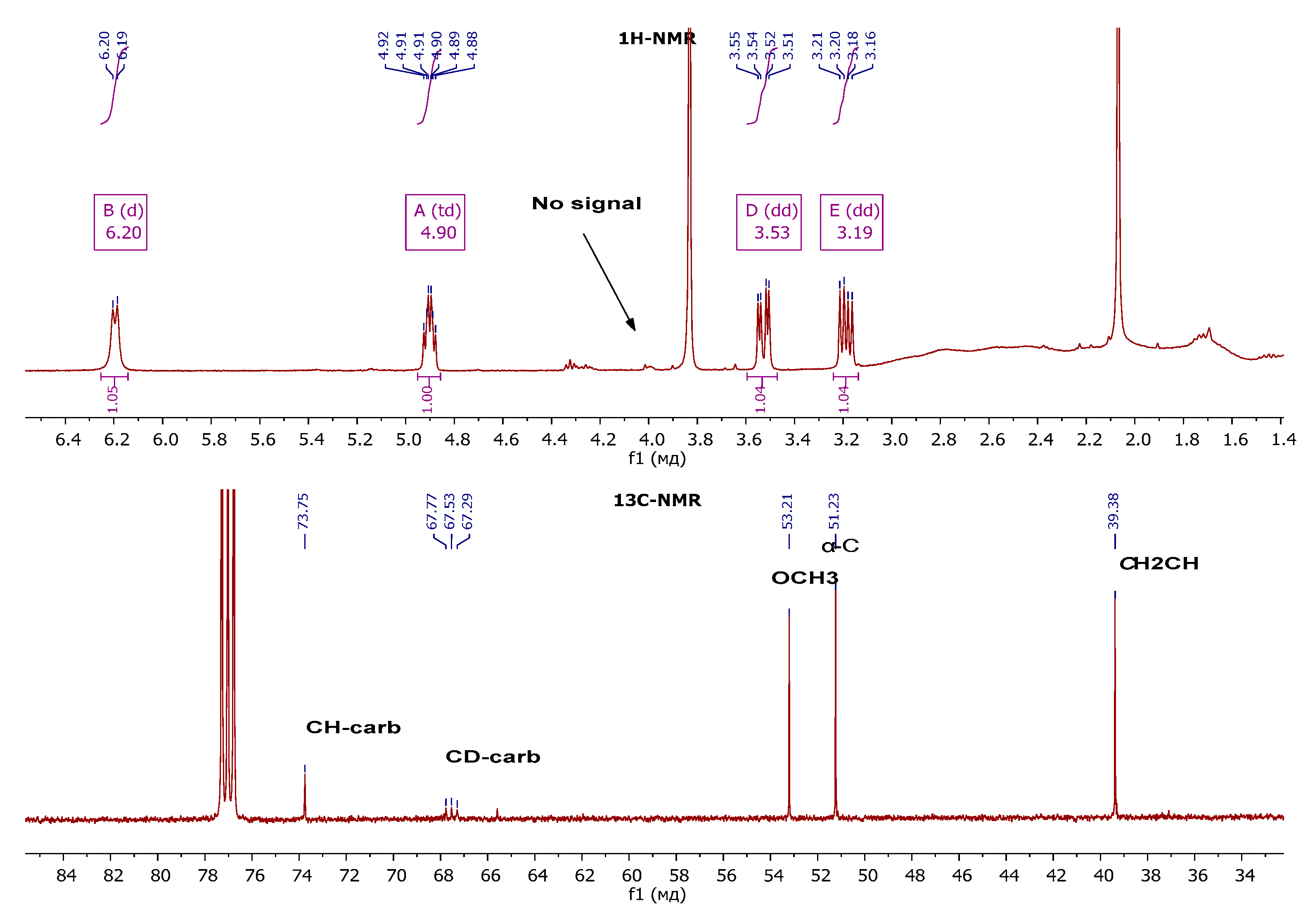
2.6. Synthesis of 1-CH3O(O)C(CH3(O)CHN)CHCH2S-2-D-1,2-C2B10H10 (12)
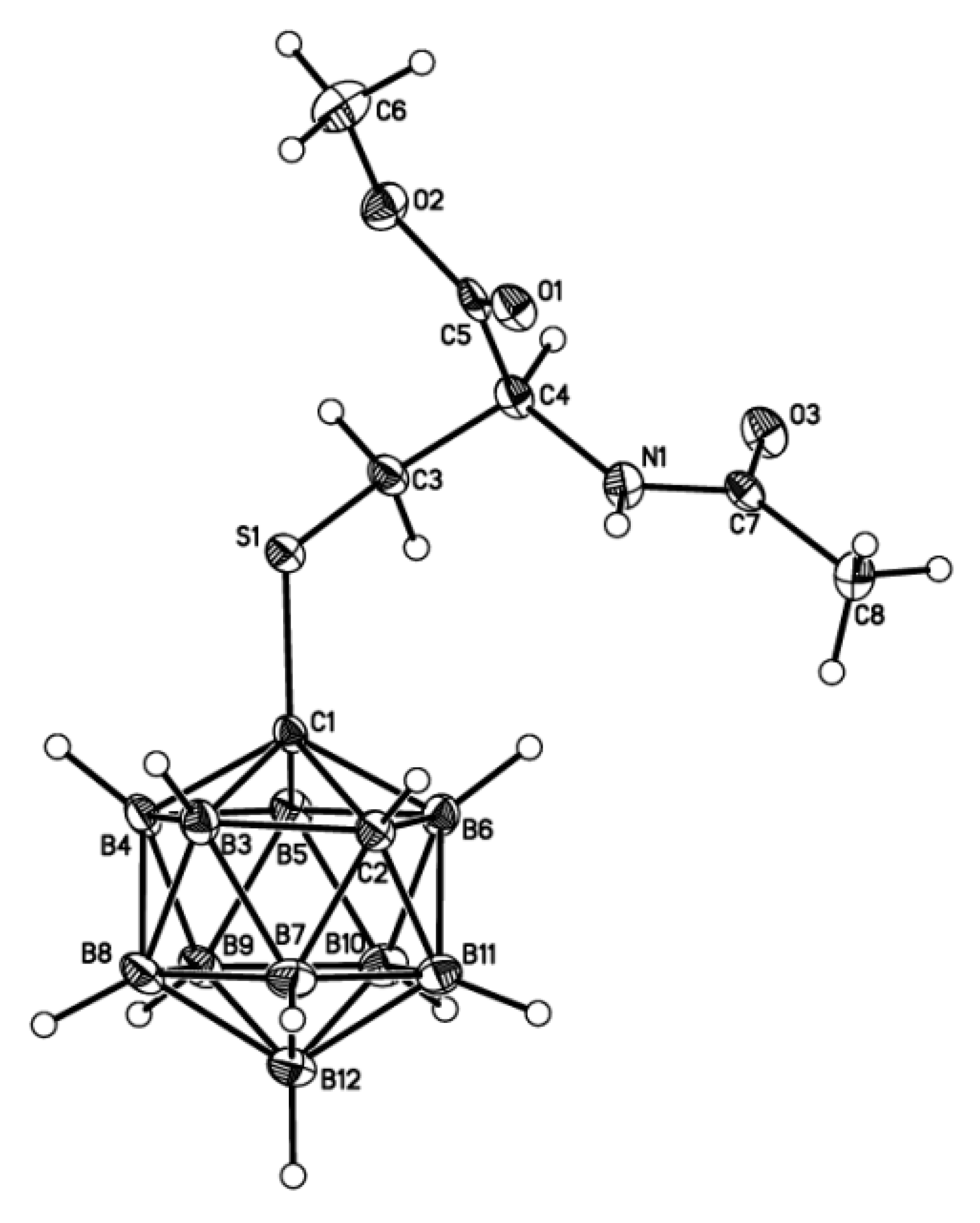
2.7. X-ray Diffraction
3. Results
3.1. o-Carboranyl-Cysteine Synthesis
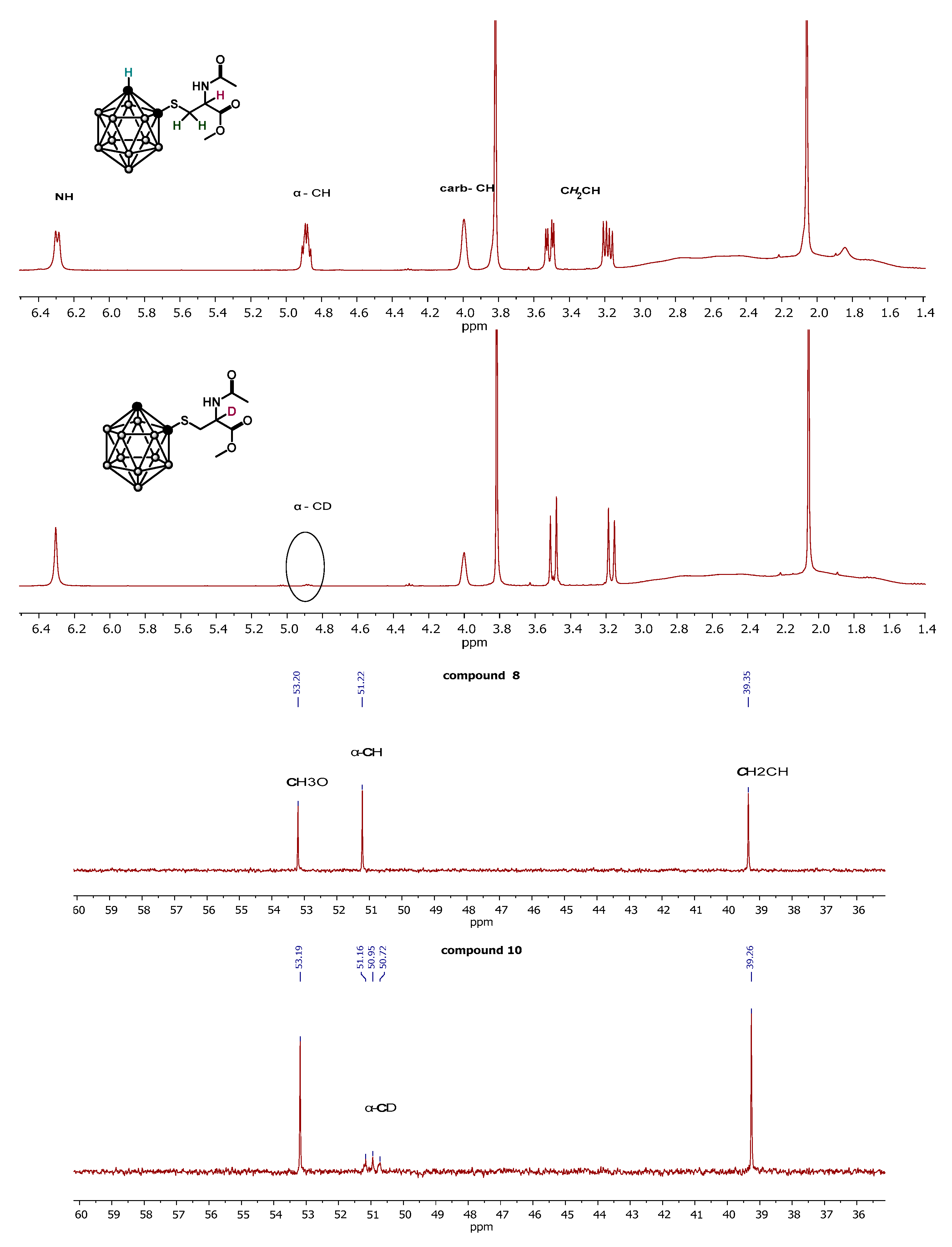
3.2. The Sulfa-Michel Addition Mechanism Investigation for o-Carboranyl Cysteine and Synthesis of Deuterium Labeled Compounds
4. Discussion
5. Conclusions
Supplementary Materials
Author Contributions
Funding
Acknowledgments
Conflicts of Interest
References
- Siegel, R.L.; Miller, K.D.; Jemal, A. Cancer statistics. CA Cancer J. Clin. 2019, 69, 7–34. [Google Scholar] [CrossRef] [PubMed]
- Black, P.M. Brain Tumors. N. Engl. J. Med. 1991, 324, 1471–1476. [Google Scholar] [CrossRef] [PubMed]
- Shah, H.K.; Mehta, M.P. Radiation Therapy. In High-Grade Gliomas. Current Clinical Oncology; Barnett, G.H., Ed.; Humana Press: Totowa, NJ, USA, 2007; pp. 231–244. [Google Scholar] [CrossRef]
- Afseth, J.; Neubeck, L.; Karatzias, T.; Grant, R. Holistic needs assessment in brain cancer patients: A systematic review of available tools. Eur. J. Cancer Care 2018, 28, e12931. [Google Scholar] [CrossRef]
- Locher, G.L. Biological effects and therapeutic possibilities of neutrons. Am. J. Roentgenol. Radium Ther. 1936, 36, 1–13. [Google Scholar]
- Tolpin, E.I.; Wellum, G.R.; Dohan, F.C., Jr.; Komblith, P.R.; Zamenhof, R.G. Boron Neutron Capture Therapy of Cerebral Gliomas. Oncology 1975, 32, 223–246. [Google Scholar] [CrossRef] [PubMed]
- Barth, R.F.; Zhang, Z.; Liu, T. A realistic appraisal of boron neutron capture therapy as a cancer treatment modality. Cancer Commun. 2018, 38, 36. [Google Scholar] [CrossRef] [PubMed]
- Xuan, S.; Vicente, M.G.H. Recent Advances in Boron Delivery Agents for Boron Neutron Capture Therapy (BNCT). In Boron-Based Compounds: Potential and Emerging Applications in Biomedicine; Hey-Hawkins, E., Viñas, C., Eds.; John Wiley & Sons: Hoboken, NJ, USA, 2018; pp. 298–342. [Google Scholar]
- Henriksson, R.; Capala, J.; Michanek, A.; Lindahl, S.-Å.; Salford, L.G.; Franzén, L.; Blomquist, E.; Westlin, J.-E.; Bergenheim, T.A. Boron Neutron Capture Therapy (BNCT) for Glioblastoma Multiforme: A Phase II Study Evaluating A Prolonged High-Dose of Boronophenylalanine (BPA). Radiother. Oncol. 2008, 88, 183–191. [Google Scholar] [CrossRef]
- Kulvik, M.; Vähätalo, J.; Buchar, E.; Färkkilä, M.; Järviluoma, E.; Jääskeläinen, J.; Křiž, O.; Laakso, J.; Rasilainen, M.; Ruokonen, I.; et al. Clinical implementation of 4-dihydroxyborylphenylalanine synthesised by an asymmetric pathway. Eur. J. Pharm. Sci. 2003, 18, 155–163. [Google Scholar] [CrossRef]
- Barth, R.F.; Coderre, J.F.; Vicente, M.G.H.; Blue, T.E. Boron Neutron Capture Therapy of Cancer: Current Status and Future Prospects. Clin. Cancer Res. 2005, 11, 3987–4002. [Google Scholar] [CrossRef]
- Hu, K.; Yang, Z.; Zhang, L.; Xie, L.; Wang, L.; Xu, H.; Josephson, L.; Liang, S.H.; Zhang, M.-R. Boron agents for neutron capture therapy. Coord. Chem. Rev. 2020, 405, 213139. [Google Scholar] [CrossRef]
- Kabalka, G.W.; Yao, M.-L. The synthesis and use of boronated amino acids for boron neutron capture therapy. Anticancer Agents Med. Chem. 2006, 6, 111–125. [Google Scholar] [CrossRef] [PubMed]
- Hawthorne, M.F. The Role of Chemistry in the Development of Boron Neutron Capture Therapy of Cancer. Angew. Chem. Int. Ed. Engl. 1993, 32, 950–984. [Google Scholar] [CrossRef]
- Sivaev, I.B.; Bregadze, V.I. Polyhedral Boranes for Medical Applications: Current Status and Perspectives. Eur. J. Inorg. Chem. 2009, 1433–1450. [Google Scholar] [CrossRef]
- Grimes, R.N. Carboranes, 3rd ed.; Academic Press: New York, NY, USA; Elsevier: Amsterdam, The Netherlands, 2016. [Google Scholar]
- Stogniy, M.Y.; Zakharova, M.V.; Sivaev, I.B.; Godovikov, I.A.; Chizov, A.O.; Bregadze, V.I. Synthesis of new carborane-based amino acids. Polyhedron 2013, 55, 117–120. [Google Scholar] [CrossRef]
- Leukart, O.; Caviezel, M.; Eberle, A.; Escher, E.; Tun-Kyi, A.; Schwyzer, R. L-o-Carboranylalanine, a Boron Analogue of Phenylalanine. Helv. Chim. Acta 1976, 59, 2184–2187. [Google Scholar] [CrossRef]
- Gruzdev, D.A.; Levit, G.L.; Olshevskaya, V.A.; Krasnov, V.P. Synthesis of ortho-Carboranyl Derivatives of (S)-Asparagine and (S)-Glutamine. Russ. J. Org. Chem. 2017, 5, 769–776. [Google Scholar] [CrossRef]
- Prashar, J.K.; Moore, D.E. Synthesis of Carboranyl Phenylalanine for Potential Use in Neutron Capture Therapy of Melanoma. J. Chem. Soc. Perkin Trans. 1 1993, 1051–1053. [Google Scholar] [CrossRef]
- Gruzdev, D.A.; Ustinov, V.O.; Levit, G.L.; Ol’shevskaya, V.A.; Krasnov, V.P. Synthesis of meta-Carboranyl-(S)-homocysteine Sulfoxide. Russ. J. Org. Chem. 2018, 54, 1579–1582. [Google Scholar] [CrossRef]
- He, T.; Misuraca, J.C.; Musah, R.A. “Carboranyl-Cysteine”-Synthesis, Structure and Self-Assembly Behavior of a Novel α-Amino Acid. Sci. Rep. 2017, 7, 16995. [Google Scholar] [CrossRef]
- He, T.; Musah, R.A. Evaluation of the Potential of 2-Amino-3-(1,7-dicarba-closododecaboranyl-1-thio)propanoic Acid as a Boron Neutron Capture Therapy Agent. ACS Omega 2019, 4, 3820–3826. [Google Scholar] [CrossRef]
- He, T.; Chittur, S.V.; Musah, R.A. Impact on Glioblastoma U87 Cell Gene Expression of a Carborane Cluster bearing Amino Acid: Implications for Carborane Toxicity in Mammalian Cells. ACS Chem. Neurosci. 2019, 10, 1524–1534. [Google Scholar] [CrossRef] [PubMed]
- Vinas, C.; Benakki, R.; Teixidor, F.; Casabo, J. Dimethoxyethane as a Solvent for the Synthesis of C-Monosubstituted o-Carborane Derivatives. Inorg. Chem. 1995, 34, 3844–3845. [Google Scholar] [CrossRef]
- Plešek, J.; Heřmanek, S. Syntheses and properties of substituted icosahedral carborane thiols. Collect. Czech. Chem. Commun. 1981, 46, 687–692. [Google Scholar] [CrossRef]
- Stogniy, M.Y.; Erokhina, S.A.; Druzina, A.A.; Sivaev, I.B.; Bregadze, V.I. Synthesis of novel carboranyl azides and “click” reactions thereof. J. Organomet. Chem. 2019, 904, 121007. [Google Scholar] [CrossRef]
- Frisch, M.J.; Trucks, G.W.; Schlegel, H.B.; Scuseria, G.E.; Robb, M.A.; Cheeseman, J.R.; Scalmani, G.; Barone, V.; Petersson, G.A.; Nakatsuji, H.; et al. Gaussian 09, Revision, D.01; Gaussian, Inc.: Wallingford, CT, USA, 2016. [Google Scholar]
- Perdew, J.; Ernzerhof, M.; Burke, K. Rationale for mixing exact exchange with density functional approximations. J. Chem. Phys. 1996, 105, 9982–9985. [Google Scholar] [CrossRef]
- Carlo, A.; Barone, V. Toward reliable density functional methods without adjustable parameters: The PBE0 model. J. Chem. Phys. 1999, 110, 6158–6170. [Google Scholar] [CrossRef]
- Keith, T.A. TK Gristmill Software; AIMAll (Version 19.10.12): Overland Park, KS, USA, 2019. [Google Scholar]
- Cossec, B.; Cosnier, F.; Burgart, M. Methyl Mercapturate Synthesis: An Efficient, Convenient and Simple Method. Molecules 2008, 13, 2394–2407. [Google Scholar] [CrossRef]
- Davidson, M.G.; Fox, M.A.; Hibbert, T.G.; Howard, J.A.K.; Mackinnon, A.; Neretin, I.S.; Wade, K. Deboronation of orthocarborane by an iminophosphorane: Crystal structures of the novel carborane adduct nido-C2B10H12·HNP(NMe2)3 and the borenium salt [(Me2N)3PNHBNP(NMe2)3]2O2+ (C2B9H12−)2. Chem. Commun. 1999, 1649–1650. [Google Scholar] [CrossRef]
- Svantesson, E.; Pettersson, J.; Olin, Å.; Markides, K.E. A kinetic study of the self-degradation of o-carboranylalanine to nido-carboranylalanine in solution. Acta Chem. Scand. 1999, 53, 731–736. [Google Scholar] [CrossRef][Green Version]
- Taoda, Y.; Sawabe, T.; Endo, Y.; Yamaguchi, K.; Fujii, S.; Kagechika, H. Identification of an intermediate in the deboronation of ortho-carborane: An adduct of ortho-carborane with two nucleophiles on one boron atom. Chem. Commun. 2008, 2049–2051. [Google Scholar] [CrossRef]
- Kononov, L.O.; Orlova, A.V.; Zinin, A.I.; Kimel, B.G.; Sivaev, I.B.; Bregadze, V.I. Conjugates of polyhedral boron compounds with carbohydrates. 2. Unexpected easy closo- to nido-transformation of a carborane–carbohydrate conjugate in neutral aqueous solution. J. Organomet. Chem. 2005, 690, 2769–2774. [Google Scholar] [CrossRef]
- Likhosherstov, L.M.; Novikova, O.S.; Chizhov, A.O.; Sivaev, I.B.; Bregadze, V.I. Conjugates of polyhedral boron compounds with carbohydrates 8. Synthesis and properties of nido-ortho-carborane glyco conjugates containing one to three β-lactosylamine residues. Russ. Chem. Bull. 2011, 60, 2359–2364. [Google Scholar] [CrossRef]
- Núñez, R.; Teixidor, F.; Kivekäs, R.; Sillanpää, R.; Viñas, C. Influence of the solvent and R groups on the structure of (carboranyl)R2PI2 compounds in solution. Crystal structure of the first iodophosphonium salt incorporating the anion [7,8-nido-C2B9H10]−. Dalton Trans. 2008, 1471–1480. [Google Scholar] [CrossRef]
- Teixidor, F.; Viñas, C.; Mar Abad, M.; Nuñez, R.; Sillanpäa, R. Procedure for the degradation of 1,2-(PR2)2-1,2-dicarba-closo-dodecaborane(12) and 1-(PR2)-2-R′-1,2-dicarba-closo-dodecaborane(12). J. Organomet. Chem. 1995, 503, 193–203. [Google Scholar] [CrossRef]
- Poater, J.; Viñas, C.; Bennour, I.; Escayola, S.; Solà, M.; Teixidor, F. Too Persistent to Give up: Aromaticity in Boron Clusters Survives Radical Structural Changes. J. Am. Chem. Soc. 2020, 142. [Google Scholar] [CrossRef] [PubMed]
- Boyd, L.A.; Clegg, W.; Copley, R.C.B.; Davidson, M.G.; Fox, M.A.; Hibbert, T.G.; Howard, J.A.; Mackinnon, K.A.; Peace, R.J.; Wade, K. Exo-π-bonding to an ortho-carborane hypercarbon atom: Systematic icosahedral cage distortions reflected in the structures of the fluoro-, hydroxy- and amino-carboranes, 1-X-2-Ph-1,2-C2B10H10 (X = F, OH or NH2) and related anions. Dalton Trans. 2004, 2786–2799. [Google Scholar] [CrossRef] [PubMed]
- Stogniy, M.Y.; Sivaev, I.B.; Petrovskii, P.V.; Bregadze, V.I. Synthesis of monosubstituted functional derivatives of carboranes from1-mercapto-ortho-carborane: 1-HOOC(CH2)nS-1,2-C2B10H11 and [7-HOOC(CH2)nS-7,8-C2B9H11]− (n = 1–4). Dalton Trans. 2010, 39, 1817–1822. [Google Scholar] [CrossRef]
- Romanova, A.; Lyssenko, K.; Ananyev, I. Estimations of energy of noncovalent bonding from integrals over interatomic zero-flux surfaces: Correlation trends and beyond. J. Comput. Chem. 2018, 39, 1607–1616. [Google Scholar] [CrossRef]
- Mutlib, A.E. Application of Stable Isotope-Labeled Compounds in Metabolism and in Metabolism-Mediated Toxicity Studies. Chem. Res. Toxicol. 2008, 21, 1672–1689. [Google Scholar] [CrossRef]
- Wilkinson, D.J. Historical and contemporary stable isotope tracer approaches to studying mammalian protein metabolism. Mass Spectrom. Rev. 2018, 37, 57–80. [Google Scholar] [CrossRef]
- Pająk, M.; Pałka, K.; Winnicka, E.; Kańska, M. The chemo- enzymatic synthesis of labeled l-amino acids and some of their derivatives. J. Radioanal. Nucl. Chem. 2018, 317, 643–666. [Google Scholar] [CrossRef] [PubMed]


Publisher’s Note: MDPI stays neutral with regard to jurisdictional claims in published maps and institutional affiliations. |
© 2020 by the authors. Licensee MDPI, Basel, Switzerland. This article is an open access article distributed under the terms and conditions of the Creative Commons Attribution (CC BY) license (http://creativecommons.org/licenses/by/4.0/).
Share and Cite
Laskova, J.; Kosenko, I.; Ananyev, I.; Stogniy, M.; Sivaev, I.; Bregadze, V. “Free of Base” Sulfa-Michael Addition for Novel o-Carboranyl-DL-Cysteine Synthesis. Crystals 2020, 10, 1133. https://doi.org/10.3390/cryst10121133
Laskova J, Kosenko I, Ananyev I, Stogniy M, Sivaev I, Bregadze V. “Free of Base” Sulfa-Michael Addition for Novel o-Carboranyl-DL-Cysteine Synthesis. Crystals. 2020; 10(12):1133. https://doi.org/10.3390/cryst10121133
Chicago/Turabian StyleLaskova, Julia, Irina Kosenko, Ivan Ananyev, Marina Stogniy, Igor Sivaev, and Vladimir Bregadze. 2020. "“Free of Base” Sulfa-Michael Addition for Novel o-Carboranyl-DL-Cysteine Synthesis" Crystals 10, no. 12: 1133. https://doi.org/10.3390/cryst10121133
APA StyleLaskova, J., Kosenko, I., Ananyev, I., Stogniy, M., Sivaev, I., & Bregadze, V. (2020). “Free of Base” Sulfa-Michael Addition for Novel o-Carboranyl-DL-Cysteine Synthesis. Crystals, 10(12), 1133. https://doi.org/10.3390/cryst10121133