


Abstract
During the refining processes, when catalyst activity falls below acceptable levels and it is not possible to regenerate it for its reuse, the catalyst is disposed of as solid waste; however, the spent catalysts could be a promising source of metals for manufacturing new products due to their high content of heavy metals, such as nickel. In this research, nickel recovered from a spent hydrodesulfurization catalyst by ultrasonication-assisted leaching was used as a metal source for the synthesis of Ni-MOF-74 material (Ni-MOF-74E), and its properties and CO2 adsorption capture capacity were compared with a Ni-MOF-74 prepared with commercial salt nickel nitrate (Ni-MOF-74C). The MOF-74 structure was confirmed by analytical techniques such as FT-IR and powder X-ray diffraction. By SEM and EDX, the fusiform morphology and the elemental composition were found. The CO2 capture capacity, evaluated at 298 K, 288 K and 273 K, showed that the Ni-MOF-74E material presented an adsorption capacity higher than 2.2 mmol g−1 and a heat adsorption of 44 kJ mol−1.
1. Introduction
One of the fundamental issues in petroleum refining is the large volume of spent hydroprocessing catalysts (HCPs) discarded as solid waste. With increasingly heavy feedstock processing and expanding diesel capacity to meet low-sulfur fuel demand, the industry produces an estimated 700,000–900,000 t of spent catalysts annually, including about 200,000 t of deactivated HCPs [1]. The market for refinery catalysts is predicted to expand from $5.6 billion in 2024 to $6.8 billion by 2029, showing an annual growth rate of 4.0% [2]. Catalysts used industrially in the hydrotreating process cause environmental problems, as they generate substantial amounts of spent catalysts. Due to the hazardous nature of these spent catalysts, their storage, transportation, handling, and disposal are subject to strict environmental regulations [3]. Consequently, there is a growing interest in minimizing the waste generated by spent catalysts and in developing safe and cost-effective methods for their recovery and disposal. HCPs typically consist of Al2O3 as a support and active metal sulfides like Mo, Ni, and Co, in addition to other elements that enhance their performance [4]. Depending on the formulation, spent HCPs may have (4–12)% Mo, (0.5–1.5)% V, up to 5% Ni, (0.5–3)% Co, 30% Al, and about 20% residual oil [4,5]. Mo, Ni, and Co are critical metals in industries such as steelmaking, batteries, aerospace, and catalysis, and the mining of these metals is progressively becoming more unsustainable due to rising industrial demand.
The use of spent catalysts to obtain metals offers an alternative for reducing hazardous waste by converting industrial waste into useful resources. Recovering metals from spent catalysts significantly reduces the environmental impact, as it avoids mining, which is the main source of greenhouse gas emissions; additionally, mineral processing leads to soil degradation and water pollution [6]. Metal extraction using conventional mining produces a significant carbon footprint; for example, it is estimated that cobalt mining generates between 6 and 7 kg of CO2 per kilogram extracted. While catalyst recycling can reduce this value by 50–70% depending on the process used [7], emissions associated with mining represent between 4% and 7% of global greenhouse gas emissions [8]. Total emissions from metal extraction from spent catalysts could range from 2 to 5 kg of CO2 per kilogram of metal recovered, depending on the energy used [6]. The costs associated with obtaining metals from spent catalysts include the transportation of spent catalysts, materials, and energy for the extraction stage, as well as waste disposal. The cost of recovery can be between 20% and 50% lower than the cost of primary extraction, depending on the process efficiency and the scale of operation [9]. Additionally, due to the scarcity of metals, their extraction will become increasingly complex due to difficulties in accessing the sources. Although the process of recycling metals from spent catalysts may involve higher first costs due to the demand for specific infrastructure, in the long term, the reduction in operating costs will be a sustainability advantage.
To recover these valuable metals and relieve the environmental impact, efforts are underway to develop methodologies that enable their efficient recovery from a circular view [1]. Metal recovery from spent catalysts can be achieved through hydrometallurgical, pyrometallurgical, and pyrohydrometallurgical methods. Hydrometallurgy is characterized by low emissions, high efficiency, and selectivity [10], where leaching agents are used to dissolve metals. Pyrometallurgy involves high-temperature melting and metal alloying, while pyrohydrometallurgy combines both hydrometallurgical and pyrometallurgical approaches [11]. Metal recovery begins with the removal of undesired compounds from the spent catalysts by thermal treatments between 573.15 K and 873.15 K, dropping the volatile organic compounds, coke, sulfur, and metal sulfide, among others. Then, residual oil is extracted with organic solvents such as acetone, naphtha, toluene, and ethanol, which can also be removed through physical processes such as mechanical washing [4]. Additionally, there are treatments that enhance the extraction of metals, such as oxidative or salt roasting, which favors leaching and aids in the removal of contaminants [10,12]. After pretreatment, spent catalysts undergo leaching for metal extraction. Leaching types include alkaline, acidic, oxidizing, and Fenton processes [1]. The acid leaching uses inorganic acids like sulfuric, hydrochloric, or nitric acid. This is a simple and low-energy method with high extraction rates. Organic acids can improve the selectivity by forming stable metal complexes [1].
There are no reports about the use of recovered Ni, Co, V, and Pt as feedstocks for materials that capture greenhouse gases. One of the most important greenhouse gases is carbon dioxide, which is naturally released by animal and microbial respiration and absorbed by plants and oceans, keeping a near balance in natural carbon sources and sinks [13]. However, about 87% of CO2 emissions come from anthropogenic activities, 9% from deforestation, and 4% from industrial processes [14]. These emissions disrupt the natural carbon balance and mainly originate from fossil fuel combustion in power plants, refineries, transportation, industrial processes, cement production, hydrogen generation, and biomass burning [15].
In 2000, global CO2 emissions from fossil fuels reached about 2.3 × 10⁻¹³ kg per year (~6 × 10⁻¹³ kg of carbon). Around 60% came from large stationary sources, emitting over 0.1 million tons annually [15]. Rising CO2 levels have caused ocean warming and acidification, which are expected to increase rapidly with global energy demands, especially in developing countries. Atmospheric CO2 is going from 280 ppm at the beginning of the 19th century to 417 ppm by 2022, and an increase to 980 ppm is predicted by the year 2100 [16].
There are three technical options for reducing CO2 emissions: (1) improving energy efficiency and reducing consumption; (2) developing renewables and non-fossil fuels like hydrogen; and (3) advancing capture and storage technologies (CCSs). CCSs have the potential to reduce emissions more quickly than renewable energy development [15], because the CO2 is captured and separated from flue gas to produce a concentrated stream for transport to geological storage. A typical flue gas has about 72% N2, (8–12)% CO2, (8–10)% water vapor, and smaller amounts of pollutants like SOx, NOx, particulates, and metals in trace amounts [13]. CCSs are classified into post-combustion, pre-combustion, and oxy-combustion. Post-combustion capture is a technology that uptakes CO2 after fuel burning using membranes, adsorbents, or cryogenic and absorption processes. Pre-combustion capture consists of removing CO2 during fuel conversion. Lastly, oxy-combustion burns fuel with oxygen, producing mainly CO2 and water, but it is complex and costly [17].
Absorption, adsorption, and membranes are key post-combustion CO2 capture methods and are widely used due to easy integration into industrial processes. Absorption uses mainly amine solvents that form chemical or physical bonds with CO2, offering good selectivity and capacity, but with high energy costs, corrosion risks, and solvent degradation [17]. Adsorption relies on gas molecules adhering to solid adsorbents through physisorption or chemisorption processes, which separate gases based on the affinity with the solid surface [18]. The ideal adsorbents for CO2 capture are porous solids with high selectivity and adsorption capacities, fast adsorption/desorption rates, strong stability for multiple cycles, low aging and regeneration energy, and scalability to megaton capture rates [13]. Porous materials with large surface areas, such as zeolites, silicates, activated carbon, polymers, amine-functionalized materials, and metal–organic frameworks (MOFs), are particularly effective for CCSs [18,19].
MOFs are a promising material for CO2 capture due to their crystalline and tunable structure, high porosity, and abundant open metal sites (OMSs), which enhance capture efficiency [20]. MOFs are 2D or 3D polymeric networks built with organic ligands bonded by inorganic centers [21,22]. MOF-74 is a MOF family that stands out for its higher CO2 adsorption capacity, CO2/N2 selectivity, hierarchical porosity, thermal stability, and high OMS content [20]. MOF-74 compounds have the formula M2(dobdc), where M is a divalent metallic ion, and the common organic ligand is the 2,5-dihydroxy-1,4-benzenedicarboxylic acid. The structural hydroxyl and carboxyl groups form a one-dimensional secondary building unit (SBU) linked by organic ligands into a 3D planar framework with hexagonal channels. During synthesis, several solvents like dimethylformamide (DMF), MeOH, and H2O are needed; solvent molecules coordinate with metal ions during the crystallization but are later removed by thermal or vacuum degassing. Thus, the OMSs are available and function as Lewis acid centers, which strongly interact with CO2, giving MOF-74 a high carbon capture capacity [20,21].
The effect of different divalent metals (Mn, Fe, Mg, Co, Zn, and Cu) in MOF-74 on CO2 capture was studied using solvothermal synthesis and adsorption tests at 298 K. Under low-pressure conditions, CO2 uptake capacity follows the order Mg > Ni > Co > Fe > Mn > Zn > Cu, reflecting increasing Lewis’s acidity and bond strength between CO2 and the OMS. Electrostatic interactions and metal site accessibility also affect capture capacity [23]. The role of Lewis acidity in MOF-74 was confirmed by studying Ni, Co, Mn, and Zn metal centers in structures synthesized via solvothermal and microwave methods. Higher Lewis acidity correlates with greater CO2 adsorption enthalpy, with Ni-MOF-74 showing the highest stability and capture capacity [24].
This article describes the nickel extraction procedure from spent hydrotreating catalysts and its next use in the synthesis of Ni-MOF 74 material. In this way, recycled metal is used to obtain a MOF material, with a procedure that is aligned with the circular economy principles, contributing to the reduction in environmental impacts associated with the final disposal of spent HDS catalysts and to the mining and refining of metals as nickel, which is classified as a critical metal. In addition, the synthesized material contributes to mitigating the effects of greenhouse gas emissions due to its capacity for CO2 adsorption, which was compared, at three temperatures, with the capacity of the synthesized material using a commercial salt.
2. Results and Discussion
2.1. Nitrogen Adsorption Isotherm and Size Pore Distribution
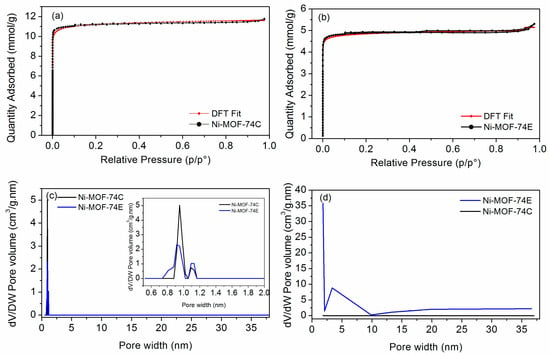
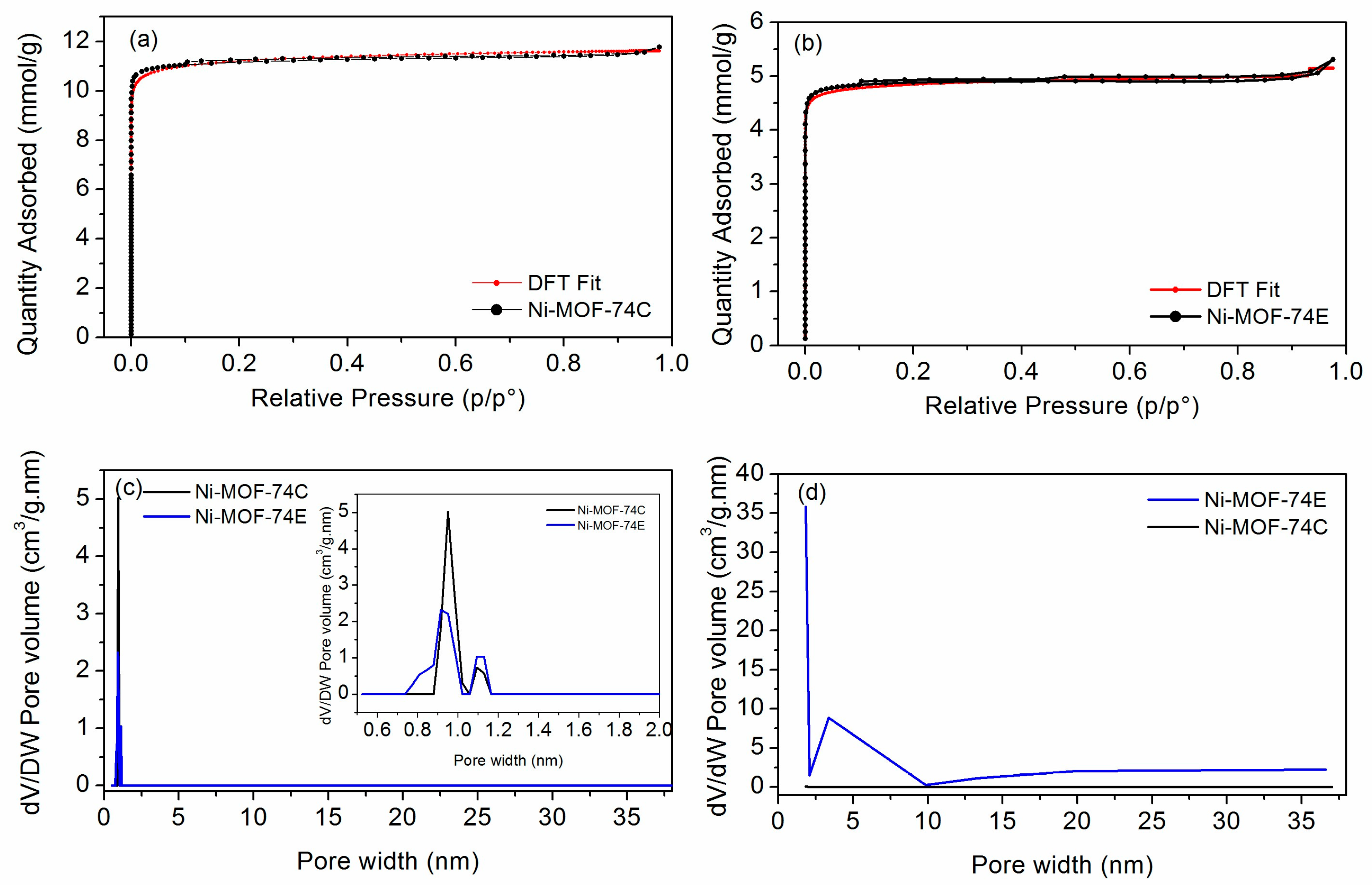
The adsorption isotherms obtained for both Ni-MOF-74C and Ni-MOF-74E correspond to type I profiles, characterized by pronounced uptake at low relative pressures, confirming the presence of microporous structures (Figure 1a,b). Once the adsorption isotherm reaches the first inflection point at p/p° 0.005, a plateau is obtained near 10.5 mmol·g−1 and 4.7 mmol·g−1 for samples Ni-MOF-74C and Ni-MOF-74E, respectively. In the Ni-MOF-74C sample, the desorption branch overlaps with the adsorption curve, showing the absence of mesoporosity, in agreement with the BJH desorption profile (Figure 1d). In contrast, the Ni-MOF-74E sample displays non-overlapping adsorption and desorption branches, showing the presence of larger pores or structural defects. As shown in Figure 1b,d, this material has mesopores between 2.5 and 10 nm, which correspond to slit-shaped pores typically associated with H4-type hysteresis. Such pore characteristics, arising from non-rigid slit-like voids or aggregates of platy particles, suggest the presence of non-crystalline domains, a point that will be addressed in the following discussion. DFT analysis was also applied to evaluate the pore size distribution using a cylindrical pore model with N2 as the adsorbate. This approach provided reliable results for micropores (≤2 nm), which for Ni-MOF-74 typically fall in the 1.0–1.2 nm range; however, it did not adequately describe the mesoporosity observed in the Ni-MOF-74E sample. As noted above, the shape of the hysteresis loop in the Ni-MOF-74E isotherm reflects the presence of inter-particle pores, which are not captured by the DFT model employed.
Figure 1.
Experimental and DFT-simulated adsorption–desorption N2 isotherms of (a) Ni-MOF-74C (standard deviation of fit: 0.258405 mmol/g) and (b) Ni-MOF-74E (standard deviation of fit: 0.067202 mmol/g); (c) pore size distribution analysis of Ni-MOF-74C and Ni-MOF-74E using DFT model for N2 cylindrical pores—oxide surface; and (d) pore size distribution analysis of Ni-MOF-74C and Ni-MOF-74E using BJH desorption model.
The external area corresponds to 5% of the total surface area for both Ni-MOF-74E and Ni-MOF-74C samples (Table 1). The micropore volume was higher in the Ni-MOF-74C sample than in the reported Ni-MOF-74 material [25], which is consistent with the BET total surface area values (Table 1). In contrast, the sample synthesized from the nickel extract, Ni-MOF-74E, showed a smaller BET value, which may be due to structural defects, dilution of MOF-74 in the presence of amorphous material (see XRD analysis), or interferences (Table S1) in the nickel extract affecting the nucleation process and impacting the nuclei growing.
Table 1.
Textural properties of Ni-MOF-74 samples compared with the reported values.
It has been reported that impurities can significantly alter crystallization kinetics, even at trace concentrations [27]. Impurities influence the crystallization of MOFs by acting as competitive ligands that regulate nucleation and growth. For instance, Li et al. [28] proved that various inorganic and organic additives can be used to control the crystallization process. The presence of impurities may significantly reduce porosity through pore-blocking mechanisms, inhibit growth along specific crystallographic directions, or become incorporated into the framework via lattice inclusion or solvent entrapment, thereby altering the final pore architecture. Furthermore, impurities can affect host particle mobility and introduce defects; they also compete with ligands to modulate nucleation kinetics, particle size, and structural assembly. In terms of structural integrity, metal salts can affect pore volume and thermal stability, while foreign metals may form secondary phases that precipitate alongside the MOF. Occasionally, an impurity substitutes for an organic ligand, disrupting the periodicity of the network and potentially causing premature structural collapse during activation. Additionally, impurities not removed during washing remain trapped in the cavities, reducing the BET surface area. Ultimately, when impurities compete with the primary metal ion for ligand coordination, they favor the formation of mixed-metal, less-ordered structures over pure, highly crystalline phases.
2.2. Infrared Spectroscopy ATR-FTIR Analysis
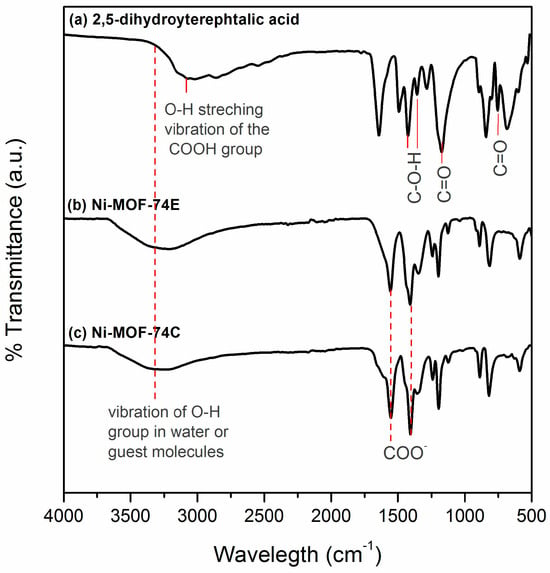
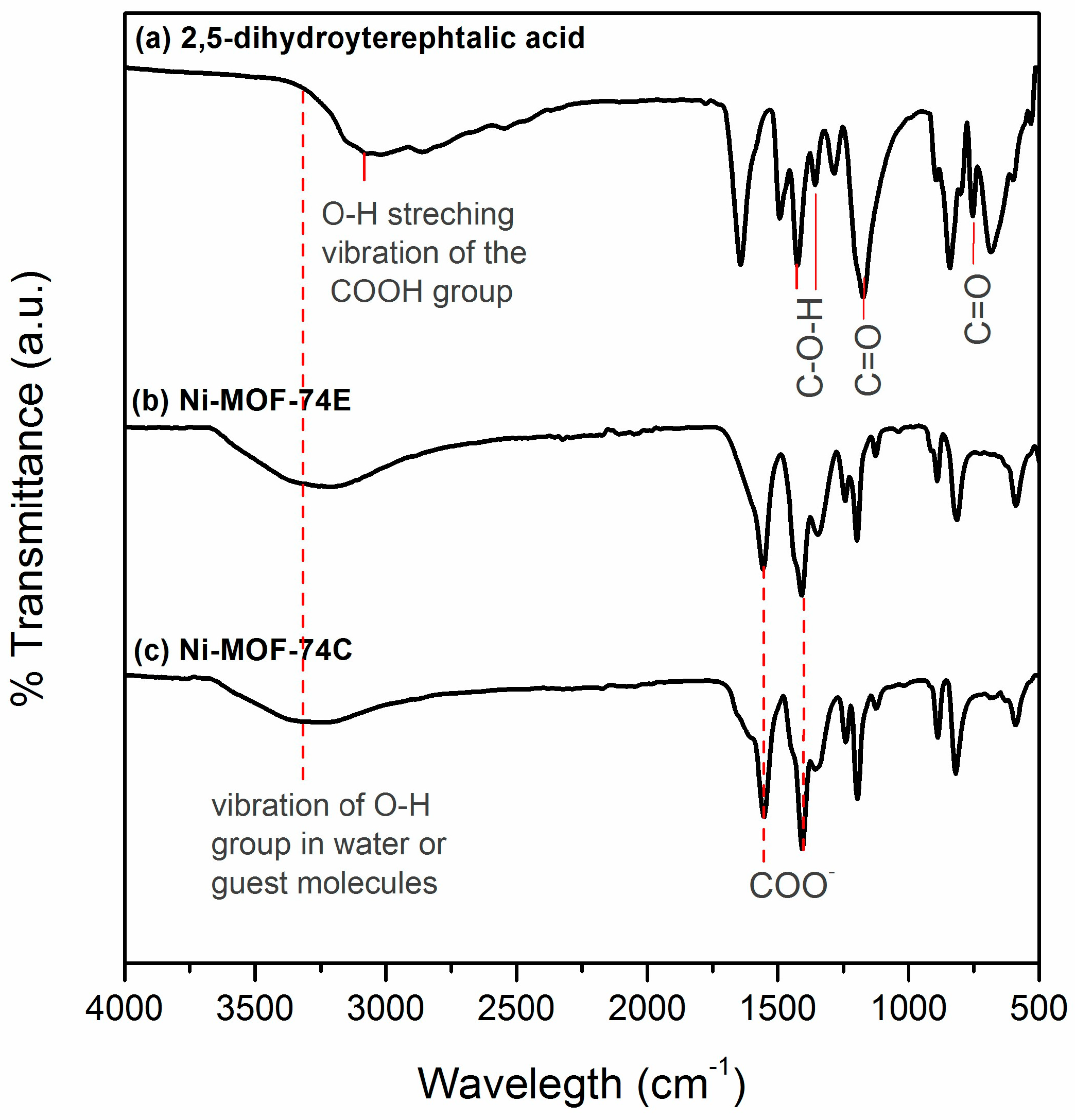
Figure 2a presents the IR spectrum of the ligand 2,5-dihydroxyterephthalic acid, used as a reference to find peak correlations with the vibrational modes observed in the Ni-MOF-74C and Ni-MOF-74E samples. While several characteristic signals are shared between the ligand and the MOF structures, notable shifts in band position, intensity, and shape, as well as the disappearance of some linker-related vibrations, occur upon coordination to Ni2+ ions, confirming the formation of the MOF-74 framework. When the acid is uncoordinated with Ni2+, a broadband is found around 2800–3300 cm−1, which is attributed to the stretching of O-H bonds due to carboxylic acids groups [29]. A peak at 1250–1300 cm−1 associated with C=O stretching of the –COOH group in the free linker disappears or transforms once coordination with the metal occurs. Additionally, the aromatic C=C stretching band appears at 1580–1600 cm−1 in both the free ligand and the resulting MOF structures [29]. Once the MOF-74 structure is reached, the ligand signals change, confirming ligand deprotonation, carboxylate formation, and Ni-O coordination (Figure 2b,c). Thus, the C=O signal (~1700 cm−1) is missing, while sharp COO− bands appear as evidence of the formation of Ni-MOF-74 [30].
Figure 2.
FT-IR spectra of (a) 2,5 dihydroxyterephthalic acid and the samples synthesized with (b) recycled nickel extract from spent catalysts Ni-MOF-74E and (c) Ni-MOF-74 using commercial salt (Ni-MOF-74C).
The infrared spectra of Ni-MOF-74C and Ni-MOF-74E solids are plotted in Figure 2b,c. A broad band appears around 3400 cm−1, which is attributed to the vibration of O-H bonds due to the presence of water or guest molecules [29]. This band associated with solvent was confirmed by acquisition of Ni-MOF-74C spectra before and after sample activation by degassing (Figure S1). A shoulder present in 1609 cm−1 corresponds to C-N bonds attributed to DMF solvent [31]. A series of bands between 1563 and 1356 cm−1 is attributed to the asymmetric and symmetric stretching vibrations of the carboxylate groups, respectively [30]. The signals at 1241, 1199, and 1126 cm−1 correspond to C–H and C=O stretching modes of the aromatic ring. Additionally, the peaks at 889 and 820 cm−1 are associated with out-of-plane bending vibrations of the aromatic moiety [29]. A broad and intense band observed between 590 and 580 cm−1 is likely related to Ni–O vibrational modes [32].
2.3. X-Ray Diffraction Analysis
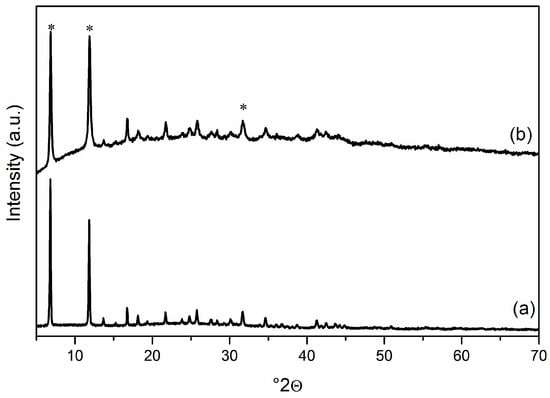
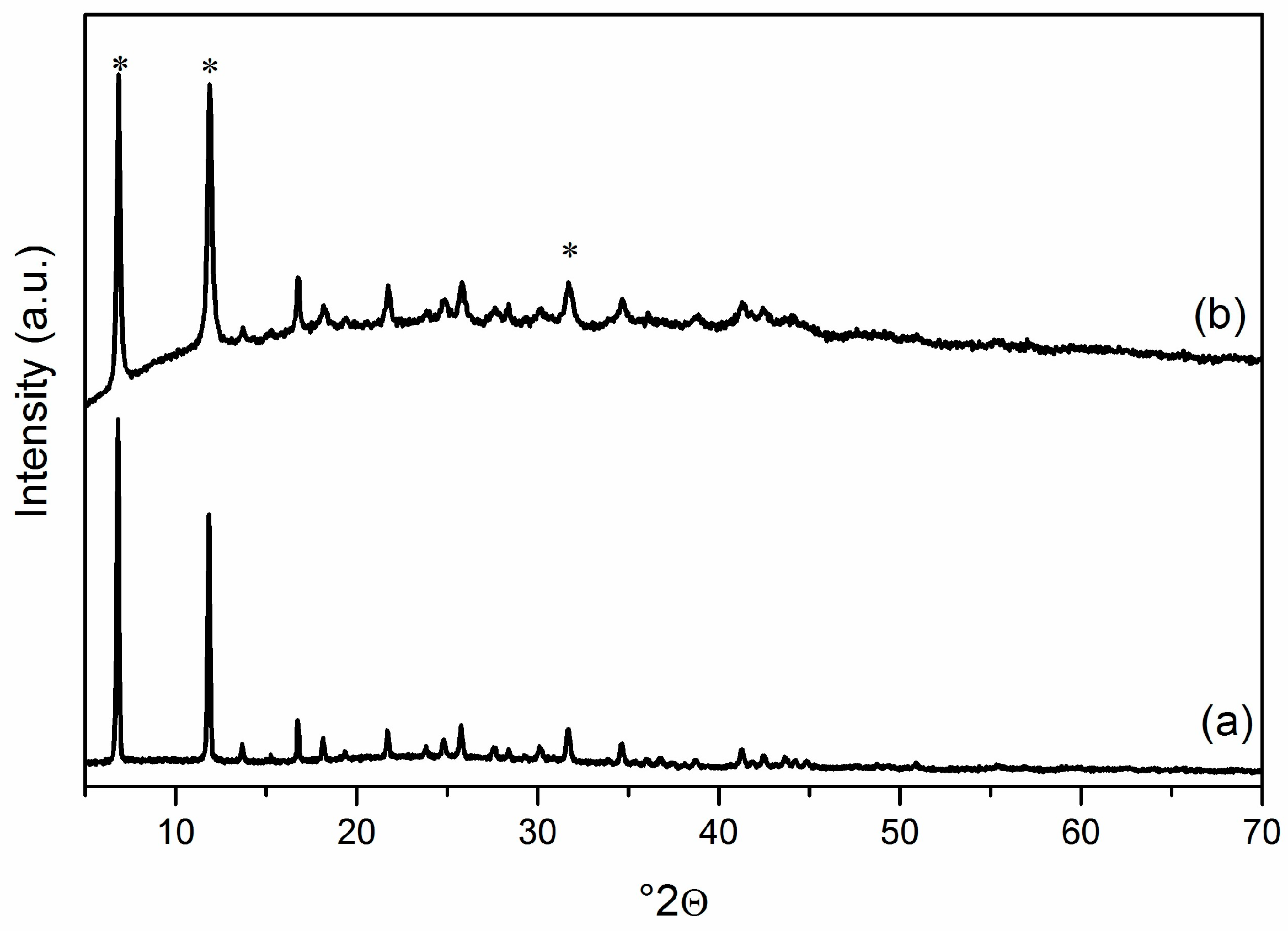
The X-ray diffraction traces of samples Ni-MOF-74C and Ni-MOF-74E are shown in Figure 3. The phase assignment corresponding to Ni-MOF-74 material was conducted matching the three main reflections of the experimental profiles from the CDD (2026, PDF-5+, International Centre for Diffraction Data, Newtown Square, PA, EE.UU. File No. I0-065-0862), corresponding to (Nickel (2,5-dihydroxyterephthalate) hydrate). Despite the XRD profiles pointing out the MOF-74 topology in the synthesized materials, the sample Ni-MOF-74E exhibits a broad and raised background suggesting the presence of amorphous impurities.
Figure 3.
XRD profiles of the synthesized (a) Ni-MOF-74C and (b) Ni-MOF-74E. * Correspond to more intense signals of Ni-MOF-74 PDF card number 00-065-0862.
In the case of MOF-74E, the low intensity of the XRD reflections can be attributed to the presence of amorphous material (represented in the background), which reduces the signal-to-noise ratio. This amorphous phase may consist of an alumina species, such as boehmite, which can be synthesized hydrothermally in an acidic medium using aluminum nitrate as a precursor in deionized water. While the presence of aluminum does not directly disrupt the MOF-74 framework, the synthesis environment favors the simultaneous crystallization of two phases: a crystalline phase (MOF-74) and an amorphous phase (aluminum-based phase). The latter dilutes the MOF-74 and is dispersed throughout the bulk material.
Refinements of the structure by adjusting the XRD profile (profile matching) enable the assignment of intensities, shapes, and widths of peaks and background, using Le Bail’s method or Pawley’s method. The Armel Le Bail method was used in this research and involves decomposing the diffractogram by extracting intensities to find lattice parameters once the adjustment is complete [33]. The Le Bail fit of XRD profiles with space group R-3 was performed to confirm the MOF-74 phase in the synthesized solids (Table S2). In the case of the sample Ni-MOF-74C, synthesized with commercially sourced reagents, with the Le Bail refinement a good fit was obtained between calculated and experimental data according to the r-factors (Rp = 3.24%, Rwp = 4.25%, Rexp = 2.76%). However, to achieve a proper profile simulation for the Ni-MOF-74E sample, it was necessary to shorten the phase refinement range between 3–30 °2θ resulting in the following r-factors: Rp = 0.927%, Rwp = 1.40%, Rexp = 1.17% (Table S2). The results of the unit cell parameters are listed in Table 2, showing a good correlation with the previously reported Ni-MOF-74 structures [34,35]. The lattice parameters of the sample Ni-MOF-74E show a slight contraction compared to those in Ni-MOF-74C, which could be related to adjustments in the refinement range.
Table 2.
Lattice parameters for Ni-MOF-74C and Ni-MOF-74E samples.
2.4. Scanning Electron Microscopy and Elemental Analysis
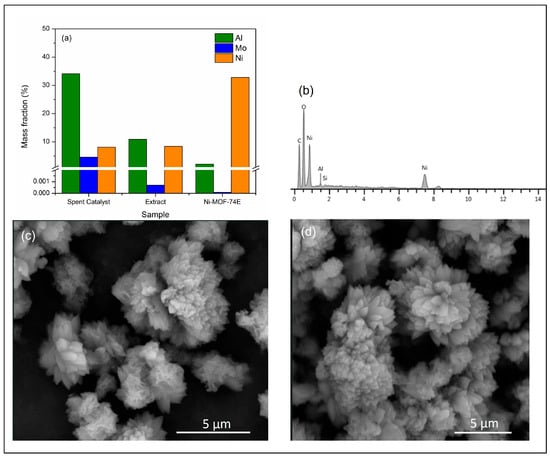
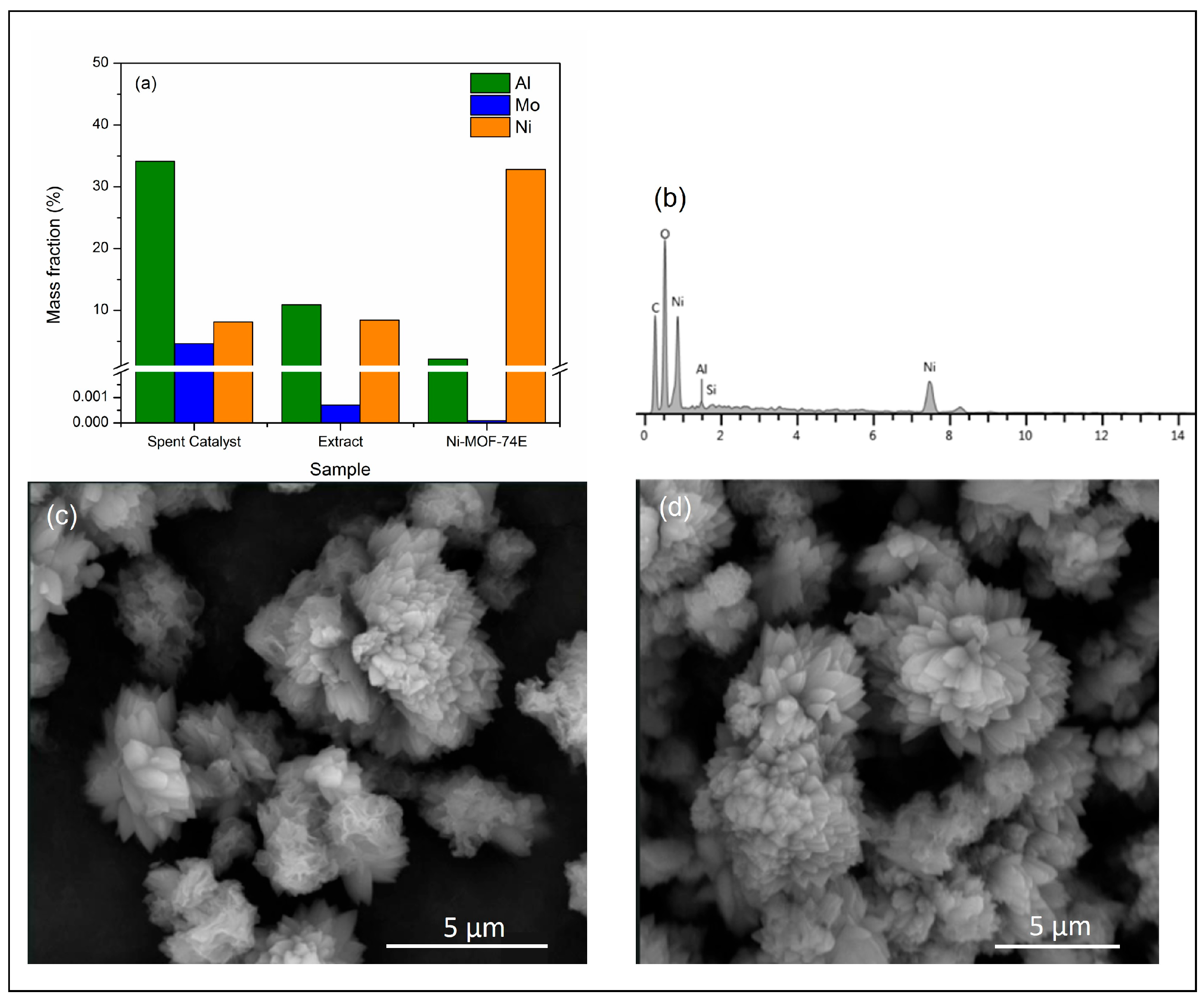
The spent hydroprocessing catalyst constitutes a hazardous solid waste enriched with multiple metal species. If not adequately removed during the nickel-recovery procedure, these residual metals can interfere with the crystallization of the MOF-74 framework. For this reason, the raw material was analyzed by ICP-OES to find its bulk elemental composition (Table S1). The spent catalyst showed Ni, Mo, and Al as the predominant elements by mass. Following the nickel extraction process, more than 20% of the aluminum was removed, and the molybdenum content decreased to 0.001% (mass fraction) (Figure 4a). The remaining aluminum in the extract accounted for 10%, corresponding to approximately 2% of the total mass in the final Ni-MOF-74E material. The aluminum, as an impurity in contact with the acidic medium of the reaction MOF mixture, could produce aluminum oxide or unreacted metal clusters that block pores, reducing the nitrogen adsorption capacity and surface area, as shown in the textural analysis results of Ni-MOF-74E. A complementary elemental composition evaluation was conducted with an EDX analysis (Figure 4b). The EDX analysis showed that the aluminum/nickel ratio is similar on the surface and the bulk; then, the Al impurity is distributed homogeneously in the sample. In addition, molybdenum traces identified with ICP-OES were not detected in the EDX analysis, which could be attributed to the detection limits being out of range for this technique.
Figure 4.
(a) Mass fraction plot for raw materials (spent catalyst, Ni extract) and Ni-MOF-74E; (b) EDX spectrum for Ni-MOF-74E; SEM images of the samples; (c) Ni MOF-74C and (d) Ni-MOF-74E.
Figure 4c,d shows the micrographs of Ni-MOF-74C and Ni-MOF-74E samples, in which the observed morphology could be defined as spindle-shaped and bulk stacking. This morphology is consistent with images obtained by Hu et al., who reported that the synthesized bimetallic MOF of Ni and Co were obtained from nitrate salts of the corresponding metals [36]. On the other hand, Chen et al. [37] reported that the structure of Ni-MOF-74, synthesized starting from another precursor such as nickel acetate, had a morphology consisting of crystalline agglomerates like those obtained in this work with average particle sizes less than 4 µm.
2.5. CO2 Adsorption Capacity Measurement and Heat of Adsorption
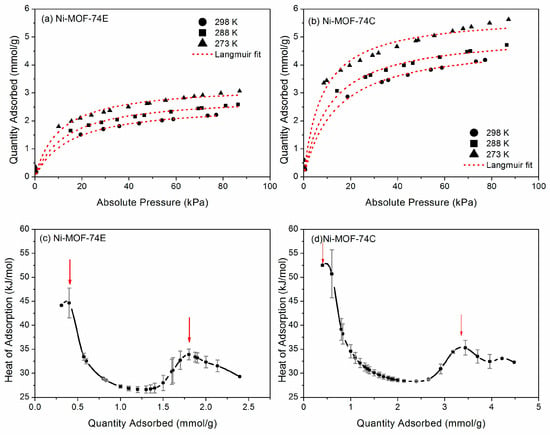
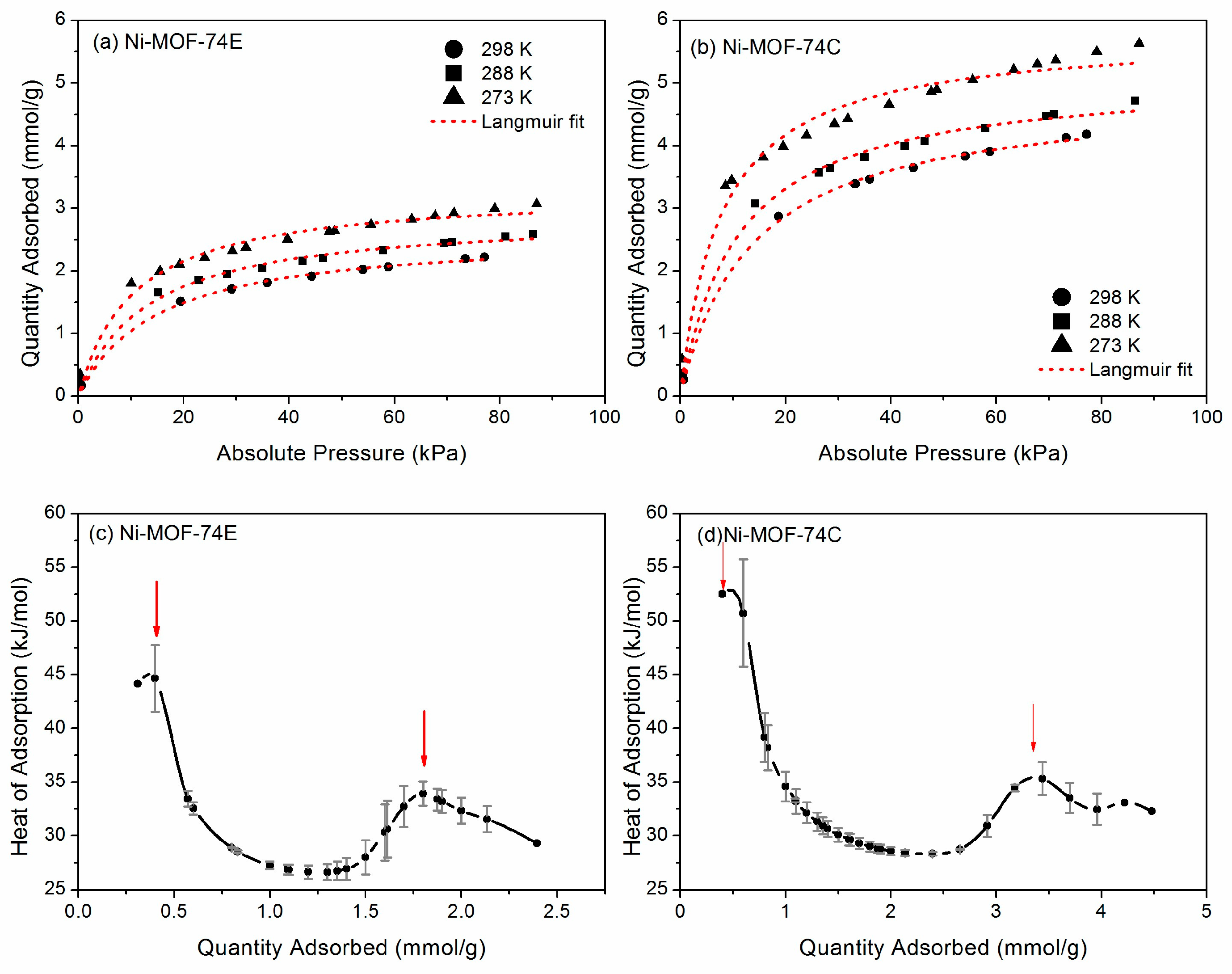
Figure 5a,b presents the CO2 adsorption isotherms and their corresponding Langmuir fits (Table S3) for the Ni-MOF-74C and Ni-MOF-74E samples. As expected, the adsorption capacity decreases with increasing temperatures, consistent with Le Chatelier’s principle. Because adsorption in MOF-74 is an exothermic process, higher temperatures disfavor CO2 uptake by shifting the equilibrium toward desorption. Notably, metal–organic frameworks provide significant advantages over conventional adsorbents such as activated carbon, zeolites, and silica, owing to their high CO2 affinity and comparatively low energy requirements for adsorption–desorption cycling [17]. Additionally, the nickel in the structure of the MOF presents the highest affinity for stability in the presence of water compared with other metals [38]. Activated carbon can only be used under high-pressure and temperature conditions, it is very water sensitive and has low selectivity; furthermore, zeolites are hydrophilic and therefore their adsorption capacity can decrease in the presence of water [17].
Figure 5.
CO2 adsorption isotherms obtained at 273 K, 288 K, and 298 K of Ni-MOF-74E (a) and Ni-MOF-74C (b); curves of heat of adsorption vs. adsorbed quantity of Ni-MOF-74E (c) and Ni-MOF-74C (d). The red arrows in (c,d) correspond to the two ΔHads maximum values.
At 273 K, the CO2 adsorption capacities reached approximately 5.6 mmol·g−1 for Ni-MOF-74C and 3.1 mmol·g−1 for Ni-MOF-74E. However, adsorption measurements at temperatures closer to ambient conditions (288–303 K) are more relevant for evaluating the practical viability of CO2 capture materials, as they reduce both energy demand and operational costs. At 298 K, the Ni-MOF-74E and Ni-MOF-74C samples showed adsorption capacities of 2.2 mmol·g−1 and 4.2 mmol·g−1, respectively. Literature reports show that CO2 uptakes exceeding 2 mmol·g−1 at 298 K and 1 bar are generally considered indicative of a promising adsorbent [39]. Therefore, despite the presence of amorphous domains, significant aluminum impurities, and a reduced BET surface area relative to Ni-MOF-74C, the Ni-MOF-74E material can still be regarded as suitable for CO2 capture applications.
The isosteric heat of adsorption (Qst), expressed as the change in enthalpy (ΔHads), is a key thermodynamic parameter used to measure the energy released once the CO2 adsorbs onto the MOF surface (Tables S4 and S5) and is determined from plots of ln (P) versus 1/T at constant coverage (adsorption quantity) and provides information about surface affinity for CO2 (Figures S2 and S3). Figure 5c,d shows the ΔHads curves for each synthesized Ni-MOF-74; the curves indicate that the maximum ΔHads values are reached at low surface coverage of approximately 0.4 mmol·g−1 due to the availability of adsorption sites once the surface is activated by degassing; the reported values are 52 kJ mol−1 and 44 kJ mol−1 for Ni-MOF-74C and Ni-MOF-74E, respectively. For both samples, a second maximum was found, which could be related to a secondary adsorption site with an energy near 35 kJ·mol−1. While impurities diminish the sample’s adsorption capacity, the presence of two distinct types of adsorption sites stays unaffected. In porous materials like MOF-74, a second peak in ΔHads represents a structure change where the adsorbate is more accessible, or the filling of a higher-energy adsorption site after lower-energy sites have been partially filled, specifically adsorbate–adsorbate interactions between CO2 molecules that are densely packed within the hexagonal channels [40].
Heterogeneity in the adsorption sites of metal–organic frameworks (MOFs) arises from structural, chemical, and topological variations, including open metal sites, functionalized linkers, and crystallographic defects. This non-uniformity results in diverse binding energies for guest molecules, directly affecting adsorption capacity and selectivity. These sites range from high-energy, specific open metal sites to lower-energy organic linker surfaces. For instance, it has been reported that CO2 molecules form a 1:1 adsorption complex with the Mg2+ sites of the framework, resulting in a markedly angular geometry (∠MgOCO = 129°) [41]. The heterogeneity in M-MOF-74 is primarily driven by these strong, unsaturated open metal sites, complemented by weaker secondary sites on the linkers and pore surfaces. These secondary CO2 adsorption sites are likely stabilized by the population of the primary sites and contribute significantly to total adsorption at ambient temperature [23]. Furthermore, NMR studies of small molecule adsorption in Mg-MOF-74 confirm that primary binding sites are found near the six metal ions in each unit cell, while secondary sites are positioned closer to the organic linkers [42].
3. Materials and Methods
3.1. Chemicals
All chemicals were bought from a commercial supplier: nickel nitrate hexahydrate (Merck (Boston, MA, USA), 95%), 2,5-dihydroxyterephthalic acid (Sigma-Aldrich (Saint Louis, MO, USA), 98%), N, N-dimethylformamide (Sigma-Aldrich (Darmastadt, Germany), 99.8%), ethanol (Merck (Darmastadt, Germany), 99.93%), deionized water, methanol (Merck, 95%), and nitric acid (JT Baker (Phillipsburg, NJ, USA), 70%). The elemental mass fraction of the spent hydrodesulfurization catalysts (SCs) was 36.97% Al, 8.12% Ni, 4.68% Mo, and 193.1 ppm Co, and other metals in trace amounts.
3.2. Typical Synthesis of Ni-MOF-74
In a typical synthesis, nickel nitrate hexahydrate (3.79 mmol) and 2,5-dihydroxyterephthalic acid (1.10 mmol) are dissolved in a 90 mL solution having equal amounts of N, N-dimethylformamide, ethanol, and deionized water. The resulting blend is ultrasonically mixed to form a homogeneous solution with pH values ranging from 2.9 to 3.4; and is transferred into a 150 mL Teflon reactor with a stainless-steel jacket. The reaction mixture is heated for 24 h in a furnace at 373 K for crystallization. Subsequently, the reactor is allowed to cool. The mother liquor is removed, and the resulting product is washed four times with 70 mL of methanol, allowing the precipitation of a solid. Once the washes are complete, all the solvent is removed, and the solid is dried for 8 h at 363 K. The obtained yellow-brown solid is degassed under vacuum at 423 K for 48 h to activate it, and the resulting material was denoted as Ni-MOF-74C.
3.3. Synthesis of Ni-MOF-74 Using the Ni-Extract Obtained from the Spent Catalyst
3.3.1. Pretreatment of Spent Catalyst
The spent catalyst (SC), NiMo/Al2O3, is weighed and ground in an agate mortar until a fine, smooth texture is achieved. The crushed SC is heated in a muffle at 278 K min−1 until 393 K for 2 h, and after that, the temperature is increased to 873 K with a heating rate of 277 K min−1 and it is kept at this condition for 5 h. Then, the calcined fine powder is sieved into particles smaller than 1 mm.
3.3.2. Acid Digestion of SC and Washing
The sieved SC was mixed with nitric acid in a 1:10 mass-to-volume ratio in a beaker. The mixture is introduced in a preheated ultrasonic bath at 353 K for 1 h at 40 Hz. After that, the beaker is placed on a heating plate at 363 K for 12 h until the volume of the mixture is reduced by half. Then, the mixture is filtered through a No. 42 filter. During the filtration process, a residue R1 is recovered (Table S6), which is washed with deionized water and dried in an oven at 363 K for 4 h. The filtrate solution is evaporated at 363 K for 10 h to obtain the nickel extract precursor for the synthesis of Ni-MOF-74E.
3.3.3. Crystallization of the Recovered Nickel from the Digestion Process
The filtrate solution taken from the earlier step is left to stand overnight at room temperature, resulting in a mixture of crystallized solid and a green solution. The solution is separated by decantation. The precipitate is gradually washed with 20 mL of cool water, while the solution is evaporated on a heating plate at 363 K for 8 h. Finally, the resulting solution was heated at 363 K for 4 h, and then in an oven at 393 K at 277 K min−1; thus, an extract E is obtained.
3.3.4. Ethanol Treatment for the Ni Extract E
The extract E is weighed into a beaker and crushed to reduce the particle size. Then, ethanol is added in a 1:5 mass-to-volume ratio. This mixture is stirred with a glass rod and then is left to stand for 2 h at room temperature. Finally, the solution is passed through a No. 42 filter. The resulting translucent solution is heated to 323 K until a green solid is obtained.
3.3.5. Preparation of Ni-MOF-74 from E
Solution A is prepared with 1.10 mmol of 2,5-dihydroxyterephthalic acid that is placed in a beaker, then 30 mL of N, N-dimethylformamide and 30 mL of ethanol are added onto the solid, stirring until the mixture is homogenized. Solution B, which has 1 g of E dissolved in 30 mL of water, is slowly dropped into solution A under stirring. Once the reactants are mixed, the vessel is placed under ultrasound for 0.5 h. The pH of the resultant mixture should be between 2.9 and 3.4. Finally, the reaction solution is transferred to a PTFE reactor with a stainless-steel jacket and placed in a furnace at 373 K for 24 h. The procedure to recover the product Ni-MOF-74E continues as described in Section 3.2.
3.4. Material Characterization
3.4.1. Nitrogen Adsorption Isotherm
The specific surface areas and pore size distribution of the synthesized Ni-MOF-74C and Ni-MOF-74E materials were assessed by N2 physisorption isotherms at 77 K. The sorption isotherms were recorded with a Micromeritics 3-flex gas adsorption analyzer (Norcross, GA, USA) using the tool Microactive of Micromeritics software instrument corporation version 5.03. Approximately 100 mg of the synthesized samples were placed in the sample tube and degassed at 150 °C for 48 h under vacuum to remove the solvent molecules before the measurements. The surface areas were estimated by the BET method, while pore volumes were estimated using the total adsorbed at p/p0 of 0.99.
3.4.2. Infrared Spectroscopy ATR-FTIR
A Bruker Vertex 70 V infrared spectrometer (Ettlingen, Germany) with an ATR module was used for the analysis. The spectra were acquired in transmittance mode in the range of 400–4000 cm−1 and resolution of 8 cm−1.
3.4.3. X-Ray Diffraction (XRD) Patterns
The XRD traces were collected in a RIGAKU (Tokyo, Japan) Smartlab SE advanced powder diffractometer, using Cu-Kα radiation working at 50 kV, 40 mA, and a scanning step of 0.015 °2θ (1.2 °2θ min−1). The lattice parameters were found by Le Bail Refinement using Toolbar Fullproof Suite Software (5.20) December-2023 Copyleft 2023 LGP-JRC.
3.4.4. Scanning Electron Microscopy
This study was performed using a Quanta 450 microscope (Houston, TX, USA), equipped with an Oxford energy-dispersive X-ray system. The observed images were obtained using a backscattered electron (BSE) detector.
3.4.5. CO2 Adsorption Capacity Measurement and Heat of Adsorption Evaluation
To check the adsorption capacity of the synthesized solids, the adsorption of CO2 at three different temperatures, 273 K, 288 K, and 298 K, was measured using a 3-flex adsorption analyzer from Micromeritics. The solids were degassed in situ at 423 K for 48 h before each analysis.
4. Conclusions
The spent hydrodesulfurization catalysts were effectively used as raw material to obtain a recycling nickel extract that led to the synthesis of an MOF 74-type organometallic circular structure by the solvothermal method. This material was experimentally measured and displayed properties close to the Ni-MOF-74 sample synthesized using commercial reagents. The synthesized Ni-MOF-74E from recycled metal material showed surface area values of 450 m2g−1 with a crystalline structure classified in the space group R-3. Even though it has a lower crystallinity with respect to the material obtained with commercial salts, it showed a high capacity of adsorption of CO2. This promotes the use of secondary raw material to produce new end products to solve environmental problems like greenhouse emissions. In future research, adsorption–desorption cycling to determine reusability of the MOF will be evaluated.
Supplementary Materials
The following supporting information can be downloaded at: https://www.mdpi.com/article/10.3390/catal16030240/s1.
Author Contributions
Conceptualization, I.R., J.P. and A.L.V.; Methodology, I.R.; Validation, I.R.; Formal analysis, I.R., J.P. and A.L.V.; Investigation, I.R.; Data curation, I.R., J.P. and A.L.V.; Writing—original draft, I.R.; Writing—review & editing, J.P. and A.L.V.; Supervision, J.P. and A.L.V.; Funding acquisition, I.R. All authors have read and agreed to the published version of the manuscript.
Funding
This research was funded by Ecopetrol, Universidad de Antioquia and Instituto Nacional de Metrología—Colombia. The scholarship of I.R. was funded by Ecopetrol. The APC was funded by Instituto Nacional de Metrología—Colombia.
Data Availability Statement
The original contributions presented in this study are included in the article/Supplementary Material. Further inquiries can be directed to the corresponding author.
Conflicts of Interest
Author Ingrid Ramírez was employed by the company Ecopetrol. All other authors declare that the research was conducted in the absence of any commercial or financial relationships that could be construed as a potential conflict of interest. Furthermore, the authors acknowledge that this research was performed at Ecopetrol facilities with the organization’s formal consent and with the technical support of the authors from Universidad de Antioquia and the Instituto Nacional de Metrología—Colombia.
References
- Yu, H.; Liu, S.; Yaraş, A.; Enkhchimeg, B.; Hu, L.; Zhang, W.; Peng, M.; Arslanoğlu, H.; Mao, L. Recovery of Valuable Metals from Spent Hydrodesulfurization (HDS) Catalysts: A Comprehensive Research Review and Specific Industrial Cases. J. Environ. Manag. 2025, 379, 124920. [Google Scholar] [CrossRef] [Scilit]
- Von der Assen, N.; Voll, P.; Peters, M.; Bardow, A. Life cycle assessment of CO2 capture and utilization: A tutorial review. Environ. Sci. Technol. 2014, 48, 3809–3825. [Google Scholar] [CrossRef] [Scilit]
- USEPA. Framework for Cumulative Risk Assessment; USEPA: Washington, DC, USA, 2003. [Google Scholar]
- Wang, J.-Z.; Du, H.; Olayiwola, A.; Liu, B.; Gao, F.; Jia, M.-L.; Wang, M.-H.; Gao, M.-L.; Wang, X.-D.; Wang, S.-N. Recent Advances in the Recovery of Transition Metals from Spent Hydrodesulfurization Catalysts. Tungsten 2021, 3, 305–328. [Google Scholar] [CrossRef] [Scilit]
- Xu, G.; Wang, J.; Xu, F.; Huang, G.; Xu, S.; Wu, B. Highly Efficient Recovery of Total Components from Spent Hydroprocessing Catalysts (HPCs) with Minimal CO2 & SO2 Emissions. J. Environ. Manag. 2025, 375, 124204. [Google Scholar] [CrossRef] [Scilit]
- Danaci, D.; Bui, M.; Mac Dowell, N.; Petit, C. Exploring the limits of adsorption-based CO2 capture using MOFs with PVSA—From molecular design to process economics. Mol. Syst. Des. Eng. 2020, 5, 212–231. [Google Scholar] [CrossRef] [Scilit]
- Gandara-Loe, J.; Pastor-Perez, L.; Bobadilla, L.F.; Odriozola, J.A.; Reina, T.R. Understanding the opportunities of metal–organic frameworks (MOFs) for CO2 capture and gas-phase CO2 conversion processes: A comprehensive overview. React. Chem. Eng. 2021, 6, 787–814. [Google Scholar] [CrossRef] [Scilit]
- Araya Ibarra, C.I. Desarrollo de una Herramienta de Cálculo de Emisiones y Evaluación de Iniciativas para la Descarbonización de la Industria Minera del Cobre en Chile. Master’s Thesis, Universidad de Chile, Santiago, Chile, 2022. [Google Scholar]
- El Jery, A.; Cosme Pecho, R.D.; Churampi Arellano, M.T.; Aldrdery, M.; Elkhaleefa, A.; Wang, C.; Sammen, S.S.; Tizkam, H.H. Transforming Waste into Value: Eco-Friendly Synthesis of MOFs for Sustainable PFOA Remediation. Sustainability 2023, 15, 10617. [Google Scholar] [CrossRef] [Scilit]
- Wang, W.; Zhang, L.; Han, Y.; Zhang, Y.; Liu, X.; Xu, S. Cleaner Recycling of Spent Ni–Mo/γ-Al2O3 Catalyst Based on Mineral Phase Reconstruction. J. Clean. Prod. 2019, 232, 266–273. [Google Scholar] [CrossRef] [Scilit]
- Liang, X.; Tang, J.; Li, L.; Wu, Y.; Sun, Y. A Review of Metallurgical Processes and Purification Techniques for Recovering Mo, V, Ni, Co, Al from Spent Catalysts. J. Clean. Prod. 2022, 376, 134108. [Google Scholar] [CrossRef] [Scilit]
- Nagar, N.; Garg, H.; Gahan, C.S. Integrated Bio-Pyro-Hydro-Metallurgical Approach to Recover Metal Values from Petroleum Refinery Spent Catalyst. Biocatal. Agric. Biotechnol. 2019, 20, 101252. [Google Scholar] [CrossRef] [Scilit]
- Kwon, S.; Fan, M.; DaCosta, H.F.M.; Russell, A.G.; Berchtold, K.A.; Dubey, M.K. CO2 Sorption. In Coal Gasification and Its Applications; Elsevier: Amsterdam, The Netherlands, 2011; pp. 293–339. [Google Scholar]
- Tyagi, P.; Singh, D.; Malik, N.; Kumar, S.; Singh Malik, R. Metal Catalyst for CO2 Capture and Conversion into Cyclic Carbonate: Progress and Challenges. Mater. Today 2023, 65, 133–165. [Google Scholar] [CrossRef] [Scilit]
- IPPC. Intergovernmental Panel on Climate Change. In IPCC Special Report on Carbon Dioxide Capture and Storage; Metz, B., Davidson, O., De Coninck, H., Loos, M., Meyer, L., Eds.; Cambridge University Press: Cambridge, UK, 2005. [Google Scholar]
- Gaikwad, R.; Joshi, D.N.; Kim, D. Enhanced CO2 Capture and Selectivity in Metal–Organic Frameworks through Ionic Liquid Modification: Synthesis, Characterization, and Performance Evaluation. Results Eng. 2025, 25, 104140. [Google Scholar] [CrossRef] [Scilit]
- Hasan, H.F.; Al-Sudani, F.T.; Albayati, T.M.; Salih, I.K.; Hharah, H.N.; Majdi, H.S.; Cata Saady, N.M.; Zendehboudi, S.; Amari, A.; Gheni, S.A. Solid Adsorbent Material: A Review on Trends of Post-Combustion CO2 Capture. Process Saf. Environ. Prot. 2024, 182, 975–988. [Google Scholar] [CrossRef] [Scilit]
- Soo, X.Y.D.; Lee, J.J.C.; Wu, W.-Y.; Tao, L.; Wang, C.; Zhu, Q.; Bu, J. Advancements in CO2 Capture by Absorption and Adsorption: A Comprehensive Review. J. CO2 Util. 2024, 81, 102727. [Google Scholar] [CrossRef] [Scilit]
- Khan, U.; Ogbaga, C.C.; Abiodun, O.A.O.; Adeleke, A.A.; Ikubanni, P.P.; Okoye, P.U.; Okolie, J.A. Assessing Absorption-Based CO2 Capture: Research Progress and Techno-Economic Assessment Overview. Carbon Capture Sci. Technol. 2023, 8, 100125. [Google Scholar] [CrossRef] [Scilit]
- Chen, C.; Kosari, M.; Jing, M.; He, C. Microwave-Assisted Synthesis of Bimetallic NiCo-MOF-74 with Enhanced Open Metal Site for Efficient CO2 Capture. Environ. Funct. Mater. 2022, 1, 253–266. [Google Scholar] [CrossRef] [Scilit]
- Choe, J.H.; Kim, H.; Hong, C.S. MOF-74 Type Variants for CO2 Capture. Mater. Chem. Front. 2021, 5, 5172–5185. [Google Scholar] [CrossRef] [Scilit]
- Villegas-Fernández, M.H.; Carpio-Granillo, M.; Vargas-Hernández, E.; Zuno-Cruz, F.J.; Sánchez-Cabrera, G. Una Revisión General de Las Estructuras Metal-Orgánicas (MOF) Dentro de La Química Inorgánica. Pädi Boletín Científico Cienc. Básicas Ing. ICBI 2021, 8, 18–29. [Google Scholar] [CrossRef] [Scilit]
- Queen, W.L.; Hudson, M.R.; Bloch, E.D.; Mason, J.A.; Gonzalez, M.I.; Lee, J.S.; Gygi, D.; Howe, J.D.; Lee, K.; Darwish, T.A.; et al. Comprehensive Study of Carbon Dioxide Adsorption in the Metal-Organic Frameworks M2(Dobdc) (M = Mg, Mn, Fe, Co, Ni, Cu, Zn). Chem. Sci. 2014, 5, 4569–4581. [Google Scholar] [CrossRef] [Scilit]
- Yoo, G.Y.; Lee, W.R.; Jo, H.; Park, J.; Song, J.H.; Lim, K.S.; Moon, D.; Jung, H.; Lim, J.; Han, S.S.; et al. Adsorption of Carbon Dioxide on Unsaturated Metal Sites in M2(Dobpdc) Frameworks with Exceptional Structural Stability and Relation between Lewis Acidity and Adsorption Enthalpy. Chem.—A Eur. J. 2016, 22, 7444–7451. [Google Scholar] [CrossRef] [Scilit]
- Korili, S.A.; Gil, A. On the Application of Various Methods to Evaluate the Microporous Properties of Activated Carbons. Adsorption 2001, 7, 249–264. [Google Scholar] [CrossRef] [Scilit]
- Wang, Z.; Li, C.; Tang, L.; Yang, J.; Shi, Q.; Dong, J. The CO Working Capacity of Ni-MOF-74 and Corresponding Operating Conditions for CO/N2 Adsorption Separation. Ind. Eng. Chem. Res. 2024, 63, 13776–13786. [Google Scholar] [CrossRef] [Scilit]
- Nyande, B.W.; Diab, S.; Yao, H.; Lakerveld, R.; Nagy, Z.K. Crystallization in the presence of impurities: Mechanisms, models and controls. Chem. Eng. Res. Des. 2025, 221, 525–546. [Google Scholar] [CrossRef] [Scilit]
- Li, X.; Wang, J.; Liu, X.; Liu, L.; Cha, D.; Zheng, X.; Yousef, A.A.; Song, K.; Zhu, Y.; Zhang, D.; et al. Direct imaging of tunable crystal surface structures of MOF MIL-101 using high-resolution electron microscopy. J. Am. Chem. Soc. 2019, 141, 12021–12028. [Google Scholar] [CrossRef] [Scilit]
- Lei, L.; Cheng, Y.; Chen, C.; Kosari, M.; Jiang, Z.; He, C. Taming Structure and Modulating Carbon Dioxide (CO2) Adsorption Isosteric Heat of Nickel-Based Metal Organic Framework (MOF-74(Ni)) for Remarkable CO2 Capture. J. Colloid. Interface Sci. 2022, 612, 132–145. [Google Scholar] [CrossRef] [Scilit]
- Xiao, L.; Yao, S.; Liu, J.; Zou, H.; Xu, Y.; Cao, Y.; Chen, C. Efficient Ultrasonic Synthesis of Ni-Based Metal–Organic Framework for High Performance Battery-Type Supercapacitor Electrodes. Energy Technol. 2022, 10, 2100350. [Google Scholar] [CrossRef] [Scilit]
- Espinosa-Flores, R.A.; Trejo-Valdez, M.D.; Manríquez-Ramírez, M.E.; Tzompantzi-Morales, F.J. Electrochemical Conversion of CO2 Using Metal-Organic Framework Catalysts. Heliyon 2023, 9, e17138. [Google Scholar] [CrossRef] [Scilit] [PubMed]
- Heidary, N.; Chartrand, D.; Guiet, A.; Kornienko, N. Rational Incorporation of Defects within Metal-Organic Frameworks Generates Highly Active Electrocatalytic Sites. Chem. Sci. 2021, 12, 7324–7333. [Google Scholar] [CrossRef] [Scilit] [PubMed]
- de Oliveira, A.; de Lima, G.F.; De Abreu, H.A. Structural and Electronic Properties of M-MOF-74 (M = Mg, Co or Mn). Chem. Phys. Lett. 2018, 691, 283–290. [Google Scholar] [CrossRef] [Scilit]
- Kamal, K.; Bustam, M.A.; Ismail, M.; Grekov, D.; Shariff, A.M.; Pré, P. Optimization of Washing Processes in Solvothermal Synthesis of Nickel-Based Mof-74. Materials 2020, 13, 2741. [Google Scholar] [CrossRef] [Scilit]
- Li, X.; Xu, Z.; Li, T.; Zhao, N.; Zhao, W.; Hao, X.; Wang, J.; Wang, B.; Zhao, W. Equimolar CO2 Adsorption by Two Ni-Based MOFs and Their Kinetic and Thermodynamic Studies. Sep. Purif. Technol. 2025, 355, 129696. [Google Scholar] [CrossRef] [Scilit]
- Hu, J.; Li, L.; Li, H.; Zhai, Y.; Tang, F.; Zhang, Z.; Chen, B. Bimetal NiCo-MOF-74 for Highly Selective NO Capture from Flue Gas under Ambient Conditions. RSC Adv. 2022, 12, 33716–33724. [Google Scholar] [CrossRef] [Scilit]
- Chen, D.L.; Shang, H.; Zhu, W.; Krishna, R. Transient Breakthroughs of CO2/CH4 and C3H6/C3H8 Mixtures in Fixed Beds Packed with Ni-MOF-74. Chem. Eng. Sci. 2014, 117, 407–415. [Google Scholar] [CrossRef] [Scilit]
- Kizzie, A.C.; Wong-Foy, A.G.; Matzger, A.J. Effect of Humidity on the Performance of Microporous Coordination Polymers as Adsorbents for CO2 Capture. Langmuir 2011, 27, 6368–6373. [Google Scholar] [CrossRef] [Scilit] [PubMed]
- Raganati, F.; Miccio, F.; Ammendola, P. Adsorption of carbon dioxide for post-combustion capture: A review. Energy Fuels 2021, 35, 12845–12868. [Google Scholar] [CrossRef] [Scilit]
- FitzGerald, S.A.; Hopkins, J.; Burkholder, B.; Friedman, M.; Rowsell, J.L.C. Quantum dynamics of adsorbed normal- and para-H2, HD, and D2 in the microporous framework MOF-74 analyzed using infrared spectroscopy. Phys. Rev. B 2010, 81, 104305. [Google Scholar] [CrossRef] [Scilit]
- Valenzano, L.; Civalleri, B.; Chavan, S.; Palomino, G.T.; Areán, C.O.; Bordiga, S. Computational and Experimental Studies on the Adsorption of CO, N2, and CO2 on Mg-MOF-74. J. Phys. Chem. C 2010, 114, 11185–11191. [Google Scholar] [CrossRef] [Scilit]
- Lopez, M.G.; Canepa, P.; Thonhauser, T. NMR study of small molecule adsorption in MOF-74-Mg. J. Chem. Phys. 2013, 138, 154704. [Google Scholar] [CrossRef] [Scilit] [PubMed]

Disclaimer/Publisher’s Note: The statements, opinions and data contained in all publications are solely those of the individual author(s) and contributor(s) and not of MDPI and/or the editor(s). MDPI and/or the editor(s) disclaim responsibility for any injury to people or property resulting from any ideas, methods, instructions or products referred to in the content. |
© 2026 by the authors. Licensee MDPI, Basel, Switzerland. This article is an open access article distributed under the terms and conditions of the Creative Commons Attribution (CC BY) license.