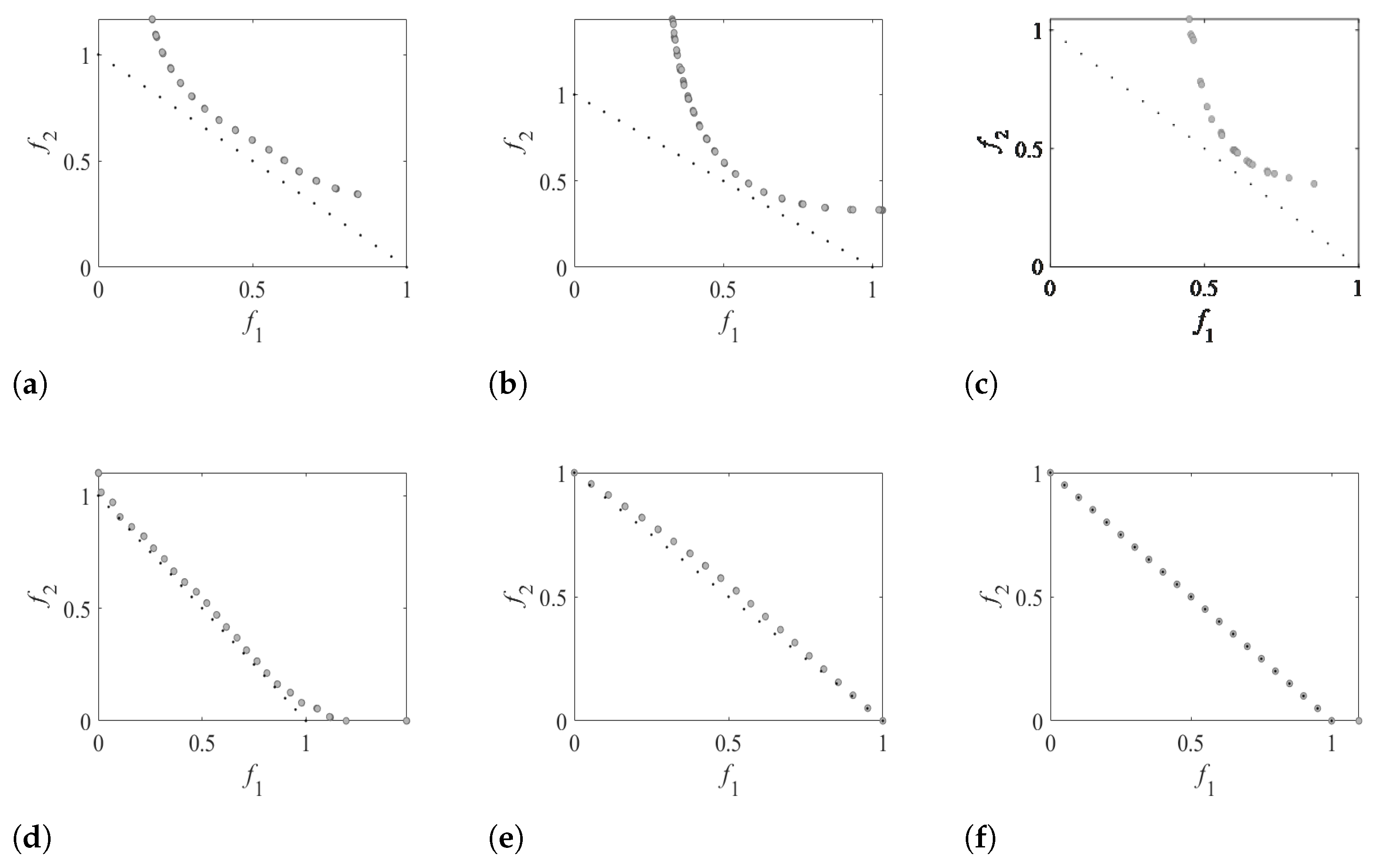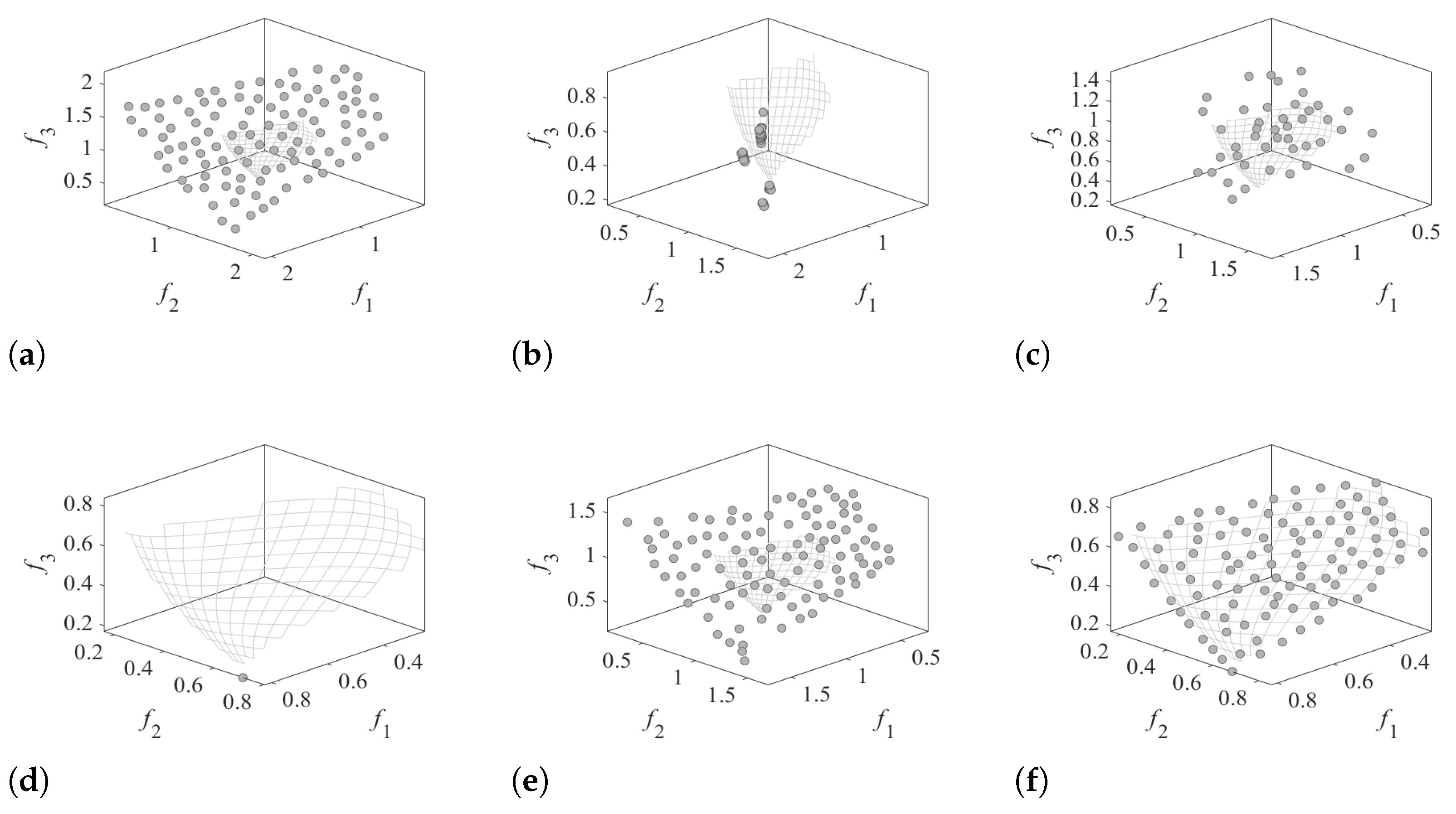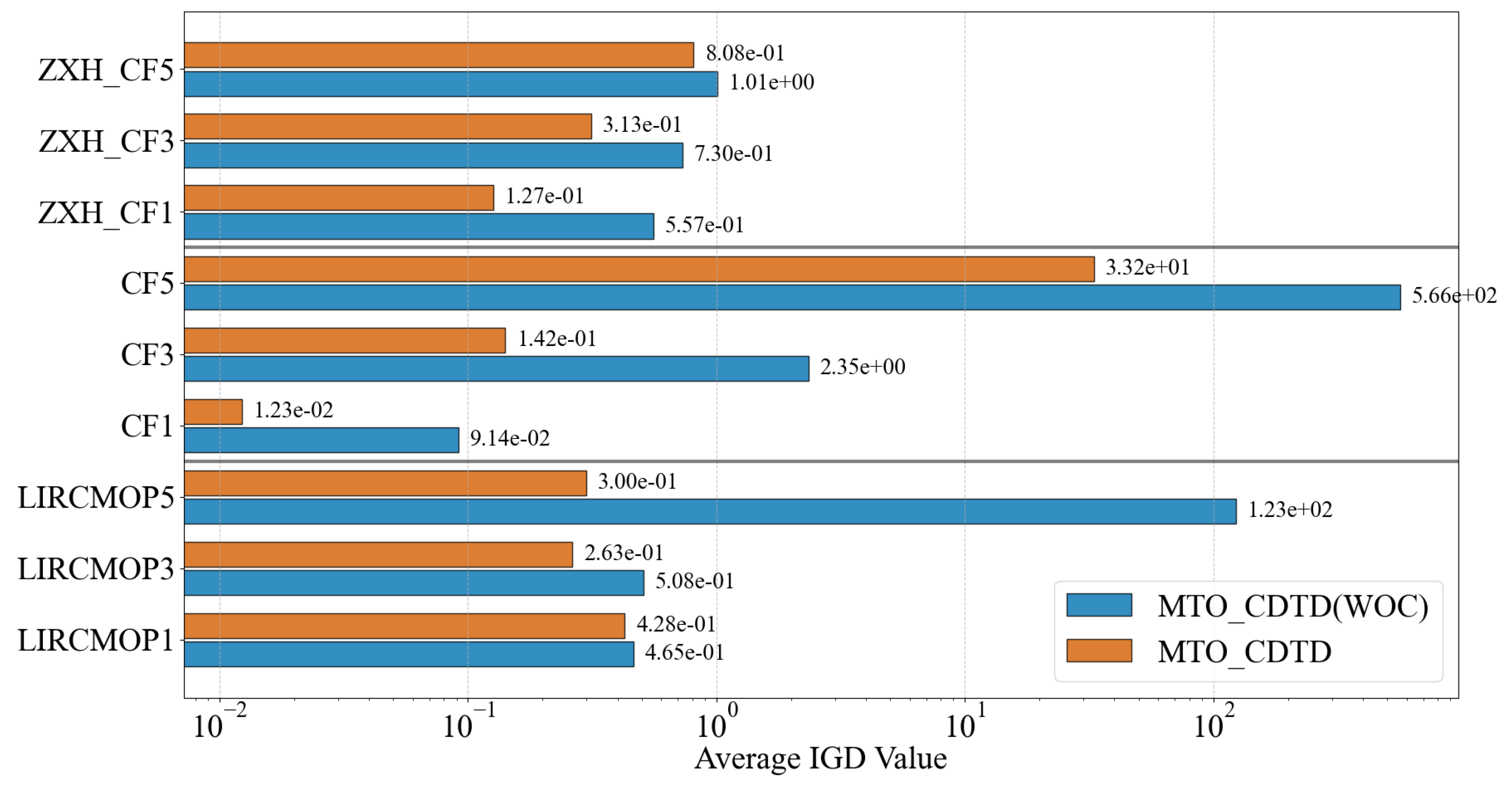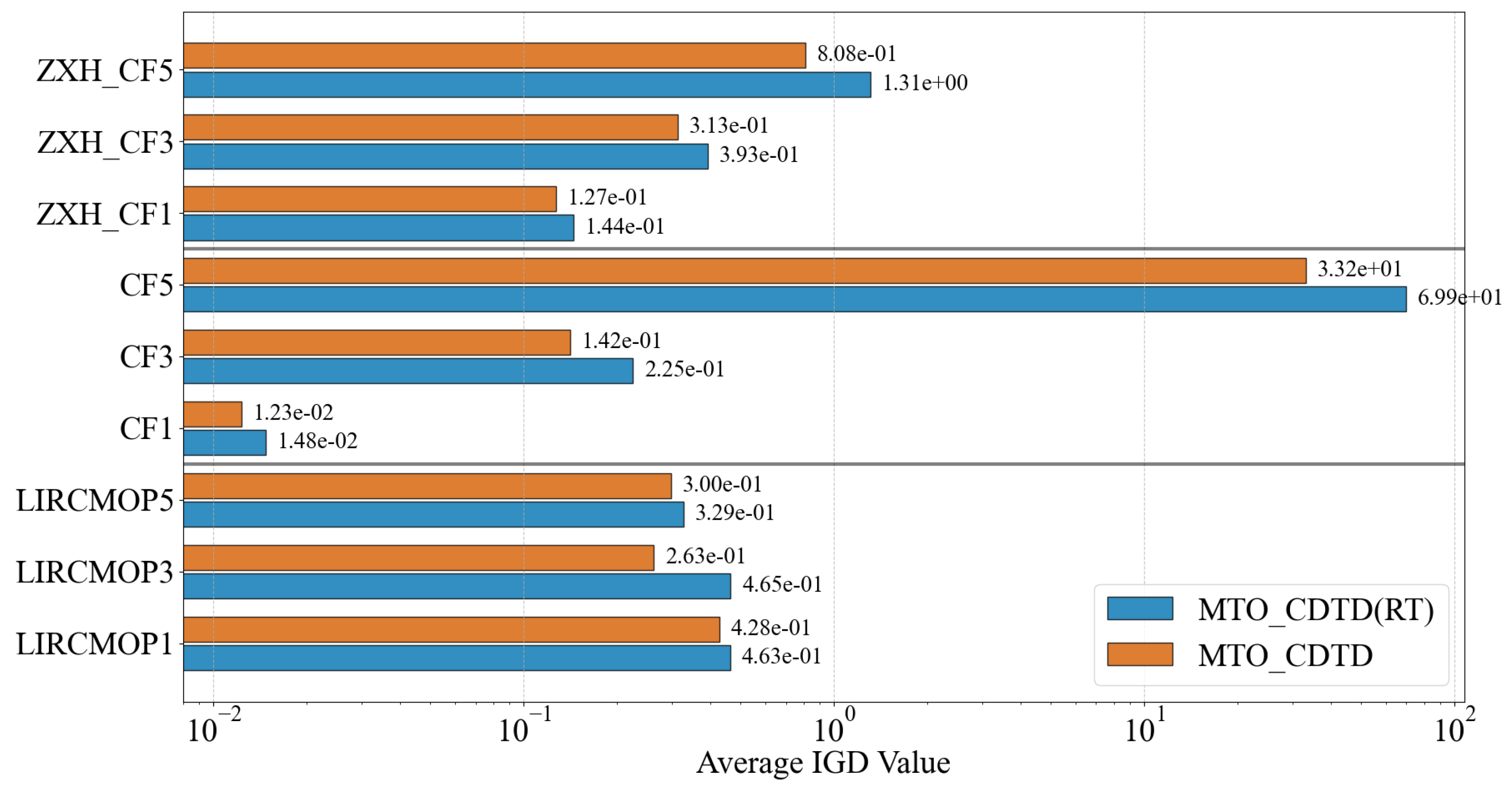


Contribution-Driven Task Design: Multi-Task Optimization Algorithm for Large-Scale Constrained Multi-Objective Problems

Abstract
1. Introduction
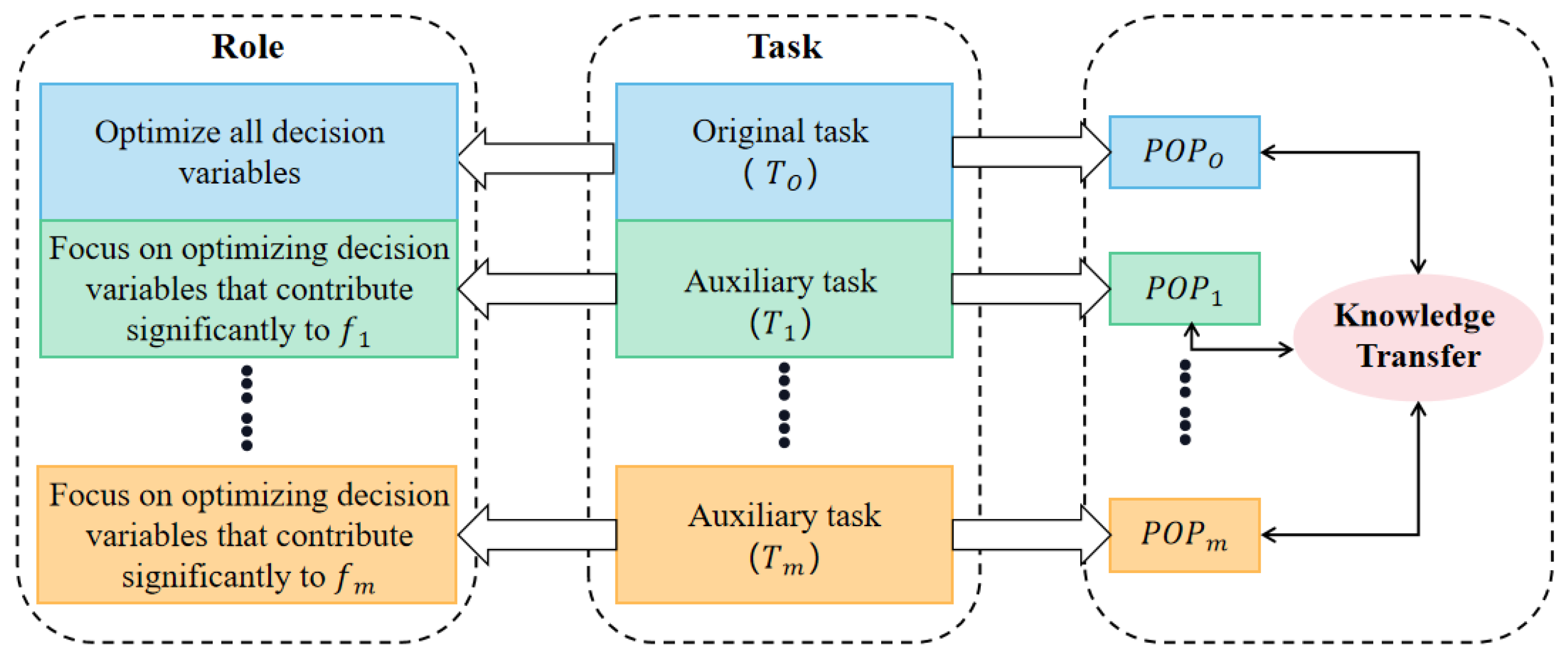
- A multi-task framework for LSMOPs is proposed, incorporating a contribution-driven task design technique. The framework consists of one original task (the original LSMOP task) and m auxiliary tasks (where m is the number of objective functions). The i-th auxiliary task optimizes only those decision variables that contribute significantly to the i-th objective function.
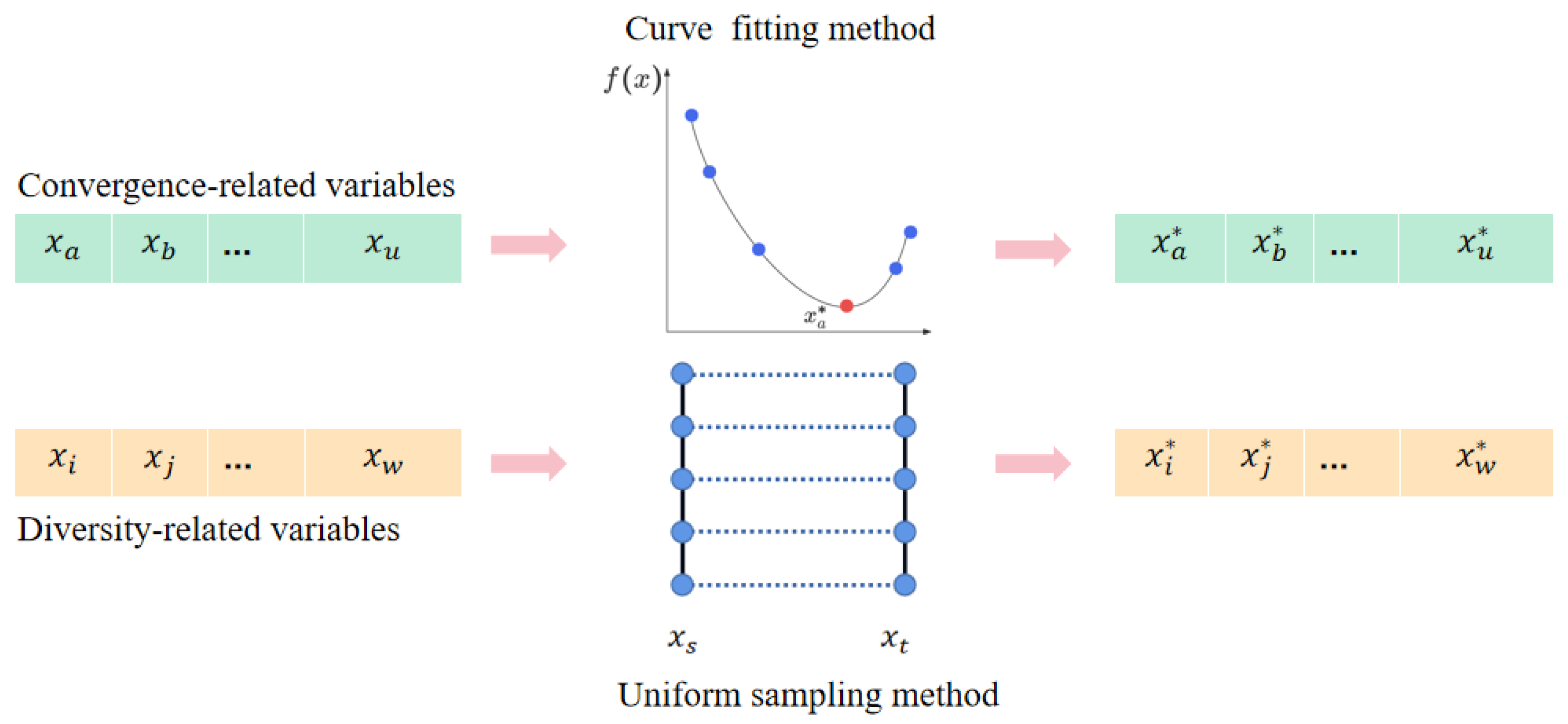
- An optimal contribution objective assignment strategy is proposed to assign each convergence-related decision variable to the objective function with the greatest contribution. The assignment results are used to determine the decision variables optimized by the auxiliary tasks and to generate the initial population for the auxiliary tasks.
- A contribution-guided initialization strategy is introduced to generate high-quality initial populations for auxiliary tasks in the large-scale decision space.
- A multi-population-based knowledge transfer strategy is proposed to improve the algorithm’s performance on the original LSMOP task by integrating useful information from multiple auxiliary tasks.
2. Related Works
2.1. Large-Scale Multi-Objective Evolutionary Algorithms
2.2. Large-Scale Constrained Multi-Objective Evolutionary Algorithms
2.3. MTO
3. The Proposed MTO-CDTD
3.1. Multi-Task Framework in MTO-CDTD
| Algorithm 1: Main Loop |
|
3.2. Optimal Contribution Objective Assignment Strategy
| Algorithm 2: Optimal contribution objective assignment strategy for decision variables |
|
3.3. Contribution-Guided Initialization Strategy
| Algorithm 3: Contribution-guided initialization strategy |
|
3.4. Multi-Population-Based Knowledge Transfer Strategy
| Algorithm 4: Procedure of the multi-population-based knowledge transfer strategy |
|
4. Experimental Results and Analysis
4.1. Experimental Setup
- (1)
- Comparative Algorithms
- (2)
- Benchmark test suites
- (3)
- Parameter settings
- (4)
- Performance metrics
4.2. Parameter Analysis in MTO-CDTD
4.3. Comparison Results and Analysis
- (1)
- LIRCMOP
- (2)
- CF
- (3)
- ZXH_CF
4.4. Comparison of Runtime
4.5. Ablation Study
4.5.1. Investigation of the Contribution-Guided Initialization Strategy
4.5.2. Investigation of the Multi-Population-Based Knowledge Transfer Strategy
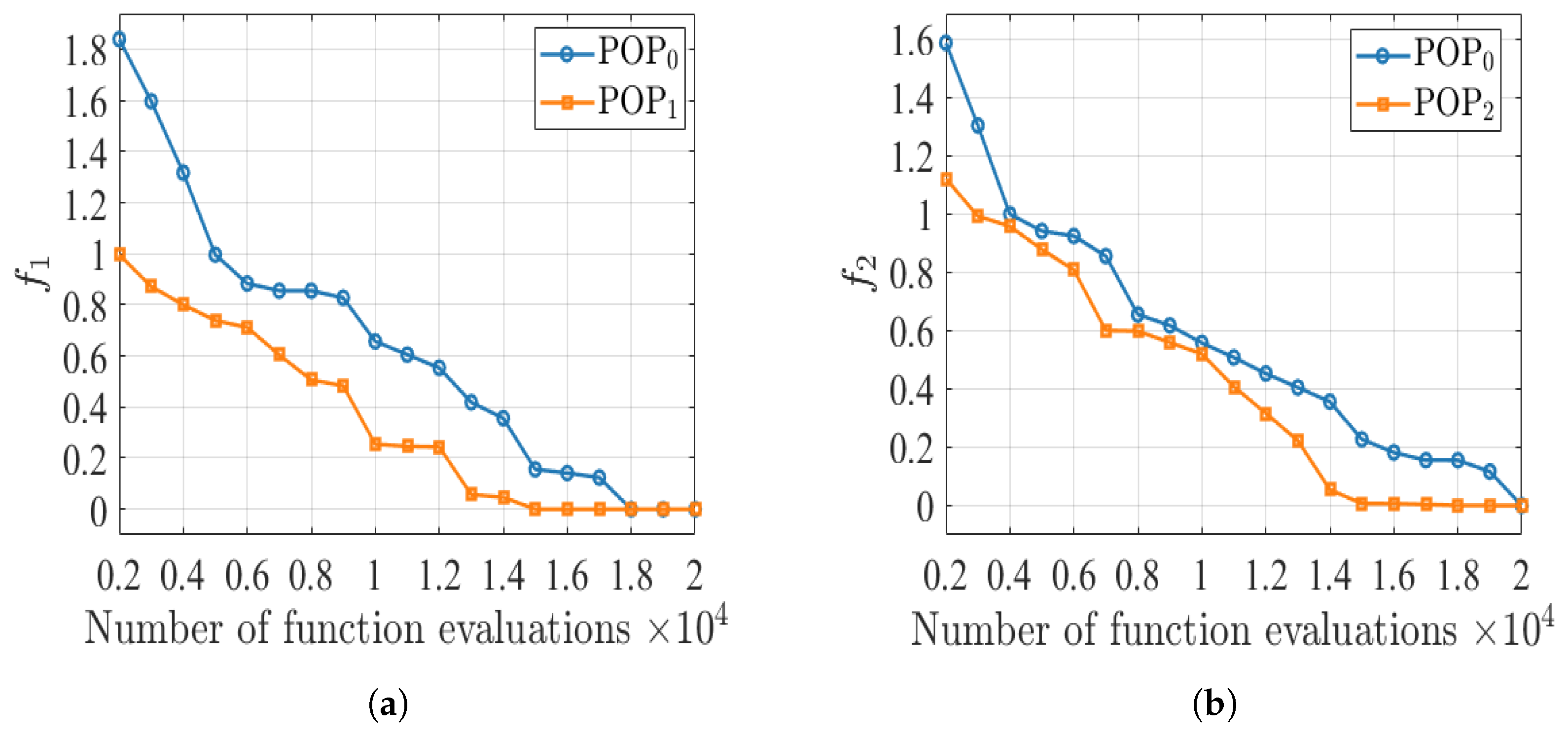
4.6. Validation of the Reliability of Optimal Contribution Objective Assignment Strategy
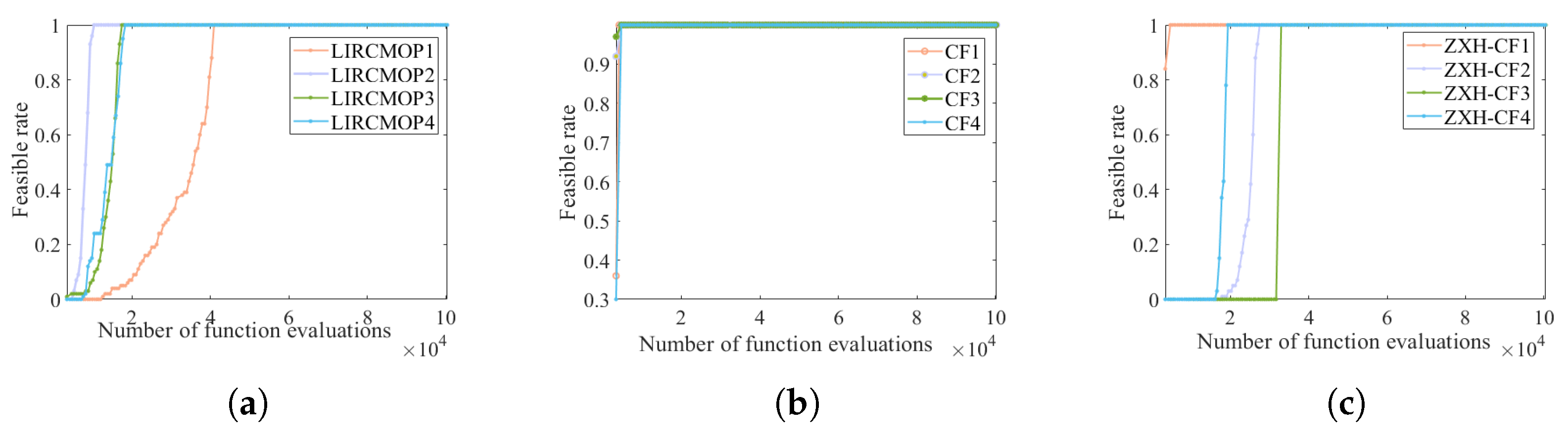
4.7. Analysis of the Feasible Solution Ratio During Population Iteration
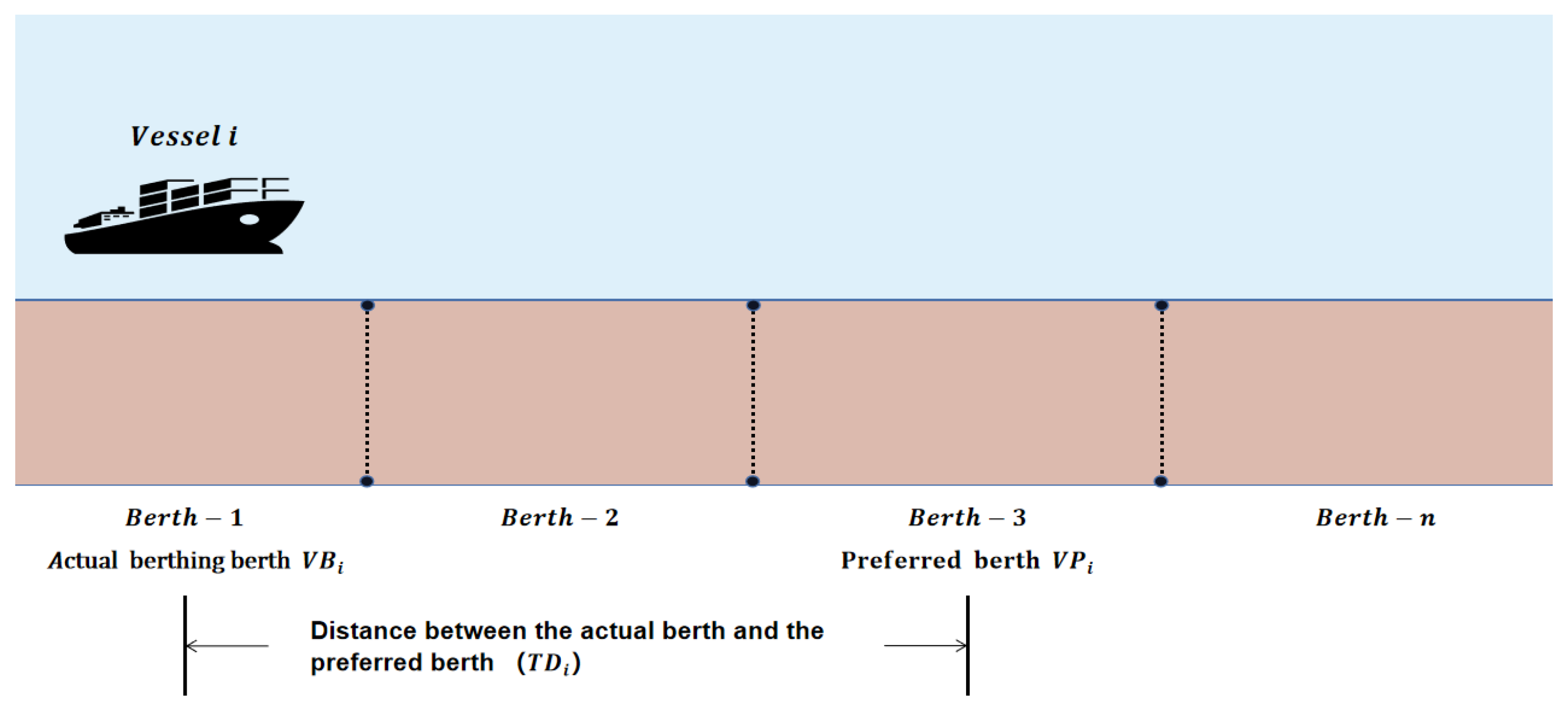
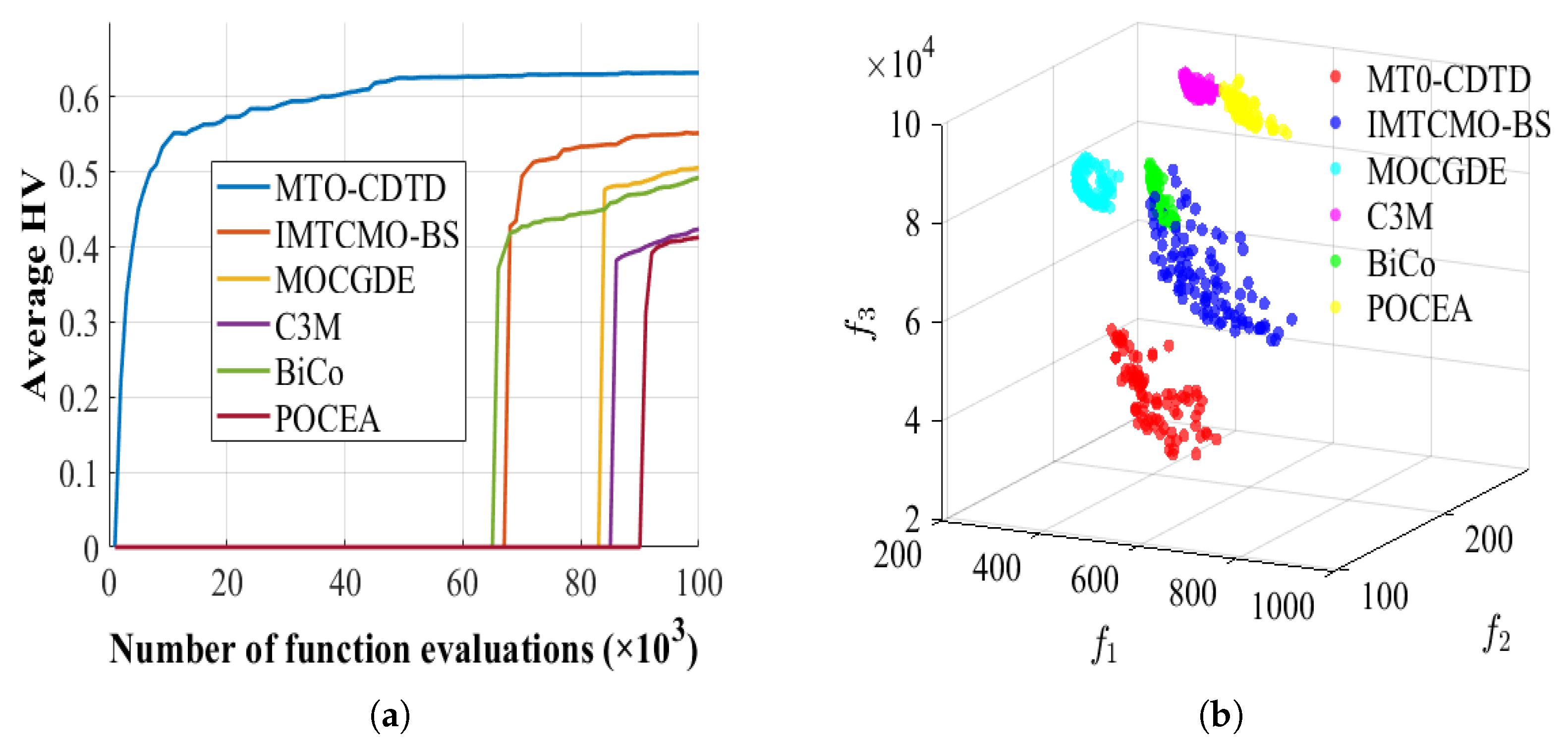
4.8. Application Study
- Parameters and Variables
- Objective functions
- Constraints
5. Conclusions
5.1. Summary of Research Work
5.2. Theoretical Analysis of Algorithms
- Convergence analysis: auxiliary tasks focus on optimizing high-contribution decision variables for specific objectives, reducing the search dimension of each subtask, and accelerating the convergence of local optimal solutions. Through the multi-population-based knowledge transfer strategy, the original task continuously absorbs high-quality information from auxiliary tasks, ensuring the search process advances toward the feasible region and the Pareto optimal front. According to evolutionary algorithm convergence theory, integrating elite individuals from multiple auxiliary tasks via SubPOP provides a mechanism for the original population to escape local optima—transferred information expands the search scope and increases the probability of approaching the global optimal region. Additionally, the environmental selection strategies adopted by the original task and auxiliary tasks prioritize retaining feasible solutions and potential high-quality infeasible individuals, ensuring the population consistently maintains the trend of objective value optimization and constraint satisfaction during iterations, laying the foundation for convergence.
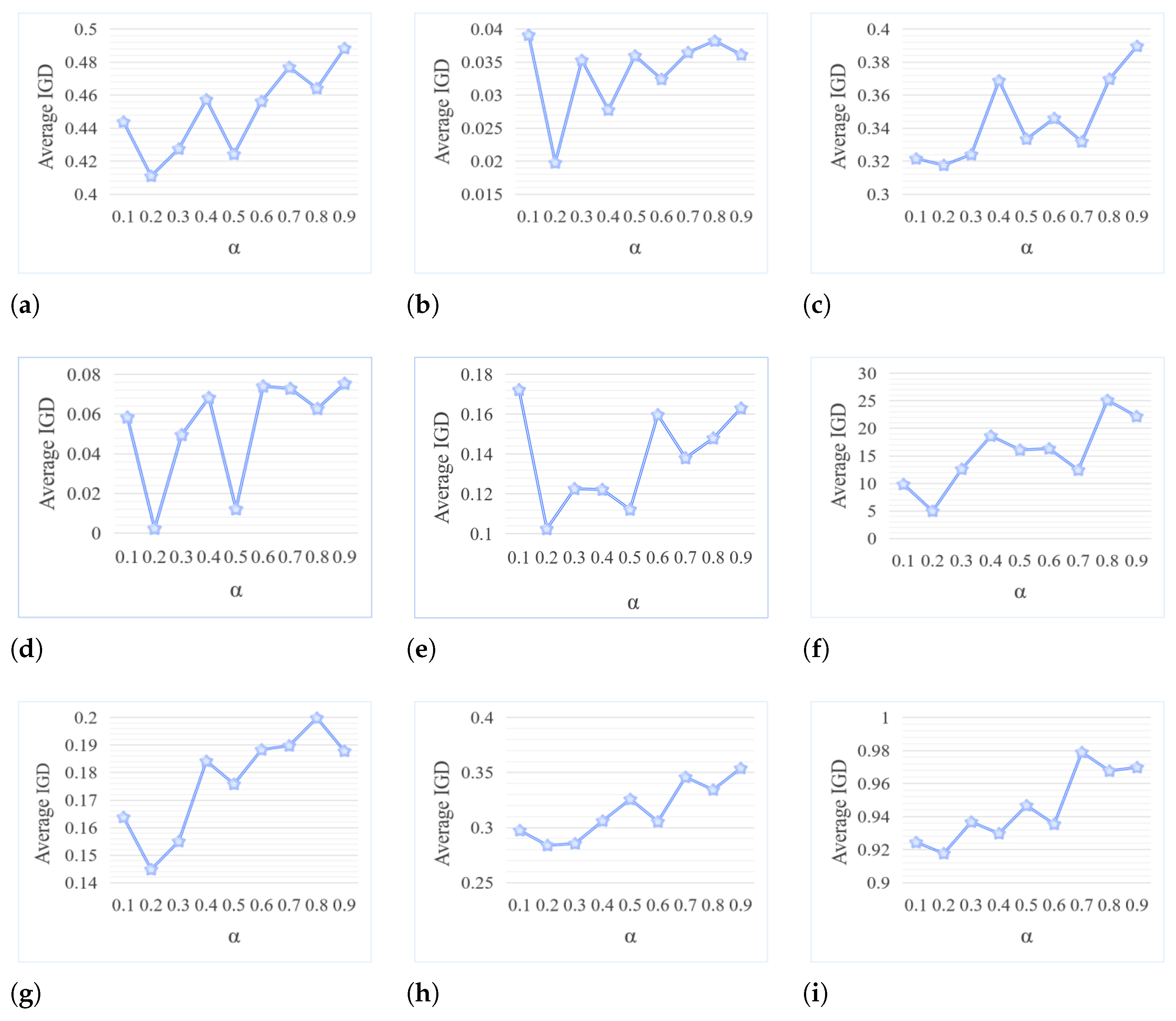
- Stability analysis: the optimal contribution objective assignment strategy classifies decision variables into convergence-related and diversity-related categories, and assigns them to appropriate tasks based on quantitative contribution degrees. This reduces interference between variables and avoids fluctuations in search direction caused by unstructured variable optimization. The contribution-guided initialization strategy generates high-quality initial populations for auxiliary tasks, ensuring the algorithm starts from an advantageous position and reducing the risk of premature convergence or divergence. Meanwhile, the knowledge transfer rate (set to 0.2 after parameter analysis) controls the proportion of information transfer, balancing the exploration capability of the original task and the exploitation efficiency of auxiliary tasks. It not only avoids instability caused by over-reliance on local information but also prevents convergence delays due to ineffective global search, thus guaranteeing the stability of the evolutionary process.
5.3. Future Work
Author Contributions
Funding
Institutional Review Board Statement
Informed Consent Statement
Data Availability Statement
Conflicts of Interest
References
- Ye, Q.; Wang, W.; Li, G.; Wang, Z. Dynamic-multi-task-assisted evolutionary algorithm for constrained multi-objective optimization. Swarm Evol. Comput. 2024, 90, 101683. [Google Scholar] [CrossRef]
- Neumann, A.; Neumann, F. Optimizing Monotone Chance-Constrained Submodular Functions Using Evolutionary Multiobjective Algorithms. Evol. Comput. 2024, 33, 363–393. [Google Scholar] [CrossRef] [PubMed]
- Wang, Y.; Cai, Z. Constrained evolutionary optimization by means of (μ + λ)-differential evolution and improved adaptive trade-off model. Evol. Comput. 2011, 19, 249–285. [Google Scholar] [CrossRef] [PubMed]
- Zhu, M.; Kong, M.; Wen, Y.; Gu, S.; Xue, B.; Huang, T. A multi-objective path planning method for ships based on constrained policy optimization. Ocean Eng. 2025, 319, 120165. [Google Scholar] [CrossRef]
- Yang, Z.; Deng, L.; Li, C.; Zhang, L. Optimization of Built-In Self-Test test chain configuration in 2.5 D Integrated Circuits Using Constrained Multi-Objective Evolutionary Algorithm. Eng. Appl. Artif. Intell. 2025, 143, 109876. [Google Scholar] [CrossRef]
- Ben Alla, H.; Ben Alla, S.; Ezzati, A.; Touhafi, A. A Novel, Self-Adaptive, Multiclass Priority Algorithm with VM Clustering for Efficient Cloud Resource Allocation. Computers 2025, 14, 81. [Google Scholar] [CrossRef]
- Jan, M.A.; Zhang, Q. MOEA/D for constrained multiobjective optimization: Some preliminary experimental results. In Proceedings of the 2010 UK Workshop on Computational Intelligence (UKCI), Colchester, UK, 8–10 September 2010; pp. 1–6. [Google Scholar]
- Ali, M.M.; Zhu, W. A penalty function-based differential evolution algorithm for constrained global optimization. Comput. Optim. Appl. 2013, 54, 707–739. [Google Scholar] [CrossRef]
- Fan, Z.; Li, W.; Cai, X.; Hu, K.; Lin, H.; Li, H. Angle-based constrained dominance principle in MOEA/D for constrained multi-objective optimization problems. In Proceedings of the 2016 IEEE Congress on Evolutionary Computation (CEC), Vancouver, BC, Canada, 24–29 July 2016; pp. 460–467. [Google Scholar]
- Deb, K.; Pratap, A.; Agarwal, S.; Meyarivan, T. A fast and elitist multiobjective genetic algorithm: NSGA-II. IEEE Trans. Evol. Comput. 2002, 6, 182–197. [Google Scholar] [CrossRef]
- Takahama, T.; Sakai, S. Constrained optimization by the ε constrained differential evolution with an archive and gradient-based mutation. In Proceedings of the IEEE Congress on Evolutionary Computation, Barcelona, Spain, 18–23 July 2010; pp. 1–9. [Google Scholar]
- Fan, Z.; Li, W.; Cai, X.; Huang, H.; Fang, Y.; You, Y.; Mo, J.; Wei, C.; Goodman, E. An improved epsilon constraint-handling method in MOEA/D for CMOPs with large infeasible regions. arXiv 2017, arXiv:1707.08767. [Google Scholar] [CrossRef]
- Qiao, K.; Yu, K.; Qu, B.; Liang, J.; Song, H.; Yue, C.; Lin, H.; Tan, K.C. Dynamic auxiliary task-based evolutionary multitasking for constrained multiobjective optimization. IEEE Trans. Evol. Comput. 2022, 27, 642–656. [Google Scholar] [CrossRef]
- Runarsson, T.P.; Yao, X. Stochastic ranking for constrained evolutionary optimization. IEEE Trans. Evol. Comput. 2000, 4, 284–294. [Google Scholar] [CrossRef]
- Lara, A.; Uribe, L.; Alvarado, S.; Sosa, V.A.; Wang, H.; Schütze, O. On the choice of neighborhood sampling to build effective search operators for constrained MOPs. Memetic Comput. 2019, 11, 155–173. [Google Scholar] [CrossRef]
- Xu, B.; Duan, W.; Zhang, H.; Li, Z. Differential evolution with infeasible-guiding mutation operators for constrained multi-objective optimization. Appl. Intell. 2020, 50, 4459–4481. [Google Scholar] [CrossRef]
- Ming, F.; Gong, W.; Wang, L.; Jin, Y. Constrained multi-objective optimization with deep reinforcement learning assisted operator selection. IEEE CAA J. Autom. Sin. 2024, 11, 919–931. [Google Scholar] [CrossRef]
- Uribe, L.; Lara, A.; Deb, K.; Schütze, O. A new gradient free local search mechanism for constrained multi-objective optimization problems. Swarm Evol. Comput. 2021, 67, 100938. [Google Scholar] [CrossRef]
- Morovati, V.; Pourkarimi, L. Extension of Zoutendijk method for solving constrained multiobjective optimization problems. Eur. J. Oper. Res. 2019, 273, 44–57. [Google Scholar] [CrossRef]
- Peng, Y.; Qiu, R.; Zhao, W.; Zhang, F.; Liao, Q.; Liang, Y.; Fu, G.; Yang, Y. Efficient energy optimization of large-scale natural gas pipeline network: An advanced decomposition optimization strategy. Chem. Eng. Sci. 2025, 309, 121456. [Google Scholar] [CrossRef]
- He, R.; Xie, Y.; Zhang, S.; Xu, F.; Long, J. Knowledge-assisted hybrid optimization strategy of large-scale crude oil scheduling integrated production planning. Comput. Chem. Eng. 2025, 192, 108904. [Google Scholar] [CrossRef]
- Zhou, S.Z.; Zhan, Z.H.; Chen, Z.G.; Kwong, S.; Zhang, J. A multi-objective ant colony system algorithm for airline crew rostering problem with fairness and satisfaction. IEEE Trans. Intell. Transp. Syst. 2020, 22, 6784–6798. [Google Scholar] [CrossRef]
- Yu, Q.; Yang, C.; Dai, G.; Peng, L.; Chen, X. Synchronous wireless sensor and sink placement method using dual-population co-evolutionary constrained multiobjective optimization algorithm. IEEE Trans. Ind. Inform. 2022, 19, 7561–7571. [Google Scholar] [CrossRef]
- Li, X.; Wang, W.; Wang, H.; Wu, J.; Fan, X.; Xu, Q. Dynamic environmental economic dispatch of hybrid renewable energy systems based on tradable green certificates. Energy 2020, 193, 116699. [Google Scholar] [CrossRef]
- Gupta, A.; Ong, Y.S.; Feng, L. Multifactorial evolution: Toward evolutionary multitasking. IEEE Trans. Evol. Comput. 2015, 20, 343–357. [Google Scholar] [CrossRef]
- Chen, K.; Xue, B.; Zhang, M.; Zhou, F. Evolutionary multitasking for feature selection in high-dimensional classification via particle swarm optimization. IEEE Trans. Evol. Comput. 2021, 26, 446–460. [Google Scholar] [CrossRef]
- Song, Q.; Zheng, Y.J.; Yang, J.; Huang, Y.J.; Sheng, W.G.; Chen, S.Y. Predicting demands of COVID-19 prevention and control materials via co-evolutionary transfer learning. IEEE Trans. Cybern. 2022, 53, 3859–3872. [Google Scholar] [CrossRef] [PubMed]
- Zhang, N.; Gupta, A.; Chen, Z.; Ong, Y.S. Evolutionary machine learning with minions: A case study in feature selection. IEEE Trans. Evol. Comput. 2021, 26, 130–144. [Google Scholar] [CrossRef]
- Zhang, F.; Mei, Y.; Nguyen, S.; Tan, K.C.; Zhang, M. Task relatedness-based multitask genetic programming for dynamic flexible job shop scheduling. IEEE Trans. Evol. Comput. 2022, 27, 1705–1719. [Google Scholar] [CrossRef]
- Qiao, K.; Yu, K.; Qu, B.; Liang, J.; Song, H.; Yue, C. An evolutionary multitasking optimization framework for constrained multiobjective optimization problems. IEEE Trans. Evol. Comput. 2022, 26, 263–277. [Google Scholar] [CrossRef]
- Ming, F.; Gong, W.; Wang, L.; Gao, L. Constrained multiobjective optimization via multitasking and knowledge transfer. IEEE Trans. Evol. Comput. 2022, 28, 77–89. [Google Scholar] [CrossRef]
- Tian, Y.; Si, L.; Zhang, X.; Cheng, R.; He, C.; Tan, K.C.; Jin, Y. Evolutionary large-scale multi-objective optimization: A survey. ACM Comput. Surv. CSUR 2021, 54, 1–34. [Google Scholar] [CrossRef]
- Liu, J.; Sarker, R.; Elsayed, S.; Essam, D.; Siswanto, N. Large-scale evolutionary optimization: A review and comparative study. Swarm Evol. Comput. 2024, 85, 101466. [Google Scholar] [CrossRef]
- Hong, W.J.; Yang, P.; Tang, K. Evolutionary computation for large-scale multi-objective optimization: A decade of progresses. Int. J. Autom. Comput. 2021, 18, 155–169. [Google Scholar] [CrossRef]
- Zhang, X.; Tian, Y.; Cheng, R.; Jin, Y. A decision variable clustering-based evolutionary algorithm for large-scale many-objective optimization. IEEE Trans. Evol. Comput. 2016, 22, 97–112. [Google Scholar] [CrossRef]
- Liu, S.; Lin, Q.; Tian, Y.; Tan, K.C. A variable importance-based differential evolution for large-scale multiobjective optimization. IEEE Trans. Cybern. 2021, 52, 13048–13062. [Google Scholar] [CrossRef]
- Ma, L.; Huang, M.; Yang, S.; Wang, R.; Wang, X. An adaptive localized decision variable analysis approach to large-scale multiobjective and many-objective optimization. IEEE Trans. Cybern. 2021, 52, 6684–6696. [Google Scholar] [CrossRef] [PubMed]
- Meselhi, M.; Sarker, R.; Essam, D.; Elsayed, S. A decomposition approach for large-scale non-separable optimization problems. Appl. Soft Comput. 2022, 115, 108168. [Google Scholar] [CrossRef]
- He, C.; Cheng, R.; Li, L.; Tan, K.C.; Jin, Y. Large-scale multiobjective optimization via reformulated decision variable analysis. IEEE Trans. Evol. Comput. 2022, 28, 47–61. [Google Scholar] [CrossRef]
- Chen, L.; Zhang, J.; Wu, L.; Cai, X.; Xu, Y. Large-ScaleMulti-Objective Optimization Algorithm Based on Weighted Overlapping Grouping of Decision Variables. Comput. Model. Eng. Sci. 2024, 140, 363–383. [Google Scholar]
- Xu, Y.; Xu, C.; Zhang, H.; Huang, L.; Liu, Y.; Nojima, Y.; Zeng, X. A multi-population multi-objective evolutionary algorithm based on the contribution of decision variables to objectives for large-scale multi/many-objective optimization. IEEE Trans. Cybern. 2022, 53, 6998–7007. [Google Scholar] [CrossRef]
- Zille, H.; Ishibuchi, H.; Mostaghim, S.; Nojima, Y. A framework for large-scale multiobjective optimization based on problem transformation. IEEE Trans. Evol. Comput. 2017, 22, 260–275. [Google Scholar] [CrossRef]
- Li, Y.; Li, L.; Lin, Q.; Wong, K.C.; Ming, Z.; Coello, C.A.C. A self-organizing weighted optimization based framework for large-scale multi-objective optimization. Swarm Evol. Comput. 2022, 72, 101084. [Google Scholar] [CrossRef]
- Wang, H.; Zhu, S.; Fang, W. A clustering-based weighted optimization algorithm for large-scale multi-objective optimization problems: H. Wang et al. Memetic Comput. 2025, 17, 34. [Google Scholar] [CrossRef]
- Xiong, Z.; Wang, X.; Li, Y.; Feng, W.; Liu, Y. A problem transformation-based and decomposition-based evolutionary algorithm for large-scale multiobjective optimization. Appl. Soft Comput. 2024, 150, 111081. [Google Scholar] [CrossRef]
- Yang, X.; Zou, J.; Yang, S.; Zheng, J.; Liu, Y. A fuzzy decision variables framework for large-scale multiobjective optimization. IEEE Trans. Evol. Comput. 2021, 27, 445–459. [Google Scholar] [CrossRef]
- Sun, Y.; Jiang, D. An improved problem transformation algorithm for large-scale multi-objective optimization. Swarm Evol. Comput. 2024, 89, 101622. [Google Scholar] [CrossRef]
- Zhu, S.; Wang, W.; Fang, W.; Cui, M. Critical vector based evolutionary algorithm for large-scale multi-objective optimization. Clust. Comput. 2025, 28, 190. [Google Scholar] [CrossRef]
- Shang, Q.; Tan, M.; Hu, R.; Huang, Y.; Qian, B.; Feng, L. A multi-stage competitive swarm optimization algorithm for solving large-scale multi-objective optimization problems. Expert Syst. Appl. 2025, 260, 125411. [Google Scholar] [CrossRef]
- Cao, J.; Guo, K.; Zhang, J.; Chen, Z. A dual-stage large-scale multi-objective evolutionary algorithm with dynamic learning strategy. Expert Syst. Appl. 2023, 226, 120184. [Google Scholar] [CrossRef]
- Guo, W.; Li, S.; Dai, F.; Wang, J.; Zhang, M. A two-stage large-scale multi-objective optimization approach incorporating adaptive entropy and enhanced competitive swarm optimizer. Expert Syst. Appl. 2025, 278, 127374. [Google Scholar] [CrossRef]
- Wang, H.; Chen, L.; Hao, X.; Yu, T.; Qian, Y.; Yang, R.; Liu, W. Meta-knowledge-assisted sampling with variable sorting for large-scale multi-objective optimization. Appl. Soft Comput. 2025, 181, 113386. [Google Scholar] [CrossRef]
- Wang, H.; Chen, L.; Hao, X.; Qu, R.; Zhou, W.; Wang, D.; Liu, W. Learning-guided cross-sampling for large-scale evolutionary multi-objective optimization. Swarm Evol. Comput. 2024, 91, 101763. [Google Scholar] [CrossRef]
- Zhang, W.; Wang, S.; Li, G.; Zhang, W.; Wang, X. A dual-sampling based evolutionary algorithm for large-scale multi-objective optimization. Appl. Soft Comput. 2024, 167, 112344. [Google Scholar] [CrossRef]
- Li, L.; He, C.; Cheng, R.; Li, H.; Pan, L.; Jin, Y. A fast sampling based evolutionary algorithm for million-dimensional multiobjective optimization. Swarm Evol. Comput. 2022, 75, 101181. [Google Scholar] [CrossRef]
- Liu, Z.; Han, F.; Ling, Q.; Han, H.; Jiang, J. A fast interpolation-based multi-objective evolutionary algorithm for large-scale multi-objective optimization problems. Soft Comput. 2024, 28, 6475–6499. [Google Scholar] [CrossRef]
- Wu, Y.; Yang, N.; Chen, L.; Tian, Y.; Tang, Z. Directed quick search guided evolutionary framework for large-scale multi-objective optimization problems. Expert Syst. Appl. 2024, 239, 122370. [Google Scholar] [CrossRef]
- Lu, Y.; Li, B.; Liu, S.; Zhou, A. A population cooperation based particle swarm optimization algorithm for large-scale multi-objective optimization. Swarm Evol. Comput. 2023, 83, 101377. [Google Scholar] [CrossRef]
- Madani, A.; Engelbrecht, A.; Ombuki-Berman, B. Cooperative coevolutionary multi-guide particle swarm optimization algorithm for large-scale multi-objective optimization problems. Swarm Evol. Comput. 2023, 78, 101262. [Google Scholar] [CrossRef]
- Zhang, W.; Wang, S.; Li, G.; Zhang, W. Cooperative tri-population based evolutionary algorithm for large-scale multi-objective optimization. Expert Syst. Appl. 2023, 227, 120290. [Google Scholar] [CrossRef]
- Ge, Y.; Wang, Z.; Wang, H.; Cheng, F.; Zhang, L. Auxiliary optimization framework based on scaling transformation matrix for large-scale multi-objective problem. Swarm Evol. Comput. 2025, 95, 101931. [Google Scholar] [CrossRef]
- Liu, S.; Lin, Q.; Feng, L.; Wong, K.C.; Tan, K.C. Evolutionary multitasking for large-scale multiobjective optimization. IEEE Trans. Evol. Comput. 2022, 27, 863–877. [Google Scholar] [CrossRef]
- Cui, Z.; Wu, Y.; Zhao, T.; Zhang, W.; Chen, J. A two-stage accelerated search strategy for large-scale multi-objective evolutionary algorithm. Inf. Sci. 2025, 686, 121347. [Google Scholar] [CrossRef]
- Wang, M.; Li, X.; Chen, L.; Chen, H.; Chen, C.; Liu, M. A deep-based Gaussian mixture model algorithm for large-scale many objective optimization. Appl. Soft Comput. 2025, 172, 112874. [Google Scholar] [CrossRef]
- He, C.; Cheng, R.; Tian, Y.; Zhang, X.; Tan, K.C.; Jin, Y. Paired offspring generation for constrained large-scale multiobjective optimization. IEEE Trans. Evol. Comput. 2020, 25, 448–462. [Google Scholar] [CrossRef]
- Fan, C.; Wang, J.; Yang, L.T.; Xiao, L.; Ai, Z. Efficient constrained large-scale multi-objective optimization based on reference vector-guided evolutionary algorithm. Appl. Intell. 2023, 53, 21027–21049. [Google Scholar] [CrossRef]
- Wang, Q.; Li, T.; Meng, F.; Li, B. A framework for constrained large-scale multi-objective white-box problems based on two-scale optimization through decision transfer. Inf. Sci. 2024, 665, 120411. [Google Scholar] [CrossRef]
- Si, L.; Zhang, X.; Zhang, Y.; Yang, S.; Tian, Y. An efficient sampling approach to offspring generation for evolutionary large-scale constrained multi-objective optimization. IEEE Trans. Emerg. Top. Comput. Intell. 2025, 9, 2080–2092. [Google Scholar] [CrossRef]
- Wang, Q.; Xi, Y.; Zhang, Q.; Li, T.; Li, B. Hierarchical optimization by spatial-temporal indictor in multi-scale decision pyramid for constrained large-scale multi-objective problems. Expert Syst. Appl. 2024, 257, 125068. [Google Scholar] [CrossRef]
- Tian, Y.; Chen, H.; Ma, H.; Zhang, X.; Tan, K.C.; Jin, Y. Integrating conjugate gradients into evolutionary algorithms for large-scale continuous multi-objective optimization. IEEE CAA J. Autom. Sin. 2022, 9, 1801–1817. [Google Scholar] [CrossRef]
- Ban, X.; Liang, J.; Yu, K.; Qiao, K.; Suganthan, P.N.; Wang, Y. A Subspace Search-Based Evolutionary Algorithm for Large-Scale Constrained Multiobjective Optimization and Application. IEEE Trans. Cybern. 2025, 55, 2486–2499. [Google Scholar] [CrossRef]
- Qiao, K.; Liang, J.; Yu, K.; Guo, W.; Yue, C.; Qu, B.; Suganthan, P.N. Benchmark problems for large-scale constrained multi-objective optimization with baseline results. Swarm Evol. Comput. 2024, 86, 101504. [Google Scholar] [CrossRef]
- Chen, H.; Liu, H.L.; Gu, F.; Tan, K.C. A multiobjective multitask optimization algorithm using transfer rank. IEEE Trans. Evol. Comput. 2022, 27, 237–250. [Google Scholar] [CrossRef]
- Zhang, F.; Mei, Y.; Nguyen, S.; Zhang, M.; Tan, K.C. Surrogate-assisted evolutionary multitask genetic programming for dynamic flexible job shop scheduling. IEEE Trans. Evol. Comput. 2021, 25, 651–665. [Google Scholar] [CrossRef]
- Tang, Q.; Meng, K.; Cheng, L.; Zhang, Z. An improved multi-objective multifactorial evolutionary algorithm for assembly line balancing problem considering regular production and preventive maintenance scenarios. Swarm Evol. Comput. 2022, 68, 101021. [Google Scholar] [CrossRef]
- Zitzler, E.; Laumanns, M.; Thiele, L. SPEA2: Improving the strength Pareto evolutionary algorithm. TIK Rep. 2001, 103. [Google Scholar] [CrossRef]
- Sun, R.; Zou, J.; Liu, Y.; Yang, S.; Zheng, J. A multistage algorithm for solving multiobjective optimization problems with multiconstraints. IEEE Trans. Evol. Comput. 2022, 27, 1207–1219. [Google Scholar] [CrossRef]
- Liu, Z.Z.; Wang, B.C.; Tang, K. Handling constrained multiobjective optimization problems via bidirectional coevolution. IEEE Trans. Cybern. 2021, 52, 10163–10176. [Google Scholar] [CrossRef]
- Tian, Y.; Cheng, R.; Zhang, X.; Jin, Y. PlatEMO: A MATLAB platform for evolutionary multi-objective optimization [educational forum]. IEEE Comput. Intell. Mag. 2017, 12, 73–87. [Google Scholar] [CrossRef]
- Coello, C.A.C.; Cortés, N.C. Solving multiobjective optimization problems using an artificial immune system. Genet. Program. Evolvable Mach. 2005, 6, 163–190. [Google Scholar] [CrossRef]
- Zitzler, E.; Thiele, L. Multiobjective evolutionary algorithms: A comparative case study and the strength Pareto approach. IEEE Trans. Evol. Comput. 2002, 3, 257–271. [Google Scholar] [CrossRef]
- García, S.; Fernández, A.; Luengo, J.; Herrera, F. A study of statistical techniques and performance measures for genetics-based machine learning: Accuracy and interpretability. Soft Comput. 2009, 13, 959–977. [Google Scholar] [CrossRef]



| Algorithm | Parameter Settings | Reference |
|---|---|---|
| C3M | The proportion of entering the third stage at the latest . | [77] |
| BiCo | Probability of crossover ; Mutation probability (where n is the number of decision variables); Distribution indexes of crossover operator and mutation operator are 20. | [78] |
| IMTCMO_BS | Sampling execution frequency ; Probability of crossover ; Scaling factor (both randomly selected per individual); Probability of mutation (where n is the number of decision variables); Distribution index of mutation operator . | [72] |
| MOCGDE | Small population size . | [70] |
| POCEA | Neighborhood size ; Probability of mutation (where n is the number of decision variables); Distribution index of mutation operator . | [65] |
| MTO-CDTD | Knowledge transfer rate ; Probability of crossover is 1; Scaling factor F is 0.5; Probability of mutation (where n is the number of decision variables); Distribution index of mutation operator . |
| Problem | D | BiCo | C3M | POCEA | MOCGDE | IMTCMO_BS | MTO-CDTD |
|---|---|---|---|---|---|---|---|
| LIRCMOP1 | 100 | 3.4069e-1 (8.38e-3) = | 3.3807e-1 (1.65e-2) = | 3.6853e-1 (0.00e+0) = | 3.1923e-1 (1.96e-2) = | 3.4840e-1 (8.65e-2) | |
| 500 | 3.5254e-1 (3.26e-3) = | 3.4955e-1 (5.52e-3) = | 3.4593e-1 (2.98e-3) = | 4.1106e-1 (1.17e-1) | |||
| 1000 | 3.5617e-1 (2.70e-3) + | 3.5537e-1 (4.91e-3) + | 3.5048e-1 (2.12e-3) + | 4.2815e-1 (9.45e-2) | |||
| LIRCMOP2 | 100 | 2.9512e-1 (8.28e-3) − | 2.8408e-1 (1.39e-2) − | 2.8443e-1 (1.73e-2) − | 2.9588e-1 (4.27e-2) − | 1.3484e-1 (9.00e-2) − | 1.2990e-1 (1.76e-1) |
| 500 | 3.1312e-1 (4.20e-3) − | 3.1557e-1 (2.12e-3) − | 3.0504e-1 (8.33e-3) − | 2.0937e-2 (1.00e-2) − | 7.5287e-3 (8.68e-3) | ||
| 1000 | 7.1389e-2 (2.62e-2) = | 2.2591e-1 (1.82e-1) | |||||
| LIRCMOP3 | 100 | 3.3632e-1 (8.47e-3) − | 3.3198e-1 (1.74e-2) − | 3.3260e-1 (2.69e-2) − | 3.5951e-1 (1.09e-2) = | 1.7320e-1 (1.09e-1) = | 2.2146e-1 (1.64e-1) |
| 500 | 3.4515e-1 (3.51e-3) − | 3.4378e-1 (3.47e-3) − | 3.4806e-1 (4.96e-3) − | 2.4977e-2 (1.69e-2) − | 1.9785e-2 (6.75e-2) | ||
| 1000 | 3.4868e-1 (1.77e-3) = | 3.4779e-1 (1.10e-3) = | 3.4800e-1 (3.66e-3) = | 1.4691e-2 (1.11e-2) = | 2.6313e-1 (2.27e-1) | ||
| LIRCMOP4 | 100 | 3.1332e-1 (4.47e-3) + | 3.0288e-1 (2.27e-2) + | 3.1909e-1 (1.50e-2) + | 3.0256e-1 (4.40e-2) = | 1.7709e-1 (1.12e-1) + | 3.3967e-1 (1.56e-1) |
| 500 | 3.2104e-1 (2.05e-3) = | 3.1756e-1 (2.85e-3) = | 3.1941e-1 (4.65e-3) = | 2.9281e-2 (1.37e-2) + | 2.4630e-1 (1.91e-1) | ||
| 1000 | 3.2244e-1 (2.27e-3) = | 3.2103e-1 (1.48e-3) = | 3.2155e-1 (3.29e-3) = | 1.1716e-2 (5.77e-3) = | 1.9866e-1 (2.10e-1) | ||
| LIRCMOP5 | 100 | 2.5734e+0 (3.21e-3) − | 2.5941e+1 (2.48e+0) − | 1.8846e+0 (6.62e-1) − | 2.1416e+1 (1.41e+1) − | 1.0525e+1 (3.51e+0) − | 3.3924e-1 (1.27e-1) |
| 500 | 2.5899e+0 (1.32e-2) − | 1.8969e+2 (1.46e+1) − | 2.5795e+0 (2.71e-3) − | 1.4552e+2 (7.35e+1) − | 1.4740e+2 (2.83e+1) − | 3.1766e-1 (1.49e-1) | |
| 1000 | 2.7315e+0 (2.81e-1) − | 4.3011e+2 (1.84e+1) − | 2.5892e+0 (6.94e-3) − | 3.7381e+2 (1.38e+2) − | 3.7914e+2 (3.22e+1) − | 2.9967e-1 (1.23e-1) | |
| LIRCMOP6 | 100 | 2.7586e+0 (1.73e-3) − | 2.7063e+1 (2.62e+0) − | 1.8400e+0 (6.69e-1) − | 1.9474e+1 (1.65e+1) − | 9.6954e+0 (3.52e+0) − | 4.1755e-1 (1.70e-1) |
| 500 | 2.7774e+0 (1.48e-2) − | 1.8894e+2 (1.34e+1) − | 2.7687e+0 (5.44e-3) − | 1.6499e+2 (7.41e+1) − | 1.5851e+2 (2.32e+1) − | 3.6825e-1 (1.55e-1) | |
| 1000 | 2.8318e+0 (1.03e-1) − | 4.2752e+2 (2.05e+1) − | 2.7818e+0 (9.75e-3) − | 3.0589e+2 (1.75e+2) − | 3.9109e+2 (4.37e+1) − | 3.3484e-1 (1.15e-1) | |
| LIRCMOP7 | 100 | 3.4403e+0 (9.87e-3) − | 2.5043e+1 (2.95e+0) − | 1.8735e+0 (1.10e+0) − | 1.6735e+1 (1.55e+1) − | 9.1255e+0 (3.95e+0) − | 1.4586e-1 (5.95e-2) |
| 500 | 3.5160e+0 (4.15e-2) − | 1.9011e+2 (1.71e+1) − | 3.3965e+0 (3.11e-1) − | 1.7281e+2 (6.51e+1) − | 1.4919e+2 (3.02e+1) − | 1.3341e-1 (7.05e-2) | |
| 1000 | 3.5677e+0 (6.06e-2) − | 4.2663e+2 (2.00e+1) − | 3.4742e+0 (9.57e-3) − | 3.2927e+2 (1.55e+2) − | 3.8497e+2 (3.10e+1) − | 1.5533e-1 (6.82e-2) | |
| LIRCMOP8 | 100 | 3.4416e+0 (1.54e-2) − | 2.5481e+1 (3.06e+0) − | 1.9985e+0 (8.88e-1) − | 2.1599e+1 (1.57e+1) − | 8.6258e+0 (3.54e+0) − | 3.4637e-1 (1.05e-1) |
| 500 | 3.5327e+0 (5.74e-2) − | 1.8842e+2 (1.39e+1) − | 3.4521e+0 (5.22e-3) − | 1.6362e+2 (8.15e+1) − | 1.4672e+2 (3.57e+1) − | 3.2217e-1 (1.45e-1) | |
| 1000 | 3.5913e+0 (6.09e-2) − | 4.2173e+2 (2.38e+1) − | 3.4787e+0 (1.08e-2) − | 3.4129e+2 (1.84e+2) − | 3.9040e+2 (3.83e+1) − | 3.2458e-1 (1.36e-1) | |
| LIRCMOP9 | 100 | 1.3780e+0 (1.14e-1) − | 1.4744e+1 (4.43e+0) − | 3.7179e+0 (3.39e+0) − | 8.0602e-1 (1.43e-1) = | 1.4463e+0 (7.20e-1) − | 7.7470e-1 (2.32e-1) |
| 500 | 1.6192e+0 (1.80e-1) − | 2.0658e+2 (1.49e+1) − | 1.4243e+2 (2.86e+1) − | 9.6135e-1 (1.78e-1) = | 1.1707e+0 (1.48e+0) = | 8.0723e-1 (2.71e-1) | |
| 1000 | 2.4560e+0 (4.67e-1) − | 5.1691e+2 (2.13e+1) − | 3.6729e+2 (2.80e+1) − | 9.2408e-1 (1.48e-1) − | 7.4258e-1 (1.01e-1) = | 7.5893e-1 (2.86e-1) | |
| LIRCMOP10 | 100 | 1.5023e+0 (2.58e-1) − | 1.5528e+1 (2.68e+0) − | 6.6378e+0 (1.98e+0) − | 7.7433e-1 (2.01e-1) − | 1.4280e+0 (5.99e-1) − | 6.5081e-1 (2.52e-1) |
| 500 | 1.2260e+1 (6.28e+0) − | 1.6628e+2 (4.97e+0) − | 9.7452e+1 (6.22e+0) − | 1.0163e+0 (1.95e-1) − | 1.1864e+0 (8.72e-3) − | 6.7845e-1 (1.93e-1) | |
| 1000 | 1.0771e+2 (1.35e+1) − | 3.6612e+2 (8.36e+0) − | 2.3975e+2 (1.09e+1) − | 1.0171e+0 (2.04e-1) − | 1.3001e+0 (7.47e-2) − | 5.6024e-1 (1.77e-1) | |
| LIRCMOP11 | 100 | 1.8810e+0 (3.55e-1) − | 1.5959e+1 (2.33e+0) − | 6.3966e+0 (2.22e+0) − | 5.1572e-1 (9.27e-2) = | 1.6238e+0 (9.11e-1) − | 5.8368e-1 (2.47e-1) |
| 500 | 1.5534e+1 (1.01e+1) − | 1.6625e+2 (7.32e+0) − | 9.8241e+1 (6.64e+0) − | 6.8776e-1 (1.37e-1) − | 8.9562e-1 (5.40e-2) − | 5.8493e-1 (2.53e-1) | |
| 1000 | 9.5937e+1 (1.81e+1) − | 3.6833e+2 (8.51e+0) − | 2.3891e+2 (8.87e+0) − | 7.6207e-1 (2.86e-1) − | 1.1825e+0 (1.32e-1) − | 5.2975e-1 (2.29e-1) | |
| LIRCMOP12 | 100 | 1.3512e+0 (1.91e-1) − | 1.4170e+1 (5.00e+0) − | 4.5292e+0 (4.59e+0) − | 1.2025e+0 (1.07e+0) − | 1.3103e+0 (5.26e-1) − | 7.9510e-1 (2.26e-1) |
| 500 | 1.3589e+0 (1.15e-1) − | 2.0804e+2 (1.84e+1) − | 1.4758e+2 (2.40e+1) − | 1.7156e+0 (3.05e+0) − | 1.0463e+0 (4.25e-1) = | 7.8703e-1 (2.30e-1) | |
| 1000 | 2.2574e+0 (5.25e-1) − | 5.2119e+2 (1.66e+1) − | 3.6453e+2 (1.76e+1) − | 4.0687e+0 (1.26e+1) − | 9.7358e-1 (2.99e-1) = | 8.2169e-1 (1.79e-1) | |
| LIRCMOP13 | 100 | 1.3199e+0 (1.99e-3) − | 2.6897e+0 (4.19e-1) − | 1.5431e+0 (1.20e-1) − | 9.2955e-2 (1.02e-3) + | 1.5402e+0 (1.28e-1) − | 1.7180e-1 (9.88e-2) |
| 500 | 2.5341e+0 (3.01e-1) − | 9.6686e+0 (3.01e+0) − | 1.5859e+0 (2.28e-1) − | 9.2541e-2 (9.27e-4) + | 7.7573e+0 (8.62e-1) − | 1.5857e-1 (3.76e-2) | |
| 1000 | 1.1108e+1 (1.20e+0) − | 2.3180e+1 (7.71e+0) − | 2.0403e+0 (1.09e+0) − | 9.2466e-2 (9.21e-4) + | 1.7964e+1 (2.72e+0) − | 1.9967e-1 (2.18e-1) | |
| LIRCMOP14 | 100 | 1.2765e+0 (1.55e-3) − | 2.7488e+0 (4.62e-1) − | 1.5329e+0 (1.45e-1) − | 1.3903e-1 (8.76e-2) + | 1.4903e+0 (1.61e-1) − | 1.9371e-1 (8.28e-2) |
| 500 | 2.6107e+0 (3.57e-1) − | 9.9407e+0 (2.97e+0) − | 1.6281e+0 (1.63e-1) − | 9.5806e-2 (1.27e-3) + | 7.5722e+0 (1.25e+0) − | 2.0073e-1 (6.60e-2) | |
| 1000 | 1.1292e+1 (1.29e+0) − | 2.3312e+1 (7.03e+0) − | 2.0186e+0 (4.27e-1) − | 9.4997e-2 (9.62e-4) + | 1.8961e+1 (2.99e+0) − | 2.4494e-1 (1.37e-1) | |
| +/−/= | 2/35/5 | 1/38/3 | 2/35/5 | 6/30/6 | 3/29/10 |
| Algorithm | HV |
|---|---|
| BiCo | 0/37/5 |
| C3M | 0/40/2 |
| POCEA | 0/38/4 |
| MOCGDE | 8/28/6 |
| IMTCMO-BS | 3/31/8 |
| Problem | D | BiCo | C3M | POCEA | MOCGDE | IMTCMO_BS | MTO-CDTD |
|---|---|---|---|---|---|---|---|
| CF1 | 100 | 1.3360e-1 (6.36e-3) − | 1.2404e-1 (1.08e-2) − | 1.8836e-1 (7.62e-3) − | 3.7919e-2 (7.18e-3) = | 4.1400e-2 (3.57e-2) = | 7.3178e-2 (8.51e-2) |
| 500 | 1.2710e-1 (3.60e-3) − | 1.7257e-1 (4.18e-3) − | 1.9749e-1 (4.60e-3) − | 2.2418e-2 (7.92e-3) − | 1.5892e-2 (1.49e-3) − | 2.3113e-3 (3.22e-3) | |
| 1000 | 1.4400e-1 (3.32e-3) − | 1.8061e-1 (3.33e-3) − | 2.0052e-1 (3.87e-3) − | 1.0167e-2 (2.30e-3) + | 1.5690e-2 (7.52e-4) − | 1.2313e-2 (3.19e-2) | |
| CF2 | 100 | 1.1569e-1 (3.87e-2) − | 7.2795e-1 (9.03e-2) − | 4.6647e-1 (1.05e-1) − | 5.3771e-2 (2.12e-2) + | 2.0561e-1 (3.98e-2) − | 9.5580e-2 (1.81e-2) |
| 500 | 1.2254e-1 (1.87e-2) − | 1.1233e+0 (4.38e-2) − | 5.3012e-1 (1.37e-1) − | 4.0643e-2 (1.10e-2) + | 2.0561e-1 (3.98e-2) − | 8.4484e-2 (1.30e-2) | |
| 1000 | 1.3763e-1 (3.85e-2) − | 1.2519e+0 (3.65e-2) − | 5.1169e-1 (1.64e-1) − | 5.2794e-2 (1.90e-2) + | 3.5414e-1 (3.66e-2) − | 1.0083e-1 (2.21e-2) | |
| CF3 | 100 | 4.2699e-1 (1.60e-1) − | 2.6512e+0 (6.79e-1) − | 4.5895e-1 (1.12e-1) − | 1.8635e-1 (8.47e-2) − | 7.7070e-1 (2.96e-1) − | 1.0252e-1 (4.63e-2) |
| 500 | 3.8269e-1 (1.93e-1) − | 3.1870e+0 (4.91e-1) − | 3.6716e-1 (1.02e-1) − | 1.4044e-1 (1.22e-1) = | 4.2263e-1 (1.81e-1) − | 1.0252e-1 (4.63e-2) | |
| 1000 | 3.9591e-1 (1.02e-1) − | 3.3795e+0 (4.41e-1) − | 4.2364e-1 (1.26e-1) − | 1.5475e-1 (1.23e-1) = | 3.4975e-1 (5.41e-2) − | 1.4157e-1 (5.76e-2) | |
| CF4 | 100 | 5.5852e-1 (8.78e-2) − | 1.3805e+1 (3.51e+0) − | 1.5350e+0 (4.92e+0) − | 5.9221e-1 (7.42e-1) − | 2.7344e+0 (1.74e+0) − | 1.2816e-1 (1.53e-2) |
| 500 | 1.0540e+0 (1.36e-1) − | 9.8562e+1 (1.95e+1) − | 1.7941e+1 (5.23e+1) − | 4.0132e+0 (1.12e+1) − | 6.7510e+0 (2.48e+0) − | 1.2649e-1 (2.08e-2) | |
| 1000 | 2.2987e+0 (3.04e-1) − | 2.0617e+2 (2.61e+1) − | 1.2422e+1 (3.86e+1) − | 5.3726e+0 (1.46e+1) − | 1.3758e+1 (3.27e+0) − | 1.3181e-1 (3.19e-2) | |
| CF5 | 100 | 1.1782e+1 (2.90e+0) − | 4.7115e+1 (5.48e+0) − | 1.1229e+1 (1.98e+0) − | 6.8077e+1 (1.63e+1) − | 4.3051e+1 (5.79e+0) − | 4.2948e+0 (3.26e+0) |
| 500 | 6.5584e+1 (4.05e+0) − | 2.1763e+2 (2.49e+1) − | 5.0912e+1 (5.56e+0) − | 3.6964e+2 (9.87e+1) − | 1.9328e+2 (3.25e+1) − | 4.9840e+0 (3.71e+0) | |
| 1000 | 1.5138e+2 (6.49e+0) − | 4.9370e+2 (5.85e+1) − | 1.0929e+2 (1.33e+1) − | 8.7283e+2 (2.86e+2) − | 3.4396e+2 (5.22e+1) − | 3.3248e+1 (3.11e+1) | |
| CF6 | 100 | 5.5519e-1 (9.69e-2) − | 1.7316e+0 (4.26e-1) − | 4.2822e-1 (8.85e-2) = | 4.3253e-1 (3.10e-1) = | 1.2545e+0 (4.22e-1) − | 4.1752e-1 (1.57e-1) |
| 500 | 1.0747e+0 (1.27e-1) − | 5.7214e+0 (7.36e-1) − | 5.2966e-1 (1.61e-1) − | 5.0571e-1 (1.70e-1) − | 4.6268e+0 (1.14e+0) − | 3.5681e-1 (8.77e-2) | |
| 1000 | 1.9182e+0 (1.50e-1) − | 1.5654e+1 (4.03e+0) − | 7.5716e-1 (1.41e-1) − | 5.7932e-1 (7.28e-2) − | 7.5024e+0 (1.49e+0) − | 4.9947e-1 (3.20e-1) | |
| CF7 | 100 | 1.3841e+1 (2.20e+0) + | 9.8844e+1 (1.11e+1) − | 2.0294e+1 (3.69e+0) − | 7.2672e+1 (1.39e+1) − | 6.4345e+1 (8.64e+0) − | 1.8405e+1 (1.77e+0) |
| 500 | 7.4763e+1 (5.45e+0) = | 5.3290e+2 (3.06e+1) − | 1.1365e+2 (1.58e+1) − | 4.6746e+2 (7.87e+1) − | 3.8368e+2 (1.52e+1) − | 7.2673e+1 (8.04e+0) | |
| 1000 | 1.7455e+2 (2.87e+1) − | 1.1515e+3 (1.20e+2) − | 2.1616e+2 (1.93e+1) − | 1.0977e+3 (1.50e+2) − | 7.6280e+2 (4.55e+1) − | 1.5188e+2 (1.43e+1) | |
| CF8 | 100 | 8.8327e-1 (1.39e-1) − | 6.2885e-1 (1.37e-1) = | 2.1760e+1 (3.67e+0) − | 6.2218e-1 (2.79e-1) | ||
| 500 | 1.2233e+0 (1.66e-1) − | 7.9209e-1 (1.38e-1) − | 4.2674e-1 (7.05e-2) | ||||
| 1000 | 1.2015e+0 (1.50e-1) − | 7.6505e-1 (1.95e-1) − | 5.2893e-1 (1.88e-1) | ||||
| CF9 | 100 | 8.0671e-1 (1.12e-1) − | 3.3271e-1 (2.80e-2) = | 5.1890e-1 (1.41e-1) = | 8.2071e-1 (6.03e-1) − | 5.1329e-1 (2.09e-1) = | 5.2817e-1 (4.74e-1) |
| 500 | 5.4905e-1 (1.57e-1) − | 3.2664e-1 (5.43e-3) = | 4.9072e-1 (1.24e-1) − | 7.5417e-1 (3.07e-1) − | 3.7567e-1 (1.67e-1) = | 3.3508e-1 (1.71e-1) | |
| 1000 | 4.6981e-1 (1.08e-1) − | 3.4294e-1 (1.15e-2) = | 4.3318e-1 (1.60e-1) = | 1.0924e+0 (8.66e-1) − | 3.6320e-1 (1.28e-1) = | 4.2752e-1 (3.43e-1) | |
| CF10 | 100 | 5.3139e-1 (1.96e-1) | |||||
| 500 | 8.4912e-1 (5.01e-1) | ||||||
| 1000 | 7.9834e-1 (0.00e+0) | ||||||
| +/−/= | 1/28/1 | 0/27/3 | 0/26/4 | 4/22/4 | 0/26/4 |
| Algorithm | HV |
|---|---|
| BiCo | 0/2/8 |
| C3M | 0/3/7 |
| POCEA | 0/20/10 |
| MOCGDE | 4/14/12 |
| IMTCMO_BS | 0/2/8 |
| Problem | D | BiCo | C3M | POCEA | MOCGDE | IMTCMO_BS | MTO-CDTD |
|---|---|---|---|---|---|---|---|
| ZXH_CF1 | 100 | 4.6828e-1 (1.94e-1) − | 2.9302e-1 (6.14e-2) − | 3.5034e-1 (7.85e-2) − | 1.2429e+0 (6.10e-1) − | 5.0238e-1 (2.77e-1) − | 1.3231e-1 (4.53e-2) |
| 500 | 8.7654e-1 (1.23e-2) − | 8.7868e-1 (1.72e-1) − | 7.8767e-1 (6.23e-2) − | 9.4679e-1 (6.18e-1) − | 6.7598e-1 (1.67e-1) − | 1.4485e-1 (4.84e-2) | |
| 1000 | 1.1402e+0 (1.51e-2) − | 1.0724e+0 (2.87e-2) − | 1.0240e+0 (4.22e-2) − | 5.5188e-1 (1.97e-1) − | 9.8191e-1 (9.88e-2) − | 1.2694e-1 (2.30e-2) | |
| ZXH_CF2 | 100 | 1.5189e+0 (6.55e-1) = | 1.5391e+0 (1.94e-1) | ||||
| 500 | 1.4843e+0 (4.55e-1) = | 1.7711e+0 (3.10e-3) | |||||
| 1000 | 1.4570e+0 (5.50e-1) = | 1.3216e+0 (4.10e-1) | |||||
| ZXH_CF3 | 100 | 7.9046e-1 (2.13e-1) − | 5.5377e-1 (2.51e-1) − | 9.0408e-1 (2.41e-1) − | 1.5873e+0 (1.17e+0) − | 8.2294e-1 (3.32e-1) − | 1.4071e-1 (1.65e-2) |
| 500 | 1.3118e+0 (5.82e-2) − | 1.2587e+0 (2.41e-2) − | 1.2453e+0 (7.68e-2) − | 6.7082e-1 (3.34e-1) − | 2.8389e-1 (2.36e-1) | ||
| 1000 | 1.3338e+0 (2.81e-2) − | 1.2792e+0 (1.86e-2) − | 1.2818e+0 (3.66e-2) − | 7.6132e-1 (3.29e-1) − | 3.1336e-1 (2.93e-1) | ||
| ZXH_CF4 | 100 | 1.8913e+0 (3.61e-1) − | 3.4048e+0 (6.07e-1) − | 2.0658e-1 (9.38e-2) | |||
| 500 | 1.9369e+0 (4.03e-1) − | 1.6659e+0 (5.82e-2) − | 1.8007e-1 (8.86e-2) | ||||
| 1000 | 2.0377e+0 (1.66e-1) − | 1.7021e+0 (9.55e-2) − | 1.9486e-1 (9.42e-2) | ||||
| ZXH_CF5 | 100 | 5.6789e-2 (2.12e-2) + | 1.4421e+0 (0.00e+0) = | 1.0570e+0 (4.56e-2) | |||
| 500 | 3.0598e-2 (5.17e-4) = | 9.1771e-1 (0.00e+0) | |||||
| 1000 | 3.0534e-2 (6.84e-4) = | 8.0808e-1 (0.00e+0) | |||||
| ZXH_CF6 | 100 | 2.6637e-1 (1.54e-1) − | 2.2969e-1 (6.35e-2) − | 2.8798e-1 (1.36e-1) − | 1.7000e-1 (2.43e-1) − | 5.6772e-1 (4.60e-1) − | 6.4007e-2 (3.71e-2) |
| 500 | 1.3288e+0 (1.34e-1) − | 1.6121e+0 (1.37e-1) − | 6.4442e-1 (1.72e-1) − | 1.3685e-1 (1.84e-1) − | 6.4200e-1 (1.68e-1) − | 8.0028e-2 (3.84e-2) | |
| 1000 | 1.5570e+0 (5.87e-2) − | 1.6169e+0 (0.00e+0) = | 1.3623e+0 (1.22e-1) − | 1.7799e-1 (3.31e-1) − | 1.0477e+0 (1.46e-1) − | 1.0557e-1 (6.64e-2) | |
| ZXH_CF7 | 100 | 4.5671e-1 (2.75e-1) = | 2.5824e-1 (1.44e-1) | ||||
| 500 | 1.0971e+0 (2.40e-2) − | 2.8642e-1 (2.25e-1) | |||||
| 1000 | 2.4380e-1 (1.65e-1) | ||||||
| ZXH_CF8 | 100 | 7.3313e-1 (2.39e-1) − | 4.3324e-1 (2.70e-1) − | 1.5255e+0 (0.00e+0) = | 1.8438e+0 (0.00e+0) = | 1.0151e+0 (3.97e-1) − | 1.2172e-1 (4.09e-2) |
| 500 | 1.6939e+0 (1.92e-1) − | 1.6899e+0 (3.05e-1) − | 5.7952e-1 (1.58e-1) − | 4.0990e-1 (3.51e-1) | |||
| 1000 | 1.8608e+0 (2.34e-2) − | 1.8417e+0 (4.96e-2) − | 5.4978e-1 (1.00e-1) = | 5.0875e-1 (4.33e-1) | |||
| ZXH_CF9 | 100 | 8.2905e-1 (2.49e-1) − | 3.7082e-1 (1.75e-1) = | 1.7032e+0 (1.10e+0) − | 1.1290e+0 (4.77e-1) − | 3.1399e-1 (1.53e-1) | |
| 500 | 1.2389e+0 (2.50e-1) − | 1.5045e+0 (2.71e-1) − | 6.8732e+0 (8.89e-2) − | 5.5450e-1 (2.68e-1) − | 2.9585e-1 (2.69e-1) | ||
| 1000 | 1.5651e+0 (1.76e-1) − | 1.6389e+0 (1.58e-1) − | 4.7646e-1 (1.55e-1) = | 5.8363e-1 (5.11e-1) | |||
| ZXH_CF10 | 100 | 2.9739e+0 (2.72e-1) − | 2.3589e+0 (1.31e+0) − | 4.3064e-1 (1.56e-1) | |||
| 500 | 2.5578e+0 (6.00e-1) − | 2.1940e+0 (1.95e-1) − | 3.6702e-1 (1.57e-1) | ||||
| 1000 | 2.3653e+0 (2.08e+0) − | 4.4694e-1 (2.04e-1) | |||||
| ZXH_CF11 | 100 | 4.1033e-1 (2.19e-1) = | 2.3711e-1 (1.33e-1) + | 1.1771e+0 (1.80e-1) − | 1.1574e+0 (3.27e-1) − | 7.6094e-1 (5.54e-1) − | 3.7324e-1 (2.13e-1) |
| 500 | 8.2031e-1 (2.90e-1) − | 2.1181e+0 (2.88e-1) − | 1.6720e+0 (4.07e-1) − | 1.2345e+0 (4.11e-1) − | 6.9699e-1 (1.22e-1) − | 2.5735e-1 (9.26e-2) | |
| 1000 | 1.4345e+0 (2.22e-1) − | 2.0701e+0 (2.78e-1) − | 1.5550e+0 (4.21e-1) − | 1.2290e+0 (3.22e-1) − | 1.0133e+0 (1.96e-1) − | 1.9382e-1 (8.53e-2) | |
| ZXH_CF12 | 100 | 2.5104e-1 (1.52e-1) = | 1.2646e+0 (0.00e+0) | ||||
| 500 | 1.3050e-1 (1.21e-1) + | 1.3616e+0 (5.82e-2) | |||||
| 1000 | 1.4560e-1 (1.48e-1) + | 1.4176e+0 (9.06e-2) | |||||
| ZXH_CF13 | 100 | 2.3059e+0 (3.00e-1) − | 2.4062e+0 (8.45e-1) − | 1.9127e+0 (1.37e-1) − | 5.6216e-2 (5.14e-2) | ||
| 500 | 1.8272e+0 (1.32e+0) − | 1.8532e+0 (2.95e-1) − | 2.7489e-2 (2.14e-2) | ||||
| 1000 | 1.5032e+0 (1.51e-1) − | 1.8081e+0 (2.31e-1) − | 2.6140e-2 (2.21e-2) | ||||
| ZXH_CF14 | 100 | 1.7711e-1 (5.10e-2) − | 9.7674e-2 (1.04e-2) − | 5.9097e-1 (1.49e-1) − | 2.1774e+0 (2.01e+0) − | 3.0007e-1 (1.89e-1) − | 6.7706e-2 (8.96e-2) |
| 500 | 3.3499e-1 (6.59e-2) − | 1.6120e-1 (1.80e-2) + | 9.7024e-1 (1.04e-1) − | 2.5217e-1 (1.65e-1) − | 2.0171e-1 (2.59e-1) | ||
| 1000 | 6.5972e-1 (1.09e-1) − | 2.9731e-1 (1.07e-1) − | 1.1171e+0 (9.85e-2) − | 2.1588e-1 (5.94e-2) − | 1.7272e-1 (2.11e-1) | ||
| ZXH_CF15 | 100 | 2.2873e-2 (4.31e-2) + | 1.0410e+0 (0.00e+0) = | 6.6154e-1 (5.16e-2) | |||
| 500 | 3.0107e-2 (4.94e-2) + | 7.1629e-1 (2.47e-1) | |||||
| 1000 | 1.1601e-2 (2.21e-2) + | 1.0231e+0 (4.14e-1) | |||||
| ZXH_CF16 | 100 | 1.0294e-1 (4.06e-2) − | 3.3358e-2 (9.16e-3) − | 2.4605e-1 (3.22e-2) − | 4.8493e-1 (7.68e-1) − | 1.4637e-1 (1.54e-1) − | 2.1160e-2 (2.87e-2) |
| 500 | 1.7964e-1 (7.75e-2) − | 5.4073e-1 (4.08e-1) − | 3.1872e-1 (4.82e-2) − | 1.5229e-1 (3.54e-1) = | 1.7092e-1 (4.88e-2) − | 1.1828e-2 (9.92e-3) | |
| 1000 | 4.5306e-1 (9.63e-2) − | 8.4732e-1 (4.62e-1) − | 1.7389e-1 (3.74e-1) − | 2.4729e-1 (8.19e-2) − | 1.8345e-2 (2.18e-2) | ||
| +/−/= | 0/47/1 | 2/44/2 | 0/47/1 | 6/33/9 | 0/44/4 |
| Algorithm | HV |
|---|---|
| BiCo | 0/48/0 |
| C3M | 0/47/1 |
| POCEA | 0/47/1 |
| MOCGDE | 15/26/7 |
| IMTCMO_BS | 0/45/3 |
| LIRCMOP | CF | ZXH_CF | |||
|---|---|---|---|---|---|
| Test Problem | Rank | Test Problem | Rank | Test Problem | Rank |
| LIRCMOP1 | 1 | CF1 | 1 | ZXH_CF1 | 1 |
| LIRCMOP2 | 3 | CF2 | 1 | ZXH_CF2 | 1 |
| LIRCMOP3 | 1 | CF3 | 1 | ZXH_CF3 | 1 |
| LIRCMOP4 | 1 | CF4 | 1 | ZXH_CF4 | 1 |
| LIRCMOP5 | 1 | CF5 | 1 | ZXH_CF5 | 1 |
| LIRCMOP6 | 1 | CF6 | 1 | ZXH_CF6 | 1 |
| LIRCMOP7 | 1 | CF7 | 1 | ZXH_CF7 | 1 |
| LIRCMOP8 | 1 | CF8 | 1 | ZXH_CF8 | 1 |
| LIRCMOP9 | 1 | CF9 | 1 | ZXH_CF9 | 1 |
| LIRCMOP10 | 1 | CF10 | 1 | ZXH_CF10 | 1 |
| LIRCMOP11 | 1 | ZXH_CF11 | 1 | ||
| LIRCMOP12 | 1 | ZXH_CF12 | 1 | ||
| LIRCMOP13 | 1 | ZXH_CF13 | 1 | ||
| LIRCMOP14 | 1 | ZXH_CF14 | 1 | ||
| ZXH_CF15 | 1 | ||||
| ZXH_CF16 | 1 | ||||
| Problem | MTO-CDTD (WOC) | MTO-CDTD |
|---|---|---|
| LIRCMOP1 | 2.4328e+00 | |
| LIRCMOP3 | 1.8345e+00 | |
| LIRCMOP5 | 1.1985e+03 | 9.7472e-01 |
| CF1 | 3.9264e-01 | 3.4621e-01 |
| CF3 | 1.8922e+01 | 3.1320e-01 |
| CF5 | 2.4903e+03 | 7.7690e+01 |
| ZXH_CF1 | 4.5728e-01 | |
| ZXH_CF3 | 6.2667e-01 | |
| ZXH_CF5 |
| Problem | MTO-CDTD(RT) | MTO-CDTD | ||||
|---|---|---|---|---|---|---|
| Avg Rank | Top 50% | Bottom 25% | Avg Rank | Top 50% | Bottom 25% | |
| LIRCMOP1 | 28.76 | 88.50% | 5.00% | 24.36 | 97.50% | 0.00% |
| LIRCMOP3 | 19.63 | 93.75% | 0.00% | 15.92 | 100.00% | 0.00% |
| LIRCMOP5 | 36.43 | 64.50% | 10.75% | 34.83 | 69.375% | 10.625% |
| CF1 | 65.47 | 26.00% | 51.50% | 33.70 | 83.125% | 2.8125% |
| CF3 | 36.86 | 70.50% | 12.25% | 28.54 | 87.75% | 0.00% |
| CF5 | 27.35 | 86.50% | 1.00% | 20.91 | 100.00% | 0.00% |
| ZXH_CF1 | 22.34 | 89.00% | 0.00% | 16.20 | 100.00% | 0.00% |
| ZXH_CF3 | 61.16 | 42.25% | 53.75% | 13.51 | 100.00% | 0.00% |
| ZXH_CF5 | 14.52 | 100.00% | 0.00% | 11.47 | 100.00% | 0.00% |
Disclaimer/Publisher’s Note: The statements, opinions and data contained in all publications are solely those of the individual author(s) and contributor(s) and not of MDPI and/or the editor(s). MDPI and/or the editor(s) disclaim responsibility for any injury to people or property resulting from any ideas, methods, instructions or products referred to in the content. |
© 2026 by the authors. Licensee MDPI, Basel, Switzerland. This article is an open access article distributed under the terms and conditions of the Creative Commons Attribution (CC BY) license.
Share and Cite
Li, H.; Liu, T. Contribution-Driven Task Design: Multi-Task Optimization Algorithm for Large-Scale Constrained Multi-Objective Problems. Computers 2026, 15, 31. https://doi.org/10.3390/computers15010031
Li H, Liu T. Contribution-Driven Task Design: Multi-Task Optimization Algorithm for Large-Scale Constrained Multi-Objective Problems. Computers. 2026; 15(1):31. https://doi.org/10.3390/computers15010031
Chicago/Turabian StyleLi, Huai, and Tianyu Liu. 2026. "Contribution-Driven Task Design: Multi-Task Optimization Algorithm for Large-Scale Constrained Multi-Objective Problems" Computers 15, no. 1: 31. https://doi.org/10.3390/computers15010031
APA StyleLi, H., & Liu, T. (2026). Contribution-Driven Task Design: Multi-Task Optimization Algorithm for Large-Scale Constrained Multi-Objective Problems. Computers, 15(1), 31. https://doi.org/10.3390/computers15010031