Article

Non-Secreted Mature Decoy-Resistant IL-18-Armed Oncolytic Vaccinia Virus Elicits Potent Antitumor Effects in an Aggressive Murine Ovarian Cancer Model


1
Allegheny Health Network Cancer Institute, Pittsburgh, PA 15212, USA
2
Taikang Tongji (Wuhan) Hospital, Wuhan 430060, China
3
Department of Obstetrics, Renmin Hospital of Wuhan University, Wuhan 430060, China
4
Department of Surgery, Drexel University College of Medicine, Philadelphia, PA 19104, USA
5
Department of Cancer Center, Renmin Hospital of Wuhan University, Wuhan 430060, China
6
Cancer Center, Union Hospital, Huazhong University of Science and Technology, Wuhan 430023, China
7
College of Arts & Science, Vanderbilt University, Nashville, TN 37235, USA
*
Authors to whom correspondence should be addressed.
These authors contributed equally to this paper.
Cancers 2026, 18(7), 1065; https://doi.org/10.3390/cancers18071065 (registering DOI)
Submission received: 14 February 2026 / Revised: 19 March 2026 / Accepted: 20 March 2026 / Published: 25 March 2026
(This article belongs to the Special Issue Recent Advances in Peritoneal Carcinomatosis)

Simple Summary

Ovarian cancer is often diagnosed at advanced stages and frequently leads to the buildup of fluid in the abdomen, called ascites, which causes discomfort and weakens the body’s ability to fight the tumor. New treatment strategies are needed to improve outcomes for patients with advanced disease. In this study, we tested a modified virus designed to selectively infect tumors and stimulate the immune system. The virus was engineered to produce a form of the immune-activating protein interleukin-18 that helps boost immune responses. In a mouse model of aggressive ovarian cancer, treatment with this engineered virus improved survival and reduced abdominal swelling associated with fluid accumulation. The therapy was also linked to increased activation of immune cells that can recognize and attack tumors. These findings suggest that this virus-based approach may help strengthen antitumor immunity and could be further developed as a potential treatment strategy for ovarian cancer.

Abstract

Background/Objectives: Ovarian cancer is the most lethal gynecologic malignancy, largely due to late diagnosis and the high prevalence of malignant ascites, a hallmark of advanced disease that is difficult to control and contributes to immune suppression and treatment failure. Despite advances in standard care, durable responses are rare. This study investigates a novel immunotherapeutic strategy designed to overcome the suppressed peritoneal microenvironment using an oncolytic vaccinia virus engineered to express a decoy-resistant IL-18 mutein. Methods: We generated a vaccinia virus (vvDD-nsmDR-18) expressing a non-secreted, mature, decoy-resistant IL-18. Viral expression was validated via RT-qPCR and fluorescence microscopy, while cytotoxicity was confirmed using CCK-8 assays. The antitumor efficacy of vvDD-nsmDR-18 was evaluated in the aggressive murine ID8a ovarian cancer model. The underlying mechanisms of action were investigated using flow cytometry and transcriptional profiling. Results: Treatment with vvDD-nsmDR-18 significantly prolonged survival and was associated with reduced abdominal distension consistent with decreased ascites burden. Immune analyses indicated enhanced T cell activation across multiple anatomical compartments, including tumors, peritoneal cavity, and spleens, the latter recently suggested to serve as a reservoir for tumor-reactive T cells. This systemic activation was characterized by increased IFN-γ and perforin expression. In addition, vvDD-nsmDR-18 treatment was associated with expansion of CD39+CD103+CD8+ tumor-reactive T cells and a shift toward a lower PD-1 expression phenotype within this population. Conclusions: These findings demonstrate that nsmDR-18-expressing oncolytic viruses can remodel the immunosuppressive landscape of advanced ovarian cancer, suggesting this approach is a promising candidate for further clinical development.

1. Introduction

Ovarian cancer remains the most lethal gynecologic malignancy in the United States, with an estimated 21,010 new cases and 12,450 deaths projected in 2026 [1]. Globally, approximately 324,398 new cases and 206,839 deaths were reported in 2022 [2]. Ovarian cancers arise from the uncontrolled growth of malignant cells originating in the ovaries, fallopian tubes, or peritoneum. Early detection is challenging, as symptoms are often nonspecific or absent until the disease has progressed to advanced stages.
When diagnosed at an early, localized stage, ovarian cancer is highly treatable, with a 5-year survival rate of approximately 92% based on data from 2015–2021. However, nearly 75% of patients present with advanced-stage disease at the time of diagnosis, resulting in a marked decline in survival outcomes. For patients with regional disease involving adjacent organs, the 5-year survival rate decreases to approximately 71%, while those with distant metastatic disease have a 5-year survival rate of only 32% during the same period [1].
Despite advances in cytoreductive surgery and platinum-based chemotherapy, durable disease control for advanced ovarian cancer remains elusive, with high rates of recurrence and therapy resistance. These limitations highlight the urgent need for novel therapeutic approaches capable of overcoming immune suppression and heterogeneity within the peritoneal tumor microenvironment. In this context, cancer immunotherapy, and especially oncolytic virus-based approaches, holds considerable promise by integrating selective oncolysis with localized immune activation in the peritoneal cavity, offering a rational strategy to address peritoneal carcinomatosis and malignant ascites in advanced ovarian cancer.
Oncolytic viruses (OVs) are replication-competent viruses that selectively infect and kill cancer cells while sparing normal, healthy cells. OVs, especially those that are appropriately armed with immunomodulatory molecules, have the potential to convert “cold” tumors into “hot” ones, thereby eliciting potent antitumor effects alone or in combination with other anticancer agents [3,4,5,6,7,8,9,10,11,12,13]. A wide range of chemokines, cytokines, or other immune regulatory molecules have been incorporated into OVs to reshape the tumor microenvironment and enhance antitumor effects [14,15,16,17,18,19,20,21,22,23,24,25,26,27,28,29,30,31,32,33,34,35,36,37,38,39,40,41,42,43,44,45].
Among these candidates, interleukin-18 (IL-18) has emerged as a particularly promising cytokine for cancer immunotherapy. IL-18 plays a pivotal role in immune responses, particularly in enhancing the activity of natural killer (NK) cells and T cells, as well as in promoting the production of IFN-γ [46]. IL-18 signaling requires a heterodimeric receptor composed of the inducible IL-18Rα chain and the constitutively expressed IL-18Rβ co-receptor. However, IL-18 activity is tightly regulated by a high-affinity soluble decoy receptor, IL-18 binding protein (IL-18BP), which sequesters IL-18 and prevents receptor engagement, thereby limiting its therapeutic efficacy [47].
To overcome this limitation, a decoy-resistant IL-18 (DR-18) variant that retains full signaling capacity while evading IL-18BP inhibition was engineered [48]. DR-18 displayed on the surface of non-pathogenic Escherichia coli elicited potent antitumor effects in murine models of colon cancer and melanoma [49]. Similarly, intratumoral delivery of DR-18 via an oncolytic adenovirus induced robust antitumor responses across multiple subcutaneous tumor models, which were further enhanced by PD-1 blockade [50]. More recently, building on the clinically validated vvDD oncolytic vaccinia virus (oVV) platform [51], we developed an extremely potent non-secreted mutant of DR-18 (nsmDR-18) and demonstrated that intratumoral delivery of nsmDR-18 via an oVV (vvDD-nsmDR-18) resulted in potent antitumor activity with reduced systemic toxicity [52].
In the present study, we investigated whether and how vvDD-nsmDR-18 elicits effective antitumor immune responses in an aggressive murine ovarian cancer model, with a particular focus on its impact within the peritoneal tumor microenvironment.

2. Material and Methods

2.1. Cell Lines

Cell lines used in this study included normal African green monkey kidney fibroblast CV1 cells (#CCL-70™) and human embryonic kidney 293 (HEK293) cells (#CRL-1573™), both acquired from the American Type Culture Collection (ATCC) (Manassas, VA, USA). The aggressive murine ovarian cancer cell line ID8a-luc was generated in our laboratory [15], and the human ovarian cancer cell line A2780 was a kind gift from the National Cancer Institute, USA. For virus preparation, HEK293 cells were cultured in Dulbecco’s Modified Eagle’s Medium (DMEM; Thermo Fisher Scientific, Waltham, MA, USA, #11965092) supplemented with 15% newborn calf serum (Sigma, St. Louis, MO, USA, #N4637), 2 mM L-glutamine (Thermo Fisher Scientific, Waltham, MA, USA, #A2916801), and 1× penicillin/streptomycin (Thermo Fisher Scientific, Waltham, MA, USA, #10378016) at 37 °C with 5% CO2. All other cell lines were grown in DMEM containing 10% fetal bovine serum (FBS; Sigma, St. Louis, MO, USA, #F0926), 2 mM L-glutamine (Thermo Fisher Scientific, Waltham, MA, USA, #A2916801), and 1× penicillin/streptomycin (Thermo Fisher Scientific, Waltham, MA, USA, #10378016), maintained in the same incubator conditions.

2.2. Virus Replication and nsmDR-18 Expression

An oncolytic vaccinia virus vvDD-nsmDR-18 which is expressing non-secreted mature decoy-resistant IL-18 mutein was generated in our lab as previously described [52]. The cDNAs encoding nsmDR-18 and marker yellow fluorescent protein (YFP) were inserted at viral thymidine kinase (tk) locus. A double viral gene-inactivated (tk- and vgf-) oVV carrying yfp cDNA at its tk locus, vvDD-YFP (hereafter referred to as vvDD), was used as the control virus in this study. Viruses were propagated in HEK293 cells, purified by sucrose gradient centrifuge, and titrated in CV cells using standard plaque assay. ID8a-luc (2.0 × 10⁵/well), or A2780 (3.0 × 10⁵/well) cells were seeded in 24-well culture plates on day 0. On day 1, the seeded cells were treated with PBS or infected with vvDD or vvDD- nsmDR-18 at an MOI of 1 in 0.15 mL of 2% FBS-containing-DMEM per well for 2 h, after which 0.35 mL of 10% FBS-containing DMEM was added into each well. The cells were cultured for 24 h post-treatment and then incubated with Hoechst 33342 dye (Biotium, Fremont, CA, USA, #40046; 1 ug/mL) for 5–15 min before imaging. Virus replication and YFP expression were confirmed via fluorescence microscopy. Subsequently, RNA was extracted from harvested cells to quantify nsmDR-18 and viral gene A34R expression using RT-qPCR. Five–six-week-old female C57BL/6 (B6) mice were obtained from The Jackson Laboratory (Bar Harbor, ME) and maintained in a specific pathogen-free environment at the Allegheny Health Network Research Institute Preclinical Facility. All animal procedures received approval from the Allegheny Health Network Research Institute Institutional Animal Care and Use Committee. B6 mice were intraperitoneally (i.p.) inoculated with 3.5 × 10⁶ ID8a-luc cancer cells. Tumor-bearing mice were monitored by in vivo bioluminescence imaging (IVIS) using a Xenogen IVIS 200 Optical In Vivo Imaging System (Caliper Life Sciences, Hopkinton, MA, USA). On day 5 after tumor cell inoculation, mice were imaged and allocated to three treatment groups to achieve comparable baseline bioluminescence signal intensity. Each group received an i.p. injection of either vvDD, vvDD-nsmDR-18, or Phosphate-Buffered Saline (PBS). Tumors were harvested on day 5 after treatment for subsequent RT-qPCR analysis.

2.3. Cytotoxicity Assay In Vitro

ID8a-luc (5.0 × 10³/well), or A2780 (1.0 × 10⁴/well) cells were seeded in 96-well culture plates and treated with PBS or infected with indicated viruses the following day at different MOIs. The cells were cultured for 48 h posttreatment and then incubated with Hoechst 33342 dye (1 ug/mL) for 5–15 min before imaging. Cell viability was validated under a fluorescence microscope and determined using the Cell Counting Kit-8 (CCK-8) assay (Boster Biological Technology, Pleasanton, CA, USA).

2.4. Rodent Tumor Models

B6 mice were inoculated i.p. with 3.5 × 10⁶ ID8a-luc cancer cells. Tumor-bearing mice were monitored by IVIS. On day 5 after tumor cell inoculation, mice were imaged and allocated to treatment groups to achieve comparable baseline bioluminescence signal intensity, thereby minimizing potential differences in initial tumor burden. All animals meeting the inclusion criteria were included in the analysis and no animals were excluded based on experimental outcomes. Mice were then injected i.p. with vvDD, vvDD-nsmDR-18, or PBS as indicated. Mouse body girths were measured in the indicated time points to monitor abdominal distension. In some experiments, mice were euthanized at defined time points for tissue collection and downstream analysis. For peritoneal lavage, each mouse was injected i.p. with 3 mL sterile PBS containing 2% FBS and the mouse abdomen was gently massaged for at least 30 s. The lavage fluid (PBS with peritoneal cells) was withdrawn for further analysis. Mouse spleens were collected, photographed, and mechanically dissociated to generate single-cell suspensions for subsequent analyses. Mice were monitored throughout the study for general clinical condition, including activity, posture, grooming behavior, and body condition. In this intraperitoneal ovarian cancer model, body weight was not used as an indicator of systemic toxicity, as weight changes are strongly confounded by ascites accumulation. Previous studies have demonstrated that mice with ascites may exhibit increased body weight independent of disease severity or distress, limiting its interpretability as a toxicity readout [53,54]. At necropsy, major organs, including liver, lungs, kidneys, and heart, were examined for gross pathological abnormalities.

2.5. Flow Cytometry

To prepare single-cell suspensions, approximately 200 mg of collected tumor tissue was incubated in RPMI 1640 medium (2% FBS, 1 mg/mL collagenase IV, 0.1 mg/mL hyaluronidase, 200 U/mL DNase I) at 37 °C for 1–2 h. Single-cell suspensions, derived from tumor tissues, spleen, or peritoneal lavage samples (when available from the same animals), were initially blocked with anti-CD16/32 antibody (clone 93, eBioscience, San Diego, CA, USA; #14-0161-85; 1:200). Surface markers were then stained using fluorochrome-conjugated antibodies: CD45 (BUV395, clone 30-F11, Thermo Fisher Scientific, Waltham, MA, USA; #36-304-518; 1:300), CD4 (BUV661, clone GK1.5, Thermo Fisher Scientific, Waltham, MA, USA; #37-600-4180; 1:300), CD8 (BV650, clone 53-6.7, BioLegend, San Diego, CA, USA; #100742; 1:300), PD-1 (BV605, clone 29F.1A12, BioLegend, San Diego, CA, USA; #135220; 1:300), CD39 (BUV805, clone 24DMS1, Thermo Fisher Scientific, Waltham, MA, USA; #36-803-9180; 1:300), CD103 (PerCP-eFluor 710, clone 2E7, Thermo Fisher Scientific, Waltham, MA, USA; #50-113-0773; 1:300), and IL-18Rα (CD218a) (Allophycocyanin (APC), clone A17071D, BioLegend, San Diego, CA, USA; #157904; 1:300). Following surface staining, intracellular IFN-γ was stained using an FITC-conjugated antibody (clone REA638, Miltenyi Biotec, Auburn, CA, USA; #130-117-668; 1:100). The Cyto-Fast™ Fix/Perm Buffer Set (BioLegend, San Diego, CA, USA; #426803) was used for intracellular staining. To distinguish PD-1low and PD-1high populations within the CD39+CD103+CD8+ T cell subset, PD-1 gating boundaries were established using fluorescence-minus-one (FMO) controls together with the distribution of PD-1 expression within the gated population. Cell viability was assessed with Zombie Aqua™ Fixable Viability Kit (BioLegend, San Diego, CA, USA; #423102). Samples were acquired on a NovoCyte Penteon Flow Cytometer System (Agilent, Santa Clara, CA, USA) and analyzed with FlowJo software (Version 10.8.1; Tree Star Inc., Ashland, Oregon, USA).

2.6. RT-qPCR

Total RNA was isolated from virus-infected cells, peritoneal lavage-derived cells, and tumor tissues using the RNeasy Kit (Qiagen, Valencia, CA, USA). One microgram of isolated RNA was reverse transcribed into cDNA. Subsequently, 25 to 50 ng of cDNA was used for TaqMan mRNA expression analysis on a Quantagene q225 qPCR System (Kubo Technology, Beijing, China). All TaqMan primers were sourced from Thermo Fisher Scientific (Waltham, MA, USA). Gene expression was normalized to the housekeeping gene HPRT1 and quantified as fold increase (2−ΔCT), where ΔCT represents CT(Target gene) − CT(HPRT1).

2.7. Statistics

Animal survival is shown using Kaplan–Meier survival curves and was statistically analyzed using a log-rank (Mantel–Cox) test (GraphPad Prism version 10.2). Other statistical analyses were performed using one-way ANOVA with Tukey’s multiple comparison test (GraphPad Prism version 10.2). Data are presented as means ± SD. In the figures, standard symbols are used: p < 0.05 (*); p < 0.01 (**); p < 0.001 (***), and p < 0.0001 (****); ns indicates not significant.

3. Results

3.1. nsmDR-18 Expression via oVV Does Not Impair Viral Replication In Vitro and In Vivo

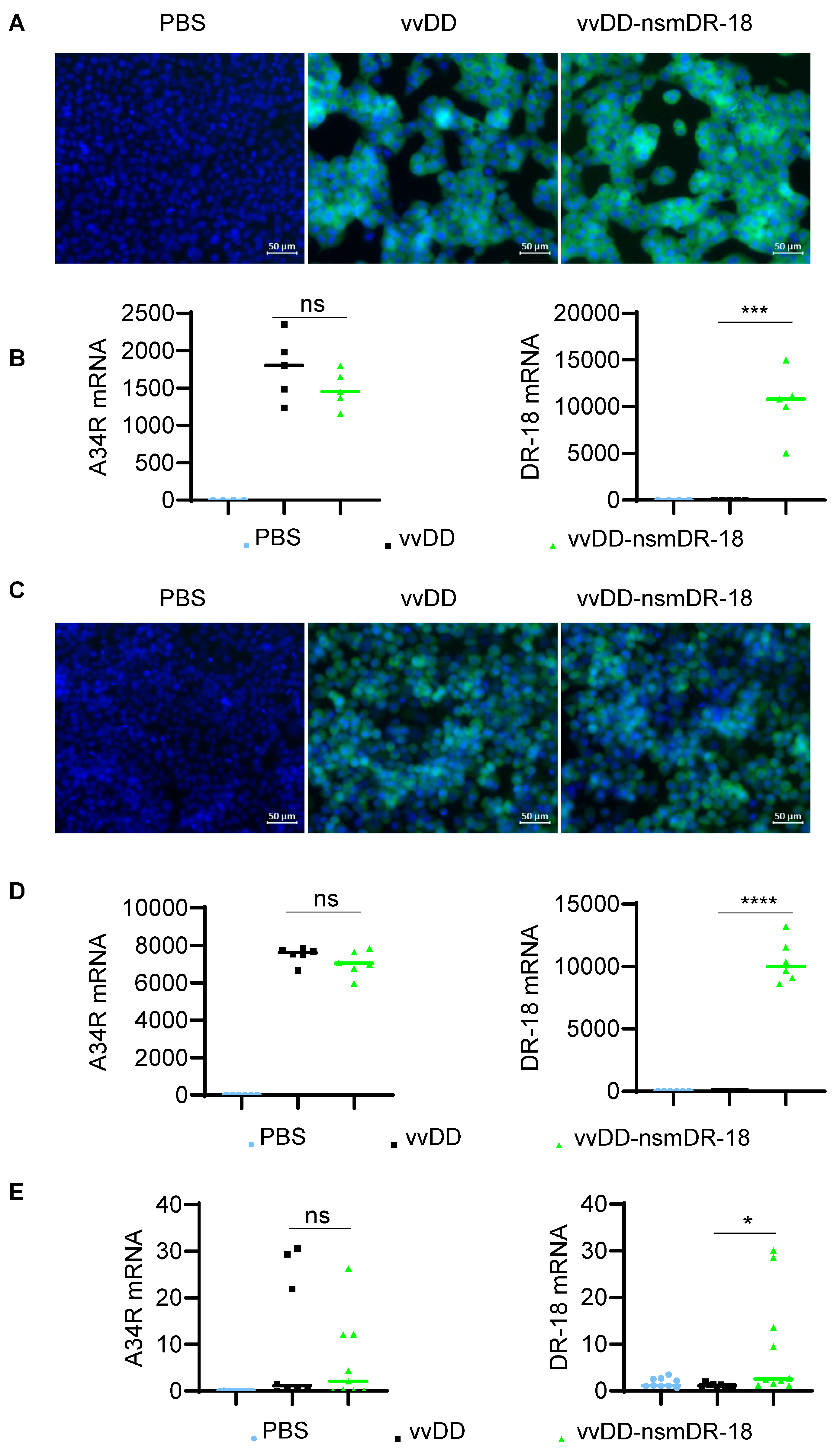
The infectivity and replication capacity of oVV were first assessed using the murine ovarian cancer cell line ID8a-luc. Cells were infected with vvDD-nsmDR-18 or control virus vvDD at an MOI of 1 or treated with PBS. Twenty-four hours posttreatment, cells were stained with Hoechst 33342 and imaged. Comparable YFP expression was observed in cells infected with either virus, whereas no signal was detected in PBS-treated cells (Figure 1A), indicating similar infectivity and replication between the two viruses in ID8a-luc cells.
To further quantify viral replication, total RNA was isolated from treated ID8a-luc cells and analyzed by RT-qPCR. Expression of the viral gene A34R did not differ significantly between vvDD-nsmDR-18- and vvDD-infected cells, whereas nsmDR-18 mRNA was detected exclusively and at significantly elevated levels in cells infected with vvDD-nsmDR-18 (Figure 1B). These data indicate that robust nsmDR-18 expression does not compromise viral replication. A similar expression pattern was observed in the human ovarian cancer cell line A2780 (Figure 1C,D).
To determine whether nsmDR-18 expression affects viral replication in vivo, we next evaluated viral gene and nsmDR-18 expression in ovarian tumors following treatment. B6 mice were injected i.p. with ID8a-luc tumor cells, and five days later, treated i.p. with PBS, vvDD, or vvDD-nsmDR-18. Tumor nodules were harvested on day 5 posttreatment, and total RNA was extracted for RT-qPCR analysis. Expression of the viral gene A34R was comparable between the two viral treatment groups, indicating similar levels of viral replication in vivo. In contrast, nsmDR-18 mRNA was significantly elevated only in tumors from vvDD-nsmDR-18–treated mice (Figure 1E). Collectively, these results demonstrate that nsmDR-18 expression does not impair oVV replication in vitro or in vivo.

3.2. nsmDR-18 Expression via oVV Does Not Impair Viral Cytotoxicity

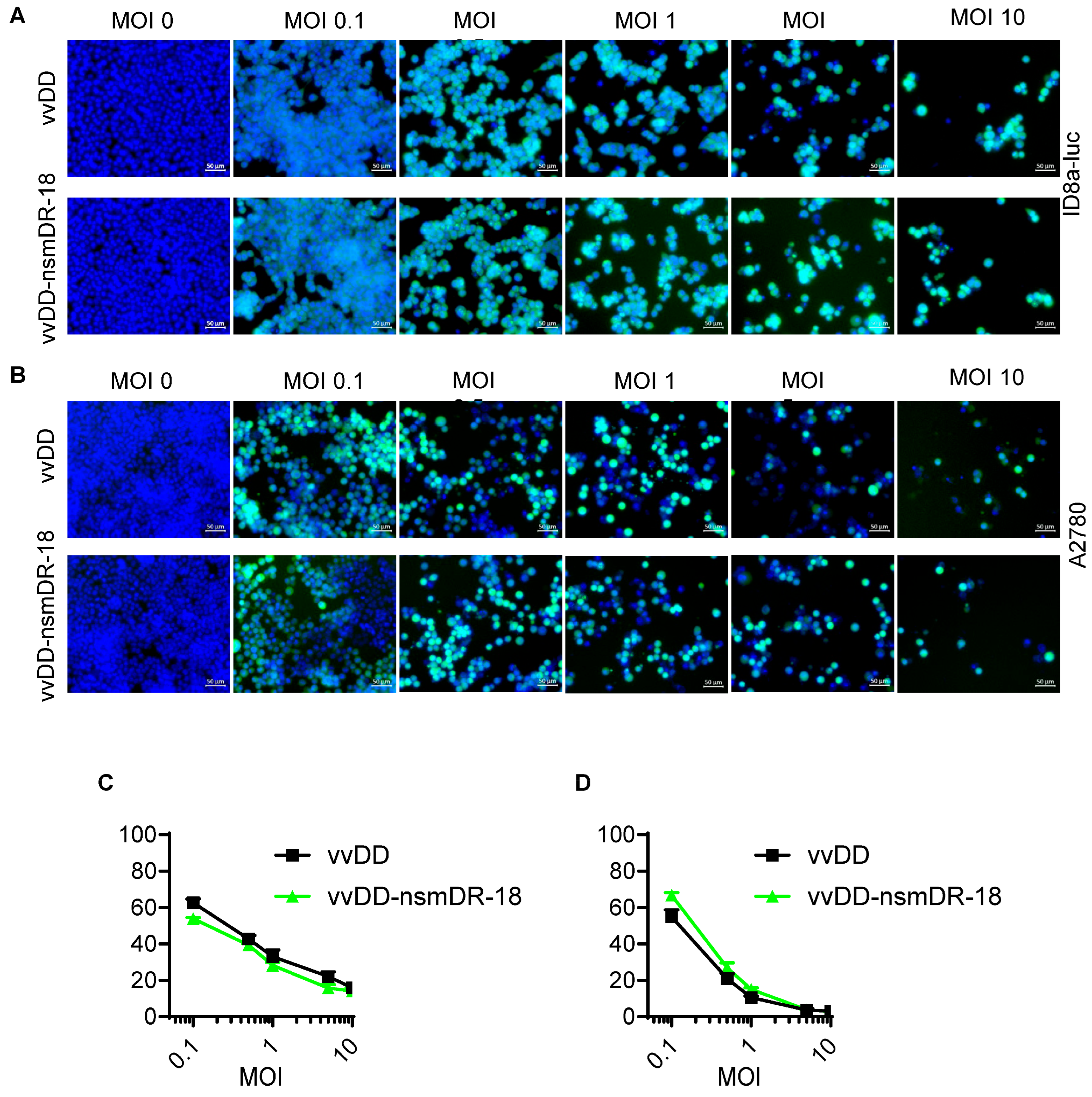
To evaluate whether nsmDR-18 expression affects the direct cytolytic activity of oVV, ID8a-luc and A2780 cells were infected with vvDD-nsmDR-18 or control vvDD at MOIs of 0, 0.1, 0.5, 1, 5, or 10. Cell viability was assessed 48 h post-infection. Cells were stained with Hoechst 33342 and imaged to quantify cell numbers. In both cell lines, cell numbers decreased progressively with increasing viral dose, with no discernible difference between vvDD-nsmDR-18 and vvDD treatment (Figure 2A,B).
Cell viability was further quantified using the CCK-8 assay. Consistent with imaging results, both viruses induced comparable, dose-dependent reductions in cell viability in ID8a-luc and A2780 cells (Figure 2C,D). Together, these data indicate that nsmDR-18 expression does not alter the intrinsic oncolytic cytotoxicity of vvDD in ovarian cancer cells.

3.3. vvDD-nsmDR-18 Elicits Potent Antitumor Effects in a Murine Ovarian Cancer Model

We evaluated the in vivo antitumor efficacy of vvDD-nsmDR-18 in an aggressive murine ovarian cancer ID8a-luc model. B6 mice were injected i.p. with ID8a-luc tumor cells, and five days later, treated i.p. with PBS or 1.0 × 10⁸ of PFU of vvDD or vvDD-nsmDR-18. Tumor progression was monitored longitudinally using in vivo imaging. Survival was monitored until spontaneous death or euthanasia at predefined humane endpoints.
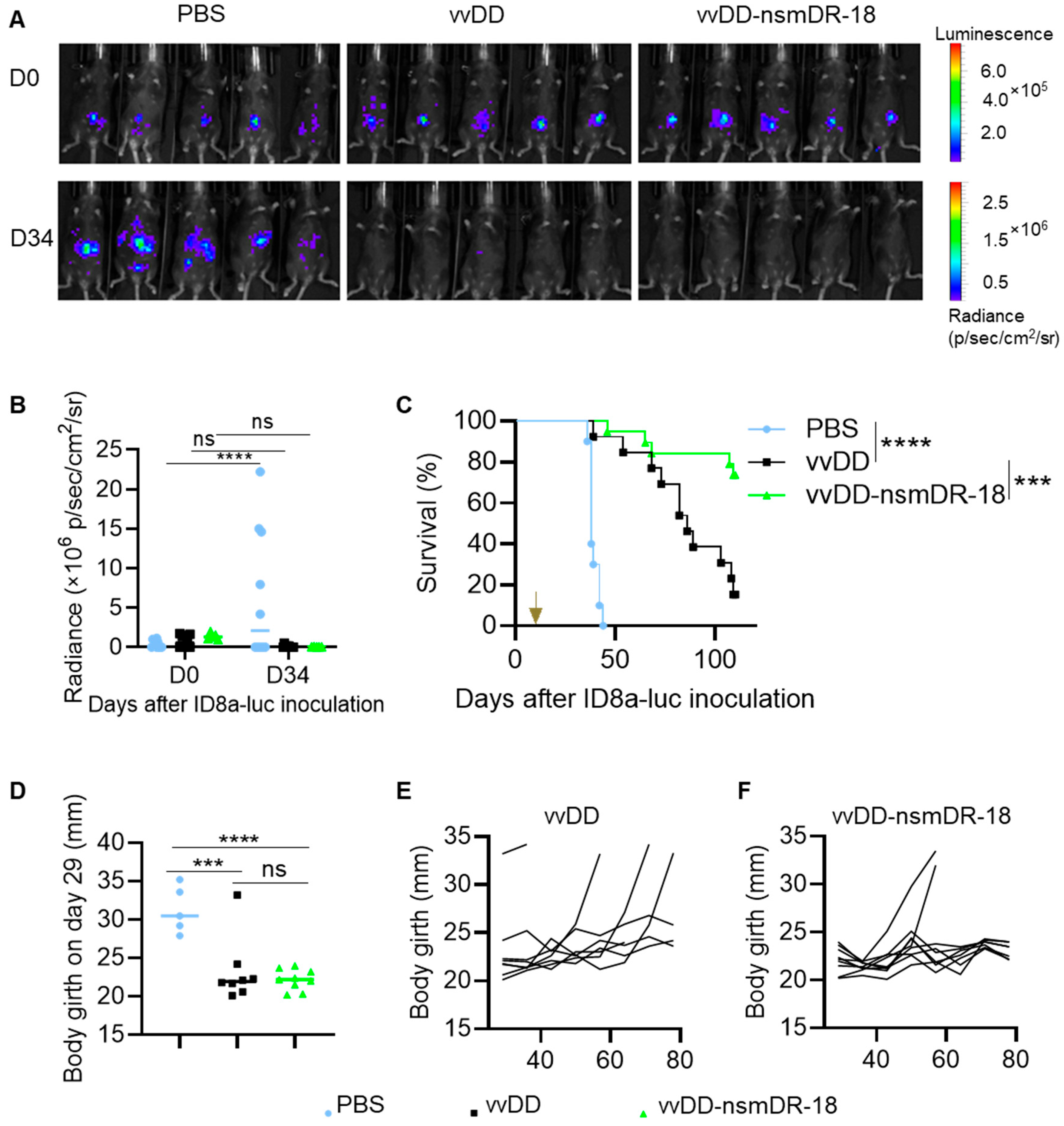
Compared to PBS, both vvDD and vvDD-nsmDR-18 effectively inhibited tumor growth by Day 34 after tumor inoculation (Figure 3A,B). Treatment with vvDD significantly prolonged survival of tumor-bearing mice compared to the PBS control (Figure 3C). Notably, vvDD-nsmDR-18 conferred superior antitumor efficacy, resulting in a significantly greater survival benefit relative to vvDD (Figure 3C). Median survival was 38 days for PBS-treated mice and 86 days for vvDD-treated mice, whereas median survival was not reached in the vvDD-nsmDR-18 group during the 110-day observation period (Figure 3C). Furthermore, necropsy on day 110 revealed no observable tumor nodules in the surviving mice that received oVV treatment.
Because the ID8a-luc model is characterized by extensive ascites formation [55], abdominal girth was measured as a surrogate of disease burden. On day 29 post tumor inoculation (day 24 posttreatment), mice receiving viral therapy exhibited significantly reduced abdominal distension compared with PBS-treated controls (Figure 3D). In a follow-up cohort, 4 of 8 vvDD-treated mice developed marked abdominal enlargement (>33 mm) (Figure 3E), whereas only 2 of 10 vvDD-nsmDR-18-treated mice exceeded this threshold (Figure 3F), compared with a normal girth of ~20 mm in healthy mice.
Collectively, these findings demonstrate that vvDD-nsmDR-18 treatment markedly enhances survival and was associated with reduced abdominal distension consistent with decreased ascites burden, a major clinical challenge in advanced ovarian cancer.

3.4. vvDD-nsmDR-18 Activates T Cells in the Spleen

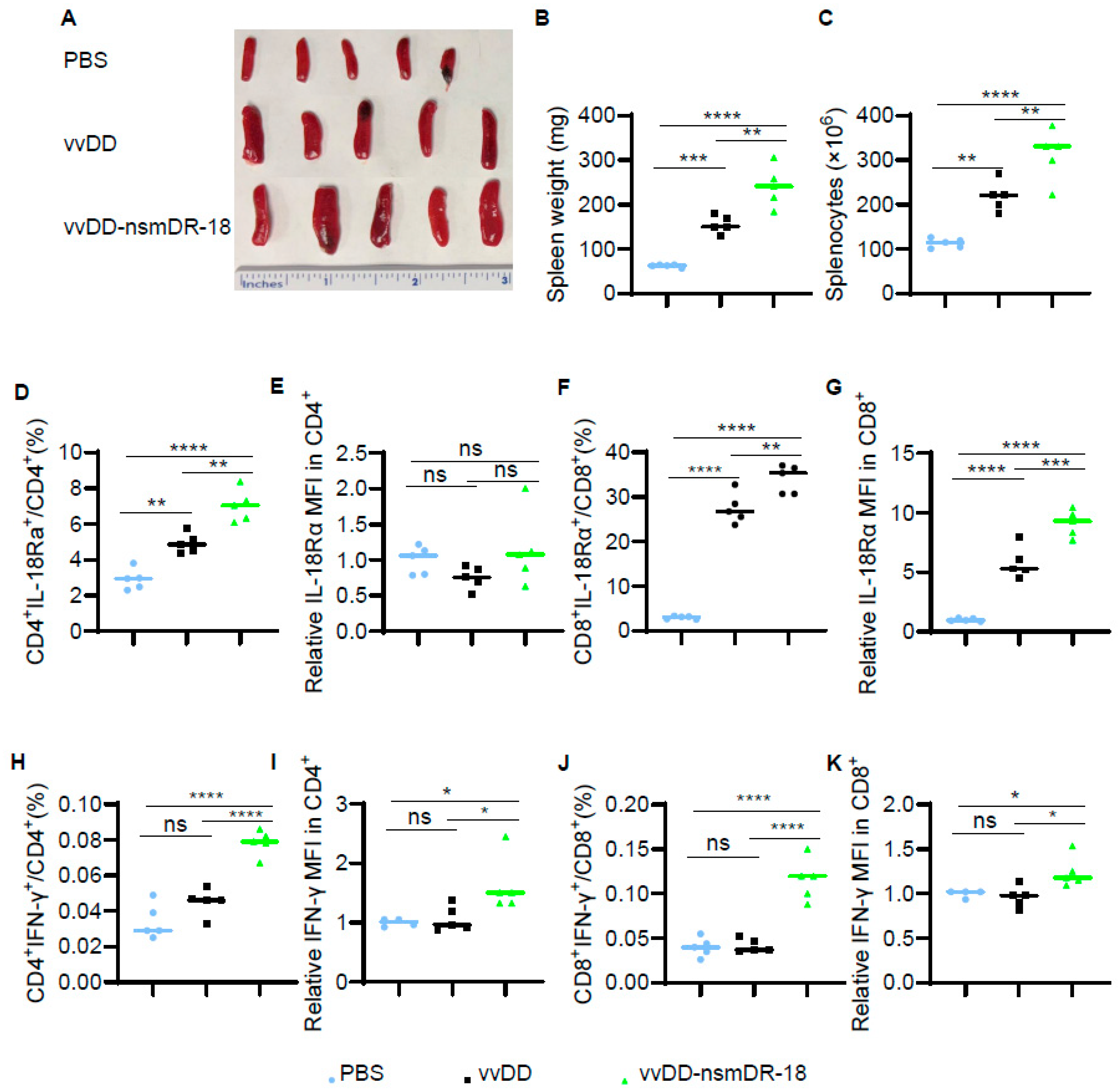
To elucidate the mechanism underlying vvDD-nsmDR-18-induced antitumor activity in the ID8a-luc model, we first examined T cell responses in the spleen. Spleens from virus-treated mice were significantly enlarged compared with those from PBS-treated controls, and nsmDR-18 expression further increased spleen weight relative to vvDD alone (Figure 4A,B). Consistent with this observation, total splenocyte numbers increased proportionally with spleen weight (Figure 4C).
Single-cell suspensions from spleens were analyzed by flow cytometry. We first assessed IL-18Rα expression on T cells. Compared with PBS treatment, vvDD significantly increased the frequency of IL-18Rα+CD4+ T cells, while vvDD-nsmDR-18 induced a more pronounced increase (Figure 4D). However, the median fluorescence intensity (MFI) of IL-18Rα on CD4+ T cells was not significantly altered following viral treatment (Figure 4E). In contrast, both the frequency and MFI of IL-18Rα expression on splenic CD8+ T cells were significantly upregulated after viral treatment, with vvDD-nsmDR-18 producing a markedly stronger effect than vvDD alone (Figure 4F,G). These data indicate that both vaccinia virus infection and nsmDR-18 expression enhance IL-18 receptor availability on splenic T cells, particularly within the CD8+ compartment.
We next assessed splenic T cell activation by measuring IFN-γ production. Compared with PBS, vvDD alone did not significantly increase either the frequency or MFI of IFN-γ expression in splenic CD4+ or CD8+ T cells. In contrast, vvDD-nsmDR-18 markedly increased both the percentage and MFI of IFN-γ-producing CD4+ and CD8+ T cells (Figure 4H–K). These findings indicate that expression of nsmDR-18 is associated with enhanced splenic T cell activation following viral treatment.

3.5. vvDD-nsmDR-18 Activates T Cells in Peritoneal Lavage-Derived Cells

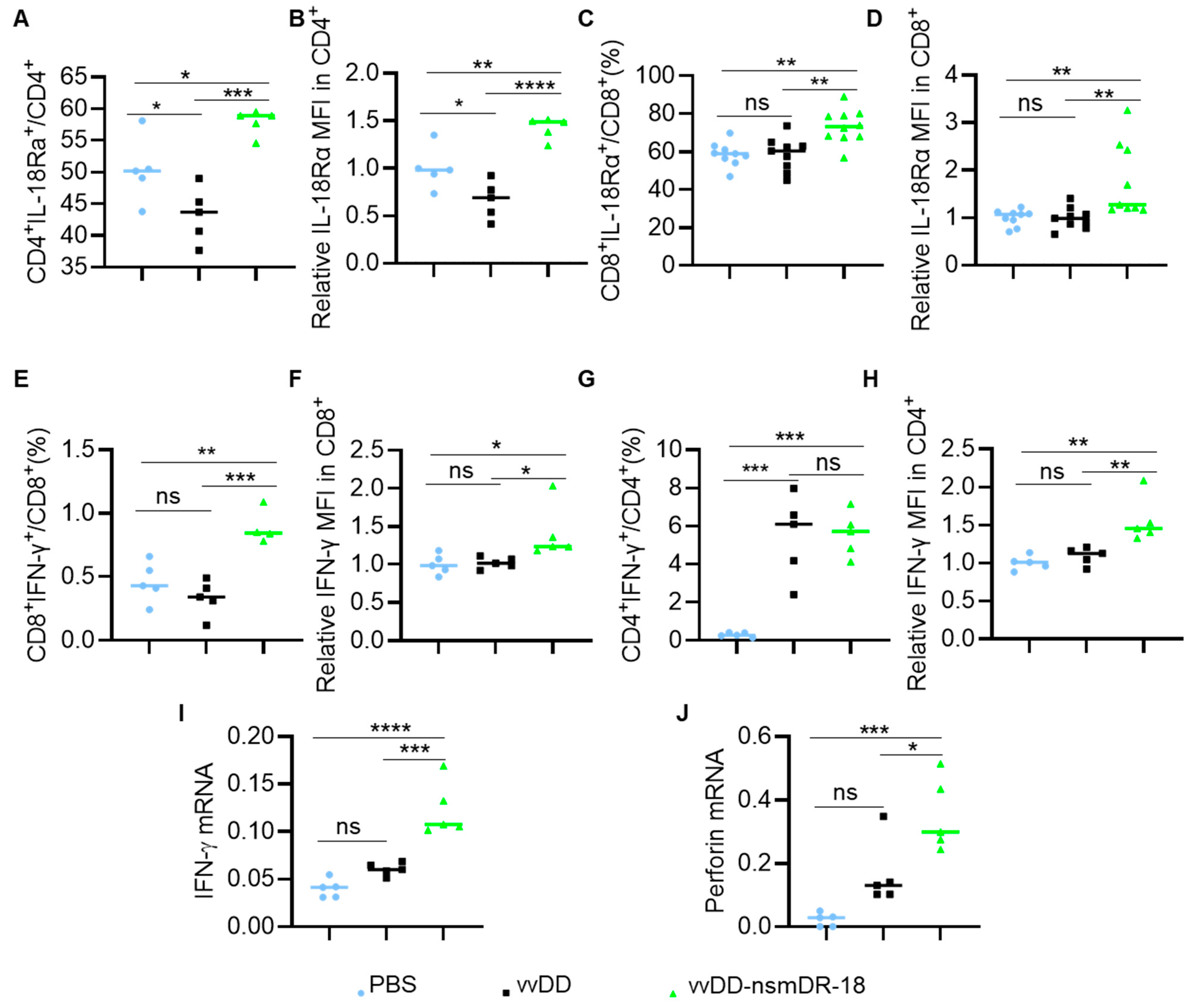
We next evaluated T cell responses in peritoneal lavage-derived cells. The cells were collected by peritoneal lavage and analyzed by flow cytometry and RT-qPCR. Flow cytometric analysis revealed that vvDD-nsmDR-18, but not vvDD, significantly increased both the frequency and MFI of IL-18Rα expression on CD4+ and CD8+ T cells compared with PBS treatment (Figure 5A–D). Moreover, vvDD-nsmDR-18 significantly increased both the percentage and MFI of IFN-γ-producing CD8+ T cells (Figure 5E,F).
Interestingly, both viruses induced comparable increases in the frequency of IFN-γ+CD4+ T cells relative to PBS; however, vvDD-nsmDR-18 uniquely enhanced IFN-γ expression intensity (MFI) within this population (Figure 5G,H). Consistent with these findings, RT-qPCR analysis of peritoneal lavage-derived cells demonstrated that vvDD-nsmDR-18, but not vvDD, significantly elevated transcript levels of key effector molecules, including IFN-γ and perforin (Figure 5I,J). The enrichment of IFN-γ-producing CD8+ T cells and increased expression of cytotoxic effector genes likely contribute to the improved control of abdominal distension observed following vvDD-nsmDR-18 treatment.

3.6. vvDD-nsmDR-18 Activates T Cells Within Tumor Microenvironment

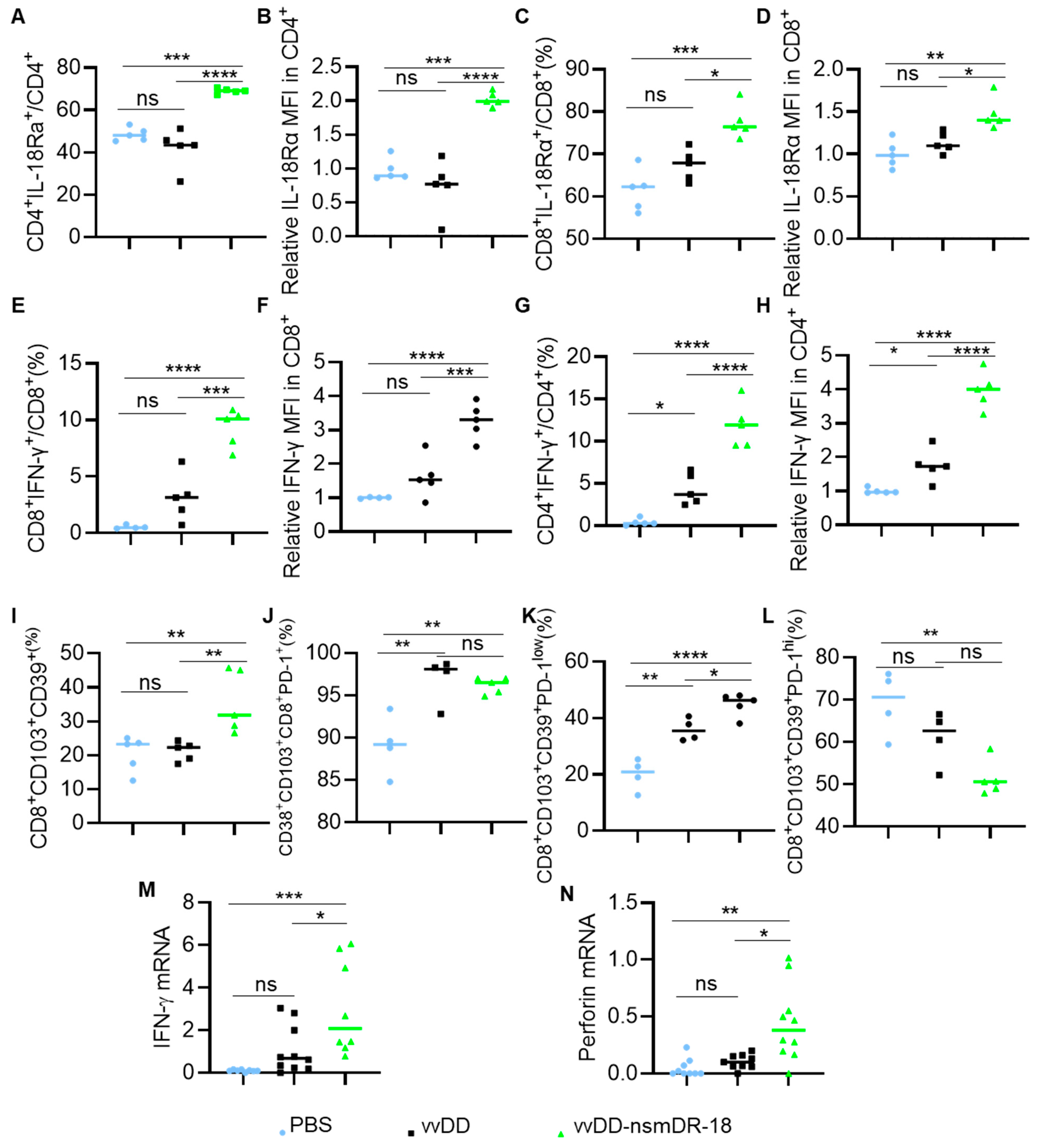
We further characterized T cell activation within the tumor microenvironment. Single-cell suspensions prepared from tumor nodules were analyzed by flow cytometry. The patterns of IL-18Rα expression on tumor-infiltrating T cells and IFN-γ expression on CD8+ T cells closely mirrored those observed in peritoneal lavage-derived cells (Figure 6A–F).
Notably, both vvDD and vvDD-nsmDR-18 increased the frequency and MFI of IFN-γ expression in tumor-infiltrating CD4+ T cells relative to PBS treatment; however, vvDD-nsmDR-18 induced significantly stronger IFN-γ production than vvDD alone (Figure 6G,H). In addition, vvDD-nsmDR-18 significantly increased the abundance of highly activated, tumor-reactive CD8+ T cells (CD39+CD103+CD8+) (Figure 6I), consistent with our previous observations in a murine colon cancer model [52].
The CD39+CD103+CD8+ T cells exhibited high PD-1 expression, consistent with an “exhausted” yet functionally potent phenotype. While total PD-1 expression on CD39+CD103+CD8+ T cells did not differ between vvDD and vvDD-nsmDR-18 treatments (Figure 6J), vvDD-nsmDR-18 significantly increased the proportion of CD39+CD103+CD8+PD-1low T cells compared with other treatments and reduced the proportion of CD39+CD103+CD8+PD-1high T cells compared with PBS treatment (Figure 6K,L). Although the reduction in CD39+CD103+CD8+PD-1high T cells did not reach statistical significance relative to vvDD, this shift may suggest improved functional fitness of tumor-reactive CD39+CD103+CD8+ T cells following nsmDR-18 delivery.
Finally, RT-qPCR analysis of tumor tissues confirmed that vvDD-nsmDR-18 significantly increased the expression of key effector molecules, including IFN-γ and perforin, compared with control treatments (Figure 6M,N), further supporting its role in enhancing intratumoral T cell cytotoxicity.

3.7. Safety Observations and Splenomegaly

No overt signs of systemic toxicity were observed in virus-treated animals based on routine clinical monitoring, including activity, posture, grooming behavior, and body condition. Body weight was not used as a toxicity indicator due to the confounding effects of ascites accumulation in this model. At necropsy, no obvious gross pathological abnormalities were detected in major organs, including liver, lungs, kidneys, and heart, in virus-treated animals compared with controls. Consistent with immune activation, splenomegaly and increased splenocyte numbers were observed, particularly in the vvDD-nsmDR-18-treated group.

4. Discussion

Ovarian cancer is the most lethal gynecologic malignancy, largely due to late diagnosis, as early symptoms are often nonspecific or absent until the disease has progressed to advanced stages. More than 90% of patients develop malignant ascites, a hallmark of advanced ovarian cancer that is notoriously difficult to control and contributes substantially to morbidity and treatment failure. Despite improvements in surgery and chemotherapy, durable disease control in advanced ovarian cancer remains difficult to achieve, highlighting the need for innovative therapeutic strategies capable of overcoming the highly immunosuppressive peritoneal tumor microenvironment.
Cytokines are central regulators of antitumor immunity and have emerged as powerful modulators in cancer immunotherapy, making them compelling candidates for therapeutic intervention. IL-18, a member of IL-1 family, is synthesized as an inactive precursor and requires intracellular processing by caspase-1 within the NLRP3 inflammasome to generate its biologically active form [56]. To overcome endogenous inhibition by IL-18 binding protein and reduce systemic toxicity, we generated the vvDD-nsmDR-18 to deliver nsmDR-18 while maximizing localized immune activation with reduced off-target effects [52]. In the present study, we investigated the therapeutic potential vvDD-nsmDR-18 in an aggressive intraperitoneal ovarian cancer model. Treatment with vvDD-nsmDR-18 was associated with prolonged survival and reduced abdominal distension consistent with decreased ascites burden.
To elucidate the mechanisms underlying vvDD-nsmDR-18-induced antitumor activity, we evaluated T cell activation across multiple anatomical compartments. Our data show that nsmDR-18 delivered via oVV significantly upregulates IL-18Rα not only on tumor-infiltrating T cells (Figure 6A–D), consistent with prior reports [52,57], but also on T cells in the spleen (Figure 4D,F,G) and peritoneal lavage-derived cells (Figure 5A–D). These findings suggest that nsmDR-18 may induce a positive feedback loop that systemically enhances IL-18 responsiveness across distinct immune niches. Correspondingly, elevated IL-18Rα expression was associated with increased IFN-γ production in these T cell populations (Figure 4H–K, Figure 5E–H and Figure 6E–H), indicating robust T cell activation and heightened antitumor effector potential. Mechanistically, delivery of nsmDR-18 through the oncolytic virus promoted immune activation across multiple anatomical compartments, including tumors, peritoneal lavage-derived cells, and spleens, accompanied by increased expression of effector molecules such as IFN-γ and perforin. These findings suggest that localized IL-18 signaling mediated by the engineered virus may enhance antitumor immune responses within the peritoneal tumor environment.
Interestingly, vvDD, especially vvDD-nsmDR-18, induced marked splenomegaly accompanied by expansion and activation of splenic T cells. This observation is mechanistically intriguing in light of recent evidence identifying the spleen as a critical, and potentially primary, reservoir for tumor-infiltrating T cells, especially following immune checkpoint blockade [58]. Our findings support the concept that vvDD-nsmDR-18 may mobilize splenic T cell pools to sustain antitumor immunity, thereby contributing to durable tumor control. Although our findings are consistent with this emerging concept, the present data remain correlative and do not establish the spleen as a direct source of tumor-infiltrating T cells in this model.
Consistent with our previous studies, vvDD-nsmDR-18 treatment significantly increased the frequency of tumor-reactive CD39+CD103+CD8+ T cells in the ID8a-luc ovarian cancer model. Co-expression of CD39 and CD103 marks a subset of tumor-infiltrating CD8+ T cells with enhanced cytolytic capacity and strong associations with improved clinical outcomes [59,60,61,62]. Although CD39+CD103+CD8+ T cells typically exhibit high PD-1 expression [63], our data reveal that while both vvDD and vvDD-nsmDR-18 increase PD-1+ frequencies in CD39+CD103+CD8+ T cells, nsmDR-18 skews this population toward a PD-1low phenotype. However, these observations represent associations rather than direct causal evidence for their role in mediating therapeutic benefit. Moreover, PD-1 expression was assessed at a single time point, and longitudinal analyses will be required to determine whether this phenotype reflects sustained T cell functionality or delayed exhaustion.
It is important to acknowledge several limitations of the present study. First, the ID8 intraperitoneal ovarian cancer model recapitulates key features of advanced human disease, including peritoneal dissemination and ascites formation, but cannot fully capture the genetic heterogeneity and clinical variability of human ovarian cancer. Therefore, evaluation of vvDD-nsmDR-18 in additional ovarian cancer models with diverse molecular backgrounds will be important to determine the broader applicability of this approach.
Second, abdominal distension (body girth) was used as a surrogate indicator of ascites burden. Although this measurement is commonly used in intraperitoneal ovarian cancer models, it can be influenced by factors such as tumor burden and physiological variability. To aid interpretation, qualitative necropsy observations were recorded and generally showed reduced abdominal distension and less visible peritoneal fluid accumulation in virus-treated animals compared with controls. Nonetheless, direct quantification of ascites volume would further strengthen these findings and will be incorporated in future studies.
Third, although vvDD-nsmDR-18 treatment was associated with increased IL-18Rα expression and elevated levels of IFN-γ and perforin, the current data remain correlative and do not establish the essential immune mediators responsible for therapeutic efficacy. In addition to CD8+ T cells, IL-18 is known to activate several immune populations, including NK cells, whose potential contribution was not directly evaluated in this study. Future mechanistic experiments will be required to determine the relative roles of these immune cell populations.
Finally, splenomegaly observed following vvDD-nsmDR-18 treatment is consistent with systemic immune activation; however, alternative explanations, including inflammatory responses, cannot be excluded. Importantly, no overt clinical signs of toxicity were observed, and no gross pathological abnormalities were detected in major organs at necropsy. In this model, body weight is not a reliable indicator of systemic toxicity due to the confounding effects of ascites accumulation, which can lead to weight gain independent of health status. Therefore, clinical observations and gross pathology were prioritized for safety assessment. Nevertheless, these evaluations remain limited, and comprehensive safety studies, including histopathological and cytokine analyses, will be required in future work.
Given the immune-modulating properties of oncolytic viruses, an important future direction will be to evaluate vvDD-nsmDR-18 in combination with existing therapeutic modalities, including platinum-based chemotherapy and immune checkpoint inhibitors. Such strategies may further enhance antitumor immunity and improve clinical outcomes in ovarian cancer.

5. Conclusions

In conclusion, this study demonstrates that an oncolytic vaccinia virus expressing a non-secreted decoy-resistant IL-18 mutein can promote immune activation across multiple anatomical compartments and is associated with prolonged survival in an aggressive intraperitoneal ovarian cancer model. The treatment was also associated with reduced abdominal distension consistent with decreased ascites burden and expansion of tumor-reactive CD8+ T cell populations. Although additional mechanistic and safety studies are required, these findings support further investigation of vvDD-nsmDR-18 as a potential immunotherapeutic strategy for ovarian cancer.

Author Contributions

P.M., C.L. and Z.L. performed experiments, analyzed and interpreted the data, and wrote the manuscript. J.Y., L.C., J.W., J.Z., M.E. and T.Z. performed experiments and analyzed the data. Z.L., J.R., W.G. and D.L.B. revised the manuscript. Z.L. and D.L.B. supervised the project. All authors have read and agreed to the published version of the manuscript.

Funding

This work was supported by Allegheny Health Network Cancer Institute Chair Core fund (19467509).

Institutional Review Board Statement

Approval for the animal study protocol was granted by the Institutional Animal Care and Use Committee (IACUC) at Allegheny Health Network Research Institute (protocol number 1081-2/19 June 2024).

Informed Consent Statement

Not applicable.

Data Availability Statement

All data is available from the corresponding author upon reasonable request.

Acknowledgments

This project used the Allegheny Health Network Research Institute Preclinical Facility.

Conflicts of Interest

The authors declare no conflicts of interest.

References

  1. Siegel, R.L.; Kratzer, T.B.; Wagle, N.S.; Sung, H.; Jemal, A. Cancer statistics, 2026. CA Cancer J. Clin. 2026, 76, e70043. [Google Scholar] [CrossRef]
  2. Bray, F.; Laversanne, M.; Sung, H.; Ferlay, J.; Siegel, R.L.; Soerjomataram, I.; Jemal, A. Global cancer statistics 2022: GLOBOCAN estimates of incidence and mortality worldwide for 36 cancers in 185 countries. CA Cancer J. Clin. 2024, 74, 229–263. [Google Scholar] [CrossRef] [PubMed]
  3. Bartlett, D.L.; Liu, Z.; Sathaiah, M.; Ravindranathan, R.; Guo, Z.; He, Y.; Guo, Z.S. Oncolytic viruses as therapeutic cancer vaccines. Mol. Cancer 2013, 12, 103. [Google Scholar] [CrossRef] [PubMed]
  4. Bommareddy, P.K.; Shettigar, M.; Kaufman, H.L. Integrating oncolytic viruses in combination cancer immunotherapy. Nat. Rev. Immunol. 2018, 18, 498–513. [Google Scholar] [CrossRef] [PubMed]
  5. Twumasi-Boateng, K.; Pettigrew, J.L.; Kwok, Y.Y.E.; Bell, J.C.; Nelson, B.H. Oncolytic viruses as engineering platforms for combination immunotherapy. Nat. Rev. Cancer 2018, 18, 419–432. [Google Scholar] [CrossRef]
  6. Harrington, K.; Freeman, D.J.; Kelly, B.; Harper, J.; Soria, J.C. Optimizing oncolytic virotherapy in cancer treatment. Nat. Rev. Drug Discov. 2019, 18, 689–706. [Google Scholar] [CrossRef]
  7. Pelin, A.; Boulton, S.; Tamming, L.A.; Bell, J.C.; Singaravelu, R. Engineering vaccinia virus as an immunotherapeutic battleship to overcome tumor heterogeneity. Expert Opin. Biol. Ther. 2020, 20, 1083–1097. [Google Scholar] [CrossRef]
  8. Lichty, B.D.; Breitbach, C.J.; Stojdl, D.F.; Bell, J.C. Going viral with cancer immunotherapy. Nat. Rev. Cancer 2014, 14, 559–567. [Google Scholar] [CrossRef]
  9. Shalhout, S.Z.; Miller, D.M.; Emerick, K.S.; Kaufman, H.L. Therapy with oncolytic viruses: Progress and challenges. Nat. Rev. Clin. Oncol. 2023, 20, 160–177. [Google Scholar] [CrossRef]
  10. Alwithenani, A.; Hengswat, P.; Chiocca, E.A. Oncolytic viruses as cancer therapeutics: From mechanistic insights to clinical translation. Mol. Ther. 2025, 33, 2217–2228. [Google Scholar] [CrossRef]
  11. Liu, Z.; Ravindranathan, R.; Kalinski, P.; Guo, Z.S.; Bartlett, D.L. Rational combination of oncolytic vaccinia virus and PD-L1 blockade works synergistically to enhance therapeutic efficacy. Nat. Commun. 2017, 8, 14754. [Google Scholar] [CrossRef]
  12. Meylan, M.; Tian, Y.; Wu, L.; Ling, A.L.; Kovarsky, D.; Barlow, G.L.; Nguyen, L.D.; Pyrdol, J.; Marx, S.; Westphal, L.; et al. Persistent T cell activation and cytotoxicity against glioblastoma following single oncolytic virus treatment in a clinical trial. Cell 2026, 189, 1287–1304.e1218. [Google Scholar] [CrossRef]
  13. Lin, D.; Shen, Y.; Liang, T. Oncolytic virotherapy: Basic principles, recent advances and future directions. Signal Transduct. Target. Ther. 2023, 8, 156. [Google Scholar] [CrossRef] [PubMed]
  14. Liu, Z.; Ravindranathan, R.; Li, J.; Kalinski, P.; Guo, Z.S.; Bartlett, D.L. CXCL11-Armed oncolytic poxvirus elicits potent antitumor immunity and shows enhanced therapeutic efficacy. Oncoimmunology 2016, 5, e1091554. [Google Scholar] [CrossRef]
  15. Liu, Z.; Ge, Y.; Wang, H.; Ma, C.; Feist, M.; Ju, S.; Guo, Z.S.; Bartlett, D.L. Modifying the cancer-immune set point using vaccinia virus expressing re-designed interleukin-2. Nat. Commun. 2018, 9, 4682. [Google Scholar] [CrossRef] [PubMed]
  16. Chen, L.; Chen, H.; Ye, J.; Ge, Y.; Wang, H.; Dai, E.; Ren, J.; Liu, W.; Ma, C.; Ju, S.; et al. Intratumoral expression of interleukin 23 variants using oncolytic vaccinia virus elicit potent antitumor effects on multiple tumor models via tumor microenvironment modulation. Theranostics 2021, 11, 6668–6681. [Google Scholar] [CrossRef]
  17. Ge, Y.; Wang, H.; Ren, J.; Liu, W.; Chen, L.; Chen, H.; Ye, J.; Dai, E.; Ma, C.; Ju, S.; et al. Oncolytic vaccinia virus delivering tethered IL-12 enhances antitumor effects with improved safety. J. Immunother. Cancer 2020, 8, e000710. [Google Scholar] [CrossRef] [PubMed]
  18. Ye, J.; Chen, L.; Waltermire, J.; Zhao, J.; Ren, J.; Guo, Z.; Bartlett, D.L.; Liu, Z. Intratumoral Delivery of Interleukin 9 via Oncolytic Vaccinia Virus Elicits Potent Antitumor Effects in Tumor Models. Cancers 2024, 16, 1021. [Google Scholar] [CrossRef]
  19. Marelli, G.; Chard Dunmall, L.S.; Yuan, M.; Di Gioia, C.; Miao, J.; Cheng, Z.; Zhang, Z.; Liu, P.; Ahmed, J.; Gangeswaran, R.; et al. A systemically deliverable Vaccinia virus with increased capacity for intertumoral and intratumoral spread effectively treats pancreatic cancer. J. Immunother. Cancer 2021, 9, e001624. [Google Scholar] [CrossRef]
  20. Wang, P.; Li, X.; Wang, J.; Gao, D.; Li, Y.; Li, H.; Chu, Y.; Zhang, Z.; Liu, H.; Jiang, G.; et al. Re-designing Interleukin-12 to enhance its safety and potential as an anti-tumor immunotherapeutic agent. Nat. Commun. 2017, 8, 1395. [Google Scholar] [CrossRef]
  21. Chen, T.; Ding, X.; Liao, Q.; Gao, N.; Chen, Y.; Zhao, C.; Zhang, X.; Xu, J. IL-21 arming potentiates the anti-tumor activity of an oncolytic vaccinia virus in monotherapy and combination therapy. J. Immunother. Cancer 2021, 9, e001647. [Google Scholar] [CrossRef]
  22. Wang, S.; Yan, W.; Kong, L.; Zuo, S.; Wu, J.; Zhu, C.; Huang, H.; He, B.; Dong, J.; Wei, J. Oncolytic viruses engineered to enforce cholesterol efflux restore tumor-associated macrophage phagocytosis and anti-tumor immunity in glioblastoma. Nat. Commun. 2023, 14, 4367. [Google Scholar] [CrossRef]
  23. Zhang, H.; Zhang, Y.; Dong, J.; Li, B.; Xu, C.; Wei, M.; Wu, J.; Wei, J. Recombinant oncolytic adenovirus expressing a soluble PVR elicits long-term antitumor immune surveillance. Mol. Ther. Oncolytics 2021, 20, 12–22. [Google Scholar] [CrossRef]
  24. Liu, K.; Kong, L.; Cui, H.; Zhang, L.; Xin, Q.; Zhuang, Y.; Guo, C.; Yao, Y.; Tao, J.; Gu, X.; et al. Thymosin alpha1 reverses oncolytic adenovirus-induced M2 polarization of macrophages to improve antitumor immunity and therapeutic efficacy. Cell Rep. Med. 2024, 5, 101751. [Google Scholar] [CrossRef]
  25. Dias, J.D.; Hemminki, O.; Diaconu, I.; Hirvinen, M.; Bonetti, A.; Guse, K.; Escutenaire, S.; Kanerva, A.; Pesonen, S.; Loskog, A.; et al. Targeted cancer immunotherapy with oncolytic adenovirus coding for a fully human monoclonal antibody specific for CTLA-4. Gene Ther. 2012, 19, 988–998. [Google Scholar] [CrossRef] [PubMed]
  26. Choi, I.K.; Lee, Y.S.; Yoo, J.Y.; Yoon, A.R.; Kim, H.; Kim, D.S.; Seidler, D.G.; Kim, J.H.; Yun, C.O. Effect of decorin on overcoming the extracellular matrix barrier for oncolytic virotherapy. Gene Ther. 2010, 17, 190–201. [Google Scholar] [CrossRef]
  27. Ju, Y.; Dai, F.; Wang, Y.; Ye, Z.; Li, Y.; Ju, S.; Ge, Y.; Chen, W. Oncolytic vaccinia virus armed with 4-1BBL elicits potent and safe antitumor immunity and enhances the therapeutic efficiency of PD-1/PD-L1 blockade in a pancreatic cancer model. Transl. Oncol. 2024, 50, 102151. [Google Scholar] [CrossRef]
  28. Park, A.K.; Fong, Y.; Kim, S.I.; Yang, J.; Murad, J.P.; Lu, J.; Jeang, B.; Chang, W.C.; Chen, N.G.; Thomas, S.H.; et al. Effective combination immunotherapy using oncolytic viruses to deliver CAR targets to solid tumors. Sci. Transl. Med. 2020, 12, eaaz1863. [Google Scholar] [CrossRef]
  29. Yang, A.; Zhang, Z.; Chaurasiya, S.; Park, A.K.; Jung, A.; Lu, J.; Kim, S.I.; Priceman, S.; Fong, Y.; Woo, Y. Development of the oncolytic virus, CF33, and its derivatives for peritoneal-directed treatment of gastric cancer peritoneal metastases. J. Immunother. Cancer 2023, 11, e006280. [Google Scholar] [CrossRef] [PubMed]
  30. Taha, Z.; Crupi, M.J.F.; Alluqmani, N.; MacKenzie, D.; Vallati, S.; Whelan, J.T.; Fareez, F.; Alwithenani, A.; Petryk, J.; Chen, A.; et al. Complementary dual-virus strategy drives synthetic target and cognate T-cell engager expression for endogenous-antigen agnostic immunotherapy. Nat. Commun. 2024, 15, 7267. [Google Scholar] [CrossRef] [PubMed]
  31. Mullins-Dansereau, V.; Myre, M.L.; Bardoul, A.; Geoffroy, K.; Rallo Pita, M.J.; Beland, D.; Desaulniers, K.L.; Roy, D.G.; Bourgeois-Daigneault, M.C. Oncolytic VSV-IL-2 has enhanced anticancer vaccination adjuvant abilities. J. Immunother. Cancer 2025, 13, e010570. [Google Scholar] [CrossRef]
  32. Bourgeois-Daigneault, M.C.; Roy, D.G.; Aitken, A.S.; El Sayes, N.; Martin, N.T.; Varette, O.; Falls, T.; St-Germain, L.E.; Pelin, A.; Lichty, B.D.; et al. Neoadjuvant oncolytic virotherapy before surgery sensitizes triple-negative breast cancer to immune checkpoint therapy. Sci. Transl. Med. 2018, 10, eaao1641. [Google Scholar] [CrossRef] [PubMed]
  33. Jia, Y.; Wang, Y.; Zhao, G.; Yang, Y.; Yan, W.; Wang, R.; Han, B.; Wang, L.; Zhang, Z.; Chen, L.; et al. Novel oncolytic vaccinia virus armed with interleukin-27 is a potential therapeutic agent for the treatment of murine pancreatic cancer. J. Immunother. Cancer 2025, 13, e010341. [Google Scholar] [CrossRef]
  34. Brito Baleeiro, R.; Liu, P.; Chard Dunmall, L.S.; Di Gioia, C.; Nagano, A.; Cutmore, L.; Wang, J.; Chelala, C.; Nyambura, L.W.; Walden, P.; et al. Personalized neoantigen viro-immunotherapy platform for triple-negative breast cancer. J. Immunother. Cancer 2023, 11, e007336. [Google Scholar] [CrossRef] [PubMed]
  35. Block, M.S.; Clubb, J.H.A.; Maenpaa, J.; Pakola, S.; Quixabeira, D.C.A.; Kudling, T.; Jirovec, E.; Haybout, L.; van der Heijden, M.; Zahraoui, S.; et al. The oncolytic adenovirus TILT-123 with pembrolizumab in platinum resistant or refractory ovarian cancer: The phase 1a PROTA trial. Nat. Commun. 2025, 16, 1381. [Google Scholar] [CrossRef]
  36. Woo, Y.; Warner, S.G.; Geha, R.; Stanford, M.M.; Decarolis, P.; Rahman, M.M.; Singer, S.; McFadden, G.; Fong, Y. The Oncolytic Activity of Myxoma Virus against Soft Tissue Sarcoma Is Mediated by the Overexpression of Ribonucleotide Reductase. Clin. Med. Insights Oncol. 2021, 15, 1179554921993069. [Google Scholar] [CrossRef] [PubMed]
  37. Liu, B.L.; Robinson, M.; Han, Z.Q.; Branston, R.H.; English, C.; Reay, P.; McGrath, Y.; Thomas, S.K.; Thornton, M.; Bullock, P.; et al. ICP34.5 deleted herpes simplex virus with enhanced oncolytic, immune stimulating, and anti-tumour properties. Gene Ther. 2003, 10, 292–303. [Google Scholar] [CrossRef]
  38. Ma, R.; Lu, T.; Li, Z.; Teng, K.Y.; Mansour, A.G.; Yu, M.; Tian, L.; Xu, B.; Ma, S.; Zhang, J.; et al. An Oncolytic Virus Expressing IL15/IL15Ralpha Combined with Off-the-Shelf EGFR-CAR NK Cells Targets Glioblastoma. Cancer Res. 2021, 81, 3635–3648. [Google Scholar] [CrossRef]
  39. Parker, J.N.; Meleth, S.; Hughes, K.B.; Gillespie, G.Y.; Whitley, R.J.; Markert, J.M. Enhanced inhibition of syngeneic murine tumors by combinatorial therapy with genetically engineered HSV-1 expressing CCL2 and IL-12. Cancer Gene Ther. 2005, 12, 359–368. [Google Scholar] [CrossRef]
  40. Barnard, Z.; Wakimoto, H.; Zaupa, C.; Patel, A.P.; Klehm, J.; Martuza, R.L.; Rabkin, S.D.; Curry, W.T., Jr. Expression of FMS-like tyrosine kinase 3 ligand by oncolytic herpes simplex virus type I prolongs survival in mice bearing established syngeneic intracranial malignant glioma. Neurosurgery 2012, 71, 741–748; discussion 748. [Google Scholar] [CrossRef]
  41. Soliman, H.; Hogue, D.; Han, H.; Mooney, B.; Costa, R.; Lee, M.C.; Niell, B.; Williams, A.; Chau, A.; Falcon, S.; et al. Oncolytic T-VEC virotherapy plus neoadjuvant chemotherapy in nonmetastatic triple-negative breast cancer: A phase 2 trial. Nat. Med. 2023, 29, 450–457. [Google Scholar] [CrossRef] [PubMed]
  42. Ribas, A.; Dummer, R.; Puzanov, I.; VanderWalde, A.; Andtbacka, R.H.I.; Michielin, O.; Olszanski, A.J.; Malvehy, J.; Cebon, J.; Fernandez, E.; et al. Oncolytic Virotherapy Promotes Intratumoral T Cell Infiltration and Improves Anti-PD-1 Immunotherapy. Cell 2017, 170, 1109–1119.e1110. [Google Scholar] [CrossRef]
  43. Porter, C.E.; Rosewell Shaw, A.; Jung, Y.; Yip, T.; Castro, P.D.; Sandulache, V.C.; Sikora, A.; Gottschalk, S.; Ittman, M.M.; Brenner, M.K.; et al. Oncolytic Adenovirus Armed with BiTE, Cytokine, and Checkpoint Inhibitor Enables CAR T Cells to Control the Growth of Heterogeneous Tumors. Mol. Ther. 2020, 28, 1251–1262. [Google Scholar] [CrossRef]
  44. Rosewell Shaw, A.; Porter, C.E.; Watanabe, N.; Tanoue, K.; Sikora, A.; Gottschalk, S.; Brenner, M.K.; Suzuki, M. Adenovirotherapy Delivering Cytokine and Checkpoint Inhibitor Augments CAR T Cells against Metastatic Head and Neck Cancer. Mol. Ther. 2017, 25, 2440–2451. [Google Scholar] [CrossRef]
  45. Feodoroff, M.; Hamdan, F.; Antignani, G.; Feola, S.; Fusciello, M.; Russo, S.; Chiaro, J.; Valimaki, K.; Pellinen, T.; Branca, R.M.; et al. Enhancing T-cell recruitment in renal cell carcinoma with cytokine-armed adenoviruses. Oncoimmunology 2024, 13, 2407532. [Google Scholar] [CrossRef]
  46. Nakamura, K.; Okamura, H.; Wada, M.; Nagata, K.; Tamura, T. Endotoxin-induced serum factor that stimulates gamma interferon production. Infect. Immun. 1989, 57, 590–595. [Google Scholar] [CrossRef]
  47. Dinarello, C.A.; Novick, D.; Kim, S.; Kaplanski, G. Interleukin-18 and IL-18 binding protein. Front. Immunol. 2013, 4, 289. [Google Scholar] [CrossRef]
  48. Zhou, T.; Damsky, W.; Weizman, O.E.; McGeary, M.K.; Hartmann, K.P.; Rosen, C.E.; Fischer, S.; Jackson, R.; Flavell, R.A.; Wang, J.; et al. IL-18BP is a secreted immune checkpoint and barrier to IL-18 immunotherapy. Nature 2020, 583, 609–614. [Google Scholar] [CrossRef] [PubMed]
  49. Yang, S.; Sheffer, M.; Kaplan, I.E.; Wang, Z.; Tarannum, M.; Dinh, K.; Abdulhamid, Y.; Bobilev, E.; Shapiro, R.; Porter, R.; et al. Non-pathogenic E. coli displaying decoy-resistant IL18 mutein boosts anti-tumor and CAR NK cell responses. Nat. Biotechnol. 2024, 43, 1311–1323. [Google Scholar] [CrossRef] [PubMed]
  50. Cheng, Y.; Zhao, Y.; Liu, Y.; Zhang, Y.; Xu, D.; Sun, W.; Zhang, M.; Miao, Y.; He, S.; Hou, Y.; et al. Durable antitumor response via an oncolytic virus encoding decoy-resistant IL-18. J. Immunother. Cancer 2024, 12, e009716. [Google Scholar] [CrossRef]
  51. Zeh, H.J.; Downs-Canner, S.; McCart, J.A.; Guo, Z.S.; Rao, U.N.; Ramalingam, L.; Thorne, S.H.; Jones, H.L.; Kalinski, P.; Wieckowski, E.; et al. First-in-man study of western reserve strain oncolytic vaccinia virus: Safety, systemic spread, and antitumor activity. Mol. Ther. 2015, 23, 202–214. [Google Scholar] [CrossRef]
  52. Ye, J.; Chen, L.; Patel, S.; Ming, P.; Li, C.; Waltermire, J.; Zhao, J.; Ren, J.; Bartlett, D.L.; Liu, Z. Oncolytic vaccinia virus expressing non-secreted decoy-resistant IL-18 mutein elicits potent antitumor effects with enhanced safety. Mol. Ther. Oncol. 2025, 33, 201022. [Google Scholar] [CrossRef]
  53. Callaway, C.S.; Mouchantat, L.M.; Bitler, B.G.; Bonetto, A. Mechanisms of Ovarian Cancer-Associated Cachexia. Endocrinology 2023, 165, bqad176. [Google Scholar] [CrossRef]
  54. Fastaia, J.; Dumont, A.E. Pathogenesis of ascites in mice with peritoneal carcinomatosis. J. Natl. Cancer Inst. 1976, 56, 547–550. [Google Scholar] [CrossRef] [PubMed]
  55. Chiriva-Internati, M.; Yu, Y.; Mirandola, L.; Jenkins, M.R.; Chapman, C.; Cannon, M.; Cobos, E.; Kast, W.M. Cancer testis antigen vaccination affords long-term protection in a murine model of ovarian cancer. PLoS ONE 2010, 5, e10471. [Google Scholar] [CrossRef]
  56. Gu, Y.; Kuida, K.; Tsutsui, H.; Ku, G.; Hsiao, K.; Fleming, M.A.; Hayashi, N.; Higashino, K.; Okamura, H.; Nakanishi, K.; et al. Activation of interferon-gamma inducing factor mediated by interleukin-1beta converting enzyme. Science 1997, 275, 206–209. [Google Scholar] [CrossRef]
  57. Zheng, J.N.; Pei, D.S.; Sun, F.H.; Liu, X.Y.; Mao, L.J.; Zhang, B.F.; Wen, R.M.; Xu, W.; Shi, Z.; Liu, J.J.; et al. Potent antitumor efficacy of interleukin-18 delivered by conditionally replicative adenovirus vector in renal cell carcinoma-bearing nude mice via inhibition of angiogenesis. Cancer Biol. Ther. 2009, 8, 599–606. [Google Scholar] [CrossRef]
  58. Morgan, D.M.; Horton, B.L.; Bhandarkar, V.; Van, R.; Dinter, T.; Zagorulya, M.; Love, J.C.; Spranger, S. Expansion of tumor-reactive CD8+ T cell clonotypes occurs in the spleen in response to immune checkpoint blockade. Sci. Immunol. 2024, 9, eadi3487. [Google Scholar] [CrossRef] [PubMed]
  59. Duhen, T.; Duhen, R.; Montler, R.; Moses, J.; Moudgil, T.; de Miranda, N.F.; Goodall, C.P.; Blair, T.C.; Fox, B.A.; McDermott, J.E.; et al. Co-expression of CD39 and CD103 identifies tumor-reactive CD8 T cells in human solid tumors. Nat. Commun. 2018, 9, 2724. [Google Scholar] [CrossRef]
  60. Workel, H.H.; van Rooij, N.; Plat, A.; Spierings, D.C.J.; Fehrmann, R.S.N.; Nijman, H.W.; de Bruyn, M. Transcriptional Activity and Stability of CD39+CD103+CD8+ T Cells in Human High-Grade Endometrial Cancer. Int. J. Mol. Sci. 2020, 21, 3770. [Google Scholar] [CrossRef] [PubMed]
  61. Van den Bulk, J.; van der Ploeg, M.; Ijsselsteijn, M.E.; Ruano, D.; van der Breggen, R.; Duhen, R.; Peeters, K.; Farina-Sarasqueta, A.; Verdegaal, E.M.E.; van der Burg, S.H.; et al. CD103 and CD39 coexpression identifies neoantigen-specific cytotoxic T cells in colorectal cancers with low mutation burden. J. Immunother. Cancer 2023, 11, e005887. [Google Scholar] [CrossRef] [PubMed]
  62. Lama, G.I.G.; Noel, G.; Marquez, F.C.L.; Galarza, F.F.G.; Hinojosa, A.I.P.; Rivera, L.E.N.; Willard-Gallo, K.; Astorga, J.R.A. Concomitant Expression of CD39, CD69, and CD103 Identifies Antitumor CD8+ T Cells in Breast Cancer Implications for Adoptive Cell Therapy. Curr. Pharm. Biotechnol. 2024, 25, 1747–1757. [Google Scholar] [CrossRef] [PubMed]
  63. Laumont, C.M.; Wouters, M.C.A.; Smazynski, J.; Gierc, N.S.; Chavez, E.A.; Chong, L.C.; Thornton, S.; Milne, K.; Webb, J.R.; Steidl, C.; et al. Single-cell Profiles and Prognostic Impact of Tumor-Infiltrating Lymphocytes Coexpressing CD39, CD103, and PD-1 in Ovarian Cancer. Clin. Cancer Res. 2021, 27, 4089–4100. [Google Scholar] [CrossRef] [PubMed]
Figure 1. nsmDR-18 expression via oVV does not impair viral replication in vitro and in vivo. Tumor cells (ID8a-luc, 2.0 × 10⁵ cells; A2780, 3.0 × 10⁵ cells), were treated with PBS or infected with vvDD or vvDD-nsmDR-18 at an MOI of 1. Cells were stained with Hoechst 33342 and imaged. Representative fluorescence images of cells infected with YFP-expressing virus (yellow) and counterstained with Hoechst 33342 (blue) to visualize nuclei (A,C). Cells were harvested to measure A34R or nsmDR-18 expression using RT-qPCR 24 h posttreatment (B,D). B6 mice were inoculated i.p. with 3.5 × 10⁶ ID8a-luc cells and treated i.p. with the indicated viruses (1.0 × 10⁸ PFU/mouse) or PBS five days after tumor cell inoculation (4–6 mice/group). Tumors were harvested for RT-qPCR analysis. Expression of viral gene A34R and nsmDR-18 is shown in (E). Data show one representative experiment, except for panels in (E), which present combined data from two independent experiments. p < 0.05 (*); p < 0.001 (***), and p < 0.0001 (****); ns indicates not significant.
Cancers 18 01065 g001
Figure 2. nsmDR-18 expression via oVV does not impair viral cytotoxicity. Tumor cells (ID8a-luc, 5.0 × 10³ cells; A2780, 1.0 × 10⁴ cells), were treated with PBS or infected with vvDD or vvDD-nsmDR-18 at indicated MOIs. Cells were stained with Hoechst 33342 and imaged. Representative fluorescence images of cells infected with YFP-expressing virus (yellow) and counterstained with Hoechst 33342 (blue) to visualize nuclei (A,B). Cell viability was measured 48 h post-infection (C,D). Data show one representative experiment.
Cancers 18 01065 g002
Figure 3. vvDD-nsmDR-18 elicits potent antitumor effects in an aggressive ovarian cancer model. B6 mice were inoculated i.p. with 3.5 × 10⁶ ID8a-luc cells and treated i.p. with the indicated viruses (1.0 × 10⁸ PFU/mouse) or PBS five days after tumor cell inoculation (the arrow indicates treatment initiation; 5–10 mice/group). Live animal imaging of representative mice with ID8a-luc tumors on day 34 after tumor cell inoculation (A), quantified data derived from the imaging (B) and Kaplan–Meier survival curves (C) are shown. The mouse body girth measured on day 29 after tumor cell inoculation for all treatment groups is shown in (D). Longitudinal changes in individual body girth from days 29–78 are shown for vvDD-treated mice in (E) and for vvDD-nsmDR-18-treated mice in (F). Data show one representative experiment, except for panel (C), which presents combined data from two independent experiments (n = 10 for PBS; n = 13 for vvDD; n = 19 for vvDD-nsmDR-18). p < 0.001 (***), and p < 0.0001 (****); ns indicates not significant.
Cancers 18 01065 g003
Figure 4. vvDD-nsmDR-18 activates T cells in the spleen. B6 mice were inoculated i.p. with 3.5 × 10⁶ ID8a-luc cells and treated i.p. with the indicated viruses (1.0 × 10⁸ PFU/mouse) or PBS five days after tumor cell inoculation (5 mice/group). Spleens were harvested, photographed (A), and weighed (B). Total splenocyte numbers are shown in (C). Single splenocytes were analyzed by flow cytometry, and the frequency and MFI of IL-18Rα and IFN-γ on T cells are shown in (DK). Data show one representative experiment. p < 0.05 (*); p < 0.01 (**); p < 0.001 (***), and p < 0.0001 (****); ns indicates not significant.
Cancers 18 01065 g004
Figure 5. vvDD-nsmDR-18 activates T cells in the peritoneal lavage-derived cells. B6 mice were inoculated i.p. with 3.5 × 10⁶ ID8a-luc cells and treated i.p. with the indicated viruses (1.0 × 10⁸ PFU/mouse) or PBS five days after tumor cell inoculation (4–5 mice/group). Peritoneal lavage-derived cells were harvested and analyzed by flow cytometry to determine the frequency and MFI of IL-18Rα and IFN-γ expression on T cells (AH). Peritoneal lavage-derived cells were also analyzed by RT-qPCR, and the expression of the effector molecules IFN-γ and perforin is shown in (I,J). Data show one representative experiment, except for panels (C,D), which present combined data from two independent experiments. p < 0.05 (*); p < 0.01 (**); p < 0.001 (***), and p < 0.0001 (****); ns indicates not significant.
Cancers 18 01065 g005
Figure 6. vvDD-nsmDR-18 activates T cells in the tumor. B6 mice were inoculated i.p. with 3.5 × 10⁶ ID8a-luc cells and treated i.p. with the indicated viruses (1.0 × 10⁸ PFU/mouse) or PBS five days after tumor cell inoculation (n = 4–6). Tumors were harvested to prepare single-cell suspensions for flow cytometry or RT-qPCR analysis. The frequency and MFI of IL-18Rα and IFN-γ on tumor-infiltrating T cells are shown in (AH). The frequency of CD39+CD103+CD8+ T cells is shown in (I) and PD-1 expression on CD39+CD103+CD8+ T cells is shown in (JL). Expression of effector molecules IFN-γ and perforin is shown in (M,N). Data show one representative experiment, except for panels (M,N), which present combined data from two independent experiments. p < 0.05 (*); p < 0.01 (**); p < 0.001 (***), and p < 0.0001 (****); ns indicates not significant.
Cancers 18 01065 g006
Disclaimer/Publisher’s Note: The statements, opinions and data contained in all publications are solely those of the individual author(s) and contributor(s) and not of MDPI and/or the editor(s). MDPI and/or the editor(s) disclaim responsibility for any injury to people or property resulting from any ideas, methods, instructions or products referred to in the content.