Age-Specific ADHD and Internalizing/Externalizing Comorbidity in Children with Neurofibromatosis Type 1: A Multi-Site Study

 ,
,  , , , and
Simple Summary
Abstract
1. Introduction
2. Materials & Method
2.1. Participants and Procedure
2.2. Measures
2.3. Statistical Analysis
2.4. Transparency and Openness
3. Results
3.1. Sample Characteristics
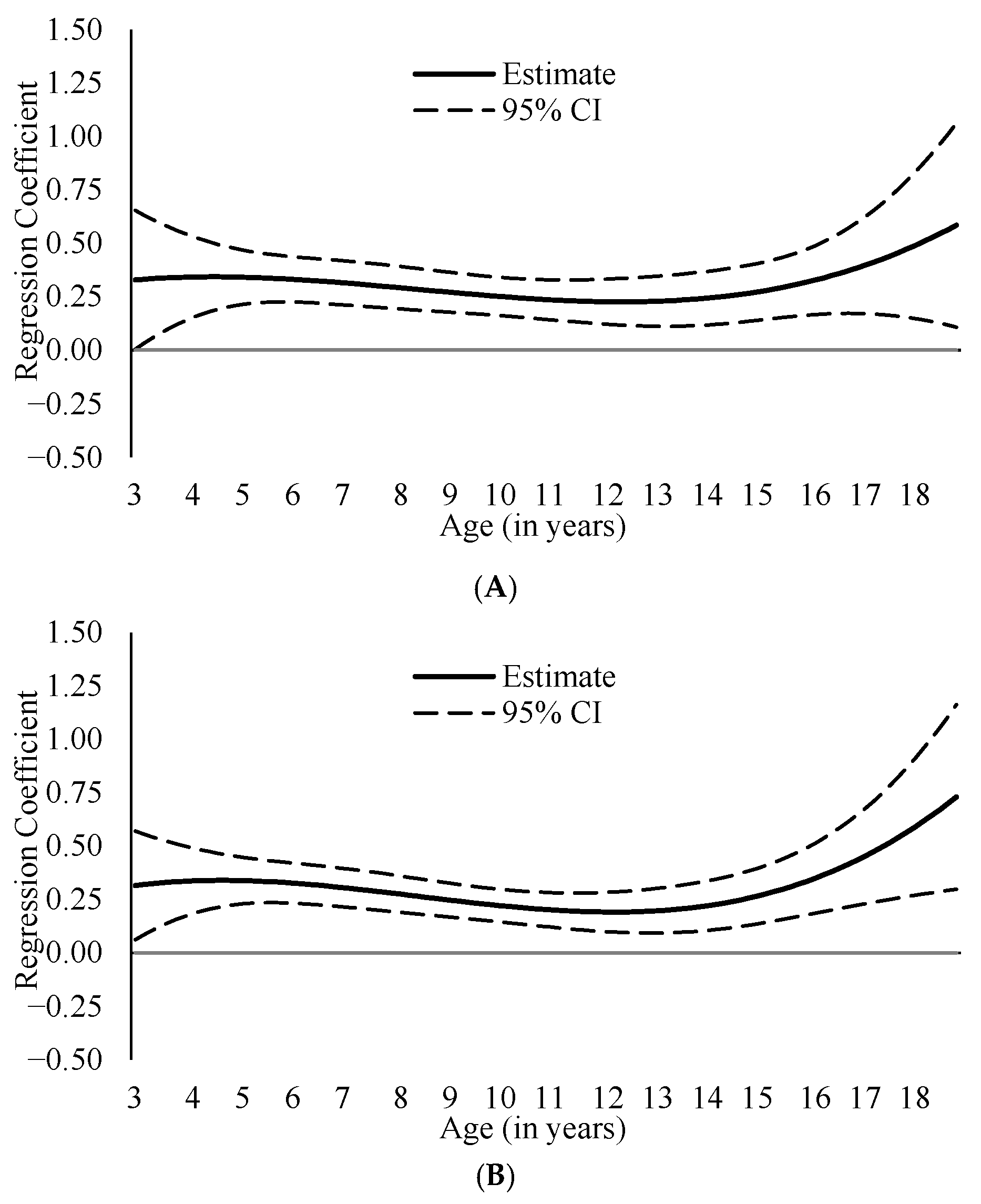
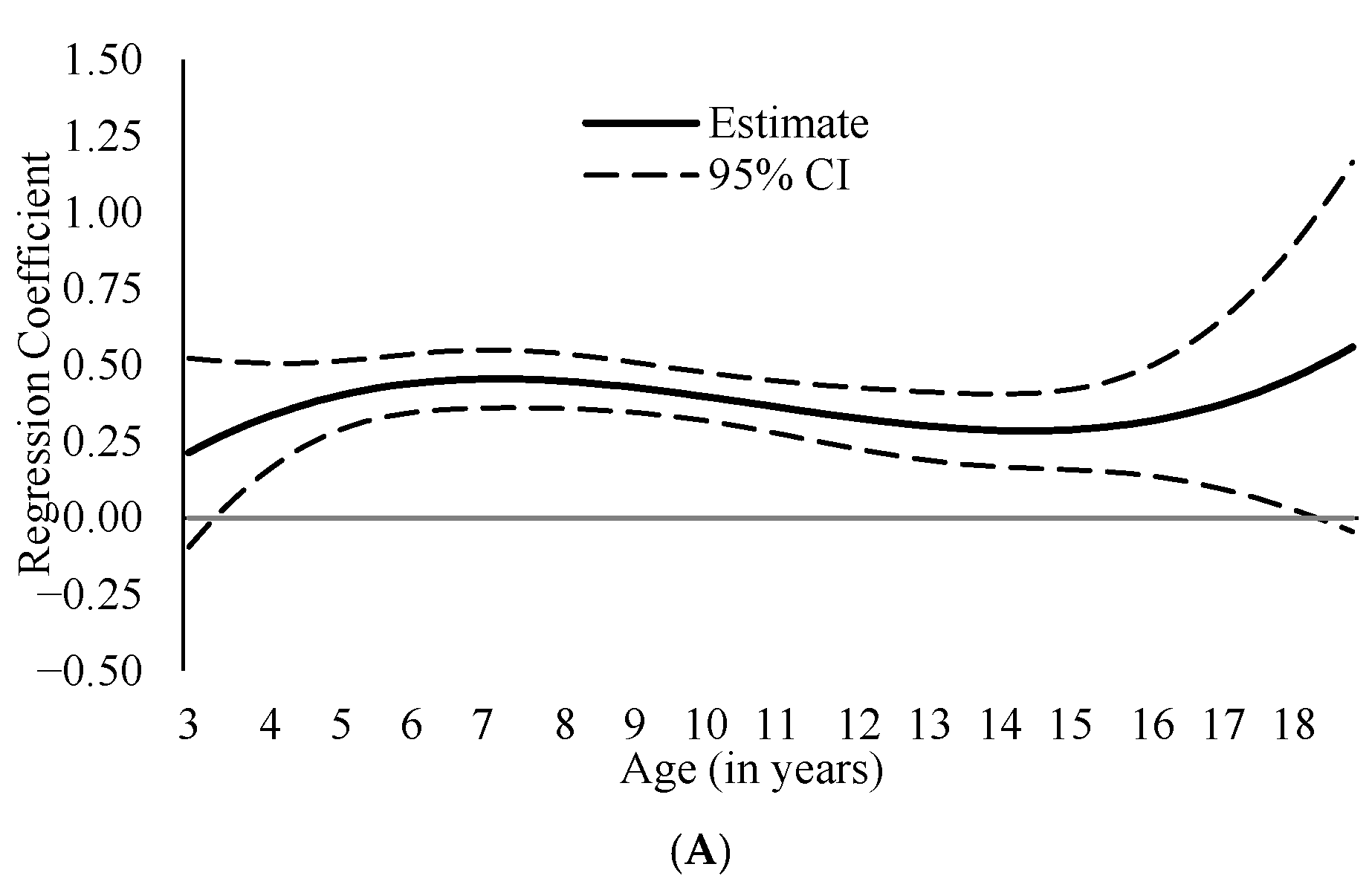
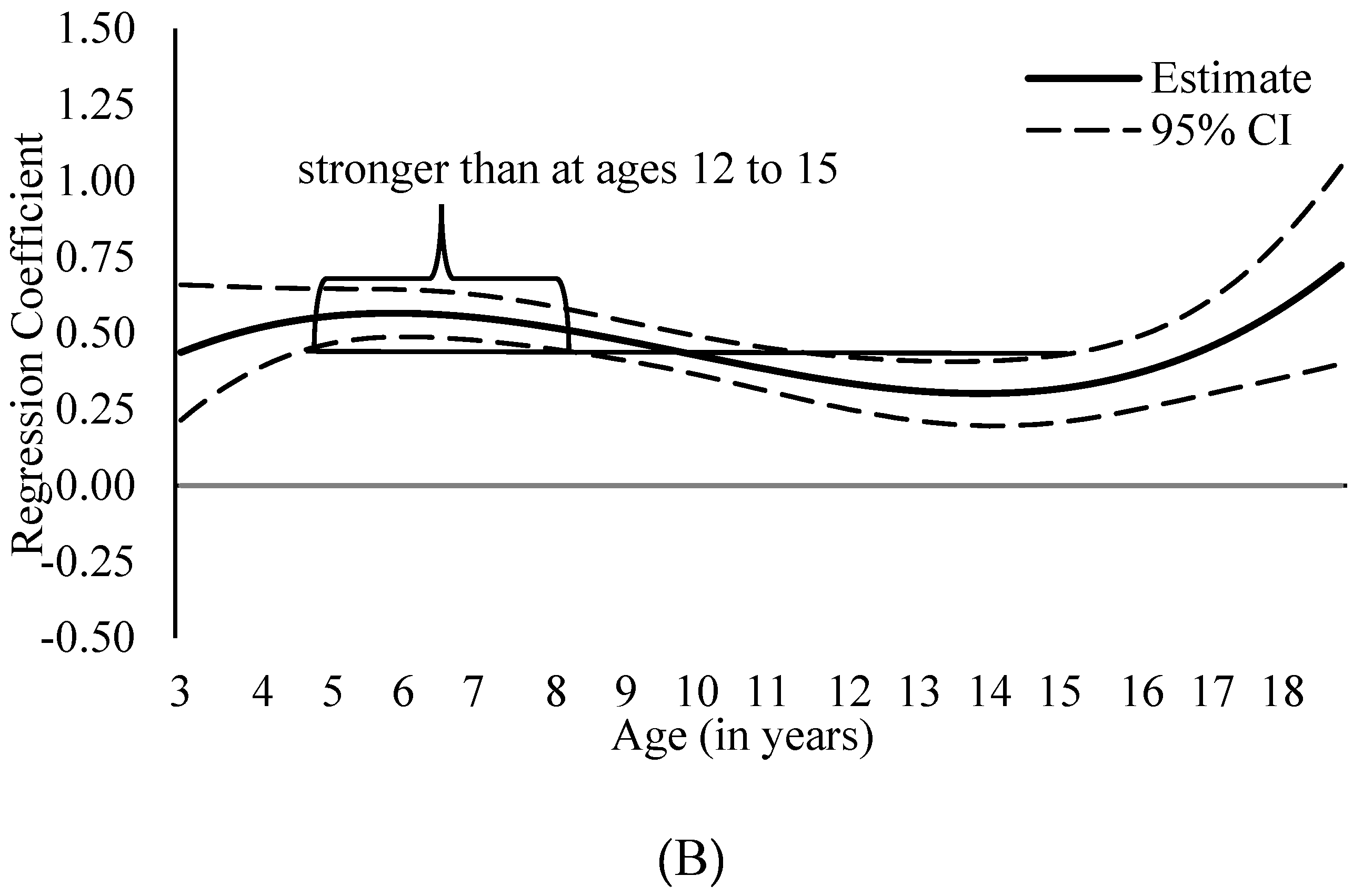
3.2. Age-Varying Associations Between ADHD Symptoms and Internalizing/Externalizing Problems
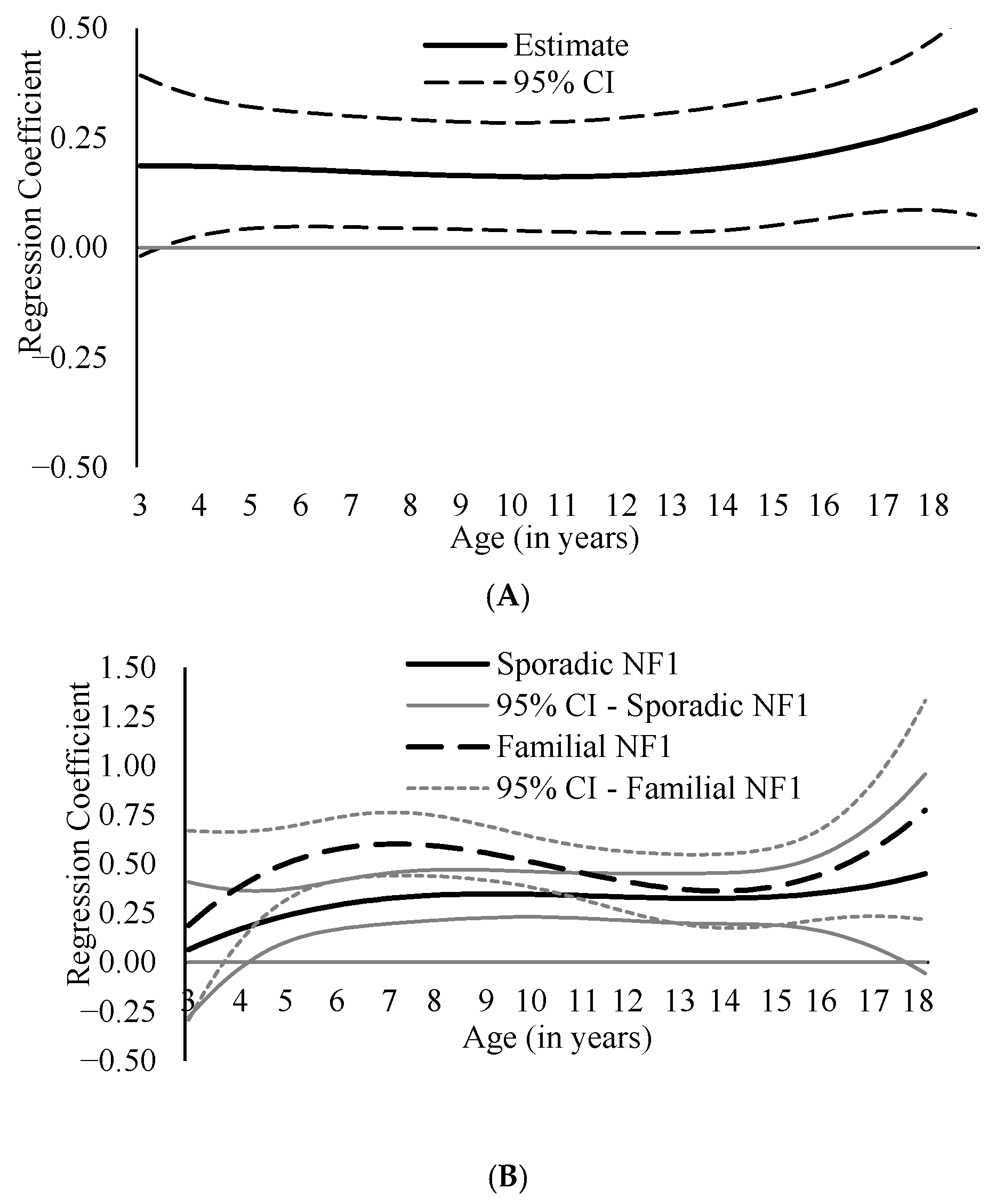
3.3. Moderation Effects by Sex, Parental Education, and Mode of NF1 Inheritance
3.4. Sensitivity Analyses
4. Discussion
4.1. Robust Links Between ADHD Symptoms and Internalizing/Externalizing Problems Across Ages
4.2. Moderating Role of NF1 Inheritance and the Robustness of Symptom Associations Across Demographic and Clinical Subgroups
4.3. Implications
4.4. Limitations and Future Directions
5. Conclusions
Supplementary Materials
Author Contributions
Funding
Institutional Review Board Statement
Informed Consent Statement
Data Availability Statement
Acknowledgments
Conflicts of Interest
Abbreviations
References
- Gutmann, D.H.; Ferner, R.E.; Listernick, R.H.; Korf, B.R.; Wolters, P.L.; Johnson, K.J. Neurofibromatosis type 1. Nat. Rev. Dis. Primers 2017, 3, 17004. [Google Scholar] [CrossRef]
- Gutmann, D.H.; Anastasaki, C.; Gupta, A.; Hou, Y.; Morris, S.M.; Payne, J.M.; Raber, J.; Tomchik, S.M.; Van Aelst, L.; Walker, J.A.; et al. Cognition and behavior in neurofibromatosis Type 1: Report and perspective from the cognition and behavior in NF1 (CABIN) Task Force. Genes. Dev. 2025, 39, 541–554. [Google Scholar] [CrossRef]
- Vogel, A.C.; Gutmann, D.H.; Morris, S.M. Neurodevelopmental disorders in children with neurofibromatosis type 1. Dev. Med. Child Neurol. 2017, 59, 1112–1116. [Google Scholar] [CrossRef]
- Beaussart, M.-L.; Barbarot, S.; Mauger, C.; Roy, A. Systematic review and meta-analysis of executive functions in preschool and school-age children with neurofibromatosis type 1. J. Int. Neuropsychol. Soc. 2018, 24, 977–994. [Google Scholar] [CrossRef]
- Payne, J.M.; Arnold, S.S.; Pride, N.A.; North, K.N. Does attention-deficit-hyperactivity disorder exacerbate executive dysfunction in children with neurofibromatosis type 1? Dev. Med. Child Neurol. 2012, 54, 898–904. [Google Scholar] [CrossRef]
- Hou, Y.; Yu, L.; Liu, D.; Wilson-Lemoine, E.; Wu, X.; Moreira, J.; Mujica, B.; Mukhopadhyay, E.; Novotney, A.; Payne, J.M. Systematic review and meta-analysis: Attention deficit/hyperactivity disorder symptoms in children with neurofibromatosis type 1. Am. Acad. Child Adolesc. Psychiatry 2025, 64, 447–462. [Google Scholar] [CrossRef]
- Liu, D.; Yu, L.; Wu, X.; Moreira, J.; Mujica, B.F.; Mukhopadhyay, E.S.; Novotney, A.; Rietman, A.B.; Hou, Y. Internalizing and externalizing symptoms in individuals with neurofibromatosis type 1: A systematic review and meta-analysis. Syst. Rev. 2025, 14, 20. [Google Scholar] [CrossRef]
- American Psychological Association. Diagnostic and Statistical Manual of Mental Disorders: DSM-5, 5th ed.; American Psychiatric Association: Washington, DC, USA, 2013. [Google Scholar]
- Murray, A.L.; Hall, H.A.; Speyer, L.G.; Carter, L.; Mirman, D.; Caye, A.; Rohde, L. Developmental trajectories of ADHD symptoms in a large population-representative longitudinal study. Psychol. Med. 2022, 52, 3590–3596. [Google Scholar] [CrossRef] [PubMed]
- Sasser, T.R.; Kalvin, C.B.; Bierman, K.L. Developmental trajectories of clinically significant attention-deficit/hyperactivity disorder (ADHD) symptoms from grade 3 through 12 in a high-risk sample: Predictors and outcomes. J. Abnorm. Psychol. 2016, 125, 207–219. [Google Scholar] [CrossRef] [PubMed]
- Larsson, H.; Dilshad, R.; Lichtenstein, P.; Barker, E.D. Developmental trajectories of DSM-IV symptoms of attention-deficit/hyperactivity disorder: Genetic effects, family risk and associated psychopathology. J. Child Psychol. Psychiatry 2011, 52, 954–963. [Google Scholar] [CrossRef] [PubMed]
- Shaw, P.; Eckstrand, K.; Sharp, W.; Blumenthal, J.; Lerch, J.P.; Greenstein, D.; Clasen, L.; Evans, A.; Giedd, J.; Rapoport, J.L. Attention-deficit/hyperactivity disorder is characterized by a delay in cortical maturation. Proc. Natl. Acad. Sci. USA 2007, 104, 19649–19654. [Google Scholar] [CrossRef]
- Faraone, S.V.; Asherson, P.; Banaschewski, T.; Biederman, J.; Buitelaar, J.K.; Ramos-Quiroga, J.A.; Rohde, L.A.; Sonuga-Barke, E.J.S.; Tannock, R.; Franke, B. Attention-deficit/hyperactivity disorder. Nat. Rev. Dis. Primers 2015, 1, 15020. [Google Scholar] [CrossRef] [PubMed]
- Petersen, I.T.; Bates, J.E.; Dodge, K.A.; Lansford, J.E.; Pettit, G.S. Describing and predicting developmental profiles of externalizing problems from childhood to adulthood. Dev. Psychopathol. 2015, 27, 791–818. [Google Scholar] [CrossRef] [PubMed]
- Steinberg, L. A dual systems model of adolescent risk-taking. Dev. Psychobiol. 2010, 52, 216–224. [Google Scholar] [CrossRef]
- Costello, E.J.; Mustillo, S.; Erkanli, A.; Keeler, G.; Angold, A. Prevalence and development of psychiatric disorders in childhood and adolescence. Arch. Gen. Psychiatry 2003, 60, 837–844. [Google Scholar] [CrossRef] [PubMed]
- Sanborn, K.; Hayward, C. Hormonal changes at puberty and the emergence of gender differences in internalizing disorders. In Gender Differences at Puberty; Hayward, C., Ed.; Cambridge University Press: Cambridge, UK, 2003; pp. 29–58. [Google Scholar]
- Barreto, I.S.; Teodoro, M.L.M.; Ohno, P.M.; Froeseler, M.V.G. Cognitive vulnerability and stress for emotional and behavioral problems in children and adolescents: A longitudinal study. J. Cogn. Psychother. 2018, 32, 272–284. [Google Scholar] [CrossRef]
- Connor, D.F.; Edwards, G.; Fletcher, K.E.; Baird, J.; Barkley, R.A.; Steingard, R.J. Correlates of comorbid psychopathology in children with ADHD. J. Am. Acad. Child Adolesc. Psychiatry 2003, 42, 193–200. [Google Scholar] [CrossRef]
- Hargitai, L.D.; Livingston, L.A.; Waldren, L.H.; Robinson, R.; Jarrold, C.; Shah, P. Attention-deficit hyperactivity disorder traits are a more important predictor of internalising problems than autistic traits. Sci. Rep. 2023, 13, 31. [Google Scholar] [CrossRef]
- Brown, A.J.; Casey, B.M. Subclinical ADHD-symptoms are associated with executive-functioning and externalizing problems in college students without ADHD-diagnoses. J. Educ. Dev. Psychol. 2016, 6, 204–220. [Google Scholar] [CrossRef]
- Obsuth, I.; Murray, A.L.; Di Folco, S.; Ribeaud, D.; Eisner, M. Patterns of homotypic and heterotypic continuity between ADHD symptoms, externalising and internalising problems from age 7 to 15. J. Abnorm. Child Psychol. 2020, 48, 223–236. [Google Scholar] [CrossRef]
- Willcutt, E.G.; Nigg, J.T.; Pennington, B.F.; Solanto, M.V.; Rohde, L.A.; Tannock, R.; Loo, S.K.; Carlson, C.L.; McBurnett, K.; Lahey, B.B. Validity of DSM-IV attention deficit/hyperactivity disorder symptom dimensions and subtypes. J. Abnorm. Psychol. 2012, 121, 991–1010. [Google Scholar] [CrossRef]
- Jaekel, J.; Wolke, D.; Bartmann, P. Poor attention rather than hyperactivity/impulsivity predicts academic achievement in very preterm and full-term adolescents. Psychol. Med. 2013, 43, 183–196. [Google Scholar] [CrossRef]
- Beauchaine, T.P.; Zisner, A.R.; Sauder, C.L. Trait impulsivity and the externalizing spectrum. Annu. Rev. Clin. Psychol. 2017, 13, 343–368. [Google Scholar] [CrossRef]
- Kuja-Halkola, R.; Lichtenstein, P.; D’Onofrio, B.M.; Larsson, H. Codevelopment of ADHD and externalizing behavior from childhood to adulthood. J. Child Psychol. Psychiatry 2015, 56, 640–647. [Google Scholar] [CrossRef]
- Karalunas, S.L.; Antovich, D.; Miller, N.; Nigg, J.T. Prospective prediction of developing internalizing disorders in ADHD. J. Child Psychol. Psychiatry 2023, 64, 768–778. [Google Scholar] [CrossRef] [PubMed]
- Booster, G.D.; Dupaul, G.J.; Eiraldi, R.; Power, T.J. Functional impairments in children with ADHD: Unique effects of age and comorbid status. J. Atten. Disord. 2012, 16, 179–189. [Google Scholar] [CrossRef] [PubMed]
- Dumbuya, J.S.; Zeng, C.; Deng, L.; Li, Y.; Chen, X.; Ahmad, B.; Lu, J. The impact of rare diseases on the quality of life in paediatric patients: Current status. Front. Public Health 2025, 13, 1531583. [Google Scholar] [CrossRef] [PubMed]
- Hou, Y.; Yu, L.; Jamnik, M.R.; Liu, D.; Wilson-Lemoine, E.; Wu, X.; Moreira, J.; Mujica, B.F.; Mukhopadhyay, E.S.; Novotney, A. Systematic review: Biopsychosocial factors related to attention-deficit/hyperactivity disorder in children/adolescents with Neurofibromatosis type 1. Neurosci. Biobehav. Rev. 2025, 178, 106355. [Google Scholar] [CrossRef]
- Assari, S. Emotional, behavioral, and cognitive correlates of attention deficit and hyperactive disorder (ADHD) screening and diagnosis history: Sex/gender differences. J. Neurol. Neuromed. 2021, 6, 1278. [Google Scholar] [CrossRef]
- Torvik, F.A.; Eilertsen, E.M.; McAdams, T.A.; Gustavson, K.; Zachrisson, H.D.; Brandlistuen, R.; Gjerde, L.C.; Havdahl, A.; Stoltenberg, C.; Ask, H.; et al. Mechanisms linking parental educational attainment with child ADHD, depression, and academic problems: A study of extended families in The Norwegian Mother, Father and Child Cohort Study. J. Child. Psychol. Psychiatry 2020, 61, 1009–1018. [Google Scholar] [CrossRef]
- Anderson, A.S.; Siciliano, R.E.; Henry, L.M.; Watson, K.H.; Gruhn, M.A.; Kuhn, T.M.; Ebert, J.; Vreeland, A.J.; Ciriegio, A.E.; Guthrie, C.; et al. Adverse childhood experiences, parenting, and socioeconomic status: Associations with internalizing and externalizing symptoms in adolescence. Child Abus. Negl. 2022, 125, 105493. [Google Scholar] [CrossRef]
- Hou, Y.; Allen, T.; Wolters, P.L.; Toledo-Tamula, M.A.; Martin, S.; Baldwin, A.; Reda, S.; Gillespie, A.; Goodwin, A.; Widemann, B.C. Predictors of cognitive development in children with neurofibromatosis type 1 and plexiform neurofibromas. Dev. Med. Child Neurol. 2020, 62, 977–984. [Google Scholar] [CrossRef]
- Tan, X.; Shiyko, M.P.; Li, R.; Li, Y.; Dierker, L. A time-varying effect model for intensive longitudinal data. Psychol. Methods 2012, 17, 61–77. [Google Scholar] [CrossRef] [PubMed]
- Curran, P.J.; Hussong, A.M. Integrative data analysis: The simultaneous analysis of multiple data sets. Psychol. Methods 2009, 14, 81–100. [Google Scholar] [CrossRef]
- Bainter, S.A.; Curran, P.J. Advantages of integrative data analysis for developmental research. J. Cogn. Dev. 2015, 16, 1–10. [Google Scholar] [CrossRef]
- Achenbach, T.M. The Achenbach System of Empirically Based Assessment (ASEBA): Development, Findings, Theory, and Applications; University of Vermont, Research Center for Children, Youth, & Families: Burlington, VT, USA, 2009. [Google Scholar]
- Reynolds, C.R.; Kamphaus, R.W. The Clinician’s Guide to the Behavior Assessment System for Children (BASC); Guilford Press: New York, NY, USA, 2002; 288p. [Google Scholar]
- Reynolds, C.R.; Kamphaus, R.W. Behavior Assessment System for Children, 3rd ed.; Pearson: Bloomington, MN, USA, 2015. [Google Scholar]
- Reynolds, C.R.; Kamphaus, R.W. Behavior Assessment System for Children, 2nd ed.; Pearson Assessments: Bloomington, MN, USA, 2004. [Google Scholar]
- Conners, C.K. Conners, Third Edition (Conners 3); Western Psychological Services: Los Angeles, CA, USA, 2008. [Google Scholar]
- Conners, C.K. Conners’ Rating Scales-Revised User’s Manual; Multi-Health Systems Inc.: New York, NY, USA, 1997. [Google Scholar]
- Conners, C.K. Conners’ Rating Scales-Revised: Technical Manual; Multi-Health Systems: Toronto, ON, Canada, 1997. [Google Scholar]
- DuPaul, G.J.; Power, T.J.; Anastopoulos, A.D.; Reid, R. ADHD Rating Scale—IV: Checklists, Norms, and Clinical Interpretation; The Guilford Press: New York, NY, USA, 1998. [Google Scholar]
- Zhang, S.; Faries, D.; Vowles, M.; Michelson, D. ADHD rating scale IV: Psychometric properties from a multinational study as clinician-administered instrument. Int. J. Methods Psychiatr. Res. 2005, 14, 186–201. [Google Scholar] [CrossRef]
- Shiyko, M.P.; Burkhalter, J.; Li, R.; Park, B.J. Modeling nonlinear time-dependent treatment effects: An application of the generalized time-varying effect model (TVEM). J. Consult. Clin. Psychol. 2014, 82, 760–772. [Google Scholar] [CrossRef] [PubMed]
- Juang, L.P.; Hou, Y.; Bayless, S.D.; Kim, S.Y. Time-varying associations of parent-adolescent cultural conflict and youth adjustment among Chinese American families. Dev. Psychol. 2018, 54, 938–949. [Google Scholar] [CrossRef] [PubMed]
- Dermody, S.S.; Thomas, K.M.; Hopwood, C.J.; Durbin, C.E.; Wright, A.G.C. Modeling the complexity of dynamic, momentary interpersonal behavior: Applying the time-varying effect model to test predictions from interpersonal theory. J. Res. Personal. 2017, 68, 54–62. [Google Scholar] [CrossRef]
- Li, R.; Dziak, J.J.; Tan, X.; Huang, L.; Wagner, A.T.; Yang, J. TVEM (Time-Varying Effect Modeling) SAS Macro Users’ Guide (Version 3.1.1); The Methodology Center, Penn State: University Park, PA, USA, 2017. [Google Scholar]
- Kazak, A.E. Editorial: Journal Article Reporting Standards. Am. Psychol. 2018, 73, 1–2. [Google Scholar] [CrossRef]
- Shiyko, M.P.; Lanza, S.T.; Tan, X.; Li, R.; Shiffman, S. Using the time-varying effect model (TVEM) to examine dynamic associations between negative affect and self confidence on smoking urges: Differences between successful quitters and relapsers. Prev. Sci. 2012, 13, 288–299. [Google Scholar] [CrossRef] [PubMed]
- Dziak, J.J.; Li, R.; Zimmerman, M.A.; Buu, A. Time-varying effect models for ordinal responses with applications in substance abuse research. Stat. Med. 2014, 33, 5126–5137. [Google Scholar] [CrossRef] [PubMed]
- McNeish, D.; Stapleton, L.M. Modeling clustered data with very few clusters. Multivar. Behav. Res. 2016, 51, 495–518. [Google Scholar] [CrossRef] [PubMed]
- Yang, Y.; Shields, G.S.; Zhang, Y.; Wu, H.; Chen, H.; Romer, A.L. Child executive function and future externalizing and internalizing problems: A meta-analysis of prospective longitudinal studies. Clin. Psychol. Rev. 2022, 97, 102194. [Google Scholar] [CrossRef]
- Sonuga-Barke, E.J.S. Causal models of attention-deficit/hyperactivity disorder: From common simple deficits to multiple developmental pathways. Biol. Psychiatry 2005, 57, 1231–1238. [Google Scholar] [CrossRef]



| Predictor(s) in Each Model | Age Group (in Years) | |||||||||||||||
|---|---|---|---|---|---|---|---|---|---|---|---|---|---|---|---|---|
| 3.00–3.99 | 4.00–4.99 | 5.00–5.99 | 6.00–6.99 | 7.00–7.99 | 8.00–7.99 | 9.00–9.99 | 10.00–10.99 | 11.00–11.99 | 12.00–12.99 | 13.00–13.99 | 14.00–14.99 | 15.00–15.99 | 16.00–16.99 | 17.00–17.99 | 18.00–18.99 | |
| Inattention | 38 | 41 | 48 | 62 | 59 | 53 | 69 | 59 | 47 | 49 | 44 | 31 | 29 | 25 | 22 | 6 |
| Inattention + sex + inattention × sex | 38 | 41 | 47 | 61 | 59 | 53 | 68 | 59 | 47 | 49 | 43 | 31 | 29 | 25 | 22 | 6 |
| Inattention by sex | ||||||||||||||||
| Male | 25 | 24 | 29 | 34 | 25 | 28 | 44 | 33 | 22 | 34 | 24 | 17 | 16 | 15 | 14 | 3 |
| Female | 13 | 17 | 18 | 27 | 34 | 25 | 24 | 26 | 25 | 15 | 19 | 14 | 13 | 10 | 8 | 3 |
| Inattention + parental education + inattention × parental education | 35 | 40 | 40 | 50 | 44 | 37 | 50 | 47 | 39 | 42 | 35 | 26 | 24 | 20 | 20 | 1 |
| Inattention by parental education | ||||||||||||||||
| Lower than college | 10 | 7 | 13 | 17 | 14 | 9 | 11 | 14 | 15 | 14 | 13 | 13 | 11 | 8 | 8 | 0 |
| Some college or above | 25 | 33 | 27 | 33 | 30 | 28 | 39 | 33 | 24 | 28 | 22 | 13 | 13 | 12 | 12 | 1 |
| Inattention + NF1 inheritance + inattention × NF1 inheritance | 35 | 41 | 41 | 51 | 46 | 41 | 53 | 47 | 38 | 44 | 34 | 26 | 24 | 22 | 19 | 1 |
| Inattention by NF1 inheritance | ||||||||||||||||
| Sporadic NF1 | 20 | 27 | 27 | 26 | 34 | 27 | 37 | 28 | 22 | 26 | 22 | 14 | 14 | 13 | 11 | 1 |
| Familial NF1 | 15 | 14 | 14 | 25 | 12 | 14 | 16 | 19 | 16 | 18 | 12 | 12 | 10 | 9 | 8 | 0 |
| Hyperactivity/impulsivity | 38 | 41 | 49 | 62 | 59 | 55 | 69 | 59 | 47 | 49 | 43 | 31 | 29 | 25 | 22 | 6 |
| Hyperactivity/impulsivity + sex + hyperactivity/impulsivity × sex | 38 | 41 | 48 | 61 | 59 | 55 | 68 | 59 | 47 | 49 | 42 | 31 | 29 | 25 | 22 | 6 |
| Hyperactivity/impulsivity by sex | ||||||||||||||||
| Male | 25 | 24 | 29 | 34 | 25 | 29 | 44 | 33 | 22 | 34 | 24 | 17 | 16 | 15 | 14 | 3 |
| Female | 13 | 17 | 19 | 27 | 34 | 26 | 24 | 26 | 25 | 15 | 18 | 14 | 13 | 10 | 8 | 3 |
| Hyperactivity/impulsivity + parental education + hyperactivity/impulsivity × parental education | 35 | 40 | 41 | 50 | 44 | 39 | 50 | 47 | 39 | 42 | 35 | 26 | 24 | 20 | 20 | 1 |
| Hyperactivity/impulsivity by parental education | ||||||||||||||||
| Lower than college | 10 | 7 | 13 | 17 | 14 | 10 | 11 | 14 | 15 | 14 | 13 | 13 | 11 | 8 | 8 | 0 |
| Some college or above | 25 | 33 | 28 | 33 | 30 | 29 | 39 | 33 | 24 | 28 | 22 | 13 | 13 | 12 | 12 | 1 |
| Hyperactivity/impulsivity + NF1 inheritance + hyperactivity/impulsivity × NF1 inheritance | 35 | 41 | 41 | 51 | 46 | 43 | 53 | 47 | 38 | 44 | 34 | 26 | 24 | 22 | 19 | 1 |
| Hyperactivity/impulsivity by NF1 inheritance | ||||||||||||||||
| Sporadic NF1 | 20 | 27 | 27 | 26 | 34 | 28 | 37 | 28 | 22 | 26 | 22 | 14 | 14 | 13 | 11 | 1 |
| Familial NF1 | 15 | 14 | 14 | 25 | 12 | 15 | 16 | 19 | 16 | 18 | 12 | 12 | 10 | 9 | 8 | 0 |
| Predictor(s) in Each Model | Age Group (in Years) | |||||||||||||||
|---|---|---|---|---|---|---|---|---|---|---|---|---|---|---|---|---|
| 3.00–3.99 | 4.00–4.99 | 5.00–5.99 | 6.00–6.99 | 7.00–7.99 | 8.00–7.99 | 9.00–9.99 | 10.00–10.99 | 11.00–11.99 | 12.00–12.99 | 13.00–13.99 | 14.00–14.99 | 15.00–15.99 | 16.00–16.99 | 17.00–17.99 | 18.00–18.99 | |
| Inattention | 38 | 41 | 48 | 62 | 59 | 53 | 69 | 59 | 47 | 49 | 44 | 31 | 29 | 25 | 22 | 6 |
| Inattention + sex + inattention × sex | 38 | 41 | 47 | 61 | 59 | 53 | 68 | 59 | 47 | 49 | 43 | 31 | 29 | 25 | 22 | 6 |
| Inattention by sex | ||||||||||||||||
| Male | 25 | 24 | 29 | 34 | 25 | 28 | 44 | 33 | 22 | 34 | 24 | 17 | 16 | 15 | 14 | 3 |
| Female | 13 | 17 | 18 | 27 | 34 | 25 | 24 | 26 | 25 | 15 | 19 | 14 | 13 | 10 | 8 | 3 |
| Inattention + parental education + inattention × parental education | 35 | 40 | 40 | 50 | 44 | 37 | 50 | 47 | 39 | 42 | 35 | 26 | 24 | 20 | 20 | 1 |
| Inattention by parental education | ||||||||||||||||
| Lower than college | 10 | 7 | 13 | 17 | 14 | 9 | 11 | 14 | 15 | 14 | 13 | 13 | 11 | 8 | 8 | 0 |
| Some college or above | 25 | 33 | 27 | 33 | 30 | 28 | 39 | 33 | 24 | 28 | 22 | 13 | 13 | 12 | 12 | 1 |
| Inattention + NF1 inheritance + inattention × NF1 inheritance | 35 | 41 | 41 | 51 | 46 | 41 | 53 | 47 | 38 | 44 | 34 | 26 | 24 | 22 | 19 | 1 |
| Inattention by NF1 inheritance | ||||||||||||||||
| Sporadic NF1 | 20 | 27 | 27 | 26 | 34 | 27 | 37 | 28 | 22 | 26 | 22 | 14 | 14 | 13 | 11 | 1 |
| Familial NF1 | 15 | 14 | 14 | 25 | 12 | 14 | 16 | 19 | 16 | 18 | 12 | 12 | 10 | 9 | 8 | 0 |
| Hyperactivity/impulsivity | 38 | 41 | 49 | 62 | 59 | 55 | 69 | 59 | 47 | 49 | 43 | 31 | 29 | 25 | 22 | 6 |
| Hyperactivity/impulsivity + sex + hyperactivity/impulsivity × sex | 38 | 41 | 48 | 61 | 59 | 55 | 68 | 59 | 47 | 49 | 42 | 31 | 29 | 25 | 22 | 6 |
| Hyperactivity/impulsivity by sex | ||||||||||||||||
| Male | 25 | 24 | 29 | 34 | 25 | 29 | 44 | 33 | 22 | 34 | 24 | 17 | 16 | 15 | 14 | 3 |
| Female | 13 | 17 | 19 | 27 | 34 | 26 | 24 | 26 | 25 | 15 | 18 | 14 | 13 | 10 | 8 | 3 |
| Hyperactivity/impulsivity + parental education + hyperactivity/impulsivity × parental education | 35 | 40 | 41 | 50 | 44 | 39 | 50 | 47 | 39 | 42 | 35 | 26 | 24 | 20 | 20 | 1 |
| Hyperactivity/impulsivity by parental education | ||||||||||||||||
| Lower than college | 10 | 7 | 13 | 17 | 14 | 10 | 11 | 14 | 15 | 14 | 13 | 13 | 11 | 8 | 8 | 0 |
| Some college or above | 25 | 33 | 28 | 33 | 30 | 29 | 39 | 33 | 24 | 28 | 22 | 13 | 13 | 12 | 12 | 1 |
| Hyperactivity/impulsivity + NF1 inheritance + hyperactivity/impulsivity × NF1 inheritance | 35 | 41 | 41 | 51 | 46 | 43 | 53 | 47 | 38 | 44 | 34 | 26 | 24 | 22 | 19 | 1 |
| Hyperactivity/impulsivity by NF1 inheritance | ||||||||||||||||
| Sporadic NF1 | 20 | 27 | 27 | 26 | 34 | 28 | 37 | 28 | 22 | 26 | 22 | 14 | 14 | 13 | 11 | 1 |
| Familial NF1 | 15 | 14 | 14 | 25 | 12 | 15 | 16 | 19 | 16 | 18 | 12 | 12 | 10 | 9 | 8 | 0 |
Disclaimer/Publisher’s Note: The statements, opinions and data contained in all publications are solely those of the individual author(s) and contributor(s) and not of MDPI and/or the editor(s). MDPI and/or the editor(s) disclaim responsibility for any injury to people or property resulting from any ideas, methods, instructions or products referred to in the content. |
© 2026 by the authors. Licensee MDPI, Basel, Switzerland. This article is an open access article distributed under the terms and conditions of the Creative Commons Attribution (CC BY) license.
Share and Cite
Liu, D.; Wolters, P.L.; Klein-Tasman, B.P.; Walsh, K.S.; Payne, J.M.; Pride, N.; Morris, S.M.; Hou, Y. Age-Specific ADHD and Internalizing/Externalizing Comorbidity in Children with Neurofibromatosis Type 1: A Multi-Site Study. Cancers 2026, 18, 529. https://doi.org/10.3390/cancers18030529
Liu D, Wolters PL, Klein-Tasman BP, Walsh KS, Payne JM, Pride N, Morris SM, Hou Y. Age-Specific ADHD and Internalizing/Externalizing Comorbidity in Children with Neurofibromatosis Type 1: A Multi-Site Study. Cancers. 2026; 18(3):529. https://doi.org/10.3390/cancers18030529
Chicago/Turabian StyleLiu, Dan, Pamela L. Wolters, Bonita P. Klein-Tasman, Karin S. Walsh, Jonathan M. Payne, Natalie Pride, Stephanie M. Morris, and Yang Hou. 2026. "Age-Specific ADHD and Internalizing/Externalizing Comorbidity in Children with Neurofibromatosis Type 1: A Multi-Site Study" Cancers 18, no. 3: 529. https://doi.org/10.3390/cancers18030529
APA StyleLiu, D., Wolters, P. L., Klein-Tasman, B. P., Walsh, K. S., Payne, J. M., Pride, N., Morris, S. M., & Hou, Y. (2026). Age-Specific ADHD and Internalizing/Externalizing Comorbidity in Children with Neurofibromatosis Type 1: A Multi-Site Study. Cancers, 18(3), 529. https://doi.org/10.3390/cancers18030529