The Role of Dosimetric Parameters in Radiation Pneumonitis: A Functional Approach in Adjuvant Treatment of Malignant Pleural Mesothelioma

 , , , , , , , and
Simple Summary
Abstract
1. Introduction
2. Materials and Methods
2.1. Study Design and Patient Population
2.2. Radiotherapy Protocol
2.3. Delineation of Functional Lung Volume
2.4. Dosimetric Analysis
2.5. Statistical Analysis
2.6. Outcome Measures
3. Results
4. Discussion
4.1. Predictive Factors and Biomarkers
4.2. Clinical Implications
5. Conclusions
Author Contributions
Funding
Institutional Review Board Statement
Informed Consent Statement
Data Availability Statement
Acknowledgments
Conflicts of Interest
Abbreviations
| MPM | Malignant Pleural Mesothelioma |
| RP | Radiation Pneumonitis |
| P/D | Pleurectomy/Decortication |
| CT | Computed Tomography |
| FLV | Functional Lung Volume |
| V20 | Volume of Lung Receiving ≥ 20 Gy |
| MLD | Mean Lung Dose |
| IMRT | Intensity-Modulated Radiotherapy |
| CTCAE | Common Terminology Criteria for Adverse Events |
| ROC | Receiver Operating Characteristic |
| AUC | Area Under Curve |
| FCL | Functional Contralateral Lung |
References
- Gomez, D.R.; Hong, D.S.; Allen, P.K.; Welsh, J.S.; Mehran, R.J.; Tsao, A.S.; Liao, Z.; Bilton, S.D.; Komaki, R.; Rice, D.C. Patterns of failure, toxicity, and survival after extrapleural pneumonectomy and hemithoracic intensity-modulated radiation therapy for malignant pleural mesothelioma. J. Thorac. Oncol. Off. Publ. Int. Assoc. Study Lung Cancer 2013, 8, 238–245. [Google Scholar] [CrossRef] [PubMed]
- Arrieta, O.; Lozano-Ruiz, F.; Blake-Cerda, M.; Catalán, R.; Lara-Mejía, L.; Salinas, M.Á.; Maldonado-Magos, F.; Corona-Cruz, J.F. Locoregional control and toxicity after pleurectomy/decortication and intensity-modulated pleural radiation therapy in patients with malignant pleural mesothelioma. Thorac. Cancer 2020, 11, 3448–3455. [Google Scholar] [CrossRef] [PubMed]
- Parisi, E.; Arpa, D.; Ghigi, G.; Fabbri, L.; Foca, F.; Tontini, L.; Neri, E.; Pieri, M.; Cima, S.; Burgio, M.A.; et al. Malignant Pleural Mesothelioma: Preliminary Toxicity Results of Adjuvant Radiotherapy Hypofractionation in a Prospective Trial (MESO-RT). Cancers 2023, 15, 1057. [Google Scholar] [CrossRef] [PubMed] [PubMed Central]
- Ashton, M.; O’Rourke, N.; Macleod, N.; Laird, B.; Stobo, J.; Kelly, C.; Alexander, L.; Franks, K.; Moore, K.; Currie, S.; et al. SYSTEMS-2: A randomised phase II study of radiotherapy dose escalation for pain control in malignant pleural mesothelioma. Clin. Transl. Radiat. Oncol. 2017, 8, 45–49. [Google Scholar] [CrossRef]
- Yang, J.; Xia, L.; Jie, H.; Wang, T.; Guo, C.; Liu, C.; Liao, H.; Mei, J.; Pu, Q.; Liu, L. The impact of age on the efficacy of radiotherapy in pleural mesothelioma patients receiving trimodality therapy: A population-based study of the SEER database. J. Thorac. Dis. 2024, 16, 6462–6474. [Google Scholar] [CrossRef]
- Crovella, S.; Revelant, A.; Muraro, E.; Moura, R.R.; Brandão, L.; Trovò, M.; Steffan, A.; Zacchi, P.; Zabucchi, G.; Minatel, E.; et al. Biological Pathways Associated with the Development of Pulmonary Toxicities in Mesothelioma Patients Treated with Radical Hemithoracic Radiation Therapy: A Preliminary Study. Front. Oncol. 2021, 11, 784081. [Google Scholar] [CrossRef] [PubMed Central]
- Bucknell, N.W.; Belderbos, J.; Palma, D.A.; Iyengar, P.; Samson, P.; Chua, K.; Gomez, D.; McDonald, F.; Louie, A.V.; Faivre-Finn, C.; et al. Avoiding Toxicity with Lung Radiation Therapy: An IASLC Perspective. J. Thorac. Oncol. Off. Publ. Int. Assoc. Study Lung Cancer 2022, 17, 961–973. [Google Scholar] [CrossRef]
- Nakanishi-Imai, M.; Murai, T.; Onishi, M.; Mouri, A.; Komiyama, T.; Omura, M.; Kudo, S.; Miyamoto, A.; Hoshino, M.; Ogawa, S.; et al. Survey of malignant pleural mesothelioma treatment in Japan: Patterns of practice and clinical outcomes in tomotherapy facilities. J. Radiat. Res. 2022, 63, 281–289. [Google Scholar] [CrossRef]
- Müdder, T.; Sarria, G.R.; Henkenberens, C.; Holz, J.; Garbe, S.; Röhner, F.; Stumpf, S.; Buchstab, T.; Giordano, F.A.; Leitzen, C. Dosimetric Comparison Between Helical Tomotherapy and Volumetric Modulated Arc Therapy in Patients with Malignant Pleural Mesothelioma. Clin. Oncol. 2022, 34, 164–171. [Google Scholar] [CrossRef]
- Leitzen, C.; Wilhelm-Buchstab, T.; Stumpf, S.; Heimann, M.; Koch, D.; Schmeel, C.; Simon, B.; Vornholt, S.; Garbe, S.; Röhner, F.; et al. Tomotherapy in malignant mesothelioma: A planning study to establish dose constraints. Tomotherapie bei malignem Pleuramesotheliom: Eine Planungsstudie zur Etablierung von Dosisbeschränkungen. Strahlenther. Onkol. 2019, 195, 668–676. [Google Scholar] [CrossRef]
- Rimner, A.; Zauderer, M.G.; Gomez, D.R.; Adusumilli, P.S.; Parhar, P.K.; Wu, A.J.; Woo, K.M.; Shen, R.; Ginsberg, M.S.; Yorke, E.D.; et al. Phase II Study of Hemithoracic Intensity-Modulated Pleural Radiation Therapy (IMPRINT) As Part of Lung-Sparing Multimodality Therapy in Patients with Malignant Pleural Mesothelioma. J. Clin. Oncol. Off. J. Am. Soc. Clin. Oncol. 2016, 34, 2761–2768. [Google Scholar] [CrossRef]
- Ozyurt, H.; Ozdemir, S.; Dogan, B.; Gunalp, G.; Ozden, A.S. Trimodality therapy of malignant pleural mesothelioma with helical tomotherapy. North. Clin. Istanb. 2023, 10, 172–180. [Google Scholar] [CrossRef] [PubMed] [PubMed Central]
- Marks, L.B.; Bentzen, S.M.; Deasy, J.O.; Kong, F.M.; Bradley, J.D.; Vogelius, I.S.; El Naqa, I.; Hubbs, J.L.; Lebesque, J.V.; Timmerman, R.D.; et al. Radiation dose-volume effects in the lung. Int. J. Radiat. Oncol. Biol. Phys. 2010, 76, S70–S76. [Google Scholar] [CrossRef] [PubMed]
- Kong, F.M.; Hayman, J.A.; Griffith, K.A.; Kalemkerian, G.P.; Arenberg, D.; Lyons, S.; Turrisi, A.; Lichter, A.; Fraass, B.; Eisbruch, A.; et al. Final toxicity results of a radiation-dose escalation study in patients with non-small-cell lung cancer (NSCLC): Predictors for radiation pneumonitis and fibrosis. Int. J. Radiat. Oncol. Biol. Phys. 2006, 65, 1075–1086. [Google Scholar] [CrossRef] [PubMed]
- Seppenwoolde, Y.; Lebesque, J.V.; de Jaeger, K.; Belderbos, J.S.; Boersma, L.J.; Schilstra, C.; Henning, G.T.; Hayman, J.A.; Martel, M.K.; Ten Haken, R.K. Comparing different NTCP models that predict the incidence of radiation pneumonitis. Normal tissue complication probability. Int. J. Radiat. Oncol. Biol. Phys. 2003, 55, 724–735. [Google Scholar] [CrossRef]
- Lee, H.J., Jr.; Zeng, J.; Vesselle, H.J.; Patel, S.A.; Rengan, R.; Bowen, S.R. Correlation of Functional Lung Heterogeneity and Dosimetry to Radiation Pneumonitis using Perfusion SPECT/CT and FDG PET/CT Imaging. Int. J. Radiat. Oncol. Biol. Phys. 2018, 102, 1255–1264. [Google Scholar] [CrossRef]
- Kimura, T.; Nishibuchi, I.; Murakami, Y.; Kenjo, M.; Kaneyasu, Y.; Nagata, Y. Functional image-guided radiotherapy planning in respiratory-gated intensity-modulated radiotherapy for lung cancer patients with chronic obstructive pulmonary disease. Int. J. Radiat. Oncol. Biol. Phys. 2012, 82, e663-70. [Google Scholar] [CrossRef] [PubMed]
- Yamamoto, T.; Kabus, S.; von Berg, J.; Lorenz, C.; Keall, P.J. Impact of four-dimensional computed tomography pulmonary ventilation imaging-based functional avoidance for lung cancer radiotherapy. Int. J. Radiat. Oncol. Biol. Phys. 2011, 79, 279–288. [Google Scholar] [CrossRef]
- Thompson, M.R.; Dumane, V.A.; Lazarev, S.A.; Zia, Y.; Rosenzweig, K.E. Dosimetric Correlates of Pulmonary Toxicity in Patients with Malignant Pleural Mesothelioma Receiving Radiation Therapy to the Intact Lungs. Pract. Radiat. Oncol. 2019, 9, e331–e337. [Google Scholar] [CrossRef]
- Zhang, X.J.; Sun, J.G.; Sun, J.; Ming, H.; Wang, X.X.; Wu, L.; Chen, Z.T. Prediction of radiation pneumonitis in lung cancer patients: A systematic review. J. Cancer Res. Clin. Oncol. 2012, 138, 2103–2116. [Google Scholar] [CrossRef]
- Uchida, Y.; Tsugawa, T.; Tanaka-Mizuno, S.; Noma, K.; Aoki, K.; Shigemori, W.; Nakagawa, H.; Kinose, D.; Yamaguchi, M.; Osawa, M.; et al. Exclusion of emphysematous lung from dose-volume estimates of risk improves prediction of radiation pneumonitis. Radiat. Oncol. 2017, 12, 160. [Google Scholar] [CrossRef] [PubMed]
- Franceschini, D.; De Rose, F.; Cozzi, S.; Renna, I.; Franzese, C.; Di Brina, L.; Navarria, P.; D’Agostino, G.R.; Mancosu, P.; Tomatis, S.; et al. Volumetric Modulated Arc Therapy After Lung Sparing Surgery for Malignant Pleural Mesothelioma: A Single Institution Experience. Clin. Lung Cancer 2020, 21, 86–93. [Google Scholar] [CrossRef] [PubMed]
- Kishan, A.U.; Cameron, R.B.; Wang, P.C.; Alexander, S.; Qi, S.X.; Low, D.A.; Kupelian, P.A.; Steinberg, M.L.; Lee, J.M.; Selch, M.T.; et al. Tomotherapy improves local control and changes failure patterns in locally advanced malignant pleural mesothelioma. Pract. Radiat. Oncol. 2015, 5, 366–373. [Google Scholar] [CrossRef] [PubMed]
- Trovò, M.; Franceschini, D.; Furlan, C.; Pietrobon, F.; Vagge, S.; Farina, E.; Revelant, A.; Visani, L.; Maragna, V.; Parisi, G.; et al. Extra-pleural pneumonectomy in the era of image-guided intensity-modulated radiotherapy. La Radiol. Medica 2019, 124, 854–859. [Google Scholar] [CrossRef]
- Rosenzweig, K.E. Malignant pleural mesothelioma: Adjuvant therapy with radiation therapy. Ann. Transl. Med. 2017, 5, 242. [Google Scholar] [CrossRef]
- Layer, J.P.; Fischer, P.; Dejonckheere, C.S.; Sarria, G.R.; Mispelbaum, R.; Hattenhauer, T.; Wiegreffe, S.; Glasmacher, A.R.; Layer, K.; Nour, Y.; et al. Safety and efficacy of helical tomotherapy following lung-sparing surgery in locally advanced malignant pleural mesothelioma. Strahlenther. Onkol. 2024, 200, 605–613. [Google Scholar] [CrossRef]
- Stahel, R.A.; Riesterer, O.; Xyrafas, A.; Opitz, I.; Beyeler, M.; Ochsenbein, A.; Früh, M.; Cathomas, R.; Nackaerts, K.; Peters, S.; et al. Neoadjuvant chemotherapy and extrapleural pneumonectomy of malignant pleural mesothelioma with or without hemithoracic radiotherapy (SAKK 17/04): A randomised, international, multicentre phase 2 trial. Lancet Oncol. 2015, 16, 1651–1658. [Google Scholar] [CrossRef]
- Patel, R.; Ludmir, E.B.; Miccio, J.A.; Menon, H.; Barsky, A.R.; Mesko, S.M.; Kodali, M.; Lautenschlaeger, T.; Adeberg, S.; Simone, C.B., 2nd; et al. Disease-Related Outcomes and Toxicities of Intensity Modulated Radiation Therapy After Lung-Sparing Pleurectomy for Malignant Pleural Mesothelioma: A Systematic Review. Pract. Radiat. Oncol. 2020, 10, 423–433. [Google Scholar] [CrossRef]
- Sheen, H.; Cho, W.; Kim, C.; Han, M.C.; Kim, H.; Lee, H.; Kim, D.W.; Kim, J.S.; Hong, C.S. Radiomics-based hybrid model for predicting radiation pneumonitis: A systematic review and meta-analysis. Phys. Medica PM Int. J. Devoted Appl. Phys. Med. Biol. Off. J. Ital. Assoc. Biomed. Phys. (AIFB) 2024, 123, 103414. [Google Scholar] [CrossRef]
- Tsujino, K.; Hirota, S.; Endo, M.; Obayashi, K.; Kotani, Y.; Satouchi, M.; Kado, T.; Takada, Y. Predictive value of dose-volume histogram parameters for predicting radiation pneumonitis after concurrent chemoradiation for lung cancer. Int. J. Radiat. Oncol. Biol. Phys. 2003, 55, 110–115. [Google Scholar] [CrossRef]
- Flakus, M.J.; Kent, S.P.; Wallat, E.M.; Wuschner, A.E.; Tennant, E.; Yadav, P.; Burr, A.; Yu, M.; Christensen, G.E.; Reinhardt, J.M.; et al. Metrics of dose to highly ventilated lung are predictive of radiation-induced pneumonitis in lung cancer patients. Radiother. Oncol. J. Eur. Soc. Ther. Radiol. Oncol. 2023, 182, 109553. [Google Scholar] [CrossRef]




| Characteristic | Details |
|---|---|
| Number of Patients | 68 |
| Median Age (years) | 65 |
| Age Range (years) | 37–78 |
| Gender Distribution | Majority Male |
| R0 Resection (%) | 85% (58 patients) |
| R1 Resection (%) | 15% (10 patients) |
| Chemotherapy Regimen | Platinum–pemetrexed |
| Number of Chemotherapy Cycles (median, range) | 6 (range: 3–9) |
| Dosimetric Parameter | Median Value (Range) | p-Value |
|---|---|---|
| Total Dose (Gy) | 44 Gy (50.6–59.4 Gy) | - |
| Boost Dose (Gy) | 50.6 Gy (50.6–59.4 Gy) | - |
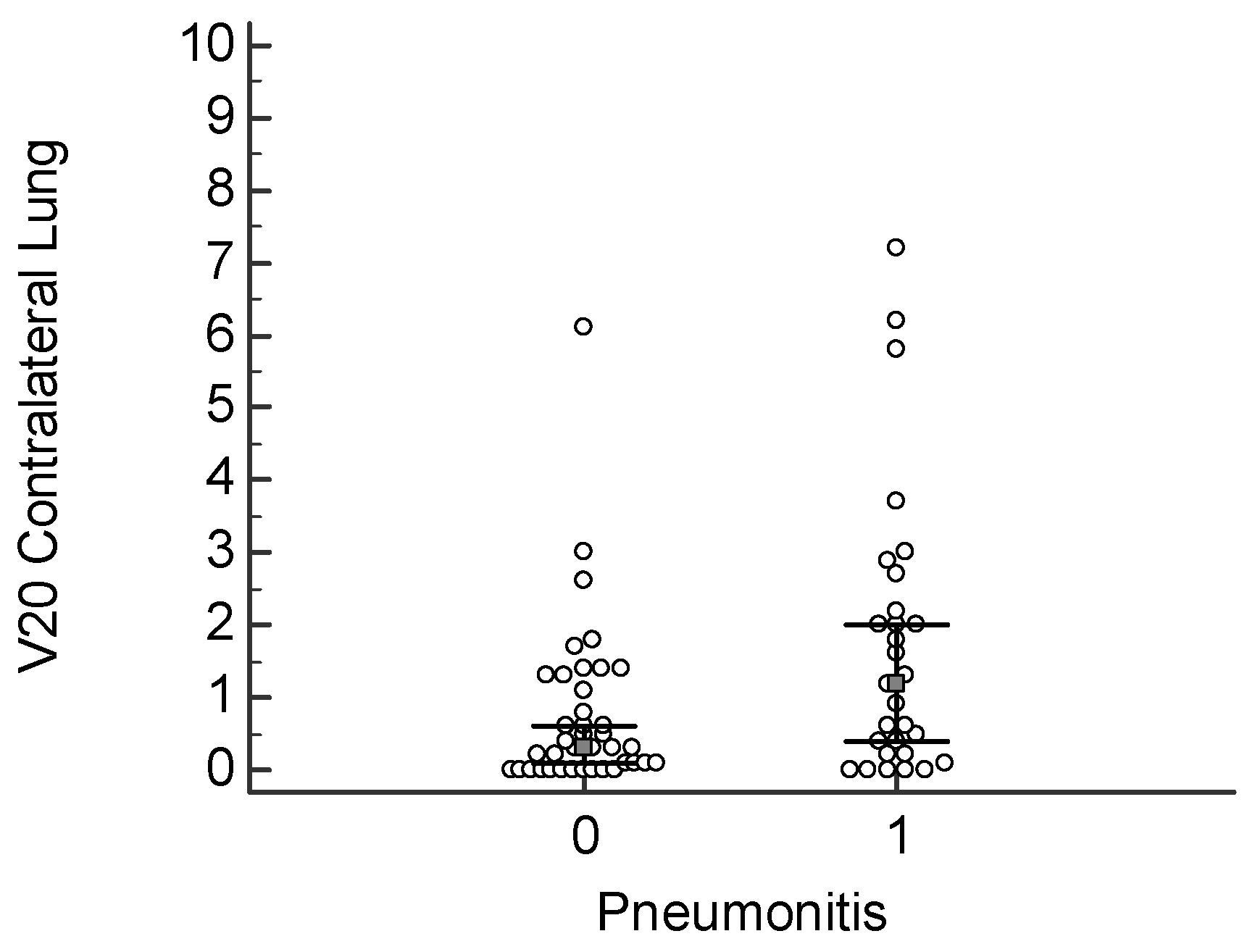
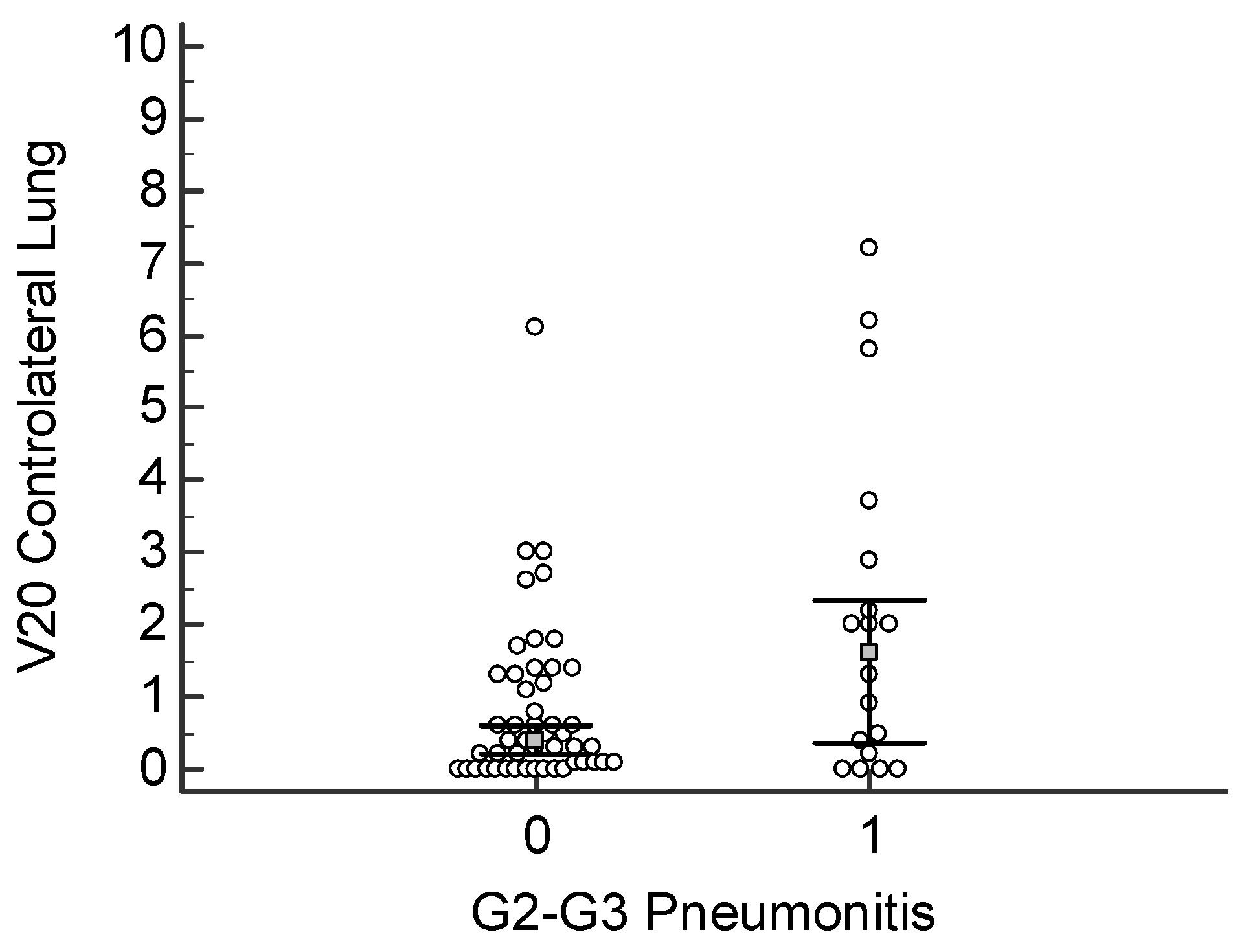
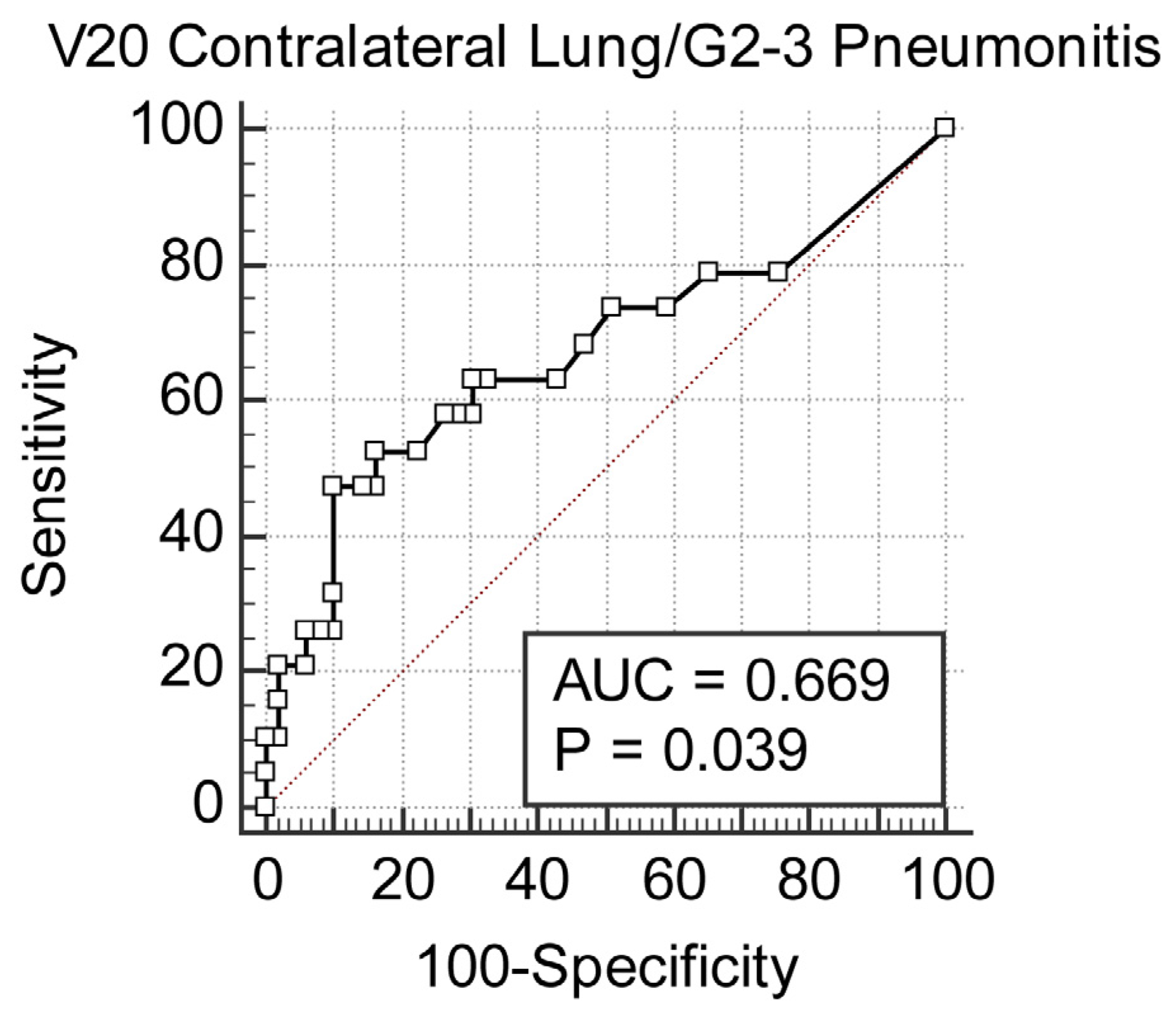
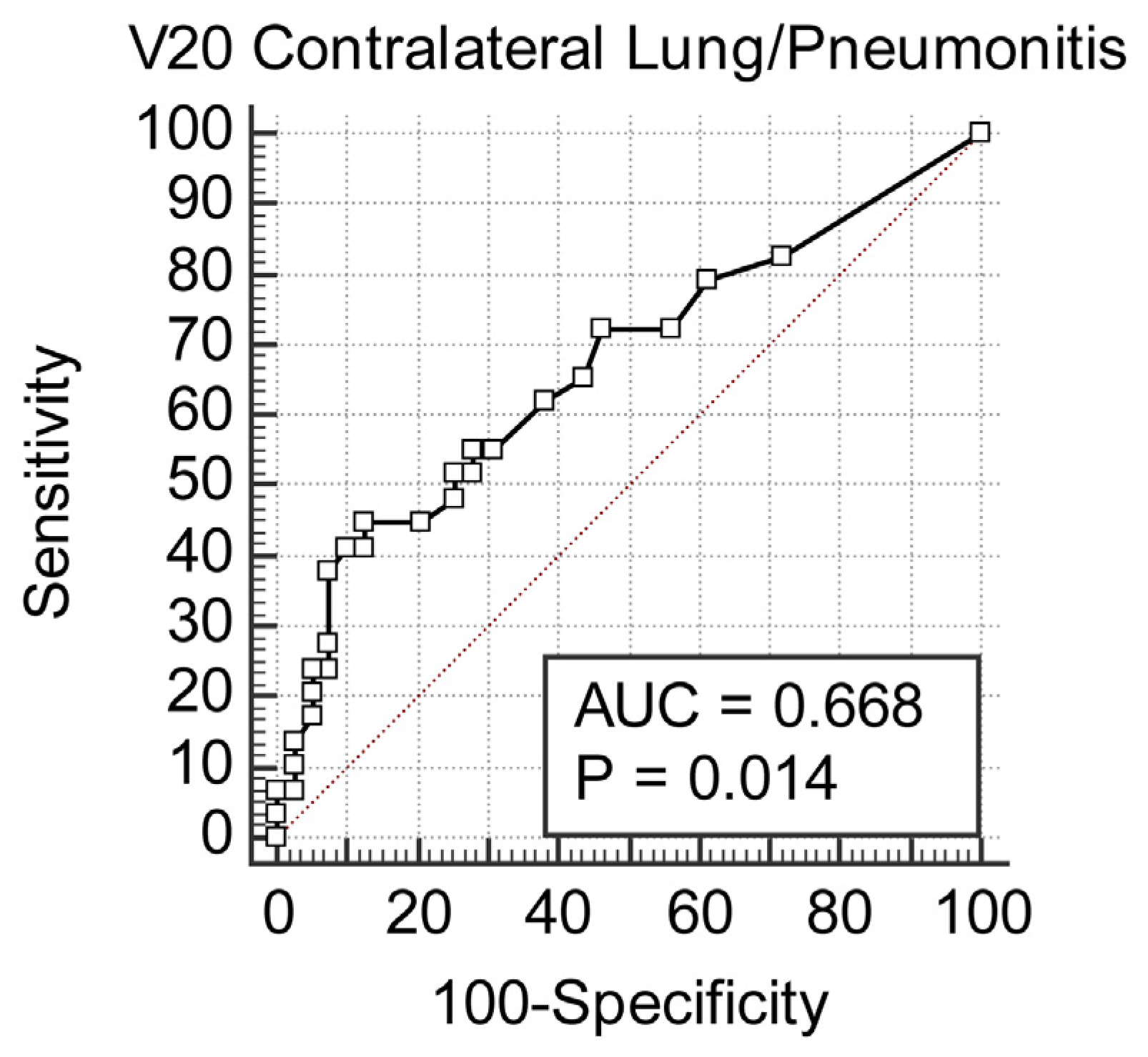
| V20 (Contralateral Lung) | 0.5% (0.3–1.1%) | 0.017 |
| V5 (Contralateral Lung) | 55% (48.7–57.7%) | 0.97 |
| Mean Lung Dose (MLD) | 6.25 Gy (6.0–6.5 Gy) | 0.98 |
| FCL_V20 (Functional Lung) | 0.46% (0.17–0.88%) | 0.028 |
| FCL_V5 (Functional Lung) | 56.7% (49.9–59.5%) | 0.55 |
| FCL_MLD (Functional Lung) | 6.35 Gy (6.03–6.75 Gy) | 0.32 |
Disclaimer/Publisher’s Note: The statements, opinions and data contained in all publications are solely those of the individual author(s) and contributor(s) and not of MDPI and/or the editor(s). MDPI and/or the editor(s) disclaim responsibility for any injury to people or property resulting from any ideas, methods, instructions or products referred to in the content. |
© 2026 by the authors. Licensee MDPI, Basel, Switzerland. This article is an open access article distributed under the terms and conditions of the Creative Commons Attribution (CC BY) license.
Share and Cite
Dominici, L.; Franceschini, D.; Loi, M.; Spoto, R.; Marzo, A.M.; Marini, B.; Ilieva, M.B.; Lambri, N.; La Fauci, F.; Franzese, C.; et al. The Role of Dosimetric Parameters in Radiation Pneumonitis: A Functional Approach in Adjuvant Treatment of Malignant Pleural Mesothelioma. Cancers 2026, 18, 405. https://doi.org/10.3390/cancers18030405
Dominici L, Franceschini D, Loi M, Spoto R, Marzo AM, Marini B, Ilieva MB, Lambri N, La Fauci F, Franzese C, et al. The Role of Dosimetric Parameters in Radiation Pneumonitis: A Functional Approach in Adjuvant Treatment of Malignant Pleural Mesothelioma. Cancers. 2026; 18(3):405. https://doi.org/10.3390/cancers18030405
Chicago/Turabian StyleDominici, Luca, Davide Franceschini, Mauro Loi, Ruggero Spoto, Antonio Marco Marzo, Beatrice Marini, Mariya Boyanova Ilieva, Nicola Lambri, Francesco La Fauci, Ciro Franzese, and et al. 2026. "The Role of Dosimetric Parameters in Radiation Pneumonitis: A Functional Approach in Adjuvant Treatment of Malignant Pleural Mesothelioma" Cancers 18, no. 3: 405. https://doi.org/10.3390/cancers18030405
APA StyleDominici, L., Franceschini, D., Loi, M., Spoto, R., Marzo, A. M., Marini, B., Ilieva, M. B., Lambri, N., La Fauci, F., Franzese, C., & Scorsetti, M. (2026). The Role of Dosimetric Parameters in Radiation Pneumonitis: A Functional Approach in Adjuvant Treatment of Malignant Pleural Mesothelioma. Cancers, 18(3), 405. https://doi.org/10.3390/cancers18030405