Prehabilitation in Adult Cancer Patients Undergoing Chemotherapy or Radiotherapy: A Scoping Review

 , , , , and
Simple Summary
Abstract
1. Introduction
2. Materials and Methods
- What current forms of prehabilitation are used for non-surgical cancer treatments?
- What feasibility, implementation strategies, and outcomes have been found for these prehabilitation interventions?
- Which populations benefit the most from non-surgical cancer prehabilitation?
- What gaps exist in the current literature, and where is future research needed?
2.1. Eligibility Criteria
2.2. Search Strategy
3. Results
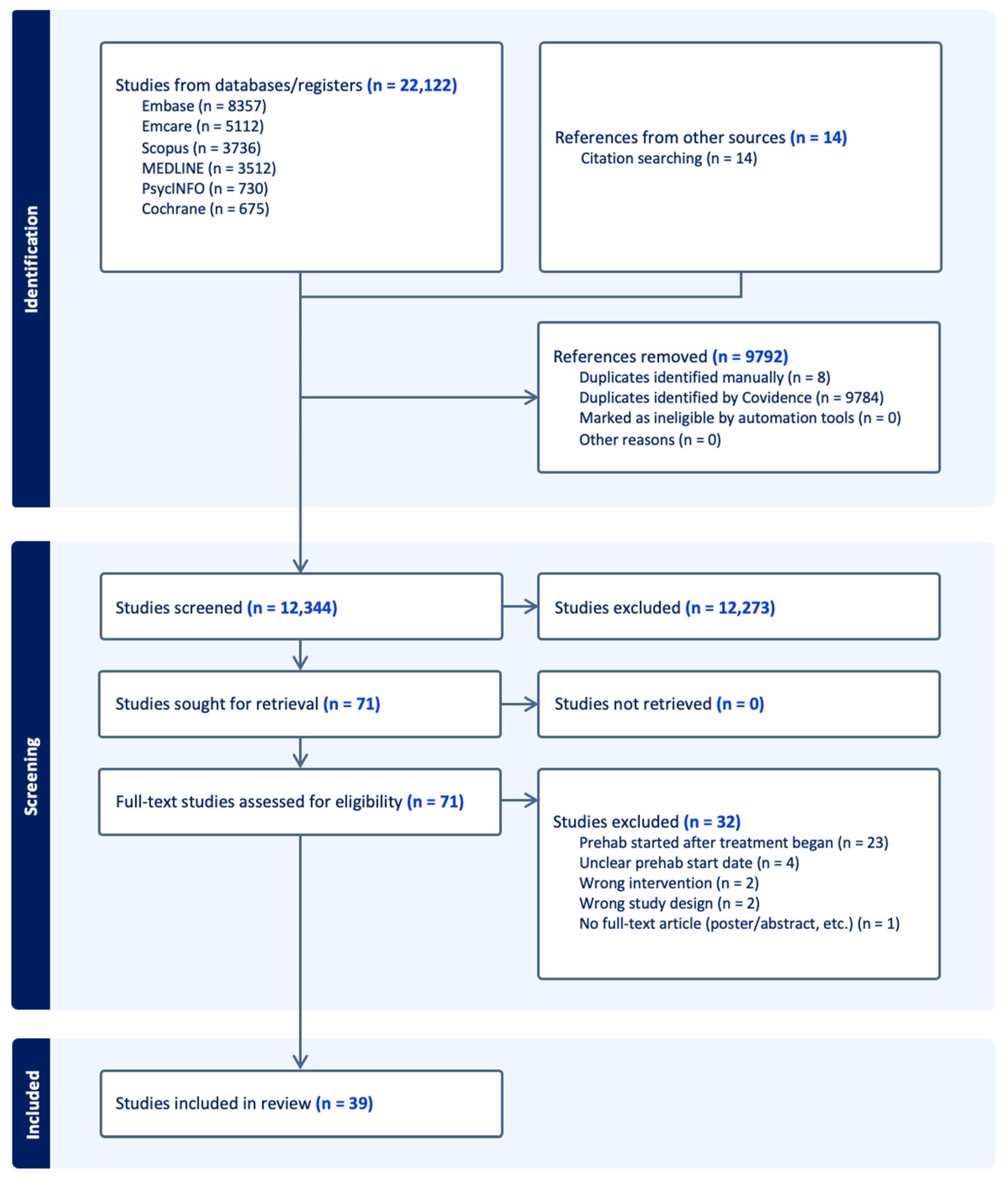
3.1. Search
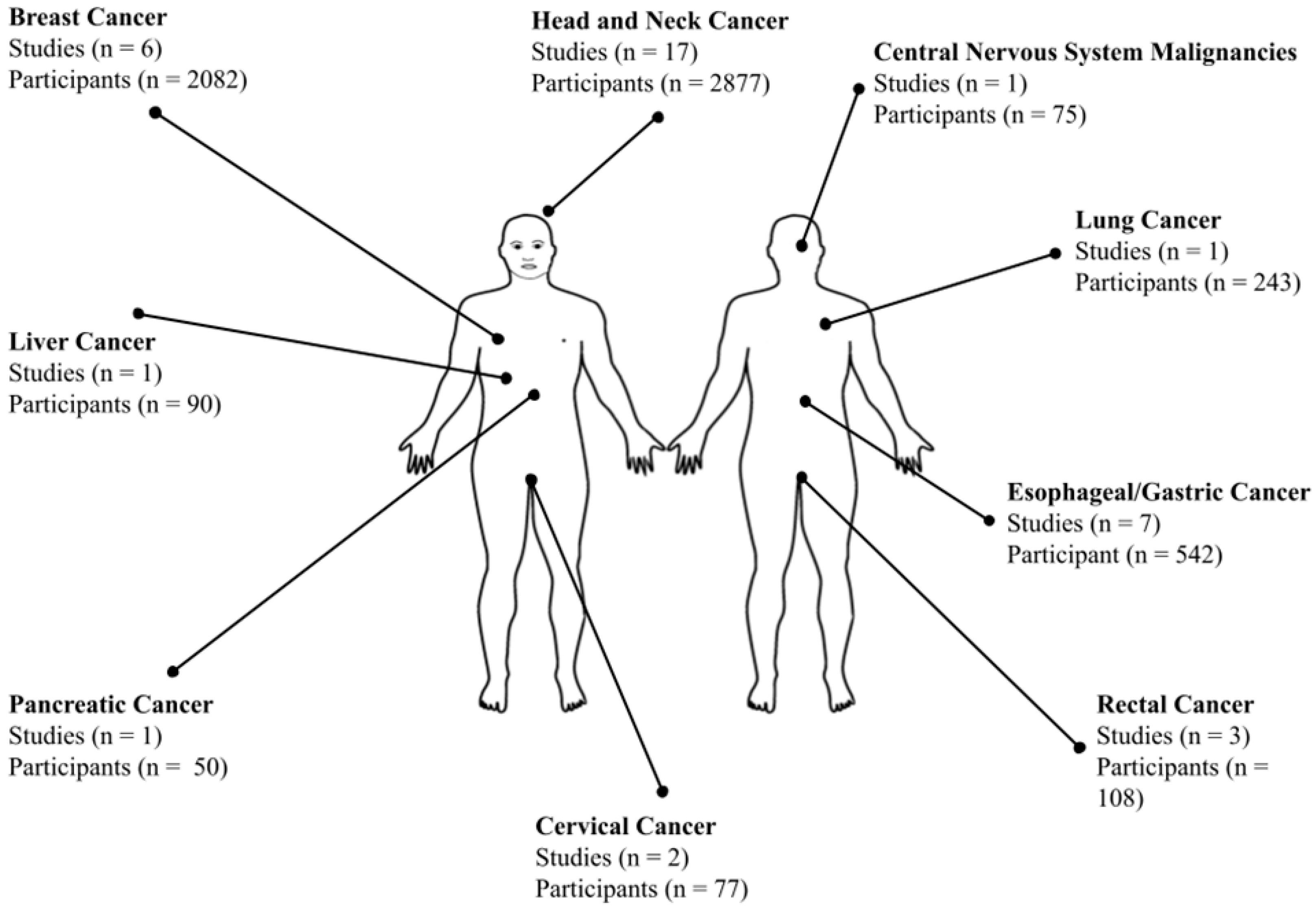
3.2. Characteristics of Included Studies
3.3. Intervention Characteristics
4. Discussion
4.1. Exercise Interventions
4.2. Nutrition Intervention
4.3. Psychosocial Support and Educational Interventions
4.4. Cancer Types Represented
4.5. Treatment Types
4.6. Study Outcomes
4.7. Age-Specific Considerations
4.8. Limitations
5. Conclusions
Supplementary Materials
Author Contributions
Funding
Data Availability Statement
Conflicts of Interest
References
- Miller, K.D.; Nogueira, L.; Mariotto, A.B.; Rowland, J.H.; Yabroff, K.R.; Alfano, C.M.; Jemal, A.; Kramer, J.L.; Siegel, R.L. Cancer treatment and survivorship statistics, 2019. CA Cancer J. Clin. 2019, 69, 363–385. [Google Scholar] [CrossRef]
- Shapiro, C.L. Cancer survivorship. N. Engl. J. Med. 2018, 379, 2438–2450. [Google Scholar] [CrossRef] [PubMed]
- Alterio, D.; Jereczek-Fossa, B.A.; Fiore, M.R.; Piperno, G.; Ansarin, M.; Orecchia, R. Cancer treatment-induced oral mucositis. Anticancer Res. 2007, 27, 1105–1125. [Google Scholar] [PubMed]
- National Cancer Institute. Radiation Therapy Side Effects. Available online: https://www.cancer.gov/about-cancer/treatment/types/radiation-therapy/side-effects (accessed on 10 December 2025).
- Guise, T.A. Bone loss and fracture risk associated with cancer therapy. Oncologist 2006, 11, 1121–1131. [Google Scholar] [CrossRef] [PubMed]
- Sturgeon, K.M.; Mathis, K.M.; Rogers, C.J.; Schmitz, K.H.; Waning, D.L. Cancer- and chemotherapy-induced musculoskeletal degradation. JBMR Plus 2019, 3, e10187. [Google Scholar] [CrossRef]
- Katta, B.; Vijayakumar, C.; Dutta, S.; Dubashi, B.; Ramakrishnaiah, V.P.N. The incidence and severity of patient-reported side effects of chemotherapy in routine clinical care: A prospective observational study. Cureus 2023, 15, e38301. [Google Scholar] [CrossRef]
- Peterson, S.J.; Mozer, M. Differentiating sarcopenia and cachexia among patients with cancer. Nutr. Clin. Pract. 2017, 32, 30–39. [Google Scholar] [CrossRef]
- Muhandiramge, J.; Orchard, S.G.; Warner, E.T.; van Londen, G.J.; Zalcberg, J.R. Functional decline in the cancer patient: A review. Cancers 2022, 14, 1368. [Google Scholar] [CrossRef]
- Wedding, U.; Röhrig, B.; Klippstein, A.; Pientka, L.; Höffken, K. Age, severe comorbidity and functional impairment independently contribute to poor survival in cancer patients. J. Cancer Res. Clin. Oncol. 2007, 133, 945–950. [Google Scholar] [CrossRef]
- Repetto, L.; Fratino, L.; Audisio, R.A.; Venturino, A.; Gianni, W.; Vercelli, M.; Parodi, S.; Dal Lago, D.; Gioia, F.; Monfardini, S.; et al. Comprehensive geriatric assessment adds information to Eastern Cooperative Oncology Group performance status in elderly cancer patients: An Italian Group for Geriatric Oncology Study. J. Clin. Oncol. 2002, 20, 494–502. [Google Scholar] [CrossRef]
- Jordhøy, M.S.; Fayers, P.; Loge, J.H.; Saltnes, T.; Ahlner-Elmqvist, M.; Kaasa, S. Quality of life in advanced cancer patients: The impact of sociodemographic and medical characteristics. Br. J. Cancer 2001, 85, 1478–1485. [Google Scholar] [CrossRef] [PubMed]
- Michael, C.M.; Lehrer, E.J.; Schmitz, K.H.; Zaorsky, N.G. Prehabilitation exercise therapy for cancer: A systematic review and meta-analysis. Cancer Med. 2021, 10, 4195–4205. [Google Scholar] [CrossRef] [PubMed]
- Merchant, Z.; Denehy, L.; Mina, D.S.; Alibhai, S.; Moore, J. Prehabilitation and rehabilitation in older adults with cancer and frailty. In Frailty in Older Adults with Cancer; Gomes, F., Ed.; Springer: Cham, Switzerland, 2022; pp. 155–176. [Google Scholar] [CrossRef]
- Alfano, C.M.; Pergolotti, M. Next-generation cancer rehabilitation: A giant step forward for patient care. Rehabil. Nurs. Off. J. Assoc. Rehabil. Nurses 2018, 43, 186–194. [Google Scholar] [CrossRef] [PubMed]
- Flores, L.E.; Westmark, D.; Katz, N.B.; Hunter, T.L.; Silver, E.M.; Bryan, K.M.; Jagsi, R.; McClelland, S.; Silver, J.K. Prehabilitation in radiation therapy: A scoping review. Support. Care Cancer 2024, 32, 83. [Google Scholar] [CrossRef]
- Pal, S.K.; Katheria, V.; Hurria, A. Evaluating the older patient with cancer: Understanding frailty and the geriatric assessment. CA Cancer J. Clin. 2010, 60, 120–132. [Google Scholar] [CrossRef]
- Nicholson, N.R. A review of social isolation: An important but underassessed condition in older adults. J. Prim. Prev. 2012, 33, 137–152. [Google Scholar] [CrossRef]
- Waterland, J.L.; McCourt, O.; Edbrooke, L.; Granger, C.L.; Ismail, H.; Riedel, B.; Denehy, L. Efficacy of prehabilitation including exercise on postoperative outcomes following abdominal cancer surgery: A systematic review and meta-analysis. Front. Surg. 2021, 8, 628848. [Google Scholar] [CrossRef]
- Yang, L.; Alice, A.; Friedenreich, C.M. Physical activity for cancer prehabilitation: A scoping review. Crit. Rev. Oncol. Hematol. 2024, 196, 104319. [Google Scholar] [CrossRef]
- Trommer, M.; Marnitz, S.; Skoetz, N.; Rupp, R.; Niels, T.; Morgenthaler, J.; Theurich, S.; von Bergwelt-Baildon, M.; Baues, C.; Baumann, F.T. Exercise interventions for adults with cancer receiving radiation therapy alone. Cochrane Database Syst. Rev. 2023, 3, CD013448. [Google Scholar] [CrossRef]
- Sadlonova, M.; Katz, N.; Jurayj, J.S.; Flores, L.; Celano, C.M.; von Arnim, C.A.F.; Silver, J.K. Surgical prehabilitation in older and frail individuals: A scoping review. Int. Anesthesiol. Clin. 2023, 61, 34–46. [Google Scholar] [CrossRef]
- Bruns, E.R.J.; Argillander, T.E.; Schuijt, H.J.; van Duijvendijk, P.; van der Zaag, E.S.; Wassenaar, E.B.; Gerhards, M.F.; Consten, E.C.; Buskens, C.J.; van Munster, B.C.; et al. Fit4SurgeryTV at-home prehabilitation for frail older patients planned for colorectal cancer surgery: A pilot study. Am. J. Phys. Med. Rehabil. 2019, 98, 399–406. [Google Scholar] [CrossRef]
- Bullock, A.F.; Patterson, M.J.; Paton, L.W.; Currow, D.C.; Johnson, M.J. Malnutrition, sarcopenia and cachexia: Exploring prevalence, overlap, and perceptions in older adults with cancer. Eur. J. Clin. Nutr. 2024, 78, 486–493. [Google Scholar] [CrossRef]
- Santa Mina, D.; Alibhai, S.M.H. Prehabilitation in geriatric oncology. J. Geriatr. Oncol. 2020, 11, 731–734. [Google Scholar] [CrossRef]
- MacDonald, A.M.; Chafranskaia, A.; Lopez, C.A.; Maganti, M.; Bernstein, L.J.; Chang, E.; Langelier, D.M.; Obadia, M.; Edwards, B.; Oh, P.; et al. CaRE @ Home: Pilot study of an online multidimensional cancer rehabilitation and exercise program for cancer survivors. J. Clin. Med. 2020, 9, 3092. [Google Scholar] [CrossRef] [PubMed]
- Peters, M.D.J.; Godfrey, C.M.; Khalil, H.; McInerney, P.; Parker, D.; Soares, C.B. Guidance for conducting systematic scoping reviews. Int. J. Evid.-Based Healthc. 2015, 13, 141–146. [Google Scholar] [CrossRef] [PubMed]
- Arksey, H.; O’Malley, L. Scoping studies: Towards a methodological framework. Int. J. Soc. Res. Methodol. 2005, 8, 19–32. [Google Scholar] [CrossRef]
- Moher, D.; Shamseer, L.; Clarke, M.; Ghersi, D.; Liberati, A.; Petticrew, M.; Shekelle, P.; Stewart, L.A. Preferred reporting items for systematic review and meta-analysis protocols (PRISMA-P) 2015 statement. Syst. Rev. 2015, 4, 1. [Google Scholar] [CrossRef]
- Tricco, A.C.; Lillie, E.; Zarin, W.; O’Brien, K.K.; Colquhoun, H.; Levac, D.; Moher, D.; Peters, M.D.J.; Horsley, T.; Weeks, L.; et al. PRISMA Extension for Scoping Reviews (PRISMA-ScR): Checklist and explanation. Ann. Intern. Med. 2018, 169, 467–473. [Google Scholar] [CrossRef]
- Veritas Health Innovation. Covidence Systematic Review Software. Available online: https://www.covidence.org/ (accessed on 10 December 2025).
- Page, M.J.; McKenzie, J.E.; Bossuyt, P.M.; Boutron, I.; Hoffmann, T.C.; Mulrow, C.D.; Shamseer, L.; Tetzlaff, J.M.; Akl, E.A.; Brennan, S.E.; et al. The PRISMA 2020 statement: An updated guideline for reporting systematic reviews. BMJ 2021, 372, n71. [Google Scholar] [CrossRef]
- Hong, Q.N.; Pluye, P.; Bujold, M.; Wassef, M. Convergent and sequential synthesis designs: Implications for conducting and reporting systematic reviews of qualitative and quantitative evidence. Syst. Rev. 2017, 6, 61. [Google Scholar] [CrossRef]
- Bausys, A.; Luksta, M.; Anglickiene, G.; Maneikiene, V.V.; Kryzauskas, M.; Rybakovas, A.; Dulskas, A.; Kuliavas, J.; Stratilatovas, E.; Macijauskien, L.; et al. Effect of home-based prehabilitation on postoperative complications after surgery for gastric cancer: Randomized clinical trial. Br. J. Surg. 2023, 110, 1800–1807. [Google Scholar] [CrossRef]
- Brahmbhatt, P.; Look Hong, N.J.; Sriskandarajah, A.; Alavi, N.; Selvadurai, S.; Berger-Richardson, D.; Lemon-Wong, S.; Mascarenhas, J.; Gibson, L.; Rapier, T.; et al. A feasibility randomized controlled trial of prehabilitation during neoadjuvant chemotherapy for women with breast cancer: A mixed methods study. Ann. Surg. Oncol. 2024, 31, 2261–2271. [Google Scholar] [CrossRef] [PubMed]
- Govender, R.; Smith, C.H.; Barratt, H.; Gardner, B.; Taylor, S.A. SIP SMART: A parallel group randomised feasibility trial of a tailored pre-treatment swallowing intervention package compared with usual care for patients with head and neck cancer. BMC Cancer 2020, 20, 360. [Google Scholar] [CrossRef] [PubMed]
- Heiman, J.; Onerup, A.; Bock, D.; Haglind, E.; Olofsson Bagge, R. The effect of nonsupervised physical activity before and after breast cancer surgery on quality of life: Results from a randomized controlled trial (PhysSURG-B). Scand. J. Surg. 2022, 111, 75–82. [Google Scholar] [CrossRef] [PubMed]
- Kotz, T.; Federman, A.D.; Kao, J.; Milman, L.; Packer, S.; Lopez-Prieto, C.; Forsythe, K.; Genden, E.M. Prophylactic swallowing exercises in patients with head and neck cancer undergoing chemoradiation: A randomized trial. Arch. Otolaryngol. Head Neck Surg. 2012, 138, 376–382. [Google Scholar] [CrossRef]
- Liu, L.; Xin, L.; Li, W.; Duan, X.; Pi, H. Application of prerehabilitation nursing practice before radiotherapy in patients with liver cancer: A single-center prospective randomized controlled study. Int. J. Clin. Exp. Med. 2022, 15, 16–22. [Google Scholar]
- Loughney, L.; Bolger, J.; Tully, R.; Sorensen, J.; Bambrick, M.; Carroll, P.A.; Arumugasamy, M.; Murphy, T.J.; McCaffrey, N.; Robb, W.B. The effect of a pre-operative and post-operative exercise programme versus standard care on physical fitness of patients with oesophageal and gastric cancer undergoing neoadjuvant treatment prior to surgery (the PERIOP-OG trial): A randomized controlled trial. Int. J. Surg. 2024, 110, 6632–6646. [Google Scholar] [CrossRef]
- Loughney, L.; Murphy, K.; Tully, R.; Robb, W.B.; McCaffrey, N.; Dowd, K.; Skelly, F. The effect of a pre- and post-operative exercise program versus standard care on physical activity and sedentary behavior of patients with esophageal and gastric cancer undergoing neoadjuvant treatment prior to surgery (the PERIOP-OG Trial): A randomized controlled trial. Dis. Esophagus 2024, 37, doae044. [Google Scholar] [CrossRef]
- Messing, B.P.; Ward, E.C.; Lazarus, C.L.; Kim, M.; Zhou, X.; Silinonte, J.; Gold, D.; Harrer, K.; Ulmer, K.; Merritt, S.; et al. Prophylactic swallow therapy for patients with head and neck cancer undergoing chemoradiotherapy: A randomized trial. Dysphagia 2017, 32, 487–500. [Google Scholar] [CrossRef]
- Mortensen, H.R.; Jensen, K.; Aksglæde, K.; Lambertsen, K.; Eriksen, E.; Grau, C. Prophylactic swallowing exercises in head and neck cancer radiotherapy. Dysphagia 2015, 30, 304–314. [Google Scholar] [CrossRef]
- Moug, S.J.; Mutrie, N.; Barry, S.J.E.; Mackay, G.; Steele, R.J.C.; Boachie, C.; Buchan, C.; Anderson, A.S. Prehabilitation is feasible in patients with rectal cancer undergoing neoadjuvant chemoradiotherapy and may minimize physical deterioration: Results from the REx trial. Color. Dis. 2019, 21, 548–562. [Google Scholar] [CrossRef] [PubMed]
- Moug, S.; Barry, S.J.E.; Maguire, S.; Johns, N.; Dolan, D.R.; Steele, R.; Buchan, C.; MacKay, G.J.; Anderson, A.S.; Mutrie, N. Does prehabilitation modify muscle mass in patients with rectal cancer undergoing neoadjuvant therapy? A subanalysis from the REx randomised controlled trial. Tech. Coloproctol. 2020, 24, 959–964. [Google Scholar] [CrossRef] [PubMed]
- van der Molen, L.; van Rossum, M.A.; Burkhead, L.M.; Smeele, L.E.; Rasch, C.R.N.; Hilgers, F.J.M. A randomized preventive rehabilitation trial in advanced head and neck cancer patients treated with chemoradiotherapy: Feasibility, compliance, and short-term effects. Dysphagia 2011, 26, 155–170. [Google Scholar] [CrossRef] [PubMed]
- van der Molen, L.; van Rossum, M.A.; Rasch, C.R.N.; Smeele, L.E.; Hilgers, F.J.M. Two-year results of a prospective preventive swallowing rehabilitation trial in patients treated with chemoradiation for advanced head and neck cancer. Eur. Arch. Oto-Rhino-Laryngol. 2014, 271, 1257–1270. [Google Scholar] [CrossRef]
- Wang, Y.-J.; Boehmke, M.; Wu, Y.-W.B.; Dickerson, S.S.; Fisher, N. Effects of a 6-week walking program on Taiwanese women newly diagnosed with early-stage breast cancer. Cancer Nurs. 2011, 34, E1–E13. [Google Scholar] [CrossRef]
- Xu, F.; Zhang, J.; Xie, S.; Li, Q. Effects of Mindfulness-Based Cancer Recovery training on anxiety, depression, post-traumatic stress disorder, and cancer-related fatigue in breast neoplasm patients undergoing chemotherapy. Medicine 2024, 103, e38460. [Google Scholar] [CrossRef]
- Aggarwal, V.V.; Waghmare, C.M.; Lolage, S.N.; Pawar, H.J.; Ravichandran, M.; Bhanu, A. Subjective and perceptive assessment of speech/voice and swallowing function before and after radiation therapy in patients of head-and-neck squamous cell cancer. J. Cancer Res. Ther. 2023, 19, S373–S379. [Google Scholar] [CrossRef]
- Carmignani, I.; Locatello, L.G.; Desideri, I.; Bonomo, P.; Olmetto, E.; Livi, L.; Le Saec, O.; Coscarelli, S.; Mannelli, G. Analysis of dysphagia in advanced-stage head-and-neck cancer patients: Impact on quality of life and development of a preventive swallowing treatment. Eur. Arch. Oto-Rhino-Laryngol. 2018, 275, 2159–2167. [Google Scholar] [CrossRef]
- Charters, E.; Loy, J.; Wu, R.; Cheng, K.; Dunn, M.; Davies, S.; Clark, J. Pilot study of intensive trismus intervention using RestorabiteTM during unilateral adjuvant radiation for head and neck cancer. Dysphagia 2024, 39, 864–871. [Google Scholar] [CrossRef]
- Cnossen, I.C.; van Uden-Kraan, C.F.; Rinkel, R.N.; Aalders, I.J.; de Goede, C.J.; de Bree, R.; Doornaert, P.; Rietveld, D.H.; Langendijk, J.A.; Witte, B.I.; et al. Multimodal guided self-help exercise program to prevent speech, swallowing, and shoulder problems among head and neck cancer patients: A feasibility study. J. Med. Internet Res. 2014, 16, e74. [Google Scholar] [CrossRef]
- Di Franco, R.; Calvanese, M.; Murino, P.; Manzo, R.; Guida, C.; Di Gennaro, D.; Anania, C.; Ravo, V. Skin toxicity from external beam radiation therapy in breast cancer patients: Protective effects of Resveratrol, Lycopene, Vitamin C and anthocianin (Ixor®). Radiat. Oncol. 2012, 7, 12. [Google Scholar] [CrossRef]
- Halliday, L.J.; Doganay, E.; Wynter-Blyth, V.; Osborn, H.; Buckley, J.; Moorthy, K. Adherence to pre-operative exercise and the response to prehabilitation in oesophageal cancer patients. J. Gastrointest. Surg. 2021, 25, 890–899. [Google Scholar] [CrossRef] [PubMed]
- Ngo-Huang, A.; Parker, N.H.; Bruera, E.; Lee, R.E.; Simpson, R.; O’Connor, D.P.; Petzel, M.Q.B.; Fontillas, R.C.; Schadler, K.; Xiao, L.; et al. Home-based exercise prehabilitation during preoperative treatment for pancreatic cancer is associated with improvement in physical function and quality of life. Integr. Cancer Ther. 2019, 18, 1534735419894061. [Google Scholar] [CrossRef] [PubMed]
- O’Loughlin, L.; Lukez, A.; Ma, Y.; Baima, J.; Moni, J. Prehabilitation for patient positioning: Pelvic exercises assist in minimizing inter-fraction sacral slope variability during radiation therapy. Med. Oncol. 2019, 37, 3. [Google Scholar] [CrossRef] [PubMed]
- Phillips, I.; Deans, M.; Walton, A.; Vallet, M.; Mencnarowksi, J.; McMillan, D.; Peacock, C.; Hall, P.; O’Brien, F.; Stares, M.; et al. Early prehabilitation reduces admissions and time in hospital in patients with newly diagnosed lung cancer. BMJ Support. Palliat. Care 2024, 15, 125–129. [Google Scholar] [CrossRef]
- Sacomori, C.; Araya-Castro, P.; Diaz-Guerrero, P.; Ferrada, I.A.; Martínez-Varas, A.C.; Zomkowski, K. Pre-rehabilitation of the pelvic floor before radiation therapy for cervical cancer: A pilot study. Int. Urogynecol. J. 2020, 31, 2411–2418. [Google Scholar] [CrossRef]
- Starmer, H.M.; Abrams, R.; Webster, K.; Kizner, J.; Beadle, B.; Holsinger, F.C.; Quon, H.; Richmon, J. Feasibility of a mobile application to enhance swallowing therapy for patients undergoing radiation-based treatment for head and neck cancer. Dysphagia 2018, 33, 227–233. [Google Scholar] [CrossRef]
- Strijker, D.; Hoogeboom, T.J.; Meijerink, J.W.J.H.; Taveirne, A.; Schreurs, W.H.; van Laarhoven, C.J.H.M.; van den Heuvel, B. Multimodal rehabilitation (Fit4Chemo) before and during adjuvant chemotherapy in patients with colonic cancer. Br. J. Surg. 2024, 111, znad354. [Google Scholar] [CrossRef]
- Zylstra, J.; Whyte, G.P.; Beckmann, K.; Pate, J.; Santaolalla, A.; Gervais-Andre, L.; Russell, B.; Maisey, N.; Waters, J.; Tham, G.; et al. Exercise prehabilitation during neoadjuvant chemotherapy may enhance tumour regression in oesophageal cancer: Results from a prospective non-randomised trial. Br. J. Sports Med. 2022, 56, 402–409. [Google Scholar] [CrossRef]
- Ajmani, G.S.; Nocon, C.C.; Brockstein, B.E.; Campbell, N.P.; Kelly, A.B.; Allison, J.; Bhayani, M.K. Association of a proactive swallowing rehabilitation program with feeding tube placement in patients treated for pharyngeal cancer. JAMA Otolaryngol.-Head Neck Surg. 2018, 144, 483–488. [Google Scholar] [CrossRef]
- Blake, C.; Edwards, A.S.; Treleaven, E.; Brown, T.; Hughes, B.; Lin, C.; Kenny, L.; Banks, M.; Bauer, J. Evaluation of a novel pre-treatment model of nutrition care for patients with head and neck cancer receiving chemoradiotherapy. Nutr. Diet. J. Dietit. Assoc. Aust. 2022, 79, 206–216. [Google Scholar] [CrossRef]
- Christodoulidis, G.; Halliday, L.J.; Samara, A.; Bhuva, N.; Park, W.-H.E.; Moorthy, K. Personalized prehabilitation improves tolerance to chemotherapy in patients with oesophageal cancer. Curr. Oncol. Tor. Ont. 2023, 30, 1538–1545. [Google Scholar] [CrossRef]
- Halliday, L.J.; Boshier, P.R.; Doganay, E.; Wynter-Blyth, V.; Buckley, J.P.; Moorthy, K. The effects of prehabilitation on body composition in patients undergoing multimodal therapy for esophageal cancer. Dis. Esophagus 2023, 36, doac046. [Google Scholar] [CrossRef]
- Malik, N.H.; Maganti, M.; McQuestion, M.; Tjong, M.C.; Keilty, D.; Monteiro, E.; Huang, S.H.; Jang, R.W.-J.; Gomes, A.; Pun, J.; et al. Pre-treatment psychoeducational intervention and outcomes in head and neck cancer patients undergoing radiotherapy. Support. Care Cancer 2021, 29, 1643–1652. [Google Scholar] [CrossRef]
- Natsume, K.; Yoshida, A.; Sakakima, H.; Yonezawa, H.; Kawamura, K.; Akihiro, S.; Hanaya, R.; Shimodozono, M. Age-independent benefits of postoperative rehabilitation during chemoradiotherapy on functional outcomes and survival in patients with glioblastoma. J. Neuro-Oncol. 2024, 170, 129–137. [Google Scholar] [CrossRef]
- Retel, V.P.; van der Molen, L.; Hilgers, F.J.M.; Rasch, C.R.N.; L’Ortye, A.A.; Steuten, L.M.G.; van Harten, W.H. A cost-effectiveness analysis of a preventive exercise program for patients with advanced head and neck cancer treated with concomitant chemo-radiotherapy. BMC Cancer 2011, 11, 475. [Google Scholar] [CrossRef] [PubMed]
- Retel, V.P.; van der Molen, L.; Steuten, L.M.G.; van den Brekel, M.W.; Hilgers, F.J.M. A cost-effectiveness analysis of using TheraBite in a preventive exercise program for patients with advanced head and neck cancer treated with concomitant chemo-radiotherapy. Eur. Arch. Oto-Rhino-Laryngol. 2016, 273, 709–718. [Google Scholar] [CrossRef] [PubMed]
- Büntzel, J.; Büntzel, H.; Micke, O.; Mücke, R.; Kisters, K.; Hübner, J.; Schäfer, U.; Boehme, R.; Oehler, W. Nutritional support for head and neck cancer patients before irradiation—A pilot project for malnutrition risk group. Trace Elem. Electrolytes 2013, 31, 1–5. [Google Scholar] [CrossRef]
- Rossi, C.; Maggiore, C.; Rossi, M.M.; Filippone, A.; Guarino, D.; Di Micco, A.; Forcina, L.; Magno, S. A model of an integrative approach to breast cancer patients. Integr. Cancer Ther. 2021, 20, 15347354211040826. [Google Scholar] [CrossRef]
- Weston, M.; Weston, K.L.; Prentis, J.M.; Snowden, C.P. High-intensity interval training (HIT) for effective and time-efficient pre-surgical exercise interventions. Perioper. Med. 2016, 5, 2. [Google Scholar] [CrossRef]
- Alfouzan, A.F. Radiation therapy in head and neck cancer. Saudi Med. J. 2021, 42, 247–254. [Google Scholar] [CrossRef] [PubMed]
- Morris, K.A.; Haboubi, N.Y. Pelvic radiation therapy: Between delight and disaster. World J. Gastrointest. Surg. 2015, 7, 279–288. [Google Scholar] [CrossRef] [PubMed]
- Bossi, P.; Delrio, P.; Mascheroni, A.; Zanetti, M. The spectrum of malnutrition/cachexia/sarcopenia in oncology according to different cancer types and settings: A narrative review. Nutrients 2021, 13, 1980. [Google Scholar] [CrossRef] [PubMed]
- Mejareh, Z.N.; Abdollahi, B.; Hoseinipalangi, Z.; Jeze, M.S.; Hosseinifard, H.; Rafiei, S.; Aghajani, F.; Dehnad, A.; Ardakani, M.F.; Ahmadi, S. Global, regional, and national prevalence of depression among cancer patients: A systematic review and meta-analysis. Indian. J. Psychiatry 2021, 63, 527–535. [Google Scholar] [CrossRef]
- Barsouk, A.; Aluru, J.S.; Rawla, P.; Saginala, K.; Barsouk, A. Epidemiology, risk factors, and prevention of head and neck squamous cell carcinoma. Med. Sci. 2023, 11, 42. [Google Scholar] [CrossRef]
- Gegechkori, N.; Haines, L.; Lin, J.J. Long term and latent side effects of specific cancer types. Med. Clin. North Am. 2017, 101, 1053–1073. [Google Scholar] [CrossRef]
- Cohen, E.E.W.; LaMonte, S.J.; Erb, N.L.; Beckman, K.L.; Sadeghi, N.; Hutcheson, K.A.; Stubblefield, M.D.; Abbott, D.M.; Fisher, P.S.; Stein, K.D.; et al. American Cancer Society Head and Neck Cancer Survivorship Care Guideline. CA Cancer J. Clin. 2016, 66, 203–239. [Google Scholar] [CrossRef]
- Dapkevičiūtė, A.; Šapoka, V.; Martynova, E.; Pečeliūnas, V. Time from symptom onset to diagnosis and treatment among haematological malignancies: Influencing factors and associated negative outcomes. Medicina 2019, 55, 238. [Google Scholar] [CrossRef]
- DeGraaff, L.H.; Platek, A.J.; Iovoli, A.J.; Wooten, K.E.; Arshad, H.; Gupta, V.; McSpadden, R.P.; Kuriakose, M.A.; Hicks, W.L.; Platek, M.E.; et al. The effect of time between diagnosis and initiation of treatment on outcomes in patients with head and neck squamous cell carcinoma. Oral. Oncol. 2019, 96, 148–152. [Google Scholar] [CrossRef]
- Coca-Martinez, M.; Carli, F. Prehabilitation: Who can benefit? Eur. J. Surg. Oncol. 2024, 50, 106979. [Google Scholar] [CrossRef]
- Kim, J.; Hurria, A. Determining chemotherapy tolerance in older patients with cancer. J. Natl. Compr. Cancer Netw. 2013, 11, 1494–1502. [Google Scholar] [CrossRef]
- McGladrigan, E.; Wrench, E.; Dean, E.; O’Neil, A.; Ashmore, L.; Gaffney, C. Exploring prehabilitation interventions for patients with gynaecological cancer undergoing radiotherapy: A scoping review. PLoS ONE 2025, 20, e0319518. [Google Scholar] [CrossRef]
- Kadambi, S.; Loh, K.P.; Dunne, R.; Magnuson, A.; Maggiore, R.; Zittel, J.; Flannery, M.; Inglis, J.; Gilmore, N.; Mohamed, M.; et al. Older adults with cancer and their caregivers—Current landscape and future directions for clinical care. Nat. Rev. Clin. Oncol. 2020, 17, 742–755. [Google Scholar] [CrossRef]
- Glover, M.; Mansoor, E.; Panhwar, M.; Parasa, S.; Cooper, G.S. Epidemiology of colorectal cancer in average risk adults 20–39 years of age: A population based national study. Dig. Dis. Sci. 2019, 64, 3602–3609. [Google Scholar] [CrossRef]
- Kouka, M.; Hermanns, I.; Schlattmann, P.; Guntinas-Lichius, O. The association between patient’s age and head and neck cancer treatment decision—A population-based diagnoses-related group-based nationwide study in Germany. Cancers 2023, 15, 1780. [Google Scholar] [CrossRef]



| Inclusion Criteria | Exclusion Criteria | |
|---|---|---|
| Population | Adults aged 18 or over | Individuals under the age of 18 |
| Individuals diagnosed with any form of cancer | Individuals without cancer | |
| Patients undergoing non-surgical cancer treatments, such as chemotherapy, RT, chemoradiation, immunotherapy, or hormonal therapy | Patients exclusively undergoing surgical cancer treatments without any neoadjuvant/adjuvant therapies | |
| Concept or Focus | Any type of prehab program initiated prior to the onset of non-surgical cancer treatments; non-surgical cancer treatments can be neoadjuvant, adjuvant, or curative/mainline therapies | Studies that do not involve prehab or focus solely on rehabilitation during or after the completion of cancer treatments |
| Outcomes of interest must be directly related to non-surgical cancer treatments and may include, but are not limited to, QoL, physical function, treatment adherence/tolerance, treatment-related side effects, or psychosocial well-being | Studies that focus exclusively on surgical prehab programs or only report on post-surgery outcomes | |
| Studies discussing the feasibility, acceptability, and implementation strategies of non-surgical cancer prehab programs | Studies that do not involve cancer patients or focus on non-cancer prehab programs | |
| Context | Studies conducted in any clinical, community, or at-home settings | N/A |
| Other | English | Narrative reviews |
| Articles published in any year | Systematic/scoping reviews | |
| Original research articles | Editorials | |
| Feasibility studies | Opinion/perspective papers | |
| Quantitative (RCTs, cohort study, case–control, cross-sectional studies, etc.), qualitative, and mixed-methods studies | Conference abstracts Study protocols/proposals |
| Extraction Field | Details |
|---|---|
| General Information | Author(s), paper title, journal, year of publication, and source origin/country of origin |
| Population | Number of participants, participant age range, cancer type, and treatment type |
| Prehabilitation Intervention Used | Type of prehabilitation program (multimodal or unimodal), specific interventions used (e.g., exercise, nutrition therapy, and psychosocial support), duration of program, and program setting/context |
| Study Characteristics | Aim of prehab program/intervention, study design, study methodology, and outcomes measures |
| Outcome Results | Key findings that are related to the review question, including primary outcome results, qualitative analyses, barriers/enablers to program implementation, patient perspectives, and feasibility |
| Authors | Study Design | Disease Type | Cancer Treatment Type | N | Age | Prehab Type | Intervention Summary | Timing | Comparison |
|---|---|---|---|---|---|---|---|---|---|
| Aggarwal et al. [50] | Prospective single-arm cohort | Head and neck cancer | Curative RT or CTRT (radical or adjuvant) | 30 | Med 57 | Unimodal (Exercise) | SLP-guided speech, voice, and swallowing exercises. Self-administered post-instruction. | Before (after complete staging), during, and post-treatment | None |
| Ajmani et al. [63] | Retrospective cohort | Head and neck cancer | Curative RT or CCRT (definitive or adjuvant) | 254 | Med 60 | Unimodal (Exercise) | SLP swallowing program with targeted exercises. | Before, during, and 2–3 wks post-treatment | Historical group with reactive referral only |
| Bausys et al. [34] | RCT | Gastric cancer | Neoadjuvant chemo | 122 | Mean 61 | Multimodal | Home-based exercise, respiratory and resistance training, nutrition, and relaxation. | 1 wk before NAC through to surgery | Standard care without structured support |
| Blake et al. [64] | Retrospective pre-post cohort | Head and neck cancer | CTRT (mostly definitive) | 111 | Mean 60.7 | Unimodal (Nutrition) | Dietetic counseling + enteral nutrition protocol via gastrostomy. | ≥2 wks before CTRT through treatment until oral intake deemed adequate | Historical cohort without pre-treatment counseling |
| Brahmbhatt et al. [35] | Mixed methods feasibility RCT | Breast cancer | Neoadjuvant chemo | 72 | Mean 57.4 | Multimodal | Unsupervised exercise, dietitian counseling, stress management, and smoking cessation. | Few wks before NAC through to surgery | Standard care |
| Büntzel et al. [71] | Non-randomized matched pair | Head and neck cancer | Curative RT | 40 | Med 58 | Multimodal | Parenteral and oral nutrition + swallowing exercises. | 2 wks pre-RT through treatment | Standard supportive care |
| Carmignani et al. [51] | Prospective case–control | Head and neck cancer | Curative or adjuvant RT/CTRT | 12 | Most 50–70 | Unimodal (Exercise) | Home-based swallowing exercises, ten repetitions twice daily. | 2 wks pre-treatment through 6 wks during treatment | Standard care without exercise protocol |
| Charters et al. [52] | Prospective single-arm cohort | Head and neck cancer (trismus) | Adjuvant RT | 9 | Mean 56.1 | Unimodal (Exercise) | Jaw stretching using Restorabite device + SLP sessions. | 3–6 wks post-surgery, pre-RT, continued 10 wks | None |
| Christodoulidis et al. [65] | Retrospective case–control | Esophageal/gastric junction cancer | Neoadjuvant chemo/CTRT | 92 | Mean 67.6 | Multimodal | Home-based exercise + nutritional and psychological support. | Before NAC (at diagnosis) to surgery | Standard care per guidelines |
| Cnossen et al. [53] | Prospective single-arm feasibility | Head and neck cancer | Curative or adjuvant RT/CTRT | 34 | Mean 60 | Multimodal | Pretreatment and educational counseling + home swallowing exercises with weekly coaching. | Up to 11 days pre-RT, 6 weeks during treatment | None |
| Di Franco et al. [54] | Prospective cohort | Breast cancer | Adjuvant RT ± chemo/hormone therapy | 71 | Mean 52.1 | Unimodal (Nutrition) | 6-week oral supplement (Ixor) + standard topical care. | 10 days pre-RT to 10 days post-RT | Standard topical care only |
| Govender et al. [36] | Feasibility RCT | Head and neck cancer | RT/CTRT ± surgery | 32 | Mean 57 | Multimodal | Targeted swallowing exercises + behavioral support + video education. | 3–4 wks pre-RT through 6 months | General info + baseline assessment only |
| Halliday et al. [55] | Prospective single-arm cohort | Esophageal/gastric junction cancer | Neoadjuvant chemo | 67 | Mean 66 | Unimodal (Exercise) | FITT-based home exercise program (aerobic + strength). | Before NAC (post-staging) until pre-surgery (16 wks) | None |
| Halliday et al. [66] | Retrospective cohort | Esophageal/gastric junction cancer | Neoadjuvant chemo/CTRT | 79 | Mean 66.2 | Multimodal | Exercise + personalized nutrition with dietitian monitoring. | Start of NAC through pre-surgery (16 wks) | Standard care |
| Heiman et al. [37] | RCT | Breast cancer | Adjuvant therapies post-surgery (RT/chemo/endocrine therapy/bisphosphonate/anti-Her-2-therapy) | 287 | Med 63 | Unimodal (Exercise) | Home aerobic exercise (30 min/day), self-paced + monitored. | 2 wks pre-surgery (6–16 wks pre-adjuvant therapy) to 4 wks post-surgery | Standard physical activity advice only |
| Kotz et al. [38] | RCT | Head and neck cancer | Curative CTRT ± induction chemo/RT | 26 | Mean 59 | Unimodal (Exercise) | Daily targeted swallowing exercises (five types). | Pre-CTRT through treatment | Standard care with reactive SLP referral |
| Liu et al. [39] | RCT | Liver cancer | RT | 90 | Mean 68.8 | Multimodal | Nursing program with nutrition, Baduanjin exercise, meditation, and health education. | 10–15 days pre-RT to start of treatment | Routine RT preparation |
| Loughney et al. [40] | RCT | Esophageal/gastric cancer | Neoadjuvant chemo/CTRT | 71 | Mean 62.2 | Unimodal (Exercise) | Home or center-based aerobic and resistance training. | Pre-NAC through surgery; optional post-op phase | Standard care |
| Loughney et al. [41] | RCT | Esophageal/gastric cancer | Same as Loughney et al. [40] | 71 | Same as Loughney et al. [40] | Unimodal (Exercise) | Same program as Loughney et al. [40]; focus on behavior outcomes. | Same as Loughney et al. [40] | Same as Loughney et al. [40] |
| Malik et al. [67] | Retrospective cohort | Head and neck cancer | Curative or adjuvant RT/CTRT | 1992 | Mean 62.2 | Multimodal | Group prehab class covering patient and family education, managing swallowing dysfunction, nutrition, and hydration. | Before or early RT | Non-attendees receiving standard care |
| Messing et al. [42] | RCT | Head and neck cancer | Curative CTRT | 60 | Med 56 | Unimodal (Exercise) | Oromotor/swallow exercises + TheraBite protocol; weekly swallow-therapy sessions. | 1 week pre-CTRT to 3 months post | No SLP contact; received prophylactic TheraBite only |
| Mortensen et al. [43] | RCT | Head and neck cancer | Curative RT/CTRT | 44 | Med 58 | Unimodal (Exercise) | Daily prophylactic swallowing exercises + therapist visits. | Pre-RT to up to 9 months post-RT (11 months total) | Standard care with dietary advice only |
| Moug et al. [44] | Feasibility RCT | Rectal cancer | Neoadjuvant CTRT | 48 | Mean 65.9 | Unimodal (Exercise) | Graduated walking program with biweekly step targets and 7 phone check-ins. | Before CTRT to 1–2 wks pre-surgery (13 wks total) | Standard care |
| Moug et al. [45] | Subanalysis of Moug et al. [44] | Rectal cancer | Neoadjuvant CTRT | 44 | Mean 66.8 | Unimodal (Exercise) | Same as Moug et al. [44] | Same as Moug et al. [44] | Same as Moug et al. [44] |
| Natsume et al. [68] | Retrospective age-stratified cohort | Glioblastoma | Adjuvant CTRT post-surgery | 75 | Mean: older 72.5, younger 52.4 | Multimodal | Physical rehab, aerobic and cognitive training, occupational therapy. | Post-op (up to 25 days pre-CTRT) to end of adjuvant CTRT (~6 weeks) | Two age groups (older and younger) |
| Ngo-Huang et al. [56] | Prospective single-arm cohort | Pancreatic cancer | Neoadjuvant chemo/CTRT | 50 | Mean 66.8 | Multimodal | Moderate aerobic + strength training + dietitian counseling. | Pre-treatment to restaging before surgery | None |
| O’Loughlin et al. [57] | Prospective cohort | Pelvic (gynecologic) cancer | RT | 28 | Mean 63.4 | Unimodal (Exercise) | Daily pelvic-focused exercises before each RT session. | Pre-RT (from CT simulation) through RT; optional post-treatment | Historical cohort without exercise |
| Phillips et al. [58] | Prospective cohort | Lung cancer | Radical systemic therapy (not otherwise specified) | 243 | Med 70 | Multimodal | Symptom management + dietitian support + physio assessment/exercise. | Pre-diagnosis to post-treatment (no fixed end) | Historical cohort without intervention |
| Retel et al. [69] | Cost-effectiveness analysis | Head and neck cancer | Curative CTRT | 90 | Med 58 | Unimodal (Exercise) | TheraBite mouth-opening + strengthening exercises (self-administered). | 2 weeks pre-CTRT to 10 weeks post | Standard exercises without TheraBite |
| Retel et al. [70] | Cost-effectiveness analysis | Head and neck cancer | Curative CTRT | 29 | Med 57 | Unimodal (Exercise) | Same TheraBite program as Retel et al. [69] but supervised. | 2 weeks pre-CTRT to post-treatment | SLP-led standard exercises without TheraBite |
| Rossi et al. [72] | Program implementation report | Breast cancer | Neoadjuvant chemo ± other adjuvant therapies (chemo, RT, and endocrine therapy) | 1500 | NR | Multimodal | Lifestyle and diet counseling, psycho-oncology, physiotherapy, exercise complementary therapies (acupuncture, mindfulness, qigong, massage, and music/art therapy). | Pre-treatment (post-diagnosis) to surgery (~4–6 weeks) | None |
| Sacomori et al. [59] | Pilot prospective single cohort | Cervical cancer | Curative RT | 49 | Mean 44 | Unimodal (Exercise) | Pelvic floor exercises; one supervised session + home-based program. | Up to 1 month pre-RT through treatment; up to 1 month post | None |
| Starmer et al. [60] | Prospective single cohort feasibility | Head and neck cancer | RT ± surgery/CTRT | 36 | Mean 61.9 | Multimodal (exercise + tech) | SLP evaluation + swallowing exercises supported by Vibrent mobile app. | Up to 2 weeks pre-RT through 4-month period | None |
| Strijker et al. [61] | Prospective single cohort feasibility | Colorectal cancer | Adjuvant chemo post-surgery | 16 | Mean 62 | Multimodal | Supervised endurance/resistance training + dietary counseling and supplementation. | Up to 24–38 days pre-chemo (within 2 wks post-surgery) through treatment | None |
| van der Molen et al. [46] | Feasibility RCT | Head and neck cancer | Curative CTRT | 49 | Mean 57 | Unimodal (Exercise) | TheraBite mouth-opening protocol vs. standard swallowing exercises; same as Retel et al. [69] | Same as Retel et al. [69] | Same as Retel et al. [69] |
| van der Molen et al. [47] | RCT | Head and neck cancer | Curative CTRT | 29 | Med 60 | Unimodal (Exercise) | TheraBite protocol vs. standard SLP program; same as Retel et al. [69] | Same as Retel et al. [69] | Same as Retel et al. [69] |
| Wang et al. [48] | RCT | Breast cancer | Adjuvant chemo post-surgery | 72 | Mean 50.4 | Unimodal (Exercise) | 6-week walking program based on self-efficacy model. | 2–3 weeks pre-chemo (post-surgery) through mid-chemotherapy (6 wks total) | Usual care |
| Xu et al. [49] | Quasi-RCT | Breast cancer | Adjuvant chemo post-surgery | 80 | Mean 53.2 | Multimodal (psychological) | 8-week mindfulness-based cancer recovery program. | 1 week before chemo through treatment | Routine nursing care |
| Zylstra et al. [62] | Prospective non-randomized controlled | Esophageal cancer | Neoadjuvant chemo pre-surgery | 40 | Med 64 | Unimodal (exercise) | 4-week walking + core/band/flexibility exercises guided by physio. | Pre-NAC through to surgery | Usual care |
| Authors | Outcome Time Points | Primary Outcomes | Key Findings |
|---|---|---|---|
| Aggarwal et al. [50] | Pre-RT, 4–6 wks post-RT | Speech, voice, and swallowing | Improved voice and speech after RT + prehab; swallowing did not improve until first follow-up. |
| Ajmani et al. [63] | Pre-RT, midpoint, and 2–3 wks post-treatment | SLP program feasibility, feeding tube placement | Increased pretreatment evaluations, reduced feeding tube placement, and improved oral intake. |
| Bausys et al. [34] | Pre-NAC, 1 wk pre-surgery, and 90 days post-surgery | Physical condition, fitness, nutrition status, QOL, and treatment adherence | Improved fitness, QOL, preoperative fitness, emotional functioning, and lower nonadherence to NAC in prehab group. |
| Blake et al. [64] | Pre-CTRT, 3 months post | Weight change, nutrition status, and feasibility | High feasibility (96% referral, 91% attendance, and 81% adherence); reduced weight loss and nutritional decline, but not statistically significant. |
| Brahmbhatt et al. [35] | Pre-NAC, 2 wks post-NAC, and 6 months post-surgery | Feasibility, 6MWT, QOL, and semi-structured interviews for participant experiences | Feasible with acceptable recruitment and low attrition; improved walking capacity, QOL, and less fatigue. Qualitative data supported high acceptability and emotional benefit. |
| Büntzel et al. [71] | Weekly during and end of RT | RT interruptions, duration, toxicities, and functional status | Fewer RT interruptions, lower toxicities, and better function in prehab group. |
| Carmignani et al. [51] | Baseline (2 wks pre-RT), 1 wk and 3 months post-RT | Swallowing, weight, and voice-related QOL | Improved swallowing, solid diet tolerance, and weight maintenance in prehab group. |
| Charters et al. [52] | Baseline, 10 and 26 wks post-intervention | Feasibility, trismus-related function, mouth opening, and QOL | Safe (no adverse events) and feasible (100% retention); significant improvement in mouth opening and trismus-related QOL. |
| Christodoulidis et al. [65] | Post-NAC | Chemo completion rate | Prehabilitation improved chemotherapy completion rate vs. controls (93.6% vs. 77.7%). |
| Cnossen et al. [53] | During and post-intervention | Feasibility, adherence, and barriers/facilitators | Feasible with good uptake, reasonable adherence, and moderate-to-high level of exercise performance. Common barriers included poor physical condition, treatment side effects, fatigue, and low motivation; facilitators included improved physical condition, motivation, and social or technical support. |
| Di Franco et al. [54] | Weekly during RT | Skin toxicity (Grade 2–3) | Ixor reduced skin toxicity especially in patients with moderate radiation doses (OR 0.50), breast volume < 500 mL, and those undergoing chemo with anthracyclines or taxanes (OR 0.68). |
| Govender et al. [36] | Baseline (pre-tx), 1, 3, and 6 months post-intervention start | Feasibility, adherence, and swallowing QOL | Feasible with 91% retention and good adherence; MDADI identified as key outcome. |
| Halliday et al. [55] | Baseline (pre-NAC), post-NAC, and 1 wk pre-surgery | Cardiorespiratory fitness, physical activity, and adherence | Preserved fitness during NAC and improved fitness pre-surgery; higher adherence linked to greater gains. |
| Halliday et al. [66] | Pre- and post-NAC | Body composition, hand grip strength, and exercise volume | Less skeletal muscle loss in prehab group; greater activity linked to reduced visceral fat. No change in hand grip strength between diagnosis and post-NAC. |
| Heiman et al. [37] | Baseline (pre-tx), 4 weeks and 12 months post-surgery | Quality of life | No QOL differences by group, but adjuvant chemo patients had lower QOL at 12 months (OR 0.475). |
| Kotz et al. [38] | Baseline, 1 week to 12 months post-CTRT | Swallowing function (PSS-H&N, FOIS) | Better swallowing function at 3–6 months post-CTRT in prehab group; no difference immediately after CRTR or post 9–12 months. |
| Liu et al. [39] | Baseline (10–15 days pre-RT) and 1 day post-RT | Grip strength, albumin, QOL, and immune markers | Improved QOL, immune function, and nutrition status in prehab group. |
| Loughney et al. [40] | Pre-NAC, post-NAC, and pre-surgery | 6MWT, body composition, and strength | Improved 6MWT in prehab group; no difference in secondary outcomes. |
| Loughney et al. [41] | Same as Loughney et al. [40] | Physical activity and sedentary behavior | No significant changes in activity or sedentary time between groups. |
| Malik et al. [67] | 2-year follow-up post-tx | Overall/locoregional recurrence-free survival, toxicities, and treatment completion | Higher overall and locoregional recurrence-free survival, lower treatment complications in prehab group; no toxicity difference. |
| Messing et al. [42] | Baseline (pre-tx), 3, 6, 12, and 24 months post-CTRT | Functional oral intake, oromotor function, and swallow efficiency | Improved early oromotor function, pharyngeal impairment, swallow efficiency, and incisal opening at 3–6 months; functional oral intake gains not statistically significant. |
| Mortensen et al. [43] | Baseline (pre-tx), 2, 5, and 11 months post-RT | Swallow score, QOL, and mouth opening | No significant difference in swallowing outcomes between groups; high dropout and moderate adherence. |
| Moug et al. [44] | Baseline (pre-tx) to 1–2 wks pre-surgery | Feasibility, adherence, and step counts | Feasible, with good adherence, patient satisfaction, and no serious adverse events; smaller decline in step count vs. control, but not significant. |
| Moug et al. [45] | Same as Moug et al. [44] | Muscle mass (psoas area) | More patients in the prehab group gained muscle mass; trend toward preserving lean mass. |
| Natsume et al. [68] | Post-op, end of CTRT, and follow-up | Survival, functional status, and ADL | Improved functional outcomes and ADLs regardless of age; while there were more adverse events in the older group, there was no survival difference by age group. |
| Ngo-Huang et al. [56] | Baseline (pre-intervention) to restaging pre-surgery | Objective physical function (6MWT, handgrip strength, and 5xSTS), QOL, and determination of frailty | Significant gains in function and health-related QOL; sedentary behavior linked to worse QOL. No significant difference in objective outcomes by sarcopenia status or frailty status. |
| O’Loughlin et al. [57] | Baseline (simulation CT), each RT week, and 6–20 months post-RT | Sacral slope angle (SSA) variability, setup reproducibility | Improved positioning stability in prehab group (lower SSA variability). |
| Phillips et al. [58] | 6 weeks post-diagnosis, 1- and 2-year survival | ER visits, hospital stays, and treatment rates | Fewer admissions, shorter hospital stays, and higher short-term survival in prehab group. |
| Retel et al. [69] | 12 months post-CTRT | Cost, QALY, tube dependency, and number of hospital admissions | Lower tube dependency, fewer hospital admission days, and better QALYs despite higher cost; 83% cost-effective. |
| Retel et al. [70] | 2 years post-CTRT | Cost, QALY, trismus, functional oral intake, and facial pain | Lower costs, better outcomes in TheraBite group (lower trismus, aspiration, and diet restriction rates), and more QALY; 70% probability cost-effective. |
| Rossi et al. [72] | Program activity metrics only | Uptake, activity volume | High feasibility and uptake; of 1500 patients, 83% underwent lifestyle counseling and 85% a psycho-oncological consultation before NAC. Overall, 1780 acupuncture treatments, 1340 physiotherapy sessions, and 218 herbal medicine counseling sessions have been carried out. A total of 90 patients completed the mindfulness-based stress reduction protocol and 970 participated in qi gong, art therapy, or music therapy classes. |
| Sacomori et al. [59] | Baseline (1 month pre-RT) and 1 month post-RT | Pelvic floor strength, activation of pelvic floor muscle, urinary incontinence, and feasibility/adherence | No significant improvements in pelvic floor muscle strength, activation, and incontinence, but it was feasible and may protect muscle function during RT. |
| Starmer et al. [60] | 3-month app use period | Feasibility, adherence, satisfaction, and usability | App use was feasible; 80% used it, though adherence declined over time. |
| Strijker et al. [61] | Baseline (pre-chemo) through end of adjuvant chemo | Feasibility, adherence, safety, and participant satisfaction | Program was feasible and well accepted by participants, with 84% enrolment and high adherence (97% phase 1, 83% phase 2); no adverse events. |
| van der Molen et al. [46] | Baseline (1–2 wks pre-CTRT) and 10 wks post-CTRT | Feasibility, compliance, and functional outcomes | Moderate adherence and functional decline in both groups; fewer tube-dependent patients overall. |
| van der Molen et al. [47] | Baseline (1–2 wks pre-CTRT), 10 weeks, 1 and 2 years post-CTRT | Videofluoroscopy, functional outcomes | Most tumor- and treatment-related impairments improved by year 1; at 2 years, the only additional improvement was weight in TheraBite group. |
| Wang et al. [48] | Baseline (24 hrs pre-surgery), 24 hrs pre-chemo (2–3 wks post-surgery), and mid-cycle chemo (7–10 days after chemo initiation), to end of 6-week program | QOL, fatigue, sleep, self-efficacy, and activity | Significant improvements in QOL, fatigue, sleep disturbances, exercise self-efficacy, exercise behavior, and exercise capacity vs. control by mid-chemo (p < 0.001); program was effective and feasible. |
| Xu et al. [49] | Pre- and post-intervention | Anxiety, depression, PTSD, and fatigue | Mindfulness program reduced psychological distress and fatigue, with stronger effects in prehab group (all p < 0.05). |
| Zylstra et al. [62] | Baseline (pre-NAC), 1–7 days post-NAC, and 1–7 days pre-surgery | Tumor regression, body composition, and immune markers | Higher tumor regression, greater combined tumor and nodal downstaging, less fat loss, and better immune markers in prehab group. |
Disclaimer/Publisher’s Note: The statements, opinions and data contained in all publications are solely those of the individual author(s) and contributor(s) and not of MDPI and/or the editor(s). MDPI and/or the editor(s) disclaim responsibility for any injury to people or property resulting from any ideas, methods, instructions or products referred to in the content. |
© 2026 by the authors. Licensee MDPI, Basel, Switzerland. This article is an open access article distributed under the terms and conditions of the Creative Commons Attribution (CC BY) license.
Share and Cite
Kwan, D.; Kwan, W.; Badwal, A.; Puol, T.; Deng, J.Z.; Wang, R.; Ahmed, S.; Mansfield, A.; Fazelzad, R.; Jones, J. Prehabilitation in Adult Cancer Patients Undergoing Chemotherapy or Radiotherapy: A Scoping Review. Cancers 2026, 18, 286. https://doi.org/10.3390/cancers18020286
Kwan D, Kwan W, Badwal A, Puol T, Deng JZ, Wang R, Ahmed S, Mansfield A, Fazelzad R, Jones J. Prehabilitation in Adult Cancer Patients Undergoing Chemotherapy or Radiotherapy: A Scoping Review. Cancers. 2026; 18(2):286. https://doi.org/10.3390/cancers18020286
Chicago/Turabian StyleKwan, Dylan, Wesley Kwan, Anchal Badwal, Tuti Puol, Justin Zou Deng, Raymond Wang, Saad Ahmed, Alexandria Mansfield, Rouhi Fazelzad, and Jennifer Jones. 2026. "Prehabilitation in Adult Cancer Patients Undergoing Chemotherapy or Radiotherapy: A Scoping Review" Cancers 18, no. 2: 286. https://doi.org/10.3390/cancers18020286
APA StyleKwan, D., Kwan, W., Badwal, A., Puol, T., Deng, J. Z., Wang, R., Ahmed, S., Mansfield, A., Fazelzad, R., & Jones, J. (2026). Prehabilitation in Adult Cancer Patients Undergoing Chemotherapy or Radiotherapy: A Scoping Review. Cancers, 18(2), 286. https://doi.org/10.3390/cancers18020286