
Body Fat Distribution and Risk of Breast, Endometrial, and Ovarian Cancer: A Two-Sample Mendelian Randomization Study
by
 , , , , and
Dennis Freuer
1,2,* ,
,
Jakob Linseisen
1,2,3,
Tracy A. O’Mara
4,
Michael Leitzmann
5,
Hansjörg Baurecht
5,
Sebastian-Edgar Baumeister
6 and
Christa Meisinger
1 1
Chair of Epidemiology, University of Augsburg, University Hospital Augsburg, 86156 Augsburg, Germany
2
Institute for Medical Information Processing, Biometry, and Epidemiology, Ludwig-Maximilians-Universität München, 81377 Munich, Germany
3
German Research Center for Environmental Health, Independent Research Group Clinical Epidemiology, Helmholtz Zentrum München, 85764 Neuherberg, Germany
4
Genetics and Computational Biology Department, QIMR Berghofer Medical Research Institute, Brisbane 4006, Australia
5
Department of Epidemiology and Preventive Medicine, University of Regensburg, 93053 Regensburg, Germany
6
Institute of Health Services Research in Dentistry, University of Münster, 48149 Münster, Germany
*
Author to whom correspondence should be addressed.
Cancers 2021, 13(20), 5053; https://doi.org/10.3390/cancers13205053
Submission received: 5 August 2021
/
Revised: 27 September 2021
/
Accepted: 6 October 2021
/
Published: 9 October 2021
(This article belongs to the Section Cancer Epidemiology and Prevention)
Simple Summary
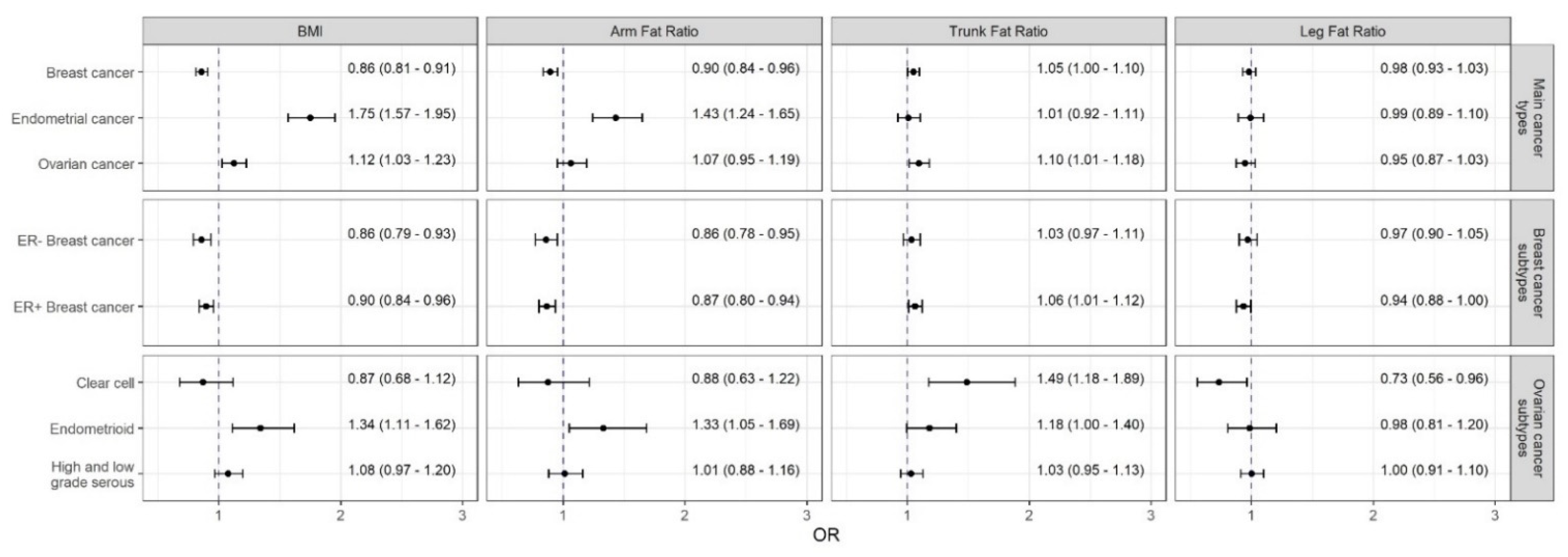
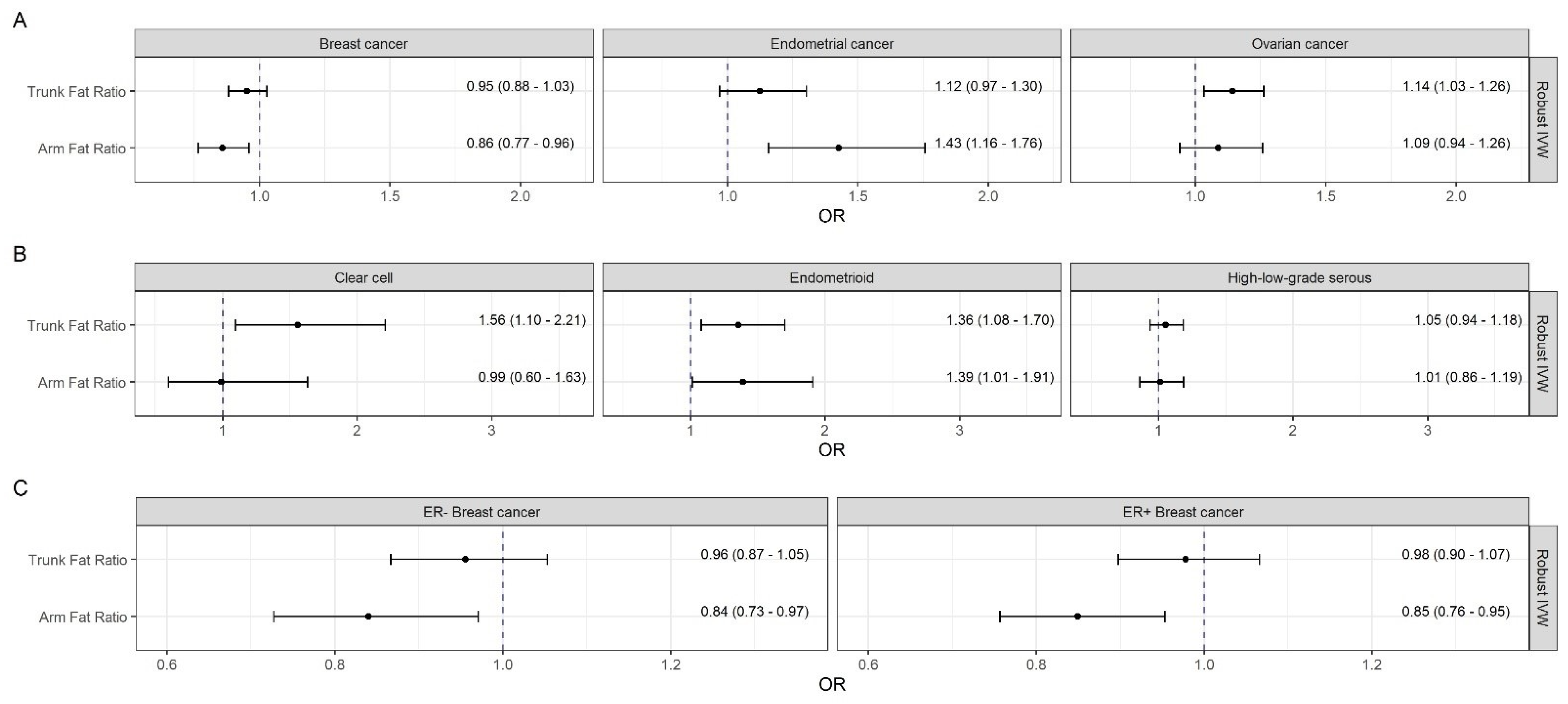
The causal impact of body fat distribution on female-specific cancers is largely unknown. For the first time we used a two-sample multivariable Mendelian randomization (MR) approach to elucidate the role and causal relations of body composition assessed by segmental bioelectrical impedance analysis on the risks of breast, endometrial and ovarian cancers and their subtypes. We found that abdominal fat content increases the risk for ovarian cancer and its endometrioid and clear cell subtypes independent of overall fat content. General adiposity has a protective effect on risk of breast cancer and its ER- and ER+ subtypes but increases the risk for endometrial cancer, ovarian cancer, and the endometrioid ovarian cancer subtype. This study extends the literature by addressing specifically the causal role of visceral fat on female-specific cancers.
Abstract
Background: Mounting evidence shows that adiposity increases female-specific cancer risk, but the role of body fat distribution is less clear. We used a two-sample Mendelian randomization (MR) approach to elucidate causal relations of body fat distribution to the risks of breast, endometrial and ovarian cancers and their subtypes. Methods: Body composition was assessed using segmental bioelectrical impedance analysis, yielding trunk, arm, and leg fat ratios (TFR, AFR, LFR) and BMI including 195,043 and 434,794 European women, respectively. The sample sizes for the outcomes ranged between 58,396 and 228,951. Causal effects were estimated per one standard deviation increment in the respective exposure within the radial regression framework. Robust sensitivity analyses were performed to verify MR assumptions. In a multivariable MR setting, the proportion of risk attributable to overall and abdominal fat content was assessed. Results: TFR, which represents abdominal fat content, was associated with ovarian cancer and its clear cell and endometrioid histotypes independent of overall fat content. BMI was inversely associated with breast cancer and its ER− and ER+ subtypes, but positively with endometrial cancer and ovarian cancer, including its endometrioid histotype. These estimates were confirmed using AFR as proxy for overall body fat. Conclusions: Visceral adiposity seems to be a driver of elevated ovarian cancer risk, particularly of the endometrioid and clear cell ovarian cancer histotypes. General adiposity decreases the risk of breast cancer but increases the risk of endometrial and ovarian cancer.