In order to validate the aforementioned simulation method and process, an original scheme to generate heterogeneous acoustofluidic distributions and particle movement trajectories caused by assorted radiation surface arrangements in different pseudo-Sierpiński-carpet-shaped chambers with various filling fractions and cross-sectional configurations is put forward. According to the existing references [
44,
45], when the height/thickness of the microfluidic chamber can be ignored in comparison with the other two dimensions, the original 3D (three-dimensional) bulk-wave-driven acoustic streaming field can be simplified into a 2D (two-dimensional) model. Although there are differences in the magnitude of acoustic streaming velocity, the acoustofluidic patterns at different heights of the horizontal plane are basically similar, and the flow speeds can be easily regulated by changing the input voltage values of piezoelectric transducers. Therefore, although it is necessary to consider the pseudo-Sierpiński-carpet-shaped chambers as bulk wave devices in practice, simplified 2D acoustofluidic models can still be used in the following simulation process, and the possible manufacturing method and excitation mode of the 3D pseudo-Sierpiński-carpet-shaped chambers are depicted in
Figure S1 (Schematic diagram of fabrication method and oscillation mode) of the
Supplementary Materials. The 3D pseudo-Sierpiński-carpet-shaped chambers with different filling fractions and cross-sectional configurations can be constructed using traditional soft lithography or 3D microprinting technique. As described elsewhere in the literature, thin film ultrasonic transducers can be attached to the upper surface of each fractal convex platform [
39,
46]. As shown in
Figure S1, the vertical oscillation of each thin film ultrasonic transducer can be further transformed into the normal vibration of the corresponding radiation surface through the Poisson effect. Geometrically speaking, the 2D pseudo-Sierpiński-carpet-shaped chambers with different filling fractions and cross-sectional configurations in our simulation can be feasibly constructed using the following procedure [
47,
48,
49]. For example, a square chamber with a side length of
L0 = 10 mm is divided into 9 congruent sub-square regions in a 3 × 3 grid. By removing a circle with a diameter (10/3 mm) equal to the side length of the central sub-square region, a 1-stage pseudo-Sierpiński-carpet-shaped chamber with circular cross-section can be created. Similarly, the same step can be repeated in the eight remaining regions to generate a 2-stage pseudo-Sierpiński-carpet-shaped chamber with circular cross-section. Although the above-mentioned process can continue indefinitely, considering the construction limitations of the device-manufacturing equipment and the computational performance of our workstation, the subdivision operation must be terminated at a specific step
n, and an
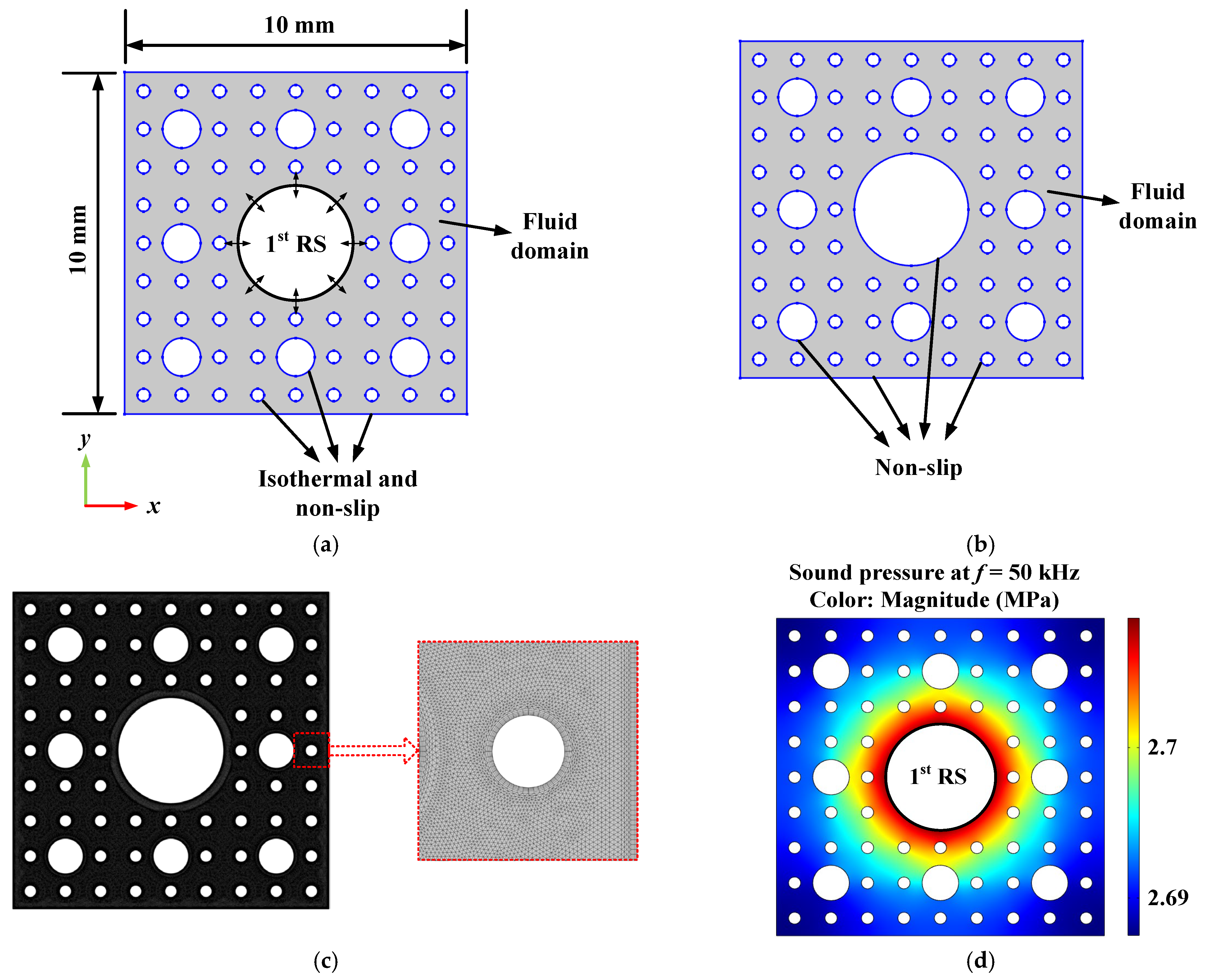
n-stage pseudo-Sierpiński-carpet-shaped chamber with circular cross-section can be ultimately generated. In the following simulation, a 3-stage pseudo-Sierpiński-carpet-shaped chamber with circular cross-section is primarily used to calculate the sound field and acoustic streaming distribution with the given boundary conditions, as shown in
Figure 1a,b, respectively. The mesh refinement scheme with locally magnified boundary layer setting is illustrated in
Figure 1c. Most simulation regions are divided into free triangular grids with a maximum size of 0.1 mm, which is 1/300 of the sound wavelength at 50 kHz (
). The boundary layer number and the first element thickness are respectively defined as 6 and 0.5 μm, which is 1/5 of the flow boundary layer thickness in water (
) when the oscillation frequency is 50 kHz. Unless otherwise specified, the model parameters throughout the entire simulation process, including structural dimensions, material properties and operating conditions, are listed in
Table 1 (Model parameters in the simulation) as far as possible.
Model Validation
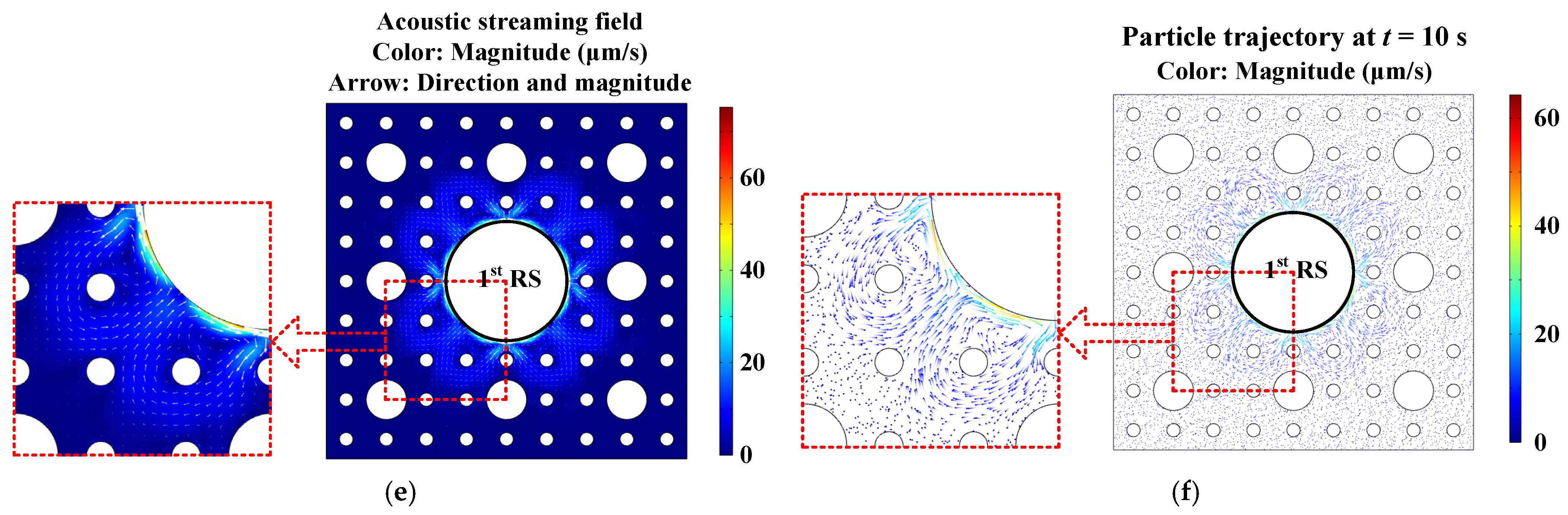
The simulated sound pressure distribution and acoustic streaming field generated in the 3-stage pseudo-Sierpiński-carpet-shaped chamber with circular cross-section under the excitation of 1-stage radiation surfaces (abbreviated as 1st RS) highlighted by the black solid lines are simulated and respectively plotted in
Figure 1d (Pattern of sound pressure field) and
Figure 1e (Pattern of acoustic streaming field). All radiation surfaces possess the same input frequency point of 50 kHz, vibration amplitude of 100 nm, and initial phase distribution along normal directions, as indicated by double-headed arrows in
Figure 1a (Computational model and boundary condition of sound field). Due to the presence of higher-stage sub-circular regions, ultrasound will reflect and diffract among multiple fluid–solid interfaces, resulting in a symmetrical sound field mode with discontinuous and uneven boundaries, but overall still exhibiting a concentric circular distribution. However, unlike the global characteristic of sound pressure distribution, the petal-shaped acoustic streaming field is roughly limited to the vicinity of 1-stage radiation surfaces and the adjacent fluid–solid boundaries, and mainly flows out from the four directions of 0°, 90°, 180°, and 270°, whilst flowing in from the other four directions of 45°, 135°, 225°, and 315° in the Cartesian coordinate system, as shown in the enlarged red dashed box in
Figure 1e. The above-mentioned conclusion can also be verified by the movement trajectory pattern of massive particles, which basically rotate along the eight local vortices symmetrically distributed around the 1-stage radiation surfaces, as shown in
Figure 1f (Pattern of micro particle trajectory at a given time). According to our previously published paper [
50] and the comparison among the magnitudes of acoustic radiation force, acoustic streaming induced drag force, gravity force, and buoyancy force in the
Supplementary Material, the buoyancy force and gravity force can be neglected compared to the acoustic radiation force and the Stokesian drag force acting on polystyrene beads with a diameter of 1 μm, as shown in
Figure S2 (Driving force magnitudes generated in the 3-stage pseudo-Sierpiński-carpet-shaped chamber with circular cross-section under the excitation of 1st RS). In addition, the distribution of acoustic radiation force magnitude within the whole chamber is relatively uniform and almost concentrated near the radiation surfaces. Therefore, the particle motion pattern in the proposed pseudo-Sierpiński-carpet-shaped chamber is generally consistent with the distribution of the acoustic streaming field. The particle movement trajectory patterns in the following simulation results also meet the above conclusion. In addition to
Figure 1 (Acoustofluidic field and particle trajectory generated in the 3-stage pseudo-Sierpiński-carpet-shaped chamber with circular cross-section under the excitation of 1st RS), the remaining combination modes and the corresponding acoustofluidic distributions of 1- to 3-stage radiation surfaces, as well as particle motion trajectories, are plotted in
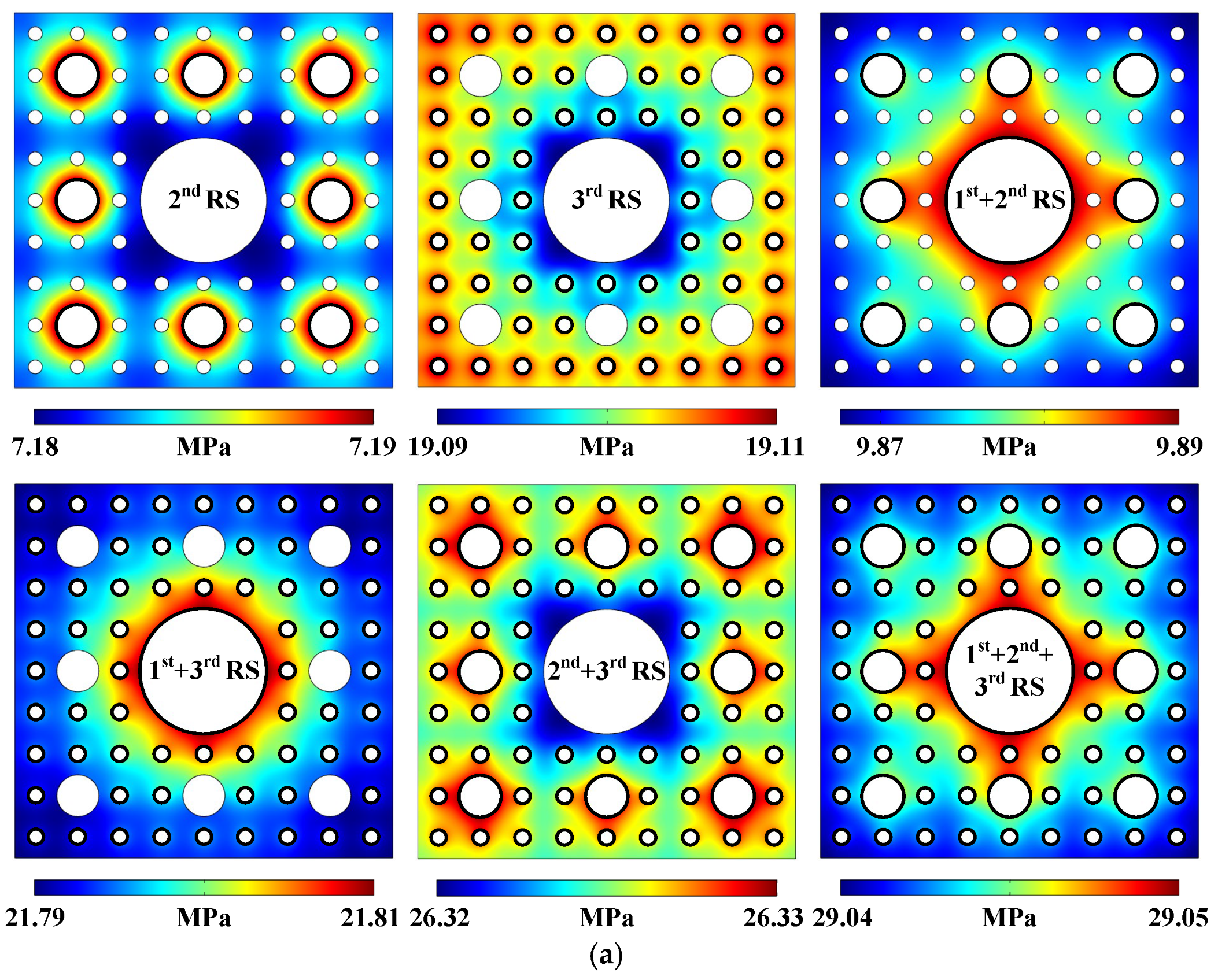
Figure 2 (Acoustofluidic fields and particle trajectories generated in the 3-stage pseudo-Sierpiński-carpet-shaped chamber with circular cross-section under the excitation of different-stage radiation surfaces) without omission, thus demonstrating the influence of different vibration source arrangements on the acoustic streaming fields. Since all initial phase settings remain unchanged in all simulations, the combination of multi-stage radiation surfaces can be directly abbreviated as
mth +
nth + ⋯ RS, such as 1st + 2nd + 3rd RS in
Figure 2a (Pattern of sound pressure field).
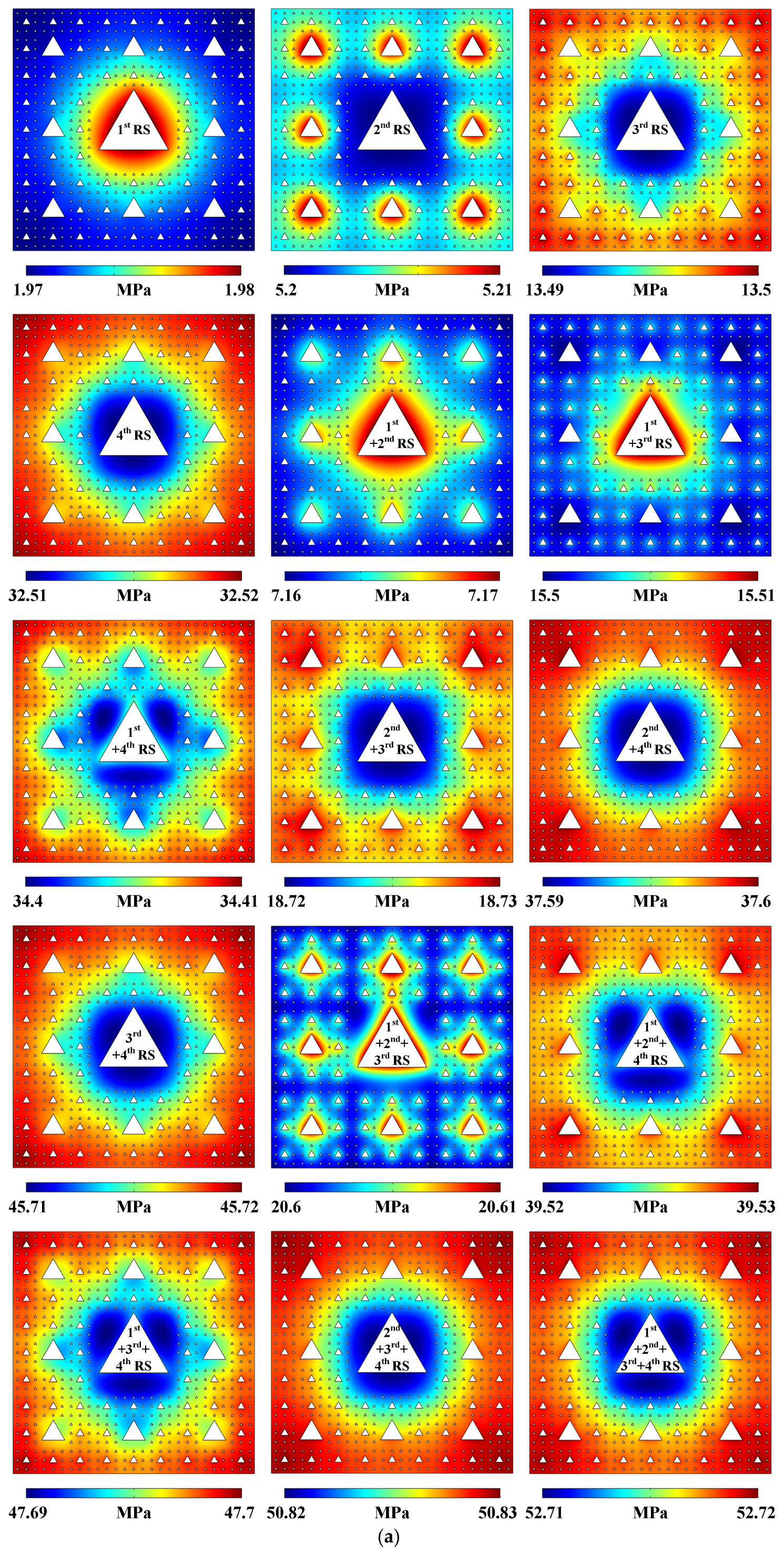
In comparison with the sound field generated by the vibration of the 1-stage radiation surfaces, the sound pressure distribution excited by the 2-stage radiation surfaces possesses the self-similarity characteristic of the fractal structure, and the regions with relatively higher sound pressure values are almost concentrated near the corresponding vibration sources. This is due to the fact that when the lower-stage radiation surfaces (1- or 2-stage) oscillate, the higher-stage radiation surfaces in the orientations of 45°, 135°, 225°, and 315° are farther away from the lower-stage radiation surfaces, making it hard for them to affect the sound pressure distribution generated by the lower-stage radiation surfaces. The distribution of sound pressure generated by the 3-stage radiation surfaces is different from that induced by the 1- or 2-stage radiation surfaces, and the areas with higher sound pressure values are almost concentrated around the peripheries of the 3-stage pseudo-Sierpiński-carpet-shaped chamber, especially at the four corners. This occurs because the chamber boundaries are closer to the 3-stage radiation surfaces, and the local sound pressure distribution at the four corners is mainly affected by the corresponding two boundaries of the chamber. From
Figure 1d and
Figure 2a, it can be seen that the sound pressure magnitudes produced by the fluctuation of
mth +
nth + ⋯ RS satisfy the linear superposition of those induced by individual radiation surfaces, while the sound pressure patterns do not follow the above principle. Comparing the circumstances of the sound pressure distributions generated by 1st RS, 1st + 2nd RS, 1st + 3rd RS, and 1st + 2nd + 3rd RS, it can be concluded that the overall sound pressure distribution is primarily determined by the lowest-stage radiation surfaces, and the existence of higher-stage radiation surfaces only affects the local sound field. The higher-stage radiation surfaces located along the diagonal directions basically have no influence on the sound pressure patterns, which is due to the fact that they are farther away from the lowest ones, and the regions with larger sound pressure values are predominantly concentrated in the area surrounding the 1st RS. Similarly, the sound pressure distributions of 2nd RS and 2nd + 3rd RS also follow the aforementioned principle. Overall, the sound fields involved in the 3-stage pseudo-Sierpiński-carpet-shaped chamber do not completely follow the self-similarity feature of the fractal structure, which can be obtained by comparing the sound pressure distribution generated by the 3-stage radiation surfaces with the remaining situations. The above-mentioned conclusion is quite different from that in our previous published paper [
39], which is due to the fact that the construction process of the pseudo-Sierpiński-carpet-shaped chamber does not strictly follow the fractal principle.
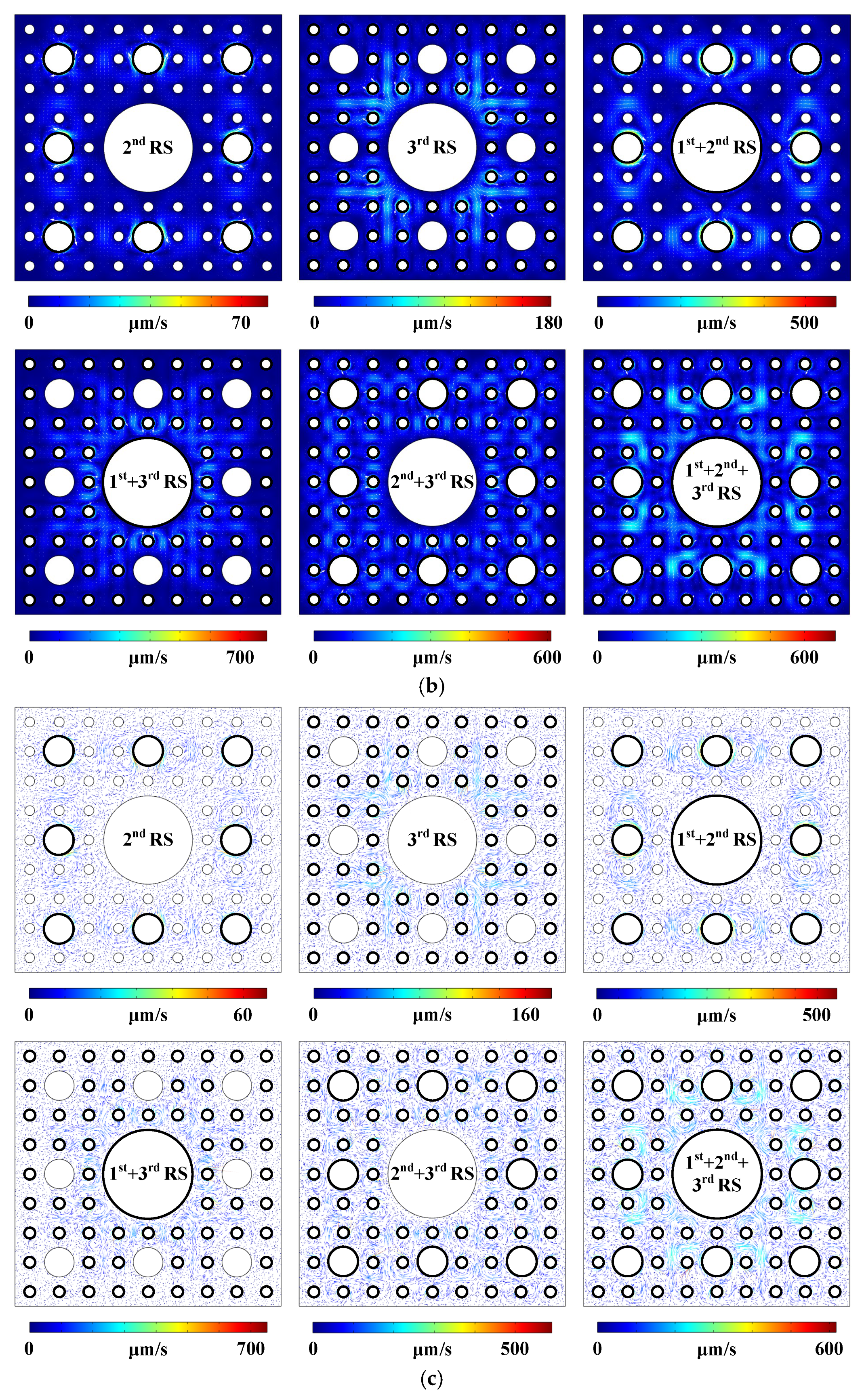
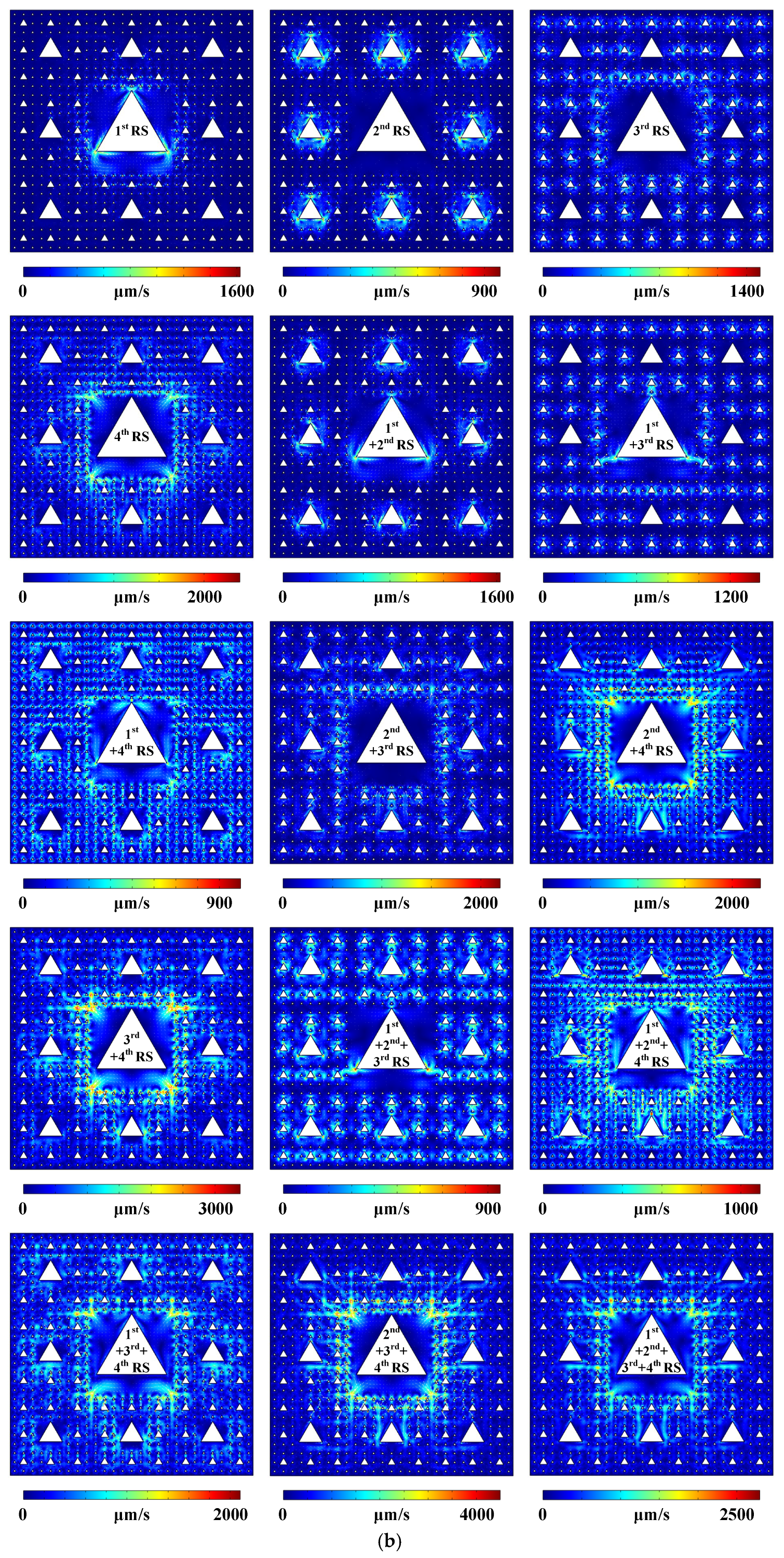
Comparing
Figure 1e and
Figure 2b (Pattern of acoustic streaming field), from the perspective of acoustic streaming distribution, the influence range of radiation surfaces is no longer determined by the lowest-stage radiation surfaces, and the acoustic streaming field caused by individual higher-stage radiation surfaces cannot be directly obtained by scaling the field generated by the lower-stage radiation surfaces. The influence of the higher-stage radiation surfaces on the acoustic streaming field is greater than that of the low-stage radiation surfaces, to a certain extent. Once the highest-stage (3-stage) radiation surfaces participate in oscillation, strip-shaped acoustic streaming distribution will be formed, which is due to the fact that the highest-stage radiation surfaces possess the widest distribution area and the largest influence range, and the distance between opposite radiation surfaces is the closest. Therefore, diffraction and reflection effects during sound wave propagation are more likely to occur, and acoustic energy is more concentrated in given areas, which is capable of driving acoustic streaming over a larger scale. Under the combination circumstance of multi-stage radiation surfaces, the flow orientations of the acoustic streaming field induced by the oscillation of the higher-stage fluid–solid interfaces point towards the secondary- or lowest-stage radiation surfaces from a global perspective. Meanwhile, the local acoustic stream flowing out from the higher-stage radiation surfaces will preferentially point towards the neighboring lower-stage solid–liquid interfaces. The particle trajectory diagram in
Figure 2c (Pattern of micro particle trajectory at a given time) also illustrates that polystyrene beads are basically confined to the near-field region of vibration sources under the influence of the lower-stage radiation surfaces. However, in the presence of the highest-stage vibration sources, the movement range of massive polystyrene particles will inevitably extend to a wider area within the chamber.
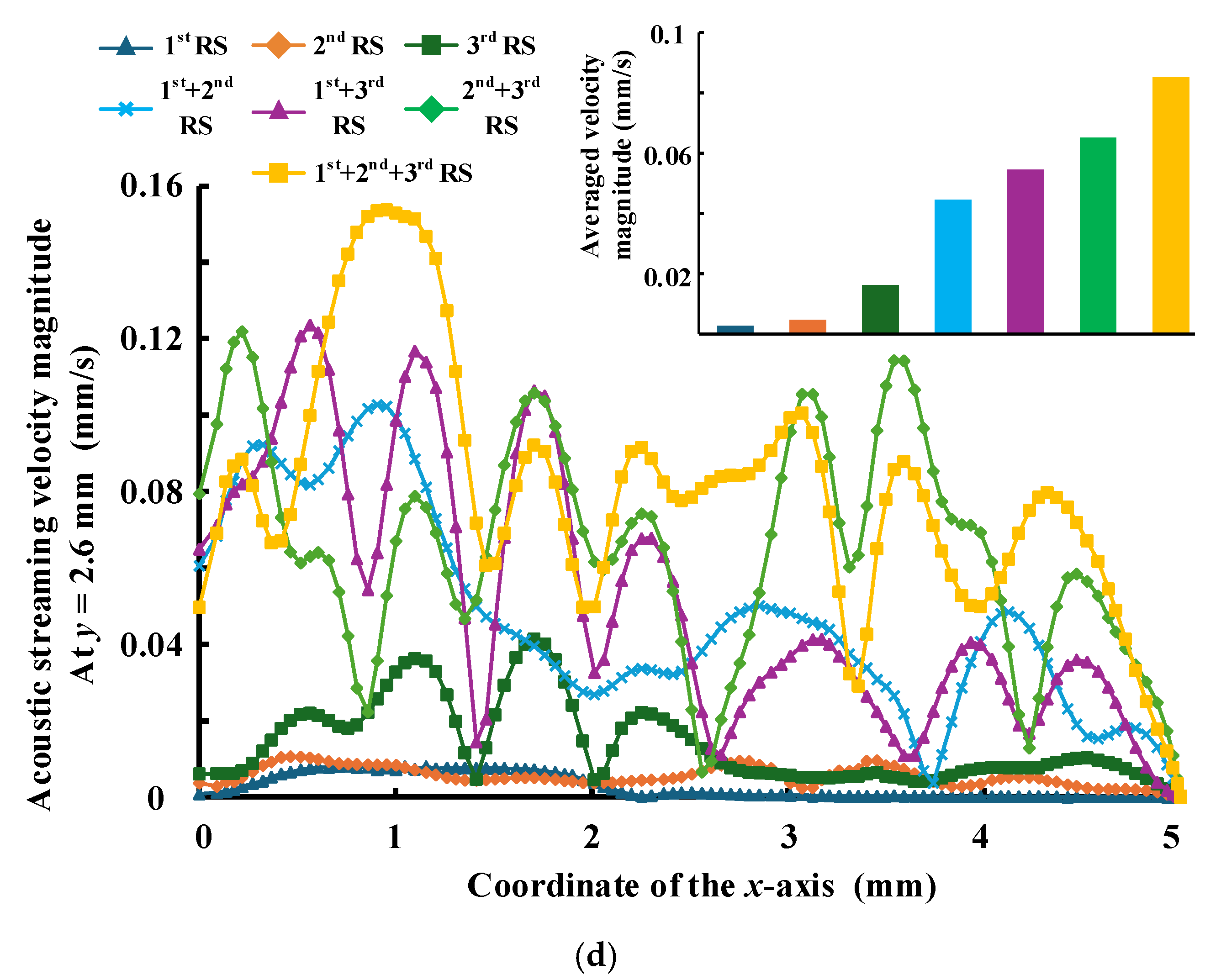
In order to quantitatively depict the distribution of an acoustic streaming field excited by different combination modes of multiple radiation surfaces, the acoustic streaming velocity magnitude
along the
x-axis at
y = 2.6 mm is extracted from
Figure 1e and
Figure 2b, and the obtained curves can be regarded as characteristic lines describing the acoustic streaming distributions, as shown in
Figure 2d (Acoustic streaming velocity magnitude distribution). Although the number of extreme values in each curve and the corresponding
x-axis coordinates are totally different from each other, the extreme value numbers in the characteristic lines acquired from the combination modes are obviously larger than those generated by individual radiation surfaces, which is due to the fact that under the influence of multiple vibration sources, more local small vortices can be generated. In addition, the column chart representing the averaged acoustic streaming velocity magnitudes
in the 3-stage pseudo-Sierpiński-carpet-shaped chamber under different radiation surface combination modes are also plotted in
Figure 2d, which can be calculated by the following formula:
where
S denotes the
n-stage pseudo-Sierpiński-carpet chamber area and can be expressed as
. The different colors used in the column chart represent different radiation surface combination modes, which is consistent with the colors of the characteristic curves. From the perspective of energy conversion, the introduction of higher-stage radiation surfaces will transmit more sound energy into the fluid medium, which will result in larger fluid flow velocity magnitude and wider acoustic streaming range. Assuming that the height of the pseudo-Sierpiński-carpet-shaped chamber is
H (see the
Supplementary Material), the total area of the corresponding radiation surfaces of different stages can be expressed as
. Therefore, the area ratio of 1st RS, 2nd RS, 3rd RS, 1st + 3rd RS, 2nd + 3rd RS, and 1st + 2nd + 3rd RS can be written as 9:24:64:33:73:88:97, while the corresponding averaged acoustic streaming velocity magnitude is about 3:4:19:41:56:63:82. According to the column chart, it can be found that even though the averaged fluid flow speed under two single modes is small, the averaged acoustic streaming velocity magnitude after recombination will still be significantly enhanced. The reason is that the sound field between adjacent radiation surfaces is concentrated due to the superposition effect, resulting in an increase in the sound energy gradient within the entire chamber, and correspondingly an increase in acoustic streaming velocity magnitude.
To sum up, in the pseudo-Sierpiński-carpet-shaped chamber, the lower-stage radiation surfaces play a crucial role in sound pressure distribution. However, for the acoustic streaming field induced by the nonlinear effect of ultrasound, the existence of higher-stage vibration sources will affect the acoustofluidic pattern, which occurs because sound waves can bypass obstacles by diffraction, while acoustic streaming vortices will be hindered by these obstacles along the flow pathway. Also, in comparison with our previous work [
39], due to the fact that the circular radiation surfaces do not contain sharp corners, it is difficult to form a concentrated strong sound field in the whole 3-stage pseudo-Sierpiński-carpet-shaped chamber, resulting in the inability to generate pronounced sound intensity gradients, and thus the range and magnitude of the acoustic streaming field will be correspondingly weakened.
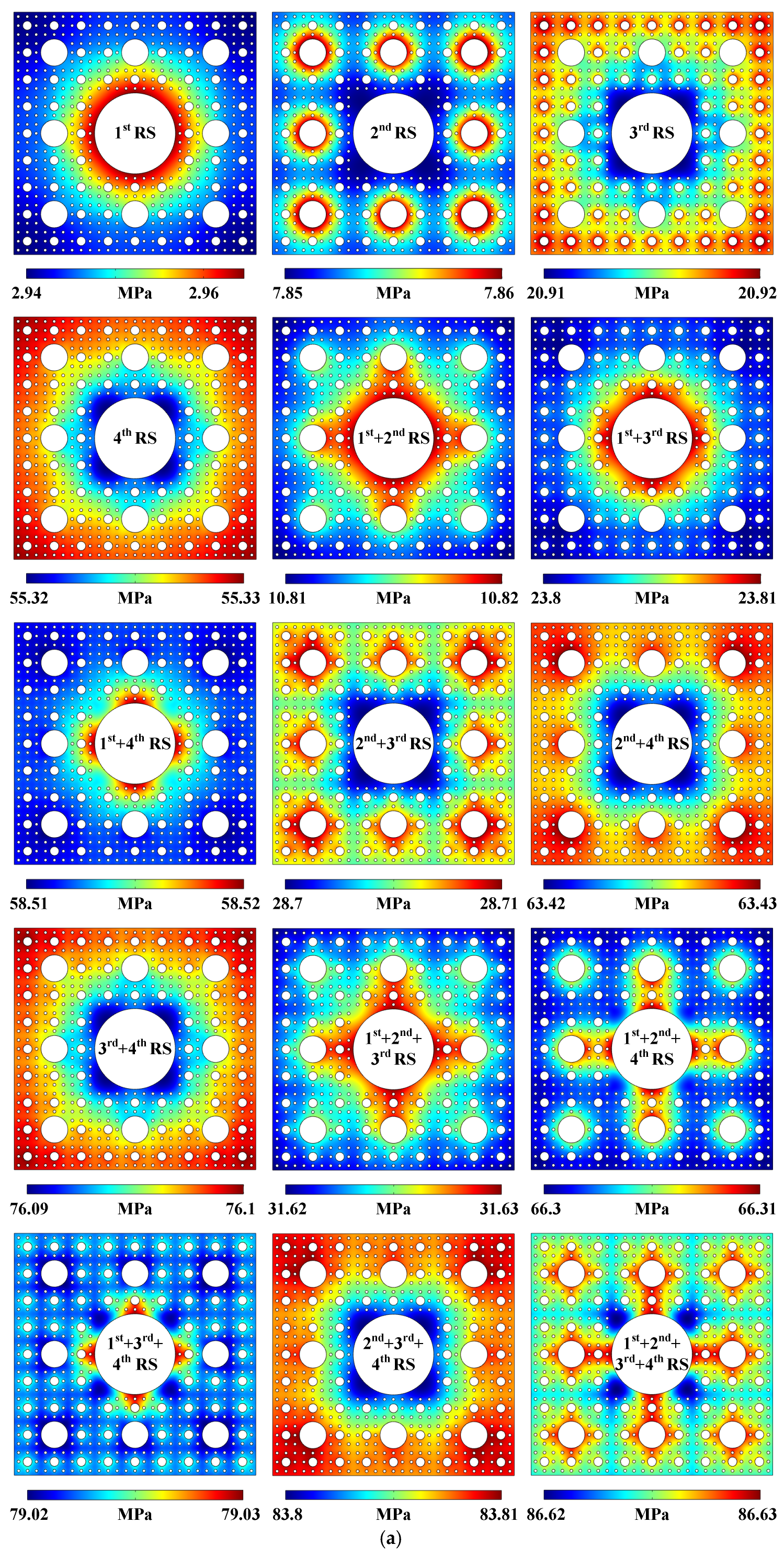
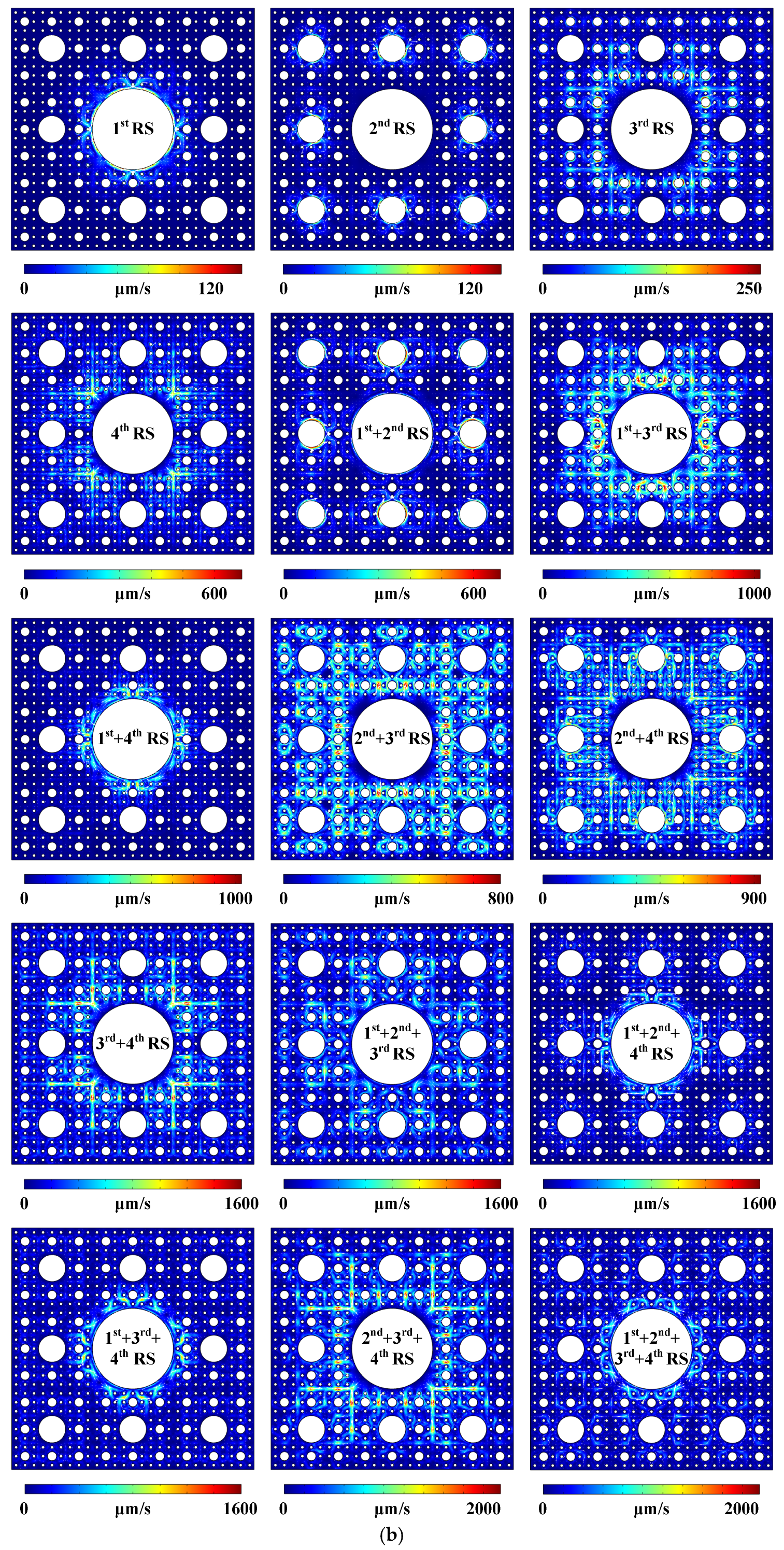
More patterned sound pressure distributions, acoustic streaming fields, particle movement trajectories, and the averaged acoustic streaming velocity magnitudes generated in the 4-stage pseudo-Sierpiński-carpet-shaped chamber with circular cross-section under the excitation of different-stage radiation surface combination modes are all plotted in
Figure 3 (Acoustofluidic fields and particle trajectories generated in the 4-stage pseudo-Sierpiński-carpet-shaped chamber with circular cross-section under the excitation of different-stage radiation surfaces). The evolution law of the sound field under the combination of 1- to 4-stage radiation surfaces is consistent with the above-mentioned conclusion drawn from
Figure 1d and
Figure 2a. When the lower-stage radiation surfaces (1st RS or 2nd RS) experience oscillation, the generated extreme sound pressure regions are almost concentrated near the corresponding vibration sources. However, in comparison with the sound pressure distributions generated in the 3-stage pseudo-Sierpiński-carpet-shaped chamber under the same radiation surface modes, the sound field contours shown in
Figure 3a (Pattern of sound pressure field) tend to be more circular, which are determined by the denser arrangement of the 4-stage radiation surfaces. When the acoustic waves pass through the 4-stage fluid–solid interfaces, part of the sound energy along the directions of 0°, 90°, 180°, and 270° will be dissipated, thereby homogenizing the sound field distribution. Similarly, the regions of larger sound pressure generated by the vibration of higher-stage radiation surfaces (3rd RS or 4th RS) are still concentrated around the peripheries of the 4-stage pseudo-Sierpiński-carpet-shaped chamber, especially at the four corners, which occurs because the chamber boundaries are much closer to the higher-stage radiation surface, making it easier for the sound field to be reflected and form a standing wave distribution. Under the combination modes of multiple-stage vibration sources, the sound pressure distribution exhibits nonlinear superposition characteristic. In the presence of lower-stage vibration sources participating in oscillation, the spatial distribution of sound pressure is mainly determined by the lower-stage radiation surfaces, while the existence of higher-stage solid–liquid interfaces only affects the local sound pressure patterns. Similarly to the situation shown in
Figure 1d and
Figure 2a, the sound pressure values generated by different combination modes of multiple-stage radiation surfaces in the 4-stage pseudo-Sierpiński-carpet-shaped chamber still follow the linear superposition law of the sound pressure induced by single radiation surfaces.
Figure 3b (Pattern of acoustic streaming field) shows the acoustic streaming distributions under all possible combination modes of 1- to 4-stage radiation surfaces. It can be found that the introduction of higher-stage radiation surfaces usually leads to a strip-shaped fluid field. The reason is that the higher-stage radiation surfaces possess denser arrangement and wider distribution range, and when the lower-stage radiation surfaces are involved in vibration, an obvious sound energy gradient more easily forms between two adjacent lower- and higher-stage radiation surfaces, thus affecting the intensity and flow pathway of the acoustic streaming field. According to the acoustofluidic simulation results under different radiation surface combination modes, the calculated acoustic streaming patterns can be classified into three types. The first type comprises 1st + 4th RS, 1st + 2nd + 4th RS, 1st + 3rd + 4th RS, and 1st + 2nd + 3rd + 4th RS, and the acoustic streaming fields displayed by this kind of type are basically concentrated near the 1-stage radiation surfaces. The second type can be categorized as 2nd + 3rd RS, 2nd + 4th RS, 3rd + 4th RS, and 2nd + 3rd + 4th RS. In the case of the higher-stage radiation surfaces without the 1-stage radiation surfaces participating in vibration, the simulated acoustic streaming distributions are commonly strip-shaped and not concentrated around 1st RS. The third type can be classified as 1st + 2nd RS, 1st + 3rd RS, and 1st + 2nd + 3rd RS, and the computed acoustic streaming fields are both located near 1st RS and exhibit strip-shaped distributions. Generally speaking, with the introduction of multiple-stage radiation surfaces, the influence range of the local sound energy gradient expands, and the acoustic streaming velocity magnitude displayed by color bars also demonstrates that the more radiation surfaces are introduced, the larger the extreme value of fluid flow speed is. The particle trajectories successively plotted in
Figure S4a (Circular cross-section) are generally consistent with the distribution characteristics of acoustic streaming patterns, which means that the Stokesian drag forces dominate the movement trajectories of polystyrene beads with the diameter of 1 μm [
50].
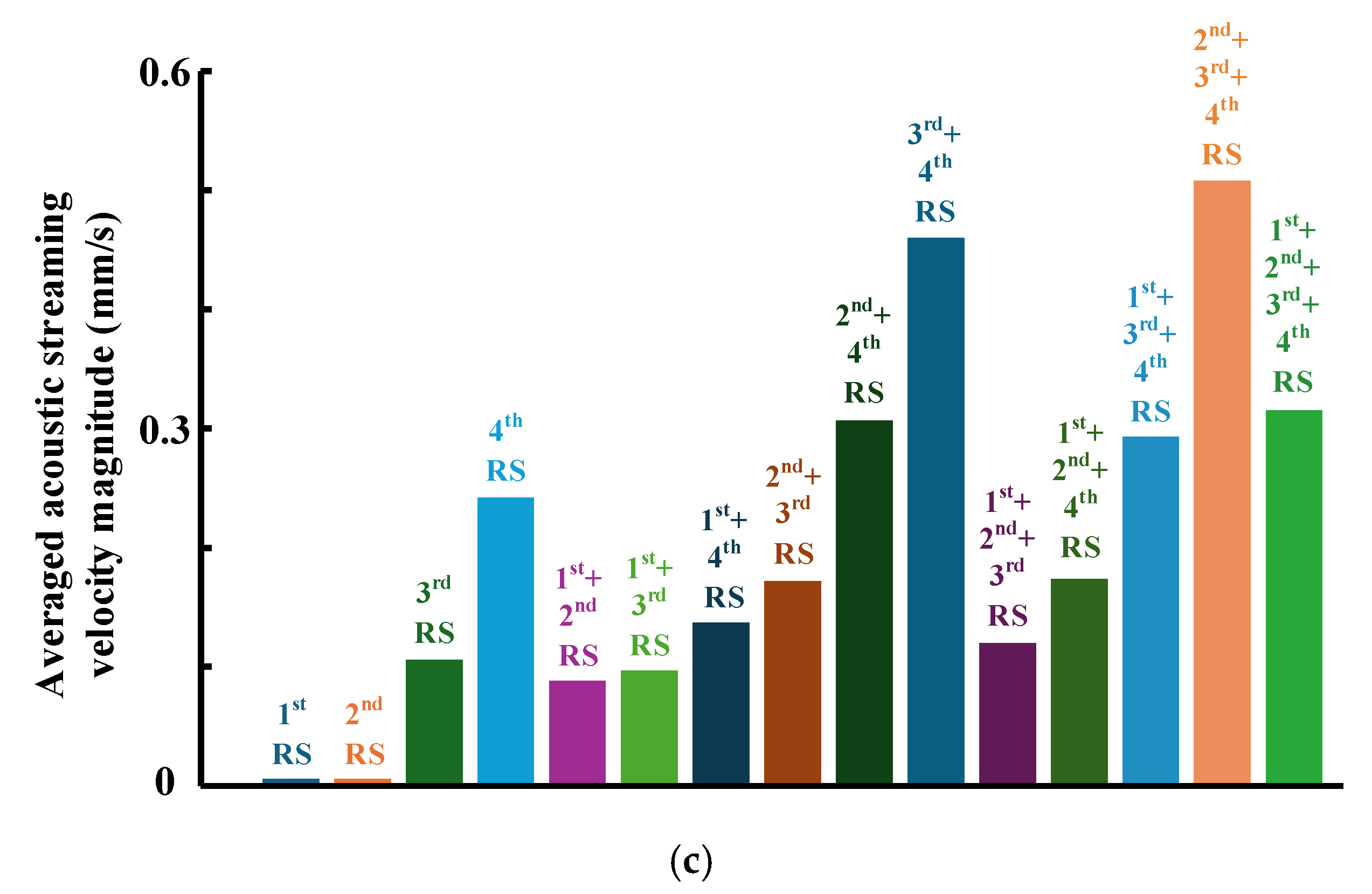
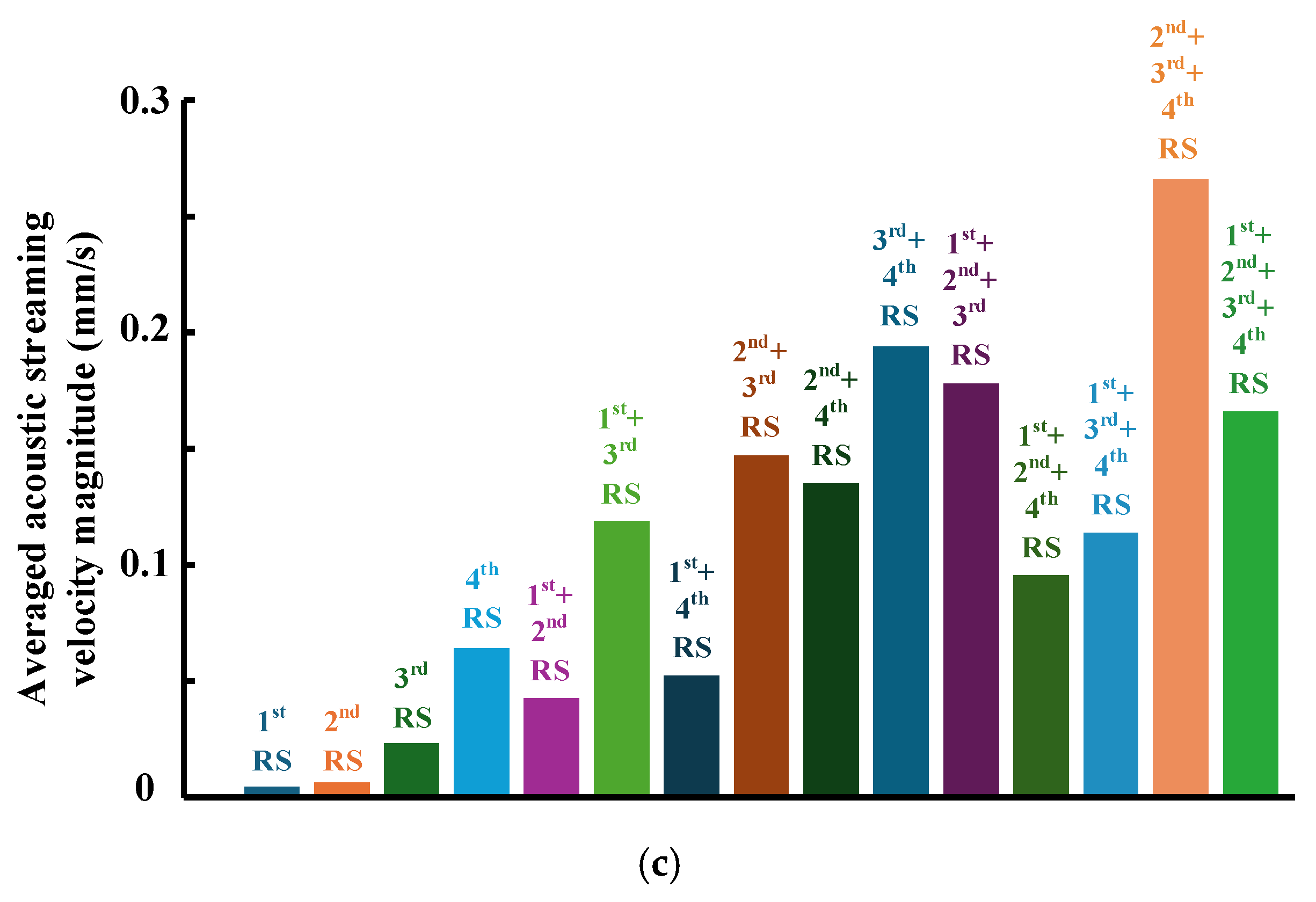
However, the averaged acoustic streaming velocity magnitudes do not gradually increase with the sequential introduction of higher-stage radiation surfaces. It can be found from
Figure 3c (Averaged acoustic streaming velocity magnitude) that when 4th RS, 2nd + 4th RS, 3rd + 4th RS, and 2nd + 3rd + 4th RS are combined with 1st RS, the corresponding fluid flow speeds are much smaller than before. The regularity is different from the increasing trend of the averaged acoustic streaming velocity magnitudes in the 3-stage quasi-Sierpiński-carpet-shaped chambers which have been published [
39]. The reason for this phenomenon is that when the 1st RS participates in vibration, much more sound energy can be released than other higher-stage radiation surfaces. Therefore, a larger sound energy gradient can be preferentially formed among 1st RS and other vibration sources, resulting in the concentration of acoustic streaming vortices around 1st RS. Nevertheless, the sound energy generated by 1st RS will gradually dissipate when passing through the near-field 4-stage radiation surfaces, and the remaining ultrasonic waves transmitting to the far field and chamber periphery can compensate for the sound energy generated by other radiation surfaces, which narrows the range of sound energy gradient among multiple-stage radiation surfaces and weakens the far-field fluid flow speed, thus leading to the decrease of the overall averaged acoustic streaming velocity magnitude. The above-mentioned conclusion can also be confirmed by the simulation results shown in
Figure 3b.
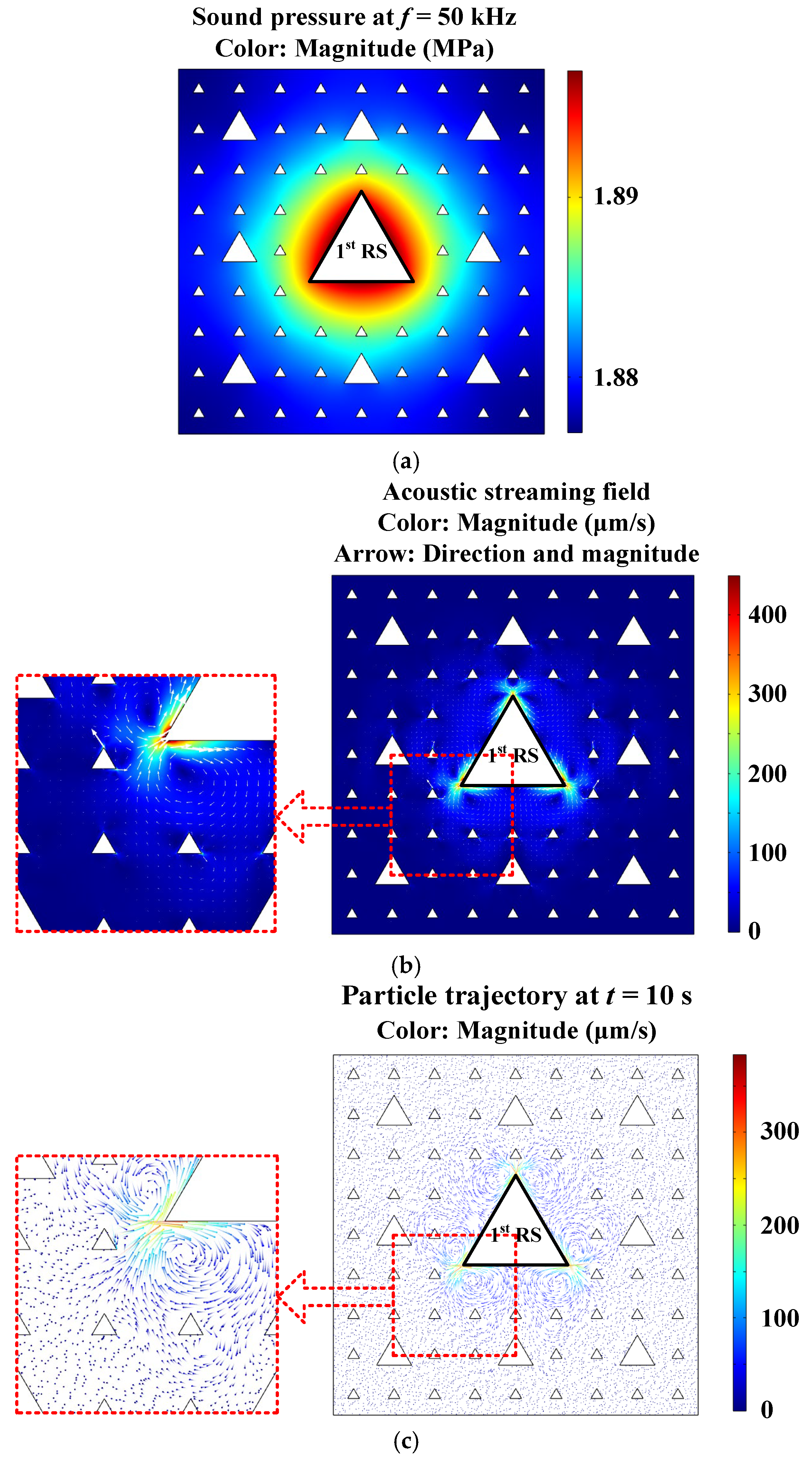
Using the aforementioned construction method of the pseudo-fractal chamber, other kinds of chambers with diversified cross-sections of different geometric shapes have also been proposed, such as the 3-stage pseudo-Sierpiński-carpet-shaped chamber with equilateral triangular cross-section, as shown in
Figure 4 (Acoustofluidic fields and particle trajectories generated in the 3-stage pseudo-Sierpiński-carpet-shaped chamber with triangular cross-section under the excitation of 1st RS). All the equilateral triangles are formed by the intersection of the corresponding circular cross-sections from
Figure 1. Under the given boundary conditions and oscillation parameters, the sound field, acoustic streaming distribution and particle trajectory are calculated and respectively plotted from
Figure 4a (Pattern of sound pressure field) to
Figure 4c (Pattern of micro particle trajectory at a given time). The highlighted black lines still represent the 1-stage radiation surfaces (1st RS), and the other boundary conditions of acoustofluidic fields remain unchanged. The simulated sound field in
Figure 4a is different from the one generated in the 3-stage pseudo-Sierpiński-carpet-shaped chamber with circular cross-section. Although it is still a bilateral symmetry pattern with discontinuous and uneven boundaries, a distribution mode similar to the Reuleaux triangle is presented.
Due to the existence of the sharp corners, local acoustic streaming vortices can be formed on both sides of each triangular corner, flowing in from the corner vertex and out from the edge midpoint, as shown in the red dashed box in
Figure 4b (Pattern of acoustic streaming field), and the maximum acoustic streaming velocity magnitude in
Figure 4b is approximately seven times that in
Figure 1e. The comparative analysis and quantitative characterization of acoustofluidic fields generated in these two kinds of 3-stage pseudo- Sierpiński-carpet chambers with circular and triangular cross-sections reveals fundamentally distinct physical behaviors dictated by their geometric singularities. For the circular cross-section, the continuously differentiable contour facilitates a relatively uniform acoustic pressure distribution. The well-defined boundary layer along the smooth perimeter effectively dissipates energy, resulting in subdued acoustic streaming velocities near the circumferential region. In stark contrast, the triangular cross-section introduces geometric singularities at its vertices. The non-differentiable sharp corners disrupt the boundary layer continuity, leading to two synergistic effects: Enhanced Acoustic Energy Gradient, where a significantly steeper spatial gradient of acoustic energy is established between the vertices and edge midpoints of the primary radiation surface compared to the circular case due to the vibration magnification effect at the sharp corner; and Boundary Layer Ineffectiveness, where, at the vertices, the classical boundary layer formulation breaks down due to the geometric discontinuity, and therefore particle inertia dominates in these regions with minimal viscous damping effect from the boundary layer. On the other hand, at the sharp corners of the triangular cross-section, the first-order velocity variance increases sharply, resulting in the concentration of Reynolds stress, which significantly enhances local acoustic streaming. To sum up, the introduction of sharp corners will significantly strengthen the local acoustic streaming vortex effect. Also, the simulated particle movement trajectory plotted in
Figure 4c can be used to verify the above conclusion.
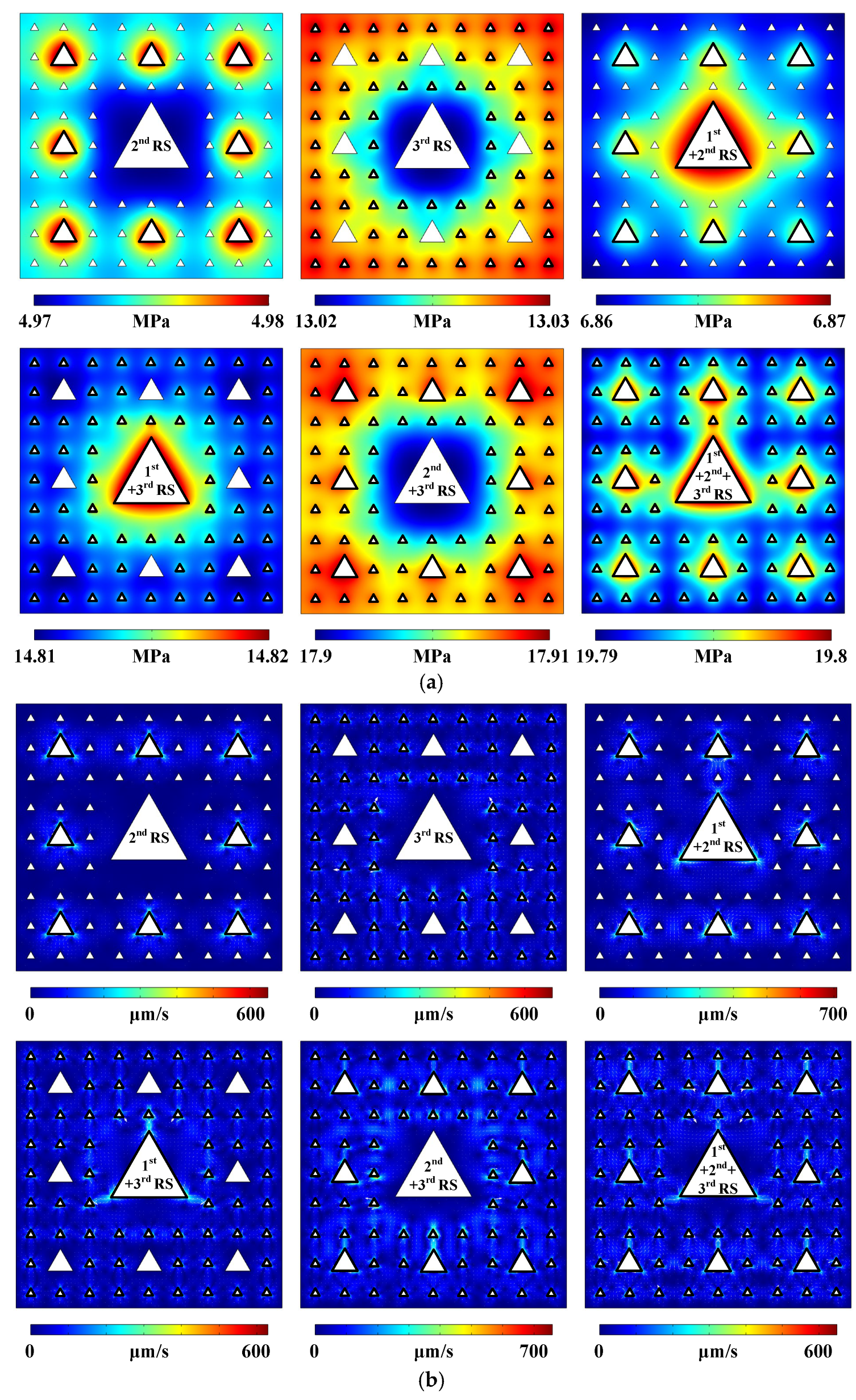
The remaining sound fields under different radiation surface combination modes are also calculated and plotted in
Figure 5a (Pattern of sound pressure field). When 1st RS and 2nd RS vibrate, the induced sound pressure patterns possess the fractalized characteristics of self-similarity and locality, while the extreme value region of the sound field generated by 3rd RS is mainly concentrated around the chamber peripheries. The sound field superposition modes under the combination of multiple radiation surfaces are almost consistent with the ones under the circumstances of the 3-stage pseudo/quasi-Sierpiński-carpet-shaped chambers with circular or square cross-section [
39], except for the sound pressure distribution generated by 1st + 2nd + 3rd RS. When 1st + 2nd + 3rd RS are in operation, the extreme sound pressure region shown in the 3-stage pseudo-Sierpiński-carpet-shaped chamber with equilateral triangular cross-section is almost concentrated near 1st RS and 2nd RS, which differs from the results shown in
Figure 2a. The reason for this phenomenon is that the extreme sound pressure region generated by 1st RS under the circumstance of equilateral triangular cross-section is concentrated around the three edge midpoints, and ultrasonic waves radiate outward from these three normal orientations. However, due to the long distances from the adjacent 2nd RS located in the corresponding transmission pathways or the cancellation effect of ultrasonic waves generated by the surrounding 3rd RS, obvious sound pressure patterns are mainly retained between 2nd RS and 3rd RS.
However, the acoustic streaming field distributions generated in the 3-stage pseudo-Sierpiński-carpet-shaped chamber with triangular cross-section still follow the fractal principle of self-similarity, as shown in
Figure 5b (Pattern of acoustic streaming field). Regardless of the radiation surface combination mode, the concentrated regions of acoustic streaming mainly exist at the three sharp corners of each triangular cross-section, demonstrating the conclusion that the existence of sharp corners can amplify the vibration amplitude and significantly enhance the acoustic streaming effect, which is also consistent with our previously published work on quasi-Sierpiński-type fractal structures [
39]. The sound energy gradients induced by different-stage radiation surfaces are almost concentrated around the individual sharp corners, rather than among different-stage solid–liquid interfaces, thus ensuring the self-similarity principle of acoustic streaming patterns. Particle trajectory images shown in
Figure 5c (Pattern of micro particle trajectory at a given time) also indicate that polystyrene bead movement basically exists near the three sharp corners of each equilateral triangular cross-section.
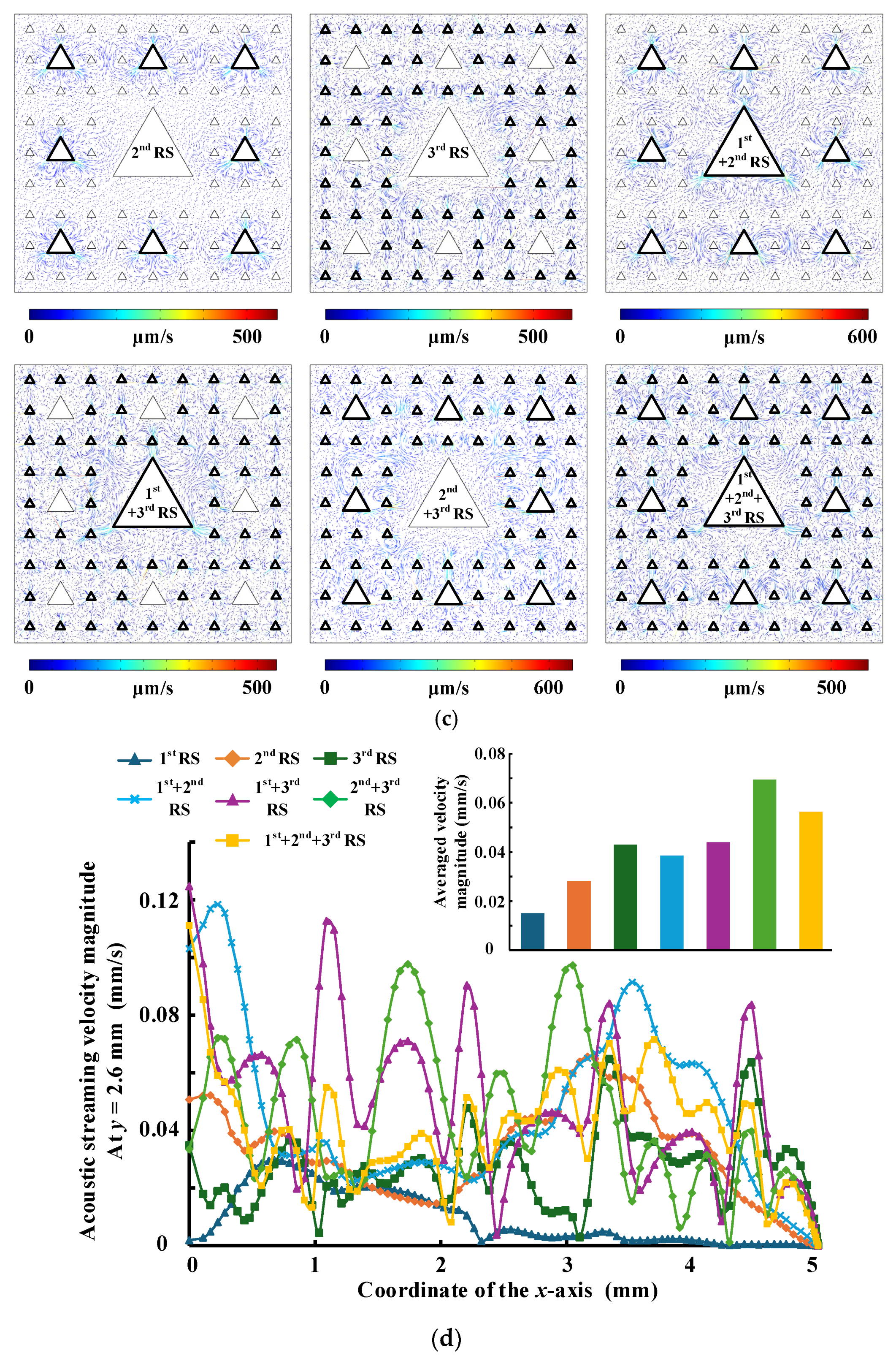
Similarly, the acoustic streaming velocity magnitudes along the
x-axis at
y = 2.6 mm can be extracted from
Figure 4b and
Figure 5b and plotted as characteristic curves describing the acoustofluidic distributions, as shown in
Figure 5d (Acoustic streaming velocity magnitude distribution). Due to the fact that the number of equilateral triangles corresponding to 3rd RS is the largest and the acoustic streaming vortices are mainly concentrated around the sharp corners, the extreme value numbers in the characteristic curves drawn with the participation of 3rd RS in vibration are usually larger than those drawn with only 1st RS or 2nd RS. Assuming that the height of the pseudo-Sierpiński-carpet-shaped chamber is
H, the total areas of multiple-stage radiation surfaces in
Figure 5 (Acoustofluidic fields and particle trajectories generated in the 3-stage pseudo-Sierpiński-carpet-shaped chamber with triangular cross-section under the excitation of different-stage radiation surfaces) can be expressed as
. Therefore, the area ratio of 1st RS, 2nd RS, 3rd RS, 1st + 2nd RS, 1st + 3rd RS, 2nd + 3rd RS, and 1st + 2nd + 3rd RS is 9:24:64:33:73:88:97. However, the averaged acoustic streaming velocity magnitudes corresponding to the inserted image in
Figure 5d is about 15:27:42:38:44:68:55, which does not match the above area ratio, indicating that there exist inhibitory effects among the chaotic and complex acoustic streaming vortices generated by excessive sharp corner structures and overly dense radiation surfaces.
According to simulation results shown in
Figure 6a (Pattern of sound pressure field), the sound pressure extreme values activated by 1st RS or 2nd RS are mainly concentrated in the vicinity of 1st RS or 2nd RS, respectively, while the extreme regions induced by the vibration of 3rd RS or 4th RS are concentrated around the peripheries of the 4-stage pseudo-Sierpiński-carpet-shaped chamber, among which the one generated by 4th RS is more widely distributed. Unlike the sound pressure patterns in the 4-stage pseudo-Sierpiński-carpet-shaped chamber with circular cross-section, the existence of 4th RS under the circumstance of triangular cross-section possesses the strongest influence on the sound field distribution, followed by 1st RS, then 3rd RS, and finally 2nd RS. Also, the sound field patterns under different combination modes of multiple-stage vibration sources are mainly determined by the individual radiation surfaces with the corresponding strongest influence mentioned above. For instance, the sound field distributions generated by the combination modes with 4th RS participating in oscillation are basically similar to the simulation result of individual 4th RS, while the sound pressure patterns activated by the combination modes without 4th RS but with 1st RS participating in oscillation are predominantly concentrated in the vicinity of 1st RS.
The introduction of 4th RS leads to slight differences in the acoustic streaming distributions generated in the 4-stage pseudo-Sierpiński-carpet-shaped chambers with equilateral triangular cross-section, which is due to the fact that 4th RS are densely arranged near other vibration sources. The acoustic waves radiated outward from the sharp corners of the lower-stage radiation surfaces and the ones reflected back from the boundaries of the surrounding 4th RS can superimpose to form a strong standing wave field, enhancing the sound energy gradients at the sharp corners of the lower-stage radiation surfaces and the resulting acoustofluidic effect, as shown by the acoustic streaming vortex patterns generated under the circumstances of individual or combined 1st RS, 2nd RS, and 3rd RS in
Figure 6b (Pattern of acoustic streaming field). However, the acoustic streaming fields induced by the introduction of 4th RS present radial-like distributions along the four corners of the square chamber, which is due to the fact that there exist massive 4-stage radiation surfaces around each chamber corner, and the generated acoustic waves propagate, reflect and diffract among these solid–liquid interfaces, thus forming intense standing wave fields inside the entire chamber. Meanwhile, since the sound energy gradients near the chamber corners are relatively larger, radial-like acoustic streaming patterns can be formed. Similar to the above-mentioned conclusion drawn from the sound pressure distributions, all the combination modes with 4th RS exhibit acoustic streaming patterns similar to that generated by individual 4th RS, followed by 1st RS, then 3rd RS, and finally 2nd RS. For example, if the acoustic streaming fields are activated by the combination modes without 4th RS but with 1st RS, the vortex patterns are similar to those generated by individual 1st RS. The particle movement trajectories plotted in
Figure S4b (Triangular cross-section) can also be used to confirm the above distributions of acoustic streaming fields.
Figure 6c (Averaged acoustic streaming velocity magnitude) shows the variation regularity of the averaged acoustic streaming velocity magnitudes under different radiation surface combination modes in the 4-stage pseudo-Sierpiński-carpet-shaped chamber with equilateral triangular cross-section, which is similar to the one presented under the situation of circular cross-section. Once 1st RS are introduced into combination modes with 3rd RS or 4th RS, the averaged acoustic streaming velocity magnitudes will decrease, and the decrease degrees will be even larger in the presence of 4th RS, which is due to the fact that the arrangement of 4th RS is much denser than that of 3rd RS, releasing more sound energy and stimulating wider acoustic streaming range, thus offsetting the acoustic streaming velocity magnitudes excited by 1st RS to a greater extent.
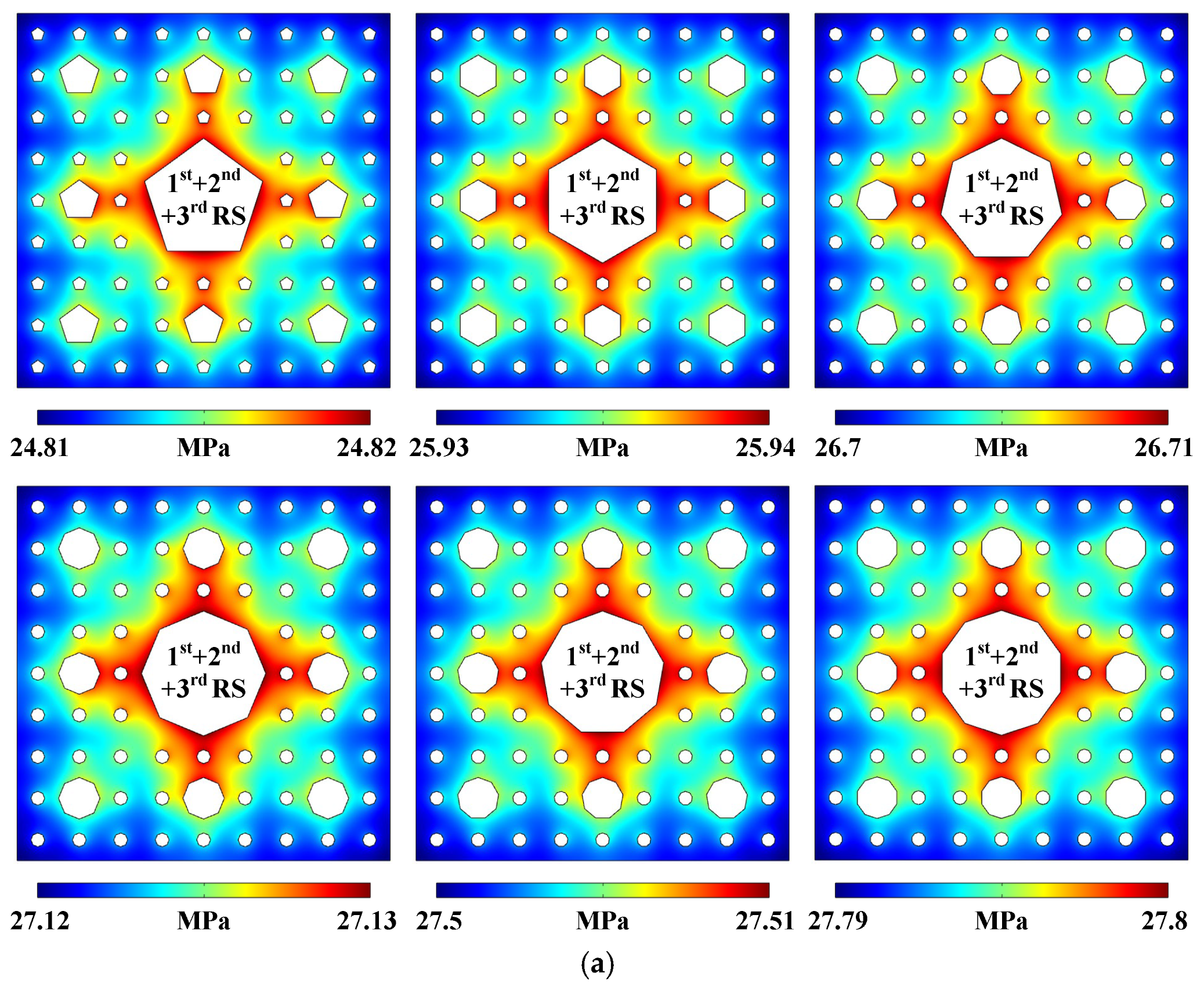
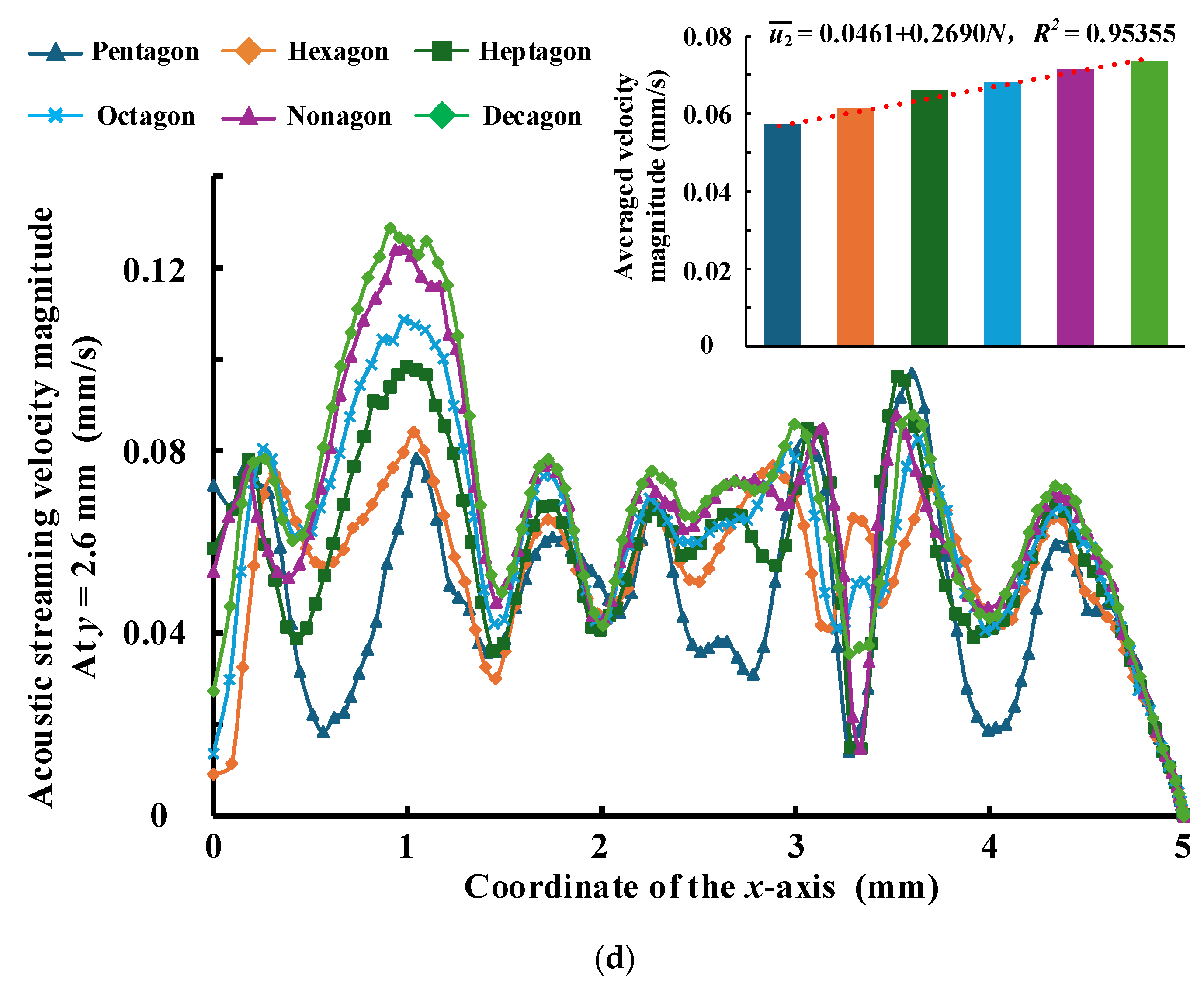
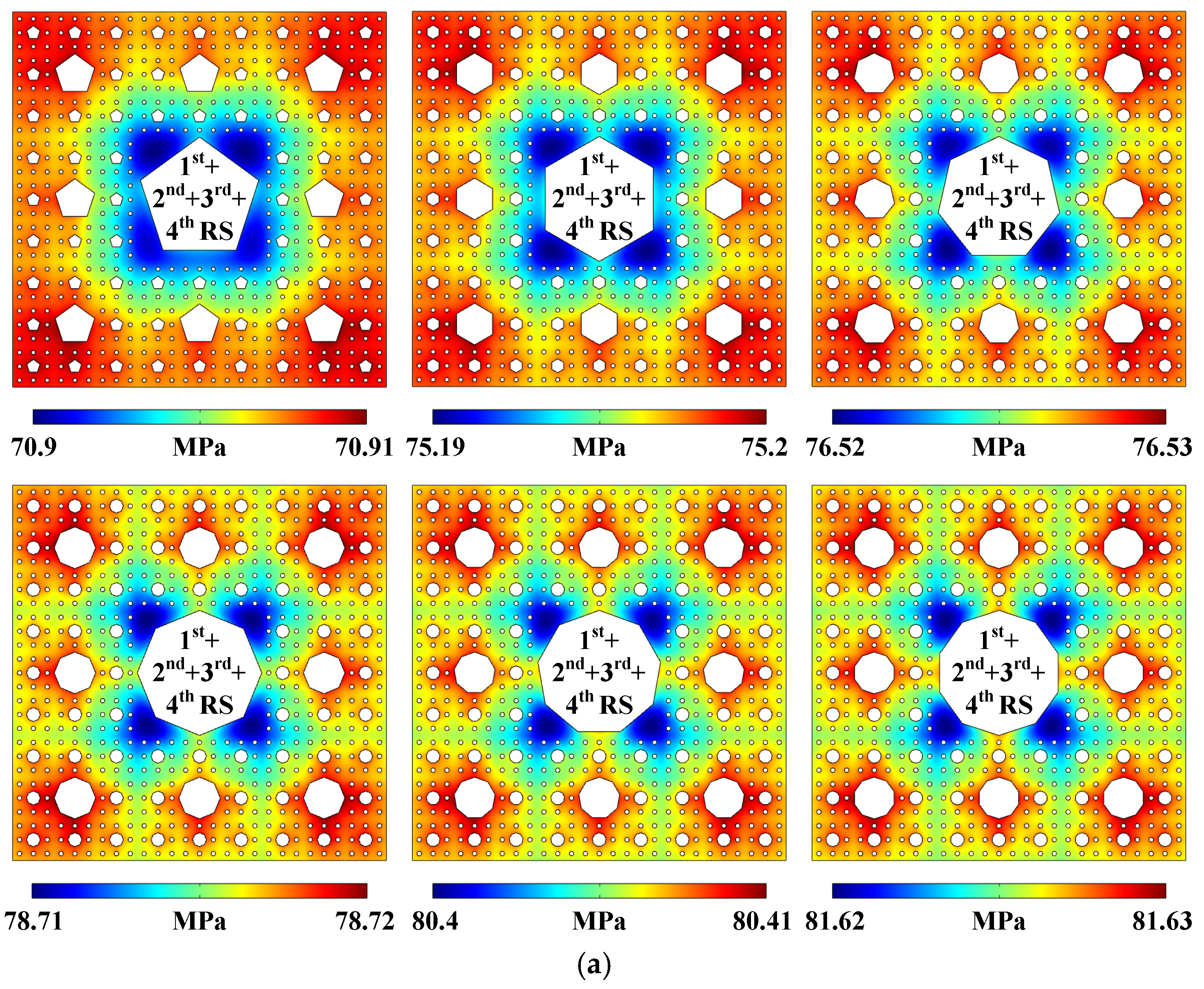
In order to explore more distributions of sound fields, acoustic streaming vortices, and particle motion trajectories under the circumstances of different regular polygonal cross-sections, the following simulation results are simplified by applying the same radiation surface combination mode. Similar to the sound pressure distribution generated by 1st + 2nd + 3rd RS in the 3-stage pseudo-Sierpiński-carpet-shaped chamber with circular cross-section, the ones shown in
Figure 7a (Pattern of sound pressure field) induced by the same radiation surface combination mode corresponding to different cross-sectional configurations from regular pentagon to regular decagon inscribed within the corresponding circular cross-section apparently exhibit concave square patterns rotated by 45°, and the main difference, excluding the magnitude factor, is the concavity degree of the square distributions, which gradually decreases with the increase of regular polygonal edge number (defined as
N) and also tends to approach the sound field generated by 1st + 2nd + 3rd RS under the situation of circular cross-section. According to the construction method of regular polygons, it can be found that as the edge number
N increases, the radiation surface shapes and areas of regular polygonal cross-sections tend to tend to approach those under the circumstance of a circular cross-section. Therefore, the generated sound pressure pattern plotted in
Figure 7a becomes gradually similar to the last one presented in
Figure 2a.
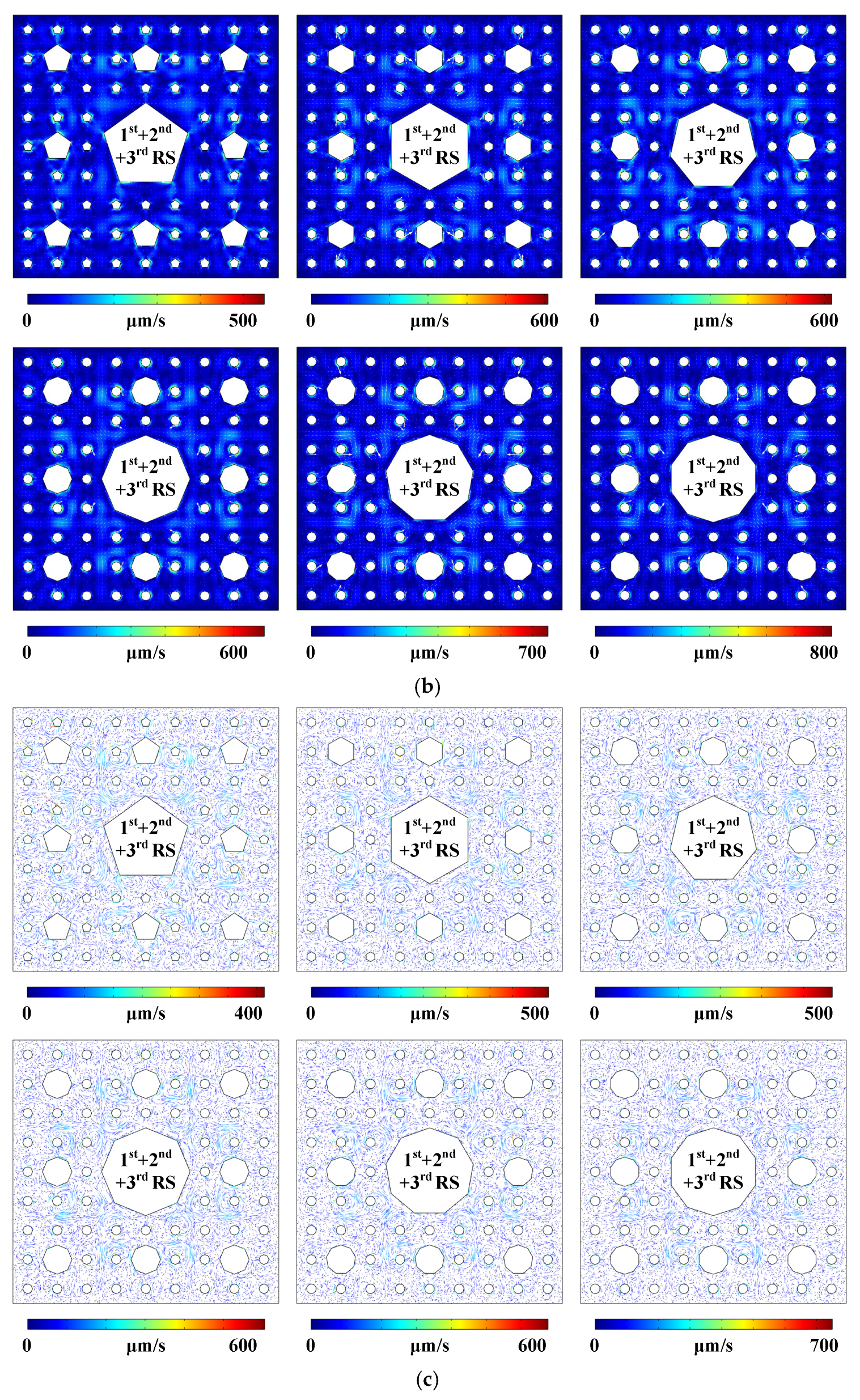
The acoustic streaming distributions also present the same changing principle as the sound fields. With the increase of
N, the generated acoustofluidic patterns are progressively approaching the pattern generated by 1st + 2nd + 3rd RS under the situation of circular cross-section. However, considering the circular cross-section is continuous and smooth, the flow resistance of the liquid–solid interfaces to the acoustic streaming field is the smallest in comparison with other cross-sectional configurations. For regular polygons with fewer
N, the sharp corner degrees are relatively smaller, and the acoustofluidic vortices are almost concentrated around each corner, while for regular polygons with more edges, the corner effect is no longer obvious. Therefore, as the regular polygonal edge number increases, the strip-shaped acoustofluidic distributions are more distinctly displayed in
Figure 7b (Pattern of acoustic streaming field). The particle movement trajectories under different cross-sectional configurations plotted in
Figure 7c (Pattern of micro particle trajectory at a given time) also demonstrate the same regularity as described above.
According to the characteristic curves at
y = 2.6 mm extracted from
Figure 7b and shown in
Figure 7d (Acoustic streaming velocity magnitude distribution), it can be found that except for the different extreme value magnitudes, the variation trends and extreme value numbers of each characteristic curve are basically consistent. Especially from
x = 4.5 mm to
x = 5 mm, the coincidence degree of the six characteristic curves is relatively high, which is due to the fact that this region is far from 1st RS and predominantly affected by 3rd RS. The above results also indicate that the number and position of acoustic streaming vortices along the extracted characteristic curve pathways under the circumstances of six cross-sectional configurations are almost the same. Moreover, with the increase of
N, the extreme value magnitude gradually approaches the one generated by the situation of circular cross-section. The averaged acoustic streaming velocity magnitude shown in the inserted image (see
Figure 7d) is also related to the regular polygonal edge number. As
N increases, the radiation surface area and the released sound energy also increase, resulting in an increase in the averaged fluid flow speed throughout the entire chamber. The red dotted line plotted in the inserted image represents a fitting curve based on the six magnitude values, which can be written as
, and the coefficient of determination
R2 is about 0.95355, indicating a high degree of linear correlation.
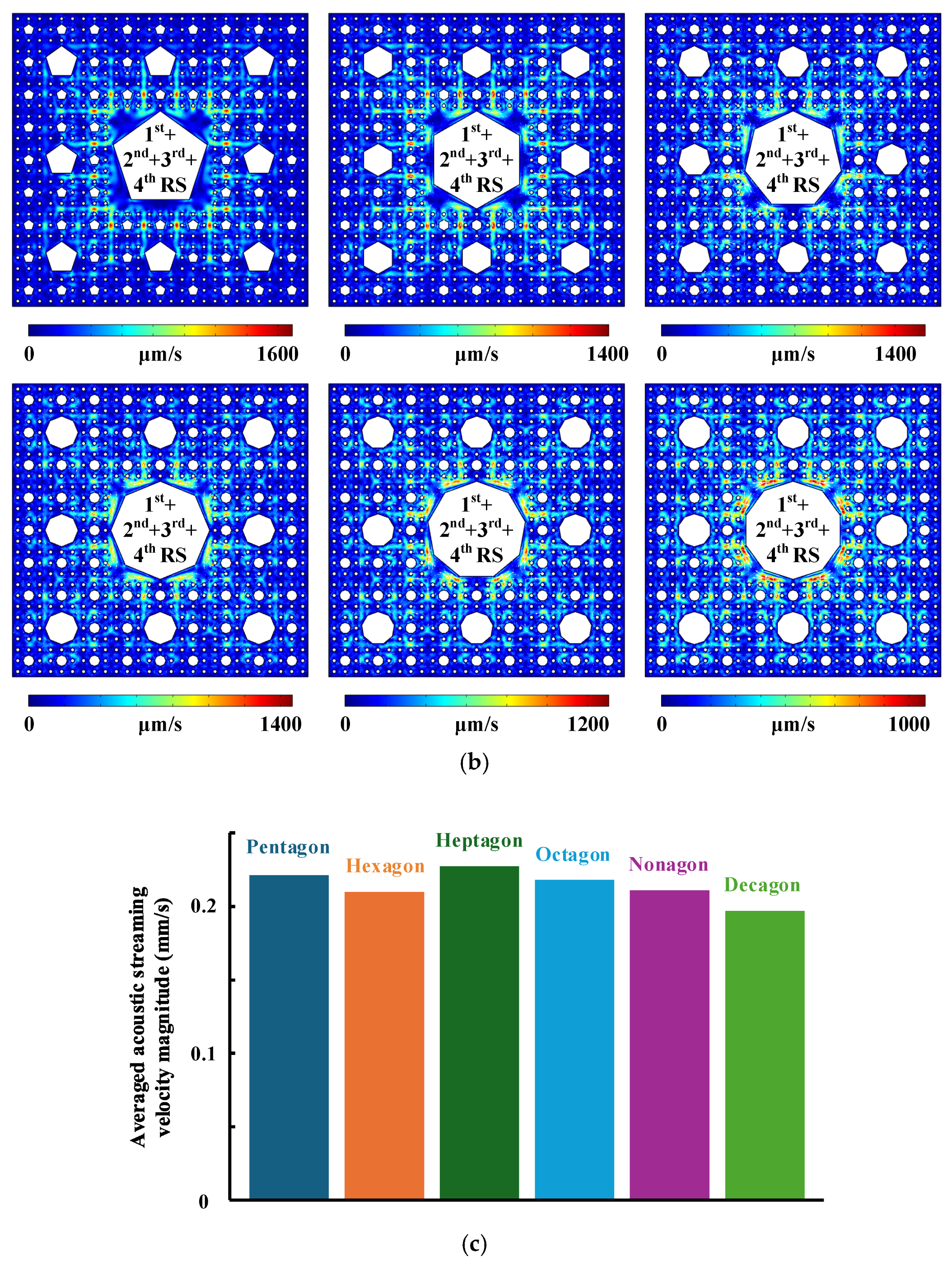
More sound pressure distributions generated by 1st + 2nd + 3rd + 4th RS in the 4-stage pseudo-Sierpiński-carpet-shaped chambers with different regular polygonal cross-sections are plotted in
Figure 8a (Pattern of sound pressure field). As
N increases, the extreme sound pressure regions progressively converge from the chamber periphery to the vicinity of the 2nd RS, and the cross-shaped sound pressure patterns gradually form between 1st RS and 2nd RS, approaching the situation of circular cross-section. The acoustic streaming fields presented in
Figure 8b (Pattern of acoustic streaming field) are all strip-shaped, while the acoustofluidic vortices which are originally concentrated around the sharp corners of the 1-stage regular polygonal cross-section will gradually shift to the vicinity of 1st RS and spread towards the chamber periphery with the increase of
N, positively relating to the increase in the degree of sharp corners and the total area of radiation surfaces. The particle trajectories shown in
Figure S5 (Particle trajectories generated in the 4-stage pseudo-Sierpiński-carpet-shaped chamber with different regular polygonal cross-sections under the excitation of 1st + 2nd + 3rd + 4th RS) also validate the above regularity. The averaged acoustic streaming velocity magnitudes in the 4-stage pseudo-Sierpiński-carpet-shaped chambers with different regular polygonal cross-sections can be calculated and shown in
Figure 8c (Averaged acoustic streaming velocity magnitude), and the variation tendency of fluid flow speed is also related to the sharp corner degree and the radiation surface area. The angle increase will weaken the acoustofluidic amplification effect at each sharp corner, while the area increase will enhance the acoustic streaming field. Therefore, the averaged acoustic streaming velocity magnitude reaches the maximum value under the circumstance of regular heptagonal cross-section.
More simulation results of the acoustofluidic fields and particle movement trajectories generated in the 3- and 4-stage pseudo-Sierpiński-carpet-shaped chambers with other cross-sections (i.e., Reuleaux polygon, pentagram, and concave square) are listed in the
Supplementary Material as shown from
Figure S6 (Acoustofluidic fields and particle trajectories generated in the 3-stage pseudo-Sierpiński-carpet-shaped chamber with different Reuleaux polygonal cross-sections under the excitation of 1st + 2nd + 3rd RS) to
Figure S13 (Acoustofluidic fields and particle trajectories generated in the 4-stage pseudo-Sierpiński-carpet-shaped chamber with concave square cross-section under the excitation of different-stage radiation surfaces). Also, the averaged acoustic streaming velocity magnitudes under all circumstances are consolidated and presented in
Table S1 (Averaged acoustic streaming velocity magnitude under all circumstances). Since the generation mechanism and evolution principle of diversified acoustofluidic distributions have been illuminated in the above-mentioned main sections, no more detailed descriptions are included in the
Supplementary Material.
In summary, although the combination of multiple radiation surfaces can linearly superimpose sound pressure amplitudes, the distribution of the acoustic energy gradient is modified through a nonlinear mechanism, ultimately affecting the morphology and intensity of the acoustic streaming field. Therefore, the linear acoustic field establishes the fundamental framework for energy distribution, while the nonlinear acoustic streaming effect gives rise to rich steady-state flow modes within this framework, collectively enabling controllable modulation of particle motion trajectories. The coupling relationship between the two mechanisms can be summarized as follows: the linear acoustic field determines the distribution of energy emission through boundary conditions, while the nonlinear acoustofluidic effect converts sound energy gradient into fluid kinetic momentum through an inherent nonlinear mechanism. Therefore, the heterogeneous acoustic streaming distributions and particle movement trajectories achieved in this study are essentially a vivid manifestation of the nonlinear acoustofluidic effect output indirectly programmed by designing the spatial energy distribution of the linear sound field (i.e., geometric and radiation surface arrangement). This clear distinction and correlation provide profound physical guidance for the design of acoustofluidic devices based on fractal or complex geometries; that is, by manipulating the boundary conditions of linear sound fields, the functional output of nonlinear acoustic streaming vortices can be predictively shaped.
In comparison to existing studies on fractal acoustics or acoustofluidics, this work introduces pseudo-fractal structures (such as pseudo-Sierpiński-carpet) characterized by regularity yet lacking strict self-similarity in geometric design. Such structures leverage the spatial symmetry and multi-scale nesting features of the given geometry to effectively modulate the distribution of both acoustic pressure distributions and acoustic streaming fields without relying on complex parametric adjustments. The study further reveals that although the pattern of acoustic streaming fields does not fully adhere to the self-similarity of fractals, their formation still obeys the principles of energy conservation and linear superposition. This suggests that in the design of fractal-inspired acoustofluidic devices, the geometric arrangement and excitation combinations of radiation surfaces can be flexibly tailored to customize acoustic streaming vortex patterns. Additionally, the cross-sectional shape exhibits a significant influence on the enhancement of acoustic streaming effects, particularly for geometries with sharp edges (such as triangular cross-section), where boundary layer discontinuity and concentrated acoustic energy gradients markedly amplify acoustic streaming magnitude. However, its limitation lies in the fact that due to the absence of strict adherence to the fractal self-similarity principle, the acoustic pressure distribution does not fully exhibit fractal characteristics. Moreover, the dense arrangement of higher-order radiation surfaces may lead to mutual suppression among acoustic streaming vortices, thereby affecting the overall acoustic streaming intensity. Distinct from conventional construction methods of miniaturized microfluidic systems, the artificial introduction of fractal elements such as Sierpiński carpets/triangles, Koch snowflakes, Mandelbrot sets, and Pythagorean trees offers novel perspectives and expands the application scope of acoustofluidic effects, simultaneously enriching and diversifying ultrasonic micro/nano-scale manipulation technologies. By incorporating fractal-inspired multi-scale geometric structures and independently controllable radiation surface arrays, this approach provides a new methodology for the spatial customization of acoustic field energy and acoustic streaming distribution.




 ,
,