1. Introduction
After a stroke or other acquired brain injury, many individuals experience impaired muscle control and difficulty with normal movement, and a substantial proportion develop disabling spasticity. Spasticity often develops following damage to the central nervous system and is marked by abnormal muscle overactivity [
1]. This condition can cause stiffness and pain and may lead to contractures, joint deformities, and pressure ulcers [
2]. These complications can significantly hinder functional activities and slow rehabilitation progress. Estimates of spasticity prevalence vary, but it has been reported in up to 42% of stroke survivors—equivalent to roughly 504,000 people in the UK [
3,
4,
5].
Spasticity can interfere with the function of the body’s systems as well as activities that people want to perform. It can limit ‘active function’ (using the limb to perform functional tasks) or ‘passive function’ (the ability to care for the affected limb, such as maintaining hygiene or dressing) [
6,
7,
8].
Injection with botulinum toxin type A (BoNT-A) is shown to be a safe and effective focal intervention for reducing spasticity [
9,
10,
11,
12], and is recommended for use in routine clinical practice by national and international guidelines [
13,
14,
15].
BoNT-A therapy, when appropriately targeted and supported by complementary physical interventions, may enhance passive function by decreasing muscle spasticity, improving joint misalignment, and alleviating deformity-related strain [
16]. When motor recovery is less likely, improving ease of care of the affected limb remains the predominant aim [
17]. Previous studies have reported passive function as a major treatment goal for arm spasticity management [
12,
13,
18,
19,
20,
21,
22,
23,
24,
25].
Goal attainment scaling (GAS) is a structured approach for evaluating the degree to which individualized patient goals are achieved following treatment [
26]. Detailed guidance on its application is covered extensively in the literature [
27,
28,
29,
30,
31,
32]. In complex interventions, patients often set multiple goals, with varying levels of achievement. The GAS T-score provides an aggregate measure of overall goal attainment; scores increasing from baseline indicate progress, and a score of 50 (SD ±10) reflects achievement as predicted. Values above 50 indicate outcomes exceeding expectations. GAS can assist, when categorized, in identifying patients whose treatment goals target specific functional domains. Although GAS is sensitive to changes during spasticity management [
19,
33,
34], it measures goal achievement and has limitations regarding scaling and comparability [
35]. Consequently, it should complement, not replace, standardized outcome measures [
27].
In order to provide comprehensive assessment of both active and passive function in the context of interventions for arm spasticity, a standardized outcome measure needs to assess both of these constructs [
36]. The Arm Activity measure (ArmA) was developed specifically for this purpose and includes two sub-scales addressing difficulty in active and passive function as separate entities. The ArmA [
37] is a patient or carer-rated 20-item measure comprising a 7-item ‘passive function’ subscale (ArmA-PF, score range 0–28) and a 13-item ‘active function’ subscale (ArmA-AF, score range 0–52). Decreasing ArmA scores indicate a decrease in the difficulty of tasks and therefore an improvement in passive (or active) function. The ArmA has been systematically developed [
38], supporting content validity. It has been psychometrically tested, providing evidence for construct validity, internal consistency, dimensionality, test–retest reliability, scaling, feasibility, and responsiveness [
39].
The Upper Limb International Spasticity (ULIS) program consists of three international observational studies which uniquely describe and reevaluate real-life clinical practice in the use of BoNT-A to manage arm spasticity [
40]. A primary element of the program is incorporation of GAS as the primary outcome measure, with validated measures including ArmA [
41,
42,
43].
As a chronic condition, spasticity often requires ongoing intervention, and repeated BoNT-A injections have been shown to deliver long-term benefits across multiple symptoms [
7,
25,
44,
45,
46,
47,
48]. ULIS-III [
25,
41], the third phase of the ULIS program, is among the largest multicenter studies assessing repeated BoNT-A treatment for upper-limb spasticity, with an effectiveness cohort of 953 patients. The study introduced the Upper Limb Spasticity Index (ULSI), integrating the Focal Spasticity Index (FSI) and recording GAS alongside selected standardized measures aligned with treatment priorities for each cycle. Results confirmed sustained treatment response over two years in goal attainment and functional outcomes—both passive and active [
25]. Post hoc analyses suggested that injection guidance, female gender, and certain toxin types (favoring Abobotulinum over Onabotulinum) may predict better overall response [
49].
This post hoc analysis aimed to examine outcomes from repeated BoNT-A injections in patients for whom passive function of the arm was explicitly identified as a treatment goal in routine clinical practice. The objectives were as follows:
- (a)
To assess whether goals for improving passive function were consistently achieved across multiple injection cycles over two years;
- (b)
To evaluate longitudinal changes (improvement) in passive function scores to determine any cumulative benefit on ease of limb care;
- (c)
To identify patient- and treatment-related factors associated with improvement following each injection.
Clinically, we hypothesized that patient-related predictors of improvement or increased injection frequency might include age, sex, time since injury, prior BoNT-A exposure, and spasticity severity or distribution. Intervention-related predictors were expected to include the number and location of muscles treated, total dose administered, and use of injection guidance techniques (e.g., electromyography, nerve stimulation, or ultrasound). We further hypothesized that increased number and location of muscles treated, greater total dose administered, and use of injection guidance may lead to a greater effect.
The clinical relevance is therefore in identifying ongoing responses for passive function treatment goals, with potential improvements for ease of care in people with arm spasticity. It was also important to establish other factors that contribute to a positive outcome in both practice and research.
3. Discussion
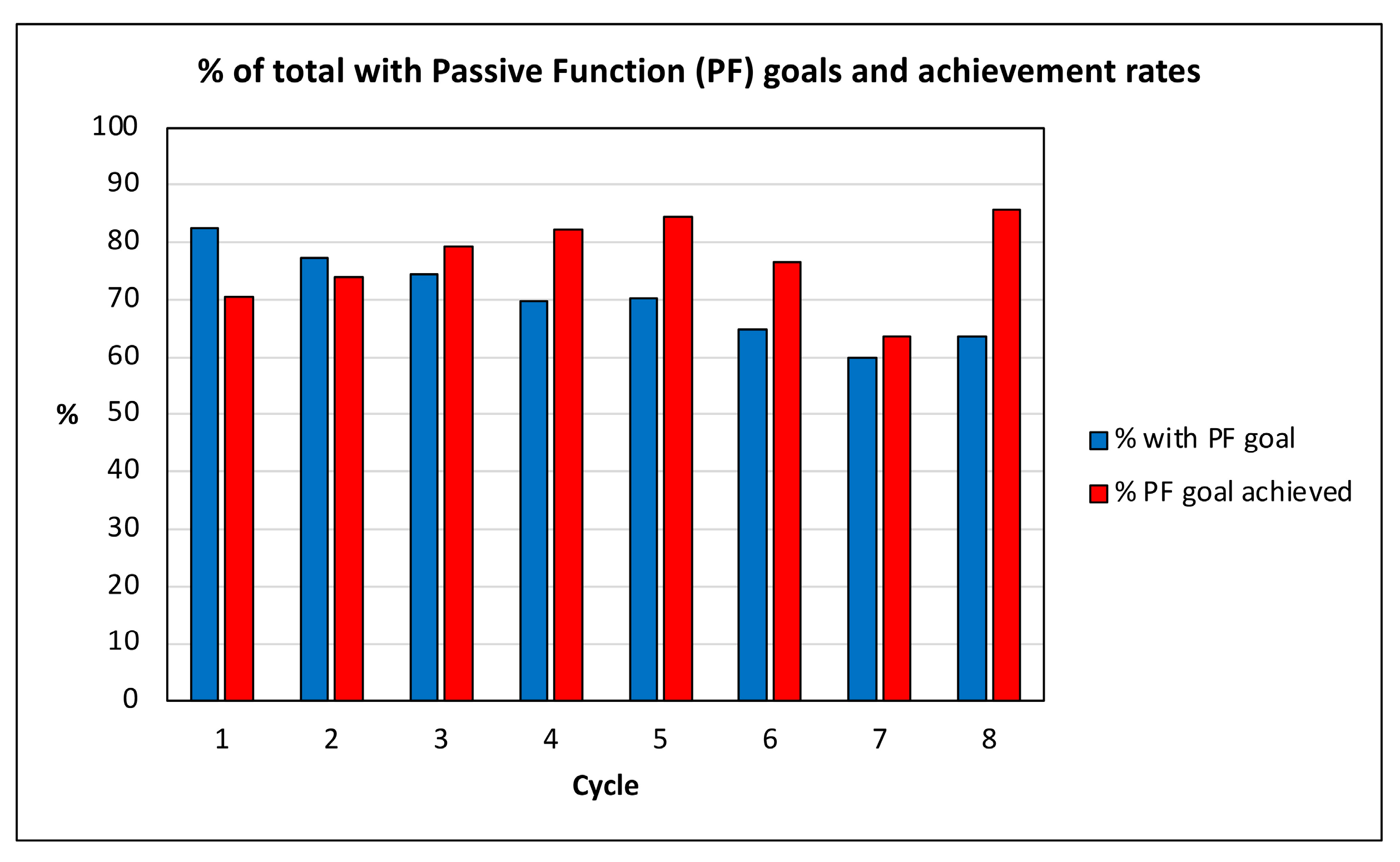
This post hoc evaluation of the outcomes gathered in the ULIS-III study assessed the sustained impact of repeated BoNT-A injections on passive function—defined as ease of caring for the affected arm—within routine clinical practice. The findings confirm that improving passive function was a key treatment objective for over half of the patients and that repeated administrations provided ongoing benefit throughout a two-year observation period. From a clinical perspective it is important to re-emphasize the importance of passive function gain as an aim for treatment so that clinicians continue to prioritize this. It is also important to understand that increasing gain in passive function/ease of care is clinically possible and likely to happen with repeated cycles of treatment.
3.1. Response to Repeated Injections
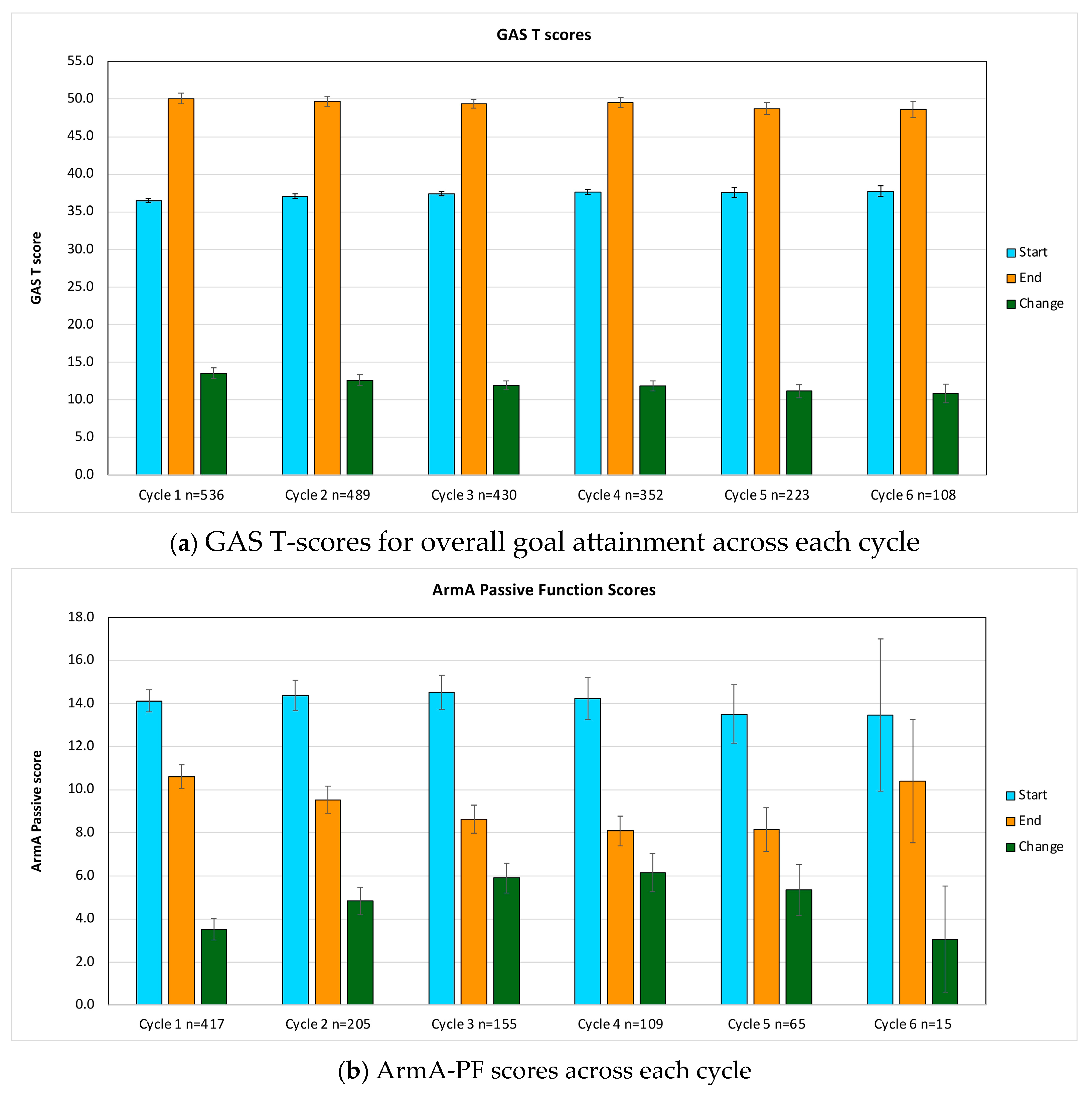
Over at least six treatment cycles, passive function improved significantly between the start and end of each treatment cycle, as measured by a reduction in ArmA-PF scores and shown by goal attainment. This reduction occurred regardless of baseline characteristics such as age, type of neurological damage, or chronicity of spasticity, other than a trend towards less improvement with more severe spasticity in the hand and wrist. In other words, it did not matter how old the patient was, the nature of their injury, or how long they had had spasticity—BoNT-A injection still made it significantly easier to care for the affected arm after each injection and improved passive function.
More severe spasticity in the hand and wrist (as demonstrated by higher distal MAS scores at baseline) (p = 0.001) seemed to be associated with greater improvements in passive function as measured by ArmA-PF at the end of the cycle. This makes clinical sense in that, when spasticity is more severe, there is more potential for change with BoNT-A administration, and thus greater improvement in passive function than in milder spasticity. Although no longer significant after adjustment of p-values, there was also a statistical trend towards greater improvement with higher doses of BoNT-A and use of injection guidance, which is in line with the direction that we hypothesized and resonates both with clinical experience and other published findings (see below).
3.2. Cumulative Benefit from Repeated Injections
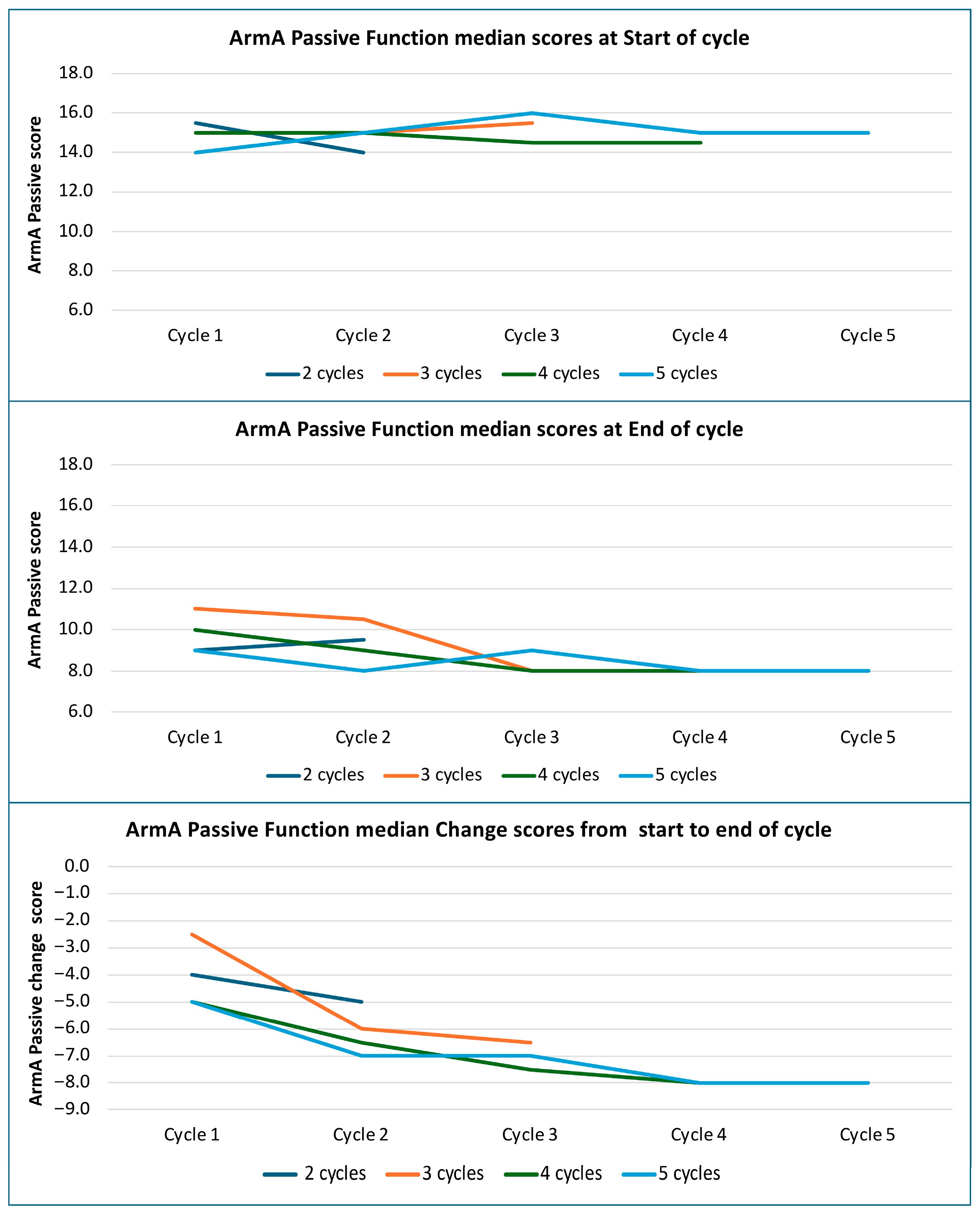
Amongst the patients who had between two and six injections during the study period, there was evidence indicative of a small cumulative effect on improvement in passive function, which carried on over successive cycles for ArmA-PF scores at the start and end of each cycle (p < 0.001). This is a unique finding which has not, to our knowledge, been previously shown. It appeared to be unrelated to other treatment factors, suggesting that this may be a real effect of the repeated cycles of treatment rather than a sampling error, and therefore warrants further investigation to determine if this is indeed a true effect.
From a clinical perspective, this possible cumulative effect on ease of caring for the limb would not be surprising, as it resonates with clinical experience. There are a number of possible explanations for it, which include (a) the potential for spasticity to stabilize and its expression to reduce over time [
50], (b) the effect of ongoing concomitant physical interventions (such as splinting and positioning), which provide an ongoing stretch to muscle and soft tissues resulting in decreased contracture and limb deformity (i.e., increased muscle length due to stretch to connective tissue and increase in sarcomeres) [
50,
51,
52,
53,
54,
55], (c) a learning effect on the part of the injector and treating team, enabling them to target the most affected/responsive muscles, localize them with injection guidance techniques, and using higher doses of BoNT-A where appropriate, resulting in the impact of better spasticity reduction.
Higher ArmA-PF scores before injection were also statistically associated with higher doses of BoNT-A (p < 0.001), which again resonates with clinical experience. Patients presenting with more severe difficulties with passive function are likely to require higher doses of BoNT-A to manage the problem.
3.3. Comparison of Findings with Other Studies
Our findings align with previous research, which consistently identifies passive function—defined as ease of caring for the upper limb—as a primary therapeutic goal, particularly when the hand or arm is non-functional [
12,
48,
56,
57]. While fewer studies have examined the longitudinal impact of repeated BoNT-A injections on arm spasticity, those that have have also demonstrated a continuing benefit from repeated injections [
58] and the importance of injection guidance in the response to treatment.
We are not aware of any previous study reporting a cumulative effect of repeated injection of BoNT-A on ease of caring for a limb, but a previous secondary analysis of the primary ULIS-III longitudinal study revealed evidence of cumulative benefit from repeated injections in the management of spasticity-related pain [
58]. Therapy inputs were also found to be important [
49], and this has been further supported in a worldwide survey of the perception of clinicians engaged in the management of spasticity [
59].
Provision of physical therapy inputs and incorporation of spasticity management into a holistic program of rehabilitation or management has been emphasized in a number of national and international guidelines for focal spasticity intervention [
15,
49,
59,
60]. Spasticity management using botulinum toxin is therefore not an isolated intervention and should be viewed in the context of the overall rehabilitation program [
61,
62]. In planning treatment, the wider rehabilitation or care context is particularly important to consider when the goal of treatment is passive function- or care-related in nature.
3.4. Important Messages for Clinicians Managing Arm Spasticity
With a specific clinical focus, it is important to re-emphasize the importance of passive function gain as an aim for treatment so that clinicians continue to prioritize this in treatment planning and delivery. It is also important to understand that increasing gains in passive function/ease of care is clinically possible and likely to happen with repeated cycles of treatment, with maintenance of some benefit over those cycles.
The findings provide important justification to support repeated BoNT-A injection as part of ongoing management to maintain ease of caring for arm spasticity and passive function gain [
18,
20].
For a proportion of people, ongoing administration (three or more cycles per year) of BoNT-A will be required to sustain the benefits over a longer time period, often critically preventing deterioration in their condition and possibly also supporting longer-term improvements. However, concomitant physical management is also likely to be necessary in order to maintain long-term benefits.
These benefits are likely to be achieved irrespective of patient-related characteristics, including age, gender, time since injury, previous injection with BoNT-A, and severity/distribution of spasticity, but they may be enhanced through optimal injection techniques such as guidance and total dose of BoNT-A used.
There are challenges with long-term adherence to physical management and, indeed, repeated cycles of BoNT-A administration. This paper does not aim to address issues of self-efficacy and treatment engagement specifically. However, the goal-setting process used (incorporating goal attainment scaling), by ensuring patient/participant engagement, partially aids in achieving ‘buy-in’ for associated rehabilitation and management.
3.5. Strengths and Limitations
Several strengths and limitations warrant consideration.
- 1.
Strengths include its large sample size and the fact that it was conducted within real-world clinical practice, encompassing broad international representation, diverse etiologies, and all BoNT-A formulations, thereby enhancing the generalizability of findings.
- 2.
Limitations relate primarily to the absence of a control group—an inherent feature of the longitudinal design—and variability in site distribution across countries, which may limit representativeness in certain settings. Additional sources of bias may include clinician expertise, injector skill, and external prescribing constraints that restrict injection frequency.
The ULIS-III dataset provides a robust foundation for post hoc analyses; however, such analyses inherently increase the risk of type I error due to multiple testing. In this study, we specifically examined the influence of patient characteristics (e.g., age, gender, severity, and chronicity) on passive function outcomes following repeated injections, applying statistical methods to minimize this risk. However, in so doing, there is some risk of obscuring important findings or increasing type II error, though this is addressed already in the paper related to overall treatment dose and injection guidance. This sub-analysis focuses only on patients with goals for passive function and needs to be read in conjunction with other publications from the ULIS III study, including the main results paper (25). Other complementary sub-analyses for different key goal areas, such as pain, which is published in Toxins (58), and further analyses on goal attainment and active function, which are in progress, should also be referred to.
5. Materials and Methods
5.1. Study Design and Participants
This retrospective analysis utilized data from ULIS-III (NCT02454803), a large-scale, international, prospective observational study, previously described in detail [
25,
41].
In summary, ULIS-III followed adults living with arm spasticity over a two-year period in real-world clinical settings, assessing integrated care programs incorporating both BoNT-A administration and physical intervention. The study was conducted across 58 sites in 14 countries, spanning 4 continents.
Up to 30 eligible adult patients (≥18 years old) for whom BoNT-A injections had been planned to treat arm spasticity were consecutively recruited per center. Treatment complied with local regulatory requirements and standard practice, using any approved BoNT-A product.
Patients were monitored for two years, during which multiple treatment cycles occurred. Treatment was goal-directed, with flexibility to adjust primary and/or secondary goals at the start of each cycle. Ethical approval and written informed consent for anonymized data collection were obtained as required.
5.2. Outcome Assessment and Measures
Baseline and follow-up assessments were conducted throughout the two-year study using the Upper Limb Spasticity Index (ULSI), which combines GAS with selected standardized measures aligned to the priority treatment goal areas for each cycle.
Goal setting and attainment were evaluated using the Goal Attainment Scaling Evaluation of Outcome for Upper Limb Spasticity Tool [
41], employing the GAS light method [
27] to calculate GAS T-scores. Patients could define up to three goals per cycle (one primary, two secondary). A mean GAS T-score of 50 (SD +/− 10) indicates expected goal achievement [
26], and a 10-point increase from baseline represents the minimal clinically important difference [
30].
The Arm Activity measure (ArmA) is a validated patient-reported outcome measure of perceived difficulty in both passive and active arm function in individuals with hemiparesis [
38,
39]. It comprises 20 items, each scored on a 5-point Likert scale ranging from 0 (no difficulty) and 4 (unable to do task). It has two subscales, a 7-item scale of passive function (ease of caring for the spastic arm) score with a range of 0–28, and a 13-item scale of active function (using the limb for functional tasks) score with a range of 0–52. Higher scores on the ArmA measures equal greater impairment; therefore, a negative change score indicates improvement over time.
This secondary analysis focused on patients within the effectiveness population (n = 953) who identified ease of care for the affected limb (passive function) as a treatment goal during the study period.
5.3. Statistical Analysis
Patients in the ‘passive function subgroup’ set at least one goal—primary or secondary—related to improving passive function during any treatment cycle. Each cycle had two assessments, pre-injection, and post-injection, change in passive function was quantified by the difference in ArmA-PF scores between both assessment timepoints.
Given the observational nature of ULIS-III and delivery in routine clinical practice, patients with passive function goals did not necessarily maintain such goals across all cycles, which complicated the longitudinal evaluation of data. Accordingly, initial evaluations involved descriptive and visual exploration of trends in the data, followed by more advanced statistical modeling.
Although up to eight cycles were recorded, very few patients with relevant data (n = 2 and n = 3, respectively), such as goals related to passive function and before and after ArmA-PF scores, completed seven or eight cycles, so for the primary analysis, we included the results for up to a maximum of six cycles.
Variables in this dataset were analyzed without any transformation, and no outliers were excluded. Missing values were accounted for in the mixed effects models using the random forests algorithm in the R package missForest (version 1.5), using all variables included in the mixed effect models only. There were three imputations for cycle in this study, one for re-injection scores, one for post-injection scores, and one for change scores. Because the ArmA-PF score was the response variable, we removed missing values in the ArmA-PF score before each imputation. This maximized the valid sample size without needing to impute the response variable. No other imputation was implemented in this study. Holm’s method was applied to adjust
p-values for multiple comparisons [
63]. This method is a standard, less conservative, uniformly more powerful method to adjust
p-values compared to the Bonferroni correction [
64]. Nevertheless, it is recognized that adjustment of
p-values can potentially obscure more subtle trends arising from the analysis, so where relevant, we have included both the adjusted and non-adjusted
p-values.
Analyses were conducted in R (version 4.3.2). The primary objective of this study included evaluating changes in GAS T-scores and ArmA-PF scores across repeated cycles for patients with passive function goals. We first ran statistical tests to identify if the demographics in the effectiveness population were significantly different to those with at least one ArmA-PF score. Population-level analyses involved calculating mean pre, post, and change scores per cycle with 95% confidence intervals (CIs) and comparing change scores using paired
t-tests stratified by cycle number (see
Table A2 in
Appendix A). To capture change over repeated cycles at the individual level, we present descriptive charts of the median ArmA-PF score grouped by the maximum number of cycles each individual had, up to five cycles (as none of the patients with a maximum of six cycles had complete ArmA-PF scores in every cycle).
Mixed effects models assessed predictors of start-of-cycle scores, end-of-cycle scores, and change-in-ArmA-PF scores, while controlling for the confounding effect of repeated measures. We conducted two analyses for change in cycle scores, one for the effect of baseline characteristics on change and one for the effect of treatment characteristics on change. We also conducted two analyses each for both the start-of-cycle scores and end-of-cycle scores: one using cycle number only and one using cycle number and other treatment characteristics. Observations were at the level of the patients and cycle number, rather than the patients alone. Because of the AB design and the maximum of five cycles, as well as small sample sizes in later cycles, observations were not independent. To account for this dependency, a random effect term for each patient was incorporated. This modeling strategy improved sensitivity for detecting significant differences between the predictors and outcome variables.
Based on prior analyses [
34,
49], we proposed that reductions in passive function might be influenced by patient or intervention-related factors such as age, gender, chronicity of spasticity (years since onset), previous treatment with BoNT-A, baseline severity, and distribution of spasticity (as measured by the composite MAS for the proximal (elbow and shoulder) [
25] and distal (hand, wrist, and finger) muscles, and the number of cycles (or visits) required during the 2-year period of the study. We also hypothesized that intervention-related factors may include the number of muscles injected, the part of the arm injected, the total dose injected, and the use of techniques to guide injection (e.g., using electromyography, muscle stimulation, or ultrasound). As the study included any of the three licensed preparations of BoNT-A (Abobotulinum Toxin, Incobotulinum Toxin, and Onabotulinum Toxin), which have different units, the total dose used was expressed as a percentage of the maximum recommended dose for each product, referencing the UK Summary of Product Characteristics.



 ,
,