Reducing Aflatoxin Accumulation in Maize: Development and Performance of a Novel Biological Input

 , ,
, ,  ,
,  , and
, and 
Abstract
1. Introduction
2. Results and Discussion
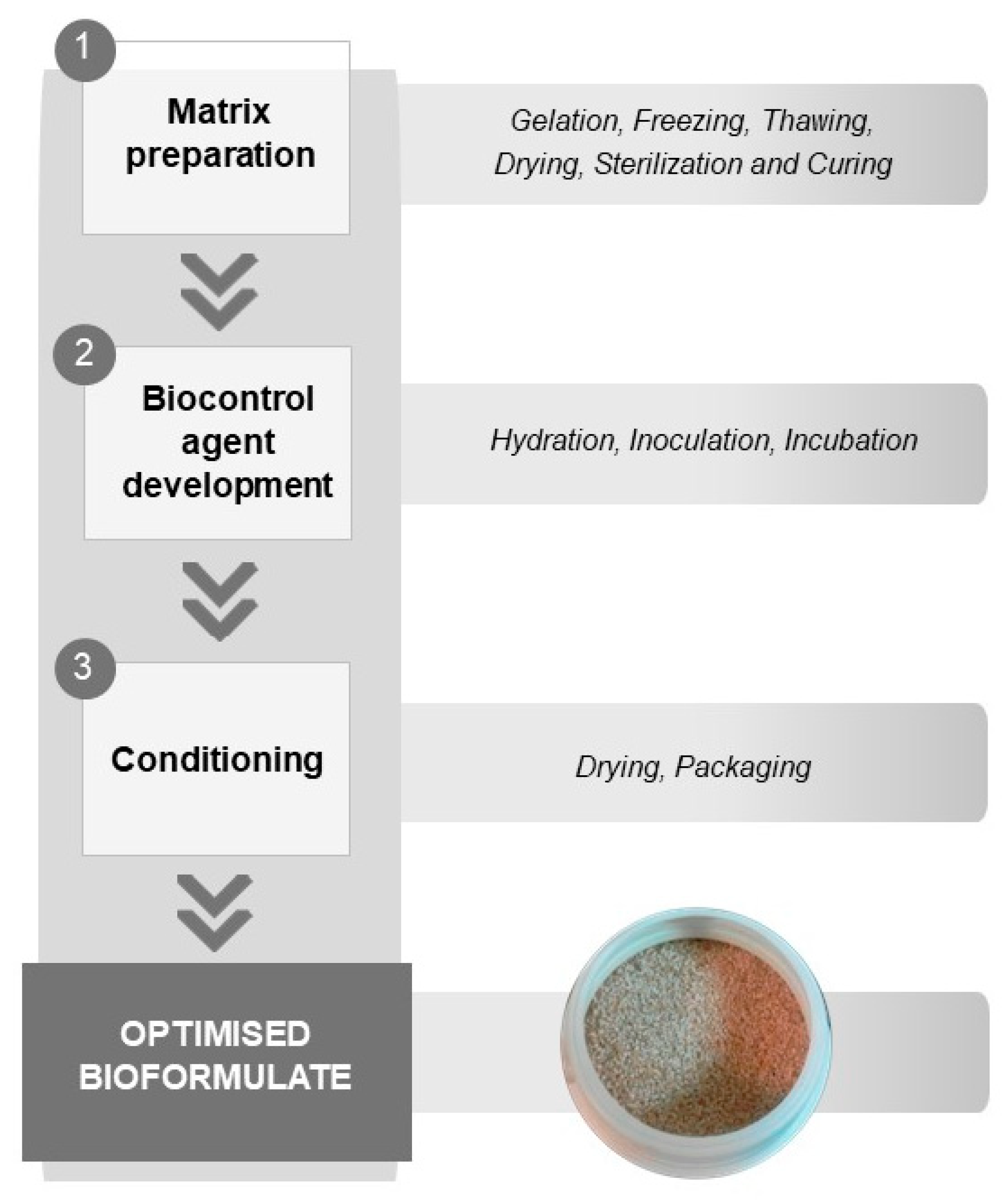
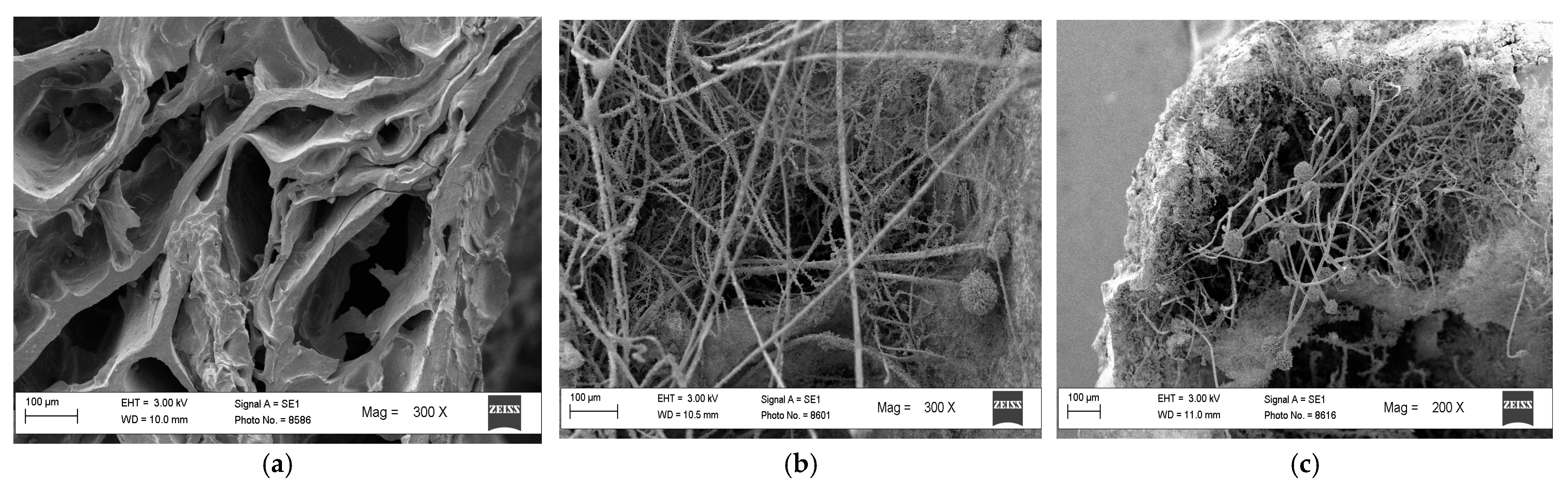
2.1. Bioformulate Production Based on Macroporous Starch Polymer
2.2. Field Trials
2.2.1. Soil Analysis
2.2.2. Maize Kernel Analysis
3. Conclusions
4. Materials and Methods
4.1. Fungal Strain
4.2. Preparation of the Novel Bioformulate
4.2.1. Composition of the Bioformulate
4.2.2. Synthesis and Characterisation of the Macroporous Polymer
4.2.3. Inoculation and Growth of the Biocontrol Agent
4.2.4. Scanning Electron Microscopy (SEM) Analysis
4.3. Field Assay Design
4.4. Total Fungal and Aspergillus Section Flavi Count in Soil and Maize Kernel Samples
4.5. Aflatoxin Determination in Maize Kernels
4.6. Statistical Analysis
5. Patents
Author Contributions
Funding
Institutional Review Board Statement
Informed Consent Statement
Data Availability Statement
Acknowledgments
Conflicts of Interest
Abbreviations
| AFs | Aflatoxins |
| AFB1 | Aflatoxin B1 |
| RBF | Rice-based formulate |
| BBF | Biopolymer-based formulate |
| ND | Not detected |
| LOD | Limit of detection |
References
- United Nations (UN). Why Improving Food Safety Is Important. 2024. Available online: https://www.un.org/sustainabledevelopment/es/hunger/ (accessed on 17 November 2025).
- Lalawmpuii, R.P.K. Role of water-energy-food nexus in environmental management and climate action. Energy Nexus 2023, 11, 100230. [Google Scholar] [CrossRef]
- Yuan, X.; Li, S.; Chen, J.; Yu, H.; Yang, T.; Wang, C.; Huang, S.; Chen, H.; Ao, X. Impacts of global climate change on agricultural production: A comprehensive review. Agronomy 2024, 14, 1360. [Google Scholar] [CrossRef]
- McMillan, A.; Renaud, J.B.; Burgess, K.M.N.; Orimadegun, A.E.; Akinyinka, O.O.; Allen, S.J.; Miller, J.D.; Reid, G.; Sumarah, M.W. Aflatoxin exposure in Nigerian children with severe acute malnutrition. Food Chem. Toxicol. 2018, 111, 356–362. [Google Scholar] [CrossRef]
- Choi, H.; Garavito-Duarte, Y.; Gormley, A.R.; Kim, S.W. Aflatoxin B1: Challenges and strategies for the intestinal microbiota and intestinal health of monogastric animals. Toxins 2025, 17, 43. [Google Scholar] [CrossRef]
- MERCOSUR MERCOSUR/GMC/Res. Nº 25/02. Reglamento Técnico MERCOSUR Sobre Límites Máximos de Aflatoxinas Admisibles en Leche, Maní y Maíz (Derogación de la Res. GMC Nº 56/94). 2002. Available online: https://normas.mercosur.int/public/normativas/1047 (accessed on 17 November 2025).
- Agência Nacional de Vigilância Sanitária (ANVISA). Resolução RDC 07/2011, Dispõe Sobre Limites Máximos Tolerados (LMT) para Micotoxinas em Alimentos. 2011. Available online: https://bvsms.saude.gov.br/bvs/saudelegis/anvisa/2011/res0007_18_02_2011_rep.html (accessed on 17 November 2025).
- Código Alimentario Argentino (CAA). Capítulo III: De los Productos Alimenticios. 2021. Available online: https://www.argentina.gob.ar/sites/default/files/anmat_capitulo_iii_prod_alimenticios.pdf (accessed on 17 November 2025).
- Commission Regulation (EU). Commission Regulation (EU) 2023/915; On maximum levels for certain contaminants in food and repealing Regulation (EC) No 1881/2006. Off. J. Eur. Union 2023, L 119, 103–157. Available online: https://eur-lex.europa.eu/legal-content/EN/TXT/PDF/?uri=CELEX:32023R0915 (accessed on 17 November 2025).
- Goda, A.A.; Shi, J.; Xu, J.; Liu, X.; Zhou, Y.; Xiao, L.; Ramzy, S. Global health and economic impacts of mycotoxins: A comprehensive review. Environ. Sci. Eur. 2025, 37, 122. [Google Scholar] [CrossRef]
- Serna–Saldivar, S.O. Chapter 14—Maize. In ICC Handbook of 21st Century Cereal Science and Technology; Shewry, P.R., Koksel, H., Taylor, J.R.N., Eds.; Academic Press: London, UK, 2023; pp. 131–143. [Google Scholar] [CrossRef]
- DSM-Firmenich. World Mycotoxin Survey: The Global Threat. January–December 2024. DSM-Firmenich. 2025. Available online: https://pages-anh.dsm.com/rs/944-XYO-531/images/REP_MTXsurvey_Q4_0125_62309_FINAL.pdf (accessed on 17 November 2025).
- Khan, R.; Ghazali, F.M.; Mahyudin, N.A.; Samsudin, N.I.P. Biocontrol of aflatoxins using non-aflatoxigenic Aspergillus flavus: A literature review. J. Fungi 2021, 7, 381. [Google Scholar] [CrossRef] [PubMed]
- Dorner, J.W.; Cole, R.J. Effect of application of nontoxigenic strains of Aspergillus flavus and A. parasiticus on subsequent aflatoxin contamination of peanuts in storage. J. Stored Prod. Res. 2002, 38, 329–339. [Google Scholar] [CrossRef]
- Cotty, P.; Antilla, L. Managing Aflatoxins in Arizona; United States Department of Agriculture, Agricultural Research Service: New Orleans, LA, USA, 2003.
- Abbas, H.; Zablotowicz, R.; Bruns, H.A.; Abel, C. Biocontrol of aflatoxin in corn by inoculation with non-aflatoxigenic Aspergillus flavus isolates. Biocontrol Sci. Technol. 2006, 16, 437–449. [Google Scholar] [CrossRef]
- Pitt, J.I.; Hocking, A.D. Mycotoxins in Australia: Biocontrol of aflatoxin in peanuts. Mycopathologia 2006, 162, 233–243. [Google Scholar] [CrossRef]
- Dorner, J.W.; Horn, B.W. Separate and combined applications of nontoxigenic Aspergillus flavus and A. parasiticus for biocontrol of aflatoxin in peanuts. Mycopathologia 2007, 163, 215–223. [Google Scholar] [CrossRef]
- Atehnkeng, J.; Ojiambo, P.S.; Ikotun, T.; Sikora, R.A.; Cotty, P.J.; Bandyopadhyay, R. Evaluation of atoxigenic isolates of Aspergillus flavus as potential biocontrol agents for aflatoxin in maize. Food Addit. Contam. Part A 2008, 25, 1264–1271. [Google Scholar] [CrossRef]
- Alaniz Zanon, M.S.; Barros, G.G.; Chulze, S.N. Non-aflatoxigenic Aspergillus flavus as potential biocontrol agents to reduce aflatoxin contamination in peanuts harvested in Northern Argentina. Int. J. Food Microbiol. 2016, 231, 63–68. [Google Scholar] [CrossRef]
- Alaniz Zanon, M.S.; Bossa, M.; Chiotta, M.L.; Oddino, C.; Giovanini, D.; Cardoso, M.L.; Bartosik, R.E.; Chulze, S.N. Pre-harvest strategy for reducing aflatoxin accumulation during storage of maize in Argentina. Int. J. Food Microbiol. 2022, 380, 109887. [Google Scholar] [CrossRef]
- Mauro, A.; Garcia-Cela, E.; Pietri, A.; Cotty, P.J.; Battilani, P. Biological control products for aflatoxin prevention in Italy: Commercial field evaluation of atoxigenic Aspergillus flavus active ingredients. Toxins 2018, 10, 30. [Google Scholar] [CrossRef] [PubMed]
- Ortega-Beltran, A.; Moral, J.; Picot, A.; Puckett, R.D.; Cotty, P.J.; Michailides, T.J. Atoxigenic Aspergillus flavus isolates endemic to almond, fig, and pistachio orchards in California with potential to reduce aflatoxin contamination in these crops. Plant Dis. 2019, 103, 905–912. [Google Scholar] [CrossRef]
- Agbetiameh, D.; Ortega-Beltran, A.; Awuah, R.T.; Atehnkeng, J.; Elzein, A.; Cotty, P.J.; Bandyopadhyay, R. Field efficacy of two atoxigenic biocontrol products for mitigation of aflatoxin contamination in maize and groundnut in Ghana. Biol. Control 2020, 150, 104351. [Google Scholar] [CrossRef]
- Savić, Z.; Dudaš, T.; Loc, M.; Grahovac, M.; Budakov, D.; Jajić, I.; Krstović, S.; Barošević, T.; Krska, R.; Sulyok, M.; et al. Biological control of aflatoxin in maize grown in Serbia. Toxins 2020, 12, 162. [Google Scholar] [CrossRef] [PubMed]
- Moore, G.G. Practical considerations will ensure the continued success of pre-harvest biocontrol using non-aflatoxigenic Aspergillus flavus strains. Crit. Rev. Food Sci. Nutr. 2022, 62, 4208–4225. [Google Scholar] [CrossRef]
- Daigle, D.J.; Cotty, P.J. Formulating atoxigenic Aspergillus flavus for field release. Biocontrol Sci. Technol. 1995, 5, 175–184. [Google Scholar] [CrossRef]
- Abbas, H.K.; Accinelli, C.; Shier, W.T. Biological control of aflatoxin contamination in U.S. crops and the use of bioplastic formulations of Aspergillus flavus biocontrol strains to optimize application strategies. J. Agric. Food Chem. 2017, 65, 7081–7087. [Google Scholar] [CrossRef]
- Accinelli, C.; Abbas, H.K.; Little, N.S.; Kotowicz, J.K.; Shier, W.T. Biological control of aflatoxin production in corn using non-aflatoxigenic Aspergillus flavus administered as a bioplastic-based seed coating. Crop Prot. 2018, 107, 87–92. [Google Scholar] [CrossRef]
- Weaver, M.A.; Abbas, H.K.; Jin, X.; Elliott, B. Efficacy of water-dispersible formulations of biological control strains of Aspergillus flavus for aflatoxin management in corn. Food Addit. Contam. Part A 2016, 33, 346–351. [Google Scholar] [CrossRef]
- Accinelli, C.; Saccà, M.L.; Abbas, H.K.; Zablotowicz, R.M.; Wilkinson, J.R. Use of a granular bioplastic formulation for carrying conidia of a non-aflatoxigenic strain of Aspergillus flavus. Bioresour. Technol. 2009, 100, 3997–4004. [Google Scholar] [CrossRef] [PubMed]
- Accinelli, C.; Abbas, H.K. New perspectives for the application of bioplastic materials in the biocontrol of Aspergillus flavus in corn. Toxin Rev. 2011, 30, 71–78. [Google Scholar] [CrossRef]
- Accinelli, C.; Abbas, H.K.; Vicari, A.; Shier, W.T. Aflatoxin contamination of corn under different agro-environmental conditions and biocontrol applications. Crop Prot. 2014, 63, 9–14. [Google Scholar] [CrossRef]
- Ortega-Beltran, A.; Kaptoge, L.; Senghor, A.L.; Aikore, M.O.S.; Jarju, P.; Momanyi, H.; Konlambigue, M.; Falade, T.D.O.; Bandyopadhyay, R. Can it be all more simple? Manufacturing aflatoxin biocontrol products using dry spores of atoxigenic isolates of Aspergillus flavus as active ingredients. Microb. Biotechnol. 2021, 15, 901–914. [Google Scholar] [CrossRef]
- Barros, G.; Torres, A.; Palacio, G.; Chulze, S. Aspergillus species from section Flavi isolated from soil at planting and harvest time in peanut-growing regions of Argentina. J. Sci. Food Agric. 2003, 83, 1303–1307. [Google Scholar] [CrossRef]
- Alaniz Zanon, M.S.; Chiotta, M.L.; Giaj-Merlera, G.; Barros, G.; Chulze, S. Evaluation of potential biocontrol agent for aflatoxin in Argentinean peanuts. Int. J. Food Microbiol. 2013, 162, 220–225. [Google Scholar] [CrossRef]
- Alaniz Zanon, M.S.; Clemente, M.P.; Chulze, S.N. Characterization and competitive ability of non-aflatoxigenic Aspergillus flavus isolated from the maize agro-ecosystem in argentina as potential aflatoxin biocontrol agents. Int. J. Food Microbiol. 2018, 277, 58–63. [Google Scholar] [CrossRef]
- United Nations (UN). The 17 Goals. 2015. Available online: https://sdgs.un.org/goals (accessed on 17 November 2025).
- Cole, R.J.; Dorner, J.W. Biological Control Formulations Containing Spores of Nontoxigenic Strains of Fungi for Toxin Control of Food Crops. U.S. Patent Application US 6,306,386 B1, 23 October 2001. [Google Scholar]
- Abbas, H.K.; Zablotowicz, R.M. Biocontrol of Aflatoxin in Corn by Inoculation with Non-Aflatoxigenic Aspergillus flavus Isolates. International Patent Application No. PCT/US2006/000569; World Intellectual Property Organization Patent WO 2006/076245 A2, 20 July 2006. [Google Scholar]
- Dorner, J.W.; Horn, B.W.; Cole, R.J. Non-Toxigenic Strain of Aspergillus oryzae and Aspergillus sojae for Biocontrol of Toxigenic Fungi. U.S. Patent Application US 6,027,724 A, 22 February 2000. [Google Scholar]
- Abbas, H.K.; Accinelli, C. A Sprayable Dispersed Starch-Based Bioplastic Formulation to Control Pests. International Patent Application No. PCT/US2015/030081; World Intellectual Property Organization Patent WO 2015/175372 A1, 19 November 2015. [Google Scholar]
- Abbas, H.K.; Accinelli, C.; Zablotowciz, R.M.; Sacca, M.L.; Wilkinson, J. Granular Bioplastic Biocontrol Composition. U.S. Patent Application US 8,734,862 B2, 27 May 2014. [Google Scholar]
- Lyn, M.; Zablotowicz, R.; Abbas, H.K. A Water Dispersible Formulation for Delivery of Biocontrol Fungi to Reduce Aflatoxin. International Patent Application No. PCT/US2008/074476; World Intellectual Property Organization Patent WO 2009/032696 A2, 12 March 2009. [Google Scholar]
- Lewis, J.A.; Lumsden, D.; Papavizas, G.; Hollenbeck, M.D.; Walter, J.F. Fungal Formulation for Biocontrol of Soilborne Plant Pathogens. U.S. Patent Application US 5,068,105, 26 November 1991. [Google Scholar]
- Shasha, B.S.; Dunkle, R.L. Starch Encapsulation of Biocontrol Agents. Australian Patent Office No. 613069, 25 July 1991. [Google Scholar]
- Tammy, T.; Swanson, J.A. Water-Dispersible Stabilised Biocontrol Granules: Preparation and Use. Uruguayan Patent UY 34093 A, 3 January 2013. [Google Scholar]
- Bastioli, C.; Belloti, V.; Del Tredici, G.; Lombi, R.; Montino, A.; Ponti, R. Biodegradable Polymeric Compositions Based on Starch and Thermoplastic Polymers. International Patent Application No. PCT/EP92/00959; World Intellectual Property Organization Patent WO 1992/19680 A1, 12 November 1992. [Google Scholar]
- Bastioli, C.; Capuzzi, P.M.; Magistrali, P.; Gesti García, S.; Viola, G.T.; Savini, G.; Bacchelli, F. Plant Derivatives as Extender Oils and Biofillers in Elastomeric Compositions. International Patent Application No. PCT/EP2013/062592; World Intellectual Property Organization Patent WO 2013/189917 A2, 27 December 2013. [Google Scholar]
- Bastioli, C.; Capuzzi, L.; Magistrali, P. Dispersiones Acuosas Estables que Comprenden Almidón Complejado. Oficina Española de Patentes y Marcas No. 2824832 T3, 13 May 2021. [Google Scholar]
- Nesci, A.; Barros, G.; Castillo, C.; Etcheverry, M. Soil fungal population in preharvest maize ecosystem in different tillage practices in Argentina. Soil Tillage Res. 2006, 91, 143–149. [Google Scholar] [CrossRef]
- Benito, N.; Carranza, C.S.; Magnoli, C.E.; Barberis, C.L. Survey and aflatoxigenic characterization for Aspergillus section Flavi from three maize production regions of Argentina. Cienc. Suelo 2018, 36, 82–91. [Google Scholar]
- Borges, D.F.; Nogueira, G.D.A.; Cruz, G.D.A.; Silva, S.G.D.A.; da Silva, W.L.; Ambrósio, M.M.D.Q. Changes on soil microbiota induced by the use of commercial products and the incorporation of plant materials. Rev. Caatinga 2023, 36, 300–309. [Google Scholar] [CrossRef]
- Ji, L.; Si, H.; He, J.; Fan, L.; Li, L. The shifts of maize soil microbial community and networks are related to soil properties under different organic fertilizers. Rhizosphere 2021, 19, 100388. [Google Scholar] [CrossRef]
- Xiong, C.; Singh, B.K.; He, J.Z.; Han, Y.L.; Li, P.P.; Wan, L.H.; Meng, G.Z.; Liu, S.Y.; Wang, J.T.; Wu, C.F.; et al. Plant developmental stage drives the differentiation in ecological role of the maize microbiome. Microbiome 2021, 9, 171. [Google Scholar] [CrossRef] [PubMed]
- Muhammad, M.; Wahab, A.; Waheed, A.; Hakeem, K.R.; Mohamed, H.I.; Basit, A.; Toor, M.D.; Liu, Y.H.; Li, L.; Li, W.J. Navigating climate change: Exploring the dynamics between plant–soil microbiomes and their impact on plant growth and productivity. Glob. Change Biol. 2025, 31, e70057. [Google Scholar] [CrossRef]
- Mamo, F.T.; Shang, B.; Selvaraj, J.N.; Zheng, Y.; Liu, Y. Biocontrol efficacy of atoxigenic Aspergillus flavus strains against aflatoxin contamination in peanut field in Guangdong province, South China. Mycology 2022, 13, 143–152. [Google Scholar] [CrossRef]
- Bonkoungou, S.; Dagno, K.; Basso, A.; Ekanao, T.; Atehnkeng, J.; Agbetiameh, D.; Neya, A.; Toure, M.; Tiendrebeogo, A.; Konate, M.; et al. Mitigation of aflatoxin contamination of maize, groundnut, and sorghum by commercial biocontrol products in farmers’ fields across Burkina Faso, Mali, Niger, and Togo. CABI Agric. Biosci. 2024, 5, 106. [Google Scholar] [CrossRef]
- Nji, Q.N.; Babalola, O.O.; Mwanza, M. Soil Aspergillus species, pathogenicity and control perspectives. J. Fungi 2023, 9, 766. [Google Scholar] [CrossRef]
- Weaver, M.A.; Abbas, H.K. Field displacement of aflatoxigenic Aspergillus flavus strains through repeated biological control applications. Front. Microbiol. 2019, 10, 1788. [Google Scholar] [CrossRef]
- Barontini, J.M.; Druetta, M.A.; Luna Perez, I.M.; Torrico Ramallo, A.K.; Alaniz Zanon, M.S.; Paccioretti, P.A.; Maurino, M.F.; Giménez, M.D.L.P.; Chulze, S.N. Performance of transgenic maize genotypes against ear caterpillars in Argentina. Maydica 2020, 65, 6. [Google Scholar]
- Brown, R.L.; Menkir, A.; Chen, Z.Y.; Bhatnagar, D.; Yu, J.; Yao, H.; Cleveland, T.E. Breeding aflatoxin-resistant maize lines using recent advances in technologies—A review. Food Addit. Contam. Part A 2013, 30, 1382–1391. [Google Scholar] [CrossRef] [PubMed]
- Giorni, P.; Bertuzzi, T.; Battilani, P. Aflatoxin in maize, a multifaceted answer of Aspergillus flavus governed by weather, host-plant and competitor fungi. J. Cereal Sci. 2016, 70, 256–262. [Google Scholar] [CrossRef]
- Servicio Meteorológico Nacional (SMN). Datos Meteorológicos y Climatológicos de Argentina. Retrieved Repeatedly Between 2019 and 2023. Available online: https://www.smn.gob.ar/ (accessed on 17 November 2025).
- Sanchis, V.; Magan, N. Chapter 8—Environmental conditions affecting mycotoxins. In Mycotoxins in Food: Detection and Control; Magan, N., Olsen, M., Eds.; Woodhead Publising Limited: Cambridge, UK, 2004; Volume 1, pp. 174–189. [Google Scholar]
- Battilani, P.; Logrieco, A.F. Chapter 22—Global risk maps for mycotoxins in wheat and maize. In Mycotoxin Reduction in Grain Chains; Leslie, J.F., Logrieco, A.F., Eds.; John Wiley & Sons, Ltd.: Ames, IA, USA, 2014; pp. 309–326. [Google Scholar]
- Medina, A.; Rodriguez, A.; Magan, N. Effect of climate change on Aspergillus flavus and aflatoxin B1 production. Front. Microbiol. 2014, 5, 103363. [Google Scholar] [CrossRef] [PubMed]
- Barros, G.; Torres, A.; Chulze, S. Aspergillus flavus population isolated from soil of Argentina’s peanut-growing region. Sclerotia production and toxigenic profile. J. Sci. Food Agric. 2005, 85, 2349–2353. [Google Scholar] [CrossRef]
- Barros, G.; Chiotta, M.L.; Torres, A.; Chulze, S. Genetic diversity in Aspergillus parasiticus population from the peanut agroecosystem in Argentina. Lett. Appl. Microbiol. 2006, 42, 560–566. [Google Scholar] [CrossRef]
- Barros, G.G.; Torres, A.M.; Rodriguez, M.I.; Chulze, S.N. Genetic diversity within Aspergillus flavus strains isolated from peanut-cropped soils in Argentina. Soil Biol. Biochem. 2006, 38, 145–152. [Google Scholar] [CrossRef]
- BeMiller, J.N.; Whistler, R.L. (Eds.) Starch: Chemistry and Technology; Academic Press: Cambridge, MA, USA, 2009. [Google Scholar]
- Reddy, N.; Yang, Y. Citric acid cross-linking of starch films. Food Chem. 2010, 118, 702–711. [Google Scholar] [CrossRef]
- Oyewale, M.O. statistical analysis of growth and amylase production by Aspergillus flavus grown on different carbon sources. Fountain J. N. Appl. Sci. 2013, 2, 39–44. [Google Scholar] [CrossRef]
- Zhang, B.; Davis, S.A.; Mann, S. Starch gel templating of spongelike macroporous silicalite monoliths and mesoporous films. Chem. Mater. 2002, 14, 1369–1375. [Google Scholar] [CrossRef]
- Liu, H.; Xie, F.; Yu, L.; Chen, L.; Li, L. Thermal processing of starch-based polymers. Prog. Polym. Sci. 2009, 34, 1348–1368. [Google Scholar] [CrossRef]
- Zhou, J.; Song, J.; Parker, R. Structure and properties of starch-based foams prepared by microwave heating from extruded pellets. Carbohydr. Polym. 2006, 63, 466–475. [Google Scholar] [CrossRef]
- Zhou, J.; Song, J.; Parker, R. Microwave-assisted moulding using expandable extruded pellets from wheat flours and starch. Carbohydr. Polym. 2007, 69, 445–454. [Google Scholar] [CrossRef]
- Liu, H.; Lelievre, J.; Ayoung-Chee, W. A study of starch gelatinization using differential scanning calorimetry, X-Ray, and birefringence measurements. Carbohydr. Res. 1991, 210, 79–87. [Google Scholar] [CrossRef]
- Klich, M.A. Identification of Common Aspergillus Species; Centraalbureau Voor Schimmelcultures: Utrecht, The Netherlands, 2002. [Google Scholar]
- Temperini, C.V.; Franchi, M.L.; Rozo, M.E.B.; Greco, M.; Pardo, A.G.; Pose, G.N. Diversity and abundance of airborne fungal spores in a rural cold dry desert environment in Argentinean Patagonia. Sci. Total Environ. 2019, 665, 513–520. [Google Scholar] [CrossRef]
- Pitt, J.I.; Hocking, A.D. Fungi and Food Spoilage; Springer: New York, NY, USA, 2009. [Google Scholar]
- Bursić, V.P.; Vuković, G.L.; Jajić, I.M.; Lazić, S.D.; Kara, M.H.; Colović, R.R.; Vukmirović, Ð.M. Analysis of aflatoxins B1 and G1 in maize by QuEChERS. Zb. Matice Srp. Za Prir. Nauk. 2013, 124, 51–57. [Google Scholar] [CrossRef]
- Bossa, M.; Alaniz-Zanon, M.S.; Monesterolo, N.E.; Monge, M.D.P.; Coria, Y.M.; Chulze, S.N.; Chiotta, M.L. Aflatoxin decontamination in maize steep liquor obtained from bioethanol production using laccases from species within the Basidiomycota Phylum. Toxins 2024, 16, 27. [Google Scholar] [CrossRef]
- Di Rienzo, J.A.; Casanoves, F.; Balzarini, M.G.; Gonzalez, L.; Tablada, M.; Robledo, C.W. InfoStat, Versión 2018; Centro de Tranferencia InfoStat, FCA, Universidad Nacional de Córdoba: Córdoba, Argentina, 2016; Available online: http://www.infostat.com.ar (accessed on 10 November 2025).



| Starch Source | Starch Proportion (%) | Media Gelation Temperature (°C) | Media Porous Diameter (µm) |
|---|---|---|---|
| Tapioca | 10 | 56 ± 2 | 42.2 ± 13.2 |
| 15 | 57.5 ± 2 | 68.8 ± 23.3 | |
| Rice | 10 | 88.5 ± 1 | 67.2 ± 15.7 |
| 15 | 90 ± 2 | 72.5 ± 34 | |
| Maize | 5 | 94 ± 1 | 53.7 ± 25.2 |
| 10 | 94 ± 0.5 | 96.15 ± 25.9 | |
| 15 | 95 ± 1.5 | 64.9 ± 13.9 |
| Growing Season and Treatments | |||||||||||
|---|---|---|---|---|---|---|---|---|---|---|---|
| 2019/2020 | 2021/2022 | 2022/2023 | |||||||||
| RBF a | BBF b | Control | RBF | BBF | Control | RBF | BBF | Control | |||
| Soil | Pre- treatment stage | Total fungal count (CFU/g) | 4.1 × 10⁵ a | 7.4 × 10⁵ c | 3.4 × 10⁵ a | 1.4 × 10⁵ c | 8.8 × 10⁴ b | 9.7 × 10⁴ b | 1.1 × 10⁵ b | 3.1 × 10⁵ d | 1.8 × 10⁵ c |
| Relative density of A. flavus (%) | 2.4 b | 1.3 a | 4.6 d | 9.9 c | ND c a | 60.8 e | 7.1 b | 5.4 a | 5.3 a | ||
| Aflatoxigenic isolates (%) | 50 d | 25 c | 17 a | 19 b | ND a | 23 c | ND a | ND a | 34 c | ||
| Harvest stage | Total fungal count (CFU/g) | 8.4 × 10⁵ d | 8.9 × 10⁵ d | 5.6 × 10⁵ b | 4.1 × 10⁴ a | 1.9 × 10⁵ d | 1.4 × 10⁵ c | 2.4 × 10⁴ a | 2.6 × 10⁴ a | 3 × 10⁴ a | |
| Relative density of A. flavus (%) | 5.5 e | 3.7 c | 2.2 b | 10.2 d | 4.2 b | 3.6 b | 7.5 b | 6.0 a | 4.8 a | ||
| Aflatoxigenic isolates (%) | 21 b | 20 b | 50 d | 17 b | 25 c | 56 d | 35 c | 7 b | 60 d | ||
| Kernels | A. flavus prevalence (%) | 24 c | 12 b | 9 a | 8 b | 11.5 c | 4.5 a | 0.5 a | 1.5 b | 4.5 c | |
| Aflatoxigenic isolates (%) | 21 a | 25 a | 78 c | 33 a | 32 a | 43 b | ND a | ND a | 67 b | ||
| Aflatoxin B1 (μg/kg) d | 4.0 ± 2.3 a | 5.2 ± 2.4 a | 27.5 ± 9.2 b | ND | ND | ND | 5.4 ± 1.6 a | 10.9 ± 1.2 ab | 32.3 ± 5.5 b | ||
Disclaimer/Publisher’s Note: The statements, opinions and data contained in all publications are solely those of the individual author(s) and contributor(s) and not of MDPI and/or the editor(s). MDPI and/or the editor(s) disclaim responsibility for any injury to people or property resulting from any ideas, methods, instructions or products referred to in the content. |
© 2026 by the authors. Licensee MDPI, Basel, Switzerland. This article is an open access article distributed under the terms and conditions of the Creative Commons Attribution (CC BY) license.
Share and Cite
Rhein, P.; Bossa, M.; Monge, M.d.P.; Giovanini, D.; Barbero, C.A.; Chulze, S.N.; Chiotta, M.L.; Alaniz-Zanon, M.S. Reducing Aflatoxin Accumulation in Maize: Development and Performance of a Novel Biological Input. Toxins 2026, 18, 49. https://doi.org/10.3390/toxins18010049
Rhein P, Bossa M, Monge MdP, Giovanini D, Barbero CA, Chulze SN, Chiotta ML, Alaniz-Zanon MS. Reducing Aflatoxin Accumulation in Maize: Development and Performance of a Novel Biological Input. Toxins. 2026; 18(1):49. https://doi.org/10.3390/toxins18010049
Chicago/Turabian StyleRhein, Paloma, Marianela Bossa, María del Pilar Monge, Diego Giovanini, César Alfredo Barbero, Sofía Noemí Chulze, María Laura Chiotta, and María Silvina Alaniz-Zanon. 2026. "Reducing Aflatoxin Accumulation in Maize: Development and Performance of a Novel Biological Input" Toxins 18, no. 1: 49. https://doi.org/10.3390/toxins18010049
APA StyleRhein, P., Bossa, M., Monge, M. d. P., Giovanini, D., Barbero, C. A., Chulze, S. N., Chiotta, M. L., & Alaniz-Zanon, M. S. (2026). Reducing Aflatoxin Accumulation in Maize: Development and Performance of a Novel Biological Input. Toxins, 18(1), 49. https://doi.org/10.3390/toxins18010049