
Detection and Characterization of Mesoscale Eddies in the Gulf of California Using High-Resolution Satellite Altimetry


Highlights
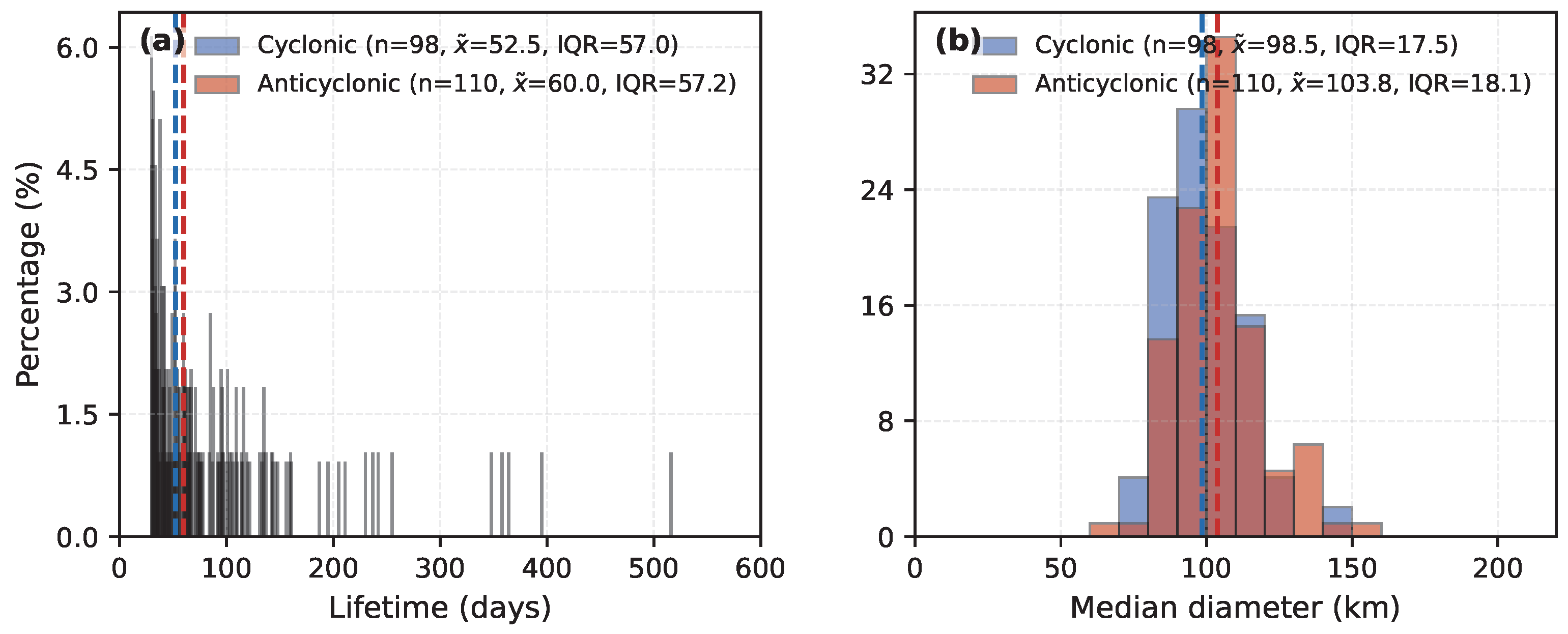
- The Gulf exhibits two distinct dynamical regimes: a transient north versus a persistent, topographically trapped south.
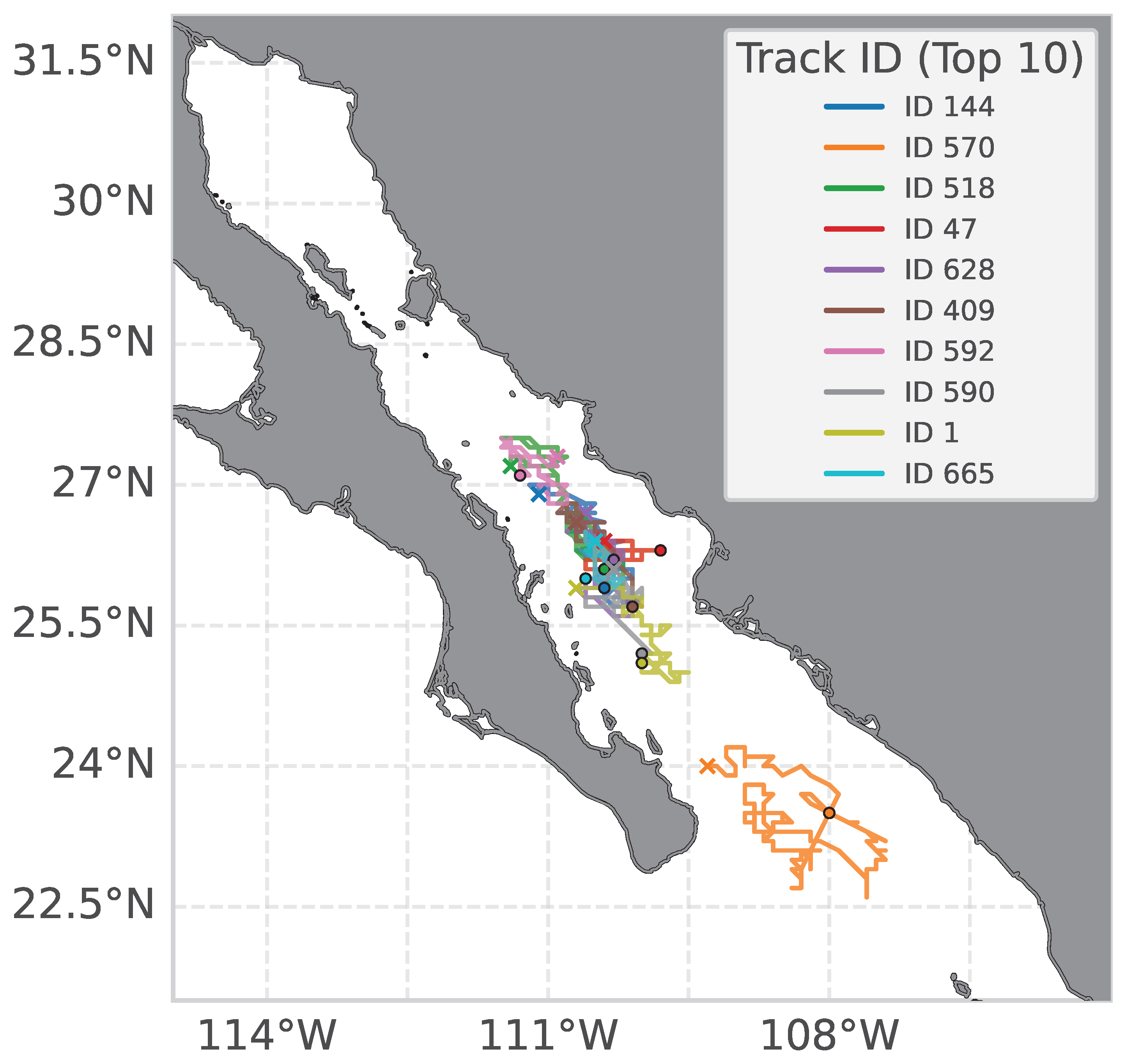
- Long-lived eddies at the mouth of the Gulf of California are predominantly cyclonic and exhibit coherent poleward propagation consistent with advection by the Mexican Coastal Current.
- Mesoscale structures near the entrance facilitate significant meridional connectivity and transport biogeochemical properties up-basin, acting as active exchange pathways between the Pacific Ocean and the Gulf of California.
Abstract
1. Introduction
2. Materials and Methods
2.1. Satellite Datasets
- SSHA: The Neural Optimal Sea Surface Topography (NeurOST) dataset [20], developed using deep learning from Data Unification and Altimeter Combination System (DUACS) L3 altimetry and MUR L4 SST [19], provides daily SSHA fields at spatial resolution. We used the full data record from 1 January 2010 to 16 July 2024.
2.2. Preprocessing and Anomaly Computation
- Linear trend removal: A least-squares fit was used to remove the long-term linear trend from each time series.
- Seasonal cycle removal: The annual and semi-annual harmonics were fitted and subtracted, thereby eliminating the dominant seasonal signal.
- Spatial detrending: For each daily map, a best-fit linear plane in latitude and longitude was removed to suppress large-scale background slopes and emphasize mesoscale structures.
- Regridding: Daily MUR SST fields were bilinearly interpolated onto the NeurOST grid to allow pixel-wise comparison with SSHA fields.
2.3. Eddy Detection Algorithm
- Stage 1: Vorticity–strain filter (Okubo–Weiss) and speed minima. We computed the Okubo–Weiss parameter [25,26] , where and are the normal and shear components of strain, respectively, and is the vertical component of relative vorticity. Here, u and v are the horizontal velocity components (zonal and meridional), and x and y are the corresponding spatial coordinates. This parameter was computed from the detrended geostrophic velocity anomalies and normalized by , with , where is the angular velocity of the Earth and is the latitude. Candidate pixels were defined by , where is the 10th percentile of the daily distribution, thus applying a conservative but adaptive threshold. The constant threshold is a widely used empirical value, consistent with open-ocean studies [1,28], and is applied here because selecting regions where vorticity strongly dominates strain is even more critical in the turbulent, high-resolution SSHA fields of the GC. Candidates were further restricted to local minima of the geostrophic speed, defined within a pixel neighborhood and allowing a tolerance proportional to the 95th percentile of the speed. This neighborhood size was selected as the minimal area required to define a local extremum in the gridded data while avoiding excessive smoothing of small-scale features. A binary dilation was then applied to consolidate contiguous candidate pixels into solid core regions, filling small gaps within the identified cores.
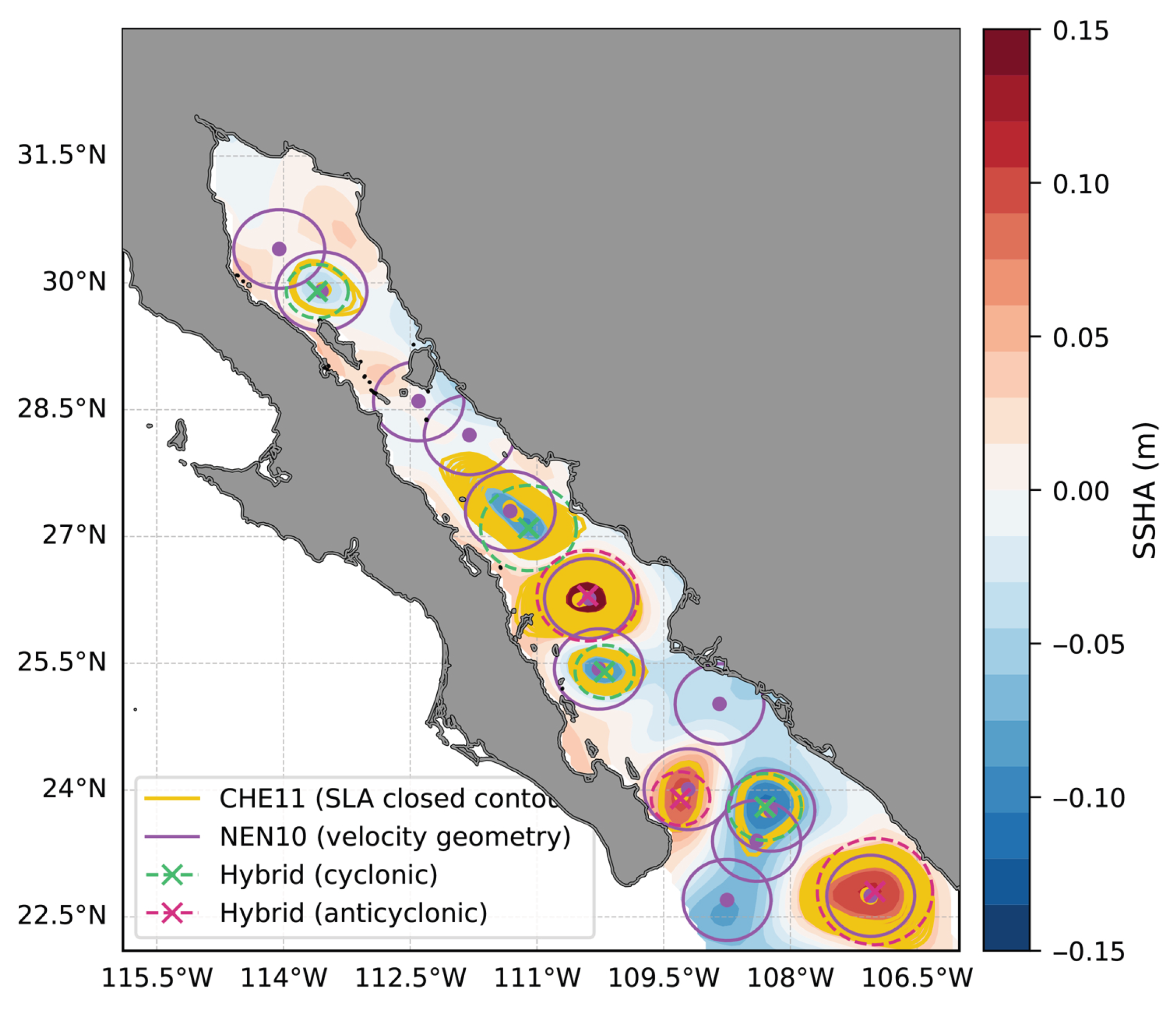
- Stage 2: Velocity geometry consistency. Candidate eddy cores were refined using the flow–symmetry conditions of NEN10, implemented with an annular search radius a. A pixel was retained only if at least six out of eight radial directions satisfied the sign-change and magnitude-decrease conditions in and (the zonal and meridional geostrophic velocities, respectively), with a relaxation factor . This value was selected based on sensitivity tests as a compromise, balancing the strict coherence of NEN10 with the slightly less regular structures observed in the high-resolution SSHA fields of this complex region. This yielded a refined mask centered on rotational cores. The hyperparameters adjusted in this and the following stages are detailed in Table 1.
- Stage 3: Closed-contour validation on SSHA with shape and scale controls. SSHA isolines were computed from masked fields to avoid artifacts over NaNs (Not-a-Number; i.e., masked land or cloud areas), and only closed, geometrically valid contours that did not intersect the domain boundaries were retained. Each candidate contour had to satisfy a circularity threshold (, where A is the contour area and P is the perimeter). This threshold was determined through sensitivity tests as an optimal balance for this topographically complex region: it is strict enough to filter spurious, non-eddy features, yet flexible enough to retain coherent eddies during deformation (e.g., when interacting with the coast). This approach reduces artificial detection gaps and track fragmentation. Nested contours were grouped into families, and the member with the largest SSHA amplitude relative to its perimeter level was selected; a minimum amplitude of m was imposed. This value was chosen to be approximately twice the nominal root-mean-square error of the altimetry product [19], ensuring that detected features are significantly above the instrument and mapping noise level. Additional scale filters required at least 8 enclosed pixels and a maximum convex–hull diameter km, consistent with the width of the Gulf. Residual coherent “seeds” (i.e., the rotational cores identified in Stage 2) from Stage 2 not intersected by any selected contour were added if their area exceeded 10 pixels, using their convex hull as a proxy boundary. Finally, nested duplicates were removed and contours with centroids separated by less than 10 km were merged into a single eddy.
2.4. Eddy Tracking
2.5. SSTA Comparison and Implementation
3. Results
3.1. Comparison of Detection Methods
3.2. General Statistics and Spatial Distribution (Gulf-Wide)
3.3. Seasonal Variability
3.4. SSHA–SSTA Relationship
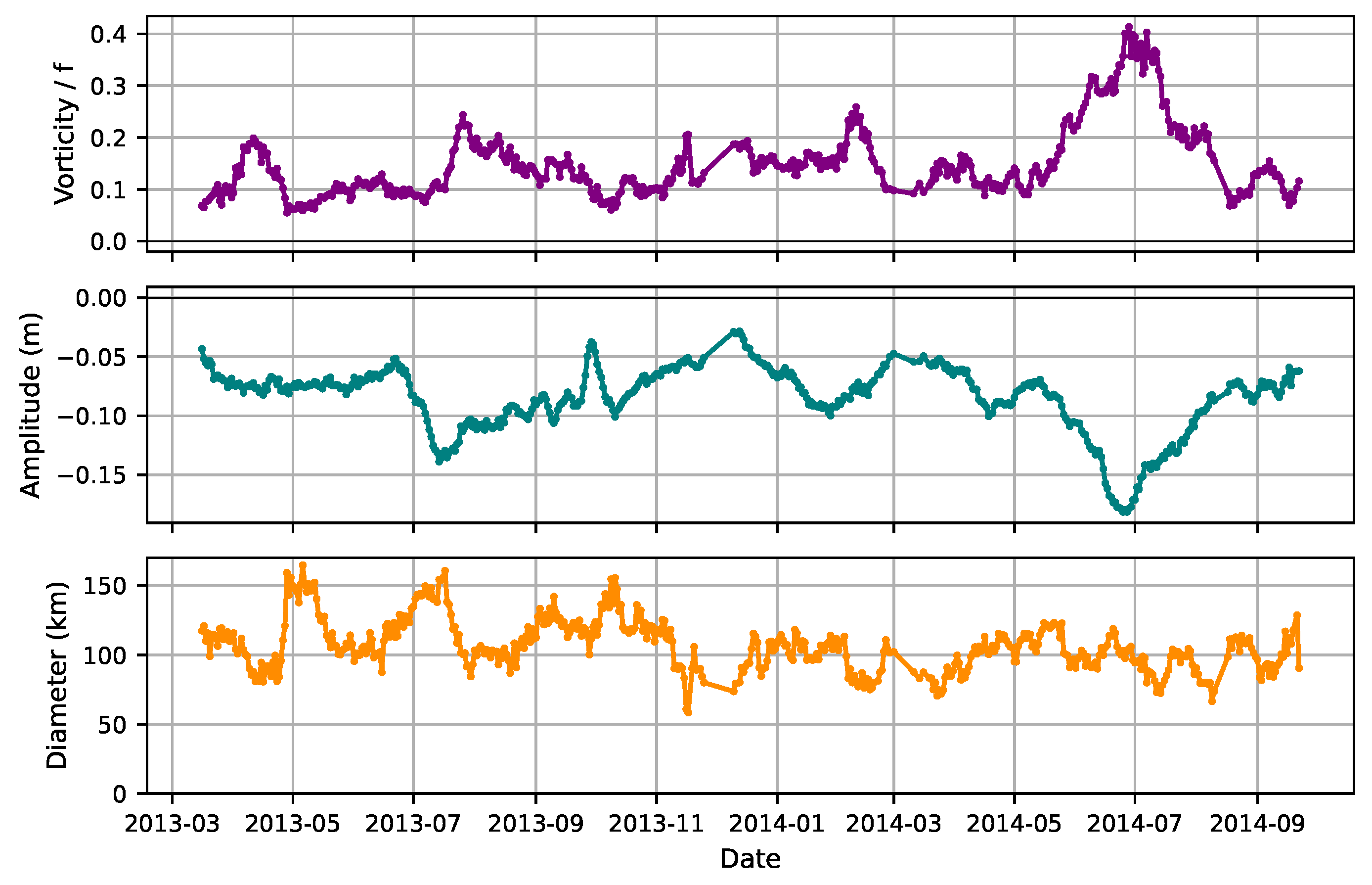
3.5. Case Study: Long-Lived and Quasi-Stationary Eddies
4. Discussion
4.1. Performance and Robustness of the Hybrid Framework
4.2. Gulf Dynamics: Two Distinct Regimes
4.3. Seasonal Variability and Generation Mechanisms
4.4. SSHA–SSTA Relationship and Seasonal Decoupling
5. Conclusions
Author Contributions
Funding
Data Availability Statement
Acknowledgments
Conflicts of Interest
Abbreviations
| DUACS | Data Unification and Altimeter Combination System |
| EKE | Eddy Kinetic Energy |
| GC | Gulf of California |
| MUR | Multi-scale Ultra-high Resolution |
| NeurOST | Neural Ocean Surface Topography |
| SLA | Sea Level Anomaly |
| SSH | Sea Surface Height |
| SSHA | Sea Surface Height Anomaly |
| SST | Sea Surface Temperature |
| SSTA | Sea Surface Temperature Anomaly |
| SWOT | Surface Water and Ocean Topography |
References
- Chelton, D.B.; Schlax, M.G.; Samelson, R.M. Global observations of nonlinear mesoscale eddies. Prog. Oceanogr. 2011, 91, 167–216. [Google Scholar] [CrossRef]
- Morrow, R.; Le Traon, P.Y. Recent advances in observing mesoscale ocean dynamics with satellite altimetry. Adv. Space Res. 2012, 50, 1062–1076. [Google Scholar] [CrossRef]
- Ferrari, R.; Wunsch, C. Ocean circulation kinetic energy: Reservoirs, sources, and sinks. Annu. Rev. Fluid Mech. 2009, 41, 253–282. [Google Scholar] [CrossRef]
- McWilliams, J.C. Submesoscale, coherent vortices in the ocean. Rev. Geophys. 1985, 23, 165–182. [Google Scholar] [CrossRef]
- Fu, L.L. Pattern and velocity of propagation of the global ocean eddy variability. J. Geophys. Res. Ocean. 2009, 114, C11017. [Google Scholar] [CrossRef]
- Argote, M.L.; Amador, A.; Lavin, M.F.; Hunter, J.R. Tidal dissipation and stratification in the Gulf of California. J. Geophys. Res. Ocean. 1995, 100, 16103–16118. [Google Scholar] [CrossRef]
- Lavín, M.F.; Marinone, S.G. An overview of the physical oceanography of the Gulf of California. In Nonlinear Processes in Geophysical Fluid Dynamics; Velasco-Fuentes, O.U., Sheinbaum, J., Ochoa, J., Eds.; Springer: Dordrecht, The Netherlands, 2003; pp. 173–204. [Google Scholar]
- Lavín, M.F.; Castro, R.; Beier, E.; Godínez, V.M. Mesoscale eddies in the southern Gulf of California during summer: Characteristics and interaction with the wind stress. J. Geophys. Res. Ocean. 2013, 118, 1367–1381. [Google Scholar] [CrossRef]
- GEBCO Compilation Group. GEBCO_2025 Grid—A Continuous Terrain Model of the Global Oceans and Land. 2025. Available online: https://doi.org/10.5285/34f8b6e8-0d73-6e7d-e063-093794aae8d2 (accessed on 12 January 2026).
- Fernández-Barajas, M.; Monreal-Gómez, M.; Molina-Cruz, A. Thermohaline structure and geostrophic flow in the Gulf of California, during 1992. Cienc. Mar. 1994, 20, 267–286. [Google Scholar] [CrossRef]
- Emilsson, I.; Alatorre, M. Evidencias de un remolino ciclónico de mesoescala en la parte sur del Golfo de California. Contrib. Oceanogr. Fís. México. Monogr. 1997, 3, 173–182. [Google Scholar]
- Pegau, W.S.; Boss, E.; Martínez, A. Ocean color observations of eddies during the summer in the Gulf of California. Geophys. Res. Lett. 2002, 29, 6-1–6-3. [Google Scholar] [CrossRef]
- Farach-Espinoza, E.B.; López-Martínez, J.; García-Morales, R.; Nevárez-Martínez, M.O.; Lluch-Cota, D.B.; Ortega-García, S. Temporal Variability of Oceanic Mesoscale Events in the Gulf of California. Remote Sens. 2021, 13, 1774. [Google Scholar] [CrossRef]
- Zamudio, L.; Hogan, P.; Metzger, E.J. Summer generation of the Southern Gulf of California eddy train. J. Geophys. Res. Ocean. 2008, 113, C06020. [Google Scholar] [CrossRef]
- Badan-Dangon, A.; Koblinsky, C.; Baumgartner, T. Spring and summer in the Gulf of California-observations of surface thermal patterns. Oceanol. Acta 1985, 8, 13–22. [Google Scholar]
- Lopez-Calderon, J.; Martinez, A.; Gonzalez-Silvera, A.; Santamaria-del Angel, E.; Millan-Nuñez, R. Mesoscale eddies and wind variability in the northern Gulf of California. J. Geophys. Res. Ocean. 2008, 113, C10001. [Google Scholar] [CrossRef]
- Nencioli, F.; Dong, C.; Dickey, T.; Washburn, L.; McWilliams, J.C. A Vector Geometry–Based Eddy Detection Algorithm and Its Application to a High-Resolution Numerical Model Product and High-Frequency Radar Surface Velocities in the Southern California Bight. J. Atmos. Ocean. Technol. 2010, 27, 564–579. [Google Scholar] [CrossRef]
- Costa de Almeida Tenreiro, M.J. Topographic Effects on the Formation, Evolution and Organization of Coherent Structures in Turbulent Flows: The Gulf of California Case. Ph.D. Thesis, Centro de Investigación Científica y de Educación Superior de Ensenada (CICESE), Ensenada, Baja California, Mexico, 2011. [Google Scholar]
- Martin, S.A.; Manucharyan, G.E.; Klein, P. Deep Learning Improves Global Satellite Observations of Ocean Eddy Dynamics. Geophys. Res. Lett. 2024, 51, e2024GL110059. [Google Scholar] [CrossRef]
- Martin, S.A.; Manucharyan, G.E.; Klein, P. Daily NeurOST L4 Sea Surface Height and Surface Geostrophic Currents. 2024. Available online: https://doi.org/10.5067/NEURO-STV24 (accessed on 12 January 2026).
- Morrow, R.; Fu, L.L.; Ardhuin, F.; Benkiran, M.; Chapron, B.; Cosme, E.; d’Ovidio, F.; Farrar, J.T.; Gille, S.T.; Lapeyre, G.; et al. Global Observations of Fine-Scale Ocean Surface Topography With the Surface Water and Ocean Topography (SWOT) Mission. Front. Mar. Sci. 2019, 6, 232. [Google Scholar] [CrossRef]
- Fu, L.L.; Ubelmann, C. On the transition from profile altimeter to swath altimeter for observing global ocean surface topography. J. Atmos. Ocean. Technol. 2014, 31, 560–568. [Google Scholar] [CrossRef]
- JPL MUR MEaSUREs Project. GHRSST Level 4 MUR Global Foundation Sea Surface Temperature Analysis. 2015. Available online: https://doi.org/10.5067/GHGMR-4FJ04 (accessed on 12 January 2026).
- Chin, T.M.; Vazquez-Cuervo, J.; Armstrong, E.M. A Multi-scale High-resolution Analysis of Global Sea Surface Temperature. Remote Sens. Environ. 2017, 200, 154–169. [Google Scholar] [CrossRef]
- Okubo, A. Horizontal dispersion of floatable particles in the vicinity of velocity singularities such as convergences. Deep Sea Res. Oceanogr. Abstr. 1970, 17, 445–454. [Google Scholar] [CrossRef]
- Weiss, J. The dynamics of enstrophy transfer in two-dimensional hydrodynamics. Phys. D Nonlinear Phenom. 1991, 48, 273–294. [Google Scholar] [CrossRef]
- Halo, I.; Backeberg, B.; Penven, P.; Ansorge, I.; Reason, C.; Ullgren, J.E. Eddy properties in the Mozambique Channel: A comparison between observations and two numerical ocean circulation models. Deep Sea Res. Part II Top. Stud. Oceanogr. 2014, 100, 38–53. [Google Scholar] [CrossRef]
- Isern-Fontanet, J.; García-Ladona, E.; Font, J. Identification of marine eddies from altimetric maps. J. Atmos. Oceanic Technol. 2003, 20, 772–778. [Google Scholar] [CrossRef]
- Jolliffe, I.T.; Cadima, J. Principal component analysis: A review and recent developments. Philos. Trans. R. Soc. A 2016, 374, 20150202. [Google Scholar] [CrossRef]
- Harasti, P.R.; Randall, D.A.; Toth, Z. Principal Component Analysis of Doppler Radar Data. Part I: Spatial Structures. J. Atmos. Sci. 2005, 62, 4271–4283. [Google Scholar] [CrossRef]
- Otsuka, H.; Ohta, Y.; Hino, R.; Kubota, T.; Inazu, D.; Inoue, T.; Takahashi, N. Reduction of non-tidal oceanographic fluctuations in ocean-bottom pressure records of DONET using principal component analysis to enhance transient tectonic detectability. Earth Planets Space 2023, 75, 112. [Google Scholar] [CrossRef]
- Chaigneau, A.; Eldin, G.; Dewitte, B. Eddy activity in the four major upwelling systems from satellite altimetry (1992–2007). Prog. Oceanogr. 2009, 83, 117–123. [Google Scholar] [CrossRef]
- Pegliasco, C.; Chaigneau, A.; Morrow, R. Main eddy vertical structures observed in the four major Eastern Boundary Upwelling Systems. J. Geophys. Res. Ocean. 2015, 120, 6008–6033. [Google Scholar] [CrossRef]
- Faghmous, J.H.; Frenger, I.; Yao, Y.; Warmka, R.; Lindell, A.; Kumar, V. A daily global mesoscale ocean eddy dataset from satellite altimetry. Sci. Data 2015, 2, 150028. [Google Scholar] [CrossRef]
- Trott, C.B.; Subrahmanyam, B.; Chaigneau, A.; Delcroix, T. Eddy Tracking in the Northwestern Indian Ocean During Southwest Monsoon Regimes. Geophys. Res. Lett. 2018, 45, 6594–6603. [Google Scholar] [CrossRef]
- Du, Y.; Zhang, Y.; He, P. Automated detection and tracking of mesoscale eddies in the South China Sea. Acta Oceanol. Sin. 2013, 32, 36–43. [Google Scholar] [CrossRef]
- Marshall, J.; Plumb, R.A. Atmosphere, Ocean and Climate Dynamics: An Introductory Text; International Geophysics; Academic Press: Burlington, MA, USA, 2008; Volume 93. [Google Scholar]
- Assassi, C.; Morel, Y.; Vandermeirsch, F.; Chaigneau, A.; Pegliasco, C.; Morrow, R.; Colas, F.; Fleury, S.; Carton, X.; Klein, P.; et al. An Index to Distinguish Surface- and Subsurface-Intensified Vortices from Surface Observations. J. Phys. Oceanogr. 2016, 46, 2529–2552. [Google Scholar] [CrossRef]
- Castro, R.; Lavín, M.F.; Ripa, P. Seasonal heat balance in the Gulf of California. J. Geophys. Res. Ocean. 1994, 99, 3249–3261. [Google Scholar] [CrossRef]
- Paden, C.A.; Abbott, M.R.; Winant, C.D. Tidal and atmospheric forcing of the upper ocean in the Gulf of California, 1. Sea surface temperature variability. J. Geophys. Res. Ocean. 1991, 96, 18337–18359. [Google Scholar] [CrossRef]
- Pegliasco, C.; Delepoulle, A.; Mason, E.; Morrow, R.; Faugère, Y.; Dibarboure, G. META3.1exp: A new global mesoscale eddy trajectory atlas derived from altimetry. Earth Syst. Sci. Data 2022, 14, 1087–1107. [Google Scholar] [CrossRef]
- Yi, J.; Du, Y.; He, Z.; Zhou, C. Enhancing the accuracy of automatic eddy detection and the capability of recognizing the multi-core structures from maps of sea level anomaly. Ocean Sci. 2014, 10, 39–48. [Google Scholar] [CrossRef]
- Xing, T.; Yang, Y. Three Mesoscale Eddy Detection and Tracking Methods: Assessment for the South China Sea. J. Atmos. Ocean. Technol. 2021, 38, 243–258. [Google Scholar] [CrossRef]
- Erickson, Z.K.; Fields, E.; Johnson, L.; Thompson, A.F.; Dove, L.A.; D’Asaro, E.; Siegel, D.A. Eddy Tracking From In Situ and Satellite Observations. J. Geophys. Res. Ocean. 2023, 128, e2023JC019701. [Google Scholar] [CrossRef]
- Zhang, X.; Liu, L.; Fei, J.; Li, Z.; Wei, Z.; Zhang, Z.; Jiang, X.; Dong, Z.; Xu, F. Advances in surface water and ocean topography for fine-scale eddy identification from altimeter sea surface height merging maps in the South China Sea. Ocean Sci. 2025, 21, 1033–1045. [Google Scholar] [CrossRef]
- Carrillo, L.; Lavín, M.; Palacios-Hernández, E. Seasonal evolution of the geostrophic circulation in the northern Gulf of California. Estuar. Coast. Shelf Sci. 2002, 54, 157–173. [Google Scholar] [CrossRef]
- Marinone, S.G. A three-dimensional model of the mean and seasonal circulation of the Gulf of California. J. Geophys. Res. Ocean. 2003, 108, 3325. [Google Scholar] [CrossRef]
- Palacios-Hernández, E.; Argote, M.; Amador, A.; Morales-Pérez, R. Summer-autumn mean surface circulation in the northern Gulf of California. Deep Sea Res. Part II Top. Stud. Oceanogr. 2002, 49, 4275–4289. [Google Scholar]
- Beier, E. A numerical investigation of the annual variability in the Gulf of California. J. Phys. Oceanogr. 1997, 27, 615–632. [Google Scholar] [CrossRef]
- Godínez, V.M.; Beier, E.; Lavín, M.F.; Kurczyn, J.A. Circulation at the entrance of the Gulf of California from satellite altimeter and hydrographic observations. J. Geophys. Res. Ocean. 2010, 115, C04007. [Google Scholar] [CrossRef]
- Pantoja, D.A.; Marinone, S.G.; Parés-Sierra, A.; Gómez-Valdivia, F. Numerical modeling of seasonal and mesoscale hydrography and circulation in the Mexican Central Pacific. Cienc. Mar. 2012, 38, 663–676. [Google Scholar] [CrossRef]



| Parameter | Symbol/Code | Value |
|---|---|---|
| Max match distance | /DIST_MAX_KM | km |
| Cost threshold | /COST_THRESHOLD | 1.2 |
| Max allowed gap | /ALLOWED_GAP_DAYS | 15 days |
| Min detections per track | /MIN_TRACK_LENGTH | 14 |
| Distance metric | havensine | great-circle (km) |
| Gap penalty | — | for |
| Cost weights |
| Method | (Eddies/Day) | P | R | F1 | TP | FP |
|---|---|---|---|---|---|---|
| CHE11 (SSHA closed contour) | 35.8 ± 14.3 | 0.12 ± 0.03 | 1.00 ± 0.00 | 0.22 ± 0.04 | 4.3 | 31.5 |
| NEN10 (velocity geometry) | 15.7 ± 2.9 | 0.00 ± 0.00 | 0.00 ± 0.00 | 0.00 ± 0.00 | 0.0 | 15.7 |
| Hybrid (this study) | 4.3 ± 1.7 | — | — | — | — | — |
| Season | Eddy Type | Lifetime (Days) | Diameter (km) | Rot. Speed (m ) | Transl. Speed (m ) |
|---|---|---|---|---|---|
| Summer–Autumn | Anticyclonic | 55.00 (IQR: 46.00) | 105.72 (IQR: 18.35) | 0.48 (IQR: 0.11) | 0.05 (IQR: 0.03) |
| (Jul–Dec) | Cyclonic | 50.50 (IQR: 38.25) | 99.20 (IQR: 20.09) | 0.49 (IQR: 0.14) | 0.05 (IQR: 0.02) |
| Winter–Spring | Anticyclonic | 66.00 (IQR: 69.75) | 101.47 (IQR: 15.10) | 0.46 (IQR: 0.12) | 0.04 (IQR: 0.01) |
| (Jan–Jun) | Cyclonic | 58.00 (IQR: 65.00) | 96.67 (IQR: 14.40) | 0.47 (IQR: 0.11) | 0.04 (IQR: 0.01) |
| Region | Track ID | Type | Start Date | End Date | Duration (Days) |
|---|---|---|---|---|---|
| South | 144 | Cyclonic | 16 March 2013 | 22 September 2014 | 516 |
| South | 570 | Cyclonic | 6 August 2021 | 12 October 2022 | 395 |
| South | 518 | Cyclonic | 14 July 2020 | 12 September 2021 | 364 |
| South | 47 | Cyclonic | 28 October 2010 | 20 October 2011 | 358 |
| South | 628 | Cyclonic | 29 October 2022 | 31 October 2023 | 348 |
| South | 409 | Cyclonic | 2 April 2018 | 20 January 2019 | 255 |
| South | 592 | Cyclonic | 24 January 2022 | 10 October 2022 | 242 |
| South | 590 | Cyclonic | 18 January 2022 | 7 October 2022 | 237 |
| South | 1 | Cyclonic | 1 January 2010 | 7 September 2010 | 230 |
| South | 665 | Anticyclonic | 10 November 2023 | 14 June 2024 | 211 |
Disclaimer/Publisher’s Note: The statements, opinions and data contained in all publications are solely those of the individual author(s) and contributor(s) and not of MDPI and/or the editor(s). MDPI and/or the editor(s) disclaim responsibility for any injury to people or property resulting from any ideas, methods, instructions or products referred to in the content. |
© 2026 by the authors. Licensee MDPI, Basel, Switzerland. This article is an open access article distributed under the terms and conditions of the Creative Commons Attribution (CC BY) license.
Share and Cite
Perez-Corona, Y.; Torres, H.; Ramos-Musalem, K. Detection and Characterization of Mesoscale Eddies in the Gulf of California Using High-Resolution Satellite Altimetry. Remote Sens. 2026, 18, 434. https://doi.org/10.3390/rs18030434
Perez-Corona Y, Torres H, Ramos-Musalem K. Detection and Characterization of Mesoscale Eddies in the Gulf of California Using High-Resolution Satellite Altimetry. Remote Sensing. 2026; 18(3):434. https://doi.org/10.3390/rs18030434
Chicago/Turabian StylePerez-Corona, Yuritzy, Hector Torres, and Karina Ramos-Musalem. 2026. "Detection and Characterization of Mesoscale Eddies in the Gulf of California Using High-Resolution Satellite Altimetry" Remote Sensing 18, no. 3: 434. https://doi.org/10.3390/rs18030434
APA StylePerez-Corona, Y., Torres, H., & Ramos-Musalem, K. (2026). Detection and Characterization of Mesoscale Eddies in the Gulf of California Using High-Resolution Satellite Altimetry. Remote Sensing, 18(3), 434. https://doi.org/10.3390/rs18030434