Article

Satellite Views of Long-Term Variations in pCO2 on the Changjiang River Estuary and the Adjacent East China Sea (1998–2024)


1
State Key Laboratory of Satellite Ocean Environment Dynamics, Second Institute of Oceanography, Ministry of Natural Resources, Hangzhou 310012, China
2
School of Oceanography, Shanghai Jiao Tong University, Shanghai 200030, China
3
Institute of Marine Biology and Pharmacology, Ocean College, Zhejiang University, Zhoushan 316021, China
*
Author to whom correspondence should be addressed.
Remote Sens. 2026, 18(1), 86; https://doi.org/10.3390/rs18010086 (registering DOI)
Submission received: 30 October 2025 / Revised: 22 December 2025 / Accepted: 24 December 2025 / Published: 26 December 2025
(This article belongs to the Section Ocean Remote Sensing)

Highlights

What are the main findings?
  • Over the past 27 years, the carbon sink capacity of the Changjiang River Estuary has increased approximately fivefold, accompanied by a sustained enhancement in air-sea CO2 uptake.
  • After 2014, a marked shift in carbon sink control mechanisms was identified, revealing that complex biogeochemical regulation underscores the influence of river discharge on pCO2_sea.
What are the implications of the main findings?
  • The long-term intensification of the carbon sink underscores the growing importance of the Changjiang River Estuary in regional coastal carbon budgets under ongoing climate change.
  • The recently discharge-dominated, dynamically regulated system implies increased vulnerability of the coastal carbon sink to extreme hydrological events, complicating the prediction of carbon sink variability under future climate change.

Abstract

The Changjiang River Estuary and the adjacent East China Sea is one of the world’s largest coastal carbon sinks, with a steadily increasing sink capacity over recent decades. However, the potential changes in its carbon sink and control mechanisms at decadal scales under climate change remain unclear. This study, based on 27 years (1998–2024) of continuous satellite remote sensing data, investigates the spatiotemporal distribution and long-term evolution of this coastal carbon sink. The results reveal a typical carbon sink with a capacity of −5.23 ± 3.73 mmol m−2 d−1 and significant seasonal variation. High-frequency remote sensing data reduces uncertainty compared to traditional shipborne observations. Over the past 27 years, the air–sea CO2 flux increased at a rate of 0.24 mmol m−2 d−1 yr−1, with a five-fold enhancement in carbon sink capacity. However, after atmospheric pCO2 exceeded 400 μatm in 2014, the rate of increase slowed, indicating stabilization. Control mechanism analysis shows that biogeochemical processes have been persistently active, while over the past decade the influence of Changjiang discharge on seawater pCO2 increased by 50%, shifting the system from primarily physical dilution to enhanced biogeochemical regulation. The findings provide insights into the evolution and management of coastal carbon cycles under climate change.

1. Introduction

Coastal seas are significant contributors to global oceanic carbon sinks. Although they occupy only ~8% of the global ocean area, coastal seas contribute nearly 20% of the global ocean carbon sink [1,2], with a carbon uptake per unit area approximately three times that of the open ocean [3,4]. Additionally, these regions account for approximately 25% of marine primary production and up to 80% of organic carbon burial [1,5,6,7]. However, pronounced heterogeneity in physical and biogeochemical processes, together with strong riverine inputs, leads to substantial uncertainty in current estimates of the global coastal carbon sink (~0.2–0.5 Pg C yr−1) [3,4,8,9,10].
The East China Sea is one of the largest coastal carbon sink regions globally and the largest continental shelf sea at the same latitude. It is directly influenced by the discharge from the Changjiang River and the Kuroshio intrusion, playing a critical role in the global carbon cycle [11]. Factors influencing the air–sea CO2 flux in the East China Sea exhibit significant spatial and temporal variations. In open waters far from river mouths, temperature is the dominant controlling factor, while in nearshore shelf areas close to the river mouth, wind speed, biological activity, and vertical mixing of water masses also play important roles [12,13,14,15,16,17,18]. Furthermore, the unique land-ocean connectivity of the Changjiang River Estuary and the adjacent East China Sea has drawn increasing attention to the critical role of Changjiang discharge in regulating the source-sink transition of CO2 in the East China Sea shelf [19,20].
The Changjiang River Estuary and the adjacent East China Sea is a typical river-dominated marginal sea (RioMar), where the seawater carbon sink and seawater pCO2 (pCO2_sea) are influenced by various factors, among which discharge, temperature, and biological productivity are the most significant ecological processes [17,18,20]. Previous studies have shown that discharge, by introducing nutrients, freshwater, and other substances, directly or indirectly affects pCO2_sea and carbon sink intensity [17,21,22,23,24,25]. In the Changjiang River Estuary, the control of pCO2 by discharge is particularly significant, especially during high-discharge periods when nutrients brought by the discharge enhance primary productivity, thereby influencing carbon absorption capacity [16,26]. Additionally, temperature variations also play a key role in the East China Sea, with sea surface temperature having a strong regulatory effect on the carbon sink. However, in recent years, the biogeochemical regulatory effect of discharge has gradually strengthened [18]. Tseng et al. [17] quantified the linear relationship between Changjiang discharge and normalized pCO2 at 25 °C (NpCO2), indicating a strong negative correlation (slope = −2.71, R2 = 0.93, n = 6). However, this relationship only covered the summer seasons from 1998 to 2011, which was insufficient to address the scientific questions regarding whether there has been a shift in the carbon cycling mechanisms at the air–sea interface of the Changjiang River Estuary and the adjacent East China Sea, as well as the long-term changes in its carbon sink capacity.
Historical studies have shown that the seasonal and interannual variation patterns of the coastal carbon sink in the Changjiang River Estuary are similar to those in other typical river-dominated seas. In particular, under the combined influence of temperature and discharge, the spatial distribution and seasonal fluctuations of pCO2 exhibit strong regional and temporal variability [13,21,27,28]. Previous research has primarily focused on shipborne and remote sensing data analyses, highlighting that the pCO2 in the Changjiang River Estuary acts as a strong carbon sink in winter and spring, while it functions as a weak carbon sink or weak source in summer and autumn [28,29,30,31]. Furthermore, there is a significant negative correlation between carbon sink intensity and temperature [27,32]. Overall, research over the past few decades has indicated that the East China Sea serves as a strong sink for atmospheric CO2, and with advancements in satellite remote sensing products, its carbon sink capacity has been shown to be steadily increasing [30]. However, recent studies have pointed out that frequent Changjiang floods and droughts have caused significant disruptions in the carbon sink, further driving changes in carbon sink intensity in the region [20,33,34,35]. Extreme events, such as droughts and heatwaves, can severely reduce its carbon sink capacity [19] and even turn it into a CO2 source [20]. However, existing research has mostly concentrated on short-term process studies or seasonal mechanism exploration, with a lack of systematic understanding of long-term trends and inter-stage evolutionary patterns.
This study, based on the latest Chinese sea pCO2 remote sensing data products from 1998 to 2024 [30,36], reveals the long-term evolutionary trend of the coastal carbon sink in the Changjiang River Estuary over a continuous 27-yr period. It also highlights the shift in the role of discharge in carbon sink regulation towards a multi-factor co-regulation mechanism. Notably, after 2014, the regulatory capacity of discharge on pCO2 significantly strengthened, becoming closely associated with changes in temperature and biological productivity, reflecting the complexity and variability of the carbon sink control mechanisms in the East China Sea.

2. Data and Methods

2.1. Study Area

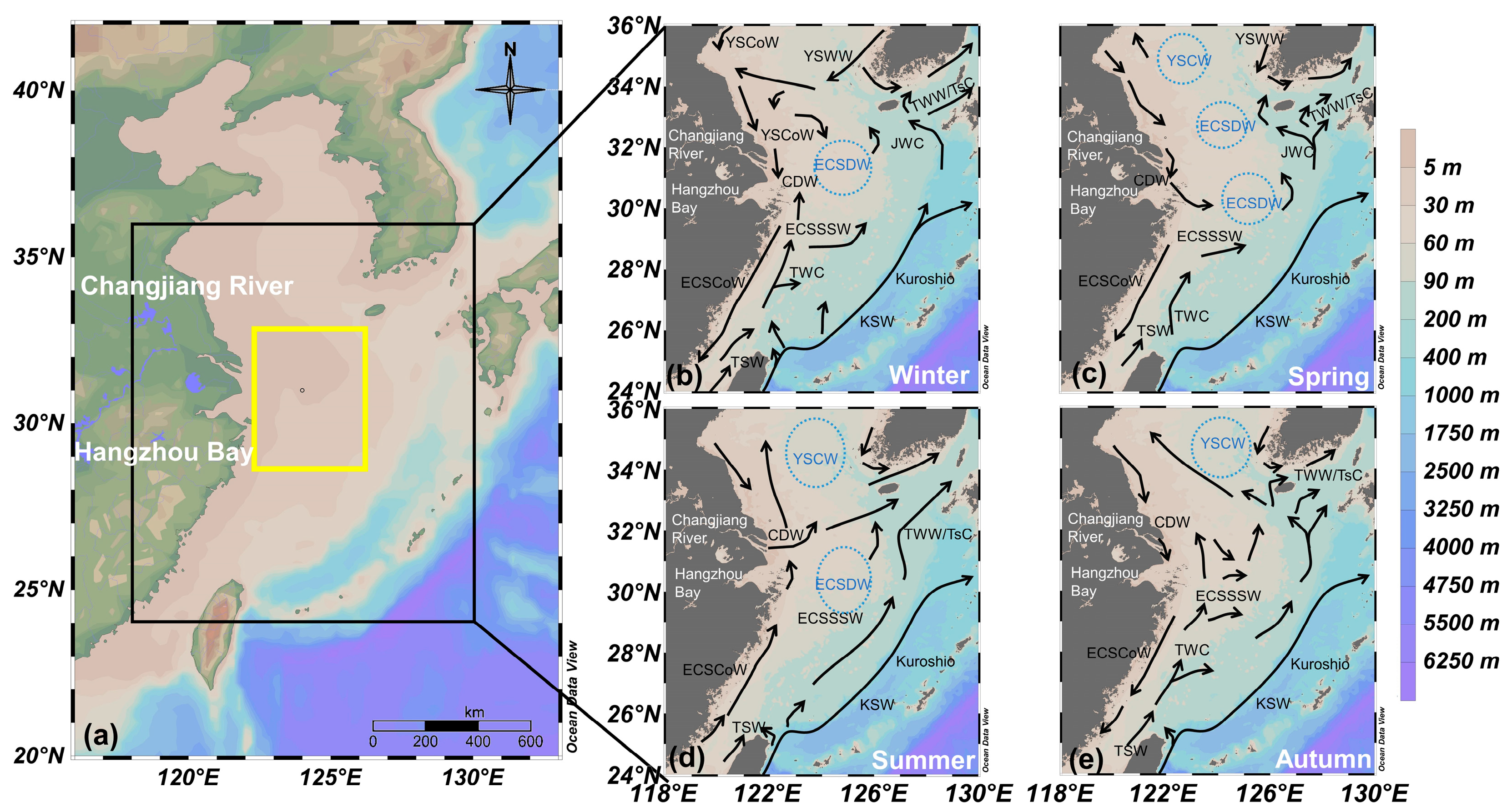
The East China Sea is a typical continental shelf marginal sea (Figure 1a), accounting for 66% of the global continental shelf area [37,38]. This region exhibits strong land–sea interactions and is one of the most productive continental shelf seas [39,40]. The high productivity of the East China Sea is primarily driven by the nutrient-rich Changjiang diluted water and the Kuroshio, which together dominate the high concentration of carbon in the region [41,42,43,44]. The study area follows the historical classification of the Changjiang River Estuary based on shipborne and satellite remote sensing research [18,30] (Yu et al. [30] Table 1), specifically the region between 28.5–33°N and 122–126°E (Yellow box in Figure 1a). The Changjiang River Estuary and the adjacent East China Sea are located in the temperate and subtropical regions of the Northwest Pacific. The discharge of Changjiang diluted water is approximately 944 km3 yr−1 [45]. The maximum monthly discharge at the Changjiang Datong gauge station, 624 km from the river mouth, occurs between June and August [46]. Under the influence of the East Asian monsoon, the Changjiang diluted water extends northeastward in summer and southwestward along the Chinese coastline in winter [47], exhibiting seasonal patterns with higher freshwater and nutrient fluxes in summer and lower fluxes in winter. The Changjiang River Estuary and the adjacent East China Sea are characterized by complex interactions of various water masses and currents, with significant seasonal and regional differences (Figure 1b–e). Temperature, freshwater input from the Changjiang, and biological activity are key factors regulating the surface pCO2_sea and air–sea CO2 flux in the Changjiang River Estuary and the adjacent East China Sea [17,18,20].

2.2. Satellite Data

The Changjiang River Estuary and the adjacent East China Sea carbon sink data used in this study were obtained from updated data products by Yu et al. [30] and Song et al. [36], extending the original 2003–2019 period to 1998–2024. These data include monthly averaged, 1 km spatial resolution remote sensing data of pCO2_sea and air–sea CO2 flux. The data used for remote sensing model inversion include sea surface temperature (SST) from OISST, chlorophyll-a concentration and remote sensing reflectance from the European Space Agency’s OC-CCI (Version 6.0), xCO2 data from Carbon Tracker, as well as upwelling index and thermodynamic pCO2, all processed to 1 km spatial resolution with a monthly time resolution. The upwelling index is derived from the difference between SST and the mean SST at the same latitude and is used to characterize the upwelling of seawater. Thermodynamic pCO2 is the result of the equilibrium between atmospheric pCO2 and pCO2_sea under ideal conditions, reflecting the influence of atmospheric forcing. The model input data include SST, chlorophyll-a concentration, remote sensing reflectance, upwelling index, and thermodynamic pCO2 [30]. The model’s root mean square error (RMSE) for the East China Sea inversion was below 17 μatm. The monthly discharge of the Changjiang River from 1998 to 2024, sourced from the Datong Station of the Changjiang River, was obtained from the Ministry of Water Resources of the People’s Republic of China and previous studies provided by He et al. [54].
This study introduces net community production (NCP) into the carbon parameter assessment of the Changjiang River Estuary. Based on satellite data, NCP is derived by multiplying net primary productivity (NPP) and the e-ratio algorithm from the satellite data. This algorithm aligns with the global trends of NPP and e-ratio variations [55,56]. The algorithm was previously applied to regional NCP estimation in the South China Sea [57] and California Current coastal system [58]. This study employed the same calculation method, using ecosystem NPP data from the new oceanic multi-model net primary productivity data [59].
NCP = NPP × e-ratio
e-ratio = 0.04756 × (0.78 − 0.43SST/30) × NPP0.37

2.3. Generalized Additive Model

To assess the relative influence of various environmental drivers on long-term pCO2_sea in the coastal area of the Changjiang River Estuary, a generalized additive model (GAM) was employed. This modelling approach captures potential nonlinear interactions between pCO2_sea and multiple predictors while preserving the interpretability of individual variable effects [60]. The analysis was conducted using the ‘mgcv’ package in R version 4.0.2 [61]. Key metrics were defined to evaluate variable contributions: Deviance Explained (DE) reflects the proportion of variability in long-term pCO2_sea accounted for by each environmental factor; the Effective Degrees of Freedom (edf) indicates the nature of the relationship, with values near 1 suggesting linearity; the F-value represents the relative significance of each predictor; and R2 measures the overall proportion of variance explained by the model.

3. Results

3.1. Spatial and Seasonal Patterns of pCO2 and Air–Sea CO2 Flux in the Changjiang River Estuary and the Adjacent East China Sea

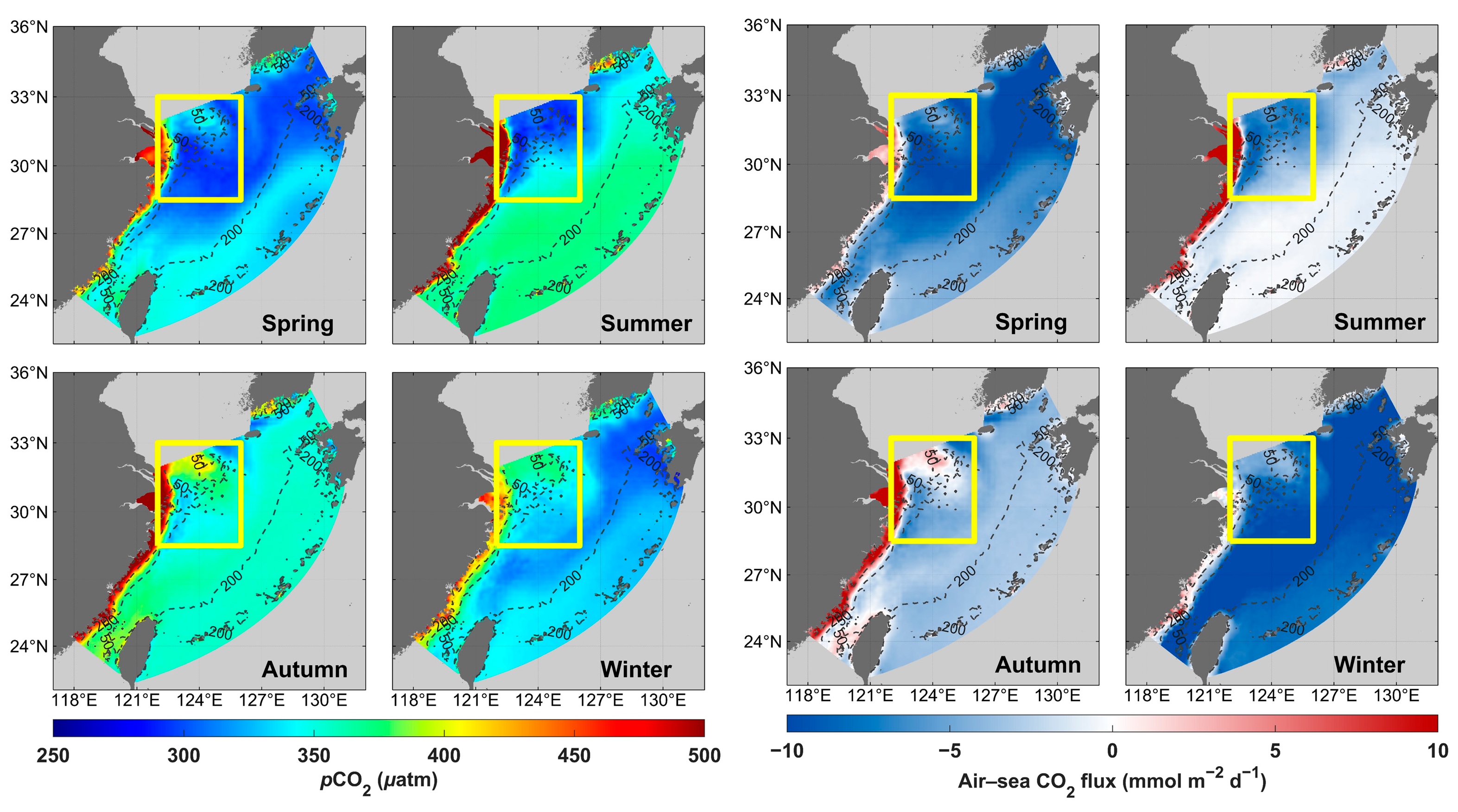
The annual mean surface pCO2 in the East China Sea exhibited a clear spatial gradient, with higher in coastal waters and lower over the continental shelf (Figure 2). In the study area, the pCO2 near the Changjiang River Estuary could reach up to 500 μatm, significantly higher than that in the central shelf region. Pronounced seasonal variability was observed across the region. The climatological mean pCO2 was lowest in spring (~311 μatm) and highest in autumn (~385 μatm), with the seasonal amplitude being approximately twice that observed in the northeastern offshore area of Taiwan (Figure 2). The Changjiang River Estuary region exhibits the characteristics of a typical carbon sink, with an air–sea CO2 flux of −5.23 ± 3.73 mmol m−2 d−1, indicating a persistent net uptake of atmospheric CO2. The carbon sink intensity also showed pronounced seasonal oscillations, with winter and spring carbon sink intensities reaching −7.36 ± 3.56 and −7.63 ± 2.39 mmol m−2 d−1, respectively. In contrast, autumn exhibited the lowest carbon sink intensity at −1.90 ± 2.73 mmol m−2 d−1, while summer was −4.05 ± 2.68 mmol m−2 d−1.

3.2. Continued Enhancement of Air–Sea Carbon Sink over the Past 27 Years

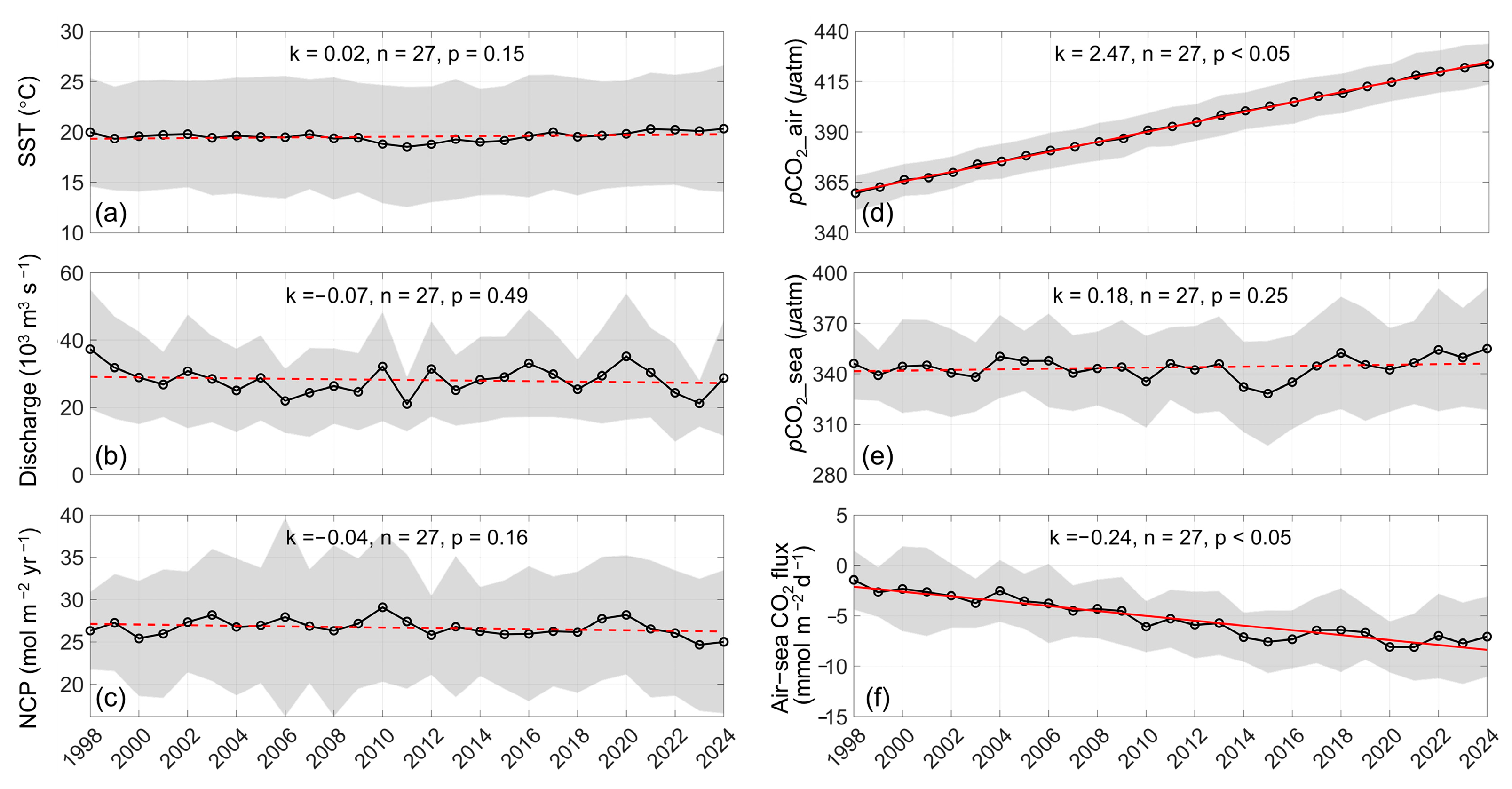
Based on continuous satellite remote sensing data spanning 27 years, a systematic assessment of the evolution characteristics of the Changjiang River Estuary’s coastal zone was conducted (Table 1). In terms of environmental parameters, SST, discharge, and NCP did not show significant interannual trends, with weak warming overall (−0.02 °C yr−1, p = 0.15, n = 27, R2 = 0.08, Figure 3a), a decrease in discharge (−71.1 m−3 s−1 yr−1, p = 0.49, n = 27, R2 = 0.02, Figure 3b), and a decline in productivity (−0.04 mol m−2 yr−2, p = 0.16, n = 27, R2 = 0.07, Figure 3c) over the long term. Regarding carbon parameters, over the past 27 years, the oceanic CO2 absorption flux showed a significant increasing trend (0.24 mmol m−2 d−1 yr−1, p < 0.05, n = 27, R2 = 0.89, Figure 3f), indicating a yearly enhancement of carbon sink. From 1998 to 2024, satellite-derived air–sea CO2 flux revealed a roughly fivefold increase in the ocean’s ability to absorb CO2 (from −1.43 ± 2.96 to −7.07 ± 4.00 mmol m−2 d−1). Atmospheric pCO2 (pCO2_air) increased significantly over the 27-year period, with its annual average exceeding 400 μatm in 2014 (Figure 3d). The continuous rise in pCO2_air was a key driver of the enhanced carbon sink, showing a strong negative correlation with monthly flux (slope = −0.12, p < 0.05, n = 324, R2 = 0.47). In contrast, pCO2_sea, influenced by environmental parameters, increased slowly with fluctuations (0.18 μatm yr−1, p = 0.25, n = 27, R2 = 0.05, Figure 3e), with a growth rate much lower than pCO2_air. The positive correlation between pCO2_sea and flux (slope = 0.09, p < 0.05, n = 324, R2 = 0.47) was also noticeably weaker than that between pCO2_air and flux. We suggest that part of the reason is that flux enhancement absorbed more CO2, reflecting the buffering capacity of the coastal carbon sink. The slow increase in pCO2_sea may signal a potential decline in absorption efficiency in the future.
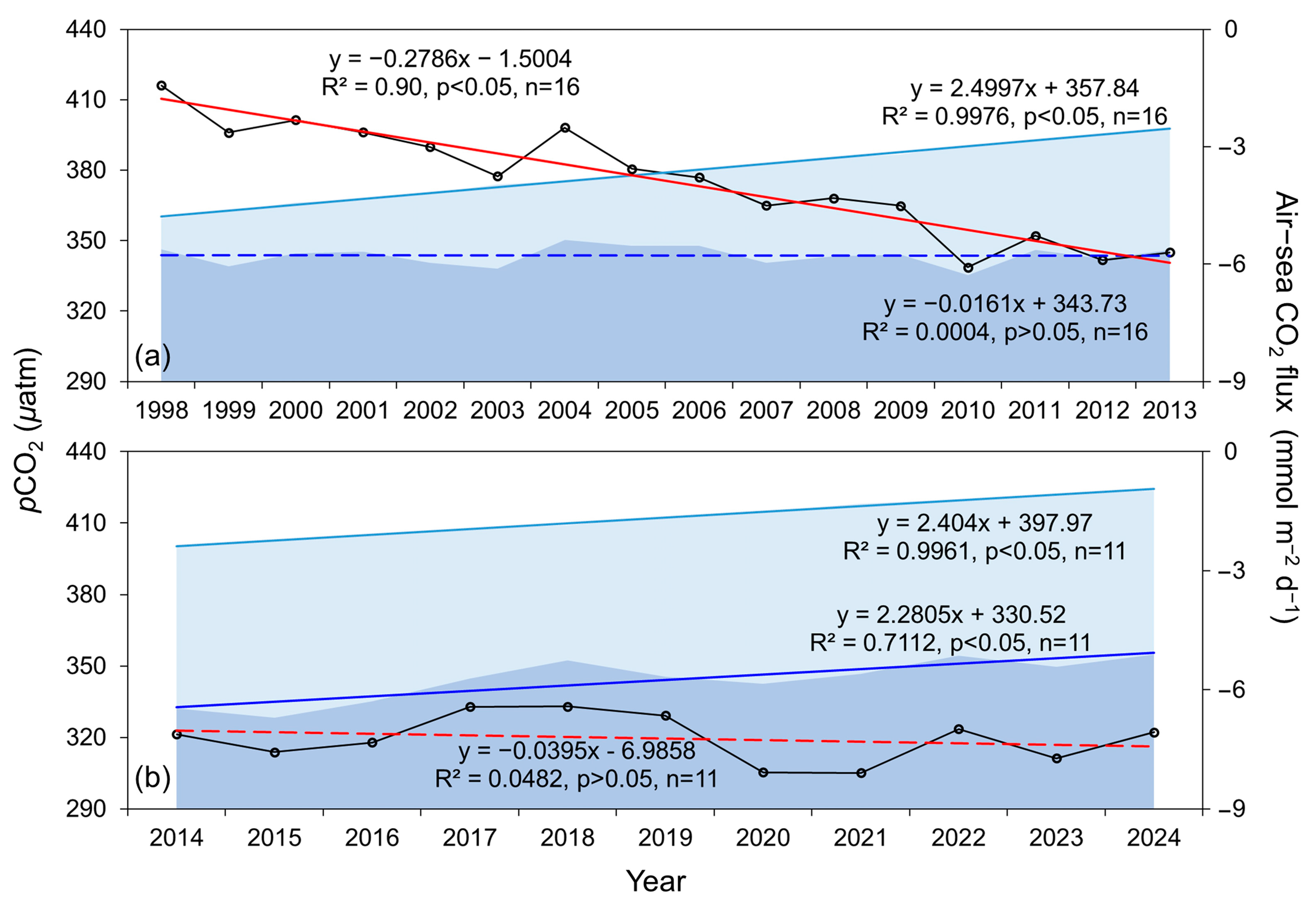
A clear shift in the carbon cycling function of the Changjiang River Estuary coastal zone occurred around 2014, when atmospheric CO2 surpassed 400 μatm (Figure 3f and Figure 4). From 1998 to 2013, pCO2_sea exhibited large fluctuations but did not show a significant upward or downward trend (−0.02 μatm yr−1, p > 0.05, n = 16, Figure 4a), indicating that the system was in a relatively stable state. However, from 2014 to 2024, pCO2_sea showed a rapid increase (2.28 μatm yr−1, p < 0.05, n = 11, R2 = 0.71), with a rate similar to that of pCO2_air (2.40 μatm yr−1, p < 0.05, n = 11, R2 = 0.99). This transition might have triggered a reduction in the rate of increase in the coastal carbon sink: from 1998 to 2013, the flux showed a significant decline (−0.28 mmol m−2 d−1 yr−1, p < 0.05, n = 16, R2 = 0.90), reflecting a continuous enhancement of the carbon sink. However, in the 2014-2024 period, the flux trend sharply slowed down (−0.04 mmol m−2 d−1 yr−1, p > 0.05, n = 11, R2 = 0.05, Figure 4b), with the CV in flux changes (8.28%) being only one-fourth of that observed during the 1998-2013 period. Notably, there was no significant shift in pCO2_air around 2014, with both periods showing a marked increase at a rate of 2.40–2.50 μatm yr−1 (p < 0.05, n = 16 or 11, R2 = 0.99). Therefore, the observed “slower enhancement of the carbon sink” did not stem from atmospheric CO2 forcing but was instead caused by the convergence of the rates of increase in pCO2_sea and atmospheric, leading to a smaller gradient in the air–sea CO2 partial pressure difference. This highlights the decisive role of regional processes.

4. Discussion

4.1. Spatial-Seasonal Variability and Controls of the Coastal Carbon Sink

The spatial annual average pCO2 in the East China Sea, characterized by elevated values in coastal waters and lower values over the continental shelf, is consistent with previous observations and reconstructions and reflects the influence of nutrient- and carbon-rich freshwater and terrestrial inputs from the Changjiang River [18,62,63]. From a seasonal perspective, the Changjiang River Estuary and the adjacent East China Sea acted as a strong carbon sink during the spring and winter, while in the summer and autumn, it was a weak sink [13,18,29,33]. The magnitude and seasonal pattern of the estimated carbon sink are highly consistent with independent assessments, including the ship-based observations for 2006–2011 reported by Guo et al. [18] (−6.2 ± 9.1 mmol m−2 d−1) and inversion-based estimates for 2003–2019 reported by Yu et al. [30] (−5.55 ± 3.49 mmol m−2 d−1). The close agreement in both magnitude and sign across different observational approaches and time periods indicates a persistent and robust net CO2 uptake, thereby providing strong quantitative support for the region’s overall function as a strong coastal carbon sink.
The strong seasonal cycle in both pCO2 and air–sea CO2 fluxes highlights the combined influence of temperature, river discharge, upper-ocean stratification, and associated biological activity. In winter and spring, relatively low solar radiation and sea surface temperatures weaken stratification, enhancing vertical mixing and CO2 uptake [3,13]. Seasonal biological activity further modulates CO2 uptake during spring blooms [31,54,64]. In summer and autumn, high temperature enhances the stratification and river discharge increases sediment transport, jointly reducing the physical solubility of CO2 and constraining phytoplankton carbon fixation [65,66,67]. Meanwhile, intensified stratification may trap terrestrial organic matter in the upper-ocean, leading to a comparatively weaker carbon sink than in winter and spring [13,18,68].
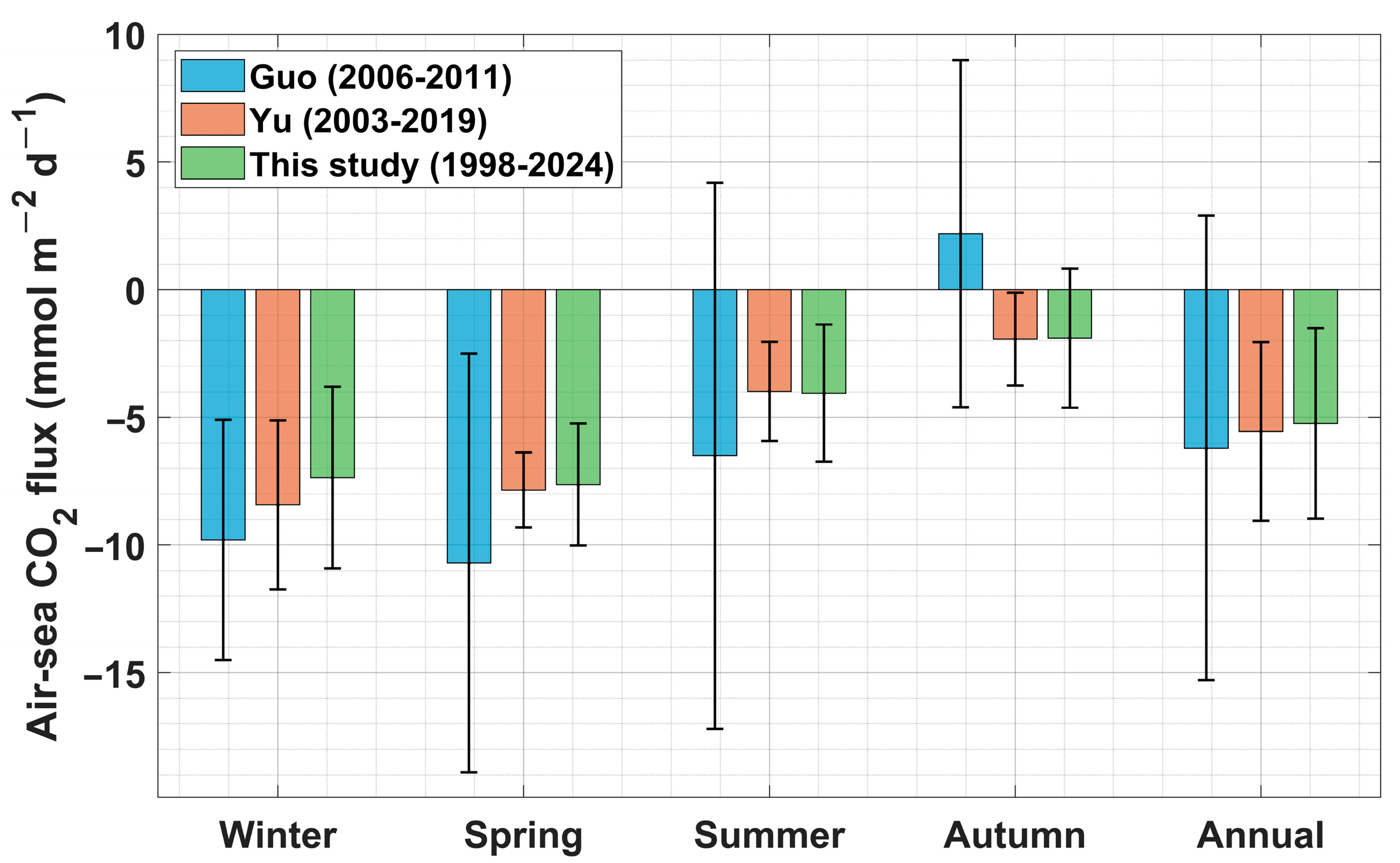
Additionally, compared to shipborne observations, the sample observations with higher temporal frequency and broader spatial coverage in this study significantly reduced the uncertainty introduced by shipborne measurements and extended the time-series data (Figure 5). For example, the autumn air–sea CO2 flux from shipborne observations was 2.2 ± 6.8 mmol m−2 d−1, with a coefficient of variation (CV) exceeding 300% [18]. Remote sensing observations from 2003 to 2019 (17-yr) showed an autumn result of −1.94 ± 1.82 mmol m−2 d−1, with the CV being only one-third of that from shipborne observations [30]. This study provided continuous remote sensing data over a 20-year period (1998–2024), with a slightly higher CV than the 17-yr version, yet still less than half of the CV observed in shipborne measurements.

4.2. The Impact of Changjiang Discharge on pCO2_Sea in the Last Decade (2014–2024) Has Increased by over 50% Compared to Historical Periods

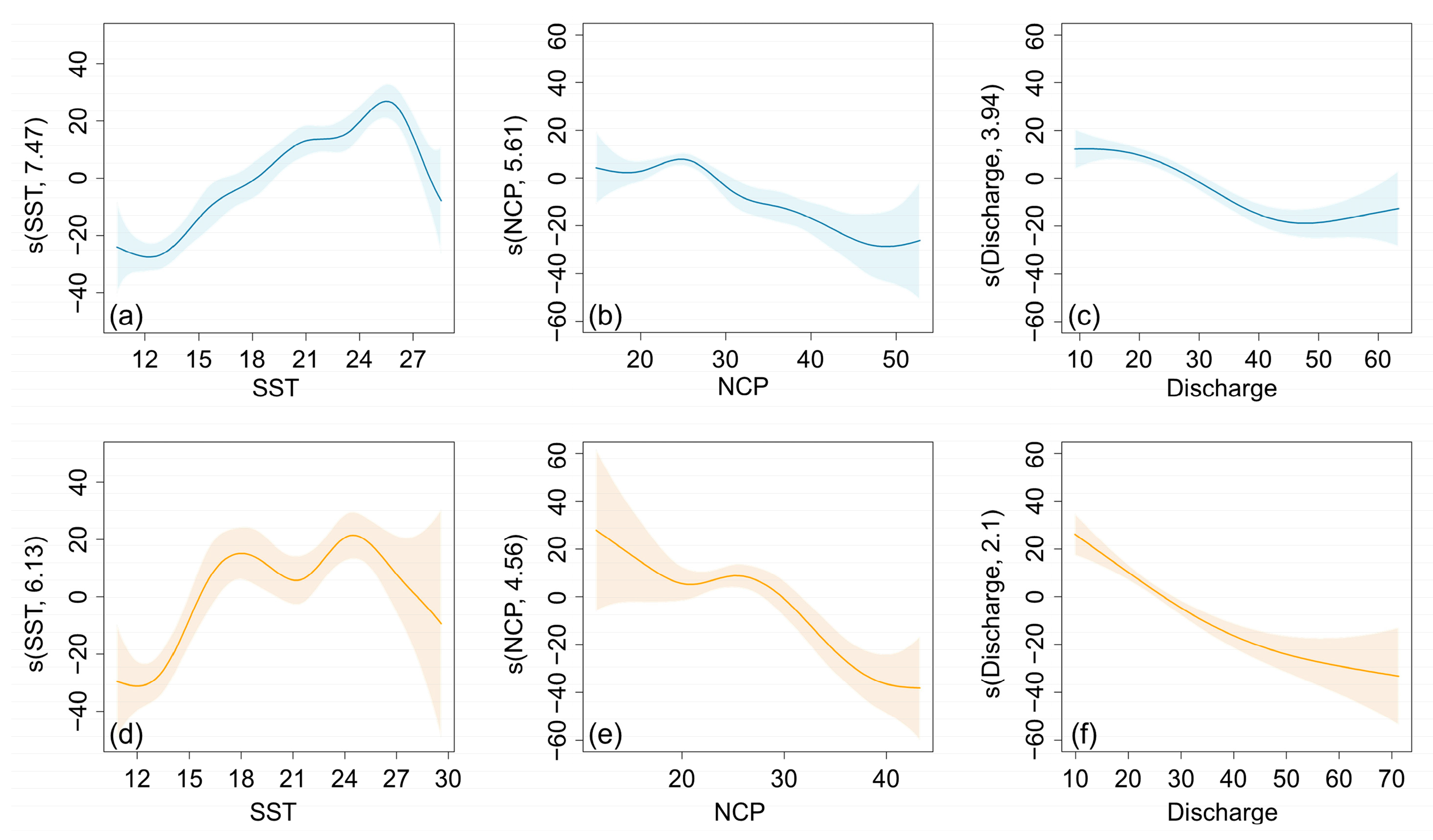
To investigate the reasons behind the reduced rate of carbon sink enhancement in the past decade, this study utilized 27 years of continuous monthly average environmental parameters and pCO2_sea records. A generalized additive model (GAM) was applied to analyze the significance of control factors (SST, NCP, and discharge) in two distinct periods, with 2014 as the dividing point. The univariate control capacities exhibited a clear reversal (Table 2). In the earlier period (1998–2013), discharge showed no significant influence in the univariate model (p = 0.191) but became highly significant in the recent decade (2014–2024) (p < 0.001), with the deviance explained (DE) increasing from 0.90% to 19.40%. In contrast, the univariate explanatory power of SST sharply decreased from 35.00% (R2 = 0.319) to 9.21% (R2 = 0.0803). NCP showed a modest and steady increase (around 7.2%) in the recent decade. In recent years, discharge and NCP exerted stronger independent effects on pCO2_sea, while SST’s independent effect weakened.
Multivariate GAM analysis further confirmed the shift in control patterns. First, the Variance Inflation Factor (VIF) for all variables in both periods was less than 3, indicating weak multicollinearity and reliable model results. Moreover, the R2 of the multivariate model in 2014–2024 (0.707) was slightly higher than that in 1998–2013 (0.683), with the deviance explained also increasing slightly (73.6% vs. 71.1%). This suggested an improvement in model explanatory power in the recent decade (Table 3), confirming the existence of an “interdecadal shift” in estuarine carbon cycle control mechanisms around 2014 (Figure 6).
During the 1998–2013 period, SST was the dominant factor (F = 24.650), significantly higher than discharge (F = 11.689) and NCP (F = 7.851). However, in the 2014–2024 period, the F-values of the three factors became more balanced (discharge: F = 17.950, SST: F = 17.929, NCP: F = 9.379), forming a clear multi-factor collaborative control pattern. Notably, the role of discharge underwent a fundamental shift. Whether from the significant increase in DE in the univariate model or the rise in its F-value from 11.689 to 17.950 in the multivariate model—almost equal to that of temperature (an increase of 54%)—it became clear that discharge transitioned from a simple physical dilution effect to a complex biogeochemical regulation, forming a strong synergistic effect with other factors (Figure 6).
Therefore, discharge no longer solely reduced pCO2_sea, but instead operated synergistically with other physical and biogeochemical drivers to regulate coastal carbon cycling, especially after 2014. By delivering terrigenous nutrients with altered concentrations and stoichiometry, enhanced freshwater discharge likely reshaped plankton community structure and modulated biological production in estuarine and coastal waters [49,69]. Enhanced nutrient inputs stimulated phytoplankton biomass and bloom intensity [70], strengthening biological carbon fixation [54], while concomitant increases in microbial respiration and terrestrial organic matter remineralization could have partially offset this uptake [12,38,71,72,73]. Consistent with this interpretation, the system response patterns exhibit a trend toward simplification as indicated by the degrees of freedom (edf) for all variables generally decreased in the post-2014 period: NCP’s edf decreased from 5.613 to 4.561 (Figure 6b,e), discharge from 3.486 to 2.096 (Figure 6c,f), and SST from 7.472 to 6.132 (Figure 6a,d). This phenomenon suggests that the relationship between variables and pCO2_sea shifted from complex nonlinear interactions toward a more organized and constrained structure. Further clarification of these processes will require targeted in situ observations and biogeochemical modelling to resolve how changes in nutrient stoichiometry, terrestrial organic matter composition, and ecosystem structure mediate the evolving regulatory role of river discharge.

4.3. Extension of the Relationship Between Discharge and NpCO2 in the Changjiang River Estuary and the Adjacent East China Sea

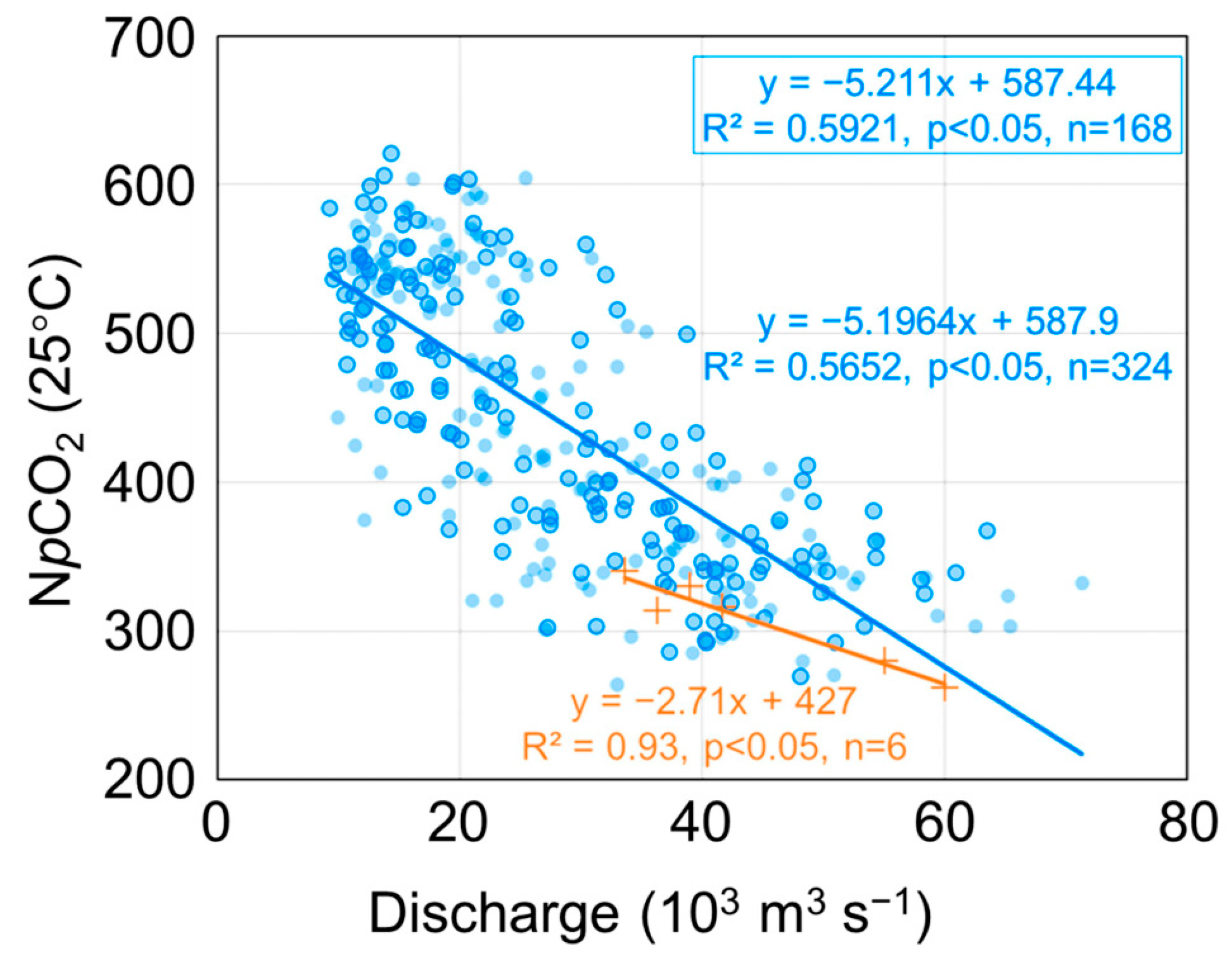
Based on the observed data from 1998 to 2011, Tseng et al. [17] established a linear relationship between temperature-normalized surface CO2 partial pressure (NpCO2 (25 °C)) and Changjiang discharge. The extended dataset used here allows a reassessment of this relationship over a longer timescale. Consistent with Tseng et al. [17], a significant linear negative correlation is observed (Figure 7). Notably, the study area in this work, which is closer to the Changjiang River Estuary, exhibits a substantially stronger discharge sensitivity, with slopes of −5.21 for 1998–2011 and −5.20 for the full 27 years, compared to the slope of −2.71 reported by Tseng et al. [17] (Table 4). This directly confirms that the influence of discharge on pCO2 is stronger in the coastal area closer to the Changjiang River Estuary.
While the linear relationship captures the first-order response of NpCO2 (25 °C) to discharge and provides a physically interpretable framework, results from the GAM multivariate analysis suggest that discharge-related impacts are modulated by additional processes. The estimated effective degrees of freedom (edf > 1; Table 3) indicate that the impact of discharge on NpCO2 is coupled with multiple mechanisms. The coastal system is primarily controlled by physical dilution effects [21,74], increased discharge directly lowers the coastal pCO2_sea of the Changjiang River Estuary [46]. With increasing discharge, however, the influence of biological might response intensifies. The large nutrient input carried by Changjiang discharge significantly promotes phytoplankton primary productivity [24,25,75], enhancing the biological absorption of CO2 [62,76,77]. Meanwhile, respiration within the phytoplankton community [78] and the remineralization and decomposition of terrestrially derived organic matter contribute to elevated surface pCO2_sea [79]. Additionally, discharge-induced changes in water-column stratification and mixing processes may further modulate surface pCO2_sea variability [80]. For example, Huang et al. [81] found in the Mississippi River-dominated continental shelf that riverine nitrogen-enhanced biological removal, along with mixing processes, dominated pCO2_sea variation along the salinity gradient. Therefore, the linear regression presented here provides a physically baseline for quantifying discharge control on coastal pCO2_sea, while the observed variability reflects the combined influence of dilution, biological activity, and mixing under different discharge conditions.
Extreme events, such as the 2023 Changjiang flood, can significantly affect near-shore carbon dynamics. For example, the 2023 flood delivered over twice the usual nutrient load, stimulating phytoplankton growth and tripling biological carbon sequestration [34]. Historical floods, however, showed variable responses: some, like in 2016 and 2020, increased turbidity and limited phytoplankton productivity [35], while others enhanced nutrient availability and local algal blooms, as in 2023 [22]. Overall, these events highlight the sensitivity and potential instability of the coastal carbon sink system under high discharge conditions. Currently, the studies focus on selected representative extreme events, including floods [22,35], droughts [19,20], and heatwaves [82], to illustrate their impacts on regional coastal carbon dynamics. Building on this, future research—leveraging high-frequency observational and inversion datasets [30,36,83,84] along with biogeochemical and coupled hydrodynamic–ecosystem models [85,86]—can establish a systematic framework to evaluate and compare the collective effects of various extreme events on annual carbon budgets, coastal system resilience, and long-term carbon sink trends. Such a framework would enhance our ability to assess the vulnerability and adaptive capacity of coastal carbon sinks under increasingly frequent and intense hydrological extremes.

5. Conclusions

The Changjiang River Estuary and the adjacent East China Sea are typical carbon sink areas, characterized by significant carbon sink intensity and seasonal variability. According to climate-based seasonal analysis, the spring and winter seasons represent strong carbon sink periods, while summer and autumn are weak carbon sink periods, with a significant seasonal amplitude. The seasonal oscillation of pCO2_sea in this region is approximately twice that of the northeastern offshore area of Taiwan. The overall carbon sink intensity was −5.23 ± 3.73 mmol m−2 d−1, with winter and spring carbon sink intensities exceeding −7 mmol m−2 d−1, and the lowest intensity observed in autumn at −1.90 ± 2.73 mmol m−2 d−1. These climate-based and overall results were consistent with historical survey observations and remote sensing data, and the high-frequency sample observations provided in this study effectively reduced the uncertainty of survey-based observations. Over the past 27 years, the oceanic carbon sink capacity has significantly increased. According to satellite remote sensing data, the air–sea CO2 flux in the Changjiang River Estuary and its coastal area increased annually by 0.24 mol m−2 d−1 yr−1, enhancing carbon sink capacity by about five times. This trend closely correlated with the continuous rise in atmospheric pCO2 concentration, which first surpassed 400 μatm in 2014. Afterward, the increase in carbon sink capacity slowed significantly, indicating that the carbon sink system in this region entered a relatively stable phase.
The control mechanisms of the carbon sink in the Changjiang River Estuary and the adjacent East China Sea underwent a significant shift. In recent years (2014–2024), the impact of Changjiang discharge on pCO2_sea significantly increased. Long-term time series analysis and comparisons using multiple periods of GAM revealed a notable change in the role of discharge in carbon sink regulation. Specifically, over the past decade, the explanatory power of discharge for pCO2_sea substantially improved. Univariate analysis showed that between 2014 and 2024, discharge’s control ability (Deviance explained) reached 19.40%, compared to only 0.90% from 1998 to 2013. In contrast, the independent explanatory power of SST decreased from 35% to 9.21%, indicating a shift in the role of discharge from a physical dilution effect to a more complex biogeochemical regulation. Multivariable analysis further confirmed this transition. During the 2014–2024 period, the roles of discharge, SST, and NCP became more balanced, highlighting an “interdecadal shift” in the control mechanisms of the coastal carbon sink, signalling a transition toward more sensitive, finely tuned regulation of the carbon sink in this region. Additionally, based on long-term continuous data, this study the linear regression between discharge and NpCO2 (25 °C) provides a physically baseline for quantifying discharge control on coastal pCO2_sea, highlighting that the coupling of biological and geochemical processes that play an increasingly important role.
In this study, we based on 27 years of continuous remote sensing observation data, systematically revealed the interdecadal shift in the carbon cycle control mechanisms of the Changjiang River Estuary for the first time. The year 2014, identified as a clear statistical threshold, marked the transition of the coastal carbon sink system from a “rapid change” phase to a “relatively stable” phase. This finding provides valuable scientific insight for estuarine management under the context of global change. The restructuring of the control mechanisms reflects the synergistic drivers of climate change and human activities: global atmospheric CO2 increase and warming provided background pressure, while human activities, such as watershed development and major infrastructure projects, exerted direct impacts by altering nutrient transport and ecosystem structure. For future research, we recommend investigating the complex and synergistic effects of extreme river discharge events on coastal carbon fluxes using higher-resolution temporal and spatial datasets. Such studies are critical to improving the prediction of carbon sink variability under climate change and to informing management strategies for sensitive coastal systems.

Author Contributions

Conceptualization, Y.Z. and Y.B.; methodology, Y.Z., Z.J. and Y.B.; validation, Z.J.; data curation, Z.J. and Y.Z.; writing—original draft preparation, Y.Z. and X.H.; writing—review and editing, Y.B., X.H., T.L. and C.Z.; visualization, Y.Z., Z.J., X.J. and F.G. All authors have read and agreed to the published version of the manuscript.

Funding

This study was supported by the Zhejiang Provincial Natural Science Foundation of China (Grant # LDT23D06024D06), the “Pioneer” R&D Program of Zhejiang (Grant #2023C03011), the Scientific Research Fund of the Second Institute of Oceanography, MNR (Grants # JB2502) and the National Natural Science Foundation of China (Grants #42176177 and #U23A2037).

Data Availability Statement

The SST data from OISST can be obtained from the website https://www.ncei.noaa.gov/products/optimum-interpolation-sst (accessed on 13 February 2025). The OC-CCI data from ESA can be obtained from the website https://climate.esa.int/en/projects/ocean-colour/data/#citing-ocean-colour-cci-information-and-data-products (accessed on 12 February 2025). The atmospheric CO2 data from CarbonTracker can be obtained from the website https://gml.noaa.gov/ccgg/carbontracker/ (accessed on 17 December 2023). The monthly discharge data of the Changjiang River (2006–2024) from the Datong Station can be obtained from the Ministry of Water Resources of the People’s Republic of China at http://www.cjw.gov.cn (accessed on 22 July 2025).

Acknowledgments

We thank SOED/SIO/MNR satellite ground station, satellite data processing & sharing centre, and marine satellite data online analysis platform (SatCO2) for their help with data collection and processing. We also thank the NOAA Optimum Interpolation SST (OISST) Version 2.1 data were provided by the NOAA PSL, Boulder, Colorado, USA, from their website at https://www.ncei.noaa.gov/products/optimum-interpolation-sst (accessed on 13 February 2025). The Ocean Colour data used in this publication were produced by the ESA Ocean Colour Climate Change Initiative (CCI) project (Version 6.0). We thank the ESA CCI Ocean Colour team and available at https://climate.esa.int/en/projects/ocean-colour/data/ (accessed on 12 February 2025). CarbonTracker CT2022 results provided by NOAA GML, Boulder, Colorado, USA from the website at http://carbontracker.noaa.gov(accessed on 17 December 2023). We thank Tianzhen Zhang for providing technical support and helpful comments. We also thank the three anonymous reviewers for their constructive comments on improving the manuscript.

Conflicts of Interest

The authors declare no conflicts of interest.

References

  1. Laruelle, G.G.; Cai, W.-J.; Hu, X.; Gruber, N.; Mackenzie, F.T.; Regnier, P. Continental shelves as a variable but increasing global sink for atmospheric carbon dioxide. Nat. Commun. 2018, 9, 454. [Google Scholar] [CrossRef] [PubMed]
  2. Takahashi, T.; Sutherland, S.C.; Wanninkhof, R.; Sweeney, C.; Feely, R.A.; Chipman, D.W.; Hales, B.; Friederich, G.; Chavez, F.; Sabine, C. Climatological mean and decadal change in surface ocean pCO2, and net sea–air CO2 flux over the global oceans. Deep. Sea Res. Part II Top. Stud. Oceanogr. 2009, 56, 554–577. [Google Scholar] [CrossRef]
  3. Chen, C.T.A.; Huang, T.H.; Chen, Y.C.; Bai, Y.; He, X.; Kang, Y. Air-sea exchanges of CO2 in the world’s coastal seas. Biogeosciences 2013, 10, 6509–6544. [Google Scholar] [CrossRef]
  4. Dai, M.; Cao, Z.; Guo, X.; Zhai, W.; Liu, Z.; Yin, Z.; Xu, Y.; Gan, J.; Hu, J.; Du, C. Why are some marginal seas sources of atmospheric CO2? Geophys. Res. Lett. 2013, 40, 2154–2158. [Google Scholar] [CrossRef]
  5. Burdige, D.J. Preservation of organic matter in marine sediments: Controls, mechanisms, and an imbalance in sediment organic carbon budgets? Chem. Rev. 2007, 107, 467–485. [Google Scholar] [CrossRef]
  6. DeVries, T. The ocean carbon cycle. Annu. Rev. Environ. Resour. 2022, 47, 317–341. [Google Scholar] [CrossRef]
  7. Bourgeois, T.; Orr, J.C.; Resplandy, L.; Terhaar, J.; Ethé, C.; Gehlen, M.; Bopp, L. Coastal-ocean uptake of anthropogenic carbon. Biogeosciences 2016, 13, 4167–4185. [Google Scholar] [CrossRef]
  8. Laruelle, G.G.; Lauerwald, R.; Pfeil, B.; Regnier, P. Regionalized global budget of the CO2 exchange at the air-water interface in continental shelf seas. Glob. Biogeochem. Cycles 2014, 28, 1199–1214. [Google Scholar] [CrossRef]
  9. Liu, Q.; Guo, X.; Yin, Z.; Zhou, K.; Roberts, E.G.; Dai, M. Carbon fluxes in the China Seas: An overview and perspective. Sci. China Earth Sci. 2018, 61, 1564–1582. [Google Scholar] [CrossRef]
  10. Roobaert, A.; Laruelle, G.G.; Landschützer, P.; Gruber, N.; Chou, L.; Regnier, P. The spatiotemporal dynamics of the sources and sinks of CO2 in the global coastal ocean. Glob. Biogeochem. Cycles 2019, 33, 1693–1714. [Google Scholar] [CrossRef]
  11. Jiao, N.; Liang, Y.; Zhang, Y.; Liu, J.; Zhang, Y.; Zhang, R.; Zhao, M.; Dai, M.; Zhai, W.; Gao, K. Carbon pools and fluxes in the China Seas and adjacent oceans. Sci. China Earth Sci. 2018, 61, 1535–1563. [Google Scholar] [CrossRef]
  12. Chou, W.C.; Gong, G.C.; Sheu, D.D.; Jan, S.; Hung, C.C.; Chen, C.C. Reconciling the paradox that the heterotrophic waters of the east China Sea shelf act as a significant CO2 sink during the summertime: Evidence and implications. Geophys. Res. Lett. 2009, 36, L15607. [Google Scholar] [CrossRef]
  13. Zhai, W.; Dai, M. On the seasonal variation of air–sea CO2 fluxes in the outer Changjiang (Yangtze River) estuary, east China Sea. Mar. Chem. 2009, 117, 2–10. [Google Scholar] [CrossRef]
  14. Tseng, C.M.; Liu, K.K.; Gong, G.C.; Shen, P.Y.; Cai, W.J. CO2 uptake in the east China Sea relying on Changjiang runoff is prone to change. Geophys. Res. Lett. 2011, 38, L24609. [Google Scholar] [CrossRef]
  15. Kim, D.; Choi, S.-H.; Shim, J.; Kim, K.-H.; Kim, C.-H. Revisiting the seasonal variations of sea-air CO2 fluxes in the northern east China Sea. Terr. Atmos. Ocean. Sci. 2013, 24, 409–419. [Google Scholar] [CrossRef]
  16. Chou, W.-C.; Gong, G.-C.; Hung, C.-C.; Wu, Y.-H. Carbonate mineral saturation states in the east China Sea: Present conditions and future scenarios. Biogeosciences 2013, 10, 6453–6467. [Google Scholar] [CrossRef]
  17. Tseng, C.-M.; Shen, P.-Y.; Liu, K.-K. Synthesis of observed air–sea CO2 exchange fluxes in the river-dominated east China Sea and improved estimates of annual and seasonal net mean fluxes. Biogeosciences 2014, 11, 3855–3870. [Google Scholar] [CrossRef]
  18. Guo, X.-H.; Zhai, W.-D.; Dai, M.-H.; Zhang, C.; Bai, Y.; Xu, Y.; Li, Q.; Wang, G.-Z. Air–sea CO2 fluxes in the east China Sea based on multiple-year underway observations. Biogeosciences 2015, 12, 5495–5514. [Google Scholar] [CrossRef]
  19. Yu, S.; Wang, Z.; Jiang, Z.; Li, T.; Ding, X.; Wei, X.; Liu, D. Marine heatwave and terrestrial drought reduced CO2 uptake in the east China Sea in 2022. Remote Sens. 2024, 16, 849. [Google Scholar] [CrossRef]
  20. Xu, Y.; Bu, D.; Guo, X.; Lei, S.; Yang, Y.; Zhou, K. The 2023 summer drought and high temperatures turned the east China Sea off the Changjiang estuary from a CO2 sink to a CO2 source. Sci. China Earth Sci. 2025, 68, 2217–2225. [Google Scholar] [CrossRef]
  21. Ran, L.; Lu, X.X.; Liu, S. Dynamics of riverine CO2 in the Yangtze River fluvial network and their implications for carbon evasion. Biogeosciences 2017, 14, 2183–2198. [Google Scholar] [CrossRef]
  22. Song, S.; Bellerby, R.; Liu, J.; Guo, W.; Yu, P.; Ge, J.; Li, D. Impacts of an extreme Changjiang flood on variations in carbon cycle components in the Changjiang estuary and adjacent east China Sea. Cont. Shelf Res. 2023, 269, 105137. [Google Scholar] [CrossRef]
  23. Yang, Z.; Yang, X.; Zhang, C.; Jin, Y.; Hu, X.; Zhou, X.; Zhuang, T.; Ning, J.; Zeng, J.; Yu, P. Seasonal variability of sea surface pCO2 and air-sea CO2 flux in a high turbidity coastal ocean in the vicinity of the east China Sea. Front. Mar. Sci. 2025, 12, 1580318. [Google Scholar] [CrossRef]
  24. Zhong, X.; Liu, J.; Shi, M.; Liu, X.; Lv, Z.; Ran, X. Nutrient dynamics in the east China Sea: Seasonal changes, budget, and ecological impacts. Prog. Oceanogr. 2025, 234, 103463. [Google Scholar] [CrossRef]
  25. Liu, K.-K.; Yan, W.; Lee, H.-J.; Chao, S.-Y.; Gong, G.-C.; Yeh, T.-Y. Impacts of increasing dissolved inorganic nitrogen discharged from Changjiang on primary production and seafloor oxygen demand in the east China Sea from 1970 to 2002. J. Mar. Syst. 2015, 141, 200–217. [Google Scholar] [CrossRef]
  26. Chen, C.C.; Gong, G.C.; Chiang, K.P.; Shiah, F.K.; Chung, C.C.; Hung, C.C. Scaling effects of a eutrophic river plume on organic carbon consumption. Limnol. Oceanogr. 2021, 66, 1867–1881. [Google Scholar] [CrossRef]
  27. Shim, J.; Kim, D.; Kang, Y.C.; Lee, J.H.; Jang, S.-T.; Kim, C.-H. Seasonal variations in pCO2 and its controlling factors in surface seawater of the northern east China Sea. Cont. Shelf Res. 2007, 27, 2623–2636. [Google Scholar] [CrossRef]
  28. Zhai, W.-D.; Dai, M.-H.; Chen, B.-S.; Guo, X.-H.; Li, Q.; Shang, S.-L.; Zhang, C.-Y.; Cai, W.-J.; Wang, D.-X. Seasonal variations of sea–air CO2 fluxes in the largest tropical marginal sea (south China Sea) based on multiple-year underway measurements. Biogeosciences 2013, 10, 7775–7791. [Google Scholar] [CrossRef]
  29. Chou, W.-C.; Gong, G.-C.; Tseng, C.-M.; Sheu, D.D.; Hung, C.-C.; Chang, L.-P.; Wang, L.-W. The carbonate system in the east China Sea in winter. Mar. Chem. 2011, 123, 44–55. [Google Scholar] [CrossRef]
  30. Yu, S.; Song, Z.; Bai, Y.; Guo, X.; He, X.; Zhai, W.; Zhao, H.; Dai, M. Satellite-estimated air-sea CO2 fluxes in the Bohai Sea, yellow sea, and east China Sea: Patterns and variations during 2003–2019. Sci. Total Environ. 2023, 904, 166804. [Google Scholar] [CrossRef]
  31. Zhai, W.D.; Chen, J.F.; Jin, H.Y.; Li, H.L.; Liu, J.W.; He, X.Q.; Bai, Y. Spring carbonate chemistry dynamics of surface waters in the northern east China Sea: Water mixing, biological uptake of CO2, and chemical buffering capacity. J. Geophys. Res. Ocean. 2014, 119, 5638–5653. [Google Scholar] [CrossRef]
  32. Rodgers, K.B.; Schwinger, J.; Fassbender, A.J.; Landschützer, P.; Yamaguchi, R.; Frenzel, H.; Stein, K.; Müller, J.D.; Goris, N.; Sharma, S. Seasonal variability of the surface ocean carbon cycle: A synthesis. Glob. Biogeochem. Cycles 2023, 37, e2023GB007798. [Google Scholar] [CrossRef]
  33. Deng, X.; Zhang, G.-L.; Xin, M.; Liu, C.-Y.; Cai, W.-J. Carbonate chemistry variability in the southern yellow sea and east China Sea during spring of 2017 and summer of 2018. Sci. Total Environ. 2021, 779, 146376. [Google Scholar] [CrossRef] [PubMed]
  34. Sun, Q.; Li, D.; Wang, B.; Xu, Z.; Miao, Y.; Lin, H.; Jin, H.; Jiang, Z.; Zeng, J.; Zhou, F. Massive nutrients offshore transport off the Changjiang estuary in flooding summer of 2020. Front. Mar. Sci. 2023, 10, 1076336. [Google Scholar] [CrossRef]
  35. Yao, A.; Gao, L.; Ming, Y. Influences of catastrophic floods on the biogeochemistry of organic matter and nutrients in the Changjiang River estuary. J. Mar. Syst. 2024, 241, 103922. [Google Scholar] [CrossRef]
  36. Song, Z.; Yu, S.; Bai, Y.; Guo, X.; He, X.; Zhai, W.; Dai, M. Construction of a high spatiotemporal resolution dataset of satellite-derived pCO2 and air–sea CO2 flux in the south China Sea (2003–2019). IEEE Trans. Geosci. Remote Sens. 2023, 61, 4207015. [Google Scholar] [CrossRef]
  37. Tsunogai, S.; Watanabe, S.; Nakamura, J.; Ono, T.; Sato, T. A preliminary study of carbon system in the east China Sea. J. Oceanogr. 1997, 53, 9–17. [Google Scholar] [CrossRef]
  38. Zhang, Y.; Li, D.; Wang, K.; Xue, B. Contribution of biological effects to the carbon sources/sinks and the trophic status of the ecosystem in the Changjiang (Yangtze) River estuary plume in summer as indicated by net ecosystem production variations. Water 2019, 11, 1264. [Google Scholar] [CrossRef]
  39. Hama, T.; Shin, K.; Handa, N. Spatial variability in the primary productivity in the east China Sea and its adjacent waters. J. Oceanogr. 1997, 53, 41–51. [Google Scholar] [CrossRef]
  40. Liu, K.-K.; Chao, S.-Y.; Lee, H.-J.; Gong, G.-C.; Teng, Y.-C. Seasonal variation of primary productivity in the east China Sea: A numerical study based on coupled physical-biogeochemical model. Deep. Sea Res. Part II Top. Stud. Oceanogr. 2010, 57, 1762–1782. [Google Scholar] [CrossRef]
  41. Guo, S.; Feng, Y.; Wang, L.; Dai, M.; Liu, Z.; Bai, Y.; Sun, J. Seasonal variation in the phytoplankton community of a continental-shelf sea: The east China Sea. Mar. Ecol. Prog. Ser. 2014, 516, 103–126. [Google Scholar] [CrossRef]
  42. Liu, X.; Xiao, W.; Landry, M.R.; Chiang, K.-P.; Wang, L.; Huang, B. Responses of phytoplankton communities to environmental variability in the east China Sea. Ecosystems 2016, 19, 832–849. [Google Scholar] [CrossRef]
  43. Zhai, W.-D.; Yan, X.-L.; Qi, D. Biogeochemical generation of dissolved inorganic carbon and nitrogen in the north branch of inner Changjiang estuary in a dry season. Estuar. Coast. Shelf Sci. 2017, 197, 136–149. [Google Scholar] [CrossRef]
  44. Hasegawa, T.; Kitajima, S.; Kiyomoto, Y. Phytoplankton distribution in the Kuroshio region of the southern east China Sea in early spring. In Kuroshio Current: Physical, Biogeochemical, and Ecosystem Dynamics; American Geophysical Union: Washington, DC, USA, 2019; pp. 189–205. [Google Scholar]
  45. Dai, A.; Trenberth, K.E. Estimates of freshwater discharge from continents: Latitudinal and seasonal variations. J. Hydrometeorol. 2002, 3, 660–687. [Google Scholar] [CrossRef]
  46. Chen, C.-T.A.; Zhai, W.; Dai, M. Riverine input and air–sea CO2 exchanges near the Changjiang (Yangtze River) estuary: Status quo and implication on possible future changes in metabolic status. Cont. Shelf Res. 2008, 28, 1476–1482. [Google Scholar] [CrossRef]
  47. Lee, H.-J.; Chao, S.-Y. A climatological description of circulation in and around the east China Sea. Deep. Sea Res. Part II Top. Stud. Oceanogr. 2003, 50, 1065–1084. [Google Scholar] [CrossRef]
  48. Su, Y.; Weng, X. Water masses in China Seas. Oceanol. China Seas 1994, 1, 3–16. [Google Scholar]
  49. Chen, C.-T.A. Chemical and physical fronts in the Bohai, yellow and east China Seas. J. Mar. Syst. 2009, 78, 394–410. [Google Scholar] [CrossRef]
  50. Chen, C.; Ruo, R.; Paid, S.; Liu, C.; Wong, G. Exchange of water masses between the east China Sea and the Kuroshio off northeastern Taiwan. Cont. Shelf Res. 1995, 15, 19–39. [Google Scholar] [CrossRef]
  51. Chen, C.-T.A. Rare northward flow in the Taiwan strait in winter: A note. Cont. Shelf Res. 2003, 23, 387–391. [Google Scholar] [CrossRef]
  52. Guan, B.-x. Patterns and structures of the currents in Bohai, Huanghai and East China Seas. In Oceanology of China Seas; Springer: Berlin/Heidelberg, Germany, 1994; pp. 17–26. [Google Scholar]
  53. Lie, H.J.; Cho, C.H.; Lee, J.H.; Lee, S.; Tang, Y.; Zou, E. Does the yellow sea warm current really exist as a persistent mean flow? J. Geophys. Res. Ocean. 2001, 106, 22199–22210. [Google Scholar] [CrossRef]
  54. He, X.; Bai, Y.; Pan, D.; Chen, C.T.A.; Cheng, Q.; Wang, D.; Gong, F. Satellite views of the seasonal and interannual variability of phytoplankton blooms in the eastern China Seas over the past 14 yr (1998–2011). Biogeosciences 2013, 10, 4721–4739. [Google Scholar] [CrossRef]
  55. Behrenfeld, M.J.; Falkowski, P.G. Photosynthetic rates derived from satellite-based chlorophyll concentration. Limnol. Oceanogr. 1997, 42, 1–20. [Google Scholar] [CrossRef]
  56. Laws, E.A.; D’Sa, E.; Naik, P. Simple equations to estimate ratios of new or export production to total production from satellite-derived estimates of sea surface temperature and primary production. Limnol. Oceanogr. Methods 2011, 9, 593–601. [Google Scholar] [CrossRef]
  57. Huang, Y.; Yang, B.; Chen, B.; Qiu, G.; Wang, H.; Huang, B. Net community production in the south China Sea basin estimated from in situ o2 measurements on an argo profiling float. Deep Sea Res. Part I Oceanogr. Res. Pap. 2018, 131, 54–61. [Google Scholar] [CrossRef]
  58. Zhang, Y.; Bai, Y.; He, X.; Li, T.; Jiang, Z.; Gong, F. Three stages in the variation of the depth of hypoxia in the California current system 2003–2020 by satellite estimation. Sci. Total Environ. 2023, 874, 162398. [Google Scholar] [CrossRef] [PubMed]
  59. Ryan-Keogh, T.J.; Thomalla, S.J.; Chang, N.; Moalusi, T. A new global oceanic multi-model net primary productivity data product. Earth Syst. Sci. Data 2023, 15, 4829–4848. [Google Scholar] [CrossRef]
  60. Gómez-Ocampo, E.; Durazo, R.; Gaxiola-Castro, G.; De la Cruz-Orozco, M.; Sosa-Ávalos, R. Effects of the interannual variability of water column stratification on phytoplankton production and biomass in the northern zone off Baja California. Cienc. Mar. 2017, 43, 109–122. [Google Scholar] [CrossRef]
  61. R Core Team. R: A Language and Environment for Statistical Computing; R Foundation for Statistical Computing: Vienna, Austria, 2025. [Google Scholar]
  62. Chou, W.-C.; Gong, G.-C.; Cai, W.-J.; Tseng, C.-M. Seasonality of CO2 in coastal oceans altered by increasing anthropogenic nutrient delivery from large rivers: Evidence from the Changjiang–east China Sea system. Biogeosciences 2013, 10, 3889–3899. [Google Scholar] [CrossRef]
  63. Liu, J.; Bellerby, R.G.; Zhu, Q.; Ge, J. Estimation of sea surface pCO2 and air–sea CO2 flux in the east China Sea using in-situ and satellite data over the period 2000–2016. Cont. Shelf Res. 2023, 254, 104879. [Google Scholar] [CrossRef]
  64. Chen, C.; Zhu, J.; Beardsley, R.C.; Franks, P.J. Physical-biological sources for dense algal blooms near the Changjiang River. Geophys. Res. Lett. 2003, 30, 1515. [Google Scholar] [CrossRef]
  65. Wu, J.; Liu, J.T.; Wang, X. Sediment trapping of turbidity maxima in the Changjiang estuary. Mar. Geol. 2012, 303, 14–25. [Google Scholar] [CrossRef]
  66. Wang, Y.; Wu, H.; Lin, J.; Zhu, J.; Zhang, W.; Li, C. Phytoplankton blooms off a high turbidity estuary: A case study in the Changjiang River estuary. J. Geophys. Res. Ocean. 2019, 124, 8036–8059. [Google Scholar] [CrossRef]
  67. Lin, Q.; Feng, Z.; Wang, Y.; Wang, X.; Bian, Z.; Zhang, F.; Cao, F.; Wu, H.; Wang, Y.P. Light attenuation parameterization in a highly turbid mega estuary and its impact on the coastal planktonic ecosystem. Front. Mar. Sci. 2024, 11, 1486261. [Google Scholar] [CrossRef]
  68. Xiong, T.Q.; Liu, P.F.; Zhai, W.D.; Bai, Y.; Liu, D.; Qi, D.; Zheng, N.; Liu, J.W.; Guo, X.H.; Cheng, T.Y.; et al. Export flux, biogeochemical effects, and the fate of a terrestrial carbonate system: From Changjiang (Yangtze River) estuary to the east China Sea. Earth Space Sci. 2019, 6, 2115–2141. [Google Scholar] [CrossRef]
  69. Jiang, Z.; Liu, J.; Chen, J.; Chen, Q.; Yan, X.; Xuan, J.; Zeng, J. Responses of summer phytoplankton community to drastic environmental changes in the Changjiang (Yangtze River) estuary during the past 50 years. Water Res. 2014, 54, 1–11. [Google Scholar] [CrossRef]
  70. Jiang, Z.; Chen, J.; Zhou, F.; Shou, L.; Chen, Q.; Tao, B.; Yan, X.; Wang, K. Controlling factors of summer phytoplankton community in the Changjiang (Yangtze River) estuary and adjacent east China Sea shelf. Cont. Shelf Res. 2015, 101, 71–84. [Google Scholar] [CrossRef]
  71. Dang, H.; Jiao, N. Perspectives on the microbial carbon pump with special reference to microbial respiration and ecosystem efficiency in large estuarine systems. Biogeosciences 2014, 11, 3887–3898. [Google Scholar] [CrossRef]
  72. Regnier, P.; Resplandy, L.; Najjar, R.G.; Ciais, P. The land-to-ocean loops of the global carbon cycle. Nature 2022, 603, 401–410. [Google Scholar] [CrossRef]
  73. Zhai, W.D.; Zhao, H.D.; Su, J.L.; Liu, P.F.; Li, Y.W.; Zheng, N. Emergence of summertime hypoxia and concurrent carbonate mineral suppression in the central Bohai Sea, China. J. Geophys. Res. Biogeosci. 2019, 124, 2768–2785. [Google Scholar] [CrossRef]
  74. Li, B.-H.; Zhao, H.-L.; Gong, J.-C.; Wu, X.; Liu, C.-Y.; Hu, J.-W.; Yang, G.-P. Emission of CO2 and its related carbonate system dynamics in a hotspot area during winter and summer: The Changjiang River estuary. Mar. Environ. Res. 2024, 198, 106496. [Google Scholar] [CrossRef]
  75. Ge, J.; Shi, S.; Liu, J.; Xu, Y.; Chen, C.; Bellerby, R.; Ding, P. Interannual variabilities of nutrients and phytoplankton off the Changjiang estuary in response to changing river inputs. J. Geophys. Res. Ocean. 2020, 125, e2019JC015595. [Google Scholar] [CrossRef]
  76. Li, D.; Ni, X.; Wang, K.; Zeng, D.; Wang, B.; Jin, H.; Li, H.; Zhou, F.; Huang, D.; Chen, J. Biological CO2 uptake and upwelling regulate the air-sea CO2 flux in the Changjiang plume under south winds in summer. Front. Mar. Sci. 2021, 8, 709783. [Google Scholar] [CrossRef]
  77. Choi, Y.; Kim, D.; Noh, J.H.; Kang, D.-J. Contribution of Changjiang river discharge to CO2 uptake capacity of the northern east China Sea in august 2016. Cont. Shelf Res. 2021, 215, 104336. [Google Scholar] [CrossRef]
  78. Chen, C.C.; Shiah, F.K.; Chiang, K.P.; Gong, G.C.; Kemp, W.M. Effects of the Changjiang (Yangtze) river discharge on planktonic community respiration in the east China Sea. J. Geophys. Res. Ocean. 2009, 114, C03005. [Google Scholar] [CrossRef]
  79. Chen, C.-C.; Meng, P.-J.; Hsieh, C.-h.; Jan, S. Plankton community respiration and particulate organic carbon in the kuroshio east of taiwan. Plants 2022, 11, 2909. [Google Scholar] [CrossRef]
  80. Tsao, S.-E.; Shen, P.-Y.; Tseng, C.-M. Rapid increase of pCO2 and seawater acidification along kuroshio at the east edge of the east China Sea. Mar. Pollut. Bull. 2023, 186, 114471. [Google Scholar] [CrossRef] [PubMed]
  81. Huang, W.J.; Cai, W.J.; Wang, Y.; Lohrenz, S.E.; Murrell, M.C. The carbon dioxide system on the Mississippi river-dominated continental shelf in the northern Gulf of Mexico: 1. Distribution and air-sea CO2 flux. J. Geophys. Res. Ocean. 2015, 120, 1429–1445. [Google Scholar] [CrossRef]
  82. Zhang, R.; Cheng, Y.; Wang, X. Classification of marine heatwaves in the south China Sea and their thermodynamic features. Atmos. Ocean. Sci. Lett. 2025, 100662. [Google Scholar] [CrossRef]
  83. Zhang, R.; Guo, W.; Zhou, F.; Yin, J.; Huang, J.; Wang, X. The chinese air-sea heat flux (casflux) gridded dataset: Description and validation. Big Earth Data 2025, 9, 1191–1209. [Google Scholar] [CrossRef]
  84. Xuan, J.; Li, H.; Bai, Y.; Meng, Q.; Jin, H.; Pan, Y.; Li, Q.; Zhang, J.; He, Y.; Ma, Y. Trend of air-sea CO2 flux in the frontal zone of the east China Sea investigated by a remote-sensing data assimilation model. J. Geophys. Res. Ocean. 2025, 130, e2025JC022423. [Google Scholar] [CrossRef]
  85. Ma, W.; Xiu, P.; Yu, Y.; Zheng, Y.; Chai, F. Production of dissolved organic carbon in the south China Sea: A modeling study. Sci. China Earth Sci. 2022, 65, 351–364. [Google Scholar] [CrossRef]
  86. Meng, Q.; Pan, Y.; Xuan, J.; Zhou, F.; Fan, W.; Di, Y.; Jiang, Z.-P.; Xiao, C.; Zhang, W.; Daewel, U. Leveraging artificial oxygenation efficacy for coastal hypoxia by taking advantage of local hydrodynamics. Environ. Sci. Technol. 2024, 58, 21629–21640. [Google Scholar] [CrossRef] [PubMed]
Figure 1. (a) Study area and (be) surface currents (black arrows) and bottom water masses (blue dashed lines) in the East China Sea shelf edge during (b) winter, (c) spring, (d) summer, and (e) autumn. The yellow rectangular box represents the study area of this research, which is the Changjiang River Estuary and the adjacent East China Sea. In nearshore areas, the primary water masses include Yellow Sea Coastal Water (YSCoW), Changjiang Diluted Water (CDW), and East China Sea Coastal Water (ECSCoW) [48,49]. In offshore areas, the water masses include Yellow Sea Cold Water (YSCW), Yellow Sea Warm Water (YSWW) [48], East China Sea Deep Water (ECSDW), and East China Sea Shelf Surface Water (ECSSSW) [48,50], Taiwan Strait Water (TSW), Taiwan Warm Current (TWC), and CDW in summer [50,51]. Near the East China Sea shelf slope, the primary currents/water masses include Tsushima Warm Water (TWW), Tsushima Current (TsC) [52], Jeju Warm Current (JWC), and Kuroshio Surface Water (KSW) [49,53].
Remotesensing 18 00086 g001
Figure 2. The spatiotemporal distribution of seasonal climatological variability in satellite-derived pCO2 and air–sea CO2 flux in the East China Sea (1998–2024). The yellow rectangular box represents the study area of this research, which is the Changjiang River Estuary and the adjacent East China Sea.
Remotesensing 18 00086 g002
Figure 3. The long-term variations in (a) sea surface temperature (SST), (b) the Changjiang River discharge, (c) net community production (NCP), (d) pCO2_air, (e) pCO2_sea and (f) air–sea CO2 flux in the Changjiang River Estuary and the adjacent East China Sea from 1998 to 2024. The shaded areas represent monthly averages, and the dots represent annual averages. The red lines indicate the temporal evolution trends. Correlations significant at a level of p < 0.05 are indicated with solid lines; other correlations are indicated with dashed lines.
Remotesensing 18 00086 g003
Figure 4. Evolution trends of (a) pCO2_air (light blue shade), pCO2_sea (dark blue shade), and air–sea CO2 flux (black solid line) from 1998 to 2013, and (b) from 2014 to 2024. The light blue line represents the fitted trend of pCO2_air, the dark blue line represents the fitted trend of pCO2_sea, and the red line represents the fitted trend of the air–sea CO2 flux. Correlations significant at a level of p < 0.05 are indicated with solid lines; other correlations are indicated with dashed lines.
Remotesensing 18 00086 g004
Figure 5. Climatological seasonal variation distribution of carbon sink in the Changjiang River Estuary and the adjacent East China Sea.
Remotesensing 18 00086 g005
Figure 6. Using GAM to analyze the response of key environmental factors to the pCO2_sea from 1998 to 2024. (ac) represent the response of pCO2_sea to various environmental factors (SST, NCP and discharge) during 1998–2013. (df) represent the response during 2014–2024. The curves represent the fitting result, with the shaded area indicating a 95% confidence interval.
Remotesensing 18 00086 g006
Figure 7. Linear regression between normalized pCO2 at 25 °C (NpCO2 (25 °C)) and discharge. The orange line represents the correlation established by Tseng et al. [17] for the period 1998–2011. The blue line denotes the relationship constructed from monthly data in this study (1998–2024), with data points and fitted results for 1998–2011 marked by bordered points.
Remotesensing 18 00086 g007
Table 1. Rates of change of key biogeochemical parameters in the Changjiang River Estuary and adjacent East China Sea (1998–2024); significant correlations highlighted in bold.
ParameterRateNumberSignificant Level
Sea surface temperature (SST)0.02270.15
Changjiang River discharge (Discharge)−0.07270.48
Net community production (NCP)−0.04270.16
pCO2_air2.4727<0.05
pCO2_sea0.18270.25
Air–sea CO2 flux0.2427<0.05
Table 2. Results of univariate generalized additive model (GAM) analysis.
StageModel FormulaVIF 1edfAdjusted R2DESignificant Level
1998–2013
(n = 192)
pCO2_sea~s(SST)2.2708.6470.31935.00%<0.001
pCO2_sea~s(NCP)1.2726.3310.33635.80%<0.001
pCO2_sea~s(discharge)2.3071.0000.0040.90%0.191
2014–2024
(n = 132)
pCO2_sea~s(SST)2.2541.6850.0809.21%0.004
pCO2_sea~s(NCP)1.5277.1270.39743.00%<0.001
pCO2_sea~s(discharge)1.8442.2570.18019.40%<0.001
1 Note: Variance Inflation Factor (VIF) analysis was conducted to detect multicollinearity among the variables. edf stands for the residual degree of freedom. When edf value is close to 1, it indicates that the influence of the independent variable on the dependent variable is more like a linear relationship. DE stands for the deviance explained.
Table 3. Results of multivariate generalized additive model (GAM) analysis.
StageAdjusted R2DEModel FactorsedfF 1Significant
Level
Model Formula: pCO2_sea~s(SST) + s(NCP) + s(discharge)
1998–2013
(n = 192)
0.68371.10%SST7.47224.65<0.001
NCP5.6137.851<0.001
discharge3.48611.689<0.001
2014–2024
(n = 132)
0.70773.60%SST6.13217.929<0.001
NCP4.5619.379<0.001
discharge2.09617.950<0.001
1 Note: The greater the F value, the greater the relative importance of the explanatory variables.
Table 4. Comparison of the relationship between NpCO2 (25 °C) and Changjiang discharge (unit: 103 m3 s−1).
Fitting RelationshipPerformance
(period/n/R2)
Reference
NpCO2(25 °C) = −2.71 × discharge + 4271998–2011/6/0.93[17]
NpCO2(25 °C) = −5.20 × discharge + 5881998–2024/324/0.565This study
Disclaimer/Publisher’s Note: The statements, opinions and data contained in all publications are solely those of the individual author(s) and contributor(s) and not of MDPI and/or the editor(s). MDPI and/or the editor(s) disclaim responsibility for any injury to people or property resulting from any ideas, methods, instructions or products referred to in the content.