


Highlights
What are the main findings?
- Adversarial robustness can be transferred across datasets and across architectures without sacrificing clean accuracy.
- The proposed Multi-Teacher Feature Matching (MTFM) framework consistently outperforms standard models and surpasses most existing defense strategies, while requiring less training time.
What is the implication of the main finding?
- Robustness-aware knowledge transfer can serve as a scalable and efficient defense strategy in remote sensing.
- MTFM enables resilient geospatial AI systems without the computational burden of full adversarial training on every new domain.
Abstract
Remote sensing plays a critical role in environmental monitoring, land use analysis, and disaster response by enabling large-scale, data-driven observation of Earth’s surface. Image classification models are central to interpreting remote sensing data, yet they remain vulnerable to adversarial attacks that can mislead predictions and compromise reliability. While adversarial training improves robustness, the challenge of transferring this robustness across models and domains remains underexplored. This study investigates robustness transfer as a defense strategy, aiming to enhance the resilience of remote sensing classifiers against adversarial patch attacks. We propose a novel Multi-Teacher Feature Matching (MTFM) framework to align feature spaces between clean and adversarially robust teacher models and the student model, aiming to achieve an optimal trade-off between accuracy and robustness against adversarial patch attacks. The proposed method consistently outperforms traditional standard models and matches—or in some cases, surpasses—conventional defense strategies across diverse datasets and architectures. The MTFM approach also supersedes the self-attention module-based adversarial robustness transfer. Importantly, it achieves these gains with less training effort compared to traditional adversarial defenses. These results highlight the potential of robustness-aware knowledge transfer as a scalable and efficient solution for building resilient geospatial AI systems.
1. Introduction
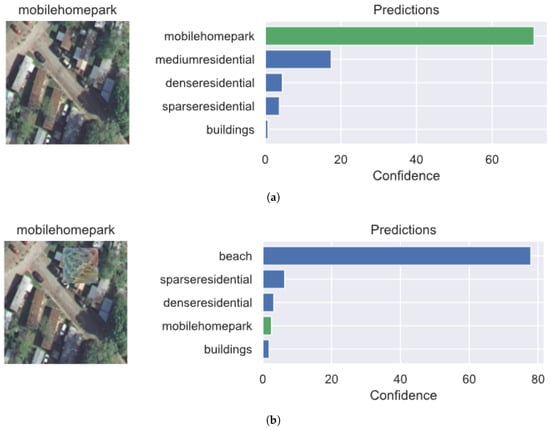
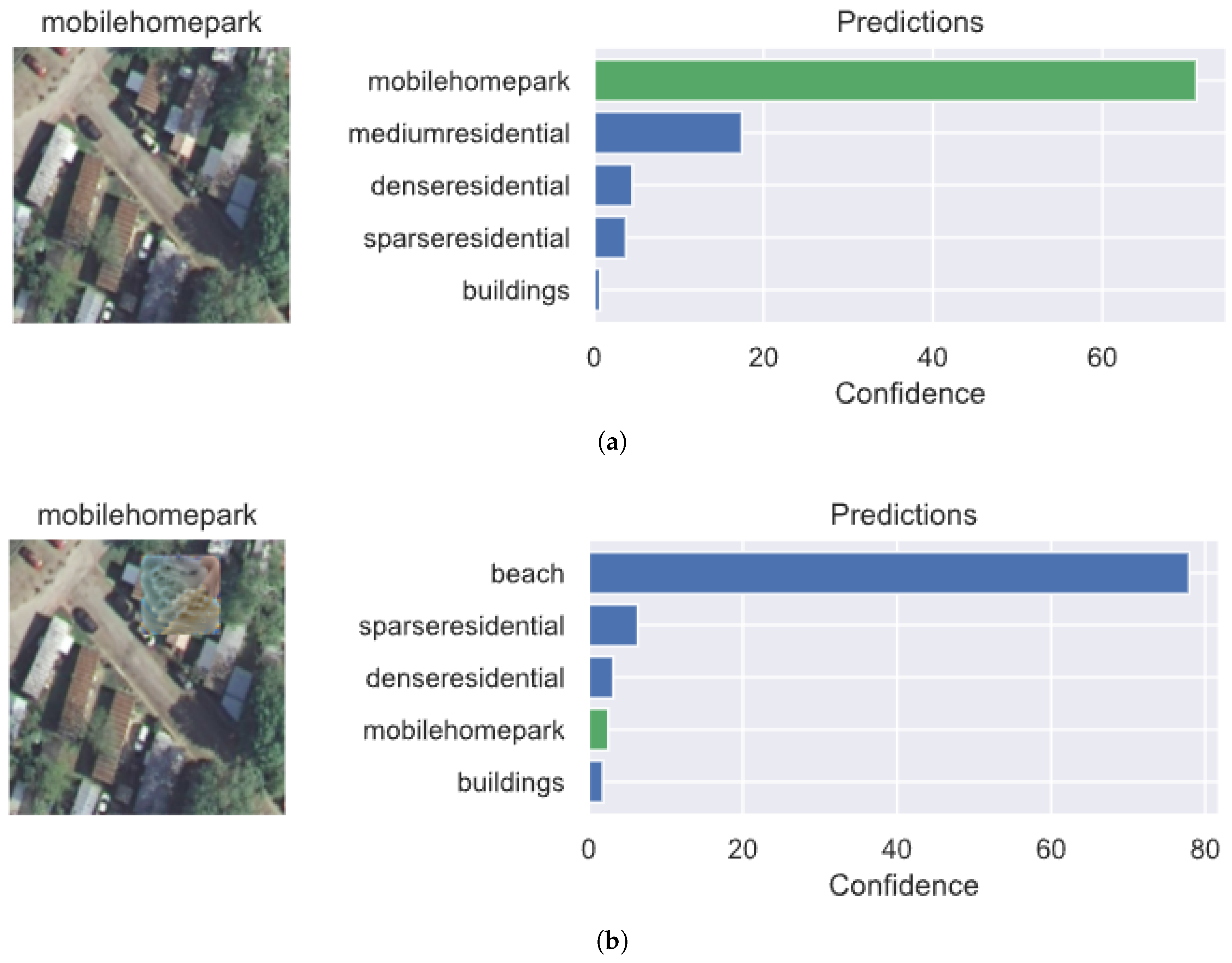
Convolutional Neural Networks (CNNs) have become essential tools in remote sensing, enabling automated interpretation of satellite and aerial imagery for land cover classification [1], environmental monitoring [2], disaster response [3], and seagrass detection [4]. However, despite their success, CNNs are highly vulnerable to adversarial attacks—carefully crafted perturbations that can mislead models with minimal or physically realizable changes. Among these, adversarial patch attacks pose a particularly serious threat due to their robustness and deployability in real-world settings. A single printed sticker or patch [5], strategically placed in a scene, can consistently fool a classifier across varying contexts and lighting conditions as shown in Figure 1. This makes patch attacks especially relevant for remote sensing systems, which often operate autonomously over large-scale, high-resolution imagery.
Figure 1.
Predictions of the standard model on clean and adversarially patched images: (a) The model correctly classifies the clean image as mobilehomepark and (b) Under an adversarial patch attack, the model misclassifies the image as a beach class. The green bar in each prediction chart highlights the prediction confidence of the ground-truth class. The blue bar represents the prediction confidence of incorrect classes.
To defend against such threats, adversarial training methods like Projected Gradient Descent Adversarial Training (PGD-AT) have been widely adopted. This approach improves robustness by exposing models to adversarial examples during training, but it is computationally expensive and often degrades clean accuracy. Moreover, it is typically tied to specific datasets and architectures, limiting their scalability across the diverse landscape of remote sensing. In practice, remote sensing models must generalize across different sensors, resolutions, and geographic regions—making cross-dataset and cross-architecture robustness transfer a critical challenge.
Recent research has explored robustness transfer, where adversarial robustness is distilled from robust models into new architectures or datasets. Most existing work [6] focuses on logit-level distillation and often targets pixel-level attacks. In many cases, the source and target models are trained and evaluated on the same dataset, limiting the generalization scope. In contrast, this study implements cross-dataset transfer and cross-architecture distillation within the remote sensing domain—for example, transferring robustness from a ResNet-152 [7] model trained on the EuroSAT [8] remote sensing dataset to a ResNet-50 model on the AID [9] aerial imagery dataset. This setup reflects real-world deployment scenarios where models must adapt to new imagery sources without retraining from scratch.
To tackle this challenge, this study introduces a novel methodology: an enhanced multi-teacher distillation framework tailored for adversarial patch defense in remote sensing. Unlike conventional approaches that rely primarily on logit-level supervision, this framework emphasizes feature-level guidance. It leverages both clean and adversarial robust teachers to supervise the student model’s feature representations, promoting richer semantic alignment and improved spatial robustness. A dynamic loss formulation is employed to weight each teacher’s contribution during training, enabling the student to balance clean accuracy and adversarial resilience adaptively. This multi-teacher feature alignment strategy provides a more expressive and flexible alternative to traditional logit-only distillation methods.
The core contributions of this study are summarized as follows:
- Developed a new methodology to improve adversarial robustness in remote sensing: a feature-level multi-teacher distillation framework (MTFM) that guides the student using both clean and adversarial supervision, offering a better trade-off between clean accuracy and robustness under patch-based attacks.
- Demonstrated effective robustness transfer across datasets (e.g., EuroSAT to AID) and architectures (e.g., ResNet-152 to ResNet-50), addressing a gap in existing literature where most robustness transfer is limited to same-dataset setups.
- Compared the proposed MTFM framework with existing robustness transfer strategies, showing favorable trade-offs between clean accuracy and robustness in diverse settings.
- Validated the proposed methods using adversarial test accuracy and explainable AI techniques to interpret feature alignment under patch-based attacks.
2. Related Work
This section presents the foundational background for the study.
2.1. Remote Sensing
Remote sensing is the science of acquiring information about Earth’s surface without direct contact, typically through satellite or aerial imagery. To interpret these images effectively, image classification plays a central role [10]. Traditional machine learning algorithms have shown limited performance on complex classification tasks [11], particularly in high-dimensional visual domains. Applications of image classification in remote sensing include traffic sign recognition [12], disaster monitoring [3], and urban planning [13].
The advent of convolutional neural networks (CNNs) significantly improved performance across image classification benchmarks. Researchers began investigating the vulnerabilities of CNNs [14], particularly their sensitivity to small, imperceptible perturbations in input images [15]. This phenomenon led to the emergence of adversarial attacks—techniques that intentionally perturb inputs to induce misclassification.
2.2. Adversarial Attacks
One of the earliest and most widely studied attacks is the Fast Gradient Sign Method (FGSM) [15], which perturbs an image x in the direction of the gradient of the loss function with respect to the input:
where controls the perturbation magnitude, J is the loss function, and denotes model parameters.
Building on this, researchers proposed a more physically realizable form of attack known as adversarial patch attacks [5]. Unlike pixel-level perturbations, adversarial patches are localized regions—often printable stickers—generated using model and dataset knowledge. These patches can be placed on real-world objects to induce misclassification, simulating realistic attack scenarios [16]. To generate the adversarial patch , we use a variant of the Expectation over Transformation (EOT) formulation:
where X is a training set of images, is the target class, T is a distribution over transformations of the patch, and L is a distribution over locations in the image [5]. The patch operator applies random scaling, transformation t, and location l on the patch to attach image x. Then, it is trained by gradient descent to create a universal patch for the target class.
Adversarial attacks are typically categorized based on the attacker’s knowledge [17]: - White-box attacks assume full access to model parameters and training data. - Black-box attacks operate without any internal model knowledge. - Gray-box attacks, which are more realistic, assume partial knowledge—such as access to the dataset and a standard model architecture, but no information about the defense mechanism.
This study adopts a gray-box adversarial patch attack framework to evaluate the robustness of defense models under practical constraints.
2.3. Defense Strategy
Adversarial training is a widely adopted defense mechanism aimed at improving model robustness against adversarial attacks. In this approach, the model is trained not only on clean inputs but also on adversarially perturbed examples. By exposing the model to adversarial inputs during training, it learns to generalize better under worst-case perturbations and reduce susceptibility to misclassification.
Formally, adversarial training seeks to minimize the expected loss over both clean and adversarial examples. The adversarial examples can be generated using various attack methods, such as FGSM, PGD, or more advanced techniques. The general training objective can be expressed as:
where is the adversarial version of input x, and is the model with parameters .
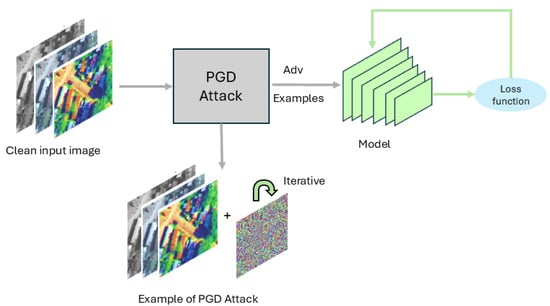
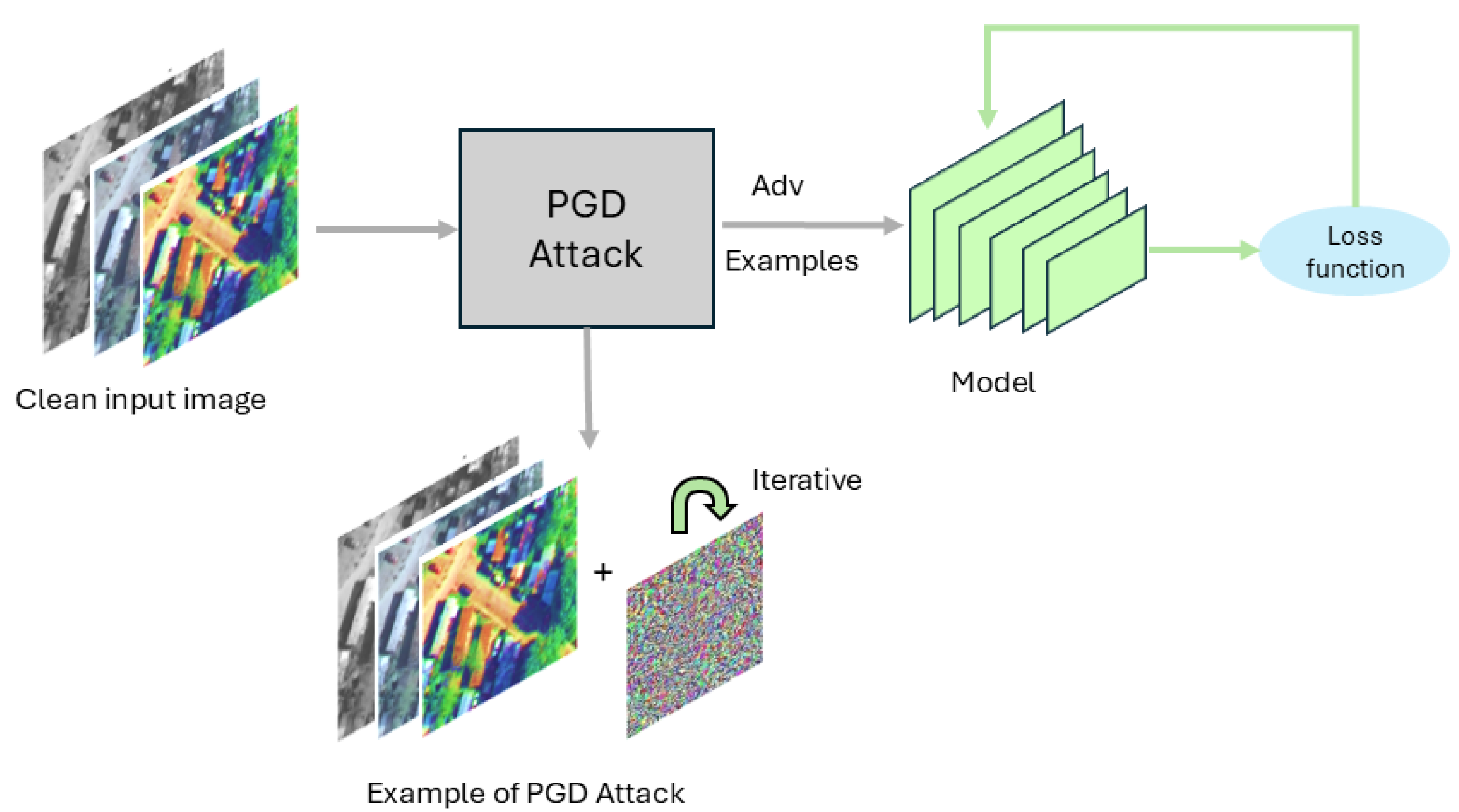
A more rigorous and effective variant of adversarial training is Projected Gradient Descent adversarial training (PGD-AT) [18], as shown in Figure 2. PGD generates adversarial examples by iteratively applying small perturbations in the direction of the gradient and projecting the result back into an -bounded ball around the original input. This multi-step attack is considered one of the strongest first-order adversaries and serves as a benchmark for evaluating robustness in most recent defense strategies.
Figure 2.
Projected Gradient Descent Adversarial Training.
The PGD adversarial training objective adopts a min-max formulation, where the inner maximization generates the worst-case adversarial example and the outer minimization updates the model to defend against it:
where is the adversarial perturbation constrained by set , typically defined as an -norm ball of radius .
This min-max framework ensures that the model is trained to minimize the worst-case loss over all allowable perturbations, thereby enhancing its robustness against strong adversarial attacks.
Several defense strategies have been proposed to mitigate adversarial patch attacks. One such method is Local Gradient Smoothing (LGS) [19], which suppresses adversarial gradients by smoothing the loss landscape around the input image. LGS modifies the input such that the gradient signal becomes less informative for crafting perturbations. While this technique can reduce the effectiveness of certain attacks, it may cause adversarial images to resemble clean ones without truly enhancing model robustness. In other words, the defense may mask the attack rather than strengthen the model’s decision boundaries. The goal of this study is to develop models that are genuinely robust so that robustness can be transferred across tasks and domains.
PGD adversarial training remains the most widely accepted and empirically validated defense against adversarial patch attacks. Most recent works [20] build upon PGD training as a foundation, coupling it with additional mechanisms to improve spatial awareness or generalization. For example, PatchZero [21] introduces a two-stage adversarial training scheme to defend against stronger adaptive attacks by “zeroing out” the patch—multiplying the input image X with a binary mask M and replacing the patch region with mean pixel values. The preprocessed image is then passed to the downstream model for final prediction.
Another line of work focuses on physically realizable occlusion-based attacks [22], where adversaries insert small, adversarially crafted rectangles into the image. These attacks simulate real-world scenarios such as sticker-based perturbations on traffic signs or printed patches on objects. Defense strategies in this space include training with synthetic occlusions (e.g., gray patches) and designing attention mechanisms that ignore irrelevant regions.
Adversarial patches, though localized in the input space, often introduce abnormal activations and inflated feature norms in deep networks, leading to distorted intermediate representations [23]. Recent defenses therefore focus on extracting more robust global features—such as semantic context, boundary structures, and long-range correlations—which are less sensitive to localized corruption and can effectively suppress the influence of patch attacks [24].
Self-attention [25] module allows the model to dynamically focus on different parts of the input when making predictions. Unlike traditional convolutional layers, which extract local features using fixed-size kernels, self-attention captures global dependencies by computing interactions between all spatial positions in the input feature map.
In this study, a self-attention block is introduced before the penultimate layer of the model architecture to enhance intermediate feature representations and aimed at improving adversarial robustness by enabling the model to focus on the most informative regions of the image.
Let the input feature map be denoted as , where C is the number of channels and are the spatial dimensions. The self-attention mechanism projects the input into three representations: query Q, key K, and value V, computed via learnable convolutions:
where , , and (as in our implementation).
We then reshape and flatten the spatial dimensions such that:
The attention map is computed using a dot product between the query and key followed by a softmax operation:
This attention matrix reflects the pairwise similarities between all spatial positions in the feature map. The output of the attention layer is then calculated by:
which is reshaped back to . To preserve the original features and enable residual learning, the final output is:
where is a learnable scalar initialized to zero.
The query–key interaction measures similarity between all spatial locations, enabling the model to capture long-range dependencies. The attention map A controls where the model focuses by weighting spatial features based on these similarities. The value V provides the information to be aggregated according to the attention weights, forming the refined representation. A residual connection is added to ensure stable training and preserve the original spatial context.
This non-local attention mechanism is inspired by [26], and enhances the model’s ability to attend to semantically important regions in the image, improving both classification performance and adversarial robustness.
While these methods introduce novel components, they often come with substantial training overhead—sometimes exceeding that of PGD adversarial training itself—and the transferability of the resulting robustness across datasets and architectures remains uncertain. In this study, PGD adversarial training serves as the base defense strategy. We combine it with transfer learning to address two key challenges: robustness transferability and training efficiency. Our approach aims to retain PGD-level robustness while improving generalization and reducing computational cost.
2.4. Transferring Robustness
Having established the severity of adversarial patch attacks and reviewed traditional defense mechanisms, we now explore the concept of transferring robustness [27]. This idea is inspired by transfer learning, a paradigm in which knowledge gained from one task or domain is leveraged to improve performance on another. In transfer learning, a model trained on a large source dataset (e.g., ImageNet) is fine-tuned on a smaller target dataset, allowing it to retain generalizable features while adapting to new tasks.
Transferring robustness extends this idea by aiming to preserve adversarial resilience across domains. Instead of training a robust model from scratch for every new dataset, we seek to transfer robustness from a source model—typically trained with adversarial defenses—to a target model via fine-tuning or feature alignment. This approach is particularly valuable when computational resources are limited or when the target domain lacks sufficient adversarial examples for training.
Recent research [28] has established the benefits of robustness transfer, demonstrating that adversarially trained models can retain and propagate resilience when adapted to new domains. Studies [29] show that fine-tuning robust source models often leads to improved adversarial accuracy on target tasks, even without direct exposure to adversarial examples during transfer.
Knowledge distillation [30] framework is used for transferring knowledge [31] and robustness from a high-capacity model (teacher) to a smaller or less complex model (student). In this setup, the teacher model is typically pre-trained and exhibits strong performance, often including resilience to adversarial attacks. The student model is trained to mimic the behavior of the teacher by minimizing the divergence between their output distributions, rather than relying solely on ground-truth labels.
In the context of adversarial robustness, the teacher is a robust model trained using techniques such as PGD adversarial training. The student learns not only the classification task but also inherits the robustness characteristics of the teacher through distillation. This enables the student to generalize better under adversarial conditions, even when trained with fewer resources or on smaller datasets.
The training objective combines the standard cross-entropy loss with a distillation loss based on the Kullback–Leibler divergence between temperature-scaled soft logits of the teacher and student, as introduced by Hinton et al. [30] and further detailed in the review by Stanton et al. [32].
where and are the student and teacher logits respectively, y is the one-hot ground-truth label, and balances the two objectives.
The cross-entropy loss is defined as:
The distillation loss uses temperature-scaled softmax distributions:
where is the temperature parameter and denotes the softmax probability for class j. The factor ensures proper gradient scaling during backpropagation.
This architecture allows robustness to be transferred in a scalable and modular fashion, making it suitable for deployment in resource-constrained environments. In this study, we use robust teacher models trained on source datasets and distill their robustness into student models trained on target datasets, evaluating their performance under adversarial patch attacks.
3. Methodology
This section outlines the methodology adopted in this study to evaluate robustness transfer under adversarial patch attacks. The process involves training standard models and developing robust models using transfer learning strategies.
3.1. Standard Models
The first step is to train standard models on all source datasets (EuroSAT, PatternNet) and target datasets (UCM, AID), following the architectures and training parameters outlined in the Experimental Setup section. These models serve as baseline classifiers and are denoted as . These models are later used to generate adversarial patches specific to each dataset.
3.2. Projected Gradient Descent Adversarial Training
As discussed, the PGD-AT algorithm [18] is used to develop robust models against adversarial patch attacks. It generates adversarial examples by iteratively perturbing the input image to maximize the model’s loss, thereby encouraging robustness during training. Throughout this work, models trained using the PGD-AT algorithm are referred to as , representing the adversarially robust baseline.
3.3. Self-Attention Module-Based Adversarial Robustness Transfer
Transfer learning (TL) enables the reuse of robustness learned from a source model to a target model through selective retraining of network layers. Three TL strategies were employed in this study: (1) Full Network Fine-Tuning (Fullnet), where all layers of the robust source model are transferred and retrained on the target dataset to enable complete adaptation to the new domain; (2) Fixed Feature Fine-Tuning (Fixedfeat), where all layers except the final fully connected (FC) layer are frozen, allowing the model to retain its learned feature representations while adapting its output space; and (3) Freeze 25 Layer Transfer (F25), in which the first 25 layers are frozen while the remaining layers are retrained, balancing feature reuse and domain-specific learning.
A self-attention module is integrated before the penultimate layer of the ResNet architecture to enhance feature representations and is aimed at improving robustness against adversarial patch attacks. This module enables the model to focus on salient spatial regions and suppress less relevant features, thereby improving resistance to localized perturbations. A ResNet-50 model augmented with this self-attention module was first trained on the source dataset using PGD adversarial training and then transferred to the target dataset using the aforementioned TL strategies. The best-performing variant is denoted as SA-TL for comparison.
For example, a PGD-trained ResNet-50 with a self-attention module trained on EuroSAT was transferred to UCM, enabling the model to retain adversarial robustness while adapting to the target domain. To ensure consistency, the same architectural modification was applied to models used for patch generation. While this approach improved robustness, it also introduced additional parameters and deviated from standard model configurations, which may affect its efficiency in lightweight deployment settings. Moreover, it does not support cross-architecture robustness transfer, limiting its flexibility when adapting to models with different backbone structures.
3.4. Proposed Multi-Teacher Feature Matching (MTFM) Approach
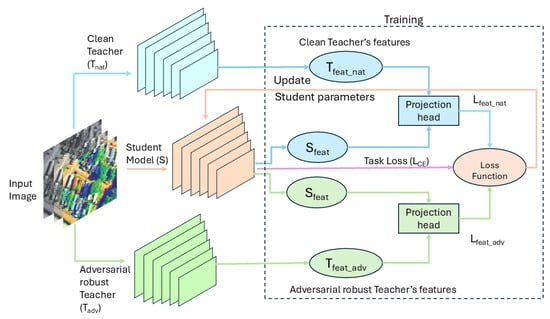
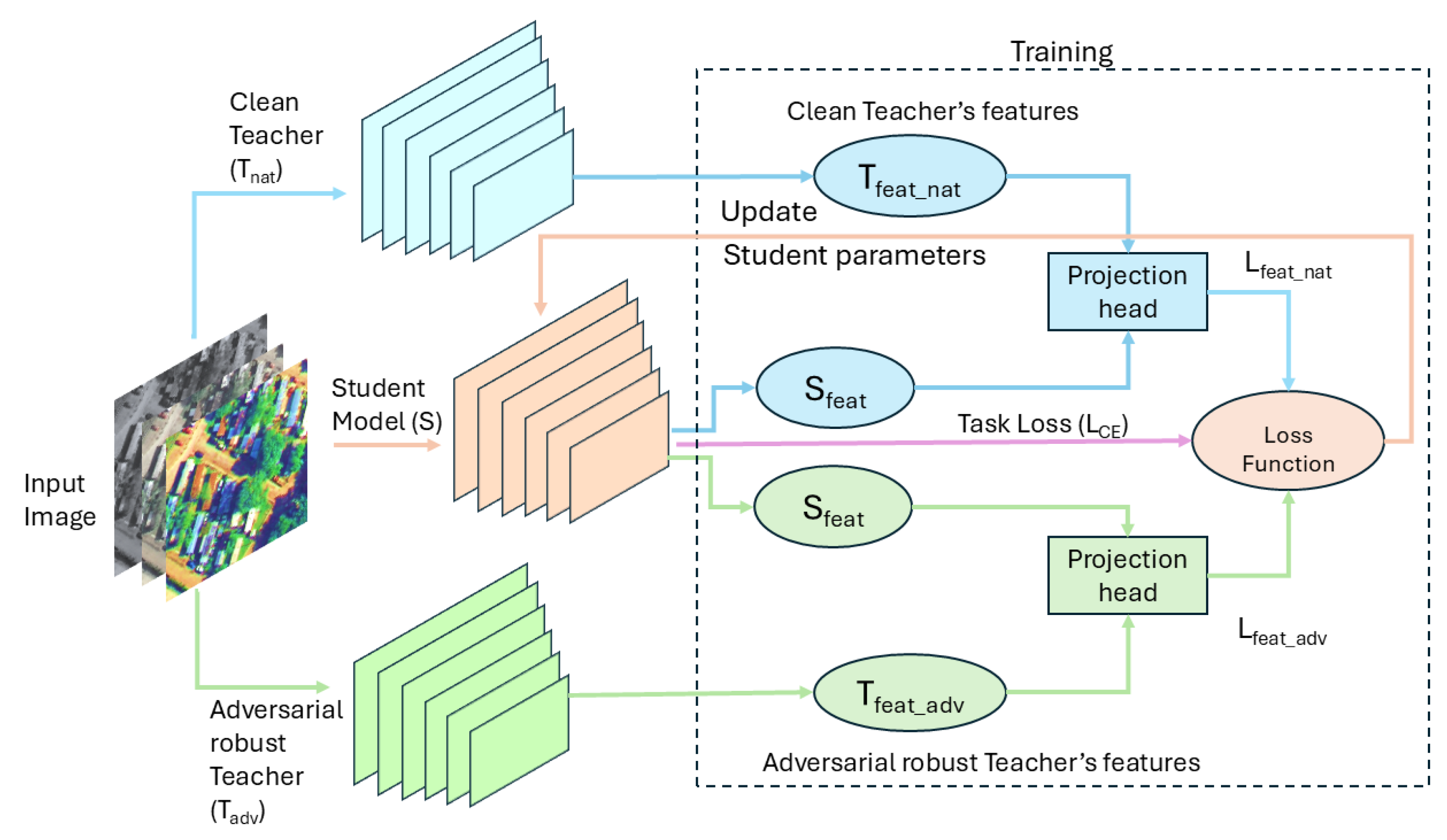
Multi-Teacher Feature Matching (MTFM) is a teacher–student framework [31] for knowledge distillation that leverages both adversarial and natural supervision. In this setup (shown in Figure 3), two distinct teacher models are employed: one adversarially robust () teacher trained via PGD-based adversarial training, and one naturally trained () teacher using standard clean examples. The previous dual-teacher method MTARD (Multi-Teacher Adversarially Robust Distillation) framework [6], facilitates robust knowledge transfer within the same dataset. The proposed Multi-Teacher Feature Matching (MTFM) explores a more challenging cross-dataset and cross-architecture transfer setting.
Figure 3.
Multi-Teacher Feature Matching (MTFM) Framework.
The MTFM approach utilizes two types of teachers: adversarially robust and natural teachers. Specifically, the adversarially robust () and natural teachers () are trained on a large source dataset (e.g., PatternNet), and their knowledge is distilled into a student model (S) trained on a smaller, unrelated target dataset (e.g., UCM). Due to the mismatch in class semantics between source and target datasets, logit-based distillation becomes ineffective. Instead, feature-level matching is performed, allowing the student () to learn from the internal representations of both teachers (Tfeat_nat, Tfeat_adv), using cosine similarity to compute the feature loss and encourage directional alignment in representation space.
This architecture introduces projection heads to enable effective feature-level distillation across architectures, as illustrated in Figure 3. A projection head is a small neural network that maps features into a shared embedding space for comparison or alignment. For example, the student projection head maps the 512-dimensional penultimate features from ResNet-18 () into a common 512-dimensional embedding space, while each teacher’s 2048-dimensional features (Tfeat_nat, Tfeat_adv) are projected into the same space using their own projection head. This design resolves the dimensional mismatch between models, enabling direct comparison of internal representations. By aligning features in a common embedding space, the student learns directional similarity to the teacher’s representations—even across architectural gaps. This setup supports semantic and spatial robustness transfer from both clean and adversarially robust teachers, without relying on logits or class alignment, and offers flexibility to incorporate diverse teacher architectures across domains.
To accommodate the differing influence of each teacher during training, we use a dynamically weighted loss function. The individual components are defined as follows.
The standard cross-entropy loss between the student predictions and ground-truth labels is:
where C is the number of classes, is the one-hot encoded ground-truth label, and is the predicted probability for class i.
The feature matching losses between the student and the natural/adversarial robust teachers are computed using cosine similarity:
where is the student feature representation, and , are the corresponding features from the natural and adversarial robust teachers.
Cosine similarity is defined as:
The cross-entropy loss is assigned a constant weight of , while the feature matching weights and are initialized to 0.4 and updated dynamically during training based on the relative magnitude of feature losses from each teacher.
The dynamic weights are computed as:
where is a small constant added to prevent division by zero.
Finally, the total loss is computed as:
This weighting mechanism reflects the student’s learning progress from each teacher. A lower feature loss indicates that the student is already aligned with that teacher’s representation, so its weight is reduced. Conversely, a higher feature loss suggests the student has more to learn from that teacher, increasing its influence. This adaptive balance ensures that the student benefits from both teachers in proportion to their current impact, enabling effective cross-domain robustness transfer even when class labels and architectures differ. For clarity, we denote each multi-teacher feature matching model using the notation .
Before discussing the experimental outcomes, we define a few key terms and evaluation metrics to aid interpretation.
4. Experimental Setup
This section outlines the experimental setup used to evaluate the proposed methodology.
4.1. Threat Model
The threat model considered in this study involves a victim application that relies on an image classification model for remote sensing tasks. An adversary aims to compromise this model by deploying adversarial patches—localized, physically realizable perturbations designed to induce misclassification. These patches are crafted using publicly available remote sensing datasets such as UCM [33] or PatternNet [34], along with standard models trained on those datasets. Unlike imperceptible pixel-level perturbations, adversarial patches can be printed and physically placed on objects within the scene, making them highly relevant for real-world attack scenarios. The attacker’s capabilities are defined by their knowledge of the victim system: in a white-box setting, the attacker has full access to the model architecture and parameters; in a black-box setting, the attacker has no internal knowledge; and in a gray-box setting, the attacker has partial knowledge—typically access to the dataset and a standard model architecture, but no information about the defense mechanism. This study adopts a gray-box attack setup, reflecting a practical and moderately informed adversary. The adversarial patch is generated using a standard model trained on the same dataset as the victim model, without access to the defense strategy. The primary objective of this study is to develop robust models that can withstand adversarial patch attacks while minimizing computational overhead. To achieve this, we explore the concept of transferring robustness—leveraging pre-trained robust models to enhance resilience in new domains without retraining from scratch.
4.2. Datasets
The datasets used in this study are divided into two categories: source datasets, which are used to train robust source models, and target datasets, to which robustness is transferred. This setup mimics a downstream transfer learning scenario, where the goal is to evaluate how well robustness generalizes across domains. The primary source datasets include EuroSAT (E) [8], which contains 27,000 RGB satellite images across 10 land use and land cover classes at a resolution of 64 × 64 pixels. Derived from Sentinel-2 satellite data, EuroSAT is widely used for remote sensing classification tasks. Another source dataset is PatternNet (P) [34], comprising over 30,000 high-resolution aerial images spanning 38 scene categories, each sized at 256 × 256 pixels, making it suitable for fine-grained scene understanding.
The target datasets include the UC Merced Land Use Dataset (UCM) [33], which consists of 2100 aerial images across 21 classes, each image sized at 256 × 256 pixels. It is commonly used for evaluating scene classification performance. The Aerial Image Dataset (AID) [9] contains 10,000 images across 30 scene categories, with varying resolutions and geographic diversity, making it a challenging benchmark for generalization. Robustness transfer is performed from EuroSAT to AID and UCM, and from PatternNet to AID and UCM, to evaluate cross-dataset generalization under adversarial patch attacks.
4.3. Model Architectures
This study employs three variants of the ResNet architecture [7]. ResNet-152 (R152) is a deep residual network with 152 layers, known for its strong representational capacity and robustness in large-scale classification tasks. ResNet-50 (R50) is a 50-layer variant that balances depth and computational efficiency, and is commonly used in transfer learning pipelines. ResNet-18 (R18) is a lightweight 18-layer model suitable for low-resource settings and fast inference. Robustness is transferred from ResNet-152 to both ResNet-50 and ResNet-18, and additionally from ResNet-50 to ResNet-18. This hierarchical transfer setup allows us to evaluate whether robustness learned by deeper models can be effectively inherited by shallower architectures. By experimenting with multiple datasets and model configurations, we demonstrate the generalizability of the proposed robustness transfer framework across both domain and architectural shifts.
4.4. Hyperparameters
Dataset split: All datasets are divided into training, validation, and test sets using a 70%–20%–10% ratio.
Standard models: Trained using a learning rate of , with categorical cross-entropy as the loss function and stochastic gradient descent as the optimization algorithm. Training is conducted for 10 epochs unless otherwise specified. All models are initialized with ImageNet pre-trained weights to accelerate convergence and enable effective fine-tuning.
Adversarial training: We apply Projected Gradient Descent (PGD) with 10 iterations and an perturbation budget of . This setup is used to train robust models across all source datasets and architectures.
Self attention: Models used in self-attention experiments follow the same learning rate and loss function, and are trained for 10 epochs. These models are evaluated for robustness transfer under adversarial patch attacks.
MTARD: The training procedure follows the setup described in the MTARD paper [6]. All models are initialized with ImageNet-pretrained weights and trained for 10 epochs, consistent with the setup used across other approaches. Teacher models are trained using the adversarial training parameters outlined above, and to maintain consistency, the student model is also trained with the same adversarial parameters as specified in the adversarial training setup.
MTFM: For multi-teacher feature distillation experiments, the training configuration remains consistent: learning rate of , a custom distillation loss function, and stochastic gradient descent optimizer, with training conducted for 10 epochs. This uniform setup ensures comparability across all robustness transfer strategies. All the models are trained on GPU device: NVIDIA RTX A5000.
4.5. Evaluation Metrics
In this study, we use the following terminology to describe the robustness transfer setup. The Source refers to the dataset used to train the robust teacher models, while the Target denotes the dataset to which robustness is transferred and evaluated. The term Model identifies the specific robustness strategy or training configuration being assessed, and Arch indicates the architecture of the model (e.g., ResNet-18, ResNet-50, ResNet-152).
To evaluate model performance, we report three key metrics. Clean Accuracy (Clean) measures the model’s performance on unperturbed test images. It represents the percentage of clean (non-adversarial) samples correctly classified by the model, indicating generalization and baseline discriminative capability under normal conditions. It is computed as:
where is the ground-truth label for image i, and is the model’s prediction on the clean image.
Adversarial Test Accuracy (ATA) quantifies the percentage of adversarially patched images for which the model correctly predicts the ground-truth label despite the presence of an adversarial patch. It is computed as:
where is the ground-truth label for image i, and is the model’s prediction on the adversarially patched image.
Attack Success Rate (ASR) measures the percentage of adversarially patched images for which the model’s prediction matches the attacker’s target label. It is defined as:
where is the model’s prediction for adversarial image i, is the attacker’s target label, and N is the total number of adversarial samples. The indicator function returns 1 if the condition is true and 0 otherwise.
5. Results
This section presents the results of the proposed Multi-Teacher Feature Matching (MTFM) framework.
5.1. Generating Adversarial Patches
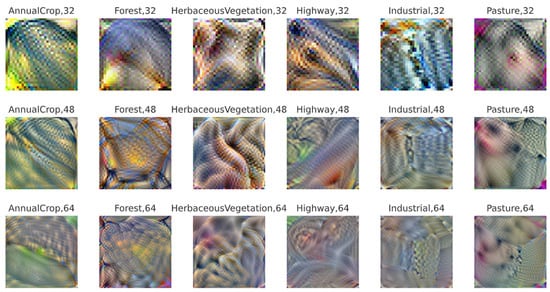
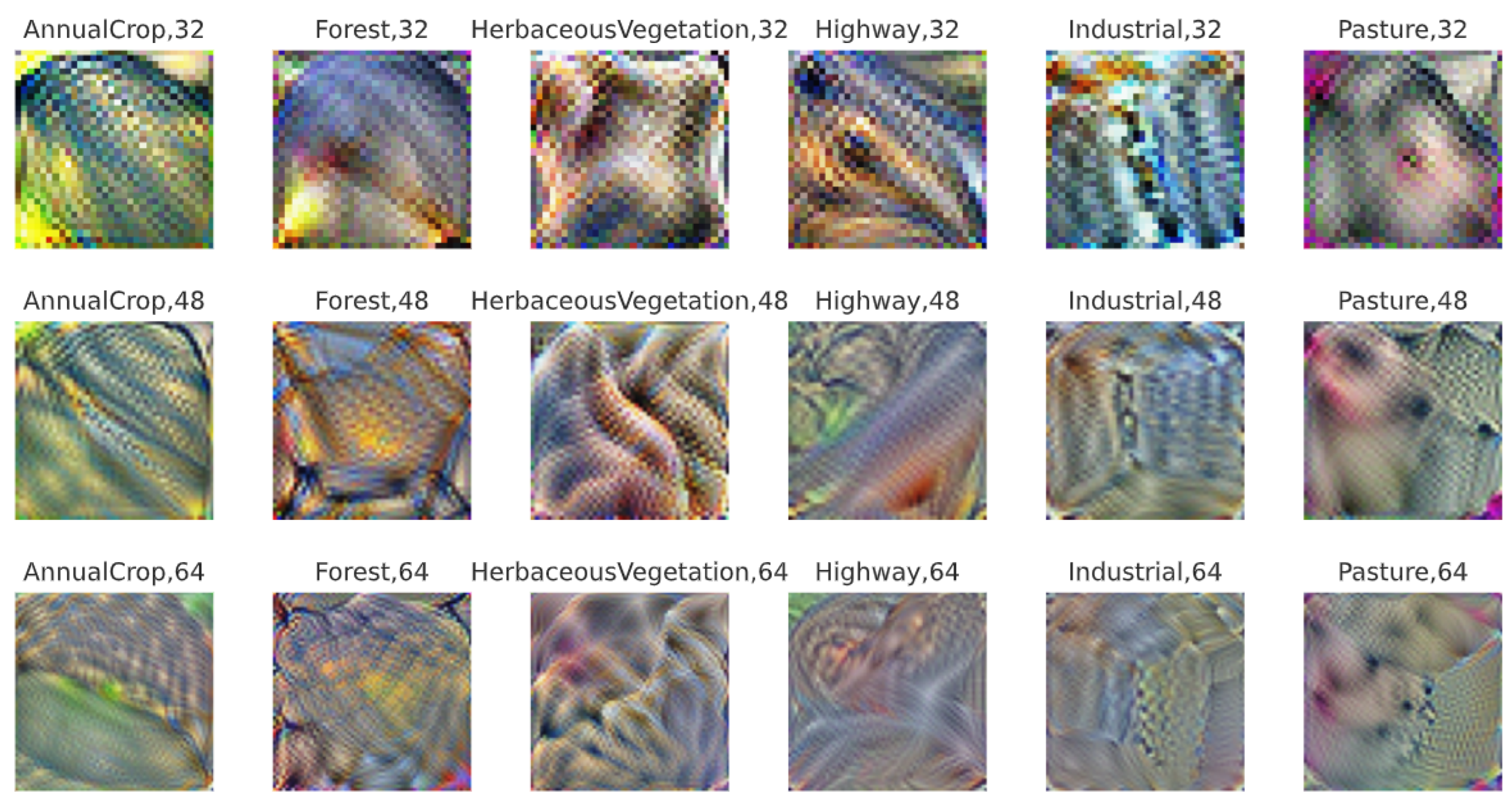
Adversarial patches [5] represent a stronger class of adversarial attacks that are physically realizable and can be placed directly on input images. To generate these patches, we use the standard model trained on a given dataset along with the dataset itself, following the Expectation Over Transformation (EOT) framework as defined in Equation (2). This approach ensures that the generated patch remains effective under various transformations such as scaling, rotation, and translation. For instance, adversarial patches for EuroSAT are generated using EuroSAT model and the EuroSAT dataset as shown in Figure 4.
Figure 4.
Adversarial patches of EuroSAT dataset using ResNet-50 model.
In this study, we develop adversarial patches of three standard sizes: , , and . These patch sizes correspond to approximately , , and of the total area of the input image, respectively, assuming a fixed input resolution of pixels. This range allows us to evaluate robustness under varying degrees of localized perturbation, from subtle to visually dominant attacks.
5.2. Multi Teacher Feature Matching (MTFM) Result
In this subsection, we compare the results of the proposed Multi-Teacher Feature Matching (MTFM) approach against standard and traditional defense models. The evaluation spans multiple source datasets, target datasets, and model architectures to assess the generalizability of MTFM. All models are attacked using adversarial patches of varying sizes—32 × 32, 48 × 48, and 64 × 64—to test robustness under increasingly localized perturbations.
Table 1 presents the performance of standard and PGD-trained models. All standard models exhibit a significant drop in Adversarial Test Accuracy (ATA) when attacked with a 64 × 64 adversarial patch. In contrast, models trained with PGD adversarial training show a noticeable decrease in clean accuracy but achieve substantial gains in ATA, albeit with increased training time. These PGD-trained models will be used as robustness sources for transferring to target models.
Table 1.
Clean and adversarial accuracies of models trained on source datasets (PatternNet and EuroSAT).
5.3. PatternNet → UCM and AID
Table 2 summarizes the clean accuracy, adversarial test accuracy (ATA), and attack success rate (ASR) across standard training and various defense strategies, including the proposed Multi-Teacher Feature Matching (MTFM) framework. The source domain is PatternNet, and robustness is transferred to target datasets—UCM and AID—using different architectural configurations: ResNet-152→ResNet-50, ResNet-152→ResNet-18, and ResNet-50→ResNet-18.
Table 2.
Clean and adversarial accuracies of target models developed by transferring robustness from PatternNet.
The model refers to the standard baseline trained directly on the target dataset without any adversarial defense. The model is trained using Projected Gradient Descent adversarial training on the same target dataset, generating perturbations across the entire image to improve robustness. The model applies transfer learning, where robustness is inherited from a source dataset and fine-tuned on the target dataset using the same architecture. Similarly, the SA-TL model transfers robustness from a source dataset and fine-tunes it on the target dataset, maintaining the same architecture. The model uses the same dataset for both source and target domains—for example, teachers are trained on the UCM dataset and transferred to a different architecture on the same UCM dataset. In contrast, the model performs cross-architecture and cross-dataset robustness transfer, where robustness learned from a source dataset is transferred to a different target dataset to enhance generalization and reduce training overhead.
5.3.1. Results on ResNet-50 (UCM and AID)
For the UCM dataset, all models employ ResNet-50 as the backbone architecture. The standard model () achieves a clean accuracy of 88.09%, while the PGD-trained model (PGD) reaches 85.56%. The transfer learning model (), which inherits robustness from a PGD-trained ResNet-50 on PatternNet, achieves the highest clean accuracy of 92.85%. The self-attention transfer learning variant (SA-TL) achieves a clean accuracy of 91.11%. The () model achieves a clean accuracy of 86.62%. The proposed Multi-Teacher Feature Matching model () achieves a clean accuracy of 90.95%, outperforming (), (), and (), while closely approaching the performance of (SA-TL) and () models. Under a patch, the proposed model achieves an ATA of 85.83%, outperforming the , , and models by 3.83%, 2.5%, and 3.33%, respectively, while matching the performance of the SA-TL model. For a larger patch size of , the model achieves an ATA of 81.16%, surpassing the , , and matching the performance of both , SA-TL, and models. Under the largest patch size of , the ATA of the model drops to 15.83%, while the , SA-TL, and models achieve 70.00%, 79.50%, and 77.17%, respectively. The model achieves an ATA of 81.83%, outperforming all baseline models and matching the performance of the model. In terms of training efficiency, the model achieves this robustness with 38.21 s per epoch, which is comparatively less training time compared to the and models.
Switching to the AID dataset as the target domain, the model achieves the highest clean accuracy of 91.73%, followed by the model (88.23%), model (84.87%), model (78.07%), SA-TL model (77.90%), and with a clean accuracy of 76.43%. Under the adversarial patch attack, the model achieves 82.06% ATA—improvements of 57.28% over the model, 12.86% over the model, 9.01% over the model, 10.16% over the SA-TL model (71.90%), and 10.43% over the model. When attacked with a adversarial patch, the model again leads with 77.17% ATA, outperforming the model (10.44%), model (58.50%), model (72.56%), SA-TL model (66.36%), and the model (67.63%). Under the most challenging patch attack, the model sustains robustness with 76.97% ATA, surpassing the model (3.97%), model (45.93%), model (69.33%), SA-TL model (63.52%), and model (67.45%). Notably, the model achieves these improvements while maintaining substantially lower training times than the model, and performs better than SA-TL and , while matching the performance of the model—demonstrating better trade-offs between robustness, accuracy, and computational cost.
5.3.2. Results on ResNet-18 (UCM and AID)
To further assess cross-architecture robustness transfer, the framework is evaluated with ResNet-18 as the target model, as shown in Table 2. On UCM, variants (R152→R18 and R50→R18) achieve clean accuracies of 89.68% and 86.99%, respectively, outperforming (85.08%), (79.68%), (84.60%), SA-TL (86.98%), and . Under , , and adversarial patch attacks, the models perform better than and in terms of ATA. The defense models , SA-TL, and also achieve competitive ATA scores.
For AID with ResNet-18, achieves 88.7% clean accuracy, reaches 83.87%, and slightly improves to 89.2%. achieves 73.8% (R152→R18) and 70.17% (R50→R18). The SA-TL model achieves a clean accuracy of 85.37%. attains 85.37% (R152→R18) and 88.27% (R50→R18). Under the adversarial patch attack, the model (R152→R18) achieves a notable improvement over all baselines and matches the performance of the model. A similar trend is observed under the adversarial patch attack, where the MTFM model shows similar performance to TL. Under the most severe adversarial patch attack, (R50→R18) achieves the highest ATA of 69.9%, representing improvements of 68.37% over , 8.56% over , 1.9% over , and 7.68% over the best-performing variant. Importantly, achieves these accuracies with less than half the training time compared to and , highlighting its cost-effective nature.
5.4. EuroSAT → UCM and AID
To further validate the robustness transfer hypothesis, we repeat the same experimental setup using EuroSAT as the source dataset (Table 3), replacing PatternNet from the previous experiments.
Table 3.
Clean and adversarial accuracies of target models developed by transferring robustness from EuroSAT.
5.4.1. Results on ResNet-50 (UCM and AID)
On the UCM dataset with ResNet-50 as the target architecture, the model achieves a clean accuracy of 88.09%, while the -trained model reaches 85.56%. The transfer learning model , which inherits robustness from EuroSAT, achieves 82.7%. The SA-TL model achieves a clean accuracy of 83.33%, and the model achieves 86.82%. The proposed model outperforms all baselines with a clean accuracy of 90.95%. Under a adversarial patch attack, all models maintain ATA above or close to 80%, with achieving the highest at 84.33%. At the adversarial patch level, the model’s ATA drops to 45.0%, while reaches 75.67%, achieves 79.01%, SA-TL achieves 77.5%, achieves 81.17%, and leads with 81.83% ATA. Against the strongest patch attack, the model collapses to 15.83% ATA, reaches 70.0%, achieves 77.0%, SA-TL reaches 76.83%, achieves 77.17%, and tops the performance with 79.0% ATA—showing strong resilience across patch sizes.
On the AID dataset with ResNet-50, achieves a clean accuracy of 91.73%, reaches 84.87%, achieves 88.0%, SA-TL achieves 87.3%, achieves 76.43%, and attains 90.01%. Under a adversarial patch attack, ATA values are 24.78% (), 69.2% (), 85.31% (), 78.03% (SA-TL), 71.63% (), and 83.81% (). outperforms , , SA-TL, and , and closely matches . Attacked with a adversarial patch, the models exhibit varying levels of robustness, with outperforming most baselines across ATA. Against the strongest adversarial patch attack, drops to 3.97%, reaches 45.93%, achieves 81.52%, SA-TL reaches 73.44%, achieves 67.45%, and attains 76.66%—which is within 5% of and represents improvements of 72.69% over and 30.73% over .
5.4.2. Results on ResNet-18 (UCM and AID)
With ResNet-18 as the target architecture on UCM, the model achieves 85.08% clean accuracy, with ATA values of 71.33%, 48.33%, and 22.83% under , , and adversarial patches, respectively. The model achieves 79.68% clean accuracy and ATA values of 74.0%, 71.66%, and 63.66%. maintains 79.05% clean accuracy and achieves 75.33%, 72.33%, and 72.17% ATA across the three patch sizes. The SA-TL model achieves 80.32% clean accuracy and ATA values of 76.83%, 72.33%, and 71.0%. The model (R152→R18) achieves 86.51% clean accuracy and ATA values of 84.0%, 78.83%, and 78.17%. The proposed model (R152→R18) outperforms all baselines with 86.83% clean accuracy. The model (R152→R18) achieves ATA values of 78.67%, 76.30%, and 70.17%, respectively—surpassing and across all metrics and closely matching and .
On AID with ResNet-18, the model achieves 88.87% clean accuracy, with ATA values of 32.41%, 8.04%, and 1.53% under increasing patch sizes. The model achieves 83.87% clean accuracy and ATA values of 58.93%, 50.41%, and 61.34%. The model achieves 83.23% clean accuracy and ATA values of 76.18%, 68.21%, and 75.69%. The SA-TL model achieves 82.33% clean accuracy and ATA values of 64.22%, 51.81%, and 66.39%, respectively—outperforming and closely matching . The model (R152→R18) attains a clean accuracy of 73.8% and ATA values of 66.01%, 62.8%, and 62.22%. The model (R152→R18) achieves the clean accuracy of 84.63% and ATA values of 74.19%, 67.72%, and 67.73%, respectively—outperforming , , SA-TL, and , while closely matching the model.
Overall, the proposed framework consistently outperforms both and -trained models in terms of clean accuracy, Adversarial Test Accuracy (ATA), and Attack Success Rate (ASR) under patch-based adversarial attacks. All reported accuracies were averaged over three independent runs to ensure stability and fairness in comparison. In many cases, also matches or exceeds the performance of transfer learning () models. requires less training time. This demonstrates its effectiveness and efficiency as a robust defense strategy.
5.5. Evaluating Performance Using Grad-CAM Visualizations
While model performance has traditionally been evaluated using accuracy metrics, this study also employs Grad-CAM [35] to assess interpretability and decision focus. Grad-CAM is an explainable AI technique that visualizes the regions of an input image that most influence the model’s predictions. In this context, it highlights where the model attends when making classification decisions.
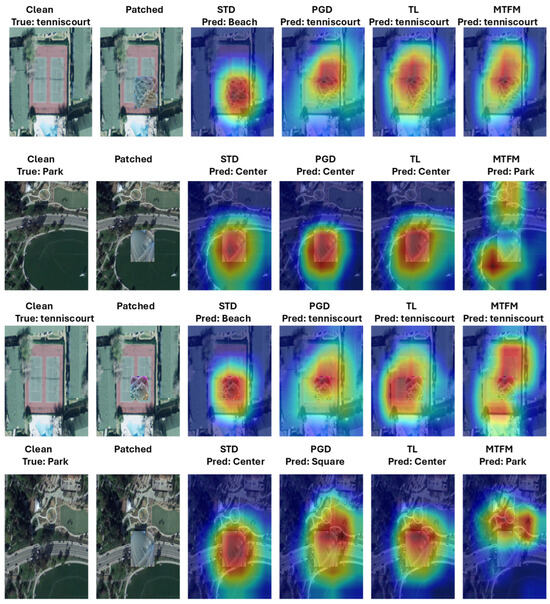
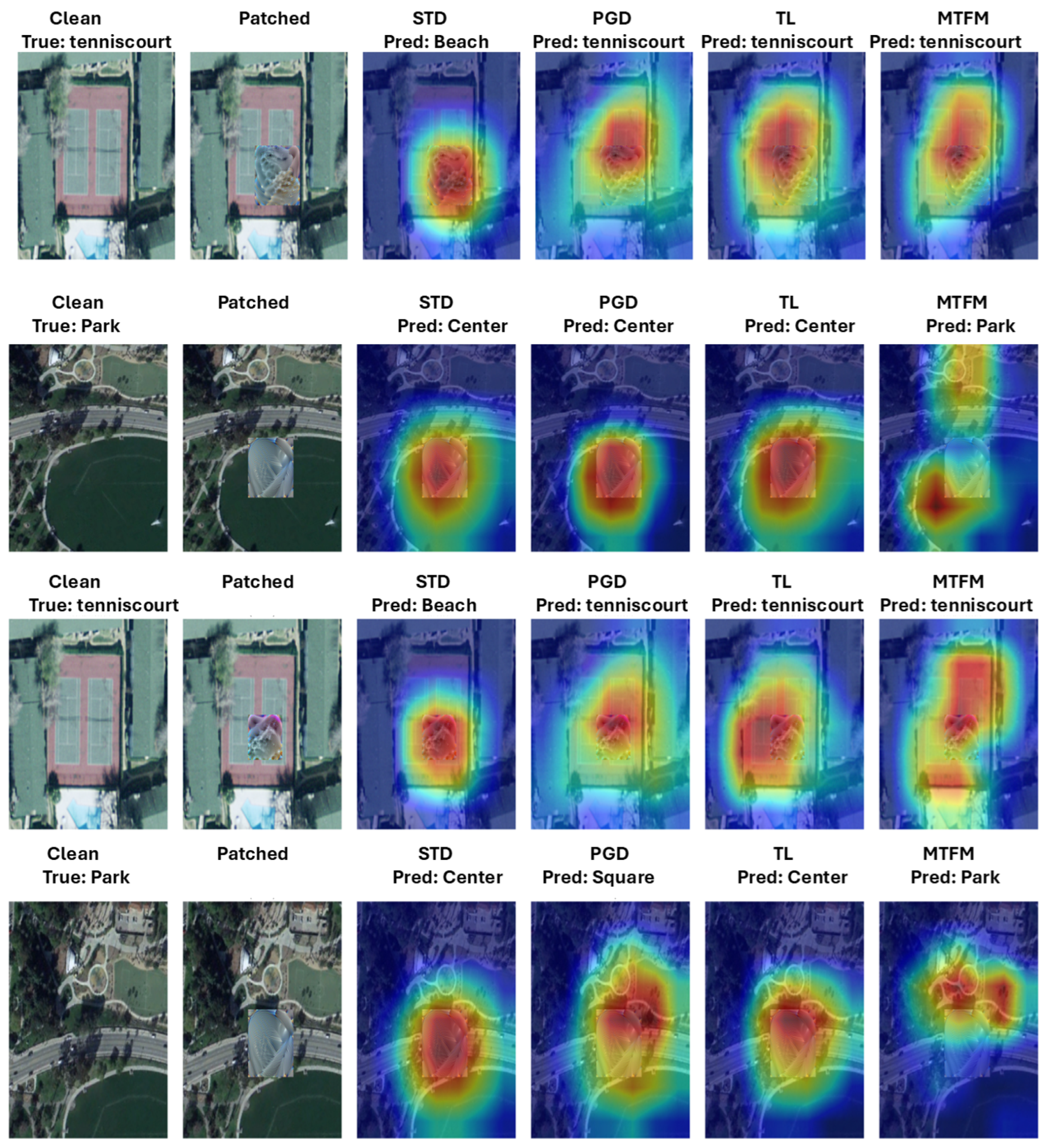
In Figure 5, the first column shows the clean image, followed by its adversarially patched counterpart. The third column displays the standard model (STD), which tends to focus heavily on the adversarial patch—often leading to misclassification by predicting the patch class instead of the true label. In contrast, the (MTFM) model in the sixth column attends more to the rest of the image, which supports correct classification. The first two rows represent ResNet-50 models trained on UCM and AID datasets with PatternNet as the source, while the next two rows show results when the source is EuroSAT.
Figure 5.
Visualization of Grad-CAM results for ResNet-50 models on the UCM and AID datasets. Conventions: Clean = original image; Patched = adversarially attacked image; True = ground truth label; Pred = model prediction. STD = standard model; PGD = PGD-AT model; TL = Transfer learning model; MTFM = MTFM model.
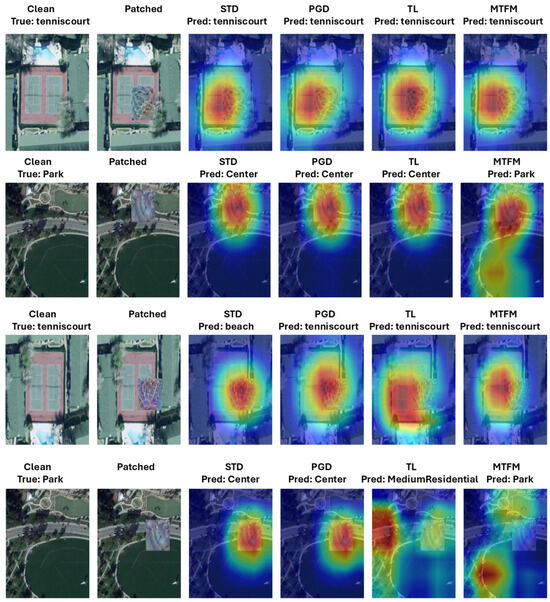
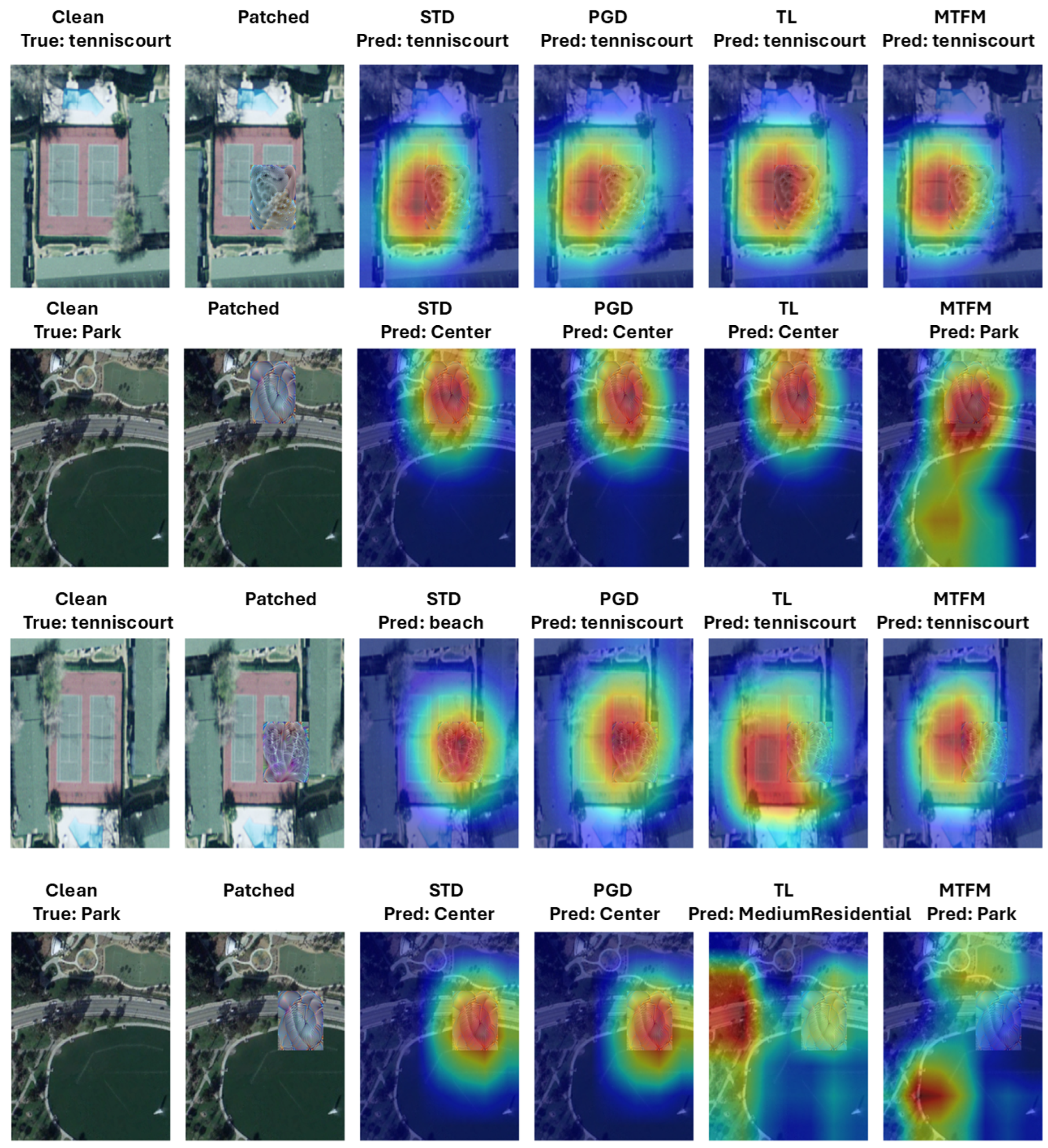
A similar trend is observed in Figure 6, which shows Grad-CAM results for ResNet-18 models. The standard model (STD) in the third column again focuses primarily on the patch, whereas the (MTFM) model in the sixth column attends to the broader image context, improving classification accuracy. Although the patch size is and the image size is , some attention leakage toward the patch is still observed. Nevertheless, the (MTFM) models correctly classify the image in most cases, demonstrating both robustness and improved interpretability.
Figure 6.
Visualization of Grad-CAM results for ResNet-18 models on the UCM and AID datasets. Conventions: Clean = original image; Patched = adversarially attacked image; True = ground truth label; Pred = model prediction. STD = standard model; PGD = PGD-AT model; TL = Transfer learning model; MTFM = MTFM model.
Across all experiments, the proposed MTFM approach consistently demonstrates superior robustness transfer across datasets and architectures. Whether using ResNet-50 or ResNet-18 as the student model, MTFM outperforms baseline defense models in terms of adversarial test accuracy while maintaining competitive or superior clean accuracy.
6. Discussion
The proposed Multi-Teacher Feature Matching (MTFM) approach is evaluated against adversarial patch attacks and compared with traditional defense strategies across benchmark datasets and architectures. Robustness is assessed using adversarial test accuracy (ATA), training efficiency, and interpretability via Grad-CAM visualizations.
Projected Gradient Descent adversarial training (PGD-AT) is used as the baseline defense technique. PGD generates adversarial examples by perturbing all regions of the image. This broader perturbation strategy makes PGD effective against patch attacks, positioning it as a strong baseline. However, PGD suffers from a notable trade-off between clean accuracy and robustness, as shown in Table 1. For example, the EuroSAT ResNet-152 model achieves a clean accuracy of 95.12%, but its ATA drops to 5.06% under a adversarial patch attack. The defense model improves ATA to 73.38%, but this comes at the cost of nearly a 7% reduction in clean accuracy and a substantial training time of 1880.26 s per epoch. Similarly, in Table 2, the AID dataset’s robust model (R50) shows an ATA improvement of 41.96% but suffers a 6.86% loss in clean accuracy compared to the model. In contrast, the proposed MTFM approach achieves a 73% improvement in ATA with only a 3.5% sacrifice in clean accuracy, outperforming PGD in both ATA and clean accuracy.
In most scenarios, PGD-AT develops robust models at the cost of clean accuracy and high computational expense. The larger the dataset, the more training time is required to train the model. In contrast, the proposed framework achieves superior clean accuracy and better ATA than PGD in most cases. One contributing factor is its two-teacher setup, where both teachers are trained on larger datasets that retain rich semantic features. Since the target datasets are also remote sensing satellite image datasets with similar class types, the teacher feature representations are highly transferable—enabling the development of robust models with lower training overhead. For example, on the UCM dataset, the training time difference between and is approximately 54.56 s per epoch. On the larger AID dataset, reduces training time by nearly 232.74 s per epoch compared to .
The proposed MTFM approach is also compared against other defense strategies such as and . In most cases, models match or surpass the performance of models. The training setup employs a single adversarially robust teacher, whereas the setup leverages two teachers, which helps maintain both clean accuracy and ATA. Furthermore, match or outperforms models in most scenarios. The training setup focuses primarily on logit matching, while emphasizes feature matching, leading to better overall performance.
7. Conclusions
This study demonstrated that adversarial robustness can be significantly enhanced through the proposed Multi-Teacher Feature Matching (MTFM) framework, achieving a favorable trade-off between clean accuracy and adversarial robustness. We evaluated this method across diverse scenarios, including varying source and target datasets, different architectures, and transfer settings. Our proposed MTFM approach outperformed traditional robustness transfer approaches by achieving a better trade-off between clean accuracy and adversarial robustness. Notably, the training time for MTFM remained consistently low, outperforming many traditional defenses in both robustness and efficiency.
For future work, we aim to extend this robustness to datasets with limited labeled samples by exploring semi-supervised and weakly supervised regimes. Additionally, while this study employed cosine similarity to measure feature alignment, we plan to investigate alternative metrics that may better capture semantic consistency. Overall, this work highlights a promising direction for developing robust models with reduced computational overhead.
8. Supplementary Results
Self Attention Evaluation
This subsection presents additional results for ResNet-50 and ResNet-18 models integrated with self-attention modules, tested against 32 × 32, 48 × 48, and 64 × 64 adversarial patch attacks. Robustness is transferred from source datasets (PatternNet and EuroSAT) to target datasets (UCM and AID) using four previously defined transfer learning strategies: Fullnet, Fixedfeat, F25, and F9 (for ResNet-18).
Table 4 summarizes the performance of self-attention-based defense models under varying adversarial patch sizes. Across both UC_Merced and AID datasets, these models consistently outperform standard and PGD-trained baselines, demonstrating stronger robustness and reduced training time. Robustness is transferred from PatternNet and EuroSAT using strategies such as textitFullnet, Fixedfeat, F25, and F9. The best-performing self-attention model is used as a reference for comparison against the MTFM framework.
Table 4.
Clean and adversarial accuracies of models trained on source datasets (PatternNet and EuroSAT).
Author Contributions
Conceptualization, K.A.I.; Methodology, R.K.R. and K.A.I.; Data Curation, R.K.R.; Formal analysis and investigation: R.K.R., Software, R.K.R.; Resources, R.K.R. and K.A.I.; Writing—Original Draft Preparation, R.K.R. and K.A.I.; Writing—Review & Editing, R.K.R. and K.A.I.; Supervision, K.A.I.; Project Administration, K.A.I. All authors have read and agreed to the published version of the manuscript.
Funding
This research received no external funding.
Data Availability Statement
The data will be made available by the authors on request.
Acknowledgments
The authors would like to acknowledge the College of Computing and Software Engineering (CCSE) at Kennesaw State University for the technical and administrative support, including access to high-performing computing (HPC) servers used in this research.
Conflicts of Interest
The authors declare no conflicts of interest.
Abbreviations
The following abbreviations are used in this manuscript:
| PGD-AT | Projected Gradient Descent adversarial training |
| ATA | Adversarial Test Accuracy |
| ASR | Attack Success Rate |
| Pred | Model prediction |
| Arch | Architecture |
| Standard model trained on the target dataset | |
| PGD adversarially trained model | |
| Transfer learning model with robustness transferred from a source dataset | |
| SA-TL | Self-attention-based transfer learning model |
| Multi-Teacher Adversarial Robustness Distillation | |
| Multi-Teacher Feature Matching framework |
References
- Abburu, S.; Golla, S.B. Satellite image classification methods and techniques: A review. Int. J. Comput. Appl. 2015, 119, 20–25. [Google Scholar] [CrossRef] [Scilit]
- Yuan, Q.; Shen, H.; Li, T.; Li, Z.; Li, S.; Jiang, Y.; Xu, H.; Tan, W.; Yang, Q.; Wang, J.; et al. Deep learning in environmental remote sensing: Achievements and challenges. Remote Sens. Environ. 2020, 241, 111716. [Google Scholar] [CrossRef] [Scilit]
- Alidoost, F.; Arefi, H. Application of deep learning for emergency response and disaster management. In Proceedings of the AGSE Eighth International Summer School and Conference; University of Tehran: Tehran, Iran, 2017; pp. 11–17. [Google Scholar]
- Ul Hoque, M.R.; Islam, K.A.; Perez, D.; Hill, V.; Schaeffer, B.; Zimmerman, R.; Li, J. Seagrass Propeller Scar Detection using Deep Convolutional Neural Network. In Proceedings of the 2018 9th IEEE Annual Ubiquitous Computing, Electronics & Mobile Communication Conference (UEMCON), New York, NY, USA, 8–10 November 2018; pp. 659–665. [Google Scholar] [CrossRef] [Scilit]
- Brown, T.B.; Mané, D.; Roy, A.; Abadi, M.; Gilmer, J. Adversarial Patch. arXiv 2017, arXiv:1712.09665. [Google Scholar] [CrossRef] [Scilit]
- Zhao, S.; Yu, J.; Sun, Z.; Zhang, B.; Wei, X. Enhanced Accuracy and Robustness via Multi-teacher Adversarial Distillation. In Proceedings of the Computer Vision—ECCV 2022: 17th European Conference, Tel Aviv, Israel, 23–27 October 2022; Proceedings, Part IV; Springer Nature: Berlin/Heidelberg, Germany, 2022; pp. 585–602. [Google Scholar] [CrossRef] [Scilit]
- He, K.; Zhang, X.; Ren, S.; Sun, J. Deep Residual Learning for Image Recognition. arXiv 2015, arXiv:1512.03385. [Google Scholar] [CrossRef] [Scilit]
- Helber, P.; Bischke, B.; Dengel, A.; Borth, D. EuroSAT: A Novel Dataset and Deep Learning Benchmark for Land Use and Land Cover Classification. arXiv 2019, arXiv:1709.00029. [Google Scholar] [CrossRef] [Scilit]
- Xia, G.S.; Hu, J.; Hu, F.; Shi, B.; Bai, X.; Zhong, Y.; Zhang, L.; Lu, X. AID: A Benchmark Data Set for Performance Evaluation of Aerial Scene Classification. IEEE Trans. Geosci. Remote Sens. 2017, 55, 3965–3981. [Google Scholar] [CrossRef] [Scilit]
- Krizhevsky, A.; Sutskever, I.; Hinton, G.E. ImageNet classification with deep convolutional neural networks. Commun. ACM 2017, 60, 84–90. [Google Scholar] [CrossRef] [Scilit]
- Karypidis, E.; Mouslech, S.G.; Skoulariki, K.; Gazis, A. Comparison Analysis of Traditional Machine Learning and Deep Learning Techniques for Data and Image Classification. Wseas Trans. Math. 2022, 21, 122–130. [Google Scholar] [CrossRef] [Scilit]
- Toshniwal, D.; Loya, S.; Khot, A.; Marda, Y. Optimized Detection and Classification on GTRSB: Advancing Traffic Sign Recognition with Convolutional Neural Networks. arXiv 2024, arXiv:2403.08283. [Google Scholar] [CrossRef] [Scilit]
- Yang, H.L.; Yuan, J.; Lunga, D.; Laverdiere, M.; Rose, A.; Bhaduri, B. Building Extraction at Scale using Convolutional Neural Network: Mapping of the United States. arXiv 2018, arXiv:1805.08946. [Google Scholar] [CrossRef] [Scilit]
- Szegedy, C.; Zaremba, W.; Sutskever, I.; Bruna, J.; Erhan, D.; Goodfellow, I.; Fergus, R. Intriguing properties of neural networks. arXiv 2014, arXiv:1312.6199. [Google Scholar] [CrossRef] [Scilit]
- Goodfellow, I.J.; Shlens, J.; Szegedy, C. Explaining and Harnessing Adversarial Examples. arXiv 2015, arXiv:1412.6572. [Google Scholar] [CrossRef] [Scilit]
- Thys, S.; Ranst, W.V.; Goedemé, T. Fooling automated surveillance cameras: Adversarial patches to attack person detection. arXiv 2019, arXiv:1904.08653. [Google Scholar] [CrossRef] [Scilit]
- Guo, Z.; Qian, Y.; Li, Y.; Li, W.; Lei, C.T.; Zhao, S.; Fang, L.; Arandjelović, O.; Lau, C.P. Beyond Vulnerabilities: A Survey of Adversarial Attacks as Both Threats and Defenses in Computer Vision Systems. arXiv 2025, arXiv:2508.01845. [Google Scholar] [CrossRef] [Scilit]
- Madry, A.; Makelov, A.; Schmidt, L.; Tsipras, D.; Vladu, A. Towards Deep Learning Models Resistant to Adversarial Attacks. arXiv 2019, arXiv:1706.06083. [Google Scholar] [CrossRef] [Scilit]
- Naseer, M.; Khan, S.H.; Porikli, F. Local Gradients Smoothing: Defense against localized adversarial attacks. arXiv 2018, arXiv:1807.01216. [Google Scholar] [CrossRef] [Scilit]
- Li, X.; Ji, S. Generative Dynamic Patch Attack. arXiv 2021, arXiv:2111.04266. [Google Scholar] [CrossRef] [Scilit]
- Xu, K.; Xiao, Y.; Zheng, Z.; Cai, K.; Nevatia, R. PatchZero: Defending against Adversarial Patch Attacks by Detecting and Zeroing the Patch. arXiv 2022, arXiv:2207.01795. [Google Scholar] [CrossRef] [Scilit]
- Wu, T.; Tong, L.; Vorobeychik, Y. Defending Against Physically Realizable Attacks on Image Classification. arXiv 2020, arXiv:1909.09552. [Google Scholar] [CrossRef] [Scilit]
- Yu, C.; Chen, J.; Xue, Y.; Liu, Y.; Wan, W.; Bao, J.; Ma, H. Defending against Universal Adversarial Patches by Clipping Feature Norms. In Proceedings of the 2021 IEEE/CVF International Conference on Computer Vision (ICCV), Montreal, QC, Canada, 10–17 October 2021; pp. 16414–16422. [Google Scholar] [CrossRef] [Scilit]
- Wang, Z.; Wang, B.; Zhang, C.; Liu, Y. Defense against Adversarial Patch Attacks for Aerial Image Semantic Segmentation by Robust Feature Extraction. Remote Sens. 2023, 15, 1690. [Google Scholar] [CrossRef] [Scilit]
- Vaswani, A.; Shazeer, N.; Parmar, N.; Uszkoreit, J.; Jones, L.; Gomez, A.N.; Kaiser, L.; Polosukhin, I. Attention Is All You Need. arXiv 2023, arXiv:1706.03762. [Google Scholar] [CrossRef] [Scilit]
- Wang, X.; Girshick, R.; Gupta, A.; He, K. Non-local Neural Networks. arXiv 2018, arXiv:1711.07971. [Google Scholar] [CrossRef] [Scilit]
- Zhuang, F.; Qi, Z.; Duan, K.; Xi, D.; Zhu, Y.; Zhu, H.; Xiong, H.; He, Q. A Comprehensive Survey on Transfer Learning. arXiv 2020, arXiv:1911.02685. [Google Scholar] [CrossRef] [Scilit]
- Salman, H.; Ilyas, A.; Engstrom, L.; Kapoor, A.; Madry, A. Do Adversarially Robust ImageNet Models Transfer Better? arXiv 2020, arXiv:2007.08489. [Google Scholar] [CrossRef] [Scilit]
- Hua, A.; Gu, J.; Xue, Z.; Carlini, N.; Wong, E.; Qin, Y. Initialization Matters for Adversarial Transfer Learning. arXiv 2024, arXiv:2312.05716. [Google Scholar] [CrossRef] [Scilit]
- Hinton, G.; Vinyals, O.; Dean, J. Distilling the Knowledge in a Neural Network. arXiv 2015, arXiv:1503.02531. [Google Scholar] [CrossRef] [Scilit]
- Hu, C.; Li, X.; Liu, D.; Wu, H.; Chen, X.; Wang, J.; Liu, X. Teacher-Student Architecture for Knowledge Distillation: A Survey. arXiv 2023, arXiv:2308.04268. [Google Scholar] [CrossRef] [Scilit]
- Stanton, S.; Izmailov, P.; Kirichenko, P.; Alemi, A.A.; Wilson, A.G. Does Knowledge Distillation Really Work? arXiv 2021, arXiv:2106.05945. [Google Scholar] [CrossRef] [Scilit]
- Yang, Y.; Newsam, S. Bag-of-visual-words and spatial extensions for land-use classification. In Proceedings of the 18th SIGSPATIAL International Conference on Advances in Geographic Information Systems, San Jose, CA, USA, 2–5 November 2010; pp. 270–279. [Google Scholar] [CrossRef] [Scilit]
- Zhou, W.; Newsam, S.; Li, C.; Shao, Z. PatternNet: A benchmark dataset for performance evaluation of remote sensing image retrieval. ISPRS J. Photogramm. Remote Sens. 2018, 145, 197–209. [Google Scholar] [CrossRef] [Scilit]
- Selvaraju, R.R.; Cogswell, M.; Das, A.; Vedantam, R.; Parikh, D.; Batra, D. Grad-CAM: Visual Explanations from Deep Networks via Gradient-Based Localization. Int. J. Comput. Vis. 2019, 128, 336–359. [Google Scholar] [CrossRef] [Scilit]

Disclaimer/Publisher’s Note: The statements, opinions and data contained in all publications are solely those of the individual author(s) and contributor(s) and not of MDPI and/or the editor(s). MDPI and/or the editor(s) disclaim responsibility for any injury to people or property resulting from any ideas, methods, instructions or products referred to in the content. |
© 2025 by the authors. Licensee MDPI, Basel, Switzerland. This article is an open access article distributed under the terms and conditions of the Creative Commons Attribution (CC BY) license.