


Persuasive Design for Products Leading to Health and Sustainability Using Case-Based Reasoning
Abstract
:1. Introduction
2. A Domain Knowledge Model for Persuasive Design
- (1)
- Target behavior involving bodily movements
- (2)
- Motives and lack of ability of users
- (3)
- Design principles modified from the list in PSD
- (4)
- Design techniques modified and extended from the list in DwI method
- (5)
- Technology (hardware) used for effective persuasion.
- (1)
- Target behavior. Referring to the work of Fogg and Hreha [18] that explicitly listed out target behaviors, this study proposes nine types of target behavior by defining three types of behavior change and three types of bodily movements. Three types of behavior change (behavior flavors called by Fogg and Hreha [18]) include: (a) users try out new behavior, (b) users re-perform beneficial actions or familiar behavior, and (c) users increase behavior intensity. Since the essence of this study is to persuade users into more bodily movement, it is crucial to identify which parts of body exercises, which may be classified as an upper, lower limb or whole body movement. The two classifications result in totally nine types of target behaviors shown in Table 1, which offers an objective way to view different bodily movements and assists in retrieving cases for further applications.
- (2)
- Motives and lack of ability of users. Fogg [7] stated that motive, ability and trigger are three factors for behavior change. Since more understanding of users motives and lack of ability could help get better design suggestions, these two factors are included in the domain knowledge model as well as case profiling. For each case, why (motives) and how (ability) target users use the case product are described in the case profile. Because of this additional information, in retrieving cases, with given target users’ motives and lack of ability, more appropriate cases and useful suggestions can be found. By referring to Fogg [7] and the information of collected cases, ten types of motives and five types of ability are defined and shown in Table 1. Section 4 shows how regression models are established to find different motives and abilities for given target users.
- (3)
- Design principles: The 28 design principles presented in Persuasive System Design (Oinas-Kukkonen and Harjumaa [8]) provide a potential list for the attributes. However, since this study only focuses on the underlined product design, not all design principles would be appropriate. After checking with collected cases, 17 out of 28 design principles were found to appear in the 98 cases and are presented in Table 2.
- (4)
- Design techniques. The 101 design techniques from DwI method (Lockton et al. [5,19]) are examined and cross checked with the information of case products related to this domain. Forty-three out of the 101 design techniques are used in the 98 cases. In addition, six new design techniques are added by this study. So, there are in total 49 design techniques shown in Table 3 that help with the underlined persuasive design. The six new design techniques suggested by this study are marked by “*”, including full-recording, virtual reality, energy feedback, virtual rewards, system praise and public exhibition which are somewhat different from the 101 design techniques.
- (5)
- Technology/hardware. Technology is another major ingredient in persuasive technology. Fogg [7] pointed out that technologies can play roles in three ways, as tools, media, and social actors, thereby presenting various functions and influencing behaviors differently. As a complement to design means (software), applicable technology (hardware) is therefore included in the domain knowledge model because it often works together with design means in persuading people to change behavior. Therefore, it is important to sort out the technologies that are used in the collected case products. Table 4 presents 18 modern technologies, mainly information and communication technologies, including video display, recording, audio player, health condition detecting, vibration, motion sensor, internet connection, energy harvesting, etc.
3. A Case Library with Case Products Requiring Bodily Movements
- (1)
- Which parts of body physically move and what kind of behavior change are involved in the case? Upper body, lower body or whole body? To a user, is it a new behavior, familiar behavior, or a behavior with higher intensity? If there are multiple types of behavior changes in one product (like many games provided in Wii), multiple case profiles can be set up for one product, since multiple experiences of persuasion may be extracted.
- (2)
- What users’ motives are expected by the designer for using the case product? What kind of ability for behavior change is the case product enhancing? To answer these questions, one needs to know who the target users of the case product are. If there are multiple groups of target users, all possible motives and abilities should be included in the case profile.
- (3)
- Identify which design principles are used in the case product referring to the 28 candidate design principles suggested in Onis-Kukkanon and Hajumaa [8]. Modifying and adding new design principles are allowed but require a careful review. After carefully reviewing the 98 cases, 17 design principles are found useful. As new cases are added in the future, the number of useful design principles may increase.
- (4)
- Identify which design techniques are used in the case products referring to the 101 candidate design techniques provided in Lockton et al. [19]. Modifying and adding new design techniques are allowed but need a careful review. After reviewing the 98 design cases, 43 out of 101 design techniques are found useful while additional six design techniques are proposed by this study.
- (5)
- Identify what kinds of modern technologies, mainly information and communication technologies, are used in the case products. As mentioned earlier, 18 types of technologies are found in the 98 cases.
4. Regression Models for Identifying Target Users’ Motives and Lack of Ability
- (a)
- gender (male: 51%; female: 49%),
- (b)
- age (under 25: 40%; 25%–40: 21%; 40%–60: 35%; above 60: 4%),
- (c)
- self-assessed health condition (bad: 3%; alright: 38%; good: 44%; very good: 15%),
- (d)
- average times of exercise per week (less than 1 time: 14%; 1–2 times: 48%; 3–5 times: 30%; more than 6 times: 8%), and
- (e)
- average time per week (less than 30 mins: 47%; 30-60 mins: 37%; more than 60mins: 16%).
M3 = 4.087 + 0.167 × X7
M4 = 3.118 + 0.154 × X4
M6 = 2.797 +0.139 × X5 + 0.270 × X7
M7 = 2.741 + 0.187 × X5
A1 = 3.592 + 0.354 × X1 + 0.142 × X4 − 0.185 × X5
A2 = 3.568 + 0.424 × X1
A3 = 3.604 + 0.350 × X1
A4 = 3.434 + 0.142 × X4
A5 = 3.272 + 0.279 × X1 + 0.146 × X4
5. A Six-Step Method to Retrieve Cases and Obtain Useful Design Suggestions
- (1)
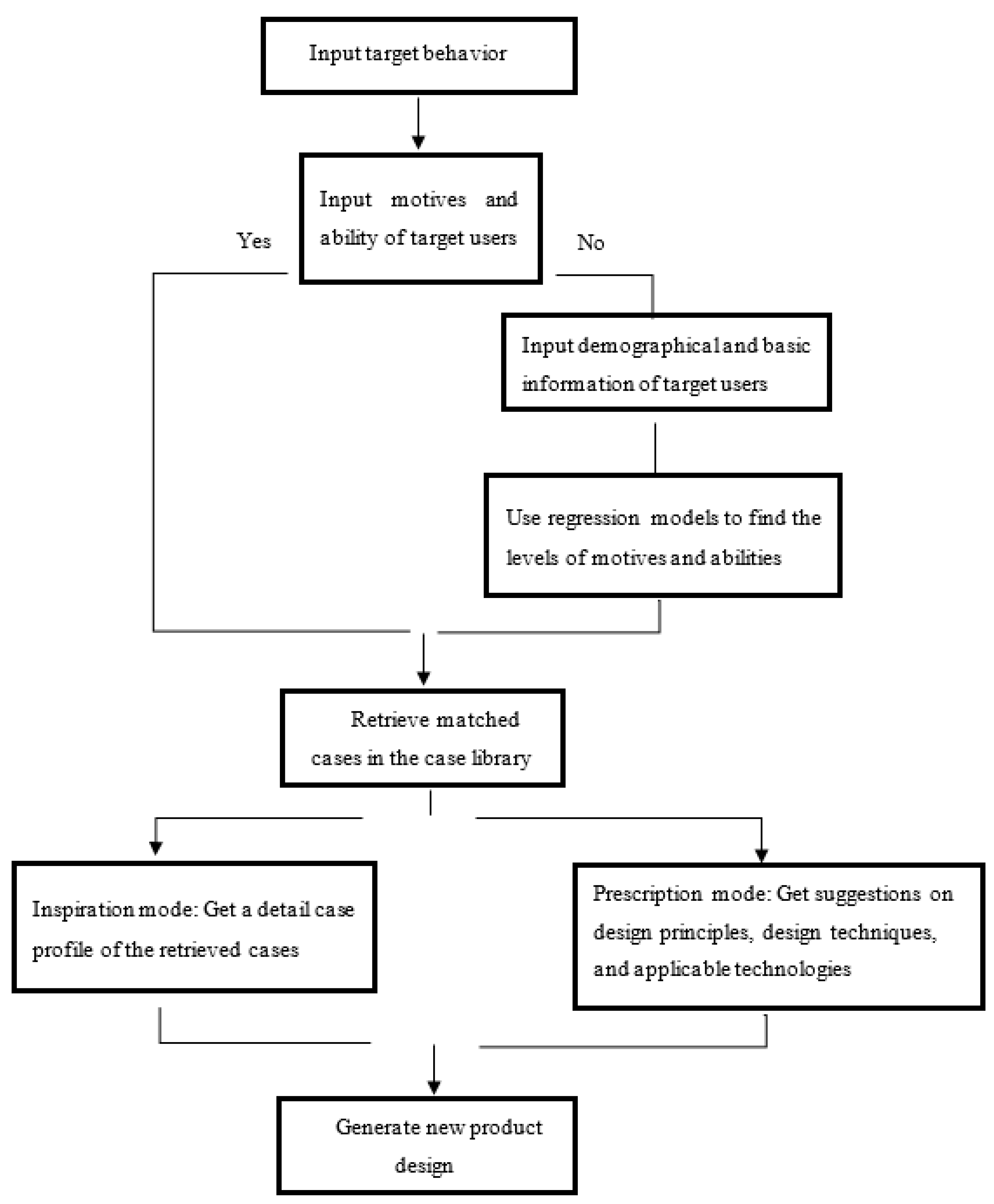
- Specify a goal of the design project, either an existing product that needs some new idea to improve or a completely new product is expected starting from conceptual design. Refer to the nine types of target behavior in Table 1 and choose a target behavior defined by the expected part of body moving and behavior flavors.
- (2)
- If target users are specified, conduct a prior analysis on target users to find their motives and lack of ability in performing the target behavior. A list of motives and abilities is available for consideration in Table 1. Interviewing with some users may be necessary to identify motives and ability. This study proposes regression models to help identify target user’s motive and ability in advance as described in Section 4. With the responses from a questionnaire survey, 15 regression models are established with seven independent variables (X1~X7) including age, gender, education, vocation, health condition, frequency and time of weekly exercise (refer to Table 6). By inputting aforementioned variables, designers could get the estimates of users’ motives and lack of ability that can be used as input conditions to search for similar cases.
- (3)
- Use results of (1) and (2) as input conditions to search for similar cases and retrieve case profiles and indices representing design principles, techniques and technologies. These design principles, techniques and technologies used in retrieved cases serve as output of the search. Table 2, Table 3 and Table 4 contain the lists of design principles, design techniques and applicable technologies. Relax some minor conditions if no case could be retrieved and conduct a search again.
- (4)
- One way of using the retrieved cases is called “inspiration mode”, where designers simply get inspiration from retrieved case profiles that contain case description, picture, and background information in addition to design principles, design techniques and technologies. An information aid based on data management software ACCESS was written to help conduct steps (1) to (4), making case retrieval and extracting useful suggestions easier and faster.
- (5)
- Another way of using the retrieved cases is called “prescription mode”, while design principles, design techniques and technologies used in the retrieved cases are explicitly presented as design suggestions. When multiple cases are retrieved in the search, summarize the frequency of the occurrence of each design principle, technique and technology. The ones appear more frequently in the retrieved cases should be recommended with higher priority. This is a simple and logic way to highlight useful suggestions out of multiple retrieved cases. It may also be helpful to trace back how these design principles, design techniques and technologies are used in the retrieved cases.
- (6)
- Following either the inspiration mode or the prescription mode, designers may generate and screen creative ideas of product design. For example, by following prescription mode designers could play with different combinations of recommended design principles, design techniques and applicable technologies and see if new ideas can be generated, thereby choosing a good one out of them.
6. An Illustrative Example
- (1)
- For illustration, suppose designers want to develop a new product to help elder women in Taiwan keep lower body moving and help them remain healthy. Target behavior will take more lower limb movements assuming that users want to increase the intensity of familiar exercises rather than try a new exercise, leading to a target behavior in Table 1. Good examples of familiar behavior for local elders are riding bicycle and jogging.
- (2)
- Assuming that target users are elder women who seldom exercise, detail description may include: female, age 51–60, graduated from senior high school, health condition is not good, less than one exercise session on average, and exercise time less than 30 min per week. By putting this user information as independent variables into regression models (Equation (1)), estimates of motives and lack of ability can be obtained as shown in Table 7. For illustration, assuming that the items with resulting estimates of dependent variables more than 3.5 in Table 7 are considered as significant ones, M3, and A1–A5 are considered as significantly strong motives and abilities that can be used in case searching.
- (3)
- With the information of target behavior and significant motives and abilities of target users from the above two steps, one can conduct conditional search for cases meeting the condition. Seven cases out of 98 cases are found matching the conditions and thus retrieved.
- (4)
- In the inspiration mode, detail case profiles of the seven retrieved cases can be presented to designers for stimulating new ideas, including Wii Fit Rhythmic Game, Wii Fit Jogging, Wii Fit Snow Skiing, Piezo-electric Harvester shoe, POWER Leap Power Floor, Piezo-electric Floor in Tokyo Station, and FitWet. If designers still cannot get inspired and create new ideas from the results, they may go to the next step.
- (5)
- In the prescription mode, design principles, design techniques and technologies used in the seven retrieved cases are summarized as shown in Table 8. The meanings of the indices of design principles, design techniques and technologies are shown in Table 2, Table 3 and Table 4. Table 8 also presents occurrence times of each of them in the seven cases in descending order. The ones with more occurrence times are recommended for use with higher priority.
- (6)
- With the suggestions of the design principles, design techniques and applicable technologies as listed in Table 8, one may get inspiration either from each individual suggestion or from different combinations of them to obtain new design concepts. Reviewing how these design principles, design techniques and technologies are used in each of the retrieved cases may also be beneficial. To illustrate how one could be inspired by the suggestions in Table 8, samples of new product concepts are shown in Table 9. These ideas are for illustration showing different combinations of the design principles, design techniques and technologies may inspire new product concepts.
7. Conclusions
Acknowledgments
Conflicts of Interest
References
- Herring, H.; Roy, R. Technological innovation, energy efficient design and the rebound effect. Technovation 2007, 27, 194–203. [Google Scholar] [CrossRef]
- Lilley, D. Design for sustainable behaviour: Strategies and perceptions. Des. Stud. 2009, 30, 704–720. [Google Scholar] [CrossRef]
- Wever, R.; Kuijk, J.; Boks, C. User-centered design for sustainable behavior. Int. J. Sustain. Eng. 2008, 1, 9–20. [Google Scholar] [CrossRef]
- Lockton, D.; Harrison, D. Design with Intent: Persuasive technology in a wider context. In Proceedings of the Persuasive Technology: Third International Conference, Oulu, Finland, 4–6 June 2008; Springer: Berlin, Germany, 2008; pp. 274–278. [Google Scholar]
- Lockton, D.; Harrison, D. The design with intent method: A design tool for influencing user behaviour. Appl. Ergon. 2010, 41, 382–392. [Google Scholar] [CrossRef] [PubMed]
- Fogg, B.J. Persuasive computers: perspectives and research directions. In Proceedings of the SIGCHI Conference on Human Factors in Computing Systems, Los Angeles, CA, USA, 18–23 April 1998; ACM Press/Addison-Wesley Publishing Co.: New York, NY, USA, 1998; pp. 225–232. [Google Scholar]
- Fogg, B.J. A behavior model for persuasive design. In Proceedings of the 4th International Conference on Persuasive Technology, Claremont, CA, USA, 26–29 April 2009; ACM: New York, NY, USA, 2009; pp. 1–7. [Google Scholar]
- Oinas-Kukkonen, H.; Harjumaa, M. Persuasive systems design: Key issues, process model, and system features. Commun. Assoc. Inf. Syst. 2009, 24, 485–500. [Google Scholar]
- Pettersen, I.N.; Boks, C. The ethics in balancing control and freedom when engineering solutions for sustainable behaviour. Int. J. Sustain. Eng. 2008, 1, 287–297. [Google Scholar] [CrossRef]
- Lockton, D.; Harrison, D.; Stanton, N.A. Models of the user: Designers’ perspectives on influencing sustainable behavior. J. Des. Res. 2012, 10. [Google Scholar] [CrossRef]
- Webb, D.; Soutar, G.N.; Mazzarol, T.; Saldaris, P. Self-determination theory and consumer behavioural change: Evidence from a household energy-saving behaviour study. J. Environ. Psychol. 2013, 35, 59–66. [Google Scholar] [CrossRef]
- Daae, J.; Boks, C. A classification of user research methods for design for sustainable behavior. J. Clean. Prod. 2015, 106, 680–689. [Google Scholar] [CrossRef]
- Shih, L.H.; Hsin, H.E. Persuasive design for LOHAS products with physical activity. In Proceedings of the Electronics Goes Green International Conference, Berlin, Germany, 9–12 September 2012.
- Shih, L.H.; He, W.S. Persuasive design aid for products leading to happy, healthy and sustainable lifestyle. In Proceedings of the International Conference on Innovation, Communication and Engineering, Qingdao, China, 26 October–1 November 2013.
- Ray, P.; Anderson, S.R. The Cultural Creatives: How 50 Million People are Changing the World; Three Rivers Press: New York, NY, USA, 2000. [Google Scholar]
- Aamodt, A.; Plaza, E. Case-Based Reasoning: Foundational Issues, Methodological Variations, and System Approaches. AI Commun. 1994, 7, 39–59. [Google Scholar]
- Aha, D.W. The omnipresence of case-based reasoning in science and application. Knowl. Based Syst. 1998, 11, 261–273. [Google Scholar] [CrossRef]
- Fogg, B.J.; Hreha, J. Behavior wizard: A method for matching target behaviors with solutions. In Proceedings of the 5th International Conference on Persuasive Technology, Copenhagen, Denmark, 7–10 June 2010; pp. 117–131.
- Lockton, D.; Harrison, D.; Stanton, N.A. Design with Intent: 101 Techniques for Influencing Behavior through Design. Available online: http://danlockton.com/dwi/Main_Page (accessed on 20 March 2016).
- Lehto, T.; Oinas-Kukkonen, H. Persuasive Features in Six Weight Loss Websites: A Qualitative Evaluation Persuasive Technology; Ploug, T., Hasle, P., Oinas-Kukkonen, H., Eds.; Springer: Berlin, Germany; Heidelberg, Germany, 2010; Volume 6137, pp. 162–173. [Google Scholar]
- Purpura, S.; Schwanda, V.; Williams, K.; Stubler, W.; Sengers, P. Fit4life: The design of a persuasive technology promoting healthy behavior and ideal weight. In Proceedings of the 2011 Annual Conference on Human factors in Computing Systems, New York, NY, USA, 7–12 May 2011; p. 423.
- Sun, C.J. Persuasive design system development for LOHAS products considering users types. Master’s Thesis, Department of Resources Engineering, National Cheng Kung University, Tainan, Taiwan, 2014. [Google Scholar]

| Type of Attributes | Attributes | ||
|---|---|---|---|
| Upper limb/new behavior | Upper limb/Familiar behavior | Upper limb/Increase intensity | |
| Target behavior | Lower limb/New behavior | Lower limb/Familiar behavior | Lower limb/Increase intensity |
| Whole body/New behavior | Whole body/Familiar behavior | Whole body/Increase intensity | |
| M1. Visual pleasure | M2. Audio pleasure | M3. Physical excitement | |
| Motives | M4. Learning | M5. Health | M6. Accomplishment |
| M7. Fashion | M8. Cooperation | M9. Competition | |
| M10. Sustainability (energy generation) | |||
| Ability | A1. Saving time | A2. Less physical effort | A3. Less brain cycle |
| A4. Less social deviance | A5. Turning behavior to routine | ||
| Number | Design Principle | Number | Design Principle |
|---|---|---|---|
| A | Reduction | J | Suggestion & Reminders |
| B | Tunneling | K | Similarity |
| C | Tailoring | L | Liking |
| D | Personalization | M | Social role |
| E | Self-monitoring | N | Social learning |
| F | Simulation | O | Social Comparison |
| G | Rehearsal | P | Normative Influence |
| H | Rewards | Q | Social Facilitation |
| I | Praise |
| Number | Design Technique | Number | Design Technique |
|---|---|---|---|
| A1 | Hiding things | G1 | Rehearsal |
| A2 | Feature Deletion | H1 | Energy Feedback * |
| A3 | Simplicity | H2 | Virtual Rewards * |
| B1 | Angles | I1 | System praise * |
| B2 | Conveyor belts | I2 | Social Praise |
| B3 | Mazes | J2 | Conditional warning |
| B4 | Positioning | J3 | Serving suggestion |
| B5 | Pave the Cowpaths | J4 | Are you sure? |
| B6 | Interlock | K1 | Similarity |
| B7 | Implied Sequence | L1 | Color associations |
| B8 | Bundling | L2 | Prominence |
| B9 | Matched affordance | L3 | Seductive atmospherics |
| B10 | Levels | L4 | Emotional engagement |
| B11 | Kairos | M1 | Personality |
| C1 | Who or what you are? | N1 | Expert choice |
| C2 | Where you are? | N2 | Public Exhibition * |
| D1 | What you have done? | N3 | Social proof |
| D2 | What can you do? | O1 | Competition |
| E1 | Feedback through form | O2 | Cooperation |
| E3 | Progress bar | P1 | Commitment & Consistency |
| E4 | Real-time feedback | P2 | Assuaging guilt |
| E5 | Summary feedback | Q1 | Do as you’re told |
| E6 | Full-recording * | Q2 | Recognition |
| F1 | Simulation & Feedforward | Q3 | Peer feedback |
| F2 | Virtual Reality * |
| Number | Applicable Technology | Number | Applicable Technology |
|---|---|---|---|
| T1 | Display | T10 | Internet |
| T2 | Record | T11 | Fitness equipment |
| T3 | Speaker | T12 | Energy harvest |
| T4 | Health monitor | T13 | Storage device |
| T5 | Mobile and remote control | T14 | Software for stratified content |
| T6 | Lighting | T15 | Software for increasingly challenging content |
| T7 | Vibration | T16 | Avatar types |
| T8 | Motion sensor | T17 | Air mask |
| T9 | 3D virtual reality | T18 | GIS or GPS service |
| Type of Attributes in a Case | Number of Attributes |
|---|---|
| Target behavior | 9 |
| Motives | 10 |
| Lack of ability | 5 |
| Design principle | 17 |
| Design technique | 43 |
| Applicable technology | 18 |
| Total number of attributes | 102 |
| Independent Variables | Description | Variable Level |
|---|---|---|
| X1 | Gender | 1: male |
| 2: female | ||
| X2 | Age | 1: age 15–20 |
| 2: age 21–25 | ||
| 3: age 26–30 | ||
| 4: age 31–40 | ||
| 5: age 41–50 | ||
| 6: age 51–60 | ||
| 7: age 60 above | ||
| X3 | Vocation | 1: service |
| 2: manufacture | ||
| 3: office work | ||
| 4: house keeping | ||
| 5: student | ||
| 6: retirement | ||
| 7: others | ||
| X4 | Education | 1: lower than junior high |
| 2: senior high | ||
| 3: college | ||
| 4: graduate school | ||
| X5 | Health condition | 1: bad |
| 2: all right | ||
| 3: good | ||
| 4: very good | ||
| X6 | Exercise frequency | 1: none |
| 2: 1–2 times per week | ||
| 3: 3–5 times per week | ||
| 4: more than | ||
| 5 times per week | ||
| X7 | Average exercise time | 1: 0–30 min per week |
| 2: 31–60 min per week | ||
| 3: 61–90 min per week | ||
| 4: more than 90 min per week |
| Estimates of Motive and Ability Using Regression Models | |||
|---|---|---|---|
| Motive | Level | Ability | Level |
| M2: audio pleasure | 3.379 | A1: saving time | 4.214 |
| M3: physical excitement | 4.254 | A2: less physical effort | 4.416 |
| M4: learning | 3.426 | A3: less brain cycle | 4.304 |
| M6: accomplishment | 3.345 | A4: less social deviance | 3.718 |
| M7: fashion | 3.115 | A5: turning behavior to routine | 4.122 |
| Design Principle | Appearance Times | Design Technique | Appearance Times | ICT Technology | Appearance Times |
|---|---|---|---|---|---|
| B | 7 | E4, E5 | 4 | T1 | 4 |
| A, H | 6 | H2, A3, H1, A1, D1, B9, I1, J3, K1, L4, M1, F2 | 3 | T12, T9, T8, T7, T4 | 3 |
| D, E | 4 | N2, N3, B4 | 2 | T11 | 1 |
| F, I, J, K, L, M, N, O, P | 3 | P1, D2, O1, B8, B5 | 1 |
| Illustrative Ideas Inspired from Recommended Design Principles, Techniques and Technologies | |||
|---|---|---|---|
| Recommended design principle | Recommended design techniques | Recommended technologies | Ideas inspired |
| B | B9 | T7 | let the pedal vibrate as a reminder whenever users stop cycling |
| E | E5 | T1, T4 | let users know her health conditions such as blood pressure and calories consumption by setting sensors on the pedals |
| B | B9 | T12 | turn the cycling into energy generation source that provides electricity for music playing, but music may stop once cycling stops |
| H | E4 | let pedal generate heat in winter to keep users’ feet warm | |
| A | A3 | put handy and simple control device close to users so that users do not have to bend their back for it. | |
| A | D1 | make the product portable and easily be used in kitchen, bathroom or other places so that users can do some housework at the same time as they exercise their lower limbs | |
© 2016 by the author; licensee MDPI, Basel, Switzerland. This article is an open access article distributed under the terms and conditions of the Creative Commons by Attribution (CC-BY) license (http://creativecommons.org/licenses/by/4.0/).
Share and Cite
Shih, L.-h. Persuasive Design for Products Leading to Health and Sustainability Using Case-Based Reasoning. Sustainability 2016, 8, 318. https://doi.org/10.3390/su8040318
Shih L-h. Persuasive Design for Products Leading to Health and Sustainability Using Case-Based Reasoning. Sustainability. 2016; 8(4):318. https://doi.org/10.3390/su8040318
Chicago/Turabian StyleShih, Li-hsing. 2016. "Persuasive Design for Products Leading to Health and Sustainability Using Case-Based Reasoning" Sustainability 8, no. 4: 318. https://doi.org/10.3390/su8040318
APA StyleShih, L.-h. (2016). Persuasive Design for Products Leading to Health and Sustainability Using Case-Based Reasoning. Sustainability, 8(4), 318. https://doi.org/10.3390/su8040318

