Agriculture and Eutrophication: Where Do We Go from Here?

Abstract
:
1. Introduction
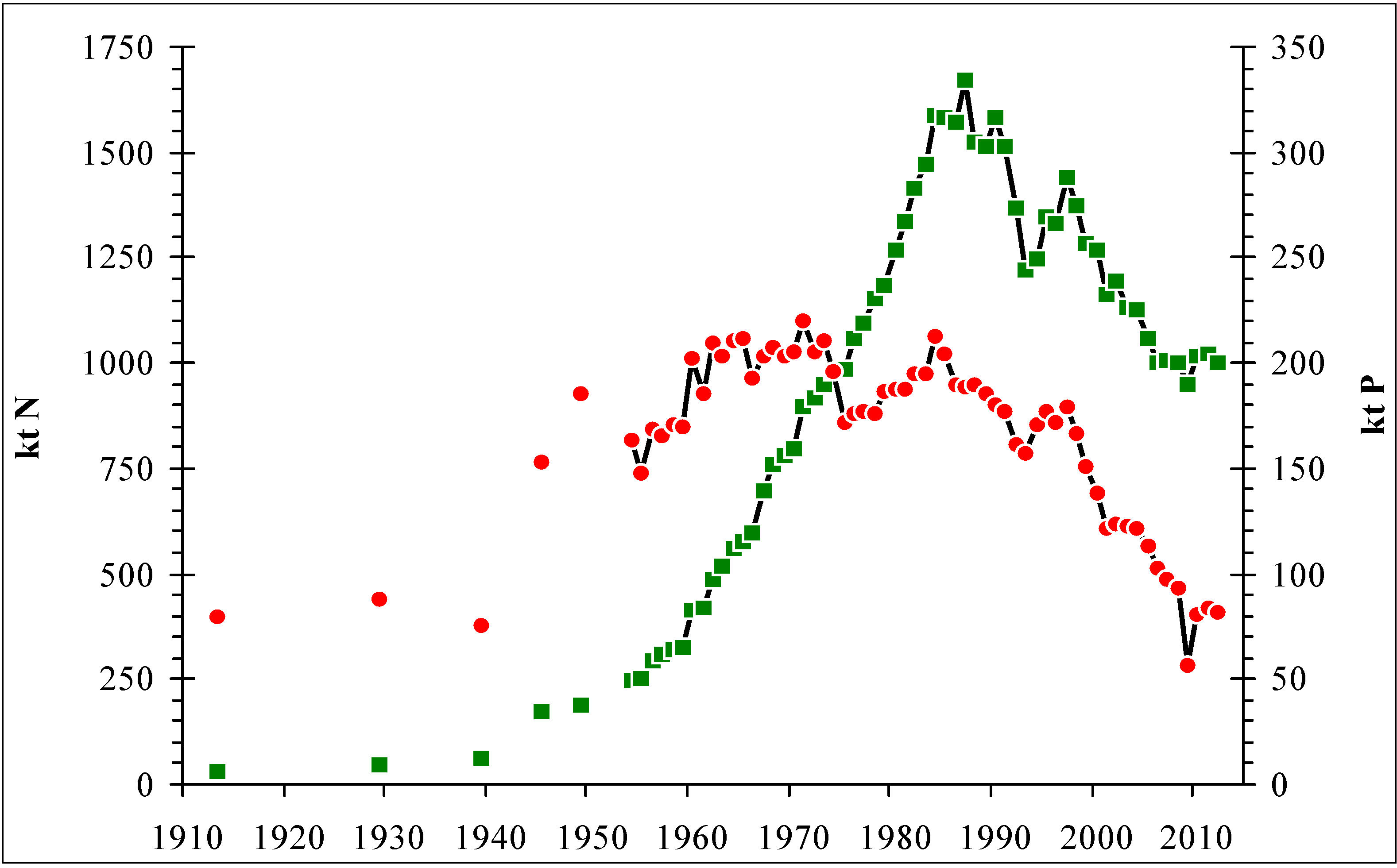
2. Nutrient Legacies

| Year | Intervention |
|---|---|
| 1946 | National Agricultural Advisory Service (NAAS) set up to give free technical advice to farmers to boost agricultural production |
| 1957 | Treaty of Rome established the principle of the Common Market (CM) to safeguard European food security |
| 1962 | A Common Agricultural Policy (CAP) implemented across member states to provide commodity price support (import quotas and levies, intervention prices) |
| 1971 | NAAS widens the free services offered to farmers and becomes the Agricultural Development and Advisory Service (ADAS) |
| 1984 | Dairy quotas introduced to help limit over-production of milk |
| 1986 | ADAS started to charge farmers for advice eventually leading to full privatization in 1997—the era of free advice was over. The first agri-environment scheme involving long-term voluntary agreements with farmers to adopt practices that would help protect environmentally-sensitive areas was introduced and funded by the taxpayer |
| 1992–1993 | MacSharry reforms designed to limit over-production led to a switch from commodity-based support to direct farmer support (arable area and livestock headage payments) and set-aside was introduced |
| 1991 | Countryside Stewardship Scheme (CSS) involving long-term subsidised agreements with farmers was introduced to protect valuable habitats paid by the taxpayer |
| 2000 | Reform of CAP under AGENDA 2000 led to two pillars of support: farmers and rural development |
| 2003–2005 | Further reform of CAP to encourage resource protection led to a system of Single Income Payments (SIP) to farmers based on farmed area and Cross-compliance measures which gradually became more ecosystem service oriented. Set-aside was abolished. |
| 2009 | New countryside stewardship scheme introduced to help protect the rural environment and comply with requirements of the Water Framework Directive (WFD)- Entry Level Scheme (ELS) and Higher Level Scheme (HLS) |
| 2014 | Further reforms of CAP in preparation |

3. Uncertainties in Ecological Outcomes from Non-Point Source Controls
3.1. Accurate Source Apportionment
| Agglomerations | Normal Areas 1 | Sensitive Areas 1 | ||||
|---|---|---|---|---|---|---|
| p.e. | Freshwaters and Estuaries | Coastal Waters | Freshwaters and Estuaries | Coastal Waters | Total | Percent of Total |
| 2000–10,000 | 422 | 26 | 594 | 1 | 1043 | 56 |
| 10,001–15,000 | 65 | 16 | 110 | 0 | 191 | 10 |
| 15,001–150,000 | 190 | 65 | 302 | 5 | 562 | 30 |
| >150,000 | 33 | 10 | 36 | 2 | 81 | 4 |
| Total | 710 | 117 | 1042 | 8 | 1877 | |
- (1)
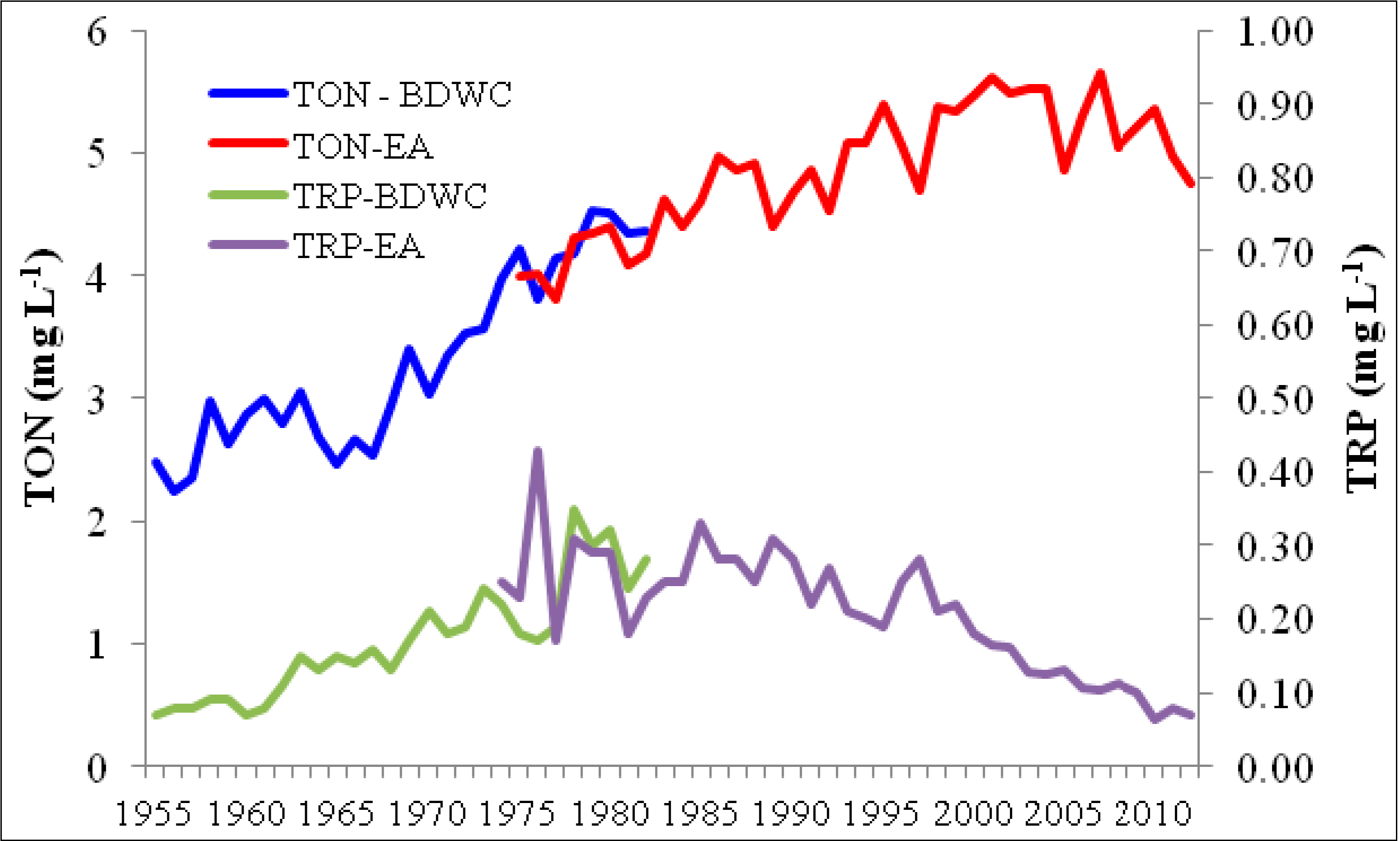
- In densely populated regions, wastewater sources can have a much more dominant role in P cycling within river networks than has hitherto been appreciated and agriculture’s contribution to river and lake eutrophication needs to be re-evaluated within this context.
- (2)
- More sophisticated source apportionment models are necessary to fully and more accurately apportion the relative nutrient contributions from wastewater, agriculture and urban sources in catchments with multiple pressures to direct proportioned mitigation efforts more effectively.
- (3)
- Where the inputs of wastewater sources have been underestimated, efforts to mitigate freshwater eutrophication through control of non-point P inputs from agriculture are likely to have far less impact than is currently predicted by nutrient export models calibrated and validated by catchment P flux data that do not take account of remobilized point source inputs.
3.2. Waterbody Characteristics
- (1)
- Nutrient control strategies must take account of waterbody characteristics (waterbody type and site characteristics) since these characteristics will have a large influence on ecological state and therefore on recovery trajectories.
- (2)
- Since catchments cross diverse landscapes, may contain more than one waterbody type and will extend to the coastal zone, catchment-based management plans to reduce nutrient loadings should take account of the location of eutrophication problems and which types of waterbodies are affected.
- (3)
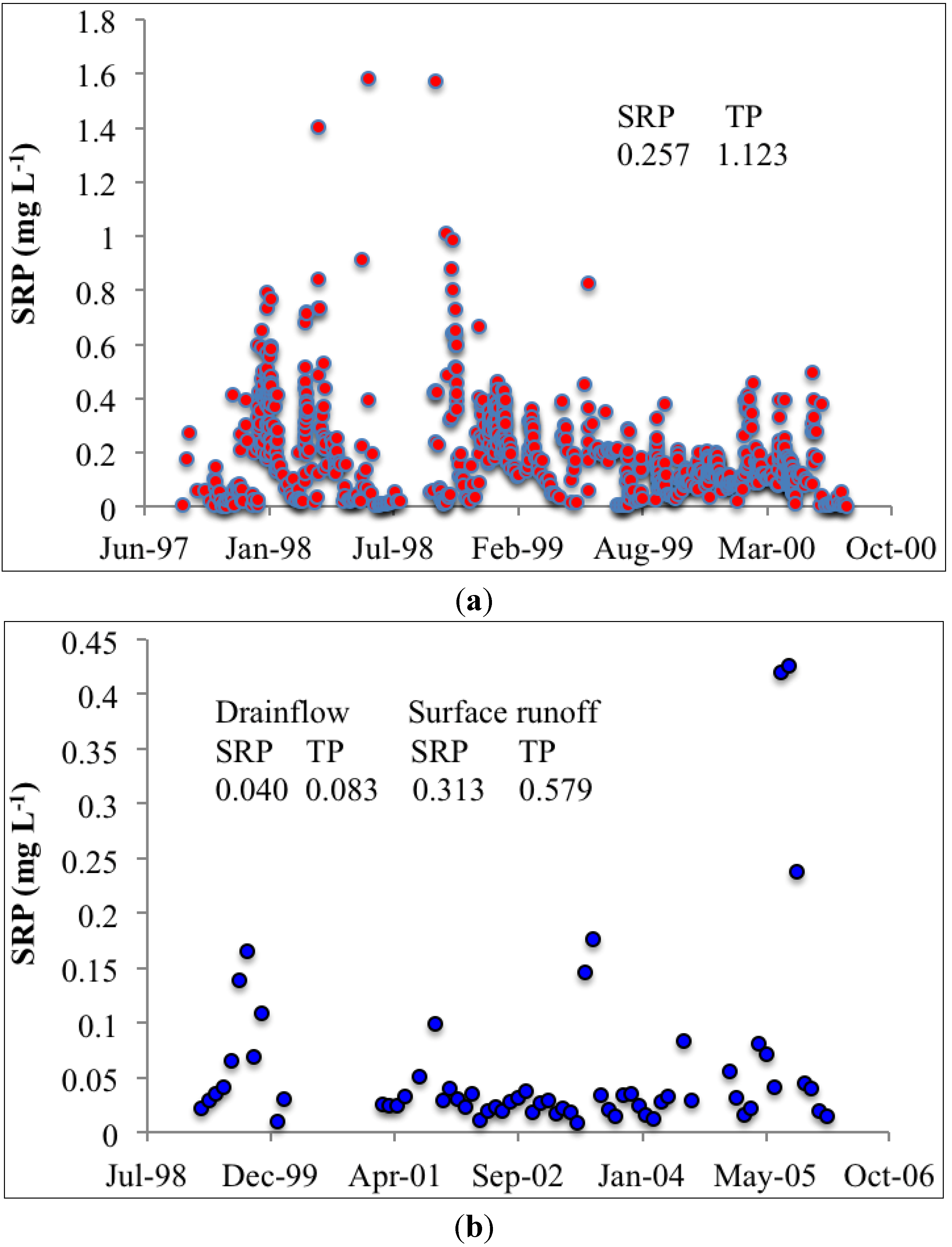
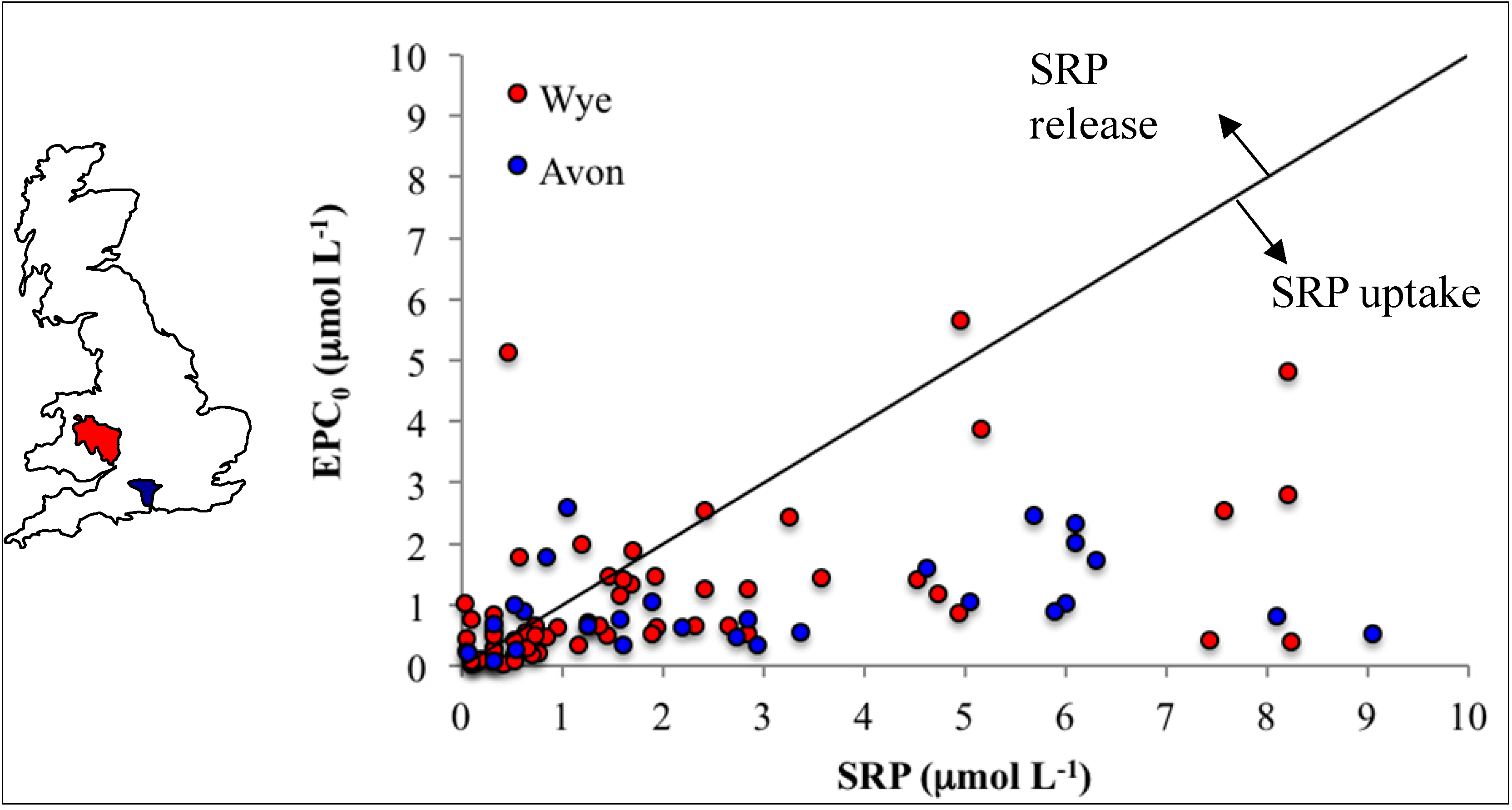
- While nutrient controls over agriculture may be justified to reduce downstream eutrophication from an accumulating nutrient pool, the ecological response of rivers to non-point P controls may be less than expected because of the limited bioavailability and accessibility of the P delivered.
3.3. Mitigating Nutrient Pressures from Farming

- (1)
- It is extremely difficult to accurately quantify the degree of change in agricultural practices needed to achieve the reductions in N and P loadings necessary for eutrophication control. Nutrient reduction measures targeted at farming may therefore be less effective, or take much longer, than expected.
- (2)
- The dynamic and unpredictable nature of nutrient loss from agriculture (e.g., extreme events) makes it very difficult to implement fully effective mitigation actions. At best, accurately targeted measures to reduce runoff, soil erosion and direct losses from fertilizer and manure sources will reduce land vulnerability and frequency of high loss events, but some loss is inevitable.
- (3)
- Strategic reductions in inorganic N and P inputs to farming systems are essential for drawing down legacy N and P stores for long-term gains. Farmers and the agricultural industry must embrace the concept of sustainable intensification by improving N and P use efficiency on the farm.
4. Wider Societal Goals

5. Conclusions
Acknowledgments
Author Contributions
Conflicts of Interest
References
- Paerl, H.W.; Otten, T.G. Harmful cyanobacterial blooms: Causes, consequences and controls. Microb. Ecol. 2013, 65, 995–1010. [Google Scholar] [CrossRef]
- Dudgeon, D.; Arthington, A.H.; Gessner, M.Q.; Kawabata, Z.; Knowler, D.J.; Lévêque, C.; Naiman, R.J.; Prieur-Richard, A.H.; Soto, D.; Stiassny, M.L.J.; et al. Freshwater biodiversity: Importance, threats, status and conservation challenges. Biol. Rev. 2006, 8, 163–182. [Google Scholar]
- Rabalais, N.N.; Diaz, R.J.; Levin, L.A.; Turner, R.E.; Gilbert, D.; Zhang, J. Dynamics and distribution of natural and human-caused hypoxia. Biogeoscience 2010, 7, 585–619. [Google Scholar] [CrossRef]
- Bennett, E.M.; Carpenter, S.R.; Caraco, N.F. Human impact on erodable phosphorus and eutrophication: A global perspective. BioScience 2001, 51, 227–234. [Google Scholar] [CrossRef]
- Galloway, J.N.; Cowling, E.B. Reactive nitrogen and the world: 200 years of change. Ambio 2002, 31, 64–71. [Google Scholar]
- Rabalais, N.N. Nitrogen in aquatic ecosystems. Ambio 2002, 31, 102–112. [Google Scholar]
- Smith, V.H.; Joye, S.B.; Howarth, R.W. Eutrophication of freshwater and marine ecosystems. Limnol. Oceanogr. 2006, 51, 351–355. [Google Scholar] [CrossRef]
- Tilman, D. Global environmental impacts of agricultural expansion: The need for sustainable and efficient practices. Proc. Natl. Acad. Sci. USA 1999, 96, 5995–6000. [Google Scholar] [CrossRef]
- Smith, S.V.; Swaney, D.P.; Talaue-McManus, L.; Bartley, J.D.; Sandhel, P.T.; McLaughlin, C.J.; Dupra, V.C.; Crossland, C.J.; Buddemeier, R.W.; Maxwell, B.A.; et al. Humans, hydrology, and the distribution of inorganic nutrient loading to the ocean. Bioscience 2003, 53, 235–245. [Google Scholar] [CrossRef]
- Pretty, J.N.; Mason, C.F.; Nedwell, D.B.; Hine, R.E.; Leaf, S.; Dils, R. Environmental costs of freshwater eutrophication in England and Wales. Environ. Sci. Technol. 2003, 32, 201–208. [Google Scholar]
- Dodds, W.K.; Bouska, W.W.; Eitzman, J.L.; Pilger, T.J.; Pitts, K.L.; Riley, A.J.; Schloesser, J.T.; Thornbrugh, D.J. Eutrophication of U.S. freshwaters: Analysis of potential economic damages. Environ. Sci. Technol. 2009, 43, 12–19. [Google Scholar] [CrossRef]
- Rockström, J.; Steffen, W.; Noone, K.; Persson, Å.; Chapin, F.S., III; Lambin, E.; Lenton, T.M.; Scheffer, M.; Folke, C.; Schellnhuber, H.J.; et al. Planetary boundaries: Exploring the safe operating space for humanity. Ecol. Soc. 2009, 14. Article 32. [Google Scholar]
- Carpenter, S.R.; Bennett, E.M. Reconsidering the planetary boundary for phosphorus. Res. Lett. 2011. [Google Scholar] [CrossRef]
- Elser, J.J.; Bracken, M.E.; Cleland, E.E.; Gruner, D.S.; Harpole, W.S.; Hillebrand, H.; Ngai, J.T.; Seabloom, E.W.; Shurin, J.B.; Smith, J.E. Global analysis of nitrogen and phosphorus limitation of primary production in freshwater, marine and terrestrial ecosystems. Ecol. Lett. 2007, 10, 1135–1142. [Google Scholar] [CrossRef]
- Lewis, W.M.; Wurtsbaugh, W.A.; Paerl, H.W. Rationale for control of anthropogenic nitrogen and phosphorus in inland waters. Environ. Sci. Technol. 2011, 45, 10030–10035. [Google Scholar]
- Jeppesen, E.; Sondergaard, M.; Meerhoff, M.; Lauridsen, T.L.; Jensen, J.P. Shallow lake restoration by nutrient loading reduction: Some recent findings and challenges ahead. Hydrobiologia 2007, 584, 239–252. [Google Scholar]
- Heisler, J.; Glibert, P.M.; Burkholder, J.M.; Anderson, D.M.; Cochlan, W.; Dennison, W.C.; Dortch, Q.; Gobbler, C.J.; Heil, C.A.; Humphries, E.; et al. Eutrophication and harmful algal blooms: A scientific consensus. Harmful Algae 2008, 8, 3–113. [Google Scholar]
- Bowes, M.J.; Smith, J.T.; Neal, C.; Leach, D.V.; Scarlett, P.M.; Wickham, H.D.; Harman, S.A.; Armstrong, L.K.; Davy-Bowker, J.; Haft, M. Changes in water quality of the River Frome (UK) from 1965 to 2009: Is phosphorus mitigation finally working? Sci. Tot. Environ. 2011, 409, 3418–3430. [Google Scholar] [CrossRef]
- Vaughan, I.; Ormerod, S.J. Large-scale, long-term trends in British river macroinvertebrates. Glob. Chang. Biol. 2012, 18, 2184–2194. [Google Scholar] [CrossRef]
- Alexander, R.B.; Smith, R.A. Trends in the nutrient enrichment of U.S. rivers during the late 20th century and their relation to changes in probable stream trophic conditions. Limnol. Oceanog. 2006, 51, 639–654. [Google Scholar] [CrossRef]
- European Environment Agency (EEA). European Waters—Assessment and Pressures; European Environment Agency: Copenhagen, Denmark, 2012. Available online: http://www.eea.europa.eu/publications/european-waters-assessment-2012 (accessed on 26 August 2014).
- Smith, V.H.; Schindler, D.W. Eutrophication science: Where do we go from here? Trends Ecol. Evol. 2009, 24, 201–207. [Google Scholar] [CrossRef]
- Jarvie, H.P.; Sharpley, A.N.; Withers, P.J.A.; Scott, J.T.; Haggard, B.E.; Neal, C. Phosphorus mitigation to control river eutrophication: Murky waters, inconvenient truths and “post-normal” science. J. Environ. Qual. 2013, 42, 295–304. [Google Scholar] [CrossRef]
- Kemp, W.M.; Boynton, W.R.; Adolf, J.E.; Boesch, D.F.; Boicourt, W.C.; Brush, G.S.; Cornwell, J.C.; Fisher, T.R.; Glibert, P.M.; Hagy, J.D.; et al. Eutrophication of Chesapeake Bay: Historical trends and ecological interactions. Mar. Ecol. Prog. Ser. 2005, 303, 1–29. [Google Scholar] [CrossRef]
- Hamilton, S.K. Biogeochemical time lags may delay responses of streams to ecological restoration. Freshw. Biol. 2012, 57, 43–57. [Google Scholar] [CrossRef]
- Neal, C. Catchment water quality: The inconvenient but necessary truth of fractal functioning. Hydrol. Process. 2013, 27, 3516–3520. [Google Scholar] [CrossRef]
- Schindler, D.W.; Hecky, R.E.; McCullough, G.K. The rapid eutrophication of Lake Winnipeg: Greening under global change. J. Great Lakes Res. 2012, 38, 6–13. [Google Scholar] [CrossRef]
- Palmer, M.; Allan, J.D.; Meyer, J.; Bernhardt, E.S. River restoration in the twenty-first century: Data and experiential knowledge to inform future efforts. Restor. Ecol. 2007, 15, 472–481. [Google Scholar] [CrossRef]
- Mehner, T.; Benndorf, J.; Kasprzak, P.; Koschel, R. Biomanipulation of lake ecosystems: Successful applications and expanding complexity in the underlying science. Freshw. Biol. 2002, 47, 2453–2465. [Google Scholar] [CrossRef]
- Carpenter, S.R. Eutrophication of aquatic ecosystems: Bistability and soil phosphorus. Proc. Natl. Acad. Sci. USA 2005, 102, 1003–1005. [Google Scholar] [CrossRef]
- Moss, B. Water pollution by agriculture. Phil. Trans. Royal Soc. Lond. B. 2008, 363, 659–666. [Google Scholar] [CrossRef]
- US Environmental Protection Agency. Reactive Nitrogen in the United States: An Analysis of Inputs, Flows, Consequences, and Management Options; Scientific Advisory Board Publication: Washington, DC, USA, 2011. Available online: http://yosemite.epa.gov/sab/sabproduct.nsf/WebBOARD/INCFullReport/$File/Final%20INC%20Report_8_19_11%28without%20signatures%29.pdf (accessed on 26 August 2014).
- Organisation for Economic Co-operation and Development (OECD). Water Quality and Agriculture: Meeting the Policy Challenge. OECD Publishing. 2012. Available online: http://www.oecd.org/tad/sustainable-agriculture/waterqualityandagriculturemeetingthepolicychallenge.htm (accessed on 26 August 2014).
- Haygarth, P.M.; ApSimon, H.; Betson, M.; Harris, D.; Hodgkinson, R.; Withers, P.J.A. Mitigating diffuse phosphorus transfer from agriculture according to cost and efficiency. J. Environ. Qual. 2009, 38, 2012–2022. [Google Scholar] [CrossRef]
- Meals, D.W.; Dressing, S.A.; Davenport, T.E. Lag time in water quality response to best management practices: A review. J. Environ. Qual. 2010, 39, 85–89. [Google Scholar]
- Defra. Agriculture in the United Kingdom; Department for Environment, Food and Rural Affairs: London, UK, 2012. Available online: https://www.gov.uk/government/publications/agriculture-in-the-united-kingdom-2012 (accessed on 26 August 2014).
- Muscutt, A.D.; Withers, P.J.A. The phosphorus content of rivers in England and Wales. Water Res. 1996, 30, 1258–1268. [Google Scholar] [CrossRef]
- Foy, R.H.; Bailey-Watts, A.E. Observations on the spatial and temporal variation in the phosphorus status of lakes in the British Isles. Soil Use Manag. 1998, 14, 131–138. [Google Scholar] [CrossRef]
- Burt, T.P.; Howden, N.K.J.; Worrall, F.; Whelan, M.J.; Bieroza, M. Nitrate in United Kingdom rivers: Policy and its outcomes since 1970. Environ. Sci. Technol. 2011, 45, 175–181. [Google Scholar] [CrossRef]
- Ryder, C.; Bennett, C. The River Basin Districts Typology, Standards and Groundwater Threshold Values (Water Framework Directive) (England and Wales) Directions 2010; Department for Environment, Food and Rural Affairs: London, UK, 2010. Available online: http://archive.defra.gov.uk/environment/quality/water/wfd/documents/2010directions.pdf (accessed on 26 August 2014).
- Mainstone, C.P.; Dils, R.M.; Withers, P.J.A. Controlling sediment and phosphorus transfer to receiving waters—A strategic management perspective for England and Wales. J. Hydrol. 2008, 350, 131–143. [Google Scholar] [CrossRef]
- McGonigle, D.F.; Harris, R.C.; McCamphill, C.; Kirk, S.; Dils, R.; Macdonald, J.; Bailey, S. Towards a more strategic approach to research to support catchment-based policy approaches to mitigate agricultural water pollution: A UK case-study. Environ. Sci. Policy 2012, 24, 4–14. [Google Scholar] [CrossRef]
- Doody, D.G.; Withers, P.J.A.; Dils, R.M. Prioritizing waterbodies to balance agricultural production and environmental outcomes. Environ. Sci. Technol. 2014, 48, 7697–7699. [Google Scholar] [CrossRef]
- Hooda, P.S.; Edwards, A.C.; Anderson, H.A.; Miller, P. A review of water quality concerns in livestock farming areas. Sci. Tot. Environ. 2000, 250, 143–167. [Google Scholar] [CrossRef]
- Hart, M.R.; Quin, B.F.; Nguyen, M.L. Phosphorus runoff from agricultural land and direct fertilizer effects: A review. J. Environ. Qual. 2004, 33, 1954–1972. [Google Scholar]
- Allan, J.D. Landscapes and riverscapes: The influence of land use on stream ecosystems. Ann. Rev. Ecol. Evol. Syst. 2004, 35, 257–284. [Google Scholar] [CrossRef]
- Howden, N.J.K.; Burt, T.P.; Worrall, F.; Mathias, S.A.; Whelan, M.J. Nitrate pollution in intensively farmed regions: What are the prospects for sustaining high quality groundwater. Water Resourc. Res. 2011. [Google Scholar] [CrossRef]
- Sharpley, A.; Jarvie, H.P.; Buda, A.; May, L.; Spears, B.; Kleinman, P. Phosphorus legacy: Overcoming the effects of past management practices to mitigate future water quality impairment. J. Environ. Qual. 2013, 42, 1308–1326. [Google Scholar] [CrossRef]
- Garforth, C. United Kingdom: ADAS and the Privatization of Advisory Services in England and Wales. In Volume 2. Privatization of Extension Systems—Case Studies of International Initiatives; Rivera, W., Alex, G., Eds.; World Bank: Washington, DC, USA, 2002; pp. 56–63. [Google Scholar]
- Johnston, A.E.; Dawson, C.J. Phosphorus in Agriculture and in Relation to Water Quality; Agricultural Industries Confederation: Peterborough, UK, 2005. [Google Scholar]
- Sylvester-Bradley, R.; Withers, P.J.A. Innovation in Crop Nutrition. In Proceedings of the International Fertilizer Society No. 700, Cambridge, UK, December 2011; Institute For Fiscal Studies (IFS): Peterborough, UK, 2011. [Google Scholar]
- Hooda, P.S.; Truesdale, V.W.; Edwards, A.C.; Withers, P.J.A.; Aitken, M.N.; Miller, A.; Rendell, A.R. Manuring and fertilization effects on phosphorus accumulation in soils and potential environmental implications. Adv. Environ. Res. 2001, 5, 13–21. [Google Scholar] [CrossRef]
- Carpenter, S.R.; Caraco, N.F.; Correll, D.L.; Howarth, D.W.; Sharpley, A.N.; Smith, V.H. Nonpoint pollution of surface waters with phosphorus and nitrogen. Ecol. Appl. 1998, 8, 559–568. [Google Scholar] [CrossRef]
- Withers, P.J.A.; Lord, E.I. Agricultural nutrient inputs to rivers and groundwaters in the UK: Policy, environmental management and research needs. Sci. Tot. Environ. 2002, 282–283, 9–24. [Google Scholar] [CrossRef]
- Doody, D.G.; Higgins, A.; Matthews, D.; Foy, R.H.; Pilatova, K.; Duffy, O.; Watson, C.J. Overland flow initiation from a drumlin grassland hillslope. Soil Use Manag. 2010, 26, 286–298. [Google Scholar] [CrossRef]
- Tesoriero, A.J.; Duff, J.H.; Saad, D.A.; Spahr, N.E.; Wolock, D.M. Vulnerability of streams to legacy nitrate sources. Environ. Sci. Technol. 2013, 47, 3623–3629. [Google Scholar]
- Schlesinger, W.H. On the fate of anthropogenic nitrogen. Proc. Natl. Acad. Sci. USA 2009, 106, 203–208. [Google Scholar] [CrossRef]
- Jarvie, H.P.; Sharpley, A.N.; Spears, B.; Buda, A.R.; May, L.; Kleinman, P.J.A. Water quality remediation faces unprecedented challenges from legacy phosphorus. Environ. Sci. Technol. 2013, 47, 8997–8998. [Google Scholar]
- Howden, N.J.K.; Burt, T.P.; Mathias, S.A.; Worrall, F.; Whelan, M.J. Modelling long-term diffuse nitrate pollution at the catchment-scale: Data, parameter and epistemic uncertainty. J. Hydrol. 2011, 403, 337–351. [Google Scholar]
- Withers, P.J.A.; Edwards, A.C.; Foy, R.H. Phosphorus cycling in UK agriculture and implications for phosphorus loss from soil. Soil Use Manag. 2001, 17, 139–149. [Google Scholar] [CrossRef]
- Withers, P.J.A.; Sylvester-Bradley, R.; Jones, D.L.; Healey, J.R.; Talboys, P.J. Feed the crop not the soil: Rethinking phosphorus management in the food chain. Environ. Sci. Technol. 2014, 48, 6523–6530. [Google Scholar] [CrossRef]
- Oenema, O.; van Liere, L.; Schoumans, O.F. Effects of lowering nitrogen and phosphorus surpluses in agriculture on the quality of groundwater and surface water in the Netherlands. J. Hydrol. 2005, 304, 289–301. [Google Scholar] [CrossRef]
- Grizzetti, B.; Bouraoui, F.; Aloe, A. Changes of nitrogen and phosphorus loads to European seas. Glob. Chang. Biol. 2012, 18, 769–782. [Google Scholar] [CrossRef]
- Søballe, D.M.; Kimmel, B.L. A large-scale comparison of factors influencing phytoplankton abundance in rivers, lakes and impoundments. Ecology 1987, 68, 1943–1954. [Google Scholar] [CrossRef]
- Edwards, A.C.; Withers, P.J.A. Linking phosphorus sources to impacts in different types of waterbody. Soil Use Manag. 2007, 23, 133–143. [Google Scholar] [CrossRef]
- Stamm, C.; Jarvie, H.P.; Scott, T. What’s more important for managing phosphorus: Loads, concentrations or both. Environ. Sci. Technol. 2014, 48, 23–24. [Google Scholar] [CrossRef]
- Hilton, J.; O’Hare, M.; Bowes, M.J.; Iwan Jones, J. How green is my river? A new paradigm of eutrophication in rivers. Sci. Tot. Environ. 2006, 365, 66–83. [Google Scholar] [CrossRef]
- Alexander, R.B.; Boyer, E.W.; Smith, R.A.; Schwarz, G.E.; Moore, R.B. The role of headwater streams in downstream water quality. J. Amer. Water Resour. Assoc. 2007, 43, 41–59. [Google Scholar] [CrossRef]
- Edwards, A.C.; Withers, P.J.A. Transport and delivery of suspended solids, nitrogen and phosphorus from various sources to freshwaters in the UK. J. Hydrol. 2008, 350, 144–153. [Google Scholar]
- Bowes, M.J.; Hilton, T.J.; Irons, G.P.; Hornby, D.D. The relative contribution of sewage and diffuse phosphorus sources in the River Avon catchment, southern England: Implications for nutrient management. Sci. Tot. Environ. 2005, 344, 67–81. [Google Scholar] [CrossRef]
- Kronvang, B.; Bechmann, M.; Lundekvam, H.; Behrendt, H.; Rubaek, G.H.; Schoumans, O.F.; Syversen, N.; Andersen, H.E.; Hoffmann, C.C. Phosphorus losses from agricultural areas in river basins: Effects and uncertainties of targeted mitigation measures. J. Environ. Qual. 2005, 34, 2129–2144. [Google Scholar] [CrossRef]
- Maguire, R.O.; Rubaek, G.H.; Haggard, B.E.; Foy, B.H. Critical evaluation of the implementation of mitigation options for phosphorus from field to catchment scales. J. Environ. Qual. 2009, 38, 1989–1997. [Google Scholar] [CrossRef]
- Jarvie, H.P.; Withers, P.J.A.; Hodgkinson, R.; Bates, A.; Neal, M.; Wickham, H.D.; Harman, S.A.; Armstrong, L. Influence of rural land use on streamwater nutrients and their ecological significance. J. Hydrol. 2008, 350, 166–186. [Google Scholar]
- Jarvie, H.P.; Withers, P.J.A.; Bowes, M.J.; Palmer-Felgate, E.J.; Harper, D.M; Wasiak, K.; Wasiak, P.; Hodgkinson, R.A.; Bates, A; Stoate, C.; et al. Streamwater nutrients and their sources across a gradient in rural-agricultural land use intensity. Agric. Ecosyst. Environ. 2010, 135, 238–252. [Google Scholar] [CrossRef]
- Neal, C.; Jarvie, H.P.; Withers, P.J.A.; Whitton, B.A.; Neal, M. The strategic significance of wastewater sources to pollutant phosphorus levels in English rivers and to environmental management for rural, agricultural and urban catchments. Sci. Tot. Environ. 2010, 408, 1485–1500. [Google Scholar] [CrossRef]
- White, P.J.; Hammond, J.P. The sources of phosphorus in the waters of Great Britain. J. Environ. Qual. 2009, 38, 13–26. [Google Scholar] [CrossRef]
- Jarvie, H.P.; Neal, C.; Withers, P.J.A. Sewage effluent phosphorus: A greater risk to river eutrophication than agricultural phosphorus? Sci. Tot. Environ. 2006, 360, 246–253. [Google Scholar] [CrossRef]
- Moss, B. A land awash with nutrients—The problem of eutrophication. Chem. Indust. Lond. 1996, 11, 407–411. [Google Scholar]
- Foy, R.H.; Lennox, S.D. Evidence for a delayed response of riverine phosphorus exports from increasing agricultural catchment pressures in the Lough Neagh catchment. Limnol. Oceanog. 2006, 51, 655–663. [Google Scholar] [CrossRef]
- May, L.; Spears, B.M. Managing ecosystem services at Loch Leven, Scotland, UK: Actions, impacts and unintended consequences. Hydrobiologia 2012, 681, 117–130. [Google Scholar] [CrossRef]
- Foy, R.H. Variation in the reactive phosphorus concentrations in rivers of northwest Europe with respect to their potential to cause eutrophication. Soil Use Manag. 2007, 23, 195–204. [Google Scholar] [CrossRef]
- Davies, H.; Neal, C. Estimating nutrient concentrations from catchment characteristics across the UK. Hydrol. Earth Syst. Sci. 2007, 11, 550–558. [Google Scholar] [CrossRef]
- Withers, P.J.A.; Jordan, P.; May, L.; Jarvie, H.P.; Deal, N.E. Do septic tanks pose a hidden threat to water quality? Front. Ecol. Environ. 2013, 12, 123–130. [Google Scholar]
- Jarvie, H.P.; Sharpley, A.N.; Scott, J.T.; Haggard, B.E.; Massey, L.; Bowes, M.J. Within-river phosphorus retention: A missing piece in the watershed phosphorus puzzle? Environ. Sci. Technol. 2012, 46, 13284–13292. [Google Scholar]
- Neal, C.; Jarvie, H.P.; Neal, M.; Love, A.J.; Hill, L.; Wickham, H. Water quality of treated sewage effluent in a rural area of the upper Thames Basin, southern England, and the impacts of such effluents on riverine phosphorus concentrations. J. Hydrol. 2005, 304, 103–117. [Google Scholar] [CrossRef]
- Defra. Waste Water Treatment in the United Kingdom—2012; Department for Environment, Food and Rural Affairs: London, UK, 2012. Available online: https://www.gov.uk/government/uploads/system/uploads/attachment_data/file/69592/pb13811-waste-water-2012.pdf (accessed on 26 August 2014).
- Reynolds, C.S.; Davies, P.S. Sources and bioavailability of phosphorus fractions in freshwaters: A British perspective. Biol. Rev. Camb. Philos. Soc. 2001, 76, 27–64. [Google Scholar]
- Withers, P.J.A.; Hodgkinson, R.A. The effect of farming practices on phosphorus transfer to a headwater stream in England. Agric. Ecosyst. Environ. 2009, 131, 347–355. [Google Scholar] [CrossRef]
- Ekholm, P.; Lehtoranta, J. Does control of soil erosion inhibit eutrophication. J. Environ. Manag. 2012, 93, 140–146. [Google Scholar] [CrossRef]
- Haggard, B.E.; Stanley, E.H.; Storm, D.E. Nutrient retention in a point-source-enriched stream. J. North. Am. Benthol. Soc. 2005, 24, 29–47. [Google Scholar]
- House, W.A.; Jickells, T.D.; Edwards, A.C.; Praska, K.E.; Denison, F.H. Reactions of phosphorus with sediments in fresh and marine waters. Soil Use Manag. 1998, 14, 39–46. [Google Scholar]
- Jarvie, H.P.; Neal, C.; Juergens, M.D.; Sutton, E.J.; Neal, M.; Wickham, H.D.; Hill, L.K.; Harman, S.A.; Davies, J.J.L.; Warwick, A.; et al. Within-river nutrient processing in Chalk streams: The Pang and Lambourn, UK. J. Hydrol. 2006, 330, 101–125. [Google Scholar] [CrossRef]
- Palmer-Felgate, E.J.; Mortimer, R.J.G.; Krom, M.D.; Jarvie, H.P. Impact of point-source pollution on phosphorus and nitrogen cycling in stream-bed sediments. Environ. Sci. Technol. 2010, 44, 908–914. [Google Scholar]
- Jarvie, H.P.; Mortimer, R.J.G.; Palmer-Felgate, E.J.; St Quinton, K.; Harman, S.A.; Carbo, P. Measurement of Soluble Reactive Phosphorus concentration profiles and fluxes in river-bed sediments using DET gel probes. J. Hydrol. 2008, 350, 261–273. [Google Scholar] [CrossRef]
- Bowes, M.J.; Ings, N.L.; McCall, S.J.; Warwick, A.; Barrett, C.; Wickham, H.D.; Harman, S.A.; Armstrong, L.K.; Scarlett, P.M.; Roberts, C.; et al. Nutrient and light limitation of periphyton in the River Thames: Implications for catchment management. Sci. Tot. Environ. 2012, 434, 201–212. [Google Scholar] [CrossRef]
- Gordon, L.J.; Peterson, G.D.; Bennett, E.M. Agricultural modifications of hydrological flows create ecological surprises. Trends Ecol. Evol. 2008, 23, 211–219. [Google Scholar]
- Carpenter, S.R.; Stanley, E.H.; vander Sanden, M.J. State of the world’s freshwater ecosystems: Physical, chemical and biological changes. Ann. Rev. Environ. Resour. 2011, 36, 75–99. [Google Scholar] [CrossRef]
- Jarvie, H.P.; Juergens, M.D.; Williams, R.J.; Neal, C.; Davies, J.J.L.; Barrett, C.; White, J. Role of river bed sediments as sources and sinks of phosphorus across two major eutrophic UK river basins: The Hampshire Avon and Herefordshire Wye. J. Hydrol. 2005, 304, 51–74. [Google Scholar] [CrossRef]
- Palmer-Felgate, E.J.; Jarvie, H.P.; Withers, P.J.A.; Mortimer, R.J.G.; Krom, M.D. Stream-bed phosphorus in paired catchments with different agricultural land use intensity. Agric. Ecosyst. Environ. 2009, 134, 53–66. [Google Scholar] [CrossRef]
- Foy, R.H.; Kirk, M. Agriculture and water quality: A regional study. Water Environ. J. 1995, 9, 247–256. [Google Scholar] [CrossRef]
- Harding, J.; Young, R.G.; Hayes, J.; Shearer, K.A.; Stark, J. Changes in agricultural intensity and river health along a river continuum. Freshw. Biol. 1999, 42, 345–357. [Google Scholar]
- Doody, D.G.; Foy, R.H.; Barry, C.D. Accounting for the role of uncertainty in declining water quality in an extensively farmed grassland catchment. Environ. Sci. Policy 2012, 24, 15–23. [Google Scholar] [CrossRef]
- Beman, J.M.; Arrigo, J.R.; Matson, P.A. Agricultural runoff fuels large phytoplankton blooms in vulnerable areas of the ocean. Nature 2005, 434, 211–214. [Google Scholar] [CrossRef]
- Newell-Price, J.P.; Harris, D.; Taylor, M.; Williams, J.R.; Anthony, S.G.; Duethmann, D.; Gooday, R.D.; Lord, E.I.; Chambers, B.J.; Chadwick, D.R.; et al. An Inventory of Mitigation Methods and Guide to their Effects on Diffuse Water Pollution, Greenhouse Gas Emissions and Ammonia Emissions from Agriculture. Available online: http://www.adas.co.uk/LinkClick.?fileticket=vUJ2vlDHBjc%3D&tabid=345 (accessed on 26 August 2012).
- Bechmann, M.; Deelstra, J.; Stalnacke, P.; Eggestad, H.O.; Øygarden, L.; Pengerud, A. Monitoring catchment scale agricultural pollution in Norway: Policy instruments, implementation of mitigation methods and trends in nutrient and sediment losses. Environ. Sci. Pollut. 2007, 11, 102–114. [Google Scholar]
- Dobbs, T.L.; Pretty, J. Case study of agri-environmental payments: The United Kingdom. Ecol. Econ. 2008, 65, 765–775. [Google Scholar]
- Worrall, F.; Spencer, E.; Burt, T.P. The effectiveness of nitrate vulnerable zones for limiting surface water nitrate concentrations. J. Hydrol. 2009, 370, 21–28. [Google Scholar] [CrossRef]
- Sharpley, A.N.; Withers, P.J.A.; Abdalla, C.W.; Dodd, A.R. Strategies for the sustainable management of phosphorus. In Phosphorus: Agriculture and the Environment. Agronomy Monograph No.46; Sims, J.T., Sharpley, A.N., Eds.; American Society of Agronomy; Crop Science Society of America; Soil Science Society of America: Madison, WI, USA, 2005; pp. 1069–1101. [Google Scholar]
- Goulding, K.; Jarvis, S.; Whitmore, A. Optimizing nutrient management for farm systems. Phil. Trans. R. Soc. B. 2007, 363, 667–680. [Google Scholar] [CrossRef]
- Schoumans, O.F.; Chardon, W.J.; Bechmann, M.; Gascuel-Odoux, C.; Hofman, G.; Kronvang, B.; Rubæk, G.H.; Ulén, B.; Dorioz, J.-M. Mitigation options to reduce phosphorus losses from the agricultural sector and improve surface water quality: A review. Sci. Tot. Environ. 2014, 468–469, 1255–1266. [Google Scholar] [CrossRef]
- Kleinman, P.J.A.; Sharpley, A.N.; McDowell, R.W.; Flaten, D.N.; Buda, A.R.; Tao, L.; Bergstrom, L.; Zhu, Q. Managing agricultural phosphorus for water quality protection: Principles for progress. Plant. Soil 2011, 349, 169–182. [Google Scholar] [CrossRef]
- Doody, D.G.; Archbold, M.; Foy, R.H.; Flynn, R. Approaches to the implementation of the Water Framework Directive: Targeting mitigation measures at critical source areas of diffuse phosphorus in Irish catchments. J. Environ. Manag. 2012, 93, 225–234. [Google Scholar] [CrossRef]
- Kröger, R.; Dunne, E.J.; Novak, J.; King, K.W.; McLellan, E.; Smith, D.R.; Strock, J.; Boomer, K.; Tomer, M.; Noe, G.B. Downstream approaches to phosphorus management in agricultural landscapes: Regional applicability and use. Sci. Tot. Environ. 2013, 442, 263–274. [Google Scholar] [CrossRef]
- Dodds, W.K.; Smith, V.H.; Lohman, K. Nitrogen and phosphorus relationships to benthic algal biomass in temperate streams. Can. J. Fish. Aquat. Sci. 2002, 59, 865–874. [Google Scholar] [CrossRef]
- Chambers, P.A.; McGoldrick, D.J.; Brua, R.B.; Vis, C.; Culp, J.M.; Benoy, G.A. Development of environmental thresholds for nitrogen and phosphorus in streams. J. Environ. Qual. 2012, 41, 7–20. [Google Scholar] [CrossRef]
- Howden, N.K.J.; Burt, T.P.; Worrall, F.; Mathias, S.A.; Whelan, M.J. Farming for water quality: Balancing food security and nitrate pollution in UK river basins. Ann. Assoc. Am. Geogr. 2013, 103, 397–407. [Google Scholar] [CrossRef]
- Watson, C.J.; Smith, R.V.; Matthews, D.I. Increase in phosphorus losses from grassland in response to Olsen-P accumulation. J. Environ. Qual. 2007, 36, 1452–1460. [Google Scholar] [CrossRef]
- Jordan, P.; Melland, A.R.; Mellander, P.; Shortle, G.; Wall, D. The seasonality of phosphorus transfers from land to water: Implications for trophic impacts and policy evaluation. Sci. Tot. Environ. 2012, 434, 101–109. [Google Scholar] [CrossRef]
- Donner, S.D. Surf or Turf: A shift from feed to food cultivation could reduce nutrient flux to the Gulf of Mexico. Glob. Environ. Chang. 2006, 17, 105–113. [Google Scholar] [CrossRef]
- Cordell, D.; Neset, T.S.S.; Prior, T. The phosphorus mass balance: Identifying “hotspots” in the food system as a roadmap to phosphorus security. Curr. Opin. Biotechnol. 2012, 23, 839–845. [Google Scholar] [CrossRef]
- Childers, D.L.; Corman, J.; Edwards, M.; Elser, J.J. Sustainability challenges of phosphorus and food: Solutions from closing the human phosphorus cycle. Bioscience 2011, 61, 117–124. [Google Scholar] [CrossRef]
- Dawson, C.J.; Hilton, J. Fertilizer availability in a resource-limited world: Production and recycling of nitrogen and phosphorus. Food Policy 2011, 36, S14–S22. [Google Scholar]
- Elser, J.J. Phosphorus: A limiting nutrient for humanity? Curr. Opin. Biotechnol. 2012, 23, 833–838. [Google Scholar] [CrossRef]
- Birk, S.; Bonne, W.; Borja, A.; Brucet, S.; Courrat, A.; Poikane, S.; Solimini, A.; van de Bund, W.; Zampoukas, N.; Hering, D. Three hundred ways to assess Europe’s surface waters: An almost complete overview of biological methods to implement the Water Framework Directive. Ecol. Indicat. 2012, 18, 31–41. [Google Scholar] [CrossRef]
© 2014 by the authors; licensee MDPI, Basel, Switzerland. This article is an open access article distributed under the terms and conditions of the Creative Commons Attribution license (http://creativecommons.org/licenses/by/3.0/).
Share and Cite
Withers, P.J.A.; Neal, C.; Jarvie, H.P.; Doody, D.G. Agriculture and Eutrophication: Where Do We Go from Here? Sustainability 2014, 6, 5853-5875. https://doi.org/10.3390/su6095853
Withers PJA, Neal C, Jarvie HP, Doody DG. Agriculture and Eutrophication: Where Do We Go from Here? Sustainability. 2014; 6(9):5853-5875. https://doi.org/10.3390/su6095853
Chicago/Turabian StyleWithers, Paul J. A., Colin Neal, Helen P. Jarvie, and Donnacha G. Doody. 2014. "Agriculture and Eutrophication: Where Do We Go from Here?" Sustainability 6, no. 9: 5853-5875. https://doi.org/10.3390/su6095853
APA StyleWithers, P. J. A., Neal, C., Jarvie, H. P., & Doody, D. G. (2014). Agriculture and Eutrophication: Where Do We Go from Here? Sustainability, 6(9), 5853-5875. https://doi.org/10.3390/su6095853