

Involving Corporate Functions: Who Contributes to Sustainable Development?

Abstract
:1. Introduction
2. Involvement of Functional Units in Sustainability Management
2.1. The Role of Functional Units in Sustainability Management
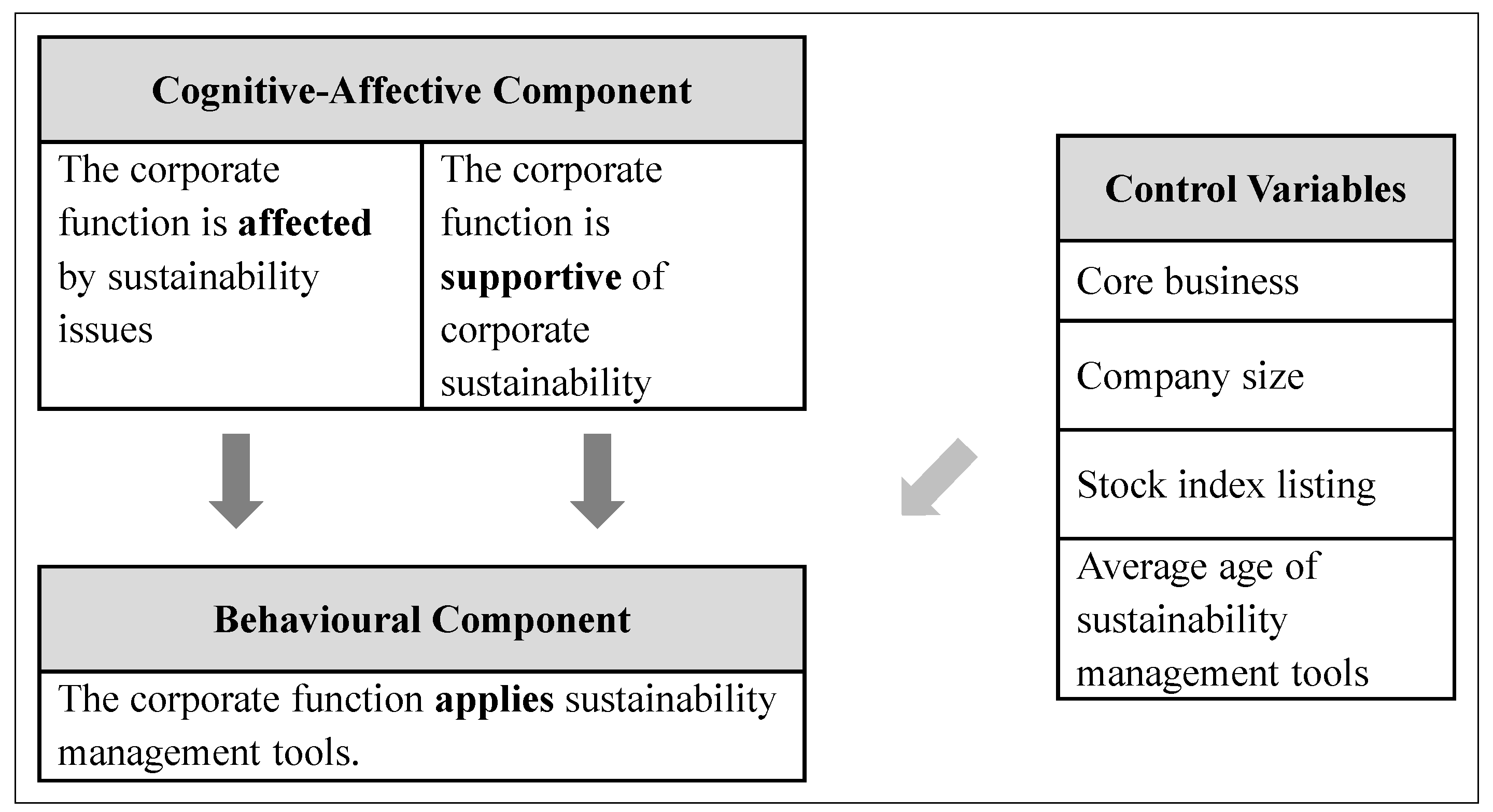
2.2. Components of Sustainability Management Involvement
2.2.1. Cognitive-Affective Involvement
2.2.2. Behavioral Involvement

| Functional unit | Selection of typical sustainability management tools | Literature |
|---|---|---|
| Production/R&D | Design (eco, sustainable) Product carbon footprint Eco-efficiency-analysis | [26,27,30,31,32] |
| Marketing | Label (eco, social, sustainability) Sponsoring (eco, social, sustainability) Marketing (eco, social, sustainability) | [28,29] |
| Purchasing/logistics | Green purchasing Green/sustainable supply chain management Material flow analysis/material and energy flow accounting | [7,9,33] |
| Strategic planning | Mission statement (environmental, social, sustainability) Risk/scenario analysis Early detection | [34,61] |
| PR | Report (environmental, social, HR, sustainability) Environmental declaration Stakeholder dialogue | [35,36] |
| HR | Continuous education Suggestion scheme Employee/corporate volunteering | [37,38] |
| Corporate finance/accounting/management control | Controlling (eco, social, sustainability) Accounting (environmental, material and energy flow, social, sustainability) Cost accounting (environmental, material flow, social) | [39,40,41] |
2.3. Towards an Involvement Model of Functional Units
2.3.1. Being Affected by Sustainability Issues and the Application of Tools
- H1:
- Being affected by sustainability issues fosters a functional unit’s application of sustainability management tools.
2.3.2. Being Supportive of Corporate Sustainability and the Application of Tools
- H2:
- Being supportive of corporate sustainability fosters a functional unit’s application of sustainability management tools.
3. Research Design
3.1. Methodology and Sample
| Annual turnover/total assets/ gross premiums (in million Euros) | Frequency | Percentage |
|---|---|---|
| 0–50 | 0 | 0% |
| >50–500 | 12 | 11.0% |
| >500–1500 | 18 | 16.5% |
| >1500–2500 | 24 | 22.0% |
| >2500–5000 | 16 | 14.7% |
| >5000–50,000 | 17 | 15.6% |
| >50,000 | 19 | 17.4% |
| No answer | 3 | 2.8% |
| Total | 109 | 100.0% |
| Number of employees | Frequency | Percentage |
|---|---|---|
| 0–50 | 0 | 0% |
| 51–250 | 1 | 0.9% |
| 251–1000 | 12 | 11.0% |
| 1001–10,000 | 55 | 50.5% |
| 10,001–100,000 | 31 | 28.4% |
| >100,000 | 10 | 9.2% |
| Total | 109 | 100.0% |
| Industry | Frequency | Percentage |
|---|---|---|
| Manufacturing, capital goods industry and construction | 24 | 22.0% |
| Consumer goods, trade and logistics | 33 | 30.3% |
| Finance and services | 32 | 29.4% |
| Commodities, auxiliary materials, energy, chemical and pharmaceutical industry | 20 | 18.3% |
3.2. Measures
3.2.1. Elements of Involvement
- No application: the functional unit does not apply any of the selected tools (0 tools).
- Partial application: the functional unit applies some, but not all of the selected tools (1–2 tools).
- Comprehensive application: the functional unit applies all of the selected tools (3 tools).
3.2.2. Control Variables
4. Empirical Results and Analysis
4.1. Varying Involvement of Different Corporate Functions
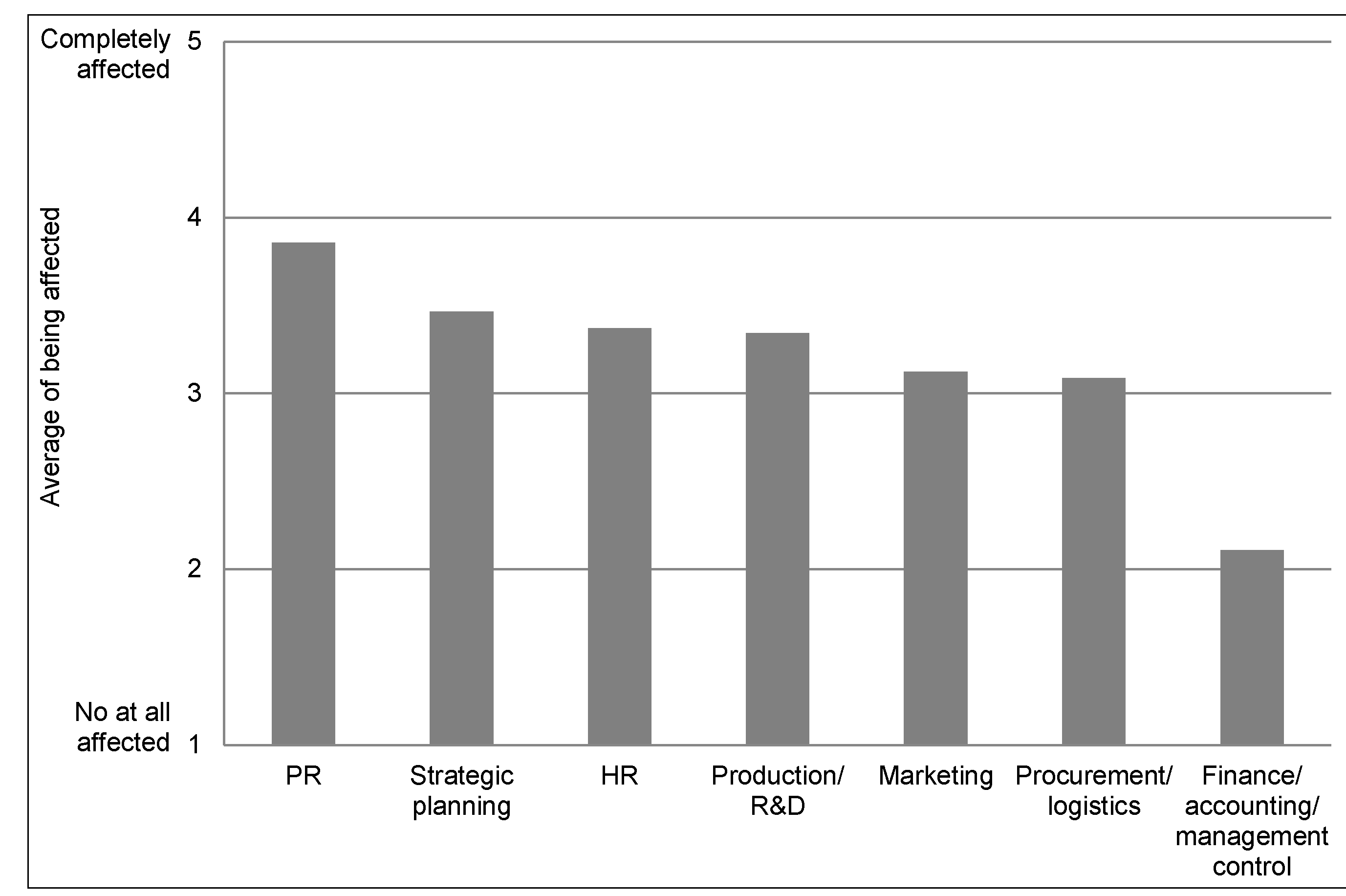
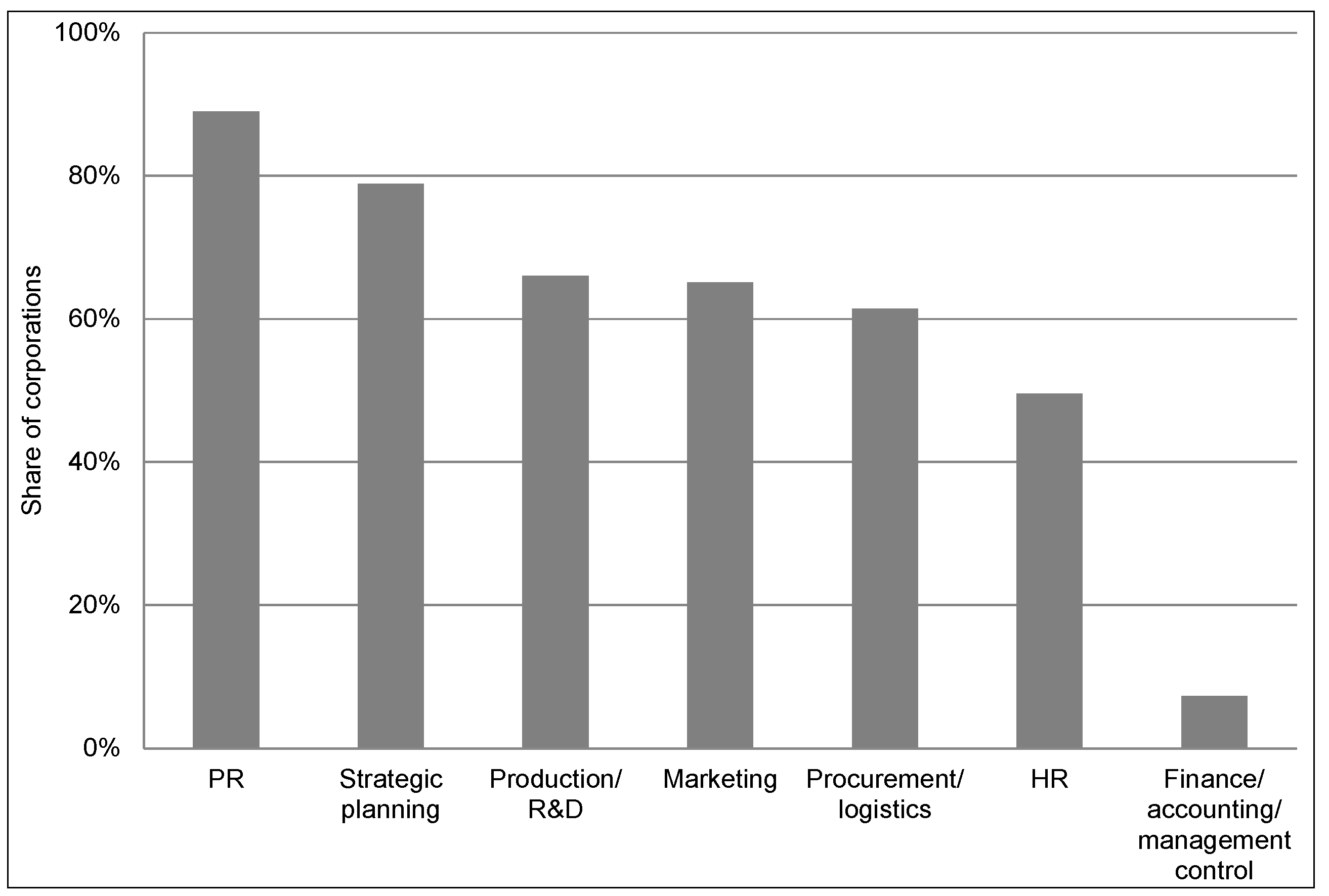
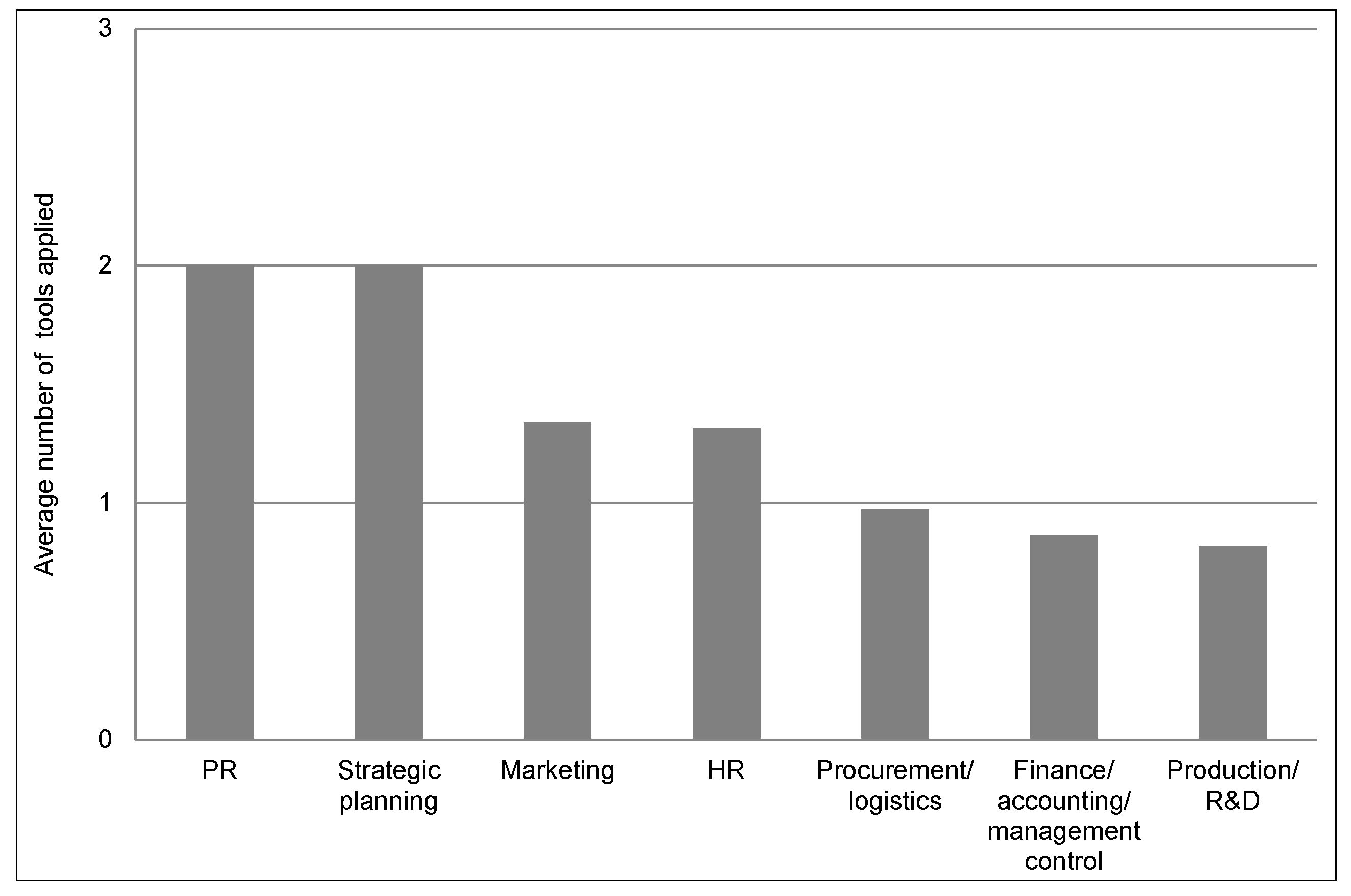
| PR’s being affected as evaluated by sustainability managers in: | N | Mean | T | Significance | Difference in means |
|---|---|---|---|---|---|
| the PR unit | 30 | 3.95 | −0.584 | 0.561 | −0.100 |
| other functional unit | 70 | 3.85 |
4.2. Being Affected, Being Supportive and Their Effects on the Application of Tools
| Influencing variables (IV) | C (IV*AT) | Eta coefficient (Eta²) | r (Pearson) |
|---|---|---|---|
| Being affected | 0.393 *** | 0.353 (0.124) | 0.313 *** |
| Being supportive | 0.257 *** | 0.252 (0.064) | - |
| Test of likelihood quotients | ||||
|---|---|---|---|---|
| Independent variable | (Chi)² | Significance | ||
| AF (being affected) | 31.408 *** | 0.000 | ||
| S (being supportive) | 7.015 ** | 0.030 | ||
| Core business | 13.978 ** | 0.030 | ||
| Revenue | 2.091 | 0.352 | ||
| Stock index listing | 2.121 | 0.346 | ||
| Age of tools | 8.025 ** | 0.018 | ||
| Parametric rating | ||||
| Categories of dependent variable | Independent variable | B | Significance | |
| No application of typical tools | Constant term | 2.252 *** | 0.000 | |
| AF (being affected) | −0.777 *** | 0.000 | ||
| S (being supportive) a | 0.720 *** | 0.009 | ||
| Core business = 1 | 0.842 ** | 0.013 | ||
| Core business = 2 | 0.537 * | 0.098 | ||
| Core business = 3 | 0.007 | 0.984 | ||
| Core business = 4 b | 0 | |||
| Revenue | 0.000 | 0.179 | ||
| Stock index listing a | 0.358 | 0.166 | ||
| Age of tools | −0.020 *** | 0.006 | ||
| Partial application of typical tools | Constant term | 1.362 ** | 0.014 | |
| AF (being affected) | −0.421 *** | 0.001 | ||
| S (being supportive) a | 0.444 * | 0.073 | ||
| Core business = 1 | 0.576 * | 0.054 | ||
| Core business = 2 | 0.683 ** | 0.014 | ||
| Core business = 3 | 0.415 | 0.180 | ||
| Core business = 4 b | 0 | |||
| Revenue | 0.000 | 0.700 | ||
| Stock index listing a | 0.252 | 0.252 | ||
| Age of tools | −0.007 | 0.240 | ||
5. Discussion
6. Conclusions
Acknowledgments
Author Contributions
Conflict of Interest
References and Notes
- Shrivastava, P. The role of corporations in achieving ecological sustainability. Acad. Manag. Rev. 1995, 20, 936–960. [Google Scholar]
- Banerjee, S.B. Managerial Perceptions of Corporate Environmentalism: Interpretations from Industry and Implications for Organizations. J. Manag. Stud. 2001, 38, 489–513. [Google Scholar]
- World Business Council for Sustainable Development (WBCSD). The business case for sustainable development: Making a difference towards the Earth Summit 2002 and beyond. Corp. Environ. Strategy 2002, 9, 226–235. [Google Scholar] [CrossRef]
- BMU German Federal Ministry for the Environment and Federation of German Industries (Ed.) Sustainability Management in Business Enterprises. Concepts and Instruments for Sustainable Development; BMU/Centre for Sustainability Management (CSM): Berlin/Lueneburg, Germany, 2003.
- Burger, P.; Daub, C.-H.; Scherrer, Y. New Perspectives on Sustainable Business (Editorial). J. Bus. Ethics 2009, 85, 479–481. [Google Scholar] [CrossRef]
- Marcus, J.; Kurucz, E.C.; Colbert, B.A. Conceptions of the Business-Society-Nature Interface: Implications for Management Scholarship. Bus. Soc. 2010, 49, 402–438. [Google Scholar] [CrossRef]
- Carter, C.R.; Dresner, M. Purchasing’s Role in Environmental Management: Cross-Functional Development of Grounded Theory. J. Supply Chain Manag. 2001, 37, 12–27. [Google Scholar] [CrossRef]
- Darnall, N.; Jolley, G.J.; Handfield, R. Environmental Management Systems and Green Supply Chain Management: Complements for Sustainability? Bus. Strategy Environ. 2008, 17, 30–45. [Google Scholar] [CrossRef]
- Seuring, S.; Müller, M. From a Literature Review to a Conceptual Framework for Sustainable Supply Chain Management. J. Clean. Prod. 2008, 16, 1699–1710. [Google Scholar] [CrossRef]
- Shrivastava, P.; Hart, S. Creating sustainable corporations. Bus. Strategy Environ. 1995, 4, 154–165. [Google Scholar] [CrossRef]
- Dunphy, D.; Griffiths, A.; Benn, S. Organizational Change for Corporate Sustainability: A Guide for Leaders and Change Agents of the Future, 2nd ed.; Routledge: London, UK, 2007. [Google Scholar]
- Martin, A.; Benn, S.; Dunphy, D. Towards a model of governance for sustainability. In Corporate Governance and Sustainability: Challenges for Theory and Practice; Benn, S., Dunphy, D., Eds.; Routledge: London, UK, 2007; pp. 94–121. [Google Scholar]
- Epstein, M.J. Making Sustainability Work: Best Practices in Managing and Measuring Corporate Social, Environmental and Economic Impacts; Greenleaf: San Francisco, USA, 2008; pp. 90–93. [Google Scholar]
- Porter, M.E. Competitive Advantage: Creating and Sustaining Superior Performance; Free Press: New York, NY, USA, 1985. [Google Scholar]
- Carter, C.R.; Rogers, D.S. A framework of sustainable supply chain management: Moving toward new theory. Int. J. Phys. Distr. Log. 2008, 38, 360–387. [Google Scholar] [CrossRef]
- Singh, R.K.; Murty, H.R.; Gupta, S.K.; Dikshit, A.K. Integrated environment management in steel industries. Inter. J. Manag. Decis. Mak. 2008, 9, 103–128. [Google Scholar]
- Gattiker, T.F.; Carter, C.R. Understanding Project Champions’ Ability to Gain Intra-organizational Commitment for Environmental Projects. J. Oper. Manag. 2010, 28, 72–85. [Google Scholar] [CrossRef]
- Schmidt, I.; Meurer, M.; Saling, P.; Kicherer, A.; Reuter, W.; Gensch, C.-O. SEEbalance. Greener Manag. Int. 2004, 45, 79–94. [Google Scholar]
- Schaltegger, S.; Burritt, R. Corporate Sustainability. In The International Yearbook of Environmental and Resource Economics; Folmer, H., Tietenberg, T., Eds.; Elgar: Cheltenham, UK, 2005; pp. 185–232. [Google Scholar]
- Nijhof, A.; de Bruijn, T.; Honders, H. Partnerships for corporate social responsibility: A review of concepts and strategic options. Manag. Decis. 2008, 46, 152–167. [Google Scholar] [CrossRef]
- Voiculescu, A. Challenges and innovation in the legal discourse: Achieving corporate responsibility for human rights. Soc. Bus. Rev. 2011, 6, 278–291. [Google Scholar] [CrossRef]
- Hanna, M.D.; Newman, W.R.; Johnson, P. Linking operational and environmental improvement through employee involvement. Int. J. Oper. Prod. Manag. 2000, 20, 148–165. [Google Scholar] [CrossRef]
- Nikolaou, I.E.; Evangelinos, K.I. Towards a generally accepted CSR accounting framework: A literature mapping. World Rev. Entrepren. Manag. Sustain. Dev. 2009, 5, 26–41. [Google Scholar] [CrossRef]
- Hansen, F. Hemispheral Lateralization: Implication for Understanding Consumer Behavior. J. Consum. Res. 1981, 8, 23–36. [Google Scholar]
- Hemetsberger, A.; Pieters, R. When Consumers Produce on the Internet: An Inquiry into Motivational Sources of Contribution to Joint Innovation. In Proceedings of the Fourth International Research Seminar on Marketing Communications and Consumer Behavior, La Londe, France, 2001; Derbaix, C., Kahle, L.R., Merunka, D., Strazzieri, A., Eds.; pp. 274–291.
- Veleva, V.; Ellenbecker, M. Indicators of Sustainable Production: Framework and Methodology. J. Clean. Prod. 2001, 9, 519–549. [Google Scholar] [CrossRef]
- Frondel, M.; Horbach, J.; Rennings, K. What triggers environmental management and innovation? Empirical evidence for Germany. Ecol. Econ. 2008, 66, 153–160. [Google Scholar] [CrossRef]
- Kotler, P.; Nancy, L. Corporate Social Responsibility: Doing the Most Good for Your Company and Your Cause; Wiley: New York, NY, USA, 2004. [Google Scholar]
- Belz, F.-M.; Peattie, K. Sustainability Marketing: A Global Perspective, 2nd ed.; Wiley: Chichester, UK, 2012. [Google Scholar]
- Hart, S.L. Beyond greening. Strategies for a sustainable world. Harvard Bus. Rev. 1997, 75, 66–76. [Google Scholar]
- Prahalad, C.K.; Hart, S.L. The fortune at the bottom of the pyramid. Strat. Bus. 2002, 26, 1–14. [Google Scholar]
- Hansen, E.G.; Grosse-Dunker, F.; Reichwald, R. Sustainability Innovation Cube—A Framework To Evaluate Sustainability-Oriented Innovations. Int. J. Innov. Manag. 2009, 13, 683–713. [Google Scholar] [CrossRef]
- Oglethorpe, D.; Heron, G. Sensible operational choices for the climate change agenda. Int. J. Logist. Manag. 2010, 21, 538–557. [Google Scholar] [CrossRef]
- Wagner, M. Integration of Environmental Management with Other Managerial Functions of the Firm. Empirical Effects on Drivers of Economic Performance. Long Range Plann. 2007, 40, 611–628. [Google Scholar] [CrossRef]
- Clark, C.E. Differences between public relations and corporate social responsibility: An analysis. Public Relat. Rev. 2000, 26, 363–380. [Google Scholar] [CrossRef]
- Black, L.D.; Härtel, C.E.J. The five capabilities of socially responsible companies. J. Publ. Aff. 2004, 4, 125–144. [Google Scholar] [CrossRef]
- Daily, B.F.; Huang, S. Achieving sustainability through attention to human resource factors in environmental management. Int. J. Oper. Prod. Manag. 2001, 21, 1539–1552. [Google Scholar] [CrossRef]
- Ehnert, I. Sustainable Human Resource Management: A Conceptual and Exploratory Analysis from a Paradox Perspective; Physica: Berlin/Heidelberg, Germany, 2009. [Google Scholar]
- Schaltegger, S.; Burritt, R. Contemporary Environmental Accounting: Issues, Concepts and Practice; Greenleaf: Sheffield, UK, 2000. [Google Scholar]
- Burritt, R.; Hahn, T.; Schaltegger, S. Towards a Comprehensive Framework for Environmental Management Accounting. Links Between Business Actors and Environmental Management Accounting Tools. Aust. Account. Rev. 2002, 12, 39–50. [Google Scholar] [CrossRef]
- Henri, J.-F.; Journeault, M. Eco-control: The Influence of Management Control Systems on Environmental and Economic Performance. Account. Organ. Soc. 2010, 35, 63–80. [Google Scholar] [CrossRef]
- Lawrence, P.R.; Lorsch, J.W. Differentiation and Integration in Complex Organizations. Admin. Sci. Quart. 1967, 12, 1–47. [Google Scholar] [CrossRef]
- Hoffman, A.J. Linking Organizational and Field-Level Analyses: The Diffusion of Corporate Environmental Practice. Organ. Environ. 2001, 14, 133–156. [Google Scholar] [CrossRef]
- Schein, E.H. Organizational Culture and Leadership; Wiley: San Francisco, CA, USA, 2010. [Google Scholar]
- Schaltegger, S.; Harms, D.; Windolph, S.E. Who is involved?—Integrating corporate functions into sustainability management. In Proceedings of the 13th EURAM conference 2013, Istanbul, Turkey, 26–29 June 2013.
- Houston, M.J.; Rothschild, M.L. Conceptual and Methodological Perspectives on Involvement. In Research frontiers in Marketing Dialogues and Directions; Jain, S.C., Ed.; American Marketing Association: Chicago, IL, USA, 1978; pp. 184–187. [Google Scholar]
- Lorenzoni, I.; Nicholson-Cole, S.; Whitmarsh, L. Barriers perceived to engaging with climate change among the UK public and their policy implications. Global Environ. Change 2007, 17, 445–459. [Google Scholar] [CrossRef]
- Roome, N. Business Strategy, R&D Management and Environmental Imperatives. R&D Manag. 1994, 24, 65–82. [Google Scholar]
- Speis, H.; Czymmek, F. Die Bedeutung der ökologischen Betroffenheit für die um-weltschutzorientierten Wettbewerbsstrategien von Unternehmen; Arbeitsberichte zum Umweltmanagement Arbeitsbericht Nr. 15; Universität zu Köln: Köln, Germany, 2003. (In German) [Google Scholar]
- Altholz, V. The advantages and limitations of developing an external perspective for analyzing corporate strategic alignment. Econ.Environ. Stud. 2010, 10, 35–48. [Google Scholar]
- Freeman, R.E. Strategic Management: A Stakeholder Approach; Pitman: Boston, MA, USA, 1984. [Google Scholar]
- DiMaggio, P.J.; Powell, W.W. The Iron Cage Revisited: Institutional Isomorphism and Collective Rationality in Organizational Fields. Am. Sociol. Rev. 1983, 48, 147–160. [Google Scholar] [CrossRef]
- Bansal, P.; Roth, K. Why companies go green: A model of ecological responsiveness. Acad. Manag. J. 2000, 43, 717–736. [Google Scholar] [CrossRef]
- Marais, M. CEO rhetorical strategies for corporate social responsibility (CSR). Soc. Bus. Rev. 2012, 7, 223–243. [Google Scholar] [CrossRef]
- Hahn, T.; Scheermesser, M. Approaches to corporate sustainability among German companies. Corp. Soc. Resp. Environ. Manag. 2006, 13, 150–165. [Google Scholar] [CrossRef]
- Schaltegger, S. Sustainability as a Driver for Corporate Economic Success: Consequences for the Development of Sustainability Management Control. Soc. Econ. 2011, 33, 15–28. [Google Scholar] [CrossRef]
- Abrahamson, E. Managerial Fads and Fashions: The Diffusion and Rejection of Innovations. Acad. Manag. Rev. 1991, 16, 586–612. [Google Scholar]
- Abrahamson, E.; Fairchild, G. Management fashion: Lifecycles, triggers, and collective learning processes. Admin. Sci. Quart. 1999, 44, 708–740. [Google Scholar] [CrossRef]
- Tencati, A.; Perrini, F.; Pogutz, S. New Tools to Foster Corporate Socially Responsible Behavior. J. Bus. Ethics 2004, 53, 173–190. [Google Scholar] [CrossRef]
- Schaltegger, S.; Hörisch, J.; Herzig, C. Methodische Operationalisierung unternehmerischer Nachhaltigkeit. Methodenbekanntheit, -anwendung und förderpolitische Implikationen. Zeitschrift für Umweltpolitik und Umweltrecht 2013, 1, 87–115. (In German) [Google Scholar]
- Schaltegger, S.; Burritt, R.; Petersen, H. An Introduction to Corporate Environmental Management: Striving for Sustainability; Greenleaf: Sheffield, UK, 2003. [Google Scholar]
- Herzig, C.; Schaltegger, S. Corporate Sustainability Reporting. In Sustainability Communication. Interdisciplinary Perspectives and Theoretical Foundations; Godemann, J., Michelsen, G., Eds.; Springer: Dordrecht, The Netherlands, 2011; pp. 151–170. [Google Scholar]
- Sharma, S.; Henriques, I. Stakeholder influences on sustainability practices in the Canadian forest products industry. Strategy Manag. J. 2005, 26, 159–180. [Google Scholar] [CrossRef]
- Gallo, P.J.; Christensen, L.J. Firm Size Matters: An Empirical Investigation of Organizational Size and Ownership on Sustainability-Related Behaviors. Bus. Soc. 2011, 50, 315–349. [Google Scholar] [CrossRef]
- Brammer, S.J.; Pavelin, S. Corporate Reputation and Social Performance: The Importance of Fit. J. Manag. Stud. 2006, 43, 435–455. [Google Scholar] [CrossRef]
- Darnall, N.; Henriques, I.; Sadorsky, P. Adopting Proactive Environmental Strategy: The Influence of Stakeholders and Firm Size. J. Manag. Stud. 2010, 47, 1072–1094. [Google Scholar] [CrossRef]
- Esrock, S.L.; Leichty, G.B. Social responsibility and corporate web pages: Self-presentation or agenda-setting? Public Relat. Rev. 1998, 24, 305–319. [Google Scholar] [CrossRef]
- Shah, K.U. Corporate Environmentalism in a Small Emerging Economy: Stakeholder Perceptions and the Influence of Firm Characteristics. Corp. Soc. Responsib. Environ. Manag. 2011, 18, 80–90. [Google Scholar] [CrossRef]
- Knoepfel, I. Dow Jones Sustainability Group Index: A Global Benchmark for Corporate Sustainability. Corp. Environ. Strategy 2001, 8, 6–15. [Google Scholar] [CrossRef]
- Fowler, S.J.; Hope, C. A Critical Review of Sustainable Business Indices and their Impact. J. Bus. Ethics 2007, 76, 243–252. [Google Scholar] [CrossRef]
- Consolandi, C.; Jaiswal-Dale, A.; Poggiani, E.; Vercelli, A. Global Standards and Ethical Stock Indexes: The Case of the Dow Jones Sustainability Stoxx Index. J. Bus. Ethics 2009, 87, 185–197. [Google Scholar] [CrossRef]
- Die 500 größten Unternehmen in Deutschland. Available online: http://top500.welt.de (accessed on 13 July 2009). (In German)
- Marsden, C. The New Corporate Citizenship of Big Business: Part of the Solution to Sustainability? Bus. Soc. Rev. 2000, 105, 8–25. [Google Scholar]
- Lewis, G.J.; Harvey, B. Perceived Environmental Uncertainty: The Extension of Miller’s Scale to the Natural Environment. J. Manag. Stud. 2001, 38, 201–233. [Google Scholar]
- Brammer, S.J.; Pavelin, S.; Porter, L.A. Corporate Charitable Giving, Multinational Companies and Countries of Concern. J. Manag. Stud. 2009, 46, 575–596. [Google Scholar]
- Estrin, S.; Baghdasaryan, D.; Meyer, K.E. The Impact of Institutional and Human Resource Distance on International Entry Strategies. J. Manag. Stud. 2009, 46, 1171–1196. [Google Scholar] [CrossRef]
- Muller, A.; Kolk, A. Extrinsic and Intrinsic Drivers of Corporate Social Performance: Evidence from Foreign and Domestic Firms in Mexico. J. Manag. Stud. 2010, 47, 1–26. [Google Scholar] [CrossRef]
- Carter, C.R.; Jennings, M.M. The Role of Purchasing in Corporate Social Responsibility: A Structural Equation Analysis. J. Bus. Logist. 2004, 25, 145–186. [Google Scholar] [CrossRef]
- Deutsche Börse 2010. Available online: http://www.dax-indices.com/EN/index.aspx?pageID=4 (accessed 4 February 2010).
- Ebsco. Available online: www.ebsco.com (accessed on 29 August 2012).
- Web of Science. Available online: www.webofknowledge.com (accessed on 29 August 2012).
- Backhaus, K.; Erichson, B.; Plinke, W.; Weiber, R. Multivariate Analysemethoden: Eine anwendungsorientierte Einführung, 11th ed.; Springer: Berlin/Heidelberg, Germany, 2011. (In German) [Google Scholar]
- Hunting, S.A.; Tilbury, D. Shifting towards Sustainability: Six Insights into Successful Organisational Change for Sustainability; The Australian Research Institute for Environment and Sustainability: Sydney, Australia, 2006. [Google Scholar]
© 2014 by the authors; licensee MDPI, Basel, Switzerland. This article is an open access article distributed under the terms and conditions of the Creative Commons Attribution license (http://creativecommons.org/licenses/by/3.0/).
Share and Cite
Schaltegger, S.; Harms, D.; Windolph, S.E.; Hörisch, J. Involving Corporate Functions: Who Contributes to Sustainable Development? Sustainability 2014, 6, 3064-3085. https://doi.org/10.3390/su6053064
Schaltegger S, Harms D, Windolph SE, Hörisch J. Involving Corporate Functions: Who Contributes to Sustainable Development? Sustainability. 2014; 6(5):3064-3085. https://doi.org/10.3390/su6053064
Chicago/Turabian StyleSchaltegger, Stefan, Dorli Harms, Sarah Elena Windolph, and Jacob Hörisch. 2014. "Involving Corporate Functions: Who Contributes to Sustainable Development?" Sustainability 6, no. 5: 3064-3085. https://doi.org/10.3390/su6053064
APA StyleSchaltegger, S., Harms, D., Windolph, S. E., & Hörisch, J. (2014). Involving Corporate Functions: Who Contributes to Sustainable Development? Sustainability, 6(5), 3064-3085. https://doi.org/10.3390/su6053064

