Open Innovation Strategies for Specialty Coffee Chains: An Innovation Management Model (IMM)

 ,
,  ,
,  ,
,  , ,
, ,
Abstract
1. Introduction
2. Theoretical Framework
2.1. OI Dynamics
2.2. OI Dynamics on Delivery Platforms
2.3. Business Models with OI Dynamics
2.4. Social OI
2.5. OI Engineering and Culture
2.6. OI Culture and Innovation
2.7. Complexity and Limits of OI
2.8. OI Management in Small and Medium-Sized Enterprises
2.9. Legal Aspects of OI in Smart Cities and Industry 4.0
3. Materials and Methods
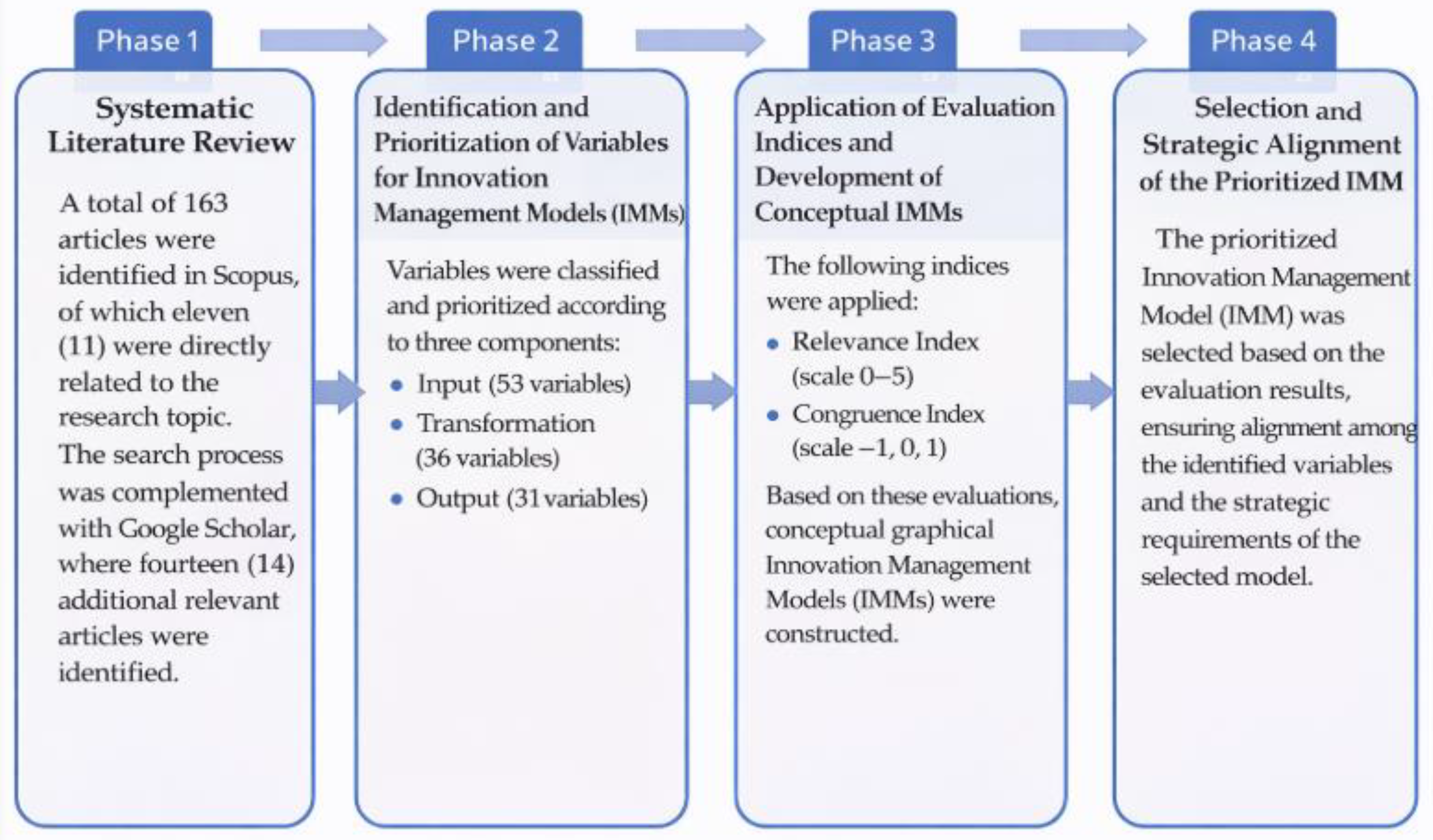
3.1. Phase 1
3.1.1. Research Questions and Scope
3.1.2. Eligibility Criteria
- Articles in peer-reviewed journals
- Indexed in Scopus
- Explicitly addressing innovation management and models for innovation management
- Written in English or Spanish
- Published without a time limit up to the final search date
- Conference proceedings, editorials, book chapters, and documents unrelated to the research
- Duplicate records
- Studies lacking conceptual or analytical relevance
3.1.3. Information Sources and Search Strategy
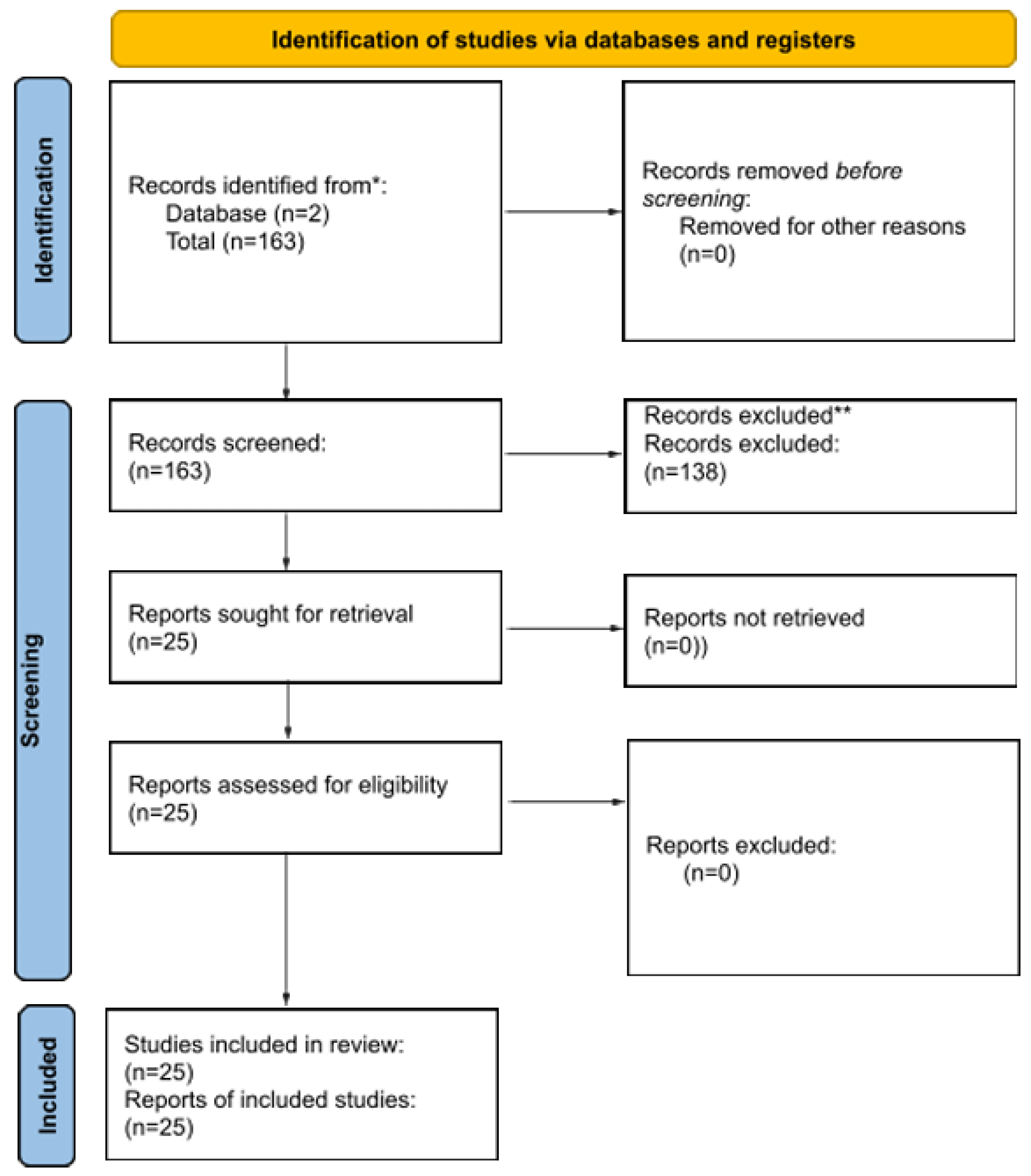
3.1.4. Study Selection Process
3.1.5. Transparency and Replicability of Reports
3.2. Phase 2
3.3. Phase 3
3.4. Phase 4
4. Results
4.1. Phase 1 Analysis
4.2. Phase 2 Analysis
4.2.1. Analysis Based on Previous Studies
4.2.2. Definition of Variables for an IMM
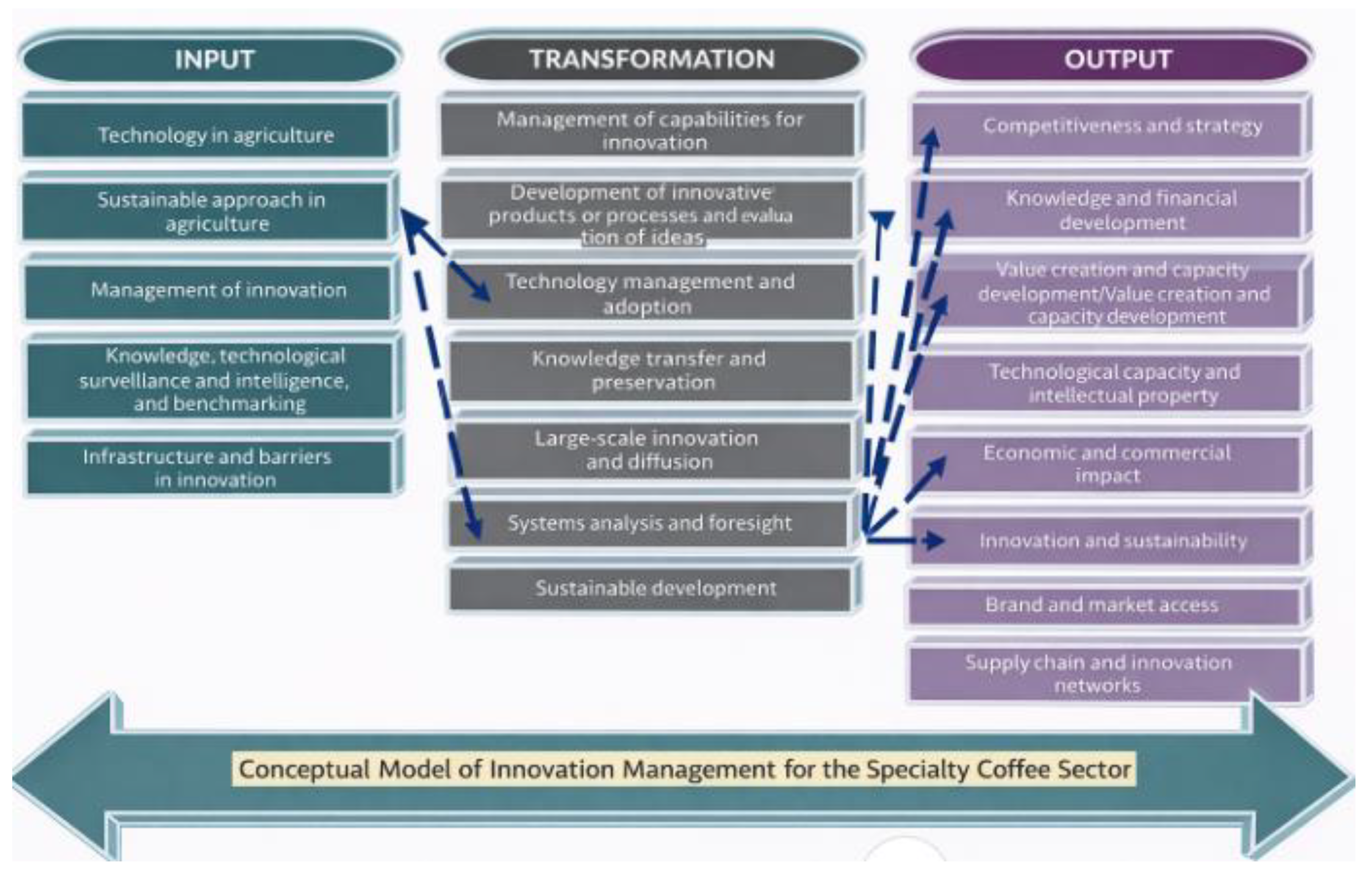
4.2.3. Input, Transformation, and Output Variables
4.3. Phase 3 Analysis
4.4. Phase 4 Analysis
4.4.1. IMM-1 or Linear
4.4.2. IMM-2 or Generic-Interactive
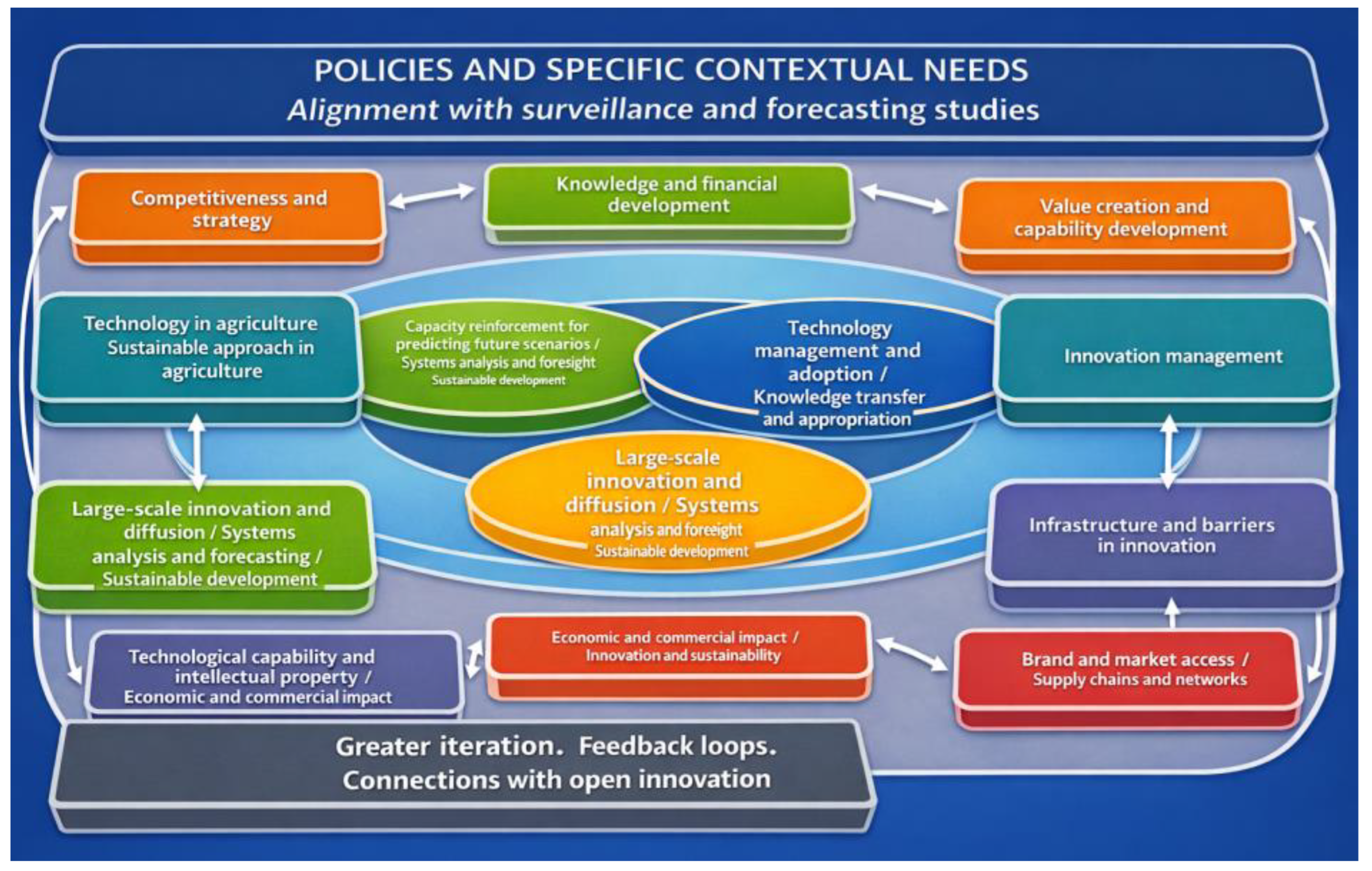
4.4.3. IMM-3 with Strategic Alignment and Innovation
5. Discussion
5.1. Axis 1
5.2. Axis 2
5.3. Research Gap
6. Conclusions, Implications, Limitations and Future Research
7. Recommendations
- Invest in the acquisition and application of advanced technologies for coffee cultivation, harvesting, and processing, ensuring that producers have access to modern equipment and innovative methods. Develop and implement training and technical assistance programs to promote sustainable agricultural practices that protect the environment and ensure the long-term viability of coffee production.
- Establish a clear and structured strategy for innovation management that involves all levels of the organization and defines clear objectives, processes, and responsibilities.
- Implement robust technological surveillance systems and benchmarking analysis to monitor market trends and best practices in the coffee industry, identifying opportunities for innovation and continuous improvement.
- Invest in improving the physical and technological infrastructure necessary to support innovation at all stages of the coffee value chain, from production to commercialization.
- Provide training and skill development to staff involved in innovation, including project management, creativity techniques, problem-solving, and leadership and teamwork skills.
- Establish structured programs and processes to encourage the development of innovative ideas across the organization, fostering collaboration and creativity among employees.
- Propose strategies to facilitate the effective adoption of innovative technologies throughout the coffee value chain, including training and technical assistance programs for producers and creating incentives for adopting new technologies.
- Establish mechanisms and platforms to facilitate effective knowledge transfer and best practices among sector stakeholders, including experience exchange programs and collaboration between companies and organizations.
- Promote the dissemination of successful innovations throughout the coffee industry through outreach programs and events with research and development institutions.
Supplementary Materials
Author Contributions
Funding
Institutional Review Board Statement
Informed Consent Statement
Data Availability Statement
Acknowledgments
Conflicts of Interest
References
- Federación Nacional de Cafeteros, F.N.C. Informe del Gerente 2023 al 92 Congreso Nacional de Cafeteros. 2023. Available online: https://federaciondecafeteros.org/wp/listado-publicaciones/informe-del-gerente-2023-al-92-congreso-nacional-de-cafeteros/ (accessed on 14 September 2024).
- Chaves, D.M.G.; Molina, C.J.; Pastrana, C.A.A. Evaluación espacial de zonas potenciales de centros de distribución de cafés especiales, caso del Departamento de Nariño-Colombia. Rev. EIA 2022, 19, 10. Available online: https://repository.eia.edu.co/entities/publication/5d4e145c-59fb-4a01-8d3c-8044dd94e783 (accessed on 14 September 2024). [CrossRef]
- Peña Gutiérrez, A.M.; Tovar Cristancho, D.E.; Ardila Pérez, J.E. Propuesta Para la Creación de Una Unidad de Negocios Para la Comercialización y Exportación de Cafés Especiales. 2021. Available online: https://repository.universidadean.edu.co/entities/publication/c2cc62ce-1198-4264-aca1-8000aa1e2ced (accessed on 17 February 2025).
- Simon, H.A. Administrative Behavior: A Study of Decision-Making Processes in Administrative Organizations; Free Press: Washington, DC, USA, 1976. [Google Scholar]
- Chesbrough, H. The Era of Open Innovation. MIT Sloan Manag. Rev. 2003, 44, 35–41. [Google Scholar]
- Lakhani, K.R.; Wolf, R.G. Why share knowledge? The influence of organizational and institutional factors on the open source software movement. Res. Policy 2005, 34, 449–469. [Google Scholar]
- Tushman, M.L.; O’Reilly, C.A. Ambidextrous organizations: Managing evolutionary and revolutionary change. Calif. Manag. Rev. 1996, 38, 8–30. [Google Scholar] [CrossRef]
- Parker, G.G.; Van Alstyne, M.W.; Choudary, S.P. Platform Revolution: How Networked Markets Are Transforming the Economy—And How to Make Them Work for You; W. W. Norton & Company: New York, NY, USA, 2016. [Google Scholar]
- Boudreau, K.J.; Lakhani, K.R. Open innovation and the commercialization of complex technologies. Ind. Corp. Change 2009, 18, 335–371. [Google Scholar]
- Chesbrough, H. Business Model Innovation: Opportunities and Barriers. Long Range Plan. 2010, 43, 354–363. [Google Scholar] [CrossRef]
- Osterwalder, A.; Pigneur, Y. Business Model Generation; Wiley: Hoboken, NJ, USA, 2010. [Google Scholar]
- Shapiro, C.; Varian, H.R. Information Rules: A Strategic Guide to the Network Economy; Harvard Business Press: Brighton, MA, USA, 1999. [Google Scholar]
- Chesbrough, H.; Bogers, M. Explicating Open Innovation: Clarifying an Emerging ParadIMM for Understanding Innovation. J. Bus. Res. 2014, 67, 45–54. [Google Scholar]
- Chesbrough, H.; Rosenbloom, R.S. The role of the business model in capturing value from innovation: Evidence from Xerox Corporation’s technology spin-off companies. Ind. Corp. Change 2002, 11, 529–555. [Google Scholar] [CrossRef]
- West, J.; Gallagher, D.J. Challenges of open innovation: The paradox of firm investment in open-source software. RD Manag. 2006, 36, 319–331. [Google Scholar] [CrossRef]
- Bogers, M.; Afuah, A.; Bastian, B. User innovation: A review of the literature and future research opportunities. Res. Policy 2012, 41, 6–23. [Google Scholar]
- Teece, D.J. Business Models, Business Strategy and Innovation. Long Range Plan. 2010, 43, 172–194. [Google Scholar] [CrossRef]
- Bogers, M.; Chesbrough, H.; O’Reilly, C. Innovation and the Digital Economy. J. Bus. Ventur. 2017, 32, 625–636. [Google Scholar]
- Fichter, K. Innovation communities: The role of user innovation communities in open innovation. Int. J. Innov. Manag. 2009, 13, 527–547. [Google Scholar]
- Von Hippel, E. Democratizing Innovation; MIT Press: Cambridge, MA, USA, 2005. [Google Scholar]
- Chesbrough, H. Open Business Models: How to Thrive in the New Innovation Landscape; Harvard Business Press: Boston, MA, USA, 2006. [Google Scholar]
- Franke, N.; Shah, S. How communities support innovative activities: An exploration of assistance and sharing among end-users. Res. Policy 2003, 32, 157–174. [Google Scholar] [CrossRef]
- Van de Vrande, V.; de Jong, J.P.J.; Vanhaverbeke, W.; de Ronde, J. Open Innovation in SMEs: Trends, Motives and Management Challenges. Technovation 2009, 29, 423–437. [Google Scholar] [CrossRef]
- Gassmann, O.; Enkel, E. Towards a theory of open innovation: Three core process archetypes. In Proceedings of the R&D Management Conference, Lisbon, Portugal, 7–9 July, 2004; pp. 1–18. [Google Scholar]
- Piller, F.T.; Walcher, D. Toolkits for user innovation and design: An exploration of user innovation toolkits and their application to the development of innovative products. J. Prod. Innov. Manag. 2006, 23, 417–435. [Google Scholar]
- West, J.; Bogers, M. Leveraging External Sources of Innovation: A Review of the Literature. J. Prod. Innov. Manag. 2014, 31, 1059–1077. [Google Scholar]
- Senge, P.M. The Fifth Discipline: The Art and Practice of the Learning Organization; Doubleday: New York, NY, USA, 1990. [Google Scholar]
- Brown, J.S.; Duguid, P. Knowledge and Organization: A Social-Practice Perspective. Organ. Sci. 2001, 12, 198–213. [Google Scholar] [CrossRef]
- Amabile, T.M. Creativity in Context; Westview Press: Boulder, CO, USA, 1997. [Google Scholar]
- Cohen, W.M.; Levinthal, D.A. Absorptive capacity: A new perspective on learning and innovation. Adm. Sci. Q. 1990, 35, 128–152. [Google Scholar] [CrossRef]
- Gassmann, O.; Enkel, E.; Chesbrough, H. The future of open innovation. RD Manag. 2010, 40, 213–221. [Google Scholar] [CrossRef]
- Alexy, O.; George, G.; Salter, A.J. Cui Bono? The Influence of Organizational Attention and Capabilities on Open Innovation. Acad. Manag. J. 2013, 56, 481–502. [Google Scholar]
- Spithoven, A.; Clarysse, B.; Knockaert, M. Building Absorptive Capacity to Organize Inbound Open Innovation in Small and Medium-Sized Enterprises. Technovation 2013, 33, 244–257. [Google Scholar]
- Vanhaverbeke, W. The inter-organizational context of open innovation. In Open Innovation: Researching a New ParadIMM; Oxford University Press: Oxford, UK, 2006; pp. 205–219. [Google Scholar]
- Laursen, K.; Salter, A. Open for innovation: The role of openness in explaining innovation performance among UK manufacturing firms. Strateg. Manag. J. 2006, 27, 131–150. [Google Scholar] [CrossRef]
- Peráček, T.; Kaššaj, M. Strategic Management of Urban Services Using Artificial Intelligence in the Development of Sustainable Smart Cities—Managerial and Legal Challenges. Sustainability 2026, 18, 582. [Google Scholar] [CrossRef]
- Pană, N. Artificial Intelligence, Industry 4.0 and Human Rights. Jurid. Trib. Rev. Comp. Int. Law 2025, 15, 561–577. [Google Scholar]
- da Silva Meireles, F.R.; Azevedo, A.C.; Boaventura, J.M.G. Open innovation and collaboration: A systematic literature review. J. Eng. Technol. Manag. 2022, 65, 101702. [Google Scholar] [CrossRef]
- Zartha Sossa, J.W.; Botero Montoya, L.H.; Palacio Piedrahíta, J.C.; González Candia, J.; Gutiérrez Cano, L.F.; Orozco Mendoza, G.L.; Gutiérrez Posada, N.; Hernández Zarta, R.; Gómez Salazar, J.O.; Zapata Valencia, J.C. Sustainable innovation management model (MGI) for agro-industrial citrus chain. Agriculture 2025, 15, 1069. [Google Scholar] [CrossRef]
- Zartha Sossa, J.W.; Gutiérrez Posada, N.; Zuluaga Monsalve, A.M.; Botero Montoya, L.H.; Gutiérrez Cano, L.F.; González Candia, J.; Gómez Salazar, J.O.; Orozco Mendoza, G.L.; Escobar Mora, N.J. Sustainable Innovation Management Model (MGI) for Plantain Agroindustrial Chain. Sustainability 2025, 17, 1716. [Google Scholar] [CrossRef]
- Botero Montoya, L.H.; Gutiérrez, N.; Zuluaga, A.; Gutiérrez, L.F.; Gómez, J.O.; Orozco, G.L.; Zartha, J.W. Proposal for Sustainability-Oriented Innovation Management Model (MGI) for Agro-Industrial Leather Chain. Sustainability 2024, 16, 8981. [Google Scholar] [CrossRef]
- Sossa, J.W.Z.; Posada, N.G.; Montoya, L.H.B.; Monsalve, A.M.Z.; Piedrahíta, J.C.P.; Mendoza, G.L.O.; Grisales, L.V.; Cano, L.F.G. Foresight study using scenarios and the Delphi method in the leather agroindustrial chain to 2035-Alignment of results with open innovation. J. Open Innov. Technol. Mark. Complex. 2024, 10, 100374. [Google Scholar] [CrossRef]
- Heyn, P.; Meeks, S.; Pruchno, R. Methodological Guidance for a Quality Review Article. Gerontologist 2019, 59, 197–201. [Google Scholar] [CrossRef]
- Cárdenas-Garcés, A.Y.; Giraldo-Ramírez, D.P.; Vélez-Acosta, L.M.; Ramírez, S.Q. Análisis de políticas de transferencia de tecnología en la cadena productiva del café en Antioquia. Rev. Lasallista Investig. 2020, 17, 403–422. [Google Scholar] [CrossRef]
- Piedrahita, J.C.P.; Zarta, R.H.; Mesa, A.F.R.; Sossa, J.W.Z. Estudio de Prospectiva: Aplicación del método Delphi en Cafés Especiales en Colombia al 2025. Rev. Espac. 2016, 37, 7. [Google Scholar]
- Malaver, D.C.V. Innovation Systems in Developing Countries: A Top-Down and Bottom-Up Approach to Studying the Colombian National System of Innovation and the Coffee, Flower and Sugarcane Production Chains; University of Edinburgh: Edinburgh, UK, 2015. [Google Scholar]
- Amir, I.T.; Indah, P.N.; Widayanti, S. Spices Coffee: Innovation Strategy to Increase Quality on Powder Coffee Farmers. J. Phys. Conf. Ser. 2018, 953, 012242. [Google Scholar] [CrossRef]
- Danse, M.; Vellema, S. Small-scale Farmer Access to International Agri-food Chains: A BOP-Based Reflection on the Need for Socially Embedded Innovation in the Coffee and Flower Sector. Greener Manag. Int. 2005, 51, 39–52. [Google Scholar] [CrossRef]
- Vargas-Hernandez, J.G.; Ali, M.M.; Vargas-González, O.C. Socio-Ecological and Green Innovation Management System Performance: An Approach Towards Green Enterprises. In Cases on Enhancing Business Sustainability Through Knowledge Management Systems; IGI Global Scientific Publishing: Hershey, PA, USA, 2023; pp. 275–298. [Google Scholar] [CrossRef]
- Wikström, A. Building Bridges for Increased Innovation Capability. 2023. Available online: https://www.worldscientific.com/doi/10.1142/9781800612105_0010 (accessed on 14 September 2024).
- Rodríguez, A.B.; García, A.G.R.; Reyes, V.C.; García, A.E. Modelos de innovación en la producción de café en la Sierra Norte de Puebla-México. Rev. Cienc. Soc. 2021, 27, 443–458. [Google Scholar]
- Suryaningrat, I.B.; Novita, E. Implementation of green supply chain management for sustainable agroindustry in coffee processing unit, a case of Indonesia. Coffee Sci. 2022, 17, e172042. [Google Scholar] [CrossRef]
- Arruda, T.J.M.; de Souza, S.B.; Barbosa, R.A.P.; de São Pedro Filho, F.; Patil-Dake, J. Innovation Elements in the Sustainable Production of Indigenous Coffee in the Amazon. In Biotechnological Innovations for Environmental Bioremediation; Springer Nature Singapore: Singapore, 2022; pp. 1041–1061. [Google Scholar] [CrossRef]
- Adams, M.; Ghaly, A.E. Maximizing sustainability of the Costa Rican coffee industry. J. Clean. Prod. 2007, 15, 1716–1729. [Google Scholar] [CrossRef]
- Verburg, R.; Rahn, E.; Verweij, P.; Van Kuijk, M.; Ghazoul, J. An innovation perspective to climate change adaptation in coffee systems. Environ. Sci. Policy 2019, 97, 16–24. [Google Scholar] [CrossRef]
- Setyawati, A.; Sugangga, R.; Maula, F.I.; Rahma, A. Analysis of MSME Innovation Strategies Before and After the COVID-19 Pandemic (Case Study of Omahan Kepanjen Coffee). Int. J. Humanit. Educ. Soc. Sci. 2022, 2. [Google Scholar] [CrossRef]
- Fadhil, R.; Maarif, M.S.; Bantacut, T.; Hermawan, A. Assessment of innovation potential of Gayo coffee agroindustry. Qual. Innov. Prosper. 2017, 21, 114–126. [Google Scholar] [CrossRef]
- Aguilar Olaya, C.M.; Anaya Galvis, Y.A.; Araujo Gálvez, D.F. Eco-Innovación: Estrategia de las Empresas Agroindustriales de Colombia. 2021. Available online: https://digitk.areandina.edu.co/handle/areandina/4744 (accessed on 14 September 2024).
- Padilla, J.; Fabian, F. El Café Guatemalteco: Un Enfoque en el Mercado Mundial y su Productividad; Asociación de Investigación y Estudios Sociales: Guatemala City, Guatemala, 2018. [Google Scholar]
- Alzate Hoyos, C.A. Gestión de la innovación en el sector de cafés especiales. Caso de estudio Asociación de Cultivadores de Apía, Risaralda-Asoapia: Asociación de Cultivadores de Apía, Risaralda-Asoapia. Soc. Econ. 2013, 135–156. Available online: https://bibliotecadigital.univalle.edu.co/server/api/core/bitstreams/c1c53456-9269-4579-a65e-cd94fa99f3c9/content (accessed on 14 September 2024).
- Gonzales Saavedra, F.A. La Influencia de la Innovación en el Desempeño Exportador de las Empresas Exportadoras de café en el Perú. 2019. Available online: https://repositorio.usil.edu.pe/server/api/core/bitstreams/c693d6a7-f7d8-4150-b2ea-2a024edcacb4/content (accessed on 14 September 2024).
- Narváez-Ordoñez, S.D.; Barreda-Ramírez, C.; Velasco-Hurtado, D.S.; Bejarano-Orozco, G.; Certuche-Muñoz, P.M. La innovación tecnológica en la Cooperativa de Caficultores del Cauca CAFICAUCA. Rev. Científica Profundidad Construyendo Futuro 2020, 12, 45–54. [Google Scholar] [CrossRef]
- Molina, Y.Y.C. Propuesta de un modelo para gestionar la IA en los Núcleos de Innovación del Cauca-Colombia. Gestión Pers. Tecnol. 2016, 9, 72–85. [Google Scholar]
- Zartha, J.W.; Solleiro, J.L.; Montes, J.M.; Hernández, R. Innovation Management Models—A Literature Review. Int. J. Innov. Creat. Change 2019, 10, 175–194. [Google Scholar]
- Nonaka, I.; Takeuchi, H. The Knowledge-Creating Company: How Japanese Companies Create the Dynamics of Innovation; Oxford University Press: Oxford, UK, 1995. [Google Scholar]
- Ramírez-Zúñiga, E.J.; Castro-Silva, H.F.; Velásquez-Pérez, T.; García-Cruz, E.K. Unveiling Critical Innovation Factors in Sustainable Coffee Production: A Colombian Perspective. Arch. Ing. Prod. 2024, 30, 431–441. [Google Scholar] [CrossRef]
- Zúñiga, E.J.R.; Silva, H.F.C.; Cruz, E.K.G. Modelo de innovación para fincas productoras de café especial en Colombia. Rev. Colomb. Tecnol. Av. 2026, 1, 1–9. [Google Scholar] [CrossRef]
- Hincapié, J.M.M.; Martínez, E.E.V.; Concha, J.L.H.; Piedrahita, J.C.P.; Rincón, J.F.A.; Fernández, G.L.R.; Sossa, J.W.Z. Priority technologies and innovations in the fishing agribusiness by the year 2032. Foresight study through the Delphi method. Rev. Lasallista Investig. 2017, 14, 105–120. [Google Scholar] [CrossRef]
- Leckel, A.; Veilleux, S.; Dana, L.P. Local Open Innovation: A means for public policy to increase collaboration for innovation in SMEs. Technol. Forecast. Soc. Change 2020, 153, 119891. [Google Scholar] [CrossRef]
- Diener, K.; Luettgens, D.; Piller, F.T. Intermediation for open innovation: Comparing direct versus delegated search strategies of innovation intermediaries. Int. J. Innov. Manag. 2020, 24, 2050037. [Google Scholar] [CrossRef]
- Chen, S.H.; Lee, R.S. A new innovation model: Interdisciplinary creative value-adding toward commercialization. In Proceedings of the 2013 1st International Conference on Orange Technologies (ICOT), Tainan, Taiwan, 12–16 March 2013; pp. 164–167. [Google Scholar] [CrossRef]
- Suárez, L.M.; Agudelo, D.A.; Zartha, J.W.; Orozco, G.L. La cadena productiva de mora en el Departamento Risaralda en el marco de un estudio de prospectiva a 2032. Sci. Tech. 2021, 26, 183–190. [Google Scholar] [CrossRef]
- Quintero, J.; Suárez, L.; Escobar, N.; Meza, C.; Jaramillo, J.; Agudelo, D.; Zartha, J.; Orozco, G. Sectorial Foresight Studies as an Input for Training and Research in Agroindustrial Process Engineering. In Proceedings of the 18th LACCEI International Multi-Conference for Engineering, Education, and Technology, Virtual, 27–31 July 2020. [Google Scholar] [CrossRef]
- Franzò, S.; Doppio, N.; Natalicchio, A.; Frattini, F.; Mion, L. Designing innovation contests to support external knowledge search in small and medium-sized enterprises. Technovation 2023, 121, 102684. [Google Scholar] [CrossRef]
- Montoya, L.H.B.; Sossa, J.W.Z.; Piedrahíta, J.C.P.; Mendoza, G.L.O.; Montoya, A.F.R.; Pérez, W.A.P. Innovation management model for functional food ingredients and additives. Alignment with hype cycle, Python S-curves, and open innovation variables. J. Open Innov. Technol. Mark. Complex. 2024, 10, 100365. [Google Scholar] [CrossRef]
- Solarte-Montufar, J.G.; Zartha-Sossa, J.W.; Osorio-Mora, O. Open Innovation in the Agri-Food Sector: Perspectives from a Systematic Literature Review and a Structured Survey in MSMEs. J. OpenInnov. Technol. Mark. Complex. 2021, 7, 161. [Google Scholar] [CrossRef]
- Duicela-Guambi, L.A.; Martínez-Soto, M.E.; Loor-Solórzano, R.G.; Rodríguez-Monroy, C.; Morris-Diaz, A. Knowledge management and organizational innovation based on the government-company-academy-producers alliance to reactivate the robusta coffee chain, in Ecuador- international journal on food system dynamics. In Proceedings of the 13th International European Forum on System Dynamics and Innovation in Food Networks, Igls, Austria, 18–22 February 2013. [Google Scholar]
- Ordoñez-Manzano, J.J.; Ríos, J.J.; Rodríguez-Rey, L.-E.; Mora-Forero, J.A. Modelo de innovación para cultivo de cafés especiales: Región centro del departamento del Cauca. Estud. Soc. 2024, 24, 63. [Google Scholar] [CrossRef]



| Search Equations | Number of Articles | Related Articles |
|---|---|---|
| TITLE-ABS-KEY ((“innovation management model” OR “innovation strategies” AND coffee) | 5 | 3 |
| TITLE-ABS-KEY (“innovation management”) AND coffee | 34 | 2 |
| TITLE-ABS-KEY (“café”) y “gestión de la innovación” | 2 | 2 |
| TITLE-ABS-KEY (“coffee “) y “innovation management” | 93 | 1 |
| (TITLE-ABS-KEY (innovation AND strategies) AND TITLE-ABS-KEY (coffee) AND TITLE-ABS-KEY (innovation AND management)) | 29 | 3 |
| TOTAL | 163 | 11 |
| Key Words | Related Articles |
|---|---|
| Innovation management models and innovation models. | 14 |
| Author | Title | Variables o Characteristics of the Model | Journal |
|---|---|---|---|
| [47] | Spices Coffee: Innovation Strategy to Increase Quality on Powder Coffee Farmers. | Internal environment condition Coffee spice industry. External environment condition Coffee spice industry. Technological innovation strategy coffee spices. | Journal of Physics: Conference Series |
| [48] | Small-scale farmer access to international agri-food chains: A BOP-based reflection on the need for socially embedded innovation in the coffee and flower sector | Access to international markets. Technology and knowledge | Jstor.org. |
| [49] | Socio-Ecological and Green Innovation Management System Performance: An Approach Towards Green Enterprises | Performance of the green and socio-ecological innovation management system Socio-ecological system Green innovation Socio-ecological strategies | Socio-Ecological-and-Green-Innovation-Management-System-Performance-An-Approach-Towards-Green-Enterprises.pdf |
| [50] | Kanthal: Building bridges for increased innovation capability | Innovation Management System (IMS) Innovation Capacity Incremental Innovation Barriers in the Innovation Environment | World Scientific (Europe)ORLD SCIENTIFIC (EUROPE) |
| [51] | Innovation models in coffee production in the Sierra Norte of Puebla, Mexico | Productive and commercial innovation Innovations Innovation models Innovation index | Dialnet |
| [44] | Analysis of technology transfer policies in the coffee production chain in Antioquia | Technological Push Mode Localized Innovation System Policy Analysis Market Opportunity Distribution | Scielo |
| [52] | Implementation of green supply chain management for sustainable agroindustry in coffee processing unit, a case of Indonesia | Waste Management Ecological Impact Ecological Processing or Ecological Manufacturing Ecological Distribution Ecological Supply Chain Management (GSCM) Emission Reduction during Distribution Techno-ecological Feasibility Processing | Coffee Science, 17, 1–8. |
| [53] | Innovation Elements in the Sustainable Production of Indigenous Coffee in the Amazon | Elements of innovation Sustainable coffee development Institutional and economic development Innovation scenario Sustainable development Process innovation Technologies. | Springer Nature Singapore. |
| [45] | Foresight study: Application of Delphi method in specialty coffees in Colombia to 2025 | Foresight in specialty coffees New businesses Dissemination strategies Marketing Eco-organic products New business lines in the specialty coffee sector | Espacios (Journal) |
| [54] | Maximizing sustainability of the Costa Rican coffee industry | Coffee production and processing Sustainability Cost reduction Risk reduction New opportunities Training Management Industry structure Cleaner Production (CP) Industrial Ecology (IE) Market niches Industrial performance Operational design Management attitudes Barriers to innovations | Sciencedirect |
| Author | Title | Variables o Characteristics of Model | Journal |
|---|---|---|---|
| [55] | An innovation perspective to climate change adaptation in coffee systems. | Climate change adaptation Incremental vs. transformative adaptation Agricultural socio-technical systems Innovation management models | International Center for Tropical Agriculture (CIAT), Hanoi, Vietnam. |
| [56] | Analysis of MSME Innovation Strategies Before and After the COVID-19 Pandemic (Case Study of Omahan Kepanjen Coffee. | Culture of Innovation Financial Resources Human Resources Product/Service Development Process External Collaboration Idea Evaluation Triple Helix Model AI Model (Artificial Intelligence) Waterfall Innovation Model Agile Innovation Model Disruptive Innovation Model | International Journal of Humanities Education and Social Sciences (IJHESS) |
| [57] | Assessment of Innovation Potential of Gayo Coffee Agroindustry | Strategy and Planning Marketing Technological Processes Quality and Environment Logistics Human Resources Collaboration and Partnerships Sustainability and Environment Organizational Innovation Financing | Quality Innovation Prosperity, 21(3) |
| [58] | Eco-innovación: Estrategia de las empresas Agroindustriales de Colombia | Eco-innovation Industrial ecology Technological revolution | Fundación universitaria del Área Andina |
| [59] | Guatemalan coffee: a focus on the global market and its productivity | Coffee Production and Sustainability Innovation in Production International Competitiveness Coffee Value Chain | ZBW—Leibniz-Informationszentrum Wirtschaft/Leibniz Information Centre for Economics |
| [60] | Innovation Management in the Specialty Coffee Sector: A Case Study of the Association of Growers of Apía, Risaralda (Asoapia) | Innovation Social appropriation of environmental knowledge Solidarity economy Sustainability and territory Product quality Fair trade Agroecology | Sociedad y Economía, (25) |
| [46] | Innovation systems in developing countries: A top-down and bottom-up approach to studying the Colombian National System of Innovation and the coffee, flower and sugarcane production chains | Science, Technology, and Innovation (STI) Policies National Innovation System (NSI) Knowledge and knowledge generation Public, industrial, and academic organizations Research funding Global supply chains Governance and governability Culture and cultural factors Power and power dynamics Innovation based on public knowledge | Doctor of Philosophy Science and Technology Studies The University of Edinburgh 2015 |
| [61] | The influence of innovation on the export performance of coffee exporting companies in Peru | Context and characteristics of the coffee industry Resources and capabilities Knowledge transfer Regularity over time and types of results | Universidad San Ignacio de Loyola. Facultad de Ciencias Empresariales ACULTAD DE CIENCIAS EMPRESARIALES Carrera de International Business |
| [62] | Technological innovation in the Cauca Coffee Growers Cooperative CAFICAUCA | Technological innovation Innovation management Competitiveness Competitive advantages Innovation culture Collaboration | Revista Científica Profundidad Construyendo Futuro, 12(12) |
| [63] | Proposal of a model to manage innovation in the Innovation Hubs of Cauca, Colombia | Innovation Hubs AI Trust between stakeholders Innovative products Collaboration structure Innovation processes Market | Revista Electrónica Gestión de las Personas y Tecnología |
| Components | Variables |
|---|---|
| Inputs | International competitiveness of agricultural products, knowledge engineering, key technologies for digital design of precision equipment, sustainable agricultural development, agricultural productivity, level of integration between crops and livestock, type of innovation, appropriate organizational definition, product portfolio, clients and consumers, innovation objectives, managerial functions, innovation process, market information, innovation model design, managerial functions. |
| Transformation | Innovation level, forage income and balance, innovation capacity, diversification, knowledge management, idea research/creativity, R&D activities, customer relationship management, customer and consumer information analysis, analysis and application of stages for formulating and implementing an innovation strategy, technological development, OI, technological monitoring, |
| Outputs | Innovation expenses, sustainable development, modern agriculture, livestock diversity, livestock innovations, conservation in mixed crop-livestock systems, alternative agriculture, outputs, integration of agricultural and livestock activities, conservation agriculture, mixed silages, innovation efficiency, technological innovation, agro-industrial company, innovation outcomes, innovation policies, innovation objectives, new product lines. |
| Input | Technological policy, formalization, growth strategy, new concepts for business units, new skills, mastery of old technology, design, project management, integrated strategy, appropriate organizational definition, ideas/creativity, product innovation program, leadership, performance objectives, integration of clients and suppliers, knowledge exploration, nature of innovation, scope of innovation, type of organization, innovation management strategy, resources, entrepreneurship. |
| Transformation | Diversification, concentration of technological specialists, economic congruence, state of technology adoption, retraining, revolutionary changes in technology, project portfolio management, competency-based management, knowledge management, technological competitive intelligence activities, collective learning, R&D activities, customer relationship management, knowledge preservation, efficiency in innovation project management, vertical integration, business model, value chain. |
| Output | Innovation champions, breakthrough innovations, senior management is responsible for new product outcomes, successful commercialization of innovation, network management, effectiveness of the strategic plan, alliances with other organizations, new product lines, impact of innovations, registered patents, technological capacity, improvement opportunities, consumers, process management, prototyping, sustainable development, monetizing investment. |
| Input | Technological policy, formalization, growth strategy, new concepts for business units, new skills, mastery of old technology, design, project management, integrated strategy, appropriate organizational definition, ideas/creativity, product innovation program, leadership, performance objectives, integration of clients and suppliers, knowledge exploration, nature of innovation, scope of innovation, type of organization, innovation management strategy, resources, entrepreneurship. |
| Transformation | Diversification, concentration of technological specialists, economic congruence, state of technology adoption, retraining, revolutionary changes in technology, project portfolio management, competency-based management, knowledge management, technological competitive intelligence activities, collective learning, R&D activities, customer relationship management, knowledge preservation, efficiency in innovation project management, vertical integration, business model, value chain. |
| Output | Innovation champions, breakthrough innovations, senior management is responsible for new product outcomes, successful commercialization of innovation, network management, effectiveness of the strategic plan, alliances with other organizations, new product lines, impact of innovations, registered patents, technological capacity, improvement opportunities, consumers, process management, prototyping, sustainable development, monetizing investment. |
| Winning-Priority Variable | Non-Winning Variable | Variables Under Discussion |
|---|---|---|
| Mode 4 or 5 and consensus above the average of the thematic group. | Mode 0, 1, or 2 and consensus above the thematic group. | The other variables. |
| Variables |
|---|
| 1. Creativity 2. Leadership 3. Financing, personnel, and facilities 4. Investment in equipment and infrastructure 5. Competitiveness 6. Types of innovation 7. R&D&I activities 8. Capacity development 9. Innovation Management System (IMS) 10. Innovation management models 11. Government policies and regulations 12. Technological development and key technologies 13. Innovation landscape 14. Management functions 15. Business skills 16. Knowledge engineering 17. Supply chain 18. Innovation capabilities 19. Knowledge generation 20. Customer and consumer demand 21. Benchmarking 22. Engagement 23. Product quality 24. Innovation objectives 25. Alternative innovation paths 26. Level of innovation 27. Organizational innovation 28. Innovation culture 29. Product innovation 30. Process/Technology Innovation 31. Monitoring Methods 32. Technological Monitoring 33. Competitive Monitoring 34. Strategic Intelligence 35. Sustainable Development Goals 36. Food Security 37. Agriculture 4.0 and 5.0 38. Sustainable Agriculture 39. Agroecology 40. Technological Roadmap 41. Technological Innovation Projects 42. Technological Innovation Center 43. Technological Changes 44. Agricultural Innovation Platforms 45. Information and Communication Technologies 46. New Production Technologies 47. Future Production Systems 48. Impact of Innovations 49. Circular Economy 50. Barriers to the Innovation Environment 51. Partnerships 52. University-Business-State Links 53. Conditions of the Business Environment and the International Market |
| Variable |
|---|
| 1. Innovation Management Strategy 2. Competency Management 3. Idea Generation and Evaluation for Experimental Development 4. Production Process 5. Value-Added Transformation 6. New Product Development through Testing and Prototyping 7. Training and Knowledge Transfer 8. Development of Innovative Products or Processes 9. Knowledge Management 10. Design Thinking, Lean Processes, and Agility 11. Intelligence Management 12. Innovation Flow Management 13. New Product and Service Strategy 14. Technology Management 15. Scaling Innovations 16. Diffusion of Innovations 17. Technology Adoption 18. Analysis of National, Local, and Territorial Innovation Systems 19. Business Model 20. Foresight 21. AI 22. Process and Technological Innovation 23. Technological Development 24. Innovation Capabilities 25. Value Chain 26. Knowledge Conservation 27. Innovation Strategy Growth 28. Product Innovation Program 29. Project Management 30. Sustainable Development 31. Market Innovation and Opportunity Analysis 32. Circular Economy 33. Market Validation 34. Knowledge Management 35. Strategic Innovation Projects 36. Knowledge Networks |
| Variable |
|---|
| 1. Competitive advantages 2. Improved product portfolio 3. Know-how (acquired knowledge) 4. Value creation 5. Product portfolio 6. Radical innovation 7. Innovation for regenerativity 8. Effectiveness of the strategic plan in project management 9. Consumer engagement 10. Development of financial sustainability 11. Financial and business results 12. Strategies and alliances 13. Technological capacity and intellectual property 14. Profitability of innovation 15. Impact and efficiency on profitability 16. Adoption of innovative technologies and practices 17. Environmental impact and sustainability 18. Quality and performance 19. Economic and commercial impact 20. Strategic and organizational impact 21. Innovation in quality and sustainability 22. Result of innovation in registered patents 23. Improvement in operational efficiency 24. Customer satisfaction 25. Brand image 26. Resilience Organizational 27. Access to new markets 28. Supply chain improvements 29. Development of new capabilities and adaptation to environmental changes 30. Compliance with standards and regulations 31. Participation in innovation networks |
| Unassociated Variables | Associated Variables |
|---|---|
| Input Variables | |
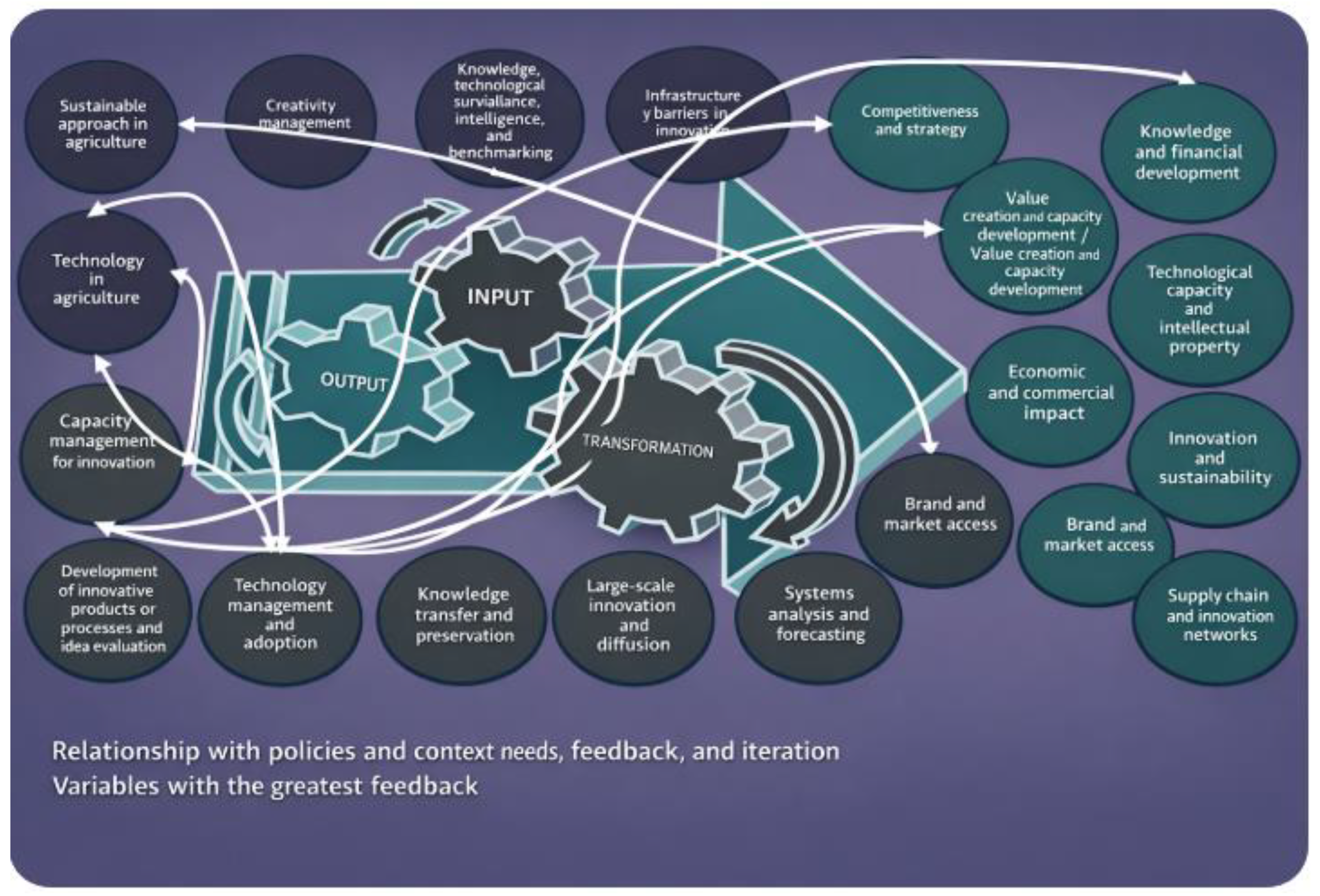
| Idea management/creativity, investment in equipment and infrastructure, Agriculture 4.0 and/or 5.0, sustainable agriculture, agroecology, technological change, innovation management models, technological development and key technologies, knowledge engineering, knowledge generation, benchmarking, product innovation, process/technology innovation, technological and competitive surveillance and intelligence, achievement of sustainable development goals, information and communication technologies, circular economy, barriers in the innovation environment. | Technology in agriculture Sustainable approach in agriculture Innovation management Knowledge, technological surveillance, intelligence, and benchmarking Infrastructure and barriers in innovation Principio del formulario Final del formulario |
| Transformation variables | |
| Strategy for innovation management, competency-based management (technological), generation and evaluation of ideas for experimental development, transformation with added value, development of new products through testing and prototyping, training and knowledge transfer, development of innovative products or processes, innovation flow management, technology management, scaling of innovations, diffusion of innovations, technology adoption, analysis of national, local, and territorial innovation systems, foresight, OI, innovation capabilities, technological development, knowledge preservation, product innovation program, sustainable development. | Innovation Capability Management Development of innovative products or processes and idea evaluation Technology management and adoption Knowledge transfer and preservation Large-scale innovation and diffusion Systems analysis and foresight Sustainable development |
| Output variables | |
| Competitive advantages, know-how (acquired knowledge), value creation, development of financial sustainability, strategies and alliances, technological capability and intellectual property, economic and commercial impact, innovation in quality and sustainability, brand image, access to new markets, improvement in the supply chain, development of new capabilities and adaptation to changes in the environment, participation in innovation networks | Competitiveness and strategy Knowledge and financial development Value creation and capacity development Technological capability and intellectual property Economic and commercial impact Innovation and sustainability Brand and access to markets Supply chain and innovation networks |
| IMM | Linearity Between the Input, Transformation, and Output Variables |
|---|---|
| Authors: | Luis Fernando Gutiérrez Cano, Jhon Wilder Zartha Sossa, John Fredy Moreno Sarta, Gina Lía Orozco Mendoza, Tatiana Álvarez Ríos and Juan Carlos Palacio Piedrahita. |
| Description | Information flows and linear relationship between input, transformation, and output variables. |
| Contribution of the model | Note: The contributions of the Innovation Management Model (IMM) will be presented in the Results Analysis section of the third survey. Outsourcing allows the knowledge to be transferred to be evidenced in different formats, not only from person to person but also from person to different formats, meaning that the knowledge must be understood in order to be captured in a format. Additionally, it is the step prior to combination, which allows for enhancing, contrasting, detailing, and discerning knowledge through interaction and contributions with other people, with different experiences and interpretations around the same topic. |
| IMM | Feedback/Iterations Between Variables |
|---|---|
| Authors: | Luis Fernando Gutiérrez Cano, Jhon Wilder Zartha Sossa, John Fredy Moreno Sarta, Gina Lía Orozco Mendoza, Tatiana Álvarez Ríos y Juan Carlos Palacio Piedrahita. |
| Description | Information flows and feedback and iteration between input, transformation, and output variables. Related to policies and the needs of the context |
| Contribution of the model | Note: The contributions of the Innovation Management Model (IMM) will be presented in the Results Analysis section of the third survey |
| IMM | Strategic Alignment and Innovation |
|---|---|
| Autores: | Luis Fernando Gutiérrez Cano, Jhon Wilder Zartha Sossa, John Fredy Moreno Sarta, Gina Lía Orozco Mendoza, Tatiana Álvarez Ríos and Juan Carlos Palacio Piedrahita. |
| Descripción | Iterations between input, transformation, and output variables.” Feedback between variables and bidirectional flows of information and knowledge” Related to policies and the needs of the context. |
| Contributions of the model | Note: The contributions of the Innovation Management Model (IMM) will be presented in the Results Analysis section of the third survey |
| Platforms | Link | Challenges/Projects in the Agroindustry |
|---|---|---|
| https://www.innocentive.com/ |  |
| https://www.ninesigma.com/ | |
| https://www.yet2.com/services/open-innovation-portals/ | |
| https://www.itonics-innovation.com/open-innovation | |
| https://www.ennomotive.com/ | |
| https://rutanmedellin.org/programas/retos-de-innovaci%C3%B3n-abierta-ofertas-ruta-n | |
| https://www.imnovation-hub.com/es | |
| Key Finding (Empirical Evidence) | Strategic Recommendation | Expected Benefits | Potential Trade-Offs/Risks |
|---|---|---|---|
| Limited access to advanced technologies across the specialty coffee value chain. | Establish structured Open Innovation (OI) partnerships with universities, technology providers, and innovation hubs to facilitate access to Agriculture 4.0 and digital monitoring tools. | Improved productivity, enhanced traceability, increased product differentiation, and higher competitiveness in premium markets. | Dependence on external partners; need for governance mechanisms to manage intellectual property and data sharing. |
| Weak technological surveillance and benchmarking systems. | Implement a formalized technological and competitive intelligence system integrated into the Innovation Management Model (IMM-3). | Early identification of market trends, regulatory shifts, and technological disruptions; reduced strategic uncertainty. | Increased managerial workload; requirement for trained personnel in intelligence analysis. |
| Insufficient structured processes for idea generation and scaling of innovations. | Adopt stage-gate and prototyping mechanisms embedded in IMM-3 to systematize idea evaluation, pilot testing, and scaling processes. | Higher innovation efficiency, reduced failure rates, and improved commercialization success. | Longer development cycles; possible resistance to process formalization among small producers. |
| Fragmented collaboration among stakeholders in the specialty coffee chain. | Create formal innovation networks and multi-actor governance platforms under an Open Innovation framework (University–Business–State–Producers model). | Strengthened collective learning, accelerated knowledge transfer, improved systemic competitiveness. | Coordination complexity; potential conflicts of interest among actors. |
| Limited integration of sustainability and circular economy principles into innovation strategy. | Integrate sustainability KPIs and circular economy practices as mandatory components of innovation project evaluation within IMM-3. | Enhanced environmental performance, improved brand positioning, compliance with international sustainability standards. | Initial investment costs; need for monitoring systems and sustainability auditing. |
| Barriers related to infrastructure and institutional constraints. | Align IMM-3 implementation with regional public policies and leverage government incentives for innovation financing. | Improved access to funding, institutional support, and long-term innovation continuity. | Exposure to policy changes; administrative complexity. |
Disclaimer/Publisher’s Note: The statements, opinions and data contained in all publications are solely those of the individual author(s) and contributor(s) and not of MDPI and/or the editor(s). MDPI and/or the editor(s) disclaim responsibility for any injury to people or property resulting from any ideas, methods, instructions or products referred to in the content. |
© 2026 by the authors. Licensee MDPI, Basel, Switzerland. This article is an open access article distributed under the terms and conditions of the Creative Commons Attribution (CC BY) license.
Share and Cite
Gutiérrez Cano, L.F.; Zartha Sossa, J.W.; Gutiérrez Posada, N.; Botero Montoya, L.H.; González Candia, J.; Orozco Mendoza, G.L.; Hernández Zarta, R.; Zapata Valencia, J.C.; Gómez Salazar, J.O. Open Innovation Strategies for Specialty Coffee Chains: An Innovation Management Model (IMM). Sustainability 2026, 18, 3225. https://doi.org/10.3390/su18073225
Gutiérrez Cano LF, Zartha Sossa JW, Gutiérrez Posada N, Botero Montoya LH, González Candia J, Orozco Mendoza GL, Hernández Zarta R, Zapata Valencia JC, Gómez Salazar JO. Open Innovation Strategies for Specialty Coffee Chains: An Innovation Management Model (IMM). Sustainability. 2026; 18(7):3225. https://doi.org/10.3390/su18073225
Chicago/Turabian StyleGutiérrez Cano, Luis Fernando, Jhon Wilder Zartha Sossa, Nolberto Gutiérrez Posada, Luis Horacio Botero Montoya, Julio González Candia, Gina Lía Orozco Mendoza, Raúl Hernández Zarta, Juan Carlos Zapata Valencia, and José Orlando Gómez Salazar. 2026. "Open Innovation Strategies for Specialty Coffee Chains: An Innovation Management Model (IMM)" Sustainability 18, no. 7: 3225. https://doi.org/10.3390/su18073225
APA StyleGutiérrez Cano, L. F., Zartha Sossa, J. W., Gutiérrez Posada, N., Botero Montoya, L. H., González Candia, J., Orozco Mendoza, G. L., Hernández Zarta, R., Zapata Valencia, J. C., & Gómez Salazar, J. O. (2026). Open Innovation Strategies for Specialty Coffee Chains: An Innovation Management Model (IMM). Sustainability, 18(7), 3225. https://doi.org/10.3390/su18073225