1. Introduction
In the context of global climate change, transitioning to low-carbon development has become a central priority for achieving sustainable economic progress worldwide [
1]. As a critical artery of global trade [
2], the logistics industry is a major contributor to energy consumption and greenhouse gas emissions. According to the International Energy Agency (IEA), the transport sector accounts for nearly one-quarter of global energy-related CO
2 emissions, with freight logistics representing a substantial and rapidly growing share of this total [
3]. Over recent decades, surging global freight volumes have significantly increased pressure on both energy resources and the environment. This situation underscores the urgent need to shift toward low-carbon logistics systems, thereby making the assessment of their efficiency a matter of strategic importance at the macroeconomic level [
4].
As the most dynamic economic zone in China and a frontrunner in the nation’s Reform and Opening-Up policy as well as the Belt and Road Initiatives, the eastern coastal region has witnessed exponential growth in its logistics industry, propelled significantly by the boom in e-commerce [
5]. While this expansion has generated substantial economic opportunities, it has also introduced considerable challenges. The traditional extensive development model, which emphasized scale over efficiency, has led to notable issues such as inefficient resource utilization, waste, and serious environmental degradation. Therefore, shifting away from this inefficient model toward an intensive and sustainable development approach, which is characterized by refined management and low-carbon operations, has become an urgent priority. Improving the efficiency of low-carbon logistics will play a decisive role in shaping the sustainable development path for provinces across the eastern coastal region, highlighting both the critical importance and the immediacy of addressing this issue [
6,
7].
Before launching targeted initiatives like low-carbon technology investments or supply chain optimization, it is essential to first obtain a precise and thorough assessment of the overall low-carbon logistics efficiency in China’s eastern coastal provinces [
8]. Therefore, this study systematically evaluates such efficiency across the region with accuracy and detail. The results will clarify the relative performance and uncover major shortcomings in each province, thereby establishing an evidence-based foundation for well-targeted, effective, and sustainable logistical improvements.
Traditionally, research on logistics efficiency has primarily focused on its economic performance across different sectors [
9,
10]. Recent developments have broadened this focus to include critical themes such as “low-carbon”, “sustainable,” and “green” development [
11]. However, a noticeable research gap persists in comprehensively evaluating low-carbon logistics efficiency across broader and more representative regions in China, which underscores the necessity of this study. Methodologically, Data Envelopment Analysis (DEA) is commonly used for efficiency assessment [
12], often extended through techniques like confidence intervals and integration with the Analytic Hierarchy Process (AHP) [
13]. However, conventional single-stage DEA-BCC models often fail to account for environmental impacts and tend to offer static efficiency evaluations [
14]. To address these limitations, this study investigates low-carbon logistics efficiency and its key driving factors within China’s eastern coastal regions, aiming to fill the identified research gap.
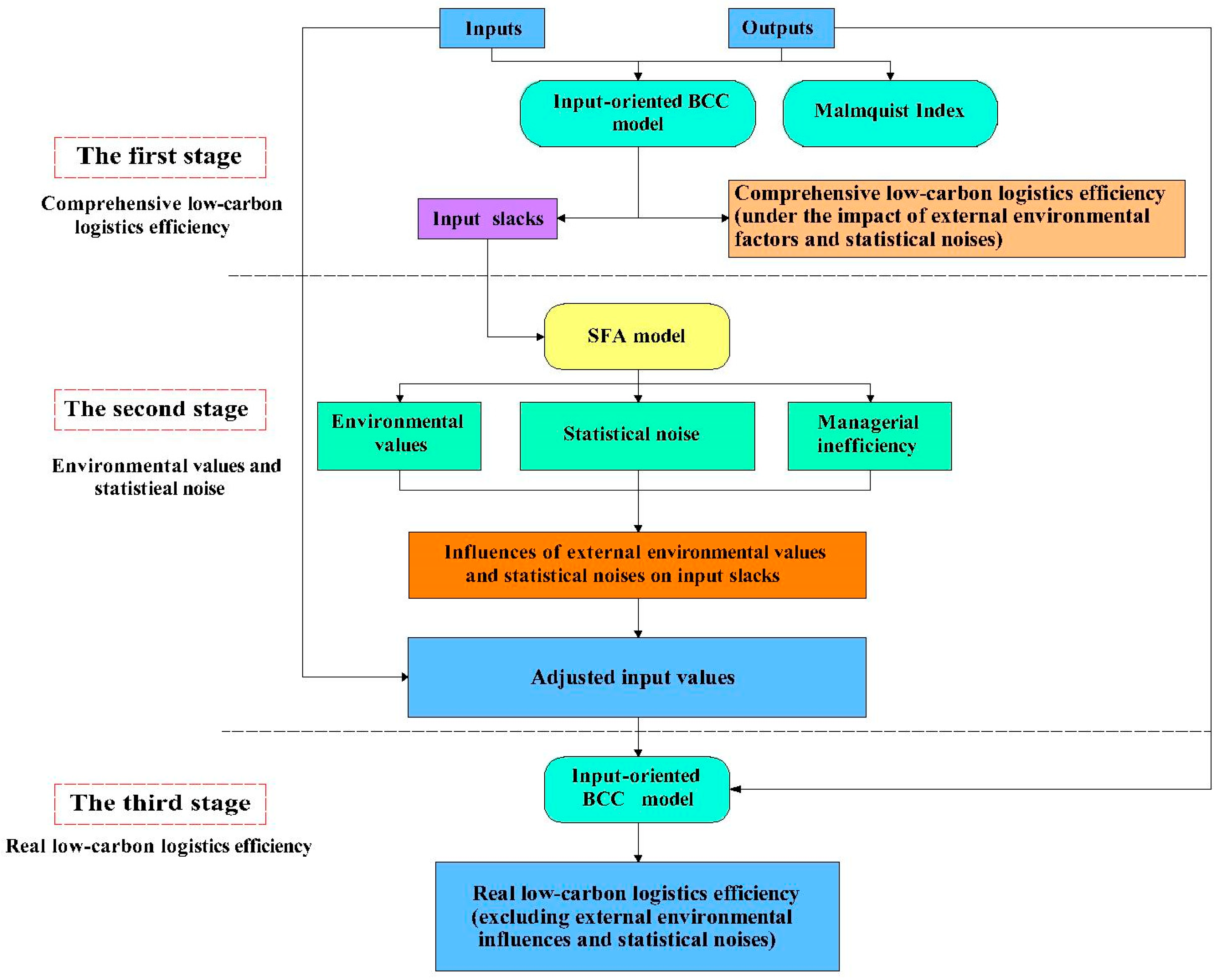
This study employs a three-phase Data Envelopment Analysis (DEA) framework to assess the efficiency of low-carbon logistics systems [
15,
16]. In the initial phase, an input-oriented BCC model is used to compute preliminary efficiency scores, while the Malmquist productivity index is introduced to analyze dynamic efficiency changes over time. The second phase applies Stochastic Frontier Analysis (SFA) to regress input slack variables against external environmental factors, namely regional GDP and environmental investment. This allows for the decomposition and elimination of the impacts of both external conditions and statistical noise. In the third phase, the DEA-BCC model is reapplied to the adjusted input data to derive a purified measure of managerial efficiency. This integrated approach effectively isolates the influence of external factors, resulting in a more accurate and robust evaluation of the true operational performance of low-carbon logistics.
The primary contributions of this study are threefold. First, it significantly expands the research scope from individual provinces to China’s entire eastern coastal region, thereby enhancing the generalizability and robustness of the conclusions. Second, it employs a superior methodological framework by integrating a three-stage Data Envelopment Analysis (DEA) model with the Malmquist index, enabling a comprehensive assessment that combines static efficiency measurement with dynamic productivity change analysis. Third, it constructs a more scientifically grounded set of variables through the explicit inclusion of carbon emissions as an undesirable output in the evaluation system, which underscores the critical synergy between economic output and environmental performance. Collectively, these advances provide valuable and actionable insights, offering both practical solutions and a conceptual framework to guide the sustainable development of low-carbon logistics in eastern coastal China.
The remainder of this study is organized as follows.
Section 2 provides a review of the related literature.
Section 3 outlines the theoretical framework.
Section 4 introduces the variables and data description.
Section 5 presents the empirical analysis and results. Finally,
Section 6 concludes with remarks and policy implications.
2. Literature Review
2.1. Low-Carbon Logistics and Evaluation Framework
Low-carbon logistics has become an essential component of green supply chain management (GSCM), serving as a key mechanism to advance global carbon neutrality and environmental sustainability [
17,
18]. Research indicates that the transition toward such systems is largely driven by the interplay between stringent regulatory measures, such as carbon pricing policies, and increasing stakeholder demands for operational transparency [
19]. Recent literature highlights the importance of comprehensive carbon accounting across supply chain activities, emphasizing that indirect emissions from upstream and downstream operations often represent the largest portion of a company’s total carbon footprint [
20]. By incorporating carbon accounting into GSCM, organizations can enhance decision-making in areas such as facility location planning, transportation routing, and broader operational processes, thereby enabling companies to transform eco-innovation and low-carbon information technology into sustainable competitive advantages [
21]. As global attention increasingly focuses on environmental performance, research on low-carbon logistics is essential to guide and inform practical implementation [
22,
23].
To advance low-carbon logistics research, it is essential to select scientifically based evaluation metrics to transform research objectives into measurable, comparable, and verifiable data standards. Contemporary research has evolved beyond simplistic cost-based metrics toward multidimensional frameworks that balance economic, energy, and environmental factors [
24,
25]. Such models typically incorporate inputs such as labor, energy consumption, and capital stock, while desirable outputs often include economic indicators like logistics value-added or regional GDP [
26,
27]. In contrast, undesirable outputs, primarily environmental ones, encompass carbon dioxide emissions, emission intensity, and pollutant levels [
28,
29]. Specialized studies further refine these assessments by integrating metrics like carbon productivity and R&D investment, thereby capturing the impact of technological innovation and policy support [
30]. A scientific selection of these variables enables a precise and effective evaluation of the development status of low-carbon logistics systems.
2.2. Low-Carbon Logistics Efficiency
Evaluating low-carbon logistics efficiency is essential for supporting the sustainable development of China’s logistics sector. However, existing empirical studies often suffer from fragmented methods, uneven regional coverage, and a focus on efficiency measurement over analyzing its underlying drivers. For example, Zheng et al. applied a non-radial Slacks-Based Measure (SBM) model with hierarchical regression to assess logistics efficiency in 17 provinces along the Belt and Road from 2007 to 2017 [
31]. Zhang et al. employed a three-stage Data Envelopment Analysis (DEA) model using data from ten coastal provinces (2015–2017), highlighting the significant impact of the external environment on efficiency [
32]. Liang et al. integrated a three-stage Super-SBM model with the Malmquist index to examine 13 cities in Jiangsu Province from 2010 to 2020 [
33]. While these studies improve methodological rigor, they remain limited in scope and scale. There is a clear need for integrated, context-sensitive frameworks that connect efficiency measurement with policy and spatial dynamics.
In terms of methodology, this study most closely resembles that of Yao et al. [
34]. Both apply the Data Envelopment Analysis (DEA) model and the Malmquist index to assess efficiency from static and dynamic perspectives, while systematically integrating carbon emissions as an undesirable output to capture environmental impacts. The core distinctions lie in regional scope and analytical depth. The former provides a focused diagnosis of inefficiencies within the Beijing–Tianjin–Hebei agglomeration, identifying localized shortcomings. In contrast, the latter examines the broader Eastern Coastal Region using a three-stage DEA to control for external environmental factors, concluding that scale inefficiency, rather than pure technical efficiency, is the primary constraint across the wider area.
Data Envelopment Analysis (DEA) has developed into a key non-parametric method for assessing and optimizing logistics entity efficiency, with researchers tailoring its models to address sector-specific challenges. Early applications focused primarily on baseline efficiency evaluation. For example, Lee et al. employed standard and variable returns-to-scale (VRS) DEA models to benchmark Malaysian logistics firms’ financial performance, identifying improvement pathways for underperforming units [
35]. To enhance precision, later studies integrated additional factors or complementary techniques: one incorporated operational risk via the basic indicator approach (BIA) into DEA [
36], while another adopted Fuzzy-DEA to tackle data uncertainty in Turkish logistics centers [
37]. More recent work reflects a trend toward methodological integration, such as combining DEA with Delphi-AHP for variable selection, or applying cluster analysis and decision trees to classify last-mile delivery station efficiency in Indonesia [
38,
39]. These advances illustrate DEA’s adaptability in complex logistics decision-making. Overall, the evolution shows a shift from descriptive benchmarking toward more sophisticated, context-aware modeling, highlighting DEA’s continued relevance in generating strategic insight amid growing industry complexity.
The DEA–Malmquist index model is widely applied in evaluating logistics efficiency, providing both static assessment and dynamic tracking of total factor productivity (TFP) change, typically decomposed into technical and scale efficiency [
40,
41]. Key findings from its application reveal that while TFP growth has been observed in regions such as the Yellow River Basin and Shandong’s agricultural cold-chain logistics, regional gaps persist, primarily due to disparities in pure technical efficiency rather than scale inefficiencies, indicating underlying innovation gaps [
42,
43]. Beyond regional studies, the model has also been applied in specialized contexts like paper-shell walnut supply chains in Northwest China and performance among listed logistics firms [
44]. Technological progress consistently appears as the main driver of TFP growth, despite temporal fluctuations in efficiency scores [
45]. While the model offers robust diagnostic insights into past performance, it provides limited prescriptive guidance for scalable interventions. Consequently, Malmquist-based insights are increasingly treated not as standalone solutions, but as diagnostic tools to inform targeted resource allocation and support sustainable, high-quality logistics development.
2.3. Research Gap
This study enhances and expands the existing literature on evaluating low-carbon logistics efficiency through three key contributions.
First, in terms of research scope, this study extends beyond earlier geographically limited analysis, which often focused on specific areas such as selected coastal provinces, individual cities within Jiangsu, or the Beijing–Tianjin–Hebei cluster. Indeed, it conducts an empirical analysis across the entire economically dynamic and carbon-intensive eastern coastal region of China. This broader and more representative sampling enhances the generalizability and practical relevance of the findings.
Second, methodologically, this study advances beyond prior research, which often relied on isolated or limited models such as stand-alone BCC, non-radial SBM, three-stage Super-SBM, or the Malmquist index alone. It does so by systematically integrating the three-stage DEA model with the Malmquist index. The three-stage DEA isolates the influence of environmental factors and random noise to clarify the role of contextual variables, while the Malmquist index tracks efficiency changes dynamically over time and examines their underlying drivers. Together, this integrated approach effectively combines static measurement with dynamic evolution analysis of low-carbon logistics efficiency.
Third, regarding variable construction and evaluation framework, the study explicitly incorporates carbon emissions as a key undesirable output within the assessment system. By analytically treating it as an input, the research better examines the synergy between economic output and carbon emissions. In evaluating results, the emphasis is placed on comparing first-stage and third-stage DEA outcomes. This involves analyzing the ten-year development path of different regions across multiple dimensions to identify their strengths and specific constraints. From the perspective of balancing high-quality development with a low-carbon sustainable transition, this analysis reveals region-specific challenges and opportunities for transforming logistics systems toward greater sustainability and lower carbon emissions.
Through these refinements, the study demonstrates stronger methodological rigor and delivers more scientifically grounded, targeted, and sustainability-oriented policy insights. It thus offers a more robust decision-making foundation for advancing high-quality development, low-carbon transformation, and long-term sustainability in China’s eastern coastal regions.
3. Construction of a Three-Stage DEA Model
The DEA method is a non-parametric efficiency evaluation technique that assesses the relative efficiency of multiple decision-making units (DMUs) by constructing a production frontier through linear programming. This approach identifies optimal input–output relationships, thereby guiding resource allocation improvements [
46]. However, traditional DEA models do not account for the influence of external environmental factors and random statistical noise, which may distort efficiency estimates. To address this limitation, the second stage incorporates Stochastic Frontier Analysis (SFA) to decompose the input slack variables into environmental effects, managerial inefficiency, and random error. In the third stage, the original input data are adjusted based on the SFA regression results, and DEA is re-applied to compute efficiency values that reflect managerial performance more accurately, free from external disturbances. This three-stage framework, first proposed by Fried et al., enhances the objectivity, reliability, and stability of efficiency measurement [
47]. The fundamental principles of the model are shown in
Figure 1.
- (1)
The First Stage of DEA Efficiency Measurement
In this initial stage, conventional DEA is performed using the original input and output variables. This study employs the input-oriented BCC model to compute the initial efficiency values, as expressed in Equation (1):
In the equations: denotes the input values, denotes the output values, denotes the weight variables, denotes the comprehensive technical efficiency, denotes the surplus variables, denotes the slack variables, and denotes the non-Archimedean infinitesimal.
The Malmquist index method enables dynamic analysis of efficiency changes in sample data over time, which contributes to a deeper identification of the driving factors behind efficiency variations. Among the established DEA models, the one proposed by Färe et al. is the most widely applied [
48,
49]. Drawing on relevant existing research, the model is specified in Equations (2)–(5):
Assume that there are n decision-making units (DMUs) to be evaluated over T time periods. In each period t, every DMU employs m inputs to generate s outputs. Denote the input vector for the j-th DMU in period t as , and its output vector as , where all input and output values are strictly positive, and t = 1, 2, …, T.
The change in productivity from period t to period t + 1 can be expressed as
The Malmquist index serves as a key indicator for measuring productivity change over time. Its value can be expressed: Malmquist Index > 1: This signifies an increase in productivity from the previous period, reflecting an improvement in production efficiency. Malmquist Index = 1: This denotes that productivity has remained unchanged compared to the prior period, indicating stagnation in efficiency levels. Malmquist Index < 1: This points to a decline in productivity relative to the previous period, suggesting a deterioration in productive performance.
- (2)
The Second Stage of the Stochastic Frontier Approach
The SFA is employed in a two-stage process to adjust for the influence of environmental factors. In the first stage, the input slack values obtained from the initial efficiency analysis are regressed against a set of external environmental variables. The purpose of this regression is to decompose the observed input slacks into two components: one attributable to environmental factors and the other to managerial inefficiency. Based on the regression results, the input data for all DMUs are then adjusted to a common operational environment, thereby eliminating the portion of input redundancy caused by external, non-managerial influences. This adjustment yields a set of normalized input quantities that reflect a comparable operational baseline. The general form of the SFA regression function for this purpose is specified in Equation (6):
In the specified equation, the following notation applies: the symbol denotes the slack value associated with the n-th input for the i-th decision-making unit; The vector represents the set of observable environmental variables, with denoting the corresponding coefficient vector. The composite error term is expressed as , where captures stochastic noise and represents the component attributable to management inefficiency.
The purpose of the SFA regression is to adjust all decision-making units to an identical external environment. The adjustment is given by Equation (7):
The following notation is defined for the equation: represents the adjusted input value, while denotes the original input before adjustment. The term corrects for disparities arising from observable external environmental factors. Simultaneously, the term standardizes the stochastic noise component, thereby ensuring that all decision-making units are evaluated under a comparable baseline of common external conditions.
The separation of the random error term v and the management inefficiency term μ from the composite error is a critical step, conducted primarily in two stages. The initial stage involves distinguishing the management inefficiency component. Drawing on the seminal conceptual framework established by Jondrow et al. [
50], and by applying the corresponding equations and methodological guidelines described by subsequent researchers such as Roden Yue and Wei Chen [
51,
52], this study isolates the components of management inefficiency and stochastic disturbance [
53]. This process integrates established procedures from the literature on the three-stage DEA methodology. The calculation is presented in Equation (8):
In the equation: , , .
The second step involves calculating the random error term v, as shown in Equation (9):
- (3)
Efficiency Analysis of DEA for Adjusted Input–Output Variables in the Third Stage
Based on the adjusted input variables, the efficiency of each DMU is recalculated by reapplying the DEA model from the initial stage. This procedure effectively eliminates the confounding effects of external environmental factors and random statistical noise. Consequently, the resulting efficiency scores more accurately reflect the true managerial performance of the DMUs, substantially enhancing the validity and reliability of the comparative assessment.
4. Indicator Selection and Data Sources
Based on the research objectives and focus of this study, a set of variables has been constructed to evaluate the efficiency of low-carbon logistics in eastern coastal China. These variables encompass inputs, outputs, and environmental factors, as summarized in
Table 1.
4.1. Input and Output Variables
The selection of “Fixed Asset Investment” and “Logistics Industry Carbon Emissions” is justified by their combined capacity to systematically evaluate the overall costs incurred by the logistics system in generating economic output. “Fixed Asset Investment” primarily reflects capital and resource expenditures from a cost perspective, capturing the scale and intensity of physical infrastructure investment. Meanwhile, “Carbon Emissions” accounts mainly for environmental impacts and external constraints, illustrating resource consumption and environmental costs within a low-carbon development framework. By integrating inputs from the cost side with impacts from the constraint side, these two variables provide a more realistic measure of the system’s operational efficiency under contemporary sustainable development goals [
54,
55].
“Value Added of the Logistics Industry” and “Freight Volume” are chosen as output indicators, as they directly and effectively reflect the industry’s economic contribution and operational performance. “Value Added” measures its role in generating economic value, while “Freight Volume” captures the scale of core operations and service throughput. Together, these indicators provide a comprehensive perspective on logistics output, encompassing both economic and service-performance dimensions [
56,
57].
4.2. Environmental Variables
The selection of environmental variables focuses on factors that significantly influence logistics efficiency but remain outside the direct control of internal industry operations. Common environmental elements considered in logistics analysis include policy-driven reductions in technological costs, infrastructure improvements, market-based mechanisms, and digital collaboration.
The choice of “GDP” as an indicator is based on its capacity to directly reflect a region’s total economic output. Higher GDP levels correlate with larger-scale and more intensive logistics activities, which typically lead to greater energy consumption and elevated emissions. This relationship establishes a strong impetus for optimizing resource allocation through low-carbon logistics solutions [
58,
59].
The inclusion of “Investment in Environmental Infrastructure Construction” indicates the degree of government commitment and the allocation of financial resources toward physical infrastructure, such as pollution control systems and clean energy facilities. Such investments directly strengthen the material capacity to decarbonize logistics networks and serve as a fundamental enabler of the transition toward sustainability [
60,
61].
The above indicators are constructed using data from 12 provinces (autonomous regions, and municipalities) in China’s eastern coastal region for the period 2013 to 2022. The data are drawn from the China Statistical Yearbook, the China Energy Statistical Yearbook, and the respective provincial (autonomous regional, and municipal) statistical yearbooks.
4.3. Data Collection and Collation
In this study, each province–year combination (N = 120) within the main three-stage DEA framework is treated as an independent DMU to evaluate the efficiency of low-carbon logistics in eastern coastal China. Over this ten-year period, the accelerated adoption of smart logistics technologies and new energy applications, among other advancements, ensures the actual technological progress within the industry. As a result, the findings derived from this analysis hold enhanced relevance and practical reference value.
The eastern coastal region represents the leading edge of China’s reform and opening-up policies and functions as the nation’s most dynamic economic core area, typically encompassing provinces and municipalities such as Shanghai, Jiangsu, Zhejiang, Fujian, and Guangdong [
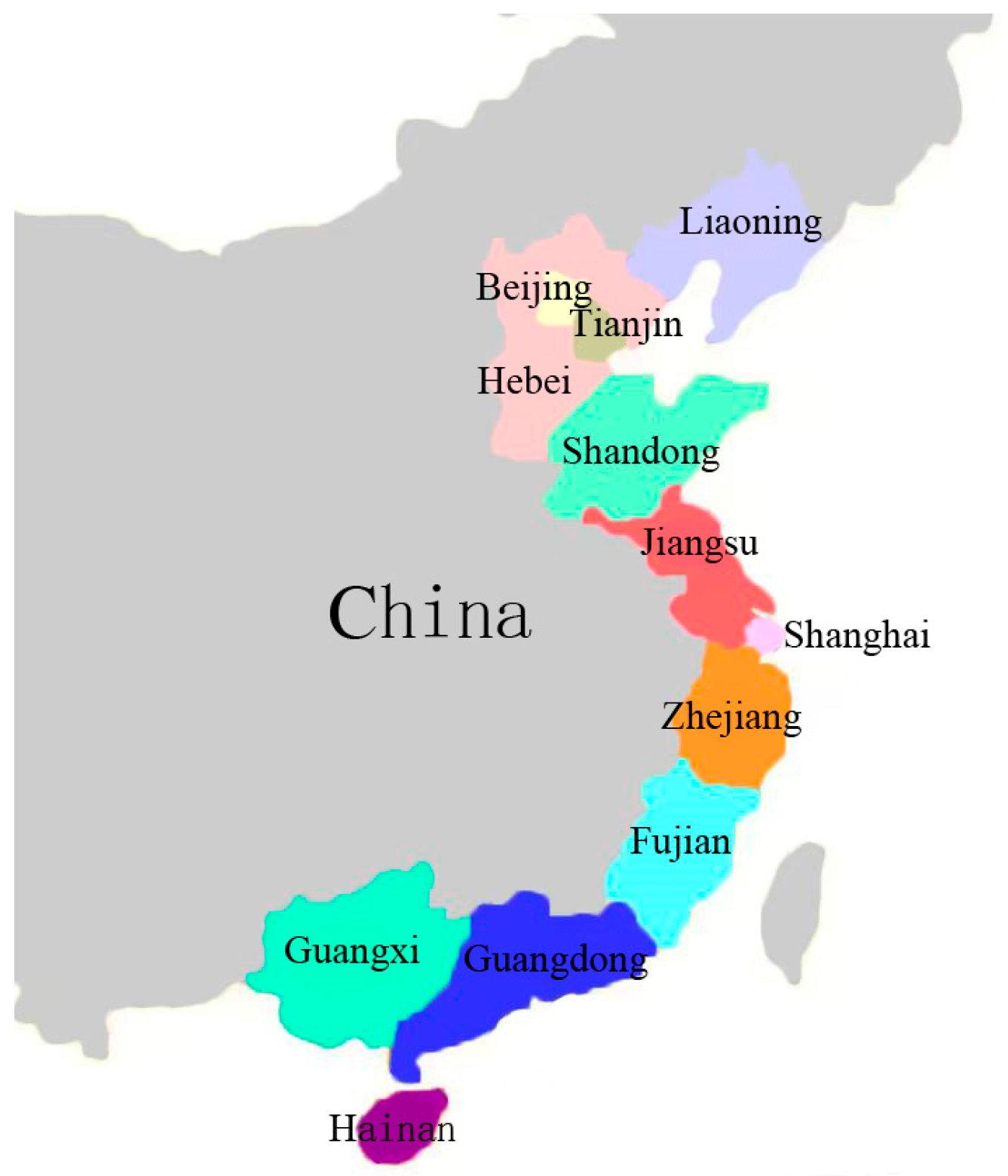
62]. Anchored by the three major urban agglomerations, specifically the Beijing–Tianjin–Hebei region, the Yangtze River Delta, and the Pearl River Delta, it has developed into the country’s most competitive and highly open economic corridor. For the purposes of this study, the research scope is defined to include 12 provincial-level regions: Liaoning, Hebei, Beijing, Tianjin, Shandong, Jiangsu, Shanghai, Zhejiang, Fujian, Guangdong, Guangxi, and Hainan (
Figure 2).
In estimating carbon emissions from the logistics industry, this study adopts the carbon dioxide calculation methodology specified in the 2006 IPCC Guidelines for National Greenhouse Gas Inventories and the China Energy Statistical Yearbook. Based on the consumption data of the eight energy categories listed in
Table 2, the carbon emissions of the logistics industry are calculated using Equation (10):
The equation presented quantifies the total carbon emissions for the logistics sector. In this context C denotes the aggregate carbon dioxide emissions generated by the logistics industry. refers to the consumption level of the i-th category of energy used within this sector. is the conversion coefficient that transforms the i-th energy type into its standard coal equivalent; represents the carbon emission factor for the i-th energy type, indicating the amount of CO2 emitted per unit of energy combusted. The index i ranges from 1 to 8, corresponding to the eight major energy categories considered in this calculation.
5. Empirical Analysis
5.1. Spatial Efficiency Analysis
This study employs a three-stage Data Envelopment Analysis (DEA) framework to evaluate efficiency. As a linear-programming-based performance measurement tool, the DEA model requires an examination of variable correlations before implementation (
Table 3). Accordingly, Pearson’s correlation coefficients between input and output variables for each year were computed using SPSS 20.0 software [
63], with results presented in
Table 4. The analysis indicates a statistically significant positive correlation between input and output variables at the 5% significance level, under the assumption of homoscedasticity.
The correlation strength between the variables fluctuated over the decade, with the strongest relationship recorded in 2014 between X1 and Y2, reaching 0.900, while the weakest was observed in 2021 between X1 and Y1, measuring 0.580. Strong correlations, defined as ranging from 0.8 to 1.0, occurred in 2014 (X1-Y2, 0.900) and 2022 (X2-Y1, 0.862). Moderate-strong correlations, between 0.7 and 0.8, are illustrated by the years 2016 (0.790) and 2018 (0.759). Meanwhile, moderate-weak correlations within the 0.5 to 0.7 range were notably present for both variable pairs in 2021. All results are validated by a consistent data collection methodology.
5.2. Numerical Analysis
5.2.1. Empirical Study of the First-Stage BCC Model
This study evaluates the efficiency of low-carbon logistics in China’s eastern coastal region using the BCC model. The initial efficiency scores and input slack variables for each decision-making unit are computed with DEAP 2.1 software, and overall technical efficiency is decomposed into pure technical efficiency and scale efficiency. Furthermore, an output-oriented DEA–Malmquist index model is applied to analyze the dynamic changes in low-carbon logistics efficiency in the region during the period 2013 to 2022.
Based on the results presented in
Table 5, it can be observed that, without adjusting for external environmental factors and random disturbances, Hebei Province has already achieved DEA effectiveness and lies on the efficiency frontier, indicating relatively sufficient resource utilization. The average efficiency values of Liaoning Province and Guangxi Zhuang Autonomous Region remain at a relatively high level overall. The comprehensive technical efficiency of Guangdong Province and Hainan Province is primarily constrained by suboptimal scale efficiency. This suggests that factor allocation, including capital, land, and labor, in these regions requires further optimization, as a rational production scale has yet to be established. In contrast, the overall efficiency performance of Beijing Municipality and Fujian Province is relatively weak, particularly due to their low pure technical efficiency, which reflects notable inefficiencies within their low-carbon logistics systems.
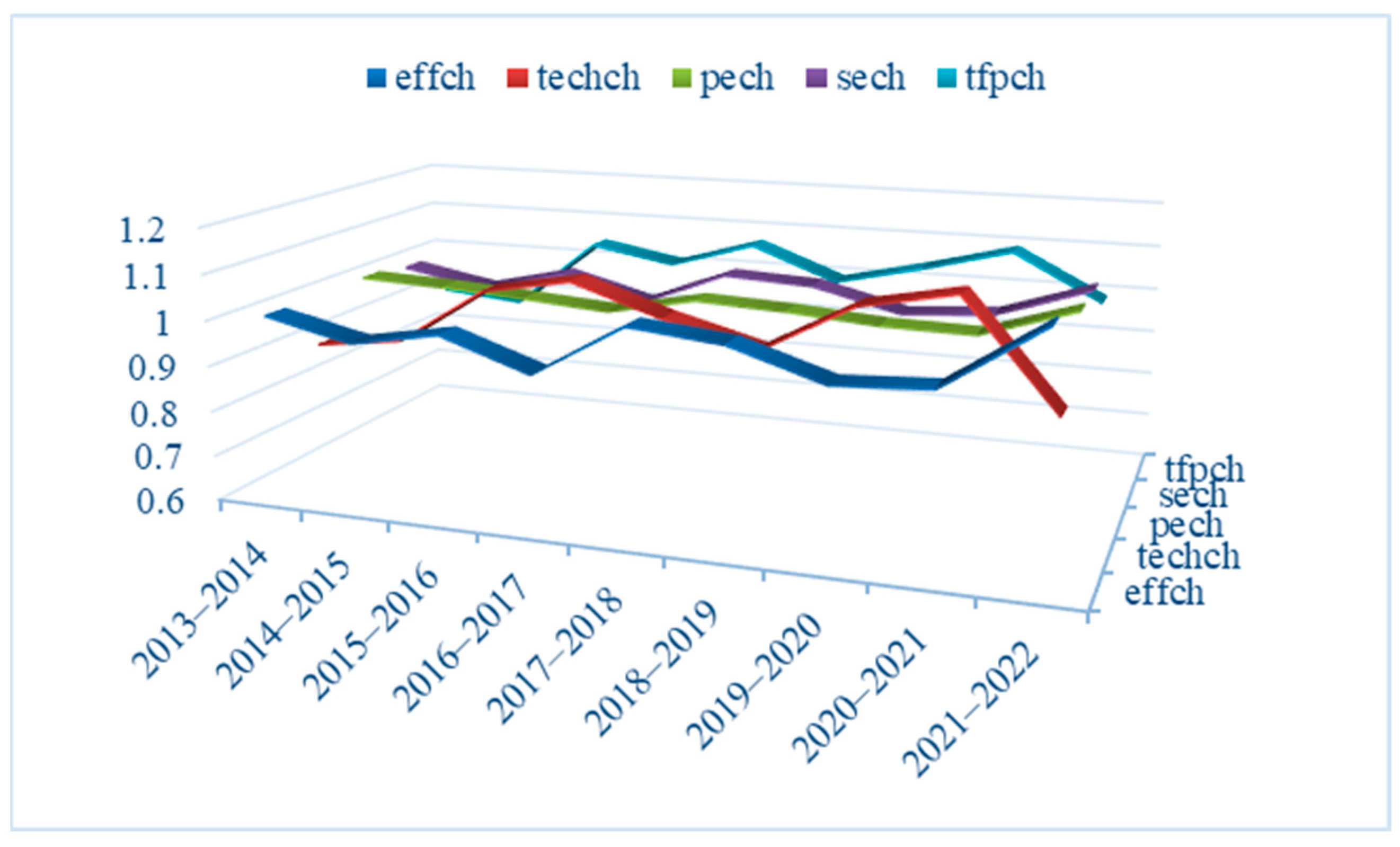
From a dynamic perspective,
Figure 3 indicates that the Total Factor Productivity Index (tfpch) in the eastern coastal region showed a fluctuating upward trend from 2013 to 2022, with technological progress (techch) serving as the primary driver of this growth. Notably, during the 2020–2021 period, techch reached its peak, contributing significantly to the rise in TFP. Furthermore, in most years, a clear alternating fluctuation pattern existed between changes in technical efficiency (effch) and technological progress (techch), without achieving sustained synergistic growth. Going forward, efforts should be directed toward promoting their coordinated contribution. Within techch, changes in pure technical efficiency (pech) remained relatively stable, while variations in scale efficiency (sech) experienced notable fluctuations, making sech the key factor driving the changes in techch.
5.2.2. Analysis of the Second-Stage SFA Regression Results
Given that the initial-stage results were affected by environmental variations and random disturbances, they do not accurately reflect the true regional logistics efficiency. In this stage, a Stochastic Frontier Analysis (SFA) model is applied to regress input redundancy against two environmental variables: Z1 (Gross Domestic Product) and Z2 (Investment in Environmental Infrastructure). The model assumes a half-normal distribution for the inefficiency term. According to Equation (7), a negative coefficient indicates that the environmental factor helps reduce input redundancy, while a positive coefficient implies an increase. The analysis was performed using Frontier 4.1, with detailed results presented in
Table 6.
As shown in
Table 6, the likelihood ratio (LR) statistic of 5.138, compared against a chi-square distribution with 2 degrees of freedom, exceeds the critical value at the 5% significance level, with γ being close to 1. This statistically significant result confirms the presence of management inefficiency, thereby justifying the application of the Stochastic Frontier Analysis (SFA) model. Based on the SFA regression coefficients, the following conclusions are drawn regarding the two environmental variables and their relationship with input slacks.
- (1)
Regional Gross Domestic Product
Gross Domestic Product (GDP) demonstrates varying effects on Fixed Asset Investment over the ten-year study period, both in direction and magnitude. Between 2016 and 2021, GDP growth supported Fixed Asset Investment, whereas in other years it exerted a restraining influence. Regarding Logistics Industry Carbon Emissions, the GDP coefficient is negative in most years, indicating a generally favorable influence. This suggests that more developed economies tend to curb unnecessary investment and energy waste. Although extensive growth can lead to inefficiency, the data show that in most years, economic advancement in eastern coastal regions promotes low-carbon logistics, signaling a shift from labor-and-energy-intensive models towards sustainable development strategies.
- (2)
Investment in Environmental Infrastructure
The regression coefficients for Investment in Environmental Infrastructure Construction relative to the slack variables of Fixed Asset Investment and Logistics Industry Carbon Emissions are positive in most years. This indicates that increased investment in this area is associated with inefficiencies in input utilization, leading to wastage of capital assets and energy consumption. Specifically, the effective operation of environmental infrastructure relies not only on the accumulation of physical facilities but also on well-coordinated operational models, management frameworks, and technical expertise. The observed lag in management and technological readiness implies that a significant portion of environmental investment fails to be promptly translated into actual operational efficiency, thereby constraining improvements in low-carbon logistics performance.
5.2.3. Analysis of the Third-Stage DEA Efficiency
Based on the adjusted input variables and the original output variables, DEAP2.1 software was employed to recalculate the low-carbon logistics efficiency values after accounting for the removal of environmental influences and random disturbances. The trends in comprehensive technical efficiency across regions from 2013 to 2022 were subsequently analyzed.
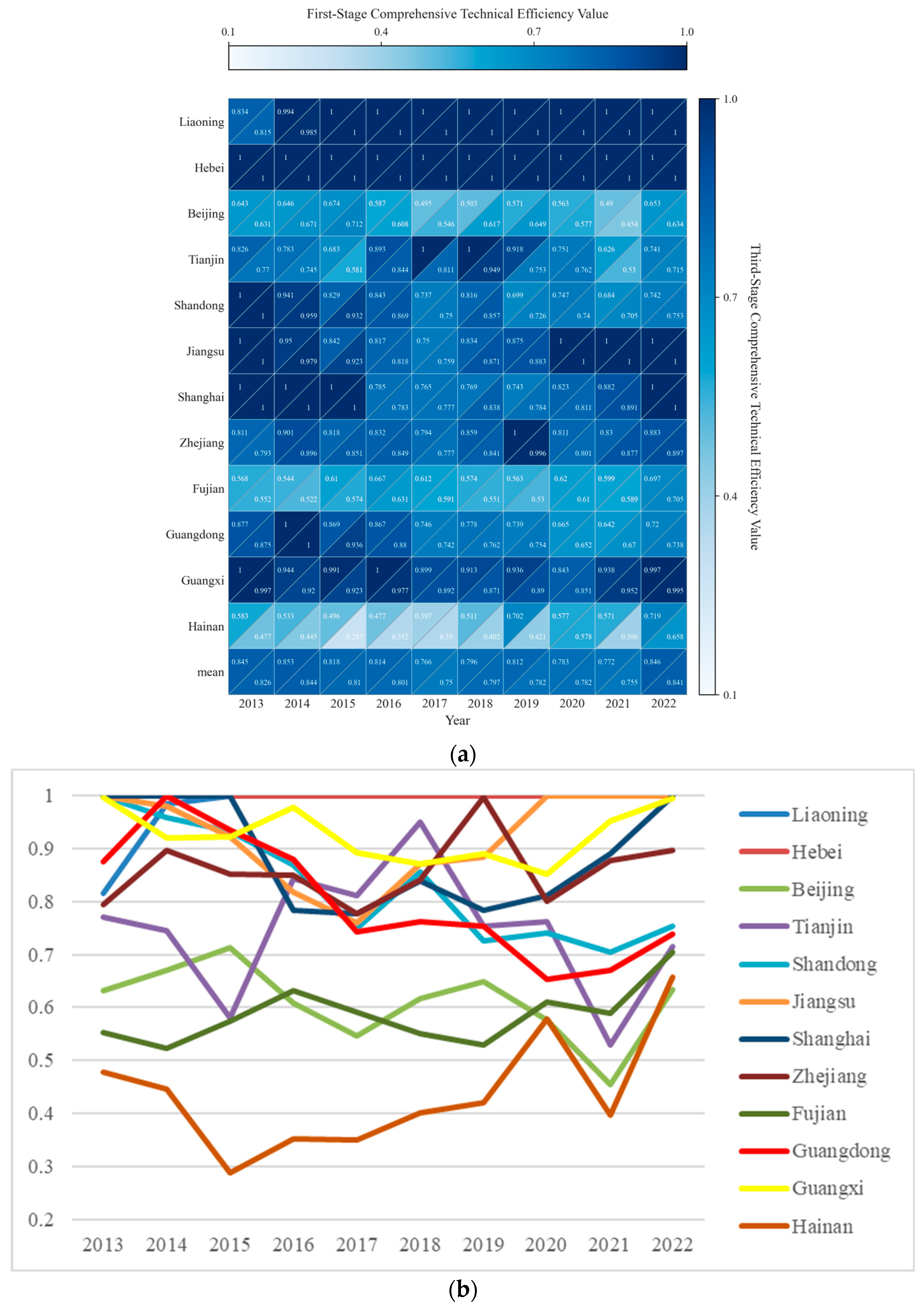
According to the results presented in
Table 7 and
Figure 4, Liaoning and Hebei sustained DEA efficiency throughout the decade, consistently operating on the efficiency frontier. Guangdong Province and Hainan Province also remained on the frontier in terms of pure technical efficiency, indicating that their current input resources are being fully utilized. Jiangsu Province has shown a marked upward trajectory since 2017, representing a typical case of “catch-up growth”; its development path and successful experience offer valuable insights for other regions. In contrast, Tianjin Municipality, Shandong Province, and Guangdong Province experienced relatively noticeable declines in efficiency during the period 2013–2022. An in-depth analysis of the specific causes behind these declines is recommended to support overall improvement in low-carbon logistics efficiency.
5.2.4. Comparative Analysis of the First Stage and the Third Stage
The adjusted mean values indicate that the overall comprehensive technical efficiency experienced a slight decline from 0.811 to 0.799, while average pure technical efficiency improved from 0.919 to 0.931. In contrast, average scale efficiency decreased from 0.885 to 0.859. These results suggest that, after controlling for environmental factors and random disturbances, the actual managerial performance and technology application efficiency across regions are more accurately represented, with overall management capabilities remaining relatively robust. However, the findings also reveal that certain regions in eastern coastal areas are facing diseconomies of scale. This is characterized by an excessive focus on expanding operational scale despite already favorable conditions, rather than optimizing efficiency. Consequently, in promoting efficiency improvements, it is essential to guide the low-carbon logistics industry in eastern coastal regions to transition from a development model primarily driven by “scale expansion” to one that emphasizes “quality enhancement.” By restructuring input allocations and optimizing resource deployment, these regions can overcome the challenge of being “large but not strong,” thereby fostering high-quality and sustainable growth in the low-carbon logistics sector.
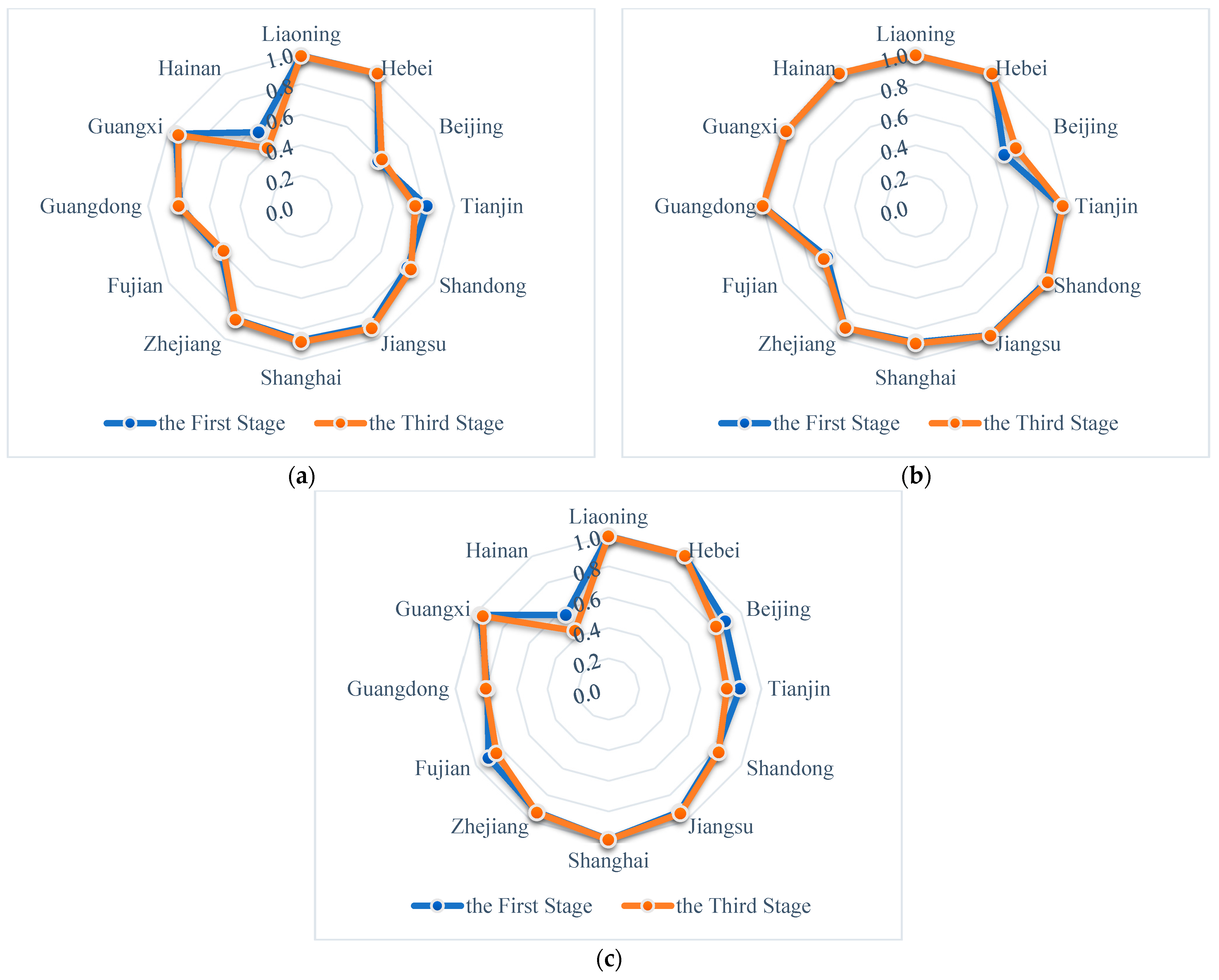
To more clearly illustrate the influence of environmental factors and random disturbances on low-carbon logistics efficiency, this study provides comparative charts of the mean values for comprehensive technical efficiency, pure technical efficiency, and scale efficiency in Stage 1 and Stage 3, respectively (
Figure 5). As shown in the figures, regions such as Liaoning, Hebei, and Jiangsu consistently maintained relatively high mean efficiency values across all three metrics in both stages. This indicates that their low-carbon logistics development is less susceptible to external environmental factors and random fluctuations, operating in a relatively stable state. These regions have already established a solid foundation in terms of technological capability, industrial scale, and managerial expertise. Consequently, they may continue to follow their current development pathways in the future, steadily advancing the construction and refinement of their low-carbon logistics systems.
Notably, Beijing Municipality exhibited a significant improvement in pure technical efficiency alongside a decline in scale efficiency, while its overall comprehensive technical efficiency remained stable. This pattern suggests that Beijing has achieved positive gains through management optimization and technological progress. At the same time, diminishing marginal returns associated with continuous urban expansion have constrained efficiency improvements to some extent. The counterbalancing effect of these two trends has maintained an overall equilibrium in efficiency performance. This further indicates that, as a mature megacity, Beijing’s development model is shifting from scale-driven expansion to quality-oriented enhancement, placing greater emphasis on growth efficiency and internal optimization.
On the other hand, the comprehensive technical efficiency of Tianjin and Hainan experienced a decline, primarily attributable to a decrease in scale efficiency. Both regions have established a solid foundation in technology and management. Going forward, while maintaining these advantages, they should place greater emphasis on enhancing the alignment between resource inputs and actual market demand. Through scientific planning and precise regulation, they can facilitate the transformation of their logistics sectors from a model of “extensive expansion” to one of “refined operation.” This will allow them to fully leverage their latent strengths in technology and management, thereby optimizing overall efficiency and sustainable growth.
6. Discussion and Conclusions
This study evaluated the low-carbon logistics efficiency in China’s eastern coastal regions using a Three-Stage DEA model combined with the Malmquist index. The results indicate significant regional disparities in efficiency and identify the key factors driving these differences. The methodology employed proved effective in assessing low-carbon logistics performance, enabling a detailed analysis of pure technical efficiency, scale efficiency, and overall efficiency across regions. Furthermore, the Malmquist index captured dynamic changes in efficiency over the ten-year observation period. The application of the SFA method effectively isolated the influences of environmental factors, providing a refined basis for recalculating efficiency after adjusting input variables.
Between 2013 and 2022, the efficiency indicators clearly distinguished the performance of the 12 provinces, autonomous regions and municipalities studied. Regions such as Hebei and Liaoning demonstrated relatively strong and stable performances across multiple efficiency metrics, with their outcomes being less susceptible to external environmental influences. In contrast, other provinces exhibited notable fluctuations in logistics efficiency over the period, mainly due to inefficient resource utilization and scale-related inefficiencies.
External environmental factors were found to significantly impact low-carbon logistics efficiency. After adjustment, Beijing’s pure technical efficiency increased from 0.669 to 0.756, while its scale efficiency decreased from 0.881 to 0.813. Similarly, Hainan’s pure technical efficiency remained relatively stable, but its scale efficiency declined from 0.557 to 0.437. Notably, regional GDP growth helps reduce input redundancy, whereas increased investment in environmental infrastructure may exacerbate it. These adjusted efficiency metrics offer a more accurate and reliable reflection of actual operational performance.
Overall, the comprehensive technical efficiency of low-carbon logistics in China’s eastern coastal region is significantly constrained by scale inefficiency. Although pure technical efficiency improved after adjustments, the decline in scale efficiency, from 0.885 to 0.859, contributed to an overall efficiency deterioration. In the long term, regions such as Beijing and Hainan have continued to increase resource inputs without corresponding improvements in resource utilization or output conversion, leading to underutilization or wastage of resources.
The findings of this study offer practical guidance, delivering actionable insights for stakeholders in the logistics industry, public authorities, and regional planners in China’s eastern coastal regions.
- (1)
To solidify the hardware foundation for low-carbon development, efforts should focus on improving low-carbon logistics infrastructure. This includes coordinated planning and accelerated construction of eco-friendly transport networks, intelligent low-carbon warehousing hubs, and supporting clean energy charging facilities, while advancing the shift toward cleaner energy sources across logistics infrastructure.
- (2)
Deepening the integration of digital and smart technologies across the logistics chain is key to boosting synergy between logistics and energy systems. This involves applying AI, big data, and other next-generation IT throughout transportation, warehousing, and distribution. A dynamic emissions monitoring system based on accurate carbon data should also be established to enable intelligent scheduling and warehouse optimization, thereby improving overall energy efficiency.
- (3)
It is recommended to enhance cross-regional coordination to optimize the logistics network layout scientifically. Tailored emission-reduction policies should be formulated based on local conditions to guide efficient resource flow and intensive allocation. This will help reduce regional disparities in logistics operational efficiency and contribute to establishing a modern, collaborative, low-carbon, and resource-efficient logistics network.
This study’s assessment of low-carbon logistics efficiency in China’s eastern coastal region presents several limitations, particularly regarding the oversimplified selection of input variables. The current model relies heavily on fixed asset investment in logistics and related carbon emissions. This approach may affect the comprehensiveness and validity of the findings. This simplified variable set stems largely from practical constraints, as significant disparities in data availability and processing complexity across potential indicators further narrow the range of feasible options. Thus, the restricted variable selection is driven more by data limitations and practical feasibility than by inherent flaws in the research design.
To improve the accuracy and practical relevance of future evaluations, the research framework should be expanded through the inclusion of additional key input and output variables. Indicators such as the number of logistics employees and total salary expenditures would better capture the operational scale and labor dimensions of logistics activities. Moreover, environmental variables should be enriched by incorporating factors from policy, economic, and technological domains. For instance, introducing metrics like internal expenditure on research and experimental development (R&D) and regional telecommunications service volume would help reflect the influence of technological innovation and digitalization on low-carbon logistics efficiency. Such refinements would enhance the real-world relevance and analytical depth of the assessment.
This study advances the understanding of the transition towards low-carbon logistics in China’s eastern coastal regions. Its key finding underscores a critical shift in strategic focus, from simple “scale expansion” to “intensified and coordinated development”, as essential for achieving efficiency gains. This implies that establishing a comprehensive low-carbon development environment is fundamental to improving energy-use efficiency, while leveraging synergistic effects through regional cooperation is vital for enhancing the resilience of the low-carbon logistics sector. By integrating a three-stage DEA model with the Malmquist index method, the research effectively analyzes regional development trends and isolates the impact of environmental factors. Future studies could expand the evaluation system by incorporating indicators related to logistics scale, policy frameworks, and economic conditions, and further explore the specific role of digitalization. Collectively, these insights contribute to formulating targeted strategies for improving low-carbon logistics efficiency and promoting sustainable development at both regional and global levels.