Article

From Innovation to Circularity: Mapping the Engines of EU Sustainability and Energy Transition

Department of Engineering and Industrial Management, Transilvania University of Brasov, Eroilor Street 29, 500036 Brasov, Romania
*
Author to whom correspondence should be addressed.
Sustainability 2026, 18(1), 467; https://doi.org/10.3390/su18010467
Submission received: 2 November 2025 / Revised: 26 December 2025 / Accepted: 30 December 2025 / Published: 2 January 2026
(This article belongs to the Section Economic and Business Aspects of Sustainability)

Abstract

This study investigates how economic development interacts with sustainability performance in the European Union, focusing on the structural and technological factors that shape progress in the green transition. Using Eurostat data for 27 EU member states over the period 2015–2023, the analysis employs panel econometric models (Pooled Ordinary Least Squares, Fixed Effects, and Random Effects) to explore how circular economy performance, innovation capacity, human capital, and renewable energy use influence environmental and economic outcomes across member states. The results show that R&D intensity and skilled human resources are key drivers of sustainability. Higher levels of circular material use and resource productivity contribute to long-term competitiveness. In contrast, uneven progress in renewable energy deployment points to persistent regional disparities and possible structural constraints that limit convergence. Northern and Western Europe record the strongest advances in innovation and environmental efficiency, whereas Southern and Eastern regions remain affected by industrial legacies and lower absorptive capacity. The findings highlight that, in the short term, renewable energy expansion may involve adjustment costs and potential trade-offs with economic competitiveness in less technologically developed economies. This study provides new comparative evidence on the differentiated pathways of the green transition across the EU. Policy implications suggest the need to reinforce R&D investment, expand circular manufacturing, and support an inclusive technological transition consistent with the European Green Deal and the United Nations 2030 Agenda.

1. Introduction

Over recent decades, the notion of economic development has evolved from a traditional focus on industrial growth, productivity, and competitiveness toward a broader paradigm of sustainability that integrates economic, social, and environmental objectives. The Brundtland Report [1] provided the widely accepted definition of sustainable development as the capacity to meet present needs without compromising the ability of future generations to meet theirs. Building on this foundation, the United Nations (UN) [2,3] translated sustainability principles into operational goals and measurable targets, embedding them within global and regional development agendas.
The European Union (EU) has embraced this framework and integrated it into a coherent system of strategies aimed at achieving sustainable and inclusive growth. The European Green Deal (EGD), launched in 2019 [4], defines climate neutrality by 2050 as a central policy objective and reorients EU priorities toward low-carbon innovation and resource efficiency. Its implementation is supported by financial and regulatory instruments such as the Just Transition Fund, the NextGenerationEU mechanism, the taxonomy of sustainable investments, and the 2021–2027 cohesion policy. At the core of this framework lies the circular economy, which promotes resource reuse, waste minimization, and value retention, thereby laying the foundation for economic growth increasingly decoupled from material and energy intensity (EI).
The green transition remains a complex and uneven process shaped by multiple tensions and uncertainties. Research shows that progress toward sustainability can generate unintended effects such as feedback loops and path dependencies in resource efficiency, reinforcing divergence among EU member states [5]. Green innovation and investment improve environmental quality in the long run, but their effects are often nonlinear and conditioned by income levels and resource dependence for the five best-performing European Union economies [6]. Grashof and Basilico [7] further highlight that strong and weak regions differ in their ability to diversify into green technologies, as pre-existing technological specializations and industrial legacies shape local trajectories of sustainable development. Such disparities lead to rebound effects, technological asymmetries, and patterns that amplify existing vulnerabilities within the European green transition. Fiscal measures and support schemes can stimulate innovation but may also create specific barriers depending on their institutional design. These dynamics point to a critical distinction between short-term adjustment costs and long-term sustainability gains, which remains insufficiently explored in comparative EU-wide empirical studies. Addressing this gap requires adaptive and territorially sensitive policy frameworks, an aspect this study examines through a comparative econometric assessment of EU member states.
Territorial disparities constitute another major challenge in Europe’s sustainability agenda. Northern and Western regions generally display higher performance, supported by advanced infrastructure, skilled human capital, and substantial investment in research and innovation. By contrast, Southern and Eastern regions remain more dependent on energy imports and emission industries, facing greater social and economic vulnerability. Recent composite indices of green transition readiness confirm that these areas are the most exposed to the socio-economic costs of decarbonization [8]. Moreover, several studies emphasize the role of social capital and governance quality in shaping environmental outcomes and fostering public acceptance of sustainability policies across EU regions [9]. The spatial asymmetries suggest that sustainability dynamics operate simultaneously at the EU, regional, and national levels, requiring an analytical framework capable of capturing cross-country heterogeneity. These asymmetries underline the need for comparative analyses capable of identifying the structural and technological determinants of progress within the EU green transition.
At the European level, the compatibility between economic growth and sustainability remains a central issue of debate. Official strategies promote the green transition as a new model of smart, sustainable, and inclusive growth. However, an expanding body of research questions this paradigm, emphasizing the social and economic risks associated with adjustment costs and proposing alternative approaches such as degrowth or fundamental changes in consumption and production models [10]. Macroeconomic studies further suggest that transition policies can generate short-term inflationary or deflationary pressures depending on their design, timing, and credibility [11]. Empirical analyses of green innovation and renewable energy consumption generally confirm positive effects on environmental performance but reveal significant heterogeneity across member states and levels of development [12]. These findings highlight that the green transition is a differentiated and path-dependent process shaped by structural, institutional, and cultural diversity across Europe. Building on this evidence, the present study investigates the main drivers of sustainable convergence within the EU.
Although extensive research has explored the green economy and environmental policy, comparative empirical evidence on the interaction between economic and sustainability indicators across EU member states remains limited. Most studies adopt single-country or sectoral perspectives, which restrict understanding of cross-national dynamics and structural asymmetries within the EU. In particular, few studies jointly examine circular economy performance, innovation capacity, and energy transition indicators within a unified panel-data framework covering all EU member states. This study addresses this gap by developing an integrated framework that combines circular economy performance, innovation capacity, and environmental outcomes using panel data for all EU members between 2015 and 2023.
The contribution is both theoretical and methodological. Theoretically, the study links sustainable development, circular economy, and competitiveness within a unified framework, providing a more nuanced perspective on how economic, environmental, and social dimensions interact in evolving policy contexts. It also underscores the growing influence of technological innovation and digitalization on sustainability outcomes, as documented in research on the digital economy, green productivity, and adaptive organizational strategies [13,14,15]. To operationalize this framework, the analysis applies longitudinal panel models, (Pooled Ordinary Least Squares (P-OLS), Fixed Effects (FE), and Random Effects (RE), complemented by robustness checks including Hausman tests and Cook’s distance diagnostics, to capture complex relationships between environmental and economic indicators. This approach extends recent econometric applications that examine nonlinear and spillover effects among renewable energy, economic growth, and sustainability [16]. By explicitly accounting for cross-country heterogeneity, the study provides new comparative evidence on differentiated sustainability pathways across the EU.
At the policy level, the research aligns with current European challenges under the Green Deal [4] and the 2030 Agenda for Sustainable Development [3]. The findings aim to inform strategies that enhance resource efficiency, foster innovation capacity, and strengthen social resilience. Particular attention is given to renewable energy communities as instruments of local empowerment and participatory governance. The analysis also considers contextual shocks such as the Coronavirus Disease 2019 (COVID-19) pandemic and the recent energy crisis, which have reshaped sustainability trajectories across the EU.
By integrating conceptual advances in sustainability and circular economy research with empirical evidence grounded in the European policy context, this study contributes both academic debate and policymaking. The remainder of the paper is structured as follows. Section 2 reviews the theoretical and empirical literature that underpins the analytical framework and research hypotheses. Section 3 describes the data sources, variables, and econometric methodology. Section 4 outlines the empirical strategy and estimation procedures. Section 5 presents and discusses the empirical results. Section 6 provides a broader discussion of the findings in relation to existing literature and policy implications, while Section 7 concludes and outlines directions for future research.

2. Literature Review

Clarifying the relationship between sustainability and the green economy is crucial for establishing the conceptual and analytical foundation needed to assess how economic structure, innovation, energy systems, and social conditions shape environmental performance in the EU.

2.1. Conceptual Foundations

Sustainability is widely understood as a multidimensional construct encompassing economic, environmental, and social pillars. The economic dimension emphasizes productivity, competitiveness, and resource efficiency. The environmental pillar focuses on pollution reduction, the energy transition, and natural capital protection. The social dimension, in turn, relates to equity, employment, and quality of life. The green growth model builds on this framework by integrating clean technologies, circular economy practices, and resource efficiency into mainstream policy to achieve sustainable competitiveness. According to UNEP [17], the green economy promotes well-being and fairness while addressing environmental constraints and sustainability deficits. These dimensions provide the conceptual basis for analyzing how structural and technological factors jointly shape sustainability outcomes. Building on these principles, Deif [18] proposes a systemic model of green production linking innovation with resource management, Dornfeld [19] presents green manufacturing as the next phase of industrial development, and Gandhi et al. [20] highlight the link between efficiency and competitiveness in small and medium-sized enterprises.
The relationship between environmental degradation and economic growth has been extensively studied through the Environmental Kuznets Curve (EKC) framework. Leal and Marques [21] argue that the EKC does not universally capture sustainability dynamics and that climate finance, technological progress, and the energy transition are key to reconciling economic expansion with environmental protection. This literature suggests that sustainability performance depends not only on income levels but also on innovation capacity and energy system transformation, connecting the EKC perspective to the broader objectives of the green economy and underscoring the importance of structural and financial mechanisms for sustainable growth.
Sustainability outcomes also depend on firm-level capabilities. Martínez-Sánchez et al. [22] show that knowledge-intensive human resources and R&D enhance absorptive capacity and innovation performance, linking micro-level capabilities to long-term competitiveness. Dubey et al. [23] underline the role of big data in improving production efficiency, Dincer and Acar [24] identify hydrogen technologies as strategic pillars of the energy transition, and Gedam et al. [25] emphasize human resources and organizational structures as enablers of the green shift.

2.2. European and International Policy Frameworks

The EU has developed a comprehensive policy framework for the green transition that aligns internal priorities with international commitments concerning competitiveness, energy security, and regional cohesion. The EGD [4] represents the cornerstone of this framework, setting climate neutrality by 2050 as a long-term target and promoting the decoupling of economic growth from finite material resources. The European Commission [26] places the circular economy at the center of this strategy, emphasizing extended recycling, eco-design, and the promotion of circular business models. The 2021 legislative package [27] reinforces these goals by establishing a binding target of a 55% reduction in net greenhouse gas emissions by 2030. These policy instruments directly relate to the core dimensions analyzed in this study, namely innovation capacity, circular economy performance, and energy transition indicators.
Energy security is addressed through the Energy Union Strategy, which encourages diversification and the integration of renewable sources. Supporting this approach, Kim et al. [28] show that a diversified energy mix and higher renewable penetration strengthen long-term energy security. However, these benefits depend on adequate grid infrastructure, as transmission capacity, interconnections, and grid flexibility are essential for integrating intermittent renewables and ensuring secure cross-border energy flows. Insufficient network capacity can therefore limit the security gains of renewable expansion.
EU cohesion policy has increasingly incorporated environmental objectives by directing funds toward energy efficiency, low-carbon infrastructure, and emissions reduction. However, persistent territorial disparities and measurement challenges continue to affect implementation during the 2021–2027 programming period [29]. At a broader scale, empirical studies have examined how these policy directions translate into macroeconomic performance and systemic resilience. These challenges highlight the relevance of assessing sustainability outcomes across heterogeneous EU member states.
From a macroeconomic perspective, Wang and Debel [30] find that renewable energy investment raises industrial productivity and supports long-term growth in emerging economies. Their results also indicate a persistent trade-off, as the expansion of clean energy infrastructure can initially increase resource intensity. Axt et al. [31] highlight that circular economy principles strengthen resource security and systemic resilience in hydrogen technologies, a sector characterized by high dependence on critical raw materials and strategic relevance within EU energy policy. Duca et al. [32] reveal that geopolitical instability affects firm profitability and investment behavior, showing that macro-level shocks can indirectly influence sustainability outcomes via innovation and energy market dynamics.
At the global level, the Sustainable Development Goals (SDGs) adopted by the UN in 2015 [3] provide the overarching framework for sustainability policy. The 2021 Sustainable Development Report highlights that progress toward the SDGs depends on industrial policy, research and development capacity, and institutional quality [33]. Complementary evidence shows that green finance accelerates both the energy transition and innovation, but its effectiveness varies with governance quality and national economic structure [34]. This global perspective reinforces the role of institutional and technological drivers emphasized in the EU policy framework.
Recent empirical work illustrates how European economies translate global sustainability objectives into industrial and innovation strategies. Rahko [35] finds that vertical spillovers along supply chains reduce energy intensity in European industries, primarily through green technological innovation and intersectoral linkages. Algieri et al. [36] introduce a Green Innovation Competitiveness Index to evaluate specialization and performance in green activities, identifying uneven progress across Europe, with Spain, Germany, and France leading. Silva et al. [37] demonstrate that disparities in labor and capital productivity, combined with education, shape entrepreneurial efficiency across EU member states, reflecting persistent structural asymmetries in the innovation landscape.

2.3. Indicators Used in the Literature

Measuring sustainability and the green transition remains a persistent challenge because sustainability is inherently multidimensional and cannot be captured by a single indicator. Environmental pressure indicators, such as carbon dioxide (CO2) emissions and emission intensity, remain central to tracking decarbonization and technological change. Liu et al. [38] demonstrate that once economies reach a certain development threshold, endogenous green technological progress becomes the dominant driver of emission reduction, creating a nonlinear relationship between economic growth and CO2 output. These indicators motivate the use of emissions-based measures as core dependent variables in empirical sustainability analysis.
Institutional and policy-related indicators are also essential. Crnčec et al. [39] find that the EU’s coordinated response to the COVID-19 crisis strengthened environmental governance and policy coherence, suggesting that external shocks can accelerate sustainability progress when supported by strong institutional capacity. This evidence highlights the importance of policy and governance contexts when interpreting sustainability outcomes across countries.
Energy-related indicators are equally prominent. Laimon and Yusaf [40] show that integrated clean-energy and hydrogen-based systems can enhance resilience, reduce emissions, and improve long-term energy security. They emphasize that energy diversification and the adoption of innovative technologies are critical components of a durable green transition. Accordingly, renewable energy penetration and energy intensity indicators are widely used to capture both environmental pressure and transition dynamics.
Human capital indicators represent another key dimension. Metrics such as Human Resources in Science and Technology (HRST) and Gross Domestic Expenditure on R&D (GERD) are widely applied to capture the role of skills and knowledge in driving structural transformation. Burger and Šlampiaková [41] find that European countries with higher employment shares in knowledge-intensive sectors and stronger innovation performance achieve higher per capita output and lower unemployment rates. Banelienė et al. [42] further show that green innovation supports economic growth in the EU, but that digitalization can weaken this link. Their findings suggest that digital transformation alone is insufficient and must be complemented by investment in education and skills to ensure inclusive and sustainable development. These results highlight the importance of human capital for both competitiveness and social cohesion in the context of the green transition.
Financial and fiscal indicators also play an important role. Martí-Ballester [43] analyzes the performance of renewable energy-focused mutual funds and finds that, when evaluated using conditional performance models, they perform comparably to conventional funds. This implies that environmental investments can remain financially viable and are not necessarily penalized by the market. Such findings support the view that sustainability-oriented investments need not undermine economic performance.
This body of research demonstrates that sustainability performance reflects the interaction between environmental pressures, human capital, innovation systems, energy structure, and financial mechanisms. Therefore, assessing sustainability requires an integrated, multidimensional approach rather than reliance on a single headline indicator. Table 1 synthesizes recent studies on indicators, empirical strategies, and key findings, illustrating the diversity of methodologies used to capture different aspects of the green transition, economic restructuring, and social outcomes in Europe [9,39,44,45,46,47].
Beyond indicator selection, the empirical literature linking economic development, environmental sustainability, and the green transition employs a wide array of econometric approaches. Early studies relied on static panel models such as P-OLS and FE estimations, which exploit cross-country and temporal variation to identify long-run relationships. Although these models remain foundational, they have well-known limitations, as they cannot fully capture unobserved heterogeneity, dynamic feedback, or adjustment processes [55]. Previous research incorporated RE estimations and Hausman tests to guide model selection and assess consistency across estimators [56]. As evidence accumulated that transition processes are both persistent and endogenous, subsequent studies adopted dynamic panel estimators, most notably the Generalized Method of Moments (GMM) in both difference and system formulations [57].
Dynamic estimators treat lagged variables as internal instruments, thereby mitigating simultaneity bias and reverse causality. They also allow for validity checks through serial correlation and over-identification tests. In more recent work, particularly in the EU context, scholars have increasingly applied second-generation panel estimators such as the Common Correlated Effects (CCE) and Cross-Sectionally Augmented Autoregressive Distributed Lag (CS-ARDL) models. These frameworks explicitly account for spatial dependence, cross-sectional spillovers, and parameter heterogeneity, providing a more realistic representation of economic and environmental interactions across interconnected regions. Rahat and Nguyen [58] use dynamic panel techniques to analyze the relationship between Environmental, Social, and Governance (ESG) profiles and firm valuation in transition economies, showing that FE-type dynamic structures can effectively capture the long-term feedback between sustainability performance and firm value. These advancements reflect a growing recognition of spatial and temporal interdependencies in sustainability research, particularly within the EU’s heterogeneous economic and institutional landscape.
Further methodological progress is reflected in studies such as Sharif et al. [59], who employ CS-ARDL estimators for Nordic countries to explore both short- and long-run relationships among green technology, environmental taxation, and renewable energy. Their findings indicate that environmental policy instruments and technological innovation are mutually reinforcing. Complementary research has increasingly relied on instrumental variable and network approaches to address endogeneity and cross-country interdependencies. Kanwal and Khan [60] analyze the interactions between carbon assets and clean energy markets in the EU. The authors find that green financial instruments and renewable energy investments contribute to carbon risk management and the transition toward low-carbon energy systems. Khan et al. [61] provide a comprehensive review of the green growth literature, highlighting the growing methodological sophistication of empirical work on sustainability, policy effectiveness, and the economic implications of decarbonization.
In parallel, recent studies have adopted robust inference techniques to enhance result reliability. These include Driscoll–Kraay standard errors, heteroskedasticity corrections, and cluster estimation, which improve inference in the presence of cross-sectional dependence and serial correlation. Researchers also use outlier diagnostics, such as Cook’s distance and influence measures, to detect high leverage observations and ensure the stability of estimates [62]. Against this background, the present study adopts a panel framework tailored to the available time dimension and focused on cross-country comparability across EU member states.

2.4. Research Gaps and Working Hypotheses

The literature on the European green transition has expanded significantly, yet several gaps remain. Many studies focus on a limited set of countries or on regional case studies, which fragments the empirical picture and makes it difficult to assess convergence or divergence across the EU as a whole [63,64]. Even within the framework of cohesion policy, evaluations of the green transition remain fragmented and are not yet fully integrated across all member states. Another important limitation relates to scope. Relatively few studies analyze the economic, social, and environmental pillars of sustainability within a single empirical framework. Instead, most research emphasizes individual dimensions such as resource efficiency [65], regional vulnerability and exposure [66], or human capital and innovation capacity [67], treating these aspects separately rather than in an integrated manner.
Methodology is another area where divergence persists. Panel data models are widely used, but many applications still rely on conventional specifications that do not include robustness checks for outliers, cross-sectional dependence, or parameter instability. Recent work has begun to address these limitations. Huang et al. [68] apply panel data methods that explicitly account for endogeneity and cross-sectional dependence in the energy and environment nexus. Abid [69] combines dynamic GMM estimation with Driscoll–Kraay standard errors to improve validity and mitigate heteroskedasticity. At the same time, studies on green finance and sustainable investment emphasize the role of renewable energy and R&D in emissions reduction and structural decarbonization, showing how targeted financial instruments and policy design can accelerate these processes [70]. However, systematic EU-wide comparative analyses that jointly integrate economic, social, environmental, and technological dimensions within a consistent econometric framework remain scarce.
Building on these gaps, the present study contributes by providing a comparative panel-data assessment for all EU member states over the period 2015–2023, integrating circular economy indicators, innovation capacity, energy transition variables, and sustainability outcomes within a unified analytical framework.
Drawing on the gaps identified above, the following hypotheses guide the empirical analysis:
H1: 
Economic and social policy conditions in EU member states influence both circular economy performance and sustainability outcomes.
H2: 
Environmental performance is shaped by key structural drivers, specifically economic development, innovation, education, and the use of renewable energy.
H3: 
The green transition follows differentiated regional patterns across the EU, indicating that member states do not converge uniformly but display persistent territorial asymmetries.
The literature review adopts a structured narrative approach, focusing on key conceptual contributions, policy frameworks, indicators, and empirical methods relevant to the analysis of sustainability and the green transition in the EU.

3. Data and Variables

The data used in this study are drawn exclusively from the Eurostat official database, which provides harmonized and comparable time series across EU member states [71]. The sample covers 27 EU member states over the 2015–2023 period, resulting in a fully balanced annual panel. The starting year (2015) reflects the availability of complete and methodologically consistent Eurostat series for sustainability indicators, ensuring cross-country comparability and temporal coherence. The selected indicators represent the core dimensions of sustainability: greenhouse gas emissions from production activities (CEIGSR), circular material use rate (ACCUR), energy import dependency (INDID), resource productivity (CEIPC), energy transition and energy intensity (INDREN, INDEI), as well as innovation (GERDTOT) and human resources in science and technology (HRST). For macroeconomic and social control variables, GDP Per Capita in purchasing power standards (TEC) and the employment rate (TIPSUN) are included. The selection of these variables follows data availability for all EU member states and ensures a balanced representation of the economic, environmental, thereby reducing potential multicollinearity among indicators.

3.1. Variable Description and Definitions

The dependent variables capture the link between economic development and sustainability. CEIGSR measure total emissions generated by domestic activity, expressed in CO2 equivalents and following the residence principle. This indicator reflects progress toward EU climate goals and the impact of production structures on environmental outcomes. Emission reductions depend on renewable energy adoption and sustained investment in green innovation [72]. ACCUR represents the share of recycled materials reintroduced into the economy and indicates a country’s capacity to conserve resources and reduce reliance on primary raw materials. Empirical studies confirm that circularity enhances resilience and supports the decoupling of growth from resource intensive consumption [73]. INDID measures exposure to international energy markets and geopolitical volatility. High dependency signals vulnerability, whereas lower levels indicate greater energy resilience [74]. CEIPC, defined as GDP per unit of material consumption, assesses how efficiently resources are transformed into value. It is a key OECD and Eurostat indicator for monitoring green growth, with higher productivity linked to lower emissions and improved environmental performance [75].
The independent variables represent structural and institutional drivers of sustainability. TEC captures material well-being and economic convergence, while HRST measures skilled human capital, a key determinant of innovation and environmental performance [76]. GERDTOT reflects research investment as a share of GDP, indicating an economy’s capacity for innovation and transition to carbon neutrality [77]. Digitalization intensity (TIN) is associated with technological advancement and reduced ecological footprints through green technologies [78,79]. The TIPSUN captures labor market conditions, reflecting social inclusion within the sustainability framework [80].
Energy-related indicators complete the analysis. The INDREN measures progress in sustainable energy adoption, and INDEI captures the decoupling of growth from energy use [81]. Together, these variables ensure that economic, environmental, and social dimensions are jointly represented in a consistent framework.
In line with the research hypotheses, four dependent variables are analyzed: CEIGSR (environmental pressure), ACCUR (circularity progress), INDID (energy vulnerability), and CEIPC (resource efficiency), for all EU member states over the period 2015–2023, using harmonized Eurostat data.
The definitions, coding, and data sources of all variables used in the empirical analysis are summarized in Table 2, which provides a structured overview of the sustainability indicators and explanatory variables included in the panel models.

3.2. Descriptive Statistics and Sample Profile

Descriptive analysis reveals substantial cross-country variation in sustainability indicators across the EU during 2015–2023. CEIGSR shows wide dispersion, reflecting differences in national energy structures and technological development. Lower emission intensities occur in Northern and Western Europe, where cleaner energy mixes and higher technological intensity prevail, while higher levels persist in economies more dependent on fossil fuels. ACCUR also varies considerably, indicating progress in circular material use. INDID highlights persistent disparities in energy dependency across EU member states, with some countries remaining highly dependent on energy imports from outside the EU, while others achieve greater energy autonomy through domestic production and renewable deployment.
For CEIPC, the EU average improves gradually, although the gap between Western and Eastern Europe remains significant. Western economies record higher GDP per kilogram of material used, while emerging economies continue to display more material intensive growth. These results confirm that sustainability advances across the Union are heterogeneous, shaped by structural conditions, policy design, and development stages.
Table 3 summarizes the statistical properties of all variables. The dataset shows notable heterogeneity among EU countries across emissions, energy dependency, circularity, resource productivity, and human capital. To ensure comparability, all variables were standardized (mean = 0; standard deviation = 1). Negative median values for CEIGSR, CEIPC, TEC, and GERDTOT indicate asymmetry, while skewness and kurtosis confirm right-skewed and leptokurtic distributions. The Jarque–Bera test rejects normality for most variables (p < 0.05), except INDID (p = 0.091).
The findings reveal pronounced structural heterogeneity within the EU. R&D investment and technological intensity show the highest dispersion, with resources concentrated in advanced economies. These patterns justify the use of panel econometric techniques robust to heteroskedasticity, non-normality, and outliers, and highlight the need for estimators that capture cross-sectional dependence and country heterogeneity.

4. Methodological Framework

The empirical strategy evaluates the relationship between economic development and sustainability in the EU. The analysis relies on P-OLS, FE, and RE estimations, complemented by diagnostic and robustness checks to ensure valid inference. This combination allows both within and between country variation to be captured while controlling for unobserved heterogeneity. The focus is on identifying medium- to long-run associations rather than short-term dynamic adjustments. All procedures follow standard econometric formulations [55,86].

4.1. Empirical Model and Estimation Strategy

The general panel specification is expressed as:
y i t = α i + γ t + j = 1 k β t x j , i t + ε i t ,
where y i t denotes a sustainability indicator for country i in year t , x j , i t are the explanatory variables, β j are the estimated parameters, α i and γ t represent country and time effects, and ε i t is the error term.
The P-OLS model treats all observations as independent:
y i t = α + β 1 x 1 , i t + β 2 x 2 , i t + + β k x k , i t + u i t ,
where u i t is the error term, capturing unobserved factors affecting the dependent variable that vary across countries and over time.
Although P-OLS ignores the panel structure, it provides a benchmark for assessing the incremental explanatory power of more advanced estimators.
The FE model controls for time-invariant country characteristics that could bias the estimates:
y i t = α i + γ t + j = 1 k β j x j , i t + u i t ,
The FE estimator isolates country variation, removing the influence of unobserved heterogeneity that is constant over time. This specification is particularly appropriate when country-specific characteristics, such as institutional quality or historical development paths, may be correlated with the regressors. The RE model assumes that country-specific effects are random and uncorrelated with the regressors [87]:
y i t = α + j = 1 k β j x j , i t + μ i + γ t + u i t ,
where μ i is the random individual component capturing cross-sectional differences. The RE model uses both within- and between-country variation, offering greater efficiency when its orthogonality assumptions are satisfied.
To identify the appropriate specification, the Hausman test is applied [88]:
H = ( b F E b R E ) [ V a r ( b F E ) V a r ( b R E ) ] 1 ( b F E b R E ) ,
A significant test statistic implies correlation between unobserved effects and regressors, favoring the FE specification; otherwise, the RE estimator is preferred.
Potential reverse causality between innovation, economic development, and sustainability outcomes is addressed by combining alternative model specifications, time fixed effects, and extensive robustness checks, rather than dynamic estimators, whose efficiency is limited by the short time dimension of the panel (2015–2023).

4.2. Variable Transformation and Robustness Procedures

All variables are standardized to ensure comparability and mitigate scale distortions [89]:
z i t = x i t x ˉ s x ,
where x ˉ denotes the sample mean and s x the standard deviation of variable x. To limit the influence of extreme values, the series are trimmed at the 1% level [62]:
x i t * = { Q p , x i t < Q p , x i t , Q p x i t Q 1 p , Q 1 p , x i t > Q 1 p ,
where Q p and Q 1 p denote the lower and upper percentiles, respectively. This procedure reduces the impact of extreme observations without altering the underlying distribution of the data.
V ^ c l = ( X X ) 1 i = 1 G X i u i u i X i ( X X ) 1 ,
where X i is the predictor matrix for unit i, u i the residual vector, and G the number of groups. Cluster-robust variance estimation is employed to ensure valid statistical inference in the presence of heteroskedasticity, serial correlation, and group-level dependence.

4.3. Diagnostic and Model Reliability Tests

Diagnostic tests evaluate the influence of individual observations and the robustness of model assumptions. Cook’s Distance [90] identifies influential country-year combinations:
D i = j = 1 n ( y ^ j y ^ j ( i ) ) 2 p σ ^ 2 ,
where y ^ j ( i ) are the fitted values obtained after excluding observation i, p is the number of parameters and σ ^ 2 , is the estimated error variance. Observations with excessive values are examined to ensure that results are not driven by outliers.
The combination of standardization, outlier adjustment, and robust standard errors enhances the credibility of the econometric framework. The use of FE and RE models, validated by the Hausman test, allows for consistent identification of the structural relationship between economic development and sustainability in the EU. This framework ensures reliable inference in the presence of heterogeneity, non-normality, and cross-sectional dependence.
To ensure the robustness of results, several diagnostic tests were performed. The Pesaran CD test confirmed the presence of cross-sectional dependence. Breusch–Pagan and Wooldridge tests detected heteroskedasticity and serial correlation, justifying the use of cluster robust standard errors. Outliers identified through Cook’s Distance were examined but retained to preserve sample representativeness. Dynamic estimators such as GMM were not applied, as the relatively short time span of the panel (2015–2023) limits their efficiency and reliability. Additional robustness checks, including alternative model specifications and the exclusion of influential observations, yielded consistent results.

5. Results

This section presents the empirical findings and examines the relationships among economic, environmental, and social indicators of sustainability across EU member states.

5.1. Correlation Analysis

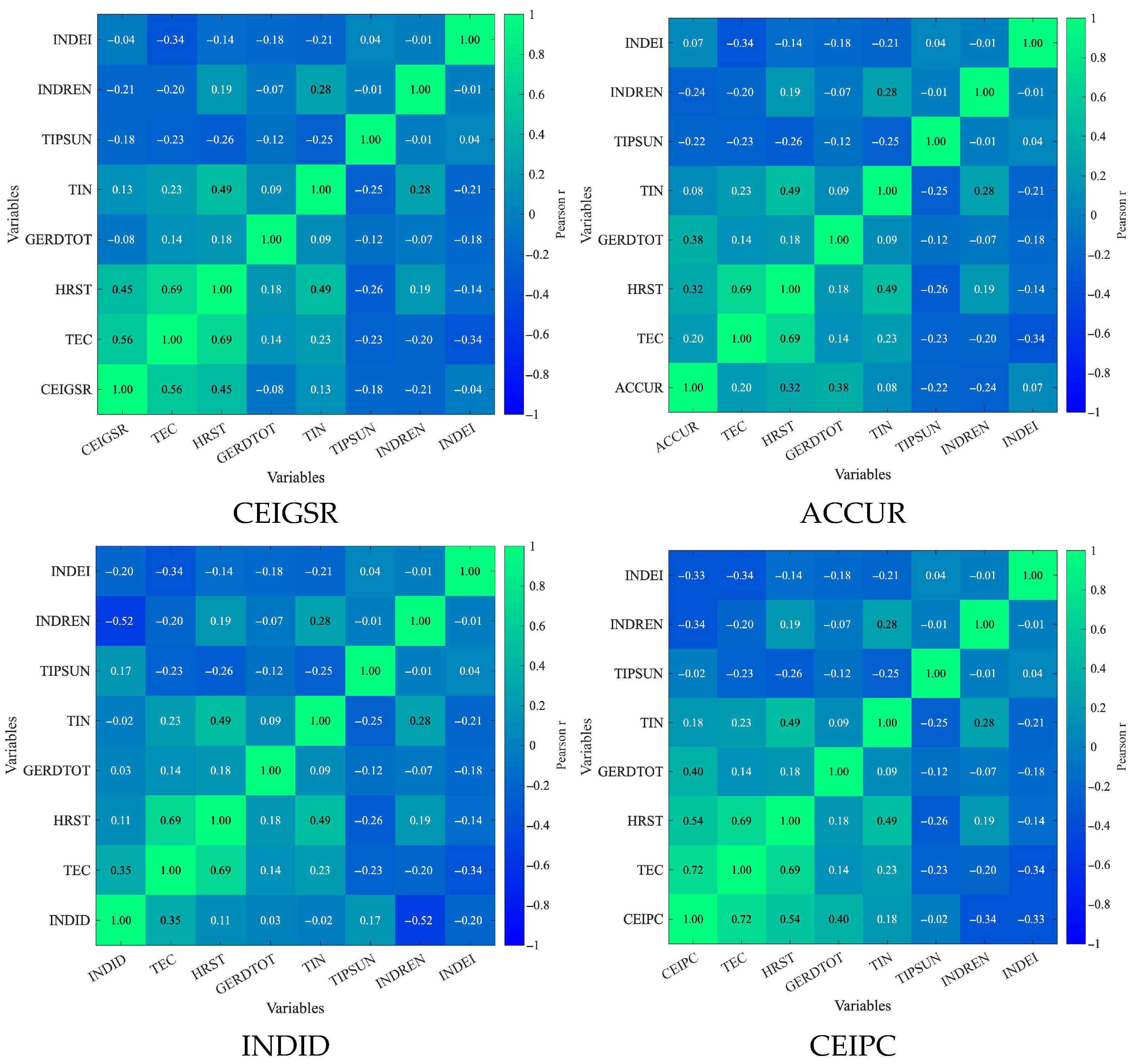
The correlation analysis highlights clear patterns between economic, technological, and environmental variables across EU member states. Figure 1 presents four correlation matrices corresponding to the main dependent variables (CEIGSR, ACCUR, INDID, and CEIPC), illustrating pairwise Pearson correlations. Regarding CEIGSR the strongest positive correlations are with TEC (+0.56) and HRST (+0.45), indicating that higher income levels and more skilled human capital are associated with higher emission intensity. This pattern reflects the structure of advanced economies, where higher output often coincides with higher production-related emissions. In contrast, negative correlations with INDREN (−0.21) and TIPSUN (−0.18) suggest that stronger renewable energy uptake and healthier labor markets are linked to lower emission levels, highlighting the mitigating role of clean energy deployment and social stability.
The ACCUR indicator shows the most pronounced positive associations with GERDTOT (+0.38) and HRST (+0.32), emphasizing the contribution of R&D investment and qualified human resources to circular economy progress. Negative correlations with INDREN (−0.21) and TIPSUN (−0.18) indicate possible short-term trade-offs between renewable energy expansion and material efficiency, consistent with evidence that structural change can initially raise material demand before efficiency gains occur.
INDID correlates positively with TEC (+0.35) and slightly with TIPSUN (+0.17), implying that more developed economies often exhibit higher exposure to imported energy. Strong negative relationships with INDREN (−0.52) and INDEI (−0.20) reveal that higher renewable energy shares and greater energy efficiency significantly are associated with reduced external energy dependence.
CEIPC exhibits the strongest correlations overall. Its links with TEC (+0.72), HRST (+0.54), and GERDTOT (+0.40) confirm the central role of technology, skills, and R&D in enhancing resource efficiency. Negative associations with INDREN (−0.34) and INDEI (−0.33) suggest that productivity gains are more closely related to innovation and structural modernization than to aggregate energy factors. These bivariate correlations provide preliminary evidence of structural relationships, which are further examined in the multivariate panel estimations. These findings are consistent with the evidence reported by Firtescu et al. [85], confirming that fiscal instruments play a critical role in incentivizing renewable energy investment and energy system restructuring.

5.2. Visualization of Partial Regression Relationships

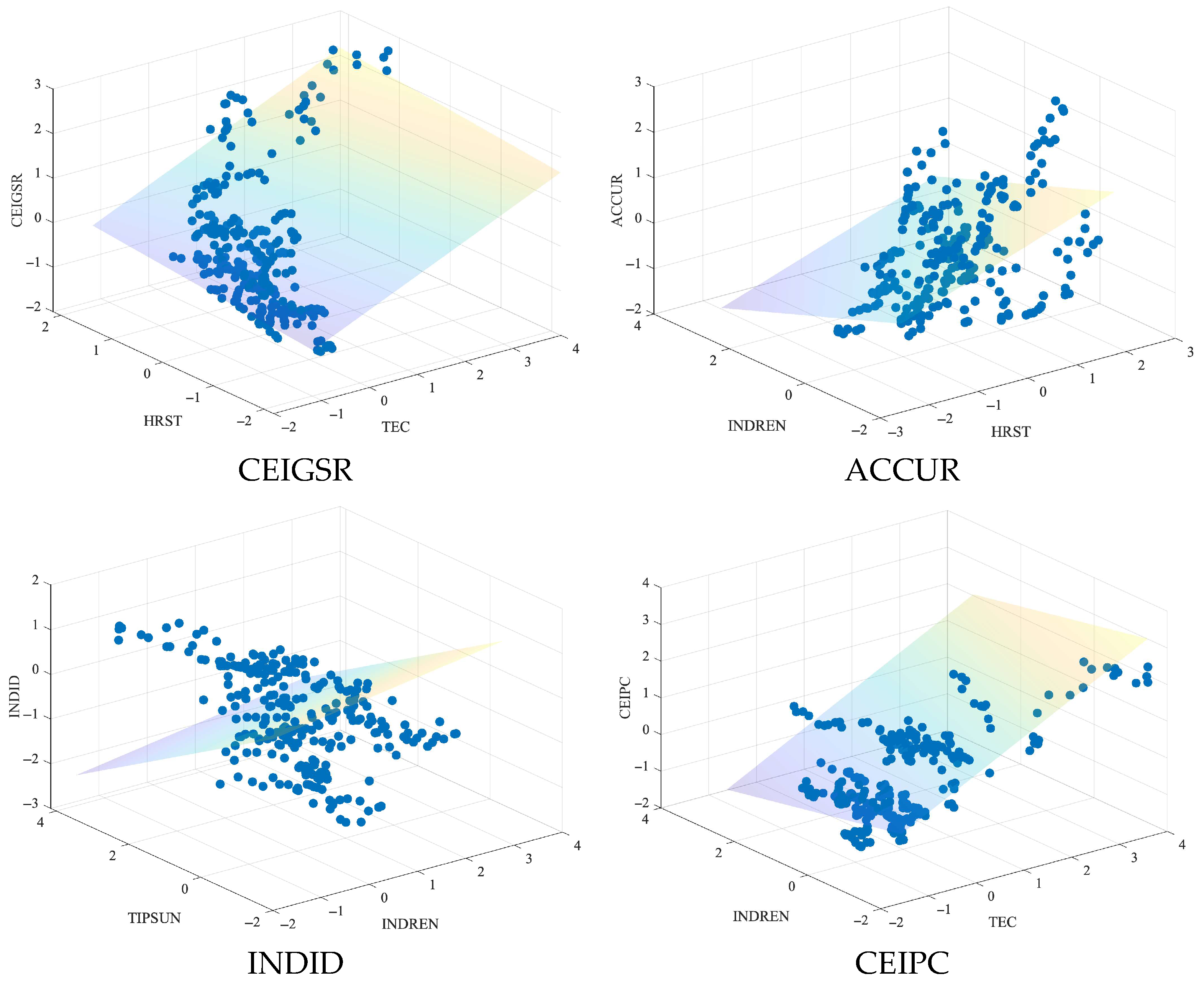
Figure 2 presents three-dimensional regression planes depicting the partial associations between sustainability indicators and their main determinants, namely economic development, human capital, innovation, and energy-related variables, as described in Section 3. The color gradient of each plane reflects the magnitude of the predicted dependent variable, with warmer colors indicating higher fitted values and cooler colors indicating lower fitted values. The scatter points correspond to observed country–year observations. These visualizations complement the correlation analysis by illustrating how human resources, technological capacity, and renewable energy are jointly associated with sustainability outcomes across EU member states.
In the case of CEIGSR, the surface shows a strong positive association with HRST and TEC. Higher levels of human capital and technological capacity correspond to greater emission intensity, suggesting that economic expansion and technological progress may still coincide with resource- and energy-intensive production structures. The clustering of observations near the fitted plane indicates a stable linear relationship. Moderate dispersion points to institutional and structural heterogeneity across countries.
For ACCUR, the surface confirms a positive influence of HRST and, to a lesser extent, INDREN. The steeper slope along the HRST axis underscores the key role of skilled human resources in advancing circular economy practices, whereas the gentler gradient for renewable energy use suggests heterogeneous country-level effects.
The INDID plane exhibits an inverse configuration: a clear negative slope along the INDREN axis demonstrates that higher renewable energy shares reduce energy import dependency, reinforcing the contribution of domestic renewables to energy autonomy. The nearly flat orientation along TIPSUN indicates that labor market dynamics play a limited role in explaining energy vulnerability.
In the case of CEIPC, the regression surface rises sharply with TEC, highlighting the dominant role of technological development in improving resource productivity. A slight downward inclination along the INDREN axis implies that, during early transition stages, expanding renewable energy capacity may be associated with temporarily efficiency losses, reflecting adjustment costs and ongoing structural change.

5.3. Coefficient Analysis

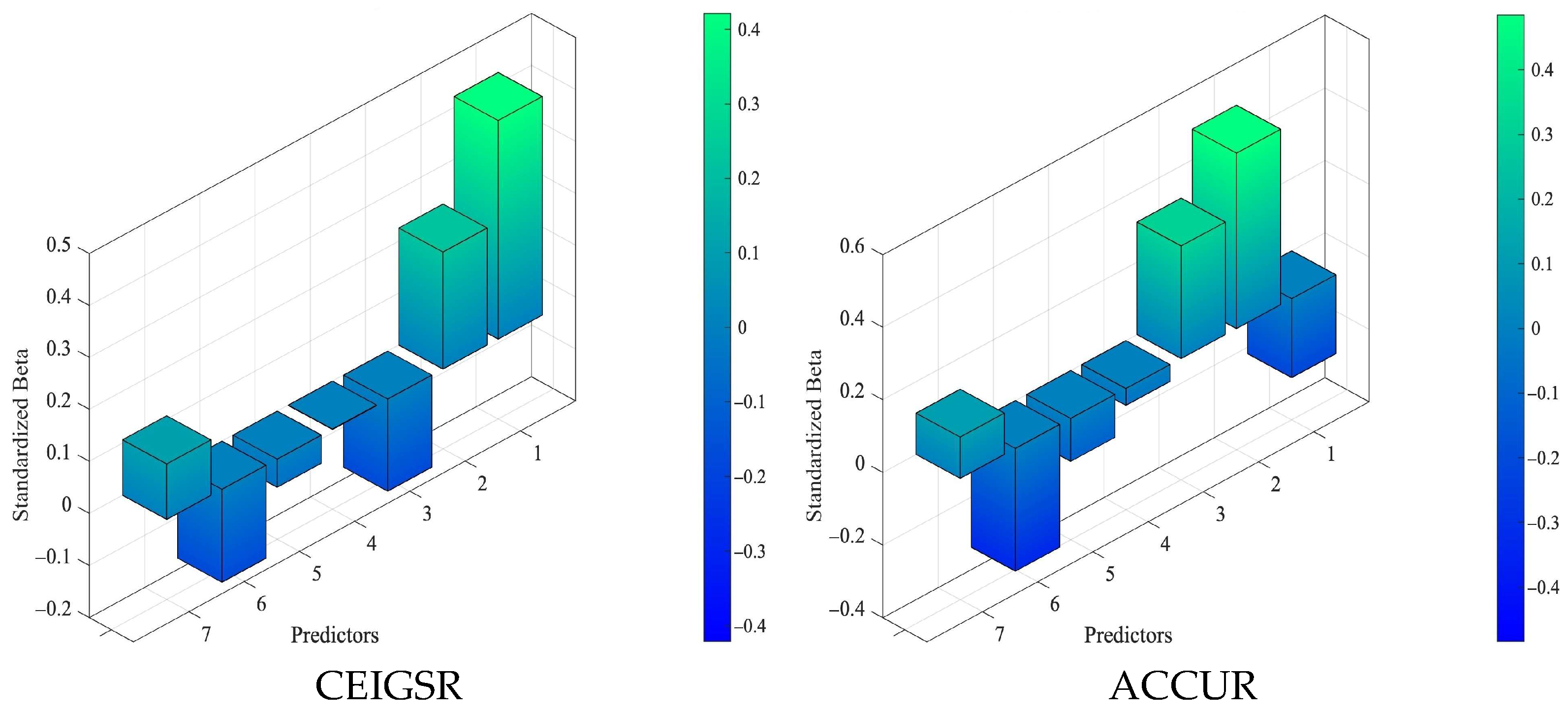
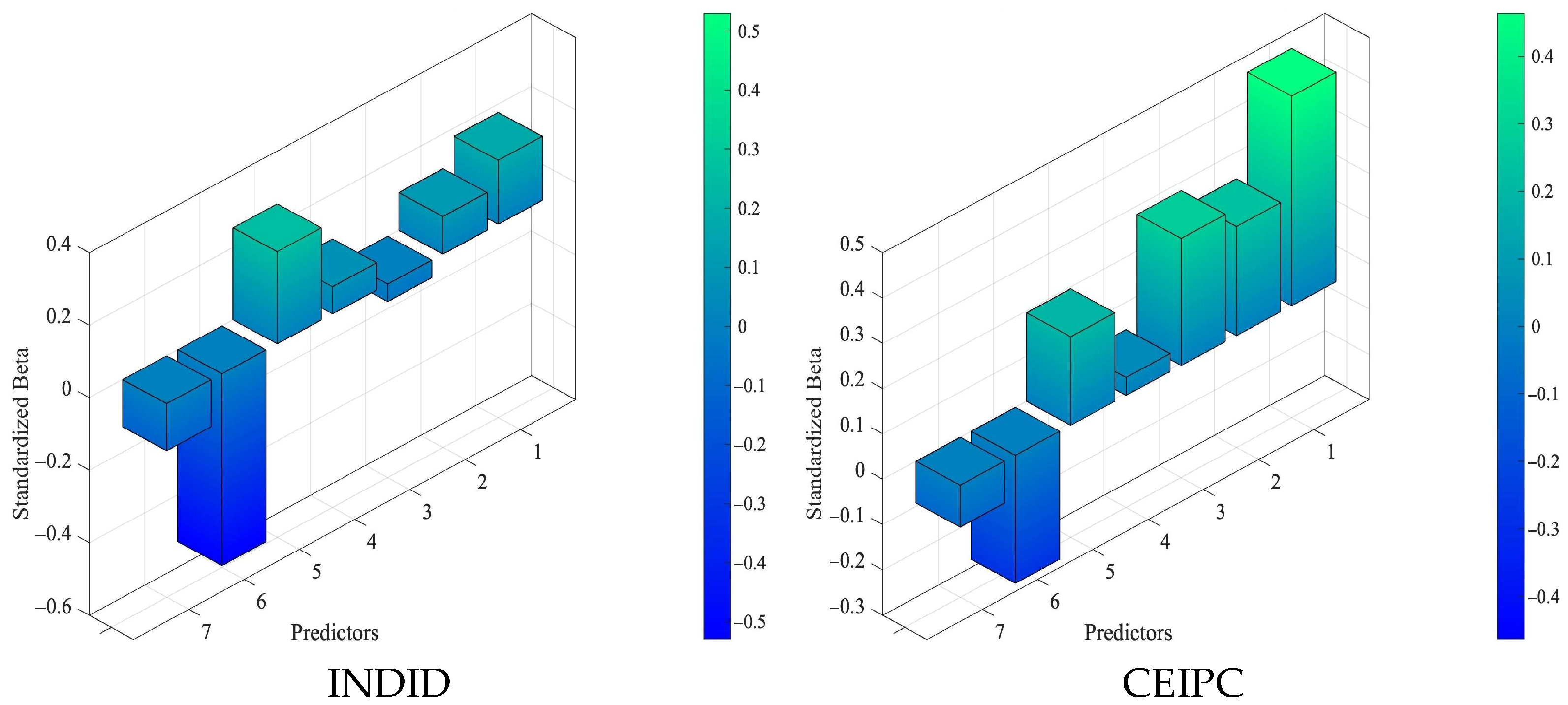
The analysis of standardized coefficients from Figure 3 offers an additional perspective on the econometric results by highlighting the relative importance of each predictor for sustainability outcomes. Figure 3 visualizes standardized regression coefficients, where the color and height gradients represent both the direction and intensity of each variable’s estimated association within the models. The results confirm the dominant role of TEC and HRST, although the magnitude of their effects varies across sustainability dimensions.
The model for CEIGSR shows more moderate effects, with positive but smaller coefficients for both TEC and HRST, suggesting that emissions outcomes are shaped by a broader set of institutional and structural factors beyond the included predictors.
In contrast, ACCUR is most strongly influenced by HRST, underlining the relevance of skilled labor and knowledge intensity for circular economy performance, consistent with O’Donovan [91], who emphasizes the need to reconcile productivity growth with ecological and biophysical limits.
For INDID, representing energy import dependency, the negative coefficient of INDREN dominates, indicating that an increasing share of renewable energy substantially reduces external vulnerability. This finding highlights a structural relationship distinct from the other models. For CEIPC, the coefficient associated with TEC is the strongest, emphasizing that technological advancement is most strongly associated with resource efficiency in the EU. This pattern is consistent with the dynamics observed by Xu et al. [92], who show that early-stage digitalization can initially increase resource use before efficiency gains consolidate at later stages.

5.4. Panel Estimation Results

The panel estimations (Table 4) reveal distinct patterns in the determinants of sustainability performance across the four analyzed indicators. For CEIGSR, the only statistically significant determinant is TEC, confirming the pivotal role of economic development in shaping environmental performance. Although HRST and GERDTOT display positive coefficients, their effects are not statistically validated, while the remaining variables show no consistent influence.
For ACCUR, qualified human resources exert a positive effect approaching statistical significance, reinforcing the importance of human capital for circular economy performance. GERDTOT also contributes positively, though with lower robustness. By contrast, INDREN exhibits a statistically significant negative association with circularity, a potential short-term inverse relationship between renewable energy expansion and material reuse efficiency, possibly reflecting adjustment costs and transitional constraints in production systems.
In the INDID model, two determinants stand out: TIPSUN exerts a positive and statistically significant effect, while INDREN shows a strong negative and highly significant relationship. This suggests that higher employment levels are associated with greater energy demand and import dependency, whereas increasing renewable energy shares substantially reduce external energy vulnerability. These results highlight the central role of renewable energy deployment in enhancing energy security.
For CEIPC, the positive and statistically significant effects of TEC, GERDTOT, and TIPSUN confirm the complementary roles of economic development, research intensity, and labor market performance in improving resource productivity, as also reflected in the findings of Wang et al. [93]. Conversely, the negative coefficient of INDREN implies that the energy transition has not yet translated into proportional productivity gains, revealing a possible short-term trade-off between renewable integration and economic efficiency. This result is consistent with Ai et al. [94], who show that renewable-oriented energy policies can initially damped productivity before longer-term sustainability benefits materialize.

5.5. Fixed Effects Regression Results and Model Selection

The Hausman test was applied to determine the appropriate panel specification for each sustainability indicator (Table 5). In all cases, the test rejected the null hypothesis of no systematic difference between FE and RE estimators (p < 0.05), indicating that the fixed effects specification is preferred. Table 5 therefore reports the fixed effects regression results for all four dependent variables.
In the case of CEIGSR, both TEC and TIN show positive and statistically significant effects (0.218, p = 0.021; 0.200, p < 0.001), indicating that higher levels of economic development and innovation intensity are associated with increased production-related emissions. INDREN exerts a strong negative influence (−0.367, p < 0.001), while INDEI is positive and highly significant (0.463, p < 0.001), confirming that greater energy intensity is associated with higher emission levels. Other variables, including HRST, GERDTOT, and TIPSUN, are not statistically significant.
For ACCUR, HRST emerges as a positive and significant driver (0.271, p = 0.020), confirming the contribution of human capital to circular economy performance. TIN also contributes positively (p = 0.013), reinforcing the role of innovation capacity. In contrast, INDEI shows a negative and highly significant effect (−0.308, p < 0.001), indicating that higher energy intensity is associated with lower material circularity. The remaining predictors are not statistically significant.
In the INDID model, INDREN is the only statistically significant determinant (−0.282, p = 0.004), confirming that a higher share of renewable energy substantially reduces energy import dependency. This result highlights the dominant role of energy structure in shaping external energy vulnerability.
Results for CEIPC are the most robust and consistent. TEC shows a strong positive effect (0.350, p < 0.001), accompanied by significant coefficients for HRST (0.321, p < 0.001) and GERDTOT (0.355, p < 0.001). These findings indicate that resource productivity is primarily driven by economic development, skilled human capital, and research intensity. This evidence is consistent with Liu et al. [50], who emphasize that strengthened environmental regulation and innovation capacity within the EU generate positive spillover effects on competitiveness and green technology diffusion.

5.6. Influential Observation Analysis

The influence diagnostics, based on Cook’s Distance, reveal that a small number of countries–year combinations exert moderate but non-critical effects on the estimated coefficients. As reported in Table 6, all Cook’s Distance values remain well below conventional thresholds, indicating that no single observation unduly drives the regression results.
For CEIGSR, the most influential cases correspond to Estonia (2014, 2016, 2017), followed by Denmark (2021) and Malta (2017). Cook’s Distance values range from 0.027 to 0.046, suggesting visible but acceptable leverage effects, well below conventional thresholds. These observations were retained in the sample to preserve cross-country representativeness.
In the case of ACCUR, influential data points are concentrated in Germany (2018, 2019, 2021, 2022) and the Netherlands (2023). This distribution indicates that circular material use in large industrial economies strongly affects EU-level estimates, reflecting their economic scale and leading role in circular economy implementation. Similar dynamics at the organizational level are described by Shoaib et al. [95], who find that green human resource management and technological advancement jointly strengthen firm-level sustainability, suggesting that human capital and innovation capabilities within industrialized economies may underpin broader circular performance patterns.
For INDID, all influential observations originate from Malta (2014–2019), indicating that its small and highly open economy exerts a disproportionate impact on estimated coefficients. This pattern reflects Malta’s structural vulnerability to external energy shocks and shifts in import dependence, rather than model misspecification or data anomalies.
Regarding CEIPC, influential points are primarily found in the Netherlands (2021–2023) and Germany (2017, 2021). Cook’s Distance values reach 0.039, confirming a moderate but not critical level of influence. These findings suggest that recent advances in energy efficiency and technological upgrading in these economies may temporarily accentuate cross-country dispersion in resource productivity, without altering the overall direction of the results. This pattern aligns with Naqvi et al. [48], who argue that the green transition in advanced economies depends on the joint evolution of renewable energy, sustainable industry, and responsible trade, while emphasizing that the effectiveness of these pillars varies with financial system strength and sectoral policy design.

5.7. Robustness and Additional Results

Cook’s Distance diagnostics identify a few influential country–year observations: Estonia and Malta for CEIGSR and INDID, Germany for ACCUR, and both the Netherlands and Germany for CEIPC. These influential cases reflect structural and temporal heterogeneity across EU economies rather than model misspecification or instability, supporting the robustness of the main empirical findings.

5.8. Regional Patterns in the EU Green Transition

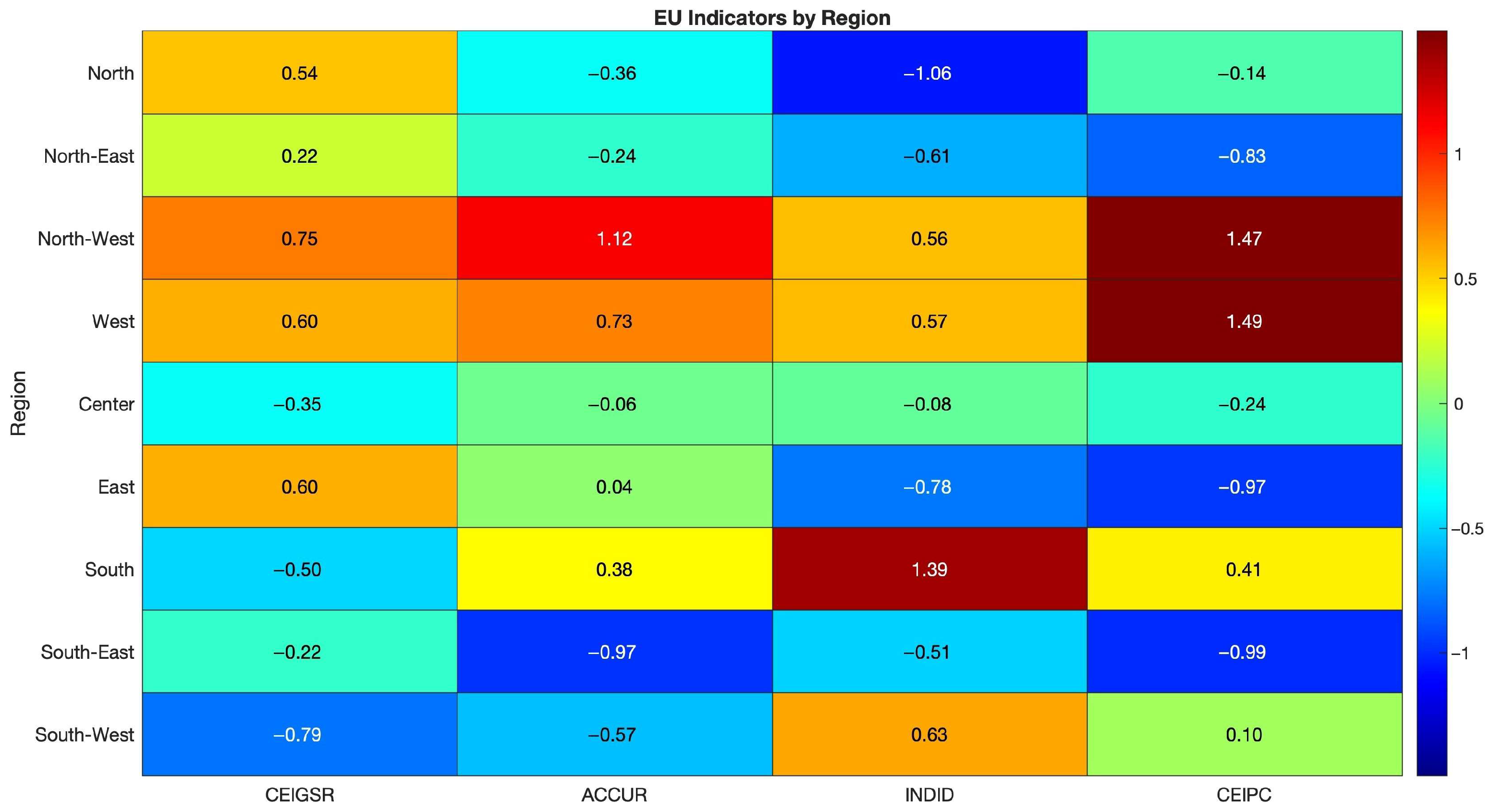
To assess spatial disparities in the EU’s green transition, the dependent variables (CEIGSR, ACCUR, INDID, and CEIPC) were aggregated at the regional level for 2014–2023. Regional values were computed as arithmetic means of the corresponding national indicators for the nine predefined regions: North, North-East, North-West, West, Center, East, South-West, South, and South-East.
To ensure comparability across indicators expressed in different units and scales, all variables were standardized using z-score. The results reveal strong spatial heterogeneity in the EU’s progress toward the EGD objectives, confirming persistent developmental asymmetries along both the North–South and East–West axes. Based on standardized regional scores for CEIGSR, ACCUR, INDID, and CEIPC, the findings show that regional performance over 2015–2023 remains uneven, reflecting deep-rooted structural and institutional differences.
  • Northern Europe (Finland, Sweden, Denmark) demonstrates a balanced yet moderate profile. The region records positive results for CEIGSR (0.54) but slightly below average values for ACCUR (−0.36) and INDID (−1.06). This suggests that despite mature institutions and resource efficiency, specialization in capital-intensive sectors constrains diversification. The slightly negative CEIPC (−0.14) points to relative stability rather than rapid gains in environmental competitiveness.
  • North-East Europe displays a moderately positive trajectory. A small surplus in CEIGSR (0.22) contrasts with negative scores in ACCUR (−0.24), INDID (−0.61), and CEIPC (−0.83), revealing persistent weaknesses in innovation diffusion and circular economy adaptation. The region’s progress remains limited by institutional capacity and absorptive constraints.
  • North-Western Europe (Ireland, the Netherlands, Belgium) stands out as the EU’s leading cluster. It registers the highest CEIGSR (0.75) and exceptional innovation and competitiveness scores (ACCUR = 1.12; CEIPC = 1.47), alongside a positive INDID (0.56). This combination reflects a self-reinforcing model of innovation growth, where R&D, technological infrastructure, and environmental performance form a cycle.
  • Western Europe (France, Luxembourg) maintains consistently strong outcomes, with all indicators above the EU average (CEIGSR = 0.60; ACCUR = 0.73; INDID = 0.57; CEIPC = 1.49). The region’s policy coherence and institutional strength underpin its ability to couple technological progress with sustainability, enhancing resilience amid energy and geopolitical challenges.
  • Central Europe (Germany, Austria, Czechia, Slovakia, Hungary, Slovenia, Croatia) shows a mixed performance, with slightly below average CEIGSR (−0.35) and CEIPC (−0.24), but near average ACCUR (−0.06) and INDID (−0.08). Despite industrial modernization and substantial EU investment, reliance on energy intensive sectors continues to moderate transition speed.
  • Eastern Europe (Poland) presents a dual profile: robust economic expansion (CEIGSR = 0.60) but limited circular economy performance (ACCUR = 0.04; CEIPC = −0.97) and low industrial diversification (INDID = −0.78). Although EU funding has supported reforms, dependence on fossil-based energy and slow innovation diffusion hinder convergence.
  • Southern Europe (Italy, Malta, Cyprus) exhibits heterogeneous outcomes. Despite below-average CEIGSR (−0.50), the region achieves strong industrial diversification (INDID = 1.39) and positive scores in ACCUR (0.38) and CEIPC (0.41). Nonetheless, high energy import dependency and fiscal constrains limit its transition potential.
  • South-Eastern Europe (Romania, Bulgaria, Greece) ranks lowest, with uniformly negative values (CEIGSR = −0.22; ACCUR = −0.97; INDID = −0.51; CEIPC = −0.99). Persistent gaps in innovation capability and circular economy implementation reflect structural weaknesses and slower institutional modernization. However, targeted EU mechanisms, such as the Just Transition Fund and cohesion policy instruments, may gradually mitigate these disparities.
  • South-Western Europe (Spain, Portugal) achieves intermediate results. Although CEIGSR (−0.79) and ACCUR (−0.57) are below average, the region records positive INDID (0.63) and near-average CEIPC (0.10). The results indicate that renewable deployment and industrial restructuring are improving sustainability, albeit at a moderate pace.
As illustrated in Figure 4, the spatial distribution of standardized z-scores across the four indicators reveals a pronounced regional gradient, with higher values concentrated in North-Western and Western Europe and lower ones in Southern and South-Eastern Europe. Central and Eastern regions display transitional profiles, showing evidence of partial convergence but persistent disparities in innovation and circular competitiveness. The heatmap thus provides a clear visual confirmation of the EU’s asymmetric sustainability trajectory, shaped by differentiated capacities for innovation, institutional adaptation, and structural transformation.

6. Discussions

The results underscore the complex mechanisms through which innovation, human capital, and technological investment jointly influence the green transition and economic competitiveness within the EU. The panel analysis reveals significant cross-country differences, showing that sustainability transformation is not linear but shaped by interdependent economic, technological, and energy dynamics.
The decisive role of economic and technological development, as captured by TEC and TIN, supports previous evidence that technological diffusion and green innovation accelerate sustainability outcomes [96], even when human resources and R&D expenditure do not always reach statistical significance across all models. The results suggest that without a consolidated technological and economic base, human resources cannot fully translate their skills into measurable sustainability outcomes. Comparable findings by Petrović and Lobanov [84] show that the environmental returns of R&D vary significantly across contexts, being positive in countries with mature innovation systems but neutral or even negative where institutional and technological capacity is limited. This interpretation aligns with studies emphasizing the mediating role of governance and institutional quality in converting technological progress into environmental improvements [48,52]. However, experiences such as Germany’s photovoltaic sector illustrate that strong R&D support alone does not guarantee long-term domestic industrial leadership if manufacturing competitiveness and supply chain policies are not simultaneously addressed. These heterogeneous effects reinforce the need for targeted R&D and innovation policies tailored to national and regional absorptive capacities.
The dominant influence of HRST suggests that skills play a pivotal role in developing and applying green technologies. This result reinforces previous evidence that qualified human resources are fundamental drivers of innovation and sustainability performance [82]. The recurring negative relationship with INDREN indicates potential short-term structural trade-offs between decarbonization targets and industrial competitiveness, likely reflecting transitional adjustment costs. Gatto et al. [52] also emphasize that regional disparities in public trust and policy coherence affect the social acceptance of renewable initiatives. To be effective, investments in human capital should be accompanied by coherent governance framework and inclusive financial mechanisms, ensuring that green transitions are both socially and economically sustainable.
CEIPC emerges as the most robust and comprehensive indicator, closely associated with technological investment, human capital, and R&D expenditure. These relationships are positive and statistically significant, supporting the view that coordinated investments across these dimensions generate cumulative, long-term effects likely reinforcing the EU’s sustainability transition [84]. Skare et al. [82] similarly note that innovation in industrial and infrastructure systems strengthens circular economy performance, enhancing sustainable production and consumption. Collectively, these findings indicate that integrated public policies combining technological infrastructure, human capital development, and R&D support are essential for fostering convergence in sustainability outcomes across EU member states.
Methodological diagnostics confirm the robustness of the results and the relevance of cross-country heterogeneity, as indicated by the Hausman and Cook’s Distance tests [90]. Re-estimations excluding influential observations such as Germany, the Netherlands, Estonia, and Malta did not materially alter the outcomes, confirming model stability. This pattern reflects structural divergence and uneven policy implementation across Europe [74], suggesting that cohesion policies remain essential for aligning trajectories.
The results indicate that the green transition and economic competitiveness are mutually interdependent and should be addressed through an integrated policy framework linking industrial modernization, energy diversification, and education systems. Technology and human capital remain the core pillars of sustainable development. The tensions associated with renewable energy expansion show that balancing environmental and economic objectives remains challenging. This conclusion resonates with the principles of the Brundtland Report [1] and the EGD [4,27], which jointly emphasize that sustainability requires simultaneous progress in innovation, inclusion, and resilience. Future policy design should therefore prioritize knowledge diffusion, institutional capacity-building, and innovation financing as key channels to accelerate convergence across EU regions.

7. Concluding Remarks and Future Outlook

This study contributes to the growing body of empirical research on sustainable competitiveness by clarifying the joint role of technological investment, human capital, and research expenditure in supporting the green transition within the EU. The results demonstrate that sustainable performance is strongly linked to innovation intensity and the quality of human resources, confirming that technological progress and R&D capacity remain central pillars of the EU’s sustainability trajectory.
The main contributions are threefold. First, by integrating four complementary indicators (CEIGSR, ACCUR, INDID, and CEIPC) within a unified econometric framework, the analysis provides a multidimensional perspective on the green transition. This approach advances beyond earlier studies that typically examined competitiveness, circularity, or innovation in isolation, reflecting instead the interconnected nature of sustainable development in the EU.
Second, the empirical results reveal distinct structural dynamics across indicators. CEIGSR is mainly associated with TEC, reaffirming the importance of economic and technological development in shaping environmental outcomes. ACCUR depends predominantly on HRST, highlighting the contribution of skills and education to maintaining competitiveness during transition. INDID shows a negative association with INDREN, suggesting that greater reliance on renewable energy reduces energy import dependency, although transitional adjustment effects may arise in less technologically mature economies. CEIPC proves to be the most comprehensive measure, supported by technological progress, human capital, and research activity, reflecting a balanced and synergistic model of sustainable development. These relationships remain consistent across alternative model specifications, confirming the robustness of the results.
Third, the analysis identifies a persistent territorial divide between Northern–Western and Southern–Eastern Europe. The spatial distribution of standardized scores confirms a North–South and East–West gradient, indicating that disparities in innovation capacity and absorptive potential continue to shape the EU’s sustainability outcomes. These findings highlight the need for innovation policies aligned with the EU cohesion agenda to promote convergence in green performance through investment in human capital and innovation ecosystems.
Methodologically, this study applies standardized transformations and three-dimensional visualization techniques that reveal complementarities among technology, human resources, and energy structures. Nonetheless, several limitations must be acknowledged. The analysis is based on a limited set of Eurostat indicators, which primarily capture environmental and technological aspects while omitting social and governance dimensions. The use of country data may conceal intra-national heterogeneity, and static panel estimators cannot fully address endogeneity or feedback effects. These constraints do not affect the robustness of the results but indicate the need for future research using micro-level or regional data and dynamic estimation methods to explore causal and long-term mechanisms.
Building on these findings, future research should expand the temporal and sectoral scope of analysis and compare regional groups, such as Central and Eastern versus Western Europe, to better understand structural asymmetries in adaptation and innovation capacity. The application of dynamic econometric approaches, including GMM, quantile regression, and difference-in-differences models, could further clarify the directionality of the observed relationships. Beyond economic and technological factors, sustainability outcomes in the EU may also be shaped by historical legacies, cultural contexts, and institutional quality. Such dimensions, including post-socialist transition paths, governance structures, and social norms, are difficult to capture using harmonized macro-level indicators but may play an important mediating role. Future research should therefore combine quantitative approaches with regional, historical, or institutional analyses to better account for these structural and cultural influences.
In summary, the results show that the EU’s green transition is primarily driven by technological capacity and human capital but remains constrained by regional and structural asymmetries. The evidence points to potential short-term trade-offs between renewable energy expansion and industrial competitiveness, emphasizing the importance of coordinated policies that align technological innovation, workforce development, and institutional cohesion. The study thus provides a quantitative foundation for assessing the effectiveness of the EGD and advancing an efficient, inclusive, and sustainable transition.

Author Contributions

Conceptualization, C.G. and O.P.; methodology, C.G. and O.P.; software, C.G. and O.P.; validation, C.G. and O.P.; formal analysis, C.G. and O.P.; investigation, C.G. and O.P.; resources, C.G., O.P. and N.S.; data curation, C.G. and O.P.; writing—original draft preparation, C.G. and O.P.; writing—review and editing, C.G. and O.P.; visualization, C.G., O.P. and N.S. All authors have read and agreed to the published version of the manuscript.

Funding

This research received no external funding.

Data Availability Statement

The following supporting information can be downloaded at https://doi.org/10.5281/zenodo.17487664 (Zenodo).

Conflicts of Interest

The authors declare no conflicts of interest.

Abbreviations

The following abbreviations are used in this manuscript:
UNUnited Nations
EUEuropean Union
EGDEuropean Green Deal
EIEnergy Intensity
P-OLSPooled Ordinary Least Squares
FEFixed Effects
RERandom Effects
COVID-19Coronavirus Disease 2019
EKCEnvironmental Kuznets Curve
SDGsSustainable development goals
CO2Carbon dioxide
HRSTHuman resources in science and technology
GERDGross domestic expenditure on R&D
GHGGreenhouse gas
GDPGross domestic product
DEDigital Economy
GTFPDigital transformation and sustainable total factor productivity
EU ETSEuropean Union’s emissions trading scheme
GMMGeneralized method of moments
CCECommon correlated effects
CS-ARDLCross-sectionally augmented autoregressive distributed lag
ESGEnvironmental, social, and governance
CEIGSRGreenhouse gases emissions from production activities
ACCURCircular material use rate
INDIDEnergy imports dependency
CEIPCResource productivity
INDRENShare of energy from renewable sources
INDEIEnergy intensity
GERDTOTGERD by sector of performance
TECGDP Per Capita in PPS
TIPSUNUnemployment rate
TINDigitalization intensity
UNEPUnited Nations Environment Programme

References

  1. Brundtland, G.H. Our common future—Call for action. Environ. Conserv. 1987, 14, 291–294. [Google Scholar] [CrossRef]
  2. United Nations. Agenda 21; United Nations: New York, NY, USA, 1992; Available online: https://sustainabledevelopment.un.org/outcomedocuments/agenda21 (accessed on 1 October 2025).
  3. United Nations. Transforming Our World: The 2030 Agenda for Sustainable Development (A/RES/70/1); United Nations: New York, NY, USA, 2015; Available online: https://sdgs.un.org/2030agenda (accessed on 2 October 2025).
  4. European Commission. The European Green Deal (COM(2019) 640 Final); European Commission: Brussels, Belgium, 2019; Available online: https://eur-lex.europa.eu/legal-content/EN/TXT/?uri=CELEX%3A52019DC0640 (accessed on 2 October 2025).
  5. Chatzistamoulou, N.; Koundouri, P. Is green transition in Europe fostered by energy and environmental efficiency feedback loops? The role of eco-innovation, renewable energy and green taxation. Environ. Resour. Econ. 2024, 87, 1445–1472. [Google Scholar] [CrossRef]
  6. Caglar, A.E.; Avci, S.B.; Ahmed, Z.; Gökçe, N. Assessing the role of green investments and green innovation in ecological sustainability: From a climate action perspective on European countries. Sci. Total Environ. 2024, 928, 172527. [Google Scholar] [CrossRef] [PubMed]
  7. Grashof, N.; Basilico, S. Divergent paths for green transition: Regional disparities in technology diversification. Reg. Stud. 2025, 59, 2363327. [Google Scholar] [CrossRef]
  8. Rodríguez-Pose, A.; Bartalucci, F. The green transition and its potential territorial discontents. Camb. J. Reg. Econ. Soc. 2024, 17, 339–358. [Google Scholar] [CrossRef]
  9. Peiro-Palomino, J.; Gianmoena, L.; Picazo-Tadeo, A.J.; Rios, V. Is social capital a driver of the green transition in the European Union? Ecol. Econ. 2025, 230, 108500. [Google Scholar] [CrossRef]
  10. Deberdt, R.; Le Billon, P. Green transition’s necropolitics: Inequalities, climate extractivism, and carbon classes. Antipode 2024, 56, 1264–1288. [Google Scholar] [CrossRef]
  11. Ferrari, A.; Nispi Landi, V. Will the green transition be inflationary? Expectations matter. IMF Econ. Rev. 2024, 73, 1195–1258. [Google Scholar] [CrossRef]
  12. Shang, Y.; Sang, S.; Tiwari, A.K.; Khan, S.; Zhao, X. Impacts of renewable energy on climate risk: A global perspective for energy transition in a climate adaptation framework. Appl. Energy 2024, 362, 122994. [Google Scholar] [CrossRef]
  13. Huang, C.; Lin, B. How digital economy index selection and model uncertainty will affect energy green transition. Energy Econ. 2024, 136, 107774. [Google Scholar] [CrossRef]
  14. Li, P. Digital Technologies, Environmental Governance and Environmental Performance: Empirical Evidence from China. Eng. Econ. 2024, 35, 236–248. [Google Scholar] [CrossRef]
  15. Crespo, N.F.; Crespo, C.F.; Silva, G.M. Every cloud has a silver lining: The role of business digitalization and early internationalization strategies to overcome cloudy times. Technol. Forecast. Soc. Chang. 2024, 200, 123084. [Google Scholar] [CrossRef]
  16. Yadav, A.; Mahalik, M.K. Does renewable energy development reduce energy import dependency in emerging economies? Evidence from CS-ARDL and panel causality approach. Energy Econ. 2024, 131, 107356. [Google Scholar] [CrossRef]
  17. United Nations Environment Programme (UNEP). Towards a Green Economy: Pathways to Sustainable Development and Poverty Eradication; UNEP: Nairobi, Kenya, 2011; Available online: https://sustainabledevelopment.un.org/content/documents/126GER_synthesis_en.pdf (accessed on 3 October 2025).
  18. Deif, A.M. A system model for green manufacturing. J. Clean Prod. 2011, 19, 1553–1559. [Google Scholar] [CrossRef]
  19. Dornfeld, D.A. Moving towards green and sustainable manufacturing. Int. J. Precis. Eng. Manuf.-Green Technol. 2014, 1, 63–66. [Google Scholar] [CrossRef]
  20. Gandhi, N.S.; Thanki, S.J.; Thakkar, J.J. Ranking of drivers for integrated lean-green manufacturing for Indian manufacturing SMEs. J. Clean Prod. 2018, 171, 675–689. [Google Scholar] [CrossRef]
  21. Leal, P.H.; Marques, A.C. The evolution of the environmental Kuznets curve hypothesis assessment: A literature review under a critical analysis perspective. Heliyon 2022, 8, e11521. [Google Scholar] [CrossRef]
  22. Martínez-Sánchez, A.; Vicente-Oliva, S.; Pérez-Pérez, M. The relationship between R&D, the absorptive capacity of knowledge, human resource flexibility and innovation: Mediator effects on industrial firms. J. Bus. Res. 2020, 118, 431–440. [Google Scholar] [CrossRef]
  23. Dubey, R.; Gunasekaran, A.; Childe, S.J.; Wamba, S.F.; Papadopoulos, T. The impact of big data on world-class sustainable manufacturing. Int. J. Adv. Manuf. Technol. 2016, 84, 631–645. [Google Scholar] [CrossRef]
  24. Dincer, I.; Acar, C. Innovation in hydrogen production. Int. J. Hydrog. Energy 2017, 42, 14843–14864. [Google Scholar] [CrossRef]
  25. Gedam, V.V.; Raut, R.D.; Lopes de Sousa Jabbour, A.B.; Narkhede, B.E.; Grebinevych, O. Sustainable manufacturing and green human resources: Critical success factors in the automotive sector. Bus. Strateg. Environ. 2021, 30, 1296–1313. [Google Scholar] [CrossRef]
  26. European Commission. A New Circular Economy Action Plan: For a Cleaner and More Competitive Europe (COM(2020) 98 Final); European Commission: Brussels, Belgium, 2020; Available online: https://eur-lex.europa.eu/legal-content/EN/TXT/?uri=CELEX%3A52020DC0098 (accessed on 6 October 2025).
  27. European Commission. Fit for 55’: Delivering the EU’s 2030 Climate Target on the Way to Climate Neutrality (COM(2021) 550 Final); European Commission: Brussels, Belgium, 2021; Available online: https://eur-lex.europa.eu/legal-content/EN/TXT/?uri=CELEX%3A52021DC0550 (accessed on 6 October 2025).
  28. Kim, J.; Jaumotte, F.; Panton, A.J.; Schwerhoff, G. Energy security and the green transition. Energy Policy 2025, 198, 114409. [Google Scholar] [CrossRef]
  29. Tijanić, L.; Kersan-Škabić, I. Tracking the Green Transition in the European Union Within the Framework of EU Cohesion Policy: Current Results and Future Paths. Econ. 2025, 13, 37. [Google Scholar] [CrossRef]
  30. Wang, F.; Debel, M.T. Investing in the relationship between industrial output, renewable energy, and sustainable economic development in Ethiopia: Does clean energy matter? Energy Policy 2025, 207, 114844. [Google Scholar] [CrossRef]
  31. Axt, M.; Baldassarre, B.; Kirchherr, J. Towards greater circularity in the hydrogen technology value chain. Ecol. Econ. 2025, 236, 108679. [Google Scholar] [CrossRef]
  32. Duca, I.; Dumitrescu, B.A.; Tănăsescu, P.; Leonida, I.; Bozagiu, A.-M.; Poleac, D. Geopolitical Risk and Firm Profitability in Complex Socio-Economic Systems: A Heterogeneous Dynamics Perspective. Systems 2025, 13, 945. [Google Scholar] [CrossRef]
  33. Sachs, J.; Kroll, C.; Lafortune, G.; Fuller, G.; Woelm, F. Sustainable Development Report 2021; Cambridge University Press: Cambridge, UK, 2021; Available online: https://www.cambridge.org/core/books/sustainable-development-report-2021/2843BDD9D08CDD80E6875016110EFDAE (accessed on 8 October 2025).
  34. Lu, H.; Pan, Y.; Fan, R.; Guan, W. Green credit policy and heavily polluting enterprises’ green transition. Int. Rev. Financ. Anal. 2025, 103, 104162. [Google Scholar] [CrossRef]
  35. Rahko, J. Vertical spillovers and the energy intensity of European industries. Energy Econ. 2025, 141, 108053. [Google Scholar] [CrossRef]
  36. Algieri, B.; Aquino, A.; Succurro, M. Green-go: A green innovation competitiveness index. Sustain. Futures 2025, 10, 101062. [Google Scholar] [CrossRef]
  37. Silva, P.M.; Moutinho, V.F.; Gaspar, P.M. Do labour productivity, capital productivity and education influence the technical efficiency of entrepreneurial outcomes? Evidence from europe. J. Int. Entrep. 2024, 23, 373–414. [Google Scholar] [CrossRef]
  38. Liu, Y.; Lei, P.; He, D. Endogenous green technology progress, green transition and carbon emissions. Int. Rev. Econ. Financ. 2024, 91, 69–82. [Google Scholar] [CrossRef]
  39. Crnčec, D.; Penca, J.; Lovec, M. The COVID-19 pandemic and the EU: From a sustainable energy transition to a green transition? Energy Policy 2023, 175, 113453. [Google Scholar] [CrossRef]
  40. Laimon, M.; Yusaf, T. Towards energy freedom: Exploring sustainable solutions for energy independence and self-sufficiency using integrated renewable energy-driven hydrogen system. Renew. Energy 2024, 222, 119948. [Google Scholar] [CrossRef]
  41. Burger, P.; Šlampiaková, L. Examining the connection between economic sectors, the unemployment rate and real GDP per capita–the case of EU countries. Cogent Econ. Financ. 2025, 13, 2532679. [Google Scholar] [CrossRef]
  42. Banelienė, R.; Strazdas, R.; González-Tejero, C.B.; Gavrila Gavrila, S. Green innovation for competitiveness: Impact on GDP growth in the European Union. Contemp. Econ. 2023, 17, 92–108. [Google Scholar] [CrossRef]
  43. Martí-Ballester, C.P. Do European renewable energy mutual funds foster the transition to a low-carbon economy? Renew. Energy 2019, 143, 1299–1309. [Google Scholar] [CrossRef]
  44. Yanovski, B.; Tahri, I.; Lessmann, K. Green transition and macroeconomic stabilization. J. Econ. Behav. Organ. 2024, 221, 586–601. [Google Scholar] [CrossRef]
  45. Cheilas, P.T.; Daglis, T.; Xidonas, P.; Michaelides, P.G.; Konstantakis, K.N. Financial dynamics, green transition and hydrogen economy in Europe. Int. Rev. Econ. Financ. 2024, 94, 103370. [Google Scholar] [CrossRef]
  46. Dini, G.; Focacci, C.N. Green jobs, intertemporal preferences, and social pressure: An experiment for a green transition of the labour market. Environ. Econ. Policy Stud. 2025, 27, 265–303. [Google Scholar] [CrossRef]
  47. Boix-Fayos, C.; De Vente, J. Challenges and potential pathways towards sustainable agriculture within the European Green Deal. Agric. Syst. 2023, 207, 103634. [Google Scholar] [CrossRef]
  48. Naqvi, B.; Rizvi, S.K.A.; Mirza, N.; Umar, M. Financial market development: A potentiating policy choice for the green transition in G7 economies. Int. Rev. Financ. Anal. 2023, 87, 102577. [Google Scholar] [CrossRef]
  49. Huang, C.; Du, A.M.; Lin, B. How does the digital economy affect the green transition: The role of industrial intelligence and E-commerce. Res. Int. Bus. Financ. 2025, 73, 102541. [Google Scholar] [CrossRef]
  50. Liu, Y.; Lv, P.; Zhao, H. Green innovation through trade: The impact of European Union emissions trading scheme on Chinese exporters. . J. Int. Money Financ. 2024, 149, 103215. [Google Scholar] [CrossRef]
  51. Hoicka, C.E.; Lowitzsch, J.; Brisbois, M.C.; Kumar, A.; Camargo, L.R. Implementing a just renewable energy transition: Policy advice for transposing the new European rules for renewable energy communities. Energy Policy 2021, 156, 112435. [Google Scholar] [CrossRef]
  52. Gatto, A.; Mattera, R.; Panarello, D. For whom the bell tolls. A spatial analysis of the renewable energy transition determinants in Europe in light of the Russia-Ukraine war. J. Environ. Manag. 2024, 352, 119833. [Google Scholar] [CrossRef]
  53. Aydin, M.; Sogut, Y.; Erdem, A. The role of environmental technologies, institutional quality, and globalization on environmental sustainability in European Union countries: New evidence from advanced panel data estimations. Environ. Sci. Pollut. Res. 2024, 31, 10460–10472. [Google Scholar] [CrossRef]
  54. Guliyev, H.; Tatoğlu, F.Y. The relationship between renewable energy and economic growth in European countries: Evidence from panel data model with sharp and smooth changes. Renew. Energ. Focus 2023, 46, 185–196. [Google Scholar] [CrossRef]
  55. Baltagi, B.H. Econometric Analysis of Panel Data, 6th ed.; Springer: Cham, Switzerland, 2021. [Google Scholar]
  56. Hsiao, C. Analysis of Panel Data, 3rd ed.; Cambridge University Press: Cambridge, UK, 2014. [Google Scholar]
  57. Arellano, M.; Bond, S. Some tests of specification for panel data: Monte Carlo evidence and an application to employment equations. Rev. Econ. Stud. 1991, 58, 277–297. [Google Scholar] [CrossRef]
  58. Rahat, B.; Nguyen, P. The impact of ESG profile on firm’s valuation in emerging markets. Int. Rev. Financ. Anal. 2024, 95, 103361. [Google Scholar] [CrossRef]
  59. Sharif, A.; Kartal, M.T.; Bekun, F.V.; Pata, U.K.; Foon, C.L.; Depren, S.K. Role of green technology, environmental taxes, and green energy towards sustainable environment: Insights from sovereign Nordic countries by CS-ARDL approach. Gondwana Res. 2023, 117, 194–206. [Google Scholar] [CrossRef]
  60. Kanwal, M.; Khan, H. Does carbon asset add value to clean energy market? Evidence from EU. Green Financ. 2021, 3, 495. [Google Scholar] [CrossRef]
  61. Khan, R.Z.; Razak, L.A.; Premaratne, G. Green Growth and Sustainability: A Systematic Literature Review on Theories, Measures and Future Directions. Clean Responsible Consum. 2025, 17, 100274. [Google Scholar] [CrossRef]
  62. Wilcox, R.R. Introduction to Robust Estimation and Hypothesis Testing, 3rd ed.; Academic Press: Cambridge, MA, USA, 2012. [Google Scholar]
  63. Gea-Bermúdez, J.; Jensen, I.G.; Münster, M.; Koivisto, M.; Kirkerud, J.G.; Chen, Y.K.; Ravn, H. The role of sector coupling in the green transition: A least-cost energy system development in Northern-central Europe towards 2050. Appl. Energy 2021, 289, 116685. [Google Scholar] [CrossRef]
  64. Carfora, A.; Scandurra, G. Boosting green energy transition to tackle energy poverty in Europe. Energy Res. Soc. Sci. 2024, 110, 103451. [Google Scholar] [CrossRef]
  65. Quttainah, M.A.; Ayadi, I. The impact of digital integration on corporate sustainability: Emissions reduction, environmental innovation, and resource efficiency in the European. J. Innov. Knowl. 2024, 9, 100525. [Google Scholar] [CrossRef]
  66. Ionescu, R.V.; Zlati, M.L.; Antohi, V.M.; Susanu, I.O.; Cristache, N. A new approach on renewable energy as a support for regional economic development among the European Union. Technol. Forecast. Soc. Change 2022, 184, 121998. [Google Scholar] [CrossRef]
  67. Talebzadehhosseini, S.; Garibay, I. The interaction effects of technological innovation and path-dependent economic growth on countries overall green growth performance. J. Clean Prod. 2022, 333, 130134. [Google Scholar] [CrossRef]
  68. Huang, H.; Mbanyele, W.; Fan, S.; Zhao, X. Digital financial inclusion and energy-environment performance: What can learn from China. Struct. Change Econ. Dyn. 2022, 63, 342–366. [Google Scholar] [CrossRef]
  69. Abid, I. Revisiting growth dynamics in G7: An econometric critique of AI, education and industrialization interactions. J. Econom. Adm. Sci. 2025, 1–18, in press. [Google Scholar] [CrossRef]
  70. Zhang, L.; Shi, Y. A dynamic multi-objective optimization model for inner-industry carbon responsibility allocation based on carbon tax and carbon offsets accounting. Appl. Energy 2025, 377, 124571. [Google Scholar] [CrossRef]
  71. Eurostat. Eurostat Database; European Commission: Luxembourg 2015–2023. Available online: https://ec.europa.eu/eurostat/data/database (accessed on 23 September 2025).
  72. Lei, X.; Chen, X.; Zhang, B. Unleashing the spillover potential: Exploring the role of technology-seeking investment in driving green innovation of host countries. Technol. Forecast. Soc. Change 2024, 200, 123200. [Google Scholar] [CrossRef]
  73. Kennedy, S.; Linnenluecke, M.K. Circular economy and resilience: A research agenda. Bus. Strateg. Environ. 2022, 31, 2754–2765. [Google Scholar] [CrossRef]
  74. Khalique, A.; Wang, Y.; Ahmed, K. Europe’s environmental dichotomy: The impact of regulations, climate investments, and renewable energy on carbon mitigation in the EU-22. Energy Policy 2025, 198, 114498. [Google Scholar] [CrossRef]
  75. Hameed, T.; Alemayehu, F.K.; Kumbhakar, S.C. Green innovation in Norwegian firms: Navigating the complexity of productivity and performance. Technol. Forecast. Soc. Change 2024, 209, 123786. [Google Scholar] [CrossRef]
  76. Erdogan, S.; Akalin, G. Empirical Evidence on the Impact of Technological Innovation and Human Capital on Improving and Enhancing Environmental Sustainability. Sustainability 2025, 17, 7840. [Google Scholar] [CrossRef]
  77. Li, Z.; Liu, J. Impact of supply chain digitalization, business enterprise R&D expenditure and government budget allocations for R&D: A roadmap towards carbon neutrality. Energy Econ. 2025, 141, 108057. [Google Scholar] [CrossRef]
  78. Imran, M.; Khan, M.K.; Alam, S.; Wahab, S.; Tufail, M.; Jijian, Z. The implications of the ecological footprint and renewable energy usage on the financial stability of South Asian countries. Financ. Innov. 2024, 10, 102. [Google Scholar] [CrossRef]
  79. Lin, W.; Wang, C.W.; Li, Y.J.; Chen, J.Y. From green to digital: Exploring the role of ecological footprints on cybersecurity risk. Energy Econ. 2025, 146, 108546. [Google Scholar] [CrossRef]
  80. Moridian, A.; Radulescu, M.; Kumar, P.; Radu, M.T.; Mohammad, J. New insights on immigration, fiscal policy and unemployment rate in EU countries–A quantile regression approach. Heliyon 2024, 10, e33519. [Google Scholar] [CrossRef]
  81. Chen, Q.; Zhang, E. Economic growth, energy consumption and CO2 emissions: A replication. Energy Econ. 2025, 147, 108538. [Google Scholar] [CrossRef]
  82. Skare, M.; Gavurova, B.; Rigelsky, M. Quantification of the impact of innovations in industry and infrastructure for sustainable circular economy production and consumption. J. Innov. Knowl. 2024, 9, 100456. [Google Scholar] [CrossRef]
  83. Kharazi, A.; Hopkinson, P.; Zils, M.; Kobayashi, T. A dynamic production network approach to model resource productivity shocks from policy interventions in the UK. Int. Econ. Econ. Policy 2025, 22, 63. [Google Scholar] [CrossRef]
  84. Petrović, P.; Lobanov, M.M. The impact of R&D expenditures on CO2 emissions: Evidence from sixteen OECD countries. J. Clean Prod. 2020, 248, 119187. [Google Scholar] [CrossRef]
  85. Firtescu, B.N.; Bostan, I.; Grosu, M.; Droj, L.; Mihalciuc, C.C. Increasing the share of renewable energy sources (RESs) in the specific portfolio by using the taxation mechanism: Study at the level of EU states. Econ. Anal. Policy 2025, 85, 1534–1549. [Google Scholar] [CrossRef]
  86. Asteriou, D.; Hall, S.G. Applied Econometrics, 4th ed.; Palgrave Macmillan: London, UK, 2021. [Google Scholar]
  87. Gujarati, D.N.; Porter, D.C. Basic Econometrics, 5th ed.; McGraw-Hill: New York, NY, USA, 2009. [Google Scholar]
  88. Hausman, J.A. Specification tests in econometrics. Econometrica 1978, 46, 1251–1271. [Google Scholar] [CrossRef]
  89. Gelman, A.; Hill, J. Data Analysis Using Regression and Multilevel/Hierarchical Models; Cambridge University Press: Cambridge, UK, 2006. [Google Scholar]
  90. Cook, R.D. Detection of influential observations in linear regression. Technometrics 1977, 19, 15–18. [Google Scholar] [CrossRef]
  91. O’Donovan, N. Turning less into more: Measuring real GDP growth in the green transition. Ecol. Econ. 2024, 224, 108293. [Google Scholar] [CrossRef]
  92. Xu, L.; Dabuo, F.T.; Madzikanda, B.; Appiah-Twum, F. Beyond bits and bytes: Examining the dynamic influence of digital economy on ecological footprint in OECD economies. J. Clean Prod. 2024, 482, 144141. [Google Scholar] [CrossRef]
  93. Wang, B.; Yu, M.; Zhu, Y.; Bao, P. Unveiling the driving factors of carbon emissions from industrial resource allocation in China: A spatial econometric perspective. Energy Policy 2021, 158, 112557. [Google Scholar] [CrossRef]
  94. Ai, H.; Tan, X.; Mangla, S.K.; Emrouznejad, A.; Liu, F.; Song, M. Renewable energy transition and sustainable development: Evidence from China. Energy Econ. 2025, 143, 108232. [Google Scholar] [CrossRef]
  95. Shoaib, M.; Qadeer, N.; Zámečník, R.; Javed, M.; Nawal, A. Towards a greener tomorrow: Investigating the nexus of GHRM, technology innovation, and employee green behavior in driving sustainable performance. Cogent Econ. Financ. 2025, 12, 2442095. [Google Scholar] [CrossRef]
  96. Aydin, M.; Degirmenci, T.; Gurdal, T.; Yavuz, H. The role of green innovation in achieving environmental sustainability in European Union countries: Testing the environmental Kuznets curve hypothesis. Gondwana Res. 2023, 118, 105–116. [Google Scholar] [CrossRef]
Figure 1. Pearson correlation matrices for sustainability indicators and associated economic, technological, energy, and social variables in EU member states (2015–2023). Note: Correlations are bivariate and do not imply causality.
Sustainability 18 00467 g001
Figure 2. Panel regression planes illustrating estimated partial relationships. Note: Note: Blue dots represent observed data points, while the colored surface indicates the estimated 3D regression plane. Color gradients reflect changes in the fitted values across the explanatory variables. Each subfigure corresponds to a different dependent variable.
Sustainability 18 00467 g002
Figure 3. Standardized regression coefficients for sustainability indicators (CEIGSR, ACCUR, INDID, and CEIPC). Bar height and color indicate the magnitude and sign of estimated effects.
Sustainability 18 00467 g003aSustainability 18 00467 g003b
Figure 4. Regional disparities in the EU Green Transition indicators (2014–2023). Note: Values represent standardized z-scores computed as deviations from the EU average. Warm colors indicate above-average performance, while cool colors indicate below-average performance across regions.
Sustainability 18 00467 g004
Table 1. Selected studies on indicators and methods in the green transition.
Author(s)/YearContext and ObjectiveIndicators UsedEconometric MethodMain Findings
Tijanić & Kersan-Škabić [29]Measuring the green transition in Cohesion Policy 2021–2027.European Structural and Investment Funds, low-carbon domains, adaptation, resource efficiency.Desk research and secondary data.Monitoring frameworks and underscores the challenges of measurement.
Naqvi et al. [48]G7: clean energy, green-oriented industry, sustainable trade, and the role of finance.Emissions; indicators of green energy, industry, and trade; financing.Panel econometric model with a moderation effect on environmental outcomes.Green energy and industry improve environmental quality, whereas green trade shows mixed effects.
Ferrari & Landi [11]Inflationary effects of the carbon tax.Emissions, prices, taxation shocks.New Keynesian and Dynamic Stochastic General Equilibrium models.Transition tends to be disinflationary in the medium perspective; in the short perspective, it may be inflationary.
Yanovski et al. [44]Goods–labor–finance–monetary policy loop in the green transition.Real output, inflation, inequality.Keynes–Metzler–Goodwin disequilibrium model.Low carbon-tax level does not destabilize the macroeconomy; investment is pivotal.
Cheilas et al. [45]Hydrogen-based transition in the EU-25.Electricity production and consumption, Greenhouse gas (GHG) emissions, Gross domestic product (GDP) per capita, environmental tax revenue.Panel Autoregressive Distributed Lag model and simulations.Higher renewable electricity reduces household consumption but raises consumption in transport, industry, and public sectors.
Grashof & Basilico [7]Regional diversification into green technologies.Green patents; Eurostat regional data.Patent analysis and relatedness mapping.Regions with related technological capabilities diversify easily into green technologies.
Crnčec et al. [39]COVID-19’s impact on the Green Deal.Policy instruments and governance features.Comparative policy analysis.EU response accelerates the transition, while biodiversity integration remains limited.
Peiró-Palomino et al. [9]Social capital and air quality (EU, 230 regions).Social capital, air quality, quality of government.Panel models with robustness checks and endogeneity controls.Social capital improves environmental performance through better institutions and stricter policies.
Dini & Focacci [46]Incentives to apply for green jobs.Job-choice preferences, social pressure.Survey experiment and probabilistic model.Mild social pressure increases the probability of choosing green jobs by 24.4%.
Huang & Lin [13]The relationship connecting the digital economy (DE) and renewable energy transition.Principal Component Analysis index, patterns of energy use, energy mix, and energy efficiency.Panel data (2013–2017).An optimized DE index provides evidence that digitalization acts as a catalyst for the green transition.
Huang et al. [49]Digital transformation and sustainable total factor productivity (GTFP).GTFP, industrial intelligence, e-commerce.Two-way FE.U-shaped DE–GTFP relationship, efficiency as main channel.
Liu et al. [38]Endogenous green technology and emissions.Technology level, growth, emissions.Theoretical model with predictions.Inverted-U emissions path; after the peak, advances in green technology dominate emissions reductions.
Boix-Fayos & de Vente [47]Sustainable agriculture within the EGD/Farm-to-Fork.Policy synthesis and global data.Review and policy mapping.Combining sustainable intensification with agroecology; calls for a holistic approach.
Liu et al. [50]European Union’s emissions trading scheme (EU ETS) and green patents among Chinese exporters.Green-patent applications, EU exports.Difference-in-differences (firm level).EU ETS raises the probability of green patenting.
Hoicka et al. [51]Renewable Energy Communities.Financing/ownership models, inclusion.Policy analysis with cases.Renewable Energy Community can mobilize local capital but require inclusive governance for a just transition.
Gatto et al. [52]Perceptions of the EU renewable energy transition during the war-induced energy crisis.Eurobarometer data; spatial variables.Spatially clustered regressions.North–South perception gaps; political and industrial cohesion are critical.
Martí-Ballester [43]Performance of EU energy/renewable funds.Returns, Total Expense Ratio, Socially Responsible Investment.Conditional vs. unconditional models.Renewable funds perform in line with market (conditional models).
Shang et al. [12]Renewable energy and climate risk (84 countries).Share of renewables; CO2/methane/nitric oxide emissions; particulate matter smaller than 2.5 μm; biodiversity.Panel (2006–2019) with robustness tests.Renewables lower climate risk via reduced pollutants and fossil-fuel use.
Aydin et al. [53]Environmental technologies, institutional quality, globalization.Low-Carbon Footprint /Low-Carbon Consumption, R&D, growth.Common Correlated Effects Mean Group estimator and Dynamic Common Correlated Effects estimator (1990–2019).Environmental technologies improve environmental quality.
Guliyev & Tatoğlu [54]Renewables and economic growth in Europe (1970–2019).Renewables, capital, human capital.Panel with Bai–Perron breakpoints, time-varying FE.Growth effect of renewables is time-varying; modeling structural breaks is essential.
Source: Authors’ compilation based on the cited studies. Several studies listed above are also discussed in earlier sections; they are included here for comparative and methodological consistency.
Table 2. Definitions, units of measurement, transformations, and expected signs of variables.
CodeIndicator (Description)UnitTransformationExpected Sign vs. SISource
CEIGSRGHG emissions relative to GDP/carbon intensitytCO2e/€ or indexln/index 2015 = 100− (higher = more pressure)Eurostat [71]; Sachs et al. [33]
ACCURCircular material use rate%level+Eurostat [71]; Skare et al. [82]
INDIDEnergy import dependency% importslevelEurostat [71]; Yadav and Mahalik, [16]
CEIPCResource productivity (GDP/material consumption)€/kgln+Eurostat [71]; Kharazi et al. [83]
TECGDP Per Capita (PPS)PPS indexln (deflated)+Eurostat [71]; Burger and Šlampiaková, [41]
HRSTHuman resources in science and technology% active populationlevel+Eurostat [71]; Gedam et al. [25]
GERDTOTR&D expenditure% of GDPln (1 + x)+Eurostat [71]; Petrović and Lobanov [84]
TINBusiness digitalization % of firmslevel+Eurostat [71]; Crespo et al. [15]
TIPSUNUnemployment rate%level−/0 (ambiguous)Eurostat [71]; Sachs et al. [33]; Silva et al. [37]
INDRENShare of renewable energy%level+Eurostat [71]; Firtescu et al. [85]
INDEIEnergy intensitykgoe/€lnEurostat [71]; Rahko, [35]
Table 3. Descriptive statistics.
MeanMedianMax.Min.Std. Dev.SkewnessKurtosisJarque–BeraProbabilityIQR
CEIGSR0.000 0.3112.706 1.2841.0001.0903.45955.8610.0001.268
ACCUR0.000 0.2452.996 1.2161.0001.0833.61557.0640.0001.162
INDID0.0000.0491.798 2.3301.000 0.1912.4714.7940.0911.443
CEIPC0.000 0.3232.722 1.3441.0000.7532.72626.3740.0001.525
TEC0.000 0.2623.992 1.1731.0002.2058.537563.7270.0001.019
HRST0.0000.0752.160 2.1811.000 0.0362.2296.7530.0341.644
GERDTOT0.000 0.3864.770 0.5231.0003.31414.4181960.7900.0000.587
TIN0.000 0.1132.344 1.6991.0000.4552.40113.3670.0011.516
TIPSUN0.000 0.2434.159 1.3121.0001.9317.581403.8630.0000.891
INDREN0.000 0.3013.282 1.4791.0001.0183.81754.1570.0001.261
INDEI0.000 0.1082.612 2.2151.0000.4533.0849.3090.0101.259
Table 4. Panel regression results for dependent variables.
VariableName(Intercept)TECHRSTGERDTOTTINTIPSUNINDRENINDEI
CEIGSREstimate0.0000.4210.226 0.177 0.001 0.054 0.1780.106
SE0.1380.1310.1490.1220.1560.1170.1650.179
tStat0.0003.2121.517 1.447 0.005 0.462 1.0840.596
p-Value1.0000.0010.1310.1490.9960.6440.2790.551
ACCUREstimate0.000 0.2180.4840.311 0.047 0.118 0.3380.114
SE0.1440.2180.2890.1930.1390.0760.1770.125
tStat0.000 0.9961.6751.609 0.334 1.557 1.9050.910
p-Value1.0000.3200.0950.1090.7390.1210.0580.364
INDIDEstimate0.0000.1770.104 0.0480.0750.254 0.529 0.130
SE0.1360.1910.2560.0970.1530.0780.1430.164
tStat0.0000.9260.406 0.4980.4913.245 3.712 0.793
p-Value1.0000.3550.6850.6190.6240.0010.0000.428
CEIPCEstimate0.0000.4630.2410.2810.0400.196 0.282 0.092
SE0.1000.1560.2050.1290.0940.0680.1280.084
tStat0.0002.9781.1762.1810.4242.867 2.205 1.104
p-Value1.0000.0030.2410.0300.6720.0040.0280.271
Table 5. Fixed effects regression results selected based on the Hausman test.
CEIGSRACCUR
NameEstimateSEp-ValueEstimateSEp-Value
(Intercept) 0.0770.1940.6920.2080.2280.362
Year_20150.0380.0610.538 0.0690.0730.345
Year_20160.0300.0650.648 0.0820.0780.293
Year_20170.0910.0730.212 0.0860.0870.324
Year_20180.1340.0860.120 0.1420.1030.170
Year_20190.1090.1010.285 0.2350.1210.053
Year_2020 0.0870.1100.431 0.2690.1320.042
Year_20210.0750.1250.550 0.3180.1490.034
Year_20220.1940.1470.188 0.3650.1760.039
Year_20230.1870.1630.251 0.5160.1950.009
TEC0.2180.0940.021 0.2110.1120.061
HRST0.0330.0970.7330.2710.1160.020
GERDTOT 0.1030.1130.361 0.0270.1340.842
TIN0.2000.0440.0000.1330.0530.013
TIPSUN 0.0320.0420.4500.0010.0510.990
INDREN 0.3670.0960.0000.1340.1150.244
INDEI0.4630.0710.000 0.3080.0850.000
INDIDCEIPC
(Intercept) 0.0330.1840.8580.0410.1400.770
Year_20150.0600.0640.3510.0030.0310.912
Year_20160.0020.0680.9730.0160.0340.626
Year_20170.0220.0760.767 0.0220.0380.565
Year_20180.0370.0890.676 0.0470.0450.295
Year_20190.1310.1050.211 0.0570.0540.286
Year_20200.0530.1130.640 0.1190.0580.043
Year_2021 0.0940.1290.465 0.1140.0670.088
Year_20220.1360.1520.370 0.0770.0790.334
Year_2023 0.0170.1670.9200.0070.0870.939
TEC0.0320.0970.7450.3500.0500.000
HRST0.1450.0990.1450.3210.0520.000
GERDTOT0.1630.1120.1480.3550.0660.000
TIN0.0570.0460.2200.0150.0230.518
TIPSUN 0.0080.0440.8520.0140.0220.520
INDREN 0.2820.0970.0040.0570.0530.282
INDEI 0.0500.0730.4970.0490.0380.191
Table 6. Influential observations identified using Cook’s distance (top five per model).
CEIGSRACCUR
Hausman   X 2 dfp-ValueDecision Hausman   X 2 dfp-ValueDecision
7.998736158.0000.434Fail to reject RE (p ≥ 0.05)10.640240048.0000.223Fail to reject RE (p ≥ 0.05)
CountryYearCooksDCountryYearCooksD
Estonia20140.046Germany20210.032
Estonia20170.039Germany20190.028
Estonia20160.038Germany20220.027
Denmark20210.030Netherlands20230.023
Malta20170.027Germany20180.022
INDIDCEIPC
Hausman   X 2 dfp-ValueDecision Hausman   X 2 dfp-ValueDecision
2.0759683288.0000.979Fail to reject RE (p ≥ 0.05)5.7802281198.0000.672Fail to reject RE (p ≥ 0.05)
CountryYearCooksDCountryYearCooksD
Malta20170.025Netherlands20220.039
Malta20160.021Netherlands20230.039
Malta20180.019Netherlands20210.035
Malta20140.018Germany20210.028
Malta20190.017Germany20170.028
Disclaimer/Publisher’s Note: The statements, opinions and data contained in all publications are solely those of the individual author(s) and contributor(s) and not of MDPI and/or the editor(s). MDPI and/or the editor(s) disclaim responsibility for any injury to people or property resulting from any ideas, methods, instructions or products referred to in the content.