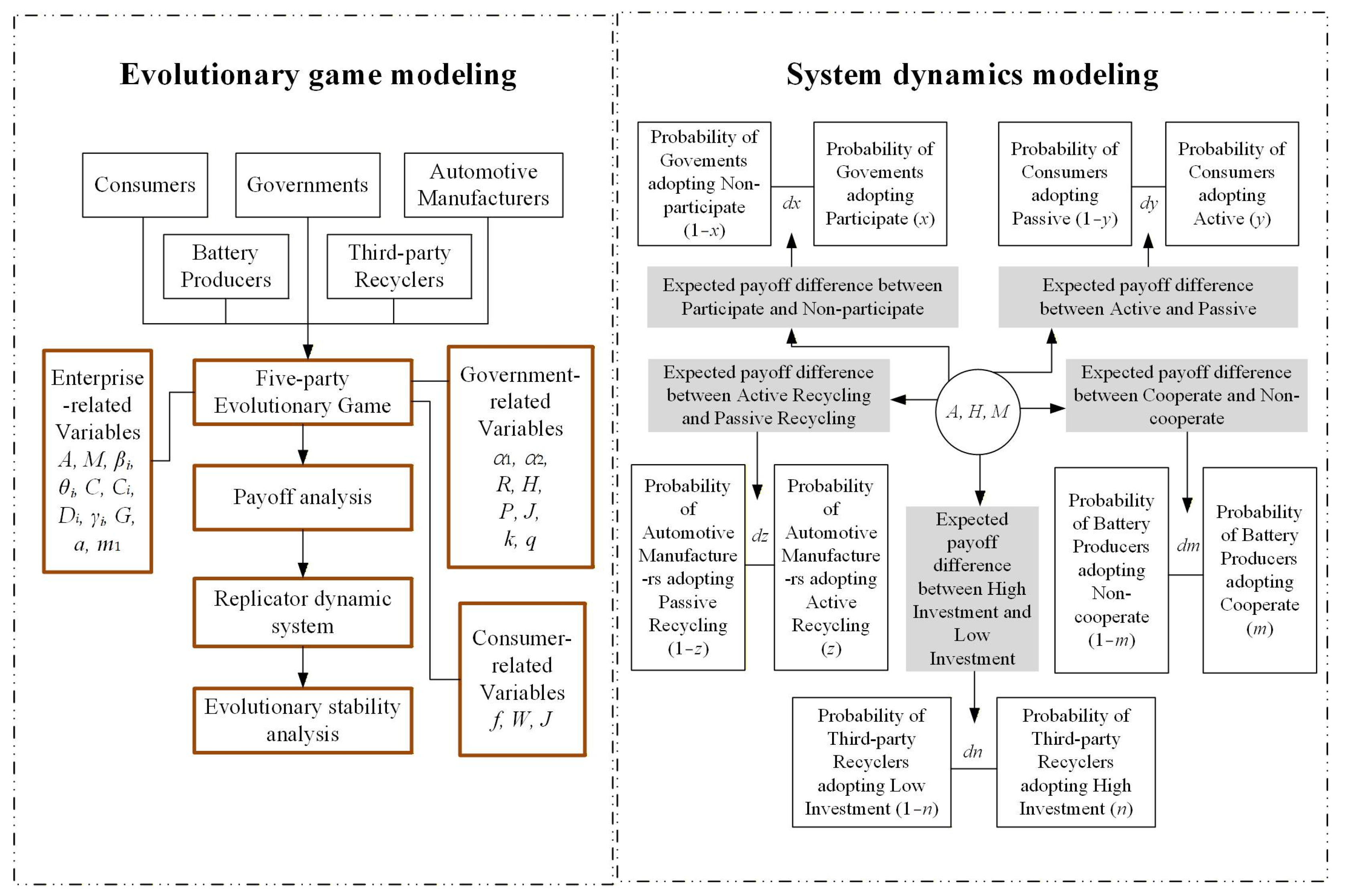
Five-Stakeholder Collaboration in Power Battery Recycling Within Reverse Supply Chains: Threshold Analysis and Policy Recommendations via Evolutionary Game and System Dynamics

Abstract
1. Introduction
2. Literature Review and Theoretical Framework
2.1. Collaborative Recycling of Power Batteries
2.2. Evolutionary Game Theory and System Dynamics
2.3. Limitations of Existing Research and Research Innovations
3. Model Construction
3.1. Model Construction Basis
3.2. Model Assumptions
3.3. Main Parameter Settings
3.4. Modeling
3.5. Evolutionary Stability Analysis of Equilibrium Points
4. Simulation Results and Analysis
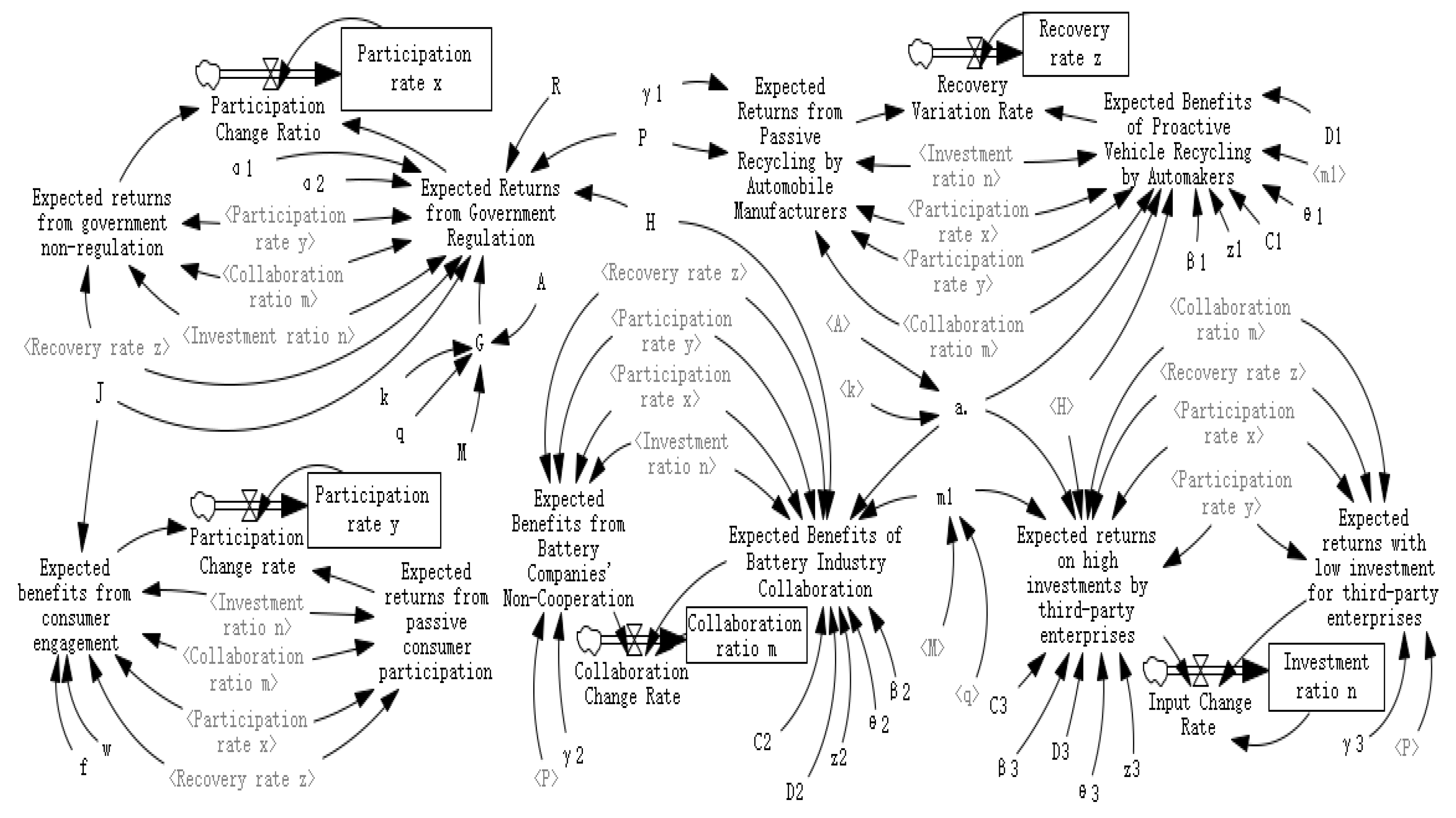
4.1. System Dynamics Simulation Modeling
4.2. Simulation Results and Discussion
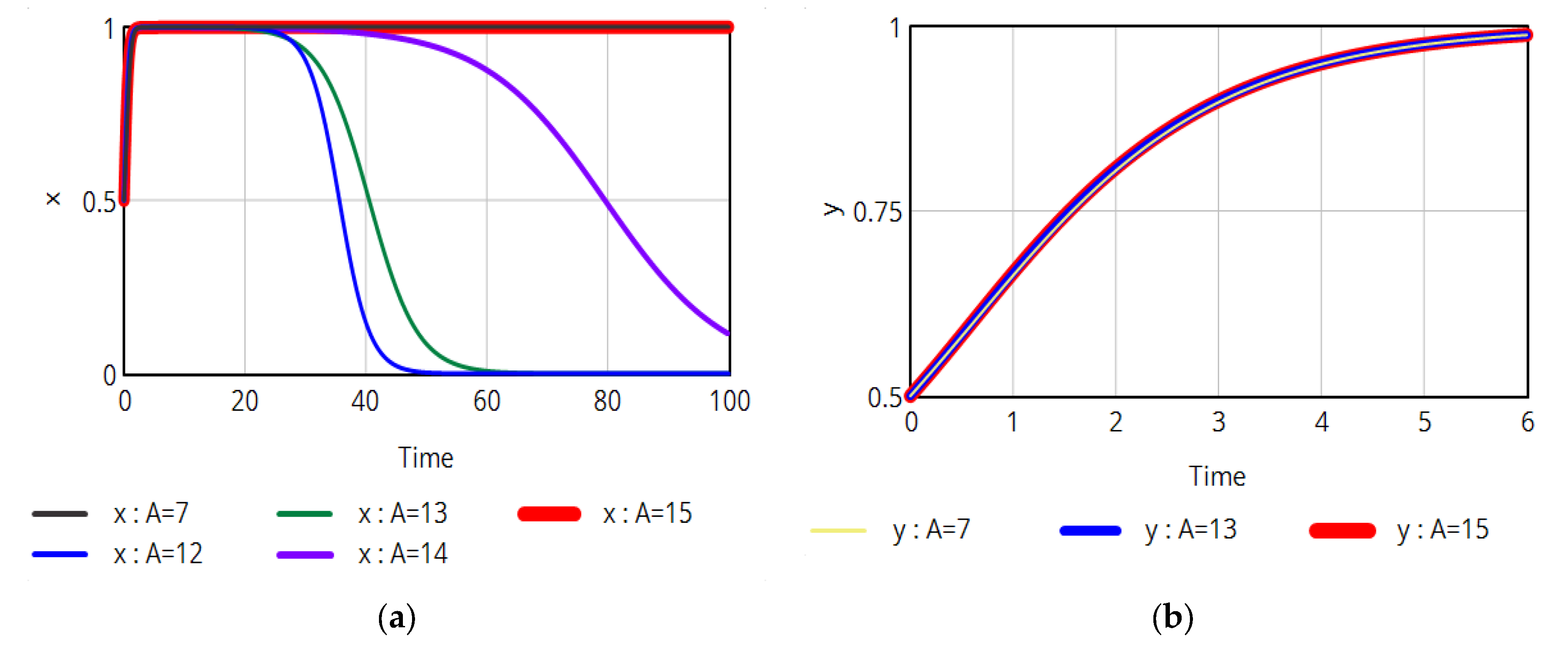
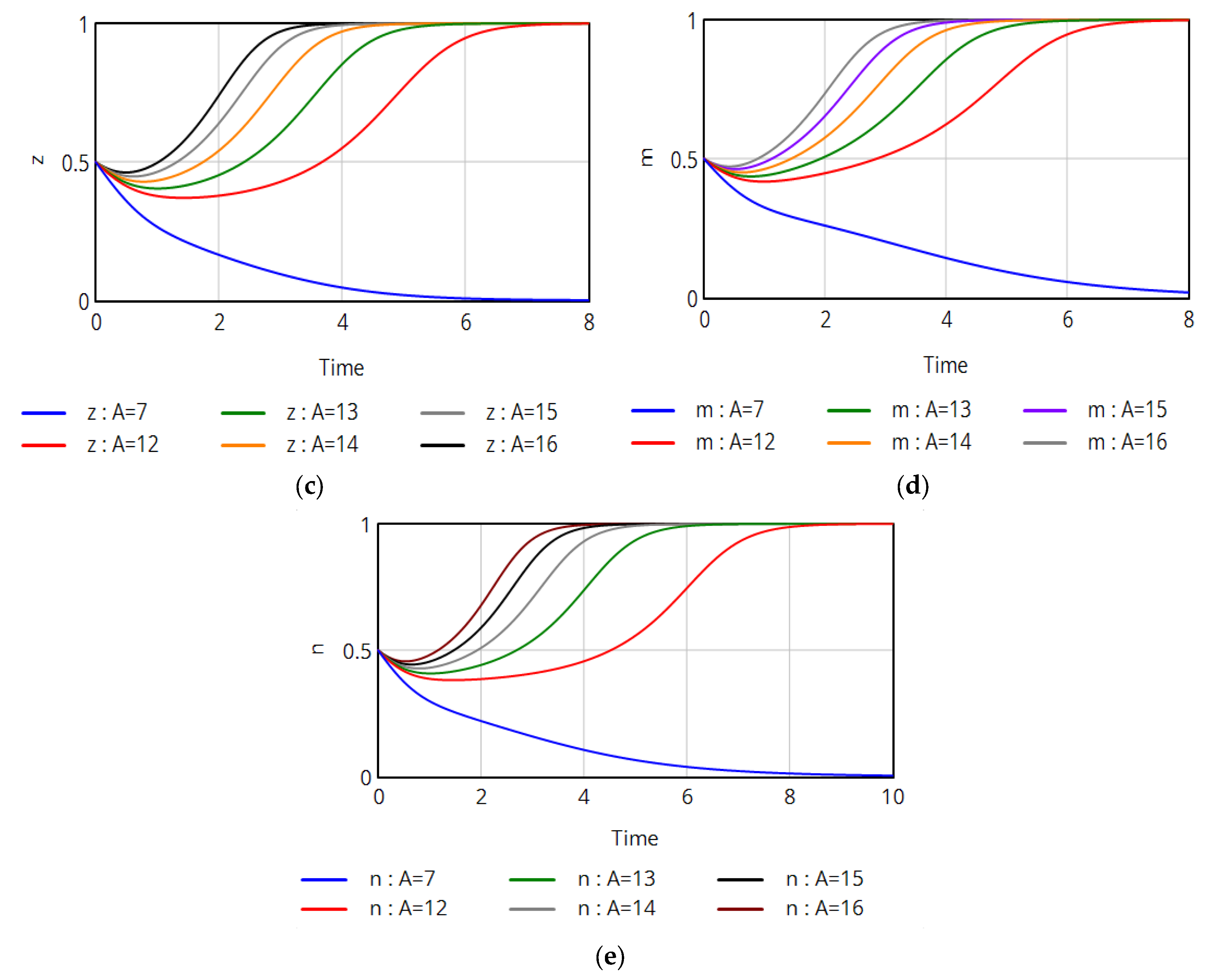
4.2.1. Impact of Total Tripartite Synergy Benefits (A)
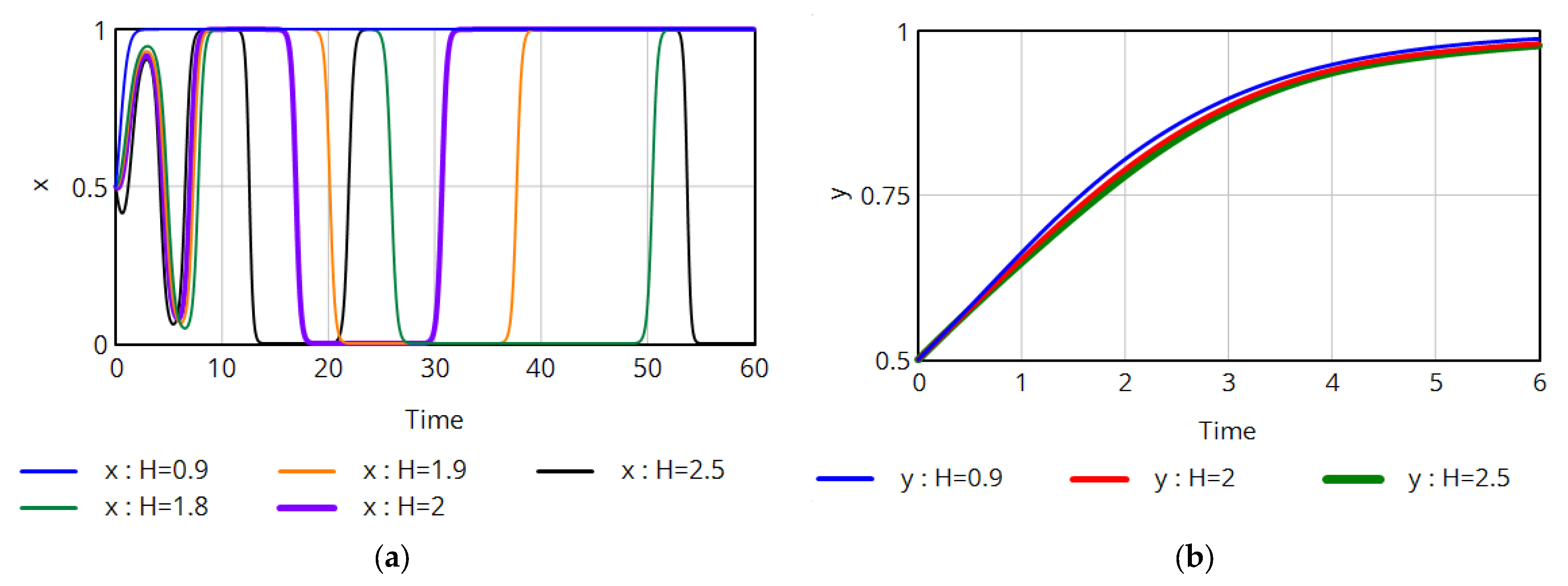
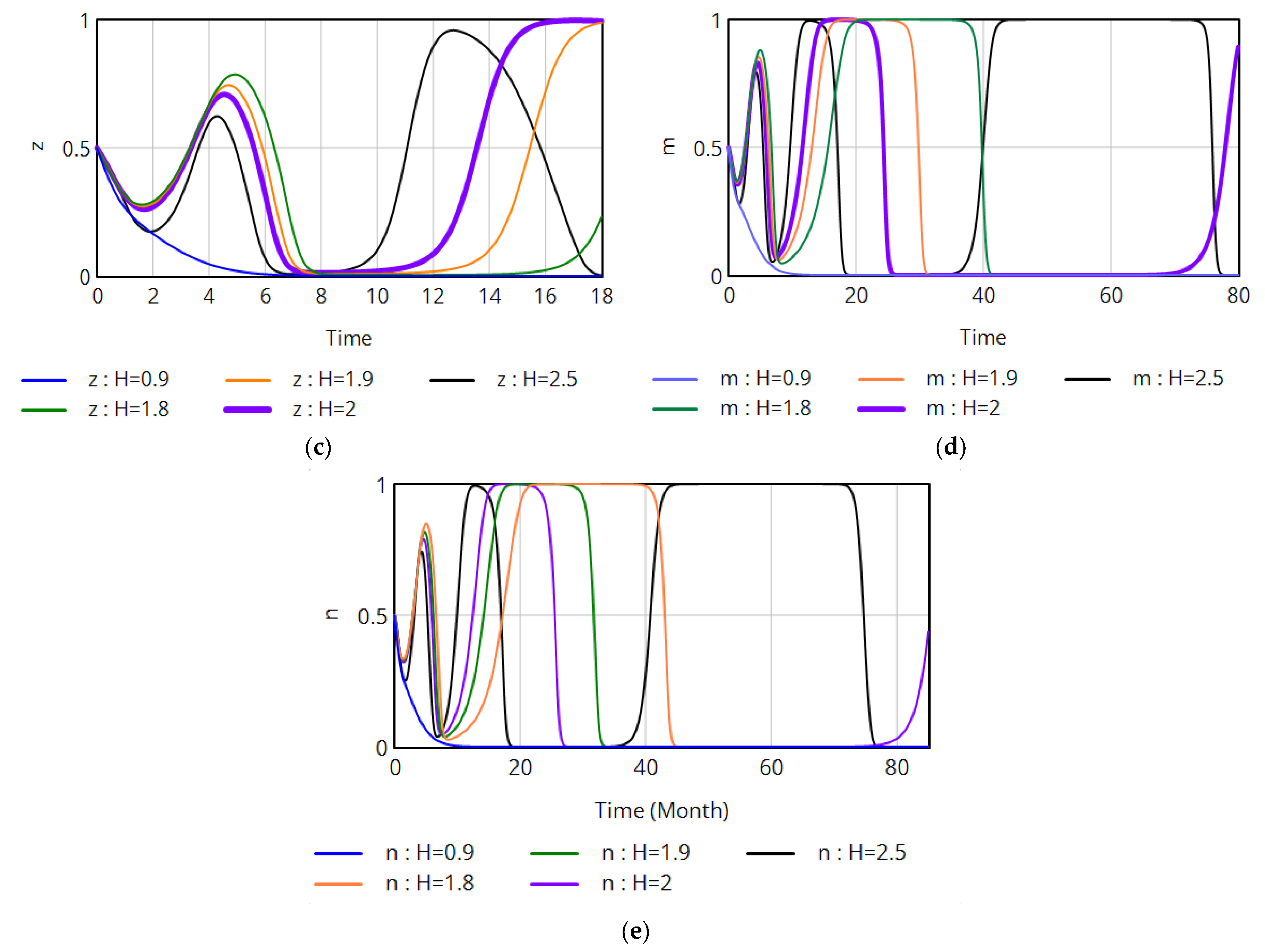
4.2.2. Impact of Government Subsidization for Synergy (H)
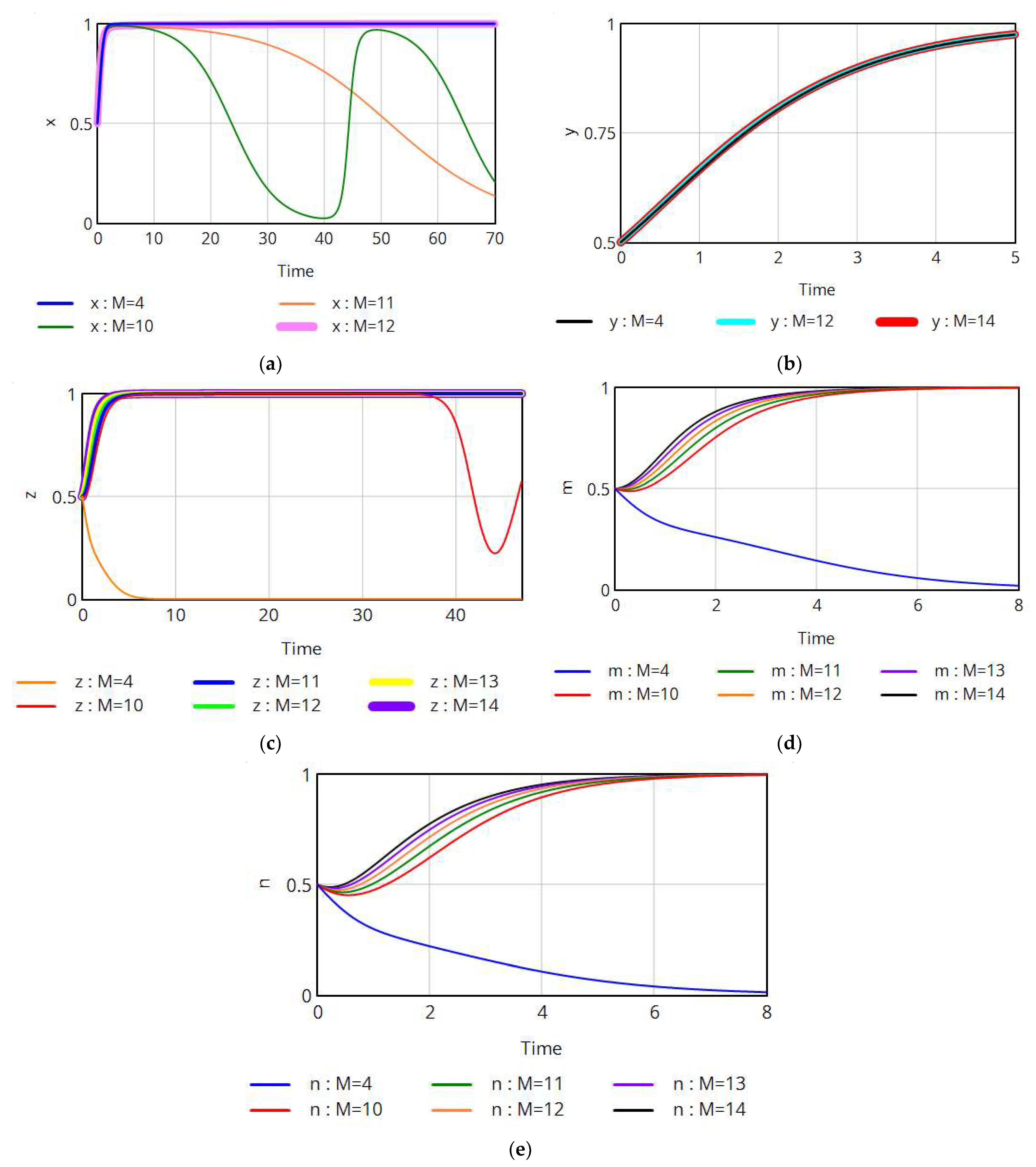
4.2.3. Impact of Total Benefit of Two-Party Synergy (M)
5. Conclusions and Policy Recommendations
5.1. Conclusions
5.2. Theoretical Contributions
5.3. Management Implications and Policy Recommendations
- Government Level: Implement Threshold-Based Dynamic Precision Governance and Building System Resilience
- The government should implement a threshold-guided “intensity-performance” dynamic subsidy mechanism. In the initial phase, the subsidy intensity must cover the upfront collaboration costs for enterprises to break the market lock-in. This initial benchmark can be determined, for instance, by assessing the industry-average incremental costs associated with establishing a formal recycling network and upgrading technologies. As the system matures, a shift toward “precision phase-out” is necessary. This involves dynamically linking subsidies to key resource and environmental performance indicators, such as critical metal recovery rates and carbon reduction per unit of output. The aim is to transition the incentive model from “universal support” to “selective enhancement,” ensuring fiscal efficiency while substantively improving resource circularity and the industry’s low-carbon development level.
- The government should strengthen the extended producer responsibility (EPR) framework and establish a robust digital traceability oversight system. To reinforce systemic resilience following subsidy phase-out, it is imperative to enhance the EPR regime and mandate full-lifecycle digital traceability for batteries—for instance, by implementing a unique digital identifier or a traceable digital record for each battery unit. Such a system serves three critical purposes: it supplies a verifiable basis for the performance-linked subsidies outlined above; enables closed-loop supervision to deter illegal recycling, thus mitigating environmental and public-health risks; and fosters innovation in green supply chains as well as the development of sustainable urban infrastructure.
- Corporate Level: Strategic Synergy and Value Co-creation Drive Circular Economy Closure
- Enterprises strive to build “shared responsibility and shared value” alliances. Leading automakers and battery manufacturers should secure recycled material supplies from third-party recyclers through joint investments or long-term contracts, ensuring critical raw material security. Simultaneously, they should promote standardized battery design to fundamentally reduce dismantling and recycling complexity and costs, practicing eco-design principles.
- Third-party recyclers should focus on “technological deepening” and high-value utilization. Simulation results confirm the superiority of a “high-investment” strategy when sufficiently incentivized. Companies should continuously increase R&D investment in cutting-edge technologies like automated dismantling and hydrometallurgy. By enhancing metal recovery rates and recycled material purity, they can transform waste batteries into high-value “urban mines,” shifting their status from “cost centers” to “value centers”.
- Consumer Level: Behavior Guidance and Social Co-governance to Strengthen Sustainable Foundations
- Design “convenient and visible” instant incentives and carbon credit systems for consumers. Deeply integrate battery collection points into community and commercial networks, offering immediate rewards like “scan-to-redeem cashback.” Simultaneously, incorporate standardized recycling behavior into personal carbon accounts, transforming green actions into quantifiable social capital and economic returns to establish long-term incentive mechanisms.
- Strive to cultivate a recycling environment and oversight network characterized by “social co-governance.” Raise public environmental awareness through multi-channel campaigns highlighting the environmental and safety risks of improper recycling. Establish accessible public reporting and feedback channels to encourage societal oversight, building a modern environmental governance framework involving tripartite collaboration between government, market, and society.
5.4. Limitation and Further Research
Author Contributions
Funding
Institutional Review Board Statement
Informed Consent Statement
Data Availability Statement
Acknowledgments
Conflicts of Interest
Appendix A
References
- Chirumalla, K.; Kulkov, I.; Vu, F.; Rahic, M. Second life use of Li-ion batteries in the heavy-duty vehicle industry: Feasibilities of remanufacturing, repurposing, and reusing approaches. Sustain. Prod. Consum. 2023, 42, 351–366. [Google Scholar] [CrossRef]
- Tao, Y.; Rahn, C.D.; Archer, L.A.; You, F. Second life and recycling: Energy and environmental sustainability perspectives for high-performance lithium-ion batteries. Sci. Adv. 2021, 7, eabi7633. [Google Scholar] [CrossRef] [PubMed]
- Altuntas Vural, C.; Patricia, V.L.; Árni, H.; John, F.; Josefsson, F. Life after use: Circular supply chains for second-life of electric vehicle batteries. Prod. Plan. Control 2024, 36, 1229–1246. [Google Scholar] [CrossRef]
- Kampker, A.; Heimes, H.H.; Offermanns, C.; Vienenkötter, J.; Frank, M.; Holz, D. Identification of Challenges for Second-Life Battery Systems—A Literature Review. World Electr. Veh. J. 2023, 14, 80. [Google Scholar] [CrossRef]
- Frank, M.; Preussner, S.; Soldan Cattani, N.; Frieges, M.; Heimes, H.H.; Kampker, A. Understanding the Economics of Aged Traction Batteries: Market Value and Dynamics. Batteries 2024, 10, 162. [Google Scholar] [CrossRef]
- Zhang, C.; Tian, Y.; Han, M. Recycling mode selection and carbon emission reduction decisions for a multi-channel closed-loop supply chain of electric vehicle power battery under cap-and-trade policy. J. Clean. Prod. 2022, 375, 134060. [Google Scholar] [CrossRef]
- Rehman, S.; Al-Greer, M.; Burn, A.S.; Short, M.; Cui, X. High-Volume Battery Recycling: Technical Review of Challenges and Future Directions. Batteries 2025, 11, 94. [Google Scholar] [CrossRef]
- Fallah, N.; Fitzpatrick, C. How will retired electric vehicle batteries perform in grid-based second-life applications? A comparative techno-economic evaluation of used batteries in different scenarios. J. Clean. Prod. 2022, 361, 132281. [Google Scholar] [CrossRef]
- Cheng, M.; Ran, A.; Zheng, X.; Zhang, X.; Wei, G.; Zhou, G.; Sun, H. Sustainability evaluation of second-life battery applications in grid-connected PV-battery systems. J. Power Sources 2022, 550, 232132. [Google Scholar] [CrossRef]
- Hassini, M.; Redondo-Iglesias, E.; Venet, P. Second-Life Batteries Modeling for Performance Tracking in a Mobile Charging Station. World Electr. Veh. J. 2023, 14, 94. [Google Scholar] [CrossRef]
- Seika, J.; Kubli, M. Repurpose or recycle? Simulating end-of-life scenarios for electric vehicle batteries under the EU battery regulation. Sustain. Prod. Consum. 2024, 51, 644–656. [Google Scholar] [CrossRef]
- Enhance the Recycling Level of Non-Ferrous Metals and Promote the Development of the New Energy Vehicle Industry. Available online: https://cn.chinadaily.com.cn/a/202502/21/WS67bfd124a310510f19ee8dca.html (accessed on 10 October 2025).
- Li, J.; Liu, F.; Zhang, J.Z.; Tong, Z. Optimal configuration of electric vehicle battery recycling system under across-network cooperation. Appl. Energy 2023, 338, 120898. [Google Scholar] [CrossRef]
- Dong, B.; Ge, J. What affects consumers’ intention to recycle retired EV batteries in China? J. Clean. Prod. 2022, 359, 132065. [Google Scholar] [CrossRef]
- Miller, I. Next-Gen Battery Strategies 2027+: Potentials and Challenges for Future Battery Designs and Diversification in Product Portfolios to Serve a Large Bandwidth of Market Applications. SAE Tech. Pap. 2024, 7, 6. [Google Scholar] [CrossRef]
- Li, J.; Wang, Z.; Jiang, B.; Kim, T. Coordination strategies in a three-echelon reverse supply chain for economic and social benefit. Appl. Math. Modell. 2017, 49, 599–611. [Google Scholar] [CrossRef]
- Guo, R.; He, Y.; Tian, X.; Li, Y. New energy vehicle battery recycling strategy considering carbon emotion from a closed-loop supply chain perspective. Sci. Rep. 2024, 14, 688. [Google Scholar] [CrossRef]
- Wenbin, W.; Junfei, D.; Zhihui, W.; Qingli, D. Reward-penalty Mechanism of Government for Retailer-led Closed-loop Supply Chain under Collection Responsibility Sharing. Chin. J. Manag. Sci. 2019, 27, 127–136. [Google Scholar] [CrossRef]
- Wang, Y.; Dong, B.; Ge, J. How can the recycling of power batteries for EVs be promoted in China? A multiparty cooperative game analysis. Waste Manag. 2024, 186, 64–76. [Google Scholar] [CrossRef]
- Xie, J.-y.; Le, W.; Guo, B.-h. Pareto Equilibrium of New Energy Vehicle Power Battery Recycling Based on Extended Producer Responsibility. Chin. J. Manag. Sci. 2022, 30, 309–320. [Google Scholar] [CrossRef]
- Li, J.; Wang, Z.; Li, H.; Jiao, J. Which policy can effectively promote the formal recycling of power batteries in China? Energy 2024, 299, 131445. [Google Scholar] [CrossRef]
- Miao, S.; Zhang, Q.; Liu, C.; Wang, L. Can the deposit-return scheme promote recycling of waste PV modules in China? Analysis of an evolutionary game. Sol. Energy 2023, 265, 112136. [Google Scholar] [CrossRef]
- Friedman, D. Evolutionary Games in Economics. Econometrica 1991, 59, 637–666. [Google Scholar] [CrossRef]
- Wang, G.; Hu, X.; Wang, T.; Liu, J.; Feng, S.; Wang, C. Tripartite Evolutionary Game Analysis of a Logistics Service Supply Chain Cooperation Mechanism for Network Freight Platforms. Int. J. Intell. Syst. 2024, 2024, 4820877. [Google Scholar] [CrossRef]
- Zhang, Z.; Xue, Y.; Li, J.; Gong, L.; Wang, L. Supply Chain Logistics Information Collaboration Strategy Based on Evolutionary Game Theory. IEEE Access 2020, 8, 46102–46120. [Google Scholar] [CrossRef]
- Sterman, J.; Sterman, J.D. Business Dynamics: System Thinking and Modeling for a Complex World; HAR/CDR; McGraw-Hill Education: New York, NY, USA, 2000; pp. 7–17. ISBN 978-00-7238-915-9. [Google Scholar]
- Mu, N.; Wang, Y.; Chen, Z.-S.; Xin, P.; Deveci, M.; Pedrycz, W. Multi-objective combinatorial optimization analysis of the recycling of retired new energy electric vehicle power batteries in a sustainable dynamic reverse logistics network. Environ. Sci. Pollut. Res. 2023, 30, 47580–47601. [Google Scholar] [CrossRef]
- Joshi, B.V.; Vipin, B.; Ramkumar, J.; Amit, R.K. Impact of policy instruments on lead-acid battery recycling: A system dynamics approach. Resour. Conserv. Recycl. 2021, 169, 105528. [Google Scholar] [CrossRef]
- Zhang, G.; Zhang, Z. An Evolutionary Game Model of a Regional Logistics Service Supply Chain Complex Network in a Blockchain Environment. Systems 2025, 13, 32. [Google Scholar] [CrossRef]
- Chen, J.; Zhang, W.; Gong, B.; Zhang, X.; Li, H. Optimal policy for the recycling of electric vehicle retired power batteries. Technol. Forecast. Social. Change 2022, 183, 121930. [Google Scholar] [CrossRef]
- Yu, W.; Guo, Y.; Shang, Z.; Zhang, Y.; Xu, S. A review on comprehensive recycling of spent power lithium-ion battery in China. eTransportation 2022, 11, 100155. [Google Scholar] [CrossRef]
- McGuthrie, P. Tesla Says It’s Focusing on Battery Cell Production in U.S., After IRA Act Incentives. Available online: https://teslanorth.com/2023/02/22/tesla-says-its-focusing-on-battery-cell-production-in-u-s-after-ira-act-incentives/ (accessed on 5 May 2025).
- China’s Trade-in Policy Energizes Consumer Market. Available online: https://english.www.gov.cn/news/202408/24/content_WS66c9c4ccc6d0868f4e8ea39a.html (accessed on 24 May 2025).
- Wanting, C.; Zhihua, H. Research on the Government Regulation and Manufacturer Recovery under Premium and Penalty Mechanism Based on Evolutionary Game Theory. Soft Sci. 2019, 33, 106–112+125. [Google Scholar] [CrossRef]
- Zhiping, D.; Yuxian, Q. Research on Information Cooperation Mechanism of Cross Border E-commerce Logistics Alliance Based on Tripartite Evolutionary Game. Chin. J. Manag. Sci. 2023, 31, 228–238. [Google Scholar] [CrossRef]
- Huimin, W.; Chang, L.; Yongguang, Z. Research on Investment Model Selection of Power Battery Recyclers Based on Evolutionary Game. Ind. Eng. Manag. 2021, 26, 161–170. [Google Scholar] [CrossRef]




| Symbol | Definition | Symbol | Definition |
|---|---|---|---|
| x | Probability of government involvement in collaboration | A | Total revenue generated from three-party collaborative recycling |
| y | The probability that consumers are actively involved in collaboration | M | Total revenue generated from two-party collaborative recycling |
| z | The probability that automobile companies actively recycle | βi | Proportion of revenue sharing that firm i receives in three-party collaborative recycling (i = 1, 2, 3 corresponds to automobile firms, battery firms, and third-party firms, respectively, ∑βi = 1) |
| m | Probability of Battery Enterprises’ Cooperation | θi | Proportion of revenue sharing that firm i receives in two-party collaborative recycling (i = 1, 2, 3 corresponds to automobile firms, battery firms, and third-party firms, respectively, ∑θi = 1) |
| n | Probability of high investment by third-party enterprises | C | Total cost required for collaborative recycling |
| α1 | The weighting of the environmental benefits that the government derives from collaborative recycling | Ci | Costs invested by enterprises in collaborative recycling |
| α2 | The social benefits to the government from consumer participation in recycling | Di | Risk-induced costs of the enterprise in the collaboration process |
| R | The total cost of policy formulation and implementation by the government | γi | Economic loss caused by the exclusion of the enterprise by the collaborative party in case of non-participation in the collaborative recycling. |
| H | Subsidy amount provided by the government to enterprises participating in collaborative recycling | G | Environmental benefits of collaboration |
| P | Penalties amount imposed by the government on enterprises not participating in collaborative recycling | f | Social Direct Benefits of Consumer Participation in Recycling |
| J | Subsidy amount provided by the government to consumers who actively participate in recycling | W | Indirect social benefits of consumer participation in recycling |
| a | Total Revenue Allocated to Enterprises in Tripartite Collaborative Recycling | m1 | Total Revenue Allocated to Enterprises During Bilateral Cooperative Recycling |
| k | Government Revenue Sharing Coefficient for Tripartite Collaborative Benefits | q | Government Revenue Sharing Coefficient for Bilateral Cooperative Benefits |
| Government (G) | Consumers (S) | Automobile Enterprises (B) | |||||||
|---|---|---|---|---|---|---|---|---|---|
| Active Recycling (z) | Passive Recycling (1 − z) | ||||||||
| Battery Enterprise (T) | |||||||||
| Cooperate (m) | Non-Cooperate (1 − m) | Cooperate (m) | Non-Cooperate (1 − m) | ||||||
| Third-Party Enterprise (C) | |||||||||
| High Investment (n) | Low Investment (1 − n) | High Investment (n) | Low Investment (1 − n) | High Investment (n) | Low Investment (1 − n) | High Investment (n) | Low Investment (1 − n) | ||
| Participate (x) | Active (y) | G1S1B1T1C1 | G1S1B1T1C2 | G1S1B1T2C1 | G1S1B1T2C2 | G1S1B2T1C1 | G1S1B2T1C2 | G1S1B2T2C1 | G1S1B2T2C2 |
| Passive (1 − y) | G1S2B1T1C1 | G1S2B1T1C2 | G1S2B1T2C1 | G1S2B1T2C2 | G1S2B2T1C1 | G1S2B2T1C2 | G1S2B2T2C1 | G1S2B2T2C2 | |
| Non-participate (1 − x) | Active (y) | G2S1B1T1C1 | G2S1B1T1C2 | G2S1B1T2C1 | G2S1B1T2C2 | G2S1B2T1C1 | G2S1B2T1C2 | G2S1B2T2C1 | G2S1B2T2C2 |
| Passive (1 − y) | G2S2B1T1C1 | G2S2B1T1C2 | G2S2B1T2C1 | G2S2B1T2C2 | G2S2B2T1C1 | G2S2B2T1C2 | G2S2B2T2C1 | G2S2B2T2C2 | |
| Local Equilibrium Point | |
|---|---|
| E1(0, 0, 0, 0, 0) | E7(0, 0, 0, 0, 1) |
| E2(0, 0, 0, 1, 0) | E8(0, 0, 0, 1, 1) |
| E3(0, 0, 1, 0, 0) | E9(0, 0, 1, 0, 1) |
| E4(0, 1, 0, 0, 0) | E10(0, 1, 0, 0, 1) |
| E5(1, 0, 0, 0, 0) | E11(1, 0, 0, 0, 1) |
| E6(1, 1, 1, 1, 0) | E12(1, 1, 1, 1, 1) |
Disclaimer/Publisher’s Note: The statements, opinions and data contained in all publications are solely those of the individual author(s) and contributor(s) and not of MDPI and/or the editor(s). MDPI and/or the editor(s) disclaim responsibility for any injury to people or property resulting from any ideas, methods, instructions or products referred to in the content. |
© 2025 by the authors. Licensee MDPI, Basel, Switzerland. This article is an open access article distributed under the terms and conditions of the Creative Commons Attribution (CC BY) license.
Share and Cite
Lu, Z.; Jin, Z.; Qin, J.; Wang, Y. Five-Stakeholder Collaboration in Power Battery Recycling Within Reverse Supply Chains: Threshold Analysis and Policy Recommendations via Evolutionary Game and System Dynamics. Sustainability 2026, 18, 382. https://doi.org/10.3390/su18010382
Lu Z, Jin Z, Qin J, Wang Y. Five-Stakeholder Collaboration in Power Battery Recycling Within Reverse Supply Chains: Threshold Analysis and Policy Recommendations via Evolutionary Game and System Dynamics. Sustainability. 2026; 18(1):382. https://doi.org/10.3390/su18010382
Chicago/Turabian StyleLu, Zhiping, Zhengying Jin, Jiaying Qin, and Yanyan Wang. 2026. "Five-Stakeholder Collaboration in Power Battery Recycling Within Reverse Supply Chains: Threshold Analysis and Policy Recommendations via Evolutionary Game and System Dynamics" Sustainability 18, no. 1: 382. https://doi.org/10.3390/su18010382
APA StyleLu, Z., Jin, Z., Qin, J., & Wang, Y. (2026). Five-Stakeholder Collaboration in Power Battery Recycling Within Reverse Supply Chains: Threshold Analysis and Policy Recommendations via Evolutionary Game and System Dynamics. Sustainability, 18(1), 382. https://doi.org/10.3390/su18010382