
Article

Simultaneous Stabilization of Cu/Ni/Pb/As Contaminated Soil by a ZVI-BFS-CaO Composite System

1
Institute of Environmental Pollution and Health, School of Environmental and Chemical Engineering, Shanghai University, Shanghai 200444, China
2
China Construction Eighth Engineering Division Co., Ltd., Shanghai 200131, China
3
CAS Key Laboratory of Soil Environment and Pollution Remediation, Institute of Soil Science, Chinese Academy of Sciences, Nanjing 210008, China
4
State Key Laboratory of Chemical Engineering, School of Chemical Engineering, East China University of Science and Technology, Shanghai 200237, China
*
Authors to whom correspondence should be addressed.
These authors contributed equally to this work.
Sustainability 2026, 18(1), 342; https://doi.org/10.3390/su18010342 (registering DOI)
Submission received: 17 November 2025 / Revised: 21 December 2025 / Accepted: 24 December 2025 / Published: 29 December 2025

Abstract

The simultaneous stabilization of Cu, Ni, Pb, and As in sustainable environmental development remains a significant challenge in heavy metal remediation. In this paper, liquid phase equilibrium experiments have evaluated the immobilization efficiency of 20 potential stabilization materials. Soil stabilization experiments, material characterization, and long-term effectiveness assessments have been performed to investigate the efficient composite stabilization agent and its underlying mechanisms. Results demonstrate that seven materials, including calcium oxide (CaO) and hydroxyapatite (HAP), exhibit multi-metal immobilization capabilities. Among single-material stabilization in soil, HAP for Pb, zero-valent iron (ZVI) for As, and blast furnace slag (BFS) for Cu exhibit prominent stabilization efficiency, yet they cannot efficiently stabilize the four heavy metals simultaneously. Subsequently, the ZVI:BFS:CaO composite agent (6:3:1 mass ratio, 10% addition rate) has been proposed by formulation optimization, achieving remarkable stabilization rates: 99.92% for Cu, 96.16% for Ni, 92.06% for Pb, and 99.58% for As. XRD, XPS, and SEM-EDS analyses confirm that the stabilization occurs through synergistic mechanisms including precipitation, complexation, and lattice encapsulation. The composite stabilizing agent withstood 15 wet–dry and 150 freeze–thaw cycles, with four types of heavy metals stabilization rates > 60%, confirming its long-term effectiveness.

1. Introduction

Rapid industrialization, agricultural intensification, and inappropriate waste disposal have made heavy metal contamination in soil a global environmental concern. Toxic heavy metals like copper (Cu), nickel (Ni), lead (Pb), and arsenic (As) accumulate in soil, posing significant risks to ecosystem health and human well-being via food chain and groundwater pollution pathways [1]. Over 20 million hectares of arable land worldwide are estimated to be heavy-metal-contaminated. This is particularly severe in developing countries with rapid urbanization and industrialization [2].
Consequently, heavy metal-contaminated soil remediation has garnered significant research interest over the past few decades [3]. Traditional ex situ methods include soil washing, solidification/stabilization (S/S), and chemical reduction. In contrast, in situ approaches comprise in situ S/S, phytoremediation [4], and novel electrokinetic remediation technologies [5]. Among these, in situ stabilization is recognized as a cost-effective and environmentally friendly strategy, particularly suitable for large-scale contaminated sites [6]. This method involves incorporating stabilizing agents into the soil, which transform heavy metals into less bioavailable and mobile forms through chemical reactions, thereby mitigating environmental risks. Stabilization effectiveness depends on several factors, including soil properties, heavy metal types, stabilizer characteristics, and environmental conditions [3].
Based on their mechanisms, common soil heavy metal stabilization technologies are categorized into chemical precipitation, physical adsorption, ion exchange, redox transformation, and lattice encapsulation [7]. These interactions significantly reduce the bioavailability or toxicity of heavy metal ions, achieving remediation objectives. Chemical precipitation relies on forming insoluble compounds (e.g., hydroxides, carbonates, phosphates) through pH adjustment or reagent addition, thereby immobilizing metals by reducing their mobility and leachability [8]. Physical adsorption utilizes high-surface-area materials such as biochar and zeolite to trap heavy metal ions, limiting their migration and enhancing immobilization [9]. Ion exchange replaces heavy metal ions with inert cations, decreasing their mobility. Redox transformation directly alters metal speciation (e.g., As5+ to As3+, Cr6+ to Cr3+) [3]. Lattice encapsulation incorporates heavy metals into stable mineral structures (e.g., C-S-H gels), providing long-term immobilization and markedly reducing bioavailability as the trapped metals become inaccessible [10]. Regardless of the specific mechanism, the practical application of these technologies depends critically on selecting efficient, low-cost stabilizers, a major focus of current research.
To reduce stabilization costs and enhance material sustainability, researchers have explored using industrial solid wastes and low-cost metal compounds as heavy metal stabilizers. For example, fly ash, a coal combustion by-product rich in silicoaluminates and alkaline components, can increase soil pH and immobilize heavy metals through adsorption and precipitation. In practice, fly ash intended for soil stabilization requires pretreatment—such as physical separation, leaching/extraction, or thermal processing—to mitigate its inherent heavy metal risk [11,12]. Studies show that fly ash effectively reduces the leaching concentrations of Pb, Zn, and Cu in contaminated soils [13], primarily via hydroxide and silicate precipitation and surface adsorption. Similarly, steel slag (SS) and blast furnace slag (BFS)—byproducts of iron and steel production rich in calcium and silicon—exhibit strong alkalinity and adsorption capacity. Their application raises soil pH, promoting heavy metal hydroxide precipitation, while silicate minerals interact with heavy metal ions through ion exchange or co-precipitation, thereby stabilizing Cd, Pb, and Cu [14]. Research indicates that BFS incorporation significantly reduces bioavailable Pb and Cd concentrations in soil. Calcium silicate hydrates in BFS effectively contribute to heavy metal immobilization. Furthermore, ZVI and iron oxides are common economical stabilization agents. ZVI’s strong reductive properties facilitate converting high-valence heavy metals like As(V) to lower valence states, forming insoluble precipitates. Concurrently, iron corrosion-derived iron oxides and hydroxides show high adsorption and co-precipitation capacities for heavy metals. Iron oxides like Fe3O4 have abundant surface hydroxyl groups, giving them high adsorption capacity for cations (e.g., Pb2+, Cu2+, Ni2+) and anions (e.g., AsO43−) [15]. Additionally, biochar and similar materials have been widely studied for heavy metal stabilization. These materials are readily available, cost-effective, and improve soil physicochemical properties, supporting green remediation principles [16].
While many studies focus on novel stabilization agents, most are limited to stabilizing one or two heavy metals. Research on simultaneous multi-heavy metal stabilization remains relatively limited. In practice, soil contamination typically involves multiple metals. The geochemical behaviors of different elements vary significantly, imposing greater demands on stabilization materials [17]. For example, Pb2+ readily forms phosphate precipitates for immobilization, whereas Cu2+ and Ni2+ tend to adsorb onto organic matter or clays [18]. As, existing primarily as anions in soil, requires adsorption by positively charged Fe–Al oxides. Moreover, cations such as Cd2+ and Pb2+ are more effectively stabilized through hydroxide precipitation under high-pH conditions [19]. Consequently, single materials seldom meet the requirements for simultaneous multi-heavy metal stabilization.
Recent research increasingly investigates composite formulations and multifunctional materials. For example, iron oxide–biochar composites provide both adsorption sites and alkaline conditions, effectively stabilizing Cd, Pb, and As [20]. Similarly, composite stabilizers derived from industrial waste residues containing Ca, Fe, and Si components exhibit synergistic effects, simultaneously reducing leaching concentrations of Pb, Cu, and Zn in soil [21]. Although stabilization material development for multi-metal contamination remains nascent, it represents a critical future direction. This research direction is expected to overcome the limited applicability of current single-material approaches and improve remediation efficiency for multi-heavy metal contaminated soils.
This study has employed liquid phase equilibrium experiments and soil stabilization experiments to develop and optimize a ZVI-BFS-CaO composite stabilization system. The research has systematically evaluated the system’s efficiency for the simultaneous stabilization and long-term maintenance of Cu, Ni, Pb, and As in contaminated soil. Multiple characterization techniques, including X-ray diffraction (XRD), X-ray photoelectron spectroscopy (XPS), and scanning electron microscopy with energy-dispersive X-ray spectroscopy (SEM-EDS) have been used to clarify the synergistic stabilization mechanisms, such as precipitation, complexation, and lattice sequestration. The findings provide new materials and technical strategies for effective remediation of multi-heavy-metal-contaminated soils and offer a theoretical basis for investigating synergistic mechanisms in multi-component stabilization systems.

2. Materials and Methods

2.1. Materials and Reagents

2.1.1. Experimental Soil and Physicochemical Properties

The soil utilized in this study was sourced from agricultural land in the Baoshan District of Shanghai. Analytical assessments confirmed that the background concentrations of Cu, Ni, Pb, and As were all below 0.2 mg/kg, rendering them negligible. Soil pH measured 7.36 ± 0.12 following NY/T 1377-2007 [22], with 10 g soil mixed into 25 mL deionized water, shaken 5 min, and equilibrated 1 h. Electrical conductivity (EC) was 176.9 ± 1.0 μs/cm at 25 °C, determined via HJ 802-2016 using a 1:5 soil–water mass ratio. The cation exchange capacity (CEC) was 15.7 cmol/kg, measured by the ammonium acetate method according to Ciesielski et al. [23]. Soil organic matter (SOM) content was 0.78 wt%, analyzed with an elemental analyzer (VARIO ELIII). Notably, the agricultural soil exhibited a neutral pH (7.36 ± 0.12), moderate cation exchange capacity (15.7 cmol/kg), and low-to-moderate organic matter content (0.78 wt%), matching typical multi-metal contaminated agricultural sites in industrialized regions (e.g., the Yangtze River Delta) commonly impacted by industrial emissions and agricultural inputs. This typicality supported generalizing the stabilization results to similar contaminated agricultural lands.

2.1.2. Heavy Metal and Acid Reagents

The introduction of heavy metal ions was facilitated through the use of copper nitrate trihydrate (Cu(NO3)2·3H2O, 99.9%), nickel nitrate hexahydrate (Ni(NO3)2·6H2O, purity 99.9%), lead nitrate (Pb(NO3)2, 99.9%), and sodium arsenate (Na3AsO4, 99.9%), which were procured from Shanghai Aladdin Biochemical Technology Co., Ltd. (Shanghai, China). Hydrochloric acid (HCl, 37%, nitric acid (HNO3, AR) and acetic acid (CH3COOH, AR) were obtained from Sinopharm Chemical Reagent Co., Ltd. (Shanghai, China).

2.1.3. Heavy Metal Stabilization Materials and Basic Information

Potential stabilization materials, including calcium oxide (CaO, AR), magnetite (Fe3O4, 98%), β-alumina (Al2O3, 99%), and 5 Å molecular sieve (60–80 mesh), were procured from Shanghai Aladdin Biochemical Technology Co., Ltd. (Shanghai, China). Various clay minerals and solid wastes, such as talc, kaolin, zeolite, bauxite, bentonite, palygorskite, fly ash, blast furnace slag (BFS), and steel slag (SS), were sourced from Yiran Mineral Processing Co., Ltd., located in Lingshou County, Shijiazhuang, Hebei Province, China. Zero-valent iron (ZVI) was acquired from Shijiazhuang Yuheng New Materials Co., Ltd. (Shanghai, China). The element and oxidation component compositions of ZVI, BFS and SS are detailed in Table 1, as determined by X-ray fluorescence spectroscopy (XRF) using a Malvern Panalytical Zetium instrument (Almelo, The Netherlands).

2.2. Liquid Phase Equilibrium Experiments

Liquid phase equilibrium experiments are used to evaluate the capture ability of heavy metal stabilization materials for single heavy metal ions. Twenty potential heavy metal stabilization agents, including clay minerals, solid wastes, metals, and their oxides, were selected for liquid phase equilibrium experiments. Each agent was added individually to four different heavy metal solutions to evaluate removal efficiency. Four types 200 mg/L heavy metal ion solutions (Cu2+, Ni2+, Pb2+, and As3+) were prepared. For each heavy metal ion test, 0.1 g of material was mixed with 10 mL of the corresponding solution and the mixture was transferred to a centrifuge tube. The centrifuge tubes were horizontally oscillated at 150 rpm at 25 °C for 24 h, followed by centrifugation at 3500 rpm for 5 min. A 2.0 mL supernatant aliquot was filtered through a 0.22 μm membrane. Then, 10.0 μL of filtrate was diluted to 10.0 mL with 3.5% nitric acid, and heavy metal concentrations were measured by inductively coupled plasma mass spectrometry (ICP-MS, PerkinElmer NexION 1000G; PerkinElmer, Inc., Waltham, Massachusetts, United States). ICP-MS detection limits for Cu, Ni, Pb, and As were 0.08, 0.06, 0.09, and 0.12 μg/L, respectively, with an RSD ≤ 2%, meeting the reliability requirements for quantitative heavy metal analysis. The heavy metal removal rate was calculated as
Removal rate (%) = [(C0 − Ce)/C0] × 100%
where C0 was the initial concentration, and Ce was the equilibrium concentration after 24 h. Experiments were conducted in duplicate, with removal rate deviations less than 1%, confirming reproducibility. Note that the liquid phase equilibrium experiment aimed to efficiently screen potential materials with multi heavy metal immobilization ability. Therefore, this study focused on comparing removal rates and did not involve precise measurement of key adsorption equilibrium parameters.

2.3. Soil Stabilization Experiments

The soil stabilization experiment tested the synergistic stabilization ability of materials for multiple metals in soil. After preparing the contaminated soil, batch experiments were performed for stabilization. The effect was evaluated through acid leaching. The specific experimental procedure was as follows.

2.3.1. Preparation of Contaminated Soil

High-concentration mixed aqueous solution (3500 mg/L Cu(NO3)2, 3500 mg/L Ni(NO3)2, 2000 mg/L Pb(NO3)2, and 1000 mg/L Na3AsO4) was mixed with uncontaminated soil at a 1:5 mass ratio. After thorough mixing, the mixture was air-dried in a shaded, well-ventilated area for one month. To ensure contaminant uniform distribution, the soil was turned daily. While metal additions using nitrate or arsenate salts may not perfectly mimic field-aged speciation, this method, combined with prolonged aging, has been a standard and validated approach for producing consistent contamination levels for stabilization studies [24].
For digestion, 0.1 g of contaminated soil was placed in a microwave digestion vessel with 9.0 mL of nitric acid and 3.0 mL of hydrochloric acid. Digestion used a temperature program: from room temperature to 120 °C held for 3 min, then to 160 °C held for 3 min, and finally to 180 °C held for 25 min. After cooling, the solution was transferred to a PTFE crucible. Silicon was removed by adding 2.0 mL of hydrofluoric acid and 1.0 mL of perchloric acid, then evaporating until white fumes ceased. The residue was dissolved in nitric acid solution (2:98, v/v) and diluted to 50.0 mL. Heavy metal concentrations were measured by ICP-MS. The measured concentrations in the combined contamination soil were Cu, 200.56 mg/kg; Ni, 204.26 mg/kg; Pb, 219.45 mg/kg; and As, 50.55 mg/kg. These target concentrations are consistent with typical field levels reported in multi-metal contaminated agricultural soils near industrial areas (e.g., metal smelters, manufacturing zones) in eastern China [25]. Additionally, all concentrations exceed the risk screening values for agricultural land specified in the Chinese national standard GB 15618-2018 (Cu: 200 mg/kg, Ni: 100 mg/kg, Pb: 140 mg/kg, As: 25 mg/kg), validating the necessity of stabilization remediation for such contaminated soils.

2.3.2. Stabilization Procedures for Contaminated Soil

Soil stabilization experiments were conducted in crucibles. A total of 10.0 g of contaminated soil was measured into each crucible. Stabilization agents for heavy metals were added at 3% and 10% dosages, respectively. The mixtures were homogenized to ensure uniform distribution of stabilization materials. Ultrapure water was sprayed to achieve a 25% soil moisture rate. The samples were then sealed and cured for 5 days at 25 °C, ensuring natural ventilation.

2.3.3. Determination of Leaching Concentration and Stabilization Rate

Soil sample heavy metal leaching concentrations were determined using the USEPA 1311 TCLP method, which is widely used for evaluating heavy metal stabilization effect [26]. The soil samples were freeze-dried and sieved through a 0.15 mm mesh. Precisely 2.0 g of each sample was weighed into a stoppered conical flask. Then, 20.0 mL of acetic acid buffer extractant (pH 4.93 ± 0.05) was added at a liquid-to-solid ratio of 20:1 (mL/g). The mixtures were shaken at 110 rpm for 18 h at 25 °C. After shaking, they were immediately vacuum-filtered through a 0.45 μm membrane, and the filtrate was collected. The concentrations of Cu, Ni, Pb, and As in the filtrate were determined by ICP-MS after appropriate dilution. All experiments were performed in triplicate, and the results were averaged to calculate the leaching concentrations. All deviations were marked with error bars. The heavy metal stabilization rate was calculated as follows [27]:
Stabilization rate (%) = [(Cblank − Ci)/Cblank] × 100%
where Cblank was the leaching concentration of the blank combined contamination soil (without stabilization agents), and Ci was the leaching concentration of the soil amended with composite stabilization agents. The measured leaching concentrations for the blank soil were Cu, 9.22 mg/L; Ni, 6.36 mg/L; Pb, 11.00 mg/L; and As, 1.48 mg/L.

2.4. Long-Term Maintenance Evaluation Experiments

Wet–dry cycles and freeze–thaw cycles were conducted to evaluate the long-term effectiveness of materials for heavy metal stabilization. The wet–dry and freeze–thaw cycle parameters were designed based on the long-term climate characteristics of the Yangtze River Delta economic belt, to simulate natural environmental stresses on contaminated agricultural soils. The 15 wet–dry cycles corresponded to the annual wet–dry frequency (10–15/year) of regional farmland soils, driven by seasonal rainfall and evaporation. For freeze–thaw cycles, local soils typically undergo 3–5 events per year within a temperature range from −20 °C to 20 °C; the 150 cycles applied here constituted a destructive limit test to evaluate the long-term stabilization effect of the composite agent.

2.4.1. Wet–Dry Cycles Experiments

The stabilized soil samples, as adjusted to 25% moisture in Section 2.3.2, were first kept at 25 °C for 24 h and then transferred to a drying oven at 60 °C for another 24 h. This 48 h procedure constituted one wet–dry cycle. Between cycles, samples were rehydrated with ultrapure water to maintain 25% moisture. Sampling and measurement were performed after 0, 3, 5, 7, 10, and 15 wet–dry cycles. After the test, the heavy metal leaching concentrations were determined using the method described in Section 2.3.3.

2.4.2. Freeze–Thaw Cycles Experiments

This experiment used a rapid freeze–thaw cycle design, with a high rate of temperature change and high-frequency disturbance, to assess stabilization durability under extreme temperature fluctuations. The stabilized soil samples (25% moisture initial) underwent freeze–thaw cycles in a JCD-40 integrated machine. Each cycle consisted of freezing at −20 °C for 2 h and thawing at 20 °C for 2 h. Between cycles, samples were rehydrated with ultrapure water to maintain 25% moisture. Sampling and measurement were conducted after 0, 30, 60, 90, 120, and 150 cycles. Finally, the heavy metal leaching concentrations were determined according to the method in Section 2.3.3.

2.5. Characterization Methods

Characterization methods were employed to analyze the microstructural changes in materials before and after exposure to heavy metal ions. Seven potential stabilization materials were examined using scanning electron microscopy (SEM) at various magnifications. The Brunauer–Emmett–Teller (BET) method was used to characterize the specific surface area and pore structure of potential stabilization materials with a Micromeritics-3Flex instrument. Samples were degassed at 300 °C under 1 mmHg vacuum for 6 h. Then, nitrogen adsorption–desorption experiments were conducted at −196 °C using liquid nitrogen. The Barrett–Joyner–Halenda (BJH) algorithm was applied to determine the specific surface area, pore size, and pore volume.
The composite stabilization agents proposed in this study were characterized by SEM-energy dispersive spectroscopy (SEM-EDS), X-ray diffraction (XRD), and X-ray photoelectron spectroscopy (XPS) before and after heavy metal ion exposure.
For SEM-EDS sample preparation, all samples were freeze-dried at −25 °C for 24 h to retain their original structural state and sputter-coated with a 5 nm gold layer to enhance conductivity. Surface morphology images were acquired with a field emission SEM (ZEISS-GeminiSEM 360, Oberkochen, Germany). After exposure, EDS mapping was performed to determine the surface distribution of Ca, Fe, Si, O, Cu, Ni, and Pb on the composite agents.
For XRD sample preparation, samples were freeze-dried, ground, and sieved through a 200-mesh sieve to remove large particles, then uniformly spread on a quartz sample holder (10 mm × 10 mm) with a thickness of 0.5 mm; scanned areas were focused on the center of the sample pool to avoid interference from holder impurities. XRD analysis was conducted on a Rigaku-Ultima IV diffractometer with Cu Kα radiation (λ = 0.15406 nm), operating at 40 kV and 100 mA. Data were collected with a 0.02 °/s scan step over a 2θ range of 10–90°.
For XPS sample preparation, samples were freeze-dried at −25 °C for 24 h, gently ground into fine powder (particle size < 10 μm) to ensure uniform sampling, and pressed into thin pellets (diameter 8 mm, thickness 0.3 mm) to avoid charging. XPS spectra were obtained using a Thermo Fisher K-Alpha spectrometer (East Grinstead, United Kingdom) with an Al Kα source. High-resolution spectra fitting was performed using Thermo Avantage v6.9.0 software, with Shirley background subtraction and a Lorentzian–Gaussian mixed function. The Si2p, O1s, Ca2p, Fe2p, Cu2p, Ni2p, Pb4f, and As3d spectra were fitted and analyzed.

3. Results and Discussion

3.1. Liquid Phase Equilibrium Results

To evaluate material components’ potential for soil heavy metal stabilization, liquid phase equilibrium experiments assessed the adsorption equilibrium of various agents for Cu, Ni, Pb, and As. There is a common understanding of some materials with specific stabilizing potential. For instance, Pb immobilization by HAP is dominated by phosphate precipitation [28], As removal by ZVI relies on redox transformation and subsequent adsorption by iron oxides [3], and Cu immobilization by BFS is primarily mediated through C-S-H gel formation via silicate–aluminate reactions [10]. These experiences guide the selection of potential stabilizing materials in this study.
Figure 1 shows that clay minerals, including talc, calcined kaolin, and washed kaolin, and hydroxides such as Fe(OH)3, exhibit poor adsorption. Specifically, talc has adsorption rates of 5.45% for Cu, 6.49% for Ni, and 3.91% for As (Figure 1e). Calcined kaolin shows adsorption rates below 2.22% for all four heavy metals (Figure 1f). Although washed kaolin achieves a high adsorption rate of 99.61% for Pb, it has low adsorption for Cu, Ni, and As (Figure 1g). Fe(OH)3 has very low adsorption rates for Cu (1.51%) and Ni (1.04%) and moderate rates for Pb (42.87%) and As (75.08%), resulting in poor overall effectiveness (Figure 1b). These results suggest that clay minerals and hydroxides may not be suitable for the simultaneous stabilization of multiple metals.
Indeed, some studies have demonstrated that clay minerals can effectively immobilize Cu, Ni, and Pb [29], which contrasts with the findings of this study. In fact, clay minerals’ adsorption and ion exchange of Cu, Ni, and Pb depend heavily on the surface characteristics and pretreatment steps [30]. For example, Eleraky et al. have confirmed that sodium-carbonate-activated bentonite has significantly increased adsorption capacity for Ni, Pb, and Cu [31], accounting for the variation in heavy metal ion immobilization performance among different clay materials.
The limitations of clay minerals and hydroxides for the simultaneous stabilization of multiple metals have been documented in various studies. Yang et al. [32] have demonstrated that natural clay minerals face practical challenges, mainly due to their limited specific surface area and sparse exposed crystal cells, which hinder adsorption efficiency. Furthermore, clay minerals’ adsorption performance highly depends on their structural composition and surface properties. Typically, natural clay minerals have insufficient active sites for the effective simultaneous adsorption of multiple heavy metals [33]. In contrast, Fe(OH)3 exhibits a pH-dependent surface charge and variable ion selectivity, complicating balanced adsorption efficiency achievement in complex multi-metal systems [34]. Consequently, Fe(OH)3 is more suitable for single heavy metal removal rather than the simultaneous stabilization of multiple metals.
In contrast, materials including CaO, HAP, BFS, SS, β-alumina, 5 Å molecular sieve, and ZVI have demonstrated significant potential for simultaneous Cu, Ni, Pb, and As immobilization (Figure 1). For example, CaO has achieved immobilization rates exceeding 90% for Cu (93.02%), Ni (99.70%), and Pb (99.94%) (Figure 1d). HAP has exhibited high immobilization for Pb (99.92%), Cu (87.41%), and Ni (45.26%) (Figure 1j). BFS has shown immobilization rates over 91.43% for Ni, 99.99% for Pb, and 84.12% for As (Figure 1m). SS has demonstrated rates exceeding 99.67% for Cu, Ni, and Pb, and 88.78% for As (Figure 1n). Both β-alumina and ZVI have achieved near-complete adsorption—β-alumina for As and Pb (Figure 1o), and ZVI for all four heavy metals, including Cu (99.80%) and As (99.98%) (Figure 1t). The 5 Å molecular sieve has exceeded 98.71% adsorption for all four heavy metals (Figure 1p). Collectively, these findings indicate that the aforementioned materials are promising candidates for the simultaneous stabilization of multiple metals. Subsequent experiments focusing on soil-based heavy metal stabilization will assess their practical effectiveness.
These findings show high consistency with existing research. As a calcium phosphate mineral, HAP offers several advantages, including high stability, ion exchange capacity, and a large specific surface area, which facilitate heavy metal removal through mechanisms such as ion exchange, surface complexation, dissolution–reprecipitation, and electrostatic adsorption [28]. Abdelbasir et al. [35] have demonstrated that BFS possesses a porous structure and a pH-dependent surface charge, effectively removing heavy metal ions (e.g., Co(II), Pb(II)) via ion exchange, with optimal immobilization efficiency observed at pH 6. Furthermore, Cui et al. [36] have reported that nanoscale 5 Å molecular sieve achieves efficient Cu(II) and Pb(II) adsorption through optimized synthesis parameters, with adsorption capacities reaching 230 mg/g and 600 mg/g, respectively, primarily via ion exchange. In addition, ZVI and its composites generally demonstrate superior heavy metal removal performance. Vilardi et al. [37] have found that ZVI employs multiple removal mechanisms, including reduction, adsorption, and even oxidation, achieving exceptionally high removal efficiency for Cr(VI), Co, and Se.

3.2. Effect of Single Stabilization Material on Soil Heavy Metal Stabilization

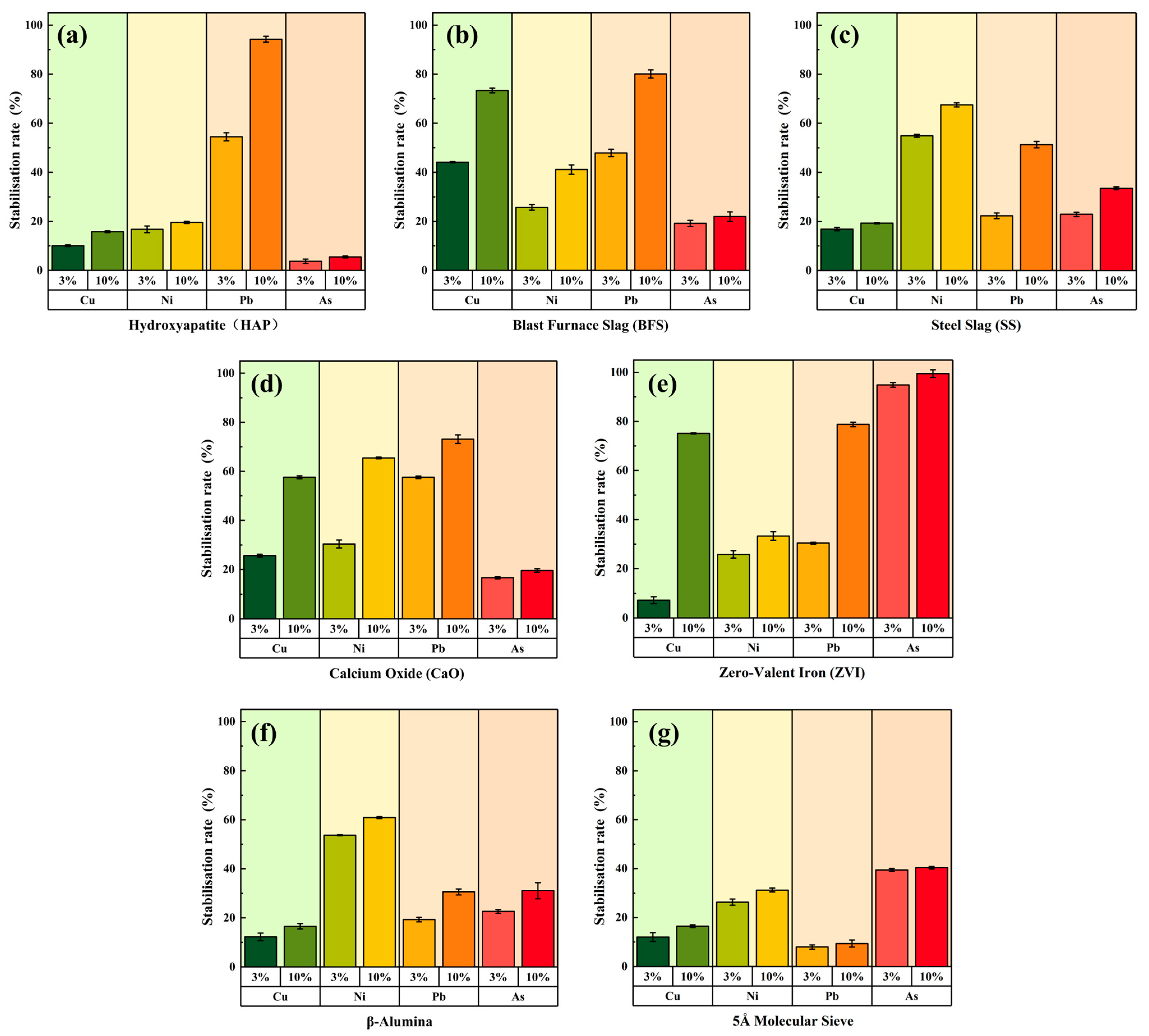
To assess heavy metal stabilization effectiveness in Cu, Ni, Pb, and As combined contamination soil, seven agent materials identified through liquid phase equilibrium experiments have been evaluated. Each material has been individually incorporated into the soil at 3% and 10% addition ratios. After a 5-day stabilization period, soil leaching concentrations have been measured and stabilization rates calculated, as shown in Figure 2. HAP has exhibited remarkable Pb stabilization, achieving rates of 54.48% at 3% addition after 5 days and 94.24% at 10% addition after 5 days. However, its stabilization efficacy for Cu, Ni, and As has remained generally low (Figure 2a). BFS has demonstrated significant Cu stabilization, with rates of 44.11% and 73.36% at 3% and 10% addition after 5 days, and also performed well for Pb, achieving 47.88% and 80.08% at the same addition ratios (Figure 2b). SS has shown excellent Ni stabilization, with rates of 54.94% and 67.51% at 3% and 10% addition after 5 days (Figure 2c). CaO has provided moderate stabilization for Cu, Ni, and Pb, with rates of 57.57%, 65.46%, and 73.12%, respectively, at 10% addition (Figure 2d). ZVI has exhibited remarkable As stabilization, achieving 94.89% at 3% addition over 5 days and 99.49% at 10% addition over 5 days (Figure 2e). Furthermore, ZVI has demonstrated effective Cu and Pb stabilization, with rates of 75.10% and 78.77% at 10% addition, respectively (Figure 2e). In contrast, β-alumina and 5 Å molecular sieve have displayed low stabilization rates for most heavy metals in the soil experiment (Figure 2f,g). These findings suggest that although HAP, β-alumina, and 5 Å molecular sieve performed effectively in previous liquid-phase equilibrium experiments, only HAP showed significant Pb stabilization under soil conditions, with limited effectiveness otherwise. Conversely, BFS and ZVI exhibited high-efficiency stabilization for specific heavy metals.
HAP’s selective stabilization effect for Pb has been confirmed by numerous studies. Wang et al. [38] have shown that HAP effectively immobilizes Pb2+ through mechanisms including ion exchange, phosphate supply, precipitation, and complexation, thereby significantly reducing soluble and exchangeable Pb2+ content in soil. Furthermore, a molecular-scale study by Guan et al. [39] has revealed that the Pb immobilization mechanism on HAP closely depends on its initial concentration. Under moderate concentration conditions, stabilization primarily occurs through hydroxyapatite precipitation. However, HAP’s stabilization capacity for other heavy metals remains relatively limited, indicating a lack of surface stabilization mechanisms for elements like Cu, Ni, and As comparable to those for Pb. However, Dong et al. [40] have achieved an 84.8% Cu stabilization rate in soil using 3% nanoscale HAP, contradicting this study’s conclusion of HAP’s poor effect on soil Cu. This is because the activity of HAP is highly dependent on the material particle size [41], although nanoscale HAP has a higher cost.
The effective stabilization of specific heavy metals using BFS and ZVI is consistent with other researchers’ findings. Reddy et al. [42] have demonstrated that ground granulated blast furnace slag (GGBS) activated with reactive magnesium oxide effectively stabilizes Cu in contaminated soil. Stabilization mechanisms primarily involve copper oxide precipitate formation and Cu solubility reduction. Similarly, Ren et al. [43] have reported that BFS-mediated stabilization of Pb-contaminated soil results in insoluble lead phosphate formation due to phosphate interactions. The major hydration products, ettringite (AFt) and calcium silicate hydrate (C-S-H) gels, play a crucial role in encapsulating Pb ions within their structures. Furthermore, ZVI’s exceptional ability to stabilize As has been well-documented in the literature. ZVI significantly enhances As5+ immobilization, facilitating exchangeable As transformation into more stable forms bound to Fe-Mn [44].
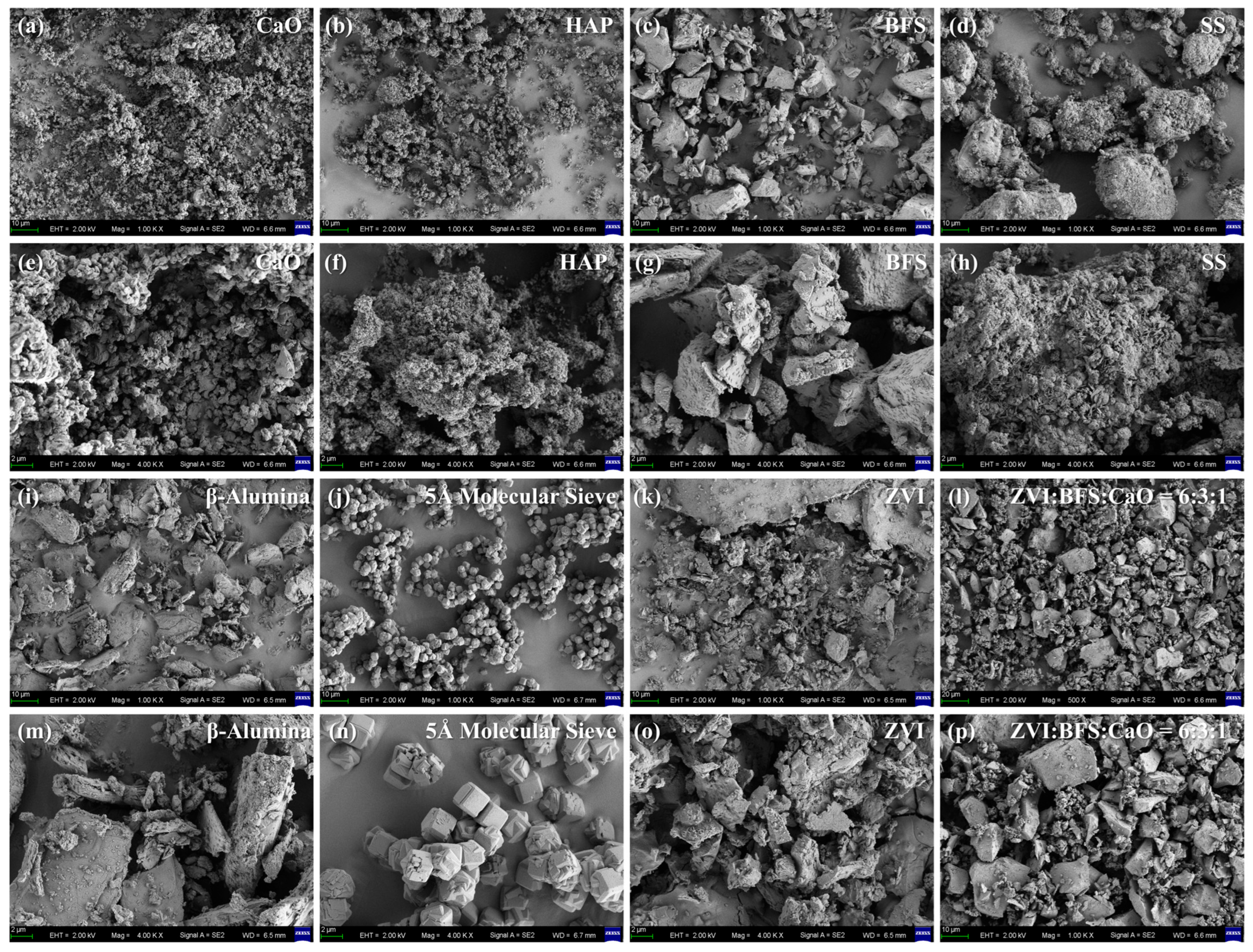
To elucidate the factors contributing to variations in heavy metal stabilization among the seven previously mentioned materials, their specific surface area, pore volume, and pore size were assessed using Brunauer–Emmett–Teller (BET) analysis, as detailed in Table 2. Additionally, SEM analysis was employed to examine the microstructures of the different materials, with the results depicted in Figure 3.
Table 2 indicates that HAP, β-Alumina, and 5 Å Molecular Sieve exhibit substantial specific surface areas (53.732, 89.494, and 91.273 m2/g, respectively) and relatively high pore volumes, indicative of strong physical adsorption capabilities. Notably, HAP demonstrates a highly abundant surface pore structure. In contrast, BFS, SS, and ZVI possess smaller specific surface areas (2.098, 3.452, and 7.108 m2/g, respectively) and lower pore volumes. Figure 3 show that BFS, SS, and ZVI are characterized by larger particle sizes and fewer surface pores (Figure 3c,h,k). The observations indicate that HAP, β-alumina, and 5 Å molecular sieve demonstrate elevated liquid-phase adsorption rates through physical adsorption, attributed to their substantial specific surface areas. Nevertheless, due to the absence of specific chemical adsorption mechanisms for Cu, Ni, Pb, and As, these materials are susceptible to releasing heavy metals under the acetic acid leaching conditions encountered in soil stabilization experiments. Conversely, materials such as BFS and ZVI, despite their relatively small specific surface areas, effectively stabilize multiple heavy metals through chemical interactions.
Therefore, materials with high specific surface areas provide more adsorption sites; however, physical adsorption often fails to achieve long-term heavy metal stabilization in complex soil matrices [1]. This may result from cation competition (e.g., Ca2+ and Mg2+) and soil organic matter vying for adsorption sites in complex soil environments, leading to decreased effectiveness of physical adsorption materials [45]. Conversely, chemical stabilization processes, such as precipitation, complexation, and ion exchange, form more stable compounds, enhancing stability under a complex soil environment. For example, Shen et al. have compared MgO-modified biomass with unmodified biochar, and the Pb removal rate from water has increased from 23% to 74% due to MgO precipitation [46]. Park et al. [47] have demonstrated that phosphate-rich biochar significantly enhances Pb2+ precipitation, achieving a 99.99% immobilization rate. In contrast, under the same conditions, conventional biochar has an immobilization rate of only 72.90%. These data confirm that physical adsorption materials lacking specific chemical interactions, including β-alumina and 5 Å molecular sieve tested in this study, underperform in complex soil environments compared to materials with special chemical effects. Furthermore, using alkaline industrial by-products like BFS facilitates the synergistic stabilization of multiple heavy metals through mechanisms including soil pH modification and silicate and calcium ion supply [48].

3.3. Stabilization of Heavy Metals in Soil by Composite Materials

3.3.1. Stabilization Performance Affected by Composite Material Type

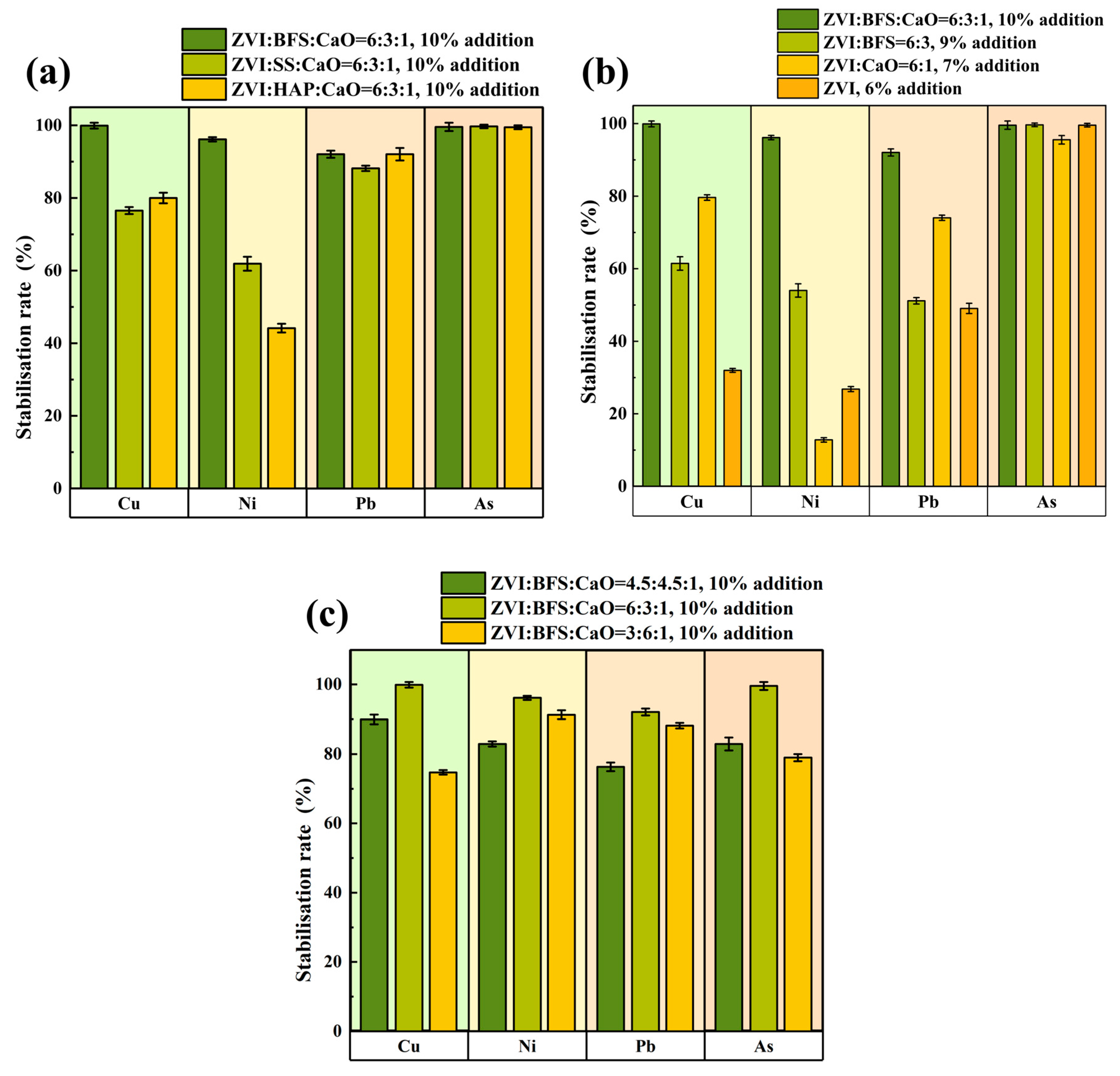
Utilizing the effective soil stabilization properties of zero-valent iron (ZVI) and the alkaline-promoting characteristics of calcium oxide (CaO), three composite stabilization agent formulations have been developed: ZVI-BFS-CaO, ZVI-SS-CaO, and ZVI-HAP-CaO. Each agent has been applied at a 10% dosage with a fixed mass ratio of 6:3:1 to evaluate its stabilization effect on Cu, Ni, Pb, and As in contaminated soil, shown in Figure 4a.
Figure 4a shows that the ZVI-BFS-CaO formulation demonstrates superior performance, achieving stabilization efficiencies of 99.92% for Cu, 96.16% for Ni, 92.06% for Pb, and 99.58% for As. The ZVI-SS-CaO formulation stabilizes As efficiently (99.70%), with lower efficiencies for Cu (76.53%), Ni (61.90%), and Pb (88.17%). In contrast, the ZVI-HAP-CaO formulation achieves 99.48% for As and 79.99% for Cu but shows high variability with 92.06% for Pb and only 44.16% for Ni.
The results indicate that the choice of auxiliary component (BFS, SS, or HAP) significantly influences the stabilization of Cu, Ni, and Pb. However, all formulations achieve high As stabilization (>99%), primarily due to the presence of ZVI. Among the auxiliary components, BFS exhibits the best synergy with ZVI and CaO, particularly for Cu and Ni stabilization. Thus, the combination of ZVI, BFS, and CaO is highly effective for simultaneously stabilizing Cu, Ni, Pb, and As in contaminated soils.

3.3.2. Stabilization Performance Affected by ZVI, BFS and CaO

To evaluate the necessity of ZVI, BFS, and CaO for heavy metal stabilization in soil, the stabilization efficiencies of Cu, Ni, Pb, and As have been assessed by sequentially removing specific components from a composite material of ZVI, BFS, and CaO at a 6:3:1 mass ratio and 10% addition (Figure 4b). When ZVI, BFS, and CaO function synergistically, the stabilization rates for Cu, Ni, and Pb exceed 90%, achieving 99.92%, 96.16%, and 92.06%, respectively. Conversely, stabilization efficiencies decrease markedly under three conditions: without CaO (ZVI:BFS = 6:3, 9% addition), without BFS (ZVI:CaO = 6:1, 7% addition), or with ZVI alone (6% addition). Importantly, the ZVI and CaO combination significantly enhances Cu and Pb stabilization rates compared to ZVI alone (6% addition).
A credible explanation for the aforementioned results involves the formation of calcium–silicate–hydrate (C-S-H) gel. The silicate–aluminate components in BFS react with CaO to produce this gel, which acts as an encapsulation matrix for heavy metals, thereby enhancing stabilization [10]. Importantly, the combination of ZVI and CaO not only improves heavy metal stabilization efficiency but also reduces ZVI agglomeration. This improvement in ZVI dispersibility and reactivity in the soil contributes to superior overall performance [1]. In summary, the synergistic interaction among ZVI, BFS, and CaO is significant in the composite stabilization system, with each component being essential for optimizing the stabilization of Cu, Ni, and Pb.

3.3.3. Stabilization Performance Affected by Components’ Proportion

Figure 4c shows the influence of ZVI-BFS-CaO component ratios on the stabilization of Cu, Ni, Pb, and As. Three specific ratios (4.5:4.5:1, 6:3:1, and 3:6:1) have been evaluated in soil stabilization experiments at a 10% additive concentration to assess their stabilization effectiveness. The stabilization effects are optimal at the 6:3:1 ratio, achieving efficiencies of 99.92% for Cu, 96.16% for Ni, 92.06% for Pb, and 99.58% for As. In contrast, the 4.5:4.5:1 and 3:6:1 ratios show lower stabilization efficiencies than the 6:3:1 ratio. Notably, Cu and As show significant variability in stabilization effects across the different ratios, indicating high sensitivity to the ZVI-BFS-CaO proportioning. Overall, the component ratio has less influence on stabilization efficacy than differences in component composition.

3.4. Potential Stabilization Mechanisms of Cu, Ni, Pb, and As

3.4.1. XRD Analysis

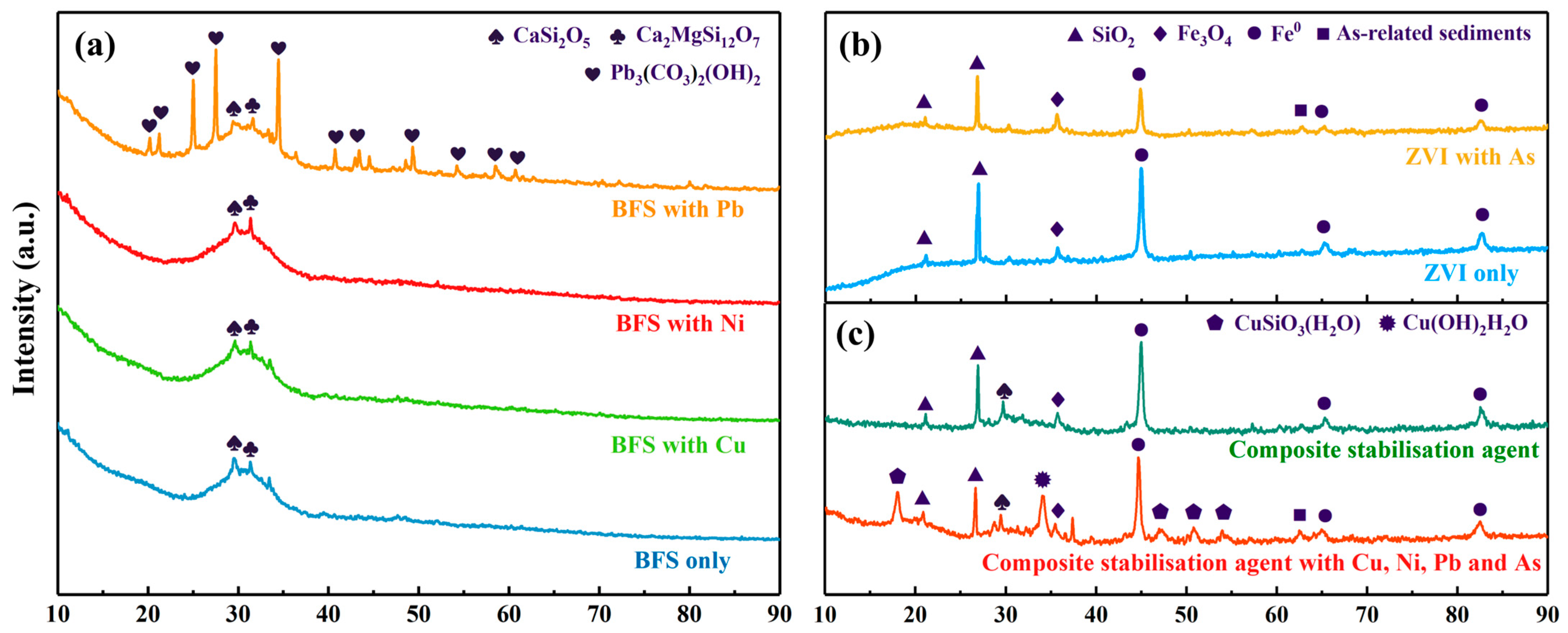
XRD analysis has been employed to examine heavy metal speciation in the stabilized materials. Figure 5a shows a broad peak between 2θ = 23° and 37°, characteristic of calcium silicate hydrate (C-S-H) [49]. Furthermore, diffraction peaks at 2θ = 29.6° and 31.4° correspond to CaSi2O5 (PDF#15-0130) and Ca2MgSi2O7 (PDF#51-0769), respectively [43]. Comparing the XRD patterns of BFS before and after Ni and Cu stabilization reveals no significant alterations, indicating that Ni and Cu are stabilized in amorphous form, lacking crystalline structures. This observation is consistent with Liu et al.’s findings, where extended X-ray absorption fine structure (EXAFS) spectroscopy confirmed Cu’s amorphous stabilization [50]. In contrast to Ni and Cu, Pb stabilization in BFS results in a new diffraction peak identified as Pb3(CO3)2(OH)2 (PDF#13-0131), indicating Pb immobilization via precipitate formation.
Figure 5b compares the XRD patterns of ZVI before and after As adsorption. In the initial ZVI XRD pattern, peaks at 2θ = 21.1° and 26.7° correspond to SiO2 (PDF#65-0466), indicating minor SiO2 impurities. Peaks at 2θ = 44.8°, 65.2°, and 82.5° indicate elemental iron (Fe0) (PDF#65-4899), while the peak at 2θ = 35.6° corresponds to Fe3O4 (PDF#65-3107). After As interaction, the peak at 2θ = 62.7° shows a marked intensity increase. This enhancement is hypothesized to result from precipitate formation on the ZVI surface due to As interaction.
Figure 5c compares the XRD patterns of the composite stabilization material (ZVI:BFS:CaO = 6:3:1) before and after exposure to Cu, Ni, Pb, and As. The results confirm the presence of characteristic peaks previously observed in the BFS system (Figure 5a) and the ZVI system (Figure 5b). After Cu contacted, the composite pattern shows two additional diffraction peaks: the peak at 2θ = 17.9° corresponds to CuSiO3(H2O) (PDF#34-0077), while weak peaks at 2θ = 47.2°, 50.6°, and 54.1° match Cu(OH)2·H2O [20]. These findings indicate that CaO in the composite system promotes C-S-H formation in BFS, facilitating Cu sequestration within silicate lattices. Additionally, CaO enhances Cu hydroxide precipitation. Together, these mechanisms make the composite more effective than BFS alone for Cu stabilization.

3.4.2. XPS Analysis

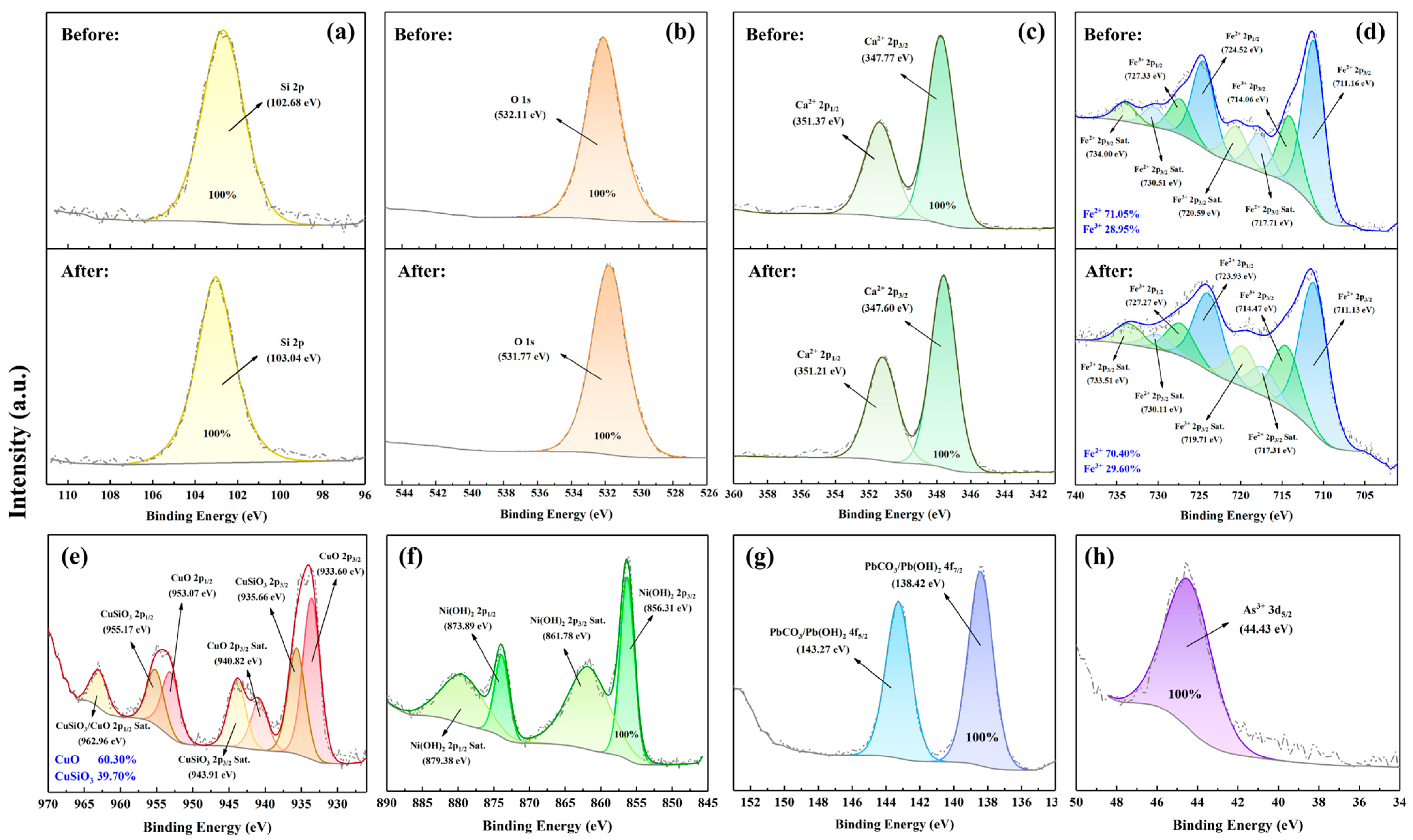
Figure 6 shows the XPS high-resolution spectra of the composite stabilization agent (ZVI:BFS:CaO = 6:3:1) before and after exposure to Cu, Ni, Pb, and As. The deconvolution results of Si2p (Figure 6a), O1s (Figure 6b), and Ca2p (Figure 6c) spectra reveal minimal changes before and after stabilization. These elements are abundant in the composite agent and not directly involved in stabilization via significant electron transfer, which explains the negligible changes. Figure 6d presents the Fe2p chemical state distribution. XPS detection is limited to the material surface, while Fe0 mainly resides in the anoxic core of ZVI particles, accounting for its absence in the spectra [51]. Before stabilization, Fe2+ (2p3/2, BE = 711.16 eV [52]) accounts for 71.05% of the Fe2p states, decreasing to 70.40% afterward. In contrast, the Fe3+ proportion (2p3/2, BE = 714.06 eV [52]) increases correspondingly. This slight change suggests electron release from the ZVI surface [53].
Moreover, Figure 6 analyzes the chemical states of Cu2p, Ni2p, Pb4f, and As3d after the composite interacts with the heavy metals. Results show that all four heavy metals are effectively stabilized and retained on the composite surface. In Figure 6e, Cu appears mainly as CuO (2p3/2, BE = 933.60 eV [54]) at 60.30% and CuSiO3 (2p3/2, BE = 935.66 eV [21]) at 39.70%. CuO is unstable and likely transforms to Cu(OH)2 under environmental exposure, consistent with XRD findings that confirm copper stabilization. Figure 6f indicates that Ni in the composite exists predominantly as Ni(OH)2 (2p3/2, BE = 856.31 eV [55]), consistent with well-established precipitation behavior of Ni2+ under alkaline conditions reported in previous studies [56], and the presence of CaO in the composite provides a favorable environment for such hydroxide formation, thereby contributing to Ni stabilization. Figure 6g shows that Pb (4f7/2, BE = 138.42 eV) is mainly present as PbCO3 [57] or Pb(OH)2 [20], aligning with the XRD results. Figure 6h indicates that arsenic is present as As3+ after adsorption, demonstrating that ZVI provides a reducing environment that prevents the oxidation of As3+ to As5+.

3.4.3. SEM-EDS Analysis

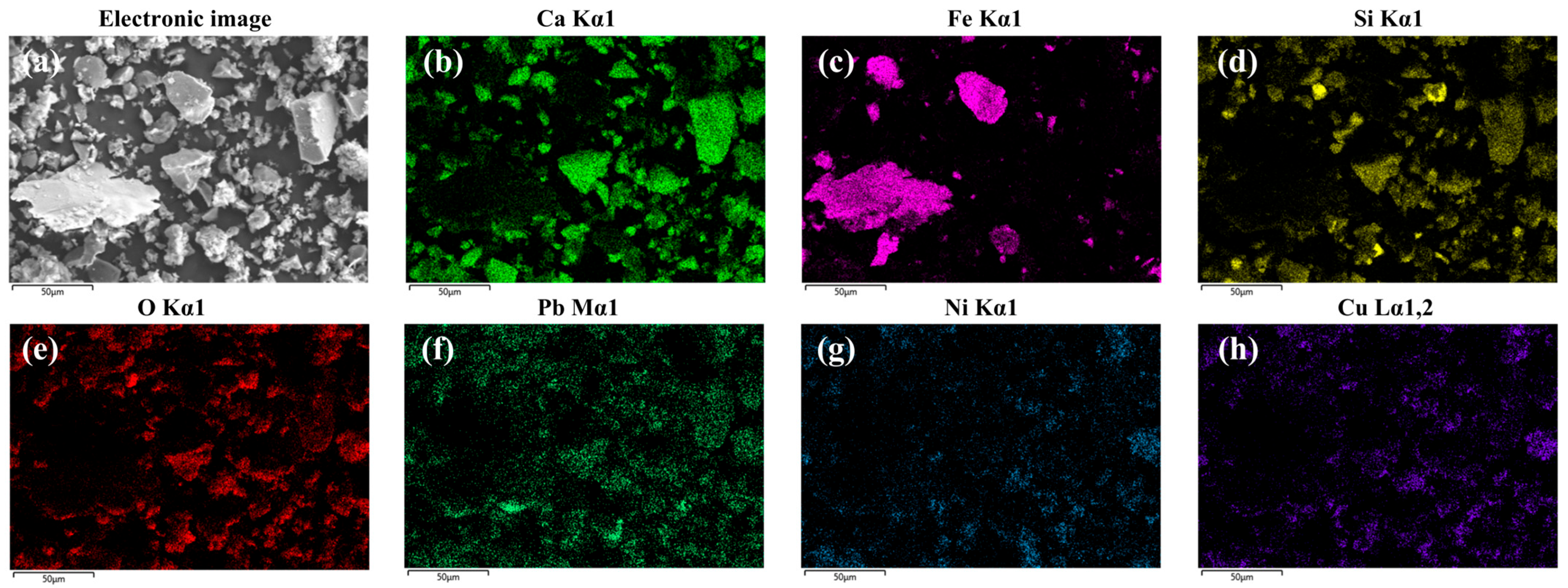
Figure 7 illustrates the results of SEM-EDS analyses conducted on the composite stabilization agent (ZVI:BFS:CaO = 6:3:1) following exposure to heavy metals. It is important to note that the distribution of As was not effectively captured due to its low detection sensitivity and interference from background noise. The figure demonstrates a strong correlation between the distributions of Ni, Cu, and Pb with those of O, Ca, and Si, suggesting that these heavy metals predominantly exist in the form of hydroxides or oxides. Furthermore, the SEM-EDS data suggest that BFS serves as the primary site for the mineralization of these three cationic heavy metals.

3.5. Long-Term Effectiveness Assessment

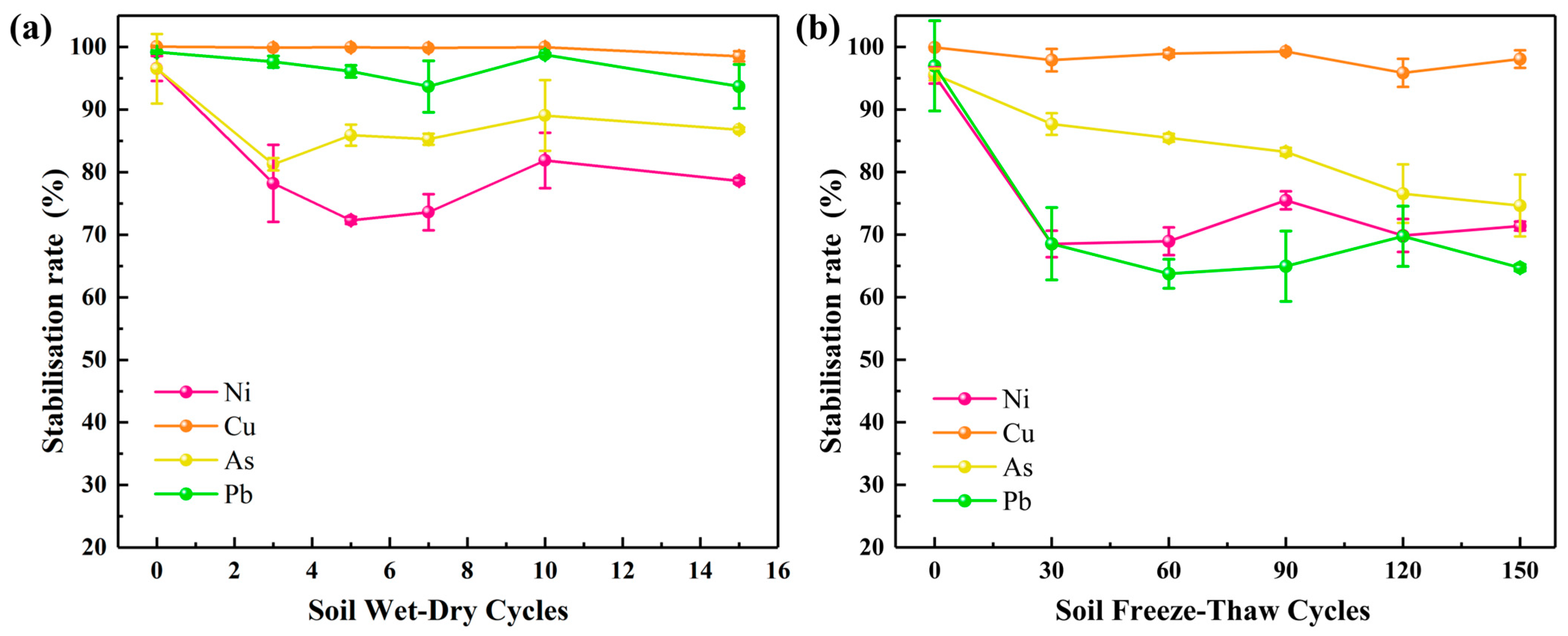
This study has evaluated the long-term effectiveness of the ZVI-BFS-CaO composite stabilization agent for immobilizing heavy metals in soil using wet–dry and freeze–thaw cycle experiments. These tests assess the stabilization performance of Ni, Cu, As, and Pb under extreme environmental cycling. As shown in Figure 8a, Cu maintains a high stabilization rate (98.53–99.92%) during wet–dry cycles, showing strong resistance, while Ni performs the least effectively. Similarly, Figure 8b indicates that Cu retains a high stabilization rate (95.87–99.92%) during freeze–thaw cycles, demonstrating the strongest resistance, whereas Pb shows the poorest performance.
The effective stabilization of Cu is attributed to its incorporation into the C-S-H lattice, which provides durable fixation, coupled with the low solubility and high chemical stability of Cu(OH)2 in typical soil environments. In contrast, Ni(OH)2 exhibits lower stability under environmental cycling due to its higher-solubility product (Ksp ≈ 5.5 × 10⁻¹⁶) compared to that of Cu(OH)2 (Ksp ≈ 2.2 × 10⁻²⁰). For Pb, dissolution of its precipitates is promoted by soil microenvironmental changes during freeze–thaw or wet–dry cycles. Concurrently, freeze–thaw-induced destruction of soil aggregates can increase Pb migration potential, likely contributing to its accumulation, as supported by previous studies [58,59].
After wet–dry cycles, the leaching concentrations of the four heavy metals are Cu 0.14 mg/L, Ni 1.36 mg/L, Pb 0.69 mg/L, and As 0.20 mg/L; after freeze–thaw cycles, the values are Cu 0.18 mg/L, Ni 1.82 mg/L, Pb 3.88 mg/L, and As 0.38 mg/L. Although these concentrations are below the limits of China’s hazardous waste standard (GB 5085.3-2007), the residual ecotoxicity, particularly from Pb and Ni, requires continued attention. Overall, after 15 wet–dry and 150 freeze–thaw cycles, all four heavy metals maintain high stabilization rates, indicating the composite’s robust performance.

3.6. Limitations and Future Prospects

This study provides valuable insights but has certain limitations. First, the research has been conducted on a single agricultural soil type. The lack of systematic investigation into key soil properties’ (e.g., carbonate content, mineralogical composition) effects on the stabilization mechanism may restrict the generalizability of results. Secondly, this study only used rapid freeze–thaw cycles to assess long-term effectiveness and did not conduct slow freeze–thaw experiments to simulate natural freeze–thaw processes under mild climates. Additionally, the study has not evaluated heavy metal distribution in different extractable fractions (e.g., exchangeable, residual) and has not dynamically tracked stabilized products’ microstructural and phase changes during wet–dry and freeze–thaw cycles, limiting a comprehensive understanding of the long-term stability intrinsic mechanisms.
Future research will address these gaps by employing in situ XRD and dynamic SEM to systematically explore stabilized products’ transformation rules at different cycle stages and their correlation with long-term stabilization performance. Simultaneously, the study scope will expand to include soils with diverse physicochemical properties, verifying the composite stabilizer’s universality. Furthermore, heavy metal fractionation analysis and synergy factor assessments will be integrated to provide more comprehensive theoretical support and technical references for such stabilization materials’ large-scale field application.

4. Conclusions

This study has systematically screened and evaluated the stabilization effects and mechanisms of various materials on soil co-contaminated with Cu, Ni, Pb, and As. The research employs liquid phase equilibrium experiments, soil stabilization tests (using single and composite materials), material characterization (BET, XRD, XPS, SEM-EDS), and long-term effectiveness assessments via wet–dry and freeze–thaw cycles. The results indicate that clay minerals and hydroxide have a limited adsorption effect on four heavy metal ions. In contrast, materials such as CaO, HAP, BFS, SS, β-alumina, 5 Å molecular sieve, and ZVI demonstrate promising liquid phase immobilization capacity. Soil stabilization tests further reveal material-specific selectivity: HAP effectively stabilizes Pb, BFS stabilizes Cu and Pb, SS stabilizes Ni, and ZVI stabilizes As. However, these single materials cannot simultaneously and efficiently stabilize the four heavy metals. Accordingly, a composite system of ZVI, BFS, and CaO has been developed. Optimization shows that a ZVI:BFS:CaO mass ratio of 6:3:1 achieves the optimal synergistic effect, with stabilization rates reaching 99.92% for Cu, 96.16% for Ni, 92.06% for Pb, and 99.58% for As, significantly outperforming individual components or other ratios. Mechanistic analysis indicates that the composite system achieves long-term heavy metal stabilization through multiple pathways. ZVI primarily facilitates As immobilization. The alkalinity of CaO activates BFS, forming calcium silicate hydrate (C-S-H) gels and other products that precipitate as CuSiO3, Ni(OH)2, and PbCO3, effectively encapsulating Cu, Ni, and Pb. After undergoing multiple rounds of wet–dry and freeze–thaw cycles, the composite stabilization agents retain their effectiveness in stabilizing the four heavy metals. This study provides an efficient, stable, and applicable material formulation with mechanistic insights for remediating multi-heavy-metal-contaminated soils, offering valuable and sustainable references for safe contaminated site remediation.

Author Contributions

Conceptualization, R.L. and N.Z.; Methodology, R.L., N.Z., Z.J. and Y.L.; Validation, N.Z., Z.J., S.W. and F.J.; Investigation, R.L., S.W. and X.C.; Resources, R.L. and Z.L.; Data curation, Z.J., X.C. and F.J.; Writing—original draft, R.L.; Writing—review and editing, N.Z., Y.L. and H.L.; Visualization, S.W. and X.C.; Supervision, Z.L. and H.L.; Project administration, Z.L. and Y.L.; Funding acquisition, F.J. and Y.L. All authors have read and agreed to the published version of the manuscript.

Funding

This study was supported by Shanghai Rising Star Nurturing Program (24YF2750900), CNPC Innovation Found (2022DQ02–0504) and CSCEC-8B Technology R&D Project (2023-4-08). It was also sponsored by the Soil Remediation Technology and Equipment of Eco-Environmental Engineering Research Center (CSCEC-PT-009).

Institutional Review Board Statement

Not applicable.

Informed Consent Statement

Not applicable.

Data Availability Statement

The original contributions presented in this study are included in the article. Further inquiries can be directed to the corresponding authors.

Acknowledgments

This study was equally supported by the Laboratory of Shanghai University and China Construction Eighth Engineering Division Corp., Ltd. Shanghai University and China Construction Eighth Engineering Division Corp., Ltd. contributed equally and should be considered as co-first affiliations.

Conflicts of Interest

Author Nan Zhao, Zhengmiao Jia, Sihan Wu, Xing Chen and Zhongyuan Li were employed by the China Construction Eighth Engineering Division Co., Ltd. The remaining authors declare that the research was conducted in the absence of any commercial or financial relationships that could be construed as a potential conflict of interest.

Abbreviations

The following abbreviations are used in this manuscript:
BJHBarrett–Joyner–Halenda
BETBrunauer–Emmett–Teller
BFSblast furnace slag
C-S-Hcalcium silicate hydrate
EDSenergy dispersive spectroscopy
EXAFSX-ray absorption fine structure
GGBSground granulated blast furnace slag
HAPhydroxyapatite
ICP-MSinductively coupled plasma mass spectrometry
S/Ssolidification/stabilization
SEMscanning electron microscopy
SSsteel slag
TCPtricalcium phosphate
XPSX-ray photoelectron spectroscopy
XRDX-ray diffraction
XRFX-ray fluorescence spectroscopy
ZVIzero-valent iron

References

  1. Cui, W.; Li, X.; Duan, W.; Xie, M.; Dong, X. Heavy metal stabilization remediation in polluted soils with stabilizing materials: A review. Environ. Geochem. Health 2023, 45, 4127–4163. [Google Scholar] [CrossRef]
  2. Montaño-López, F.; Biswas, A. Are heavy metals in urban garden soils linked to vulnerable populations? A case study from Guelph, Canada. Sci. Rep. 2021, 11, 11286. [Google Scholar] [CrossRef] [PubMed]
  3. Song, P.; Xu, D.; Yue, J.; Ma, Y.; Dong, S.; Feng, J. Recent advances in soil remediation technology for heavy metal contaminated sites: A critical review. Sci. Total Environ. 2022, 838, 156417. [Google Scholar] [CrossRef]
  4. Li, Y.; Jia, S.; Liu, J. Solidification, remediation and long-term stability of heavy metal contaminated soil under the background of sustainable development. Sci. Rep. 2022, 12, 10330. [Google Scholar] [CrossRef] [PubMed]
  5. Pasciucco, E.; Pasciucco, F.; Castagnoli, A.; Iannelli, R.; Pecorini, I. Removal of heavy metals from dredging marine sediments via electrokinetic hexagonal system: A pilot study in Italy. Heliyon 2024, 10, e27616. [Google Scholar] [CrossRef] [PubMed]
  6. Xu, D.-M.; Fu, R.-B.; Wang, J.-X.; Shi, Y.-X.; Guo, X.-P. Chemical stabilization remediation for heavy metals in contaminated soils on the latest decade: Available stabilizing materials and associated evaluation methods—A critical review. J. Clean. Prod. 2021, 321, 128730. [Google Scholar] [CrossRef]
  7. Tyagi, S.; Annachhatre, A.P. A review on recent trends in solidification and stabilization techniques for heavy metal immobilization. J. Mater. Cycles Waste Manag. 2023, 25, 733–757. [Google Scholar] [CrossRef]
  8. El-eswed, B.I. Chemical evaluation of immobilization of wastes containing Pb, Cd, Cu and Zn in alkali-activated materials: A critical review. J. Environ. Chem. Eng. 2020, 8, 104194. [Google Scholar] [CrossRef]
  9. Zhang, X.K.; Wang, H.L.; He, L.Z.; Lu, K.P.; Sarmah, A.; Li, J.W.; Bolan, N.; Pei, J.C.; Huang, H.G. Using biochar for remediation of soils contaminated with heavy metals and organic pollutants. Environ. Sci. Pollut. Res. 2013, 20, 8472–8483. [Google Scholar] [CrossRef]
  10. Zhang, M.; Yang, C.; Zhao, M.; Yang, K.; Shen, R.; Zheng, Y. Immobilization potential of Cr(VI) in sodium hydroxide activated slag pastes. J. Hazard. Mater. 2017, 321, 281–289. [Google Scholar] [CrossRef]
  11. Ajorloo, M.; Ghodrat, M.; Scott, J.; Strezov, V. Heavy metals removal/stabilization from municipal solid waste incineration fly ash: A review and recent trends. J. Mater. Cycles Waste Manag. 2022, 24, 1693–1717. [Google Scholar] [CrossRef]
  12. Meer, I.; Nazir, R. Removal techniques for heavy metals from fly ash. J. Mater. Cycles Waste Manag. 2018, 20, 703–722. [Google Scholar] [CrossRef]
  13. Zhang, S.; Shi, T.; Ni, W.; Li, K.; Gao, W.; Wang, K.; Zhang, Y. The mechanism of hydrating and solidifying green mine fill materials using circulating fluidized bed fly ash-slag-based agent. J. Hazard. Mater. 2021, 415, 125625. [Google Scholar] [CrossRef] [PubMed]
  14. Yang, L.; Wei, T.; Li, S.; Lv, Y.; Miki, T.; Yang, L.; Nagasaka, T. Immobilization persistence of Cu, Cr, Pb, Zn ions by the addition of steel slag in acidic contaminated mine soil. J. Hazard. Mater. 2021, 412, 125176. [Google Scholar] [CrossRef]
  15. Irfan, M.; Arif, A.; Munir, M.A.; Naz, M.Y.; Shukrullah, S.; Rahman, S.; Jalalah, M.; Almawgani, A.H.M. Statistically Analyzed Heavy Metal Removal Efficiency of Silica-Coated Cu0.50Mg0.50Fe2O4 Magnetic Adsorbent for Wastewater Treatment. ACS Omega 2023, 8, 47623–47634. [Google Scholar] [CrossRef]
  16. Narayanan, M.; Ma, Y. Influences of Biochar on Bioremediation/Phytoremediation Potential of Metal-Contaminated Soils. Front. Microbiol. 2022, 13, 929730. [Google Scholar] [CrossRef]
  17. Demirela, G.; Terzi, M.H.; Durgun, M.B. Heavy metal enrichments in rural environment soils, pollution dynamics, source identification, and the role of subsurface mineralizations. Sci. Rep. 2025, 15, 35858. [Google Scholar] [CrossRef]
  18. Tye, A.M.; Young, S.; Crout, N.M.J.; Zhang, H.; Preston, S.; Zhao, F.J.; McGrath, S.P. Speciation and solubility of Cu, Ni and Pb in contaminated soils. Eur. J. Soil Sci. 2004, 55, 579–590. [Google Scholar] [CrossRef]
  19. Wang, Y.; Jing, J.; Li, Y.Y.; Zhang, Y.X.; Liu, Y.Z. Bioavailability and Speciation of Potentially Toxic Trace Metals in Limestone-Derived Soils in a Karst Region, Southwestern China. Water Air Soil Pollut. 2025, 236, 169. [Google Scholar] [CrossRef]
  20. Sun, Q.; Yang, H.; Zhao, T. Multistage stabilization of Cd, Pb, Zn, Cu and As in contaminated soil by phosphorus-coated nZVI layered composite materials: Characteristics, process and mechanism. J. Hazard. Mater. 2024, 476, 134991. [Google Scholar] [CrossRef]
  21. Zhang, W.; Fu, K.; Chen, S.; Zhou, Q.; Zhu, L.; Yao, J. Stabilization of Copper, Lead, and Zinc in Copper Smelting Slag Tailings by Sulfate-reducing Bacteria Using Typical Industrial By-product Gypsum as a Sulfur Source. Water Air Soil Pollut. 2025, 236, 445. [Google Scholar] [CrossRef]
  22. NY/T 1377-2007; Determination of pH in Soil. Ministry of Agriculture: Beijing, China, 2007.
  23. Ciesielski, H.; Sterckeman, T. A comparison between three methods for the determination of cation exchange capacity and exchangeable cations in soils. Agronomie 1997, 17, 9–16. [Google Scholar] [CrossRef]
  24. Basta, N.T.; Ryan, J.A.; Chaney, R.L. Trace element chemistry in residual-treated soil: Key concepts and metal bioavailability. J. Environ. Qual. 2005, 34, 49–63. [Google Scholar] [CrossRef] [PubMed]
  25. Wu, Y.; Li, X.; Yu, L.; Wang, T.; Wang, J.; Liu, T. Review of soil heavy metal pollution in China: Spatial distribution, primary sources, and remediation alternatives. Resour. Conserv. Recycl. 2022, 181, 106261. [Google Scholar] [CrossRef]
  26. Sun, Y.; Xie, Z.; Li, J.; Xu, J.; Chen, Z.; Naidu, R. Assessment of toxicity of heavy metal contaminated soils by the toxicity characteristic leaching procedure. Environ. Geochem. Health 2006, 28, 73–78. [Google Scholar] [CrossRef]
  27. Zhao, Z.; Huang, X.; Wang, L. Stabilization Effect of Combined Stabilizing Agent on Heavy Metals in Hazardous Waste Incineration Fly Ash and Effect on Solidification Volume. Sustainability 2025, 17, 9926. [Google Scholar] [CrossRef]
  28. Jaffar, F.H.; Othman, M.H.D.; Ismail, N.J.; Puteh, M.H.; Kurniawan, T.A.; Abu Bakar, S.; Abdullah, H. Hydroxyapatite-based materials for adsorption, and adsorptive membrane process for heavy metal removal from wastewater: Recent progress, bottleneck and opportunities. J. Taiwan Inst. Chem. Eng. 2024, 164, 105668. [Google Scholar] [CrossRef]
  29. Wang, P.; Shen, X.; Qiu, S.; Zhang, L.; Ma, Y.; Liang, J. Clay-Based Materials for Heavy Metals Adsorption: Mechanisms, Advancements, and Future Prospects in Environmental Remediation. Crystals 2024, 14, 1046. [Google Scholar] [CrossRef]
  30. Uddin, M.K. A review on the adsorption of heavy metals by clay minerals, with special focus on the past decade. Chem. Eng. J. 2017, 308, 438–462. [Google Scholar] [CrossRef]
  31. Eleraky, M.I.; Razek, T.M.A.; Hasani, I.W.; Fahim, Y.A. Adsorptive removal of lead, copper, and nickel using natural and activated Egyptian calcium bentonite clay. Sci. Rep. 2025, 15, 13050. [Google Scholar] [CrossRef]
  32. Yang, X.; Zhou, Y.; Hu, J.; Zheng, Q.; Zhao, Y.; Lv, G.; Liao, L. Clay minerals and clay-based materials for heavy metals pollution control. Sci. Total Environ. 2024, 954, 176193. [Google Scholar] [CrossRef] [PubMed]
  33. Skoczko, I.; Szatyłowicz, E. Removal of heavy metal ions by filtration on activated alumina-assisted magnetic field. Desalination Water Treat. 2018, 117, 345–352. [Google Scholar] [CrossRef]
  34. Tian, Y.; Qu, G.; Xu, R.; Liu, X.; Jin, C. Iron-based materials for immobilization of heavy metals in contaminated soils: A critical review. J. Environ. Chem. Eng. 2024, 12, 113741. [Google Scholar] [CrossRef]
  35. Abdelbasir, S.M.; Khalek, M.A.A. From waste to waste: Iron blast furnace slag for heavy metal ions removal from aqueous system. Environ. Sci. Pollut. Res. 2022, 29, 57964–57979. [Google Scholar] [CrossRef] [PubMed]
  36. Cui, W.L.; Tang, K.; Chen, Y.Q.; Chen, Z.; Lan, Y.H.; Hong, Y.B.; Lan, W.G. Regulating the particle sizes of NaA molecular sieves toward enhanced heavy metal ion adsorption. New J. Chem. 2024, 48, 7863–7874. [Google Scholar] [CrossRef]
  37. Vilardi, G.; Mpouras, T.; Dermatas, D.; Verdone, N.; Polydera, A.; Di Palma, L. Nanomaterials application for heavy metals recovery from polluted water: The combination of nano zero-valent iron and carbon nanotubes. Competitive adsorption non-linear modeling. Chemosphere 2018, 201, 716–729. [Google Scholar] [CrossRef]
  38. Wang, Y.; Li, R.; Liu, W.; Cheng, L.; Jiang, Q.; Zhang, Y. Exploratory of immobilization remediation of hydroxyapatite (HAP) on lead-contaminated soils. Environ. Sci. Pollut. Res. 2019, 26, 26674–26684. [Google Scholar] [CrossRef]
  39. Guan, D.-X.; Ren, C.; Wang, J.; Zhu, Y.; Zhu, Z.; Li, W. Characterization of Lead Uptake by Nano-Sized Hydroxyapatite: A Molecular Scale Perspective. ACS Earth Space Chem. 2018, 2, 599–607. [Google Scholar] [CrossRef]
  40. Dong, A.; Ye, X.; Li, H.; Zhang, Y.; Wang, G. Micro/nanostructured hydroxyapatite structurally enhances the immobilization for Cu and Cd in contaminated soil. J. Soils Sediments 2016, 16, 2030–2040. [Google Scholar] [CrossRef]
  41. Wang, T.; Cao, W.; Dong, K.; Li, H.; Wang, D.; Xu, Y. Hydroxyapatite and its composite in heavy metal decontamination: Adsorption mechanisms, challenges, and future perspective. Chemosphere 2024, 352, 141367. [Google Scholar] [CrossRef]
  42. Reddy, A.S.; Chavali, R.V.P. Solidification/stabilization of copper-contaminated soil using magnesia-activated blast furnace slag. Innov. Infrastruct. Solut. 2023, 8, 79. [Google Scholar] [CrossRef]
  43. Ren, Z.; Wang, L.; Wang, H.; Liu, S.; Liu, M. Solidification/stabilization of lead-contaminated soils by phosphogypsum slag-based cementitious materials. Sci. Total Environ. 2023, 857, 159552. [Google Scholar] [CrossRef] [PubMed]
  44. Qiao, J.; Liu, Y.; Yang, H.; Guan, X.; Sun, Y. Remediation of arsenic contaminated soil by sulfidated zero-valent iron. Front. Environ. Sci. Eng. 2020, 15, 83. [Google Scholar] [CrossRef]
  45. Bolan, N.; Kunhikrishnan, A.; Thangarajan, R.; Kumpiene, J.; Park, J.; Makino, T.; Kirkham, M.B.; Scheckel, K. Remediation of heavy metal(loid)s contaminated soils—To mobilize or to immobilize? J. Hazard. Mater. 2014, 266, 141–166. [Google Scholar] [CrossRef] [PubMed]
  46. Shen, Z.; Zhang, J.; Hou, D.; Tsang, D.C.W.; Ok, Y.S.; Alessi, D.S. Synthesis of MgO-coated corncob biochar and its application in lead stabilization in a soil washing residue. Environ. Int. 2019, 122, 357–362. [Google Scholar] [CrossRef]
  47. Park, J.H.; Choppala, G.K.; Bolan, N.S.; Chung, J.W.; Chuasavathi, T. Biochar reduces the bioavailability and phytotoxicity of heavy metals. Plant Soil 2011, 348, 439–451. [Google Scholar] [CrossRef]
  48. Jiang, Q.; He, Y.; Wu, Y.; Dian, B.; Zhang, J.; Li, T.; Jiang, M. Solidification/stabilization of soil heavy metals by alkaline industrial wastes: A critical review. Environ. Pollut. 2022, 312, 120094. [Google Scholar] [CrossRef]
  49. Feng, Y.-S.; Du, Y.-J.; Zhou, A.; Zhang, M.; Li, J.-S.; Zhou, S.-J.; Xia, W.-Y. Geoenvironmental properties of industrially contaminated site soil solidified/stabilized with a sustainable by-product-based binder. Sci. Total Environ. 2021, 765, 142778. [Google Scholar] [CrossRef]
  50. Liu, Q.; Feng, P.; Shao, L.; Chen, C.; Liu, X.; Ma, Y.; Zhang, L.; Geng, G. Quantifying the immobilization mechanisms of heavy metals by Calcium Silicate Hydrate (C-S-H): The case of Cu2+. Cem. Concr. Res. 2024, 186, 107695. [Google Scholar] [CrossRef]
  51. Tan, Y.; Zhao, N.; Song, Q.; Ling, H. Alkali synergistic sulfide-modified nZVI activation of persulfate for phenanthrene removal. J. Environ. Chem. Eng. 2023, 11, 109923. [Google Scholar] [CrossRef]
  52. Cheng, S.; Liu, H.; Anang, E.; Li, C.; Fan, X. Enhanced As(III) sequestration using nanoscale zero-valent iron modified by combination of loading and sulfidation: Characterizations, performance, kinetics and mechanism. Water Sci. Technol. 2021, 83, 2886–2900. [Google Scholar] [CrossRef] [PubMed]
  53. Tarekegn, M.M.; Hiruy, A.M.; Dekebo, A.H. Nano zero valent iron (nZVI) particles for the removal of heavy metals (Cd2+, Cu2+ and Pb2+) from aqueous solutions. RSC Adv. 2021, 11, 18539–18551. [Google Scholar] [CrossRef]
  54. Biesinger, M.C. Advanced analysis of copper X-ray photoelectron spectra. Surf. Interface Anal. 2017, 49, 1325–1334. [Google Scholar] [CrossRef]
  55. Xiang, Y.; Lan, J.; Dong, Y.; Zhou, M.; Hou, H.; Huang, B.-T. Pollution control performance of solidified nickel-cobalt tailings on site: Bioavailability of heavy metals and microbial response. J. Hazard. Mater. 2024, 471, 134295. [Google Scholar] [CrossRef]
  56. Peltier, E.; Lelie, D.v.d.; Sparks, D.L. Formation and Stability of Ni–Al Hydroxide Phases in Soils. Environ. Sci. Technol. 2010, 44, 302–308. [Google Scholar] [CrossRef]
  57. Xing, Y.; Wang, B. Chemical speciation, distribution, and leaching behaviors of heavy metals in alkali-activated converter steel slag-based stabilization/solidification of MSWI FA. Constr. Build. Mater. 2024, 417, 135209. [Google Scholar] [CrossRef]
  58. Zhongping, Y.; Yao, W.; Xuyong, L.; Shupei, R.; Hui, X.; Jiazhuo, C. The effect of long-term freeze-thaw cycles on the stabilization of lead in compound solidified/stabilized lead-contaminated soil. Environ. Sci. Pollut. Res. 2021, 28, 37413–37423. [Google Scholar] [CrossRef]
  59. Yang, Z.; Zhang, K.; Li, X.; Ren, S.; Li, P. The effects of long-term freezing–thawing on the strength properties and the chemical stability of compound solidified/stabilized lead-contaminated soil. Environ. Sci. Pollut. Res. 2023, 30, 38185–38201. [Google Scholar] [CrossRef] [PubMed]
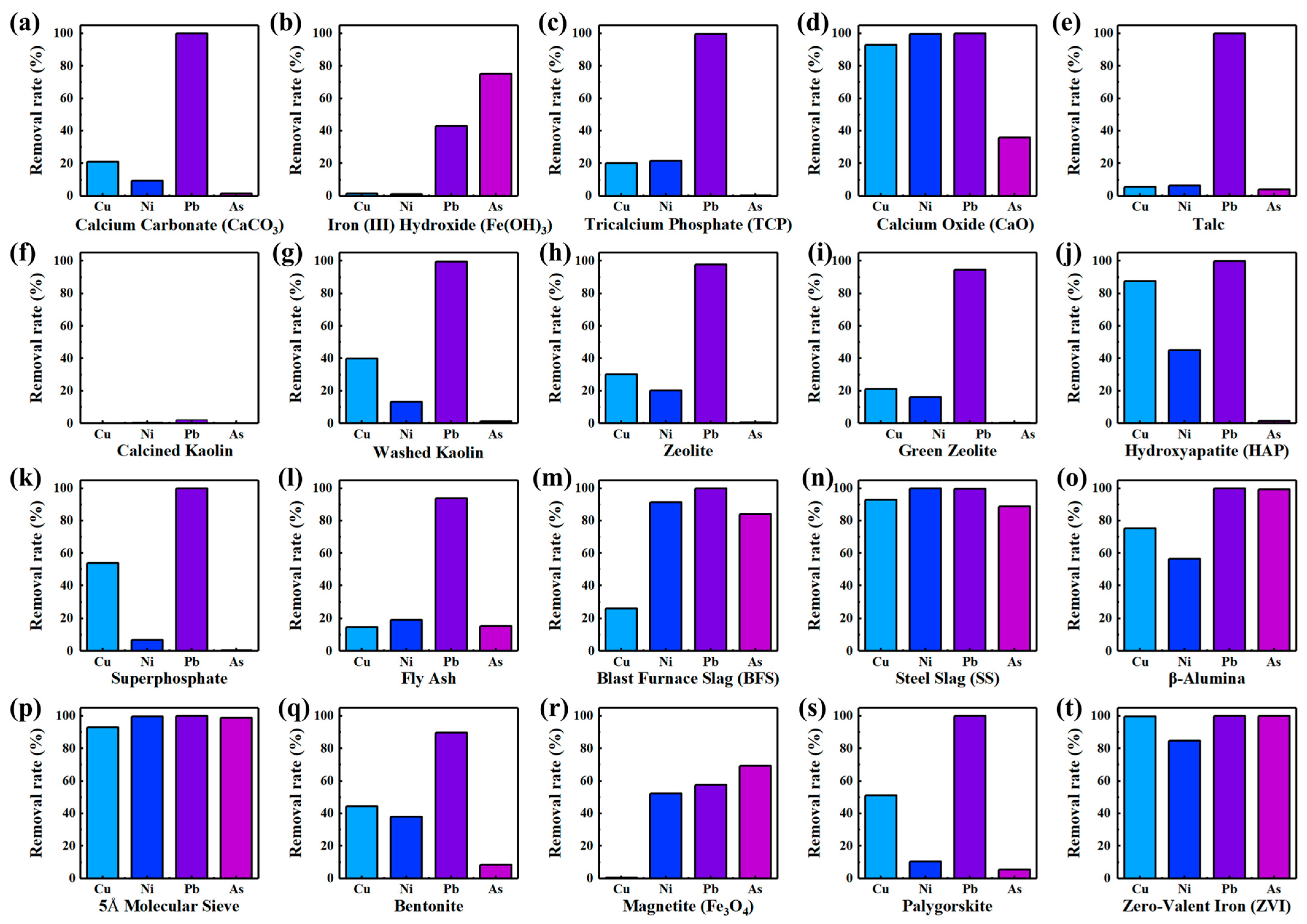
Figure 1. Liquid phase immobilization effects of different stabilization materials on Cu, Ni, Pb, and As: (a) Calcium carbonate (CaCO3), (b) Iron (III) hydroxide (Fe(OH)3), (c) Tricalcium phosphate (TCP), (d) Calcium oxide (CaO), (e) Talc, (f) Calcined kaolin, (g) Washed kaolin, (h) Zeolite, (i) Green zeolite, (j) Hydroxyapatite (HAP), (k) Superphosphate, (l) Fly ash, (m) Blast furnace slag (BFS), (n) Steel slag (SS), (o) β-alumina, (p) 5 Å molecular sieve, (q) Bentonite, (r) Magnetite (Fe3O4), (s) Palygorskite and (t) Zero-Valent Iron (ZVI).
Sustainability 18 00342 g001
Figure 2. Effect of a single stabilization material on soil heavy metal stabilization: (a) HAP, (b) BFS, (c) SS, (d) CaO, (e) ZVI, (f) β-alumina, and (g) 5 Å molecular sieve.
Sustainability 18 00342 g002
Figure 3. SEM Images of Different Stabilization Materials at Various Magnifications: (a) CaO 1.0KX, (b) HAP 1.0KX, (c) BFS 1.0KX, (d) SS 1.0KX, (e) CaO 4.0KX, (f) HAP 4.0KX, (g) BFS 4.0KX, (h) SS 4.0KX, (i) β-alumina 1.0KX, (j) 5 Å molecular sieve 1.0KX, (k) ZVI 1.0KX, (l) ZVI:BFS:CaO = 6:3:1 500X, (m) β-alumina 4.0KX, (n) 5 Å molecular sieve 4.0KX, (o) ZVI 4.0KX and (p) ZVI:BFS:CaO = 6:3:1 1.0KX.
Sustainability 18 00342 g003
Figure 4. Stabilization performance of composite materials affected by: (a) composite material type; (b) ZVI, BFS and CaO presence; and (c) components proportion.
Sustainability 18 00342 g004
Figure 5. X-ray diffraction (XRD) patterns of (a) BFS before and after contact with Cu, Ni, and Pb; (b) ZVI before and after contact with As; (c) composite stabilization agent before and after contact with Cu, Ni, Pb, and As.
Sustainability 18 00342 g005
Figure 6. XPS spectra of the composite stabilization agent (ZVI:BFS:CaO = 6:3:1) for: (a) Si2p, (b) O1s, (c) Ca2p, (d) Fe2p, (e) Cu2p, (f) Ni2p, (g) Pb4f, and (h) As3d. The dashed-dotted line represents the measured values, while the solid line represents the fitted values.
Sustainability 18 00342 g006
Figure 7. SEM-EDS elemental scanning-derived mapping images of the composite stabilization agent (ZVI:BFS:CaO = 6:3:1): (a) Electronic image, (b) Ca Kα1, (c) Fe Kα1, (d) Si Kα1, (e) O Kα1, (f) Pb Mα1, (g) Ni Kα1, and (h) Cu Lα1,2.
Sustainability 18 00342 g007
Figure 8. Long-term effectiveness of the composite stabilization agent (ZVI:BFS:CaO = 6:3:1): (a) Soil wet–dry cycles and (b) Soil freeze–thaw cycles.
Sustainability 18 00342 g008
Table 1. The element and oxidation component compositions of ZVI, BFS and SS.
Element/%NaMgAlSiSKCaFeMnTiPCrOthers
ZVI0.750.350.811.940.230.021.4592.391.400.050.090.130.39
BFS0.577.5113.5924.301.670.5048.960.490.651.520.01ND0.23
SS0.285.624.018.350.590.2540.8831.235.761.340.610.310.77
Oxidation/%Na2OMgOAl2O3SiO2SO3K2OCaOFe2O3MnOTiO2P2O5Cr2O3Others
ZVI0.80 0.46 1.20 3.23 0.44 0.02 1.53 90.36 1.27 0.06 0.15 0.110.36
BFS0.55 8.86 17.47 33.15 2.43 0.33 35.31 0.30 0.36 1.10 0.01 ND0.13
SS0.29 7.13 5.71 13.27 1.06 0.21 38.28 26.26 4.42 1.37 1.02 0.28 0.69
Table 2. Surface structural parameters of heavy metal stabilization materials.
Stabilization MaterialsSpecific Surface Area (m2/g)Pore Volume(cm3/g)Pore Size (nm)
HAP53.7320.24217.980
BFS2.0980.0047.652
SS3.4520.01618.280
CaO4.0600.02322.998
β-Alumina89.4940.1165.172
ZVI7.1080.0095.135
5 Å Molecular Sieve91.2730.0642.804
Disclaimer/Publisher’s Note: The statements, opinions and data contained in all publications are solely those of the individual author(s) and contributor(s) and not of MDPI and/or the editor(s). MDPI and/or the editor(s) disclaim responsibility for any injury to people or property resulting from any ideas, methods, instructions or products referred to in the content.