Article

How Can Digital–Real Integration Affect High-Quality Development of the Regional Economy? Evidence from China

College of Economics and Management, Xinjiang Agricultural University, Urumqi 830025, China
*
Author to whom correspondence should be addressed.
Sustainability 2026, 18(1), 340; https://doi.org/10.3390/su18010340 (registering DOI)
Submission received: 29 October 2025 / Revised: 22 November 2025 / Accepted: 23 December 2025 / Published: 29 December 2025
(This article belongs to the Section Economic and Business Aspects of Sustainability)

Abstract

As the digital economy increasingly integrates with the real economy, the goal of high-quality economic development in China has become increasingly clear. Promoting high-quality regional economic development through the integration of the digital and real economies holds significant practical importance for achieving Chinese modernization. This study selects panel data from 2013 to 2023 for 31 provinces, autonomous regions, and municipalities directly under the central government in China. It employs the entropy method to measure the development levels of both the digital and real economies in each province. It uses a coupling coordination degree model to gauge their level of integration. By constructing bidirectional fixed-effects models, mediating effect models, and spatial econometric models, this study explores the impact of Digital–real Integration (DRI) on regional High-Quality Development (HQD). The findings reveal that DRI promotes high-quality regional economic development, with a 1% increase in DRI leading to a 4.810% increase in high-quality regional economic development. Meanwhile, this effect exhibits significant regional disparities. During this process, industrial structure upgrading and scientific and technological innovation serve as mediating factors, with coefficients of 1.249 and 10.562, respectively, for every 1% increase in DRI. Moreover, DRI exhibits significant spatial spillover effects, benefiting neighboring regions. Based on these findings, the paper proposes targeted recommendations, including strengthening digital infrastructure to lay a solid foundation for integrated development, implementing an innovation-driven strategy to master core technologies, optimizing production factor allocation to amplify DRI’s driving force, breaking regional economic barriers, and adopting dynamic, differentiated development strategies tailored to local conditions. These measures aim to fully harness DRI’s potential in advancing high-quality regional economic growth, offering empirical insights for coordinated regional development.

1. Introduction

The primary paradox in Chinese society has consistently changed due to the country’s rapid economic expansion. This conflict has evolved into one between the people’s growing desire for a better life and uneven, insufficient progress, according to the Communist Party of China’s report to the 19th National Congress [1]. This suggests that the old economic model, which depended on quick and extensive growth, is no longer able to adequately satisfy the demands of the modern world. In this regard, the nation has established excellent economic development as a crucial prerequisite for attaining long-term social advancement. High-quality development is crucial for Chinese-style modernization, although problems of uneven and inadequate development continue to be important, according to the report to the 20th National Congress [2]. As a result, resolving these issues has emerged as a key priority for advancing China’s high-quality economic growth.
In the meantime, a fresh wave of industrial upheaval and technological revolution is taking place. Through technical innovation and industrial synergy, the digital economy—powered by the internet, big data, cloud computing, and artificial intelligence—is integrating across the value chain and deeply infiltrating a number of sectors. According to the China Digital Economy Development Research Report (2024), China’s digital economy grew by 3.8 times between 2012 and 2023, reaching 53.9 trillion yuan, or 42.8% of GDP. Digital technologies have made use of special benefits that set them apart from traditional economies, including integration effects, network effects, and spillover effects, which offer strong support for social resource allocation and adjustment [3]. Its primary objective is to create new industrial ecosystems by optimizing the use of digital resources, generating internal motivation for high-quality, regionally focused development, and offering long-term solutions to lessen regional inequities. It is obvious that coordinated regional growth must be prioritized in order to advance high-quality economic development in China, with high-quality regional development being a critical breakthrough in addressing uneven and insufficient progress. General Secretary Xi Jinping specifically urged “accelerating the development of the digital economy, promoting its deep integration with the real economy, and building internationally competitive digital industry clusters” in his report to the 20th National Congress [4]. Against this backdrop, the deep integration of the digital economy and the real economy serves as both a critical pathway for altering economic growth paradigms and a strategic fulcrum for attaining high-quality regional economic development [5,6]. Amid unprecedented changes in a century, how to leverage the integration of digital and real economies to boost regional economic momentum has become a focus for both academia and government.
The establishment of a modern industrial system is based on the high-quality development of the real economy, which serves as the cornerstone for constructing a comprehensive socialist modernized nation. In the meantime, the digital economy’s strategic significance within China’s economic growth landscape has come to light more and more as a major force behind economic upgrading and transformation in the new era. High-quality economic development is thought to be made possible by the digital economy. It enables economies of scale and scope at the micro level by lowering production and transaction costs for businesses [7]. Through innovation, diffusion, and application, digital technologies propel the growth of digital industrialization and industrial digitization at the micro level, creating new business models and forms. By increasing total factor productivity, deepening capital, and boosting allocation efficiency, the digital economy supports high-quality economic development at the macro level [8]. A “new real economy” is created, and a dynamic development model characterized by bidirectional penetration and synergistic coexistence between the digital and real economies is fostered by the integration of the two economies through digital technologies, which enables the real economy to expand its industrial forms and value chains [9]. Three key areas are the focus of current academic study on the integration of the digital and real economies: formation mechanisms, assessment systems, and driving factors. In terms of formation mechanisms, the integration relies on the deep penetration of data elements to initiate a systematic reconfiguration of corporate organizations, production factors, product forms, industrial ecosystems, and market structures. This creates a cyclical system of deep coupling between the real and digital economies [10,11]. Second, research primarily uses coupling coordination models and complete indicator systems as evaluation methods to gauge integration [12,13]. Third, in terms of driving forces, empirical research indicates that the deep connection of digital and real economies is being accelerated by precise government policy implementation, the deepening of marketization processes, and upgrades to digital infrastructure [14,15,16,17].
The research paradigm in Chinese economics is changing fundamentally, moving from early incremental analysis that concentrated on economic scale expansion to quality-oriented research that is focused on structural optimization, efficiency improvement, and dynamic conversion. The academic community focuses on the following areas while researching high-quality economic development: First, influencing factors. In terms of factor inputs, human capital, land factors, and infrastructure investment all contribute to supporting high-quality economic development [18,19]. Both institutional and technological innovation are equally important for innovation-driven development [20,21]. However, some research suggests that high-quality economic development is also greatly impacted by the interplay of several factors [22]. Connotations and evaluation systems come in second. The academic community typically used single representative indicators, like total factor productivity and green total factor productivity, as fundamental metrics for assessing the caliber of economic development in the early phases of the research paradigm shift [23,24]. The shortcomings of conventional analytical frameworks have gradually come to light as China’s economy continues to change. The focus of scholars has switched to developing quantifiable evaluation frameworks that incorporate several viewpoints, including industrial restructuring, shifts in social welfare, and environmental sustainability, and are based on the real conditions of economic operation [25]. Nowadays, a lot of research incorporates and methodically takes into account several aspects, such as the environment, society, and economy, within the fundamental framework of the Five New Development Concepts [26,27]. The third is measurement. The Yellow River Basin, the Beijing-Tianjin-Hebei region, and three major economic zones are among the areas where the academic community regularly does quantitative evaluations of high-quality regional economic development [28,29,30].
The digital economy’s inherent link to superior economic development has drawn more attention in recent years due to its ongoing expansion. By lowering production and transaction costs for businesses, encouraging capital accumulation, improving factor allocation efficiency, and increasing total factor productivity, empirical research shows that the digital economy can successfully propel high-quality economic development [31,32]. The profound integration of the real economy and the digital economy continues to play a crucial enabling role and offers substantial potential for fostering high-quality regional economic development.
Based on a comprehensive review of existing literature, the academic community has extensively discussed the influencing factors, connotations, and measurement of high-quality economic development, as well as research on the digital economy and digital–real integration. However, exploration of the relationship between digital–real integration and regional high-quality economic development remains insufficient, particularly lacking a systematic analysis of its intrinsic pathways. Based on this, the sample used in this study is panel data from 31 provinces between 2013 and 2023. It measures the degree of development of the real economy and the digital economy using the entropy method. It evaluates the level of integration between them using a coupling coordination model. The study explores the connection between high-quality regional economic development and digital–real integration by building a two-way fixed effects model, a mediation effect model, and a spatial econometric model.
Using China’s 31 provinces as case studies against the backdrop of deep integration between the digital and real economies, this study advances the subject by methodically examining paths for digital–real integration to support high-quality regional economic development. It offers useful policy references and broadens the theoretical scope of study on digital–real integration. Theoretically: 1. It examines superior regional economic growth from the standpoint of digital–real integration using a coupling coordination model. 2. Using theoretical analysis and empirical testing, it investigates the mechanisms via which digital–real integration promotes high-quality regional economic development by introducing variables including industry structure upgrading and technological innovation. 3. It investigates the geographical spillover effects of digital–real integration on superior regional economic development using spatial econometric models. Practically speaking, it can direct distinct regional digital infrastructure layouts at the industrial policy level and help build cooperative innovation mechanisms between business, academia, and research across regions at the innovation policy level. A favorable regional institutional environment can be created by the coordinated application of these policies, which will support deep digital and real integration throughout time and promote superior regional economic development.
This paper is organized as follows: In Section 2, a theoretical framework for examining the direct, indirect, and spatial spillover impacts of digital–real integration on regional high-quality economic development is developed, along with research hypotheses. The measuring techniques, data sources, and model specifications for regional high-quality economic development (HQD) and digital–real integration (DRI) are covered in Section 3. The DRI measurement results analysis, benchmark regression results on DRI’s effect on HQD, robustness tests, endogeneity tests, heterogeneity analysis, mechanism analysis, and spatial spillover effects are all presented in Section 4. The results are discussed in Section 5, and the main conclusions, policy recommendations, limits, and future research prospects are summarized in Section 6.

2. Theoretical Analysis and Hypothesis Formulation

2.1. Theoretical Basis

2.1.1. Spillover Effect Theory

One positive externality that propels the development and concentration of human capital is the spillover effects. These impacts, which mostly flow into high-productivity businesses and sectors, speed up industrial upgrading and restructuring, allowing for superior economic development. In relation to knowledge spillovers. According to new economic geography, knowledge spillovers have a significant impact on how innovation is distributed geographically. Romer put forth an endogenous growth model of knowledge spillovers, contending that as knowledge is a non-rival public good, its creation produces positive externalities that increase returns to scale. Through the “learning-by-doing” effect, Lucas used the “human capital spillover model” to show how the accumulation of human capital not only increases individual productivity but also fosters general economic growth. The spatial logic of knowledge spillovers under endogenous growth theory is currently changing due to the spread of digital technology. By significantly lowering information transmission costs—from thousands of yuan for in-person travel to almost zero marginal costs for online meetings—real-time collaboration technologies like Tencent Meeting facilitate cross-regional knowledge transfer. Additionally, online learning platforms change knowledge spillovers from “intra-industry diffusion” to “cross-domain integration” by facilitating cross-industry knowledge matching through algorithmic recommendations.

2.1.2. Core-Periphery Theory

The Core-Periphery Theory was initially put forth by American regional economist John Friedmann in 1966. In his book Regional Development Policy, Friedmann expounded on the spatial interconnectedness and interacting mechanisms of regional economic systems. According to this hypothesis, differences in factor endowments, institutional configurations, and policy orientations cause diverse geographical areas to display noticeable economic development gradients. Using China as an example, economically developed areas like Beijing and Shanghai draw larger concentrations of talent and resources, making them natural “core zones.” In contrast, geographically constrained areas like Qinghai, Xinjiang, and Tibet lag in economic development, positioning them as “peripheral zones.” Consequently, utilizing the demonstration effect, radiating influence, and spillover effects of core cities is necessary to achieve coordinated and balanced regional development. Peripheral locations show growth trajectories driven by core areas, notwithstanding their relative underdevelopment. Peripheral areas also draw talent concentration, capital flows, and factor endowment aggregation as they progressively grow. Through this process, initially unbalanced areas become development zones that are balanced.

2.2. The Impact of DRI on HQD

At both the macro and local levels, the integration of the real and digital economies has significant effects in promoting high-quality economic development [33]. First, from the standpoint of producers, the integration allows for accurate matching of production variables and scientific management throughout the production process by utilizing the precision and networked features of the digital economy. Digital technology can precisely manage material inputs, lower resource waste and failure rates, encourage green transformation in production, and improve product quality in industrial settings. This promotes the shift to high-quality economic development in addition to increasing business efficiency and guaranteeing effective economic operation [34]. Second, from the standpoint of consumers, the integration is changing lifestyles in a number of areas. Digital technologies are enabling a wide range of practical services, including smart homes, intelligent healthcare, and digital governance, all of which improve people’s quality of life. Furthermore, informatization acts as a potent driver for rural economic development as it progressively spreads throughout rural areas [35]. With the help of informatization, rural economies have reached new development benchmarks, closing the gap between urban and rural areas and establishing a strong environmental basis for overall, superior economic growth [36].
By changing both local and international circulation, integration at the macro level offers fresh momentum for high-quality economic development [10]. In terms of domestic circulation, accurate supply and demand alignment has been made possible by intelligent support, astute decision-making, and real-time interactions in the reconstruction of production, distribution, circulation, and consumption processes. As a result, the efficiency of industrial chain collaboration is greatly increased, domestic market demand is successfully unlocked, and the creation of a single national market is accelerated, all of which contribute to the smooth operation of the country’s economy. In terms of global circulation, the integration lowers information barriers, encourages the growth of new trade models like digital payments, remote services, and cross-border e-commerce, and makes it easier for global factors to move freely and markets to become deeply integrated. As a result, a worldwide circulation system that is multifaceted, interactive, and diverse is progressively built [37]. In addition to creating more international room for China’s superior development, this method offers vital assistance in creating an open global economy. Based on this analysis, Hypothesis H1 is proposed.
H1. 
The development of digital–real integration helps to promote high-quality development of the regional economy.

2.3. Mechanisms of DRI on GI

2.3.1. Industrial Structure

The primary goal in the evolutionary process of upgrading the industrial structure within the industrial system is to achieve the rational allocation and optimal integration of production elements. The industrial system is propelled by this process from a low-end tier to a high-end stage and from an inefficient condition to a highly efficient one [38,39]. By promoting emerging industries and changing established ones, the integration of the digital and real economies serves as a vital catalyst for the optimization and modernization of industrial structures, resulting in the creation of new business models and industrial forms.
First, the digital industry keeps growing and integrating extensively with other sectors as the digital economy develops, offering significant support and a powerful catalyst for the digital upgrading of industries. Better synergy and increased efficiency among production components are made possible by the seamless cooperation between industries, which promotes an ideal resource configuration. As a result, industrial value chains quickly expand into high-end markets, eventually guiding the economic development model steadily in the direction of sustainable and high-quality paths [40]. Second, cutting-edge digital technologies like edge computing, sensors, and quantum science and technology are widely used in actual sectors and market entities due to the faster integration of the digital and real economies [41]. Industrial competition becomes much more intense, resulting in quite varied outcomes for industries with different levels of development. On the one hand, innovative and technologically sophisticated industries are likely to replace technologically backward sectors that are unable to keep up with the inventive advancements of industrial development. However, because they are unable to adjust to new market demands and developments, sectors that follow traditional methods and lack integration capabilities will eventually be marginalized by the market. This trend leads to a constant improvement in structural efficiency, increases overall competitiveness and resource allocation efficiency, pushes industrial structures toward more rationality and efficiency, and eventually fosters superior regional economic development [42]. Therefore, Hypothesis H2a is proposed.
H2a. 
The digital–real integration promotes high-quality development of the regional economy by enhancing the level of industrial structure upgrading.

2.3.2. Scientific and Technological Innovation

Innovation is ultimately responsible for the growing momentum for high-quality development. Innovation is a crucial route to transform regional economies and facilitate the combined development of the real and digital economies. On one hand, the digital economy supports the efficient flow and sharing of information, accelerates the use and transformation of new technologies in production activities, and significantly boosts the efficiency of technology diffusion and usage [43]. By optimizing the structure of resource distribution and enhancing resource utilization rates, information elements provide fertile ground for the creation of creative goods, reduce overall societal operating costs, and create higher economic value. However, systemic improvements in talent cultivation models have been spurred by the rapid growth of the digital economy and its extensive use in education, which has increased the effectiveness of creative activities while simultaneously lowering the costs of talent development [44]. In the process, the need for highly skilled workers in the digital economy has created a “reverse driving mechanism,” forcing academic institutions and research centers to use a “learning-by-doing, doing-by-learning” strategy to maximize human capital’s knowledge and skill structures. This will increase labor productivity and provide a steady boost to high-quality regional economic development. Therefore, Hypothesis H2b is proposed.
H2b. 
The digital–real integration promotes high-quality development of the regional economy by enhancing the level of scientific and technological innovation.

2.4. The Spatial Spillover Effects of DRI on HQD

According to the First Law of Geography, spatial autocorrelation is common among geographic elements, and its intensity decreases nonlinearly with increasing geographic distance [45]. When it comes to regional economic development, adjacent regions frequently have comparable institutional settings, developmental phases, and resource endowments, which leads to much reduced frictional costs for cross-regional factor flows when compared to distant regions. As a result, regional economic development no longer happens in a vacuum but instead creates intricate mechanisms of connection between neighboring regions through channels including institutional imitation, factor mobility, and technological dissemination.
In particular, on the one hand, the integration of the real and digital economies crosses conventional administrative and geographic borders, significantly lowering the costs of transaction matching, information searching, and cooperative invention. This increases the overall operational efficiency of regional economic systems by facilitating cross-regional spillover and diffusion of information and technology, allowing nearby regions to build industrial collaborative innovation networks. However, the demonstration impact of integrating the digital and real economies also encourages strategic regional exchanges. A “benchmarking effect” is frequently created through channels like formal exchanges and industry matching events when a specific region dramatically increases its total factor productivity through digital transformation. This strengthens the spatial interconnection of high-quality regional economic development by encouraging nearby regions to build digital infrastructure more quickly, optimize the business environment, and support innovation ecosystems. Therefore, Hypothesis H3 is proposed.
H3. 
The digital–real integration can enhance high-quality development of the regional economy in neighboring regions through the spillover effects.

3. Indicator Measurement and Metric Models

3.1. Variable Measure

3.1.1. Explained Variable

The explained variable is high-quality development of the regional economy (HQD). The study of high-quality economic development has evolved. First, it relied on single representative indicators, such as total factor productivity and green total factor productivity, as core measures for evaluating the quality of economic development [23,24]. Next, it built quantifiable evaluation frameworks based on various perspectives, such as changes in social welfare, industrial structure adjustment, and environmental sustainability [25]. Lastly, it evolved toward an integrated and systematic consideration of multiple elements, such as the economy, society, and environment, centered around the Five New Development Concepts [26,27]. This research categorizes regional high-quality economic growth into five dimensions: innovation, coordination, green development, openness, and sharing, based on the methodologies of Yang Yongfang and Wang Qin (2024) [26]. It uses the entropy approach to compute an assessment index system for China’s degree of high-quality regional economic development, with particular indicators listed in Table 1.

3.1.2. Explanatory Variable

The core explanatory variable is the digital–real economy integration (DRI). While the digital economy propels the real economy to accelerate innovation and transformation, the real economy offers strong support for the growth of the digital economy. The two show a pattern of coordinated development and reciprocal interaction [46]. To gauge the degree of integration between the digital and real economies, existing research mostly uses coupling coordination models and comprehensive indicator systems [6,12,13]. This study separates the integration of the real and digital economies into two subsystems: the real economy and the digital economy, citing the approach of Chen Kaixuan and Zhang Shushan (2024) [6]. First, the development levels of the real economy and the digital economy are determined independently using the entropy approach. The degree of integration between the digital and real economies is then assessed using the coupling coordination model.
C = 2 [ ( U 1 × U 2 ) ÷ ( U 1 + U 2 ) 2 ] 1 2
T = α U 1 + β U 2
D = C × T
The coupling degree is calculated using the previously given formula. In this case, C stands for the coupling degree; the higher the coupling degree, the less the degree of dispersion between the subsystems. The degree of coordination is indicated by T The development levels of the real economy and the digital economy are denoted by U 1 U 2 , respectively. Their corresponding weights are α and β . A higher degree of integration between the two is indicated by a bigger value of D, which is the coupling coordination degree [46].
This study uses the entropy approach to assess the digital economy and is based on Zhao Tao’s (2020) digital economy development level indicator system [47]. In order to create an evaluation system for the real economy, this research refers to the indicator systems developed by Huang Qunhui (2017) and Huang (2024) [48,49]. The volume and quality of real economy development are the two variables on which this assessment evaluates the degree of real economy development. Table 2 lists specific indicators.
By objectively reflecting the significance of each indicator within the overall evaluation system based on the degree of dispersion in the indicator data, the entropy method avoids the shortcomings of subjective weighting approaches when measuring high-quality regional economic development and the integration of the digital and real economies. As a result, it is frequently used to assess several indicators. The following is the calculation procedure:
  • Positive Indicators
    x i j = x i j m i n x j m a x x j m i n x j
  • Negative Indicators
    x i j = m a x x j x i j m a x x j m i n x j
    w i j = X i j i = 1 m X i j
  • Calculate the information entropy e j of each indicator, where M represents the number of years evaluated
    e j = 1 l n   m i = 1 m w i j   l n   w i j
  • Calculate the information entropy redundancy ρ j and the required indicator weight λ j .
    ρ j = 1 e j
    λ j = ρ j j = 1 m ρ j
  • Calculate the scores for digital economy, real economy, and high-quality economic development levels based on the indicator proportions w i j and corresponding weights λ j .
    U i = j = 1 m λ j

3.1.3. Control Variables

To reduce the impact of omitted variables and control for potential factors influencing HQD, the following variables are selected as control variables: (1) Human Capital Level (EDU), which is the population’s average number of years of schooling. (2) Environmental Regulation (ENV), which is determined by how much money has been spent on industrial pollution control. (3) Infrastructure Construction (INF), which is determined by dividing the total population by the area of urban roads. (4) Fixed Asset Investment (INVEST), which is determined by dividing domestic GDP by fixed asset investment. (5) Foreign Direct Investment (FDI), which is defined as the ratio of the entire amount of foreign capital that is actually used to the GDP of the country. (6) Marketization Level (MARKET): The Fan Gang Index is a thorough indicator that assesses the degree of marketization in various Chinese regions. (7) Trade Openness (TR), which is determined by dividing total goods imports and exports by the GDP of the country. (8) Regional Transportation Conditions (IFS), determined by dividing the passenger volume by the population.

3.1.4. Mechanism Variables

Industrial Structure Upgrading (ISU): measured by the ratio of the added value of the tertiary industry to that of the secondary industry. Scientific and Technological Innovation Level (TECH): represented by the ratio of expenditure on science and technology to general budget expenditure.

3.2. Measurement Model Setting

3.2.1. Baseline Regression Model

To verify the impact of digital–real integration on the high-quality development of the regional economy, this paper constructs the following regression model:
Y i , t = α + β 1 X i , t + γ C o n t r o l s i , t + μ i + δ t + ε i , t
In the model, Y i , t represents the dependent variable in the regression equation, namely, high-quality development of the regional economy. X i , t is the independent variable in the regression equation, i.e., digital–real integration. C o n t r o l s i , t represents a series of control variables. μ i denotes the controlled individual effects, δ t represents the year effects, and ε i , t is the error term.

3.2.2. Mediation Effect Model

To verify the mediating role of industrial structure upgrading or scientific and technological innovation level in the relationship between digital–real integration and high-quality development of the regional economy, this paper constructs the following regression model with reference to Jiang Ting’s testing method:
Y i , t = α + β 1 X i , t + γ C o n t r o l s i , t + μ i + δ t + ε i , t
M i , t = α + β 1 X i , t + γ C o n t r o l s i , t + μ i + δ t + ε i , t
In the model, M i , t represents the mediating variable, namely, industrial structure upgrading or the level of scientific and technological innovation.

3.2.3. Spatial Measurement Model

There is a strong spatial association between high-quality regional economic development and digital–real integration, according to the analysis performed in the earlier sections. The precise direction and extent of the spatial spillover effects between digital–real integration and high-quality regional economic development are determined by this study using a spatial econometric model. The developed spatial lag model is shown as follows based on the model selection results:
Y i , t = α + β 1 W Y i , t + β 2 X i , t + γ C o n t r o l s i , t + μ i + δ t + ε i , t
In the model, β 1 represents the coefficient of the spatial lag term, and W denotes the spatial weight matrix.

3.2.4. Classification of Coupling Coordination Degree

Drawing on relevant literature, a decile method is employed for classification (Table 3).

3.3. Data Sources and Descriptive Statistics

31 Chinese provincial-level administrative regions—aside from Taiwan, Hong Kong, and Macao Special Administrative Regions—are chosen as the sample for this study, which will run from 2013 to 2023. The “Peking University Digital Inclusive Finance Index,” the “China City Statistical Yearbook,” the “China Statistical Yearbook,” the National Bureau of Statistics, and statistical yearbooks of different administrative regions at the province level are the main sources of the data. The linear interpolation approach is used to supplement missing data.
The variables and their descriptive statistics are presented in Table 4.
Multicollinearity tests were performed to prevent findings from being skewed by significant correlations between variables. Table 5 displays the results: All variables had a maximum VIF of 5.28, which is less than the crucial threshold of 10. This suggests that there is no significant multicollinearity between the variables, permitting additional investigation.

4. Results and Analysis

4.1. Analysis of Integration Measure Results

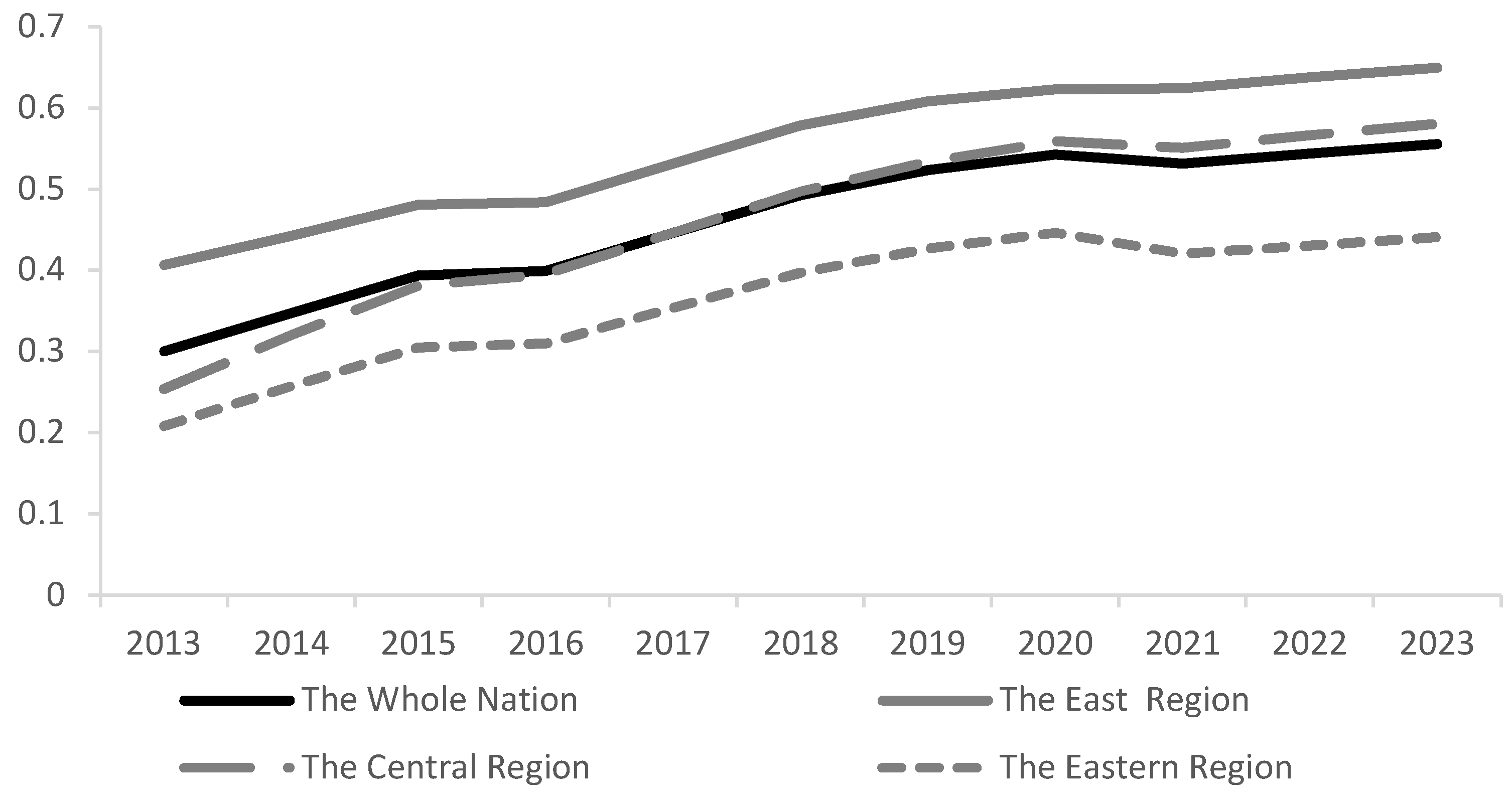
An integration study was carried out based on the two systems’ computation outputs (Figure 1). The average degree of integration between China’s real economy and digital economy developed steadily between 2013 and 2023, moving from mild imbalance to near-imbalance and eventually borderline imbalance. Integration levels were highest in the eastern region, which went from near-imbalance in 2013–2014 to borderline imbalance soon after, then stabilized between 2018 and 2023 in the main to intermediate imbalance range. It had nearly reached the threshold of a positive imbalance by 2023, demonstrating its advantages in terms of technology, policy, and the economy. Although there was still a sizable disparity with the eastern region, the average integration level in the central region gradually improved, moving from a moderate imbalance in 2013–2014 to the near-imbalance to mild imbalance range in 2018–2023. From 2013 to 2014, there was a moderate imbalance; from 2015 to 2023, there was a slight imbalance; and in 2023, the western area continued to lag at lower levels. Variances in economic structure, ability for innovation, and other variables account for the stark variances in integration between the eastern, central, and western areas. Differentiated policies must be developed, regional cooperation must be reinforced, and the western and central regions must receive more assistance to promote superior regional economic development in order to close these disparities.
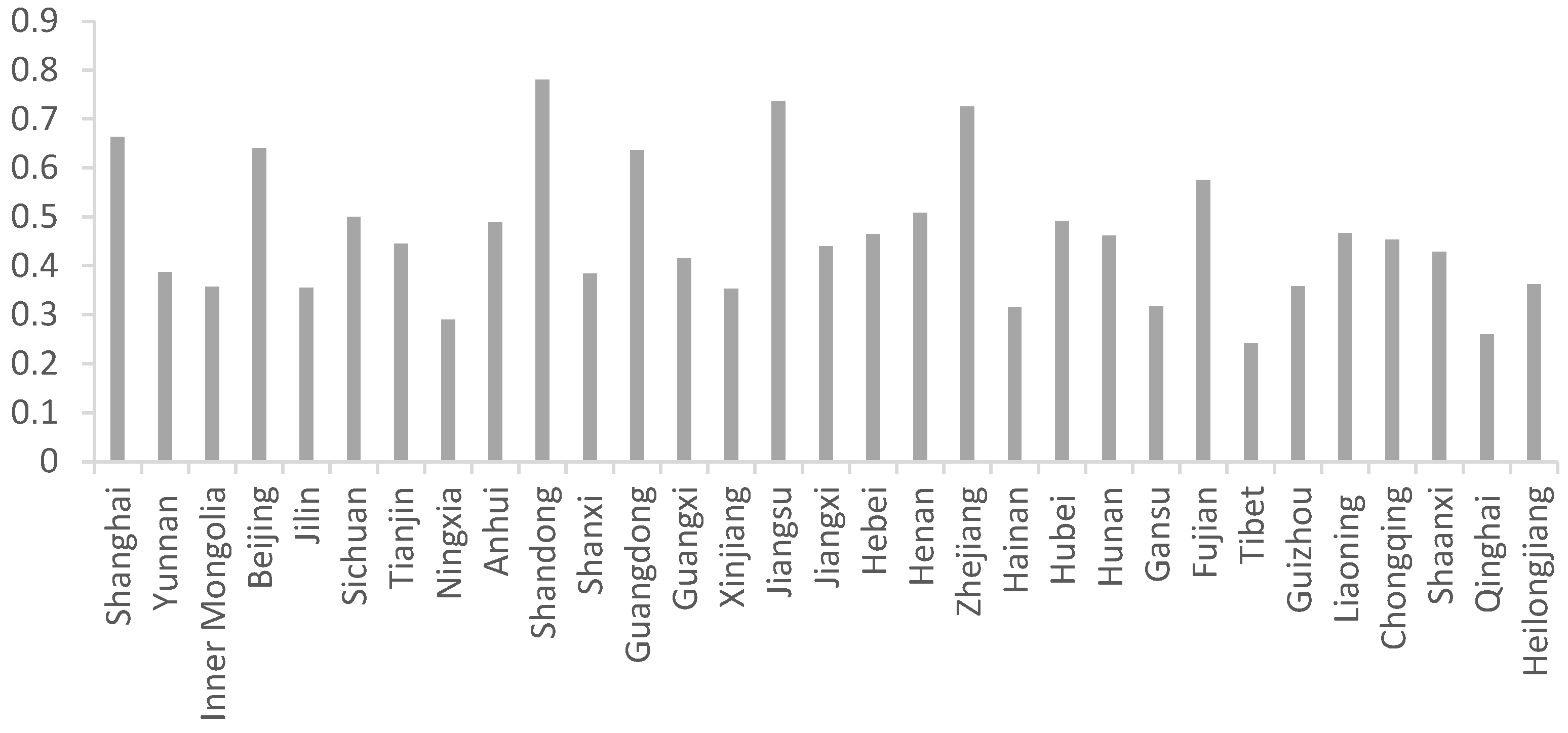
Different imbalance conditions are revealed by analyzing the average integration development levels among provinces (Figure 2). Because of their poor infrastructure, limited capacity for technical innovation, and lack of policy backing, Tibet, Qinghai, and Hainan show a mild imbalance that prevents full integration. Even while there has been some progress, provinces like Heilongjiang and Ningxia still need focused governmental support, improved infrastructure, and increased technological innovation. Integration is getting close to a positive level in provinces like Chongqing and Anhui, but it is hampered by things like poor regional coordination and low transparency. While Zhejiang and Jiangsu, which are classed as having intermediate imbalance, and Shanghai and Guangdong, which are classified as having main imbalance, have achieved remarkable integration accomplishments, they still need to optimize tactics to overcome restrictions in industrial structure and economic foundations. It appears that China’s eastern, central, and western areas have different degrees of digital–real integration. Regional inclusion should be given top priority for promoting integrated development, and targeted assistance should be given to close these gaps.

4.2. Baseline Regression

For benchmark regression analysis, a fixed-effects model was chosen. Regardless of whether control factors are included in the model, the impact of digital–real integration on high-quality regional economic development remains highly favorable at the 1% statistical significance level, as Table 6 demonstrates. This not only shows a consistent positive relationship between high-quality regional economic growth and digital–real integration, but it also emphasizes how important it is to support deep digital–real integration in order to meet high-quality regional economic development objectives. The following are potential explanations for these findings: By optimizing production processes in conventional sectors, the use of digital technology in some areas can boost total factor productivity and offer efficiency support for superior economic development. Furthermore, innovation models and company forms may emerge from digital–real integration, generating long-term innovation momentum for superior economic development. The robustness of the model architecture in this study is further demonstrated by the R-squared value, which is 0.536 without control variables and rises to 0.597 when control variables are included. This indicates better explanatory power in the model with control variables. As a result, Hypothesis 1 is confirmed.

4.3. Robustness Test

High-quality regional economic development can be enhanced by digital–real integration, according to the results of the benchmark regression study. This section uses robustness testing, such as excluding special years and using alternative models, to further confirm the validity of the research findings.

4.3.1. Exclude Exceptional Years

Due to local containment measures, regional economic development was impacted by the COVID-19 pandemic’s early 2020 outbreak and its three-year impact, creating unique economic conditions during this time. In light of this, the study does regression analysis once more and removes samples from 2020 to 2022. The findings, which are displayed in Table 7, show that, at the 1% level, the impact of digital–real integration on high-quality regional economic growth is still significantly beneficial. This suggests that digital–real integration can support the improvement of high-quality regional economic development. The strong resilience of the study’s conclusions is demonstrated by the robustness test results, which match those of the benchmark regression.

4.3.2. Replace the Model

This study performs another regression analysis using the Tobit model because the explanatory variable, high-quality regional economic development, is continuous. The impact of digital–real integration on high-quality regional economic development is continuously positive at the 1% significance level, as Table 8 illustrates. This suggests that digital–real integration can support the improvement of high-quality regional economic growth. The significant resilience of the study’s conclusions is demonstrated by the robustness test results, which agree with those of the benchmark regression.

4.4. Endogeneity Test

This work will use the instrumental variable approach to perform an endogeneity test in order to guarantee the objectivity, consistency, and dependability of the model estimation findings. This research chooses the lagged value of the integration of the digital and real economies as the instrumental variable for endogeneity analysis based on data availability and relevance. The instrumental variable is regressed against the endogenous variable in the first stage of the analysis, and the predicted value of the endogenous variable is regressed against the dependent variable in the second stage. There is no endogeneity problem in this study if both stages’ regression test findings are positive.
The under-identification test has a statistical value of 207.063 and has passed the significance test at the 1% level, according to the particular data in Table 9. This shows that the under-identification test is successful, and the null hypothesis of instrumental variable under-identification is rejected. The result of the weak instrumental variable test is 751.264, which is higher than the 10% level critical value of 16.38. As a result, the weak instrumental variable test is successful, and the null hypothesis is rejected. In the first stage, however, the regression coefficient between the instrumental and endogenous variables is 0.7845, with both p-values < 0.01. This shows that the instrumental variable has a strong explanatory power for the endogenous variable and indicates a significant correlation at the 1% significance level. The integration of the digital and real economies has a significant positive impact on high-quality economic development at the 1% significance level, according to the second stage’s regression coefficient of 4.9577 and p < 0.01. The regression results are in line with those previously discussed, indicating that the model in this study has strong robustness and does not have an endogeneity problem.

4.5. Heterogeneity Analysis

The impact of DRI on high-quality regional economic growth in China may show a variety of traits when combining the previous studies of digital–real integration levels. Based on the National Bureau of Statistics’ classification methodology and extant literature, this study divides the 31 provinces, autonomous regions, and municipalities directly under the central government into three regions: eastern, central, and western.
This study standardizes the digital–real economy integration levels within each region to ensure magnitude comparability because variations in scale and dispersion may make cross-regional coefficient comparisons difficult, and heterogeneous model specifications may obscure interpretive results. We keep year effects and control variable sets the same for every region. The F-test findings for coefficient equality are shown in Table 10. At the 1% significance level, the result Prob > F = 0.0000 shows a strong rejection of the null hypothesis (H0: no significant variations in coefficients across all regions). This indicates the existence of substantial regional heterogeneity by proving that at least one region’s coefficient differs statistically significantly from others.
The regression coefficient of digital–real integration on high-quality regional economic development in the eastern region is 3.460, with p < 0.01, showing a significant positive influence at the 1% significance level, as Table 11 illustrates. The regression coefficient in the central region is 0.890, but it does not satisfy the significance test requirements, indicating that digital–real integration has no discernible effect on high-quality regional economic development. At the 5% significance level, the regression coefficient for the western region is 3.575, with p < 0.05, indicating a substantial boosting influence. These findings unequivocally show that there are significant geographical differences in how digital–real integration affects high-quality regional economic development. The following are some potential explanations for these results: The eastern area can successfully convert the results of digital–real integration into actual productivity and promote high-quality economic development because of its solid economic base and comparatively advanced digital infrastructure. The central area, on the other hand, has inadequate digital infrastructure, and certain traditional industries struggle with digital transformation. As a result, the stimulating influence of digital–real integration on high-quality economic development is less noticeable. Despite western China’s comparatively underdeveloped digital infrastructure and economic base, the catch-up effect has produced notable nonlinear features in the region’s digital–real economy integration process: The degree of integration between the digital and real economies was initially lower in the west than in the east due to inadequate digital infrastructure and lagging industrial underpinnings. But through targeted funding, cooperative building of new infrastructure, and technology “enclave” models, policy support successfully lowered the costs of capital investment and technology acquisition in the west, allowing it to directly draw on established technological pathways from the east and achieve leapfrog development marked by “low-cost imitation and high-efficiency absorption.”

4.6. Mechanism Analysis

In order to confirm the mediating roles of technical innovation and industrial structure upgrading, this study combines the previous investigation of the underlying mechanisms with Jiang Ting’s two-step mediation test approach. The regression coefficients of digital–real integration on technical innovation and industrial structure upgrading are 1.249 and 10.562, respectively, and are statistically significant at the 1% level, as Table 12 illustrates. This suggests that digital–real integration has a major beneficial influence on both technological innovation and industrial structure upgrading, i.e., it stimulates technological innovation and industrial structure upgrading.
In the meantime, current research shows that regional industrial structure upgrading, technological innovation, and high-quality economic development are positively correlated; that is, regional economic quality increases in tandem with improvements in industrial structures and technological innovation. These results validate the mediating roles of technology innovation and industrial structure upgrading in the association between high-quality regional economic development and digital–real integration. Higher degrees of digital–real integration, in particular, encourage technical innovation and the modernization of regional industrial structures, both of which contribute to superior regional economic development. Consequently, Hypotheses H2a and H2b are confirmed.
The following are potential explanations for these findings: By optimizing industrial structures and offering physical support for technological innovation, the development of digital–real integration may encourage the establishment of new industries and business models. Upgrading the industrial structure, therefore, increases economic value and overall factor productivity. In the meantime, new development opportunities brought about by technology innovation boost regional economic growth and enhance the effectiveness and quality of economic development.

4.7. Analysis of the Spatial Spillover Effect

4.7.1. Spatial Correlation Analysis

The high-quality regional economic development indices of 31 Chinese provinces and municipalities from 2013 to 2023 are subjected to a spatial autocorrelation test using the Global Moran’s I index. This test looks for spatial autocorrelation between high-quality regional economic development and digital–real integration. The possibility of developing a spatial econometric model is demonstrated by the test findings in Table 13, which show that the Moran’s I indices for high-quality regional economic development in China are all greater than 0 and statistically significant at the 1% level.

4.7.2. Spatial Metric Analysis

1
LM Test
As a key instrument for assessing the suitability of spatial econometric models, the LM test can offer vital statistical support for model selection. Alternative models, including the Spatial Error Model (SEM) and the Spatial Lag Model (SLM), were subjected to a thorough LM test in this investigation. The Spatial Error Model’s statistical value is 0.701, as seen in Table 14, and it does not pass the significance test. This suggests that the geographic effects in this study cannot be adequately explained by the geographic Error Model, which also fails to adequately reflect the underlying spatial correlation features in the data. The Spatial Lag Model, on the other hand, has a p-value of less than 0.1 and a statistical value of 3.331. This indicates that there is a significant spatial lag effect at the 10% significance level. From a statistical standpoint, the geographical Lag Model can more correctly represent the geographical dependent relationships among variables and better suit the study’s sample data. As a result, it has the superiority and rationality to be used as the study’s analytical instrument.
The first-order adjacency matrix has many advantages over the distance weight matrix when choosing a spatial weight matrix. From a data point of view, the adjacent relationship data needed for the first-order adjacency matrix is readily available and very accurate, successfully avoiding any biases that might result from the measurement and computation of distance data. The Spatial Lag Model concentrates on spillover effects across adjacent regions in terms of model fit. Such small spatial relationships can be accurately represented by the first-order adjacency matrix, which is consistent with the fundamental assumptions of the model. Consequently, this strengthens the explanatory capacity of the model and offers solid backing for precisely evaluating the study issues.
2
LR Test
An LR test was performed to identify the proper kind of fixed-effects model after it was decided that the Spatial Lag Model (SLM) would be employed for the investigation. First, the significance test was passed based on the Hausman test results in Table 15, p < 0.1. Furthermore, every p-value in the LR tests was less than 0.01. As a result, a model with dual fixed effects should be used in this investigation.
The Table 16 results show that, with a coefficient of 1.295, the direct impact of digital–real integration on high-quality regional economic development meets the 1% significance test. With a value of 0.266, the indirect effect, on the other hand, passes the 5% significance test. These results show that digital–real integration significantly boosts high-quality regional economic development and, through geographical spillover effects, positively affects nearby regions’ economic development. As a result, Hypothesis H3 is confirmed.
When a region uses digital–real integration to support its own high-quality economic development, the benefits can spread to neighboring areas through a variety of channels, including enhancing interregional economic interactions, facilitating technology and resource sharing, and improving the digital development environment in neighboring regions. Together, these processes have a beneficial knock-on effect on nearby communities.

5. Discussion

According to this study, different provinces show differing degrees of convergence in the degree of integration between the digital and real economies (DRI). Although the eastern, central, and western areas’ DRI development levels have steadily increased over time, there are still large integration gaps between them. The findings show that DRI can greatly support superior regional economic development, as was before established. According to Li Jialin and Wen Jinyan’s (2025) findings at the provincial level, there are significant geographical variations in the impact of DRI on high-quality regional economic development under various regional sample contexts [33]. Additionally, by improving industrial structure and raising levels of technological innovation, DRI can support high-quality regional economic development. Additionally, Li Jialin and Wen Jinyan confirmed that DRI can promote high-quality development by lessening the degree of labor and capital factor misallocation [33]. This study expands on previous research by investigating how DRI fosters superior regional economic development.
Additionally, this study reveals that high-quality regional economic development is impacted by the geographical spillover effects of Digital and Real Economy Integration (DRI). When a region uses DRI to support its local high-quality economic growth, the benefits will spread to nearby areas via a variety of pathways. This supports Zhang Xinwei’s findings even more [50]. Through processes like technology diffusion, factor mobility, and industrial synergy, the digital economy’s openness, sharing, and networked features not only promote excellent local economic development but also have a major spatial spillover effect on nearby regions.

6. Conclusions

6.1. Findings

This study first uses the entropy weight method to create indices for the digital economy, real economy, and high-quality regional economic development using panel data from 31 Chinese provinces (autonomous regions and municipalities directly under the central government) between 2013 and 2023. The synergy depth between the “digital–real” systems is then measured using a coupling coordination degree model. The net effect, mechanism, and spillover boundaries of integration levels on high-quality regional economic development are investigated through the sequential construction of statistical models (benchmark regression, mediation effect, and spatial econometric models) in the empirical research. The study concludes that there is a spatial spillover effect and that DRI affects HQD both directly and indirectly through two mediating variables. The research conclusions can be summarized into four key points:
Firstly, China’s level of digital–real integration (DRI) development has shown notable spatiotemporal evolution between 2013 and 2023. Over time, the condition of integration has continuously improved, and the overall average value has increased. In terms of geography, the eastern region is in the lead, the middle region has progressively moved forward, and the western region is continuously low, with significant regional differences. An examination of the 31 provinces’ average DRI levels was performed in order to look into this trend more thoroughly. The findings show that different provinces display different states of imbalance, which offers insights for attaining balanced regional development. These states are limited by elements including infrastructure, technological innovation, and policy support.
Secondly, digital–real integration has a dual enhancing effect on high-quality regional economic development in both statistical and economic terms, according to benchmark regression and a series of robustness tests (excluding unusual years, altering models). In the meantime, there is regional heterogeneity in this promotional impact, meaning that it is “led by the eastern region, while the central and western regions relatively lag.” Additionally, through spatial interdependence, digital–real integration produces a favorable influence on the economic development of neighboring regions and has a major positive impact on high-quality regional economic development. A good spillover impact is indicated by its indirect effect of 0.266.
Thirdly, by promoting industry structure upgrading and boosting technical innovation capabilities, digital–real integration can indirectly support high-quality regional economic development, according to the mediation effect test results. The coefficients for promoting industrial structure upgrading and boosting technical innovation capacities are 1.249 and 10.526, respectively, for every 1% rise in DRI. These procedures create an environment that is more conducive to the advancement of superior regional economic growth.

6.2. Policy Recommendations

Based on the above conclusions, to fully leverage the driving role of digital–real integration in promoting high-quality regional economic development, this study proposes the following recommendations:
Firstly, make the development of digital infrastructure stronger. To improve the degree of digital–real integration, the central and local governments should, on the one hand, use digital technologies like artificial intelligence and big data to drive the upgrading and transformation of traditional infrastructure, accelerate the digital and intelligent transformation process of traditional infrastructure, and expedite the layout and coverage of 5G networks, computing power centers, etc., in key cities. However, different areas can create digital resource-sharing platforms to prevent data resource waste and inefficient resource use, develop industrial digital application scenarios, and more effectively boost market demand.
Secondly, every region must consistently boost R&D spending and advance technological innovation. The efficiency transformation brought about by digital–real integration can successfully support high-quality regional economic development by affecting industry structure upgrading and technological innovation levels, according to the mediation effect analysis. Therefore, to develop autonomous technological innovation capabilities, all regions should consistently boost talent cultivation and financial support for R&D. In the meantime, they can create technology innovation demonstration zones with complementary capabilities, allowing universities and businesses to construct cooperative research institutions to jointly develop important foundational technologies, fully utilizing everyone’s advantages. Lastly, it is critical to create new technologies and intelligent software, improve the use of digital technologies, and offer systematic, selected solutions for industrial development.
Thirdly, to unleash the driving forces behind digital–real integration, encourage the upgrading of industrial structures through data-driven factors. Governments should encourage the formation of new businesses, industries, and business models while phasing out outmoded ones in order to promote closer interaction between the digital economy and the real economy. This will provide excellent regional economic development with fresh impetus.
Fourthly, adopt dynamic, distinctive development methods that are adapted to local circumstances and improve regional connectedness. Advanced digital–real integration regions should concentrate on overcoming constraints in critical digital technologies, including industrial software, high-end semiconductors, and artificial intelligence. In the meantime, a new paradigm of coordinated regional development should be actively fostered by establishing regional collaboration mechanisms through projects like joint industrial parks and technology transfers to benefit regions with lesser integration skills.

6.3. Limitations and Further Research

The impact of the integration of real and digital economies on the superior growth of regional economies is methodically examined in this article. It prioritizes direct impacts above indirect impacts, giving equal weight to theoretical and empirical evaluations. The study uses econometric models to support its conclusions and examines the process by which the integration of digital and real economies influences the high-quality development of regional economies. However, the excellent growth of regional economies is a huge, intricate system with many parts. As a result, this study’s theoretical analysis might not be totally thorough. Additionally, the academic community currently lacks a clear definition of the integration of digital and real economies. Based on the development of the real economy and the digital economy, this study chooses indicators for measurement that are as closely related as feasible in order to perform a thorough assessment of development levels. However, it does not go into great detail about how digital and real economies are integrated, and the quantification results might be biased. More work has to be performed to improve variable selection’s thoroughness and scientific rigor. Only two aspects—industrial structure upgrading and technological innovation—are used in this paper to verify the indirect influence mechanisms. However, these two factors are not the only mediating channels via which the integration of real and digital economies affects the indirect high-quality growth of regions.
In order to fill up the existing study gaps, researchers can gather more thorough data and improve the indicator system for the integration of digital and real economies in the future. Econometric techniques can also be improved, such as by using the Difference-in-Differences (DID) model to examine the effects of this integration.

Author Contributions

Conceptualization, X.Z. and Y.X.; Methodology, X.Z.; Software, X.Z.; Validation, X.Z. and Y.X.; Formal Analysis, X.Z.; Investigation, X.Z.; Resources, Y.X.; Data Curation, X.Z.; Writing—Original Draft Preparation, X.Z.; Writing—Review and Editing, Y.X.; Visualization, X.Z.; Supervision, Y.X.; Project Administration, Y.X.; Funding Acquisition, Y.X. All authors have read and agreed to the published version of the manuscript.

Funding

This research was funded by the National Social Science Fund Project, grant number 24XTJ003; 2024 Xinjiang Uygur Autonomous Region Graduate Education Innovation Program, grant number XJ2024G118; Xinjiang Uygur Autonomous Region Higher Education Institutions Basic Research Fund Project, grany number XEDU2024J045.

Data Availability Statement

The raw data supporting the conclusions of this article will be made available by the authors on request.

Conflicts of Interest

The authors declare no conflict of interest.

References

  1. Wang, R.; Li, Y. The important value, historical evolution, and innovation logic of development planning in the process of Chinese modernization. Creation 2025, 33, 33–37. [Google Scholar]
  2. Xi, J. Holding High the Great Banner of Socialism with Chinese Characteristics and Working Together to Build a Modern Socialist Country in an All-Round Way: Report at the 20th National Congress of the Communist Party of China (October 16, 2022); People’s Daily: Beijing, China, 2022. [Google Scholar]
  3. Yao, Z.; Zhang, Y. Dynamic analysis of the linkage between the digital economy and the regional economy. Econ. Surv. 2021, 38, 27–36. [Google Scholar] [CrossRef]
  4. Liu, G.; Xi, J. Research on the mechanism of increasing returns for the development of artificial intelligence technology industry in China—Taking Guangdong Province as an example. J. Hebei Univ. Econ. Bus. 2022, 43, 1–11+82. [Google Scholar] [CrossRef]
  5. Yang, Y.W.; Tian, K. How Industrial Intelligence Affects High-Quality Economic Development. J. Knowl. Econ. 2023, 15, 8495–8512. [Google Scholar] [CrossRef]
  6. Chen, K.; Zhang, S. Information consumption and digital-real integration: Empirical evidence from the pilot of national information consumption. Soft Sci. 2024, 38, 55–61. [Google Scholar]
  7. Jing, W.; Sun, B. Digital economy promotes high-quality economic development: A theoretical analysis framework. Economist 2019, 2, 66–73. [Google Scholar] [CrossRef]
  8. Ding, Z. Research on the mechanism of digital economy driving high-quality economic development: A theoretical analysis framework. Mod. Econ. Res. 2020, 1, 85–92. [Google Scholar] [CrossRef]
  9. Han, W.; Li, Y. Political economy analysis of the deep integration of the digital economy and real economy. Theory Mon. 2023, 11, 56–65. [Google Scholar] [CrossRef]
  10. Ouyang, R. Data as a Factor of Production Promotes the Deep Integration of the Digital Economy and the Real Economy: Theoretical Logic and Analysis Framework. Econ. Rev. J. 2024, 2, 67–78. [Google Scholar] [CrossRef]
  11. He, D.-X.; Zhang, H.; Liu, Y. New Substantive Enterprises Promote the Digital-Substantive Integration and Improve the Quality of Development. China Ind. Econ. 2024, 2, 5–21. [Google Scholar] [CrossRef]
  12. Hu, X.; Shi, B.; Yang, J. Driving Factors and Regional Differentiation of the Integrated Development of China’s Digital Economy and Real Economy. Study Pract. 2022, 12, 91–101. [Google Scholar] [CrossRef]
  13. Guo, H.; Quan, Q.-H. The Integrated Development of Digital Economy and Substantial Economy: Evaluation and Path. Econ. Rev. J. 2022, 11, 72–82. [Google Scholar] [CrossRef]
  14. Chen, Y. The theoretical exploration of the integrated development of the digital economy and real economy. Econ. Res. J. 2023, 58, 22–30. [Google Scholar]
  15. Hong, Y.-X.; Ren, B.-P. Connotation and Approach of Deep Integration of the Digital Economy and the Real Economy. China Ind. Econ. 2023, 2, 5–16. [Google Scholar] [CrossRef]
  16. Xia, J.-C.; Su, M. Promoting the Construction of Modern Industrial Systems through the Integration of Digital and Real-World Industries. Reform 2024, 5, 12–23. [Google Scholar]
  17. Si, C.; Ren, B.-P. To Build Modern Industrial System With the Deep Integration of Digital Economy and Real Economy: Strategy, Task and Approach. Res. Financ. Econ. Issues 2024, 11, 18–30. [Google Scholar] [CrossRef]
  18. Xue, L.; Li, T. The impact of land factors on the high-quality economic development in Northeast China. Soc. Sci. J. 2020, 42, 40–49. [Google Scholar]
  19. Pan, Y.-R.; Luo, L.-W. The Impact of Infrastructure Investment on High-quality Economic Development: Mechanism and Heterogeneity Research. Reform 2020, 6, 100–113. [Google Scholar]
  20. Shangguan, X.-M.; Ge, B.-H. Scientific and technological innovation, environmental regulation and high-quality economic development: Empirical evidence from 278 Chinese cities at prefecture level and above. China Popul. Resour. Environ. 2020, 30, 95–104. [Google Scholar]
  21. Liu, S.; Zhang, S.; Zhu, H. Study on the Measurement and High-Quality Economy Development Effect of National Innovation Driving Force. J. Quant. Technol. Econ. 2019, 36, 3–23. [Google Scholar] [CrossRef]
  22. Ren, X.; Yang, S. Technical Innovation, Industrial Structure Upgrading and Economic High-quality Development: Measurement Analysis Based on Independent Effect and Synergistic Effect. East China Econ. Manag. 2020, 34, 72–80. [Google Scholar] [CrossRef]
  23. Yu, Y.; Yang, X.; Zhang, S. Research on the Characteristics of Time and Space Conversion of China’s Economy from High-speed Growth to High-quality Development. J. Quant. Technol. Econ. 2019, 36, 3–21. [Google Scholar] [CrossRef]
  24. Ren, Z.-Z.; Deng, F. Digital Technology, Factor Structure Transformation and High-quality Economic Development. Soft Sci. 2023, 37, 9–14, 22. [Google Scholar] [CrossRef]
  25. Yang, W.; Xu, H. The distribution dynamics, spatial differences, and convergence characteristics of the high-quality development level of the regional economy. Stat. Decis. 2024, 40, 112–116. [Google Scholar] [CrossRef]
  26. Yang, Y.; Wang, Q. Research on construction of evaluation index system for high-quality development of regional economy in China in the New Era. China Soft Sci. 2024, S1, 182–190. [Google Scholar]
  27. Shen, L.; Zhang, H.-Y. Research on the spatiotemporal dynamics and convergence of the coupling coordination between green finance and high-quality economic development in China. Chin. J. Manag. Sci. 2024, 33, 50–60. [Google Scholar] [CrossRef]
  28. Chen, J.; Chen, Y.; Chen, M. China’s High-quality Economic Development Level, Regional Differences and Dynamic Evolution of Distribution. J. Quant. Technol. Econ. 2020, 37, 108–126. [Google Scholar] [CrossRef]
  29. Cheng, J.; Peng, X.; Li, J.; Zhang, H.; Zhan, C. Transmission mechanism of the impact of environmental regulations on the high-quality economic development of the Yangtze River Economic Belt. China Popul. Resour. Environ. 2024, 34, 126–136. [Google Scholar]
  30. Tong, M.; Chu, C.; Li, Y. Research on the Distribution Dynamics, Regional Differences and Convergence of China’s High-quality Economic Development. J. Quant. Technol. Econ. 2022, 39, 3–22. [Google Scholar] [CrossRef]
  31. Ma, Z.; Ning, C. Digital economy, factor allocation, and manufacturing quality upgrading. Reform Econ. Syst. 2020, 38, 24–30. [Google Scholar]
  32. Zhang, T.; Jiang, F.; Wei, Z. Can the digital economy become a new driving force to promote the high-quality development of China’s economy? Inq. Econ. Issues 2021, 1, 25–39. [Google Scholar]
  33. Li, J.; Wen, J. Research on the Impact of Digital-Real Integration on High-Quality Development. Available online: https://link.cnki.net/urlid/11.1567.g3.20250905.1709.004 (accessed on 20 October 2025).
  34. Chen, Z.; Chen, Z.-Y.; Tan, W.-J. On Mechanism Analysis and Effect of Digital Economy on the Promotion of High-quality Economic Development. J. Guangdong Univ. Financ. Econ. 2022, 37, 4–20. [Google Scholar]
  35. Huang, Q.; Shi, P.; Hu, J. Industrial agglomeration and high-quality economic development: A case study of 107 prefecture-level cities in the Yangtze River Economic Belt. Reform 2020, 1, 87–99. [Google Scholar]
  36. Wang, P.; Chen, D. Digital China, high-quality development and Chinese-style modernization: Logical relationship, mechanism and innovation path. J. South China Norm. Univ. (Soc. Sci. Ed.) 2023, 189–203, 245. [Google Scholar]
  37. Hu, Y.; Liu, K. Research on the theoretical mechanism of digital economy promoting the construction of a new development pattern based on the perspective of Marx’s capital circulation theory. Contemp. Econ. Res. 2023, 11, 18–27. [Google Scholar]
  38. Gao, P.-F. Technological Progress, Industrial Structural Upgrading, and Urban Economic Resilience. China Bus. Mark. 2023, 37, 51–62. [Google Scholar] [CrossRef]
  39. Yin, Y.; Su, X.; Su, X. The Spatial Effect of Industrial Structure Upgrading on Urban Economic Resilience. Econ. Geogr. 2023, 43, 86–92, 112. [Google Scholar] [CrossRef]
  40. Zhang, T.; Wu, Q.; Jiang, F.-X. The Integration of Data and Reality Empowers the Development of New Quality Productivity: Internal Logic, Realistic Dilemmas, and Practical Approaches. Sci. Manag. Res. 2025, 43, 88–95. [Google Scholar] [CrossRef]
  41. Hong, Y.; Wang, K. Research on the resilience and safety of the industrial chain supply chain from the perspective of new productivity. Econ. Res. J. 2024, 59, 4–14. [Google Scholar]
  42. Wan, Y.; Wang, C. Empirical test of the digital economy enabling high-quality development. Stat. Decis. 2022, 38, 21–26. [Google Scholar] [CrossRef]
  43. Han, J. Digital economy improves urban economic efficiency: Theoretical mechanism and path selection—A case study of cities in the Yangtze River Delta region. J. Soochow Univ. (Philos. Soc. Sci. Ed.) 2024, 45, 40–51. [Google Scholar] [CrossRef]
  44. Zhao, P. The logical and practical paths to enhance the adaptability of vocational education from the perspective of the integration of industry and education. Vocat. Tech. Educ. 2023, 44, 19–24. [Google Scholar]
  45. Miao, C.; Duan, M.; Zuo, Y.; Wu, X. Spatial Heterogeneity and Evolution Trend of Regional Green Innovation Efficiency—An Empirical Study Based on Panel Data of Industrial Enterprises in China’s Provinces*. Energy Policy 2021, 156, 112370. [Google Scholar] [CrossRef]
  46. Zhang, S.; Wu, Z.; Lu, Z.; Zhang, N. Spatio-temporal Evolution Characteristics and Driving Factors of the Integration Between Digital Economy and Real Economy in China. Econ. Geogr. 2022, 42, 22–32. [Google Scholar] [CrossRef]
  47. Zhao, T.; Zhang, Z.; Liang, S. Digital Economy, Entrepreneurship, and High-Quality Economic Development: Empirical Evidence from Urban China. J. Manag. World 2020, 36, 65–76. [Google Scholar] [CrossRef]
  48. Huang, Q.-H. On the Development of China’s Real Economy at the New Stage. China Ind. Econ. 2017, 9, 5–24. [Google Scholar] [CrossRef]
  49. Huang, T.; Xia, H. How Can Digital–Real Economy Integration Affect Urban Green Innovation? Evidence from China. Sustainability 2024, 16, 11072. [Google Scholar] [CrossRef]
  50. Zhang, X.-W. Research on Evolution of Innovation Model under the Condition of Digital Economy. Economist 2019, 7, 32–39. [Google Scholar] [CrossRef]
Figure 1. Regional Digital–real Integration Level, 2013–2023.
Sustainability 18 00340 g001
Figure 2. Average Level of Digital–real Integration Development Across Provinces.
Sustainability 18 00340 g002
Table 1. HQD evaluation index system.
TargetIndicatorsMeasures
InnovationR&D expenditure intensityRegional R&D expenditure/GDP
R&D personnel expenditure intensityNumber of regional R&D personnel/People
Science and technology
financial expenditure intensity
Science and technology financial expenditure/General public finance budget expenditure
Human capitalNumber of students in regular
institutions of higher learning/people
Per capita number of
patent application authorizations
Number of domestic invention patents
application authorizations/People
The proportion of the technology market turnoverTechnology market turnover/GDP
Co-ordinationProportion of the tertiary industryThe added value of the tertiary industry/GDP
The growth rate of the industrial
added value above scale
The growth rate of
industrial added value above scale
Disposable income difference
between urban and rural residents
Urban per capita disposable income/Per
capita disposable income of rural residents
Differences in consumption expenditure
between urban and rural residents
Per capita consumption expenditure of
urban residents/Per capita consumption
expenditure of the national rural residents
Per capita GDP ratioPer capita GDP per province/National
per capita GDP
Price stabilizationConsumer price index
Stabilization of employmentRegistered unemployment/Permanent population
GreenPercentage of forest coverReal coverage of forest/Total land area
Green coverage rate of the built districtGreening area of built-up area/Total built-up area
Park area per capitaPer capita public green space area
The degree of centralized treatment of sewageCentralized Treatment Rate of
Sewage Treatment Plant
Harmless treatment ratio for house refuseHarmless treatment capacity of domestic
waste/Production waste generation
Energy consumption per unit GDPTotal energy consumption/GDP
Solid waste emissions per unit of GDPSolid waste emissions/GDP
OpeanRatio of dependence on foreign tradeTotal import and export of goods
Degree of foreign capital dependencyActual use of foreign investment
ShareOn average, every 10,000 people own a roadHighway mileage/People
Investment in education fundsEducation budget expenditure/Total
expenditure of the financial budget
Per capita possession of public library collections
Number of hospital beds per 10,000 people
The number of practicing (assistant) doctors per 10,000 people
The proportion of fiscal social security and employment expenditureFiscal expenditure on social
security and employment/GDP
Coverage rate of pension insurance for urban workersCoverage rate of pension insurance
for urban workers
Table 2. DRI evaluation index system.
TargetIndicatorsMeasures
Digital economyDevelopment of
digital financial inclusion
Digital Inclusive Finance Index
Proportion
of telecommunication services
Total telecommunications service/GDP
Employees related
to the digital economy.
Employees in IT, computer services,
and the software industry/People
Internet market sizeInternet broadband access users/People
Mobile Internet Market SizeCell phone subscribers/100 people
Real economyScale of development
of the real economy
Industrial added value/GDP
Secondary industry added value/GDP
Total exports and imports of goods
Number of industrial enterprises above the designated size
Quality of development
of the real economy
Employees in the real sector/Total employment
Total retail sales of consumer goods
Total profit of industrial enterprises above the designated size
Table 3. Coupling Coordination Rating Classification.
IntervalGradeIntervalGrade
[0, 0.1)Extreme disorder[0.5, 0.6)Reluctant imbalance
[0.1, 0.2)serious imbalance[0.6, 0.7)Primary imbalance
[0.2, 0.3)Moderate imbalance[0.7, 0.8)Intermediate imbalance
[0.3, 0.4)Mild disorders[0.8, 0.9)Good imbalance
[0.4, 0.5)On the verge of disorder[0.9, 1]High-quality imbalance
Table 4. Descriptive Statistics of Variables.
TypeVariablesObsMeanStd. Dev.MinMax
Explained variableHQD34115.1201.7440.48818.287
Explanatory variableDRI3410.4610.1650.1500.884
EDU3419.3281.0855.33012.560
INF34117.4005.0864.37026.780
ENV34111.6081.3806.47413.939
INVEST3414.3130.4333.0444.989
Control variablesFDI3411.7431.7130.0399.545
MARKET3418.2612.2231.12412.725
TR3410.2470.2540.0111.197
IFS34111.1705.9951.73128.757
Mechanism variablesISU3411.4410.7540.7165.234
TECH3412.2211.5820.3336.543
Table 5. VIF test results.
VariablesVIF1/VIF
DRI4.920.203056
EDU3.710.269465
INF1.780.562608
ENV1.970.507143
INVEST3.060.326499
FDI1.600.623834
MARKET5.280.189458
TR4.730.211622
IFS1.460.684408
ISU3.360.297919
TECH4.360.229150
Mean VIF3.29
Table 6. Basel Regression Analysis.
(1)(2)
HQDHQD
DRI4.810 ***4.422 ***
(0.461)(0.532)
EDU 0.217 ***
(0.075)
INF −0.008
(0.007)
ENV −0.004
(0.020)
INVEST −0.080
(0.074)
FDI 0.030 ***
(0.011)
MARKET −0.057 **
(0.024)
TR 0.957 ***
(0.241)
IFS −0.024 ***
(0.005)
Constant13.486 ***12.594 ***
(0.143)(0.790)
Observations341341
R-squared0.5360.597
Individual effectYESYES
Time effectYESYES
F31.4422.67
PS: “*** p < 0.01”, “** p < 0.05”; Standard errors are reported in parentheses.
Table 7. Exclude exceptional years.
(1)(2)
HQDHQD
DRI3.864 ***3.010 ***
(0.557)(0.623)
EDU 0.264 ***
(0.081)
INF −0.008
(0.008)
ENV −0.044 *
(0.026)
INVEST −0.014
(0.083)
FDI 0.038 ***
(0.013)
MARKET −0.047 *
(0.026)
TR 0.825 ***
(0.267)
IFS −0.033 ***
(0.007)
Constant13.770 ***12.870 ***
(0.171)(0.937)
Observations248248
R-squared0.4750.580
Individual effectYESYES
Time effectYESYES
F23.6017.31
PS: “*** p < 0.01”, “* p < 0.10”; Standard errors are reported in parentheses.
Table 8. Replace the model.
(1)(2)
HQDHQD
DRI4.810 ***4.422 ***
−0.432−0.492
EDU 0.217 ***
−0.069
INF −0.008
−0.006
ENV −0.004
−0.018
INVEST −0.080
−0.069
FDI 0.030 ***
−0.010
MARKET −0.057 **
−0.022
TR 0.957 ***
−0.222
IFS −0.024 ***
−0.005
Constant14.682 ***12.784 ***
−0.218−0.940
Observations341341
Individual effectYESYES
Time effectYESYES
PS: “*** p < 0.01”, “** p < 0.05”; Standard errors are reported in parentheses.
Table 9. Endogeneity Test.
(1)(2)
Stage 1Stage 2
DRIHQD
Delayed Phase DRI0.7845 ***
(0.0286)
DRI 4.9577 ***
(0.6577)
EDU0.00210.1279 *
(0.0041)(0.0738)
INF−0.0010 ***−0.0095
(0.0004)(0.0066)
ENV−0.00080.0034
(0.0010)(0.0187)
INVEST0.0013−0.1251 *
(0.0042)(0.0757)
FDI0.00070.0281 **
(0.0006)(0.0109)
MARKET−0.0003−0.0692 ***
(0.0014)(0.0247)
TR0.01681.1639 ***
(0.0143)(0.2597)
IFS0.0001−0.0250 ***
(0.0003)(0.0053)
Non-identifiable test 207.063 ***
Weak Instrumental Variables Test 751.264
Observations310310
Individual effectYESYES
Time effectYESYES
PS: “*** p < 0.01”, “** p < 0.05”, “* p < 0.10”; Standard errors are reported in parentheses.
Table 10. Test for Regional Coefficient Heterogeneity.
Statistical MeasureStatistical Value
F p value0
F (2320)134.99
Table 11. Regional Heterogeneity Analysis.
The East RegionThe Central RegionThe Eastern Region
DRI3.460 ***0.8903.575 **
(0.678)(1.194)(1.390)
EDU0.476 ***−0.1410.146
(0.103)(0.126)(0.136)
INF0.030 ***0.005−0.041 ***
(0.010)(0.016)(0.012)
ENV−0.043 *0.0170.023
(0.023)(0.037)(0.040)
INVEST−0.241 ***0.0060.261
(0.091)(0.095)(0.191)
FDI0.031 ***0.0450.039
(0.011)(0.034)(0.057)
MARKET−0.026−0.016−0.089 **
(0.033)(0.067)(0.042)
TR0.573 **8.717 ***1.968 **
(0.233)(1.362)(0.835)
IFS−0.006−0.009−0.035 ***
(0.008)(0.008)(0.009)
Constant11.154 ***14.767 ***11.488 ***
(1.068)(1.597)(1.500)
Observations14366132
R-squared0.6820.9420.572
Individual effectYESYESYES
Time effectYESYESYES
F12.5135.327.104
PS: “*** p < 0.01”, “** p < 0.05”, “* p < 0.10”; Standard errors are reported in parentheses.
Table 12. Analysis of Mechanistic Findings.
(1)(2)(3)
HQDISUTECH
DRI4.422 ***1.249 ***10.562 ***
(0.532)(0.385)(1.136)
EDU0.217 ***−0.072−0.026
(0.075)(0.054)(0.159)
INF−0.008−0.0050.007
(0.007)(0.005)(0.014)
ENV−0.0040.011−0.099 **
(0.020)(0.014)(0.042)
INVEST−0.0800.0090.061
(0.074)(0.054)(0.159)
FDI0.030 ***−0.020 **0.037
(0.011)(0.008)(0.024)
MARKET−0.057 **−0.069 ***−0.133 **
(0.024)(0.018)(0.052)
TR0.957 ***−0.574 ***−0.245
(0.241)(0.174)(0.514)
IFS−0.024 ***−0.009 **−0.044 ***
(0.005)(0.004)(0.011)
Constant12.594 ***2.186 ***1.514
(0.790)(0.572)(1.684)
Observations341341341
R-squared0.5970.5980.487
Individual effectYESYESYES
Time effectYESYESYES
F22.6722.7414.52
PS: “*** p < 0.01”, “** p < 0.05”; Standard errors are reported in parentheses.
Table 13. Global Moran’s Index.
YearMoran IZp
20130.36713.41510.0006
20140.37863.51310.0004
20150.42893.92440.0001
20160.43033.92160.0001
20170.41963.85070.0001
20180.39663.65690.0003
20190.39233.62250.0003
20200.40353.73340.0002
20210.43333.98660.0001
20220.44454.07050.0000
20230.45354.12290.0000
Table 14. LM Test.
Table 14. LM Test.
TestdfStatisticp-Value
Spatial errorMoran’s I10.4590.646
Lagrange multiplier10.7010.402
Robust Lagrange multiplier10.4690.494
Spatial lagLagrange multiplier13.3310.068
Robust Lagrange multiplier13.0980.078
Table 15. LR Test.
Table 15. LR Test.
TestStatisticp-Value
Hausman Test121.270.000
LR TestDouble fixed-individual78.620.000
Double fixation–time719.220.000
Table 16. Effect Decomposition of the Double-Fixed Space Lag Model.
(1)(2)(3)
Direct EffectIndirect EffectGross Effect
DRI1.295 ***0.266 **1.561 ***
(0.264)(0.126)(0.306)
EDU0.184 ***0.038 *0.222 ***
(0.064)(0.022)(0.077)
INF−0.009−0.002−0.011
(0.007)(0.002)(0.008)
ENV0.0190.0040.023
(0.019)(0.005)(0.023)
INVEST0.0230.0050.028
(0.071)(0.016)(0.086)
FDI0.040 ***0.008 *0.048 ***
(0.012)(0.005)(0.015)
MARKET0.0050.0010.006
(0.023)(0.005)(0.028)
TR1.671 ***0.354 **2.025 ***
(0.224)(0.179)(0.316)
IFS−0.010 ***−0.002−0.013 **
(0.004)(0.001)(0.005)
rho0.173 **
(0.072)
sigma2_e 0.044 ***
(0.004)
Observations310310310
R-squared0.7030.7030.703
Individual effectYESYESYES
Time effectYESYESYES
PS: “*** p < 0.01”, “** p < 0.05”, “* p < 0.10”; Standard errors are reported in parentheses.
Disclaimer/Publisher’s Note: The statements, opinions and data contained in all publications are solely those of the individual author(s) and contributor(s) and not of MDPI and/or the editor(s). MDPI and/or the editor(s) disclaim responsibility for any injury to people or property resulting from any ideas, methods, instructions or products referred to in the content.