Article

Fe2O3 Catalyst-Assisted Pyrolysis of Waste Cross-Linked Polyethylene on a Large Scale: Recycling of Difficult-to-Process Material


Institute of Rock Structure and Mechanics, v.v.i., Czech Academy of Sciences, V Holešovičkách 94/41, 18209 Praha, Czech Republic
*
Author to whom correspondence should be addressed.
Sustainability 2026, 18(1), 339; https://doi.org/10.3390/su18010339 (registering DOI)
Submission received: 5 November 2025 / Revised: 19 December 2025 / Accepted: 26 December 2025 / Published: 29 December 2025
(This article belongs to the Special Issue Waste to Energy: An Approach Towards Sustainability)

Abstract

Cross-linked polyethylene (PEX) is very stable, both chemically and mechanically. This makes its waste difficult to process. A very promising approach is slow pyrolysis catalyzed by hematite (α-Fe2O3). Such pyrolysis was carried out on a large scale (feedstock of 38 kg, catalyst amount of 2 wt.%, heating rate of 4 K min−1, end temperature of 435 °C, delay at the end temperature several hours) and provided an oil containing both liquid (up to C17) and solid hydrocarbons (>C17). Thus, the oil obtained can be a source of valuable chemicals, solvents, and paraffin, and/or used as a clean liquid fuel and/or as a source of lubricants. Pyrolysis of PEX also yielded energy gas (12 wt.%) and solid carbonaceous residue (15 wt.%) for further use. The process mass balance and parameters (temperature, heating rate, dwell time, catalyst amount), composition, and chemical (elemental analysis, XRF, GC-MS, GC, distillation curve) and physical (viscosity, density, higher and lower heating value) properties of the oil, gas, and solid carbonaceous residue obtained are presented and discussed. The main product of the proposed technology is oil with a yield of almost 73 wt.%. The by-products are energy gas (12 wt.%) and solid carbonaceous residue (15 wt.%). The results obtained showed that the proposed technology successfully recycles difficult-to-process PEX with a process efficiency of 70%.

1. Introduction

Because of its unique properties and stability, cross-linked polyethylene (PEX) is used extensively for manufacture of pressure pipes, for installations of water-, chlorinated water- and steam-distribution systems, thermal equipment in industrial plants and households, and often for underfloor heating. PEX is also widely used to insulate electrical conductors, particularly for voltages ranging from 600 V to 35 kV. This work focuses on the recovery of waste cross-linked polyethylene (PEX) while reducing pollution and increasing recycling of this plastic waste. If the amount of PEX waste is effectively and meaningfully reduced, the production process will be more efficient, which will promote sustainable economic growth for the manufacturer. Sustainable PEX production and PEX waste recovery are interlinked concepts where waste is converted into valuable products, creating a more sustainable and circular economy in this regard.
The broad range of PEX applications inevitably results in significant amounts of production and installation waste that must be properly managed. Unfortunately, current disposal methods rely mainly on incineration and landfilling, which are inefficient and environmentally harmful. According to OECD statistics [1], in 2019, worldwide, 49% of all plastic waste was landfilled, 19% was incinerated, 9% was recycled, and 22% was disposed of in an uncontrolled manner (simply thrown away). In EU member states, 37% of plastics were landfilled, 44% were incinerated, 14% were recycled, and 5% were disposed of in an uncontrolled manner. In non-OECD countries, the situation regarding uncontrolled disposal of plastic waste is even worse. Evidently, in most countries, management of waste plastic leads to significant reserves that provide an opportunity for the deployment of pyrolysis, because it reduces waste, minimizes environmental impact, and creates new economic opportunities.
PEX waste continues to be considerable. This is due to its advantages and wide range of applications. Industries in which PEX is used and from which its waste is derived are plumbing (flexible and rigid piping systems in homes and industries for hot and cold water), electrical insulation (widely used for insulating low, medium, and high voltage electrical cables), medical implants (orthopedic implants such as hip and knee replacements to reduce wear and tear), transportation (chemical transport, sewage pipes, and offshore oil applications), and consumer goods (baby play mats and protective foam padding). The key growth drivers are construction and infrastructure (increased demand for PEX pipes, radiant heating and cooling systems due to their flexibility, durability, and corrosion resistance); energy sector (the growing need for high-performance electrical cable insulation for efficient and safe energy transmission); new materials as an alternative to traditional materials like copper and PVC. Such widespread use results not only in high production, but also in large amounts of waste.
As described below, waste PEX can be effectively recycled by converting it into high-value products such as industrial oils, paraffin, and energy gas, which is possible using catalytic pyrolysis technology at temperatures up to 450 °C, which is not a particularly high temperature. It should be emphasized that waste PEX is not technological, which means that it cannot be directly returned to the production process because the quality requirements for PEX products are too high and could not be met if waste PEX were reused as a starting material. It must therefore be processed, preferably into products with high utility value.
So far, this waste material has been recommended to be practically processed using mechanical methods [2], extrusion [3,4], chemical recycling [5,6], and forming after preheating [7]. A major disadvantage of mechanical methods is their low efficiency. The practical application of the product is also unclear. In the case of PEX, this is significant because of the high demands on the product properties. The disadvantages of extrusion include the high acquisition and maintenance costs of equipment and the reduction in the density of the resulting product in comparison with the starting material. This can cause problems in the practical use of the products. An obvious drawback of chemical recycling is the use of methods that are difficult to implement in practice, for example, plasma degradation or reactions with supercritical water (a dense, highly aggressive gas), which consume large quantities of energy. The technical design of equipment is unclear and the use of these methods can be economically very risky. It is thus appropriate to consider a way of treating the PEX waste that is realistic and provides products with feasible applications. Finding such a processing method is difficult, because PEX is a very stable material. Pyrolysis complies with these criteria by converting a stable polymer into liquid and gaseous products suitable for use as fuels or chemical feedstocks, at relatively moderate temperatures and with the possibility of catalytic enhancement [8].
Pyrolysis of polyolefin-based plastics, including PEX, produces hydrocarbon oils, waxes, BTX aromatics (benzene, toluene, xylene), and light aliphatic hydrocarbons. The product distribution depends on process conditions, particularly temperature. At 400–500 °C, the process mainly yields oils, waxes, and high-calorific gas, whereas above 700 °C, gaseous hydrocarbons (C1–C4) and BTX aromatics dominate, serving as feedstocks for numerous chemical syntheses [8,9]. Conventional thermal pyrolysis of polyethylene typically occurs at 500–700 °C without catalysts, producing a broad range of hydrocarbons. However, this approach is energy-intensive and offers limited control over product composition, restricting their direct use as fuels or chemical intermediates [10]. The yield of light hydrocarbons and liquid oils increases with rising temperature (>600 °C), while the paraffins are mainly produced at a lower temperature around 400 °C.
In contrast, catalytic pyrolysis enables lower operating temperatures (typically 400–500 °C) and improved product selectivity. Acidic catalysts (e.g., zeolites HZSM-5, HUSY, FCC catalysts, metal oxides such as Al2O3, Fe2O3) enhance chain scission efficiency, promoting the formation of shorter hydrocarbons, aromatics, or hydrogen [11]. Catalysts also increase the yield and quality of the liquid fraction. Pyrolysis oils contain higher concentrations of saturated and unsaturated hydrocarbons (C5–C24), and their physical properties (density, heating value) approach those of commercial diesel. Furthermore, catalysts reduce undesirable by-products such as carbonaceous residues and allow better control over aromatization and isomerization processes [12,13].
The aim of this study is to suggest a method for processing waste PEX through catalytic pyrolysis under precisely defined conditions using hematite (α-Fe2O3) as a catalyst. Hematite (α-Fe2O3) is a versatile and widely studied catalyst with applications in various fields, including combustion, environmental remediation, and energy conversion. Its catalytic properties result from its ability to facilitate chemical reactions, often by providing active sites for reactants to interact or by influencing reaction pathways [11,14,15]. The large-scale pyrolysis process is designed to achieve a high yield of oil and energy-rich gas with high calorific value. At the same time, the efficiency of the process and its potential to reduce environmental pollution and increase PEX waste recycling are evaluated. The implementation of this technology supports the concept of a circular economy, where waste is converted into valuable products, thereby enhancing production sustainability and resource efficiency.
The novelty consists in the scale of the process. Typically, laboratory tests are performed with samples weighing in the range of milligrams or grams [16,17,18]. The aim of our research was to verify the feasibility of large-scale PEX processing with several tens of kilograms of waste material, yielding a main product—oil of almost 73 wt.% at a process efficiency of 70%.

2. Materials and Methods

2.1. Materials

The processed waste consisted of colored cross-linked polyethylene (PEX) material in the form of small ovals and their parts, having an outer dimension of approx. 18.4–25.0 mm and a thickness ranging from 0.6 to 2.2 mm, which came mainly from the production of pressure pipes, hot water pipes, and cable insulation. The modification of input material on a large scale is difficult—it involves tens of kilograms—therefore, the material was pyrolyzed in its original state (as received). The waste contained very little water and ash, and had a high percentage of combustible matter. Proximate and organic elemental analysis and the higher and lower heating value of the processed material were conducted according to standards [19,20,21,22,23,24,25] and are shown in Table 1. The lower heating value (LHV) was calculated from the equation given in ČSN ISO 1928 [25]. At the same time, these standards were used to characterize oil and solid carbonaceous residue (SCR). The oxygen content in both the input raw material and the products (oil and solid carbonaceous residue) was determined by calculation to 100%.
The hematite catalyst was applied in the form of a fine dispersion of α-Fe2O3 (Merck Life Science, Ltd., Darmstadt, Germany) particle size ≤ 110 nm (use based on [26]).

2.2. Methods

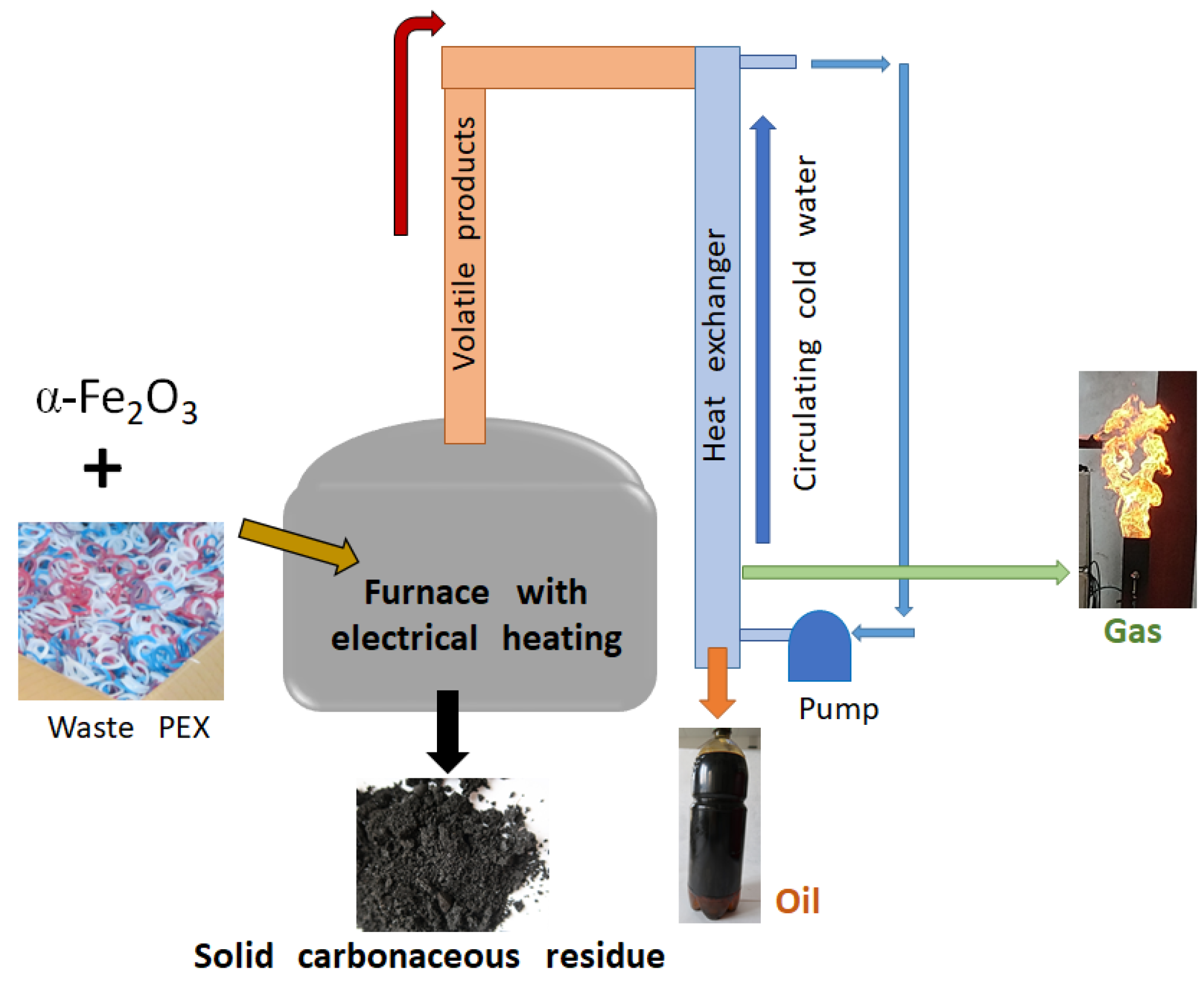
Thirty-eight kilograms of waste PEX in oval forms with 2 wt.% (760 g) of catalysts was pyrolyzed in a fixed bed in a power-controlled electric furnace. (Note: with 2 wt.% of α-Fe2O3, the content of low hydrocarbons C6–C9 increased to 36 wt.% (see below) compared to 1 wt.%; therefore, 2 wt.% of catalyst was chosen for the large-scale experiment.) The furnace was preheated to a wall temperature of 114 °C, after which the waste PEX feedstock was introduced into the reactor. It was uniformly sprinkled throughout the entire volume with a fine dispersion of the catalyst. The mixture was then homogenized using an operational kneader. Subsequently, the batch was heated from 56 °C to 435 °C at a rate of 4 K min−1 in the center of reactor and simultaneously 5.4 K min−1 on the reactor wall. A heating rate of 5 K min−1 was tested on a laboratory scale, at which a sufficient amount of oil was obtained, and we used this finding as a feasible parameter to use on a large scale [18]. The 435 °C temperature was maintained for several hours until gas evolution was terminated. During pyrolysis, the released volatile products (raw gas) were cooled in a heat exchanger by a countercurrent flow of circulating cold water (6–8 °C) with flow rate of 160 L min−1. The heat exchanger had a heat transfer area of 20 m2 and thus provided sufficient cooling of the raw gas and produced oil. In this way, the pyrolysis oil and pyrolysis gas were separated and the outgoing gas was sampled and then burned using a gas flare (Figure 1).
This study assumes that fillers do not interfere with the pyrolysis process.
The pyrolysis conditions were selected based on the laboratory experiments summarized in Section 4, see below. The realistic heating rate of waste plastic mixtures under operating conditions is approximately 4 K min−1. The final temperature should not exceed 500 °C so that heat consumption is not too high. The laboratory experiments were therefore carried out under conditions stated below (see Section 4). Under operational conditions, a heating rate of 4 K min−1 was achieved in the center of the reactor and simultaneously 5.4 K min−1 on the reactor wall, with a final temperature of 435 °C, which was maintained for several hours until gas evolution was terminated.
The components of main product, the oil obtained, were determined on an HP 6890 gas chromatograph (Hewlett-Packard, Buffalo, NY, USA) with MSD 5975 mass detector (GC-MS) operating in an inert helium atmosphere with a flow rate of 93 cm3 min−1. A 30 m long DB XLB capillary column with a diameter of 0.25 mm was used. The initial column temperature was 50 °C; this temperature was maintained for the first minute. Heating was then controlled by a program at a rate of 10 K min−1 to a final temperature of 300 °C. The column was maintained at the final temperature for 6 min. Calibration curves based on the digital response of the instrument were used to determine the oil components. MSD ChemStation Data Analysis software, version D.01.00 was used to evaluate the GC-MS spectra.
The distillation curve of the oil was determined by simulated distillation according to ASTM D2887 method [27]. A Trace GC Ultra instrument (Thermo Fisher Scientific, Milano, Italy) equipped with cryogenic cooling of the chromatographic oven, an automatic sample dispenser, and an FID detector was used to evaluate the distillation curve of the oil. A 1 µL sample was injected onto a Varian WCOT Ultimetal column (10 m × 0.53 mm i.d.; film thickness of 0.17 μm), which was placed in an oven heated linearly to 410 °C at a rate of 15 K min−1. The helium carrier gas flow rate (5 mL min−1) was constant throughout the heating period. The results obtained were evaluated using SimDisChrom software version 2.2.
The moisture content in the oil was analyzed using the Karl Fischer automatic titration method. The measurement was performed at least five times and the results were processed using specialized software connected to a volumetric titrator (Metrohm, Prague, Czech Republic).
The dynamic viscosity of the oils obtained was measured with a Haake Viscotester iQ rotational rheometer (Thermo Fisher Scientific) with a double-gap cylindrical geometry. After the temperature was stabilized at 20 or 40 °C, the measurement was performed at the shear rate of 1400 s−1 and repeated three times. The density of the oils was determined using a Densito electronic densimeter (Mettler Toledo, Prague, Czech Republic) and the results were used to calculate kinematic viscosity. Kinematic viscosity ( ν ) was calculated from dynamic viscosity ( η ) and oil density (ρ) using Equation (1).
ν = ( η ρ ) × 1000
Gas samples collected in 500 mL Tedlar bags were immediately analyzed using gas chromatography with both FID and TCD on two Agilent Technologies 6890N chromatographs (Agilent Technologies, Buffalo, NY, USA) with three 30 m × 0.32 mm capillary columns. The analysis of O2, N2, and CO was performed on an HP-MOLSIV capillary column (40 °C) with carrier gas He (5 cm3 min−1) using TCD; further, analysis of CH4 and C2–C5 hydrocarbons on a GS-Gaspro (60 °C) with carrier gas N2 (20 cm3 min−1) using FID, CO2 on a GS-Gaspro (40 °C) with carrier gas He (5 cm3 min−1) using TCD, and H2 on an HP-5 (40 °C) with carrier gas N2 (7 cm3 min−1) using TCD were performed.
Inorganic elements in solid carbonaceous residue were determined using a non-destructive X-ray fluorescence (XRF) analyzer (Spectro IQ, Kleve, Germany). The instrument has the following parameters: He atmosphere; palladium target material; target angle from the central ray, −90°; focal point, a 1 mm × 1 mm square; maximum anode dissipation of 50 W; and 10 cfm forced-air cooling. Sample preparation involved the pressed-pellet method, where 4.0 g of material with a particle size of 15–20 µm was mixed for 10 min with 0.9 g of Hoechst wax (Bedburg-Hau, Germany) as a binding additive. The mixture was then pressed at 80 kN. X-LabPro software version 5.1 automatically converted the elemental results.
To evaluate the efficiency of the conversion process, the efficiency of low-temperature pyrolysis was determined based on a comprehensive mass and energy balance. The calculation considered the energy of useful products obtained on one side and the energy of the input feedstock together with losses on the other (see Section 3.1). Efficiency of the process (EPi, %) was then expressed as the ratio of the lower or higher heating value (LHV or HHV) of the useful products (oil and gas) to the LHV or HHV of the input waste PEX, including the heat required to raise the PEX to the decomposition temperature, ~420 °C. This heat demand (Q) was calculated using the specific heat capacity of PEX (c = 1.9 kJ kg−1 K−1) and the LHV or HHV of solid carbonaceous residue (SCR). SCR as a product with no or negligible utility value was considered as a loss. Using LHV, the efficiency EPLHV was then expressed by Equations (2) and (3):
EPLHV = (LHVoil × 0.726 + LHVgas × 0.118)/(LHVPEX + Q + LHVSCR × 0.155) (%)
using HHV as
EPHHV = (HHVoil × 0.726 + HHVgas × 0.118)/(HHVPEX + Q + HHVSCR × 0.155) (%)
No generative artificial intelligence was used in this paper.

3. Results

3.1. Mass Balance

Pyrolysis yielded 27.6 kg of oil (72.6 wt.%), 4.5 kg of energy gas (11.8 wt.%), and 5.9 kg of solid carbonaceous residue (SCR) (15.5 wt.%). As expected, oil was the dominant product. The gas yield was high enough compared to laboratory-scale experiments to cover the heating of the operational pyrolysis unit, if necessary. In a laboratory-scale experiment conducted up to a final temperature between 460–470 °C, it was found that without the use of a catalyst, approximately half the amount of gas (4.9 wt.%) was produced under the same temperature conditions, and with the use of a 15 g Ru/Al2O3 catalyst, the amount of gas increased to 7.5 wt.% [18]. At around 420 °C, the first gas evolution was observed, burning with an intermittent (discontinuous) flame. As the temperature increased (from 450 °C), intensive combustion of flammable gas components and oil evolution took place. Muhammad et al. compared the pyrolysis of pure plastics, their model mixtures, and mixed plastic waste at 500 °C, finding that the use of the zeolite catalyst HZSM-5 significantly increased the yield of oils up to 80 wt.% from PE, as opposed to gases, which corresponds to the yields obtained on a large-scale [28]. However, contrary to expectations, the amount of resulting solid carbonaceous residue was considerable and the question of its utilization arose.

3.2. Main Product—Pyrolysis Oil

The main product was oil. Its chemical and elemental composition and physical properties are summarized in Table 2. The chemical composition of the oil was determined by GC-MS analysis. The elemental analysis of the oil was performed according to the standards specified in Section 2.1.
To assess the usability of the oil, a detailed GC-MS analysis was performed. The GC-MS results revealed that the oils contained dissolved gases, liquid fractions, and solid aliphatic hydrocarbons across a broad range of carbon numbers up to C28. The oil sample contained saturated and unsaturated aliphatic hydrocarbons in the C5–C28 range, including dissolved gaseous hydrocarbons and liquid hydrocarbons C5–C17 (78 wt.%) (Table 2). Rahman et al. confirmed that the addition of a catalyst more effectively cleaved long hydrocarbon chains, e.g., in PE, producing hydrocarbons with a range of C5–C18 [10]. These findings are consistent with the GC-MS analysis results from Singh et al. (2020) [29], who reported a similar distribution of hydrocarbons in pyrolysis oils derived from mixed plastics. A similar composition of oils from the catalytic pyrolysis of HDPE and LDPE over a wide temperature range was found by Papari et al. [16].
The composition of the oil is influenced by the final pyrolysis temperature. Pyrolysis of polyolefins at low temperatures (400–500 °C) produced condensable hydrocarbon oils and waxes, while at temperatures over 700 °C, primarily C1–C4 gas mixtures and aromatic compounds (benzene, toluene, xylene) were produced [30,31].
The oils also contained a significant amount of solved solid aliphatic hydrocarbons in the C18–C28 range, which are solid under ambient conditions. A relatively high proportion of these solid aliphatic hydrocarbons (approximately 20 wt.%) suggests that the resulting oil may serve as a potential feedstock for the production of waxes or paraffins. Due to the very slow heating rate, the oils did not contain higher solid hydrocarbons in the C29–C35 range. This supports the hypothesis that slow pyrolysis suppresses secondary reactions such as repolymerization of hydrocarbon radicals. Minor amounts of simple aromatic hydrocarbons (benzene, toluene, ethylbenzene and substituted ethylbenzenes) were also detected. Their content relative to aliphatic hydrocarbons ranged only between 2.37 and 2.69 wt.%. The low content of aromatic compounds and the absence of polycyclic aromatic hydrocarbons support the use of the oil as a low-emission fuel or as a possible source of chemical intermediate for polymer resynthesis. These results indicate that the oil, rich in liquid aliphatic hydrocarbons, is a valuable feedstock for further chemical processing, as it serves as a source of valuable hydrocarbons, their derivatives, and solvents. The composition of the oil confirms its potential for use in circular economy strategies, particularly in the closed-loop recycling of polyethylene.
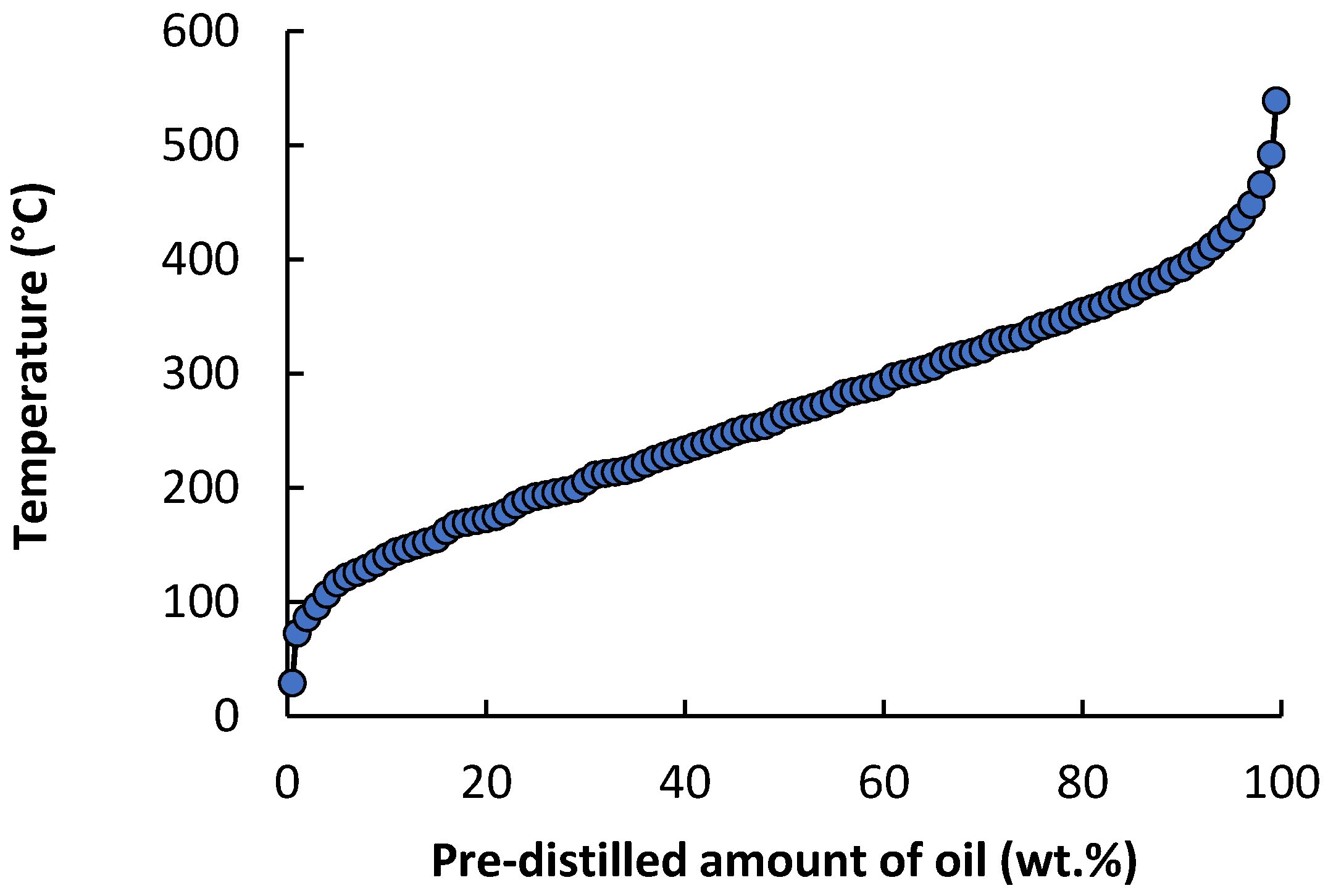
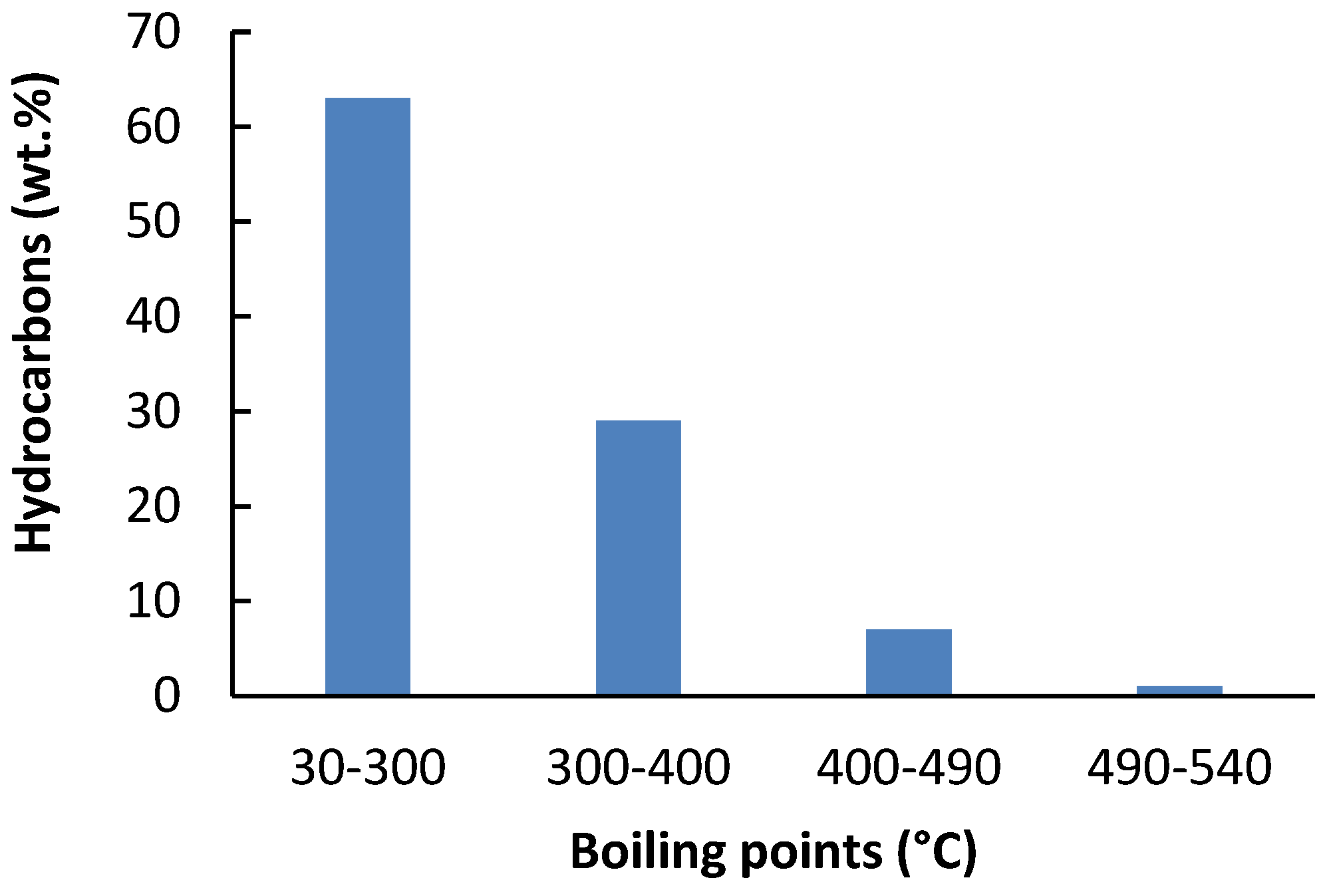
Based on the composition of the oil determined by GC-MS analysis, a distillation analysis was carried out to assess the volatility of the oil vapors (temperature) as a function of the distilled volume fraction. The resulting distillation curve (Figure 2), evaluated according to ASTM D2887 [27], reveals the presence of distinct fractions within the oil, which is essential for its further technological utilization. The European standard UNE-EN 228 specifies the required evaporated volume percentages at 70 °C, 100 °C, and 150 °C (E70/E100/E150) [32]. In contrast, the American standard ASTM D4814 defines the temperatures at which 10%, 50%, and 90% of the fuel volume evaporates (T10/T50/T90) [33]. From the distillation curve, temperature ranges corresponding to characteristic fractions were identified and are summarized in Figure 3. Muhammad et al. obtained a similar PE distillation curve [28].
Simulated distillation showed that liquid hydrocarbons with a boiling point up to 300 °C were contained in the oil in an amount of 63 wt.% and solid hydrocarbons with a boiling point of 300–400 °C in an amount of 29 wt.%; other items are evident from Figure 3. Although these results vary somewhat, it can be said that the simulated distillation confirmed a significant predominance of desirable liquid hydrocarbons in the obtained oil. The oil contained only about 7 wt.% of a heavy oil fraction, consisting of hydrocarbons above C20, which may be suitable for use as lubricating oils. Overall, the oil obtained can serve as a source of valuable hydrocarbons and solvents, together with paraffin.
Furthermore, the oil contained only 0.22 N and 0.03 S, which are present from the dyes and cross-linking agents used, as well as a low content of oxygen, which was calculated to be 100 wt.% (Table 2). The specific density of the pyrolysis oil (788 kg m−3) obtained from waste PEX indicates its potential for blending with gasoline (720–800 kg m−3) or diesel (830–880 kg m−3), depending on the intended application [10]. The importance of specific density for ensuring proper combustion performance in engines was emphasized in the study by Mwangi et al. [34]. The moisture content was very low, 0.01 wt. %, and the oil was ash-free. The high heating value (45 MJ kg−1) of the oil was determined using a calorimetric method and its low heating value (41 MJ kg−1) was subsequently calculated by ČSN ISO 1928 [25]. The values of the elemental analysis and the energy content of the oil are very close to the values obtained by catalytic pyrolysis of waste XLPE at 500 °C with a ruthenium catalyst [18]. Thus, the oil obtained at large-scale can serve as a high-quality liquid fuel with low emissions, similar to light fuel oil [31,35].
Finally, the density and viscosity of oil obtained were measured to determine the suitability of the oil as a lubricant. The density and kinematic viscosity values were very similar to those of the plastic pyrolytic oil (734 kg m−3; 2.9 mm2 s−1) reported by Singh et al. [29]. Thus, the oil has good lubricant properties. Moreover, the kinematic viscosity of the oil at 40 °C indicated that the oil obtained from large-scale pyrolysis can be used industrially as a lubricant in the corresponding viscosity classes according to ISO 3448 [36], and according to the application groups and areas of use listed in ISO 6743 [37]. The density and fluidity of the oils are very acceptable for their possible transport. The lubricating oils obtained can also be used as anti-corrosion agents due to their hydrophobic nature.

3.3. By-Product—Gas

As mentioned, repeated gas sampling into Tedlar bags was performed during pyrolysis. Since the composition of the gas did not change significantly during pyrolysis, and because gas samples were collected at relatively short time intervals (10 min), it was possible to express its composition using average values for the gaseous components. Gas evolution was observed from a temperature of 420 °C by automatic flare ignition. The main components of gas were gaseous hydrocarbons up to C5, in a total amount of 63 vol.%, and hydrogen, 21 vol.% (Table 3). On the other hand, the oxygen content was very low and the nitrogen content was also low, indicating that the pyrolysis unit was tight and these inert components could have entered the gas through handling during sampling. This means that the heating values are moderately high and the use of the gas is therefore realistic. This is confirmed by the heating values that are based on the composition shown in Table 3. One possible use is to heat an operational pyrolysis unit.

3.4. By-Product—Solid Carbonaceous Residue

The solid carbonaceous residue (SCR) was 15.5 wt.%, which is a moderately high yield. It is therefore necessary to carefully assess its properties and deduce whether it is useful or a waste product. Proximate analysis and elemental composition of SCR are shown in Table 4.
Based on Table 4, it follows that the ash and sulfur contents in the resulting SCR were quite high. On the other hand, the combustible matter and carbon content were high and thus the SCR can potentially be used as a solid fuel, which is also supported by the HHV and LHV (37 and 36 MJ kg−1, respectively). However, it must first be desulfurized and the ash content significantly reduced. Currently, new desulfurization and ash removal methods are being developed and can be considered for this purpose as well as for SCR, such as, a method for removing sulfur from lignin with the efficiency reached almost 85% [38]. Further, although the combined flotation and oxidation method favors the removal of inorganic sulfur over organic sulfur, the method [39] also significantly reduces the ash content and is therefore applicable for SCR deashing. Additionally, a method was evaluated for removing pyritic sulfur and ash, which involved testing a new high-voltage pulse technique followed by particle size separation [40]. A significant decrease in organic sulfur content in low-rank coal by co-pyrolysis with reduced iron powder followed by dry magnetic separation was observed by Xia et al. [41].
In parallel with the elemental organic analysis, elemental inorganic analysis of SCR was also performed using the XRF method, which quantified metals, sulfur, and chlorine. Table 4 shows lower contents of detected elements, with the exception of Si, Fe, and Ni, which originate from the raw material and catalyst. It is very likely that processing SCR using the methods described above will reduce the content of all of the listed elements.
Overall, SCR appears problematic. However, its improvement is probably possible with newly developed mineral processing methods, but further attention is needed to address this issue. For now, SCR must be considered a loss.

3.5. Efficiency of the Process

The following input data were used to calculate the process efficiency according to Equation (2): LHVoil and LHVgas 41.46 and 37.23 MJ kg−1, respectively (Table 2 and Table 3); LHVPEX 42.89 MJ kg−1 (Table 1), Q 0.80 MJ kg−1 (for 420 °C), and LHVSCR 36.37 MJ kg−1 (Table 4). Pyrolysis yielded 72.6% oil, 11.8% energy gas, and 15.5% SCR. Thus, EPLHV was 69.92%.
The following input data were used to calculate the process efficiency according to Equation (3): HHVoil and HHVgas 44.70 and 40.38 MJ kg−1, respectively (Table 2 and Table 3); HHVPEX 45.97 MJ kg−1 (Table 1), Q 0.80 MJ kg−1 (for 420 °C), and HHVSCR 37.23 MJ kg−1 (Table 4). Pyrolysis yields are given above. Thus, EPHHV was 70.84%. In average, EP was 70.38%.
Overall, the 70% efficiency of the process is acceptable, given that PEX is non-technological waste that is difficult to process due to its resistance, and because the main products, hydrocarbons, are in high demand.

4. Discussion

The reason for choosing α-Fe2O3 was that this catalyst is relatively inexpensive and readily available, according to laboratory-scale tests, and also quite effective. We tested various catalysts with different results (Table 5). PEX can be thermally processed without a catalyst, but the resulting oil does not contain the highly desirable liquid C5–C9 hydrocarbons. Very good results were achieved with ruthenium, where the addition of 1 wt.% Ru led to a significant yield of these lower hydrocarbons (39 wt.% in oil, Table 5), an overall high yield of liquid hydrocarbons (92 wt.% in oil, Table 5), and a low yield of the less desirable C18–C35 solid hydrocarbons (8 wt.% in oil, Table 5). However, a significant disadvantage is the high price of ruthenium. Good results were also achieved with FeTiO3 (lower hydrocarbons C6–C9, 15 wt.% in oil, Table 5) and overall high yield of liquid hydrocarbons of 82 wt.% in oil (Table 5), which was effective (yield of oil 92 wt.%, Table 5) and has the great advantage of being very inexpensive, as it is a waste product from titanium-white production. Waste PEX can therefore be processed together with this waste into products that are in high demand. The disadvantage is that it is not yet established as a catalyst. Furthermore, the well known and widely used FCC (fluid catalytic cracking catalyst) was tested. To achieve the required degree of cleavage in the PEX rigid structure, it was necessary to use 10 wt.% of catalyst. Unfortunately, its use led to a high proportion of undesirable hydrocarbons >C35, which would probably cause difficulties in its practical use. Due to the high consumption and lower quality of oil, it was therefore no longer considered a suitable catalyst. Finally, α-Fe2O3 was tested. Laboratory pyrolysis with this catalyst gave a high oil yield and a good composition for practical use (Table 5). However, an addition of 2 wt.% and a very fine grain size were required. Due to its availability and low cost, this catalyst was chosen for the large-scale test. The results of large-scale pyrolysis differed from the laboratory tests, indicating a lower oil yield and higher SCR yield. The composition of the obtained oil, however, was very favorable, as Table 5 shows. For the reasons given above, further large-scale tests will focus on the use of the FeTiO3 catalyst.
As mentioned, the process efficiency of 70% is assumed acceptable. It can probably be improved by an important process parameter, the residence time of volatile products in the reactor, which has a significant effect on the oil composition (the longer the residence time, the higher the proportion of liquid hydrocarbons compared to solid ones). In many cases, this parameter is difficult to quantify. In this case, the effect of residence time was tested in a comparative laboratory experiment, where 20 g of waste PEX with catalyst was heated at the specified heating rate (4 K min−1) to the final temperature of 470 °C (stationary conditions) and then again in the same way, but with a nitrogen flow rate of 100 cm3 min−1 (dynamic conditions). As a result, the residence time of volatiles in the pyrolysis zone with flowing nitrogen was much shorter than under stationary conditions. The content of liquid and solid hydrocarbons in the obtained oil was then compared. When pyrolyzed under stationary conditions, the oil (100%) contained a high proportion of liquid hydrocarbons, 92%, and few solid hydrocarbons (8%). Under dynamic conditions, the opposite was true, with a liquid hydrocarbon content of 11% and a solid hydrocarbon content of 89%, because the residence time of volatile products in the pyrolysis zone was too short and the cleavage of the rigid PEX structure was limited. This demonstrated that the large-scale pyrolysis conditions were adequately chosen, as high or at least acceptable yields of liquid aliphatic hydrocarbons were achieved. Further, this means that by reducing the residence time, higher process efficiency can be achieved because, as follows from above, with longer residence time, the oil has a high content of liquid hydrocarbons and few solid ones, but with shorter residence time this ratio changes in favor of solid hydrocarbons. This can be ensured by a lower heating rate of PEX material in the reactor. Reducing the heating rate from 4 to 3 K min−1 is quite feasible and can be considered as a further research task. Such a reduction would not significantly increase the total pyrolysis time or processing costs.
Another task is to reduce the ash content in the resulting SCR and also to reduce the iron content, which is more than 4%, practically 4.5% (Table 4). In the past, several methods have been developed for coal washing, an industrial method in which coal is mixed with water and chemicals to separate impurities based on different densities. It is a process that removes impurities from coal by crushing and screening it, and then uses techniques such as gravity separation or froth flotation to separate the cleaner coal from heavier materials such as rocks, ash, and sulfur. Magnetic separation methods have also been developed, which use powerful magnets to remove iron impurities from coal. All of these methods can be used for mineral processing of carbonaceous materials, including SCR. These methods are both standardized and still under development [42,43], which is a positive fact for SCR cleaning. It is very likely that magnetic separation using strong and affordable NdFeB magnets would significantly reduce both Fe and ash content in SCR [44].

5. Conclusions

It was demonstrated that waste PEX can be efficiently processed by Fe2O3-catalyzed slow pyrolysis on a large scale, with achieving an overall process efficiency of 70%, which is acceptable given the non-technological character of this waste. The selected process conditions (temperature, heating rate, catalyst amount) used effectively converted PEX predominantly into liquid products with a high oil yield of almost 73 wt.%. The resulting oil consisted mainly of liquid hydrocarbons up to C17 (78 wt.%) together with nearly 20 wt.% of solid hydrocarbons C18–C28, confirming its broad applicability across various industries, such as petrochemicals, fuel manufacturing, and chemical production, and potentially as a feedstock for industrial lubricants and oils. Its very low sulfur content (0.03 wt.%) further supports its suitability as a low-emission fuel. In addition to the oil, gaseous and solid carbonaceous residues were produced in non-negligible amounts of 11.8 wt.% and 15.5 wt.%, respectively. The gas exhibited a high heating value of 51.7 MJ·m−3, and can be primarily used to for heating the pyrolysis unit, thereby reducing its operating costs, or potentially used in a gas engine under favorable conditions. The solid carbonaceous residues, however, appear more challenging due to their elevated sulfur content (0.6 wt.%). Their upgrading is likely feasible through conventional or newly developed mineral-removal methods.
In the subsequent research phase, the experimental program will be systematically enhanced to evaluated the influence of different catalyst additions (0.5 wt.% and 1 wt.%) on the yield, distribution, and chemical composition of the individual products. This approach will allow more reliable support for the presented results, refine knowledge of the catalytic mechanism, and further assess the efficiency and reproducibility of the overall pyrolysis process.

Author Contributions

Investigation, methodology, writing—original draft, and writing—review and editing, P.S.; investigation, methodology, formal analysis, writing—original draft, and writing—review and editing, O.B. All authors have read and agreed to the published version of the manuscript.

Funding

This research was funded by Project No. TP01010055, Technology Agency of the Czech Republic, GAMA 2 program; the Strategy AV21 Research Program of the Czech Academy of Sciences: Sustainable Energy (VP27); and by the Long-Term Project for the Conceptual Development of the Research Organization, No. RVO 67985891.

Institutional Review Board Statement

Not applicable.

Informed Consent Statement

Not applicable.

Data Availability Statement

Data will be available on request.

Conflicts of Interest

The authors declare no conflicts of interest.

References

  1. OECD. Global Plastics Outlook. Available online: https://www.oecd.org/en/publications/global-plastics-outlook_de747aef-en/full-report/component-5.html#execsumm-d1e349 (accessed on 31 October 2025).
  2. Zhuhai New Technology Co., Ltd. Crosslinked Polyethylene Treatment Device Utility Model CN210525593U, 15 May 2020.
  3. Pujiang Jinxin Waste Material Recycling Co., Ltd; Zhejiang University. Recovery Process for Crosslinked Polyethylene Wastes. Patent CN105061805A, 29 June 2018. [Google Scholar]
  4. Nanjing Haoxiang Machinery Manufacturing Co., Ltd. Cross-Linked Polyethylene Cable Material Recovery System. Patent CN232268830, 19 April 2018. [Google Scholar]
  5. Handa Janak, H. System and Process for Converting Plastic Waste to Oil Products. Patent Application W2018085934, 17 May 2018. [Google Scholar]
  6. Borealis GmbH. Composition Based on Recycled Polyethylene from Cable Waste. Patent KR1020170082639A, 22 May 2018. [Google Scholar]
  7. Shenzhen Changyuan Tefa Technology Co., Ltd. Environment-Friendly Recycling Method of Cross-Linked Polyolefin Foaming Material. Patent CN313675730, 4 June 2020. [Google Scholar]
  8. Butler, E.; Devlin, G.; McDonell, K. Waste Polyolefins to Liquid Fuels via Pyrolysis: Review of Commercial State-of-the-Art and Recent Laboratory Research. Waste Biomass Valoriz. 2011, 2, 227–255. [Google Scholar] [CrossRef]
  9. Keane, M.A. Catalytic transformation of waste polymers to fuel oil. ChemSusChem 2009, 2, 207–214. [Google Scholar] [CrossRef] [PubMed]
  10. Rahaman, M.; Paul, S.; Das, N.C. Catalytic and Noncatalytic Pyrolysis of Waste Plastics: Comparative Analysis of Liquid Products from Polyethylene, Polypropylene, and Mixed Plastics with Diesel and Petrol. Ind. Eng. Chem. Res. 2025, 64, 3240–3253. [Google Scholar] [CrossRef]
  11. Li, S.; Xue, Y.; Lin, Y.; Wang, B.; Gao, X. Synergistic Activity of the Fe2O3/Al2O3 Catalyst for Hydrogen Production through Pyrolysis-Catalytic Decomposition of Plastics. ACS Sustain. Chem. Eng. 2023, 11, 10108. [Google Scholar] [CrossRef]
  12. Tran, T.T.; Tran, H.Q.; Tran, D.H.; Nguyen, T.N.; Phung, T.K.; Do, T.C. The effect of reaction conditions and catalysts on the pyrolysis of polyethylene. Sci. Technol. Dev. J. 2024, 27, 3375–3384. [Google Scholar] [CrossRef]
  13. van de Minkelis, J.H.; Hergesell, A.H.; van Der Waal, J.C.; Altink, R.M.; Vollmer, I.; Weckhuysen, B.M. Catalytic Pyrolysis of Polyethylene with Microporous and Mesoporous Materials: Assessing Performance and Mechanistic Understanding. ChemSusChem 2025, 18, e202401141. [Google Scholar] [CrossRef]
  14. Li, Y.; Dang, J.; Ma, Y.; Ma, H. Hematite: A Good Catalyst for the Thermal Decomposition of Energetic Materials and the Application in Nano-Thermite. Molecules 2023, 28, 2035. [Google Scholar] [CrossRef]
  15. Du, Y.; Huang, Z.; Zhang, J.; Jing, G. Fe2O3/HY Catalyst: A Microporous Material with Zeolite-Type Framework Achieving Highly Improved Alkali Poisoning-Resistant Performance for Selective Reduction of NOx with NH3. Environ. Sci. Technol. 2020, 54, 7078–7087. [Google Scholar] [CrossRef]
  16. Papari, S.; Bamdad, H.; Berruti, F. Pyrolytic Conversion of Plastic Waste to Value-Added Products and Fuels: A Review. Materials 2021, 14, 2586. [Google Scholar] [CrossRef]
  17. Mo, S.-J.; Zhang, J.; Liang, D.; Chen, H.-Y. Study on Pyrolysis Characteristics of Cross-linked Polyethylene Material Cable. Procedia Eng. 2013, 52, 588–592. [Google Scholar] [CrossRef]
  18. Straka, P.; Bičáková, O.; Cihlář, J. Slow Low-Temperature Pyrolysis of Waste Cross-Linked Polyethylene with a Ruthenium Catalyst, Preprint. Available online: https://papers.ssrn.com/sol3/papers.cfm?abstract_id=4577548 (accessed on 10 October 2025).
  19. ČSN EN ISO 15512; Plastics—Determination of Water Content. Technor: Hradec Králové, Czech Republic, 2010.
  20. ČSN EN ISO 3451-1; Plastics—Determination of Ash—Part 1: General Methods. Technor: Hradec Králové, Czech Republic, 2009.
  21. ČSN ISO 562; Hard Coal and Coke—Determination of Volatile Matter. Technor: Hradec Králové, Czech Republic, 2024.
  22. ČSN ISO 333; Coal—Determination of Nitrogen—Semi-Micro Kjeldahl Method. Technor: Hradec Králové, Czech Republic, 1996.
  23. ČSN ISO 334; Coal and Coke—Determination of Total Sulfur—Eschka Method. Technor: Hradec Králové, Czech Republic, 2020.
  24. ČSN ISO 625; Coal and Coke—Determination of Carbon and Hydrogen. Technor: Hradec Králové, Czech Republic, 1996.
  25. ČSN ISO 1928; Coal and Coke—Determination of Gross Calorific Value. Technor: Hradec Králové, Czech Republic, 2020.
  26. Li, F.; Wang, X.; Pan, H.; Li, Q.; Yang, J. Preparation of disk-like α-Fe2O3 nanoparticles and their catalytic effect on extra heavy crude oil upgrading. Fuel 2019, 251, 644–650. [Google Scholar] [CrossRef]
  27. ASTM D2887-22e1; Standard Test Method for Boiling Range Distribution of Petroleum Fractions by Gas Chromatography. ASTM International (formerly American Society for Testing and Materials): West Conshohocken, PA, USA, 2022.
  28. Muhammad, C.; Onwudili, J.A.; Williams, P.T. Thermal Degradation of Real-World Waste Plastics and Simulated Mixed Plastics in a Two-Stage Pyrolysis–Catalysis Reactor for Fuel Production. Energy Fuels 2015, 29, 2601–2609. [Google Scholar] [CrossRef]
  29. Singh, R.; Ruj, B.; Sadhukhan, A.; Gupta, P.; Tigga, V. Waste Plastic to Pyrolytic Oil and Its Utilization in CI Engine: Performance Analysis and Combustion Characteristics. Fuel 2020, 262, 116539. [Google Scholar] [CrossRef]
  30. Kassargy, C.; Awad, S.; Burnens, G.; Kahine, K.; Tazerout, M. Experimental study of catalytic pyrolysis of polyethylene and polypropylene over USY zeo-lite and separation to gasoline and diesel-like fuels. J. Anal. Appl. Pyrolysis 2017, 127, 31–37. [Google Scholar] [CrossRef]
  31. Quesada, L.; Calero, M.; Martín-Lara, M.Á.; Pérez, A.; Blázquez, G. Production of an Alternative Fuel by Pyrolysis of Plastic Wastes Mixtures. Energy Fuels 2020, 34, 1781–1790. [Google Scholar] [CrossRef]
  32. UNE-EN-228:2013+A1; Automotive Fuels—Unleaded Petrol—Requirements and Test Methods. Asociación Española de Normalización (UNE): Madrid, Spain, 2019. Available online: https://www.scribd.com/document/751011765/EX-UNE-EN-228-2013-A1-2017 (accessed on 14 October 2025).
  33. ASTM D4814–21; Standard Specification for Automotive Spark-Ignition Engine Fuel. ASTM International (American Society for Testing and Materials): West Conshohocken, PA, USA, 2021. Available online: https://www.astm.org/Standards/D4814.htm (accessed on 14 October 2025).
  34. Mwangi, J.K.; Lee, W.J.; Chang, Y.C.; Chen, C.; Wang, L.C. An overview: Energy saving and pollution reduction by using green fuel blends in diesel engines. Appl. Energy 2015, 159, 214–236. [Google Scholar] [CrossRef]
  35. Tariq, A.I.; Saleh, A.M. An experimental investigation into the combustion properties, performance, emissions, and cost reduction of using heavy and light fuel oils. Case Stud. Therm. Eng. 2023, 44, 102832. [Google Scholar] [CrossRef]
  36. ISO 3448:1992; Industrial Liquid Lubricants—ISO Viscosity Classification. International Organization for Standardization (ISO): Geneva, Switzerland, 1992.
  37. ISO 6743-4:2015; Lubricants, Industrial Oils and Related Products (Class L)—Classification—Part 4: Family H (Hydraulic Systems). International Organization for Standardization (ISO): Geneva, Switzerland, 2015.
  38. Fazal, A.; Rafique, U.; Laraib, S.; Iqtidar, A. Imminent prognosis for piperazinium-based ionic liquids applications for coal desul-furization. Fuel 2024, 378, 132918. [Google Scholar] [CrossRef]
  39. Cheng, G.; Li, Y.; Cao, Y.; Zhang, Z. A novel method for the desulfurization of medium–high sulfur coking coal. Fuel 2023, 335, 126988. [Google Scholar] [CrossRef]
  40. Li, Y.S.; He, M.B.; Shi, F.N. High voltage pulse-enabled coal desulfurization and deashing—Part 1: Selective breakdown of mineral matter. Fuel 2021, 300, 120970. [Google Scholar] [CrossRef]
  41. Xia, W.C.; Li, Y.J.; He, W.Z.; Peng, Y.L. Desulfurization of low rank coal co-pyrolysis with reduced iron powder followed by dry magnetic separation. J. Clean. Prod. 2018, 204, 525–531. [Google Scholar] [CrossRef]
  42. Ma, D.; Jia, S.; Hu, Z.; Wang, X.; Li, L.; Tan, H.; Rahman, Z.U. Experimental investigation of water washing effect on high-chlorine coal properties. Fuel 2022, 319, 123838. [Google Scholar] [CrossRef]
  43. Cebeci, Y.; Ulusoy, U.; Sönmez, İ. Determination of optimum washing conditions for a lignite coal based on ash and sulfur content. Fuel 2014, 123, 52–58. [Google Scholar] [CrossRef]
  44. Straka, P.; Žežulka, V. Linear structures of Nd-Fe-B magnets: Simulation, design and implementation in mineral processing—A review. Miner. Eng. 2019, 143, 105900. [Google Scholar] [CrossRef]
Figure 1. Schema of the large-scale experiment.
Sustainability 18 00339 g001
Figure 2. Distillation curve of simulated distillation of the PEX oil sample, by linear heating to 410 °C, heating rate 15 K min−1, with a helium carrier gas flow rate of 5 mL min−1.
Sustainability 18 00339 g002
Figure 3. Liquid and solid hydrocarbons in the oil determined by simulated distillation using linear heating to 410 °C, a heating rate of 15 K min−1, and a helium carrier gas flow rate of 5 mL min−1.
Sustainability 18 00339 g003
Table 1. Proximate analysis of waste PEX (wt.%, as received), elemental composition of combustible organic matter (wt.%), and heating values (MJ kg−1) (averages for n = 5). W—water, A—ash, CM—combustible matter, HHV—higher heating value, LHV—lower heating value.
WACMHCNSOHHVLHV
0.090.6699.2514.1081.550.600.003.0045.9742.89
±0.03±0.24±0.22±0.32±0.43±0.11±0.00±0.29±0.69±0.71
Table 2. Composition and physical properties of pyrolysis oil obtained with α-Fe2O3 catalyst. HHV—higher heating value, LHV—lower heating value.
Chemical Composition (wt.%)
C5–C9C10–C17C18–C28BenzeneTolueneAlkylbenzenes
46.7430.7819.820.950.850.73
Elemental Composition (wt.%); HHV and LHV(MJ kg−1)
WaterCHNSOHHVLHV
0.0184.8714.030.220.032.8544.7041.46
Physical Properties (20 °C)
Density
(kg m−3)
Dynamic viscosity (mPa·s)Kinematic viscosity (mm2 s−1)Fluidity
(Pa·s)−1
788.102.232.83462.79
Table 3. Average composition and physical properties of pyrolysis gas obtained with α-Fe2O3 catalyst (vol.%) (n = 7). HHV—higher heating value, LHV—lower heating value.
Gas Composition (vol.%)
CH4C2H4C2H6C3H6C3H8C4C5H2COCO2O2N2
14.1815.509.9113.033.701.185.2921.030.5112.220.682.78
±1.67±0.54±0.17±0.31±0.73±0.36±0.64±0.43±0.18±0.11±0.35±1.32
Heating Values and Gas Density
HHV (MJ m−3)/MJ/kgLHV (MJ m−3)/MJ/kgGas density (kg m−3)
51.69 ± 2.23/40.38 ± 1.7447.65 ± 2.07/37.23 ± 1.62 1.28 ± 0.03
Table 4. Proximate analysis of SCR, elemental organic analysis of its combustible organic matter, and elemental inorganic analysis (as received, wt.%). W—water, A—ash, CM—combustible matter. HHV—higher heating value, LHV—lower heating value.
Proximate Analysis and Elemental Organic Analysis (wt.%)
WACMHCNSOHHVLHV
1.2521.9478.063.9794.470.930.620.0137.2336.37
Elemental Inorganic Analysis (wt.%)
MgAlSiSClKCaTiFeNiZn
0.090.242.750.360.250.350.560.414.441.100.14
Note: After dry magnetic separation using the NdFeB magnet, the Fe content decreased to 0.8693 ± 0.0035 wt.%. Si in the char comes from the production of PEX by the silane method (silane-grafted PEX).
Table 5. Mass balance of pyrolysis (wt.%) and composition of obtained oils (wt.%) from waste XLPE pyrolysis without and with various catalysts (wt.%) at 5 K min−1, up to 470 °C, delay at the end temperature 30 min, laboratory-scale. SCR—solid carbonaceous residue.
CatalystMass BalanceOil Composition
OilGasSCRC6–C9C10–C17C18–C35>C35
-93.675.071.260.0090.619.390.00
Ru (1%)90.826.832.3539.2352.897.880.00
FeTiO3 (1%)92.076.671.2614.5767.4018.030.00
FCC (10%)86.3411.132.5336.7437.466.1919.61
α-Fe2O3 (2%)90.828.071.1135.9647.0417.000.00
Disclaimer/Publisher’s Note: The statements, opinions and data contained in all publications are solely those of the individual author(s) and contributor(s) and not of MDPI and/or the editor(s). MDPI and/or the editor(s) disclaim responsibility for any injury to people or property resulting from any ideas, methods, instructions or products referred to in the content.