
Article

Development and Validation of a Benthic Diatom Index of Biotic Integrity (BD-IBI) for Ecosystem Health Assessment in the Songhua River Basin

1
State Key Laboratory of Environmental Criteria and Risk Assessment, Chinese Research Academy of Environmental Sciences, Beijing 100012, China
2
Shanghai Environmental Monitoring Center, Shanghai 200235, China
*
Authors to whom correspondence should be addressed.
Sustainability 2026, 18(1), 291; https://doi.org/10.3390/su18010291 (registering DOI)
Submission received: 11 November 2025 / Revised: 12 December 2025 / Accepted: 25 December 2025 / Published: 27 December 2025

Abstract

The Songhua River, as the third-largest river in China, has garnered increasing attention for its ecological health. This study established a water ecological health assessment system for the Songhua River Basin based on the BD-IBI. Through a comprehensive analysis, including distribution range analysis, discriminant ability analysis, and correlation analysis, 97 candidate indicators were evaluated. Among these, IDSE Leclercq (IDSE), Indice Diatomique Artois Picardie (IDAP), RA. motile individuals, RA. ß-mesosaprobic, and RA. polysaprobe were selected as the core indicators for BD-IBI construction in the Songhua River Basin. The water ecological health status of the Songhua River Basin was categorized into five levels. Furthermore, environmental factors influencing BD-IBI and water quality were analyzed using box plot analysis, redundancy analysis (RDA), and multiple linear regression model. The results indicated that while the Songhua River Basin exhibits an overall “Good” water ecological health, marked heterogeneity exists across sub-reaches. Specifically, the Tangwang River exhibited the highest BD-IBI score, while the Woken River showed the lowest score. Key water quality factors driving BD-IBI changes include DO, EC, NN, TN, TP and QHEI. These findings provide a valuable reference for the assessment and restoration of water ecological environment quality in the Songhua River Basin, promoting the sustainable development of aquatic ecosystems.

1. Introduction

Diatoms constitute one of the most significant aquatic production groups, comprising 90–95% of benthic communities and contributing approximately 20% to global photosynthesis [1,2]. These widespread photosynthetic eukaryotes inhabit not only nutrient-rich high-latitude marine ecosystems [3] but also inland rivers and lakes. Benthic diatoms, a crucial component of riverine ecology, exhibit rapid responses to environmental changes and are highly sensitive to factors such as nutrient concentrations, ion levels, and organic pollution [4]. Rimet et al. [5] reported a stronger correlation between physiochemical parameters and benthic diatoms than that observed for phytoplankton in coastal regions. Soininen et al. [6] suggested that diatom communities are more responsive to chemical alterations than macroinvertebrates. With shorter generation times than fish and macroinvertebrates, benthic diatoms provide a more comprehensive assessment of river ecosystem health [7].
Water ecological assessments rely on evaluating changes in the structure and function of aquatic biological groups when ecosystems are disturbed. Common methods include the biotic index, index of biotic integrity (IBI), and O/E index [8]. These indices comprehensively evaluate water ecosystems using multiple indicators to identify influences originating from diverse and complex sources. In 1981, Karr introduced the concept of biological integrity and utilized fish as indicator organisms to assess river ecosystem health [9]. The IBI effectively describes the interaction between biological characteristics and human disturbances, accurately reflects the health status of ecosystems, and reveals the impacts of human disturbances on biological communities [10]. Moreover, the IBI provides a more comprehensive perspective for assessing aquatic communities and has been widely used in the evaluation of aquatic ecosystem health, often in long-term monitoring and ecological management [11]. Cooper et al. [12] developed a fish-based IBI index to monitor the ecological status of wetlands along the Great Lakes and demonstrated that community structure can reflect non-biotic conditions integrated over time. Huang et al.’s study in the Ganjiang River System in China showed that an IBI using fish and benthic invertebrates as indicator species exhibits stability over time [13]. Therefore, as a method for assessing ecological health, the IBI is an effective tool for supporting the sustainable management of ecosystems through long-term monitoring.
Although fish were initially used as indicator organisms in the early development of IBI [14], this approach has inspired the creation of biological indicators that incorporate other groups and the use of diverse biological assemblages for contemporary applications in water ecosystem health assessment. These include fish [15], phytoplankton [16,17], benthic diatoms [18], macroinvertebrates [19], microorganisms [20], bacteria [21] and others. The benthic diatom index of biotic integrity (BD-IBI) has been developed and applied across various regions, such as the inland plateau ecological regions of the United States [22], rivers of eastern Canada [23], and the Cook Inlet basin in Alaska [24]. These regional variations highlight the importance of selecting an appropriate evaluation system tailored to specific ecological contexts. However, the application of BD-IBI in large-scale basins in China remains limited. Currently, it is primarily used to evaluate ecosystem health within sub-basins or tributaries, such as the upper Han River [25] and the Wutong River in the Songhua River basin [18].
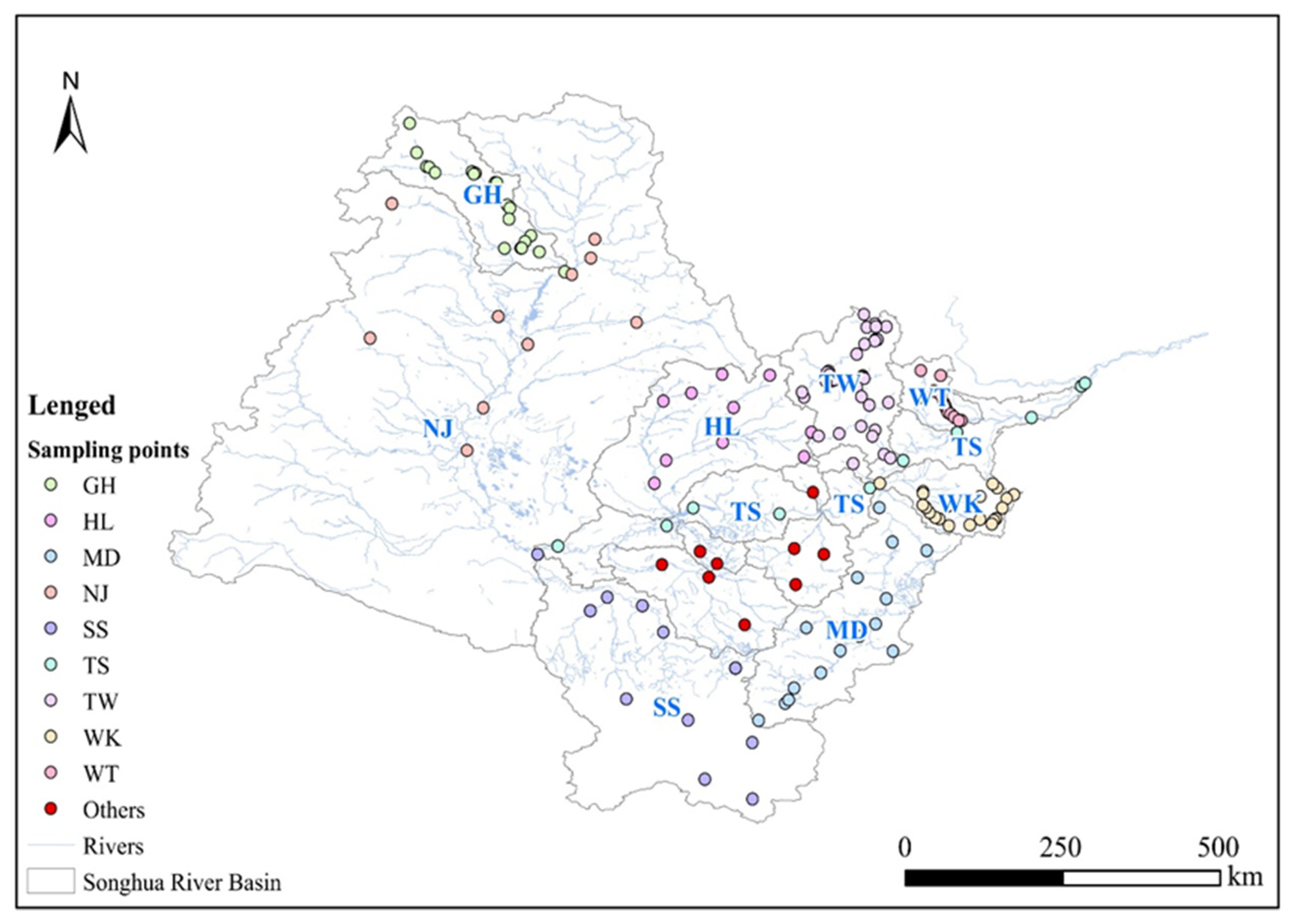
The Songhua River basin, located in northeastern China (Figure 1), serves as a vital production base for industrial manufacturing, agriculture, and animal husbandry [26]. Parts of the basin have been significantly impacted by human activities, compounded by a paucity of relevant water ecology data, thus challenging efforts to preserve the ecological health of the Songhua River basin. Therefore, to advance the application of BD-IBI for ecosystem health assessment and to provide reference values for similar river systems worldwide, this study conducted an evaluation of biological integrity in the Songhua River basin based on benthic diatom communities to analyze water ecosystem conditions. By establishing a standardized analytical method and performing correlation analyses with physicochemical factors and habitat characteristics, this study provides an effective biomonitoring tool tailored to the Songhua River basin. This tool diagnoses the severity of water impairment and provides a scientific basis for environmental restoration, thereby fostering the sustainable development of the ecosystem.

2. Materials and Methods

2.1. Study Area and Site Locations

The study area is located in the Songhua River basin, China (41°42′ N–51°38′ N, 119°52′ E–129°31′ E; Figure 1). The Songhua River, with a length of 1840 km, flows through Jilin, Heilongjiang, and the Inner Mongolia Autonomous Region of China. With a drainage area of 5.57 × 10⁶ km2, it serves as the principal tributary of Heilongjiang’s right bank and accounts for 61% of the water resources in northeast China. The basin is well-developed hydrographically, featuring numerous rivers such as the Hulan, Mudan, Woken, and Tangwang rivers, along with other significant tributaries.
The region is situated within the northern temperate continental monsoon climate zone, characterized by hot, rainy summers and long, frigid winters, with an average annual temperature of 3–5 °C. The Songhua River valley is surrounded by mountains on three sides: the Wanda and Changbai Mountains to the east, the Greater Khingan Mountains to the west, the Lesser Khingan Mountains to the north, and the Songnen Plain in the middle. The basin comprises 62% mountainous regions, 21% hilly areas, and 17% plain regions. Rainfall, seasonal snowmelt, and groundwater are the primary sources of water for the basin, with an average annual total flow of 7.33 × 10¹⁰ m3.
In this study, a total of 157 sample stations were established along the mainstem of the Songhua River and its principal tributaries from 2016 to 2018 (Figure 1). The distribution of sampling points was determined based on the river’s length, with specific site numbers allocated according to each reach and tributary segment: Trunk Stream (TS; 11 sites), Nenjiang River (NJ; 30 sites), Second Songhua River (SS; 12 sites), Wutong River (WT; 15 sites), Tangwang River (TW; 34 sites), Woken River (WK; 21 sites), Hulan River (HL; 10 sites), Mudan River (MD; 15 sites), and others (9 sites).

2.2. Field Sampling and Processing

A bell-shaped plastic cap with a bottom diameter of 2.8 cm was used to demarcate the sampling area. Three rocks were selected from various river habitats (e.g., velocity, depth, and clarity) within 100 m upstream and downstream of each sampling site. A 100 mL wide-mouth plastic bottle was employed to preserve benthic algae after they had been gently scraped off with a soft brush, cleaned, and fixed using a 5% formaldehyde solution. As a quantitative sample of benthic algae [27], the aforementioned procedure was repeated, and the collected samples were utilized as qualitative samples of benthic algae. Upon returning to the laboratory, these samples were stored at low temperatures in darkness.
A total of 0.1 mL of uniformly mixed quantitative samples were pipetted into the plankton counting chamber. Species identification and population enumeration were conducted under a 40× field of view using an optical microscope (OLYMPUS BX51). For Bacillariophyta species, only the cell count was recorded without species-level differentiation, with the average value determined twice at each sampling location. Diatom species identification and quantification were performed under a 1000× field of view using the same microscope.
The mixed qualitative samples were acidified, centrifuged to remove contaminants, and then quantitatively transferred onto coverslips to create diatom seals. At least two seals were examined at each sampling site, with each seal containing a minimum of 400 diatoms [28,29].

2.3. Measurement of Physicochemical Factors

Water temperature (WT), electrical conductivity (EC), dissolved oxygen (DO), and pH were determined on-site using a portable water quality analyzer (YSI Professional Plus, Yellow Springs, OH, USA). Two parallel water samples (2 L each) should be collected from each sampling point, stored at low temperatures, and brought back to the laboratory within 48 h. According to the standard methods outlined in the “Monitoring and Analysis Method of Water and Wastewater” (Fourth Edition), the following chemical parameters were analyzed: dichromate method for chemical oxygen demand (COD), permanganate index (PMI), ammonia nitrogen (AN), nitrate nitrogen (NN), total nitrogen (TN) and total phosphorus (TP). Additionally, a “Habitat Evaluation Indicators and evaluation criteria” form should be completed at each site to obtain qualitative habitat evaluation index (QHEI) scores.

2.4. Development of BD-IBI

2.4.1. Determine the Candidate Indexes

By referring to relevant research results [22,27,30,31], the parameter database was created after 97 indicators were chosen as candidate indicators from seven categories, including biotic index, life type, sensitive taxa, community diversity, ecotype, species richness, and species classification, by combining ecological structure characteristics and community composition structure of riverine benthic diatom.

2.4.2. Selection of Impaired Sites and Reference Sites

Similarly to IBI, numerous other biological evaluations are based on comparisons to reference conditions, including the Multi-Metric Index (MMI) [32] and the O/E index method. The latter specifically evaluates the difference between observed and expected species composition at monitoring sites [33]. The reliability of the evaluation results largely depends on our ability to establish reference conditions, which can be determined using multiple methods, including expert judgment, the establishment of objective thresholds, and comparative analysis of reference conditions. The type of water body, as well as variations in topography, climate, soil, vegetation, and land use patterns across different ecological regions, all influence reference conditions [34]. Furthermore, certain areas lack reference sites due to prolonged and intensive human activities [35]. Therefore, identifying river segments with the least amount of human disturbance is essential for establishing reference sites [16,36].
As the third largest river in China, following the Yangtze and Yellow Rivers, the Songhua River presents unique challenges in establishing reference sites due to its distinct geographical features. Hughes et al. [37] have conducted research indicating that in the assessment of river ecosystem health, physical habitats and physicochemical parameters of water quality are crucial, as they can explain biological data and diagnose the causes of ecosystem damage. Therefore, in this study, the reference sites and damaged sites were determined based on water quality standards and the scores of habitat assessment indicators. Reference sites were identified based on sites with fewer human disturbance activities, with water quality and QHEI factors comprehensively considered. According to the China Surface Water Environmental Quality Standard (GB 3838-2002) [38], the habitat evaluation index was assessed using the river habitat evaluation index and evaluation criteria developed by Zheng et al. [39] in the Liaohe Basin. Specific criteria for selecting reference sites and damaged sites include (1) Reference sites are sampling locations with water quality of Class III or better and a QHEI index score of 120 or above; (2) Damaged sites are sampling locations with water quality that does not exceed Class III criteria and a QHEI score of 90 or lower. It is worth noting that PMI was excluded as a classification criterion in this study, because the PMI is relatively high in the source areas of some tributaries that are close to the original state without human activities. The reasons for this phenomenon will be analyzed in the discussion section.

2.4.3. Screening of Candidate Indicators

To ensure that each parameter of the final IBI is most sensitive and representative of environmental changes, this study successively uses distribution range analysis, discriminant ability analysis (sensitivity analysis), and correlation analysis to screen the above candidate parameters, thereby obtaining core indicators and establishing IBI. These methods can effectively eliminate parameters with low distribution range and poor discriminatory ability, reduce data redundancy, and ensure the independence of parameters. The specific steps of each analysis method are as follows.
  • Distribution range analysis.
First, indicators that score zero at more than 95% of the sites are eliminated; second, if the median of some indicators that decrease with increased interference is zero at the reference site, it indicates that the damaged site has no range of change and should also be deleted [22]; Finally, a non-parametric Kruskal–Wallis test is performed on the candidate parameters. If there is no significant difference between the damaged group and the reference group, the indicator is eliminated [27].
2.
Discriminant ability analysis
The box plots method [30] is used to examine the discriminant ability of all the parameters that were screened in the previous step. Parameters with strong discriminant ability are retained. In the range of 25–75% quantile (corresponding to the upper and lower sides of the box, respectively), different values are assigned based on the overlap of the box plots of the reference group, the mildly damaged group, and the damaged group. The scoring method is as follows: (1) The boxes do not overlap each other, Interquartile range (IQ) = 3; (2) The boxes overlap, but the respective medians are outside each other’s boxes, IQ = 2; (3) One of the medians is within the range of the other box, IQ = 1; (4) Within the range of the other box, IQ = 0. Based on the results of the box plot, only parameters with the IQ > 2 are retained for further analysis.
3.
Correlation analysis
Correlation analysis is performed on the remaining candidate parameters, and only one candidate parameter with a strong correlation is retained. In this study, the correlation coefficient between each parameter was determined using Spearman rank correlation analysis. For candidate parameters with Spearman correlation (r > 0.75, p < 0.05), only one candidate parameter is retained because most of the reaction information is correlated and overlaps.

2.4.4. Unified Evaluation Scale

Using the following formula, the original parameter values of the sample points are normalized to a score ranging from 0 to 10 [40,41]:
Ms = A + B × Mr
If Mr < Mmin, then Ms = 0
If Mr > Mmax, then Ms = 10
where Ms represents the parameter score value and Mr represents the measured value of the parameter. A linear equation with intercept A and slope B is used to convert the original parameters into standardized parameters. For the parameter whose value decreases with environmental degradation, Mmin selects 5% quantile of the data, and Mmax generally selects 95% quantile value or the maximum value. With the increase in environmental degradation, 95% of the parameters were selected for Mmin and 5% for Mmax. After the parameter score is calculated, the average value of each parameter is taken as the total BD-IBI value at each point, and the smaller the value is, the worse the health status of the river is.
Finally, based on the total BD-IBI scores at each sampling site, the assessment criteria were classified into five grades using the 95th percentile as a reference. The score range below the 95th percentile was divided into five equal intervals, designated as “excellent”, “good”, “moderate”, “poor” and “extremely poor” [42].

2.4.5. Data Analysis

The discriminant capacity of the Index of Biotic Integrity (IBI) and candidate parameters across different groups was assessed using boxplots. The distribution of IBI scores across various tributaries was examined using violin plots. Spearman rank correlation analysis and redundancy analysis (RDA) were employed to evaluate the relationship between IBI scores and its core parameters with environmental factors. Additionally, a multiple linear regression model (MLR) was used to investigate the response relationship between IBI scores and environmental factors. In this study, all analyses were conducted using R version 4.4.0, with boxplot analysis and violin plot analysis performed using the “ggplot2” package. Spearman rank correlation analysis and RDA were implemented using the “vegan” package, while MLR was carried out using the “car” package.

3. Results

3.1. Development of the BD-IBI

Twenty reference sites were ultimately selected as the reference group (G1), primarily from areas near the source heads of each tributary, based on the screening methods for reference sites and damage sites mentioned above. A total of 28 damaged sites (G3) were chosen, mostly located in regions with high agricultural activity along the Woken River tributaries. The remaining sites were categorized as mildly damaged group (G2). Table 1 presents the water quality and habitat quality parameters for the three groups. According to the results, concentrations of COD, AN, NN, TN, TP, and EC increased progressively from the reference group to the damaged group. Conversely, DO and QHEI exhibited a gradual decline in concentration.
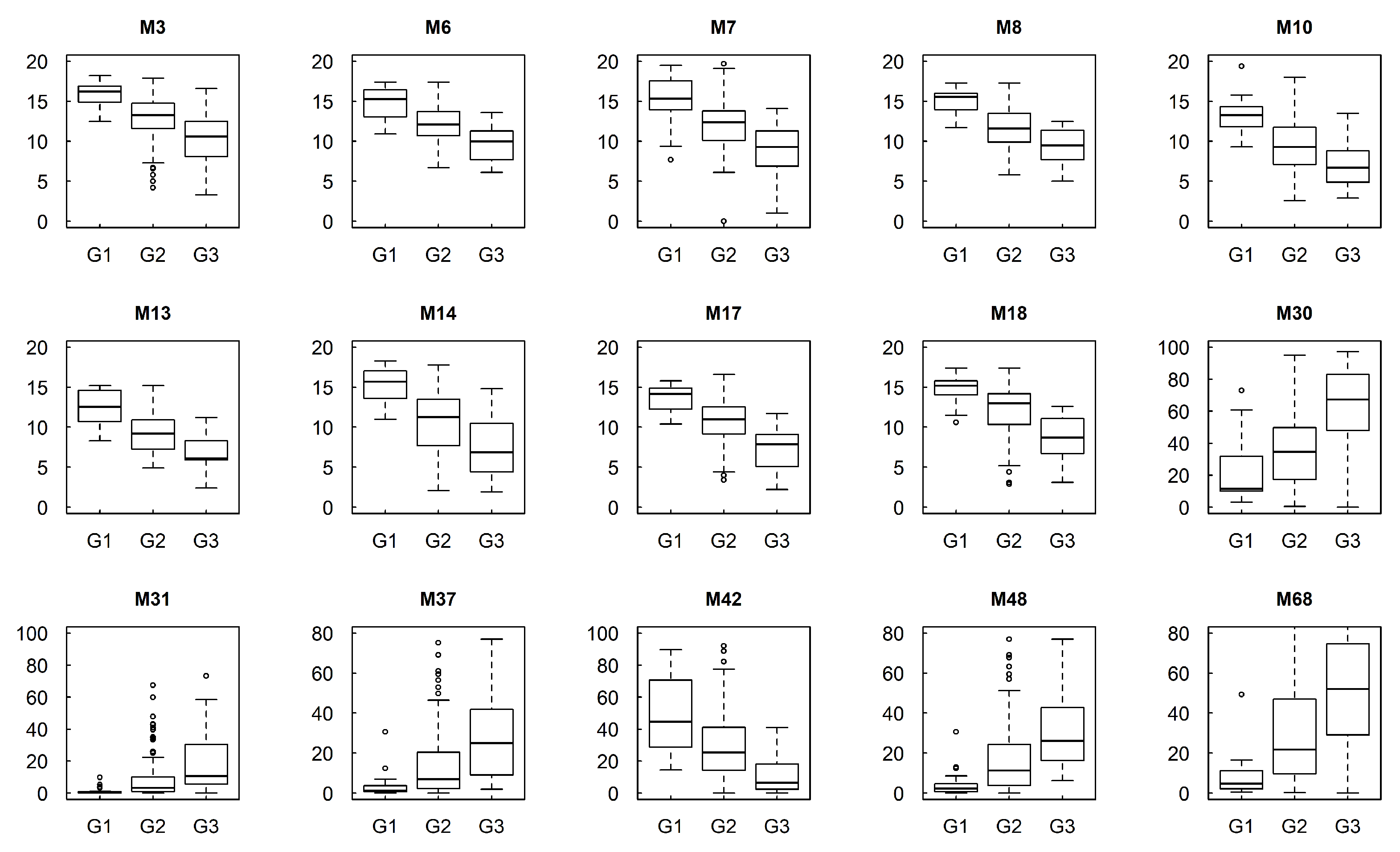
After completing the distribution range analysis and eliminating candidate parameters with insufficient discriminant ability, 15 candidate parameters were retained (Figure 2): IDG (M3), IDSE (M6), IDAP (M7), EPI-D (M8), DI-CH (M10), TDIL (M13), CEE (M14), IDP (M17), SHE (M18), RA. meso-eutrophic (M30), RA. eutrophic (M31), and RA. polysaprobe (M37), RA. β-mesosaprobic (M42), RA. low O2 (M48), RA. motile individuals (M68). To examine the relationships among the 15 candidate parameters, a correlation analysis was conducted. For each pair of parameters showing strong correlation, only one was retained. Based on this screening process, the BD-IBI for the Songhua River basin was constructed using the five core indices: M6, M7, M37, M42 and M68 (Table 2). These five core indicators integrate multiple aspects of ecological information.

3.2. Health Evaluation Results of the BD-IBI

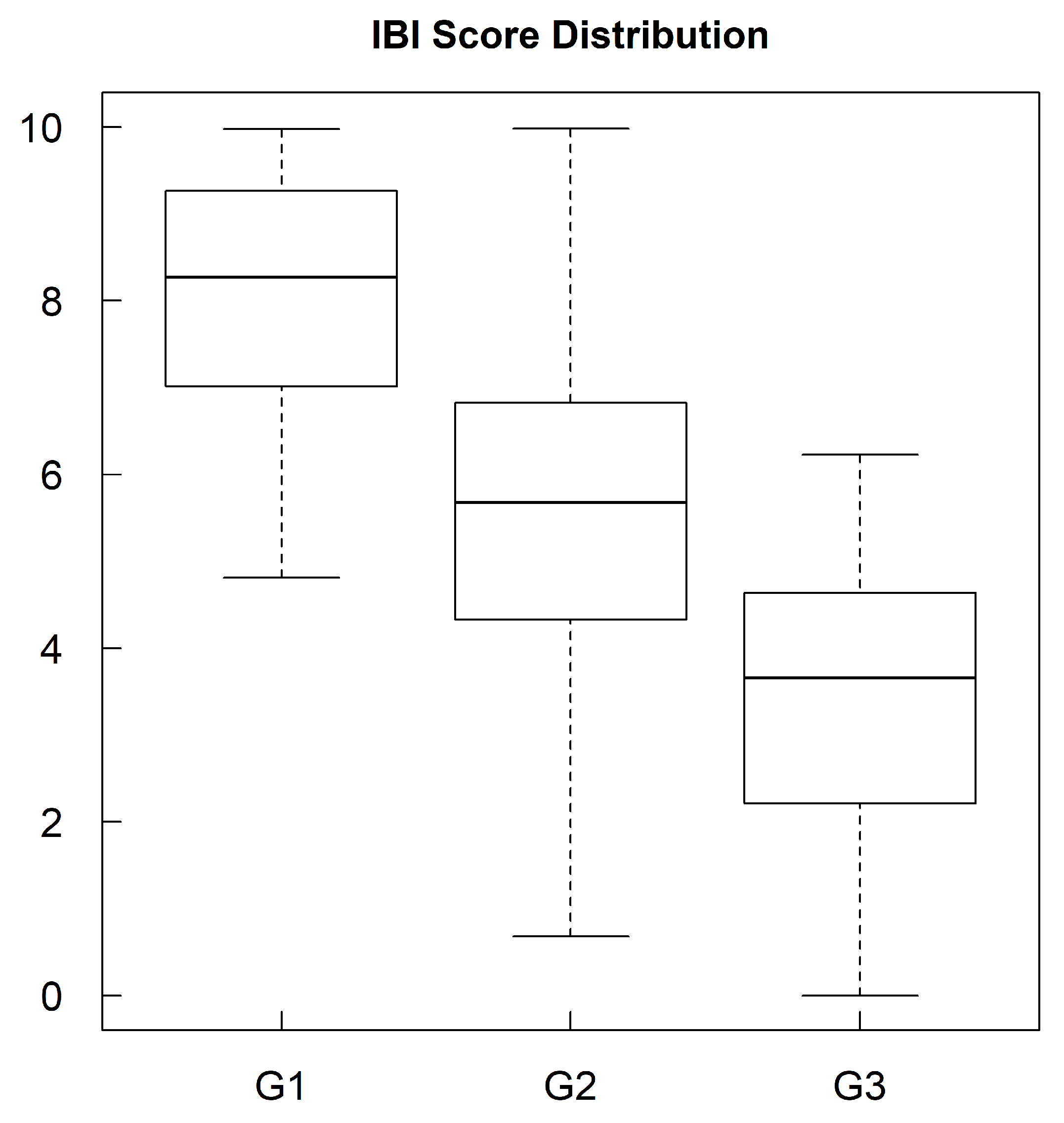
After calculating the BD-IBI scores, box plots were employed to analyze the ability of BD-IBI to distinguish between reference, mildly damaged, and damaged groups (Figure 3). The ranges of the reference group, mildly damaged group, and damaged group did not overlap, with an IQ value of 3. The mildly damaged group and damaged group exhibited minor overlaps, but the median values of each group fell outside the range of the others, also with an IQ value of 2. These findings demonstrate that BD-IBI effectively differentiates the three groups.
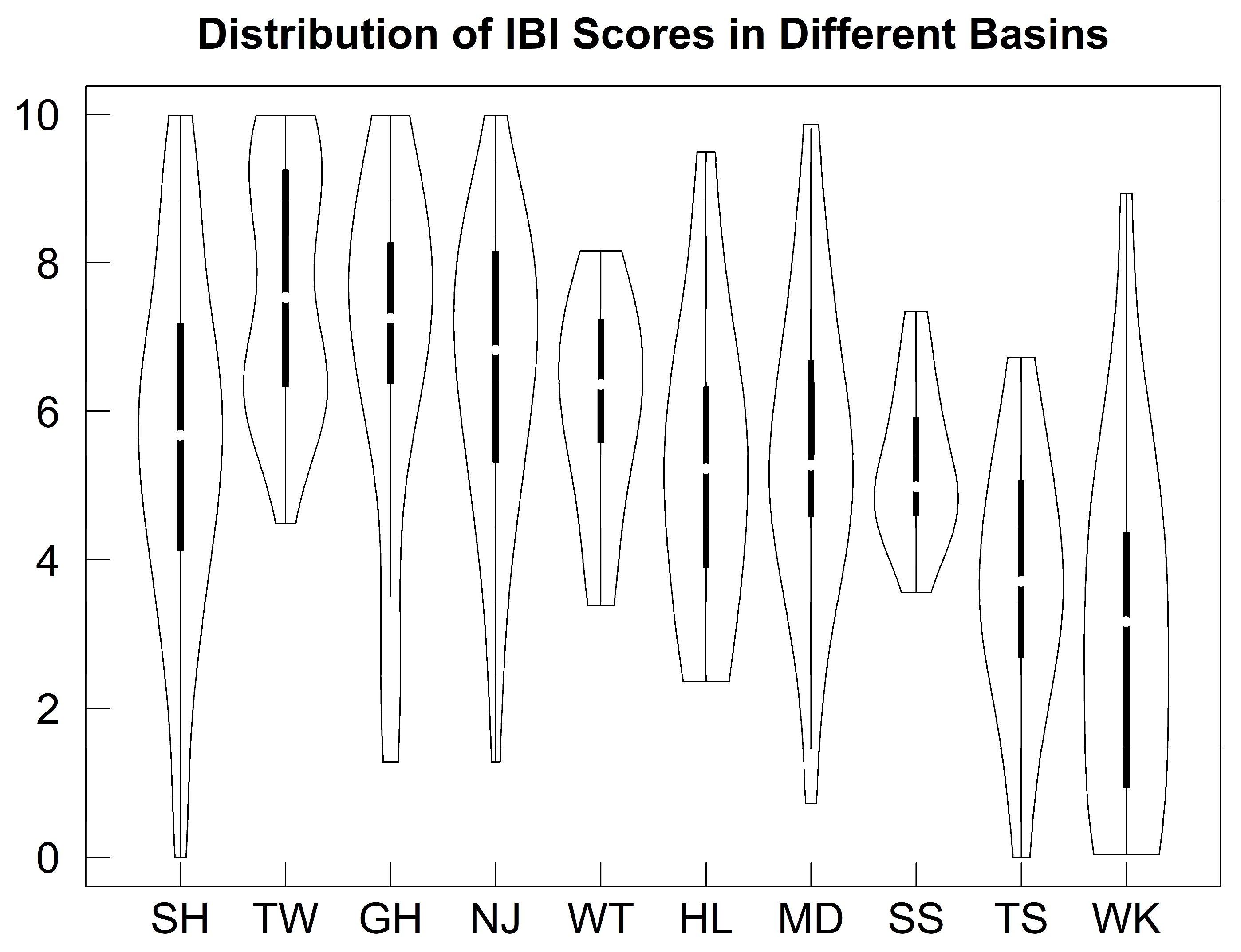
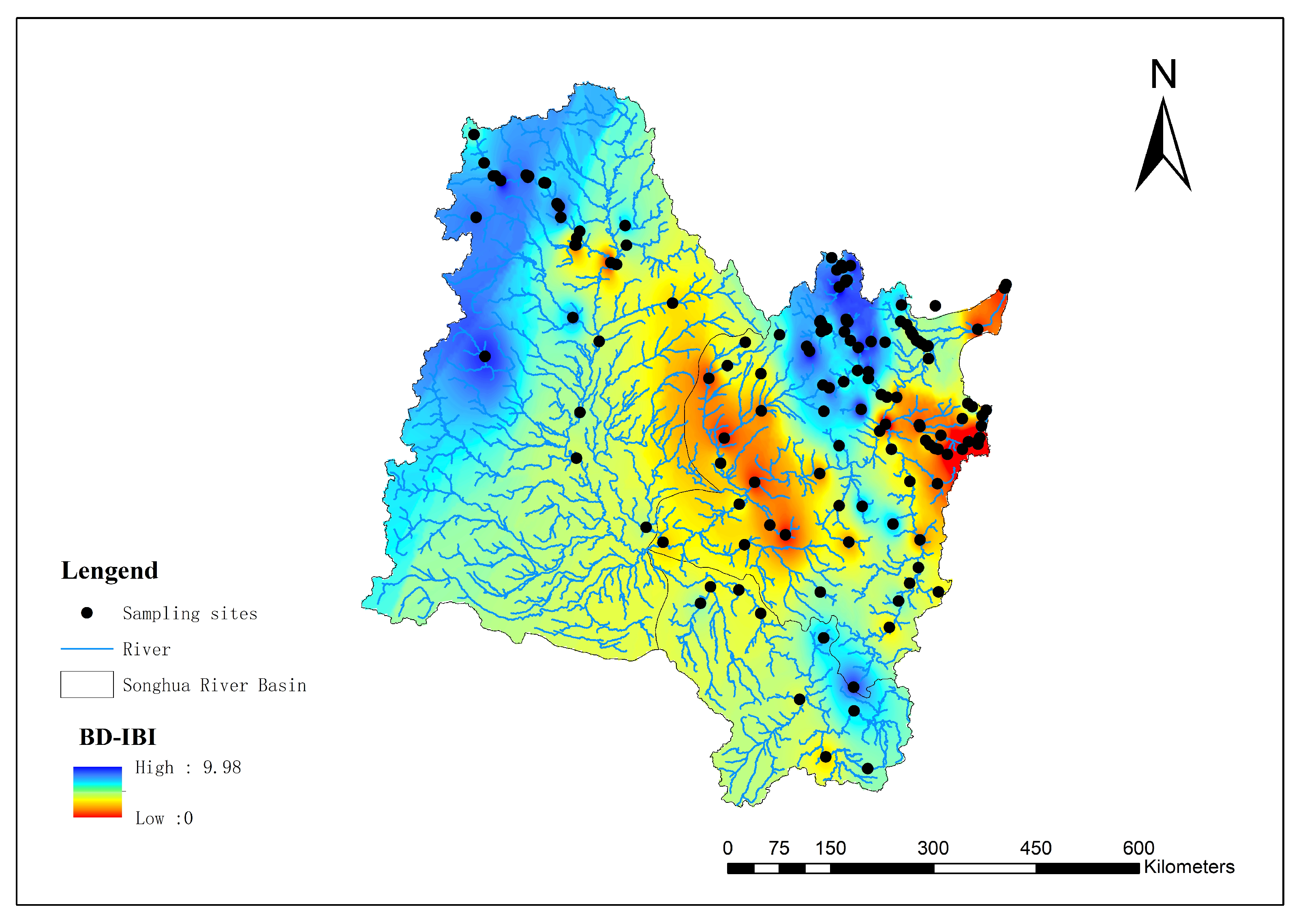
Based on the BD-IBI results, the following criteria were applied: scores of 7.6 or higher are classified as “excellent”, 5.7–7.6 as “good”, 3.8–5.7 as “moderate”, 1.9–3.8 as “poor”, and 0–1.9 as “extremely poor”. The Songhua River Basin’s and its tributaries’ BD-IBI scores were compared and examined (Figure 4 and Figure 5). According to the data, the Songhua River Basin’s median BD-IBI score is roughly 6 points, with the majority of the scores falling between 4 and 7. In terms of spatial distribution, higher scores were observed in the northwest (upper reaches of Nenjiang River and its tributary Ganhe River), northeast (Tangwang River), and southeast (Mudan River) regions of the basin.
Lower BD-IBI scores were recorded for the central and eastern portions of the basin, particularly in the Songhua River trunk stream, Woken River, and Hulan River. Among all tributaries, the Tangwang River exhibited the highest BD-IBI score, with a median value of approximately 7.5 and more than 75% of scores exceeding 6. The Ganhe River ranked second, with a median BD-IBI score > 7 and quartiles matching those of the Tangwang River. Notably, water ecological quality in Nenjiang River (excluding Ganhe River), particularly along its eastern tributaries and main stem, was significantly lower than that of Ganhe River, resulting in lower BD-IBI scores for Nenjiang River.
The BD-IBI scores for Nenjiang and Wutong River were similar, with a median score exceeding 6. Hulan River and Mudanjiang exhibited the most comparable scores, with a median of nearly 5 and the closest score distribution. The Trunk Stream and Woken River had the lowest BD-IBI scores, with a median of approximately 4. Among all tributaries, the Woken River showed the lowest median BD-IBI score, along with the smallest upper and lower quartiles. Additionally, the lower quartile of the BD-IBI score was less than 2, indicating that more than 25% of scores were below 2, reflecting the poorest water ecological environment quality.

3.3. Correlations Between the BD-IBI and Water Quality Factors

The correlation analysis results (Table 3) show that DO, PMI, AN, and QHEI were positively correlated with BD-IBI, among which DO and QHEI were significantly positively correlated (p < 0.01). EC, COD, NN, TN, and TP were negatively correlated with BD-IBI, with significant negative correlations observed for all except COD (p < 0.01). In general, EC and QHEI have the strongest correlation with BD-IBI, while COD, PMI, and AN have a weak correlation with BD-IBI. In addition, the correlation between each water quality index, QHEI, and the five diatom indexes is also consistent with the above analysis, and each of the five benthic diatom indexes has a significant correlation with at least six indexes.
The correlation of nine environmental parameters, including DO, was examined using the Spearman rank correlation coefficient (Table 3). The results showed that COD was significantly correlated with PMI (R2 = 0.84, p < 0.01), and NN was significantly correlated with TN (R2 = 0.79, p < 0.01). COD and NN were not included in the following analysis because PMI and TN had a stronger correlation with the BD-IBI score than COD and NN.
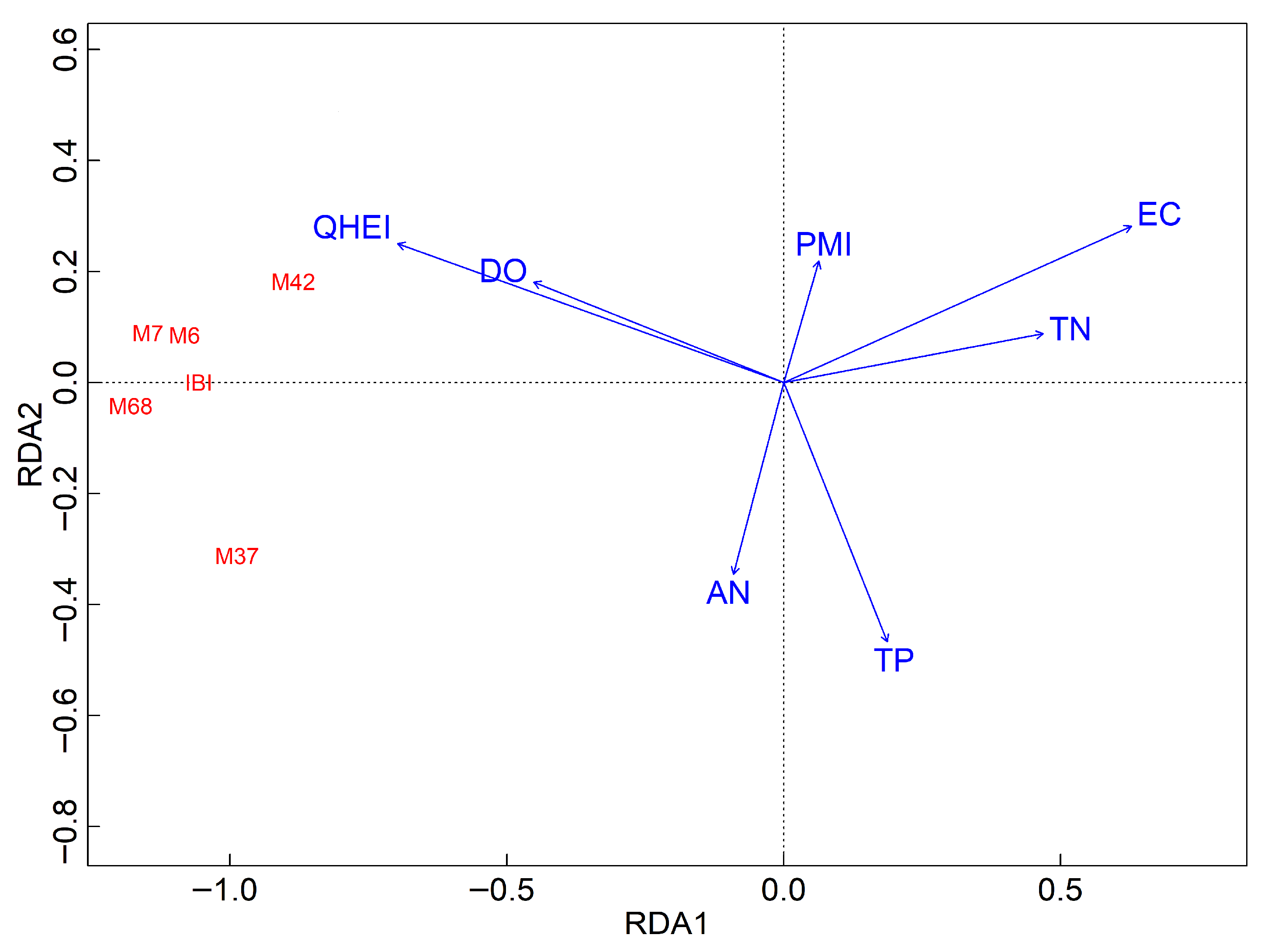
The correlation of nine environmental parameters was examined using the Spearman rank correlation coefficient, and the results showed that COD was significantly correlated with PMI (R2 = 0.84, p < 0.01), and NN was significantly correlated with TN (R2 = 0.79, p < 0.01). COD and NN were not included in the following analysis because PMI and TN had a stronger correlation with the BD-IBI score than COD and NN. RDA was used to examine the relationship between BD-IBI, its core parameters, and seven environmental factors, including DO. The findings revealed that the first two axes of RDA had eigenvalues of 0.6914 and 0.0151, respectively, which accounted for 70.7% of the systematic variation in BD-IBI (Figure 6). This indicates that RDA sequencing analysis can effectively explain the relationship between BD-IBI and diatom indexes, water quality indexes and habitat indexes.
The RDA ranking diagram’s vector shows the direction and intensity of the association between the BD-IBI, habitat environmental quality index, and water quality index. The angle formed by the two vectors indicates how strongly the indicators are correlated. The Angle between QHEI and DO is the smallest, indicating that the correlation between the two indexes is the strongest. The Angle between vector QHEI and EC, TN, and TP is obtuse, indicating that QHEI is negatively correlated with EC, TN, and TP. The first axis is positively correlated with EC, PMI, TN, and TP, and negatively correlated with QHEI, DO, and AN. QHEI has the greatest impact on RA. ß-mesosaprobic, according to the smallest angle between M42 and QHEI. QHEI has the least impact on RA. polysaprobe, as indicated by the angle between M37 and QHEI.
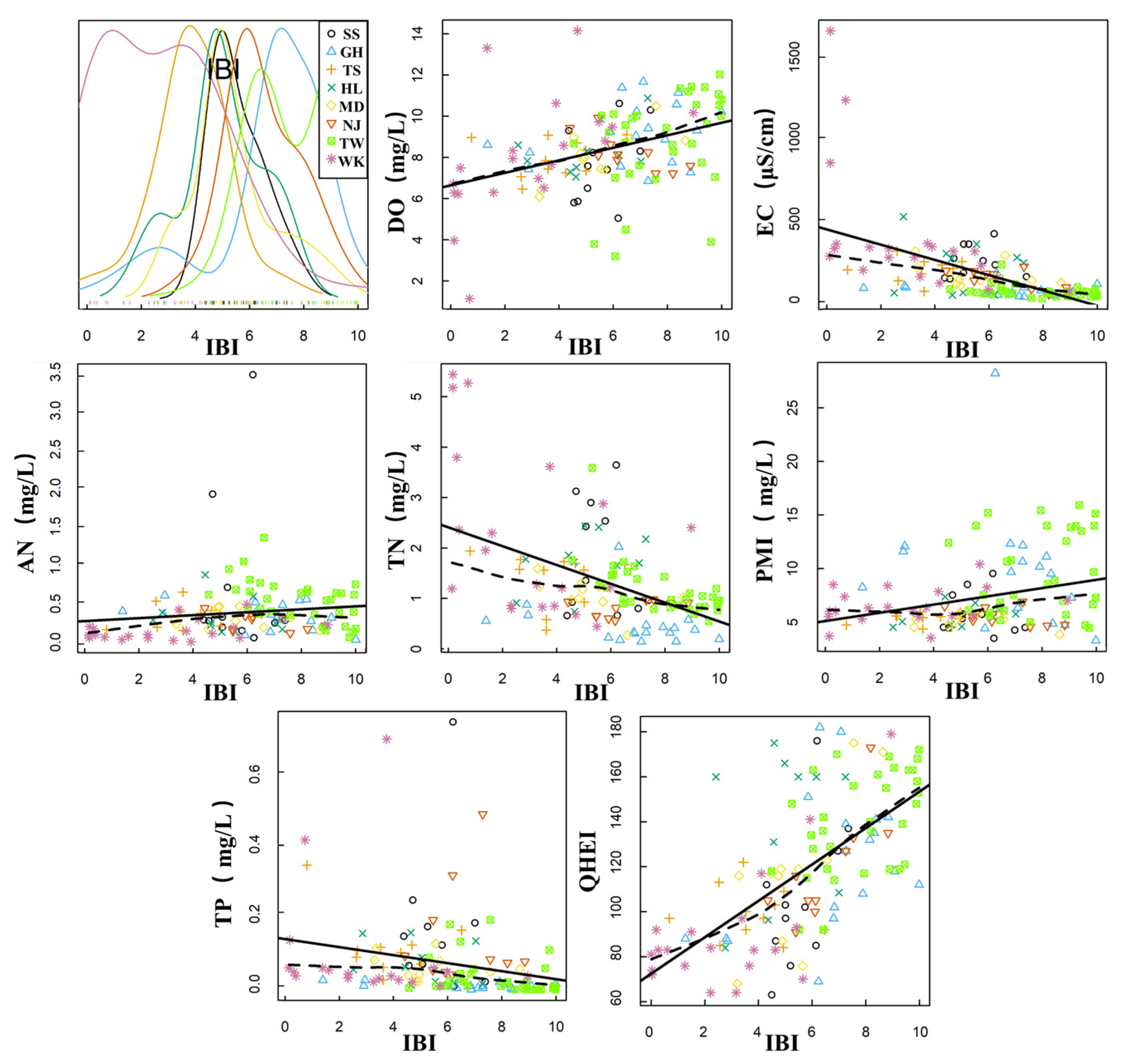
Using multiple linear regression analysis (MLR), the IBI score was regressed against seven environmental factors, including DO (Figure 7). The regression analysis scatter plots revealed that IBI scores increased with higher levels of DO, AN, PMI, and QHEI, while decreasing with higher EC, TN, and TP. After fitting the regression model, the findings (Table 4) indicated that 59% of the variance in the IBI score could be explained by all factors, with the strongest linear relationships observed between IBI and PMI and QHEI. The regression coefficients for these variables were significantly different from zero at the p < 0.01 level. The correlation coefficient between TN and IBI scores is significantly less than 0 at the level of p < 0.05. The IBI scores increased with the increase in PMI and QHEI, but decreased with the increase in TN.

4. Discussion

4.1. The Core Indicators of BD-IBI

Diatom-based assessment tools have previously been developed for specific tributaries of the Songhua River Basin. For example, Xue et al. [18] used the heavily agriculturally disturbed Wutong River as the study area. They ultimately selected four metrics, the Biological Diatom Index (BDI), Diatom Species Index for Australian Rivers (DSIAR), Sensitive%, and the Pielou index, to construct a BD-IBI. These metrics together integrate diatom-based information on overall water quality gradients (BDI and DSIAR), sensitivity based on species traits (Sensitive%), and community structural properties (Pielou Index). Thus, they primarily capture overall organic and nutrient pollution. In the less disturbed Tangwang River, Xue et al. [43] evaluated 18 diatom metrics, identifying the Specific Pollution Sensitivity Index (IPS), European Economic Community Index (CEE), and Watanabe Index (WAT) as the most suitable for reflecting overall organic and eutrophication pressures.
In contrast, this study distinguishes itself by developing a five-metric BD-IBI for the broader Songhua River Basin, encompassing the main stem and multiple tributaries. These metrics fall into three ecological categories: one growth-form metric (RA. motile individuals), two saprobity-based composition metrics (RA. ß-mesosaprobic and RA. polysaprobe) and two biotic indices (IDAP and IDSE). Selection was based on both statistical performance and ecological significance. RA. motile individuals [44] indicates the dominance of fast-growing, sediment-tolerant taxa, reflecting physical habitat disturbance. The saprobity metrics reflect aerobic organic matter levels [45]: RA. ß-mesosaprobic characterizes moderately polluted waters, while RA. polysaprobe indicates severe pollution and hypoxic conditions.
Regarding the biotic indices, although IDAP and IDSE were developed in Europe to reflect general water quality and eutrophication [46], recent studies confirm their applicability in China. For instance, Yang et al. [47] found IDSE highly suitable for the Poyang Lake basin, showing strong correlations with physicochemical parameters. Additionally, Xue et al. [43] demonstrated that IDSE and IDAP effectively discriminate between reference and slightly disturbed sites in the Tangwang River.
In summary, unlike previous studies limited to single tributaries or specific indices, this study constructs a BD-IBI that integrates organic-pollution-tolerance metrics, biotic indices, and growth-form indicators. This approach systematically characterizes aquatic ecological integrity under multiple stressors across the Songhua River Basin, providing a reference for ecological management at similar watershed scales.

4.2. Water Ecological Quality in the Songhua River Basin

The overall BD-IBI scores in the Songhua River Basin ranged from 4 to 7, indicating that the aquatic ecological health of the watershed generally falls between “moderate” and “good”. The spatial variation in BD-IBI scores underscores the strong linkage between river ecosystem health and land use patterns, the intensity of human activity, and environmental conditions. Our study found that the Tangwang River, characterized by a high coverage of national nature reserves and low anthropogenic interference, exhibited the highest level of biotic integrity. Conversely, watersheds subject to intensive agriculture, such as the Nenjiang, Wutong, and Hulan Rivers, exhibited relatively lower BD-IBI scores. Tan et al. [25] noted that BD-IBI is correlated with land use, suggesting that human activities exert a significant impact on river ecosystems. Furthermore, Adebanjo-Aina and Oludoye [48] and Rollins et al. [32] demonstrated that the excessive use of agricultural nitrogen fertilizers is a primary cause of water quality deterioration and eutrophication, posing long-term threats to watershed ecological health.
The Ganhe River, a significant tributary of the Nenjiang River, demonstrates a higher ecological health status than the main stem. Temperature acts as a critical determinant of benthic diatom community structure [49]. The Ganhe River is characterized by higher elevation and extensive upstream forest coverage, where riparian shading limits light availability and lowers water temperature. These conditions likely inhibit the growth of certain dominant species, thereby reducing interspecific competition and maintaining a relatively stable community structure [44], which contributes to the favorable ecological health of the tributary. Furthermore, the Ganhe River basin has a relatively low population density and limited anthropogenic impact. In contrast, consistent with the River Continuum Concept, the main stem accumulates fine particulate matter and materials from its tributaries, as well as pollutants discharged along its banks [50,51]. Therefore, owing to its superior water quality and stable benthic diatom assemblages, the Ganhe River exhibits better ecological health than the Nenjiang River.

4.3. Factors Affecting Water Ecological Quality in the Songhua River Basin

The BD-IBI scores in the Songhua River basin exhibited significant positive correlations (p < 0.01) with DO and QHEI, indicating that DO levels play a crucial role in determining ecological health. A decrease in DO limits the breakdown of contaminants and promotes anaerobic conditions that degrade water quality. This finding aligns with the study by Llanso et al. [52], emphasizing the importance of considering DO levels in biological integrity assessments. Additionally, QHEI’s strong correlation with BD-IBI and the five metrics highlights its reliability in assessing habitat conditions, underscores its reliability in assessing habitat conditions. This suggests that QHEI can more accurately reflect habitat conditions and is highly reliable in the development of BD-IBI and water quality evaluation.
Yuan et al. [53] conducted a study in the Liao River, which similarly demonstrated that habitat quality improves as BD-IBI scores increase. Holtrop et al. [54] used the Stream Habitat Assessment Procedure (SHAP) to assess stream habitat quality and found a significant positive correlation between SHAP and IBI, further supporting the validity of habitat assessment methods. This indicates that different evaluation approaches, such as QHEI and SHAP, effectively reflect the health of ecosystems and are closely linked to IBI scores.
EC, TN, TP, and NN demonstrated significant negative correlations with BD-IBI scores. The inverse relationship with EC suggests that increased ion concentrations may be associated with higher nutrient levels, which can affect ecological health. TN and TP are key nutrients influencing diatom biodiversity [55,56], and their increase may lead to water quality degradation, despite their role in promoting diatom growth [57]. Diatoms are widespread nitrate-storing microorganisms that can store nitrates several orders of magnitude above ambient concentrations [58]. The close connection between NN and BD-IBI further supports the role of nitrate nitrogen in influencing diatom communities and ecological health.
In this study, BD-IBI showed no significant correlations with COD, PMI, or AN. COD and PMI mainly reflect oxidizable organic matter and inorganic reducing substances, which fluctuate with seasonal discharge [59]. In contrast, the BD-IBI is based on benthic diatom assemblages and responds to long-term cumulative disturbances and habitat alterations. Thus, the short-term variability of COD and PMI may result in the lack of correlation with BD-IBI. Regarding AN, Peterson et al. [60] indicated that NH4+ (the primary form of AN) is largely absorbed or transformed by benthic algae within tens to hundreds of meters. Therefore, the measured AN likely reflects an instantaneous balance between external inputs and flow conditions, rather than the integrated nitrogen status experienced by the diatoms. Furthermore, Dalu et al. [61] found that nutrients such as NH4+ and NO3− correlate with only a few diatom indices. This further explains the lack of significant correlation between AN and BD-IBI.
These results reveal the complexity of the relationship between different environmental factors and BD-IBI scores in the Songhua River Basin, and emphasize the need to consider multiple environmental pressures comprehensively when evaluating ecosystem health.

4.4. Advantages and Limitations of IBI in Water Ecological Health Assessment

The IBI scores exhibited significantly higher values in forest-covered headwater regions due to their greater biodiversity and superior ecological health. In contrast, IBI scores showed a substantial decline in downstream areas where human activity intensity increased, indicating significant losses in ecosystem integrity. These findings underscore the critical role of forests in preserving regional biodiversity while also highlighting the detrimental impacts of human activities on ecological conditions. Forest land cover helps maintain stable flow and water temperature inputs organic matter into the river, provides food and habitat for aquatic life, and improves the quality of the aquatic environment [62]. Additionally, human activity results in the discharge of pollutants into the river, which leads to poor water quality and adversely affects the native aquatic ecosystem [63].
The comparative analysis revealed an inverse relationship between IBI scores and COD levels, suggesting that as organic pollution concentrations rise, aquatic ecosystem quality deteriorates. Notably, however, there was a positive correlation between IBI scores and PMI in headwater regions with high forest cover. This apparent contradiction arises because the accumulation of organic matter, such as fallen leaves and plant debris, in densely forested natural environments leads to higher PMI levels, reflecting an elevated content of reducing substances. In the downstream area near urban centers, however, organic materials such as dead leaves are often partially decomposed or reduced, resulting in comparatively lower PMI concentrations. Consequently, in these forested headwaters, PMI exhibits significantly higher values compared to downstream areas with increased human activity [43].
Additionally, urban drainage systems may introduce more unsaturated hydrocarbons (e.g., oils, plastics), which can significantly increase chemical oxygen demand levels due to oxidation processes. Therefore, in the Songhua River basin, particularly in upstream areas with high forest coverage rates, background PMI concentrations caused by natural factors are relatively high, potentially interfering with the accuracy of aquatic ecosystem health assessments based solely on water quality indices. Despite these challenges, the IBI demonstrated greater stability and reliability during the water ecological environment quality assessment process, effectively mitigating the interference of natural background values.
While the IBI-based assessment of aquatic ecosystem health in the Songhua River Basin has shown good performance, it has some limitations, particularly regarding regional adaptability and index stability. The IBI constructed in this study lacks practical applicability outside the Songhua River basin, necessitating further validation of its regional adaptability. Seegert’s research shows that IBI construction is common for wadeable streams, but it is often not directly applicable to large rivers, indicating that IBI is specific to different rivers and lakes [64]. Since the IBI evaluation system in each region has different applicability, the spatial scale and environmental conditions of the study region should be considered when applying IBI [65]. The development of the IBI relies on the comparison between reference and damaged sites. However, due to intense anthropogenic disturbances, identifying completely undisturbed reference sites has become increasingly challenging. Consequently, this may lead to an underestimation of the severity of degradation in certain damaged areas. Furthermore, under the combined influence of multiple stressors, it is difficult for the IBI to isolate the specific impacts of individual stressors.
Additionally, previous assessments of water ecological environmental quality on the Wutong River, the Tangwang River, and the Ganhe River sub-basins within the Songhua River Basin revealed that the five core parameters selected for IBI evaluation did not consistently reflect changes in water ecological quality across different sub-basins [18,43]. Due to the complexity of the health state of various basins and the large number of candidate indicators that can be evaluated in the IBI evaluation system, the interactions between core indicators can affect the evaluation outcomes [66,67]. Consequently, when conducting evaluations at varying spatial scales within the same study area, the choice of index may fail to accurately represent the gradient of aquatic ecosystem health.

5. Conclusions

This study evaluates the ecological health status of the Songhua River Basin using the BD-IBI, which consists of five indicators: M6, M7, M37, M42 and M68. The overall ecological health status of the Songhua River Basin was rated “Good” with significant variations observed among specific sub-reaches. The Tangwang River showed the highest BD-IBI score, while the Woken River exhibited the lowest value, highlighting the sensitivity of BD-IBI to environmental conditions. Furthermore, BD-IBI clearly distinguishes the G1-G2-G3 groups, demonstrating its outstanding ability to differentiate different levels of pollution or interference in the ecological environment. Our findings reveal that BD-IBI exhibited strong correlations with some water quality metrics, key water quality factors driving these changes include DO, EC, NN, TN, TP and QHEI.
The IBI demonstrated greater stability and reliability during the water ecological environment quality assessment process, effectively mitigating issues related to background value problems. While the findings demonstrate the utility of BD-IBI for assessing ecological health, this study has several limitations. The current application is restricted to the Songhua River Basin, necessitating further validation in other regions to ensure broader applicability. Additionally, the relationships between BD-IBI scores and water quality metrics, as well as the performance of BD-IBI in sub-basins, suggest the need for refinement and optimization of the IBI framework under different environmental conditions. To address these limitations, we advocate for the establishment of regional or national IBI networks to enhance the practicality and reliability of this tool. Future studies should focus on integrating advanced modeling techniques and incorporating new scientific discoveries to continuously improve the ecological integrity evaluation system based on benthic diatoms. This research contributes valuable insights for managing water resources in similar river basins and offers support for the development of aquatic ecosystems.

Author Contributions

Conceptualization, L.L. and P.C.; methodology, H.X.; software, H.X.; validation, P.C.; formal analysis, H.X.; investigation, P.C., H.X., L.Z., N.L. and Z.Y.; resources, F.M.; data curation, H.X.; writing—original draft preparation, L.L.; writing—review and editing, H.X.; visualization, H.X.; supervision, F.M.; project administration, F.M.; funding acquisition, F.M. All authors have read and agreed to the published version of the manuscript.

Funding

This research was financially supported by the National Key Research and Development Program of China (2021YFC3200100).

Institutional Review Board Statement

Not applicable.

Informed Consent Statement

Not applicable.

Data Availability Statement

Due to privacy concerns, the data provided in this study can be obtained from the corresponding author.

Conflicts of Interest

The authors declare no conflicts of interest.

References

  1. Tokatli, C.; Solak, C.N.; Yilmaz, E.; Atici, T.; Dayioglu, H. Research into the Epipelic Diatoms of the Meric and Tunca Rivers and the Application of the Biological Diatom Index in Water Quality Assessment. Aquat. Sci. Eng. 2020, 35, 19–26. [Google Scholar] [CrossRef]
  2. Amin, S.A.; Parker, M.S.; Armbrust, E.V. Interactions between Diatoms and Bacteria. Microbiol. Mol. Biol. Rev. 2012, 76, 667–684. [Google Scholar] [CrossRef]
  3. Wang, J.; Liu, Q.; Zhao, X.; Borthwick, A.G.L.; Liu, Y.; Chen, Q.; Ni, J. Molecular biogeography of planktonic and benthic diatoms in the Yangtze River. Microbiome 2019, 7, 153. [Google Scholar] [CrossRef] [PubMed]
  4. Hu, Y.H.; Yan, L.; Hu, P.; Guo, H.M.; Li, X.Y.; Su, W.H. Exploring the Correspondence Between Benthic Algae and Changes in the Aquatic Environment for Biodiversity Development. Sustainability 2024, 16, 11287. [Google Scholar] [CrossRef]
  5. Rimet, F.; Bouchez, A.; Montuelle, B. Benthic diatoms and phytoplankton to assess nutrients in a large lake: Complementarity of their use in Lake Geneva (France-Switzerland). Ecol. Indic. 2015, 53, 231–239. [Google Scholar] [CrossRef]
  6. Soininen, J.; Könönen, K. Comparative study of monitoring South-Finnish rivers and streams using macroinvertebrate and benthic diatom community structure. Aquat. Ecol. 2004, 38, 63–75. [Google Scholar] [CrossRef]
  7. Bere, T. Challenges of diatom-based biological monitoring and assessment of streams in developing countries. Environ. Sci. Pollut. Res. 2016, 23, 5477–5486. [Google Scholar] [CrossRef]
  8. Yi, Y.; Ye, J.; Ding, H.; Yin, S. Research progress and prospect in China of aquatic ecosystem assessment methods. Hupo Kexue 2024, 36, 657–669. [Google Scholar]
  9. Karr, J.R. Assessment of Biotic Integrity Using Fish Communities. Fisheries 1981, 6, 21–27. [Google Scholar] [CrossRef]
  10. Karr, J.R.; Chu, E.W. Biological monitoring: Essential foundation for ecological risk assessment. Hum. Ecol. Risk Assess. 1997, 3, 993–1004. [Google Scholar] [CrossRef]
  11. Wang, F.; Li, Y.; Ma, T.; Chen, H.; Wang, X.; Li, K.; Wu, Z. Ecological health assessment of urban lake based on phytoplankton-A case study of Lake Xihu, Tongling, lower reaches of the Yangtze River. Hupo Kexue 2022, 34, 1890–1900. [Google Scholar] [CrossRef]
  12. Cooper, M.J.; Lamberti, G.A.; Moerke, A.H.; Ruetz, C.R.; Wilcox, D.A.; Brady, V.J.; Brown, T.N.; Ciborowski, J.J.H.; Gathman, J.P.; Grabas, G.P.; et al. An expanded fish-based index of biotic integrity for Great Lakes coastal wetlands. Environ. Monit. Assess. 2018, 190, 580. [Google Scholar] [CrossRef] [PubMed]
  13. Huang, X.Y.; Xu, J.; Liu, B.; Guan, X.; Li, J.S. Assessment of Aquatic Ecosystem Health with Indices of Biotic Integrity (IBIs) in the Ganjiang River System, China. Water 2022, 14, 278. [Google Scholar] [CrossRef]
  14. Yirigui, Y.; Lee, S.W.; Nejadhashemi, A.P.; Herman, M.R.; Lee, J.W. Relationships between Riparian Forest Fragmentation and Biological Indicators of Streams. Sustainability 2019, 11, 2870. [Google Scholar] [CrossRef]
  15. Ling, W.; Wu, Y.; Fang, Y.; Chen, D.; Liu, G.; Sun, C. Ecosystem Health Evaluation Based on Fish-index of Ecological Integrity in Beijing Mountainous Area Rivers. Asian J. Ecotoxicol. 2024, 19, 131–142. [Google Scholar]
  16. Lin, L.; Wang, F.; Chen, H.; Fang, H.; Zhang, T.; Cao, W. Ecological health assessments of rivers with multiple dams based on the biological integrity of phytoplankton: A case study of North Creek of Jiulong River. Ecol. Indic. 2021, 121, 106998. [Google Scholar] [CrossRef]
  17. Qin, M.Q.; Fan, P.P.; Li, Y.Y.; Wang, H.T.; Wang, W.P.; Liu, H.; Messyasz, B.; Goldyn, R.; Li, B.L. Assessing the Ecosystem Health of Large Drinking-Water Reservoirs Based on the Phytoplankton Index of Biotic Integrity (P-IBI): A Case Study of Danjiangkou Reservoir. Sustainability 2023, 15, 5282. [Google Scholar] [CrossRef]
  18. Xue, H.; Zheng, B.; Meng, F.; Wang, Y.; Zhang, L.; Cheng, P. Assessment of Aquatic Ecosystem Health of the Wutong River Based on Benthic Diatoms. Water 2019, 11, 727. [Google Scholar] [CrossRef]
  19. Su, M.; Dong, W.; Zhao, S.; Wang, Q.; Liu, Y.; Yang, W. Ecosystem Health Assessment Based on Benthic Index of Biological Integrity (B-IBI) in Tongling City. Resour. Environ. Yangtze Basin 2023, 32, 104–112. [Google Scholar]
  20. Dong, J.; Lu, S.; Wu, J.; Wang, Z.; Wang, H.; Xu, F. Evaluation of urban river ecosystem health in Beijing based on the microbial index of biotic integrity. J. Environ. Eng. Technol. 2022, 12, 1411–1419. [Google Scholar]
  21. Liu, Q.; Yin, S.L.; Yi, Y.J. A bacteria-based index of biotic integrity indicates aquatic ecosystem restoration. Environ. Sci. Ecotechnol. 2024, 22, 100451. [Google Scholar] [CrossRef]
  22. Wang, Y.K.; Stevenson, R.J.; Metzmeier, L. Development and evaluation of a diatom-based Index of Biotic Integrity for the Interior Plateau Ecoregion, USA. J. N. Am. Benthol. Soc. 2005, 24, 990–1008. [Google Scholar] [CrossRef]
  23. Lavoie, I.; Hamilton, P.B.; Wang, Y.K.; Dillon, P.J.; Campeau, S. A comparison of stream bioassessment in Quebec (Canada) using six European and North American diatom-based indices. Nova Hedwig. 2009, 135, 37–56. [Google Scholar]
  24. Gottschalk, J.M. Development and Evaluation of a Diatom-Based Biological Monitoring Index for Streams in Cook Inlet Basin, Alaska. Master’s Thesis, University of Alaska Anchorage, Anchorage, AK, USA, 2010. [Google Scholar]
  25. Tan, X.; Ma, P.; Bunn, S.E.; Zhang, Q. Development of a benthic diatom index of biotic integrity (BD-IBI) for ecosystem health assessment of human dominant subtropical rivers, China. J. Environ. Manag. 2015, 151, 286–294. [Google Scholar] [CrossRef]
  26. Wang, Y.; Li, L.; Lin, K.; Zhu, Y.; Xia, Y.; Liu, L. Development and Applicability Analysis of Benthic-Macroinvertebrate Index of Biotic Integrity in the Songhua River Basin. Environ. Monit. China 2019, 35, 20–30. [Google Scholar]
  27. Tan, X.; Sheldon, F.; Bunn, S.E.; Zhang, Q. Using diatom indices for water quality assessment in a subtropical river, China. Environ. Sci. Pollut. Res. 2013, 20, 4164–4175. [Google Scholar] [CrossRef]
  28. Tan, X.; Ma, P.; Xia, X.; Zhang, Q. Spatial Pattern of Benthic Diatoms and Water Quality Assessment Using Diatom Indices in a Subtropical River, China. Clean-Soil Air Water 2014, 42, 20–28. [Google Scholar] [CrossRef]
  29. Tan, X.; Xia, X.; Zhao, Q.; Zhang, Q. Temporal variations of benthic diatom community and its main influencing factors in a subtropical river, China. Environ. Sci. Pollut. Res. 2014, 21, 434–444. [Google Scholar] [CrossRef]
  30. Wu, N.; Cai, Q.; Fohrer, N. Development and evaluation of a diatom-based index of biotic integrity (D-IBI) for rivers impacted by run-of-river dams. Ecol. Indic. 2012, 18, 108–117. [Google Scholar] [CrossRef]
  31. Tang, T.; Stevenson, R.J.; Infante, D.M. Accounting for regional variation in both natural environment and human disturbance to improve performance of multimetric indices of lotic benthic diatoms. Sci. Total Environ. 2016, 568, 1124–1134. [Google Scholar] [CrossRef] [PubMed]
  32. Rollins, S.L.; Ritz, C.; Krone, P.; Stevenson, R.J.; Pan, Y.; Gillett, N.; Los Huertos, M. Development and application of an algae multi-metric index to inform ecologically relevant nitrogen reduction targets. Hydrobiologia 2025, 852, 527–543. [Google Scholar] [CrossRef]
  33. Chen, K.; Chen, Q.; Yu, H.; Wang, B.; Jin, X.; Wang, Y.; Xu, R.; Cai, K. Methods and prospects of index of biological integrity used for China river ecological health assessment. China Environ. Sci. 2018, 38, 1589–1600. [Google Scholar]
  34. Barbour, M.T.; Swietlik, W.F.; Jackson, S.K.; Courtemanch, D.L.; Davies, S.P.; Yoder, C.O. Measuring the attainment of biological integrity in the USA: A critical element of ecological integrity. Hydrobiologia 2000, 422, 453–464. [Google Scholar] [CrossRef]
  35. Whittier, T.R.; Stoddard, J.L.; Larsen, D.P.; Herlihy, A.T. Selecting reference sites for stream biological assessments: Best professional judgment or objective criteria. J. N. Am. Benthol. Soc. 2007, 26, 349–360. [Google Scholar] [CrossRef]
  36. Ligeiro, R.; Hughes, R.M.; Kaufmann, P.R.; Macedo, D.R.; Firmiano, K.R.; Ferreira, W.R.; Oliveira, D.; Melo, A.S.; Callisto, M. Defining quantitative stream disturbance gradients and the additive role of habitat variation to explain macroinvertebrate taxa richness. Ecol. Indic. 2013, 25, 45–57. [Google Scholar] [CrossRef]
  37. Hughes, D.L. Rapid Bioassessment of Stream Health; Routledge: London, UK, 2010. [Google Scholar]
  38. GB 3838-2002; Environmental Quality Standards for Surface Water. China Environmental Science Press: Beijing, China, 2002.
  39. Binghui, Z.; Yuan, Z.; Yingbo, L.I. Study of indicators and methods for river habitat assessment of Liao River Basin. Acta Sci. Circumstantiae 2007, 27, 928–936. [Google Scholar]
  40. Bruce, V.; Koch, J.D.; Beck, M.W. A comparison of survey methods to evaluate macrophyte index of biotic integrity performance in Minnesota lakes. Ecol. Indic. 2014, 36, 178–185. [Google Scholar] [CrossRef]
  41. Hoyle, J.A.; Yuille, M.J. Nearshore fish community assessment on Lake Ontario and the St. Lawrence River: A trap net-based index of biotic integrity. J. Great Lakes Res. 2016, 42, 687–694. [Google Scholar] [CrossRef]
  42. Barbour, M.T.; Gerritsen, J.; Griffith, G.E.; Frydenborg, R.; McCarron, E.; White, J.S.; Bastian, M.L. A framework for biological criteria for Florida streams using benthic macroinvertebrates. J. N. Am. Benthol. Soc. 1996, 15, 185–211. [Google Scholar] [CrossRef]
  43. Xue, H.; Wang, L.; Zhang, L.; Wang, Y.; Meng, F.; Xu, M. Exploration of Applicability of Diatom Indices to Evaluate Water Ecosystem Quality in Tangwang River in Northeast China. Water 2023, 15, 3695. [Google Scholar] [CrossRef]
  44. Passy, S.I. Diatom ecological guilds display distinct and predictable behavior along nutrient and disturbance gradients in running waters. Aquat. Bot. 2007, 86, 171–178. [Google Scholar] [CrossRef]
  45. Van Dam, H.; Mertens, A.; Sinkeldam, J. A coded checklist and ecological indicator values of freshwater diatoms from the Netherlands. Neth. J. Aquat. Ecol. 1994, 28, 117–133. [Google Scholar]
  46. Prygiel, J.; Coste, M. The Assessment of Water-Quality in the Artois-Picardie Water Basin (France) by the Use of Diatom Indexes. Hydrobiologia 1993, 269, 343–349. [Google Scholar] [CrossRef]
  47. Yang, J.F.; Ji, Y.; Yan, R.Y.; Liu, X.C.; Zhang, J.; Wu, N.C.; Wang, K. Applicability of Benthic Diatom Indices Combined with Water Quality Valuation for Dish Lake from Nanjishan Nature Reserve, Lake Poyang. Water 2020, 12, 2732. [Google Scholar] [CrossRef]
  48. Adebanjo-Aina, O.; Oludoye, O. Impact of Nitrogen Fertiliser Usage in Agriculture on Water Quality. Pollutants 2025, 5, 21. [Google Scholar] [CrossRef]
  49. Prelle, L.R.; Karsten, U. Photosynthesis, Respiration, and Growth of Five Benthic Diatom Strains as a Function of Intermixing Processes of Coastal Peatlands with the Baltic Sea. Microorganisms 2022, 10, 749. [Google Scholar] [CrossRef] [PubMed]
  50. Jones, N.E.; Schmidt, B.J. Tributary effects in rivers: Interactions of spatial scale, network structure, and landscape characteristics. Can. J. Fish. Aquat. Sci. 2017, 74, 503–510. [Google Scholar] [CrossRef]
  51. Vannote, R.L.; Minshall, G.W.; Cummins, K.W.; Sedell, J.R.; Cushing, C.E. River Continuum Concept. Can. J. Fish. Aquat. Sci. 1980, 37, 130–137. [Google Scholar] [CrossRef]
  52. Llanso, R.J.; Dauer, D.M.; Volstad, J.H. Assessing ecological integrity for impaired waters decisions in Chesapeake Bay, USA. Mar. Pollut. Bull. 2009, 59, 48–53. [Google Scholar] [CrossRef]
  53. Yuan, Z.; Chengbin, X.U.; Xiping, M.A.; Zheng, Z.; Junchen, W. Biotic integrity index and criteria of benthic organizms in Liao River Basin. Acta Sci. Circumstantiae 2007, 27, 919–927. [Google Scholar]
  54. Holtrop, A.M.; Fischer, R.U. Relations between biotic integrity and physical habitat in the Embarras River basin, Illinois. J. Freshw. Ecol. 2002, 17, 475–483. [Google Scholar] [CrossRef]
  55. Liu, X.; Liu, C.; Ao, S.; Tan, L.; Tang, T. Impacts of urbanization on taxonomic and functional diversity of lotic benthic diatoms:A case study in Shenzhen rivers. Acta Sci. Circumstantiae 2022, 42, 435–444. [Google Scholar]
  56. Liu, B.; Cao, S. Asynchronous changes in trophic status of a lake and its watershed inferred from sedimentary diatoms of different habitats. Ecol. Indic. 2018, 90, 215–225. [Google Scholar] [CrossRef]
  57. Yongo, E.; Mutethya, E.; Zhang, P.F.; Lek, S.; Fu, Q.Y.; Guo, Z.Q. Comparing the performance of the water quality index and phytoplankton index of biotic integrity in assessing the ecological status of three urban rivers in Haikou City, China. Ecol. Indic. 2023, 157, 111286. [Google Scholar] [CrossRef]
  58. Stief, P.; Schauberger, C.; Lund, M.B.; Greve, A.; Abed, R.M.M.; Al-Najjar, M.A.A.; Attard, K.; Bonaglia, S.; Deutzmann, J.S.; Franco-Cisterna, B.; et al. Intracellular nitrate storage by diatoms can be an important nitrogen pool in freshwater and marine ecosystems. Commun. Earth Environ. 2022, 3, 154. [Google Scholar] [CrossRef]
  59. Zhao, Y.; Shen, J.; Feng, J.; Sun, Z.; Sun, T.; Liu, D.; Xi, M.; Li, R.; Wang, X. The Estimation of Chemical Oxygen Demand of Erhai Lake Basin and Its Links with DOM Fluorescent Components Using Machine Learning. Water 2021, 13, 3629. [Google Scholar] [CrossRef]
  60. Peterson, B.J.; Wollheim, W.M.; Mulholland, P.J.; Webster, J.R.; Meyer, J.L.; Tank, J.L.; Martí, E.; Bowden, W.B.; Valett, H.M.; Hershey, A.E.; et al. Control of nitrogen export from watersheds by headwater streams. Science 2001, 292, 86–90. [Google Scholar] [CrossRef] [PubMed]
  61. Dalu, T.; Bere, T.; Froneman, P.W. Assessment of water quality based on diatom indices in a small temperate river system, Kowie River, South Africa. Water Sa 2016, 42, 183–193. [Google Scholar] [CrossRef]
  62. Wang, L.Z.; Lyons, J.; Kanehl, P.; Gatti, R. Influences of watershed land use on habitat quality and biotic integrity in Wisconsin streams. Fisheries 1997, 22, 6–12. [Google Scholar] [CrossRef]
  63. Shan, T.; Yuan, A.I.; Huang, Z.R.; Zhou, J.Y.; Lu, X.X.; Fan, Y.W. Characteristics of Benthic Diatom Community Structure and Water Ecological Health Evaluation in the Lalin River Basin. Huanjing Kexue 2023, 44, 1465–1474. [Google Scholar] [CrossRef]
  64. Seegert, G. Considerations regarding development of index of biotic integrity metrics for large rivers. Environ. Sci. Policy 2000, 3, 99–106. [Google Scholar] [CrossRef]
  65. Gippel, C.; Zhang, Y.; Qu, X.D.; Bond, N.; Kong, W.J.; Leigh, C.; Catford, J.; Speed, R.; Meng, W. Design of a National River Health Assessment Program for China. In Decision Making in Water Resources Policy and Management; Academic Press: Cambridge, MA, USA, 2017. [Google Scholar]
  66. Ruaro, R.; Gubiani, E.A. A scientometric assessment of 30 years of the Index of Biotic Integrity in aquatic ecosystems: Applications and main flaws. Ecol. Indic. 2013, 29, 105–110. [Google Scholar] [CrossRef]
  67. Zhu, H.; Hu, X.D.; Wu, P.P.; Chen, W.M.; Wu, S.S.; Li, Z.Q.; Zhu, L.; Xi, Y.L.; Huang, R. Development and testing of the phytoplankton biological integrity index (P-IBI) in dry and wet seasons for Lake Gehu. Ecol. Indic. 2021, 129, 107882. [Google Scholar] [CrossRef]
Figure 1. Sampling sites in the Songhua River basin.
Sustainability 18 00291 g001
Figure 2. Box plots of 15 candidate parameters at reference group (G1), mildly damaged group (G2) and damaged group (G3).
Sustainability 18 00291 g002
Figure 3. The box plots of BD-IBI scores in the Songhua River Basin at reference group (G1), mildly damaged group (G2) and damaged group (G3).
Sustainability 18 00291 g003
Figure 4. Violin plots showing the variation in BD-IBI scores in the Songhua River Basin.
Sustainability 18 00291 g004
Figure 5. Spatial distribution of BD-IBI in the Songhua River basin.
Sustainability 18 00291 g005
Figure 6. Ordination diagram of RDA (IBI parameters-environmental factors).
Sustainability 18 00291 g006
Figure 7. Multiple linear regression analysis of IBI scores and environmental factors.
Sustainability 18 00291 g007
Table 1. Water quality and habitat quality of each group.
GroupDO (mg/L)COD (mg/L)AN (mg/L)NN (mg/L)TN (mg/L)TP (mg/L)EC (μS/cm)QHEI
G19.34 ± 2.2715.98 ± 4.960.23 ± 0.150.41 ± 0.290.72 ± 0.310.04 ± 0.0559.72 ± 41.00167.75 ± 9.28
G28.30 ± 1.5419.29 ± 3.690.45 ± 0.350.56 ± 0.471.16 ± 0.600.08 ± 0.12118.22 ± 68.13117.45 ± 20.7
G37.05 ± 1.8720.72 ± 5.30.59 ± 1.281.31 ± 1.402.53 ± 1.770.14 ± 0.19438.72 ± 341.1179.96 ± 8.97
Note: QHEI and water quality scores in the table are mean ± standard deviation.
Table 2. Final parameters and their correlation coefficients.
M6M7M37M42
M70.66 **
M370.64 **0.60 **
M420.74 **0.54 *0.43
M680.71 **0.54 **0.58 **0.61 **
Note: * indicates p < 0.05; ** indicates p < 0.01.
Table 3. Correlation coefficients between IBI parameters and environmental factors.
M6M7M68M37M42BD-IBI
DO0.37 **0.34 **0.40 **0.25 **0.32 **0.40 **
EC−0.58 **−0.61 **−0.51 **−0.53 **−0.45 **−0.62 **
COD−0.10−0.06−0.12−0.16 *−0.05−0.09
PMI0.16 *0.17 *0.120.030.17 *0.17
AN0.080.21 *0.080.150.090.14
NN−0.22 **−0.33 **−0.29 **−0.24 **−0.20 *−0.30 **
TN−0.30 **−0.29 **−0.33 **−0.27 **−0.28 **−0.33 **
TP−0.38 **−0.40 **−0.27 **−0.13−0.34 **−0.37 **
QHEI0.56 **0.60 **0.56 **0.53 **0.43 **0.62 **
Note: * indicates p < 0.05; ** indicates p < 0.01.
Table 4. The parameters of regression model.
EstimateStd. Errort ValuePr (>|t|)
DO0.1340690.0909351.4740.143096
EC−0.0011350.001195−0.9490.344416
PMI0.1714470.0479273.5770.000508 ***
AN0.6397170.4665821.3710.172999
TN−0.6075950.247821−2.4520.015707 *
TP2.1671211.6318711.3280.186786
QHEI0.0413690.0054127.6446.66 × 10−12 ***
Note: * indicates p < 0.05; *** indicates p < 0.001.
Disclaimer/Publisher’s Note: The statements, opinions and data contained in all publications are solely those of the individual author(s) and contributor(s) and not of MDPI and/or the editor(s). MDPI and/or the editor(s) disclaim responsibility for any injury to people or property resulting from any ideas, methods, instructions or products referred to in the content.