A Techno-Economic Analysis of a Hybrid Microgrid System in a Residential Area of Bangladesh: Optimizing Renewable Energy

 ,
,  ,
, 
 and
and
Abstract
1. Introduction
2. Materials and Methods
2.1. HOMER Pro
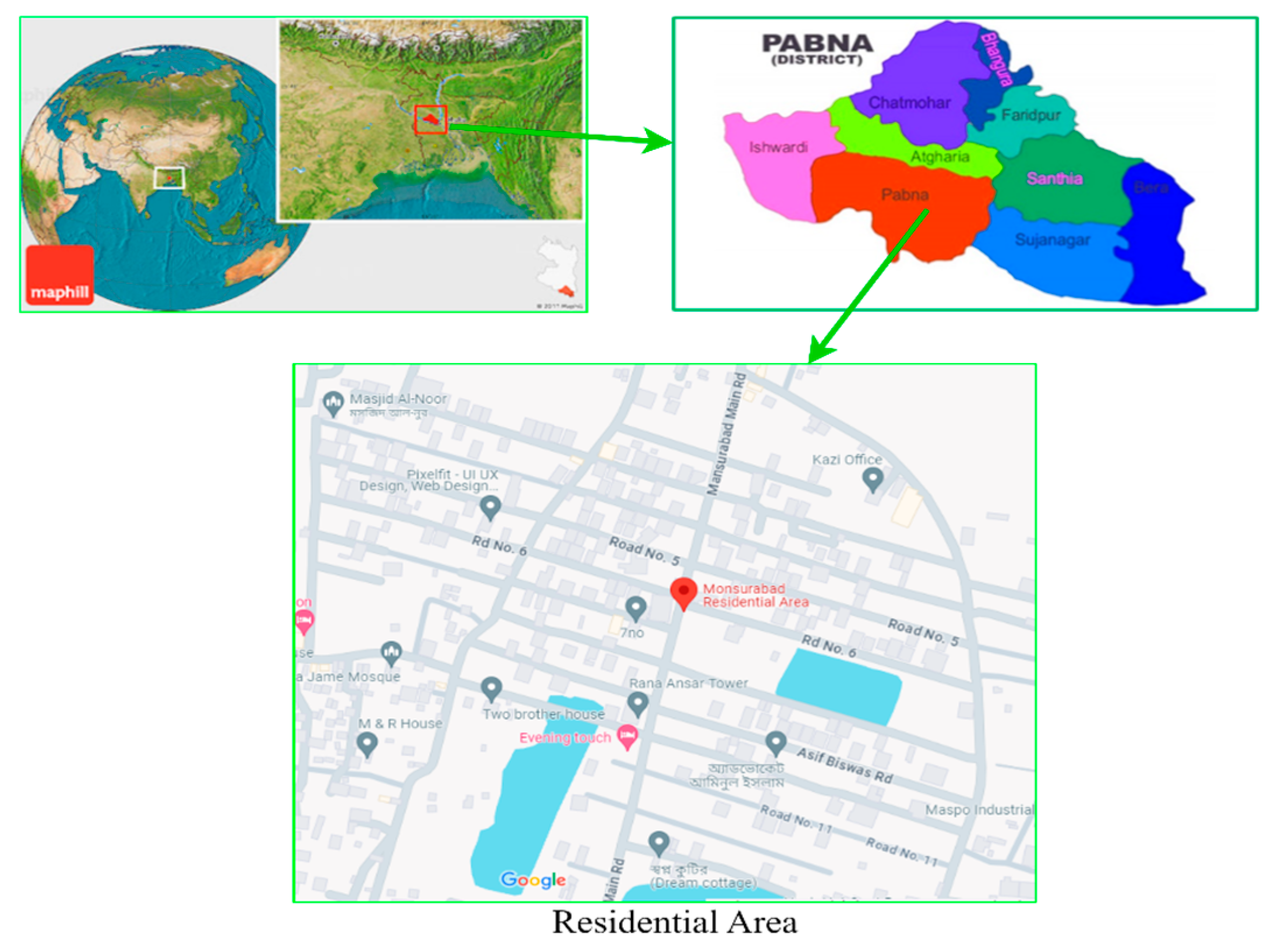
2.2. Site Location
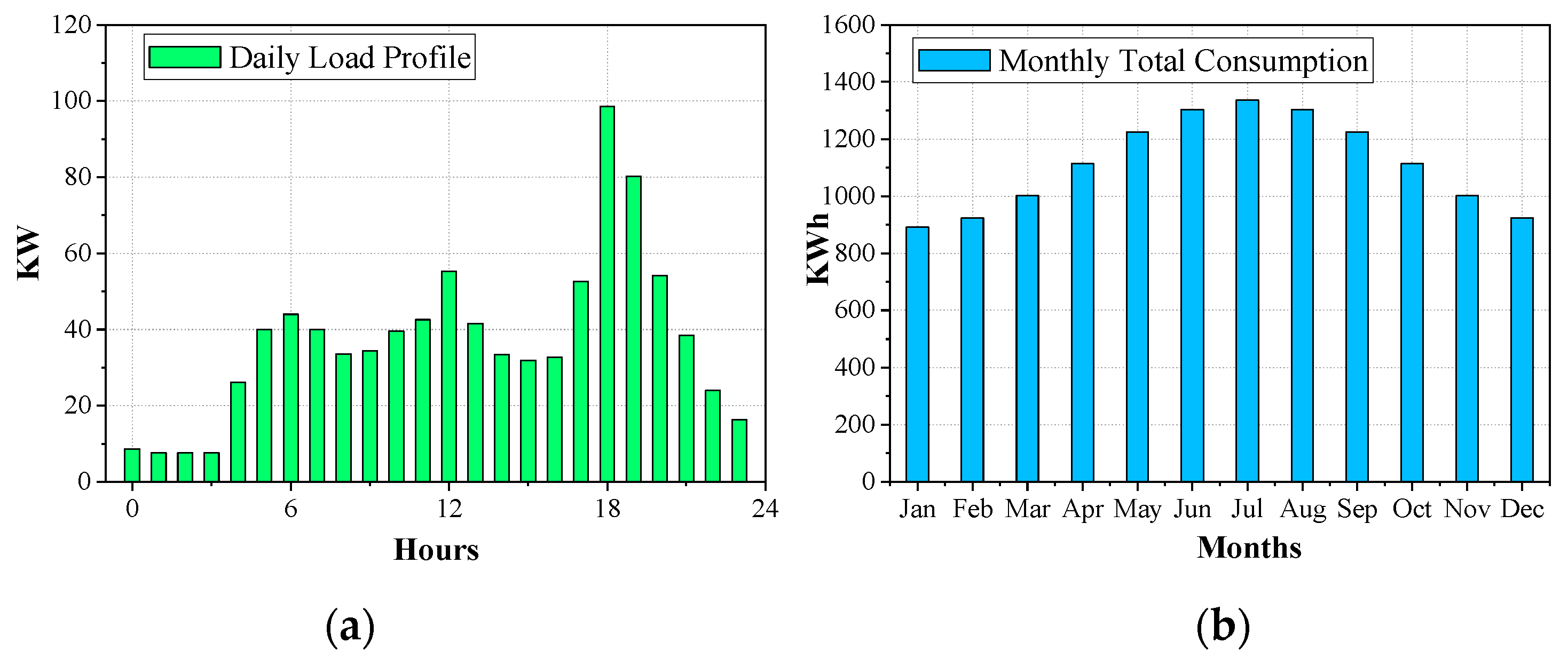
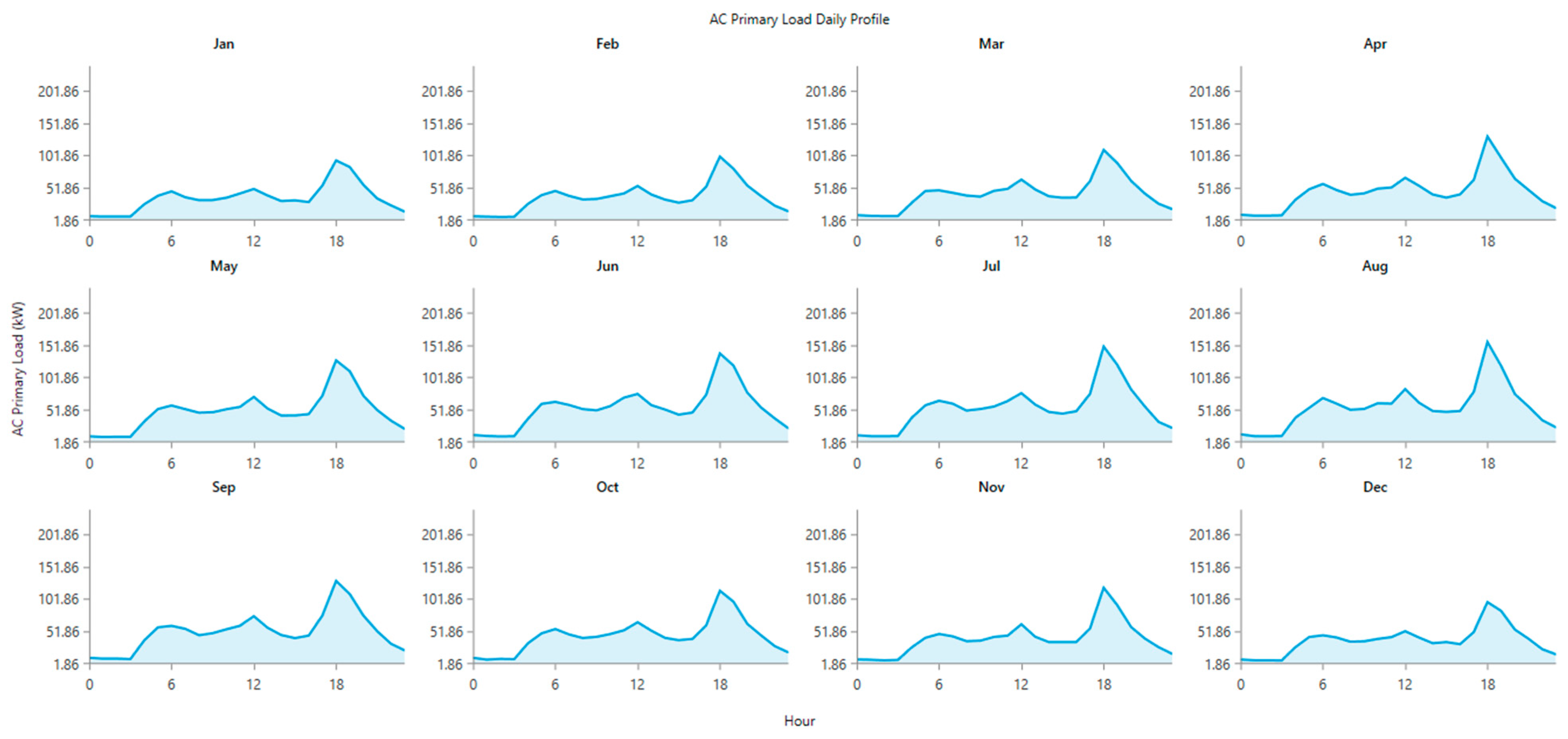
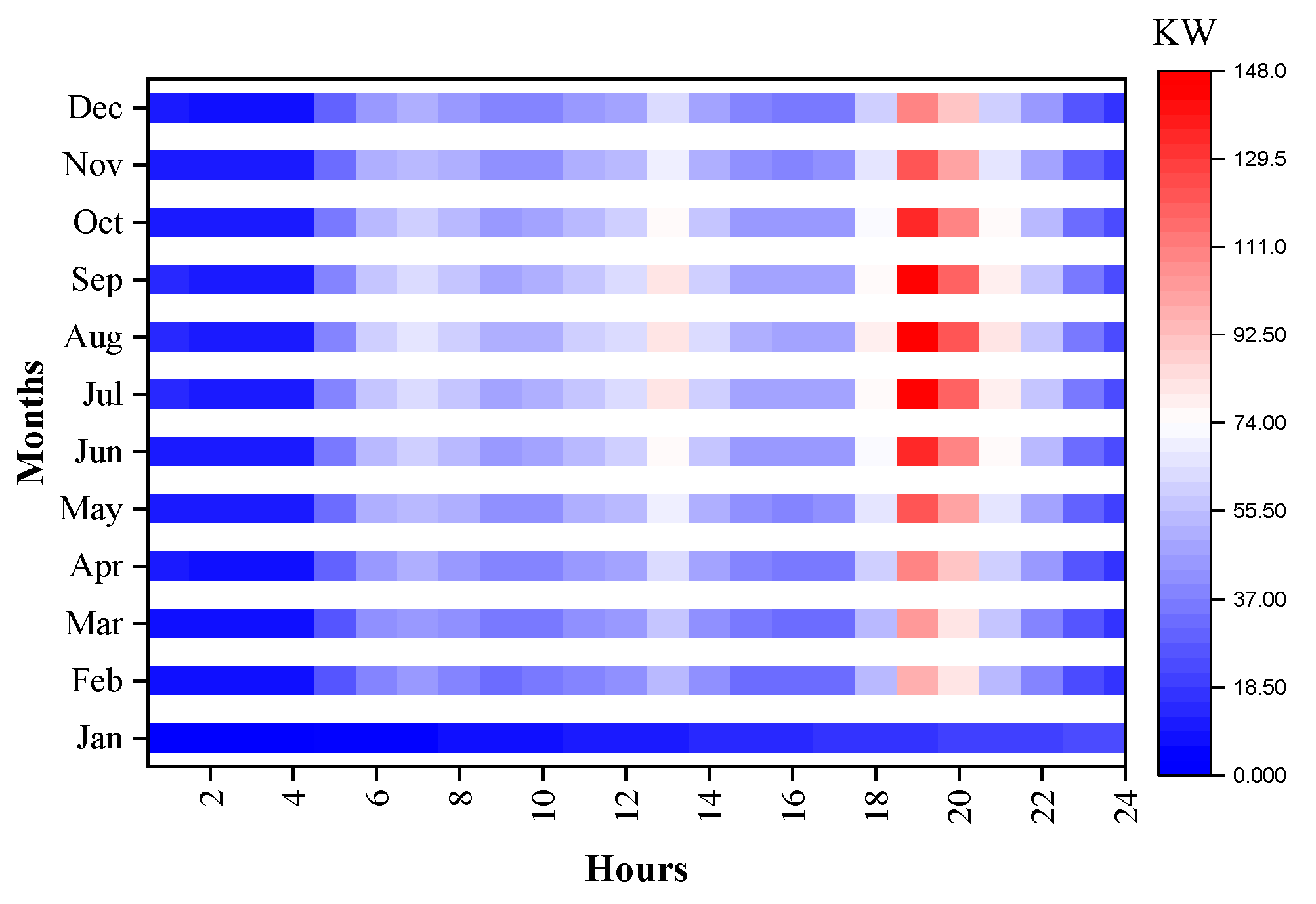
2.3. Load Profile
2.4. Resources
2.4.1. Solar Irradiations and Clearness Index
2.4.2. Wind Speed
2.4.3. Temperature
2.4.4. Biomass Resources
2.5. Solar PV
2.6. Wind Turbine
2.7. Biomass Generator
2.8. Inverter
2.9. Utility Grid
2.10. Technical Specifications
3. Result and Discussion
3.1. Techno-Economic Assessment of the Microgrid
3.2. Sensitivity Analysis Results
3.3. Comparison with Others Published Work
4. Conclusions
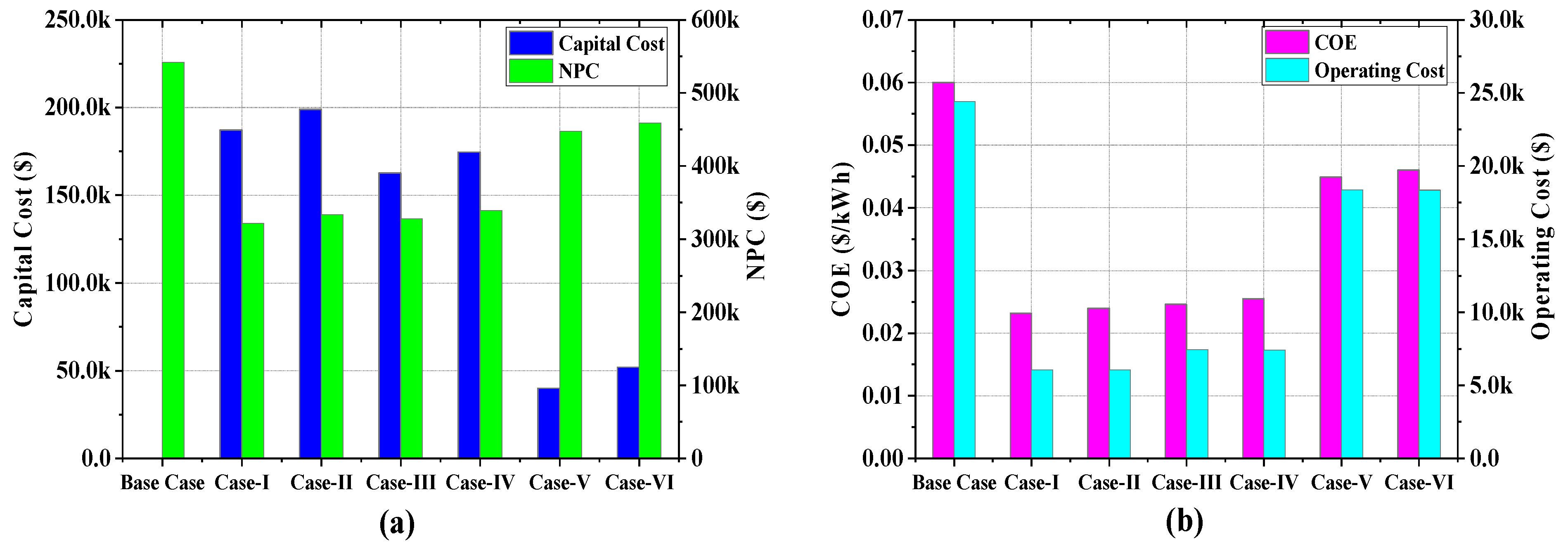
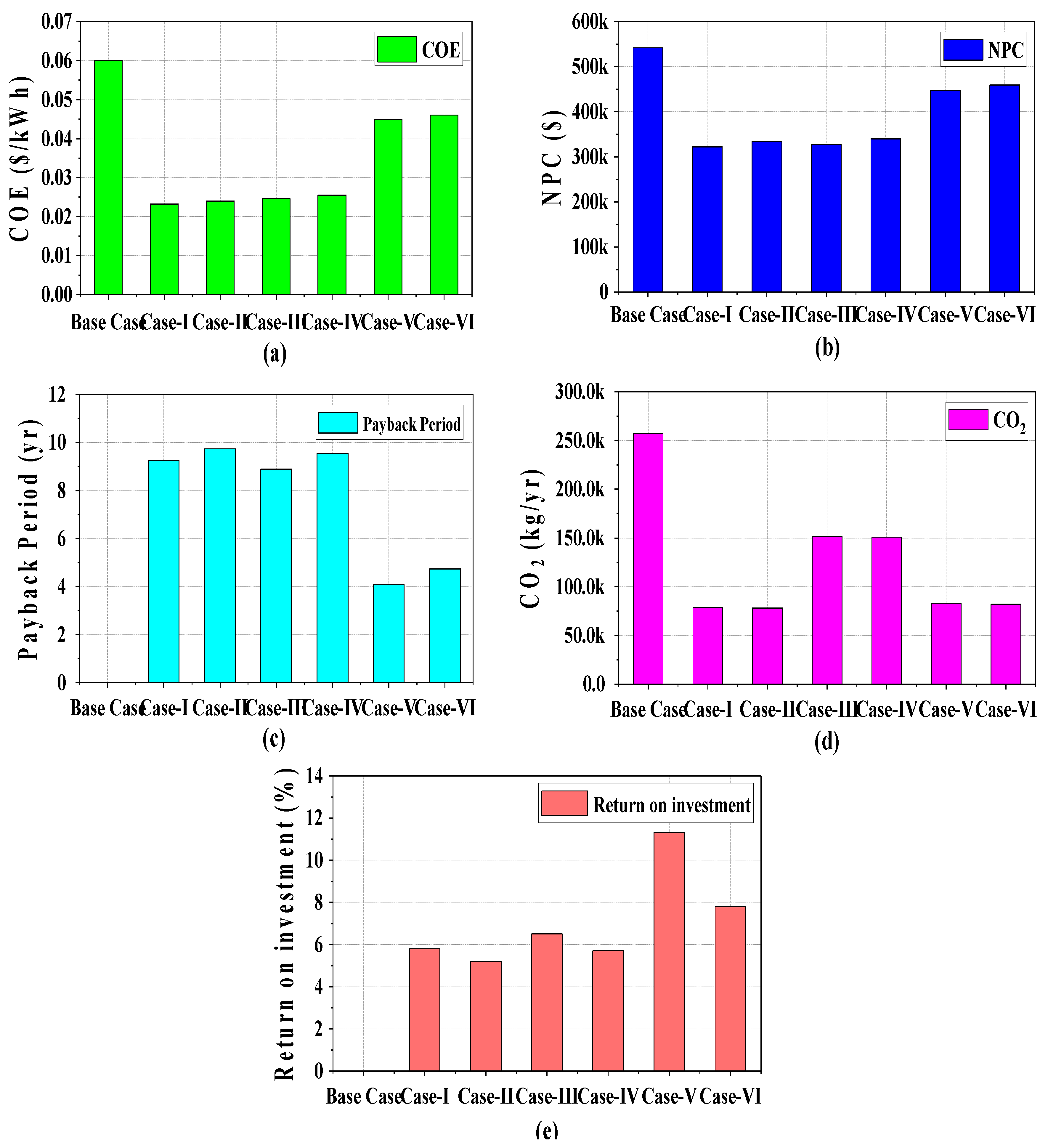
- The integration of photovoltaics with a biomass generator and grid connection (Case-I) is the most cost-effective configuration, with a COE of USD 0.0232/kWh and an NPC of USD 321,798.00.
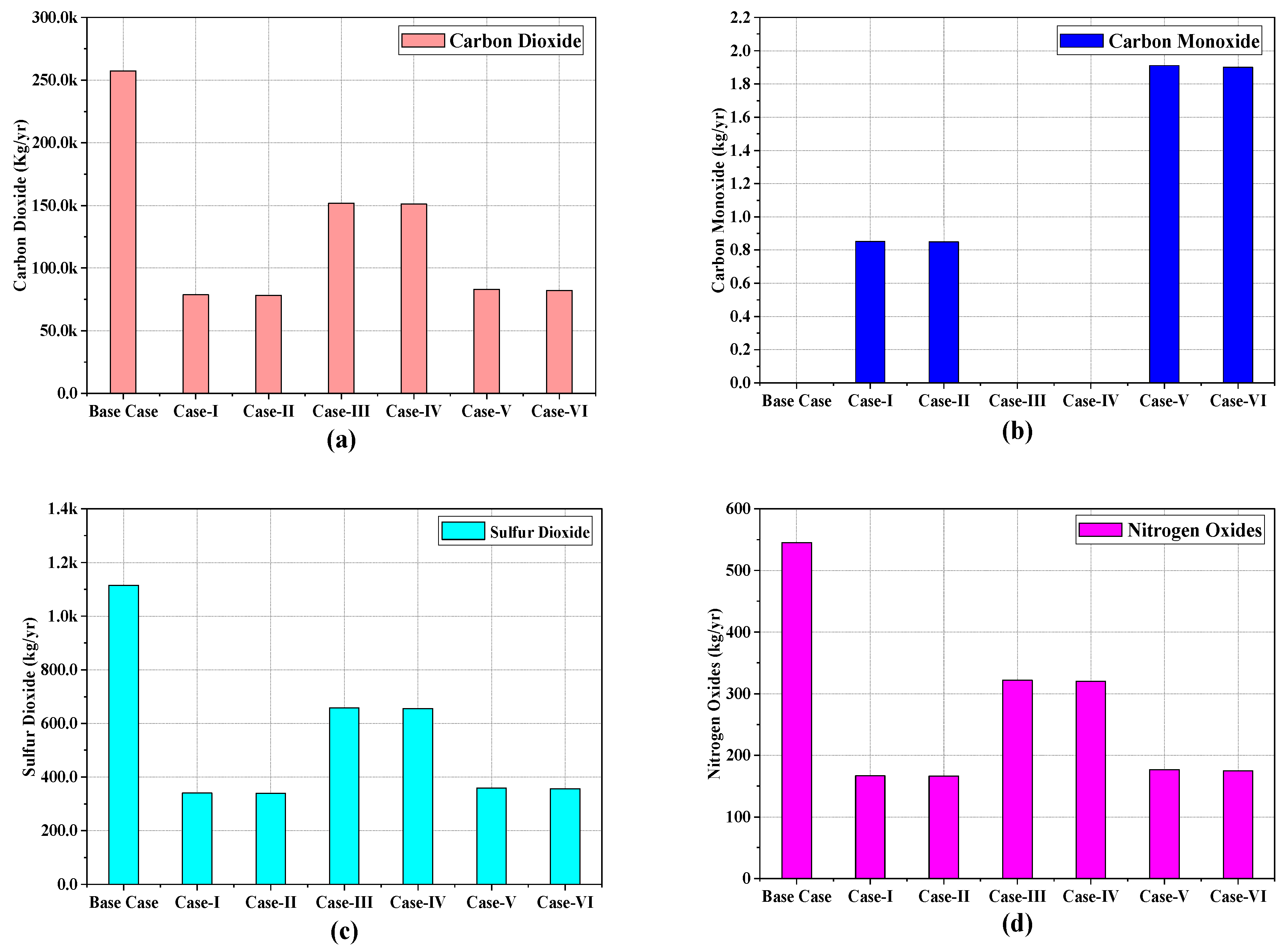
- Case-I demonstrates environmental benefits by reducing CO2 emissions to 78,721 kg/year and has an attractive payback period of 9.25 years.
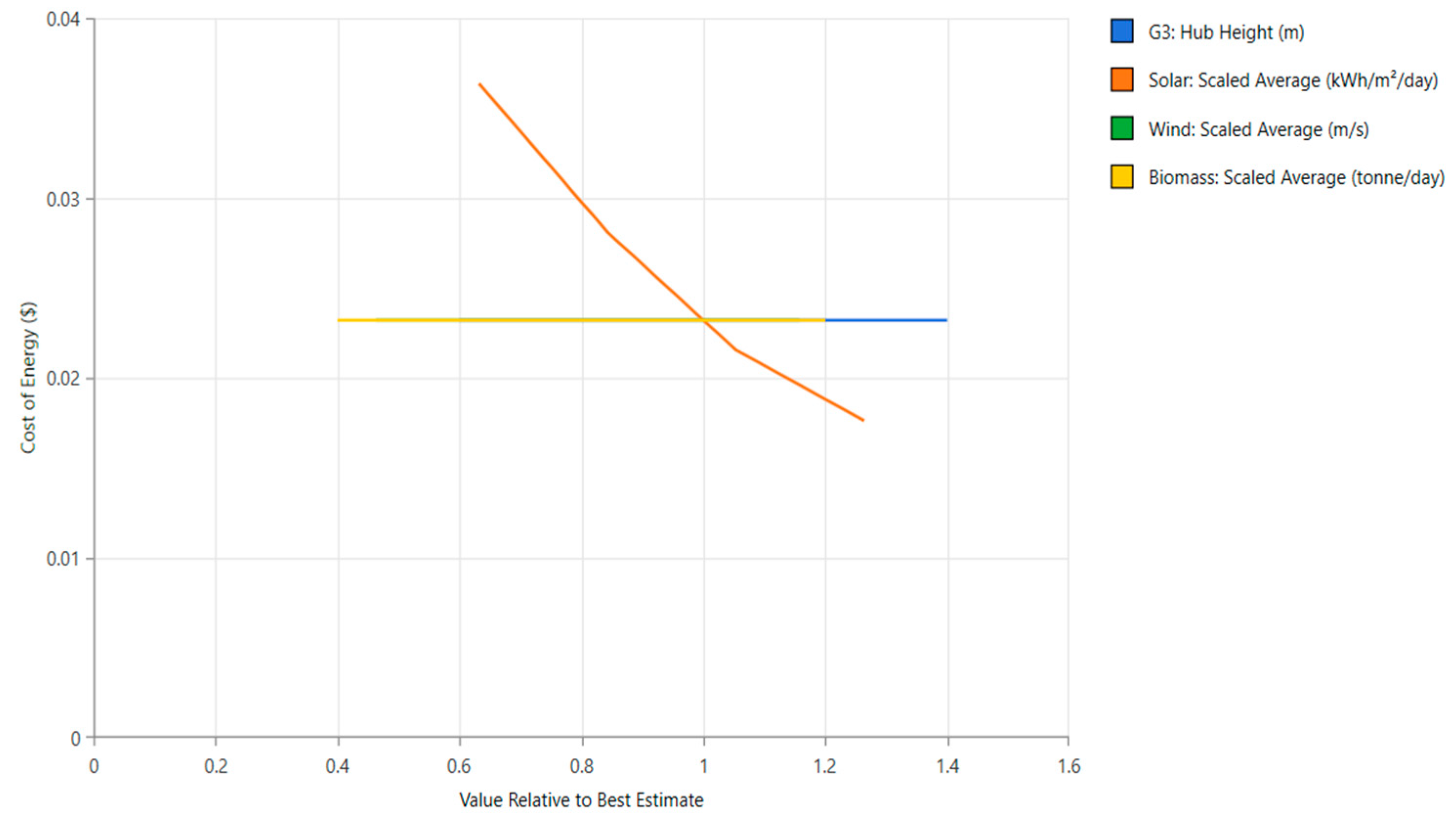
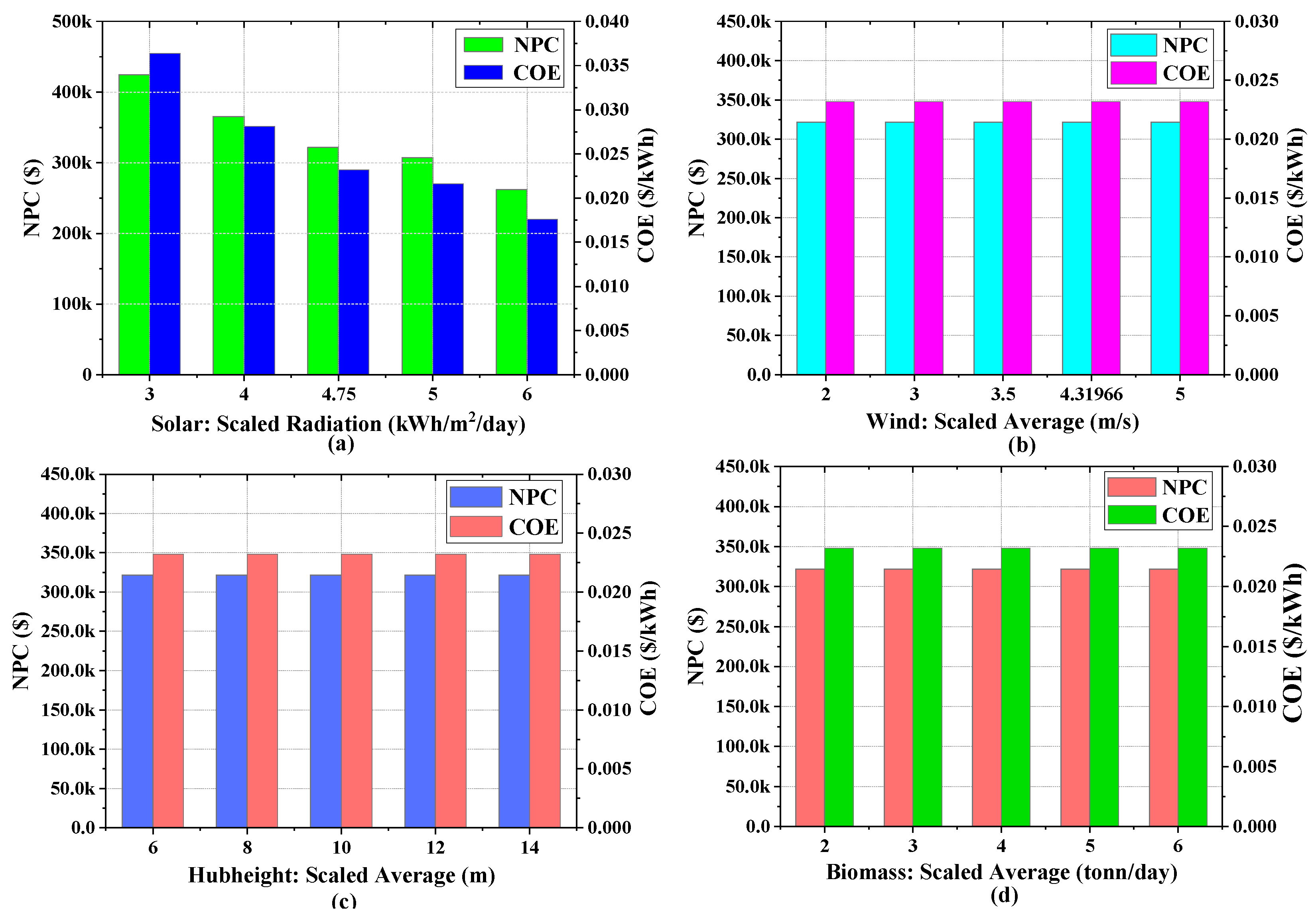
- Sensitivity analysis confirms Case-I’s robustness, highlighting its dependence on solar irradiance.
- This study emphasizes the scalability and viability of hybrid microgrids for addressing energy challenges in Bangladesh.
Author Contributions
Funding
Institutional Review Board Statement
Informed Consent Statement
Data Availability Statement
Conflicts of Interest
References
- Robinson, B.L.; Clifford, M.J.; Jewitt, S. TIME to Change: Rethinking Humanitarian Energy Access. Energy Res. Soc. Sci. 2022, 86, 102453. [Google Scholar] [CrossRef]
- Top Geopolitical Risks of 2023|S&P Global. Available online: https://www.spglobal.com/en/enterprise/geopolitical-risk/ (accessed on 29 January 2024).
- Zhang, Q.; Hu, Y.; Jiao, J.; Wang, S. The Impact of Russia–Ukraine War on Crude Oil Prices: An EMC Framework. Humanit. Soc. Sci. Commun. 2024, 11, 8. [Google Scholar] [CrossRef]
- One Year on: Impact of the Ukraine War on Global Energy Prices. Available online: https://www.openaccessgovernment.org/one-year-impact-of-ukraine-war-global-energy-prices-input-output-analysis/152599/ (accessed on 29 January 2024).
- Hossain, S.M.; Biswas, S. Reinforcing Renewable Resources for Sustainable Future of Bangladesh. In Proceedings of the IEEE 8th International Conference for Convergence in Technology, I2CT, Lonavla, India, 7–9 April 2023. [Google Scholar]
- Piyal, A.P.; Ahmed, S.; Rahman, K.F.; Mohsin, A.S.M. Energy Demand Forecasting Using Machine Learning Perspective Bangladesh. In Proceedings of the IEEE IAS Global Conference on Renewable Energy and Hydrogen Technologies, GlobConHT, Male, Maldives, 11–12 March 2023. [Google Scholar]
- Safi, M.; Chowdhury, S.; Shahabuddin, G.M. Resources Diversification in Bangladesh’s Electricity Generation: A Study on the Role of Renewable Energy Sources. J. Eng. Res. Rep. 2023, 25, 26–35. [Google Scholar] [CrossRef]
- Wertz, C.; Smit, A.; Baetz, I.; Qu, S.; Rappazzo, B.; Pannala, S.; Schulz, N.; North, P.; Carson, W.; Chorey, A. Renewable Energy Resources Connected Utility Microgrid for the Tulalip Tribes. In Proceedings of the North American Power Symposium, NAPS, Salt Lake City, UT, USA, 9–11 October 2022. [Google Scholar]
- Bastos, A.F.; Trevizan, R.D. Feasibility of 100% Renewable-Energy-Powered Microgrids Serving Remote Communities. In Proceedings of the IEEE Power and Energy Society Innovative Smart Grid Technologies Conference, ISGT, Washington, DC, USA, 16–19 January 2023. [Google Scholar]
- Boddapati, V.; Daniel, S.A. Optimal Design and Techno-Economic Analysis of a Microgrid for Community Load Applications. In Advances in Clean Energy Technologies; Springer: Singapore, 2021. [Google Scholar]
- Manoj Kumar, N.; Chopra, S.S.; Chand, A.A.; Elavarasan, R.M.; Shafiullah, G.M. Hybrid Renewable Energy Microgrid for a Residential Community: A Techno-Economic and Environmental Perspective in the Context of the SDG7. Sustainability 2020, 12, 3944. [Google Scholar] [CrossRef]
- Fofang, T.F.; Tanyi, E. Design and Simulation of Off-Grid Solar/Mini-Hydro Renewable Energy System Using Homer Pro Software: Case of Muyuka Rural Community. Int. J. Eng. Res. Technol. 2020, 9, 597–604. [Google Scholar]
- Suman, G.K.; Roy, O.P. Microgrid System for A Rural Area—An Analysis of HOMER Optimised Model Using MATLAB. In Proceedings of the 3rd International Conference on Recent Developments in Control, Automation and Power Engineering, RDCAPE, Noida, India, 10–11 October 2019. [Google Scholar]
- Yap, C.M.F.; Bismark, K.M.K.C.; Caballa, L.G.C.; Pena, R.A.S.; Parocha, R.C.; Macabebe, E.Q.B. Feasibility Study of a Hybrid Renewable Energy System for a Remote Rural Community Using HOMER Pro. In Proceedings of the IEEE International Conference on Power and Energy: Advancement in Power and Energy Systems towards Sustainable and Resilient Energy Supply, PECon, Langkawi, Malaysia, 5–6 December 2022. [Google Scholar]
- He, L.; Zhang, S.; Chen, Y.; Ren, L.; Li, J. Techno-Economic Potential of a Renewable Energy-Based Microgrid System for a Sustainable Large-Scale Residential Community in Beijing, China. Renew. Sustain. Energy Rev. 2018, 93, 631–641. [Google Scholar] [CrossRef]
- Ashetehe, A.A.; Shewarega, F.; Bantyirga, B. Feasibility Study and Energy Management of a Hybrid Microgrid for Ethiopian Rural Community. In Proceedings of the International Conference on Electrical, Computer, and Energy Technologies, ICECET, Prague, Czech Republic, 20–22 July 2022. [Google Scholar]
- Araoye, T.O.; Ashigwuike, E.C.; Umar, S.A.; Adebayo, T.F.; Egoigwe, S.V.; Odo, M.C.; Opata, C.E.; Akachukwu, O.W. Modeling and Optimization of Hybrid Microgrid Energy System: A Case Study of University of Abuja, Nigeria. Int. J. Power Electron. Drive Syst. 2023, 14, 1201–1209. [Google Scholar] [CrossRef]
- Pater, S. Field Measurements and Energy Performance Analysis of Renewable Energy Source Devices in a Heating and Cooling System in a Residential Building in Southern Poland. Energy Build. 2019, 199, 115–125. [Google Scholar] [CrossRef]
- Mazzeo, D.; Oliveti, G.; Baglivo, C.; Congedo, P.M. Energy Reliability-Constrained Method for the Multi-Objective Optimization of a Photovoltaic-Wind Hybrid System with Battery Storage. Energy 2018, 156, 688–708. [Google Scholar] [CrossRef]
- Saifullah, M.K.; Halder, R.; Afroz, S.; Shatil, A.H.; Ahmed, K.F. Design of an off-Grid Solar-Wind-Bio Hybrid Power Generation for Remote Areas of Chapainawabgonj District in Bangladesh Using Homer. In Proceedings of the 3rd International Conference on Robotics, Electrical and Signal Processing Techniques (INCREST 2023), Dhaka, Bangladesh, 7–8 January 2023; Institute of Electrical and Electronics Engineers Inc.: Piscataway, NJ, USA, 2023; pp. 56–61. [Google Scholar]
- Mohseni, M.; Moosavian, S.F.; Hajinezhad, A. Feasibility Evaluation of an Off-Grid Solar-Biomass System for Remote Area Electrification Considering Various Economic Factors. Energy Sci. Eng. 2022, 10, 3091–3107. [Google Scholar] [CrossRef]
- Hasan, S.; Hazari, M.R.; Mannan, M.A. Fuzzy Logic-Based Design Optimization and Economic Planning of a Microgrid for a Residential Community in Bangladesh. In Proceedings of the International Conference on Robotics, Electrical and Signal Processing Techniques, Dhaka, Bangladesh, 7–8 January 2023. [Google Scholar]
- Khan, A.; Nawaz, U.H.; Ahmed, M.; Ullah, S.; Yousaf, A.; Adil Khan, M. Optimized and Feasible Sustainable Energy System for Remotes Areas in Sindh by Utilizing HOMER. In Proceedings of the IEEE 23rd International Multitopic Conference (INMIC), Bahawalpur, Pakistan, 5–7 November 2020. [Google Scholar] [CrossRef]
- Mahmud, D.M.; Hasan, S.; Ahmed, S.M.M.; Zeyad, M. Techno Economic Feasibility Analysis of Grid-Connected Microgrid by Using Solar PV for Residential Usage. In Proceedings of the IEEE 9th Region 10 Humanitarian Technology Conference (R10-HTC), Bangalore, India, 30 September–2 October 2021; pp. 1–6. [Google Scholar] [CrossRef]
- Rehman, S.U.; Rehman, S.; Shoaib, M.; Siddiqui, I.A. Feasibility Study of a Grid-Tied Photovoltaic System for Household in Pakistan: Considering an Unreliable Electric Grid. Environ. Prog. Sustain. Energy 2019, 38, e13031. [Google Scholar] [CrossRef]
- Raji, A.K.; Luta, D.N. Modeling and Optimization of a Community Microgrid Components. Energy Procedia 2019, 156, 406–411. [Google Scholar] [CrossRef]
- Dawood, F.; Shafiullah, G.M.; Anda, M. Stand-Alone Microgrid with 100% Renewable Energy: A Case Study with Hybrid Solar Pv-Battery-Hydrogen. Sustainability 2020, 12, 2047. [Google Scholar] [CrossRef]
- Owoeye, K.S.; Udofia, K.M.; Okpura, N.I. Design and Optimization of Hybrid Renewable Energy System for Rural Electrification of an Off-Grid Community. Eur. J. Eng. Technol. 2022, 10, 2022. [Google Scholar]
- Shafiullah, G.M.; Masola, T.; Samu, R.; Elavarasan, R.M.; Begum, S.; Subramaniam, U.; Romlie, M.F.; Chowdhury, M.; Arif, M.T. Prospects of Hybrid Renewable Energy-Based Power System: A Case Study, Post Analysis of Chipendeke Micro-Hydro, Zimbabwe. IEEE Access 2021, 9, 73433–73452. [Google Scholar] [CrossRef]
- Himabindu, N.; Mandi, R.P.; Santoshkumar, H. Modelling and Cost Optimization of a Community Microgrid. IOP Conf. Ser. Mater. Sci. Eng. 2021, 1114, 012061. [Google Scholar] [CrossRef]
- Ishraque, M.F.; Shezan, S.A.; Nur, J.N.; Islam, M.S. Optimal Sizing and Assessment of an Islanded Photovoltaic-Battery-Diesel Generator Microgrid Applicable to a Remote School of Bangladesh. Eng. Rep. 2021, 3, e12281. [Google Scholar] [CrossRef]
- Mahmud, D.M.; Ahmed, S.M.M.; Hasan, S.; Zeyad, M. Grid-Connected Microgrid: Design and Feasibility Analysis for a Local Community in Bangladesh. Clean Energy 2022, 6, 447–459. [Google Scholar] [CrossRef]
- HOMER—Hybrid Renewable and Distributed Generation System Design Software. Available online: https://homerenergy.com/ (accessed on 11 March 2024).
- Solving Problems with HOMER. Available online: https://homerenergy.com/products/pro/docs/3.15/solving_problems_with_homer.html (accessed on 11 March 2024).
- Douiri, M.R. A Predictive Model for Solar Photovoltaic Power Based on Computational Intelligence Technique. Arab. J. Sci. Eng. 2019, 44, 6923–6940. [Google Scholar] [CrossRef]
- Hossain, M.A.; Pota, H.R.; Squartini, S.; Zaman, F.; Muttaqi, K.M. Energy Management of Community Microgrids Considering Degradation Cost of Battery. J. Energy Storage 2019, 22, 257–269. [Google Scholar] [CrossRef]
- Sultana, M.; Rahman, M.; Das, N.; Ur Rashid, M.M. Feasibility and Techno-Economic Analysis of an Off-Grid Hybrid Energy System: A Char Area in Bangladesh. In Proceedings of the International Conference on Science and Contemporary Technologies, ICSCT, Dhaka, Bangladesh, 5–7 August 2021. [Google Scholar]
- Razmjoo, A.; Shirmohammadi, R.; Davarpanah, A.; Pourfayaz, F.; Aslani, A. Stand-Alone Hybrid Energy Systems for Remote Area Power Generation. Energy Rep. 2019, 5, 231–241. [Google Scholar] [CrossRef]
- Hybrid Renewable Energy Systems (HRES)—The University of Aberdeen Research Portal. Available online: https://abdn.elsevierpure.com/en/impacts/hybrid-renewable-energy-systems-hres (accessed on 11 March 2024).
- NASA. Prediction of Worldwide Energy Resource (POWER): Data Access Viewer—NASA POWER. Available online: https://power.larc.nasa.gov/data-access-viewer/ (accessed on 12 March 2024).
- Zhang, T.; Stackhouse, P.W.; Chandler, W.S.; Hoell, J.M.; Westberg, D.; Whitlock, C.H. A Global Perspective on Renewable Energy Resources: NASA’s Prediction of Worldwide Energy Resources (POWER) Project. In Proceedings of the ISES World Congress 2007; Springer: Berlin/Heidelberg, Germany, 2007; Volume 4, pp. 2636–2640. [Google Scholar] [CrossRef]
- Sarmah, P.; Das, D.; Saikia, M.; Kumar, V.; Yadav, S.K.; Paramasivam, P.; Dhanasekaran, S. Comprehensive Analysis of Solar Panel Performanceand Correlations with Meteorological Parameters. ACS Omega 2023, 8, 47897. [Google Scholar] [CrossRef] [PubMed]
- Wind Power—Energy Education. Available online: https://energyeducation.ca/encyclopedia/Wind_power (accessed on 12 March 2024).
- What Are the Effects of Temperature on Solar Panel Efficiency? Available online: https://blog.ecoflow.com/us/effects-of-temperature-on-solar-panel-efficiency/ (accessed on 12 March 2024).
- Das, T.K.; Kundu, D. Feasibility and Sensitivity Analysis of a Self-Sustainable Hybrid System: A Case Study of a Mountainous Region in Bangladesh. Energy Convers. Manag. X 2023, 20, 100411. [Google Scholar] [CrossRef]
- Bridgwater, A.V. Review of Fast Pyrolysis of Biomass and Product Upgrading. Biomass Bioenergy 2012, 38, 68–94. [Google Scholar] [CrossRef]
- Solar Integration: Inverters and Grid Services Basics|Department of Energy. Available online: https://www.energy.gov/eere/solar/solar-integration-inverters-and-grid-services-basics (accessed on 13 March 2024).
- BERC-Electricity-Tariff-Order-Retail. Available online: https://berc.org.bd/site/notices/999da7ce-b204-4bcc-987c-49678efa9983/BERC-Electricity-Tariff-Order-Retail- (accessed on 13 March 2024).
- Bangladesh Power Development Board. Available online: https://bpdb.gov.bd/site/page/c413c44f-9611-4320-82da-b298fe69157e/ (accessed on 13 March 2024).
- DIY Calculation Guide for 1 KW Solar System—Homescape. Available online: https://homescape.solar/blog/diy-calculation-guide-for-1kw-solar-system/ (accessed on 21 March 2024).
- Rahman, M.M.; Mallick, A. Measurement of the Carbon Footprint for Bangladesh’s Electricity Generation in 2009–2015. In Proceedings of the ETCCE 2020—International Conference on Emerging Technology in Computing, Communication and Electronics, Dhaka, Bangladesh, 21–22 December 2020. [Google Scholar]
- Alayi, R.; Seyednouri, S.R.; Jahangiri, M.; Ma’arif, A. Optimization, Sensitivity Analysis, and Techno-Economic Evaluation of a Multi-Source System for an Urban Community: A Case Study. Renew. Energy Res. Appl. 2022, 3, 21–30. [Google Scholar] [CrossRef]
- Hasan, S.; Zeyad, M.; Ahmed, S.M.M.; Anubhove, M.S.T. Optimization and Planning of Renewable Energy Sources Based Microgrid for a Residential Complex. Environ. Prog. Sustain. Energy 2023, 42, e14124. [Google Scholar] [CrossRef]
- Zeyad, M.; Ahmed, S.M.M.; Hasan, S.; Mahmud, D.M. Community Microgrid: An Approach towards Positive Energy Community in an Urban Area of Dhaka, Bangladesh. Clean Energy 2023, 7, 926–939. [Google Scholar] [CrossRef]
- Hasan, S.; Hazari, M.R.; Jahan, E.; Mannan, M.A. Design Optimization of a Grid-Tied Microgrid for a Residential Community in Southern Bangladesh. Clean Energy 2023, 7, 1300–1315. [Google Scholar] [CrossRef]
- Benti, N.E.; Mekonnen, Y.S.; Asfaw, A.A. Combining Green Energy Technologies to Electrify Rural Community of Wollega, Western Ethiopia. Sci. Afr. 2023, 19, e01467. [Google Scholar] [CrossRef]
- Hossain, M.; Al Kayes, A.; Suny, R. Prospects and Design Assessment of a Hybrid Renewable Energy Microgrid for the Thuisa Para Indigenous Community in Bangladesh. In Proceedings of the IEEE Region 10 Humanitarian Technology Conference (R10-HTC), Kuala Lumpur, Malaysia, 1–3 October 2021; pp. 1–5. [Google Scholar] [CrossRef]
- Alluraiah, N.C.; Vijayapriya, P. Optimization, Design, and Feasibility Analysis of a Grid-Integrated Hybrid AC/DC Microgrid System for Rural Electrification. IEEE Access 2023, 11, 67013–67029. [Google Scholar] [CrossRef]
- Islam, M.K.; Akanto, J.M.; Zeyad, M.; Ahmed, S.M.M. Optimization of Microgrid System for Community Electrification by Using HOMER Pro. In Proceedings of the Region 10 Humanitarian Technology Conference (R10-HTC), Kuala Lumpur, Malaysia, 1–3 October 2021; pp. 1–5. [Google Scholar] [CrossRef]
- Haleema, K.; Kumari Juluri, S.; Pooja Sree, S.; Karnekota, P.; Murugaperumal, K. Sustainable Designing of Hybrid Renewable Electrification System for Urban Residential Community Load. In Proceedings of the 4th International Conference for Emerging Technology (INCET), Belgaum, India, 26–28 May 2023; pp. 1–7. [Google Scholar] [CrossRef]
- Medam, R.R.; Kavitha, K.; Chandrashekar, T. Techno-Economic Analysis of Hybrid Renewable Energy Based Community Microgrid. In Proceedings of the Mysore Sub Section International Conference (MysuruCon), Hassan, India, 24–25 October 2021; pp. 346–351. [Google Scholar] [CrossRef]
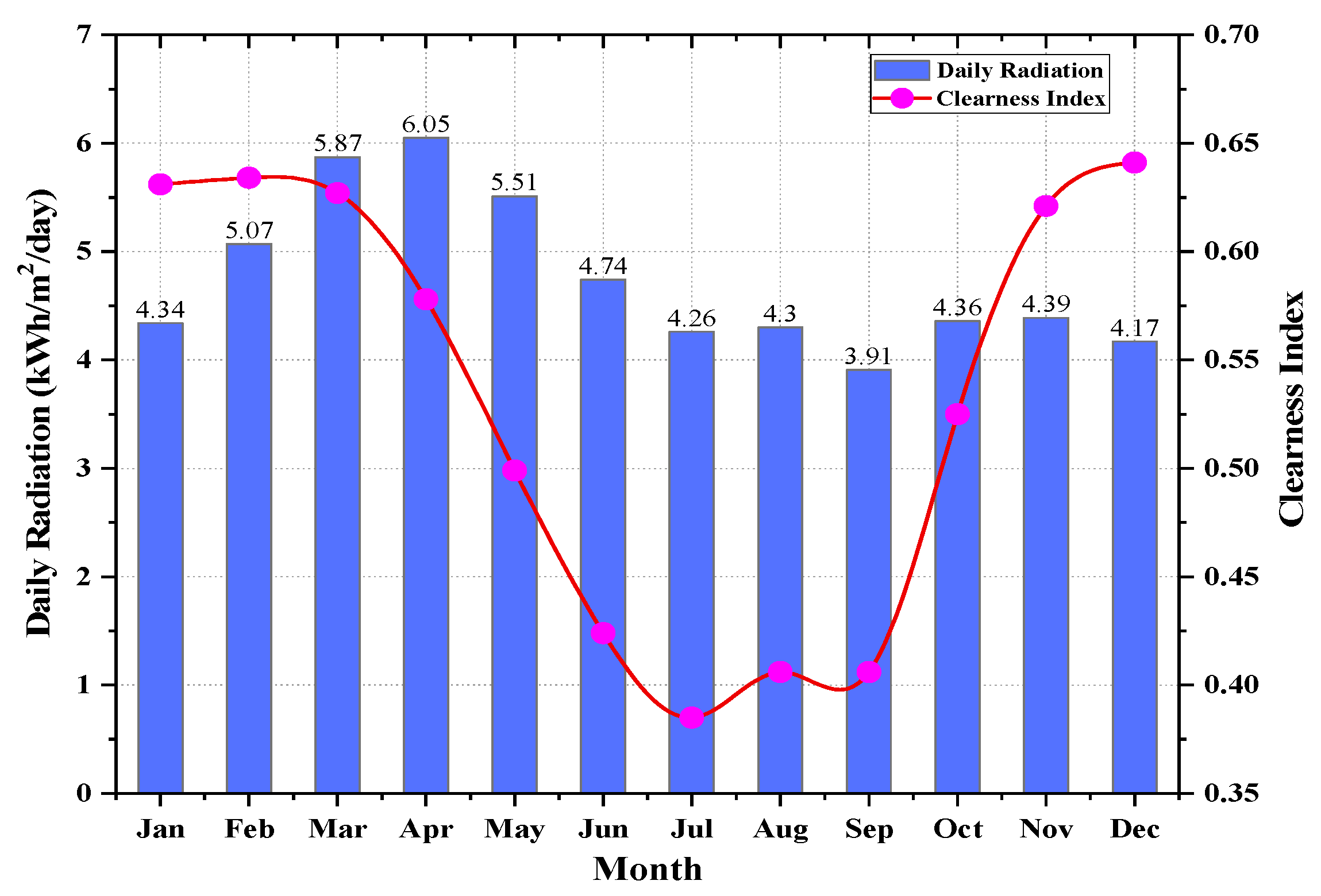
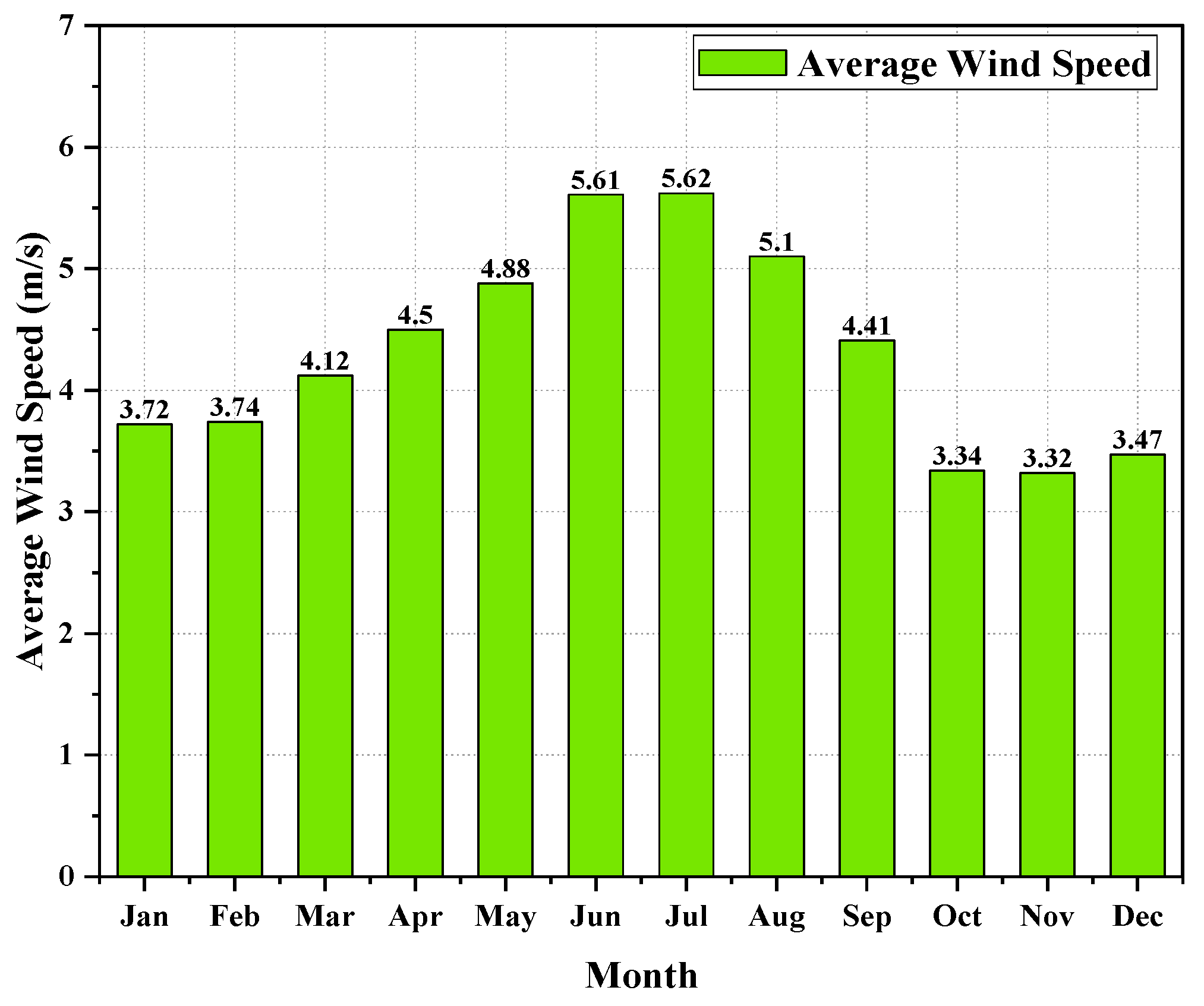
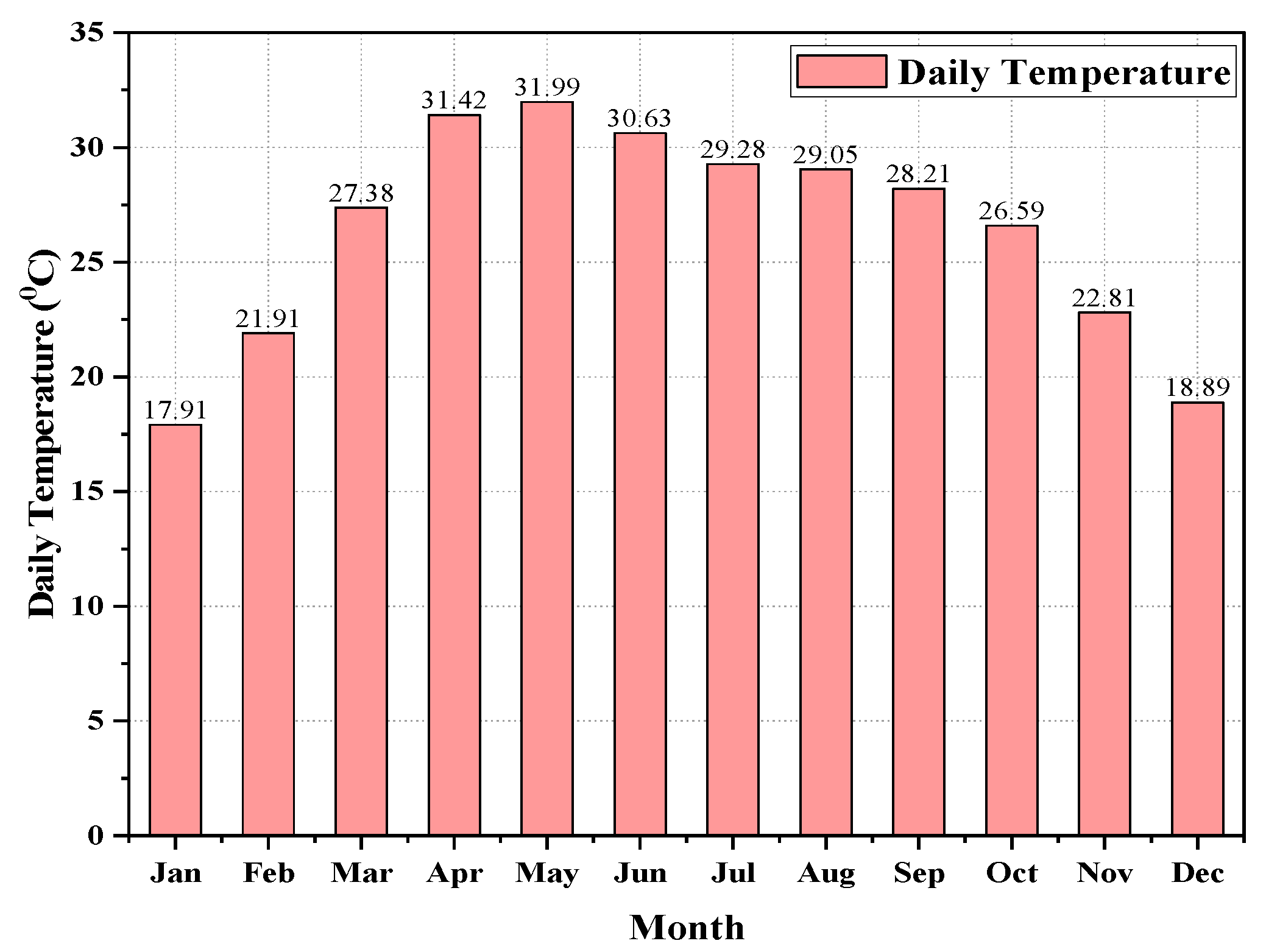
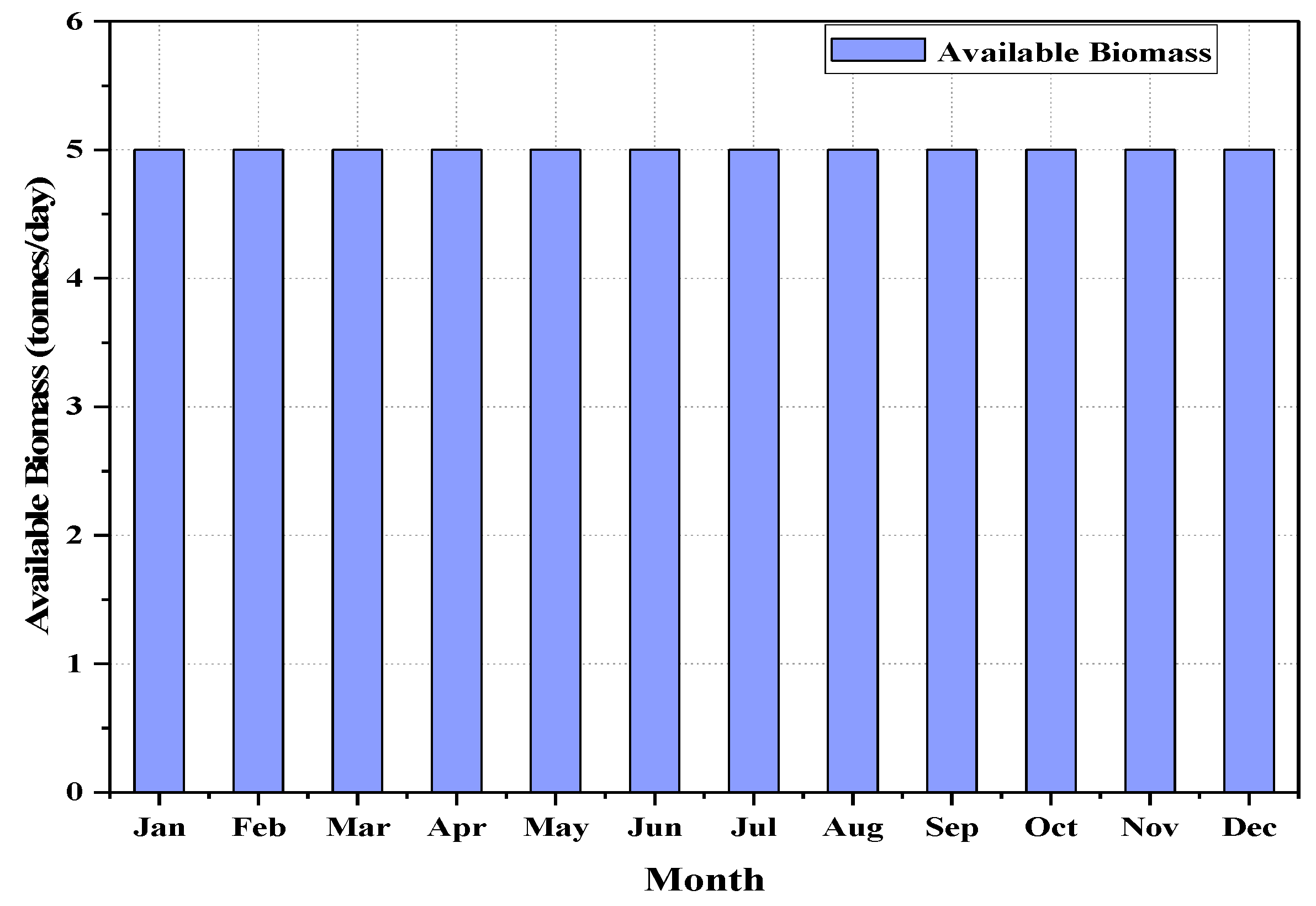



| System Structure | System Type | Location | Category | Findings |
|---|---|---|---|---|
| PV-WT-DG-BioGen-BESS [20] | Off-grid | Chapainawabgonj, Bangladesh | Residential | The study highlights the potential of hybrid renewable energy systems in remote areas of Bangladesh, emphasizing the importance of solar, wind, and biogas sources. By integrating these resources, the system can significantly reduce CO2 emissions, provide cost-effective solutions, and meet the energy demands of the community effectively. |
| PV-Biogas-BESS [21] | Off-grid | Kohgiluye and Boyer-Ahmad Province, Iran | Residential | The study assessed the feasibility of an off-grid solar–biomass system for remote rural areas in Iran, considering factors like solar radiation, available biomass, and economic aspects. HOMER Pro software optimized system sizing, resulting in a proposed configuration with a biogas-fueled generator, PV panels, battery storage, and a converter. |
| PV-WT-BESS [22] | On-grid | Remote Island, Bangladesh | Residential Community | The study employs fuzzy logic for load modeling and optimization, designing a hybrid microgrid for a residential community in Bangladesh. By integrating solar and wind energy, the proposed system achieves a low energy cost of USD 0.035/kWh, a high renewable fraction of 90%, a significant emission reduction of 78%, and enhanced reliability. |
| PV-WT-DG-BESS [23] | Off-grid | Kandhkot, Sindh, Pakistan | Community | The study analyzed the energy demand of a village in Sindh, Pakistan, and proposed an optimized hybrid sustainable energy system using wind and solar resources. The results indicated that an on-grid hybrid system was the most economical solution, with sensitivity analysis showing a decrease in costs with increased storage capacity. |
| PV-Grid [24] | On-grid | Mohammadpur, Dhaka, Bangladesh | Residential | The study concluded that the PV-Converter-Grid configuration was the most cost-effective for a residential microgrid, with higher electricity sales than purchases and lower operating costs compared to the PV-Converter-Battery-Grid setup. This configuration efficiently met the annual electrical load with minimal losses, making it a viable solution for residential energy supply. |
| PV-BESS-Grid [25] | On-grid | Larkana, Pakistan | Residential | The study found that a grid-tied PV system with battery storage significantly reduced greenhouse gas emissions compared to an unreliable grid system. The optimized configuration with no power outages had the lowest COE of USD 0.135/kWh. Outage duration directly impacted COE, increasing from USD 0.23/kWh to USD 0.55/kWh with 2 to 8 h of outages. |
| PV-BESS-DG [26] | Off-grid | Cape Town, South Africa | Community | The study evaluated a community microgrid in Cape Town using distributed energy resources like diesel generators and rooftop solar PV. HOMER software optimized system sizes for technical and economic feasibility. Comparing grid-forming and grid-connected modes, the grid-forming microgrid with 80% renewable energy penetration had a levelized cost of USD 0.509/kWh and a net present cost of USD 1.64 million. |
| PV-RESS [27] | Off-grid | North-West of Western Australia | Community | The study found that integrating hydrogen storage in a stand-alone microgrid improved system stability and increased renewable energy penetration. Techno-economic analysis revealed that the hybrid system reduced the cost of energy and achieved high renewable fractions. HOMER Pro simulations showed the feasibility of the system under various scenarios, emphasizing its potential for sustainable energy solutions. |
| PV-DG-BESS [28] | Off-grid | Edem Urua, Nigeria | Community | The research highlighted Scenario 3 as the optimal choice due to its cost effectiveness, zero CO2 emissions, and 100% renewable penetration. Despite its capacity shortage and unmet load, Scenario 3 stood out as a sustainable solution. This study’s outcomes aligned with global climate action goals, emphasizing the significance of solar PV and wind components in achieving efficient hybrid renewable energy systems. |
| PV-DG-BESS-Hydro [29] | Off-grid | Chipendeke, Zimbabwe | Community | The study on Chipendeke Micro-Hydro in Zimbabwe revealed that a hybrid system combining hydro, solar PV, energy storage, and diesel generator can address energy crises and fluctuations. Results showed the hydro-only system met only 164 kWh/day, while the optimized Hydro/PV/DG/Battery system met the community’s 310 kWh/day demand efficiently. |
| PV-WT-Grid [30] | Off-grid and on-grid | Chitradurga District, south Indian state of Karnataka | Community | The study compared on-grid and off-grid hybrid renewable energy system (HRES) configurations for a rural community. The grid-connected model achieved a minimum COE of USD 0.109, with a renewable energy contribution of 37.8%. The optimal NPC for the grid-connected system was USD 633,352, showcasing cost-effective and sustainable energy solutions. |
| PV-BESS-DG [31] | Off-grid | Fulchari Union, Gaibandha District, Bangladesh | Community School | The study successfully demonstrated that the proposed HRES effectively meets the electricity demand of a remote site with a peak load of 3.3 kW. Through sensitivity and multiyear analyses, the system’s economic viability was confirmed, outperforming grid extension. Further research with precise meteorological data is recommended for enhanced accuracy. |
| Parameters | PV | WT | Biogen | Inverter |
|---|---|---|---|---|
| Rated capacity | 278 kW | 3 kW | 25 kW | 166 kW |
| Efficiency | 18.7% | - | 30% | 95% |
| Hub height | - | 10 m | - | - |
| Lifetime | 25 years | 25 years | 2.28 Years | 15 Years |
| Parameters | PV | WT | Biogen | Inverter |
|---|---|---|---|---|
| Capital cost | USD 410/kW | USD 12,000/unit | USD 1000/kW | USD 290/kW |
| Replacement cost | USD 410/kW | USD 10,000/unit | USD 835/kW | USD 290/kW |
| Operating and maintenance cost | USD 8/year | USD 100/year | USD 0.2/h | USD 3/kW |
| Input Sensitive Variable | Values |
|---|---|
| Solar radiation (kWh/m2/day) | 3, 4, 4.75, 5, 6 |
| Wind speed (m/s) | 2, 3, 3.5, 4.32, 5 |
| Hub height (m) | 6, 8, 10, 12, 14 |
| Biomass quantity (tonnes/day) | 2, 3, 4, 5, 6 |
| System | Cases | Sensitive Outcome |
|---|---|---|
| Hybrid | Case-I | Sensitive |
| Hybrid | Case-II | Sensitive |
| Not hybrid | Case-III | Sensitive |
| Hybrid | Case-IV | Sensitive |
| Not hybrid | Case-V | Not sensitive |
| Hybrid | Case-VI | Not sensitive |
| Base Case | Not sensitive |
| System Structure | System Type | Category | RF (%) | COE (USD/kWh) |
|---|---|---|---|---|
| PV-WT-BESS [52] | Off-grid | Community | 98 | 0.824 |
| PV-BESS-Grid [53] | On-grid | Residential | 55.1 | 0.041 |
| PV-Grid [54] | On-grid | Community | 70% | 0.0357 |
| PV-WT-BESS-Grid [55] | On-grid | Residential | 90.1 | 0.0296 |
| PV-BESS [56] | Off-grid | Community | 100 | 0.173 |
| PV-Gen [57] | Off-grid | Community | - | 0.140 |
| PV-WT-Grid [58] | On-grid | Community | 97.8 | 0.0751 |
| PV-WT-DG-BESS [59] | Off-grid | Community | 88.5 | 1.01 |
| PV-WT-BioGen-Grid-BESS [60] | On-grid | Residential | 82 | 0.059 |
| PV-WT-BESS-Grid [61] | On-grid | Community | 29.3 | 0.165 |
| PV-Grid [32] | On-grid | Community | 57.5 | 0.0442 |
| The Proposed Work | On-grid | Residential | 80.1 | 0.0232 |
Disclaimer/Publisher’s Note: The statements, opinions and data contained in all publications are solely those of the individual author(s) and contributor(s) and not of MDPI and/or the editor(s). MDPI and/or the editor(s) disclaim responsibility for any injury to people or property resulting from any ideas, methods, instructions or products referred to in the content. |
© 2024 by the authors. Licensee MDPI, Basel, Switzerland. This article is an open access article distributed under the terms and conditions of the Creative Commons Attribution (CC BY) license (https://creativecommons.org/licenses/by/4.0/).
Share and Cite
Ali, M.F.; Hossain, M.A.; Julhash, M.M.; Ashikuzzaman, M.; Alam, M.S.; Sheikh, M.R.I. A Techno-Economic Analysis of a Hybrid Microgrid System in a Residential Area of Bangladesh: Optimizing Renewable Energy. Sustainability 2024, 16, 8051. https://doi.org/10.3390/su16188051
Ali MF, Hossain MA, Julhash MM, Ashikuzzaman M, Alam MS, Sheikh MRI. A Techno-Economic Analysis of a Hybrid Microgrid System in a Residential Area of Bangladesh: Optimizing Renewable Energy. Sustainability. 2024; 16(18):8051. https://doi.org/10.3390/su16188051
Chicago/Turabian StyleAli, Md. Feroz, Md. Alamgir Hossain, Mir Md. Julhash, Md Ashikuzzaman, Md Shafiul Alam, and Md. Rafiqul Islam Sheikh. 2024. "A Techno-Economic Analysis of a Hybrid Microgrid System in a Residential Area of Bangladesh: Optimizing Renewable Energy" Sustainability 16, no. 18: 8051. https://doi.org/10.3390/su16188051
APA StyleAli, M. F., Hossain, M. A., Julhash, M. M., Ashikuzzaman, M., Alam, M. S., & Sheikh, M. R. I. (2024). A Techno-Economic Analysis of a Hybrid Microgrid System in a Residential Area of Bangladesh: Optimizing Renewable Energy. Sustainability, 16(18), 8051. https://doi.org/10.3390/su16188051