A Novel Multi-Factor Three-Step Feature Selection and Deep Learning Framework for Regional GDP Prediction: Evidence from China

Abstract
1. Introduction
2. Related Works
- (1)
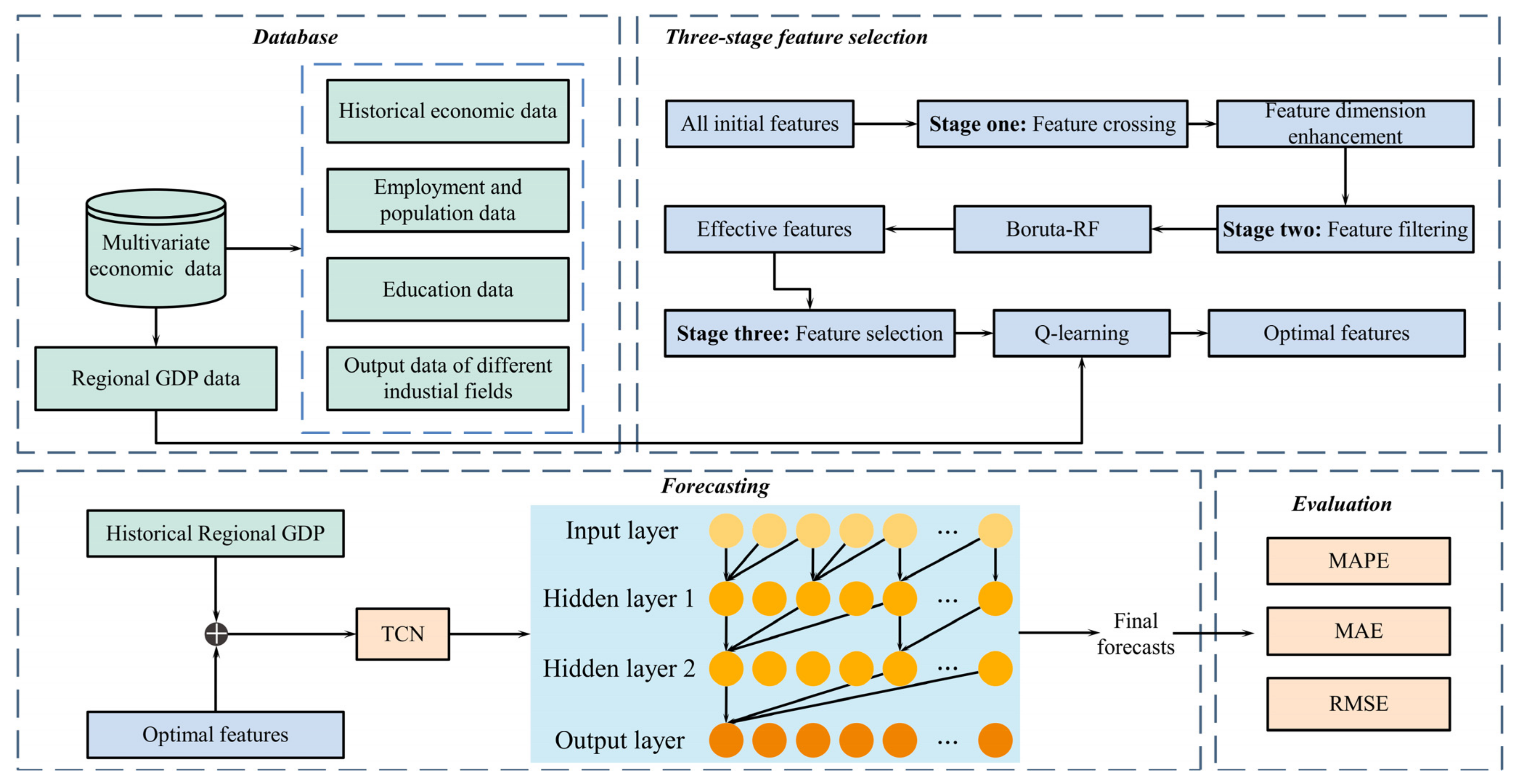
- To comprehensively analyze various influencing factors and improve the prediction accuracy of the traditional single-variable GDP time series prediction framework, a multi-factor data-driven GDP prediction framework is proposed to process the multivariate economic data. This multi-feature prediction and feature engineering is significantly efficient for general prediction structures.
- (2)
- With the excellent forecasting effect compared to the traditional shallow neural network and recursive neural network, the TCN neural network adopted in this paper is firstly applied in the field of GDP prediction, which can conduct analysis for complex nonlinear data and increase the GDP prediction accuracy.
- (3)
- A new three-stage feature selection framework is proposed in the paper. The feature crossing algorithm could select to explore the potential features and the deep information of the raw data. The Q-learning and BorutarRF algorithm could select features from different aspects and guarantee the quality of TCN input. The hybrid three-stage feature selection structure is applied firstly in GDP forecasting to improve the main predictor TCN.
3. Methodology
3.1. Framework of the Proposed Regional GDP Forecasting Model
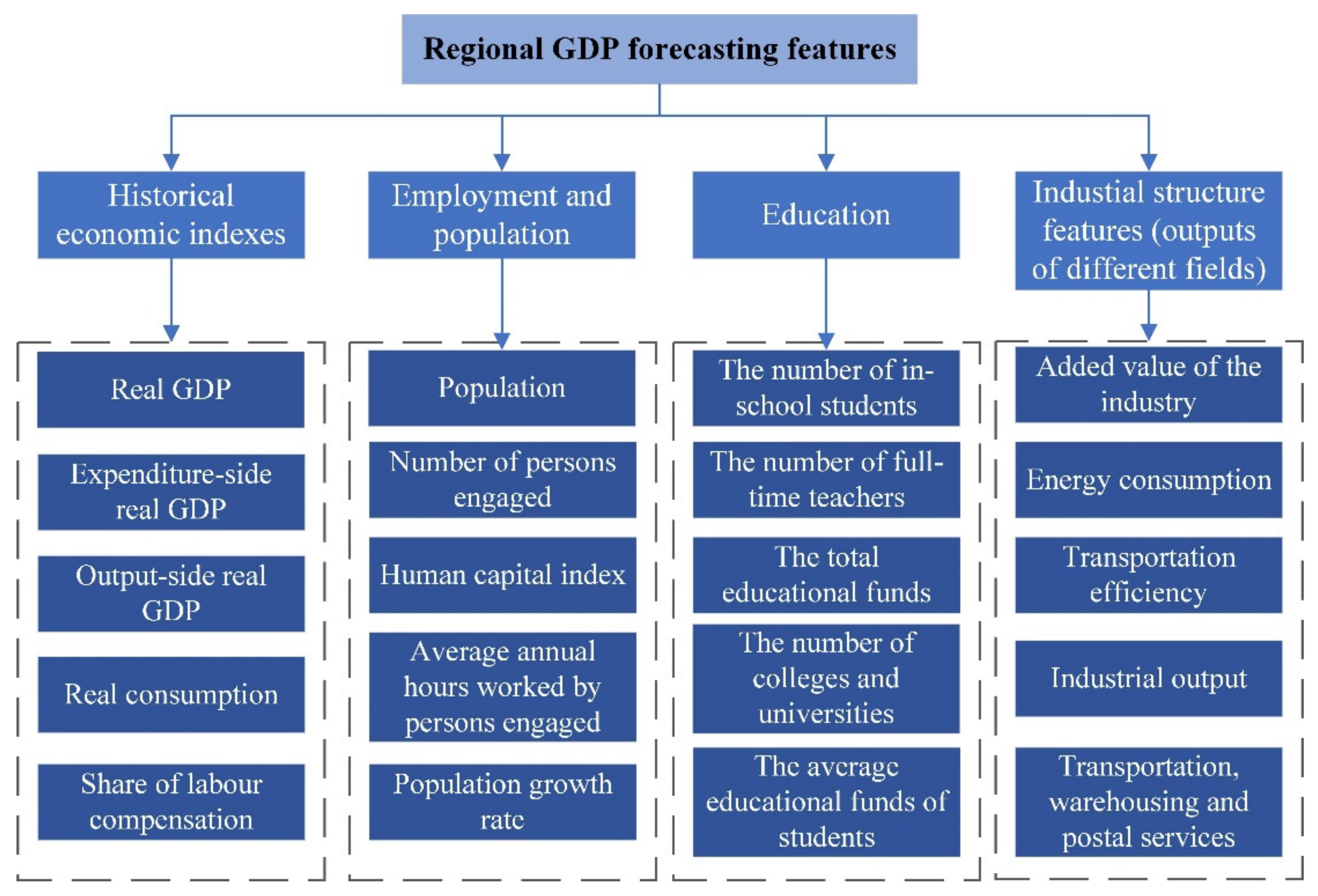
3.2. Multivariate Economic Characteristic Data
3.3. Three-Stage Feature Selection
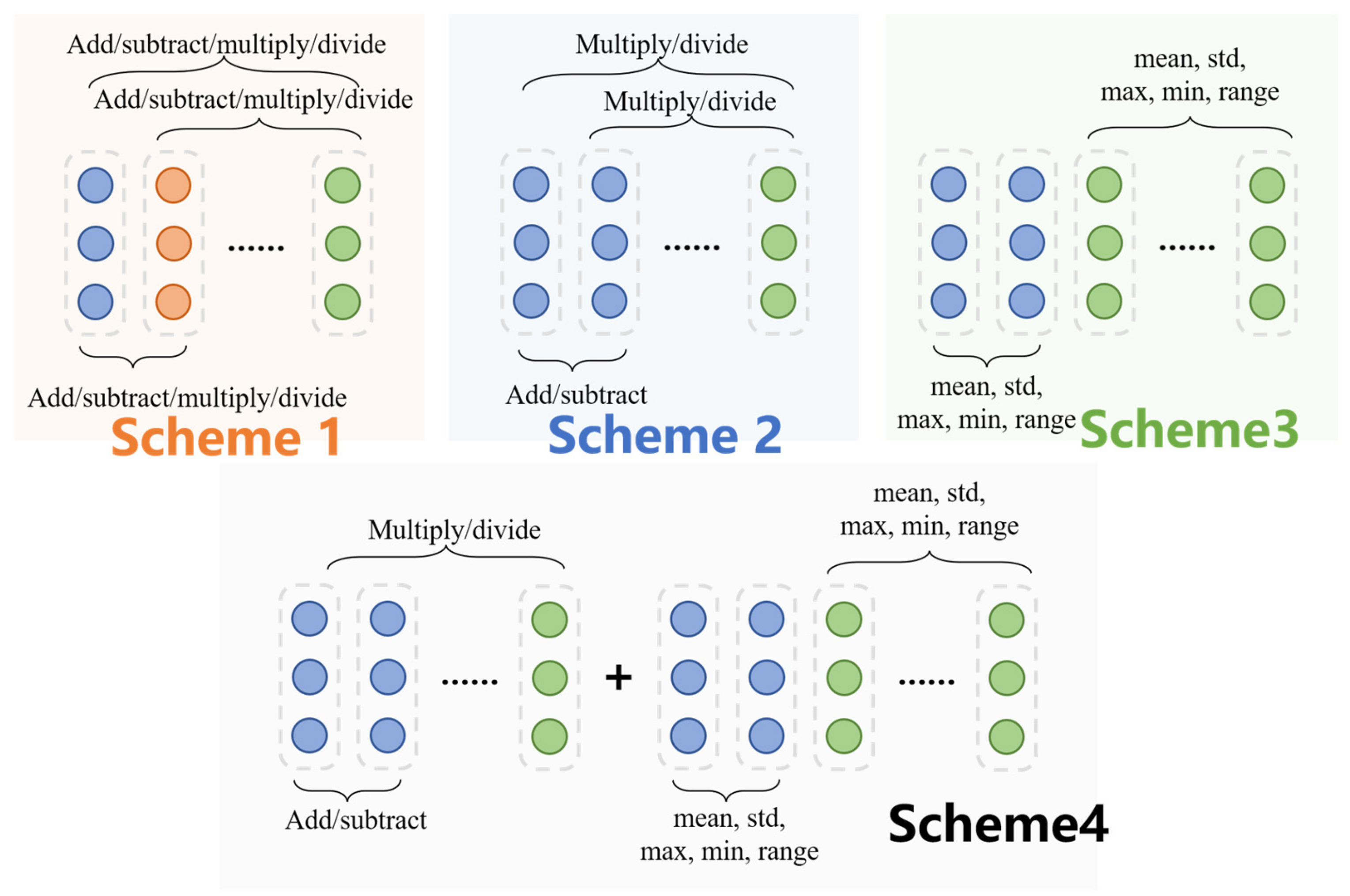
3.3.1. Stage I: Feature Crossing
3.3.2. Stage II: Feature Filtering Based on Boruta-RF
3.3.3. Stage III: Feature Selection Based on Reinforcement Learning
3.4. TCN for Regional GDP Forecasting
4. Case Study
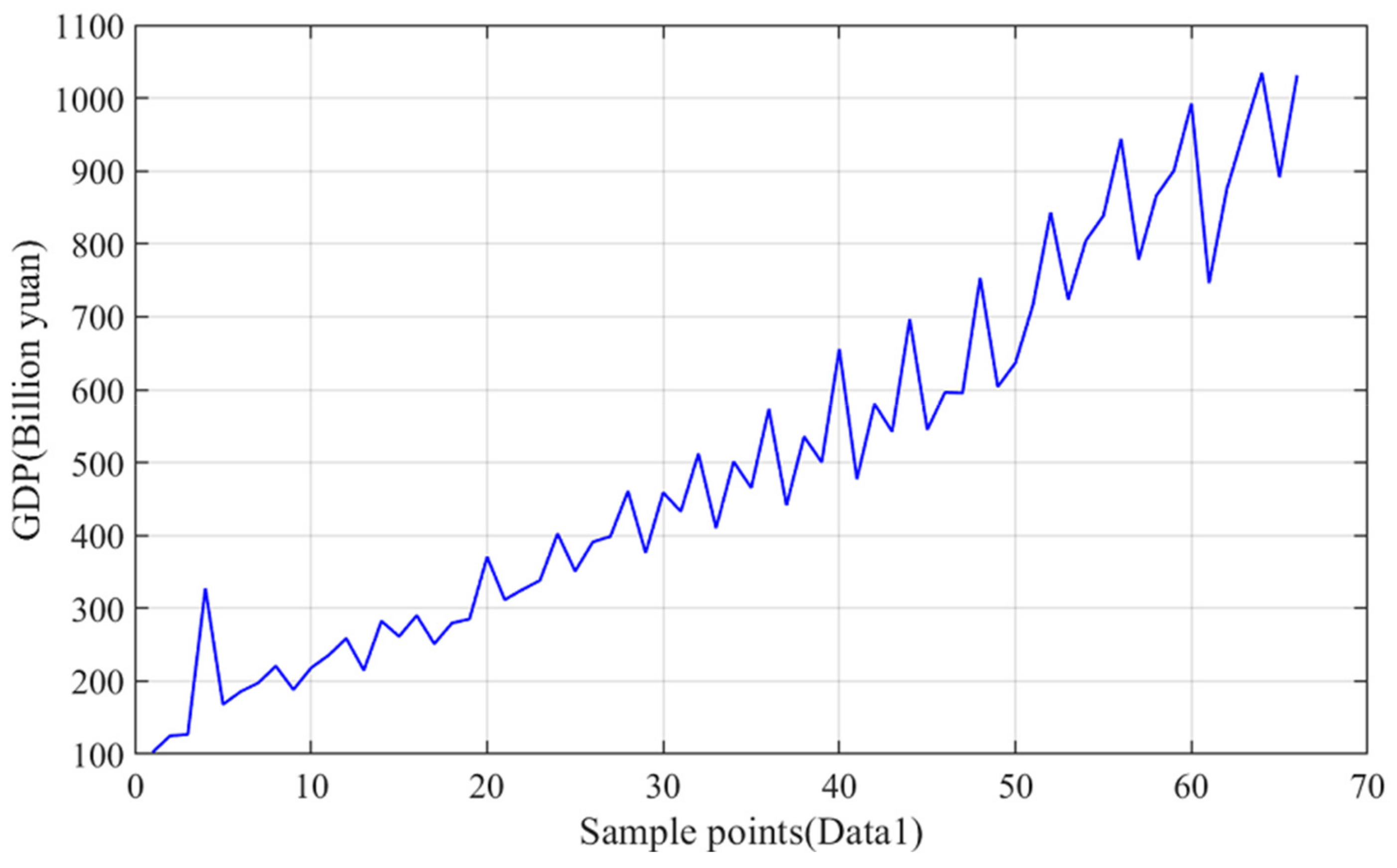
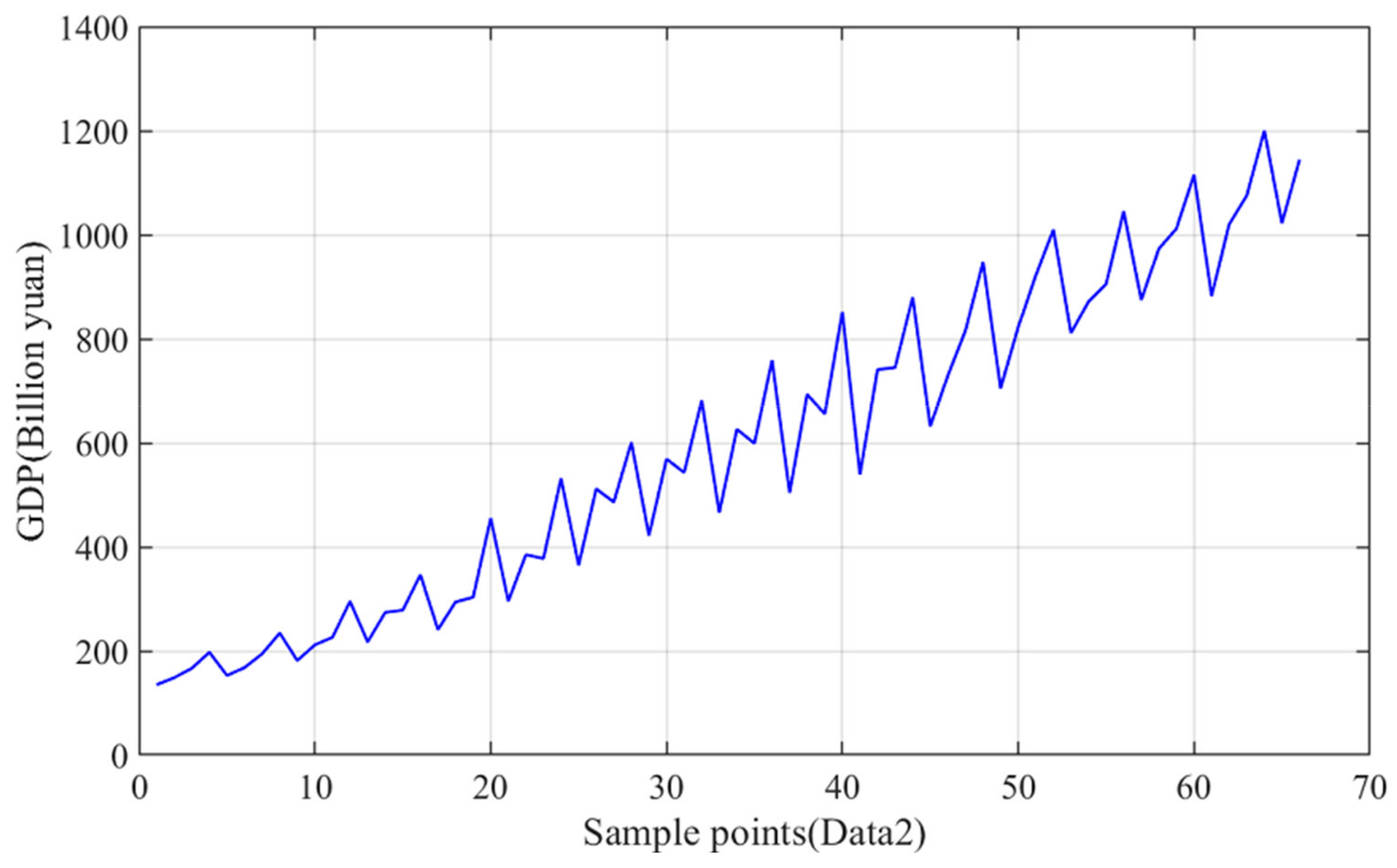
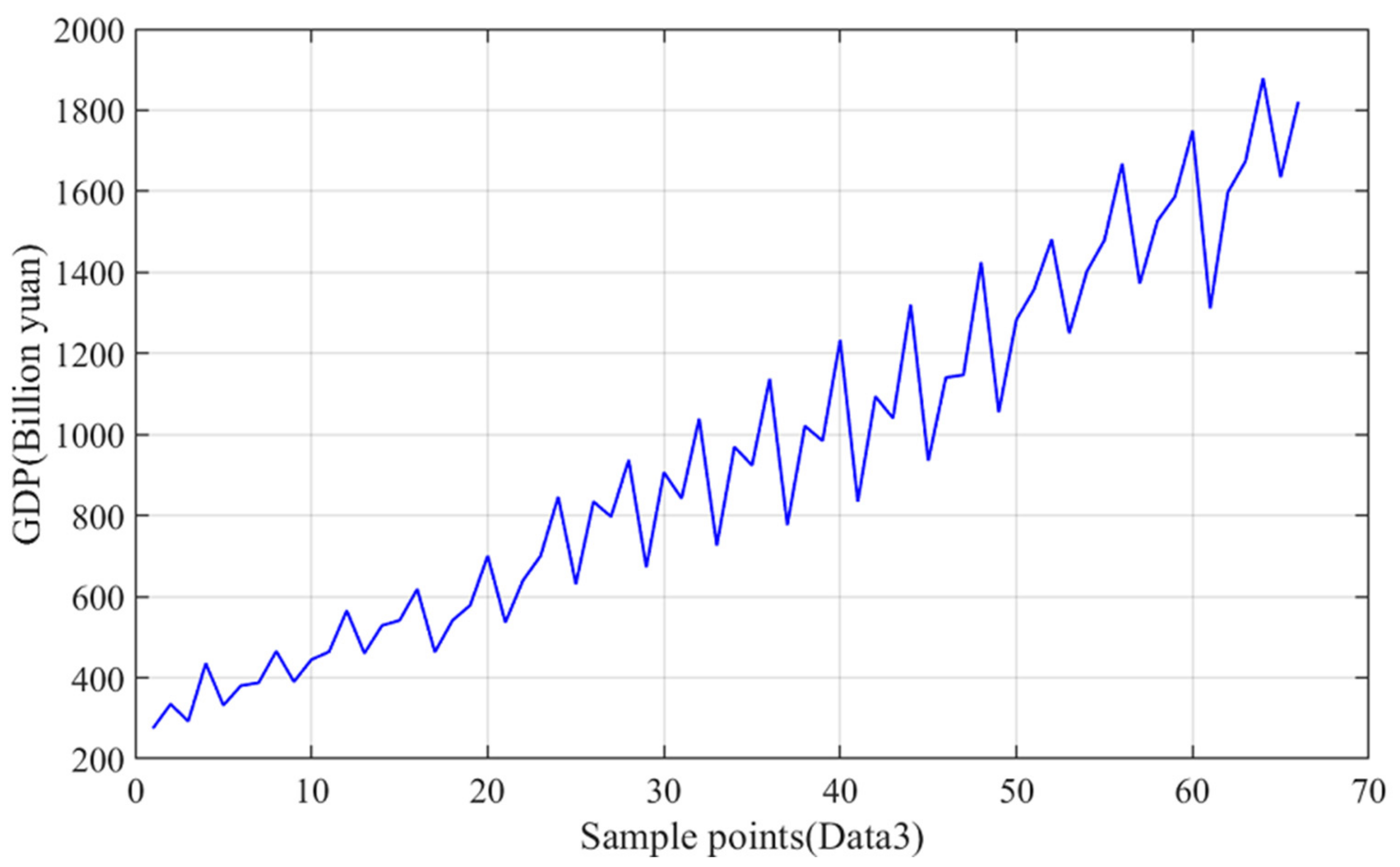
4.1. GDP Dataset
4.2. Performance Evaluation Indexes
4.3. Contrast Experiment with Benchmark Algorithms
4.3.1. Experimental Results and Analysis of Different Predictors
- (1)
- Compared with the traditional RBF and ELM algorithms, the neural network model based on deep learning can obtain fewer error prediction results. The experimental cases fully prove that the deep learning method can achieve satisfactory modeling results in this field. The feasible reason is that the multi-layer deep network structure has certain advantages in mining the deep feature information of data.
- (2)
- Compared with the traditional RNN prediction model, other deep learning models can achieve more satisfactory prediction results. This proves that other deep neural networks with special structures can better resume an excellent GDP forecasting framework. The possible reason is that the RNN model has problems such as gradient descent and gradient disappearance, which to some extent limits the training effect of the model and reduces the overall accuracy.
- (3)
- Compared with GRU and LSTM, the TCN model adopted in this paper can achieve smaller prediction errors in all cases. This fully proves the practical value and modeling ability of the TCN algorithm in GDP forecasting. The feasible reason is that the TCN algorithm fully combines the characteristics of CNN and RNN. Therefore, TCN improves the parallel computing capability of the model while maintaining the advantages of timing modeling, which further improves the performance of the model.
4.3.2. Experimental Results and Analysis of Different Hybrid Models
- (1)
- Compared with the single TCN model, all the hybrid models can achieve better prediction accuracy. The experimental results fully prove the ability of the feature engineering algorithm to optimize the prediction results of the predictor. The possible reason is that the feature engineering algorithm deeply excavates the deep correlation between GDP and other feature historical data and labels from two perspectives and selects the best quality features, which effectively optimizes the modeling ability of TCN.
- (2)
- The prediction results of FC- BorutaRF-Q-TCN are obviously better than those of FC-Q-TCN and FC-BorutaRF-TCN. This fully proves that the three-stage feature selection algorithm adopted in this paper can deeply mine the feature information of original data and achieve better results than the single feature selection algorithm. The feasible reason is that the BorutaRF algorithm and Q-Learning algorithm fully analyze the characteristic information obtained from the original data of the FC method and optimize it from two different perspectives. Therefore, TCN can obtain the best input features and establish the optimal GDP prediction model.
- (3)
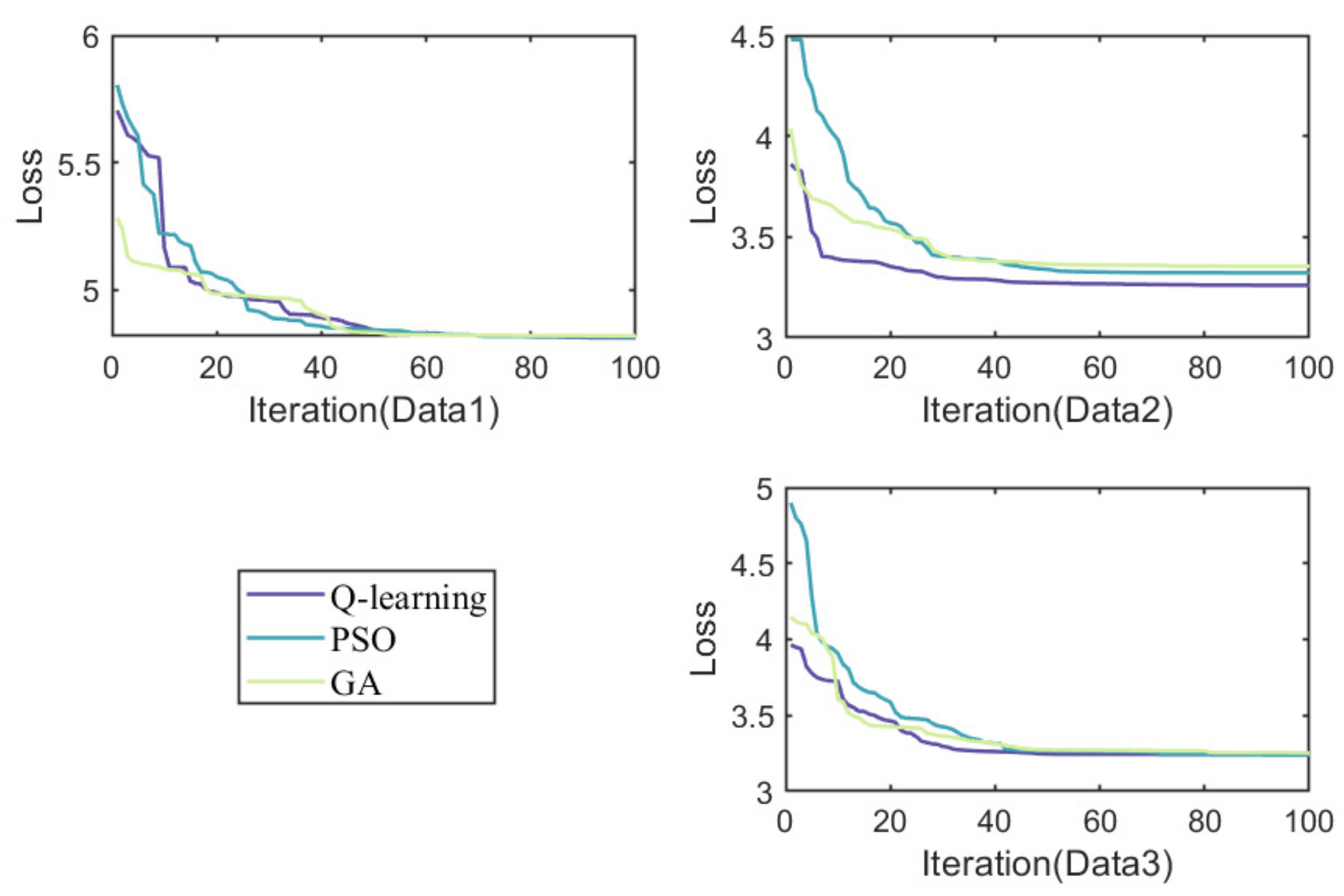
- Compared with PSO and GA, the feature selection algorithm based on reinforcement learning adopted in this paper can obtain the best results. This fully proves the ability of the Q-learning algorithm to analyze feature quality and make a selection. The possible reason is that, compared with other heuristic algorithms, the reinforcement learning algorithm improves the intelligence of the model by constantly training agents. Therefore, Q-learning can effectively evaluate the quality of features and select the optimal input for the TCN algorithm.
- (4)
- Based on feature selection results, it can be found that the largest number of retained features are historical GDP data and industrial features. In addition, the data on educational features and population features are less reserved. It proves that historical GDP data and industrial features play a paramount role in the composition of regional GDP. Based on the feature selection results, a more accurate prediction framework can be constructed in the process of establishing a GDP prediction model in the future.
4.4. Contrast Experiment with Existing Algorithms
- (1)
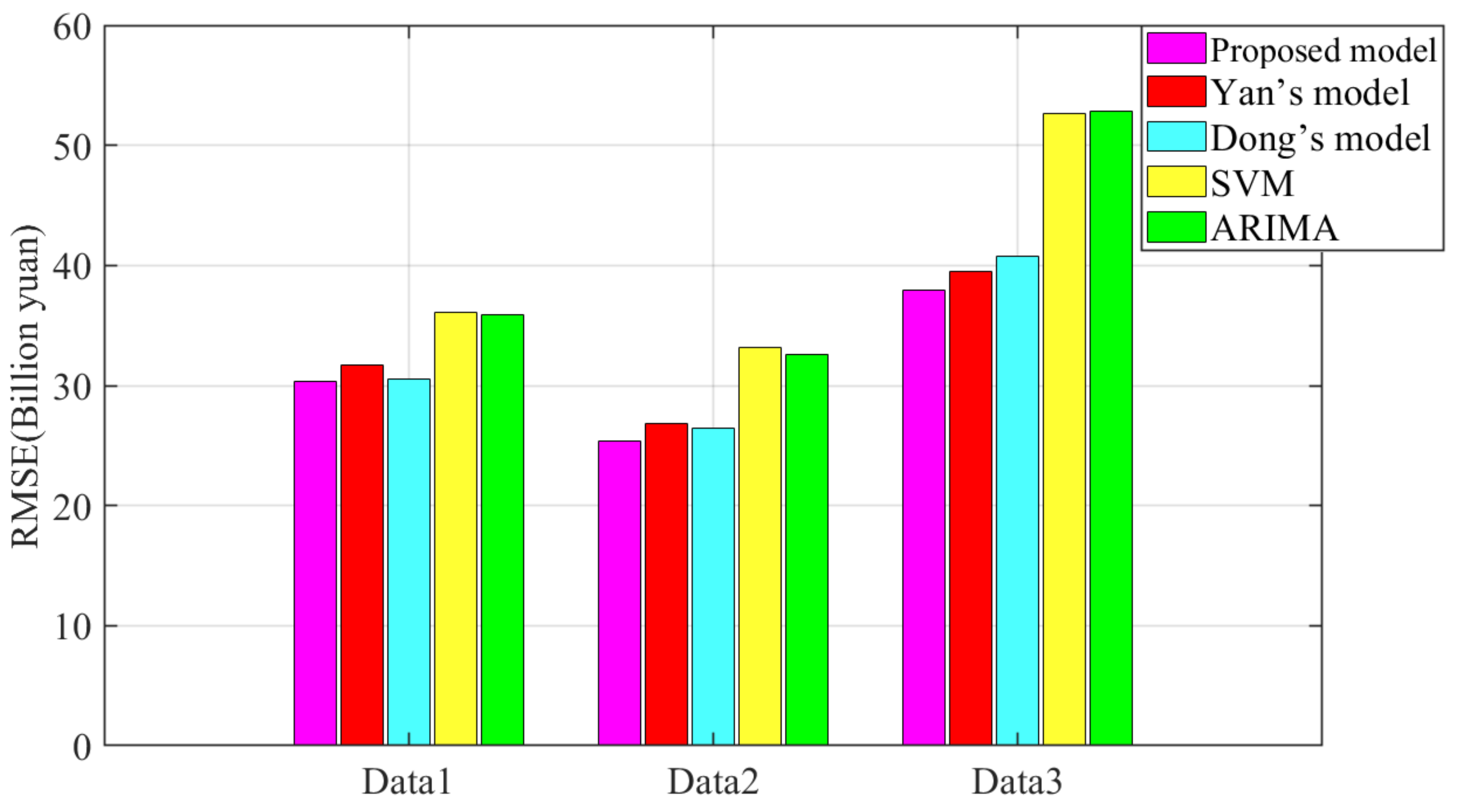
- Compared with the classical ARIMA and SVM algorithms, all the mixed models can achieve more satisfactory prediction results. The experimental results fully prove the practicability and effectiveness of the hybrid model in GDP forecasting. The feasible reason is that the hybrid model effectively optimizes the input features of the GDP forecasting model from the perspective of feature analysis and data mining, which effectively improves the analysis and modeling capabilities of all predictors.
- (2)
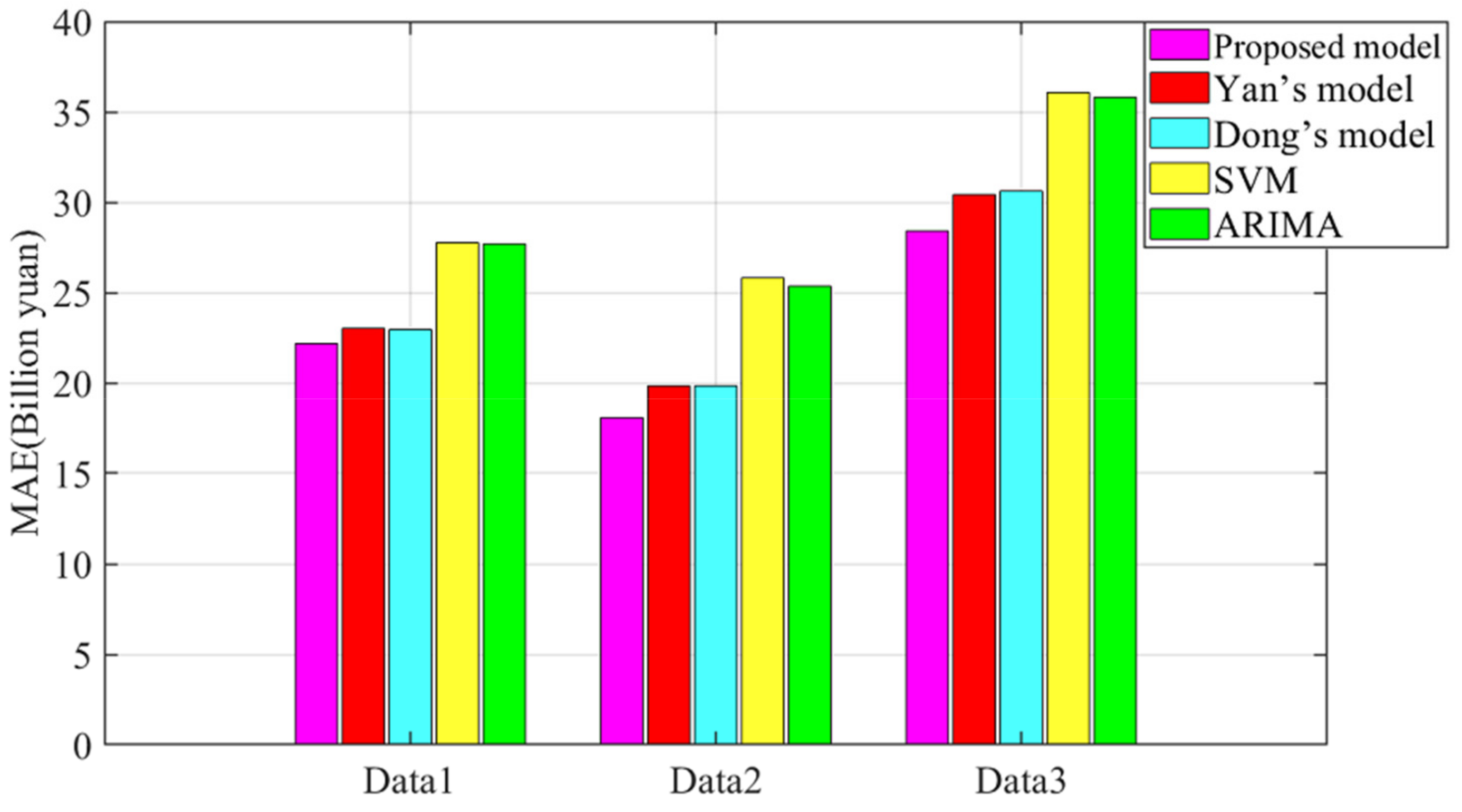
- The FC-BorutarRF-Q-TCN model proposed in this paper can achieve the best prediction accuracy in all cases. This fully proves the stability and advance of the FC-BorutarRF-Q-TCN model. First of all, the model outperforms the feature crossing algorithm to mine potential feature information from the original data. Then, the BorutarRF algorithm and the Q-learning algorithm screen the features obtained by the FC algorithm from two different angles. Finally, the screened features are used as the input of TCN to build the GDP prediction model and obtain the final prediction results. Overall, the model further improves the prediction performance from multiple perspectives. Therefore, the FC-BorutarRF-Q-TCN model can achieve excellent research value in the field of GDP prediction.
4.5. Discussion
- (1)
- The FC-BorutarRF-Q-TCN model proposed in this paper can achieve the best prediction accuracy in all cases. In addition, the stability and effectiveness of the model are fully proved by the results of ten-fold cross-validation and ten repeated experiments.
- (2)
- Table 3 fully proves the predictive performance of TCN. Compared with other neural networks, TCN effectively combines the parallel computation capability of CNN and the recursive modeling capability of RNN. Therefore, TCN has achieved excellent results in the field of GDP forecasting modeling.
- (3)
- Based on Table 4, Table 5, Table 6 and Table 7 and Figure 7, it can be found that the proposed three-stage feature selection framework can effectively improve the prediction performance of TCN. In addition, based on the result of feature selection, it can be seen that historical GDP data and Industrial structure features are relatively crucial indexes affecting GDP prediction. Education and population have relatively little impact on GDP prediction. Therefore, the experimental results have certain help for the future government to formulate policies and promote economic development.
- (4)
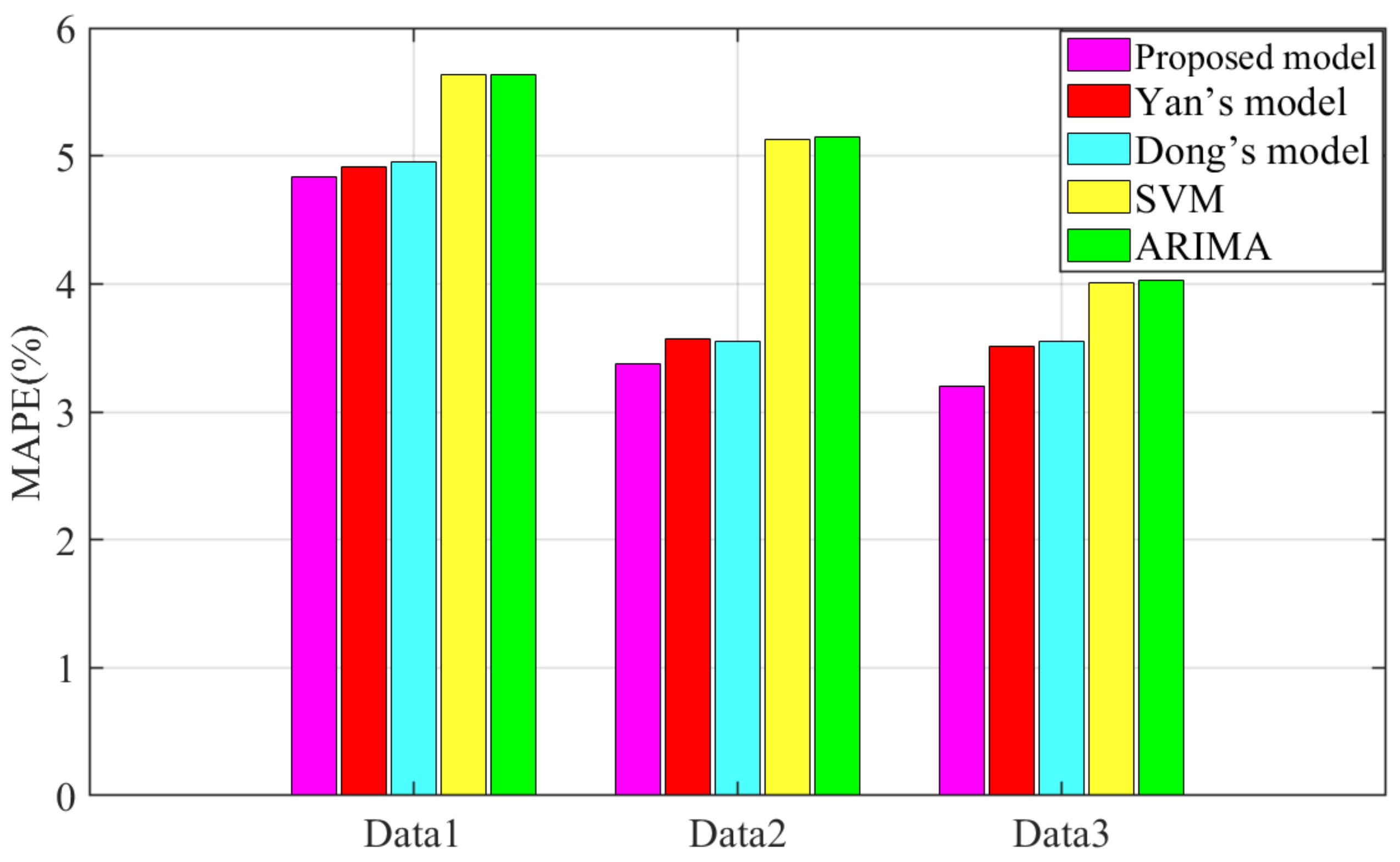
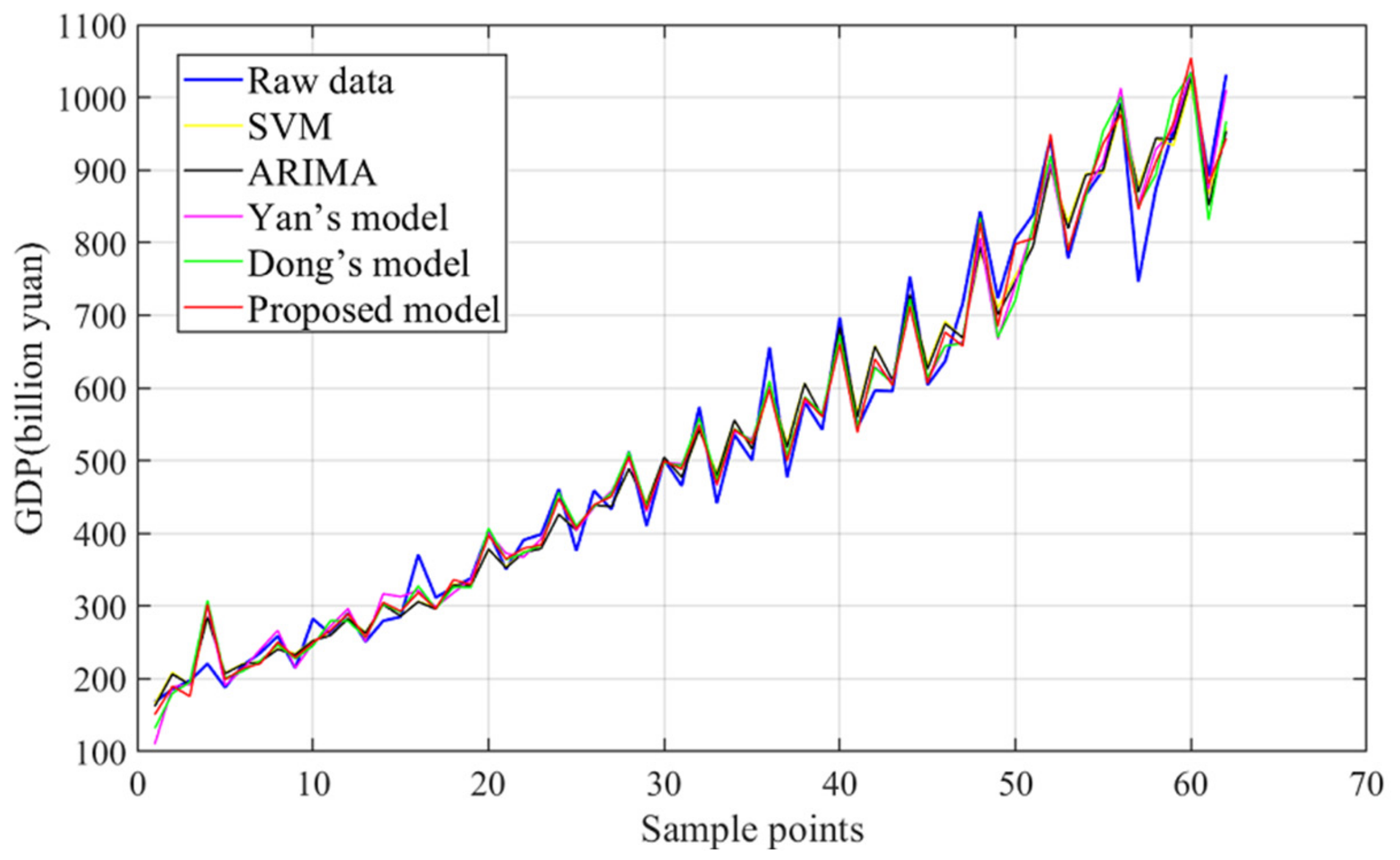
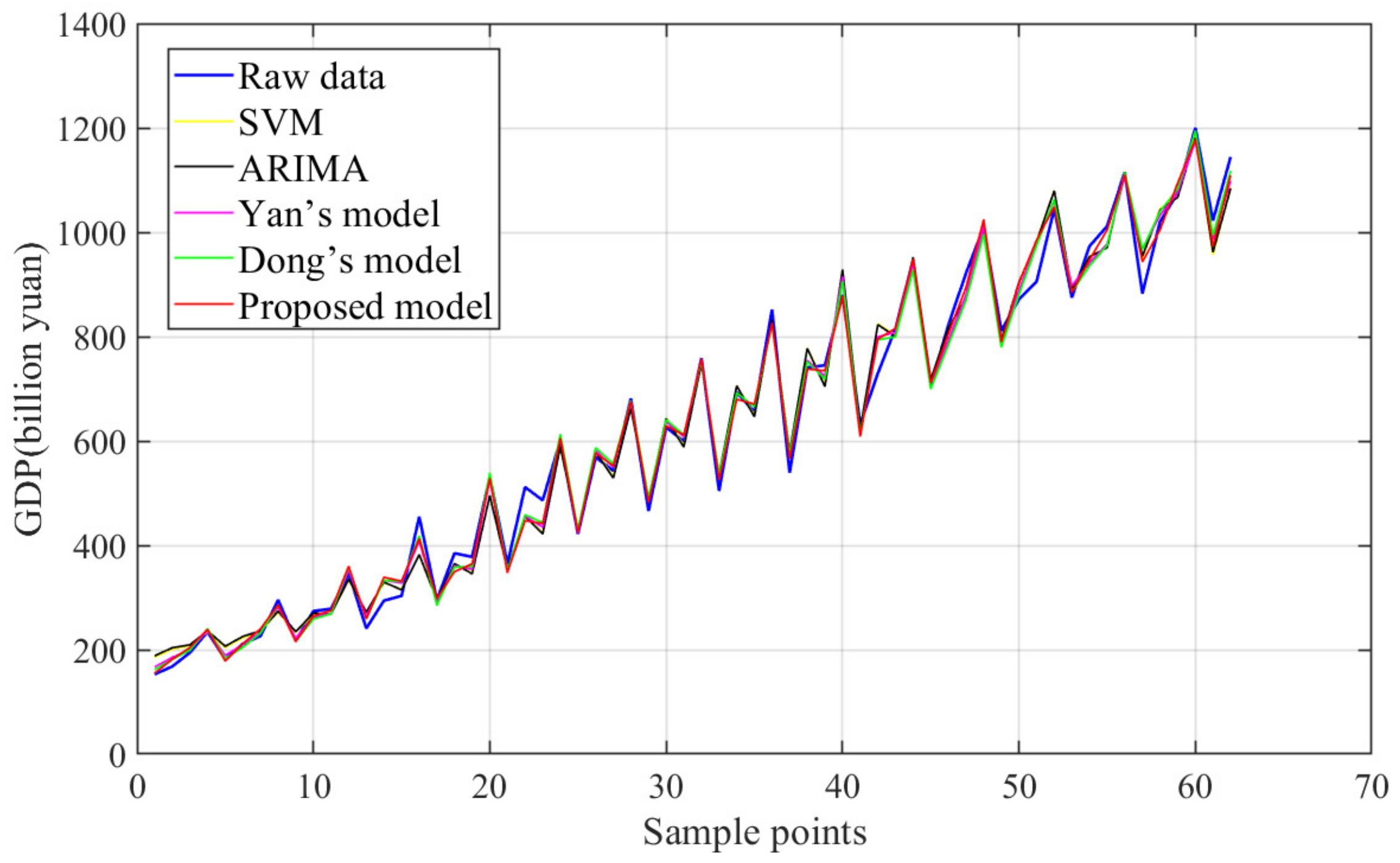
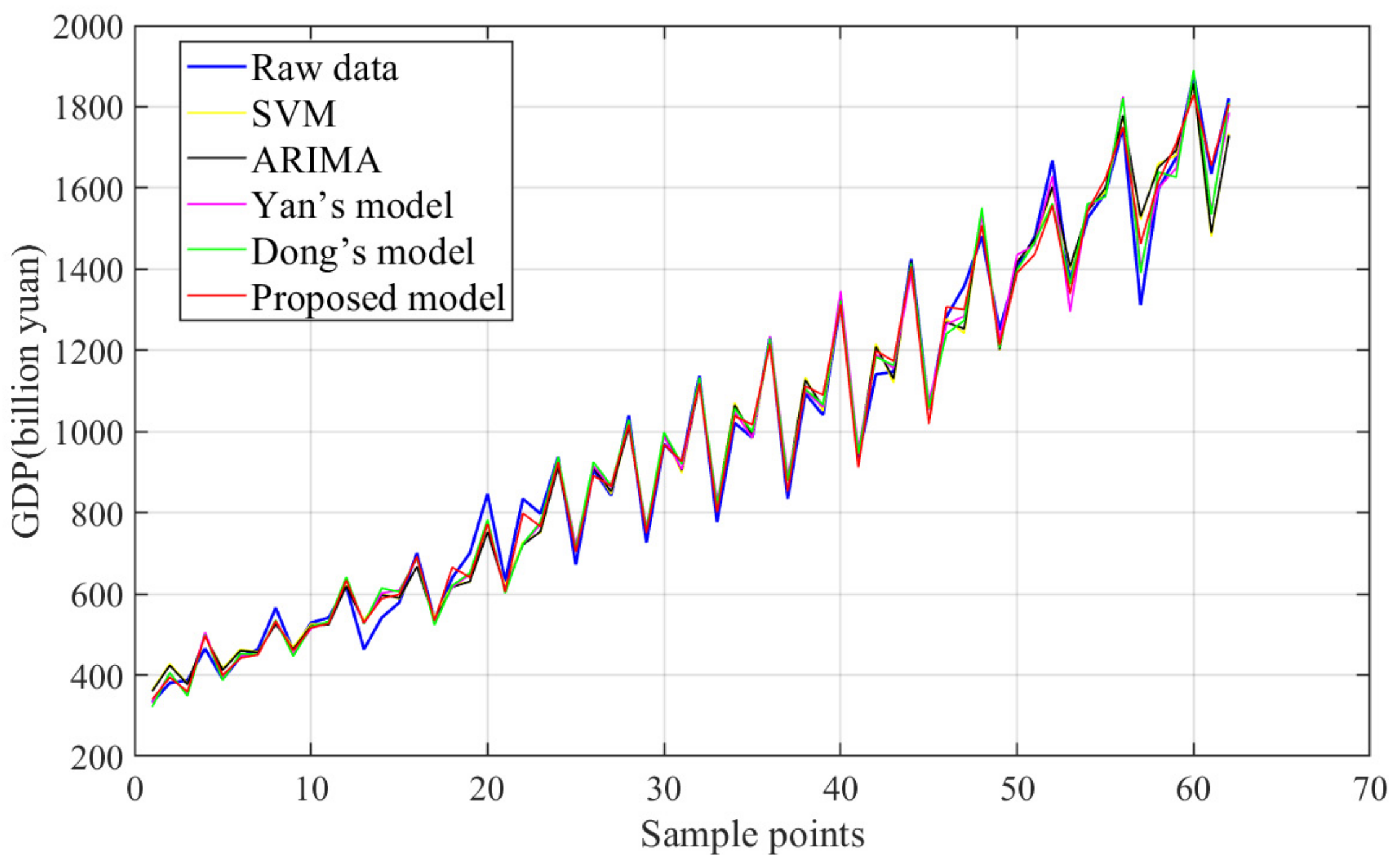
- Figure 8, Figure 9, Figure 10, Figure 11, Figure 12 and Figure 13 fully show the application prospect of the proposed model in GDP prediction. As can be seen from Figure 8, Figure 9 and Figure 10, the errors of the proposed FC-BorutarRF-Q-TCN model are significantly lower than that of other existing models. In addition, the MAPE values of the proposed model are less than 5% in all cases. In addition, based on Figure 11, Figure 12 and Figure 13, it can be found that the GDP prediction result of the proposed FC-BorutarRF-Q-TCN model is extremely close to the real GDP data, which can prove the strong practicality of the model in this field.
- (5)
- GDP prediction technology can provide technical support for regional economic development and policymaking. However, GDP prediction technology also has some limitations. GDP is a favorable indicator of physical production, and to some extent ignores the value of open-source products, services, free products, and other related industries. Therefore, GDP and other modern industries should be taken into consideration to comprehensively evaluate the regional economic level and formulate further development policies [64].
5. Conclusions and Future Work
- (1)
- Different from the traditional single-variable GDP time series forecasting framework, this paper proposes a multi-data-driven GDP forecasting model. The model comprehensively considers the influence of other features on GDP and further optimizes the prediction performance of the model.
- (2)
- Different from the traditional shallow neural network and recursive neural network, the TCN neural network adopted in the paper fully combines the training advantages of CNN and the timing sequence modeling ability of RNN. Therefore, the TCN algorithm could achieve a more excellent GDP prediction effect and is the most important predictor.
- (3)
- A new three-stage feature selection framework is proposed to optimize the prediction performance of TCN. On the one hand, the framework uses the FC algorithm to further mine the potential features of the original data and expand the deep information of the data. On the other hand, Q-learning and BorutarRF algorithms screen features from different angles and ensure the quality of TCN inputs. The three-stage feature Selection framework improves TCN performance by more than 10%.
- (4)
- The feature selection results show that historical GDP data and Industrial structure features are relatively crucial feature data for GDP prediction modeling. The feature selection results have important reference values for the government to adjust economic policy.
- (5)
- In order to prove the advance and practicability of the proposed FC-BorutarRF-Q-TCN prediction framework, fourteen models used by other researchers were replicated and compared with the model proposed in this paper. The experimental results show that the FC-BorutarRF-Q-TCN model is a GDP forecasting framework with excellent research prospects. The MAPE values are all less than 5%.
- (1)
- The GDP prediction framework is mainly obtained through multi-factor data-driven training. Therefore, when the amount of data increases and updates, the model also needs to be updated and trained constantly to ensure timeliness.
- (2)
- The model can accurately predict the change in GDP in the next quarter. Based on the forecast results, the government makes relevant economic policies to realize the adjustment and development of the regional economic level. In the future, it is a very important step to formulate a reasonable sustainable development strategy based on the GDP prediction results.
- (3)
- GDP prediction technology provides effective technical guidance for the sustainable development of the regional economy. Therefore, based on the research results, it can effectively drive the upgrading of regional industries and promote green development and sustainability in the future.
- (4)
- GDP can effectively reflect the situation of physical production and regional economic development. However, GDP does not fully analyze related industries such as services, open-source products, and products provided by society for free. Therefore, comprehensive consideration of GDP and other industries is very indispensable for the sustainable development of the regional economy and prosperity level.
Author Contributions
Funding
Institutional Review Board Statement
Informed Consent Statement
Data Availability Statement
Acknowledgments
Conflicts of Interest
References
- Pavía-Miralles, J.M.; Cabrer-Borrás, B. On estimating contemporaneous quarterly regional GDP. J. Forecast. 2007, 26, 155–170. [Google Scholar] [CrossRef]
- Jurun, E.; Pivac, S. Comparative regional GDP analysis: Case study of Croatia. Cent. Eur. J. Op. Res. 2011, 19, 319–335. [Google Scholar] [CrossRef]
- Landefeld, J.S.; Seskin, E.P.; Fraumeni, B.M. Taking the pulse of the economy: Measuring GDP. J. Econ. Perspect. 2008, 22, 193–216. [Google Scholar] [CrossRef]
- Chen, X.; Liu, C.; Yu, X. Urbanization, Economic Development, and Ecological Environment: Evidence from Provincial Panel Data in China. Sustainability 2022, 14, 1124. [Google Scholar] [CrossRef]
- König, M.; Winkler, A. COVID-19: Lockdowns, fatality rates and GDP growth. Intereconomics 2021, 56, 32–39. [Google Scholar] [CrossRef]
- Abbass, K.; Begum, H.; Alam, A.; Awang, A.H.; Abdelsalam, M.K.; Egdair, I.M.M.; Wahid, R. Fresh Insight through a Keynesian Theory Approach to Investigate the Economic Impact of the COVID-19 Pandemic in Pakistan. Sustainability 2022, 14, 1054. [Google Scholar] [CrossRef]
- Kokolakakis, T.; Lera-Lopez, F.; Ramchandani, G. Measuring the Economic Impact of COVID-19 on the UK’s Leisure and Sport during the 2020 Lockdown. Sustainability 2021, 13, 13865. [Google Scholar] [CrossRef]
- Liu, X.; Liu, Y.; Yan, Y. China macroeconomic report 2020: China’s macroeconomy is on the rebound under the impact of COVID-19. Econ. Political Stud. 2020, 8, 395–435. [Google Scholar] [CrossRef]
- Yang, W.; Wang, X.; Zhang, K.; Ke, Z. COVID-19, Urbanization Pattern and Economic Recovery: An Analysis of Hubei, China. Int. J. Environ. Res. Public Health 2020, 17, 9577. [Google Scholar] [CrossRef]
- Zheng, G.; Zhu, S. Research on the Effectiveness of China’s Macro Control Policy on Output and Technological Progress under Economic Policy Uncertainty. Sustainability 2021, 13, 6844. [Google Scholar] [CrossRef]
- Goolsbee, A.; Syverson, C. Fear, lockdown, and diversion: Comparing drivers of pandemic economic decline 2020. J. Public Econ. 2021, 193, 104311. [Google Scholar] [CrossRef] [PubMed]
- Huynh, T.L. The COVID-19 risk perception: A survey on socioeconomics and media attention. Econ. Bull. 2020, 40, 758–764. [Google Scholar]
- Gan, Z.; Li, C.; Zhou, J.; Tang, G. Temporal convolutional networks interval prediction model for wind speed forecasting. Electr. Power Syst. Res. 2021, 191, 106865. [Google Scholar] [CrossRef]
- Sun, Q.; Yang, Z.; Chen, X.; Yu, C. Optical Performance monitoring using Q-learning optimized least square support vector machine in optical network. In Proceedings of the 2021 IEEE 6th International Conference on Signal and Image Processing (ICSIP), Nanjing, China, 22–24 October 2021; pp. 954–958. [Google Scholar]
- Suganthi, L.; Samuel, A.A. Energy models for demand forecasting—A review. Renew. Sustain. Energy Rev. 2012, 16, 1223–1240. [Google Scholar] [CrossRef]
- Kalantaripor, M.; Najafi Alamdarlo, H. Spatial Effects of Energy Consumption and Green GDP in Regional Agreements. Sustainability 2021, 13, 10078. [Google Scholar] [CrossRef]
- Gómez, M.; Rodríguez, J.C. Energy consumption and financial development in NAFTA countries, 1971–2015. Appl. Sci. 2019, 9, 302. [Google Scholar] [CrossRef]
- Bjørnland, H.C.; Ravazzolo, F.; Thorsrud, L.A. Forecasting GDP with global components: This time is different. Int. J. Forecast. 2017, 33, 153–173. [Google Scholar] [CrossRef][Green Version]
- Sezer, O.B.; Gudelek, M.U.; Ozbayoglu, A.M. Financial time series forecasting with deep learning: A systematic literature review: 2005–2019. Appl. Soft Comput. 2020, 90, 106181. [Google Scholar] [CrossRef]
- Sadik-Zada, E.R.; Loewenstein, W. Drivers of CO2-Emissions in Fossil Fuel Abundant Settings: (Pooled) Mean Group and Nonparametric Panel Analyses. Energies 2020, 13, 3956. [Google Scholar] [CrossRef]
- Dai, S.; Niu, D.; Li, Y. Forecasting of energy consumption in China based on ensemble empirical mode decomposition and least squares support vector machine optimized by improved shuffled frog leaping algorithm. Appl. Sci. 2018, 8, 678. [Google Scholar] [CrossRef]
- Abonazel, M.R.; Abd-Elftah, A.I. Forecasting Egyptian GDP using ARIMA models. Rep. Econ. Financ. 2019, 5, 35–47. [Google Scholar] [CrossRef]
- Wu, C.; Chen, P. Application of support vector machines in debt to GDP ratio forecasting. In Proceedings of the 2006 International Conference on Machine Learning and Cybernetics, Dalian, China, 13–16 August 2006; pp. 3412–3415. [Google Scholar]
- Ghanem, S.; Fandi, G.; Krepl, V.; Husein, T.; Rzek, O.; Muller, Z.; Kyncl, J.; Tlustý, J.; Smutka, L. The Impact of COVID-19 on Electricity Prices in Italy, the Czech Republic, and China. Appl. Sci. 2021, 11, 8793. [Google Scholar] [CrossRef]
- Sadik-Zada, E.R.; Niklas, B. Business Cycles and Alcohol Consumption: Evidence from a Nonlinear Panel ARDL Approach. J. Wine Econ. 2021, 16, 429–438. [Google Scholar] [CrossRef]
- Niklas, B.; Sadik-Zada, E.R. Income Inequality and Status Symbols: The Case of Fine Wine Imports. J. Wine Econ. 2019, 14, 365–373. [Google Scholar] [CrossRef]
- Yusof, Y.; Kamaruddin, S.S.; Husni, H.; Ku-Mahamud, K.R.; Mustaffa, Z. Forecasting model based on LSSVM and ABC for natural resource commodity. Int. J. Comput. Theory Eng. 2013, 5, 906. [Google Scholar] [CrossRef]
- Long, G. GDP prediction by support vector machine trained with genetic algorithm. In Proceedings of the 2010 2nd International Conference on Signal Processing Systems, Dalian, China, 5–7 July 2010; pp. V3-1–V3-3. [Google Scholar]
- Guleryuz, D. Determination of industrial energy demand in Turkey using MLR, ANFIS and PSO-ANFIS. J. Artif. Intell. Syst. 2021, 3, 16–34. [Google Scholar]
- Tuo, S.; Chen, T.; He, H.; Feng, Z.; Zhu, Y.; Liu, F.; Li, C. A Regional Industrial Economic Forecasting Model Based on a Deep Convolutional Neural Network and Big Data. Sustainability 2021, 13, 12789. [Google Scholar] [CrossRef]
- Sa’adah, S.; Wibowo, M.S. Prediction of Gross Domestic Product (GDP) in Indonesia Using Deep Learning Algorithm. In Proceedings of the 2020 3rd International Seminar on Research of Information Technology and Intelligent Systems (ISRITI), Yogyakarta, Indonesia, 10–11 December 2020; pp. 32–36. [Google Scholar]
- Liu, B.; Fu, C.; Bielefield, A.; Liu, Y.Q. Forecasting of Chinese primary energy consumption in 2021 with GRU artificial neural network. Energies 2017, 10, 1453. [Google Scholar] [CrossRef]
- Wang, H.; Zhao, Y.; Tan, S. Short-term load forecasting of power system based on time convolutional network. In Proceedings of the 2019 8th International Symposium on Next Generation Electronics (ISNE), Zhengzhou, China, 9–10 October 2019; pp. 1–3. [Google Scholar]
- Sun, Y.; Hong, Y.; Wang, S. Out-of-sample forecasts of China’s economic growth and inflation using rolling weighted least squares. J. Manag. Sci. Eng. 2019, 4, 1–11. [Google Scholar] [CrossRef]
- Yoon, J. Forecasting of real GDP growth using machine learning models: Gradient boosting and random forest approach. Comput. Econ. 2021, 57, 247–265. [Google Scholar] [CrossRef]
- Bai, X.; Zhang, F.; Hou, J.; Xia, F.; Tolba, A.; Elashkar, E. Implicit multi-feature learning for dynamic time series prediction of the impact of institutions. IEEE Access 2017, 5, 16372–16382. [Google Scholar] [CrossRef]
- Ortega-Bastida, J.; Gallego, A.-J.; Rico-Juan, J.R.; Albarrán, P. Regional gross domestic product prediction using twitter deep learning representations. In Proceedings of the IADIS International Conference Applied Computing, Bangkok, Thailand, 4–5 February 2020; pp. 89–96. [Google Scholar]
- Nahil, A.; Lyhyaoui, A. Short-term stock price forecasting using kernel principal component analysis and support vector machines: The case of Casablanca stock exchange. Procedia Comput. Sci. 2018, 127, 161–169. [Google Scholar] [CrossRef]
- Wang, J.; Li, Y. Multi-step ahead wind speed prediction based on optimal feature extraction, long short term memory neural network and error correction strategy. Appl. Energy 2018, 230, 429–443. [Google Scholar] [CrossRef]
- Kosana, V.; Teeparthi, K.; Madasthu, S.; Kumar, S. A novel reinforced online model selection using Q-learning technique for wind speed prediction. Sustain. Energy Technol. Assess. 2022, 49, 101780. [Google Scholar] [CrossRef]
- Xu, R.; Li, M.; Yang, Z.; Yang, L.; Qiao, K.; Shang, Z. Dynamic feature selection algorithm based on Q-learning mechanism. Appl. Intell. 2021, 51, 7233–7244. [Google Scholar] [CrossRef]
- Maeda-Gutiérrez, V.; Galván-Tejada, C.E.; Cruz, M.; Valladares-Salgado, A.; Galván-Tejada, J.I.; Gamboa-Rosales, H.; García-Hernández, A.; Luna-García, H.; Gonzalez-Curiel, I.; Martínez-Acuña, M. Distal Symmetric Polyneuropathy Identification in Type 2 Diabetes Subjects: A Random Forest Approach. Healthcare 2021, 9, 138. [Google Scholar] [CrossRef] [PubMed]
- Ortega-Bastida, J.; Gallego, A.J.; Rico-Juan, J.R.; Albarrán, P. A multimodal approach for regional GDP prediction using social media activity and historical information. Appl. Soft Comput. 2021, 111, 107693. [Google Scholar] [CrossRef]
- Chiang, Y.H.; Tao, L.; Wong, F.K.W. Causal relationship between construction activities, employment and GDP: The case of Hong Kong. Habitat Int. 2015, 46, 1–12. [Google Scholar] [CrossRef]
- Ifa, A.; Guetat, I. Does public expenditure on education promote Tunisian and Moroccan GDP per capita? ARDL approach. J. Financ. Data Sci. 2018, 4, 234–246. [Google Scholar] [CrossRef]
- Wiemer, C.; Tian, X. The measurement of small-scale industry for China’s GDP accounts. China Econ. Rev. 2001, 12, 317–322. [Google Scholar] [CrossRef]
- Liang, J.; Hou, L.; Luan, Z.; Huang, W. Feature Selection with Conditional Mutual Information Considering Feature Interaction. Symmetry 2019, 11, 858. [Google Scholar] [CrossRef]
- Aghaeepour, N.; Finak, G.; Hoos, H.; Mosmann, T.R.; Brinkman, R.; Gottardo, R.; Scheuermann, R.H.; Flow, C.A.P.C.; Consortium, D. Critical assessment of automated flow cytometry data analysis techniques. Nat. Methods 2013, 10, 228–238. [Google Scholar] [CrossRef] [PubMed]
- Gholami, H.; Mohammadifar, A.; Golzari, S.; Kaskaoutis, D.G.; Collins, A.L. Using the Boruta algorithm and deep learning models for mapping land susceptibility to atmospheric dust emissions in Iran. Aeolian Res. 2021, 50, 100682. [Google Scholar] [CrossRef]
- Ahmed, A.A.M.; Deo, R.C.; Feng, Q.; Ghahramani, A.; Raj, N.; Yin, Z.; Yang, L. Deep learning hybrid model with Boruta-Random forest optimiser algorithm for streamflow forecasting with climate mode indices, rainfall, and periodicity. J. Hydrol. 2021, 599, 126350. [Google Scholar] [CrossRef]
- Park, J.; Kim, T.; Seong, S.; Koo, S. Control automation in the heat-up mode of a nuclear power plant using reinforcement learning. Prog. Nucl. Energy 2022, 145, 104107. [Google Scholar] [CrossRef]
- Qi, C.; Zhu, Y.; Song, C.; Cao, J.; Xiao, F.; Zhang, X.; Xu, Z.; Song, S. Self-supervised reinforcement learning-based energy management for a hybrid electric vehicle. J. Power Sources 2021, 514, 230584. [Google Scholar] [CrossRef]
- Subramanian, A.; Chitlangia, S.; Baths, V. Reinforcement learning and its connections with neuroscience and psychology. Neural Netw. 2022, 145, 271–287. [Google Scholar] [CrossRef] [PubMed]
- Huynh, T.N.; Do, D.T.T.; Lee, J. Q-Learning-based parameter control in differential evolution for structural optimization. Appl. Soft Comput. 2021, 107, 107464. [Google Scholar] [CrossRef]
- Schreiber, J.A.; Müller, S.L.; Westphälinger, S.E.; Schepmann, D.; Strutz-Seebohm, N.; Seebohm, G.; Wünsch, B. Systematic variation of the benzoylhydrazine moiety of the GluN2A selective NMDA receptor antagonist TCN-201. Eur. J. Med. Chem. 2018, 158, 259–269. [Google Scholar] [CrossRef]
- Howell, B.A.; Puglisi, L.; Clark, K.; Albizu-Garcia, C.; Ashkin, E.; Booth, T.; Brinkley-Rubinstein, L.; Fiellin, D.A.; Fox, A.D.; Maurer, K.F.; et al. The Transitions Clinic Network: Post Incarceration Addiction Treatment, Healthcare, and Social Support (TCN-PATHS): A hybrid type-1 effectiveness trial of enhanced primary care to improve opioid use disorder treatment outcomes following release from jail. J. Subst. Abus. Treat. 2021, 128, 108315. [Google Scholar] [CrossRef]
- Samal, K.K.R.; Panda, A.K.; Babu, K.S.; Das, S.K. Multi-output TCN autoencoder for long-term pollution forecasting for multiple sites. Urban Clim. 2021, 39, 100943. [Google Scholar] [CrossRef]
- Ma, Q.; Wang, H.; Luo, P.; Peng, Y.; Li, Q. Ultra-short-term Railway traction load prediction based on DWT-TCN-PSO_SVR combined model. Int. J. Electr. Power Energy Syst. 2022, 135, 107595. [Google Scholar] [CrossRef]
- Wu, X.; Zhang, Z.; Chang, H.; Huang, Q. A data-driven gross domestic product forecasting model based on multi-indicator assessment. IEEE Access 2021, 9, 99495–99503. [Google Scholar] [CrossRef]
- Yan, G.; Yu, C.; Bai, Y. Wind Turbine Bearing Temperature Forecasting Using a New Data-Driven Ensemble Approach. Machines 2021, 9, 248. [Google Scholar] [CrossRef]
- Liu, X.; Qin, M.; He, Y.; Mi, X.; Yu, C. A new multi-data-driven spatiotemporal PM2.5 forecasting model based on an ensemble graph reinforcement learning convolutional network. Atmos. Pollut. Res. 2021, 12, 101197. [Google Scholar] [CrossRef]
- Yan, G.; Yu, C.; Bai, Y. A New Hybrid Ensemble Deep Learning Model for Train Axle Temperature Short Term Forecasting. Machines 2021, 9, 312. [Google Scholar] [CrossRef]
- Dong, S.; Yu, C.; Yan, G.; Zhu, J.; Hu, H. A Novel Ensemble Reinforcement Learning Gated Recursive Network for Traffic Speed Forecasting. In Proceedings of the 2021 Workshop on Algorithm and Big Data, Fuzhou, China, 12–14 March 2021; pp. 55–60. [Google Scholar]
- Jean-Paul, F.; Martine, D. Beyond GDP Measuring What Counts for Economic and Social Performance: Measuring What Counts for Economic and Social Performance; OECD Publishing: Paris, France, 2018. [Google Scholar]





| References | Published Year | Feature Selection |
|---|---|---|
| [35] | 2020 | AE |
| [38] | 2018 | KPCA |
| [39] | 2018 | KLD, EM, SE |
| [40] | 2022 | Q-learning |
| [41] | 2021 | Q-learning |
| [42] | 2021 | BorutaRF |
| GDP Data | Data 1 | Data 2 | Data 3 |
|---|---|---|---|
| Province | Beijing | Hunan | Zhejiang |
| Minimum | 102.3870 | 134.9570 | 274.6090 |
| Mean | 506.0497 | 592.2015 | 945.7440 |
| Maximum | 1034.3040 | 1200.0900 | 1878.7420 |
| Standard derivation | 256.8505 | 309.3011 | 441.7130 |
| Series | Forecasting Models | MAE (Billion Yuan) | MAPE (%) | RMSE (Billion Yuan) |
|---|---|---|---|---|
| Data 1 | TCN | 25.2155 | 5.2263 | 34.0967 |
| GRU | 26.3096 | 5.4412 | 34.9834 | |
| LSTM | 26.6932 | 5.4694 | 34.9907 | |
| RNN | 27.1426 | 5.5086 | 35.0814 | |
| ELM | 27.7391 | 5.6319 | 36.0643 | |
| RBF | 27.6943 | 5.6393 | 35.8998 | |
| Data 2 | TCN | 21.2653 | 3.9465 | 28.4004 |
| GRU | 22.3954 | 4.0541 | 29.6895 | |
| LSTM | 22.5898 | 4.1824 | 29.9655 | |
| RNN | 23.2437 | 4.2517 | 30.4454 | |
| ELM | 25.7957 | 5.1268 | 33.1268 | |
| RBF | 25.3667 | 5.1499 | 32.6133 | |
| Data 3 | TCN | 33.9287 | 3.7871 | 50.4280 |
| GRU | 34.7236 | 3.9526 | 50.6098 | |
| LSTM | 34.1358 | 3.9577 | 51.6374 | |
| RNN | 35.5990 | 3.9983 | 52.2030 | |
| ELM | 36.0811 | 4.0071 | 52.6383 | |
| RBF | 35.8042 | 4.0245 | 52.8738 |
| Series | Forecasting Models | MAE (Billion Yuan) | MAPE (%) | RMSE (Billion Yuan) |
|---|---|---|---|---|
| Data 1 | FC-BorutaRF-Q-TCN | 22.1614 | 4.8334 | 30.3021 |
| FC-BorutaRF-PSO-TCN | 23.0066 | 4.9145 | 31.6693 | |
| FC-BorutaRF-GA-TCN | 22.9586 | 4.9517 | 30.5457 | |
| FC-BorutaRF-TCN | 23.6087 | 5.1034 | 32.1499 | |
| FC-Q-TCN | 24.1884 | 5.1061 | 33.7000 | |
| Data 2 | FC-BorutaRF-Q-TCN | 18.0778 | 3.3787 | 25.3888 |
| FC-BorutaRF-PSO-TCN | 19.8081 | 3.5706 | 26.8640 | |
| FC-BorutaRF-GA-TCN | 19.8178 | 3.5513 | 26.4723 | |
| FC-BorutaRF-TCN | 20.4341 | 3.8091 | 27.5156 | |
| FC-Q-TCN | 20.8454 | 3.8084 | 27.0660 | |
| Data 3 | FC-BorutaRF-Q-TCN | 28.4412 | 3.2037 | 37.9007 |
| FC-BorutaRF-PSO-TCN | 30.4008 | 3.5108 | 39.4640 | |
| FC-BorutaRF-GA-TCN | 30.6192 | 3.5527 | 40.7590 | |
| FC-BorutaRF-TCN | 33.3320 | 3.6871 | 49.9555 | |
| FC-Q-TCN | 33.3321 | 3.7136 | 49.7054 |
| Methods | Indexes | Data 1 | Data 2 | Data 3 |
|---|---|---|---|---|
| FC-BorutaRF-Q-TCN vs. FC-BorutaRF-TCN | PMAPE (%) | 6.1304 | 11.5312 | 14.6730 |
| PMAE (%) | 5.2906 | 11.2993 | 13.1106 | |
| PRMSE (%) | 5.7475 | 7.7294 | 24.1311 | |
| FC-BorutaRF-Q-TCN vs. FC-Q-TCN | PMAPE (%) | 8.3800 | 13.2768 | 14.6732 |
| PMAE (%) | 5.3407 | 11.2830 | 13.7306 | |
| PRMSE (%) | 10.0828 | 6.1967 | 23.7493 | |
| FC-BorutaRF-Q-TCN vs. TCN | PMAPE (%) | 12.1120 | 14.9892 | 16.1736 |
| PMAE (%) | 7.5177 | 14.3874 | 15.4049 | |
| PRMSE (%) | 11.1289 | 10.6041 | 24.8420 |
| Methods | Indexes | Data 1 | Data 2 | Data 3 |
|---|---|---|---|---|
| FC-BorutaRF-Q-TCN vs. FC-BorutaRF-PSO-TCN | PMAPE (%) | 3.6737 | 8.7353 | 6.4459 |
| PMAE (%) | 1.6502 | 5.3744 | 8.7473 | |
| PRMSE (%) | 4.3171 | 5.4914 | 3.9613 | |
| FC-BorutaRF-Q-TCN vs. FC-BorutaRF-GA-TCN | PMAPE (%) | 3.4723 | 8.7800 | 7.1132 |
| PMAE (%) | 2.3891 | 4.8602 | 9.8235 | |
| PRMSE (%) | 0.7975 | 4.0930 | 7.0127 |
| Series | Type of Feature | Number of Retained Features |
|---|---|---|
| Data 1 | Historical GDP data | 4 |
| Historical economic indexes | 2 | |
| Employment and population features | 1 | |
| Education | 1 | |
| Industrial structure features | 3 | |
| Data 2 | Historical GDP data | 3 |
| Historical economic indexes | 2 | |
| Employment and population features | 0 | |
| Education | 1 | |
| Industrial structure features | 3 | |
| Data 3 | Historical GDP data | 4 |
| Historical economic indexes | 2 | |
| Employment and population features | 1 | |
| Education | 0 | |
| Industrial structure features | 4 |
Publisher’s Note: MDPI stays neutral with regard to jurisdictional claims in published maps and institutional affiliations. |
© 2022 by the authors. Licensee MDPI, Basel, Switzerland. This article is an open access article distributed under the terms and conditions of the Creative Commons Attribution (CC BY) license (https://creativecommons.org/licenses/by/4.0/).
Share and Cite
Li, Q.; Yan, G.; Yu, C. A Novel Multi-Factor Three-Step Feature Selection and Deep Learning Framework for Regional GDP Prediction: Evidence from China. Sustainability 2022, 14, 4408. https://doi.org/10.3390/su14084408
Li Q, Yan G, Yu C. A Novel Multi-Factor Three-Step Feature Selection and Deep Learning Framework for Regional GDP Prediction: Evidence from China. Sustainability. 2022; 14(8):4408. https://doi.org/10.3390/su14084408
Chicago/Turabian StyleLi, Qingwen, Guangxi Yan, and Chengming Yu. 2022. "A Novel Multi-Factor Three-Step Feature Selection and Deep Learning Framework for Regional GDP Prediction: Evidence from China" Sustainability 14, no. 8: 4408. https://doi.org/10.3390/su14084408
APA StyleLi, Q., Yan, G., & Yu, C. (2022). A Novel Multi-Factor Three-Step Feature Selection and Deep Learning Framework for Regional GDP Prediction: Evidence from China. Sustainability, 14(8), 4408. https://doi.org/10.3390/su14084408