


Abstract
There is no expectation to suppress all accidents in the outdoor recreation sector; nevertheless, it is expected that all possible safety measures are taken in order to minimize the risk of accidents. The objective of this study was to systematize the knowledge regarding recommended and used safety measures and risk assessments for technicians and outdoor recreation practitioners. We conducted a systematic review on PubMed, BVS, SciELO, Science Direct, ABI/INFORM, Spinger, Web of Knowledge, and Esmerald full text databases, up to February 2021. The eligible criteria followed the PICOS strategy; the included risk assessment studies on outdoor recreation (according to its definition) had methodological quality, were indexed, and peer reviewed. Ten studies, from ten countries, fulfilled these specifications, which focused on different approaches. Five studies focused on risk perception, four studies focused on safety practices, injuries, and risk assessment; three studies addressed safe behaviors; two studies addressed equipment- and risk matrix-related themes. We concluded that there was a concern for this topic, and the 28 mentioned measures could provide important information regarding health and prevention. These measures could be used to develop safety strategies and risk reduction, aimed at reducing accidents in outdoor recreation activities. In order to evaluate the pertinence and importance of the mentioned measures, namely risk perception, safe practices, sport injuries, risk analysis, safe behaviors, as well as equipment and risk assessment matrices, further investigation is needed using experimental or observational designs. These strategies and procedures can contribute to enhanced interventions by technicians with higher security and quality, and therefore, improved well-being and satisfaction of practitioners.
1. Introduction
The development of significant management and prevention strategies requires comprehensive knowledge of all the factors that increase risk, including a profound understanding of the sources of risk (dangers) and their associated human motivations, attitudes, perceptions, and behaviors, as well as managing contexts and other relevant restrictions [1]. Practitioners and technicians, when confronted with risk, behave differently and have specific responses, depending on the context. This premise means that in order for strategies to effectively prevent and manage risk, they need to be adapted for the target audience. The design of effective safety strategies requires an interdisciplinary approach that integrates the available knowledge [2].
Outdoor recreation and tourism activities have experienced vast growth. This growth is the result of the public specifically seeking activities that involve a certain level of danger, satisfaction, and adventure [3,4,5].
Haegeli et al. [1] recommended identifying risk behaviors depending on the context, for an improved understanding of different segments of the population involved in these activities. This information would provide the basis for developing effective solutions to address outdoor recreation and tourism risks. Mata and Carvalhinho [6] was concerned about practitioners’ and technicians’ understanding of the associated risks of these activities. Therefore, the objective of our analysis was to investigate safety measures and risk assessment of outdoor recreation activities for practitioners and technicians.
1.1. Outdoor Recreation and Nature-Based Sports Investigation
Various studies have been conducted on safety measures, risk assessment, and management. In Table 1, we highlight some of the most studied themes.
Table 1.
Studied themes about outdoor recreation tourism and nature-based sports.
1.2. Outdoor Recreation
There is no common designation for outdoor recreation; several designations are used depending on whether it is seen from a tourist, sport, or environmental perspective. Some of these designations are: Nature Sports, Outdoor Adventure Tourism, Outdoor or Extreme Sport; or Outdoor Recreation [58]. Outdoor recreation activities comprise physical activities that differ from traditional sports since they involve nature, environmental unpredictability, equipment and specialized materials, as well as a sense of thrill, adrenaline, risk, strong emotions, and overcoming fear. This kind of language is widely embedded in those who practice these adventure sports assuming some calculated risk [59]. These adventure sports can lead practitioners to talk about their feelings of exploration of different environments such as land, water, and air [6].
Recently, the development and growth of national and international tourism has led to an increase in outdoor recreation activities, characterized by risk and environmental unpredictability. Outdoor recreation and nature-based tourism have exponentially increased in popularity [60,61,62]. In developed countries, outdoor recreation and nature-based activities have become the trademark of a healthy and modern lifestyle [2]. Risk is a challenge that provokes fear and, at the same time, an unmistakable pleasure, caused by the fusion of the different elements of sports, adventure, radicalness, and nature. It is considered that risk acts as a stimulus and a source of pleasurable feelings for the individuals involved or drawn to these adventure activities. In addition, there are more and more concerns regarding safety issues associated with participation in these adventure activities, due associated risks such as falls, slips, drowning, and other dangers related to the activities [6].
1.3. Outdoor Recreation Risks
The various outdoor recreation activities entail several other risks depending on the type of activity, various risk factors, and on the context of the uncertainty associated with the activity.
According to ISO 31000:2018 [63], risk is defined as the “effect of uncertainty on objectives”, an effect is a positive or negative deviation from what is expected. Uncertainty, in risk assessment and management context, represents the lack of information that leads to inadequate comprehension or incomplete knowledge of a probability (frequency) and consequence (seriousness) of an event [51]. Tourist companies and their technicians should follow the ISO 31000:2018 [63] recommendations that include a risk management process supported by the ISO/IEC 31010 [64] which provides guidance about the selection and systematic technique requirements for the risk assessment process.
Historically, risk assessment approaches in outdoor recreation have been centered on certain directives such as: (i) minimum experience or qualification of leaders; (ii) minimum and/or maximum number of participants; (iii) maximum number of participants per leader; (iv) the requirement of participants’ previous experiences; (v) equipment and certification processes [23,65].
Personal risks while practicing outdoor sports have a particular set of characteristics and risk sources that are obvious and commonly known. Self-knowledge of personal technical and psychological skills should be used to control the risk (up to a certain level). Risk consequences are also commonly known in the case of accidents that can be fatal; however, there can be great personal and social benefits associated with the risk [2].
1.4. Risk Analysis
In terms of risk and in relation to the risk and potential consequences, after identifying the risk, the next phase is to approach risk assessment. This analysis can be quantitative, qualitative, or a combination of both, depending on circumstances [66,67].
Since both quantitative and qualitative analyses have significant roles in risk comprehension, ISO 31000:2018 [63] does not indicate a preference for either type of analysis. A qualitative analysis is more often used for outdoor activities and nature-based sports, [68] particularly describing and classifying the odds of an accident occurring. In these activities, a quantitative analysis is rarely used. There are a number of reasons for this, such as lack of research due to the high costs associated, lack of reliable data, complexity of the theme, and the fact that most of the stakeholders’ having personal interests (company or personal). Based on the results of the risk analysis, a risk assessment is carried out and, if necessary, measures can be taken to reduce the risk. The risk can be avoided, mitigated, transferred, or accepted, amongst others [69].
1.5. Outdoor Recreation Technicians
Technicians’ evaluations and experiences form the bases for effective risk assessments for conducting clients in snow mountains, climbing routes, or descending rivers [2]. Demirhan and Grant et al. [70,71] also highlighted that experienced participants could evaluate real risks better than less experienced participants who might not recognize a risk or misinterpret it.
In situations when less experienced participants, or without any experience at all, are interacting with nature for leisure or sports, there are always risks and dangers that require an experienced technician. This can balance the risks in order to guarantee a safe and quality experience for the participants.
In order that technicians feel protected and secure on the activities they provide, Stanbury, Pryer, and Roberts [72] suggested that adventure tourism operators should provide them with the best training, resources, and support. However, the literature, until now, suggests that the main focus of adventure tourism has been consumer well-being [3,73]. If this tendency persists, there may be serious consequences to operational sustainability, since technicians may not provide the expected experience due to stress caused by safety issues [47].
There is a need to understand how technicians perceive outdoor sport activities and in what ways are they prepared to discuss and create prevention and emergency plans, prior, during, and after the activity. These are the factors that may provide more or less safety for the practitioners [6].
Therefore, technicians need to self-evaluate thoroughly, in order to minimize risks and deal effectively with incidents. This information is useful for creating training programs and systems of support, and can reduce expenses and time needed to develop leaders’ abilities, and therefore, can improve safety in outdoor recreation [74].
1.6. Outdoor Recreation Practitioners
According to Štanfel and Tutić [68], the number of outdoor recreation practitioners has increased, becoming a potential and important risk factor.
A risk assessment analysis for outdoor recreation and tourism practitioners aims to enhance knowledge about the risks involved and to transform that knowledge into effective programs to help practitioners and other intervenors to make substantiated and informed choices for their activities [1].
However, practitioners accustomed with the dangers and risks of their sports can become an accident enhancing factor. The risk is commonly understood as an element that can be controlled with determined procedures; therefore, more reflection about the meaning of adventure activities for the participants is needed [75].
Individuals should make subjective risk judgments in order to make the choice of behavior easier for each situation. This subjective risk judgment is based on risk perceptions from a cognitive and emotional response to the environment, [5] which include factors such as experience, personality, age, gender, and culture [76].
Regardless of the personal motivations to engage in nature activities and the magnitude of the risks involved, all participants seek to make the most of the activity and to return home safely.
2. Materials and Methods
2.1. Protocol
This review study did not use any registered protocol, and was designed according to the Preferred Reporting Items for Systematic Reviews and Meta-Analyses (PRISMA).
2.2. Eligibility Criteria
This systematic review was conducted with the objective of analyzing safety measures and risk assessment for outdoor recreation practitioners. The PICOS strategy was used, in which “P” represented the outdoor recreation practitioners, without any age, race, or gender limitation. There were no intervention (“I”) or comparison groups (“C”) analyzed. The outcome (“O”) stands for the safety and risk assessment, and the study design (“S”) indicates the descriptive and observational approaches (transverse or longitudinal).
Selection of the studies that were included in this systematic review was according to the following criteria: (a) nature-based sport studies (according to its definition); (b) academic relevance (methodological quality criteria); (c) completed articles published in indexed journals with peer review; (d) studies that established a relation between risk assessment/evaluation and nature sports; (e) publications in English and Portuguese.
The following studies were excluded: studies without at least two of the selected descriptors in their keywords; review articles; studies that only had an abstract; and duplicate studies.
2.3. Investigation Strategy and Information Sources
A search with no time period defined was performed, which ended on 23 January 2021. The electronic databases searched included: PubMed, BVS, SciELO, Science Direct, ABI/INFORM, Spinger, Web of Knowledge, and Esmerald full text. An advanced search was used based on the title and abstract with descriptors combinations.
The research strategy combined Boolean operators and expressions, as explained in Table 2.
Table 2.
Expressions and research strategy.
2.4. Studies Selection and Data Extraction
Titles and abstracts of articles from the electronic databases were selected by two independent reviewers (C.M. and L.C.); all the complete studies with relevant potential were analyzed to ensure that they met the eligible criteria.
The reference lists of selected articles were examined with the aim to find other relevant investigations.
The following data were extracted from the selected articles: first author name, publication year, country of origin, investigation objectives, study population (number of participants), main results, conclusions summary, and safety measures and recommendations.
2.5. Risk of Bias
The risk of bias was independently evaluated in duplicate by two authors (C.M. and L.C.); unconformities were resolved by consensus, or by consulting a third author (C.P.).
The Robvis tool (visualization tool for risk of bias assessments in a systematic review) was used [77] to evaluate the quality of the ten selected studies. This tool has been previously used to evaluate the risk of bias [78,79]. The quality of the studies was analyzed and the results presented according to specific criteria.
3. Results
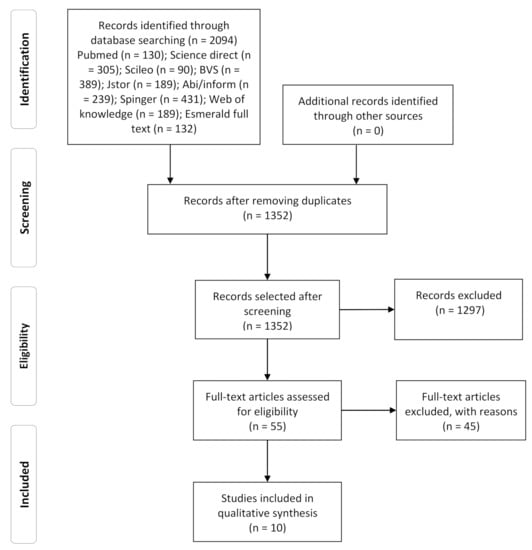
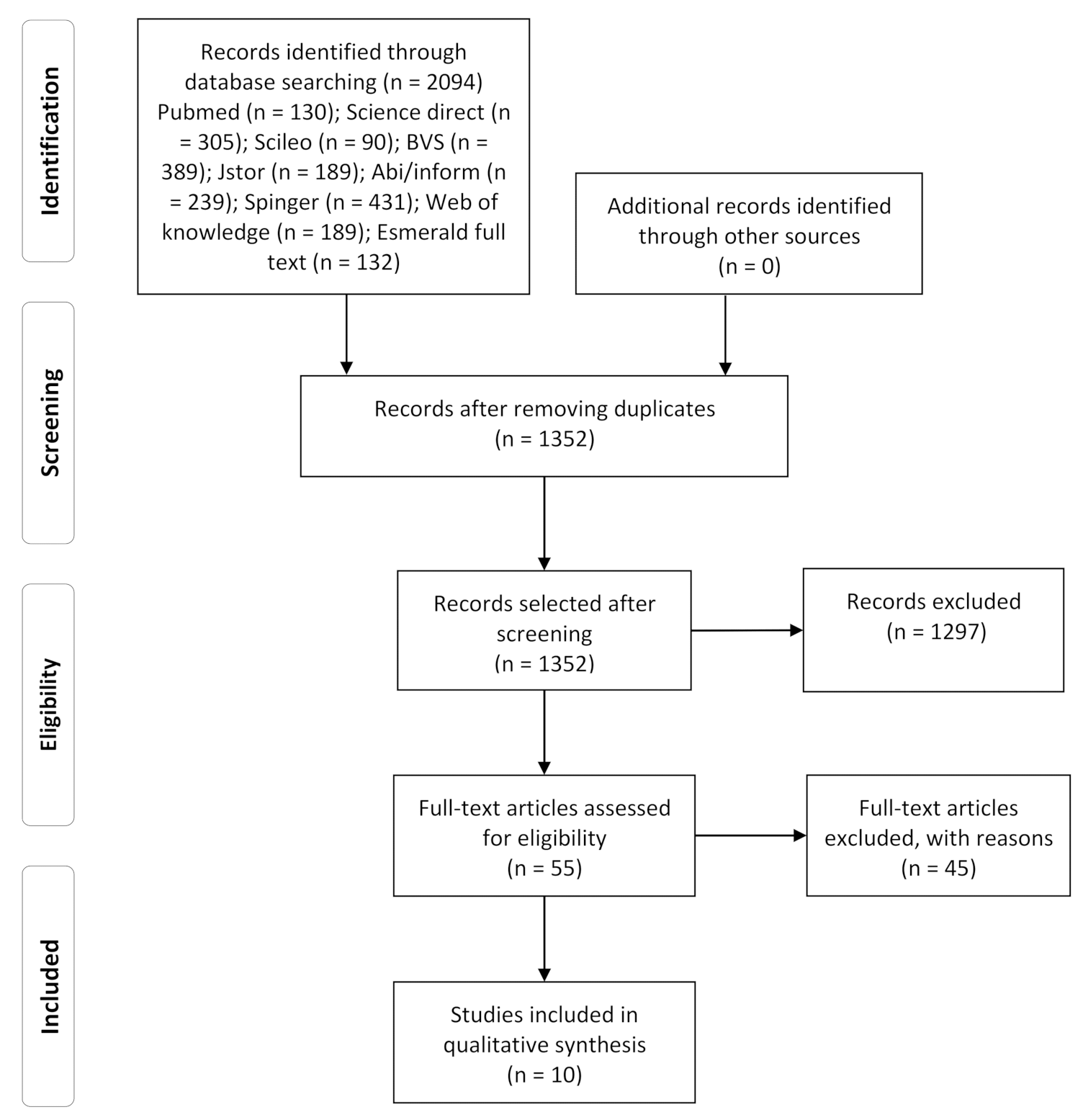
The initial database search led to a total of 2094 studies, 1352 of these studies were duplicates. After reading the abstracts, 1297 studies were excluded due to not being related to the theme, and 55 studies were excluded due to not including technicians or practitioners. After reading the titles and abstracts, 1297 studies were excluded for not being related to the topic, 55 studies were selected for full reading, among which 45 studies were excluded for not meeting the established criteria.
Ten studies remained that fit the inclusion criteria for the systematic review and were included in the quantitative analysis, as shown in Figure 1.
Figure 1.
Study selection flowchart, in an electronic database.
The ten studies selected for quantitative evaluation, recommended some safety measures and risk assessments with applications to outdoor recreation activities.
Table 3, Table 4 and Table 5 summarize the main characteristics of the selected studies. All papers were written in English. The studies were from 10 different countries and focused on several approaches of nature-based sport’s safety. The risk perception theme had the higher focus being approached in five studies, followed by safety practices, injuries, and risk analysis in four studies. Safety behaviors were approached in three studies and equipment- and risk-related matrices in two studies.
Table 3.
Description of the selected studies.
Table 4.
Description of the main results and summary of the conclusions of selected studies.
Table 5.
Safety measures and risk assessment recommendations of the selected studies.
Twenty-eight measures were found throughout the studies regarding safety recommendations for nature-based sports, three recommendations were duplicated (Table 5).
Risk of Bias
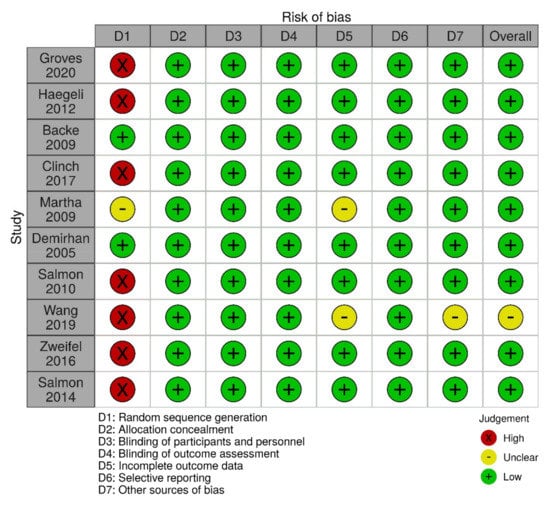
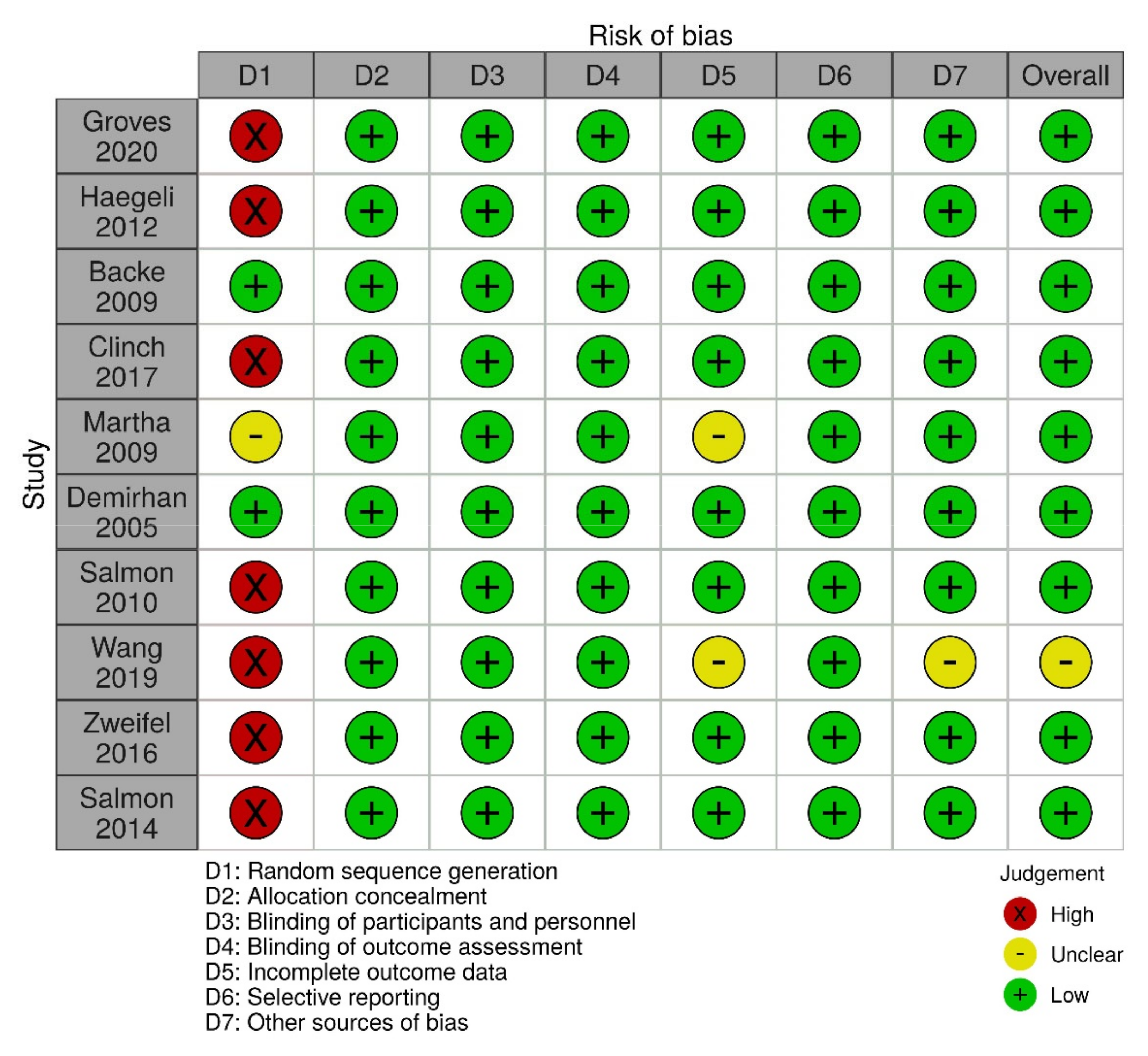
The studies analyzed in this review were considered to have a low risk of bias, mostly because the criteria classification, which was restricted to low, unclear, high and without information. Most of the studies presented a high risk in the first criteria (random sequence generation) with the exception of Martha et al. [82] that was unclear, and Backe [81] and Demirhan [70] with low risk due to random sample selection.
The other criteria were classified as low risk, with the exception of the Wang et al. [50] study that was unclear in three criteria, as shown in Figure 2.
Figure 2.
Risk of bias assessed by Robvis (visualization tool).
For the overall evaluation, we calculated the medium of the seven criteria, resulting in a classification of unclear in Wang [50] and low risk in the remaining studies.
4. Discussion
The objective of this systematic review was to analyze safety measures and risk assessment frameworks recommended by research on nature-based sports practitioners and technicians. The results showed that studies on these subjects have mostly been descriptive, instead of observational and experimental study designs, which limited the number of studies for qualitative analysis. There is a certain level of concern and interest about this field of study; the 28 safety measures and risk assessment frameworks recommended for future implementation supply extremely important information about nature-based health and prevention.
There is no consensus about a designation name for nature-based sports; a number of names have been assumed such as adventure tourism, outdoor or radical sports, outdoor sports, outdoor recreation, or adventure recreation [6,58]. Among the studies analyzed in this review, there is general consensus that these activities benefit from a high popularity, with increased interest from participants and people, since they are characterized by contact with nature, and surroundings that provide strong emotions, adrenaline, and constantly overcoming fear [6,84,85,86,87].
Considering the results of the selected studies, the expertise of technicians and participants often translates into a false sense of security and even to a depreciation of some safety equipment [80]. This can be explained by the processes mechanization and routine by technicians and participants, however, according to Martha et al. [82] the awareness of the possibility of having an accident or incident with severe consequences is always present, as these constitute risk activities. Risk perception is directly reflected in the risk exposure. Demirhan [70] argued that risk perception was lower for male and expert participants as compared with other groups. Female participants have a higher risk perception in nature-based sports. This can be related to some known female qualities such as pondering, carefulness, and observation behaviors.
This review has shown that low risk perception and low ability to assess risk can lead to inadequate safety behaviors and few self-protection measures [50]. Therefore, we should focus on the interventions that are often not focused on in an analysis of real risk comprehension, and result in inadequate safety measure responses.
According to the studies’ results, accidents and incidents occur due to several risk factors. Salmon et al. [21] and Salmon et al. [23] claimed that the Rasmussen risk management framework was adequate to implement an analysis approach for preventing accidents in outdoor activities: (1) equipment and surroundings; (2) physical processes and instructor/participant; (3) technical and operational management; (4) local area government; (5) regulatory bodies and associations; (6) policy and budgeting. This risk assessment framework constitutes another tool to prevent and mitigate future accidents and incidents, increasing participants safety. In addition, it is important to balance the ratio of technicians and practitioners, depending on the risk associated with an activity. Important factors to be aware are people management training for instructors, and evaluations of surroundings and equipment as stated by Clinch and Filimonau [47]; Zweifel et al. [83] and Davidson [18]. Another identified tool was a risk matrix that can be used to establish risk levels for each participant [1]. In addition, a matrix can also be used to analyze activities in order to classify each associated risk.
It is our perception, and also according to Cater [46] and Haegeli et al. [1], in order to access the needs of the outdoor recreation sector, this type of intervention should be done by specialists and supported by policies. Backe et al. [81] presented a higher number of injuries in more intense and formal activities that occurred due to hours of practice and loads, as well as practitioners with high BMI. According to the author in these cases, there should be a thorough training plan prepared, with gradually increased hours of training and loads, and that the practitioners should be regularly monitored for signs and symptoms of excessive practice.
Lastly, we collected 28 safety measure recommendations for nature-based sports (Table 5), among which we highlight those recommendations that differ from the ones mentioned so far through this systematic review: (i) conduct code for the sector; (ii) experience supported prevention; (iii) practical and theoretical training of safety procedures, including first aid and rescue techniques; (iv) universal database of nature-based activity accidents and incidents; (v) license and insurance oversight; (vi) regular re-evaluations of instructors’ abilities for risk management, first aid, and social abilities development; (vii) practitioner education in effective preventive measures; (viii) risk communication through different platforms such as social media, brochures, or interactive interpretation systems; (ix) video monitoring as a risk analysis technique in outdoor recreation; (x) investigation of risk factors such as age, gender, behaviors, or level of expertise; (xi) promote discussion amongst technicians in order to establish risk reduction strategies. (xii) improve participant consent and information forms; (xiii) empower instructors to be able to abort activities or prevent participants from participating; (xiv) develop risk management strategies suited for insecure terrain or adverse climate during the activities.
The measures mentioned in the studies all provide extremely important knowledge with respect to health and prevention. These measures can be used to develop safety strategies and risk reduction that are aimed at reducing accidents in outdoor recreation. However, there is no expectation that all of the accidents can be fully eliminated; regardless, all efforts should be made to reduce the risk of accidents.
For instance, activities that require a certain level of expertise by participants should be evaluated by technicians in order for technicians to manage activities according to various factors such as sports history, technical expertise, use of personal protective equipment, and correct suitability of materials such as clothing. These indications agree with those stated by Nathanson et al. [14], who also recommended knowledge of the surroundings and warning and communication systems in the event of an emergency. Risk is an integral part of nature-based sports and constitutes a reason for practitioners’ fascination and the increased popularity of these activities, and we believe that this risk can be considerably reduced [88].
The present study presents some limitations such as the exclusion of revision and descriptive studies and only the inclusion of indexed studies selected in scientific databases. In addition, the number of included studies was low, which limits the extraction of conclusions. Another limitation may be connected with the absence of PROSPERO registration.
5. Conclusions
On the basis of the obtained results, we conclude that there is interest and concern in this topic. The 28 measures mentioned in the studies provide important knowledge with significant implications related to health and prevention. These measures can be used to develop safety strategies and risk reduction aimed at reducing accidents in outdoor recreation.
In order to evaluate the pertinence and importance of the mentioned measures, namely risk perception, safe practices, sport injuries, risk analysis, safe behaviors, equipment, and risk matrix assessment, further investigation is needed using experimental or observational studies.
These strategies and procedures contribution to enhance technicians’ interventions with higher security and quality, and therefore, impact practitioners’ well-being and satisfaction.
Author Contributions
Conceptualization and methodology, C.M.; software, C.M.; validation, C.M. and L.C.; formal analysis, C.M.; investigation, C.M.; resources, data curation, C.M.; writing—original draft preparation, C.M.; writing—review and editing, L.C. and C.P.; visualization, supervision, L.C. and C.P.; project administration, C.M.; funding acquisition, C.M. All authors have read and agreed to the published version of the manuscript.
Funding
This study is funded by national funds through FCT–Fundação para a Ciência e a Tecnologia, I.P. (Science and Technology Foundation), within the scope of the projects under the references: UID/CED/04748/2020; UIDB/04470/2020 and UIDP/04923/2020.
Institutional Review Board Statement
Not applicable.
Informed Consent Statement
Not applicable.
Data Availability Statement
Not applicable.
Conflicts of Interest
The authors declare no conflict of interest.
References
- Haegeli, P.; Gunn, M.; Haider, W. Identifying a High-Risk Cohort in a Complex and Dynamic Risk Environment: Out-of-bounds Skiing—An Example from Avalanche Safety. Prev. Sci. 2012, 13, 562–573. [Google Scholar] [CrossRef] [Scilit] [PubMed]
- Haegeli, P.; Pröbstl-Haider, U. Research on personal risk in outdoor recreation and nature-based tourism. J. Outdoor Recreat. Tour. 2016, 13, 1–9. [Google Scholar] [CrossRef] [Scilit]
- Buckley, R. Adventure Tourism Management; Elsevier: Oxford, UK, 2011. [Google Scholar]
- Buckley, R. Rush as a key motivation in skilled adventure tourism: Resolving the risk recreation paradox. Tour. Manag. 2012, 33, 961–970. [Google Scholar] [CrossRef] [Scilit]
- Morgan, D. Adventure Tourism Activities in New Zealand: Perceptions and Management of Client Risk. Tour. Recreat. Res. 2000, 25, 79–89. [Google Scholar] [CrossRef] [Scilit]
- Mata, C.; Carvalhinho, L. Seguridad y gestión del riesgo en el deporte al aire libre—revisión sistemática exploratoria. Sport TK-Rev. Euroam. Cienc. Deport. 2020, 9, 59–64. [Google Scholar] [CrossRef] [Scilit]
- Bentley, T.A.; Page, S.J. A decade of injury monitoring in the New Zealand adventure tourism sector: A summary risk analysis. Tour. Manag. 2008, 29, 857–869. [Google Scholar] [CrossRef] [Scilit]
- Boyd, J.; Haegeli, P.; Abu-Laban, R.B.; Shuster, M.; Butt, J.C. Patterns of death among avalanche fatalities: A 21-year review. Can. Med. Assoc. J. 2009, 180, 507–512. [Google Scholar] [CrossRef] [Scilit]
- Brighton, B.; Sherker, S.; Brander, R.W.; Thompson, M.P.; Bradstreet, A. Rip current related drowning deaths and rescues in Australia 2004–2011. Nat. Hazards Earth Syst. Sci. 2013, 13, 1069–1075. [Google Scholar] [CrossRef] [Scilit]
- Greene, E.; Jamieson, B.; Logan, S. Fatal occupational injuries of avalanche workers in North America. In Proceedings of the International Snow Science Workshop, Banff, AB, Canada, 29 September–3 October 2014. [Google Scholar]
- Haegeli, P.; Falk, M.; Brugger, H.; Etter, H.-J.; Boyd, J. Comparison of avalanche survival patterns in Canada and Switzerland. Can. Med. Assoc. J. 2011, 183, 789–795. [Google Scholar] [CrossRef] [Scilit]
- Mei-Dan, O.; Monasterio, E.; Carmont, M.; Westman, A. Fatalities in Wingsuit BASE Jumping. Wilderness Environ. Med. 2013, 24, 321–327. [Google Scholar] [CrossRef] [Scilit]
- Monasterio, E. Accident and fatality characteristics in a population of mountain climbers in New Zealand. N. Z. Med. J. 2005, 118, 1208. [Google Scholar]
- Nathanson, A.T.; Young, J.M.J.; Young, C. Pre-Participation Medical Evaluation for Adventure and Wilderness Watersports. Clin. J. Sport Med. 2015, 25, 425–431. [Google Scholar] [CrossRef] [Scilit] [PubMed]
- Windsor, J.S.; Firth, P.G.; Grocott, M.; Rodway, G.W.; Montgomery, H. Mountain mortality: A review of deaths that occur during recreational activities in the mountains. Postgrad. Med. J. 2009, 85, 316–321. [Google Scholar] [CrossRef] [Scilit] [PubMed]
- Brackenreg, M. Learning from our mistakes–before it’s too late. Austral. J. Outdoor Educ. 1999, 3, 27–33. [Google Scholar] [CrossRef] [Scilit]
- Davidson, G. Fact or folklore? Exploring ‘myths’about outdoor education accidents: Some evidence from New Zealand. J. Adventure Educ. Outdoor Learn. 2004, 4, 13–37. [Google Scholar] [CrossRef] [Scilit]
- Davidson, G. Towards understanding the root causes of outdoor education incidents. In Proceedings of the Presentation to the 15th National Outdoor Education Conference, Ballarat, VIC, Australia, 21–23 September 2007; pp. 20–23. [Google Scholar]
- Jenkins, S.; Jenkinson, P. Report into the Lyme Bay Canoe Tragedy; Devon County Council Report: Exeter, UK, 1993. [Google Scholar]
- Rasmussen, J. Risk management in a dynamic society: A modelling problem. Saf. Sci. 1997, 27, 183–213. [Google Scholar] [CrossRef] [Scilit]
- Salmon, P.; Williamson, A.; Lenne, M.; Mitsopoulos-Rubens, E.; Rudin-Brown, C.M. Systems-based accident analysis in the led outdoor activity domain: Application and evaluation of a risk management framework. Ergonomics 2010, 53, 927–939. [Google Scholar] [CrossRef] [Scilit]
- Salmon, P.; Cornelissen, M.; Trotter, M.J. Systems-based accident analysis methods: A comparison of Accimap, HFACS, and STAMP. Saf. Sci. 2012, 50, 1158–1170. [Google Scholar] [CrossRef] [Scilit]
- Salmon, P.M.; Goode, N.; Lenné, M.G.; Finch, C.F.; Cassell, E. Injury causation in the great outdoors: A systems analysis of led outdoor activity injury incidents. Accid. Anal. Prev. 2014, 63, 111–120. [Google Scholar] [CrossRef] [Scilit]
- Salmon, P.M.; Read, G.; Walker, G.; Goode, N.; Grant, E.; Dallat, C.; Carden, T.; Naweed, A.; Stanton, N. STAMP goes EAST: Integrating systems ergonomics methods for the analysis of railway level crossing safety management. Saf. Sci. 2018, 110, 31–46. [Google Scholar] [CrossRef] [Scilit]
- Salmon, P.M.; Read, G.; Thompson, J.; McLean, S.; McClure, R. Computational modelling and systems ergonomics: A system dynamics model of drink driving-related trauma prevention. Ergonomics 2020, 63, 965–980. [Google Scholar] [CrossRef] [Scilit] [PubMed]
- Zakaria, J.; Harun, M.T.; Salamuddin, N. Risk in adventure sport tourism experienced by white water kayakers in Malaysia. In Proceedings of the Sport Tourism Conference, Coimbra, Portugal, 10–12 December 2014. [Google Scholar]
- Hendrikx, J.; Johnson, J.; Shelly, C. Using GPS tracking to explore terrain preferences of heli-ski guides. J. Outdoor Recreat. Tour. 2016, 13, 34–43. [Google Scholar] [CrossRef] [Scilit]
- Johnson, J.; Haegeli, P.; Hendrikx, J.; Savage, S. Accident causes and organizational culture among avalanche professionals. J. Outdoor Recreat. Tour. 2016, 13, 49–56. [Google Scholar] [CrossRef] [Scilit]
- Molm, L.D.; Takahashi, N.; Peterson, G. Risk and Trust in Social Exchange: An Experimental Test of a Classical Proposition. Am. J. Sociol. 2000, 105, 1396–1427. [Google Scholar] [CrossRef] [Scilit]
- Van Riper, C.J.; Wallen, K.E.; Landon, A.C.; Petriello, M.A.; Kyle, G.T.; Absher, J. Modeling the trust-risk relationship in a wildland recreation setting: A social exchange perspective. J. Outdoor Recreat. Tour. 2016, 13, 23–33. [Google Scholar] [CrossRef] [Scilit]
- Adams, L. A Systems Approach to Human Factors and Expert Decision-Making within the Canadian Avalanche Phenomena. Master’s Thesis, Royal Roads University, Victoria, BC, Canada, 2005; p. 284. [Google Scholar]
- Carson, H.J.; Davies, N.; Collins, L. The hills are alive with … Many different folk! Rationalising and operationalising a professional judgment and decision making approach within mountain leadership. J. Adventure Educ. Outdoor Learn. 2020, 21, 311–322. [Google Scholar] [CrossRef] [Scilit]
- Furman, N.; Shooter, W.; Schumann, S. The Roles of Heuristics, Avalanche Forecast, and Risk Propensity in the Decision Making of Backcountry Skiers. Leis. Sci. 2010, 32, 453–469. [Google Scholar] [CrossRef] [Scilit]
- Gigerenzer, G.; Gaissmaier, W. Heuristic decision making. Annu. Rev. Psychol. 2011, 62, 451–482. [Google Scholar] [CrossRef] [Scilit]
- Jamal, S.A.; Aminudin, N.; Kausar, D.R.K. Family adventure tourism motives and decision-making: A case of whitewater rafting. J. Outdoor Recreat. Tour. 2019, 25, 10–15. [Google Scholar] [CrossRef] [Scilit]
- Jones, T.E.; Yamamoto, K. Segment-based monitoring of domestic and international climbers at Mount Fuji: Targeted risk reduction strategies for existing and emerging visitor segments. J. Outdoor Recreat. Tour. 2016, 13, 10–17. [Google Scholar] [CrossRef] [Scilit]
- Stewart Patterson, I.; Hanke, J. Analysis of 40 years of snowmobiler fatalities–1976–2016. In Proceedings of the International Snow Science Workshop, Breckenridge, CO, USA, 2 October 2016. [Google Scholar]
- Trotter, M.J.; Salmon, P.; Goode, N.; Lenné, M.G. Distributed improvisation: A systems perspective of improvisation ‘epics’ by led outdoor activity leaders. Ergonomics 2018, 61, 295–312. [Google Scholar] [CrossRef] [Scilit] [PubMed]
- Walker, E.; Latosuo, E. Gendered decision-making practices in Alaska’s dynamic mountain environments? A study of professional mountain guides. J. Outdoor Recreat. Tour. 2016, 13, 18–22. [Google Scholar] [CrossRef] [Scilit]
- Wheeler, M. Backcountry skiing and gender: The collision of hormones and relationships with decision making in avalanche terrain or the possibility of a “gender heuristic trap”. Avalanche Rev. 2008, 26, 12–13. [Google Scholar]
- Pomfret, G.; Bramwell, B. The characteristics and motivational decisions of outdoor adventure tourists: A review and analysis. Curr. Issues Tour. 2016, 19, 1447–1478. [Google Scholar] [CrossRef] [Scilit]
- Holyfield, L.; Fine, G.A. Adventure as Character Work: The Collective Taming of Fear. Symb. Interact. 1997, 20, 343–363. [Google Scholar] [CrossRef] [Scilit]
- Cassano-Piche, A.L.; Vicente, K.J.; Jamieson, G.A. A test of Rasmussen’s risk management framework in the food safety domain: BSE in the UK. Theor. Issues Ergon. Sci. 2009, 10, 283–304. [Google Scholar] [CrossRef] [Scilit]
- Jenkins, D.P.; Salmon, P.; Stanton, N.; Walker, G. A systemic approach to accident analysis: A case study of the Stockwell shooting. Ergonomy 2010, 53, 1–17. [Google Scholar] [CrossRef] [Scilit]
- McLean, S.; Finch, C.; Coventon, L.; Salmon, P.M. Incidents in the Great Outdoors: A systems approach to understanding and preventing led outdoor accidents. Proc. Hum. Factors Ergon. Soc. Annu. Meet. 2020, 64, 1740–1744. [Google Scholar] [CrossRef] [Scilit]
- Cater, C. Playing with risk? participant perceptions of risk and management implications in adventure tourism. Tour. Manag. 2006, 27, 317–325. [Google Scholar] [CrossRef] [Scilit]
- Clinch, H.; Filimonau, V. Instructors’ Perspectives on Risk Management within Adventure Tourism. Tour. Plan. Dev. 2016, 14, 220–239. [Google Scholar] [CrossRef] [Scilit]
- Dallat, C.; Salmon, P.M.; Goode, N. Identifying risks and emergent risks across sociotechnical systems: The NETworked hazard analysis and risk management system (NET-HARMS). Theor. Issues Ergon. Sci. 2018, 19, 456–482. [Google Scholar] [CrossRef] [Scilit]
- Wall, E. Cable Wakeboarding for the First Time: How Young People Make Sense of Risk in Adventure Recreation. Young 2021, 29, 305–320. [Google Scholar] [CrossRef] [Scilit]
- Wang, J.; Liu-Lastres, B.; Ritchie, B.W.; Pan, D.-Z. Risk reduction and adventure tourism safety: An extension of the risk perception attitude framework (RPAF). Tour. Manag. 2019, 74, 247–257. [Google Scholar] [CrossRef] [Scilit]
- Webster, D. Chapter 11. Risk Management and Legal Liability. In Introduction to Tourism and Hospitality in BC; 2015. Available online: https://ecampusontario.pressbooks.pub/introtourismbc/chapter/chapter-11-risk-management-and-legal-liability/ (accessed on 5 December 2021).
- Callander, M.; Page, S.J. Managing risk in adventure tourism operations in New Zealand: A review of the legal case history and potential for litigation. Tour. Manag. 2003, 24, 13–23. [Google Scholar] [CrossRef] [Scilit]
- Hansen, M.; Rogers, D.; Fyall, A.; Spyriadis, T.; Brander-Brown, J. Collaborative industry risk management in adventure tourism: A case study of the US aerial adventure industry. J. Outdoor Recreat. Tour. 2019, 28, 100218. [Google Scholar] [CrossRef] [Scilit]
- Duerden, M.D.; Widmer, M.; Taniguchi, S.T.; McCoy, J.K. Adventures in Identity Development: The Impact of Adventure Recreation on Adolescent Identity Development. Identity 2009, 9, 341–359. [Google Scholar] [CrossRef] [Scilit]
- Haegeli, P.; Falk, M.; Procter, E.; Zweifel, B.; Jarry, F.; Logan, S.; Kronholm, K.; Biskupič, M.; Brugger, H. The effectiveness of avalanche airbags. Resusc. 2014, 85, 1197–1203. [Google Scholar] [CrossRef] [Scilit]
- Strapazzon, G.; Reisten, O.; Argenone, F.; Zafren, K.; Zen-Ruffinen, G.; Larsen, G.L.; Soteras, I. International Commission for Mountain Emergency Medicine Consensus Guidelines for On-Site Management and Transport of Patients in Canyoning Incidents. Wilderness Environ. Med. 2018, 29, 252–265. [Google Scholar] [CrossRef] [Scilit]
- Vogwell, J.; Minguez, J. The safety of rock climbing protection devices under falling loads. Eng. Fail. Anal. 2007, 14, 1114–1123. [Google Scholar] [CrossRef] [Scilit]
- Gomez, A.T.; Rao, A. Adventure and Extreme Sports. Med. Clin. N. Am. 2016, 100, 371–391. [Google Scholar] [CrossRef] [Scilit]
- La Mendola, S. O sentido do risco. Rev. Sociol. USP 2005, 17, 59–91. [Google Scholar] [CrossRef] [Scilit]
- Cordell, H.K.; Green, G.T.; Betz, C.J. Recreation and the Environment as Cultural Dimensions in Contemporary American Society. Leis. Sci. 2002, 24, 13–41. [Google Scholar] [CrossRef] [Scilit]
- Cordell, H.K.; Betz, C.; Green, G.T. Nature-based outdoor recreation trends and wilderness. Int. J. Wilderness 2008, 14, 7–13. [Google Scholar]
- Lamprecht, M.; Fischer, A.; Stamm, H. Sport Schweiz 2014: Sportaktivität und Sportinteresse der Schweizer Bevölkerung; Magglingen Federal Office of Sport: Magglingen, Switzerland, 2014. [Google Scholar]
- ISO. ISO 31000-Risk Management-Guidelines on Principles and Implementation of Risk Management; ISO/TMB WG on Risk management; British Standards Institution: Chiswick, UK, 2018. [Google Scholar]
- ISO. IEC 31010:2019 Risk Management—Risk Assessment Techniques; British Standards Institution: Chiswick, UK, 2019. [Google Scholar]
- Hogan, R. The Crux of Risk Management in Outdoor Programs—Minimising the Possibility of Death And Disabling Injury. J. Outdoor Environ. Educ. 2002, 6, 71–76. [Google Scholar] [CrossRef] [Scilit]
- Purdy, G. ISO 31000:2009-Setting a New Standard for Risk Management. Risk Anal. 2010, 30, 881–886. [Google Scholar] [CrossRef] [Scilit] [PubMed]
- Oehmen, J.; Günther, A.; Herrmann, J.W.; Schulte, J.; Willumsen, P. Risk management in product development: Risk identification, assessment, and mitigation–A literature review. In Proceedings of the Design Society: DESIGN Conference, Zagreb, Croatia, 26–29 October 2020; Cambridge University Press: Cambridge, UK, 2020; Volume 1, pp. 657–666. [Google Scholar]
- Štanfel, M.; Tutić, D. Modeling of risk assessment support system for outdoor recreation in Croatia. In Proceedings of the 7th International Conference on Cartography and GIS, Sozopol, Bulgaria, 18–23 June 2018; p. 10. [Google Scholar]
- Dowd, J. Risk and the outdoor adventure experience: Good risk, bad risk, real risk, apparent risk, objective risk, subjective risk. J. Outdoor Environ. Educ. 2004, 8, 69–70. [Google Scholar] [CrossRef] [Scilit]
- Demirhan, G. Mountaineers’ risk perception in outdoor-adventure sports: A study of sex and sports experience’. Percept. Mot. Ski. 2005, 100, 1155–1160. [Google Scholar] [CrossRef] [Scilit]
- Grant, B.C.; Thompson, S.M.; Boyes, M. Risk and Responsibility: In Outdoor Recreation. J. Phys. Educ. Recreat. Dance 1996, 67, 34–35. [Google Scholar] [CrossRef] [Scilit]
- Stanbury, J.; Pryer, M.; Roberts, A. Heroes and villains–tour operator and media response to crisis: An exploration of press handling strategies by UK adventure tour operators. Curr. Issues Tour. 2005, 8, 394–423. [Google Scholar] [CrossRef] [Scilit]
- Mackenzie, S.H.; Kerr, J.H. Stress and emotions at work: An adventure tourism guide’s experiences. Tour. Manag. 2013, 36, 3–14. [Google Scholar] [CrossRef] [Scilit]
- Boyes, M.A.; O’Hare, D. Between safety and risk: A model for outdoor adventure decision making. J. Adventure Educ. Outdoor Learn. 2003, 3, 63–76. [Google Scholar] [CrossRef] [Scilit]
- Moura, D.; Henriques, I. O Risco Percebido em Praticantes Experientes de Voo Livre e Rapel. Rev. Bras. Ciência Mov. 2014, 22, 63–68. [Google Scholar] [CrossRef] [Scilit]
- Kasperson, R.E.; Dow, K. Hazard perception and geography. In Behaviour and Environment: Geographical and Psychological Approaches; Garling, T., Golledge, R.G., Eds.; Elsevier Science Publishers: Amsterdam, The Netherlands, 1993; pp. 193–222. [Google Scholar]
- McGuinness, L.A.; Higgins, J.P.T. Risk-of-bias VISualization (robvis): An R package and Shiny web app for visualizing risk-of-bias assessments. Res. Synth. Methods 2021, 12, 55–61. [Google Scholar] [CrossRef] [Scilit] [PubMed]
- Clarke, E. Virtual reality simulation—the future of orthopaedic training? A systematic review and narrative analysis. Adv. Simul. 2021, 6, 1–11. [Google Scholar] [CrossRef] [Scilit] [PubMed]
- Cortegiani, A.; Ippolito, M.; Ingoglia, G.; Iozzo, P.; Giarratano, A.; Einav, S. Update I. A systematic review on the efficacy and safety of chloroquine/hydroxychloroquine for COVID-19. J. Crit. Care 2020, 59, 176–190. [Google Scholar] [CrossRef] [Scilit]
- Groves, M.R.; Varley, P.J. Critical mountaineering decisions: Technology, expertise and subjective risk in adventurous leisure. Leis. Stud. 2020, 39, 706–720. [Google Scholar] [CrossRef] [Scilit]
- Backe, S.; Ericson, L.; Janson, S.; Timpka, T. Rock climbing injury rates and associated risk factors in a general climbing population. Scand. J. Med. Sci. Sports 2009, 19, 850–856. [Google Scholar] [CrossRef] [Scilit]
- Martha, C.; Sanchez, X.; Gomà-I-Freixanet, M. Risk perception as a function of risk exposure amongst rock climbers. Psychol. Sport Exerc. 2009, 10, 193–200. [Google Scholar] [CrossRef] [Scilit]
- Zweifel, B.; Procter, E.; Techel, F.; Strapazzon, G.; Boutellier, R. Risk of Avalanche Involvement in Winter Backcountry Recreation: The Advantage of Small Groups. Wilderness Environ. Med. 2016, 27, 203–210. [Google Scholar] [CrossRef] [Scilit]
- Boudreau, P.; Mackenzie, S.H.; Hodge, K. Flow states in adventure recreation: A systematic review and thematic synthesis. Psychol. Sport Exerc. 2020, 46, 101611. [Google Scholar] [CrossRef] [Scilit]
- Eigenschenk, B.; Thomann, A.; McClure, M.; Davies, L.; Gregory, M.; Dettweiler, U.; Inglés, E. Benefits of Outdoor Sports for Society. A Systematic Literature Review and Reflections on Evidence. Int. J. Environ. Res. Public Health 2019, 16, 937. [Google Scholar] [CrossRef] [Scilit]
- Gstaettner, A.M.; Lee, D.; Rodger, K. The concept of risk in nature-based tourism and recreation—A systematic literature review. Curr. Issues Tour. 2018, 21, 1784–1809. [Google Scholar] [CrossRef] [Scilit]
- Kortenkamp, K.V.; Moore, C.F.; Sheridan, D.P.; Ahrens, E.S. No Hiking Beyond this Point! Hiking Risk Prevention Recommendations in Peer-Reviewed Literature. J. Outdoor Recreat. Tour. 2017, 20, 67–76. [Google Scholar] [CrossRef] [Scilit]
- Burtscher, M.; Niedermeier, M.; Gatterer, H. Editorial on the Special Issue on “Mountain Sports Activities: Injuries and Prevention”. Int. J. Environ. Res. Public Health 2021, 18, 1405. [Google Scholar] [CrossRef] [Scilit] [PubMed]

Publisher’s Note: MDPI stays neutral with regard to jurisdictional claims in published maps and institutional affiliations. |
© 2022 by the authors. Licensee MDPI, Basel, Switzerland. This article is an open access article distributed under the terms and conditions of the Creative Commons Attribution (CC BY) license (https://creativecommons.org/licenses/by/4.0/).