


Abstract
There is an increasing call for products following circular economy principles. Despite growing pressure, understanding of the current situation and development vectors is largely missing. In this study, circular economy workshops were arranged for six industrial companies manufacturing electronics and operating in Finland to obtain an empirical understanding of the current state of circular economy implementation. During the workshops, each company assessed the state of the circular economy for a chosen product using a set of 51 circular economy strategies, i.e., the circularity deck. The results indicated that circular economy principles were implemented in only 25% of the cases. This is mostly related to the production of smaller, thinner, and lighter products. The results also indicate a large improvement potential of 36% for the participating companies. This is the share of cases that are planned for implementation. Those strategies mostly relate to the use of recycled inputs, the development of products made of a single material, and the design of products suitable for primary recycling. The least relevant or even irrelevant strategies were those related to the use of information technologies and artificial intelligence, despite electronic products being the enablers of such strategies for the other companies. Therefore, to further increase the circularity of electronic products and to meet the demands and interests of the manufacturing industry, research work on the technologies and services enabling the use of waste as raw materials should be emphasized to close the loops. Finally, the results imply the necessity for a more widespread assessment of circular economy strategies among companies, with consequent development of action plans for their implementation.
1. Introduction
Despite the vast economic and social benefits that digitalization of products and services and their increasing interconnectivity brings to society, there are also serious negative consequences that cannot be neglected. The amount of waste from electrical and electronic equipment (WEEE) generated globally increased from 44.7 Mt in 2016 to 53.6 Mt in 2019, and is anticipated to reach 74.7 Mt by 2030 [1]. Out of the WEEE generated, only a small share of 17.4% has been documented to be collected and recycled globally [1]. However, the situation is different in the EU, where 47% of WEEE was collected in 2017, most of which was recycled [2]. Cucchiella et al. [3] identified a lack of harmonization of circular economy strategies for the enhanced recovery of precious metals from WEEE.
To avoid the high degree of linearity in the electronics sector, circular economy principles have been proposed for the electronics sector [4,5,6]. The main benefits of the circular economy over the linear one are related to the reduced consumption of fossil materials and the increased use of renewable materials through various actions, such as prolonged lifetime, which is 1.73 to 3.62 times shorter than the expected lifetime [7]. The reuse of electronics was also found to be environmentally friendly and is being adopted in developed countries, while developing countries are still lagging [8]. Reuse is understood as either direct reuse of functioning electronic devices or their reuse after repair, refurbishment, or remanufacturing [9]. Meloni, Souchet, and Sturges [10] identified five industry actions to accelerate the transition towards a circular economy, which include designing for circularity, among others. Bressanelli et al. [11] also identified circular product design and supply chain management as the main levers addressing the circular economy in the electronics sector. Oftentimes, however, recycling electronic and electronic equipment at their end-of-life (EoL) is seen as one of the most common strategies for a circular economy [12,13,14,15]. O’Connor et al. [16] proposed a strategy for enabling CE in the electronics sector mostly focusing on closing the loops, i.e., using recycled materials and enabling the collection of WEEE.
However, the circular economy represents a wider umbrella of strategies focusing on products, business models, and ecosystems. There are studies analyzing and conceptualizing CE [17,18,19]. Furthermore, there is ongoing standardization work worldwide in the field of circular economy [20]. One example of such development is working documents by the ISO/TC 323 Circular economy—ISO/WD 59004 “Circular economy—Framework and principles of implementation” and ISO/WD 59010.2 “Circular economy—Guidelines on business models and value chains”. However, a clear understanding by the manufacturing industry of the strategies of CE is still missing [21,22].
The goal of this study was to identify the perception of various circular economy strategies related to several products within the electronic sector in Finland, as well as to see the level of implementation of those strategies. To the best knowledge of the authors, such empirical studies have not been performed on the selected industrial sector; thus, this study brings relevant and novel information on the current state of the industrial players in terms of implementing a circular economy. The results can be exploited by other companies operating in the sector to identify the reference level, as well as by research organizations for developing projects aiming at developing the CE strategies developed the least. This paper first introduces the methodology used in this study. Then, the paper presents the results of the workshops and their discussion. Finally, conclusions are drawn from the results of the study in the context of their implications.
2. Materials and Methods
The research premise of this study builds upon the classification of CE strategies by Konietzko, Bocken, and Hultink [17]. In total, 51 circular economy strategies were identified. The strategies are divided into five categories: narrow—how to limit material and energy use (seven strategies), slow—how to prolong the lifetime of the product (15 strategies), close—how to recycle and use recycled materials (eight strategies), regenerate—how to use renewable sources (10 strategies), and inform—how to use digital technologies to promote all of the other categories (11 strategies). Furthermore, the strategies are divided into three different perspectives: product (18 strategies), business model (20 strategies), and ecosystem (13 strategies). The full list of strategies is given in Appendix A.
We utilized the circularity deck in this study through a series of workshops with Finnish companies manufacturing electronics. The companies were a part of an ongoing research project aiming at manufacturing sustainable electronics in Finland. Participation of companies in the project indicates their forerunning approach to the topic and thus should represent rather optimistic results as compared to the rest of the industry. The workshops were held online due to limitations related to COVID. At the beginning of the workshops, an introduction to the circularity deck was given and the participating company chose a specific product for the analysis. Table 1 presents the background information on the participating companies, the products analyzed, and members of the workshops. Each company had their own workshop and there were 2–5 attendees from each company, mainly with engineering/product design backgrounds and sustainability/marketing backgrounds. In addition to company attendees, there were representatives from the research institutions participating in the workshops.
Table 1.
Background information on participating companies.
During the workshops, all 51 CE strategies were individually discussed using the cards, which clearly describe the idea behind the CE strategy and also give examples of implementation. After a thorough group discussion, the relevance of the strategy for the company and its chosen product was evaluated by the company representatives. One-by-one, each strategy was classified as either:
- -
- “Addressed”—the category of strategies currently implemented by the company;
- -
- “To be addressed”—the category of strategies planned for implementation in the future;
- -
- “Not relevant”—the category of strategies that are currently not seen to apply to the area of the business operations.
After the workshops, the results were summarized in Excel and quantitative analyses of the results were performed. The average shares were calculated for each category of the circular economy strategies, as well as for the total number of answers—306 (51 strategies by six companies).
3. Results and Discussion
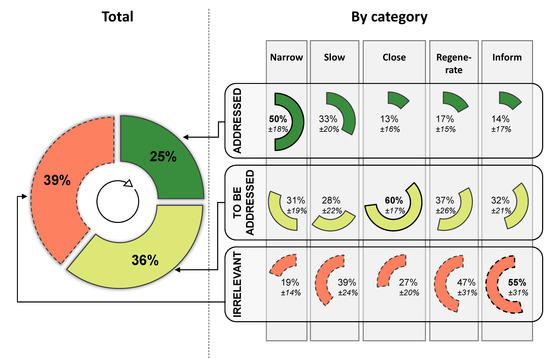
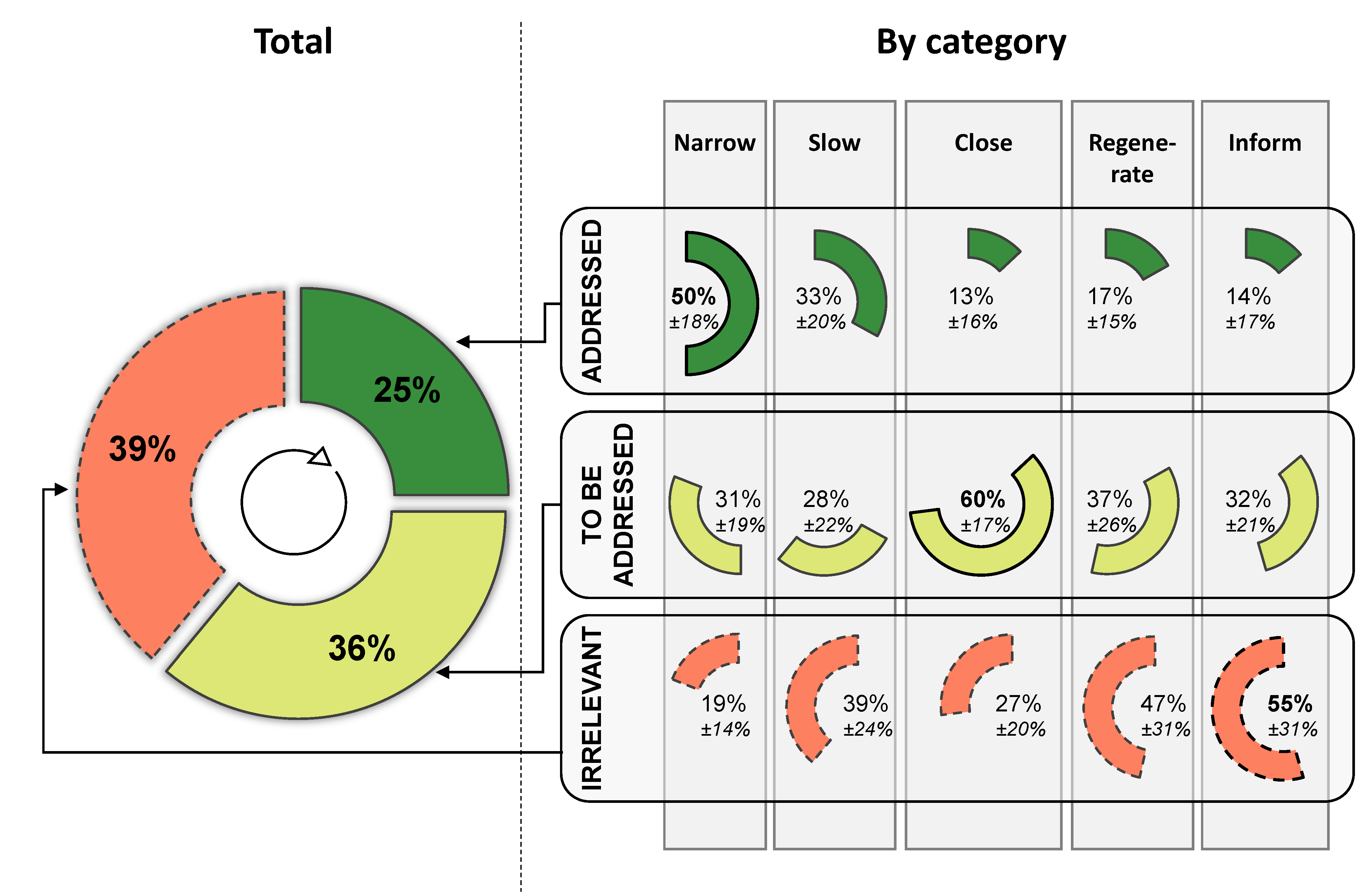
Figure 1 shows the share of strategies that are currently addressed, planned for implementation, or which are irrelevant for these companies manufacturing electronics in Finland. Currently, circular economy strategies are implemented in only 25% of the cases on average. The largest contribution to the development of the circular economy is due to strategies aiming at utilizing less raw materials, the so-called “Narrow” category, at 50%. However, as devices become smaller, little attention is given to strategies focusing on the recycling of the devices and the use of recycled feedstock, which is seen through the small share of addressed strategies in the “Close” category, at 13%. The strategies from this “Close” category were often seen as future development opportunities, with 60% of the cases being planned to be implemented in the future, the highest of all circular economy categories. On average, in 36% of the cases, circular economy strategies were planned to be addressed in the future. Out of all strategies, the largest share of 39% was seen as irrelevant for the participating companies and products assessed. Those strategies were mostly from the “Slow”, “Regenerate”, and “Inform” categories, where the share of irrelevant strategies ranged from 39–55%. Each category is described further in detail.
Figure 1.
Share of the circular economy strategies (total on the left and by category on the right) addressed, to be addressed, and irrelevant for participating companies.
3.1. Narrow
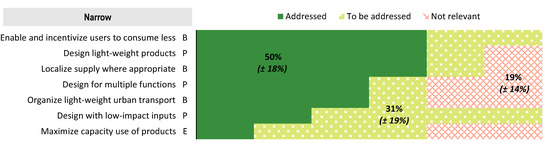
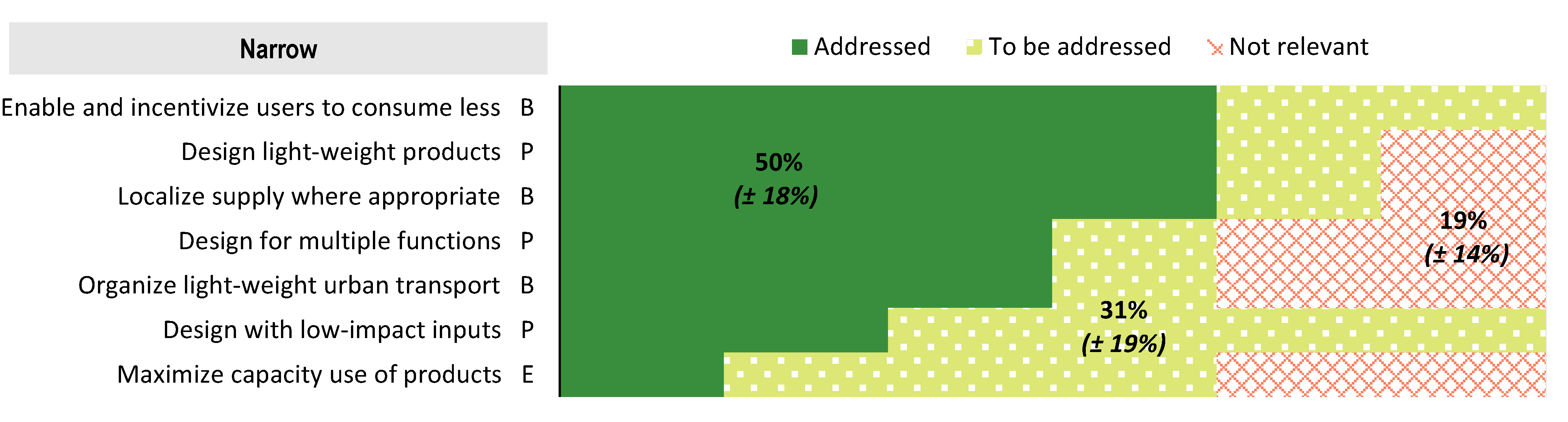
It was discovered that most of the work related to the circular economy by participating companies within the “Narrow” category was towards three strategies: (1) minimizing consumption of their customers, (2) developing lightweight products, and (3) making use of local products and components whenever possible (Figure 2). Minimization of the consumption of customers implies less consumption during the use phase of the products. Such developments require constant development from the companies through participation in research activities. Efforts towards light-weight product development are often related to the embodied economic benefits of using less raw materials, resulting in more efficient logistics. The same benefits are also often seen in the localization of the supply. Both of these strategies are expected to also reduce environmental impacts; however, the incorporation of lightweight products may require significant R&D and investment costs, which are usually more available in developed countries. One example of product light-weighting is using composite materials, such as carbon- or glass fiber-reinforced composites in automotive and aviation industries [23,24], though their recycling might be challenging and underexplored compared to conventional materials, such as steel.
Figure 2.
State of the circular economy strategies from the “Narrow” category from the product (P), business model (B), and ecosystem (E) perspectives.
The most challenging strategy in this category, on the contrary, was the maximization of the capacity of the products which often reflects the so-called “sharing economy”. The challenge with this strategy was related to the reverse logistics of the products, if the companies were to operate the sharing economy themselves, or the lack of existing companies who could operate on their behalf and ensure good customer service and technical support. Furthermore, some of the products are customized, meaning that their shared use is impossible due to personal information stored on the devices.
3.2. Slow
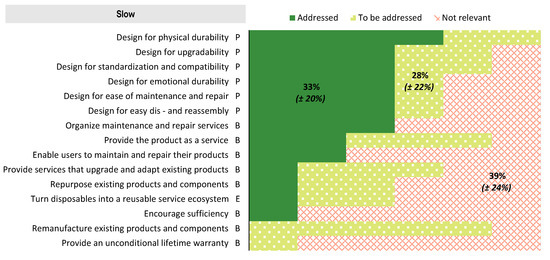
Development of electronics that can remain in use longer was practiced in 33% of the cases (Figure 3). Physical durability was the most practiced strategy. This strategy is generally a part of the company brand, ensuring the quality of the products. This strategy, however, often hindered the wider implementation of lightweight products that would have lower strength, unless using other types of raw materials.
Figure 3.
State of the circular economy strategies from the “Slow” category from the product (P), business model (B), and ecosystem (E) perspectives.
All other strategies from the “Slow” category requiring some kind of physical interference with the products, such as upgradability, repair, disassembly, repurposing, or remanufacturing, could be split into those with and without customer interaction. Often, companies tend to develop products suitable for upgradability and organize their repair services, when a specific product allows. In cases of printed RFID tags or holograms, repair is practically impossible. On the contrary, companies are not considering strategies where customers would repair, repurpose, or remanufacture their products as relevant. Such attitude is due to possible liability of the modified product, and customer perception if the product malfunctions afterwards.
3.3. Close
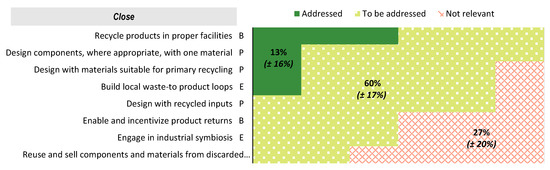
Strategies related to closing the loops, i.e., using waste as raw materials or recycling of the products, were the least addressed compared to other categories. In only 13% of the cases were companies addressing these strategies (Figure 4). The most common strategy addressed was recycling the products in proper facilities, which in most cases meant that instructions are given to the user on how to recycle, but the responsibility for implementation remains with the consumers. The relatively low engagement in the strategy could be attributed to the fact that the products are used elsewhere, preventing any possibility of directly affecting collection and disposal practices. However, ever-tightening laws on extended producer responsibility are helping to drive this strategy, forcing companies to develop their waste collection systems or join existing ones working with electronic waste. However,, the collection of WEEE can be challenging, even with the implementation of various interventions, such as increased coverage of collection system and collection points, as well as rewards [25].
Figure 4.
State of the circular economy strategies from the “Close” category from the product (P), business model (B), and ecosystem (E) perspectives.
Upcoming research and development activities will mostly concern product development through the use of recycled inputs, such as elements made of recycled steel or recycled plastics, as well as the development of single-material products suitable for recycling. Any activities related to direct management of end-of-life operations by manufacturing companies such as product return logistics, engagement in industrial symbiosis, or reuse and sale of components were seen as irrelevant. Such attitude could be related to the limitations of the existing business models, where products are only seen in the focus of companies’ activities and not in terms of the waste generated thereof. Furthermore, the remaining value of the products could be low, making their collection and recycling economically infeasible for the companies.
3.4. Regenerate
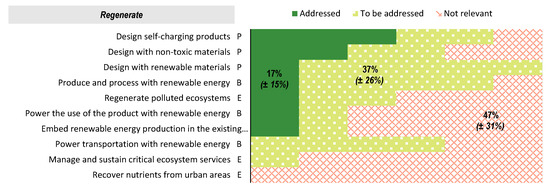
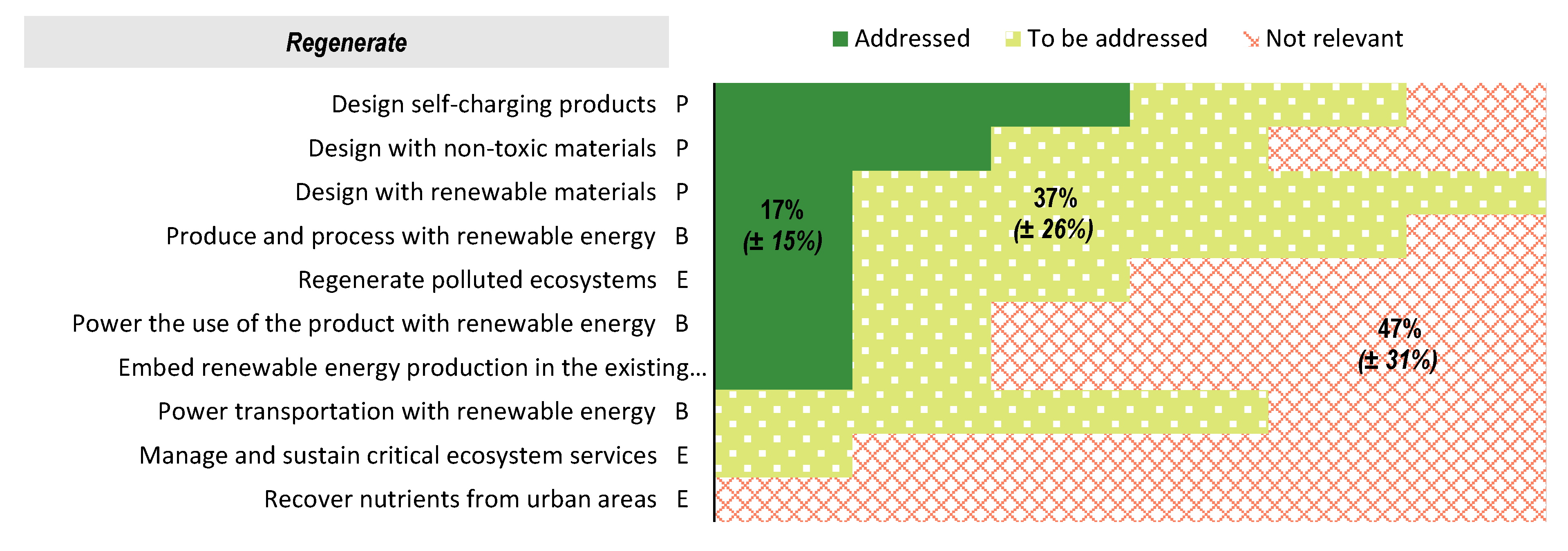
The use of renewable energy and materials was mostly seen as possible, and implementation was planned in the product-level strategies, i.e., designing self-charging products with non-toxic and renewable materials and utilizing renewable energy in the production process (Figure 5). Most of the above-mentioned activities are still to be addressed by the companies and face some obstacles, such as the absence of proven technological solutions and high costs. Furthermore, in some cases, locations of manufactures, or use of products, it was considered impossible to influence the source of power generation. On the contrary, work on the improvement of the critical ecosystems was seen as mostly irrelevant, even though electronics manufacturing utilizes significant amounts of metals, the mining of which causes substantial changes to natural ecosystems. Recovery of nutrients was perceived as an irrelevant category. This is because of the specifics of the sector do not directly involve any use of nutrients, unlike, e.g., the agricultural sector.
Figure 5.
State of the circular economy strategies from the “Regenerate” category from the product (P), business model (B), and ecosystem (E) perspectives.
3.5. Inform
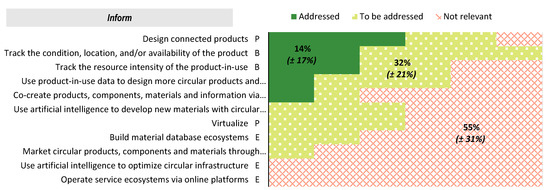
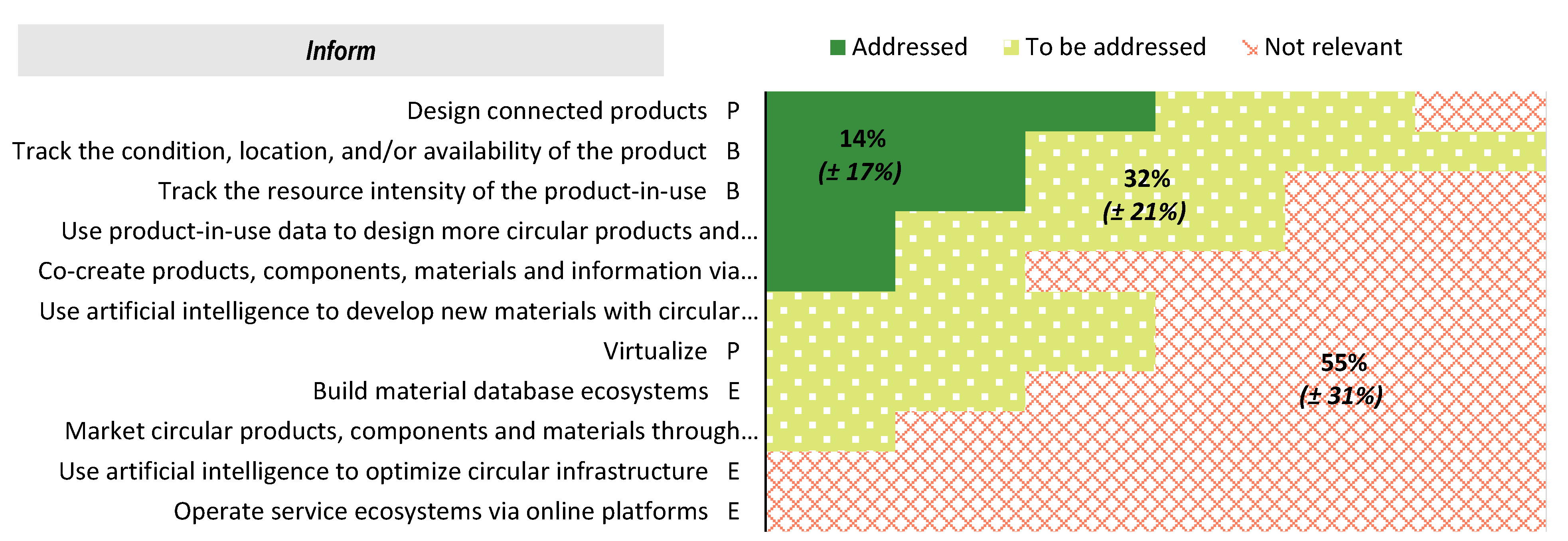
The use of information technologies was perceived as the most irrelevant category within the electronics manufacturing sector despite electronics themselves being an integral part of the IT sector (Figure 6). These strategies include the use of artificial intelligence, platforms and big data, for which actual solutions implementation might still be in its infancy. In half of the cases, the inform category was implemented through designing connected products that can exchange data with external components. In connection with this strategy, the possibilities to track the condition, location, or resource intensity of the products in use were also implemented in some cases, and were to be addressed in all others.
Figure 6.
State of the circular economy strategies from the “Inform” category from the product (P), business model (B), and ecosystem (E) perspectives.
The implemented CE strategies, as well as those planned for implementation, were chosen by companies based on their perception of the ecosystems they operate in, the economic viability of business models, and the technical specifications of products; however, their environmental impacts should also be assessed. Life cycle assessment (LCA) is a suitable tool for such assessments [26,27]. However, the application of LCA to the circular economy brings attention to unresolved methodological issues, such as allocation, especially when considering multiple recycling steps of materials [28]. Therefore, LCA studies should be performed with caution, clearly stating the methodological choices made to ensure the results can be interpreted independently. Nassajfar et al. [29] present an example of a study focusing on the environmental impact assessment of substituting conventional fossil-based materials with renewable ones.
Regarding the implementation of the strategies that were chosen as “to be addressed”, the companies were left to continue work on their implementation inside each company; some of them require further research and more strategic suggestions, also involving company management. Some strategies were identified to be such that implementation can be done instantly, especially in smaller companies. This workshop served as an eye-opener for the companies of the vast opportunities that lie in a comprehensive assessment of circular economy strategies and how it involves the whole company from design to production, delivery, and recycling, as well as the value chains before and after the company’s operations.
The number of strategies evaluated as already “Addressed” became partly a positive surprise to the companies. External communication of these achievements is important for strengthening the brand image and market position. Moreover, these are more mature strategies and therefore, in some cases, are easy to develop further. In some cases, these strategies can also be relatively simply assessed for their environmental impacts using life cycle assessment. Finally, these strategies can be taken to the next level through co-operation with stakeholders and partners across the entire value chain.
The “Not relevant” category, as described in these workshops, are the strategies that companies evaluated not to apply to them at the moment. However, their implementation might become relevant later on with the changing political, economic, or legislative operating environment.
4. Conclusions
The research revealed a strong will from companies operating in the electronics sector in Finland to further develop their circular economy policy by implementing a range of strategies from the current state. As of now, circular economy strategies were implemented in only 25% of the cases. The most common strategies implemented at the moment are those which relate to the production of smaller, thinner, and lighter products, i.e., so-called light-weighting. These strategies from the “Narrow” category were followed in 50% of the cases. Furthermore, the strategies relate to ensuring durable products that is in use for longer, i.e., the “Slow” category, were practiced in 33% of the cases.
The largest development potential is in the “Close” category, i.e., the category implying the use of recycled feedstock and ensuring recycling of products at their end-of-life. Most of the participating companies aim at making products from a single material or materials, which can be used in primary recycling, as well as using recycled input in the production processes.
Overall, workshops were considered very useful for understanding the possibilities and wide scope of opportunities that circular economics hold when considered holistically, and what they entail in the design phase, strategically, and in communicating with the others in the value chain. This kind of analysis gave the companies a comprehensive base for CE analysis and practical tools for focusing their efforts to close material and energy cycles and to increase the degree of circularity in their operations. Each company was left to further discuss the implementation of strategies internally and to include the company management in the process as needed. After that, the next step in implementation is to involve the whole value chain in the development process.
Author Contributions
Conceptualization, I.D. and S.R.; methodology, I.D. and S.R.; formal analysis, S.R.; resources, S.R.; writing—original draft preparation, I.D.; writing—review and editing, I.D., S.R., M.G., M.H., V.L. and M.N.N.; visualization, I.D.; project administration, M.H.; funding acquisition, V.L., M.H., I.D. and S.R. All authors have read and agreed to the published version of the manuscript.
Funding
Research work was carried out in ECOtronics project (www.ecotronics.fi, accessed on 30 January 2022). co-funded by Business Finland, VTT Technical Research Centre of Finland, Tampere University, LUT University, and LAB University of Applied Sciences.
Acknowledgments
The authors would like to thank each of the industrial participants in the workshops.
Conflicts of Interest
The authors declare no conflict of interest.
Appendix A. List of Circular Economy Strategies
The circular economy (CE) strategies used in this study are listed in Table A1 and originate from the study by Konietzko, Bocken and Hultink [17].
Table A1.
List of CE strategies used in the study. Note that the numbering was used to count the strategies and not to rank them in any specific order.
References
- Forti, V.; Baldé, C.P.; Kuehr, R.; Bel, G. The Global E-Waste Monitor 2020: Quantities, Flows and the Circular Economy Potential; United Nations University/United Nations Institute for Training and Research: Bonn, Germany; International Telecommunication Union: Geneva, Switzerland; International Solid Waste Association: Rotterdam, The Netherlands, 2020; ISBN 9789280891140. [Google Scholar]
- Eurostat Waste Statistics—Electrical and Electronic Equipment. Available online: https://ec.europa.eu/eurostat/statistics-explained/index.php?title=Waste_statistics_-_electrical_and_electronic_equipment&oldid=496674#EEE_put_on_the_market_and_WEEE_collected_in_the_EU (accessed on 14 April 2021).
- Cucchiella, F.; D’Adamo, I.; Lenny Koh, S.C.; Rosa, P. Recycling of WEEEs: An economic assessment of present and future e-waste streams. Renew. Sustain. Energy Rev. 2015, 51, 263–272. [Google Scholar] [CrossRef] [Scilit]
- Bressanelli, G.; Saccani, N.; Pigosso, D.C.A.; Perona, M. Circular Economy in the WEEE industry: A systematic literature review and a research agenda. Sustain. Prod. Consum. 2020, 23, 174–188. [Google Scholar] [CrossRef] [Scilit]
- Rosa, P.; Sassanelli, C.; Terzi, S. Circular Business Models versus circular benefits: An assessment in the waste from Electrical and Electronic Equipments sector. J. Clean. Prod. 2019, 231, 940–952. [Google Scholar] [CrossRef] [Scilit]
- Urbinati, A.; Chiaroni, D.; Chiesa, V. Towards a new taxonomy of circular economy business models. J. Clean. Prod. 2017, 168, 487–498. [Google Scholar] [CrossRef] [Scilit]
- Bacher, J.; Dams, Y.; Duhoux, T.; Deng, Y.; Teittinen, T.; Mortensen, L.F. Electronic Products and Obsolescence in a Circular Economy; European Topic Centre on Waste and Materials in a Green Economy: Mol, Belgium, 2020. [Google Scholar]
- Lu, B.; Li, B.; Wang, L.; Yang, J.; Liu, J.; Wang, X.V. Reusability based on Life Cycle Sustainability Assessment: Case Study on WEEE. Procedia CIRP 2014, 15, 473–478. [Google Scholar] [CrossRef] [Scilit]
- Reike, D.; Vermeulen, W.J.V.; Witjes, S. The circular economy: New or Refurbished as CE 30?—Exploring Controversies in the Conceptualization of the Circular Economy through a Focus on History and Resource Value Retention . Options. Resour. Conserv. Recycl. 2018, 135, 246–264. [Google Scholar] [CrossRef] [Scilit]
- Meloni, M.; Souchet, F.; Sturges, D. Circular Consumer Electronics: An Initial Exploration; Ellen MacArthur Foundation: Cowes, UK, 2018. [Google Scholar]
- Bressanelli, G.; Pigosso, D.C.A.; Saccani, N.; Perona, M. Enablers, levers and benefits of Circular Economy in the Electrical and Electronic Equipment supply chain: A literature review. J. Clean. Prod. 2021, 298, 126819. [Google Scholar] [CrossRef] [Scilit]
- Ragossnig, A.M.; Schneider, D.R. Circular economy, recycling and end-of-waste. Waste Manag. Res. 2019, 37, 109–111. [Google Scholar] [CrossRef] [Scilit]
- Di Maio, F.; Rem, P.C. A Robust Indicator for Promoting Circular Economy through Recycling. J. Environ. Prot. 2015, 6, 1095–1104. [Google Scholar] [CrossRef]
- Heath, G.A.; Silverman, T.J.; Kempe, M.; Deceglie, M.; Ravikumar, D.; Remo, T.; Cui, H.; Sinha, P.; Libby, C.; Shaw, S.; et al. Research and development priorities for silicon photovoltaic module recycling to support a circular economy. Nat. Energy 2020, 5, 502–510. [Google Scholar] [CrossRef] [Scilit]
- Mossali, E.; Picone, N.; Gentilini, L.; Rodrìguez, O.; Pérez, J.M.; Colledani, M. Lithium-ion batteries towards circular economy: A literature review of opportunities and issues of recycling treatments. J. Environ. Manag. 2020, 264, 110500. [Google Scholar] [CrossRef] [Scilit] [PubMed]
- O’Connor, M.P.; Zimmerman, J.B.; Anastas, P.T.; Plata, D.L. A Strategy for Material Supply Chain Sustainability: Enabling a Circular Economy in the Electronics Industry through Green Engineering. ACS Sustain. Chem. Eng. 2016, 4, 5879–5888. [Google Scholar] [CrossRef] [Scilit]
- Konietzko, J.; Bocken, N.; Hultink, E.J. A tool to analyze, ideate and develop circular innovation ecosystems. Sustainability 2020, 12, 417. [Google Scholar] [CrossRef] [Scilit]
- Kirchherr, J.; Reike, D.; Hekkert, M. Conceptualizing the circular economy: An analysis of 114 definitions. Resour. Conserv. Recycl. 2017, 127, 221–232. [Google Scholar] [CrossRef] [Scilit]
- Korhonen, J.; Honkasalo, A.; Seppälä, J. Circular Economy: The Concept and its Limitations. Ecol. Econ. 2018, 143, 37–46. [Google Scholar] [CrossRef] [Scilit]
- Muradin, M.; Foltynowitcz, Z. The circular economy in the standardized management system. Sustain. Bus. Consum. Trends 2019, 21, 871–883. [Google Scholar] [CrossRef] [Scilit]
- Blomsma, F.; Pieroni, M.; Kravchenko, M.; Pigosso, D.C.A.; Hildenbrand, J.; Kristinsdottir, A.R.; Kristoffersen, E.; Shabazi, S.; Nielsen, K.D.; Jönbrink, A.K.; et al. Developing a circular strategies framework for manufacturing companies to support circular economy-oriented innovation. J. Clean. Prod. 2019, 241, 118271. [Google Scholar] [CrossRef] [Scilit]
- Lieder, M.; Rashid, A. Towards circular economy implementation: A comprehensive review in context of manufacturing industry. J. Clean. Prod. 2016, 115, 36–51. [Google Scholar] [CrossRef] [Scilit]
- Pervaiz, M.; Panthapulakkal, S.; KC, B.; Sain, M.; Tjong, J. Emerging Trends in Automotive Lightweighting through Novel Composite Materials. Mater. Sci. Appl. 2016, 7, 26–38. [Google Scholar] [CrossRef]
- Khalil, Y.F. Eco-efficient lightweight carbon-fiber reinforced polymer for environmentally greener commercial aviation industry. Sustain. Prod. Consum. 2017, 12, 16–26. [Google Scholar] [CrossRef] [Scilit]
- Guzzo, D.; Rodrigues, V.P.; Pigosso, D.C.A.; Mascarenhas, J. Analysis of national policies for Circular Economy transitions: Modelling and simulating the Brazilian industrial agreement for electrical and electronic equipment. Waste Manag. 2022, 138, 59–74. [Google Scholar] [CrossRef] [Scilit] [PubMed]
- Peña, C.; Civit, B.; Gallego-Schmid, A.; Druckman, A.; Caldeira-Pires, A.; Weidema, B.; Mieras, E.; Wang, F.; Fava, J.; Canals, L.M. i.; et al. Using life cycle assessment to achieve a circular economy. Int. J. Life Cycle Assess. 2021, 26, 215–220. [Google Scholar] [CrossRef] [Scilit]
- Bjørnbet, M.M.; Vildåsen, S.S. Life Cycle Assessment to Ensure Sustainability of Circular Business Models in Manufacturing. Sustainability 2021, 13, 11014. [Google Scholar] [CrossRef] [Scilit]
- Malabi Eberhardt, L.C.; van Stijn, A.; Nygaard Rasmussen, F.; Birkved, M.; Birgisdottir, H. Development of a Life Cycle Assessment Allocation Approach for Circular Economy in the Built Environment. Sustainability 2020, 12, 9579. [Google Scholar] [CrossRef] [Scilit]
- Nassajfar, M.N.; Deviatkin, I.; Leminen, V.; Horttanainen, M. Alternative Materials for Printed Circuit Board Production: An Environmental Perspective. Sustainability 2021, 13, 12126. [Google Scholar] [CrossRef] [Scilit]

Publisher’s Note: MDPI stays neutral with regard to jurisdictional claims in published maps and institutional affiliations. |
© 2022 by the authors. Licensee MDPI, Basel, Switzerland. This article is an open access article distributed under the terms and conditions of the Creative Commons Attribution (CC BY) license (https://creativecommons.org/licenses/by/4.0/).