


Abstract
Agroecology has proven to be successful in responding to the demands and needs of a collective due to the relevance of its approach and proposals, which are built collaboratively between all the actors under a specific context that focuses on the actions developed. This is facilitated when spaces of horizontal interaction are generated through dialogues between different perspectives and experiences. In this perspective, agroecological training in higher education, i.e., university level, requires structural changes that go beyond the incorporation of technical content. Based on a critical documentary analysis of the records generated in the implementation of teaching innovation projects, the learning itinerary in agroecology is presented, consisting of four certifications based on transformational learning and supported by active methodologies. The potentialities, including marketing potential, of the proposed learning itinerary relate to curricular design, the articulation of the itinerary, the suitability of the learning methodologies used, the performance of the teachers, and the participation of the students. It is concluded that the implementation of flexible itineraries allows for addressing the transformation processes necessary for an agroecological transition in which we see a convergence of students’ skills, the learning objectives, and the requirements of the various actors with which they interact.
1. Introduction
In 1988, the World Food and Agriculture Organization [1] issued a report on the subregional seminars on “Training and Training of Agricultural Science Professionals for Extension and Rural Development in Latin America”, in which it pointed out the need to change the training received by young university students so that they become true agents of development. Although these seminars did not address the root of the problems that are causing the crisis experienced in rural areas, but rather the symptoms with which such a crisis manifests itself, the events pointed out the need to incorporate curricular elements that lead to the knowledge and understanding of the natural and socioeconomic environment in which future professionals will work. The FAO report acknowledged the importance of the curricular problem and the urgent need for action on training programs, as well as the expansion of the debate to sectors of society that are knowledgeable and sensitive to the subject.
A clear example of this was the meeting between CLADES (Latin American Consortium of Agroecology and Development) and FAO on “Agroecology and Agronomic Education in Latin American Universities”, held in Santiago de Chile in September 1991. This was a very important milestone for the agroecological movement because it represented a transcendental action for the consolidation of the agroecological proposal as a curricular alternative through a holistic approach. The work carried out at this meeting delivered the principles, the bases, and a proposal of contents, becoming the first reference to incorporate the agroecological approach in the scientific-technological training of agricultural sciences [2].
Thirty years later, within the framework of the II International Symposium on Agroecology, held in Rome on 3–5 April 2018, FAO recognized Agroecology for its contribution to the transformation of healthier and more sustainable production and agri-food systems. However, much has been debated regarding the contents to be addressed, and different strategies have been developed for their incorporation into the curricula: modules, subjects, curricular lines within agronomic training, the creation of new degrees at the undergraduate level, and agricultural engineering at the postgraduate level, both master’s and doctorate.
The development of learning programs on agroecology in Latin America has had diverse trajectories depending on the context in which they have been generated or characterized—in general, by situations of marginality, especially in their beginnings. In Chile, the development of agroecology training programs has been slow. At present, there are no postgraduate degrees, and of the 18 universities that provide agricultural courses only 5 report a subject or module on agroecology. University programs on agroecology refer mainly to those developed within the framework of continuing education, i.e., diplomas and postgraduate degrees.
The teaching of agroecology at the undergraduate level in Chile has been focused on the incorporation of a single subject that tries to cover the wide diversity of contents and perspectives that this approach brings together. Very few are the experiences of curricula that consider the various areas of knowledge of the agroecological approach, and there are no records of teaching innovations either in the pedagogical or curricular field or training programs at the postgraduate level [3].
However, agroecological teaching and learning require curricular designs that allow the understanding of the complexity of the territories. This implies the formulation of new profiles of graduates, the incorporation of active learning methodologies, interdisciplinary approaches, articulated itineraries for the progression of skills, and a close link with the community. In this scenario, continuing education programs present administrative flexibility in terms of entry requirements, program content, and target audience, constituting an alternative for agroecological training and learning at the university level. These gaps in the Chilean university system have served to accommodate the tangible demands of a community increasingly interested in agroecology.
The growing interest from society initially overwhelmed higher education institutions in a context of social mobilizations for free and quality education. In the case of the University of Santiago de Chile (USACh), this led to the multi-state participatory construction of a policy of Linkage with the Environment: a “transversal function that materializes in a system of collaborative relationships and actions, which [may] vary in their degrees of formalization, time and level of bidirectionality” [4] (p. 6) towards different actors of the medium to “seek to ensure a training with social responsibility that is in tune with the needs of the environment” [4] (p. 9). Along with this, the Institutional Educational Model (MEI) seeks the comprehensive formation of students with a view to the needs highlighted by current times. The purpose of the MEI is the generation of training trajectories for undergraduate education, with the aim of promoting the possibility of having specialized, flexible, interdisciplinary training, within the perspective of lifelong learning.
The Continuing Education Program in Agroecology (PECA) is the result of the confluence of needs and interests of various actors to create training programs, as a part of lifelong learning, that integrates with the training plans of degrees in agri-food sciences. This allows access to agroecological education to all of the interested public through itineraries with intermediate certifications.
The collective process of curriculum design, with a view to generating changes that would foster the development of more sustainable societies, gave way to the design and implementation of the training and learning proposal in this study.
The objective of this work is two-fold: (a) to document the implementation of an itinerary for university-level agroecological training describing the main characteristics at each level and (b) to establish the main potentialities and advantages that entail the teaching of agroecology using an active methodology in the context of continuing education.
1.1. The Demands for Quality Education
In Latin America, the possibility of equal access to educational resources is strongly conditioned on the level of the economic income of people [5]. In Chile, this educational inequality is presented with greater emphasis, with a gap in proportions between the poorest and richest quintile at the time of access to higher education institutions, with the richest having a great advantage [5]. In Chilean society, marked by strong economic–social inequality [6], the possibilities of accessing university education are highly determined by one’s economic resources available [7]. The segmentation of secondary education in Chile [8] has the result that access to university is restricted to those who come from the highest socioeconomic sectors to the detriment of the poorest groups [9], fostering social and economic inequalities. Thus, those who can choose to continue training at this level of education are from the same privileged groups.
Faced with this unjust and unfair scenario, early in the twenty-first century, student mobilizations began to demand quality education, reaching a critical point in 2011, when widespread social demonstrations took to the streets of Chile [10]. In this context, the first Diploma in Education for Sustainable Development (ESD) is framed as one of the strategies developed by the University of Santiago de Chile to build an inclusive and socially responsible university. Over time, the diploma managed to articulate the link between the environment, education with social relevance, and open spaces for the development of projects that responded to the needs of local communities. In turn, the experience of teaching this diploma gave the university input to carry out research on this type of experience and the impact it has both on the people who study it and on the communities involved.
A natural evolution from this was a journey marked by constant interactions between the various actors who sought to establish a training program within the university that responded to when demands emanating from society began. One of the elements that ensured the interest and permanence in the execution of this program, in addition to its educational quality and inclusivity factors, was the permanent reflection based on the curricular adjustments necessary to respond to an education for sustainability using as tools a transdisciplinary approach and a teaching model of the co-construction of knowledge. A second determining aspect was the absence of admission requirements, and the possession of previous formal courses, since these do not determine subsequent performance [11]. This approach sought, on the one hand, to avoid the perpetuation of the vicious circle of exclusion in higher education and, on the other hand, to recognize and validate the knowledge that people have obtained throughout their lives, without distinguishing whether these belong to the field of formal, informal, or non-formal education [12].
Supported by a pedagogical methodology based on transformational learning, the training focused on the students becoming critical, participatory citizens concerned about their environment. The latter materialized with the realization of a practical project, which was elaborated within a group by students themselves. Students’ working groups had the following characteristics:
- (a)
- A transdisciplinary nature, that is, in which it seeks to transcend the disciplinary logic of the training usually received on the basis that social reality is complex and must be approached from a holistic perspective [13].
- (b)
- The diversity of knowledge is combined, both that delivered by academic training and that acquired through professional practice and/or trades and also that obtained by life experience in general, in consideration of the relevance of recognizing and respecting the various forms of learning and knowledge available, which allows generating learning communities.
- (c)
- The diversity of people in terms of age and gender interact, making available a multiplicity of approaches that, through collaborative dialogue, must respond to a need of the community with which a member of the group has a relationship that is participatively relieved by the community itself, resulting in a proposed solution that is of a holistic and sustainable nature for the benefit of the community [14].
The teaching model implemented in the programs that constitute the training itinerary offered a critical and dialogical proposal in which academic and traditional knowledge were integrated, with respect to various disciplines, creating a space in which students learn. Students played a leading role in the construction of a joint body of knowledge based on the conjunction of academic knowledge and experience. In this way, the results have been the product of the actions defined and developed by the student body itself.
The model was intended to relieve and reinforce the role of public universities in fostering critical, reflective, independent, and democratically minded thinkers [15] to become agents of change towards sustainable societies [16]. With this, it seeks to promote equality over academic distinction as an element of social justice [17]. The integrated effort of academics, professionals, administrators, and students, often relegated to the background despite its importance being recognized [18], has been oriented towards higher objectives of the development, conservation, preservation, and quality of life of the local, national, regional, and global community. Through an innovative approach to socially contextualized, dynamic, and self-reflective teaching [19], permanent dialogue is promoted between the training processes of new professionals, technicians, researchers, and social leaders in coherence with the territory in which they operate, understanding the spatial and temporal dimensions that this implies.
1.2. Limitations for the Implementation of an Agroecological Curriculum
The momentum generated by CLADES in the Latin American region in the 1990s by promoting meetings and preparing working documents for the debate of an agroecological curriculum highlighted a series of structural limitations in those same universities that initiated such a challenge. Institutional records from those years indicated that higher education institutions should promote a process of academic restructuring not only of curricula but of the entire curricular conception and design by the universities [20]. The addition of a subject or certain contents on sustainability is not enough to train a professional prepared to give an adequate response to new challenges [21]. Substantial changes are required for the creation of new profiles of graduates and for the training of professionals who could meet agroecological objectives [22].
In the curricular development in agricultural sciences at Latin American universities, technology was not approached as the expression at a specific moment of the productive system that obeys the development of social forces and negated the dialectical selection between them because of the interaction and coevolution of both that are in permanent feedback [23]. Additionally, the main structural problem of universities remained their privatization, thus making it difficult to meet the priorities set by society based on the needs of farmers [24]. The little flexibility of the curricula, the resistance to change of some teachers trained in old paradigms, and the lack of a faculty qualified for these challenges made it difficult to incorporate the agroecological approach in universities.
Two decades later, the same limitations are found in introducing agroecology in higher agricultural education, emphasizing that the compartmentalization of disciplines and the reductionist approach of these hinders inter- and transdisciplinary work with holistic approaches and appropriate methodologies to address socio-environmental complexity [25]. “The university as a learning community is in crisis in the quantitative and qualitative, both in the so-called countries of the North and in those of the South; and this crisis is due both to economic reasons and to a lack of values, attitudes, concepts” [26]. While recognizing that agroecology is an opportunity for universities to renew the ways of generating, managing, transferring, and disseminating knowledge, he warns that the scenario is not the most favorable.
Within the European Higher Education Area, it can be argued that the reduction of public spending in universities, coupled with the implementation of the Bologna Plan, carries the risk of a decrease in the quality of the training and education provided, the absence of education as an integral experience, an increase in pressure from external actors favoring fragmentation and overspecialization of the future workforce, and the increase in the cost of studies and specialization. On the one hand, the implementation of the European Higher Education Area (EHEA) as part of the Bologna Plan has meant a strong privatization, elitization, and increase in the price of university education with a decrease in the degrees offered [27]. On the other hand, it highlights how it allowed the incorporation of new teaching methodologies and the introduction of new areas of knowledge. The latter could have facilitated the creation of new subjects and postgraduate courses in agroecology. However, the creation of more specific degrees that incorporate agroecological principles can be considered a better strategy than the mere incorporation of subjects in plans with reductionist approaches [27].
Therefore, the experience of the Autonomous University of Chapingo (Mexico) [28] pointed out that the agroecology program is the only one where there is an approach to the curricular mainstreaming of the environmental issue from the roots, reinforcing the validity and relevance of training plans in agroecology as an independent curriculum and, in doing so, overcoming the debate that was addressed by the agroecologists of Latin American Scientific Society for Agroecology (SOCLA) in its beginnings.
2. Materials and Methods
For the elaboration of this work, a critical documentary analysis of the records generated by the authors and collaborators, members of the Agroecology and Environment Group (GAMA), constituting results of the development and execution of the following teaching innovation projects supervised by Educational Innovation Unit (UNIE) and co-financed by the Academic Vice-Rectory (VRA) of the University of Santiago de Chile (USACh) are shown in Table 1.

Table 1.
Teaching innovation projects executed in the Continuing Education Program in Agroecology (PECA) of the University of Santiago de Chile.
The following activities were carried out:
- (a)
- Mainstreaming of sustainability in university curricula: an initiative developed within the framework of the University Collaboration Protocol “Sustainable Campus”—with the sponsorship of the University Social Responsibility Program (RSU)—which aimed to establish an itinerary for the study of sustainability through a flexible curriculum and transformative and active learning methodologies. It was established as an instance of propaedeutic training in studies for sustainability [29].
- (b)
- Design of a training itinerary of agroecological specialty for the articulation of undergraduate and postgraduate degrees: designed to articulate the formation of university degrees oriented to agricultural commercialization—with postgraduate training through the intermediate studies of postgraduate studies. This sought to reinforce the agro-productive training of the university degree with agro-ecological sustainability subjects focused on the design and management of agroecosystems to maintain the agroecological attributes of food along the marketing and distribution chain [30].
- (c)
- Service-Learning as a competency-based training methodology in university education, whose purpose was to implement this methodology in the subjects of agroecology as a result from educational program design (b), based on the generation of an institutional commitment with community partners, e.g., group of farmers, the content structure, and its learning strategy, aimed at the organization of student learning through collaborative work requested by farmers [31].
- (d)
- Use of Simulated Markets as a method of Project-Based Learning (PBL) in undergraduate courses, with the purpose—for agroecological teaching purposes—of moving towards training processes that link the student with real situations. The experiences focused on the formulation and execution of projects aimed at the (re)connection of the local organic production of farmers based on agroecological principles with responsible consumption through circuits of social proximity and geographical proximity [32].
- (e)
- Evaluation of the impact of the implementation of transformational learning in training programs for sustainability in the framework of innovation in teaching [33]. The relationship between the innovative elements, i.e., transformational learning and active learning, and the didactic activities was established based on the dimensions addressed by the transformational learning proposal. Active learning was intrinsically linked to the moments and the ways in which the methodologies were applied during the learning process (Table 2).
Table 2. Relationship between the innovative elements incorporated and the didactic activities used.
3. Results
The implementation of the teaching innovation projects mentioned in the previous section resulted in the itinerary illustrated in Figure 1.
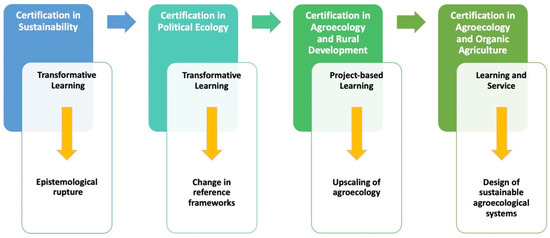
Figure 1.
Training itinerary, learning methodologies, and main characteristics. Source: based on [30,31,32,34].
3.1. Certification in Sustainability: The Epistemological Rupture
Modern epistemology defines nature as a reified, essential other, susceptible to being possessed by human society [35]. Under this perspective, it is possible to observe two main currents in the approach to the ecological crisis [36]: neoliberal and structuralist, where both assume the ontological singularity of nature. The neoliberal current aspires to the development of instruments that contribute to increasing efficiency in the production and management of resources, without questioning “the dominant productive organization model” [37] (p. 3), oriented to sustained growth. The structuralist current, while recognizing “the role of economic rationality in unsustainability” [37] (p. 4), concentrates its attention on the unequal distribution of impacts and benefits associated with the production and management of resources.
However, “nature is not a matrix, nor a resource, nor a tool for the reproduction of man” [35] (p. 122). The concept of “nature” is an operational distinction that refers not to a pre-existing univocal reality, but to relationship, dynamic and co-created habitat [38,39]. The alternative of strong sustainability [40], the radical vision of ecological economics, the perspective of complexity, and “ontological multiplicity” [39] (p. 170), converge in the recognition of nature as a multiple and emerging phenomenon. In other words, it is about conceiving “nature” not as a manifestation of a transcendent, alien, external reality but rather a reality that is not separated from the human, as immanent entities.
Therefore, it is possible to affirm that the solutions for efficient management, conservation, and distribution have in their definition of nature, as a singular and univocal phenomenon, the epistemological basis of the problem. Incorporating these approaches into professional training has meant revising the conventional bases of knowledge construction to transcend specialization and move towards a transdisciplinary and complex perspective [36].
Considering the multiplicity of nature as an emerging phenomenon with its associated conflictive elements—expressed in the correlation and synergy of phenomena associated with the ecological crisis—and as immanent to the political and social conflicts of actors with competing perspectives, one of the greatest risks for its approach has been the reduction of this complexity and disciplinary fragmentation [41]. Thus, in this context “it is essential to start from a complex thought (…) and to question the epistemological bases that enable the exploitation and destruction of ecosystems, as a dominant form of appropriation of the environment. In this last category, interdisciplinarity is indispensable, understood as the joint construction of a new object of knowledge” [42] (p. 37). This implies addressing the challenge of a “methodological pluralism (that) allows the articulation of different paradigms, through their methodologies, concepts and tools, to address and discuss the theoretical and political problems involved in the complex relationship between society and the environment” [37] (p. 6). There is a need for teaching approaches that allow students to deal with complexity and uncertainties [43] and for transdisciplinarity to be considered as a fundamental characteristic of agroecology education [44], which constitutes a great challenge for educators [45].
3.2. Certification in Political Ecology: Changes in Reference Frameworks
As has been pointed out, from the post-humanist perspective, nature is not a matrix, nor a resource, nor a tool for the reproduction of the human being and the alternative of strong sustainability and the “ontological multiplicity” that converge in the recognition of nature as a multiple and emerging phenomenon. Moreover, the recognition of the extended reality to the actor remains an immanent phenomenon in nature [46], where this does not exist a priori but rather is existing, creating new and recurring events.
From the point of view of political ecology, which advocates “the recognition that environmental transformations are based on political actors and therefore on power relations” [47] (p. 42), conceiving actors as inherent phenomena represents an opportunity to expand the creative possibilities of these actors on themselves and the inhabited territory. The concept of “immanent actor” in fact relieves the subject as a performative—co-creator of realities rather than as a pre-existing phenomenon.
In this perspective, we can affirm that power is acted by each actor that inhabits the world, in reciprocal influence or co-presence with all actors [46,48]. Correspondingly, the world as an inhabited place is dynamic, sustained by this reciprocal influence. This view is central to review the concept of an actor that has been put at the basis of political ecology: it is not then an essential, rational, and conscious subject that negotiates or affects the reality of another equivalent actor, and that influences a transcendent third party, nature. The transformative power of the actor, expressed in socio-ecological activism, seems to be based on deep intuitive and emotional processes [49]. In the perspective of inheritance, the actor moves and inhabits the world in reciprocal influence, generating networks in the encounter and convergence with the movement of other actors. This journey involves, inseparably, our rationality, corporeality, cosmology, and emotionality [49]. These elements take central stage in the formative itinerary, where it is the values and attitudes that motivate the students, recreating and influencing all the interactions of the network [50].
3.3. Certification in Agroecology and Rural Development
The conceptualization and spaces of agroecological action have overflowed the property (i.e., farm), expanding at the level of the food system including the value chain with marketing, distribution, and consumption [51]. The relocation or territorialization of socio-productive relations demand institutional accommodation strategies and social alliances that allow the formation of local agri-food systems [52].
Upscaling and outscaling agroecology to democratize agroecological consumption requires the participation of various actors to bring local production closer to committed consumption [53]. Thus, in the formative stage outlined in this study, the development of the skills that allow the transformation of agri-food systems at different levels and scales is pursued through processes of the exchange of experiences, dialogues of knowledge, and co-creation of knowledge between the different actors of a territory, overcoming the conventional models of the transfer and application of knowledge and technologies [54].
The use of active learning methodologies, such as project-based learning, has allowed the participation of students as actors committed to the community, e.g., group or community partner, in search for alternatives to address the needs highlighted by the community, thus highlighting that agroecological knowledge must be extended to the entire food chain [44].
3.4. Certification in Agroecology and Organic Agriculture
Whilst there are initiatives for the marketing and distribution of agroecological products that are integrated in pre-established channels, the strategy of the substitution of inputs for organic production on the farm evidently has not resulted in the establishment of sustainable agricultural systems. The financial dependence generated in farmers by the acquisition of inputs, their activity—especially biocides, and the productive hyper-specialization that organic monoculture has generated highlight the need to advance in the agroecological transition strategy based on the design of biodiverse farms.
Sustainable agriculture depends on healthy agroecosystems, and for this purpose, soil biota must be promoted through the management of organic matter and diversified habitat through practices such as polycultures, cover crops, and crop associations, among others, which constitute the two pillars of an agroecological transition [55]. Based on this, courses at this level pursue the development of skills, aimed at minimizing chemical inputs and production costs; the conservation and management of soil fertility; the planning of agroecosystems based on local resources and land capacity; and making efficient use of water, nutrients, and genetic resources [56]. The application of the learning and service methodology has consisted of the elaboration of joint strategies between farmers and students to establish farm designs through the application of agroecology-based cultural practices, with a special emphasis on local resources.
During the evaluation carried out in this study, the aspects referred to the perceptions of the actors involved in the learning process, i.e., teachers, students, and farmers stand out, as well as the aspects related to the adaptations and changes made in the execution of the projects. The results’ highlights are presented as follows:
- The high value that teachers attribute to their participation stands out with regards to the performance of teachers involved in transformative and active learning processes (Table 3).
Table 3. Self-evaluation of teachers’ performance. Source: [33].
- With regards to the students’ perceptions of the processes, the results indicate changes in the reified conception of oneself, of others, and of the environment (Table 4).
Table 4. Students’ perception of the learning process. Source: [49].
- Farmers’ perceptions indicate the valuation of people, their work, and collaborative work as the most important aspects in the experiences developed (Table 5).
Table 5. Farmers’ perception of co-executed activities. Source: [31].
- With regards to the use of projects as a central element of active learning, the results of the evaluations indicate the aspects to be considered to overcome the specifications for each interaction group (Table 6).
Table 6. Adjustments and modifications in the implemented projects. Source: [32].
4. Discussion
After a seven-year period of development of the formative itinerary, it was possible to observe potentialities and advantages of the proposed training itinerary in agroecology. These are shown in Table 7.
Table 7.
Potentialities and advantages of the training itinerary in agroecology.
4.1. The Curricula Design
The design of curricula for agroecological education require a (re)definition of the programs, in which it is possible to expand the orientations originally elaborated for a technical–agronomic curriculum. The experience of the authors is that curricular redesigns of agronomic curricula do not tend to promote the incorporation of inter- and transdisciplinary approaches for a dialogue between different areas of knowledge and people’s knowledge that conceive nature and our relationship with it from an epistemological rupture and the creation of new reference frameworks [36].
The flexibility granted by continuing education to expand the target audience, coexistence with people with different experiences, training and trajectories, the configuration of diverse scenarios for learning, and the use of diverse techniques facilitate the exchange of experiences that expand and enrich the training processes. The epistemic tension of agroecology highlights the existence of the tendency of green agronomy training plans that are far from transcending the modern paradigm [57]. Additionally, the transmutation through which a curriculum should pass to truly incorporate the agroecological approach entails a high degree of entropy, where a new conceptual approach of origin is more advantageous. An example of this is the creation of training plans in agroecology based on intercultural educational models [58].
4.2. The Articulation of Itineraries
Training and learning itineraries in higher education tend to be organized in basic training initially, followed by specialized training, both in relation to the areas of knowledge that contribute to a certain professional sector. What has been designed in the PECA is the articulation of itineraries, i.e., courses, diplomas, and postgraduate degrees, based on the interrelations that occur between individual and collective dimensions.
The itinerary presented in this work has been organized initially based on a circular learning model that moves towards levels of greater complexity: person > community > society > planet. This model has been structured as a process of “integration-transcendence” in which the passage from one level to the next is considered a “holarchy” [49]. Subsequently, the itinerary focuses on a phase understood as the incorporation of the reference frameworks with the community that allow the student to generate new action scenarios in conjunction with said community, tapping into endogenous potentials. Finally, with the appropriate contextualization, concrete actions are carried out that are of a more technical nature and on a smaller scale, responding to the needs of a community or group of farmers.
This flexibility allows for overcoming the rigid and compartmentalized curricular structures present in a university education that hinder agroecological teaching [59].
4.3. The Suitability of the Learning Methodologies
The suitability of the learning methodologies used in the different certifications have been decisive to the development of the skills proposed in each certification. The transformational learning methodology is adopted in the first phase of the paradigm shift, which implies, in the way of observing and inhabiting the world of actors, i.e., teachers and students, a dialogue not directive but co-creative, which enhances and facilitates the creative experience between the participants, recognized in their capacity as actors and apprentices. These characteristics coincide with the collaborative ways that agroecology promotes and synergizes when it is developed with unconventional educational approaches [45].
For the phase oriented to participation with the community, the project-based learning (PBL) methodology has allowed to articulate the formation of the individual, research, and social insertion within the community, which generates inclusion and discussion among those involved. It has been observed that the application of this methodology allows for tailor-made learning for the student in which the skills of the student converge with the requirements of a group of farmers [32]. Organizing learning based on the development of a project that meets the specific demands of farmers along with bringing students closer to real situations are characteristics to highlight in reference to the fact that the learning process has consisted of a permanent and continuous dialogue between agroecological theory and praxis and that degrees of autonomy are developed in students in their learning process [60].
Although not exclusive, the suitability of the learning and service methodology (A+S) for the development of skills related to actions at the farm level due to the characteristics of agro-productive activities is observed [31]. Like the PBL methodology, the use of A+S allows, through practical cases [45], the combination of scientific approaches with the knowledge resulting from experience [44]. The approach to real on-farm cases through a permanent dialogue between students, farmers, teachers, and technicians facilitates feedback that fosters a constant search and updating of adequate and relevant information to act in scenarios not established in advance [61].
Finally, the combination of the learning methodologies used throughout the training itinerary transform students into agents of change, while the relevance of their performance gives them a sense of responsibility.
4.4. Teachers’ Performance
In relation to the performance of the teachers involved in this work, the attitude and commitment in the educational process prevail over the mastery that they possess of the thematic contents and their skills in the implementation of the methodologies used. As important as the content developed during the training itinerary, through debates in conditions of horizontality, the attitude and commitment of teachers has been fundamental in the achievement of the objectives.
Teachers show a high commitment in the development of their teaching activities, considering appropriate strategies to address the heterogeneity of the group of students, the use of interpellation and questioning by students, the creation of spaces for feedback, and transformation in the habits of thinking and acting.
This has meant, on the part of teachers, assuming new roles. It is no longer simply a linear delivery of content, but the creation of collaborative spaces for co-creation. In the process of active learning in agroecological education, the teacher becomes a counsellor and catalyst [60], generating a complicity between the actors.
4.5. The Participation of the Students
The participation of the students, from their perspective, has implied profound transformations at the level of the individual, which has allowed changes in their practices in at least six areas of action: (1) personally, referring to the identification of a change of consciousness and an opening and internalization of new knowledge; (2) attitudes of socio-cultural sustainability, accepting diversity and heterogeneity as fundamental values and, with it, an openness to pluralistic approaches; (3) attitudes of environmental sustainability that emphasize establishing a different relationship with the environment; (4) sustainable practices in the workplace related to the space of daily habitability; (5) participation in activities and/or incorporation into organizations related to sustainability; and (6) networking, favoring collaborative and interdisciplinary work.
Assessments made by the students included comments such as: “It helped me a lot to have a different perspective of the world”; “it forces you to open your mind to new practices that integrate everyone” “(the training) guided my future work interests”; “it was an opportunity that opened a door to new research topics and practices that foster the construction of a more sustainable society”; and “I made networks that allowed me to carry out a community organization project” [33]. Similar results were found in other studies [62] and therefore denote the transformations of university students enrolled at agroecological education programs in which unconventional methodologies have been used.
5. Conclusions
The growing interest in agroecology and the urgent need for change in university curricula for its incorporation find a space in higher and continuing education that has proven to be effective for the purposes of implementing a holistic, systemic, and inclusive agroecological education. Programs should allow the implementation of flexible itineraries by developing a curriculum pertinent to the paradigmatic change proposed by agroecology, addressing at different levels the processes of socio-ecological transformation necessary for an agroecological transition towards sustainable societies.
In this context, the pathways implemented allow the deployment of potentialities where the skills of the students converge, with the learning objectives developed by the team of teachers and the requirements of the various actors with which they relate for the development of agroecological initiatives. The contextualized and adapted application of active learning methodologies is suitable for the development of skills among students, such as collaborative work and co-creation. The approach to specific problems, the development of practical cases, and the possibility of experiencing real situations, even establishing links with the communities, motivates the student to achieve specific objectives.
On the other hand, the uniqueness of agroecological experiences, as well as the difficulty of establishing comparative studies due to the lack of similar works, limits the scope of this study in the extent that it can be directly extrapolated to other contexts. This constitutes a great challenge for the implementation of new experiences in different contexts and highlights the need to develop new studies that accompany these learning processes focused on other actors, student profiles, the impact generated in the communities with these interactions, and the social dynamics in the agents of change.
Author Contributions
Conceptualization, S.P.P. and C.B.S.; methodology, S.P.P. and C.B.S.; validation, S.P.P. and C.B.S.; formal analysis, S.P.P. and C.B.S.; investigation, S.P.P. and C.B.S.; resources, S.P.P. and C.B.S.; data curation, S.P.P. and C.B.S.; writing—original draft preparation, S.P.P. and C.B.S.; writing—review and editing, S.B. and S.P.P.; visualization, S.P.P., C.B.S. and S.B.; project administration, S.P.P. and C.B.S.; funding acquisition, S.P.P. and C.B.S. All authors have read and agreed to the published version of the manuscript.
Funding
This research received no external funding. This work was supported by Universidad de Santiago de Chile (Project USA 1555).
Institutional Review Board Statement
Not applicable, the study did not require ethical approval.
Informed Consent Statement
Not applicable.
Data Availability Statement
The study did not report any data.
Acknowledgments
We acknowledge Dirección de Investigación Científica y Tecnológica, Universidad de Santiago de Chile and all those who have participated, in one way or another, over the years: colleagues, students, researchers, administrative staff, farmers, peasants, and all the people and professionals belonging to the different social organizations and public and private institutions that collaborated in this initiative.
Conflicts of Interest
The authors declare no conflict of interest.
References
- FAO. Informe de los Seminarios Subregionales sobre Formación y Capacitación de Profesionales de Ciencias Agrícolas para La Extensión y El Desarrollo Rural e n América Latina y El Caribe; United Nations Food and Agriculture Organization (FAO): Rome, Italy, 1998; p. 13. [Google Scholar]
- Altieri, M. Incorporando la Agroecología al Currículo Agronómico. In Texto Base de la Reunión CLADES/FAO sobre Agroecología y Enseñanza Agrícola en las Universidades Latino Americanas; Santiago de Chile, Chile; CLADES-FAO: Rome, Italy, 1991; pp. 68–69. [Google Scholar]
- Peredo, S. Contribuciones en la incorporación del enfoque agroecológico en las curricula universitarias: Antecedentes y reflexiones a 20 años de iniciada la travesía. Rev. Sustentabilidades 2015, 11, 1–19. [Google Scholar]
- USACh. Política de Vinculación con el Medio; Universidad de Santiago de Chile: Santiago, Chile, 2020; p. 16. [Google Scholar]
- Aponte-Hernandez, E. Inequality, inclusion and equity in higher education in Latin America and the Caribbean: Trends and alternative scenario in the horizon 2021. In Trends in Higher Education in Latin America and the Caribbean; Gazzola, A., Didriksson, A., Eds.; UNICEN: Buenos Aires, Argentina, 2008; pp. 113–154. [Google Scholar]
- Espinoza, V.; Barozet, E.; Méndez, M.L. Stratification and social mobility under a neoliberal model: The case of Chile. Mag. Lab. 2013, 25, 169–191. [Google Scholar]
- Bellei, C. The study of the socioeconomic and academic segregation of Chilean education. Pedagog. Stud. 2013, 39, 325–345. [Google Scholar]
- González, A.; Dupriez, V. Acceso a las Universidades Selectivas en Chile: Pueden las Estrategias Institucionales de los Establecimientos Secundarios Atenuar el Peso del Capital Cultural? Rev. Complut. Educ. 2017, 28, 959–978. [Google Scholar] [CrossRef]
- Uribe, D.; Espinoza, O.; Gonzalez, L.E. La Probabilidad de Terminar la Educación Secundaria y de Acceder a La Educación Superior en Chile: Análisis Estadístico de Modelos. Rev. Educ. Super. 2008, 27, 25–39, ISSN 0185-2760. [Google Scholar]
- Mayol, M.; Azócar, R. Politización del malestar, movilización social y transformación ideológica: El caso “Chile 2011”. Polis 2011, 30, 163–184. [Google Scholar] [CrossRef]
- Koljatic, M.; Silva, M. Opening a Side-Gate: Engaging the Excluded in Chilean Higher Education Through Test-Blind Admission. Stud. High. Educ. 2013, 38, 1427–1441. [Google Scholar] [CrossRef]
- Carrasco, R.; Jaude, F.; Letelier, M.; Oliva, C. Estudio Exploratorio sobre Aprendizaje no Formal e Informal de Estudiantes y Egresados Universitarios. Calid. Educ. 2012, 36, 149–184. [Google Scholar]
- Prats Cuevas, J.; Molina-Neira, J.; Ruiz Bueno, A.; Molina-Luque, F. Análisis de las Representaciones e Ideas Sociales del Alumnado en Educación para la Ciudadanía Democrática: Ejemplo de Mixed-methology desde y para la Investigación Transdisciplinar. Int. J. Sociol. Educ. 2017, 6, 1–25. [Google Scholar] [CrossRef]
- USACh. Plan Estratégico Institucional 2011–2015. Objetivos y Lineamientos Estratégicos; Universidad de Santiago de Chile: Santiago, Chile, 2011. [Google Scholar]
- Tannock, S. No Grades in Higher Education Now! Revisiting the Place of Graded Assessment in the Reimagination of the Public University. Stud. High. Educ. 2015, 42, 1345–1357. [Google Scholar] [CrossRef]
- Cotton, D.R.E.; Warren, M.F.; Maiboroda, O.; Bailey, I. Sustainable Development, Higher Education and Pedagogy: A Study of Lecturers’ Beliefs and Attitudes. Environ. Educ. Res. 2007, 13, 579–597. [Google Scholar] [CrossRef]
- Bowl, M. Experiencing the Barriers: Non-Traditional Students Entering Higher Education. Res. Pap. Educ. 2016, 16, 141–160. [Google Scholar] [CrossRef]
- Cotton, D.R.E. Revolutions and Second-Best Solutions: Education for Sustainable Development in Higher Education. Stud. High. Educ. 2009, 34, 719–733. [Google Scholar] [CrossRef]
- Treleaven, L.; Sykes, C.; Ormiston, J. A Dissemination Methodology for Learning and Teaching Developments Through Engaging and Embedding. Stud. High. Educ. 2011, 37, 747–767. [Google Scholar] [CrossRef][Green Version]
- De Alba, A. Currículum: Crisis, Mito y Perspectiva; CESU-UNAM: Ciudad de México, Mexico, 1991; p. 145. [Google Scholar]
- Sarandón, S.J. Incorporando el enfoque agroecológico en las Instituciones de Educación Agrícola Superior: La formación de profesionales para una agricultura sustentable. Rev. Agroecol. Desenvolvimiento Rural. Sustentável 2002, 3, 40–49. [Google Scholar]
- Fernández, M.; Peralta, L. La Agronomía: Sus desafíos y transformaciones en pos del Desarrollo Rural Sustentable. Agroecol. Desarro. 1996, 10, 18–24. [Google Scholar]
- Restrepo, J. Puede la Universidad contribuir al desarrollo de la agricultura orgánica en América Latina. Hoja Hoja 1997, 7, 32–36. [Google Scholar]
- Sarandón, S.J.; Hang, G.M. El Rol de la Universidad en la Incorporación de un enfoque agroecológico para el Desarrollo Rural Sustentable. Agroecol. Desarro. 1995, 8, 17–20. [Google Scholar]
- Sarandón, S. Potencialidades, limitaciones y desafíos para la introducción de la agroecología en la educación agrícola superior en la argentina. El caso de la cátedra de agroecología de la Universidad Nacional de La Plata: Una experiencia de 16 años. Agroecología 2016, 11, 47–61. [Google Scholar]
- Labrador, J. Educar en agroecología en el contexto de la educación superior. Una invitación a la reflexión. Agroecología 2016, 11, 63–74. [Google Scholar]
- Aguirre, I.; Mena, Y. Formación universitaria en agroecología y producción ecológica en España. Perspectiva histórica, situación actual y retos. Agroecología 2016, 11, 41–46. [Google Scholar]
- Victorino, L. Procesos de ambientalización curricular en educación agrícola superior en la UACh. Comparación de dos momentos clave en la historia reciente: 1991–1992 y 2014–2015. In Educación Ambiental y Sociedad: Saberes Locales para el Desarrollo y la Sustentabilidad; Laberinto Ediciones: Ciudad de México, Mexico, 2016; pp. 61–90. [Google Scholar]
- Peredo, S.; Acuña, B. Iniciativas para la Sustentabilidad: Transformado Personas, Construyendo País; Editorial USACh: Santiago, Chile, 2020; p. 249. [Google Scholar]
- Peredo, S.; Barrera, C.; Acuña, B. Innovación curricular para la incorporación de la Agroecología en la formación de grado en gestión agraria: Una contribución para la construcción de una ciudadanía crítica. In Serie de Publicaciones Impacto en el Saber y Sentir Docente; Facultad Tecnológica, Universidad de Santiago de Chile, Ariadna Ediciones: Santiago, Chile, 2017; Volume 1, pp. 74–88. [Google Scholar]
- Peredo, S. Trabajo colaborativo y responsabilidades compartidas: Bases para la enseñanza agroecológica mediante metodologías de aprendizaje activo. In Diálogo de Saberes Entre la Universidad y las Comunidades: Unas Experiencias de Aprendizaje y Servicio (A+S); Ediciones USACh: Santiago, Chile, 2018; pp. 278–299. [Google Scholar]
- Peredo, S.; Barrera, C. Aprendizaje Basado en Proyectos como metodología vehicular para la transición y el escalonamiento de la Agroecología. In Serie de Publicaciones Impacto en el Saber y Sentir Docente. Abordando Desafíos, Formación para el Entorno Socio Productivo; Facultad Tecnológica, Universidad de Santiago de Chile, Ariadna Ediciones: Santiago, Chile, 2018; Volume 2, pp. 142–154. [Google Scholar]
- Peredo, S.; Acuña, B.; Aedo, M.P.; Barrera, C. Aprendizaje transformador para la sustentabilidad: Percepción del desempeño docente y discente en la formación para la transición y masificación de la Agroecología. In Serie de Publicaciones Impacto en el Saber y Sentir Docente: Nuevas Tendencias y Experiencias Significativas en Temáticas de Educación Superior; Facultad Tecnológica, Universidad de Santiago de Chile, Ariadna Ediciones: Santiago, Chile, 2020; Volume 3, pp. 120–146. [Google Scholar]
- Peredo, S. Agroecología y comunidad: Porque cuando un estudiante PECA una GAMA de posibilidades se abren al aprendizaje solidario. Rev. Sustentabilidades 2015, 6, 212–225. [Google Scholar]
- Haraway, D. Las promesas de los monstruos: Una política regeneradora para otros inapropiados/bles. Rev. Política Soc. 1999, 30, 121–163. [Google Scholar]
- Peredo, S.; Aedo, M.P. Complejidad y multidisciplinariedad en el aprendizaje de la sustentabilidad: La experiencia del Diplomado en Educación para el Desarrollo Sustentable de la Universidad de Santiago de Chile. Rev. Sustentabilidades 2016, 7, 76–87. [Google Scholar]
- Barkin, D. La significación de una Economía Ecológica radical. Rev. Iberoam. Econ. Ecológica 2012, 19, 1–14. [Google Scholar]
- Rozzi, R. Ética biocultural: Una ampliación del ámbito socioecológico para transitar desde la homogeneización biocultural hacia la conservación biocultural. In Ecología Política en Chile: Naturaleza, Propiedad, Conocimiento y Poder. Parte I; Editorial Universitaria: Santiago, Chile, 2015; pp. 89–120. [Google Scholar]
- Sepúlveda, C.; Sundberg, J. Apertura ontológica, multiplicidad y performación: Explorando una agenda posthumanista en Ecología Política a partir del desastre del Río Cruces en Valdivia. In Ecología Política en Chile: Naturaleza, Propiedad, Conocimiento y Poder; Bustos Gallardo, B., Prieto, M., Buston, J., Eds.; Editorial Universitaria: Santiago, Chile, 2015; pp. 167–192. [Google Scholar]
- Gudynas, E. Ecología, Economía y Ética del Desarrollo Sostenible; CLAES: Montevideo, Uruguay, 2011; p. 257. [Google Scholar]
- Peredo, S. Agroecología y Sustentabilidad. Perspectivas y Experiencias para su Incorporación en la Enseñanza Universitaria; Editorial Académica Española: Barcelona, Spain, 2016; p. 83. [Google Scholar]
- Eschenhagen, M.L. El tema ambiental y la educación ambiental en las universidades: Algunos indicadores y reflexiones. Rev. Educ. Desarro. 2011, 19, 35–41. [Google Scholar]
- Francis, C.A.; Jordan, N.; Porter, P.; Breland, T.A.; Lieblein, G.; Salomonsson, L.; Sriskandarajah, N.; Wiedenhoeft, M.; DeHaan, R.; Braden, I.; et al. Innovative Education in Agroecology: Experiential Learning for a Sustainable Agriculture. Crit. Rev. Plant Sci. 2011, 30, 226–237. [Google Scholar] [CrossRef]
- Ujj, A.; Féher, I. Challenges of agroecology knowledge transfer in the higher education training programs in Hungary. Hung. Agric. Res. 2015, 4, 9–19. [Google Scholar]
- Østergaard, E.; Lieblein, G.; Breland, T.A.; Francis, C. Students Learning Agroecology: Phenomenon-Based Education for Responsible Action. J. Agric. Educ. Ext. 2010, 16, 23–37. [Google Scholar] [CrossRef]
- Clarke, D.A.G.; Mcphie, J. From Places to Paths: Learning for Sustainability, Teacher Education and a Philosophy of Becoming. Environ. Educ. Res. 2016, 22, 1002–1024. [Google Scholar] [CrossRef]
- Bustos, B.; Prieto, M.; Barton, J. Ecología Política en Chile: Naturaleza, Propiedad, Conocimiento y Poder; Editorial Universitaria: Santiago, Chile, 2015; p. 268. [Google Scholar]
- Ñanculef, J. Tayiñ Mapuche Kimün: Epistemología Mapuche, Sabiduría y Conocimientos; Departamento de Antropología, Facultad de Ciencias Sociales, Universidad de Chile: Santiago, Chile, 2016. [Google Scholar]
- Aedo, M.; Peredo, S.; Schaeffer, S. From an Essential Being to an Actor’s becoming: Transformational learning. Experiences in Adult Education in Political Ecology. Environ. Educ. Res. 2019, 25, 33–45. [Google Scholar] [CrossRef]
- Lieblein, G.; Francis, C. Towards Responsible Action through Agroecological Education. Ital. J. Agron. 2007, 2, 83–90. [Google Scholar] [CrossRef]
- Sevilla, E. La participación en la construcción histórica latinoamericana de la Agroecología y sus niveles de territorialidad. Política Soc. 2015, 52, 351–370. [Google Scholar]
- González de Molina, M.; Guzmán, G.; López, D. Politizando el consumo alimentario: Estrategias para avanzar en la transición agroecológica. REDES 2017, 22, 31–53. [Google Scholar]
- Peredo, S.; Barrera, C. Democratizando el consumo ecológico: Elementos para la acción y aprendizaje colectivo en procesos de investigación participativa. Agroecología 2018, 13, 57–69. [Google Scholar]
- Levidow, L.; Pimbert, M.; Vanloquerenc, G. Agroecological Research: Conforming—Or Transforming the Dominant Agro-Food Regime? Agroecol. Sustain. Food Syst. 2014, 38, 1127–1155. [Google Scholar] [CrossRef]
- Altieri, M.; Nicholls, C. Conversión agroecológica de sistemas convencionales de producción: Teoría, estrategias y evaluación. Ecosistemas 2007, 16, 3–12. [Google Scholar]
- Altieri, M. An agroecological perspective to guide graduate educational programs in agricultural economics and rural development in Latin America of the XXI Century. Ecol. Econ. 1998, 27, 227–236. [Google Scholar]
- Lugo, L.; Rodríguez, L. El agroecosistema: Objeto de estudio de la agroecología o de la agronomía ecologizada? Anotaciones para una tensión epistémica. Interdisciplina 2018, 6, 89–112. [Google Scholar]
- Rosado-May, F.; Kú Martínez, M.; Poot Moo, C.; Cálix de Dios, H.; Alvarado Dzul, S. Formación universitaria de agroecólogos mayas. Un enfoque intercultural. Agroecología 2016, 11, 75–82. [Google Scholar]
- Waldenström, C.; Salomonsson, L.; Francis, C.; Moulton, M.; Lieblein, G. Individualized student-centred education: Prototype for an agroecology BSc programme. Int. J. Agric. Sustain. 2008, 6, 236–247. [Google Scholar] [CrossRef]
- Lieblein, G.; Østergaard, E.; Francis, C. Becoming an Agroecologist through Action Education. Int. J. Agric. Sustain. 2004, 2, 147–153. [Google Scholar] [CrossRef]
- Francis, C.; King, J.; Lieblein, G.; Breland, T.A.; Salomonsson, L.; Sriskandarajah, N.; Porter, P.; Wiedenhoeft, M. Open-ended Cases in Agroecology: Farming and Food Systems in the Nordic Region and the US Midwest. J. Agric. Educ. Ext. 2009, 15, 385–400. [Google Scholar] [CrossRef]
- Lieblein, G.; Breland, T.A.; Salomonsson, L.; Østergaard, E.; Francis, C. Educational perspectives in agrecology: Steps on a dual learning ladder toward responsable action. NACTA J. 2007, 51, 34–44. [Google Scholar]
Publisher’s Note: MDPI stays neutral with regard to jurisdictional claims in published maps and institutional affiliations. |
© 2022 by the authors. Licensee MDPI, Basel, Switzerland. This article is an open access article distributed under the terms and conditions of the Creative Commons Attribution (CC BY) license (https://creativecommons.org/licenses/by/4.0/).