


Abstract
During the pandemic, educators around the world were unexpectedly encouraged to switch to online and distance learning. They tried to integrate face-to-face learning–teaching processes in the classrooms into the technological environment and to sustain this process in the best way. In this research, it is aimed to examine the current results in the current studies on technology integration into the teaching–learning processes in the literature. In order to collect data, a descriptive compilation pattern was used within the frame of the Literature Search method based on the qualitative method. The data obtained by examining the current articles obtained with the keyword “Technology Integration” were used in the research. As a result of the study, it was seen that technology integration is a complex and multidimensional process with several dynamics, and full integration cannot be achieved. As a result, recommendations were made in the context of various models and Google Workspace tools to help ensure technology integration in line with the obstacles specified in the studies.
1. Introduction
Due to the Coronavirus disease (COVID-19) pandemic that influenced the world, effort has been paid to integrate education and training to digital media in several countries. Institutions have embarked on an effort to sustain the distance learning of students with maximum efficiency using the infrastructures they developed and the digital tools and equipment they employed [1,2,3]. Infrastructures and enriched digital content established for the academic success of students are highly important. Besides, the theories and models on which this structure and content is based are also critical [4]. One of the requirements for teachers in the 21st century is being prepared to integrate instructional technology into teaching practices effectively. Despite great technology investments in schools, teacher training and development around technology integration and pedagogical implementation may lag behind [5].
There are reasons why there is no clear definition of technology integration in the learning and teaching processes. First of all, technology integration is a complex, multidimensional process that involves various dynamics such as several technological tools, teachers, students, school management and education programs [6,7,8]. In addition, different technology integration models are introduced according to the learning theory adopted by researchers [9,10,11]. Finally, due to the technology–education interaction, constant changes in the technology integration process make it difficult to define the process [12,13].
A technology integration to be established, as learning–teaching processes must be sustainable, in other words, it must be constantly updated. However, one of the insufficient conditions is not using technology tools that support sustainable innovative teaching practices [14,15].
The results of a study examined the obstacles preventing systemic, effective and sustainable technology integration within schools, and the three main obstacles to the sustainability of the program are—(1) schools do not take advantage of the opportunity to review their current vision, (2) schools do not use data to make changes, and (3) limited access to technology [16].
We are faced with an environment where educators try to master all technologies, and the more web 2.0 tools they know, the better educational environments they will create. Trying and learning dozens of web 2.0 tools to design an interactive lesson is exhausting for both educators and students. In addition, it creates security gaps especially in terms of online assessment and takes education away from the target [17].
In this context, in the study, the integration of technology into the courses is discussed, and related articles in the last four years are examined. As a result, it has been determined that Google Workspace tools, which can be accessed with an interactive and single account instead of independent web 2.0 tools/systems, are advantageous, and recommendations are made as to the stage of the course where they should be used.
At the beginning of the study, the justification, purpose and sub-goals of the research are stated. After the basic method is given, the articles on technology integration included in the research are examined. Subsequently, technology integration and models are analyzed, and Gagne’s Teaching Activities Model and Google Workspace Tools are explained as a solution. The paper is finalized with results and recommendations.
In the research, it is aimed to examine the current results in the present studies on technology integration into the teaching–learning processes in the literature. Answers were sought for the following sub-goals related to this purpose.
- What problems have been encountered in the studies on technology integration?
- Who is the work on technology integration aimed at? And
- What kind of a way should be followed to overcome the obstacles mentioned in the studies on technology integration?
2. Materials and Methods
In the research, a descriptive compilation pattern was used within the frame of the literature-based resource review method to collect data with a qualitative method. In addition to the useful recovery of a particular subject, review articles are also very important for researchers to follow the innovations in their fields of expertise [18]. In the explanatory compilation pattern, current studies selected according to author preferences are listed. In this context, 20 current articles written in Turkey found with the “technology integration” keyword search in the Turkish version of Google Scholar have been examined and the obtained data have been used.
All articles that can be accessed via Academic Google can be found in DergiPark Ac-ademic. DergiPark Academic is an electronic database that provides electronic hosting and editorial process management services for all academic refereed journals (2048 jour-nals) published in Turkey. Within the framework of the main problems revealed in this study, the proposed model is planned to be applied experimentally on students in Turkey. For this reason, the studies in DergiPark Academic were chosen in order to form the basis for the scientific research planned with quantitative methods in the future.
In order to examine in detail the studies on Technology Integration into Learning-Teaching Processes in the last four years, the articles published in 2016–2020 were surveyed. The criteria such as the article being written in Turkey and conducted by Turkish researchers, and data being provided by teachers, pre-service teachers and researchers, were taken into account as the selection criteria.
The articles selected based on the aforementioned criteria were tabulated based on headings such as title, publication year, sample group and top results obtained. In the study, the results obtained in the articles were discussed, their relevance was explained, the data were compared, and recommendations were made in the context of Google Workspace tools that would facilitate the integration of technology in parallel with the specified obstacles.
2.1. Studies on Technology Integration Included in the Research
Of the 20 studies included in Table 1, 20% were published in 2016, 10% were published in 2017, 35% were published in 2018, 15% were published in 2019 and 20% were published in 2020. Documents/content/tools were examined in 16% of the studies, whereas 28% were conducted on teacher candidates and 56% on educators. In Table 1, it is clearly seen that studies conducted on different teachers/pre-service teachers in different institutions have similar deficiencies, especially in terms of ICT (Information and Communication Technologies).
Table 1.
Selected Studies on Technology Integration.
The results of the studies carried out in the last 4 years included in the scope of the research constitute the following—when the problems encountered are examined in general, the in-service trainings/training programs provided are not sufficient, the educators are inadequate in integrating the technology into their courses, and they lack knowledge about technology.
Among the results of the studies carried out in the last 4 years included in the scope of the research, when the problems encountered are examined in general, three main deficiencies come to the forefront. These were found to be inadequate ICT competencies, insufficient in-service training and inadequate technological infrastructure. Failure to include the aforementioned in-service trainings/training programs to achieve relevant goals, inability of educators to integrate technology into their lessons, and lack of knowledge about technology are factors that affect each other.
It can be said that the variety of web 2.0 tools/systems used in the studies, in-service training deficiencies and hardware-infrastructure deficiencies affected these results [19]. Inadequate ICT competencies rank first among all the main conclusions and it is the most influential factor in the inability to fully realize the integration of technology into teaching–learning processes. In addition, no technology integration model was used in the studies. In addition to all these factors, it is seen that the lack of infrastructure in educational institutions has a negative effect on the process. Another factor that negatively affects the process is that teachers do not have adequate time.
In this study, it is believed that teachers and pre-service teachers need simple tools that can be integrated with each other, which are simple-to-use, free and accessible with a single account in order to integrate technology into their courses. In that way, it is projected that the integration process will become easier, more effective and simpler in terms of both management and achievements.
2.2. Technology Integration and Its Models
Technology integration in education was originally defined as the use of technology only in classrooms. Today, it is defined as a permanent and sustainable process that contributes to student learning. However, at this point, the problem of how the integration process that can contribute to student learning can be realized is at the center. It is not easy to understand and implement a complex, multi-dimensional, dynamic process such as technology integration, and different models have been developed to date [20].
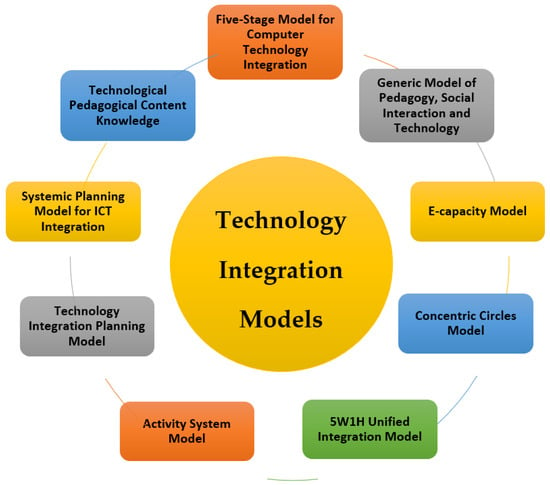
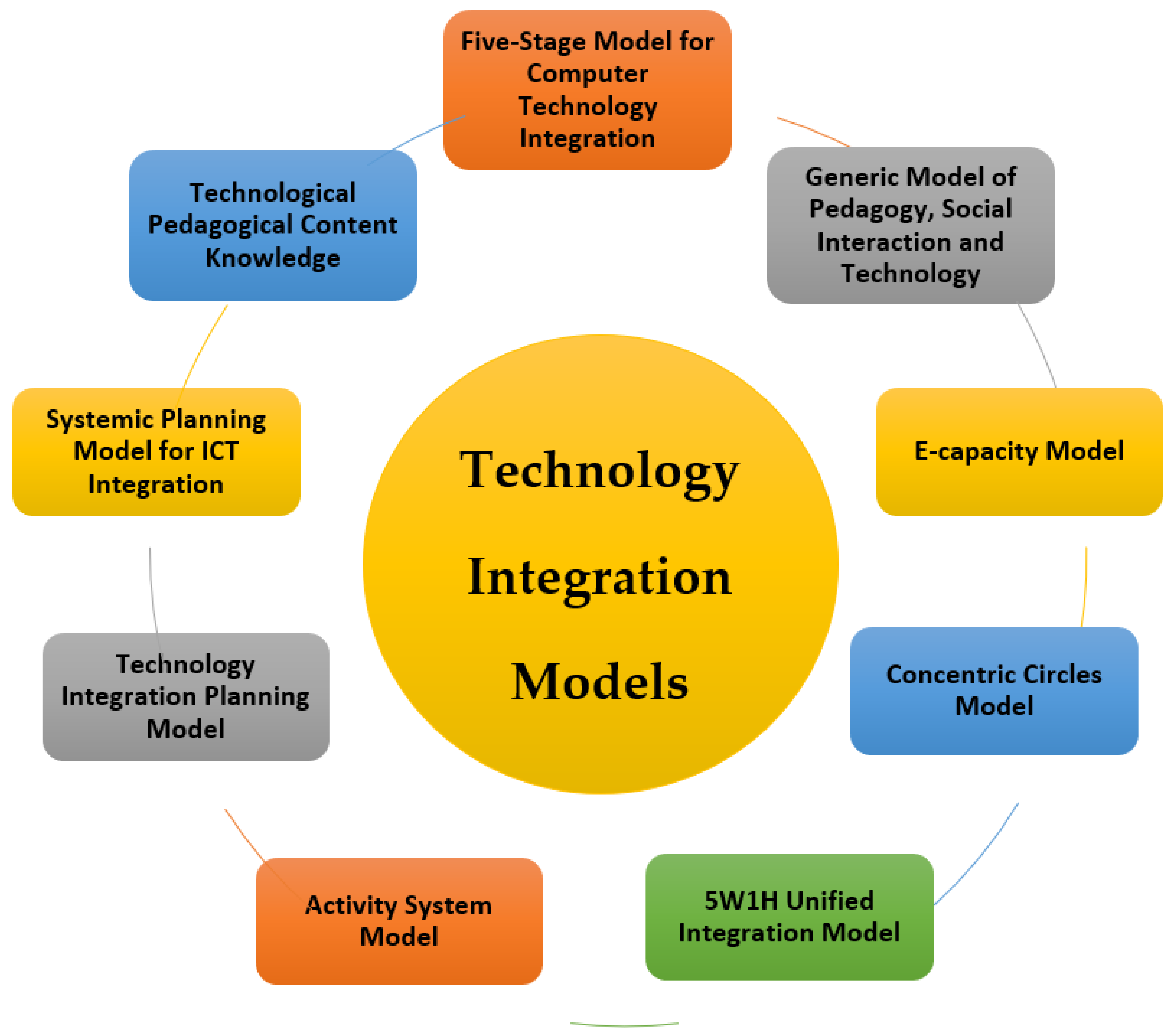
When examining the integration models in Figure 1, it can be seen that many of them deal with integration from different perspectives, and that indicators of integration for each model show difference in terms of objectives and elements [21].
Figure 1.
Technology Integration Models.
In this section, the models and definitions in the literature regarding technology integration into learning–teaching processes are examined, and their similarities and differences are revealed.
On the other hand, in the 5W1H Unified Integration Model, the focus is on student learning, and it is based on analyzing and planning the process to increase learning of students the numbers in the model are as follows;
- What: Required ICT resources and applications;
- Why: Displaying the goal of the integration process and determining the reasons for using ICT;
- How: How will appropriate teaching and learning strategies be used?
- Where: Preparing suitable environment;
- When: Planning of the application; and
- Who: Properties of target audience [22].
In the Generic Model of Pedagogy, Social Interaction and Technology, the emphasis is not on students and teachers, but on the tool in the process and what the tool provides in various contexts. The crux of the point in this model is how to use the tools to complete the task in an effective and useful way, satisfying the user. The model is theoretically based on constructivist theory, interaction design, and utility dimensions [23]. In this model, pedagogy and social interaction are seen as the basic building blocks in the integration process, while technology is accepted as a component that supports these building blocks. Vanderlinde and Braak examined technology integration from the perspective of the school, and examined the factors affecting ICT integration and the application of ICT in curriculum within the framework of the e-capacity model they developed [24].
The E-capacity Model addresses the integration process from a broader perspective, and emphasizes schools as institutions where education is essentially realized. It assumes that as students, teachers and tools are sub-units of school system, and they can be supported only if the whole is developed. In this model, contrary to many studies, teachers’ use of ICT is not seen as a dependent variable; on the contrary, it is taken as a process or an independent variable that leads to other results.
Similarly, the Concentric Ring Model assumes that the characteristics of schools and teachers as educational institutions in general will be effective in integration. This model is important as it addresses integration both at the individual and corporate level by the interaction of factors. It also clarifies the complex structure of factors affecting integration process using internal and external factors by examining the structural and cultural features of teachers as well as schools separately. The purpose of using technology, which is the dependent variable in the model and is placed in the center, is examined in three dimensions, namely gaining basic technology skills, using technology as an information tool, and using technology as a learning tool.
On the other hand, Systematic Planning Models were developed not in order to describe the factors affecting the integration process, and individuals or roles in the process, but to define the process, level or stage of the integration. These models are more useful in terms of determining the level and points that can be improved by revealing the existing integration level and showing the possible steps to achieve the highest level of integration. Wang and Woo stated that ICT integration will take place at three levels according to the content discussed [25]:
- Curriculum (Macro level): Integrating ICT into all content and learning experiences in an entire course process;
- Topic (Meso level): The use of ICT to support student learning in specific topics; and
- Course (Micro level): Using ICT to explain the subject better in one or more courses.
In the Activity System Model, Demiraslan and Usluel discussed the integration of ICT into education and training processes within the framework of the Activity Theory and put forward an activity system model related to integration within the framework of Activity Theory elements [26]:
- Tools: ICT and non-ICT tools, methods used;
- Subject: Teacher (teaching experience, teaching approach);
- Rules: Evaluation criteria;
- Community: Students, teachers, school management, ICT coordinator;
- Object: Purposes of using ICT in the learning-teaching process;
- Division of Labor: The roles and responsibilities of teachers and students; and
- Output: Reflections of the use of ICT in the learning and teaching process on student learning and teaching.
The integration model created within the framework of activity theory is very important in that it includes all the individuals involved in the integration process and clearly defines the tools, rules, duties of individuals, objectives and the output of the process, and emphasizes the interaction between these elements. It can be stated that the integration process, which we can define as a rather complicated process, is effective in terms of revealing the relationships in the activity system by providing the opportunity to clarify the multi-dimensional dynamic structure and to examine these dynamics together [27].
The Five-Stage Model for Computer Technology Integration was developed by Toledo for teacher training programs to help educational institutions such as schools, universities or departments and their sub-units have a better understanding of their place in integration and guide them in moving forward from their current status [28]. There are five stages of technology integration in the model:
- Pre-integration: Lack of university pioneering;
- Transition: Changing institutional leadership at the university, school or department level;
- Development: Educational institutions such as schools, universities or departments begin to complete tasks that will integrate technology into their curriculum;
- Dissemination: Developments are made to meet the hardware, software and systematic training needed for the school to be successful in technology integration; and
- Integration within the scope of the entire system: Integration of required competency standards for students, the integration of computer technologies in every teacher education course, the interest of teachers and students in increasing integration [28].
In the Technology Integration Planning Model, developed by Mishra and Koehler, the key point is teachers, and teacher roles and teacher competencies for integration are emphasized [29].
When the definitions, indicators and models of technology integration in learning-teaching processes are examined, it is seen that integration is generally structured on one or more different aspects such as the student, instructor, institution, technology, infra-structure, support systems, and sustainability.
As for the modeling studies conducted to explain the process and integration elements, it was noted that some of the models dealt with technology integration in the con-text of the school, while others focused on the context of the instructor, the socio-cultural context, and the interaction of various elements in the process. On the other hand, it can be stated that the proposed models of integration differ in terms of examining various environmental and external factors such as equipment, management, infrastructure, technology, government, culture as well as individual factors such as attitude, belief, intention, skill, and perception.
Finally, the Technological Pedagogical Content Knowledge (TPACK) describes effective technology integration elements by planning the integration process step by step and revealing the important elements at each stage. The TPACK model is proposed in this study due to its mentioned characteristics.
Technological Pedagogical Content Knowledge Model
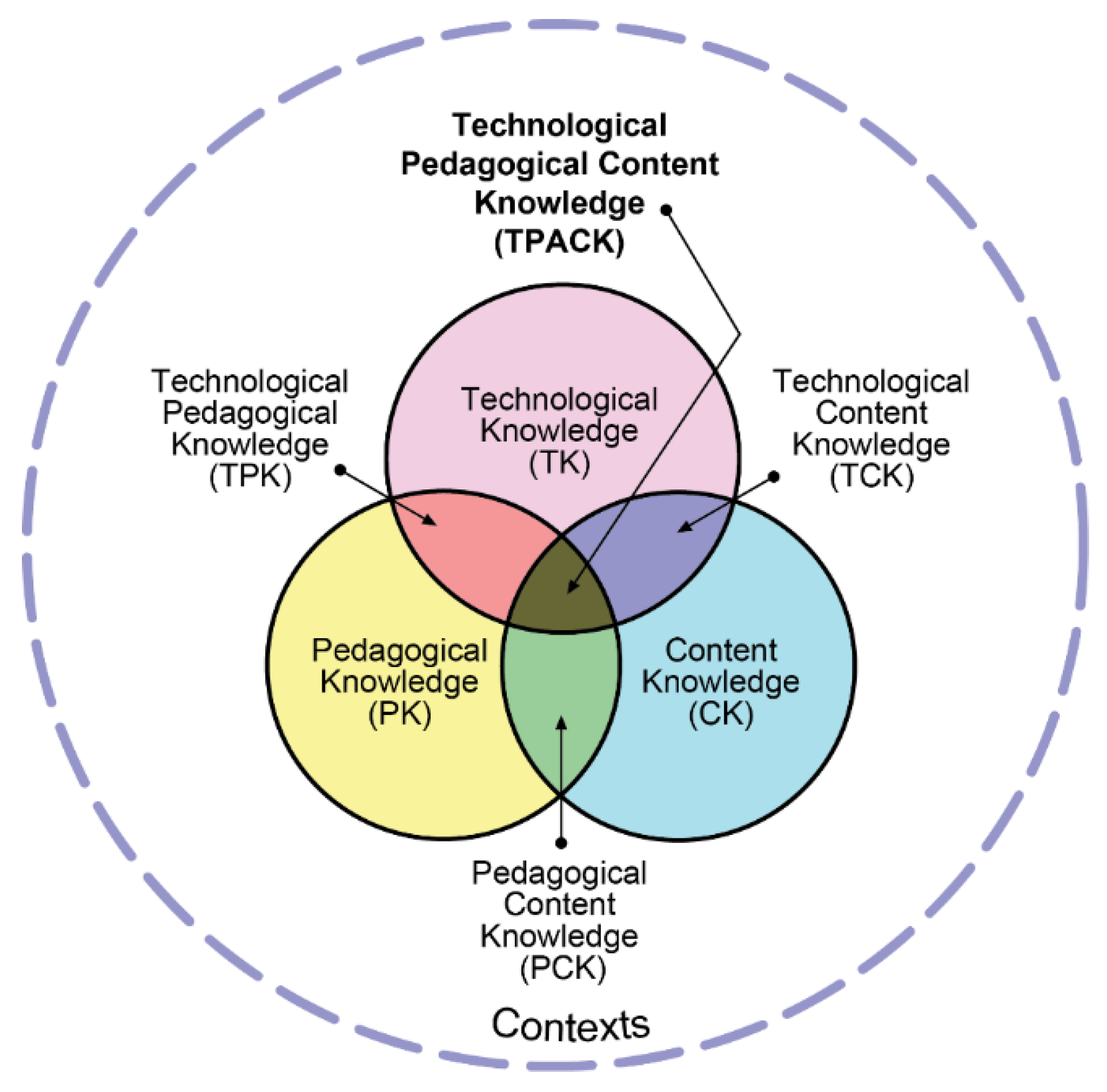
In this model developed by Mishra and Koehler [30], the basic knowledge structure needed by educators in the fields of teaching with technology and teaching of technology in their own study areas and at the level that they will deliver teaching is defined.
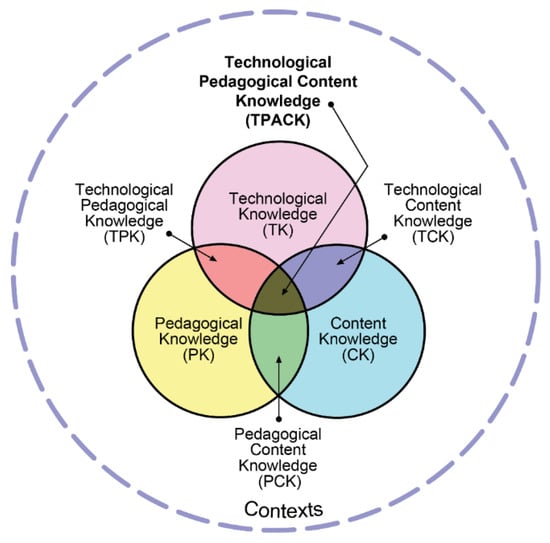
The model in Figure 2 shows how the teacher’s understanding of technology, pedagogy and content interact with each other in providing effective discipline-based technology-supported teaching. The fact that an educator has these three skills at a sufficient level paves the way to create the most efficient course environment. If the educator does not have any of these skills, we cannot be located in the dark green area on the chart, which reduces efficiency and quality in both physical classes and distance education [30].
Figure 2.
Technological Pedagogical Content Knowledge Model (TPACK).
Teaching technology integration requires teacher educators to grapple with constantly changing, politically impacted professional requirements, continuously evolving educational technology resources, and varying needs across content disciplines and contexts [31]. Teacher educators cannot foresee how their students may be expected to use educational technologies in the future or how technologies will change during their careers. Therefore, training student teachers to practice technology integration in meaningful, effective, and sustainable ways is a daunting challenge [32].
As pointed out by Cviko et al., [33], the participation of teachers in the design of ICT-based practices in schools would lead to the development of a sense of ownership and, eventually, ICT-based practices that are sustainable.
The educator’s knowledge about technology, pedagogy and content should be provided by themselves or through in-service trainings provided by their managers in accordance with the TPACK model [34]. Later, educators will need only a few technological tools that can be integrated with each other and are extremely simple to use to design an interactive lesson. Learning and practicing more than they are comfortable with exhausts educators/students and distances education from the target, and can cause several security gaps especially in terms of online assessment. What is more important than knowing the names of web tools and applications is the stages where they should be used in the course. At this point, we come across Gagne’s nine-stage teaching model [35].
2.3. Gagne’s Teaching Activities Model and Google Workspace Tools
Teaching activities consisting of nine stages that Gagne developed in 1974 and reviewed in 1985 are given in Table 2 [36,37].
Table 2.
Teaching Activities Model of Gagne and Google Workspace Tools.
Teaching activities are given in the default order. Therefore, it is not compulsory to perform the order exactly. Sometimes one or more events can trade places. For example, after drawing attention, students may be reminded to learn the prerequisite first. After these procedures, the student can be informed about the target and motivation can be provided. Sometimes, even some steps can be skipped. For example, if students are aware of the target, this step can be skipped without giving it to the students.
Activities and appropriate Google Workspace tools are defined across this model. These tools can be increased and used in different stages. Google Workspace plans provide a private email and include several collaboration tools such as Gmail, Calendar, Meet, Chat, Drive, Docs, Sheets, Slides, Forms, and Sites.
The introduction part of the course can be planned in 5–10 min, development part in 15–20 min, and conclusion and evaluation part in 10–15 min. One of the unsuited points here is that the instructors deliver the lecture through the presentation for 40 min after they welcome the students. It is recommended that the presentation section should be held for a maximum of 15 min and that the tools specified should be employed thereafter. In addition to the Google Workspace tools, there are Google Chrome plugins and many applications in the Google Workspace Marketplace, and it is stated with which Google tool works with the integration [38].
Thus, the use of hundreds of Google tools and add-ons, which are integrated with each other, tools that can be accessed from a single account, where the needs of the day can be met and continuously updated, enable a sustainable technology integration.
Google For Apps Education enables students to gain skills when technology is configured to support educational programs and courses and supports them. While Google applications continue to transform classroom environments with several educational features, it has provided integration of Classroom and Meet according to the different distance education alternatives used by schools due to pandemic events [39].
3. Conclusions and Recommendations
The teaching and learning environment is one of many that have been positively influenced by technological developments [40]. In this study, which aims to examine the current results of the present studies on integration of technology into the teaching–learning processes, the problems encountered among the results of the studies performed in the last 4 years are generally examined. It was observed that the in-service training/training programs provided in the study did not reach their exact goals, the trainers were inadequate in integrating the technology into their course, and that they lacked knowledge about technology. It can be said that the variety of web 2.0 tools/systems used in the studies, in-service training deficiencies and hardware-infrastructure deficiencies affected these results.
In the study, it is thought that teachers and prospective teachers need simple, simple-to-use, free and accessible tools that can be integrated with each other instead of independent web tools/systems in order to integrate technology into their lessons [41]. Thus, it is envisaged that the integration process will become easier, more effective and simpler in terms of both management and success. These tools are also mobile-friendly and suitable for a sustainable education [42].
In this context, it is important to organize Google Workspace Tools within the framework of the TPACK Integration Model and Gagne’s Teaching Activities Model, which are integrated with each other, can be accessed with a simple, single account instead of commissioning a wide variety of web 2.0 tools/systems [43,44,45].
Researchers are advised to work on technology integration using Google Workspace tools, and more studies on teaching programs that integrate technology are encouraged.
From this point of view, it is believed that the research will create awareness in terms of tools that can be used for sustainable technology integration, will provide grounds for new research on the subject, and contribute to the relevant literature.
Author Contributions
Conceptualization, E.K. and U.A.; methodology, E.K.; validation, E.K., U.A. and H.U.; formal analysis, E.K.; investigation, E.K.; resources, H.U.; data curation, U.A.; writing—original draft preparation, E.K.; writing—review and editing, U.A.; visualization, E.K.; supervision, U.A. and H.U. All authors have read and agreed to the published version of the manuscript.
Funding
This research received no external funding.
Institutional Review Board Statement
Not applicable.
Informed Consent Statement
Not applicable.
Data Availability Statement
Not applicable.
Conflicts of Interest
The authors declare no conflict of interest.
References
- Išoraitė, M.; Gulevičiūtė, G. A Study of Online Entrepreneurship Education under Conditions of a Pandemic. Entrep. Sustain. Issues 2021, 8, 179. [Google Scholar] [CrossRef] [Scilit]
- Moorhouse, B.L. Adaptations to a Face-to-Face Initial Teacher Education Course Forced Online Due To the COVID-19 Pandemic. J. Educ. Teach. 2020, 46, 609–611. [Google Scholar] [CrossRef] [Scilit]
- Sutiah, S.; Slamet, S.; Shafqat, A.; Supriyono, S. Implementation of Distance Learning during the Covid-19 Pandemic in Faculty of Education and Teacher Training. Cypriot J. Educ. Sci. 2020, 15, 1204–1214. [Google Scholar] [CrossRef] [Scilit]
- Dulamă, M.E.; Ilovan, O.R. Online University Education during the COVID-19 Pandemic. How Efficient Are the Adapted Instruction Models? J. Educ. Sci. Psychol. 2020, 10, 92–111. [Google Scholar]
- Avci, Y.Z.; O’Dwyer, L.M.; Lawson, J. Designing Effective Professional Development for Technology Integration in Schools. J. Comput. Assist. Learn. 2020, 36, 160–177. [Google Scholar] [CrossRef] [Scilit]
- Askar, P.; Usluel, Y.K. A Longitudinal Study Related to the Rate of Adoption of Computers: Comparison of Three Schools. Hacet. Univ. J. Educ. 2003, 24, 15–25. [Google Scholar]
- Askar, P.; Usluel, Y.K.; Mumcu, F.K. Logistic Regression Modeling for Predicting Task-Related ICT Use in Teaching. Educ. Technol. Soc. 2006, 9, 141–151. [Google Scholar]
- Teo, T. Modelling Technology Acceptance in Education: A Study of Pre-Service Teachers. Comput. Educ. 2009, 52, 302–312. [Google Scholar] [CrossRef] [Scilit]
- Ma, W.W.; Andersson, R.; Streith, K.O. Examining User Acceptance of Computer Technology: An Empirical Study of Student Teachers. J. Comput. Assist. Learn. 2005, 21, 387–395. [Google Scholar] [CrossRef] [Scilit]
- Shiue, Y.M. Investigating the Sources of Teachers’ Instructional Technology Use through the Decomposed Theory of Planned Behavior. J. Educ. Comput. Res. 2007, 36, 425–453. [Google Scholar] [CrossRef] [Scilit]
- Velazquez, C.M. Testing Predictive Models of Technology Integration in Mexico and the United States. Comput. Sch. 2008, 24, 153–173. [Google Scholar] [CrossRef] [Scilit]
- Roblyer, M.D. Integrating Educational Technology into Teaching, 2nd ed.; Prentice Hall: Upper Saddle River, NJ, USA, 2006. [Google Scholar]
- Wang, Q.; Woo, H.L. Systematic Planning for ICT Integration in Topic Learning. Educ. Technol. Soc. 2007, 10, 148–156. [Google Scholar]
- Owston, R.D. Contextual Factors that Sustain Innovative Pedagogical Practice Using Technology: An International Study. J. Educ. Chang. 2007, 8, 61–77. [Google Scholar] [CrossRef] [Scilit]
- Todorova, A.; Osburg, T. Professional Development Program for Technology Integration: Facilitators and Barriers to Sustainable Implementation. Lit. Inf. Comput. Educ. J. 2010, 1, 59–66. [Google Scholar] [CrossRef] [Scilit]
- Daniels, J.; Jacobsen, M.; Varnhagen, S.; Friesen, S. Barriers to Systemic, Effective, and Sustainable Technology Use in High School Classrooms. Can. J. Learn. Technol. 2013, 39, 1–14. [Google Scholar]
- Başal, A.; Eryılmaz, A. Engagement and Affection of Pre-Service Teachers in Online Learning in the Context of COVID 19: Engagement-Based Instruction with Web 2.0 Technologies vs. Direct Transmission Instruction. J. Educ. Teach. 2020, 1–47, 131–133. [Google Scholar] [CrossRef] [Scilit]
- Herdman, E.A. Guidelines for Conducting a Literature Review and Presenting Conference Papers. J. Educ. Res. Nurs. 2006, 3, 2–4. [Google Scholar]
- Careaga-Butter, M.; Quintana, M.G.B.; Fuentes-Henríquez, C. Critical and Prospective Analysis of Online Education in Pandemic and Post-Pandemic Contexts: Digital Tools and Resources to Support Teaching in Synchronous and Asynchronous Learning Modalities. Aloma Rev. Psicol. Ciències Educ. Esport Blanquerna 2020, 38, 23–32. [Google Scholar]
- Sumba Nacipucha, N.; Cueva Estrada, J.M.; Conde, E.L.; Mármol Castillo, M. Higher Education in Ecuador in Times of COVID 19 within the Framework of the TPACK Model. Rev. San Gregor. 2020, 71–186. [Google Scholar] [CrossRef]
- Shaw, H.; Ellis, D.A.; Ziegler, F.V. The Technology Integration Model (TIM). Predicting the Continued Use of Technology. Comput. Hum. Behav. 2018, 83, 204–214. [Google Scholar] [CrossRef] [Scilit]
- Kuşkaya, M.F.; Koçak, U.Y. Designing a Networked Learning Process about ICT. Integration for Preservice Teacher. J. Fac. Educ. Sci. 2015, 48, 19–47. [Google Scholar]
- Wright, B.; Akgunduz, D. The Relationship between Technological Pedagogical Content Knowledge (TPACK) Self-Efficacy Belief Levels and the Usage of Web 2.0 Applications of Pre-Service Science Teachers. World J. Educ. Technol. Curr. Issues 2018, 10, 52–69. [Google Scholar] [CrossRef] [Scilit]
- Vanderlinde, R.; van Braak, J. The e-Capacity of Primary Schools: Development of a Conceptual Model and Scale Construction from a School Improvement Perspective. Comput. Educ. 2010, 55, 541–553. [Google Scholar] [CrossRef] [Scilit]
- Wang, Q. A Generic Model for Guiding the Integration of ICT into Teaching and Learning. Innov. Educ. Teach. Int. 2008, 45, 411–419. [Google Scholar] [CrossRef] [Scilit]
- Demiraslan, Y.; Usluel, Y.K. Analyzing the Integration of Information and Communication Technologies into Teaching-Learning Process According to Activity Theory. J. Educ. Res. 2006, 23, 38–49. [Google Scholar]
- Tondeur, J.; Petko, D.; Christensen, R.; Drossel, K.; Starkey, L.; Knezek, G.; Schmidt-Crawford, D.A. Quality Criteria for Conceptual Technology Integration Models in Education: Bridging Research and Practice. Educ. Technol. Res. Dev. 2021, 1–22. [Google Scholar] [CrossRef] [Scilit]
- Toledo, C. A Five-Stage Model of Computer Technology Integration into Teacher Education Curriculum. Contemp. Issues Technol. Teach. Educ. 2005, 5, 177–191. [Google Scholar]
- Koehler, M.J.; Mishra, P. Teachers Learning Technology by Design. J. Comput. Teach. Educ. 2005, 21, 94–102. [Google Scholar]
- Mishra, P.; Koehler, M.J. Technological Pedagogical Content Knowledge: A New Framework for Teacher Knowledge. Teach. Coll. Rec. 2006, 108, 1017–1054. [Google Scholar] [CrossRef] [Scilit]
- Guo, P. Integrated Practice Effect Analysis of Teaching Design Pattern on TPACK. Comput. Appl. Eng. Educ. 2020, 29, 385–393. [Google Scholar] [CrossRef] [Scilit]
- Kimmons, R.; Graham, C.R.; West, R.E. The PICRAT Model for Technology Integration in Teacher Preparation. Contemp. Issues Technol. Teach. Educ. 2020, 20, 176–198. [Google Scholar]
- Cviko, A.; McKenney, S.; Voogt, J. The Teacher as Re–Designer of Technology Integrated Activities for an Early Literacy Curriculum. J. Educ. Comput. Res. 2013, 48, 447–468. [Google Scholar] [CrossRef] [Scilit]
- Koehler, M.J.; Mishra, P.; Hershey, K.; Peruski, L. With a Little Help from Your Students: A New Model for Faculty Development and Online Course Design. J. Technol. Teach. Educ. 2004, 12, 25–55. [Google Scholar]
- Ilie, M.D. An Adaption of Gagne’s Instructional Model to Increase the Teaching Effectiveness in The Classroom: The Impact in Romanian Universities. Educ. Technol. Res. Dev. 2014, 62, 767–794. [Google Scholar] [CrossRef] [Scilit]
- Gagne, R.M. The Conditions of Learning and Theory of Instruction, 4th ed.; Wadsworth Pub Co: New York, NY, USA, 1985. [Google Scholar]
- Senemoglu, N. Gelişim Öğrenme ve Öğretim Kuramdan Uygulamaya; Spot Matbaacılık: Ankara, Turkey, 1997. [Google Scholar]
- Mollov, M.; Stoitsov, G. G Suite for Education–The Challenge that Has Become a Reality in a Bulgarian School. Math. Inform. 2020, 63, 601–607. [Google Scholar]
- Romero, E.; Artal-Sevil, J.; Mir, J.; Artacho, J. Improving Learning through G Suite for Education. Use of ‘Google Universe’ Apps in the Classroom. In Proceedings of the 12th International Technology, Education and Development Conference, Valencia, Spain, 5–7 March 2018; pp. 7719–7728. [Google Scholar]
- Ifinedo, E.; Kankaanranta, M. Understanding the Influence of Context in Technology Integration from Teacher Educators’ Perspective. Technology. Pedagog. Educ. 2021, 1. [Google Scholar] [CrossRef] [Scilit]
- Singh, K.; Srivastav, S.; Bhardwaj, A.; Dixit, A.; Misra, S. Medical Education during the COVID-19 Pandemic: A Single Institution Experience. Indian Pediatrics 2020, 57, 678–679. [Google Scholar] [CrossRef] [Scilit]
- Viberg, O.; Andersson, A.; Wiklund, M. Designing for Sustainable Mobile Learning–Re-Evaluating the Concepts “Formal” and “Informal”. Interact. Learn. Environ. 2021, 29, 130–141. [Google Scholar] [CrossRef] [Scilit]
- Sriphong, L. Innovative problem-based learning integrated with G suite for education. In Proceedings of the 10th International Conference on E-Education, E-Business, E-Management and E-Learning, Tokyo, Japan, 10 January 2019; pp. 163–167. [Google Scholar]
- Atabek, O. Experienced Educators’ Suggestions for Solutions to the Challenges to Technology Integration. Educ. Inf. Technol. 2020, 1, 5669–5685. [Google Scholar] [CrossRef] [Scilit]
- Francom, G.M. Barriers to Technology Integration: A Time-Series Survey Study. J. Res. Technol. Educ. 2020, 52, 1–16. [Google Scholar] [CrossRef] [Scilit]



Publisher’s Note: MDPI stays neutral with regard to jurisdictional claims in published maps and institutional affiliations. |
© 2021 by the authors. Licensee MDPI, Basel, Switzerland. This article is an open access article distributed under the terms and conditions of the Creative Commons Attribution (CC BY) license (https://creativecommons.org/licenses/by/4.0/).