Abstract
This study analyzes the factors influencing the bilateral trade between Mongolia and China using the trade gravity model, principle component analysis (PCA), unit root test, bound test, and the estimation of coefficients in a panel data set from 1996–2019. A total of 9 variables including exports, gross domestic product (GDP), population, geographical distance, cultural distance, trade agreements, tariffs, trade facilitation index of China and Mongolia-China trade cost were considered for all models. The results indicate that the cultural distance between Mongolia and China and the population of Mongolia are stationary at level. The coefficient of GDP (income) of both countries is positive and statistically significant with exports. Moreover, trade facilitation has significant positive impact on exports of both countries. These findings reveal that efforts in improving excellence of border administration, arrangements would make a positive contribution in trade of goods. Another major influencing factor is tariffs, which was negatively significant for exports, suggesting that if China imposes 1% tariffs on Mongolian exports, it will result in 24% decrease of Mongolian exports. The results of regression coefficients show that there is long run association between variables. This indicates that China adopted a more restrictive trade policy on the flow of goods from Mongolia with an increase population of China. The study suggests a free trade agreement and relaxation of export/import procedures for Mongolia in order to increase the GDP of Mongolia.
1. Introduction
Mongolia is one of the first nations to have diplomatic relations with China. At present, ties between Mongolia and China have retained a good rate of growth and have achieved the highest stage in history [1,2]. Mongolia borders with China and Russia, though at the same time, playing a strategic role as an important center for balancing the influence of the different countries in maintaining the overall stability of Northeast Asia [1]. Mongolia has ample natural resources, together with its strategic location in Northeast Asia, and the study of Mongolia-China trade has very significant theoretical and functional significance [3]. Mongolia-China trade cooperation is of great strategic importance for China to establish new energy markets and to stabilize the economic growth of neighboring countries. While, there are great opportunities for commerce [1], cultural exchange [4], and economic improvements between these two countries. However, factors impacting the relationship between China and Mongolia have not been analyzed before. These aspects need to be analyzed and some key proposals for uninterrupted trade under the flagship of the Belt and Road initiative need to be made.
Since China introduced the Belt and Road initiative, Mongolia has gained promising intention. A major agreement was reached between two sides, Silk Road Economic Belt [5] and the Steppe Silk Road, creating new economic and trade collaboration prospects between two countries, which are becoming strong, and representing a gradual transition from early frontier trade to sub-regional economic cooperation [1]. For Mongolia and China, further deepening and strengthening of regional economic cooperation has become an important strategic option. Both China and Mongolia face serious tests and threats in this current scenario [6]. Problems have become more prevalent, such as extreme and high unemployment rates. It can be said that Mongolia and China both face huge challenges and hurdles to their economic development [7]. Consequently, it can only be achieved by strengthening the mutual trust and improving the regional economic cooperation that Mongolia and China can respond to the potential impact of internal and external pressures, improve their overall power, eliminate trade barriers, foster smooth trade, and accelerate the stable and balanced development of the economies of the two countries.
The trade gravity model is commonly used to test and predict the trading patterns [8,9]. In a number of specifications and situations, this model has been used, and argued that the gravity model in the international exchange flow economy is the leading scientific model [10,11]. The simple trade gravity equation describes that the movement of trade between countries and distance between them significantly depend on the scale of the economies of the two countries. In addition, the gravity model is the combination of numerous research efforts and it is significant for both historically and analytically, while it is a valuable approach in order to analyze international trade. In order to analyze the bilateral trade for two or more two countries, numerous studies have used the gravity model alone or with combination of other models, such as Bayesian model averaging [12,13], Heckscher–OhlinVanek model [14], extreme bound analysis [15,16], and robustness tests [17], etc. In addition, the gravity model has been applied to investigate the effects of bilateral trade for numerous countries [18,19] using various variables including population, culture [17], GDP, geographical distance, currencies [20,21], population [12], transportation cost and trading blocs [22], institutional framework [23], fixed exchange rate [24], and adjacent borders [25]. This model has a broad scope regarding the literature of international economics [26]. Meanwhile, the gravity model is widely used and known as the “workhorse” of empirical studies for evaluation of the bilateral country-pair fixed effects in order to manage the heterogeneity. The gravity model has an ability to overestimate the influence of integration on the trade volume [27]. Furthermore, macroeconomic questions related to net money flows and, for instance, the implications of currency unions, have been resolved [20,28]. Disaggregated trading movements have also been used, such as trade in agricultural products [29], iron trade [30], and trade in forest goods [31]. Furthermore, in the context of cultural influences shaping trade and political factors impacting trade, the gravity model has been discussed [17,32]. The main variables studies in the gravity model of trade are cultural values, GDP, population, borders, exports and imports, trade cost, tariffs, and trade agreements [8,11,29,32].
This paper examines and analyzes the past and status quo and the main features of economic and trade cooperation between Mongolia and China, based on applicable foreign exchange theories. In addition, various factors affecting the bilateral trade between Mongolia and China are analyzed on the basis of the enhanced trade gravity model and its multi-regression analysis model. In line with the latest rules of the World Trade Organization (WTO), Trade Facilitation Agreement, and the characteristics of Mongolia-China trade growth under Belt and Road initiative, a trade facilitation indicator framework was developed and the level of trade facilitation between China and Mongolia was calculated. Finally, the empiric review and prospective analyses of Mongolia-China trade flows rely on quantitative interpretation and empirical science and are focused on factors influencing the capacity of trade between China and Mongolia, counter-measures and recommendations to promote the growth of trade between China and Mongolia. In addition, principle component analysis (PCA) was applied to generate the index of the Mongolia China trade cost index. To strengthen these tests, unit root and bound tests were also conducted in order to evaluate the factors in details. The study provides meaningful evidence and proposes strong influential recommendations for policy makers in order to strengthen the trade of both countries (China and Mongolia).
2. Literature Review
Mongolia became one of the first nations to commit China’s independence. Since ancient times, two countries have never halted cultural, economic, and commercial collaboration [33]. As the pattern of globalization continues to intensify, the political relationship between China and Mongolia and economic trade collaboration between the two countries have gradually played a significant role in the stability and economic development of Mongolia’s periphery [34]. With the proposal of the Belt and Road initiative [4] and the continuous deepening of regional economic integration, the degree of financial trade cooperation between the two countries has been continuously enhanced, in particular, the creation of the China Mongolia Russian Economic Corridor [1], which has led to the further growth of China Mongolia’s economic and trade cooperation [11]. There are currently 152 contracts, including the Medium Term Plans for Economic and Trade Collaboration in Mongolia and China for 2014 [7]. The prime objective is to deepen the concept of equality and mutual gain, based on good neighbourly friendship and mutual confidence between China and Mongolia, and to deepen the bilateral and multilateral trade on the basis of favourable conditions for cooperation [1,34]. The strategy will be implemented between 2014 and 2044 and the set goal of achieving USD 10 billion in trade between China and Mongolia by 2020 is projected to be reached [2]. In order to do this, Mongolia is attempting to diversify its economy, aiming to increase imports of agricultural products and exports of mineral products so that it will no longer depend on the needs of China’s related industries [35]. China Mongolia’s trade rate has been on the rise in the last 20 years. In 2019, the exchange value of China and Mongolia surpassed USD 8.85 billion, accounting for 64.3% of Mongolian international trade [2]. The prospects for the growth of trade between the two countries are very wide in today’s international climate.
China-Mongolia Economic and Trade Partnership
Mongolian international exchange has been an important part of its social and economic growth. China Mongolian cooperation without borders and political conflicts is not always healthy, but cooperation has so far been preserved [3,6]. After the establishment of diplomatic associations between China and Mongolia, there have been many twists and turns in cooperation between two nations [36].
Mongolian trade in China was just 1.414 billion USD in 2007, however, Mongolia has been committed to restructuring its mining industry and developing the business climate since 2010. The economy has recovered with the introduction of this reform, and trade between China and Mongolia has risen again [1]. With the fall in prices of mining goods on the world market between 2012 and 2013, Mongolian overall foreign exchange and China Mongolia trade also declined. Although, China and Mongolia vigorously encourage and organize the convergence of the Belt and Road and Steppe Silk Road projects, trade in China Mongolia has grasped a new level [4]. Mongolia traded with 159 countries and territories in 2018, with a total exchange value of USD 12.9 billion, an improvement of 22.3% over the previous year. Among them, total exports amounted to USD 7 billion and total imports amounted to USD 5.9 billion, an increase of 13.1% over the previous year. Exports increased from USD 267 million in 2000 to USD 6.51 billion in 2018, and imports augmented from USD 610 million to USD 1.96 billion, accounting for Mongolian foreign trade growth of 7% and 65.4% [2]. In terms of trade composition, China’s exports to Mongolia are primarily oil, garments, textiles, manufacturing and mining machinery, electrical appliances, building constituents, and consumer goods. Mongolian exports to China include more than 20 goods, such as leather, animal and plant medications, and timber, scrap metal, coal, and iron mineral [2]. As China’s economy continues to expand, tree demand, gas, and oil is also increasing, and demand for domestic resource supply can no longer be fulfilled. Mongolia, however, is gorgeous in minerals and raw materials, and business between China and Mongolia is very energetic. Mongolia will also offer China with mineral wealth. There is less variation between China and Mongolia in the export sector structure and the market [37]. This indicates that export trade competition between China and Mongolia is poor and that the commodity structure has unmatched complementary advantages.
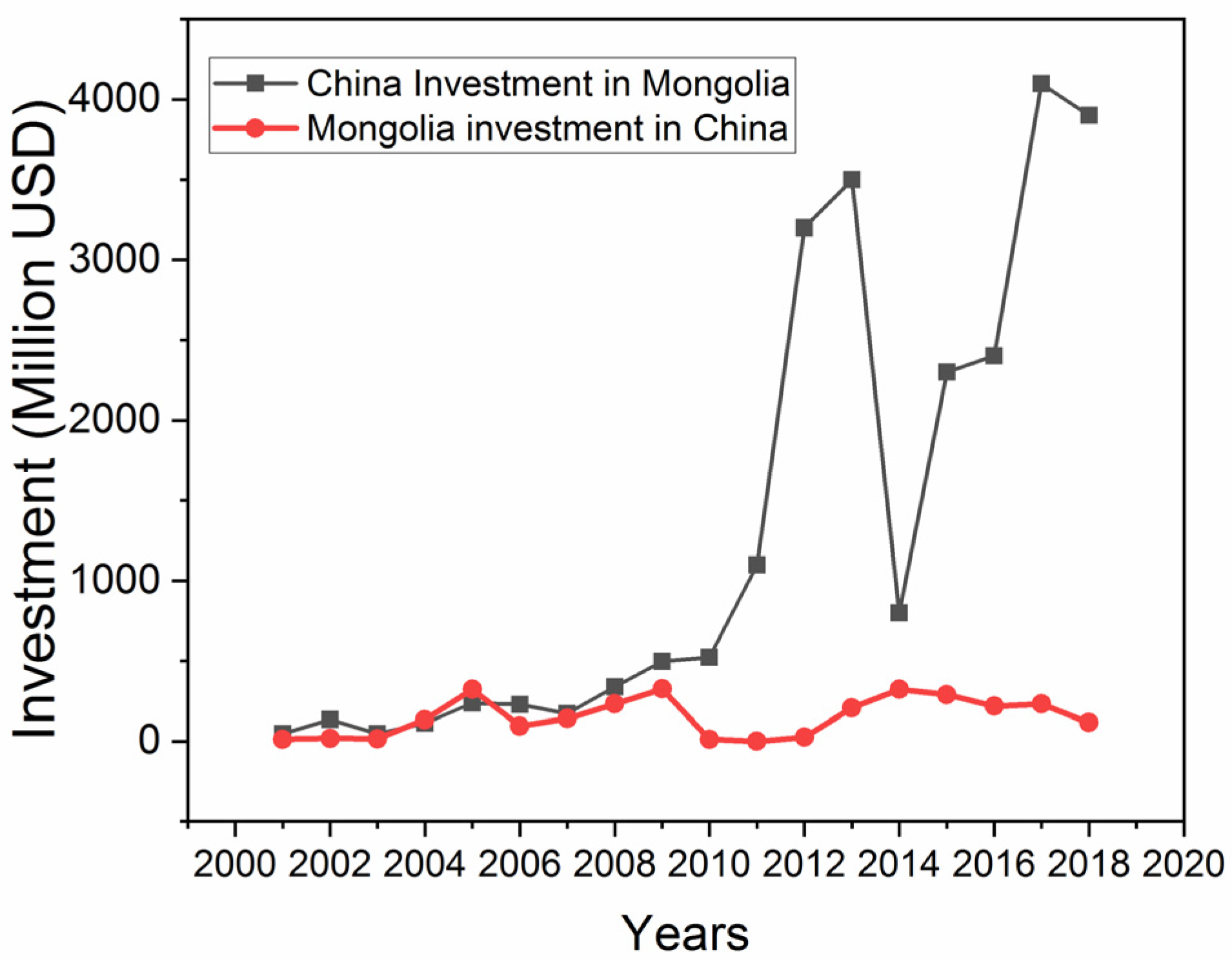
Figure 1 indicates that China’s investment in Mongolia declined substantially in 2014 due to the revision of the Mongolian Investment Law, i.e., the rise in the investment threshold and the decline in benefit area. On the contrary, Mongolia’s comparatively limited investment in China means that the difference between China’s economic level and Mongolia and Mongolia’s investment potential is weak. However, currently, the trade between China and Mongolia has been increasing continuously. Hence, there is need to evaluate the factors that are affecting the trade of both countries. To the best of the author’s knowledge, there does not exist any report that reveals the current situation and the factors that are affecting vigorously the trade between two countries. Thus, there is a need to conduct a brief investigation in this regard. Therefore, this study has hypothesized what are the most influential factors affecting the bilateral trade between China and Mongolia? The study selected 9 variables, such as exports, GDP, population, geographical distance, cultural distance, trade agreements, tariffs, trade facilitation index, and Mongolia-China trade cost. The main objective was to evaluate the relationship of these variables and their impact on bilateral trade between China and Mongolia. This hypothesis was assessed by the gravity model and various other tests, including unit root test, bound test, principle component analysis, and the regression coefficient for co-integration.
Figure 1.
Statistics of China’s direct investment in Mongolia (Unit: Million USD).
3. Empirical Model and Variables
3.1. The Model
The main technique applied in this research is the trade gravity model. The traditional gravity model is mostly applied to analyze the main factors influencing two-sided trade streams [11]. In this investigation, we extended the traditional gravity model by including three additional variables geographical and cultural distance, trade facilitation index, Mongolia-China trade cost index. Moreover, three dummy variables 1. trade integration dummy for trade agreement between china and Mongolia, 2. Association of Southeast Asian Nations (ASEAN), and 3. Global financial crisis (GFC) in the regression model to understand the intensity of trade flows of China-Mongolia. The hypothesis can be explained as these variables from Mongolia have similar values with China. For example, China-Mongolia have an adjacent border, thus have strong bilateral trade relations, which means variables have a positive trend on trade. The mathematical form of the gravity model is represented below:
where:
- = Exports of i country to j country in t period (Mongolia Exports to China);
- = GDP of i country in t period (Mongolia);
- = GDP of j country in t period (China);
- = country i Population in t period (Mongolia);
- = country j Population in t period (China);
- = Distance between China and Mongolia;
- = Cultural Distance;
- = number of regional agreements of China and Mongolia;
- = trade integration dummy for trade agreement between china and Mongolia;
- = Tariffs imposed on Mongolia exports by China;
- = Trade Facilitation Index of China;
- = Mongolia-China Trade Cost index;
- = error term.
3.2. Sample Size, Variables, and Data Source
The dataset was a balanced panel consisting of annual trade volume, GDP, exports, and imports, etc. The data were considered from the period of 1996–2019. The individual detail of variable and data source has been described in the following points.
- (1)
- Exports: Total exports from country i Mongolia to trading partner country j China is our dependent variable. The data on Mongolia exports to China were gained from the World Integrated Trade Solution database for the period 1996–2019.
- (2)
- Gross Domestic Product (GDP): The GDP of exporting country and trading partners represents both the productive and consumption capacity that determines largely the trade flows among them. The GDP of the country represents the market size of the country and it is expected that the coefficient of GDP of both exporting and trading partner country is positive because the trade flows between countries increases with increase GDP of countries. The data on GDP were obtained from the World Bank database.
- (3)
- Population: Population is helpful to calculate the size of the market of each country, which is affecting international trade. In our study, we used both exporting country and trading partner total population, the expected sign of coefficient is negative. The data on population were obtained from the World Bank database.
- (4)
- Geographical Distance: Usually, the higher the geographical distance among two countries, there will be more risk of trade and cost of transportation. The higher cost and risk is not more advantageous for realization of trade collaboration among the countries. Agreeing to the distance calculation method described in previous study [38], the formula of relative distance is:where is the geographical distance between i country and its transaction partner j state in year t. signifies the GDP of country j for the year t. is the gross domestic product (GDP) of country i in year t. is the absolute distance between capitals of two countries (i and j). The GDP data of country i and j were gained from the World Bank database for the period 1996–2019. The distance data between countries i and j were obtained from the Research and Expertise on World Economy (CEPII) database.
- (5)
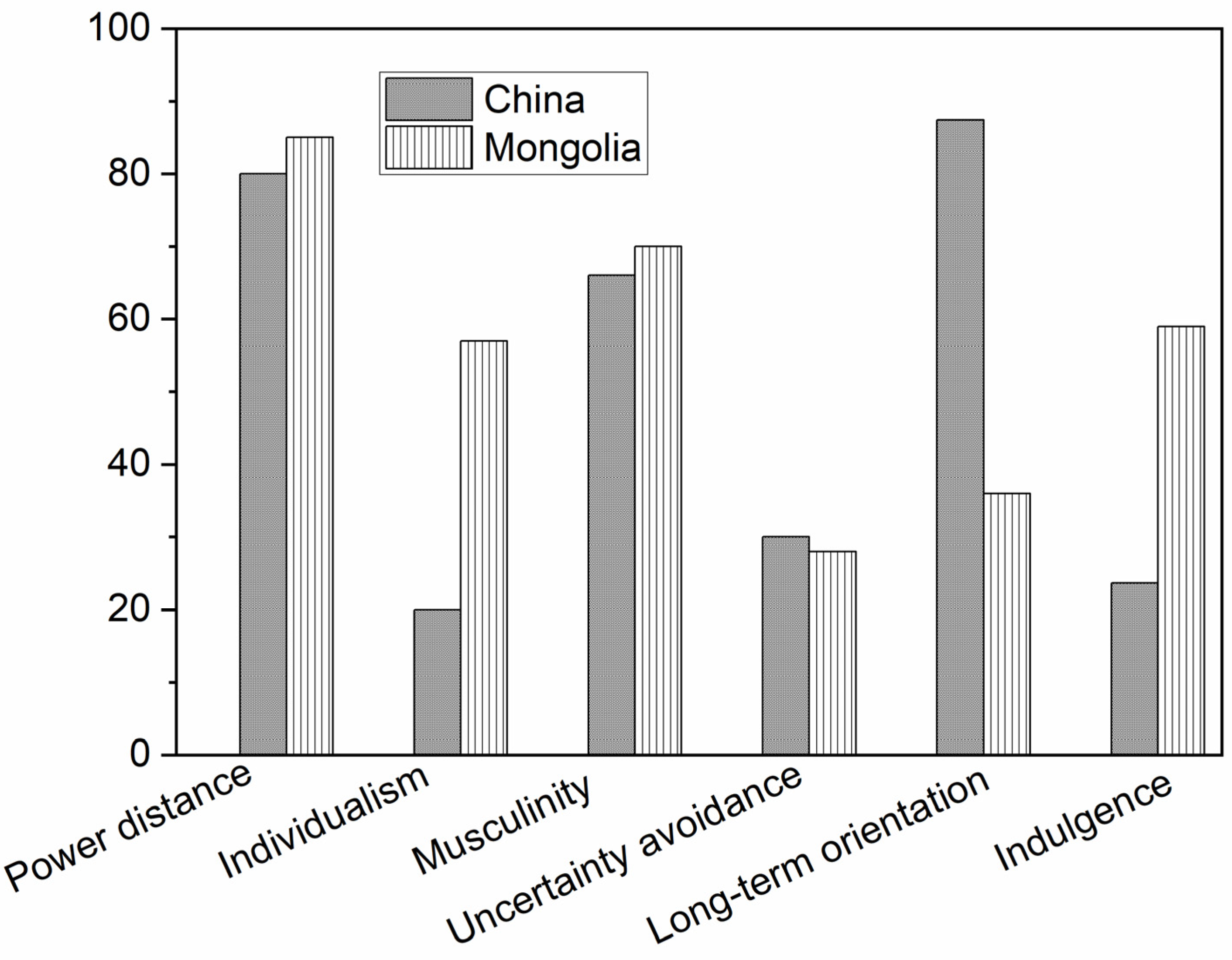
- Cultural Distance: It means alterations in ideology, such as morals or beliefs of two countries (i and j). Usually, there is inverse relationship between cultural differences and trade collaboration between two countries. The smaller the difference between two countries, the sturdier is the sense of distinctiveness and trust. Thus, this can create the greater possibility of trade cooperation between the trading partner’s countries. However, in order to calculate the cultural distance between Mongolia and China, we adopted the cultural data delivered by Hofstede. Following the methodology of Qi et al. [39], the formula of cultural distance is:where j is trading companion country i.e., China. denotes the cultural distance between Mongolia and its trading companion China. is the index of cultural dimension i of trading partner j and is the cultural dimension index i of Mongolia. is the cultural dimension variance index i, and n denotes the number of cultural dimensions. Generally, the dataset contain six dimensions, including power distance, masculinity, individualism, uncertainty avoidance, long term orientation, and indulgence (Figure 2). represents the number of years from the time when the Belt and Road country j recognized diplomatic relations with China in year t.
Figure 2. Cultural difference between China and Mongolia. Source: Author constructed based on Hofstede Database 2020 (https://www.hofstede-insights.com/country-comparison/ accessed on 25 November 2020). - (6)
- Trade agreements Dummy: This study used two regional trade integration dummies; (1) number of trade agreement of China and Mongolia during the sample time period with the rest of the world and trade agreements between China Mongolia. If the country i and j are members of the signed agreement = 1 otherwise 0.
- (7)
- Tariffs (Traiffj): The impact of tariffs on trade flows are essential and significant potential large barriers to trade. An increase in tariffs on exports and imports reduce overall trade due to raising the price of goods relative to domestic products. In this study, we used the tariffs on exports of Mongolia imposed by the trading partner China. The data on tariffs were obtained from the World Integrated Trade Solution (WITS) database for the period 1996–2019.
- (8)
- Trade Facilitation Index of China (TWTFIj): Trade facilitation is a concept used to eliminate barriers to flows of trade and reduce trade costs (OECD/WTO, 2015) [40]. The WTO (2015) define it as the explanation and coordination of the universal trade procedure. Trade facilitation is simply relating to the border procedures, including the customs and procedures of port as well as transport formalities. In this study, we used the trade facilitation as quality, clearness, and efficacy of border administration of the trading partner country, China. We used the indicators composed by the World Economic Forum (WEF) Enabling Trade Index (ETI). These indicators were evaluated by different data sources including the Doing Business and logistic performance of the World Bank and survey of WEF [41]. Definition of variables and data sources are presented in Table 1. The main indicators of the trade facilitation index are shown in Table 2. The missing data were collected from the different reports of IMF, WB, and WEF reports over the period 1996–2019.
Table 1. Definition of variables and data source.
Table 2. Descriptive statistics of main variables. - (9)
- Mongolia-China Trade Cost (MCTCIij): In this study, we generated the index of the Mongolia China trade cost index by using the principle component analysis (PCA) [42]. The data were collected from the World Bank Doing Business Database. The missing value are filled by mean interpolation method. This database provides comprehensive country data on relevant information related to trade cost, including time to exports, cost to exports, and the number of documents required to exports, time to imports, cost to imports, and documents required to exports. Using the PCA approach, composite Mongolia China trade cost index is created. The indicators of trade cost index and Mongolian China trade cost relationship were determined and shown in Table 2.
3.3. Data Description Empirical Analysis
Descriptive statistics of all variables were conducted using various tests, such as the augmented Dickey Fuller (ADF) unit root test following the methodology of Li et al. [43]. The description of variables and their details are presented in Table 1. In addition, the ARDL bound testing approach was used to scrutinize the long run cointegration among each of the variables used in the model [44]. This methodology has several benefits compared with other cointegration techniques.
4. Results of Empirical Analysis and Discussion
4.1. Principle Component Analysis (PCA)
PCA is a statistical approach mainly used to analyze a large dataset, which reproduces a large proportion of variance for a large amount of variables, resulting in a small numbers of new variables known as principle components [42]. Factor endowment, technological differences, and country size are important factors to determine the country trade or country with wider range of partners. The intensity of trade also depends on the other factors that are associated with trade cost or set of economics forces that reduce trade. The descriptive statistics of all variable used in this study are shown in Table 2. Table 3 illustrates the results of PCA of trade facilitation indicators. The principle component score is normalized to a scale of 0–10. The higher value indicates better trade facilitation and lower indicates worse trade facilitation. The numbers of PCA are selected based on the Kaiser criterion of Eigenvalues greater than one. The correlation coefficients show degree of association between constructed PCA index and indicators of PCA. According to the findings, Eigenvalues and proportion explained for trade facilitation index were 7.81755 and 0.9772, respectively. Meanwhile, the correlation coefficients for primary variables, especially the ease of arranging competitively priced shipment and custom clearance along with quality of port, were highly positively correlated. Quality of port infrastructure is of high importance since it ensures the scheduled and on time shipment within expected time [45]. It also ensures the capability of custom clearance with the track ability and tractability of consignments. The indicators of trade cost index and the Mongolia-China trade cost relationship are shown in Table 3. According to the existing literature, the influencing variables of trade costs can be considered from two aspects: geographic factors and institutional factors. Geographical factors include the distance between the two countries: there is a common border, whether it is an island country, etc. Institutional factors refer to the common language, colonial history, common currency, and tariffs level, whether to join the WTO, free trade agreements, and economic development level. However, trade cost is an important and highly informative factor trade policy purpose.
Table 3.
Principle component analysis of trade facilitation index and principle component analysis of Mongolia China trade cost.
4.2. Unit Root Test
Before the regression analysis, it is important to check the stationarity of data to avoid the superiors’ regression problem in the model [43]. The descriptive statistics of all variables used in this study are shown in Table 2. The augmented Dickey Fuller (ADF) unit root test was performed as shown in Table 4. The results show that the unit root test at level and first difference of each of main variables used in the model. The results indicate that some of the variables are integrated order I(1) and some are I(0). For instance, the population of the importing country, percentage of tariffs on import goods, and Mongolia-China trade cost are integrated of order I(0) while other variables are I(1). The results indicate that cultural distance between China and Mongolia , tariffs imposed by the China on Mongolian exports , and population of Mongolia are stationary at level while other variables are stationary at first difference. This implies that some of the variables are integrated order I(1) and some are I(0). Thus, in accordance with the pervious literature, the most appropriate methodology to apply on I(1) and I(0) variables are autoregressive distributed lag model (ARDL). This methodology is a combination of three steps; first, apply bound test for the existence of cointegration, second estimate the long run coefficients, and in the third step, the estimation of short run coefficients.
Table 4.
The results of the augmented Dickey Fuller (ADF) unit root test for the bilateral trade of China and Mongolia.
4.3. Bound Test for the Level Relationship
The ARDL bound testing approach is used to examine the long run cointegration between each of the variables used in the model. This methodology has several advantages in comparison with other cointegration methods [44]. For instance, ARDL does not impose the restrictive assumption of the same order of the variable. The ARDL method is used for the mixed order of integration of variables I(1) or I(0). Second, this method is not more sensitive for the small sample size as compared to other cointegration methods. Thus, it is suitable for the small sample size. The results of the ARDL bound test are reported in Table 5. The results reported in Table 5 show the existence of long run cointegration between the variables. F-statistics value is higher than the critical value at 10, 5, and 1%, respectively, indicating the existence of long run relationship between variables. Thus, we reject the null hypothesis of no long run cointegration among variables. This implies that there is unique cointegrating vector in each model. Furthermore, Table 6 shows the estimated coefficients of the ARDL model while short and long run results are presented in Table 7.
Table 5.
The results of the Autoregressive Distributed Lag (ARDL) bound test.
Table 6.
Regression coefficients of the ARDL test.
Table 7.
Short and long run coefficients.
Table 6 shows the estimated coefficients of the ARDL model. One lag is selected based on the Akaike information criteria (AIC). The results of estimation of the model are satisfactory as evident from the high value of the coefficient of determination (adjusted R2 = 99) and significant value of F-statistics (F-statistics = 310, prob = 0.000 < 0.05%). The result shows that the variation in independent variable explains around 99% of variation in the dependent variable. Another indication is that the model is performing very well as shown by the high value of F-statistics, rejecting the hypothesis that all estimated coefficients are jointly zero. Furthermore, all estimated coefficients carry a correct expected sign and are statistically significant at 1% and 5%. The estimated coefficient of population of i country is negative and statistically significant at 10% meaning that a 1% increase in the population of Mongolia will decrease exports by about −6.8%. While the estimated coefficient of the population of j country is positive and has a significant impact on the exports of i country . This implies that 1% increase in the population of China, the demand for exports of Mongolia decreases about 0.43%. Thus, this indicates that China adopts a more tight trade policy on the flow of goods from Mongolia with an increase in population of China.
The coefficient of GDP (income) of both i and j country is positive and statistically significant with exports. The j country GDP represents the demand side trade while i country GDP represents the supply side of the trade. The estimated coefficient of country i income is positive and statistically significant at 5% level , meaning that a 1% increase in income of the country will increase exports of the country by 2.07%, keeping other things constant. The estimated coefficient of relative income is also positive and statistically significant at the 10% level . The result shows that the supply and demand of goods is increased with an increase in income level. This indicates that the trade of small open economies with higher income countries would more likely enhance exports performance.
The estimated coefficient with respect to cost (log of distance) and cultural distance between China and Magnolia is negative and statistically insignificant . This implies that a 1% decrease in trade cost (relatively closer with trading partner) will expand Mongolian exports by 0.71%, another thing remaining constant. This shows that higher distance increases the transportation cost. Similarly, the estimated coefficient of tariffs imposed by j country has negative and significant impact on exports of i country. The estimated coefficient of tariffs= −0.244 indicates 1% increase tariffs on Mongolian exports by China, the exports will have a decrease by 24%, it is statically significant at 1% . Turing to the effect of regional trade agreements, the trade agreement between China and Mongolia and joining the ASEAN block is positive and has a significant impact on the exports of Mongolia to China. The estimated coefficient of it is positive and statistically significant at 1% . This indicates that FTA and regional blocs play a significant role in reducing trade barriers between countries and boost trade. With regard to the coefficients of variable of interest, the Mongolia-China trade cost index and trade facilitation index, the results clearly suggest that trade facilitation has a significant positive impact on exports of i to j . These suggest that efforts in improving quality of border administration, infrastructure would make a positive contribution in the trade of goods. While an increase in the transport cost, time to exports and number of documents are negative impact on exports to county j .
4.4. Long Run and Short Run Coefficients
Table 7 shows the long and short run estimated coefficients of the model. The long run results indicate that population of i and j country has negative impact on the exports of i country. Both coefficients are statistically significant and consistent with previous studies. This reduction in exports can be explained by fact that the population of Mongolia and China is still in the dynamic stage of growth, both of them are emerging and developing countries and have a continuously changing population. This implies that population growth is associated with provision of cheaper labor force to the economy for the production of goods that are traded. The negative relationship between Mongolian exports and the China population explains that fact exporter substitution, that is, as the population of trade partner country grows bigger, people work harder to provide for their own domestic market demand. The size of the economy like GDP of i and j country has positive influence on the exports of i country. The long run coefficients and short run coefficients of both variables are positive and statistically significant at 1% level of significance. This indicates that both the demand and supply side of the economy determine the exports of i country. The country i GDP represent the supply side of exports while GDP of j country represent the demand side exports of i country. The geographic distance between two countries is significant at the 10% level in both short run and long run. The coefficient of distance is which indicates that decease in distance by 1% increase trade by 0.62 percent and vis-versa. This indicates that the large distance is related to the transportation cost and hurts the flows of trade. The culture distance is statistically insignificant in the short and long run. This indicates that culture distance is not an important factor in determining the trade between China and Magnolia. Furthermore, the geographical distance between two economies is an important factor to determine the trade flows. The large distance can increase the cost of transportation as a result of smaller bilateral flows. Our results are both theoretically and empirical consistent with past studies and confirm the conclusion of the gravity model.
Tariffs imposed by the j country on exports of i country has negative impact, the estimated coefficient = −0.244, meaning that 1% increase in tariffs decreases 24% of exports from Mongolia to China in the long run but is not effective in short run. Thus, tariffs on exports of Mongolia hinder the trade between China and Mongolia. Regional trade agreements and trade agreements between China and Mongolia positively contribute to the flow of trade. The positive coefficients = 0.065 indicate that the average annual exports of Mongolia increase by 0.065% with a single trade agreement, the coefficient is statically significant at 5%. The estimated coefficient of trade facilitation index is positive (0.264, 0.278) and statistically significant in the long run and in the short run at 5% of significance level. This implies that improving the efficiency of border administration, investment in infrastructure, efficiency of custom process and port procedure enhance trade flows between China and Magnolia. These findings are consistent with previous studies [46]. With regards to the China Mongolia trade cost, the coefficient of trade cost is negatively related to the exports of i country. All these results lead to the conclusion that better infrastructure, less time in transit, less documentation process, and lower transportation cost improve trade between China and Mongolia in the short run as well as in the long run. Furthermore, the negative and statistically significant coefficient of (Eqt−1 = −1.210 prob = 0.000 < 0.01%) also indicate there is a long run and short run relationship among variables. The overall findings show that (a) Mongolian exports to China increase due to expansion in the size of the market/GDP/per capita income of China; (b) the partner country take a reform measure by removing restriction and regulation on trade including capability to track and trace shipments, competency and superiority of logistics services, customs clearance process, consignments reach consignee in planned or predictable time; (c) superiority of trade and transport-related arrangement; and (d) quality of port infrastructure; (e) exemption of tariffs on imports are important to determine the trade flows between countries.
5. Discussion
There has been a strong relationship between China and Mongolia. China has always supported Mongolia regarding structure and export-import [33]. Moreover, Mongolia has very crucial geographical boundaries linking China and Russia at the same time [4]. With the initiation of the Belt and Road initiative, the cooperation between China and Mongolia has increased tremendously, resulting in the start of 32 new projects in Mongolia to be started by China [2]. Since reform and opening up, China has accomplished great milestones. However, the refurbishment of the manufacturing system and technical development are still sluggish, economic growth is still declining, the ageing population is increasing. More extreme, the manufacturing potential is significantly surplus.
Mongolia has ample natural resources and the mining industry is boosting economic growth. The rate of economic development is relatively fast, the evolution of the industrial production infrastructure is stagnating, and human resources are inadequate, resulting in an unsustainable reliance on foreign trade. The economic position relies on the neighbouring countries, inflation is serious and unemployment remains high. Consequently, under certain conditions, China and Mongolia should make good use of the important countries of their neighbours, promotes public confidence, improve economic trade cooperation, preserve the stability of their countries, and sustain the strategic balance of foreign influence, and jointly establish mutual political trust and economic cooperation [7].
This paper has assessed the several factors affecting the China-Mongolia trade, which include exports and imports of China-Mongolia, GDP, population, geographic distance, cultural distance, trade agreements, tariffs, trade facilitation index, and trade cost. According to the findings, cultural values do not have significant effect on trade as China and Mongolia. Meanwhile, GDP of both countries is greatly affected by exports. As exports increases, GDP also increases, which is also evidenced by other studies as well for other countries. The results clearly suggest that trade facilitation has significant positive impact on exports of both countries, which suggests the strengthening of port infrastructure, custom clearance, and in time shipment of consignment. This can be further strengthened by the track records of consignment in order to trace or track it. This track record can solve several problems, such as epidemic prevention [7]. The coefficients of cost and cultural distance between China and Mongolia are negative and statistically insignificant, indicating that these are not the most influencing factors. This might be due to the neighbouring boarder of each other that has less cost of trade. However, long distance will increase the shipping cost and time.
Another important factor regarding trade is the tariffs imposed by both countries. In this study, tariffs had significant effect but it negatively suggested the great influencing factor. This is being explained by this way, so if China imposed tariffs on Mongolian exports, the export quantity would decrease drastically. However, this can be resolved by strengthening the trade agreement between China and Mongolia.
6. Conclusions and Policy Implementation
The study has examined the most influential factors affecting the bilateral trade between China and Mongolia. Among these factors, tariffs, GDP, trade cost, population rate, trade facilities are the most important factors that need key attention for a smooth trade. In addition, border administration, port facilities, and infrastructure are also prime necessities that must be strengthened for an uninterrupted trade. However, China Mongolia’s economic and trade collaboration faces many obstacles, but there are also many prospects for growth. The two countries have formed a robust strategic relationship and widened the reach of cooperation by reinforcing the relation between the Belt and Road and the Steppe Silk Road initiatives, which will prevent threats from economic and trade collaboration and make coordination more effective. Both countries must also mobilize prospects in line with global growth patterns and help each other’s sustainable and safe growth of bilateral economic and trade coordination. Both sides are growing the number of high-level meetings and aggressively fostering regional cooperation. At the same time, on the basis of the ‘Joint Declaration on the creation of a strategic partnership between Mongolia and China,’ actively supporting the ‘China Mongolian Economic and Trade Cooperation Medium Term Development Plan’ and set up of an Inter-Governmental Economic, Trade and Science Cooperation Committee to improve minerals, oil, telecommunications, and other structures and infrastructure, there is need to strengthen regional collaboration, grow cities on the Belt and Road project, set up an urban development model for cities between ports, and develop friendly connections among major cities in China and Mongolia in order to enhance shared trust between citizens of both countries, and further develop a strategic partnership. Investment and the regulatory climate must be strengthened and the technology must be accelerated. In the context of a holistic strategic system, legislative coordination needs to be improved. There is a need to establish a mutually advantageous framework for the collective recognition of legal and policy problems. In fact, bilateral economic and trade coordination also encourages an environmental sustainability mechanism; maintaining reliable and high-quality cooperation is a safe development direction for government cooperation. In the past, investment in mining and construction grew but more was needed to raise investments in wool, cashmere, telecommunications, and primary manufacturing. Depending on the international economic situation and Mongolian economic developments, cooperation with China Mongolia has complementary potential. Mongolia has large mineral wealth, while China has science and technical advantages, but due to a shortage of per capita resources, two sides collaborate in a complementary fashion. Implementing all these prospective, bilateral trade between China and Mongolia can have a positive outcome. However, there is need to conduct the theoretical aspects of the trade gravity model. Future studies could overcome this gap by conducting a combined theoretical and empirical study. Beside this, there is a need to conduct a brief study in order to expand the new dimensions of the gravity model. It would be worthy to investigate the adoptability and suitability of the gravity model with the change of environment and trade flows for emerging datasets and methodological revolutions. The findings and empirical models, especially the extended gravity model used in this study, would help to conduct future studies in dealing with emerging datasets.
Author Contributions
B.G. wrote the original manuscript and conduct analysis, C.S. did editing, provided technical support and supervision, J.H. validated the results and edited the manuscript. A.N. edited the original draft, and review and did statistical analysis. M.A. did statistical analysis and editing. All authors have read and agreed to the published version of the manuscript.
Funding
This study has received no external funding.
Institutional Review Board Statement
Not applicable.
Informed Consent Statement
Not applicable.
Data Availability Statement
The data is openly available for all readers.
Conflicts of Interest
All authors declare no conflict of interest.
References
- Soni, S.K. China–Mongolia–Russia economic corridor: Opportunities and challenges. In China’s Global Rebalancing and the New Silk Road; Deepak, B.R., Ed.; Springer: Singapore, 2018; pp. 101–117. [Google Scholar]
- Mavidkhaan, B. Research on China Mongolia economic and trade cooperaton. Int. J. Innov. Technol. Econ. 2020. [Google Scholar] [CrossRef]
- Munkherdene, G.; Sneath, D.J.C.A. Enclosing the gold-mining commons of Mongolia. Curr. Anthropol. 2018, 59, 814–838. [Google Scholar] [CrossRef]
- Li, Q.; Tavitiyaman, P.; Chen, D. How “belt and road” initiative affects tourism demand in China: Evidence from China-Mongolia-Russia economic corridor. J. Qual. Assur. Hosp. Tour. 2020, 1–11. [Google Scholar] [CrossRef]
- Qi, X.; Jia, J.; Liu, H.; Lin, Z. Relative importance of climate change and human activities for vegetation changes on China’s silk road economic belt over multiple timescales. Catena 2019, 180, 224–237. [Google Scholar] [CrossRef]
- Murugesan, S. New perspectives on China’s foreign and trade policy. Asian J. Ger. Eur. Stud. 2018, 3, 12. [Google Scholar] [CrossRef]
- Mavidkhaan, B. Empirical analysis of impacts on China and Mongolian transport service trade of international competitiveness. Int. J. Innov. Technol. Econ. 2020. [Google Scholar] [CrossRef]
- Nasrullah, M.; Chang, L.; Khan, K.; Rizwanullah, M.; Zulfiqar, F.; Ishfaq, M. Determinants of forest product group trade by gravity model approach: A case study of China. For. Policy Econ. 2020, 113, 102117. [Google Scholar] [CrossRef]
- Anderson, J.E.; van Wincoop, E. Gravity with gravitas: A solution to the border puzzle. Am. Econ. Rev. 2003, 93, 170–192. [Google Scholar] [CrossRef]
- Yao, X.; Yasmeen, R.; Li, Y.; Hafeez, M.; Padda, I.U. Free trade agreements and environment for sustainable development: A gravity model analysis. Sustainability 2019, 11, 597. [Google Scholar] [CrossRef]
- Li, E.; Lu, M.; Chen, Y. Analysis of China’s importance in “belt and road initiative” trade based on a gravity model. Sustainability 2020, 12, 6808. [Google Scholar] [CrossRef]
- Beck, K. Bayesian model averaging and jointness measures: Theoretical framework and application to the gravity model of trade. Stat. Trans. N. Ser. 2017, 18, 393–412. [Google Scholar] [CrossRef][Green Version]
- Beck, K. What drives international trade? Robust analysis for the European Union. J. Int. Stud. 2020, 13, 68–84. [Google Scholar] [CrossRef] [PubMed]
- Debaere, P. Relative factor abundance and trade. J. Polit. Econ. 2003, 111, 589–610. [Google Scholar] [CrossRef]
- Gosh, S.; Yamarik, S. Are Regional trading arrange& ments trade creating? An application of extreme bounds analysis. J. Int. Econ. 2004, 63, 369–395. [Google Scholar]
- Yamarik, S.; Ghosh, S. A sensitivity analysis of the gravity model. Int. Trade J. 2005, 19, 83–126. [Google Scholar] [CrossRef]
- Carrère, C.; Masood, M. Cultural proximity: A source of trade flow resilience? World Econ. 2018, 41, 1812–1832. [Google Scholar] [CrossRef]
- Davis, D.R.; Weinstein, D.E. An account of global factor trade. Am. Econ. Rev. 2001, 91, 1423–1453. [Google Scholar] [CrossRef]
- Wang, C.; Wei, Y.; Liu, X. Determinants of bilateral trade flows in OECD countries: Evidence from gravity panel data models. World Econ. 2010, 33, 894–915. [Google Scholar] [CrossRef]
- Frankel, J.; Rose, A. An estimate of the effect of common currencies on trade and income. Quart. J. Econ. 2002, 117, 437–466. [Google Scholar] [CrossRef]
- Rose, A.K.; Van Wincoop, E. National money as a barrier to international trade: The real case for currency union. Am. Econ. Rev. 2001, 91, 386–390. [Google Scholar] [CrossRef]
- Frankel, J.; Stein, E.; Wei, S.-J. Trading blocs and the Americas: The natural, the unnatural, and the super-natural. J. Dev. Econ. 1995, 47, 61–95. [Google Scholar] [CrossRef]
- De Groot, H.L.; Linders, G.J.; Rietveld, P.; Subramanian, U.J.K. The institutional determinants of bilateral trade patterns. Kyklos 2004, 57, 103–123. [Google Scholar] [CrossRef]
- Klein, M.W.; Shambaugh, J.C. Fixed exchange rates and trade. J. Int. Econ. 2006, 70, 359–383. [Google Scholar] [CrossRef]
- McCallum, J. National borders matter: Canada-US regional trade patterns. Am. Econ. Rev. 1995, 85, 615–623. [Google Scholar]
- Shahriar, S.; Qian, L.; Kea, S.; Abdullahi, N.M. The gravity model of trade: A theoretical perspective. Rev. Innov. Compet. J. Econ. Soc. Res. 2019, 5, 21–42. [Google Scholar] [CrossRef]
- Cheng, I.H.; Wall, H.J. qControlling for heterogeneity in gravity models of trade and integration, rFederal Reserve Bank of St. Louis Rev. 2005, 87, 49o63. [Google Scholar]
- Banik, B.; Roy Chandan, K. Effect of exchange rate uncertainty on bilateral trade performance in SAARC countries: A gravity model analysis. Int. Trade Polit. Dev. 2020. [Google Scholar] [CrossRef]
- Zahniser, S.S.; Pick, D.; Pompelli, G.; Gehlhar, M.J. Regionalism in the western hemisphere and its impact on US agricultural exports: A gravity-model analysis. Am. J. Agric. Econ. 2002, 84, 791–797. [Google Scholar] [CrossRef]
- Lundmark, R. Analysis and projection of global iron ore trade: A panel data gravity model approach. Min. Econ. 2018, 31, 191–202. [Google Scholar] [CrossRef]
- Buongiorno, J. Gravity models of forest products trade: Applications to forecasting and policy analysis. Forestry 2016, 89, 117–126. [Google Scholar] [CrossRef]
- Zhou, M. Intensification of geo-cultural homophily in global trade: Evidence from the gravity model. Soc. Sci. Res. 2011, 40, 193–209. [Google Scholar] [CrossRef]
- Clark, K.A. Imagined territory: The Republic of China’s 1955 veto of Mongolian membership in the United Nations. J. Am. East Asian Relat. 2018, 25, 263–295. [Google Scholar] [CrossRef]
- Ponka, T.; Ponomarenko, L.; Belchenko, A.; Li, X. Relations between China and Mongolia: Cultural and educational dimensions. In Proceedings of the 2nd International Conference on Contemporary Education, Social Sciences and Ecological Studies (CESSES 2019), Moscow, Russia, 5–6 June 2019; pp. 1102–1105. [Google Scholar]
- Dorj, T.; Yavuuhulan, D. Mongolian economic development strategy. Int. J. Asian Manag. 2003, 2, 93–98. [Google Scholar] [CrossRef]
- Reeves, J. Mongolia’s place in China’s periphery diplomacy. In International Relations and Asia’s Northern Tier: Sino-Russia Relations, North Korea, and Mongolia; Rozman, G., Radchenko, S., Eds.; Springer: Singapore, 2018; pp. 175–189. [Google Scholar]
- Enkhbold, V.; Nomintsetseg, U.-O. Analyzing the impacts of Mongolia’s trade costs. Northeast Asian Econ. Rev. 2016, 4, 3–19. [Google Scholar]
- Soloaga, I.; Wintersb, L.A. Regionalism in the nineties: What effect on trade? N. Am. J. Econ. Financ. 2001, 12, 1–29. [Google Scholar] [CrossRef]
- Qi, J.; Li, L.; Yang, L. Location choice of Chinese OFDI: Based on the threshold effect and test of cultural distance. J. Int. Trade 2012, 12, 137–147. [Google Scholar]
- World Trade Organization. Aid for Trade at a Glance 2015: Reducing Trade Costs for Inclusive, Sustainable Growth; OECD: Geneva, Switzerland, 2015. [Google Scholar]
- Hanouz, M.D.; Geiger, T.; Doherty, S. The Global Enabling Trade Report 2014; WEF: Geneva, Switzerland, 2014. [Google Scholar]
- Zhang, J.; Li, F.; Liu, Y.; Cheng, B. An Assessment of trade facilitation’s impacts on China’s forest product exports to countries along the “belt and road” based on the perspective of ternary margins. Sustainability 2019, 11, 1298. [Google Scholar] [CrossRef]
- Li, C.-Y.; Lai, A.-C.; Wang, Z.-A.; Hsu, Y.-C. The preliminary effectiveness of bilateral trade in China’s belt and road initiatives: A structural break approach. Appl. Econ. 2019, 51, 3890–3905. [Google Scholar] [CrossRef]
- Thanh, S.D.; Canh, N.P.; Doytch, N. Asymmetric effects of U.S. monetary policy on the U.S. bilateral trade deficit with China: A Markov switching ARDL model approach. J. Econ. Asymmet. 2020, 22, e00168. [Google Scholar] [CrossRef]
- Phan, T.M.; Thai, V.V.; Vu, T.P. Port service quality (PSQ) and customer satisfaction: An exploratory study of container ports in Vietnam. Marit. Bus. Rev. 2020, 6, 72–94. [Google Scholar] [CrossRef]
- Hurley, J.; Morris, S.; Portelance, G. Examining the debt implications of the Belt and Road Initiative from a policy perspective. J. Infrastruct. Policy Dev. 2019, 3, 139–175. [Google Scholar] [CrossRef]
Publisher’s Note: MDPI stays neutral with regard to jurisdictional claims in published maps and institutional affiliations. |
© 2021 by the authors. Licensee MDPI, Basel, Switzerland. This article is an open access article distributed under the terms and conditions of the Creative Commons Attribution (CC BY) license (https://creativecommons.org/licenses/by/4.0/).