


A Cross-Country Measurement of the EU Bioeconomy: An Input–Output Approach



Abstract
1. Introduction
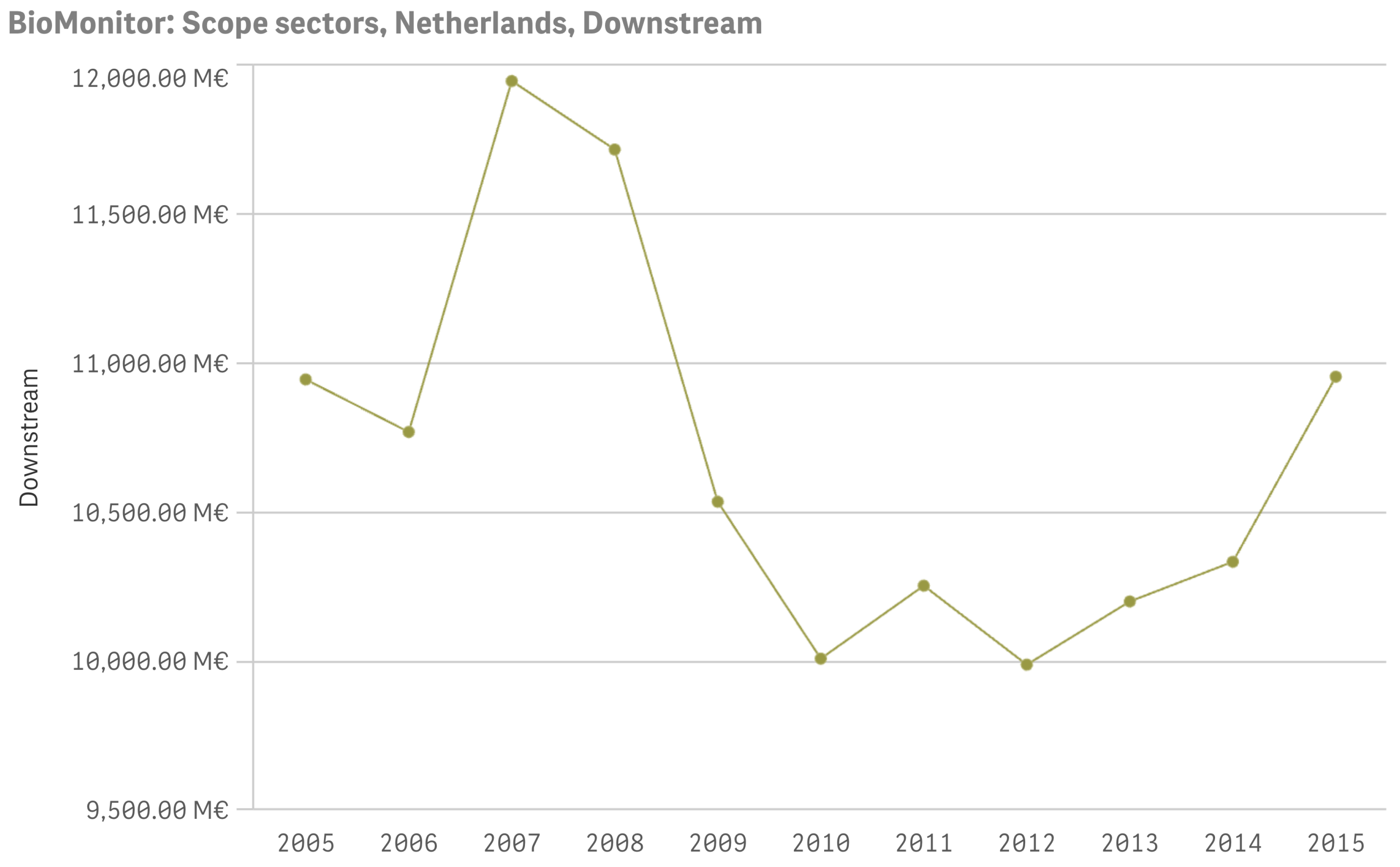
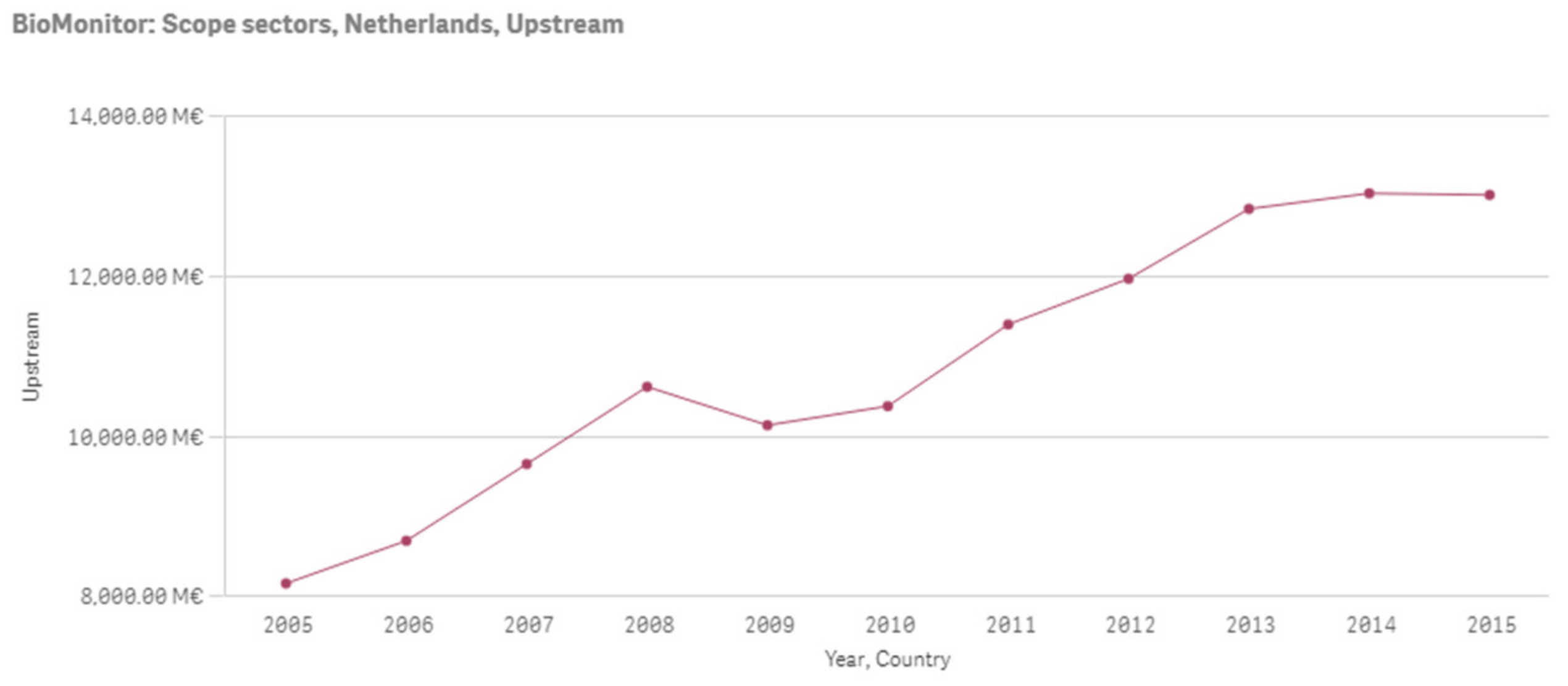
- We extend Heijman [9], bioeconomy definition by including the upstream effect which we define as part of the value added of the output flow from partly bioeconomic industries to fully bioeconomic.
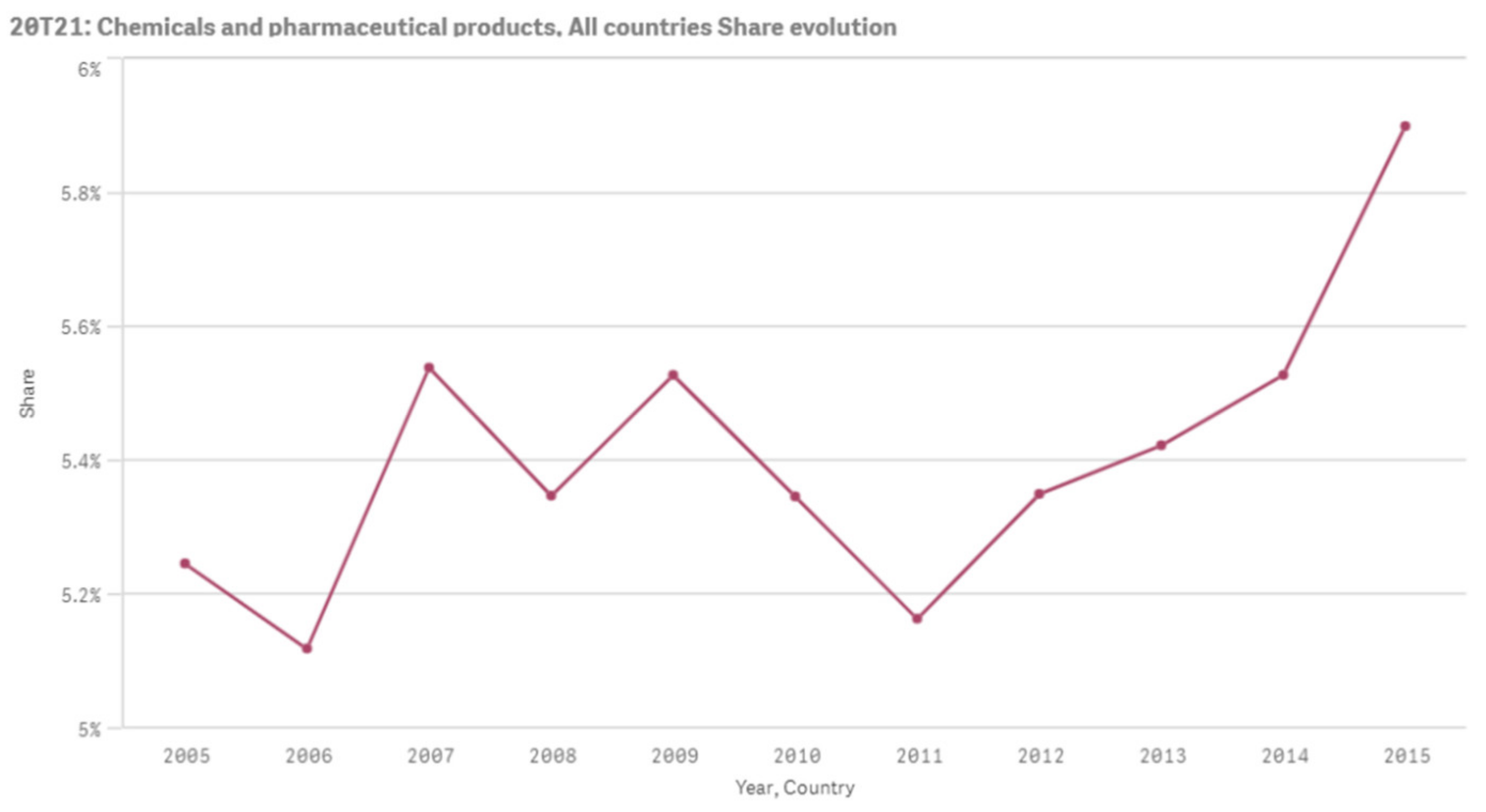
- We calculate each industry’s’ (defined by the International Standard Industrial Classification of All Economic Activities (ISIC), Revision 4) bioeconomy value added shares.
- Following the BioMonitor project scope [3], we include the relevant industries of the economy following the EU sectorial definition of the bioeconomy. This enables us to have a robust measurement of the value-added shares of the bioeconomy.
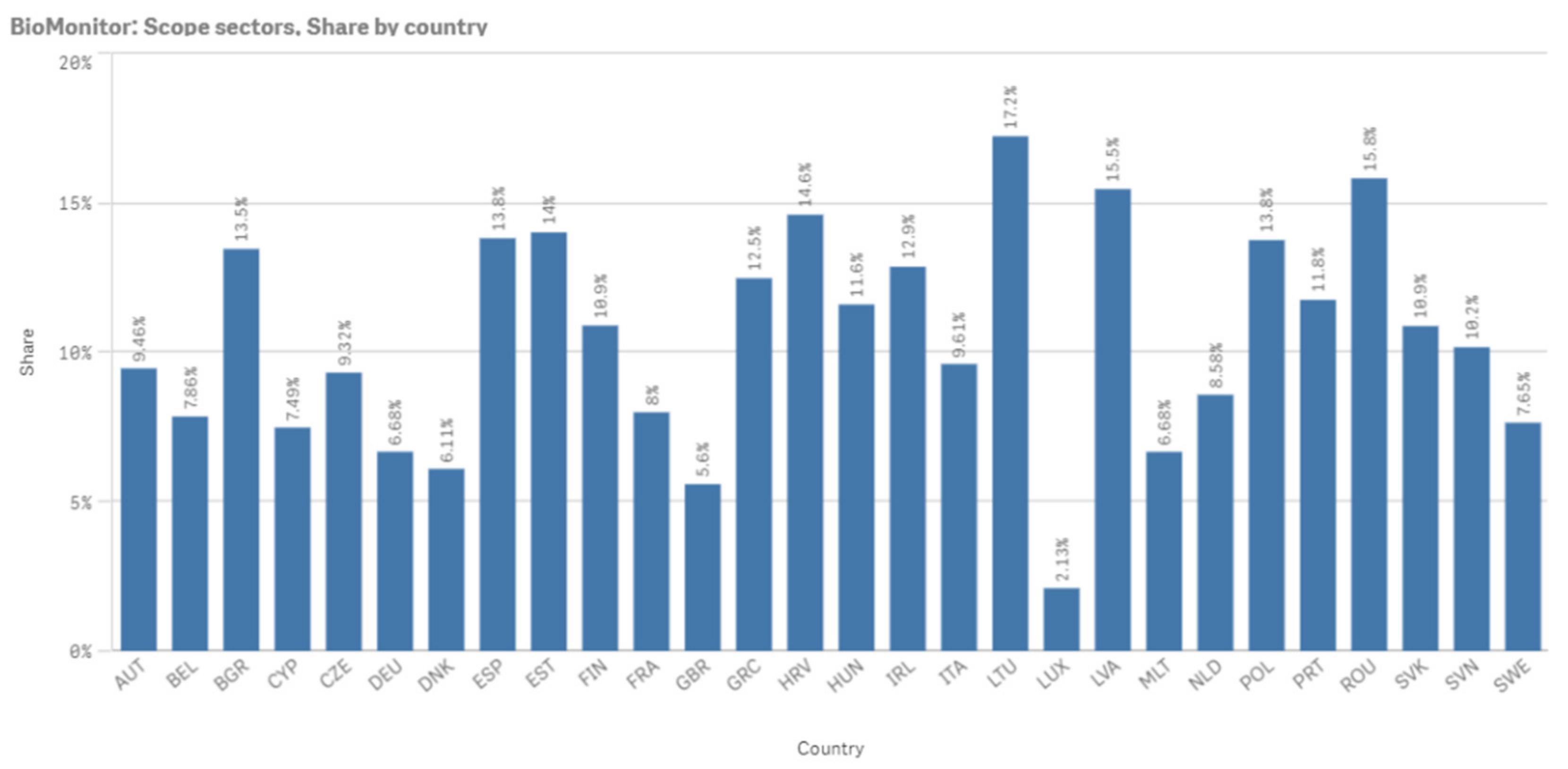
- We apply the approach on data from 28 EU member countries from year 2005 to 2015 for a cross country measurement, a method that can be implemented on any Input—Output table with certain adjustments on industry definitions. This approach provides a universal measurement method which is lacking in the literature.
2. Approaches Used for Measuring the Bioeconomy
3. Materials and Methods
- Final consumption expenditure of households;
- Final consumption expenditure of non-profit institutions serving households;
- Final consumption expenditure of general government;Gross Fixed Capital Formation;
- Changes in inventories;
- Direct purchases abroad by residents (imports).
4. Results
5. Discussion
Author Contributions
Funding
Institutional Review Board Statement
Informed Consent Statement
Data Availability Statement
Acknowledgments
Conflicts of Interest
Appendix A

| BioMonitor Sectors (NACE Codes) | ISIC Sectors |
|---|---|
| A01 Crop and animal production, hunting and related service activities | 01T03: Agriculture, forestry and fishing |
| A02 Forestry and Logging | |
| A03 Fishing and aquaculture | |
| 05T06: Mining and extraction of energy producing products | |
| 07T08: Mining and quarrying of non-energy producing products | |
| 09: Mining support service activities | |
| C10 Manufacture of food | 10T12: Food products, beverages and tobacco |
| C11 Manufacture of beverages | |
| C12 Manufacture of tobacco | |
| C13 Manufacture of textiles | 13T15: Textiles, wearing apparel, leather and related products |
| C14 Manufacture of wearing apparel | |
| C15 Manufacture of leather and related products | |
| C16 Manufacture of wood and products of wood and cork, except furniture; | 16: Wood and of products of wood and cork (except furniture) |
| C17 manufacture of articles of straw and plaiting materials | 17T18: Paper products and printing |
| C18 Manufacture of paper and paper products | |
| C19 Manufacture of coke and refined petroleum products | 19: Coke and refined petroleum products |
| C20 Manufacture of chemicals and chemical products | 20T21: Chemicals and pharmaceutical products |
| C21 Manufacture of basic pharmaceutical products and pharmaceutical preparations | |
| C22 Manufacture of rubber and plastic products | 22: Rubber and plastics products |
| 23: Other non-metallic mineral products | |
| 24: Manufacture of basic metals | |
| 25: Fabricated metal products, except machinery and equipment | |
| 26: Computer, electronic and optical products | |
| 27: Electrical equipment | |
| 28: Machinery and equipment n.e.c. | |
| 29: Motor vehicles, trailers and semi-trailers | |
| 30: Other transport equipment | |
| C31 Manufacture of furniture | 31T33: Other manufacturing; repair and installation of machinery and equipment |
| D35 Electricity, gas, steam, and air conditioning supply | 35T39: Electricity, gas, water supply, sewerage, waste and remediation services |
| D3511 Production of electricity | |
| E36 Water collection, treatment, and supply | |
| E37 Sewerage | |
| E38 Waste collection, treatment, and disposal activities; materials recovery | |
| E39 Remediation activities and other waste management services | |
| F41 Construction of buildings | 41T43: Construction |
| F42 Civil engineering | |
| G46 Wholesale trade, except for motor vehicles and motorcycles | 45T47: Wholesale and retail trade; repair of motor vehicles |
| G47 Retail trade, except for motor vehicles and motorcycles | |
| H Transportation and storage | 49T53: Transportation and storage |
| I55 Accommodation | 55T56: Accommodation and food services |
| I56 Food and beverage service activities | |
| 58T60: Publishing, audio-visual and broadcasting activities | |
| 61: Telecommunications | |
| 62T63: IT and other information services | |
| 64T66: Financial and insurance activities | |
| 68: Real estate activities | |
| M7211 Research and experimental development on biotechnology | TTL_69T82: Other business sector services |
| 84: Public administration and defence; compulsory social security | |
| 85: Education | |
| 86T88: Human health and social work | |
| R9104 Botanical and zoological gardens and nature reserves activities | 90T96: Arts, entertainment, recreation and other service activities |
| 97T98: Private households with employed persons |
















References
- European Commission. Horizon 2020—The Future Framework Programme for Research and Innovation. Available online: https://ec.europa.eu/commission/presscorner/detail/de/MEMO_15_5832 (accessed on 22 December 2020).
- Juncker, J.C. A New Start for Europe: My Agenda for Jobs, Growth, Fairness and Democratic Change. Available online: https://www.eesc.europa.eu/resources/docs/jean-claude-juncker---political-guidelines.pdf (accessed on 22 December 2020).
- Kardung, M.; Cingiz, K.; Costenoble, O.; Delahaye, R.; Heijman, W.; Lovri’c, M.; van Leeuwen, M.; M’Barek, R.; van Meijl, H.; Piotrowski, S.; et al. Development of the Circular Bioeconomy: Drivers and Indicators. Sustainability 2021, 13, 413. [Google Scholar] [CrossRef]
- Acemoglu, D.; Akcigit, U.; Hanley, D.; Kerr, W. Transition to clean technology. J. Polit. Econ. 2016, 124, 52–104. [Google Scholar] [CrossRef]
- Purnhagen, K.P.; Wesseler, J. Maximum vs minimum harmonization: What to expect from the institutional and legal battles in the EU on gene editing technologies. Pest Manag. Sci. 2019, 75, 2310–2315. [Google Scholar] [CrossRef] [PubMed]
- Purnhagen, K.; Wesseler, J. EU Regulation of New Plant Breeding Technologies and Their Possible Economic Implications for the EU and Beyond. Appl. Econ. Perspect. Policy 2020. [Google Scholar] [CrossRef]
- Giuntoli, J.; Robert, N.; Ronzon, T.; Sanchez Lopez, J.; Follador, M.; Girardi, I.; Barredo Cano, J.; Borzacchiello, M.; Sala, S.; M’Barek, R.; et al. Building a Monitoring System for the EU Bioeconomy; Publications Office of the European Union: Luxembourg, 2020. [Google Scholar] [CrossRef]
- Jorgenson, D.W. Production and welfare: Progress in economic measurement. J. Econ. Lit. 2018, 56, 867–919. [Google Scholar] [CrossRef]
- Heijman, W. How big is the bio-business? Notes on measuring the size of the Dutch bio-economy. NJAS Wagening. J. Life Sci. 2016, 77, 5–8. [Google Scholar] [CrossRef]
- Harthoorn, R. On the Integrity of Data and Methods in the Static Open Leontief Model. Ph.D. Thesis, University of Twente, Enschede, The Netherlands, 1989. [Google Scholar]
- Schumann, J. Input-Output-Analyse; Econometrics and Operations Research Series; Springer: Berlin/Heidelberg, Germany, 1968; Volume 10. [Google Scholar] [CrossRef]
- Peerlings, J. An Applied General Equilibrium Model for Dutch Agribusiness Policy Analysis. Ph.D. Thesis, Wageningen University, Wageningen, The Netherlands, 1993. [Google Scholar]
- Carlson, R. Estimating the biotech sector’s contribution to the US economy. Nat. Biotechnol. 2016, 34, 247–255. [Google Scholar] [CrossRef]
- Efken, J.; Dirksmeyer, W.; Kreins, P.; Knecht, M. Measuring the importance of the bioeconomy in Germany: Concept and illustration. NJAS Wagening. J. Life Sci. 2016, 77, 9–17. [Google Scholar] [CrossRef]
- Golden, J.S.; Handfield, R.B.; Daystar, J.; McConnell, T.E. An Economic Impact Analysis of the US Biobased Products Industry: A Report to the Congress of the United States of America. Ind. Biotechnol. 2015, 11, 201–209. [Google Scholar] [CrossRef]
- Nowicki, P.L.; Banse, M.A.H.; Bolck, C.H.; Bos, H.L.; Scott, E.L. Biobased Economy: State-of-the-Art Assessment; LEI: Den Haag, The Netherlands, 2008. [Google Scholar]
- Ronzon, T.; Piotrowski, S.; Tamosiunas, S.; Dammer, L.; Carus, M.; M’barek, R. Developments of Economic Growth and Employment in Bioeconomy Sectors across the EU. Sustainability 2020, 12, 4507. [Google Scholar] [CrossRef]
- Gurría, A.P.; González, H.H.; Ronzon, T.; Tamošiūnas, S.; López-Lozano, R.; García-Condado, S.; Ronchetti, G.; Guillén Garci, J.; Cazzaniga, N.; Jonsson, K.H.R.; et al. EU Biomass Flows. European Commission, Joint Research Centre (JRC) [Dataset]. 2017. Available online: http://data.europa.eu/89h/34178536-7fd1-4d5e-b0d4-116be8e4b124 (accessed on 22 January 2021).
- Rosegrant, M.W.; Ringler, C.; Zhu, T.; Tokgoz, S.; Bhandary, P. Water and food in the bioeconomy: Challenges and opportunities for development. Agric. Econ. (UK) 2013, 44, 139–150. [Google Scholar] [CrossRef]
- Vandermeulen, V.; Prins, W.; Nolte, S.; Van Huylenbroeck, G. How to measure the size of a bio-based economy: Evidence from Flanders. Biomass Bioenergy 2011, 35, 4368–4375. [Google Scholar] [CrossRef]
- Kuosmanen, T.; Kuosmanen, N.; El Meligi, A.; Ronzon, T.; Gurria Albusac, P.; Iost, S.; M’Barek, R. How Big is the Bioeconomy; Publications Office of the European Union: Luxembourg, 2020. [Google Scholar] [CrossRef]
- Wesseler, J.; Von Braun, J. Measuring the Bioeconomy: Economics and Policies. Annu. Rev. Resour. Econ. 2017, 9, 275–298. [Google Scholar] [CrossRef]
- Robert, N.; Giuntoli, J.; Araujo, R.; Avraamides, M.; Balzi, E.; Barredo, J.I.; Baruth, B.; Becker, W.; Borzacchiello, M.T.; Bulgheroni, C.; et al. Development of a bioeconomy monitoring framework for the European Union: An integrative and collaborative approach. New Biotechnol. 2020, 59, 10–19. [Google Scholar] [CrossRef] [PubMed]
- McCormick, K.; Kautto, N. The Bioeconomy in Europe: An Overview. Sustainability 2013, 5, 2589–2608. [Google Scholar] [CrossRef]
- Staffas, L.; Gustavsson, M.; McCormick, K. Strategies and policies for the bioeconomy and bio-based economy: An analysis of official national approaches. Sustainability 2013, 5, 2751–2769. [Google Scholar] [CrossRef]
- Schmid, O.; Padel, S.; Levidow, L. The bio-economy concept and knowledge base in a public goods and farmer perspective. Bio-Based Appl. Econ. 2012, 1, 47–63. [Google Scholar] [CrossRef]
- Scarlat, N.; Dallemand, J.F.; Monforti-Ferrario, F.; Nita, V. The role of biomass and bioenergy in a future bioeconomy: Policies and facts. Env. Dev. 2015, 15, 3–34. [Google Scholar] [CrossRef]
- OECD. Input-Output Tables; Organisation for Economic Co-operation and Development: Paris, France, 2018; Available online: http://oe.cd/i-o (accessed on 2 December 2020).
- EUROSTAT HICP Database. Available online: https://ec.europa.eu/eurostat/web/hicp/data/database (accessed on 2 December 2020).
- OECD, Exchange Rates (Indicator). Available online: https://doi.org/10.1787/037ed317-en (accessed on 3 December 2020).
- Wesseler, J. Opportunities (‘Costs) Matter—A Comment on Pimentel and Patzek “Ethanol Production Using Corn, Switchgrass, and Wood; Biodiesel Production Using Soybean and Sunflower”. Energy Pol. 2007, 35, 1414–1416. [Google Scholar] [CrossRef]
- Feleke, S.; Cole, S.M.; Sekabira, H.; Djouaka, R.; Manyong, V. Circular Bioeconomy Research for Development in Sub-Saharan Africa: Innovations, Gaps, and Actions. Sustainability 2021, 13, 1926. [Google Scholar] [CrossRef]
- Frisvold, G.B.; Moss, S.M.; Hodgson, A.; Maxon, M.E. Understanding the U.S. Bioeconomy: A New Definition and Landscape. Sustainability 2021, 13, 1627. [Google Scholar] [CrossRef]
- Arrow, K.J.; Dasgupta, P.; Goulder, L.H.; Mumford, K.J.; Oleson, K. Sustainability and the measurement of wealth. Env. Dev. Econ. 2012, 17, 317–353. [Google Scholar] [CrossRef]
- Jansen, S.; Foster, W.; Anríquez, G.; Ortega, J. Understanding Farm-Level Incentives within the Bioeconomy Framework: Prices, Product Quality, Losses, and Bio-Based Alternatives. Sustainability 2021, 13, 450. [Google Scholar] [CrossRef]
- Zilberman, D.; Gordon, B.; Hochman, G.; Wesseler, J. Economics of Sustainable Development and the Bioeconomy. Appl. Econ. Persp. Pol. 2018, 40, 22–37. [Google Scholar] [CrossRef]

| Study | Region | Period | Measure | Methodology |
|---|---|---|---|---|
| Heijman (2016) [9] | Netherlands | 2008–2012 | Value added: 6.6–7.2% of NL GDP | Input–output model |
| Carlson (2016) [13] | United States | 2012 | Turnover: around 2% of US GDP, USD 324 billion. | Combines several sources of financial, consulting reports, surveys. |
| Efken et al. (2012) [14] | Germany | 2007 | Value added: 7.6% of Germany GDP | Input–output model |
| Golden et al. (2015) [15] | United States | 2013 | Value added: 2.2% of GDP | IMPLAN software |
| Nowicki et al. (2008) [16] | EU25 | 2005 | Turnover: EUR 453,741 | Excluding food and feed, data derived from PRODCOM |
| Ronzon et al. (2020) [17] | EU28 | 2008–2017 | Value added: food, beverages and tobacco provide 37%, agriculture provides 30% | The data from EUROSTAT and sector shares of biobased products derived by nova Institute. |
| Rosegrant et al. (2013) [19] | Global | 2050 | GDP growth increase from 3.2% to 3.6% | Combination of partial equilibrium multi commodity, country IMPACT model |
| Vandermeulen et al. (2011) [20] | Flanders, Belgium | 2010 | Value added: 1.8% of GDP | Industry surveys with a focus of biobased energy and products. |
| Kousmanen et al. (2020) [21] | EU28 | 2015 | Value added: EUR 1460.6 billion that is 11% of the GDP | A synthesis of input- and output-based approaches with an ex-post bioeconomy definition. |
| S1 | F | Final Demand | Exports | Total Output | |
|---|---|---|---|---|---|
| S1 | 3877.9 | 175.7 | 5948.7 | 11,939.6 | 29,416.5 |
| F | 155.3 | 5691.8 | 69,576.5 | 603.1 | 84,082.2 |
| Imports | 7573 | 533.7 | |||
| Total Input | 18,213.6 | 55,625 | |||
| Value Added | 11,202.8 | 28,457.2 | |||
| Total Output | 29,416.5 | 84,082.2 |
Publisher’s Note: MDPI stays neutral with regard to jurisdictional claims in published maps and institutional affiliations. |
© 2021 by the authors. Licensee MDPI, Basel, Switzerland. This article is an open access article distributed under the terms and conditions of the Creative Commons Attribution (CC BY) license (http://creativecommons.org/licenses/by/4.0/).
Share and Cite
Cingiz, K.; Gonzalez-Hermoso, H.; Heijman, W.; Wesseler, J.H.H. A Cross-Country Measurement of the EU Bioeconomy: An Input–Output Approach. Sustainability 2021, 13, 3033. https://doi.org/10.3390/su13063033
Cingiz K, Gonzalez-Hermoso H, Heijman W, Wesseler JHH. A Cross-Country Measurement of the EU Bioeconomy: An Input–Output Approach. Sustainability. 2021; 13(6):3033. https://doi.org/10.3390/su13063033
Chicago/Turabian StyleCingiz, Kutay, Hugo Gonzalez-Hermoso, Wim Heijman, and Justus H. H. Wesseler. 2021. "A Cross-Country Measurement of the EU Bioeconomy: An Input–Output Approach" Sustainability 13, no. 6: 3033. https://doi.org/10.3390/su13063033
APA StyleCingiz, K., Gonzalez-Hermoso, H., Heijman, W., & Wesseler, J. H. H. (2021). A Cross-Country Measurement of the EU Bioeconomy: An Input–Output Approach. Sustainability, 13(6), 3033. https://doi.org/10.3390/su13063033



