4.1. Sample Data
We analyze the monthly data of the Far East (China, Japan, Taiwan, Hong Kong, and Korea) countries for the period from January 1997 to April 2020. As of May 2020, these five countries are among the world’s top 10 foreign exchange reserves [
55]. The international exchange reserves and U.S. bilateral nominal exchange rates were retrieved from FRED, the database of the Federal Reserve Bank of St. Louis [
56]. In the empirical analysis of this study, we use the U.S. dollar bilateral exchange rate because the share of U.S. dollar holdings in global foreign exchange reserves was 60.9% in 2019, followed by the Euro at 20.5% [
57]. The nominal effective exchange rates sourced from the Bank for International Settlements (BIS) [
58], which are available as monthly averages (2010 = 100). In detail, U.S. bilateral nominal exchange rates are the nominal exchange rates of the Chinese Yuan, Japanese Yen, New Taiwan Dollar, Hong Kong Dollar, and Korean Won per U.S. dollar. Thus, an increase in the nominal exchange rates indicates a depreciation of the country’s currency and an appreciation of the U.S. dollar. The nominal exchange rate is limited in that it represents only the exchange rate of two currencies, while the nominal effective exchange rate, expressed in U.S. dollars, is a weighted average of the exchange rate obtained by using trade weights for various countries. An increase in the nominal effective exchange rate means an appreciation of the country’s currency, and to measure the international price competitiveness of a country, the nominal effective exchange rate is considered more appropriate than the nominal exchange rate.
Appendix ATable A1 presents the descriptive statistics of the returns (i.e., % changes) series. The means of the FX rate (nominal exchange rates) returns are negative for China and Japan, and the means of the NEER (nominal effective exchange rates) returns are negative for Taiwan and Korea. Only in Hong Kong are the means of both exchange rate returns positive. The means of RES (international exchange reserves) returns are positive for all countries. Except for China, the signs of the FX rate and NEER’s skewness are reversed. The FX rate and the NEER are exchange rates expressed in the country’s own currency and in dollars, respectively; therefore, these results are generally natural. RES distributions are skewed to the right (skewness < 0), except for Hong Kong and Korea. The distributions of the three variables for all countries are highly leptokurtic (kurtosis > 3), excluding China’s RES. The high kurtosis of the distributions implies a significant possibility of fluctuations in the variables located near the tail and further away from the mean. In addition, making quantile analysis more appropriate, it suggests that the relationship between international reserves and exchange rates may vary at each different point of the conditional distribution. The results of the Jarque-Bera test
for normality show the null hypothesis of a normal distribution is rejected, except for China’s international reserves. The correlation between the FX rate and RES is negative for all countries. However, the correlation between the NEER and RES was negative (−) for China and Hong Kong, and positive (+) for Japan, Taiwan, and Korea. Further analysis needs to be made for these differences.
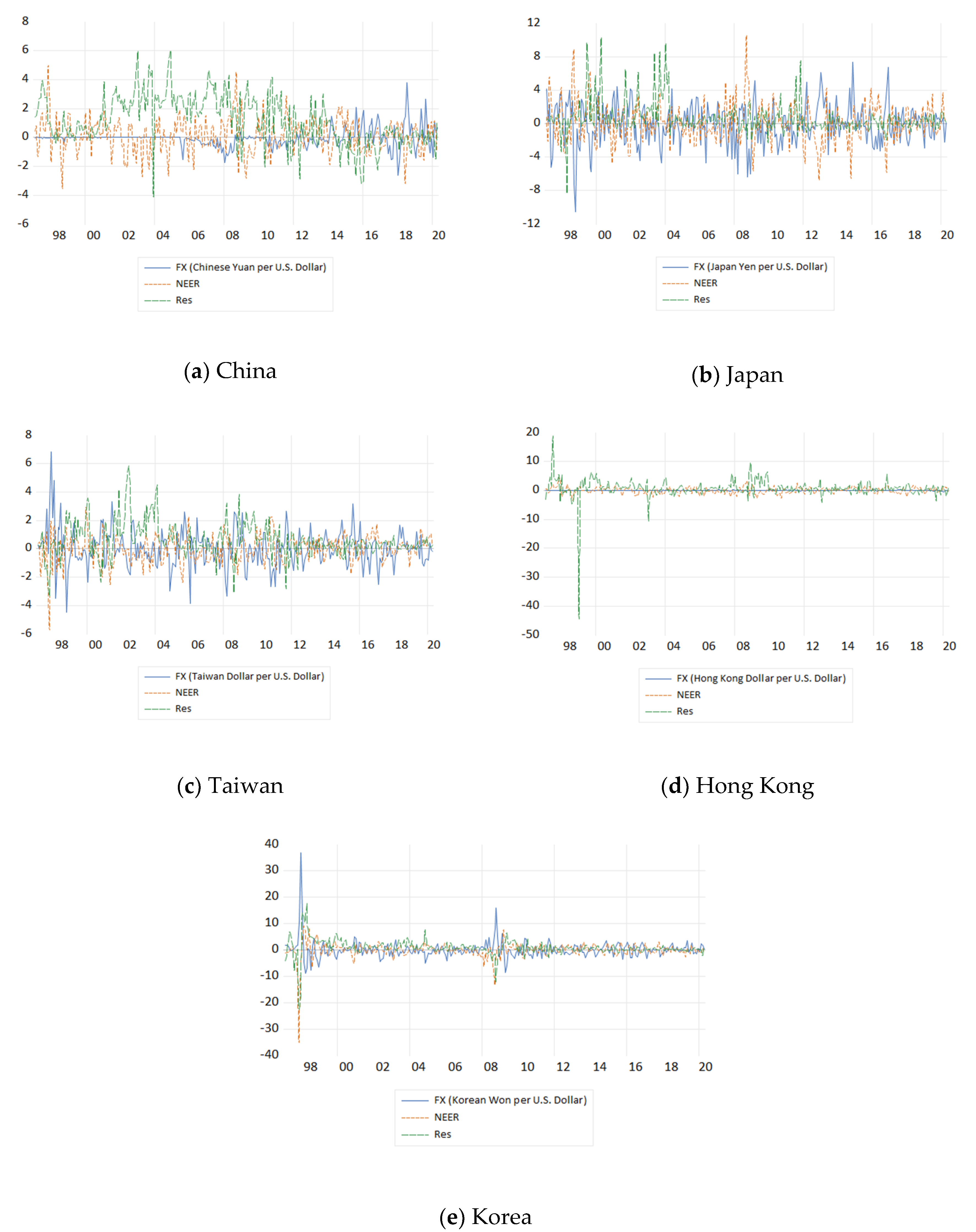
Figure 1 plots the monthly percentage changes (%) in the FX rate (nominal exchange rates), the NEER (nominal effective exchange rates in U.S. dollar), and RES (foreign exchange reserves). For all countries except China, the three variables exhibit a pattern of convergence over time. As shown in the figures, volatility persisted in China and Japan, even though the three series became less volatile after 2000. In addition, very high volatility emerged in the Asian financial crisis of 1999 and after the global financial crisis of 2008 in Hong Kong and Korea.
Table 1 summarizes the results of the unit root tests for the log level and the percentage (%) changes in the sample series. The null hypothesis of a unit root is tested by using an augmented Dickey–Fuller (ADF) with break (DF_Break) test suggested by Perron [
41] and Perron and Vogelsang [
59,
60] and the PP test of Phillips and Perron [
61]. The DF_Break test can overcome the weakness of the ADF test, which has limited power in distinguishing the unit root null hypothesis from the trend stationary alternative, and the PP test is based on a nonparametric method of controlling for serial correlation when testing for a unit root. The results in
Table 2 reveal that all series are stationary.
Table 2 presents the results of the Johansen linear cointegration test of log level variables for the FX rate and RES and the NEER and RES. The cointegration test proposed by Johansen [
62,
63] allows the identification of the linear cointegration relationship between an
variable with a unit root. Each variable is unstable with a unit root,
but if their linear combinations show stability without unit roots,
, it is defined as a linear cointegration relationship between the two variables. As shown in
Table 2, since not all log level variables in the five countries have a cointegration relationship, we proceed with further analysis by using differential variables.
4.2. Empirical Results
The relationship between international reserves and foreign exchange rates may vary depending on the country’s economic situation and policy intent. In the traditional theory of monetary policy, if the monetary authority changes the amount of money in the market as opposed to increasing or decreasing its international reserves, the value of that country’s currency changes; this strategy is called the unsterilized policy. However, if the monetary authority responds to changes of reserves in a different way, such as through government bonds rather than through changes in the amount of money, it may not affect the value of its own currency. In this situation, the monetary authority uses a sterilized policy. Thus, if the change in international reserves does not affect the foreign exchange rate, it can be interpreted that the monetary authority has successfully intervened by using the sterilized policy. However, even if the monetary authority changes international reserves to stabilize the value of its own currency, changes in the value of its currency cannot be prevented, especially when foreign investment funds are rapidly leaked due to negative economic situations or expectations. During the financial crisis in East Asia in the late 1990s, major Asian countries experienced severe shortages in reserves and a sharp decline in the value of their currencies.
In some cases, changes in the foreign exchange rates may cause changes in reserves, and the effect of the changes in exchange rates on changes in the reserves may be reversed depending on the country’s economic situation or the intervention of its monetary authority. In the traditional theory of an open economy, a decrease in the value of the domestic currency can lead to an increase in export and economic growth, but thereafter, pressure on the appreciation of the currency rises. At that time, if the monetary authority wants its currency value to remain at the same low level as before, depreciation can be induced by an intended intervention, called mercantilist interventions, that increases international reserves and simultaneously increases the amount of money. On the other hand, international reserves may decrease after exchange rate declines, and the monetary authority may actively intervene to stabilize its currency value. In this case, the monetary authorities’ intervention aims to keep the monetary value of its currency at an appropriate level. This intervention against “fear of floating” may be particularly strong in the negative economic situation where the decline in monetary value can last for a considerable period of time. Therefore, understanding the relationship between the exchange rate movements and the changes in international reserves requires a comprehensive consideration of whether the causal relationship is established and the direction and sign of the relationship.
Table 3 shows the results of the general causality test (Granger causality in mean) proposed by Granger [
14]. At lags 1 and 2, in China, the change in international reserves significantly Granger causes the nominal exchange rate change at lags 1 and 2, but at most lags, no significant causal relationship is found between the changes in reserves and nominal exchange rate movements. In the case of Japan, the change in international reserves significantly Granger caused the change of the nominal exchange rate only when the lags are 24. Taiwan has a uni- or bi-directional Granger causal relationship between the changes in variables at most lags. In Hong Kong, the change in the nominal effective exchange rate significantly Granger causes the change in international reserves at lags 3, 6, and 12. At all lags except lag 24, Korea has a bi-directional Granger causal relationship between the changes in variables.
Meanwhile, the results of the general Granger causal relationship of China and Japan show that exchange rate changes do not significantly cause changes in their foreign exchange reserves; therefore, it is difficult to grasp the possibility of a mercantilist motive by the monetary authorities in the two countries.
However, as suggested in previous studies, major Asian countries are suspected of maintaining a depreciation of their currencies by the deliberate intervention of their monetary authorities to grow their economies and, especially, to increase their export-led economic growth. Since the intention of the monetary authority may vary depending on the level of international reserves and exchange rates, it is necessary to take into account the characteristics of quantiles that are not captured in the general Granger causality test. Thus, by using a quantile analysis, we analyze the relationship between changes in international reserves and exchange rate movements in five countries and systematically grasp the intentions of the monetary authority to intervene in the market.
Appendix BTable A2,
Table A3,
Table A4,
Table A5,
Table A6 show the results of the quantile Granger causality (Granger causality in quantile) of the five Far Eastern countries. Considering
, both the changes in the nominal exchange rate and the nominal effective exchange rate in all five countries Granger cause changes in each country’s international reserves at the 1% of significant level. In detail, however, the change in each country has different characteristics according to the quantiles of the distribution.
In
Appendix B Table A2, for the quantiles
at lags 1, 2, and 3, both the changes in the nominal exchange rate and the nominal effective exchange rate in China significantly Granger cause a change in Chinese foreign exchange reserves. The fact that China’s exchange rates significantly quantile Granger cause changes in its reserves is also seen at the extreme tail of the conditional distribution,
at lag 3. This indicates the possibility of Chinese monetary authority’s policy intervention against the fluctuations in the foreign exchange market. Overall, however, there are more quantiles where the changes in the exchange rates in China do not Granger cause changes in the international reserves. On the other hand, the changes in the Chinese international reserves are more significant in relation to the changes in its nominal exchange rate than to the changes in its nominal effective exchange rate. The fact that the changes in international reserves have little effect on the nominal effective exchange rate means that the monetary authority’s policy of sterilization is working effectively.
Appendix BTable A3 shows the result of the quantile Granger causal relationship between the Japanese exchange rate and its international reserves. At the quantiles of the conditional distributions,
or
when the lags are 1, 2, and 3, the changes in the nominal exchange rate and nominal effective exchange rate in Japan significantly quantile cause the changes in Japanese foreign reserves. Therefore, it can be interpreted that there has been Japanese monetary authority intervention in most exchange rate changes, except for the medium level (
) and the extreme high tail level (
) quantiles. The changes in Japanese international reserves do not cause the changes in exchange rates in any quantiles of the distribution, which means the sterilized policy by Japanese monetary authority is effectively being applied in the money market.
As shown in
Appendix B Table A4, the changes in the nominal exchange rate and the nominal effective exchange rate in Taiwan are found to significantly cause changes in Taiwan’s foreign exchange reserves in the quartile ranges
or
at lags 1, 2, and 3. Therefore, it can be seen that Taiwan’s policy intervention appears when the changes in the exchange rate exceed a specified range,
. For the extreme tails of the distribution on both sides, it is possible that they reflect mercantilist intervention attempts, the results of which did not produce significant changes. In addition, when the lags are 1 and 2, the change in Taiwan’s international reserves significantly cause the nominal effective exchange rate change at the quantiles of tails
, which indicate the tail-dependent property of quantile analysis. Moreover, in the wider range of quantiles, the changes in Taiwan’s international reserves significantly cause changes in the nominal exchange rate.
Appendix BTable A5 shows the results of the quantile granger causality analysis in Hong Kong. Except for the quantile
, the changes in foreign exchange reserves in Hong Kong does not significantly cause the changes in the nominal effective exchange rates. Therefore, it can be interpreted that the stabilization policy of Hong Kong’s monetary authority, which defended the changes in its currency value, is well reflected. However, the high fluctuations in the foreign exchange reserves in Hong Kong quantile Granger cause changes in the nominal exchange rate of Hong Kong at the edges of the distribution,
or
. The null hypothesis of quantile Granger non-causality from the exchange rates to the international reserves is significantly rejected in the ranges of quantiles
or
when the lags are 1 and 3, and in the ranges of quantiles
or
when the lags are 2. This shows the possibility of Hong Kong’s monetary authority intervening extensively in response to the changes in its exchange rates.
In the case of Korea, in
Appendix B Table A6, the null hypothesis of quantile Granger non-causality from the changes in Korean international reserves to the changes in the nominal exchange rate is significantly rejected, except for the quantiles
or
. In addition, the relationship in which Korean international reserves cause changes in the nominal effective exchange rate is statistically significant except for the quantiles
. Conversely, with the exception of quantiles
, the changes in exchange rates Granger cause the changes in Korean international reserves at the 1% significance level. This means that compared to other countries, Korea has a stronger quantile-dependent causal relationship and bi-directional causality between the two variables.
On the other hand, in order to understand the motivations of each country’s monetary authorities to intervene in the market, it is necessary to analyze the causal relationship between the exchange rate and the reserves as well as the regression coefficient between the two variables. In
Table 4 and
Table 5, we present the estimated coefficients
of the quantile autoregressive (QAR) regression model of the relationship between the changes in international reserves and the changes in foreign exchange rates of each country. The shaded parts in
Table 4 and
Table 5 denote the results of the estimated coefficients together with the significant causal relationship between the two variables in
Appendix B Table A2,
Table A3,
Table A4,
Table A5,
Table A6.
In the case of China and Hong Kong, the quantile regression coefficients between the changes in the nominal exchange rate and the changes in foreign exchange reserves are not statistically significant in all quantiles of the distribution. This means that on the partial quantiles in
Appendix B Table A2 and
Table A5, in China and Hong Kong, there is a causal relationship between the nominal exchange rate changes and the foreign reserves change, but the coefficient does not indicate a significant level. In Taiwan, the quantile regression coefficients in the causal relationship of the changes from the Taiwan international reserves to the changes in the nominal exchange rate in
Appendix B Table A4 are significant at the quantiles
. This indicates that the positive changes in Taiwan international reserves cause negative changes in the nominal exchange rates of the New Taiwan Dollar per U.S. dollar, denoting the depreciation of the currency of Taiwan. In addition, in Korea, regarding the relation of the changes from international reserves to the changes in nominal exchange rate, the estimated coefficients indicating a significant causal relationship are negative in the ranges of quantiles
or
. The estimated coefficient values are higher in both tails of the significant quantiles than in the middle bounds; the estimated coefficients
are −0.487 and −0.308 at the quantiles
, respectively. This indicates the quantiles-dependence and the strong tail-dependence of the distribution. Only in Korea, the significant coefficients in the causal relationship of the changes from the nominal exchange rate to the changes in international reserves are found at the quantiles
, but the intensities are smaller than the opposite causality. In short,
Table 4 shows that except for some quantiles in Taiwan and Korea, the quantile regression coefficients evidencing a causal relationship between the changes in international reserves and the changes in nominal exchange rate are not statistically significant. Thus, in this case, it is difficult to find evidence of intentional intervention by the monetary authorities in each country.
However, in
Table 5, the quantile regression coefficients indicative of a significant causal relationship between the changes in foreign reserves and the changes in the nominal effective exchange rate shows different evidence. In China, the estimated coefficients indicative of the significant causal relationship of the changes from the nominal effective exchange rate to the changes in international reserves are significantly negative in the quantiles
. In addition, in Hong Kong, the negative regression coefficients indicating the significant causal relationship between the changes from the nominal effective exchange rate and changes to the international reserves, are found in the ranges of quantiles
or
. This indicates that the negative changes in the nominal effective exchange rate (in U.S. dollars) causes the positive changes in the international reserves in China and Hong Kong. In other words, the depreciation of currencies can cause an increase in foreign exchange reserves in China and Hong Kong. This can be interpreted that the monetary authorities have the mercantilist motive for making a response against the pressure of appreciation and the additional foreign capital inflows.
Conversely, in Japan, the estimated coefficients showing a significant causal relationship between the changes from the nominal effective exchange rate and the changes to international reserves are significantly positive in the ranges of quantiles or . In Taiwan, although the regression coefficients are not significant, they are generally positive. In addition, in Korea, the positive regression coefficients indicative of a significant causal relationship between changes from the nominal effective exchange rate and the changes to international reserves are found in the ranges of quantiles or . These results can be interpreted as the monetary authorities intervening in order to stabilize the value of their currencies. As these countries have discovered in the past, the depreciation of their currency, particularly a depreciation caused by negative economic shocks, has led to the continued declines in international reserves. The results of Japan and Korea can be seen as evidence of this type of response by their monetary authorities.
Meanwhile, except for Korea, four countries do not have significant coefficients reflecting a causal relationship of the changes from international reserves to the changes in the nominal effective exchange rate. This is interpreted that each country’s sterilized policy is working well, except that of Korea. In the case of Korea, the positive coefficients indicative of a significant causal relationship between changes from international reserves to changes in the nominal effective exchange rate are found in the quantiles in the ranges of quantiles , , or .