Production Sustainability via Supermarket Location Optimization in Assembly Lines


Abstract
1. Introduction
2. Literature Review
3. Problem Description
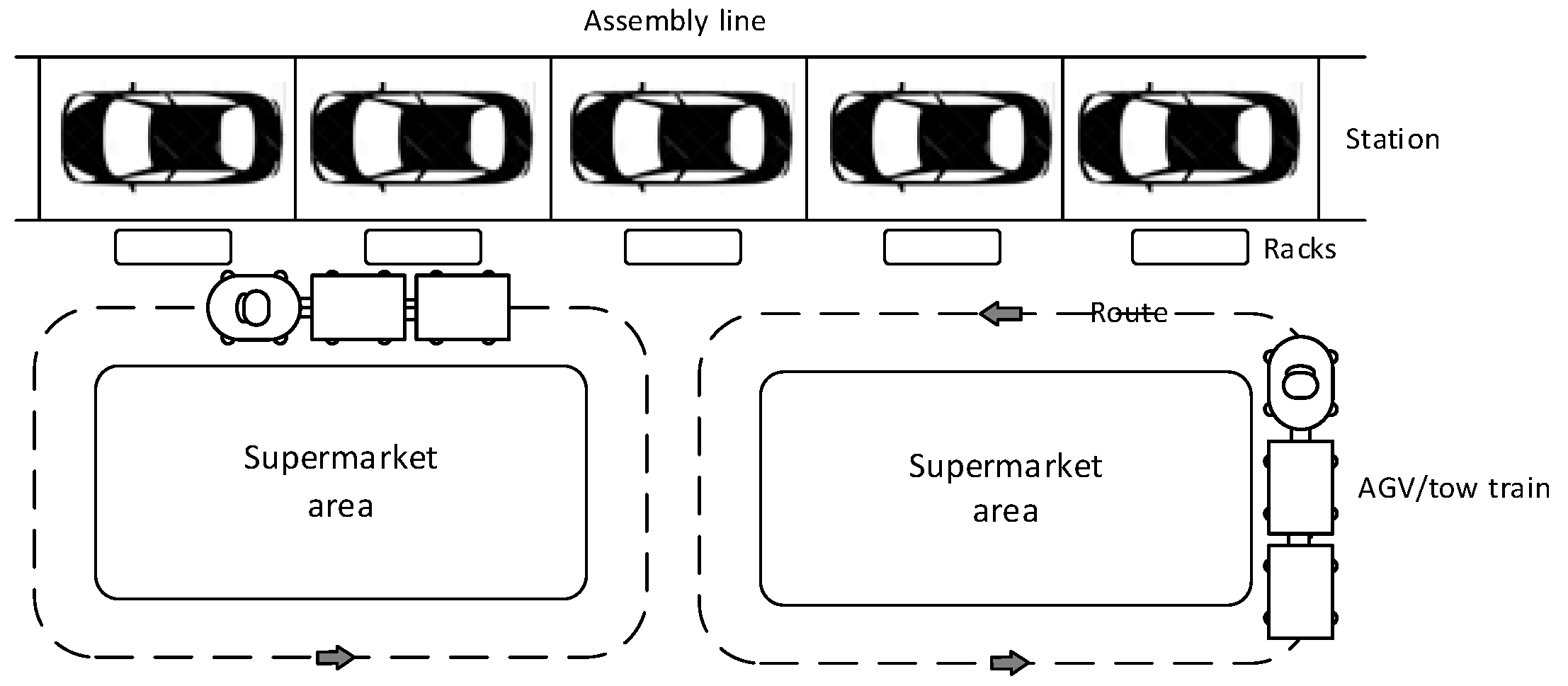
3.1. Description of SLP
3.2. The SLP Assumptions
- The order (sequence) through which each supermarket visits stations is consecutive. This means, for example, a particular supermarket is not allowed to serve stations 1, 2, and 5 if stations 3 and 4 are served by other supermarkets.
- The optimal number and location of supermarkets should be selected from the candidate supermarket places. Supermarket capacity, when it comes to serving the stations, is assumed to be limited. Thus, additional supermarket positions have to open when the capacity limitation of a particular supermarket is reached.
- The bins holding parts are identical and standardized in size.
- The arrangement of stations follows a straight-line pattern. Therefore, and considering the shop floor space limitation, supermarkets are assumed to be located as close to the stations as possible. Consistently, it is assumed that the supermarket locations smoothly scatter next to the shooter racks of workstations.
3.3. Problem Formulation
4. The Proposed Solution Approach
4.1. Simulated Annealing for SLP
4.1.1. Initial Temperature and Cooling Rate
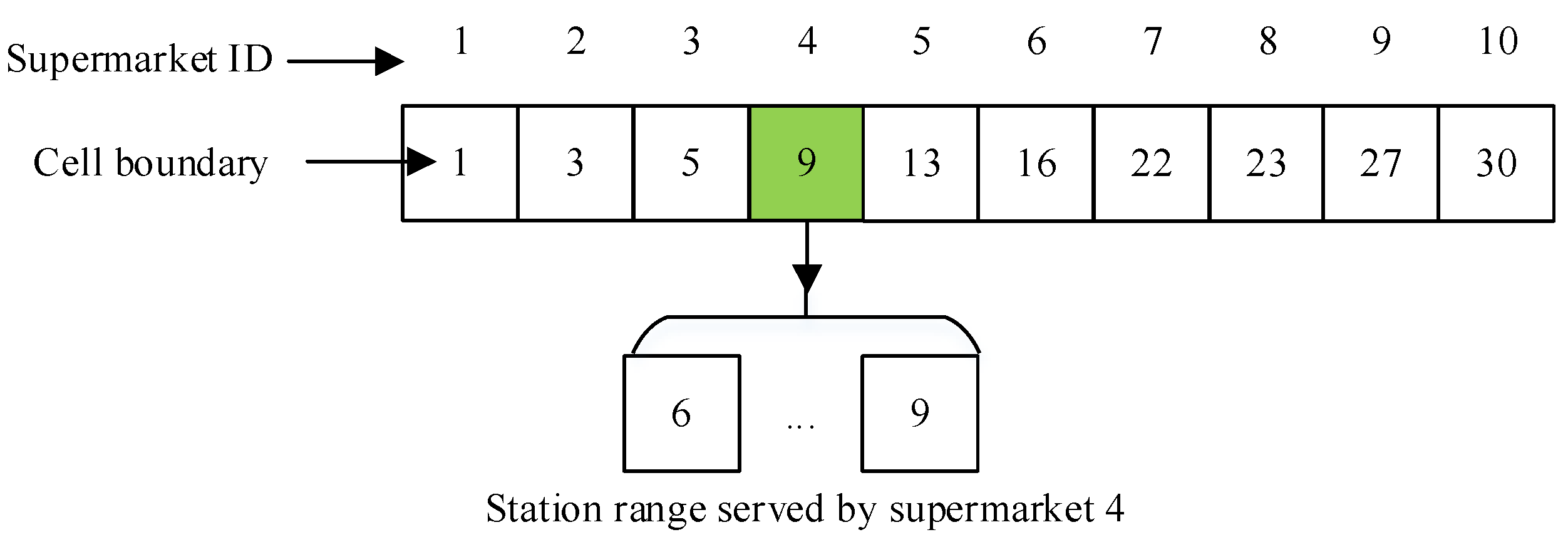
4.1.2. Solution Representation
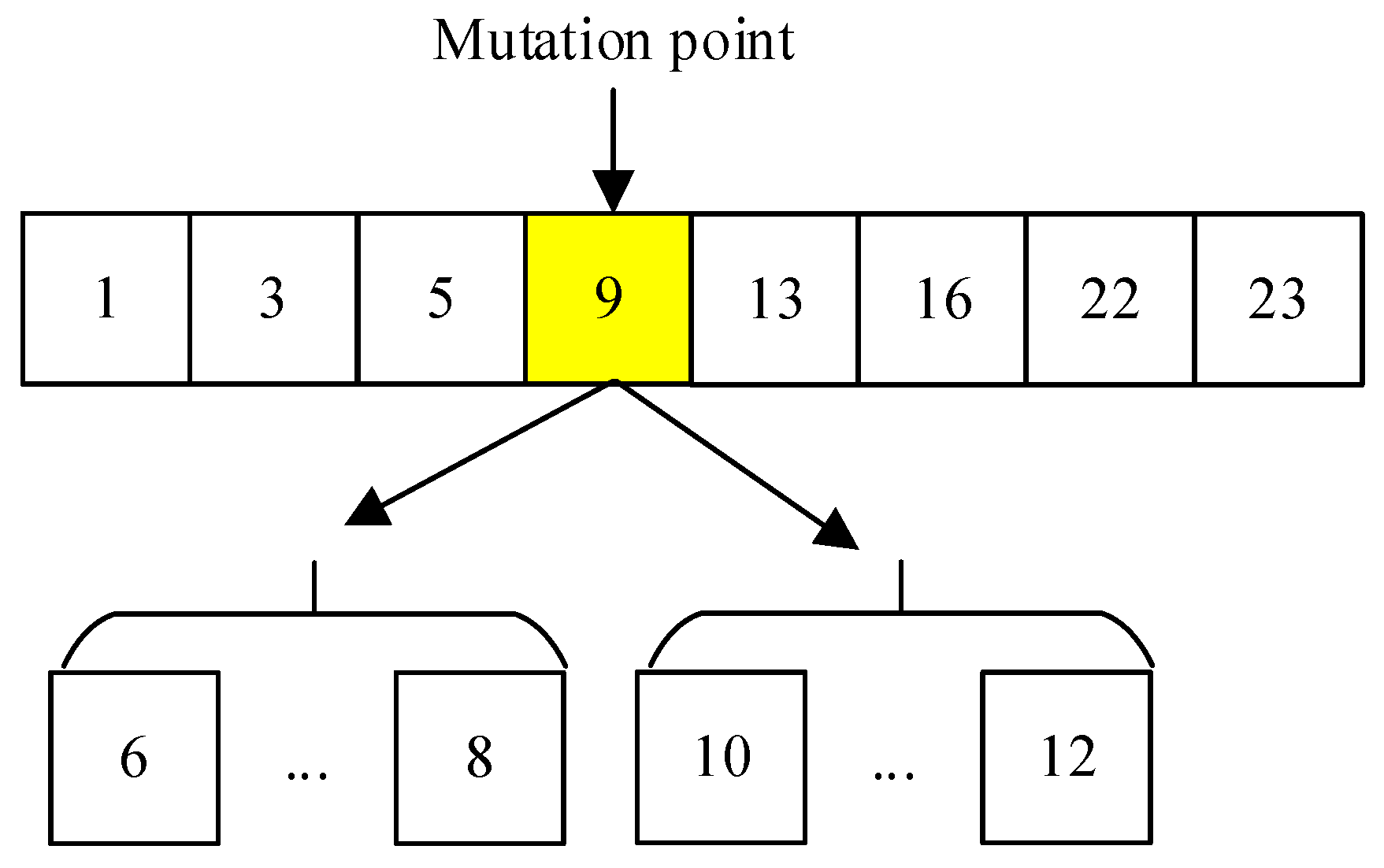
4.1.3. The Neighborhood Search Operator
4.1.4. The Evaluation Function and Termination Condition
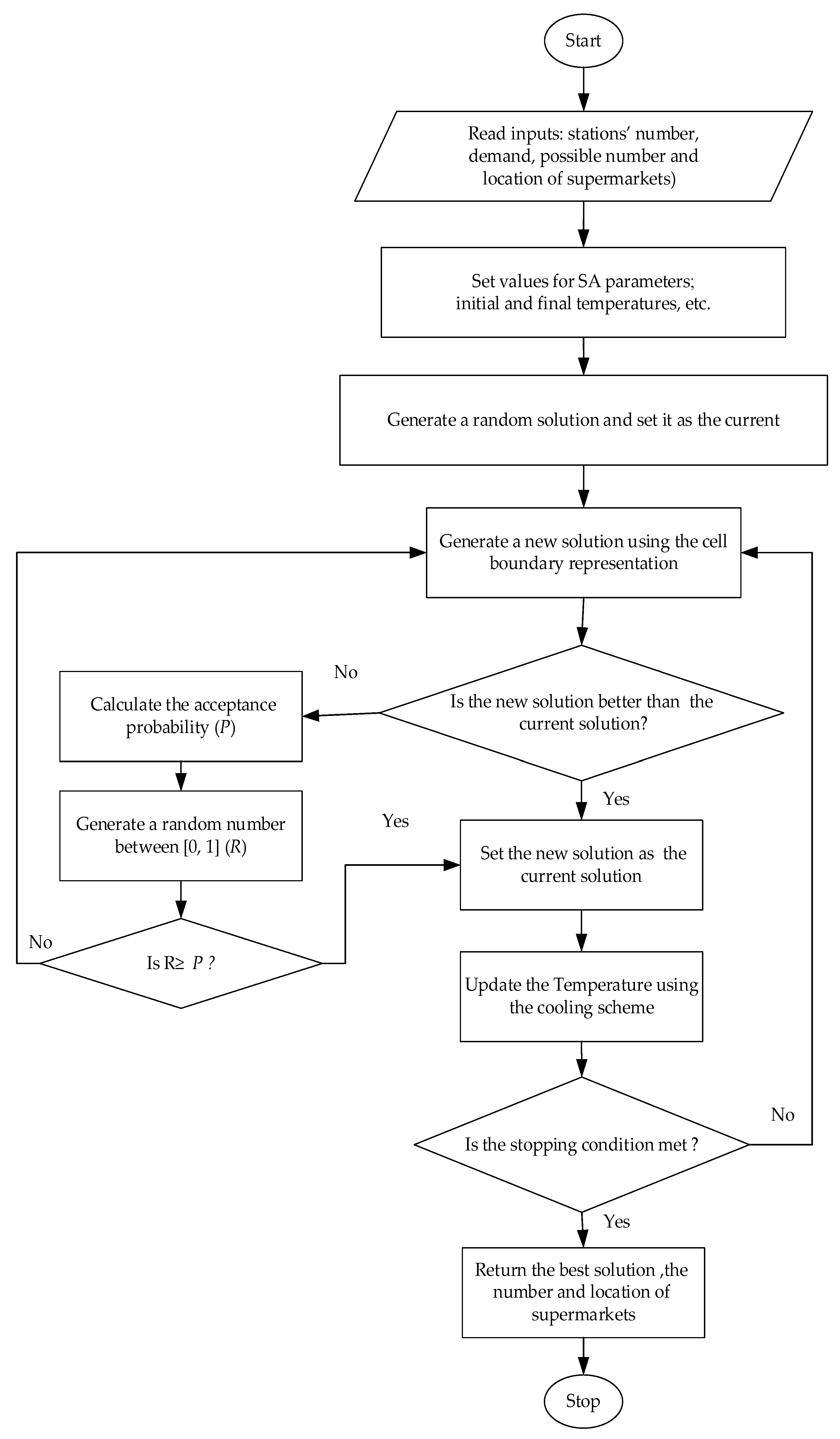
4.1.5. Pseudocode of the Proposed Algorithm
5. Computational Results
6. Analysis of Results and Discussion
7. Conclusions
Limitation and Future Directions
Author Contributions
Funding
Acknowledgments
Conflicts of Interest
References
- Cai, W.; Lai, K.-H.; Liu, C.; Wei, F.; Ma, M.; Jia, S.; Lv, L. Promoting sustainability of manufacturing industry through the lean energy-saving and emission-reduction strategy. Sci. Total Environ. 2019, 665, 23–32. [Google Scholar] [CrossRef] [Scilit] [PubMed]
- Oluyisola, O.E.; Sgarbossa, F.; Strandhagen, J.O. Smart Production Planning and Control: Concept, Use-Cases and Sustainability Implications. Sustainability 2020, 12, 3791. [Google Scholar] [CrossRef] [Scilit]
- Niaki, M.K.; Torabi, S.A.; Nonino, F. Why manufacturers adopt additive manufacturing technologies: The role of sustainability. J. Clean. Prod. 2019, 222, 381–392. [Google Scholar] [CrossRef] [Scilit]
- Realyvásquez-Vargas, A.; Arredondo-Soto, K.C.; Blanco-Fernandez, J.; Sandoval-Quintanilla, J.D.; Jiménez-Macías, E.; García-Alcaraz, J.L. Work Standardization and Anthropometric Workstation Design as an Integrated Approach to Sustainable Workplaces in the Manufacturing Industry. Sustainability 2020, 12, 3728. [Google Scholar] [CrossRef] [Scilit]
- Braccini, A.M.; Margherita, E.G. Exploring organizational sustainability of industry 4.0 under the triple bottom line: The case of a manufacturing company. Sustainability 2019, 11, 36. [Google Scholar] [CrossRef] [Scilit]
- Zhang, Z.; Tang, Q.; Li, Z.; Zhang, L. Modelling and optimisation of energy-efficient U-shaped robotic assembly line balancing problems. Int. J. Prod. Res. 2019, 57, 5520–5537. [Google Scholar] [CrossRef] [Scilit]
- Fathi, M.; Fontes, D.B.M.M.; Urenda Moris, M.; Ghobakhloo, M. Assembly line balancing problem: A comparative evaluation of heuristics and a computational assessment of objectives. J. Model. Manag. 2018, 13, 455–474. [Google Scholar] [CrossRef] [Scilit]
- Ghafoorpoor Yazdi, P.; Azizi, A.; Hashemipour, M. A hybrid methodology for validation of optimization solutions effects on manufacturing sustainability with time study and simulation approach for SMEs. Sustainability 2019, 11, 1454. [Google Scholar] [CrossRef] [Scilit]
- Fathi, M.; Nourmohammadi, A.; Ng, A.H.C.; Syberfeldt, A.; Eskandari, H. An Improved Genetic Algorithm with Variable Neighborhood Search to Solve the Assembly Line Balancing Problem. Eng. Comput. 2020, 37, 501–521. [Google Scholar] [CrossRef] [Scilit]
- Fathi, M.; Nourmohammadi, A.; Ng, A.H.C.; Syberfeldt, A. An optimization model for balancing assembly lines with stochastic task times and zoning constraints. IEEE Access 2019, 7, 32537–32550. [Google Scholar] [CrossRef] [Scilit]
- Ghobakhloo, M.; Fathi, M. Corporate survival in Industry 4.0 era: The enabling role of lean-digitized manufacturing. J. Manuf. Technol. Manag. 2019, 31, 1–30. [Google Scholar] [CrossRef] [Scilit]
- Battini, D.; Boysen, N.; Emde, S. Just-in-Time supermarkets for part supply in the automobile industry. J. Manag. Control 2013, 24, 209–217. [Google Scholar] [CrossRef] [Scilit]
- Emde, S.; Gendreau, M. Scheduling in-house transport vehicles to feed parts to automotive assembly lines. Eur. J. Oper. Res. 2017, 260, 255–267. [Google Scholar] [CrossRef] [Scilit]
- Kundu, K.; Rossini, M.; Portioli-Staudacher, A. A study of a kanban based assembly line feeding system through integration of simulation and particle swarm optimization. Int. J. Ind. Eng. Comput. 2019, 10, 421–442. [Google Scholar] [CrossRef] [Scilit]
- Kong, L.; Li, H.; Luo, H.; Ding, L.; Zhang, X. Sustainable performance of just-in-time (JIT) management in time-dependent batch delivery scheduling of precast construction. J. Clean. Prod. 2018, 193, 684–701. [Google Scholar] [CrossRef] [Scilit]
- Emde, S.; Boysen, N. Optimally locating in-house logistics areas to facilitate JIT-supply of mixed-model assembly lines. Int. J. Prod. Econ. 2012, 135, 393–402. [Google Scholar] [CrossRef] [Scilit]
- Nourmohammadi, A.; Eskandari, H.; Fathi, M.; Ng, A.H. Integrated locating in-house logistics areas and transport vehicles selection problem in assembly lines. Int. J. Prod. Res. 2020, 1–19. [Google Scholar] [CrossRef] [Scilit]
- Alnahhal, M.; Noche, B. A genetic algorithm for supermarket location problem. Assem. Autom. 2015, 35, 122–127. [Google Scholar] [CrossRef] [Scilit]
- Zacharia, P.T.; Nearchou, A.C. A population-based algorithm for the bi-objective assembly line worker assignment and balancing problem. Eng. Appl. Artif. Intell. 2016, 49, 1–9. [Google Scholar] [CrossRef] [Scilit]
- Chen, J.; Wang, J.; Baležentis, T.; Zagurskaitė, F.; Streimikiene, D.; Makutėnienė, D. Multicriteria Approach towards the Sustainable Selection of a Teahouse Location with Sensitivity Analysis. Sustainability 2018, 10, 2926. [Google Scholar] [CrossRef] [Scilit]
- Zeng, S.; Nestorenko, O.; Nestorenko, T.; Morkūnas, M.; Volkov, A.; Baležentis, T.; Zhang, C. EOQ for perishable goods: Modification of Wilson’s model for food retailers. Technol. Econ. Dev. Econ. 2019, 25, 1413–1432. [Google Scholar] [CrossRef] [Scilit]
- Li, Z.; Kucukkoc, I.; Nilakantan, J.M. Comprehensive review and evaluation of heuristics and Meta-heuristics for two-sided assembly line balancing problem. Comput. Oper. Res. 2017, 84, 146–161. [Google Scholar] [CrossRef] [Scilit]
- Eghtesadifard, M.; Khalifeh, M.; Khorram, M. A systematic review of research themes and hot topics in assembly line balancing through the web of science within 1990–2017. Comput. Ind. Eng. 2020, 139, 106–182. [Google Scholar] [CrossRef] [Scilit]
- Battini, D.; Faccio, M.; Persona, A.; Sgarbossa, F. Supermarket warehouses: Stocking policies optimization in an assembly-to-order environment. Int. J. Adv. Manuf. Technol. 2010, 50, 775–788. [Google Scholar] [CrossRef] [Scilit]
- Nourmohammadi, A.; Eskandari, H. Assembly line design considering line balancing and part feeding. Assem. Autom. 2017, 37, 135–143. [Google Scholar] [CrossRef] [Scilit]
- Nourmohammadi, A.; Eskandari, H.; Fathi, M.; Aghdasi, M. A mathematical model for supermarket location problem with stochastic station demands. In Proceedings of the CIRP: 51st CIRP Conference on Manufacturing Systems, Stockholm, Sweden, 16–18 May 2018; Volume 72, pp. 444–449. [Google Scholar]
- Nourmohammadi, A.; Eskandari, H.; Fathi, M. Design of stochastic assembly lines considering line balancing and part feeding with supermarkets. Eng. Optim. 2019, 51, 63–83. [Google Scholar] [CrossRef] [Scilit]
- Zhou, B.-H.; Tan, F. A Self-Adaptive Estimation of Distribution Algorithm with Differential Evolution Strategy for Supermarket Location Problem. Neural Comput. Appl. 2019, 32, 5791–5804. [Google Scholar] [CrossRef] [Scilit]
- Kirkpatrick, S.; Gelet, C.D.; Vecchi, M.P. Optimization by simulated annealing. Science 1983, 220, 621–630. [Google Scholar] [CrossRef] [Scilit]
- Fathi, M.; Álvarez, M.J.; Rodríguez, V. A new heuristic-based bi-objective simulated annealing method for U-shaped assembly line balancing. Eur. J. Ind. Eng. 2016, 10, 145–169. [Google Scholar] [CrossRef] [Scilit]
- Fathi, M.; Alvarez, M.J.; Mehraban, F.H.; Rodríguez, V. A Multiobjective Optimization Algorithm to Solve the Part Feeding Problem in Mixed-model Assembly Lines. Math. Probl. Eng. 2014, 1, 1–12. [Google Scholar] [CrossRef] [Scilit]
- Xia, X.; Liu, W.; Zhang, Z.; Wang, L.; Cao, J.; Liu, X. A Balancing Method of Mixed-model Disassembly Line in Random Working Environment. Sustainability 2019, 11, 2304. [Google Scholar] [CrossRef] [Scilit]



| Notations | Description |
|---|---|
| Indices: | |
| station index | |
| supermarket index | |
| Parameters | |
| number of stations | |
| possible supermarket places | |
| supermarket installation cost | |
| demand for station per shift | |
| , | and coordinates of station |
| , | and coordinates of supermarket |
| total demands of all stations from to | |
| distance AGV/tow train travels from supermarket to feed all stations from to ; | |
| the shipment unit cost that occurs by moving one bin for one unit of distance | |
| demand standard deviation for all stations from to | |
| supermarket capacity in terms of the number of bins | |
| service level for the probability of not exceeding the supermarket capacity | |
| Decision variables | |
| 1 if supermarket feeds all stations from to ; otherwise 0 | |
| Integer | number of supermarkets installed |
| 1 | Select a random position , i.e., a supermarket ID, on the current solution ; /* */ |
| 2 | Calculate the leftmost boundary of position ; /**/ |
| 3 | Calculate the rightmost boundary of position ; /**/ |
| 4 | Generate a random number within intervals and calculated above; |
| 5 | Replace the current value in position with ; |
| 6 | Return the resulting solution as a new neighborhood solution ; |
| 1 | /*Initialize the temperature*/ |
| 2 | Generate a random solution based on the cell boundary representation (see cell boundary representation defined in Section 4.1.2); /*The stations have to be ordered ascendingly*/ |
| 3 | /*initial solution*/ |
| 4 | Best solution = |
| 5 | Repeat |
| 6 | Generation of a random neighbor using the neighborhood search operator (see neighborhood search presented in Section 4.1.3) |
| 7 | Evaluate the objective function values of and namely and using the relating evaluation function (see evaluation function presented in Section 4.1.4) |
| 8 | If |
| 9 | Then ; /*Accept the neighbor*/ |
| 10 | Else accept with the acceptance probability presented in Equation (8) and set |
| 11 | Best solution = |
| 12 | /*Temperature update according to the cooling schedule*/ |
| 13 | Until the maximum number of iterations is reached. |
| 14 | Return the best solution |
| Problem | |||||||||||||
|---|---|---|---|---|---|---|---|---|---|---|---|---|---|
| SA | CPLEX | Gap (%) | SA | CPLEX | Gap (%) | SA | CPLEX | Gap (%) | SA | CPLEX | Gap (%) | ||
| Jackson | 7 | 7400 | 7400 | 0.0 | 7400 | 7400 | 0.0 | 8960 | 8960 | 0.0 | 8960 | 8960 | 0.0 |
| 9 | 6928 | 6928 | 0.0 | 6900 | 6900 | 0.0 | 8300 | 8300 | 0.0 | 8300 | 8300 | 0.0 | |
| Mitchell | 14 | 14,480 | 14,480 | 0.0 | 14,480 | 14,480 | 0.0 | 16,480 | 16,480 | 0.0 | 16,698 | 16,480 | −1.3 |
| 15 | 14,480 | 14,480 | 0.0 | 14,440 | 14,440 | 0.0 | 16,480 | 16,480 | 0.0 | 16,940 | 16,480 | −2.7 | |
| Buxey | 36 | 25,455 | 25,455 | 0.0 | 23,860 | 23,860 | 0.0 | 27,455 | 27,455 | 0.0 | 26,360 | 26,360 | 0.0 |
| 41 | 23,360 | 23,360 | 0.0 | 23,126 | 23,126 | 0.0 | 25,360 | 25,360 | 0.0 | 25,626 | 25,360 | −1.0 | |
| Sawyer | 41 | 20,840 | 20,840 | 0.0 | 20,584 | 20,584 | 0.0 | 22,840 | 22,840 | 0.0 | 23,084 | 22,840 | −1.1 |
| 48 | 20,435 | 20,435 | 0.0 | 20,440 | 20,408 | −0.2 | 22,435 | 22,435 | 0.0 | 22,940 | 22,408 | −2.3 | |
| Gunther | 44 | 25,240 | 25,240 | 0.0 | 24,190 | 24,190 | 0.0 | 27,240 | 27,240 | 0.0 | 26,690 | 26,690 | 0.0 |
| 49 | 24,550 | 24,550 | 0.0 | 23,000 | 23,000 | 0.0 | 26,550 | 26,550 | 0.0 | 25,500 | 25,500 | 0.0 | |
| Kilbridge | 62 | 33,320 | 33,320 | 0.0 | 32,152 | 32,152 | 0.0 | 35,320 | 35,320 | 0.0 | 34,652 | 34,652 | 0.0 |
| 69 | 32,000 | 32,000 | 0.0 | 31,276 | 31,276 | 0.0 | 34,000 | 34,000 | 0.0 | 33,776 | 33,776 | 0.0 | |
| Arcus1 | 3786 | 80,620 | 80,620 | 0.0 | 72,360 | 71,720 | −0.9 | 82,620 | 82,620 | 0.0 | 74,940 | 74,220 | −1.0 |
| 4454 | 74,300 | 74,300 | 0.0 | 67,400 | 67,400 | 0.0 | 76,300 | 76,300 | 0.0 | 69,900 | 69,900 | 0.0 | |
| Tonge | 160 | 81,680 | 81,680 | 0.0 | 72,880 | 72,700 | −0.2 | 83,680 | 83,680 | 0.0 | 75,560 | 75,200 | −0.5 |
| 168 | 80,440 | 80,440 | 0.0 | 71,360 | 71,360 | 0.0 | 82,440 | 82,440 | 0.0 | 74,360 | 73,860 | −0.7 | |
| No. | Problem | CT | ||||||||||||||||
|---|---|---|---|---|---|---|---|---|---|---|---|---|---|---|---|---|---|---|
| Feasible ALBP + SLP | Optimal ALBP + SLP | Feasible ALBP + SLP | Optimal ALBP + SLP | |||||||||||||||
| m | IC | SC | TC | m | IC | SC | TC | m | IC | SC | TC | m | IC | SC | TC | |||
| 1 | Jackson | 7 | 9 | 2000 | 5600 | 7600 | 8 | 2000 | 5400 | 7400 | 9 | 2000 | 5680 | 7680 | 8 | 2000 | 5400 | 7400 |
| 2 | 9 | 7 | 1500 | 5700 | 7200 | 6 | 1500 | 5428 | 6928 | 7 | 2000 | 5424 | 7424 | 6 | 2000 | 4900 | 6900 | |
| 3 | Mitchell | 14 | 10 | 2000 | 13,500 | 15,500 | 8 | 2000 | 12,480 | 14,480 | 10 | 2000 | 13,520 | 15,520 | 8 | 2500 | 11,980 | 14,480 |
| 4 | 15 | 9 | 2000 | 12,700 | 14,700 | 8 | 2000 | 12,480 | 14,480 | 9 | 2500 | 11,960 | 14,460 | 8 | 2500 | 11,940 | 14,440 | |
| 5 | Buxey | 36 | 11 | 2000 | 24,140 | 26,140 | 10 | 2000 | 23,455 | 25,455 | 11 | 2500 | 22,140 | 24,640 | 10 | 2500 | 21,360 | 23,860 |
| 6 | 41 | 9 | 2000 | 22,040 | 24,040 | 8 | 2000 | 21,360 | 23,360 | 9 | 2500 | 21,084 | 23,584 | 8 | 2500 | 20,626 | 23,126 | |
| 7 | Sawyer | 41 | 9 | 2000 | 19,640 | 21,640 | 8 | 2000 | 18,840 | 20,840 | 9 | 2500 | 18,480 | 20,980 | 8 | 2500 | 18,084 | 20,584 |
| 8 | 48 | 8 | 2000 | 18,840 | 20,840 | 7 | 2000 | 18,435 | 20,435 | 8 | 2500 | 18,138 | 20,638 | 7 | 2500 | 17,940 | 20,440 | |
| 9 | Gunther | 44 | 15 | 2000 | 25,720 | 27,720 | 12 | 2000 | 23,240 | 25,240 | 15 | 2500 | 23,920 | 26,420 | 12 | 2500 | 21,690 | 24,190 |
| 10 | 49 | 11 | 2000 | 22,660 | 24,660 | 11 | 2000 | 22,550 | 24,550 | 11 | 2500 | 20,820 | 23,320 | 11 | 2500 | 20,500 | 23,000 | |
| 11 | Kilbridge | 62 | 10 | 2000 | 32,823 | 34,823 | 9 | 2000 | 31,320 | 33,320 | 10 | 2500 | 30,000 | 32,500 | 9 | 2500 | 29,652 | 32,152 |
| 12 | 69 | 9 | 2000 | 31,380 | 33,380 | 8 | 2000 | 30,000 | 32,000 | 9 | 2500 | 29,080 | 31,580 | 8 | 2500 | 28,776 | 31,276 | |
| 13 | Arcus1 | 3786 | 22 | 2000 | 81,100 | 83,100 | 21 | 2000 | 78,620 | 80,620 | 22 | 2500 | 75,340 | 77,840 | 21 | 2500 | 69,860 | 72,360 |
| 14 | 4454 | 21 | 2000 | 79,080 | 81,080 | 18 | 2000 | 72,300 | 74,300 | 21 | 2500 | 71,840 | 74,340 | 18 | 2500 | 64,900 | 67,400 | |
| 15 | Tonge | 160 | 26 | 2000 | 87,750 | 89,750 | 23 | 2000 | 79,680 | 81,680 | 26 | 2500 | 75,300 | 77,800 | 23 | 2500 | 70,380 | 72,880 |
| 16 | 168 | 24 | 2000 | 82,440 | 84,440 | 22 | 2000 | 78,440 | 80,440 | 24 | 2500 | 75,150 | 77,650 | 22 | 2500 | 68,860 | 71,360 | |
| No. | Problem | CT | ||||||||||||||||
|---|---|---|---|---|---|---|---|---|---|---|---|---|---|---|---|---|---|---|
| Feasible ALBP + SLP | Optimal ALBP + SLP | Feasible ALBP + SLP | Optimal ALBP + SLP | |||||||||||||||
| m | IC | SC | TC | m | IC | SC | TC | m | IC | SC | TC | m | IC | SC | TC | |||
| 1 | Jackson | 7 | 9 | 3000 | 6200 | 9200 | 8 | 3000 | 5960 | 8960 | 9 | 3000 | 6440 | 9440 | 8 | 3000 | 5960 | 8960 |
| 2 | 9 | 7 | 3000 | 5700 | 8700 | 6 | 2000 | 6300 | 8300 | 7 | 2000 | 6872 | 8872 | 6 | 2000 | 6300 | 8300 | |
| 3 | Mitchell | 14 | 10 | 4000 | 13,500 | 17,500 | 8 | 4000 | 12,480 | 16,480 | 10 | 5000 | 12,456 | 17,456 | 8 | 5000 | 11,698 | 16,698 |
| 4 | 15 | 9 | 4000 | 12,700 | 16,700 | 8 | 4000 | 12,480 | 16,480 | 9 | 5000 | 12,000 | 17,000 | 8 | 5000 | 11,940 | 16,940 | |
| 5 | Buxey | 36 | 11 | 4000 | 24,340 | 28,340 | 10 | 4000 | 23,455 | 27,455 | 11 | 5000 | 22,360 | 27,360 | 10 | 5000 | 21,360 | 26,360 |
| 6 | 41 | 9 | 4000 | 22,040 | 26,040 | 8 | 4000 | 21,360 | 25,360 | 9 | 5000 | 21,060 | 26,060 | 8 | 5000 | 20,626 | 25,626 | |
| 7 | Sawyer | 41 | 9 | 4000 | 19,640 | 23,640 | 8 | 4000 | 18,840 | 22,840 | 9 | 5000 | 18,480 | 23,480 | 8 | 5000 | 18,084 | 23,084 |
| 8 | 48 | 8 | 4000 | 18,840 | 22,840 | 7 | 4000 | 18,435 | 22,435 | 8 | 5000 | 18,138 | 23,138 | 7 | 5000 | 17,940 | 22,940 | |
| 9 | Gunther | 44 | 15 | 4000 | 25,580 | 29,580 | 12 | 4000 | 23,240 | 27,240 | 15 | 5000 | 23,604 | 28,604 | 12 | 5000 | 21,690 | 26,690 |
| 10 | 49 | 11 | 4000 | 22,660 | 26,660 | 11 | 4000 | 22,550 | 26,550 | 11 | 5000 | 21,020 | 26,020 | 11 | 5000 | 20,500 | 25,500 | |
| 11 | Kilbridge | 62 | 10 | 4000 | 32,822 | 36,822 | 9 | 4000 | 31,320 | 35,320 | 10 | 5000 | 30,000 | 35,000 | 9 | 5000 | 29,652 | 34,652 |
| 12 | 69 | 9 | 4000 | 31,380 | 35,380 | 8 | 4000 | 30,000 | 34,000 | 9 | 5000 | 29,080 | 34,080 | 8 | 5000 | 28,776 | 33,776 | |
| 13 | Arcus1 | 3786 | 22 | 4000 | 81,520 | 85,520 | 21 | 4000 | 78,620 | 82,620 | 22 | 5000 | 73,454 | 78,454 | 21 | 5000 | 69,940 | 74,940 |
| 14 | 4454 | 21 | 4000 | 79,740 | 83,740 | 18 | 4000 | 72,300 | 76,300 | 21 | 5000 | 72,640 | 77,640 | 18 | 5000 | 64,900 | 69,900 | |
| 15 | Tonge | 160 | 26 | 4000 | 87,750 | 91,750 | 23 | 4000 | 79,680 | 83,680 | 26 | 5000 | 75,280 | 80,280 | 23 | 5000 | 70,560 | 75,560 |
| 16 | 168 | 24 | 4000 | 82,920 | 86,920 | 22 | 4000 | 78,440 | 82,440 | 24 | 5000 | 73,502 | 78,502 | 22 | 5000 | 69,360 | 74,360 | |
© 2020 by the authors. Licensee MDPI, Basel, Switzerland. This article is an open access article distributed under the terms and conditions of the Creative Commons Attribution (CC BY) license (http://creativecommons.org/licenses/by/4.0/).
Share and Cite
Fathi, M.; Nourmohammadi, A.; Ghobakhloo, M.; Yousefi, M. Production Sustainability via Supermarket Location Optimization in Assembly Lines. Sustainability 2020, 12, 4728. https://doi.org/10.3390/su12114728
Fathi M, Nourmohammadi A, Ghobakhloo M, Yousefi M. Production Sustainability via Supermarket Location Optimization in Assembly Lines. Sustainability. 2020; 12(11):4728. https://doi.org/10.3390/su12114728
Chicago/Turabian StyleFathi, Masood, Amir Nourmohammadi, Morteza Ghobakhloo, and Milad Yousefi. 2020. "Production Sustainability via Supermarket Location Optimization in Assembly Lines" Sustainability 12, no. 11: 4728. https://doi.org/10.3390/su12114728
APA StyleFathi, M., Nourmohammadi, A., Ghobakhloo, M., & Yousefi, M. (2020). Production Sustainability via Supermarket Location Optimization in Assembly Lines. Sustainability, 12(11), 4728. https://doi.org/10.3390/su12114728