

An Analysis of the Profiles and the Opinion of Students Enrolled on xMOOCs at the University of Málaga

 , ,
, , 
Abstract
1. Introduction
- Students who enroll in xMOOCs, considering personal variables such as sex, age, employment situation, country of origin, previous experience, and the medium through which they learned about the training activity.
- The evaluation they make of the MOOCs and their degree of satisfaction with the training process, especially the evaluation based on questionnaires and among peers.
2. Context
3. Materials and Methods
3.1. Participants
3.2. Instruments
4. Results
5. Conclusions and Discussion
6. Limitations and Future Research
Author Contributions
Funding
Conflicts of Interest
References
- Schofer, E.; Meyer, J.W. The Worldwide Expansion of Higher Education in the Twentieth Century. Am. Sociol. Rev. 2005, 70, 898–920. [Google Scholar] [CrossRef]
- Osorno, D.M.; Benítez, Á.M. La nueva misión de la universidad. Contextualización y resultados: Casos de tres universidades públicas colombianas. Panorama 2017, 11, 83–94. [Google Scholar] [CrossRef][Green Version]
- Pérez, S.; Castaño, R. Funciones de la Universidad en el siglo XXI: Humanística, básica e integral. Rev. Electrónica Interuniv. Form. Profr. 2016, 19, 191–199. [Google Scholar]
- Ruiz, C. El MOOC: ¿un modelo alternativo para la educación universitaria? Apert. Rev. Innovación Educ. 2015, 7, 110–131. [Google Scholar]
- Jee, H.A. A Study for Direction of the Character Education in University according to the Fourth Industrial Revolution Era. Korean J. Gen. Educ. 2017, 11, 39–61. [Google Scholar]
- Álvarez, A.B. Cambio organizacional y cambio en los paradigmas de la administración. Iztapalapa 2018, 21, 11–34. [Google Scholar]
- Cook, M. State of the MOOC 2017: A Year of Privatized and Open Education Growth. Online Course Report. 2017. Available online: https://www.onlinecoursereport.com/state-of-the-mooc-report/ (accessed on 3 October 2019).
- Taatila, V. Paradigm shift in higher education? Horizon 2017, 25, 103–108. [Google Scholar] [CrossRef]
- Ubell, R. How the Pioneers of the MOOC Got It Wrong. Available online: https://spectrum.ieee.org/tech-talk/at-work/education/how-the-pioneers-of-the-mooc-got-it-wrong (accessed on 16 May 2018).
- Flynn, J.T. MOOCS: Disruptive innovation and the future of higher education. Christ. Educ. J. 2013, 10, 149–162. [Google Scholar] [CrossRef]
- García, F.J.; Fidalgo, Á.; Sein, M.L. Los MOOC: Un análisis desde una perspectiva de la innovación institucional universitaria. Cuestión Univ. 2017, 9, 117–135. [Google Scholar]
- Anderson, J. Active learning through student film: A case study of cultural geography. J. Geogr. High. Educ. 2013, 37, 385–398. [Google Scholar] [CrossRef]
- Smith, N.; Caldwell, H.; Richards, M.; Bandara, A. A comparison of MOOC development and delivery approaches. Int. J. Inf. Learn. Technol. 2017, 34, 152–164. [Google Scholar] [CrossRef]
- Cabero, J.; Llorente, M.C.; Vázquez, A.I. Las tipologías de MOOC: Su diseño e implicaciones educativas. Profesorado. Rev. Curríc. Y Form. Profr. 2014, 18, 13–26. [Google Scholar]
- González, Á.; Carabantes, D. MOOC: Medición de satisfacción, fidelización, éxito y certificación de la educación digital. RIED Rev. Iberoam. Educ. A Distancia 2017, 20, 105–123. [Google Scholar]
- Toven, B.; Rhoads, R.A.; Lozano, J.B. Virtually unlimited classrooms: Pedagogical practices in massive open online courses. Internet High. Educ. 2015, 24, 1–12. [Google Scholar] [CrossRef]
- Calvo, M.A.; Rodríguez, C.; Fernández, E.M. ¿Cómo son los MOOC sobre educación? Un análisis de cursos de temática pedagógica que se ofertan en castellano. Digit. Educ. Rev. 2016, 29, 298–311. [Google Scholar]
- Fidalgo, Á. ¿Qué es un MOOC? Innovación Educativa. 2012. Available online: https://innovacioneducativa.wordpress.com/2012/12/14/que-es-un-mooc/ (accessed on 1 October 2019).
- Wilson, J. What You Need to Know about MOOCs. Available online: http://www.chronicle.com/article/What-You-Need-to-Know-About/133475/ (accessed on 10 January 2017).
- Pardo, J.Á.; Reinoso, A.J. Mooc o cursos masivos abiertos en línea. Interactividad comunicativa y multimedias. Diseño e implementación. Expectativas y consideraciones prácticas. Tecnol. Desarro. 2016, 14, 1–20. [Google Scholar]
- Marauri, P.M. Figura de los facilitadores en los cursos online masivos y abiertos (COMA / MOOC): Nuevo rol profesional para los entornos educativos en abierto. RIED Rev. Iberoam. Educ. Distancia 2014, 17, 35–67. [Google Scholar]
- Littlejohn, A.; Hood, N.; Milligan, C.; Mustain, P. Learning in MOOCs: Motivations and self-regulated learning in MOOCs. Internet High. Educ. 2016, 29, 40–48. [Google Scholar] [CrossRef]
- Weise, M.R.; Christensen, C.M. Hire Education: Mastery, Modularization, and the Workforce Revolution; Clayton Christensen Institute: Redwood City, CA, USA, 2014; ISBN 978-1-5005-5312-8. [Google Scholar]
- Kopp, M.; Ebner, M. La certificación de los MOOC. Ventajas, desafíos y experiencias prácticas. Rev. Española Pedagog. 2017, 75, 83–100. [Google Scholar] [CrossRef]
- What is a MOOC? What are the different types of MOOC? xMOOCs and cMOOCs. Available online: https://reflectionsandcontemplations.wordpress.com/2012/08/23/what-is-a-mooc-what-are-the-different-types-of-mooc-xmoocs-and-cmoocs/ (accessed on 10 October 2019).
- Pernías, P.P.; Luján Mora, S. Los MOOC: Orígenes, historia y tipos. Comun. Pedagog. Nuevas Tecnol. Recur. didácticos 2013, 269–270, 41–48. [Google Scholar]
- Anderson, T.; McGreal, R. Disruptive Pedagogies and Technologies in Universities. J. Educ. Technol. Soc. 2012, 15, 380–389. [Google Scholar]
- Conole, G. MOOCs as disruptive technologies: Strategies for enhancing the learner experience and quality of MOOCs. RED—Revista de Educación a Distancia 2013, 39, 1–17. [Google Scholar] [CrossRef]
- Vázquez-Cano, E.; López-Meneses, E.; Sarasola, J.L. La Expansión del Conocimiento en Abierto: Los MOOC; Octaedro: Barcelona, Spain, 2013. [Google Scholar]
- Glance, D.G.; Forsey, M.; Riley, M. The pedagogical foundations of massive open online courses. First Monday 2013, 18, 1–10. [Google Scholar] [CrossRef]
- Raposo, M. Orientaciones pedagógicas para los MOOC. In Creación de Cursos MOOC Con Anotaciones Multimedia; Cebrián de la Serna, M.D., Ed.; Gtea: Málaga, Spain, 2017; pp. 22–34. ISBN 978-84-695-9562-6. [Google Scholar]
- Downes, S. The Quality of Massive Open Online Courses. Available online: https://www.downes.ca/cgi-bin/page.cgi?post=66145 (accessed on 20 November 2019).
- Cabero, J.; Marín, V.; Sampedro, B.E. Aportaciones desde la investigación para la utilización educativa de los MOOC. Rev. Española Pedagog. 2017, 75, 7–27. [Google Scholar] [CrossRef]
- Duart, J.M.; Roig, R.; Mengual, S.; Maseda, M.Á. La calidad pedagógica de los MOOC a partir de la revisión sistemática de las publicaciones JCR y Scopus (2013–2015). Rev. Española Pedagog. 2017, 75, 29–46. [Google Scholar] [CrossRef]
- Zancanaro, A.; Domingues, M.J. Analysis of the scientific literature on Massive Open Online Courses (MOOCs)/Análisis de la literatura científica sobre los cursos en línea abiertos y masivos (MOOC). RIED Rev. Iberoam. Educ. Distancia 2017, 20, 59–80. [Google Scholar] [CrossRef]
- OnlineCourses.com 10 Best Online Courses of 2016. Available online: https://www.onlinecourses.com/ (accessed on 16 May 2018).
- Cabero, J.; Llorente, M.C. Los MOOC: Encontrando su camino. @tic. Rev. D’innovació Educ. 2017, 18, 24–30. [Google Scholar]
- García, L. MOOC: ¿tsunami, revolución o moda pasajera? RIED Rev. Iberoam. Educ. Distancia 2015, 18, 9–21. [Google Scholar] [CrossRef]
- Zapata, M. MOOCs, una visión crítica y una alternativa complementaria: La individualización del aprendizaje y de la ayuda pedagógica. Campus Virtuales 2013, 2, 20–38. [Google Scholar]
- Aguado, J.C. ¿Pueden los MOOC favorecer el aprendizaje y hacer disminuir las tasas de abandono universitario? RIED Rev. Iberoam. Educ. Distancia 2017, 20, 125–143. [Google Scholar]
- Sekiguchi, S.; Tanaka-Ellis, N. Integrating a Mooc in a Japanese University Curriculum with a Flipped Classroom Approach: A Case Study. In Proceedings of the INTED2017: 11th International Technology, Education and Development Conference, Alencia, Spain, 6–8 March 2017; pp. 7493–7496, ISBN 978-84-617-8491-2. [Google Scholar]
- Faizi, R.; El Fkihi, S.; Chiheb, R. Can Moocs Replace Formal Education? In Proceedings of the 10th International Conference of Education, Research and Innovation (iceri2017), Seville, Spain, 16–18 November 2017; pp. 7276–7280, ISBN 978-84-697-6957-7. [Google Scholar]
- Armstrog, L. 2013-the Year of ups and Downs for the MOOCs. Available online: http://www.changinghighereducation.com/2014/01/2013-the-year-of-the-moocs.html (accessed on 30 June 2017).
- Eriksson, T.; Adawi, T.; Stöhr, C. “Time is the bottleneck”: A qualitative study exploring why learners drop out of MOOCs. J. Comput. High. Educ. 2017, 29, 133–146. [Google Scholar] [CrossRef]
- Veletsianos, G.; Shepherdson, P. A Systematic Analysis and Synthesis of the Empirical MOOC Literature Published in 2013–2015. Int. Rev. Res. Open Distrib. Learn. 2016, 17, 198–221. [Google Scholar] [CrossRef]
- Castaño, C.M.; Maiz, I.; Garay, U. Percepción de los participantes sobre el aprendizaje en un MOOC. RIED Rev. Iberoam. Educ. Distancia 2015, 18, 197–221. [Google Scholar] [CrossRef]
- Margaryan, A.; Bianco, M.; Littlejohn, A. Instructional quality of Massive Open Online Courses (MOOCs). Comput. Educ. 2015, 80, 77–83. [Google Scholar] [CrossRef]
- Martín, Ó.; González, F.; García, M.Á. Propuesta de evaluación de la calidad de los MOOCs a partir de la Guía Afortic. Campus Virtuales 2013, 2, 124–132. [Google Scholar]
- Vázquez, E.; Méndez, J.M.; Román, P.; López, E.J. Diseño y desarrollo del modelo pedagógico de la plataforma educativa “Quantum University Project”. Campus Virtuales 2015, 2, 54–63. [Google Scholar]
- Raposo-Rivas, M.; Martínez-Figueira, E.; Sarmiento-Campos, J.A. Un estudio sobre los componentes pedagógicos de los cursos online masivos. Comunicar 2015, 22, 27–35. [Google Scholar] [CrossRef]
- León, O.G.; Montero, I. Métodos de Investigación en Psicología y Educación; McGraw-Hill: Madrid, Spain, 2002; ISBN 978-84-481-3670-3. [Google Scholar]
- González, Á.; Casaravilla, A.; Fernández, T. Aproximación al abandono en los cursos online masivos y gratuitos MOOC. In Proceedings of the Congresos CLABES, Córdoba, Argentina, 15–17 November 2017; pp. 1–9. [Google Scholar]
- Poy, R.; Gonzales-Aguilar, A. Factores de éxito de los MOOC: Algunas consideraciones críticas. RISTI Rev. Ibérica Sist. Tecnol. Inf. 2014, e1, 105–118. [Google Scholar] [CrossRef][Green Version]
- Ye, C.; Biswas, G. Early Prediction of Student Dropout and Performance in MOOCSs Using Higher Granularity Temporal Information. J. Learn. Anal. 2014, 1, 169–172. [Google Scholar] [CrossRef]
- Zhenghao, C.; Alcorn, B.; Christensen, G.; Eriksson, N.; Koller, D.; Emanuel, E.J. Who’s Benefiting from MOOCs, and Why. Available online: https://hbr.org/2015/09/whos-benefiting-from-moocs-and-why (accessed on 11 December 2017).
- Emanuel, E.J. Online education: MOOCs taken by educated few. Nature 2013, 503, 342. [Google Scholar] [CrossRef]
- Ho, A.D.; Chuang, I.; Reich, J.; Coleman, C.A.; Whitehill, J.; Northcutt, C.G.; Williams, J.J.; Hansen, J.D.; Lopez, G.; Petersen, R. HarvardX and MITx: Two Years of Open Online Courses Fall 2012-Summer 2014. SSRN Electronic Journal. 2015. Available online: https://ssrn.com/abstract=2586847 (accessed on 3 December 2019).
- Callejo, J.; Agudo, Y. MOOC: Valoración de un futuro. RIED Rev. Iberoam. Educ. Distancia 2018, 21, 219–241. [Google Scholar] [CrossRef]
- Tobarra, L.; Ros, S.; Hernández, R.; Robles-Gómez, A.; Pastor, R.; Caminero, A.C.; Cano, J.; Claramonte, J. Analyzing Students’ Behavior in UNED-COMA MOOCs. In Proceedings of the Proceedings of the Learning Analytics Summer Institute Spain 2017: Advances in Learning Analytics, Madrid, Spain, 4–5 July 2017; pp. 124–137. [Google Scholar]
- Guzmán, M.D.; Yot, C.; Aguaded, J.I. La motivación del alumnado como eje vertebrador en la era Post-MOOC. @tic. Rev. D’innovació Educ. 2017, 18, 56–64. [Google Scholar]
- Roig Vila, R.; Mengual-Andrés, S.; Suárez Guerrero, C. Evaluación de la calidad pedagógica de los MOOC. Profr. Rev. Currículum Form. Profr. 2014, 18, 27–41. [Google Scholar]
- O’Brien, L. Annual Report 2014–2015. Available online: http://docplayer.net/1358780-2014-2015-annual-report.html (accessed on 2 June 2018).
- Paz, V.; Zepeda, J.E. Implementación de un MOOC en cursos presenciales como estrategia para elevar el rendimiento académico. Innoeduca Int. J. Technol. Educ. Innov. 2016, 2, 38–45. [Google Scholar]
- Del Moral, M.E.; Villalustre, L. MOOC: Ecosistemas digitales para la construcción de PLE en la Educación Superior. RIED Rev. Iberoam. Educ. Distancia 2015, 18, 87–117. [Google Scholar] [CrossRef]

| MOOC | Editions |
|---|---|
| Financial Education. Keys to decision-making (Financial Education) | 3 |
| Image creation and editing with free software (Images) | 2 |
| Sport, personal growth and health: Martial arts | 1 |
| Science Education for 21st century citizenship. Current approaches (Science Education) | 2 |
| Mindfulness to regulate emotions (Full Emotional Intelligence Programme) (Mindfulness) | 4 |
| E-competent Professionals. Keys, strategies and tools for network innovation (E-competent Professionals) | 2 |
| Getting to know the Mediterranean (Mediterranean) | 2 |
| MOOC | Registered | Started | Completed | Questionnaire |
|---|---|---|---|---|
| Financial Education (3rd Edition) | 19,191 | 10,063 | 2186 (21.7%) | 1151 |
| Images (2nd Edition) | 26,458 | 19,402 | 4843 (24.9%) | 4387 |
| Martial Arts (1st Edition) | 3783 | 2515 | 690 (27.4%) | 587 |
| Science Education (2nd Edition) | 2410 | 1447 | 344 (23.7%) | 204 |
| Mindfulness (4th Edition) | 91,231 | 57,136 | 12,836 (22.4%) | 3629 |
| E-competent Professionals (2nd Edition) | 6024 | 3014 | 682 (22.6%) | 496 |
| Mediterranean (2nd Edition) | 7128 | 3613 | 682 (23.5%) | - |
| Total | 156,225 | 97,190 | 22,432 (23%) | 10,454 |
| MOOC | Sex | Total | |
|---|---|---|---|
| Men | Women | ||
| Images | 2748 62.6% | 1639 37.4% | 4387 100% |
| Mindfulness | 1077 29.7% | 2552 70.3% | 3629 100% |
| Financial Education | 676 58.7% | 475 41.3% | 1151 100% |
| Martial Arts | 432 73.6% | 155 26.4% | 587 100% |
| Science Education | 89 43.6% | 115 56.4% | 204 100% |
| E-competent Professionals | 215 43.3% | 281 56.7% | 496 100% |
| Total | 5237 (50.1%) | 5217 (49.9%) | 10,454 (100%) |
| MOOC | Age in Years | Total | |||||
|---|---|---|---|---|---|---|---|
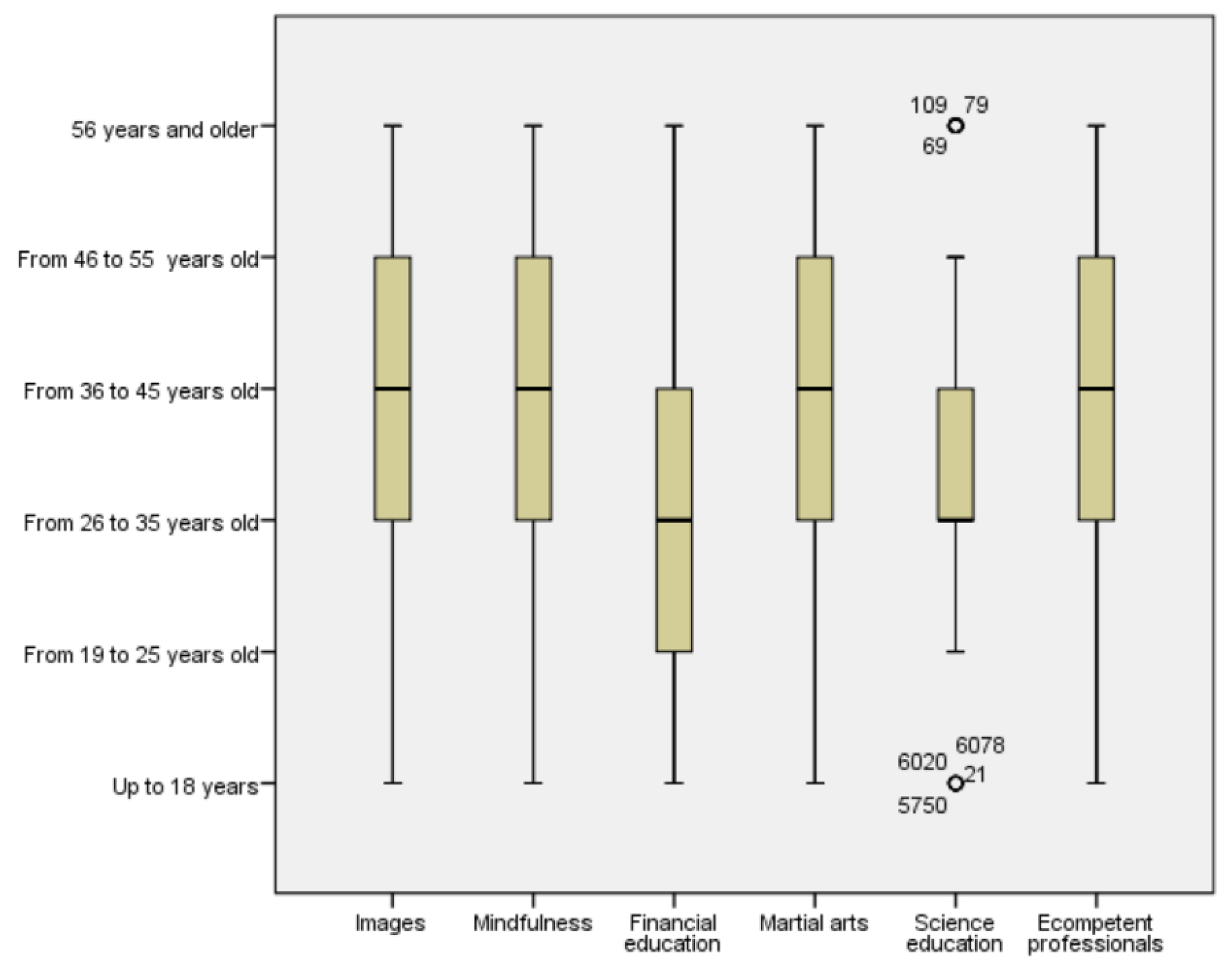
| Up to 18 | From 19 to 25 | From 26 to 35 | From 36 to 45 | From 46 to 55 | From 56 and over | ||
| Images | 98 | 657 | 1281 | 1227 | 833 | 291 | 4387 |
| 32.8% | 41.3% | 48% | 43.6% | 37.4% | 34.1% | 42% | |
| Mindfulness | 40 | 453 | 851 | 990 | 919 | 376 | 3629 |
| 13.4% | 28.5% | 31.9% | 35.2% | 41.2% | 44.1% | 34.7% | |
| Financial Education | 83 | 295 | 239 | 247 | 183 | 104 | 1151 |
| 27.8% | 18.5% | 9% | 8.8% | 8.2% | 12.2% | 11% | |
| Martial Arts | 61 | 73 | 114 | 154 | 146 | 39 | 587 |
| 20.4% | 4.6% | 4.3% | 5.5% | 6.6% | 4.6% | 5.6% | |
| Science Education | 7 | 30 | 72 | 45 | 40 | 10 | 204 |
| 2.3% | 1.9% | 2.7% | 1.6% | 1.8% | 1.2% | 2% | |
| E-competent Professionals | 10 | 84 | 110 | 151 | 108 | 33 | 496 |
| 3.3% | 5.3% | 4.1% | 5.4% | 4.8% | 3.9% | 4.7% | |
| Total | 299 | 1592 | 2667 | 2814 | 2229 | 853 | 10,454 |
| 100% | 100% | 100% | 100% | 100% | 100% | 100% | |
| Level of Studies | Sex | Total | |
|---|---|---|---|
| Men | Women | ||
| Primary | 111 2.1% | 54 1% | 165 1.6% |
| Secondary | 1225 23.4% | 839 16.1% | 2064 19.7% |
| University | 3901 74.5% | 4324 82.9% | 8225 78.7% |
| Total | 5237 (100%) | 5217 (100%) | 10,454 (100%) |
| MOOC | Employment Situation | |||||
|---|---|---|---|---|---|---|
| A | B | C | D | E | Total | |
| Up to 18 | 289 | 3 | 4 | 3 | 0 | 299 |
| 16.2% | 0.2% | 0.1% | 0.1% | 0% | 2.9% | |
| From 19 to 25 | 1077 | 73 | 232 | 210 | 0 | 1592 |
| 60.2% | 5.3% | 4.8% | 10.1% | 0.0% | 15.2% | |
| From 26 to 35 | 317 | 361 | 1303 | 684 | 2 | 2667 |
| 17.7% | 26.0% | 26.9% | 32.8% | 0.6% | 25.5% | |
| From 36 to 45 | 75 | 418 | 1667 | 640 | 14 | 2814 |
| 4.2% | 30.1% | 34.4% | 30.7% | 4.0% | 26.9% | |
| From 46 to 55 | 26 | 388 | 1323 | 441 | 51 | 2229 |
| 1.5% | 28.0% | 27.3% | 21.1% | 14.7% | 21.3% | |
| From 56 and over | 5 | 144 | 316 | 109 | 279 | 853 |
| 0.3% | 10.4% | 6.5% | 5.2% | 80.6% | 8.2% | |
| Total | 1789 | 1387 | 4845 | 2087 | 346 | 10,454 |
| 100% | 100% | 100% | 100% | 100% | 100% | |
| Have You Ever Done Online Training Before? | How Many Have You Done? | Total | ||
|---|---|---|---|---|
| One or Two | Three or Four | More Than 4 | ||
| Yes | 1991 22.7% | 1908 21.7% | 4889 55.6% | 8788 |
| No | 1666 | |||
| Total | 10,454 | |||
| Is This Your First MOOC? | How Many Have You Done? | Total | ||
|---|---|---|---|---|
| One or Two | Three or Four | More Than 4 | ||
| Yes | 4479 | |||
| No | 1810 30.3% | 1454 24.3% | 2711 45.4% | 5975 |
| Total | 10,454 | |||
| Frequency | Percentage | |
|---|---|---|
| Through social media (Facebook, Twitter, etc.) | 2636 | 25.2% |
| Through their educational centre | 795 | 7.6% |
| On the Internet | 868 | 8.3% |
| Through friends, acquaintances, co-workers | 2746 | 26.3% |
| Through Miríadax | 2413 | 23.1% |
| Advertising in press, television, Internet | 482 | 4.6% |
| Through links on other websites, email, RSS | 415 | 4% |
| Do not remember | 99 | 9% |
| Total | 10,454 | 100% |
| I Totally Agree | Partially Agree | Partially Disagree | I Disagree | Total | |
|---|---|---|---|---|---|
| Images | 2999 | 1311 | 55 | 22 | 4387 |
| 68.4% | 29.9% | 1.3% | 5% | 100% | |
| Mindfulness | 2411 | 1158 | 49 | 11 | 3629 |
| 66.4% | 31.9% | 1.4% | 3% | 100% | |
| Financial Education | 552 | 510 | 58 | 31 | 1151 |
| 48% | 44.3% | 5% | 2.7% | 100% | |
| Martial Arts | 383 | 171 | 23 | 10 | 587 |
| 65.2% | 29.1% | 3.9% | 1.7% | 100% | |
| Science Education | 125 | 73 | 6 | 0 | 204 |
| 61.3% | 35.8% | 2.9% | 0% | 100% | |
| E-competent Professionals | 300 | 188 | 8 | 0 | 496 |
| 60.5% | 37.9% | 1.6% | 0% | 100% | |
| Total | 6770 | 3411 | 199 | 74 | 10,454 |
| 64.8% | 32.6% | 1.9% | 7% | 100% |
| I Totally Agree | Partially Agree | Partially Disagree | I Disagree | Total | |
|---|---|---|---|---|---|
| Images | 3456 | 882 | 36 | 13 | 4387 |
| 78.8% | 20.1% | 8% | 3% | 100% | |
| Mindfulness | 2822 | 753 | 41 | 13 | 3629 |
| 77.8% | 20.7% | 1.1% | 4% | 100% | |
| Financial Education | 686 | 405 | 43 | 17 | 1151 |
| 59.6% | 35.2% | 3.7% | 1.5% | 100% | |
| Martial Arts | 414 | 155 | 12 | 6 | 587 |
| 70.5% | 26.4% | 2% | 1% | 100% | |
| Science Education | 135 | 61 | 6 | 2 | 204 |
| 66.2% | 29.9% | 2.9% | 1% | 100% | |
| E-competent Professionals | 342 | 144 | 10 | 0 | 496 |
| 69.0% | 29.0% | 2% | 0% | 100% | |
| Total | 7855 | 2400 | 148 | 51 | 10,454 |
| 75.1% | 23.0% | 1.4% | 0.5% | 100% |
| I Totally Agree | Partially Agree | Partially Disagree | I Disagree | Total | |
|---|---|---|---|---|---|
| Images | 2995 | 1294 | 71 | 27 | 4387 |
| 68.3% | 29.5% | 1.6% | 6% | 100% | |
| Mindfulness | 3384 | 223 | 8 | 14 | 3629 |
| 93.2% | 6.1% | 2% | 4% | 100% | |
| Financial Education | 986 | 158 | 7 | 0 | 1151 |
| 85.7% | 13.7% | 6% | 0% | 100% | |
| Martial Arts | 536 | 48 | 1 | 2 | 587 |
| 91.3% | 8.2% | 2% | 3% | 100% | |
| Science Education | 182 | 20 | 1 | 1 | 204 |
| 89.2% | 9.8% | 5% | 5% | 100% | |
| E-competent Professionals | 440 | 52 | 4 | 0 | 496 |
| 88.7% | 10.5% | 8% | 0% | 100% | |
| Total | 8523 | 1795 | 92 | 44 | 10,454 |
| 81.5% | 17.2% | 9% | 4% | 100% |
| I Totally Agree | Partially Agree | Partially Disagree | I Disagree | Total | |
|---|---|---|---|---|---|
| Images | 2208 | 1820 | 281 | 78 | 4387 |
| 50.3% | 41.5% | 6.4% | 1.8% | 100% | |
| Mindfulness | 3592 | 37 | 0 | 0 | 3629 |
| 99.0% | 1% | 0% | 0% | 100% | |
| Financial Education | 1107 | 44 | 0 | 0 | 1151 |
| 96.2% | 3.8% | 0% | 0% | 100% | |
| Martial Arts | 571 | 16 | 0 | 0 | 587 |
| 97.3% | 2.7% | 0% | 0% | 100% | |
| Science Education | 201 | 3 | 0 | 0 | 204 |
| 98.5% | 1.5% | 0% | 0% | 100% | |
| E-competent Professionals | 480 | 16 | 0 | 0 | 496 |
| 96.8% | 3.2% | 0% | 0% | 100% | |
| Total | 8159 | 1936 | 281 | 78 | 10,454 |
| 78.0% | 18.5% | 2.7% | 7% | 100% |
| Yes | No | Total | |
|---|---|---|---|
| Images | 4227 | 160 | 4387 |
| 96.4% | 3.6% | 100% | |
| Mindfulness | 3534 | 95 | 3629 |
| 97.4% | 2.6% | 100% | |
| Financial Education | 1047 | 104 | 1151 |
| 91.0% | 9.0% | 100% | |
| Martial Arts | 555 | 32 | 587 |
| 94.5% | 5.5% | 100% | |
| Science Education | 199 | 5 | 204 |
| 97.5% | 2.5% | 100% | |
| E-competent Professionals | 467 | 29 | 496 |
| 94.2% | 5.8% | 100% | |
| Total | 10,029 | 425 | 10,454 |
| 95.9% | 4.1% | 100% |
| Frequency | Percentage | |
|---|---|---|
| Very suitable/the most suitable/very good | 2681 | 25.6% |
| Adequate/correct/good | 7331 | 70.1% |
| Inadequate or poor/unreliable/needs to be supplemented | 351 | 3.4% |
| Not adequate/insufficient/demotivating | 65 | 6% |
| Don’t know/didn’t complete them | 26 | 2% |
| Total | 10,454 | 100% |
| Frequency | Percentage | |
|---|---|---|
| Excellent, fabulous, fantastic | 1314 | 12.6% |
| Very good, very useful | 3790 | 36.3% |
| Good, correct, interesting | 2265 | 21.7% |
| Don’t like it, not convinced, indifferent | 621 | 5.9% |
| Disagree, useless | 1437 | 13.7% |
| Didn’t send homework | 1027 | 9.8% |
| Total | 10,454 | 100% |
© 2019 by the authors. Licensee MDPI, Basel, Switzerland. This article is an open access article distributed under the terms and conditions of the Creative Commons Attribution (CC BY) license (http://creativecommons.org/licenses/by/4.0/).
Share and Cite
Ruiz-Palmero, J.; López-Álvarez, D.; Sánchez-Rivas, E.; Sánchez-Rodríguez, J. An Analysis of the Profiles and the Opinion of Students Enrolled on xMOOCs at the University of Málaga. Sustainability 2019, 11, 6910. https://doi.org/10.3390/su11246910
Ruiz-Palmero J, López-Álvarez D, Sánchez-Rivas E, Sánchez-Rodríguez J. An Analysis of the Profiles and the Opinion of Students Enrolled on xMOOCs at the University of Málaga. Sustainability. 2019; 11(24):6910. https://doi.org/10.3390/su11246910
Chicago/Turabian StyleRuiz-Palmero, Julio, Daniel López-Álvarez, Enrique Sánchez-Rivas, and José Sánchez-Rodríguez. 2019. "An Analysis of the Profiles and the Opinion of Students Enrolled on xMOOCs at the University of Málaga" Sustainability 11, no. 24: 6910. https://doi.org/10.3390/su11246910
APA StyleRuiz-Palmero, J., López-Álvarez, D., Sánchez-Rivas, E., & Sánchez-Rodríguez, J. (2019). An Analysis of the Profiles and the Opinion of Students Enrolled on xMOOCs at the University of Málaga. Sustainability, 11(24), 6910. https://doi.org/10.3390/su11246910

