

The Challenge of Feeding the World


Abstract
1. Introduction
2. Materials and Methods
3. Results and Discussion
3.1. Land Use
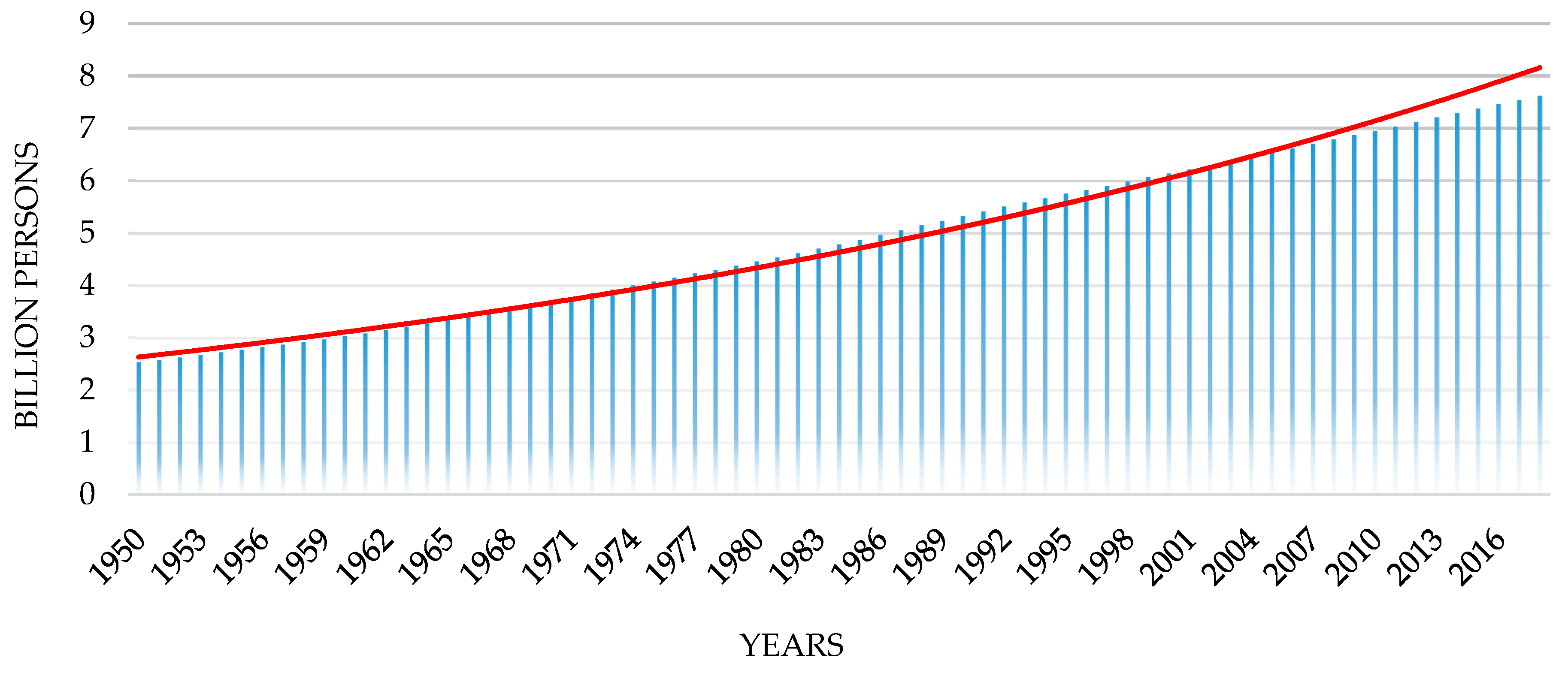
3.2. Population
3.3. Crop Biology
3.4. Reasons of Changing Eating Habits
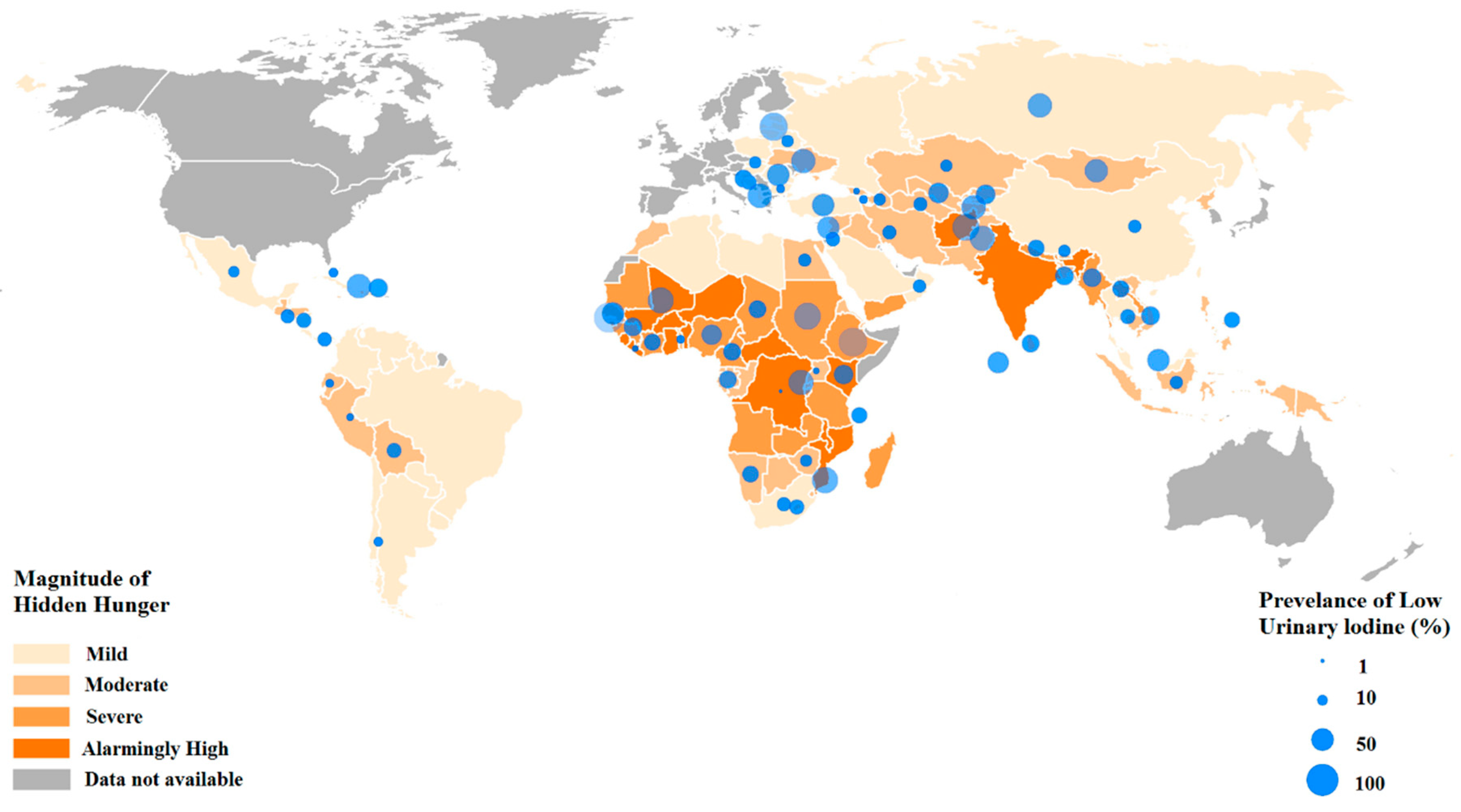
3.5. Links between Nutrients and “Hidden Hunger”
3.6. Climate Change and Water
3.7. China’s Food Supply
3.8. Food Prices and Food Security
4. Conclusions
Author Contributions
Funding
Conflicts of Interest
References
- Knapp, S.; van der Heijden, M.G.A. A global meta-analysis of yield stability in organic and conservation agriculture. Nat. Commun. 2018, 9, 3632. [Google Scholar] [CrossRef] [PubMed]
- Hofstra, N.; Vermeulen, L.C. Impacts of population growth, urbanisation and sanitation changes on global human Cryptosporidium emissions to surface water. Int. J. Hyg. Environ. Health 2016, 219, 599–605. [Google Scholar] [CrossRef] [PubMed]
- Röös, E.; Bajželj, B.; Smith, P.; Patel, M.; Little, D.; Garnett, T. Greedy or needy? Land use and climate impacts of food in 2050 under different livestock futures. Glob. Environ. Chang. 2017, 47, 1–12. [Google Scholar] [CrossRef]
- Kummu, M.; De Moel, H.; Salvucci, G.; Viviroli, D.; Ward, P.J.; Varis, O. Over the hills and further away from coast: Global geospatial patterns of human and environment over the 20th–21st centuries. Environ. Res. Lett. 2016, 11, 034010. [Google Scholar] [CrossRef]
- Smith, P. Malthus is still wrong: We can feed a world of 9–10 billion, but only by reducing food demand. Proc. Nutr. Soc. 2015, 74, 187–190. [Google Scholar] [CrossRef]
- d’Amour, C.B.; Reitsma, F.; Baiocchi, G.; Barthel, S.; Güneralp, B.; Erb, K.-H.; Haberl, H.; Creutzig, F.; Seto, K.C. Future urban land expansion and implications for global croplands. Proc. Natl. Acad. Sci. USA 2017, 114, 8939–8944. [Google Scholar] [CrossRef]
- Popp, J.; Lakner, Z.; Harangi-Rakos, M.; Fari, M. The effect of bioenergy expansion: Food, energy, and environment. Renew. Sustain. Energy Rev. 2014, 32, 559–578. [Google Scholar] [CrossRef]
- Wheeler, T.; Von Braun, J. Climate change impacts on global food security. Science 2013, 341, 508–513. [Google Scholar] [CrossRef]
- Riggs, P.K.; Fields, M.J.; Cross, H.R. Food and Nutrient Security for a Growing Population; Oxford University Press US: Oxford, MS, USA, 2018. [Google Scholar]
- Alexandratos, N.; Bruinsma, J. World Agriculture towards 2030/2050: The 2012 Revision; ESA Working Paper; FAO: Rome, Italy, 2012. [Google Scholar]
- Westhoek, H.; Lesschen, J.P.; Rood, T.; Wagner, S.; De Marco, A.; Murphy-Bokern, D.; Leip, A.; van Grinsven, H.; Sutton, M.A.; Oenema, O. Food choices, health and environment: Effects of cutting Europe’s meat and dairy intake. Glob. Environ. Chang. 2014, 26, 196–205. [Google Scholar] [CrossRef]
- The World Bank Homepage. Available online: https://databank.worldbank.org/home.aspx (accessed on 22 January 2019).
- Database of Food and Agriculture Organization of the United Nations. Available online: http://www.fao.org/faostat/en/#data (accessed on 18 January 2019).
- Boserup, E. The Conditions of Agricultural Growth: The Economics of Agrarian Change under Population Pressure; Routledge: London, UK, 2017. [Google Scholar] [CrossRef]
- Davis, K.F.; Gephart, J.A.; Emery, K.A.; Leach, A.M.; Galloway, J.N.; D’Odorico, P. Meeting future food demand with current agricultural resources. Glob. Environ. Chang. 2016, 39, 125–132. [Google Scholar] [CrossRef]
- Crist, E.; Mora, C.; Engelman, R. The interaction of human population, food production, and biodiversity protection. Science 2017, 356, 260–264. [Google Scholar] [CrossRef] [PubMed]
- McLaughlin, D.; Kinzelbach, W. Food security and sustainable resource management. Water Resour. Res. 2015, 51, 4966–4985. [Google Scholar] [CrossRef]
- Ramankutty, N.; Mehrabi, Z.; Waha, K.; Jarvis, L.; Kremen, C.; Herrero, M.; Rieseberg, L.H. Trends in global agricultural land use: Implications for environmental health and food security. Annu. Rev. Plant Biol. 2018, 69, 789–815. [Google Scholar] [CrossRef] [PubMed]
- Blum, W.E. Functions of soil for society and the environment. Rev. Environ. Sci. Bio/Technol. 2005, 4, 75–79. [Google Scholar] [CrossRef]
- Tilman, D.; Clark, M. Global diets link environmental sustainability and human health. Nature 2014, 515, 518. [Google Scholar] [CrossRef]
- Godfray, H. The challenge of feeding 9–10 billion people equitably and sustainably. J. Agric. Sci. 2014, 152, 2–8. [Google Scholar] [CrossRef]
- Arbuckle, J.G., Jr.; Morton, L.W.; Hobbs, J. Understanding farmer perspectives on climate change adaptation and mitigation: The roles of trust in sources of climate information, climate change beliefs, and perceived risk. Environ. Behav. 2015, 47, 205–234. [Google Scholar] [CrossRef]
- WORLDOMETERS. Current World Population. 2019. Available online: https://www.worldometers.info/world-population/ (accessed on 7 January 2019).
- Our World in Data. World Population over the Last 12,000 Years and UN Projection until 2100. 2018. Available online: https://ourworldindata.org/world-population-growth (accessed on 8 December 2018).
- UN. World Population Prospects. 2019. Available online: https://population.un.org/wpp/Publications/Files/WPP2019_Highlights.pdf (accessed on 8 June 2019).
- WORLDOMETERS. Current World Population. 2018. Available online: https://www.worldometers.info/world-population/world-population-by-year/ (accessed on 8 December 2018).
- FAO. The Future of Food and Agriculture—Trends and Challenges. 2017. Available online: http://www.fao.org/3/a-i6583e.pdf (accessed on 8 December 2018).
- Murchie, E.; Pinto, M.; Horton, P. Agriculture and the new challenges for photosynthesis research. New Phytol. 2009, 181, 532–552. [Google Scholar] [CrossRef]
- Furbank, R.T.; Quick, W.P.; Sirault, X.R. Improving photosynthesis and yield potential in cereal crops by targeted genetic manipulation: Prospects, progress and challenges. Field Crop. Res. 2015, 182, 19–29. [Google Scholar] [CrossRef]
- Foley, J.A.; Ramankutty, N.; Brauman, K.A.; Cassidy, E.S.; Gerber, J.S.; Johnston, M.; Mueller, N.D.; O’Connell, C.; Ray, D.K.; West, P.C.; et al. Solutions for a cultivated planet. Nature 2011, 478, 337. [Google Scholar] [CrossRef]
- Lesk, C.; Rowhani, P.; Ramankutty, N. Influence of extreme weather disasters on global crop production. Nature 2016, 529, 84. [Google Scholar] [CrossRef] [PubMed]
- Zhang, X.; Davidson, E.A.; Mauzerall, D.L.; Searchinger, T.D.; Dumas, P.; Shen, Y. Managing nitrogen for sustainable development. Nature 2015, 528, 51. [Google Scholar] [CrossRef] [PubMed]
- Goucher, L.; Bruce, R.; Cameron, D.D.; Koh, S.L.; Horton, P. The environmental impact of fertilizer embodied in a wheat-to-bread supply chain. Nat. Plants 2017, 3, 17012. [Google Scholar] [CrossRef] [PubMed]
- Dawson, C.J.; Hilton, J. Fertiliser availability in a resource-limited world: Production and recycling of nitrogen and phosphorus. Food Policy 2011, 36, S14–S22. [Google Scholar] [CrossRef]
- Lamberth, C.; Jeanmart, S.; Luksch, T.; Plant, A. Current challenges and trends in the discovery of agrochemicals. Science 2013, 341, 742–746. [Google Scholar] [CrossRef]
- Pittelkow, C.M.; Liang, X.; Linquist, B.A.; Van Groenigen, K.J.; Lee, J.; Lundy, M.E.; Van Gestel, N.; Six, J.; Venterea, R.T.; Van Kessel, C. Productivity limits and potentials of the principles of conservation agriculture. Nature 2015, 517, 365. [Google Scholar] [CrossRef]
- Woolf, S.H. The meaning of translational research and why it matters. JAMA 2008, 299, 211–213. [Google Scholar] [CrossRef]
- Jacobsen, S.-E.; Sørensen, M.; Pedersen, S.M.; Weiner, J. Feeding the world: Genetically modified crops versus agricultural biodiversity. Agron. Sustain. Dev. 2013, 33, 651–662. [Google Scholar] [CrossRef]
- Hefferon, K.L.; Herring, R.J. The End of the GMO? Genome Editing, Gene Drives and New Frontiers of Plant Technology. Journal 2017, 7, 1–32. [Google Scholar]
- Fairfield-Sonn, J.W. Political Economy of GMO Foods. J. Manag. Policy Pract. 2016, 17, 1. [Google Scholar]
- FAO. The State of Food Security & Nutrition around the World 2018; FAO: Rome, Italy, 2018. [Google Scholar]
- Jackson, P.; Ward, N.; Russell, P. Moral economies of food and geographies of responsibility. Trans. Inst. Br. Geogr. 2009, 34, 12–24. [Google Scholar] [CrossRef]
- Warde, A. Consumption and theories of practice. J. Consum. Cult. 2005, 5, 131–153. [Google Scholar] [CrossRef]
- Delormier, T.; Frohlich, K.L.; Potvin, L. Food and eating as social practice–understanding eating patterns as social phenomena and implications for public health. Sociol. Health Illn. 2009, 31, 215–228. [Google Scholar] [CrossRef] [PubMed]
- Watson, M.; Meah, A. Food, waste and safety: Negotiating conflicting social anxieties into the practices of domestic provisioning. Sociol. Rev. 2012, 60, 102–120. [Google Scholar] [CrossRef]
- West, P.C.; Gerber, J.S.; Engstrom, P.M.; Mueller, N.D.; Brauman, K.A.; Carlson, K.M.; Cassidy, E.S.; Johnston, M.; MacDonald, G.K.; Ray, D.K. Leverage points for improving global food security and the environment. Science 2014, 345, 325–328. [Google Scholar] [CrossRef]
- Clark, M.; Tilman, D. Comparative analysis of environmental impacts of agricultural production systems, agricultural input efficiency, and food choice. Environ. Res. Lett. 2017, 12, 064016. [Google Scholar] [CrossRef]
- OECD. Education at a Glance 2018; OECD: Paris, France, 2018. [Google Scholar] [CrossRef]
- Blanchard, J.L.; Watson, R.A.; Fulton, E.A.; Cottrell, R.S.; Nash, K.L.; Bryndum-Buchholz, A.; Büchner, M.; Carozza, D.A.; Cheung, W.W.L.; Elliott, J.; et al. Linked sustainability challenges and trade-offs among fisheries, aquaculture and agriculture. Nat. Ecol. Evol. 2017, 1, 1240–1249. [Google Scholar] [CrossRef]
- Cole, M.B.; Augustin, M.A.; Robertson, M.J.; Manners, J.M. The science of food security. NPJ Sci. Food 2018, 2, 14. [Google Scholar] [CrossRef]
- Gustafsson, J.; Cederberg, C.; Sonesson, U.; Emanuelsson, A. The Methodology of the FAO Study: Global Food Losses and Food Waste-Extent, Causes and Prevention—FAO, 2011; SIK Institutet för livsmedel och bioteknik: Boras, Sweden, 2013. [Google Scholar]
- Tirado, M.; Hunnes, D.; Cohen, M.; Lartey, A. Climate change and nutrition in Africa. J. Hunger Environ. Nutr. 2015, 10, 22–46. [Google Scholar] [CrossRef]
- Holdsworth, M.; Kruger, A.; Nago, E.; Lachat, C.; Mamiro, P.; Smit, K.; Garimoi-Orach, C.; Kameli, Y.; Roberfroid, D.; Kolsteren, P. African stakeholders’ views of research options to improve nutritional status in sub-Saharan Africa. Health Policy Plan. 2014, 30, 863–874. [Google Scholar] [CrossRef]
- Godfray, H.C.J.; Beddington, J.R.; Crute, I.R.; Haddad, L.; Lawrence, D.; Muir, J.F.; Pretty, J.; Robinson, S.; Thomas, S.M.; Toulmin, C. Food security: The challenge of feeding 9 billion people. Science 2010, 327, 1185383. [Google Scholar] [CrossRef] [PubMed]
- McGuire, S.; FAO; IFAD; WFP. The State of Food Insecurity in the World 2015: Meeting the 2015 International Hunger Targets: Taking Stock of Uneven Progress; FAO: Rome, Italy, 2015. [Google Scholar] [CrossRef]
- Haddad, L.; Achadi, E.; Bendech, M.A.; Ahuja, A.; Bhatia, K.; Bhutta, Z.; Blössner, M.; Borghi, E.; Colecraft, E.; de Onis, M.; et al. The Global Nutrition Report 2014: Actions and Accountability to Accelerate the World’s Progress on Nutrition. J. Nutr. 2015, 145, 663–671. [Google Scholar] [CrossRef] [PubMed]
- Hengeveld, L.M.; Wijnhoven, H.A.; Olthof, M.R.; Brouwer, I.A.; Harris, T.B.; Kritchevsky, S.B.; Newman, A.B.; Visser, M.; Study, H.A. Prospective associations of poor diet quality with long-term incidence of protein-energy malnutrition in community-dwelling older adults: The Health, Aging, and Body Composition (Health ABC) Study. Am. J. Clin. Nutr. 2018, 107, 155–164. [Google Scholar] [CrossRef] [PubMed]
- Lim, S.S.; Vos, T.; Flaxman, A.D.; Danaei, G.; Shibuya, K.; Adair-Rohani, H.; AlMazroa, M.A.; Amann, M.; Anderson, H.R.; Andrews, K.G. A comparative risk assessment of burden of disease and injury attributable to 67 risk factors and risk factor clusters in 21 regions, 1990–2010: A systematic analysis for the Global Burden of Disease Study 2010. Lancet 2012, 380, 2224–2260. [Google Scholar] [CrossRef]
- Muthayya, S.; Rah, J.H.; Sugimoto, J.D.; Roos, F.F.; Kraemer, K.; Black, R.E. The global hidden hunger indices and maps: An advocacy tool for action. PLoS ONE 2013, 8, e67860. [Google Scholar] [CrossRef]
- Eggersdorfer, M.; Akobundu, U.; Bailey, R.L.; Shlisky, J.; Beaudreault, A.R.; Bergeron, G.; Blancato, R.B.; Blumberg, J.B.; Bourassa, M.W.; Gomes, F. Hidden Hunger: Solutions for America’s Aging Populations. Nutrients 2018, 10, 9. [Google Scholar] [CrossRef]
- Trimmer, J.T.; Guest, J.S. Recirculation of human-derived nutrients from cities to agriculture across six continents. Nat. Sustain. 2018, 1, 427–435. [Google Scholar] [CrossRef]
- Lobell, D.B.; Schlenker, W.; Costa-Roberts, J. Climate trends and global crop production since 1980. Science 2011, 333, 1204531. [Google Scholar] [CrossRef]
- Diaz, D.; Moore, F. Quantifying the economic risks of climate change. Nat. Clim. Chang. 2017, 7, 774. [Google Scholar] [CrossRef]
- Fróna, D. Globális kihívások a mezőgazdaságban. Int. J. Eng. Manag. Sci. 2018, 3, 195–205. [Google Scholar] [CrossRef]
- Scialabba, N.E.-H.; Müller-Lindenlauf, M. Organic agriculture and climate change. Renew. Agric. Food Syst. 2010, 25, 158–169. [Google Scholar] [CrossRef]
- Müller, C.; Robertson, R.D. Projecting future crop productivity for global economic modeling. Agric. Econ. 2014, 45, 37–50. [Google Scholar] [CrossRef]
- Müller, C.; Bondeau, A.; Popp, A.; Waha, K.; Fader, M. Climate change impacts on agricultural yields. 2010. Available online: https://openknowledge.worldbank.org/handle/10986/9065?locale-attribute=en (accessed on 8 December 2018).
- Challinor, A.J.; Watson, J.; Lobell, D.; Howden, S.; Smith, D.; Chhetri, N. A meta-analysis of crop yield under climate change and adaptation. Nat. Clim. Chang. 2014, 4, 287. [Google Scholar] [CrossRef]
- Asseng, S.; Ewert, F.; Martre, P.; Rötter, R.P.; Lobell, D.; Cammarano, D.; Kimball, B.; Ottman, M.; Wall, G.; White, J.W. Rising temperatures reduce global wheat production. Nat. Clim. Chang. 2015, 5, 143. [Google Scholar] [CrossRef]
- EASAC. Opportunities and Challenges for Research on Food and Nutrition Security and Agriculture in Europe; EASAC: Halle, Germany, 2017. [Google Scholar]
- Lane, A.; Norton, M.; Ryan, S. Water Resources: A New Water Architecture; John Wiley & Sons: Hoboken, NJ, USA, 2017. [Google Scholar]
- WHO. Progress on Sanitation and Drinking Water: 2015 Update and MDG Assessment; World Health Organization: Geneva, Switzerland, 2015. [Google Scholar]
- Lu, C.; Tian, H. Global nitrogen and phosphorus fertilizer use for agriculture production in the past half century: Shifted hot spots and nutrient imbalance. Earth Syst. Sci. Data 2017, 9, 181–192. [Google Scholar] [CrossRef]
- Cui, K.; Shoemaker, S.P. A look at food security in China. NPJ Sci. Food 2018, 2, 4. [Google Scholar] [CrossRef] [PubMed]
- Qin, Y.; Zhang, X. The road to specialization in agricultural production: Evidence from rural China. World Dev. 2016, 77, 1–16. [Google Scholar] [CrossRef]
- Kang, S.; Hao, X.; Du, T.; Tong, L.; Su, X.; Lu, H.; Li, X.; Huo, Z.; Li, S.; Ding, R. Improving agricultural water productivity to ensure food security in China under changing environment: From research to practice. Agric. Water Manag. 2017, 179, 5–17. [Google Scholar] [CrossRef]
- Carter, C.A.; Zhong, F.; Zhu, J. Advances in Chinese agriculture and its global implications. Appl. Econ. Perspect. Policy 2012, 34, 1–36. [Google Scholar] [CrossRef]
- Guan, X.; Wei, H.; Lu, S.; Dai, Q.; Su, H. Assessment on the urbanization strategy in China: Achievements, challenges and reflections. Habitat Int. 2018, 71, 97–109. [Google Scholar] [CrossRef]
- Swinnen, J.; Squicciarini, P. Mixed messages on prices and food security. Science 2012, 335, 405–406. [Google Scholar] [CrossRef] [PubMed]
- Calvo-Gonzalez, O.; Shankar, R.; Trezzi, R. Are Commodity Prices More Volatile Now? A Long-Run Perspective; The World Bank: Washington, DC, USA, 2010. [Google Scholar]
- Baffes, J.; Haniotis, T. What explains agricultural price movements? J. Agric. Econ. 2016, 67, 706–721. [Google Scholar] [CrossRef]
- Timmer, C.P. Causes of High Food Prices; ADB Economics Working Paper Series; ADB Economics: Manila, Philippines, 2008. [Google Scholar]
- Imf, O.; Unctad, W. Price Volatility in Food and Agricultural Markets: Policy Responses; FAO: Roma, Italy, 2011. [Google Scholar]
- Hochman, G.; Rajagopal, D.; Timilsina, G.; Zilberman, D. Quantifying the causes of the global food commodity price crisis. Biomass Bioenergy 2014, 68, 106–114. [Google Scholar] [CrossRef]
- Serra, T.; Zilberman, D. Biofuel-related price transmission literature: A review. Energy Econ. 2013, 37, 141–151. [Google Scholar] [CrossRef]
- Kristoufek, L.; Janda, K.; Zilberman, D. Correlations between biofuels and related commodities before and during the food crisis: A taxonomy perspective. Energy Econ. 2012, 34, 1380–1391. [Google Scholar] [CrossRef]
- Kristoufek, L.; Janda, K.; Zilberman, D. Regime-dependent topological properties of biofuels networks. Eur. Phys. J. B 2013, 86, 40. [Google Scholar] [CrossRef]
- Gilbert, C.L. How to understand high food prices. J. Agric. Econ. 2010, 61, 398–425. [Google Scholar] [CrossRef]
- Opara, L.U. Traceability in agriculture and food supply chain: A review of basic concepts, technological implications, and future prospects. J. Food Agric. Environ. 2003, 1, 101–106. [Google Scholar]
- Behzadi, G.; O’Sullivan, M.J.; Olsen, T.L.; Zhang, A. Agribusiness supply chain risk management: A review of quantitative decision models. Omega 2018, 79, 21–42. [Google Scholar] [CrossRef]
- Horton, P.; Koh, L.; Guang, V.S. An integrated theoretical framework to enhance resource efficiency, sustainability and human health in agri-food systems. J. Clean. Prod. 2016, 120, 164–169. [Google Scholar] [CrossRef]
- Farkasné Fekete, M.; Balyi, Z.; Szűcs, I. Az agrárgazdaság hatékonyságának néhány sajátos aspektusa. Gazdálkodás Sci. J. Agric. Econ. 2014, 58, 564–594. [Google Scholar]
- Du, X.; Lu, L.; Reardon, T.; Zilberman, D. Economics of agricultural supply chain design: A portfolio selection approach. Am. J. Agric. Econ. 2016, 98, 1377–1388. [Google Scholar] [CrossRef]
- Dunning, D.; Johnson, K.; Ehrlinger, J.; Kruger, J. Why people fail to recognize their own incompetence. Curr. Dir. Psychol. Sci. 2003, 12, 83–87. [Google Scholar] [CrossRef]
- Cavicchi, C.; Vagnoni, E. Intellectual capital in support of farm businesses’ strategic management: A case study. J. Intellect. Cap. 2018, 19, 692–711. [Google Scholar] [CrossRef]
© 2019 by the authors. Licensee MDPI, Basel, Switzerland. This article is an open access article distributed under the terms and conditions of the Creative Commons Attribution (CC BY) license (http://creativecommons.org/licenses/by/4.0/).
Share and Cite
Fróna, D.; Szenderák, J.; Harangi-Rákos, M. The Challenge of Feeding the World. Sustainability 2019, 11, 5816. https://doi.org/10.3390/su11205816
Fróna D, Szenderák J, Harangi-Rákos M. The Challenge of Feeding the World. Sustainability. 2019; 11(20):5816. https://doi.org/10.3390/su11205816
Chicago/Turabian StyleFróna, Dániel, János Szenderák, and Mónika Harangi-Rákos. 2019. "The Challenge of Feeding the World" Sustainability 11, no. 20: 5816. https://doi.org/10.3390/su11205816
APA StyleFróna, D., Szenderák, J., & Harangi-Rákos, M. (2019). The Challenge of Feeding the World. Sustainability, 11(20), 5816. https://doi.org/10.3390/su11205816

