Abstract
With the cultivation of the shared economy, shared parking provides a new solution to the urban parking resource shortage problem. In this paper, the shared parking mode is taken as the research object to improve the utilization efficiency of parking spaces. The stated preference (SP) survey is used to collect the intention of sharing parking behavior in a typical shared parking mode situation. The behavior selection characteristics of the person sharing parking are analyzed and a binary logit model is used to establish the parking behavior selection model. The key parameters of a floating charge are proposed. Based on the above research, a dynamic balance adjustment method for shared parking floating charges is proposed and an empirical analysis is carried out. The research results showed that compared with fixed fees, the floating charge method can improve the utilization rate of idle spaces by more than 60% and control the occupancy rate of spaces by 60–80%. The floating charge method not only guarantees its own parking demand but also exploits the potential of shard parking facilities, which is good for promoting the sustainable and healthy development of urban transportation.
1. Introduction
Parking space sharing refers to measures to use the differences in parking demand in space and time to serve parking lots in two or more adjacent areas within a specific period of time [1]. Parking sharing between facilities usually has a clear open time and space window, while the arrival, departure and parking of vehicles are random. Through a reasonable parking sharing strategy, the utilization efficiency of parking facilities can be effectively improved, and the imbalance between the supply and demand of regional parking can be alleviated. Compared to fixed parking, shared parking demand is more flexible. It is necessary to adjust the shared space fee based on the real-time parking situation and maintain a balance between supply and demand for parking resources, so as to optimize the utilization of parking resources through price leverage.
The formulation of a shared parking management strategy is closely related to the choice of parking behavior. Hess et al. [2] proposed that prior experience will significantly affect the selection of a parking space, and drivers will consider such factors as price and walking distance on the basis of parking lot type selection. Chen [3] studied the time-varying characteristics of parking demand of an administrative office in the city and summarized a method of dividing the shared space–time window of the typical land type. Liu [4] established two logit models for the behavior of users of typical land type parking facilities based on questionnaire survey data and video data, and analyzed users’ choice intentions. Chen et al [5] built campus shared-use parking decision and a two-layer model of berth allocation, the result show that campus should open the parking space at night. The above research mainly analyzed the factors affecting the behavior selection of shared parking spaces.
Regarding a floating parking charge, as one of the main influencing factors of parking demand, parking cost is regarded as an effective management strategy of parking demand. Some studies have shown that the adjustment of parking fees can improve the utilization rate of parking lots and have a great impact on parking supply and demand [6]. Simicevic et. al. [7] analyzed the flexibility of parking charges for off-road parking, and the results showed that increasing the parking fee would reduce parking demand and the parking occupancy rate. Ayala et al. [8] proposed a parking charge model to reflect the problem of parking competition and examined the impact of pricing strategy on driver parking competition. He et al. [9] extended Ayala et al’s thinking by expressing the equilibrium state of parking competition with a nonlinear equation, and achieved the optimal allocation of parking spaces under different pricing mechanisms. In view of the dynamics of parking demand, “SF Park” was introduced in San Francisco. Sensors were installed on the parking space to detect whether and when the parking berth was occupied, so as to monitor the parking demand in real time. Variable parking charges were set based on the data on parking space utilization rates for each region, and the drivers could query the real-time vacant parking space information through the website or mobile application (app). It has been proved that the above method can effectively control the parking demand in practice [10,11].
In conclusion, there are many studies on the effects of variable parking rates at present, but most of them focus on reducing cruising and optimizing parking space allocation. The floating charge method has achieved great success in the pilot project in San Francisco, but there are few domestic applications in this field. In particular, the floating charge method for shared parking needs to be strengthened from the perspective of methodology. This paper takes the shared parking mode as the research object, with the goal of improving the utilization efficiency of existing parking spaces in parking facilities. The behavior selection characteristics of shared parking are analyzed, the optimization method of floating charge is proposed, and the empirical analysis and comparative evaluation of the charging scheme and the effect of implementation are undertaken.
3. Floating Charge Method
The basic idea of dynamic floating charge is to keep the space occupancy of shared parking facilities within an ideal range. If the occupancy rate is within this range in the current time interval, parking charges remain unchanged in the next time period. If the occupancy rate is below the ideal range in the current time interval, parking charges will be cut a floating step in the next time interval to attract more shared parking demand. If the occupancy rate is higher than the ideal range, parking charges will be raised a floating step in the next period to prevent more shared parking demand. Based on the principle of the dynamic floating space charge method, the upper and lower limits of a floating space are set according to the actual situation. The occupancy rate maintains a relatively stable level through such dynamic adjustment, realizing the effective utilization of idle space resources. Priority parking for the parking lot’s own needs is not affected.
By referring to the parking charge mechanism of San Francisco city, this parking occupancy rate ideal range was set to 60–80%. After determining the occupancy rate as the key indicator, the time interval, the floating step, and upper and lower limits of price floating were determined.
3.1. Key Parameters of Floating Charge
3.1.1. Time Interval
Many cities in China, such as Beijing, Nanjing and Shanghai, have a minimum of 15 min for space charging. Besides, it was found that the 15-min statistical interval was more stable for time series of parking space occupancy, the sequence similarity to the working day was stronger, and the fluctuation was smaller. Therefore, the adjustment interval for shared parking price fluctuations was set to 15 min under the shared parking mode.
3.1.2. Floating Step
The floating step of a single price should be set appropriately. If the floating step is too high, it will cause sudden changes in the price curve, which will lead to unfair charges for shared parking. If the floating step is too low, the price change would be small and will not effectively attract or restrain the demand for shared parking. The binary logit model established above is taken as an example. The influence of the floating step on the choice of shared parking berth was analyzed. The initial value of the shared parking facility was set to the same price as the adjacent parking lot. Income takes the average value of all survey data, and the value of price changes by 10%, 20% and 25%, respectively. The occupancy rate was calculated with probability of occupancy rate of 60–80%. The calculation method of selection probability shown above was used. When the occupancy rate was 60–80%, taking occupancy = 2, if the price ratio of B and A is 1.80, then the price is 1, . If the price ratio of B and A is 1.70, then the price is 1.25. If the price ratio of B and A is 1.80, then the price is 1.5, and the following calculation results are the same. The results are shown below (Table 3).
Table 3.
Probability of sharing parking lots under different conditions.
It is clear that the probability change is too little when the price fluctuates by 10%. Apart from that, the price will decrease to zero after four times of reduction, and the price gradient is relatively small when the price fluctuates by 25%. Therefore, the floating step was set as .
3.1.3. Upper and Lower Limits of Price Floating
In fact, the shared parking charges cannot be increased or decreased indefinitely. As can be seen from Table 3, when the upper price limit was set to shared parking price facilities 80% higher than their own parking facilities, the range of selection probability variation was a relatively elastic interval with an obvious span. If the price went beyond this range, it would no longer have a significant impact on the choices of potential shared parking drivers. Therefore, the upper of price floating was set to 180% of the initial price of the shared parking facility, and lower limit was set to 20%.
In conclusion, the specific adjustment range and method were as follows (Table 4):
Table 4.
The adjustment range and method of floating charge rate.
3.2. Floating Charge Process
Based on the space occupancy rate, the process of the dynamically floating charge is as follows:
The parking facilities that are seeking shared spaces are denoted as Y, the parking facilities that open shared spaces are denoted as .
Step 1: Get the shared space–time window of parking facility . Divide the shared space-time window into 15-min intervals and mark them as , for example, represents the first interval after open sharing, and so on.
Step 2: Get the total parking spaces of parking facilities and , recorded as and , respectively. Get the initial parking occupancy and parking charges of parking facility and ; space occupancy rates are denoted as and , respectively; space occupancy are denoted as and respectively; parking charges are denoted as and , respectively; make .
Divide the interval in which the occupancy is located into ,, , , marked as occupancy condition .
Step 3: For the time period, the number of new vehicles arriving at parking facility is ; the number of vehicles leaving parking facilities Y is ; then, the net number of vehicles entering in this period is . If , then proceed to Step 4. Otherwise, the parking facility does not seek shared spaces externally in the time period. Space occupancy is own demand for shared parking facilities .
Step 4: According to the behavior selection model, when the price of the sharing facility and space occupancy conditions of parking facility change, the probability of selecting is calculated. During the time period, when the parking occupancy condition of is , and the price of is , the probability of potential parking users willing to choose is .
Step 5: According to the space occupancy rate of parking facility in the previous time period , calculate the demand to enter the shared parking facility .
If due to the saturation of parking facility , the number of vehicles willing to go to the shared parking facilities is . According to the probability calculation formula (3), the probability of choosing shared parking facilities can be obtained under different saturations and prices.
If , the corresponding space occupancy condition is , which should be discussed in two cases:
First, the net number of entering vehicles during the period plus the number of spaces occupied during the period is still less than or equal to the total number of spaces of the parking facility ; that is, . During time period, the number of vehicles willing to go to the shared parking facilities is , and in this case, .
Second, the net number of entering vehicles during the period plus the number of spaces occupied during the period is more than the total number of spaces of the parking facilities ; that is . There are two parts to demand for the shared parking facilities , one part is demand for when parking facility Y is not saturated, because of the low price or other factors; that is . The other part is the shared parking demand for in the net number of entering vehicles due to the saturation of parking facility ; that is, .Then the driving demand of parking facility S is .
Step 6: Calculate the space occupancy rate and space condition of shared parking facilities in the time period.
According to the driving demand of the parking facility in the time period, the number of departures in the time period is obtained. Therefore, the space occupancy rate of the shared parking facility during the period is obtained; that is , where is the space occupancy of its own demand of the shared parking facilities in the period time, and the space occupancy condition is marked as .
Step 7: Recalculate the space occupancy rate and space conditions of shared parking facilities in the time period.
That is, , and the corresponding space condition is obtained. If , it is no longer necessary to stimulate or suppress the sharing demand by adjusting the price of the parking facility , so the price of the shared parking facility is maintained, that is , otherwise Steps 7 is continued.
Step 8: Adjust the price of shared parking spaces according to the occupancy condition of parking facility in the time period.
When , the space occupancy rate of parking facility S is still less than 60% after open sharing, reduce the price by one step to attract more shared demand, that is .
When , the space occupancy rate of parking facility S is kept within the range of 60–80% after open sharing, there is no need to change the price, that is .
When , the space occupancy rate of parking facility S exceeds 80% after open sharing, increase the price by one step to suppress more shared demand, that is .
Step 9: Repeat Step 3 until the shared space–time window is closed. Complete the floating charge process of sharing space price.
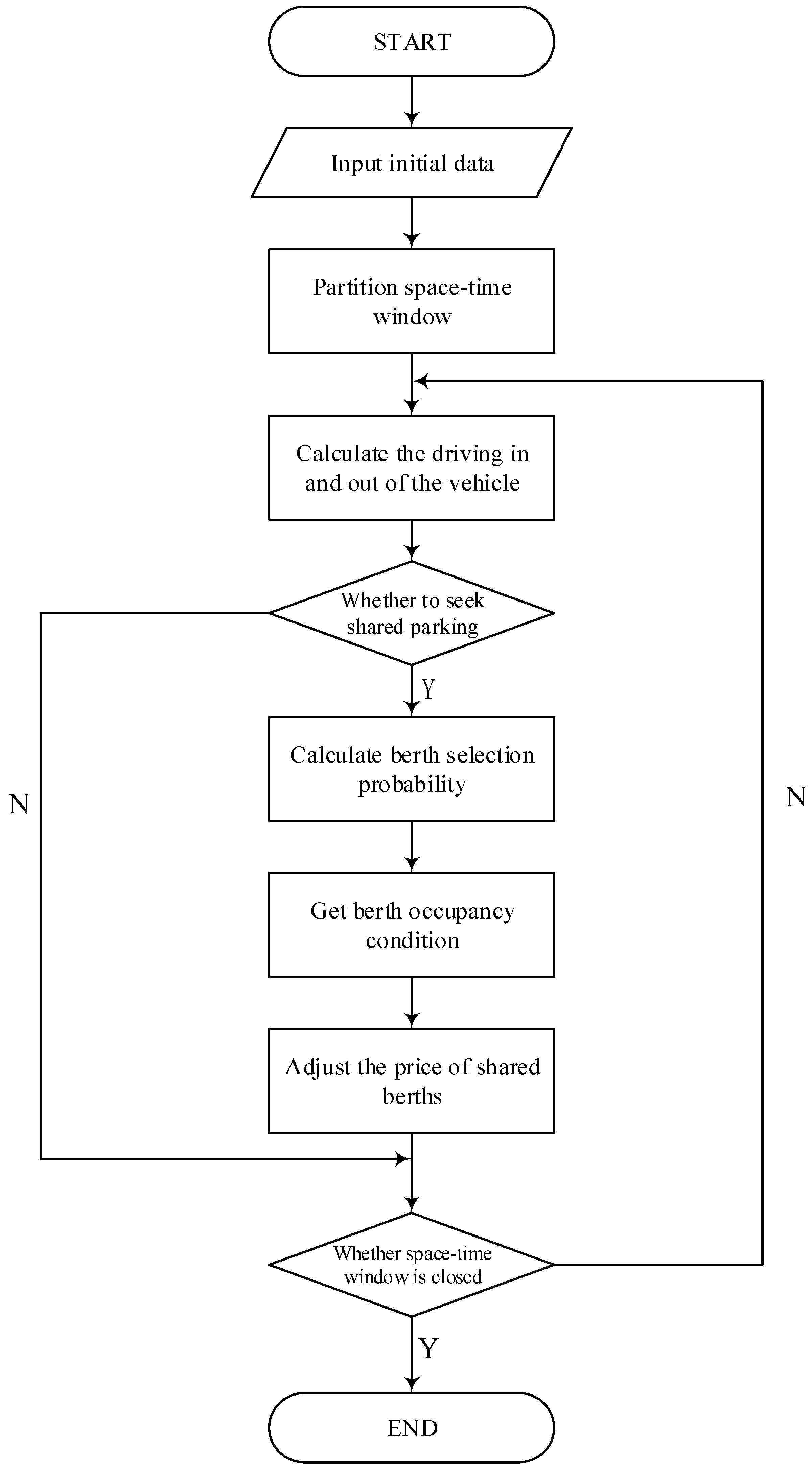
The corresponding flowchart is shown below (Figure 2).
Figure 2.
Floating charge process.
4. Instance Analysis
4.1. Floating Charge Method
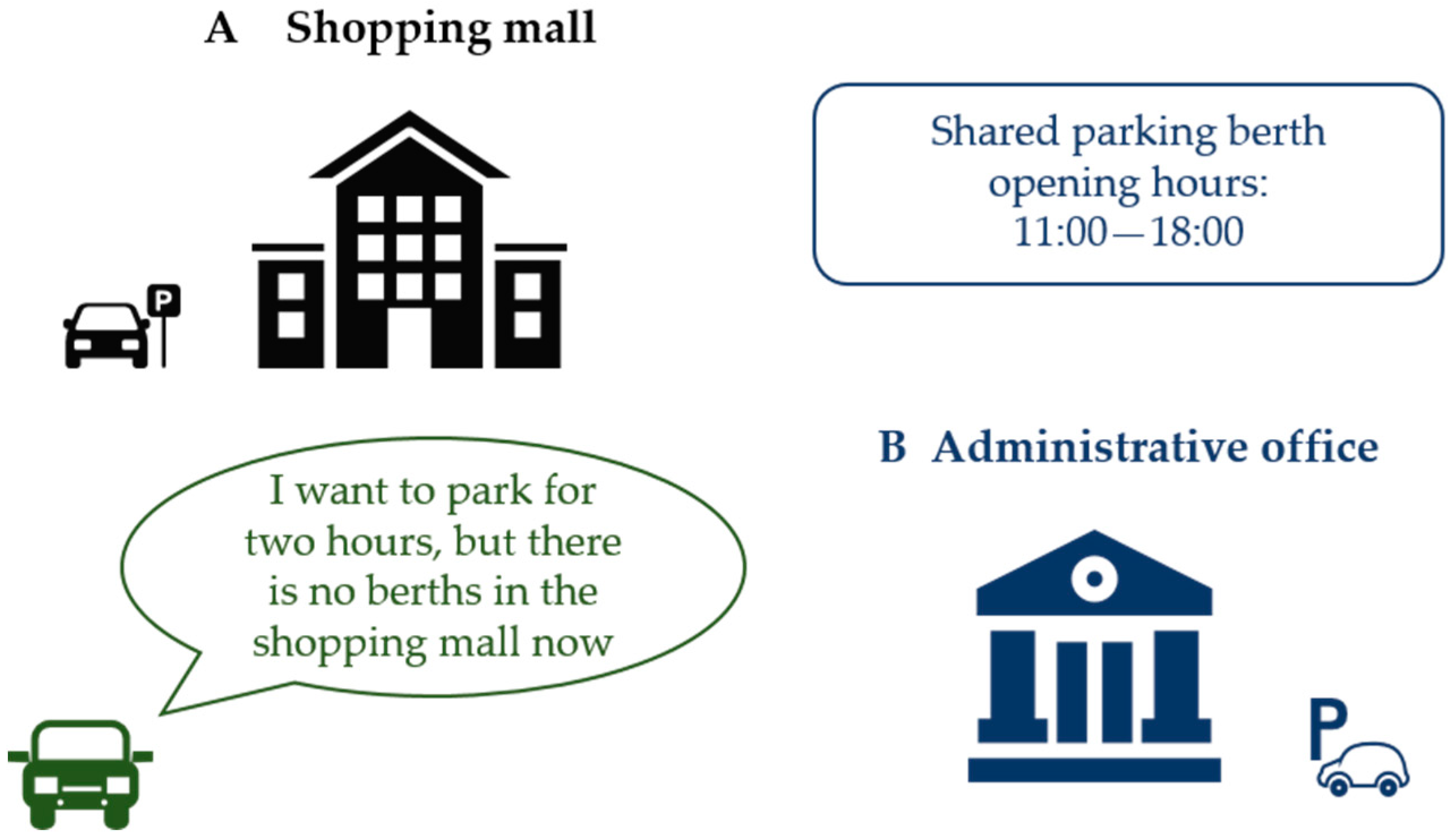
Taking the parking facilities of the shopping mall and nearby administrative office as an example, the floating charge method proposed above is used to adjust the shared space price. The shared scenario hypothesis was that when a person drives to a shopping mall during the day, the parking facilities of the shopping mall are close to saturation, and there is a parking facility of an administrative office unit that is open to the public for sharing in the day.
The monetary unit is the RMB in China, Assuming that the standard parking price for the shopping mall was 2 RMB/15 min, the total number of parking spaces is 150, that is , the initial price of the administrative office parking facility is the same, and the total number of parking spaces is 100, that is , in the shared parking mode, the shared space–time window is 11:00—18:00 following the steps shown above.
According to the known conditions, the shared space–time window of open sharing of the administrative office allocation parking lot was 11:00–18:00. The whole shared space–time window can be divided into 28 time periods, among which is 11:00–11:15, is 11:15–11:30, and so on.
During the previous period of open shared parking, namely 10:45–11:00, the number of parking spaces were and , occupancy rates were and , and the initial price of the administrative office shared space was . At this time, the parking occupancy rate of the mall was , that is .
For the first time period, , the number of new vehicles arriving in the shopping mall and the number of vehicles leaving the shopping mall were and , respectively, so the net number of vehicles entering the shopping mall was four in this period, .
When the price of the shared parking lot changes under different parking conditions in the shopping mall, the probability of the potential person parking choosing the shared parking facility is as follows (Table 5).
Table 5.
The probability of choosing the shared parking facility under different conditions.
The parking occupancy rate of the mall was in 10:45--11:00; in the time period, there was vehicle that enters the parking facility in an unsaturated condition, j = 3. Then, the number of people who choose the shared parking facility is rounded down to:
That is, the car will not go to the shared parking facility. The remaining three cars choose the shared parking facility, rounding it up to:
. Two of the remaining three cars will choose the open and shared parking facility. Therefore, the number of vehicles entering the administrative office parking facility is two.
Based on the statistical law of the parking duration of the shared parking vehicle, we obtain the departure time period of the vehicle, so as to calculate the parking occupancy rate. After the opening of administrative office sharing spaces, the space occupancy rate during the period is: , and its space condition is .
The occupancy rate of the shopping mall during this time period is: and its space condition is . The space occupancy rate is more than 60% and the next step is continued.
As can be seen from Step 5, the occupancy rate of the administrative office is 37%. Therefore, the price is reduced by one step, and the new price is RMB/15 min.
The shared space–time window is not closed, so proceed to Step 3 and calculate the second time period until the shared space–time window closes.
4.2. Shared Effect Analysis after Floating Charge
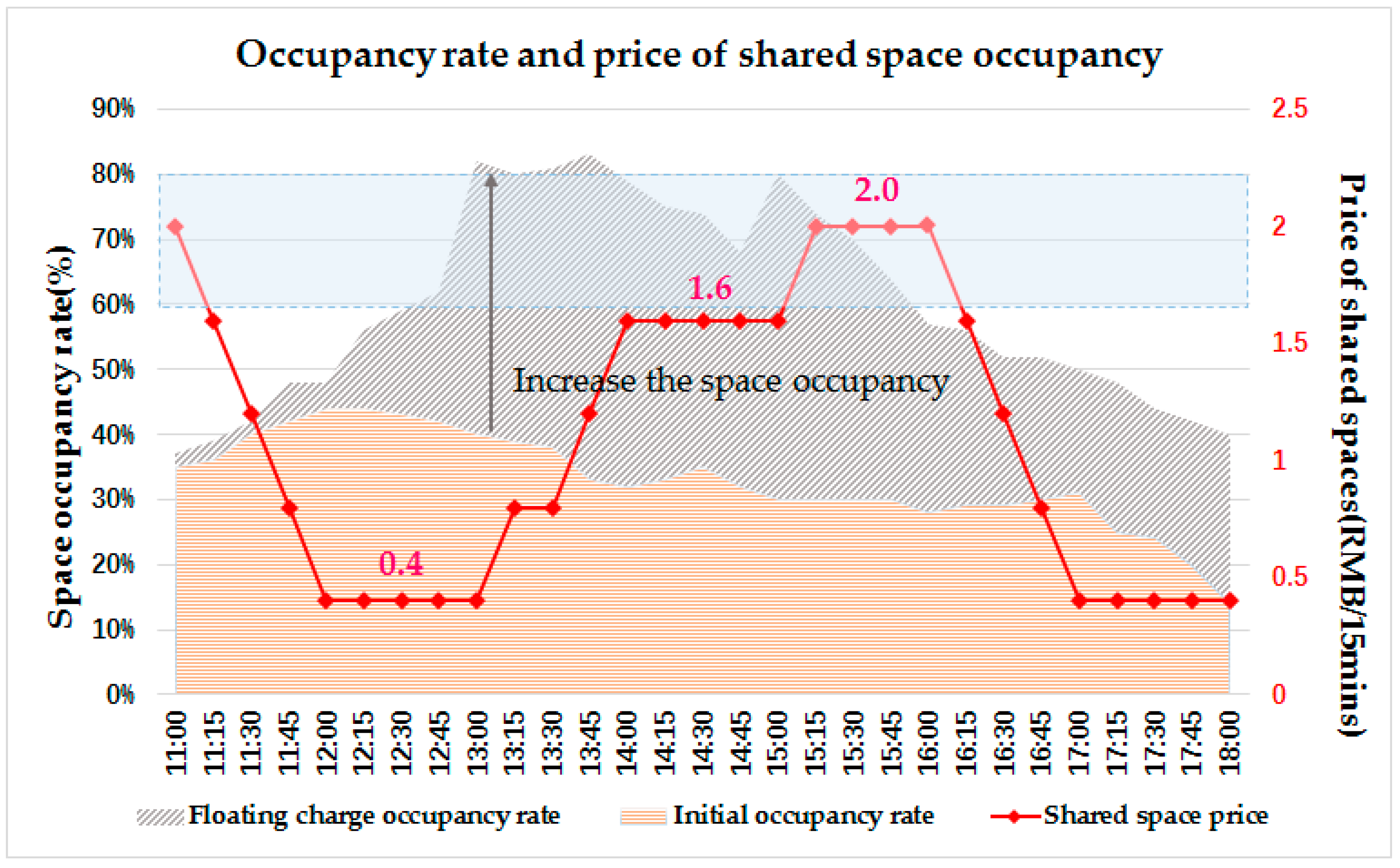
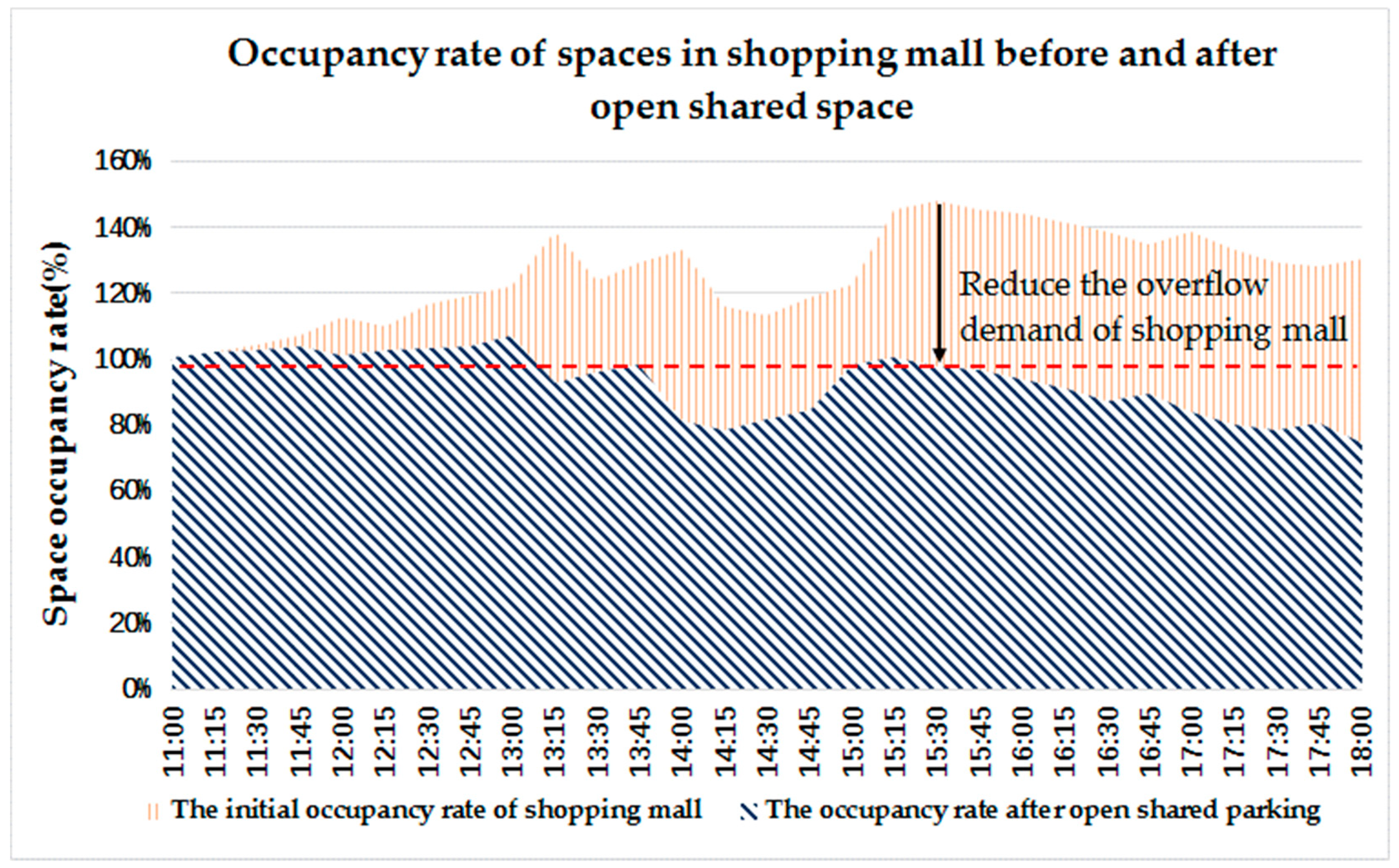
According to the above steps, it was calculated that in the whole shared space–time window, the occupancy rate and the floating price of administrative office shared spaces were as follows (Figure 3). The comparison of occupancy rates before and after shopping mall sharing were as follows (Figure 4).
Figure 3.
Parking occupancy rate and shared parking price of administrative office parking facility before and after open shared space.
Figure 4.
Comparison of market occupancy before and after open shared space.
As shown in Figure 3, the price of shared spaces generally presented a trend of first descending and then rising and falling over the whole sharing time window. And the parking occupancy rate of the administrative office land increased by more than 50% after the opening of sharing. As shown in Figure 4, the initial occupancy of the shopping mall had a large overflow demand, and the initial parking occupancy of the shopping mall exceeded 100%. Most of them were over 120%, and when administrative office land was open for sharing, the parking rate dropped below 100%, and was around 90% most of the time.
From the perspective of the floating mode of the shared space, when the shared space–time window first opened, the occupancy rate of the initial space in the administrative office parking facility was low, about 35%. Even though the overflow demand of shopping malls had been pouring in and the occupancy rate of shared spaces had been increasing, the price of shared spaces had been on a downward trend, since it was still less than 60%, until it reached the lowest value of 0.4 RMB/15 min.
Then, the berth occupancy rate reached the range of 60% to 80%, and the price stayed at 0.4 RMB/15 min. The price curve presented a platform. At this time, due to the low price, the berth occupancy rate kept rising until it reached 80%.
According to the relationship between space occupancy and price floating, when the shared space occupancy rate is higher than 80%, the shared price will rise a step to suppress the newly arrived sharing demand. The berth occupancy rate fluctuated at around 80% from 13:00, and the price curve showed a step upward until 15:15.
After 15:15, vehicles arriving at the shopping mall gradually became fewer than vehicles departing, so the demand for external sharing gradually reduced, and the occupancy rate of the shared parking facility gradually decreased, until it was lower than 60% at 16:00. The price of the shared parking space also started to decrease until the lowest value and remained unchanged thereafter.
As shown in Figure 4, the administrative office parking lot was more fully utilized through open sharing, attracting and transferring the overflow demand from the shopping mall.
4.3. Floating Charge Versus Fixed Charge
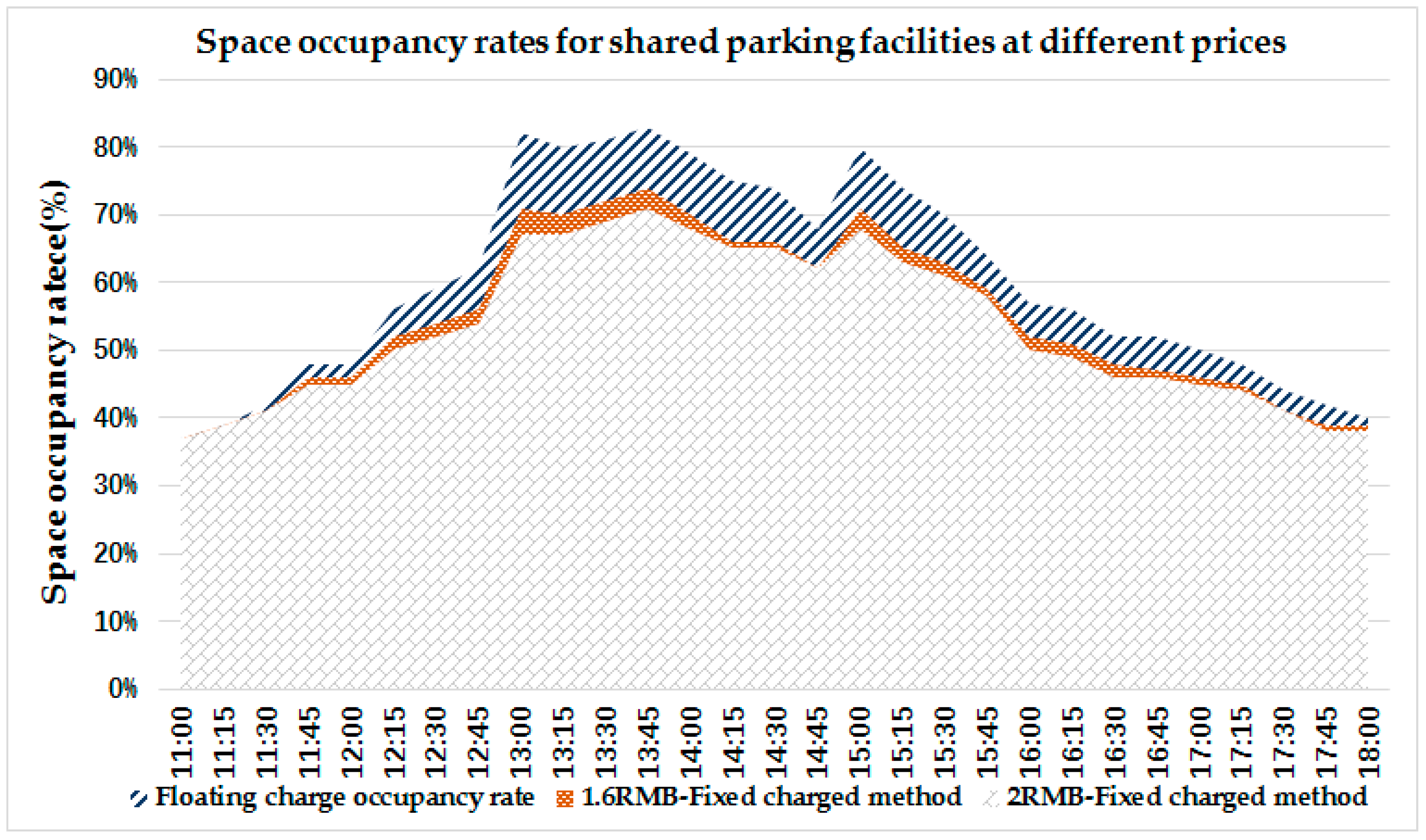
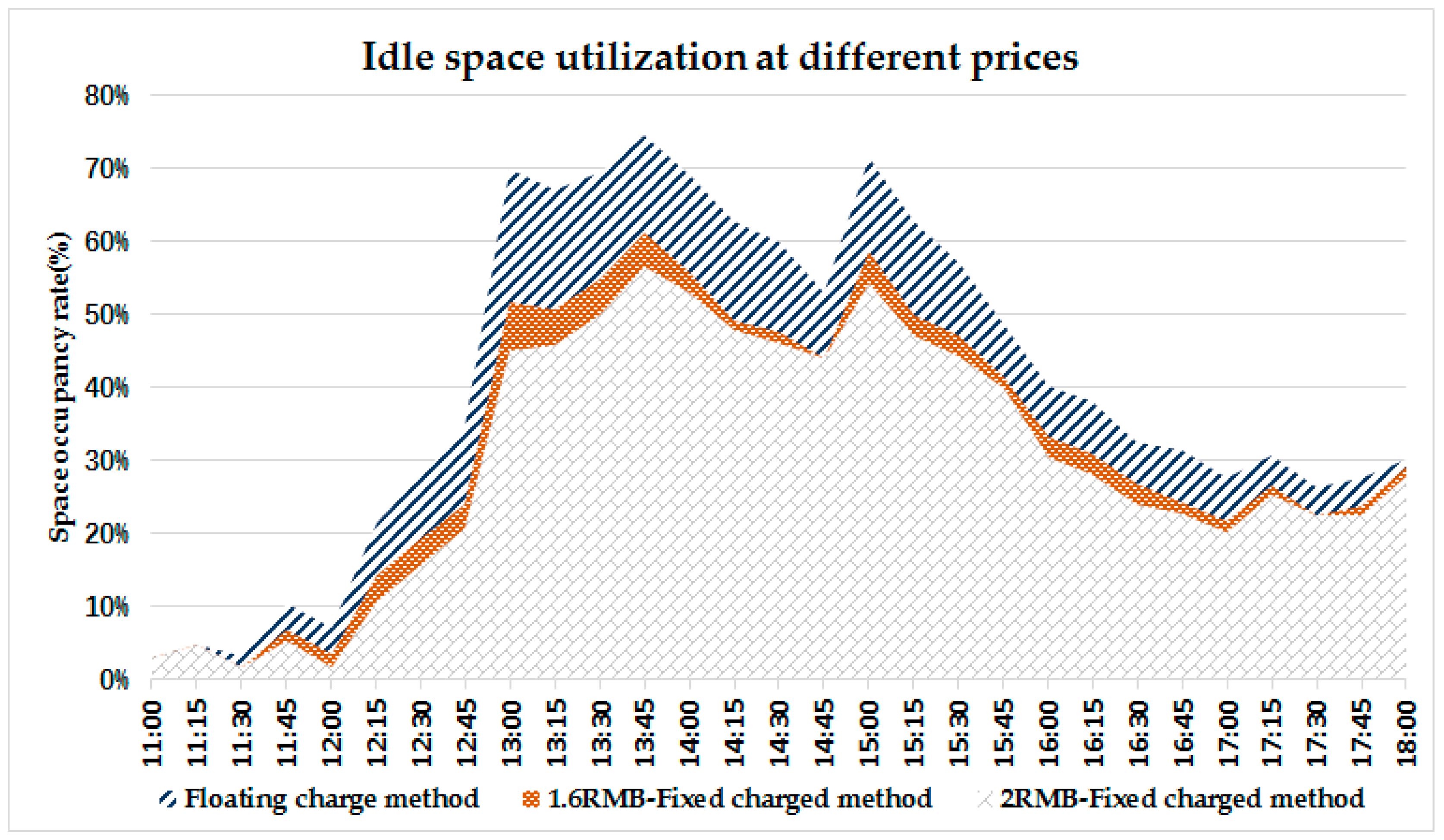
In order to further illustrate the advantages of the floating charge in the shared parking mode, the space occupancy rates under the two fixed charges were calculated with the same data and compared with the occupancy rates under the floating prices, as shown below (Figure 5 and Figure 6).
Figure 5.
Space occupancy rates at different prices.
Figure 6.
Idle space utilization at different prices.
When the price of the shared space is fixed, the peak occupancy rate can reach more than 60% after open sharing, but when the price changes from 2 RMB/15 min to 1.6 RMB/15 min, the change in occupancy rate is not obvious, only increasing by about 3%.
After adopting the floating charge pricing strategy, the occupancy rate of the shared parking lot at peak time could be increased to about 80%, and the average occupancy rate at peak time was about 75%; while the average occupancy rate at the same time period was 67% when it was priced at 1.6 RMB/15 min, and only 63% when it was priced at 2 RMB/15 min, as shown in Table 6.
Table 6.
Comparison of shared results under different pricing methods.
The space occupancy rate can reflect the utilization of shared space to some extent, but the space occupancy rate of shared facilities is likely to rise because of their own needs, rather than shared parking demand. Therefore, the introduction of the shared parking idle space utilization rate is necessary. This was defined as the number of idle spaces that could be utilized for shared parking, divided by the total number of idle spaces available for a certain period of time.
In terms of idle space utilization, the utilization rate of idle spaces in the whole shared space–time window was 40% in the case of the floating charge, while the utilization rate of fixed charges of 1.6 RMB/15 min was 32%, and that of fixed charges of 2 RMB/15 min was 30%. During the peak period, the average utilization rate of idle spaces under the latter two charging methods was 49% and 46%, respectively, while the average utilization rate of floating charges was 62% and the peak value was 71%. By means of floating charge adjustment, more than 60% of the idle spaces in the administrative office parking lot were effectively utilized during the peak sharing period. which can provide a better way to explore the space resource potential of the shared parking lot.
5. Conclusions
This paper takes the shared parking mode as the research object. By referring to the relevant dynamic pricing methods of foreign countries, the floating charging method of a shared parking space in the shared parking mode was proposed, and a case analysis was conducted.
The analysis of the hypothetical situation showed that price greatly influences shared parking behavior choices. Combined with the management concept of the parking project in San Francisco, there is a dynamic cyclic relationship between the price of shared parking spaces for shared parking facilities, the probability of choosing potential shared parking facilities and the parking occupancy rate of shared parking facilities. Based on this, the dynamic relationship between price and the regulation method of sharing parking demand was established under the shared parking sharing mode. The price drops by a floating step when the occupancy rate of shared parking facilities is less than ideal range, to attract more parking demand. Conversely, the price rises by a floating step when the occupancy rate of shared parking facilities is higher than the ideal range to restrain parking demand. In this way, it can not only divert the parking demand from adjacent buildings, but also keep the parking occupancy rate of shared parking facilities at an ideal level.
According to the case analysis, the floating charge method can make full use of the available spaces in the shared parking facilities, and improve the occupancy rate and the utilization rate of the shared parking facilities. This helps alleviate the problem of insufficient urban motor vehicle parking resources, and provides a guarantee of sustainable and healthy development of urban traffic. In the example given, the space occupancy rate of the shared parking lot can reach about 80% under the floating charge during the peak period, and the utilization rate of the idle parking space reaches about 62%, so as to better explore the space resource potential of the shared parking lot.
This paper studies the behavior selection characteristics of shared parking and the management strategy of a floating charge. Since there are also some fixed parking groups in shared parking, the frequent price adjustment of a floating charge may be unfair, so other charging methods for guiding and regulating can be considered in future research.
Author Contributions
The authors confirm contributions to the paper as follows: Formal analysis, J.H.; Investigation, J.H. and Q.C.; Methodology, J.H.; Writing—original draft, J.H. and Q.C.; Writing—review & editing, J.C. All authors reviewed the results and approved the final version of the manuscript.
Funding
This research was funded by the Key Project of National Natural Science Foundation of China (Nos. 51638004 & 51478111).
Conflicts of Interest
The authors declare that there are no conflicts of interest regarding the publication of this article.
References
- Smith, M. Shared Parking; Urban Land Institute: Washington, DC, USA, 1984. [Google Scholar]
- Hess, S.; Train, K.E.; Polak, J.W. On the Use of a Modified Latin Hypercube Sampling Approach (MLHS) in the Estimation of a Mixed Logit Model for Vehicle Choice. Transp. Res. Part B 2006, 40, 147–163. [Google Scholar] [CrossRef]
- Chen, K. Research on Time Window for Shared Parking of Administrative Land in City Center; Southeast University: Nanjing, China, 2016. [Google Scholar]
- Liu, Z. Research on Shared Time Window of Parking Spaces at Typical Malls in Downtown; Southeast University: Nanjing, China, 2016. [Google Scholar]
- Chen, J.; Xie, K. Dynamic Allocation Model and Effect Evaluation of Campus Shared-Use Parking in Central City. China J. Highw. Transp. 2015, 28, 104–111. [Google Scholar]
- Shoup, D.C. The trouble with minimum parking requirements. Transp. Res. Part A Policy Pract. 1999, 33, 549–574. [Google Scholar] [CrossRef]
- Simicevic, J.; Milosavljevic, N. Revealed preference off-street parking price elasticity. In Proceedings of the Transport Research Arena (TRA) 5th Conference, Paris, France, 14–17 April 2014. [Google Scholar]
- Ayala, D.; Wolfson, O.; Xu, B.; Dasgupta, B.; Lin, J. Parking slot assignment games. In Proceedings of the 19th ACM Sigspatial International Conference on Advances in Geographic Information Systems, Chicago, IL, USA, 1–4 November 2011; pp. 299–308. [Google Scholar]
- He, F.; Yin, Y.; Chen, Z.; Zhou, J. Pricing of parking games with atomic players. Transp. Res. Part B 2015, 73, 1–12. [Google Scholar] [CrossRef]
- Chatman, D.G.; Manville, M. Theory versus implementation in congestion-priced parking: An evaluation of SFpark, 2011–2012. Res. Transp. Econ. 2014, 44, 52–60. [Google Scholar] [CrossRef]
- Millard-Ball, A.; Weinberger, R.R.; Hampshire, R.C. Is the curb 80% full or 20% empty? Assessing the impacts of San Francisco’s parking pricing experiment. Transp. Res. Part A Policy Pract. 2013, 63, 76–92. [Google Scholar] [CrossRef]
- Kotb, A.O.; Shen, Y.C.; Zhu, X.; Huang, Y. iParker—A New Smart Car-Parking System Based on Dynamic Resource Allocation and Pricing. IEEE Trans. Intell. Transp. Syst. 2016, 17, 2637–2647. [Google Scholar] [CrossRef]
- Louviere, J.J.; Hensher, D.A. On the Design and Analysis of Simulated Choice or Allocation Experiments in Travel Choice Modeling. Transp. Res. Rec. 1982, 890, 11–17. [Google Scholar]
- Stata Coporation. Stata Reference Manual: Release 3.1, 6th ed.; StataCorp LLC: College Station, XT, USA, 1993. [Google Scholar]
© 2018 by the authors. Licensee MDPI, Basel, Switzerland. This article is an open access article distributed under the terms and conditions of the Creative Commons Attribution (CC BY) license (http://creativecommons.org/licenses/by/4.0/).