1. Introduction
Wind energy accounts for 39% of the total amount of renewable electricity generated in 2017 in the U.S. [
1]. The decade from 2007 to 2017 witnessed a quantum increase in installed wind capacity from 34.5 to 246 billion kWh [
2]. The carbon dioxide (CO
2) emissions from electricity generation decreased by 15 percent below 2005 levels, around 830 million metric tons due to the increased share of electricity generated from renewable sources [
3]. Wind energy offers an alternative to fossil fuels by lowering air pollutant and greenhouse gas (GHG) emissions and dampens the pace of the depletion of natural resources, such as fresh water and fertile land/forests [
4]. The projections for growth in utility-scale wind capacity are around 20 gigawatts (GW) between 2020 and 2050 [
2]. Currently, Texas is the leading state in installed wind capacity, with a share of 12.63% of all in-state electricity production in 2016 [
5]. However, a majority of the wind farms in Texas are onshore and no operational information is available for offshore wind farms in the Texas Gulf coast [
6]. The only offshore wind farm on the U.S. coast recently became operational in deep-water near New Shoreham, Rhode Island and has a project capacity of 30 MW, which is estimated to reduce 42,942 tons of CO
2 and 999 tons of SO
2 per year assuming a capacity factor of 45% [
7,
8]. Offshore wind farms in water depths less than 30 m are typically referred to as shallow-water wind installations, and wind farms in water depths greater than 50 m are identified as deep-water installations [
9,
10]. Texas has great potential for utilizing the first U.S. offshore wind energy experience to expand Texas’ reach into tapping wind energy in the Gulf coast [
6]. The experience in offshore oil platforms can be leveraged to serve the needs of the wind energy industry and improve the marine and port infrastructure that facilitates installation of offshore wind farms. In addition, Texas has water jurisdiction over 9 nautical miles offshore, placing Texas as one of the ideal candidates to further investments in offshore wind [
5,
6,
7]. The low life cycle GHG emissions from wind energy, averaging around 26 tons/GWH (range: 6–124 tons/GWh), place wind at an advantageous position in terms of environmental impact to other renewables, such as biomass and solar photovoltaics, which have average life cycle GHG emissions of around 45 (range: 10–101) and 85 (13–731) tons/GWH, respectively.
Life cycle assessment (LCA) is a valuable tool that allows for a comprehensive evaluation of the potential environmental impacts associated with all stages of the wind energy life cycle, from cradle to grave. Haapala and Prempreeda (2014) performed an LCA for two 2 MW onshore wind turbines located between the states of Oregon and Washington, and suggested that the manufacturing stage accounts for 78% of the life cycle environmental impact for supply chains in the U.S. [
11]. The energy payback times were reported to be 5.2 and 6.4 months for the two turbines and the turbine with a three-part tower module reported a lower environmental impact. The quantity of steel required in the tower was identified as the major contributor to environmental impact followed by the rotor and the nacelle [
11]. However, the manufacturing stage in this study also included material extraction and the transportation of components to the site location, thereby decreasing the probability to narrow down the critical stages responsible for maximum environmental impact [
11]. Another LCA study of wind energy in North America was conducted by Kabir et al. (2012), which compared Endurance (5 kW), Jacobs (20 kW), and Northern power (100 kW) turbines installed near Alberta, Canada and found that the 100 kW turbine has 58% lower global warming potential (GWP) compared to the 5 kW turbine and would be the most cost-effective and environmentally sustainable [
12]. This study considered raw material production for turbine manufacturing that was located in the U.S. and transported to Canada [
12].
Lenzen and Wachsmann (2004) determined that the location and geographical variability associated with the local economy play a major role in determining the life cycle environmental impacts of wind farms [
13]. This finding suggests that the assessment of life cycle environmental impacts is subjective to location and would require consideration of spatial variations in markets and supply chains of raw materials. In addition to geographical location, the life cycle environmental impact of wind energy is also dependent on major parameters such as axis of rotation (horizontal or vertical), capacity factor, and rated power [
14]. Kadiyala et al. (2016) performed a statistical evaluation of wind energy LCA studies and determined that for wind turbines greater than 0.25 MW capacity, onshore turbines have higher GHG emissions (15.98 ± 17.12 gCO
2eq/kWh) compared to offshore wind turbines (12.9 + 7.61 gCO
2eq/kWh) [
14]. This review also suggested that the life cycle GHG emissions from wind turbines were inversely proportional to the capacity factor. Material production, including manufacturing, was identified as the primary stage responsible for a majority of GHG emissions at onshore locations by numerous studies, with the power rating being an additional control variable [
12,
13,
14,
15,
16,
17,
18,
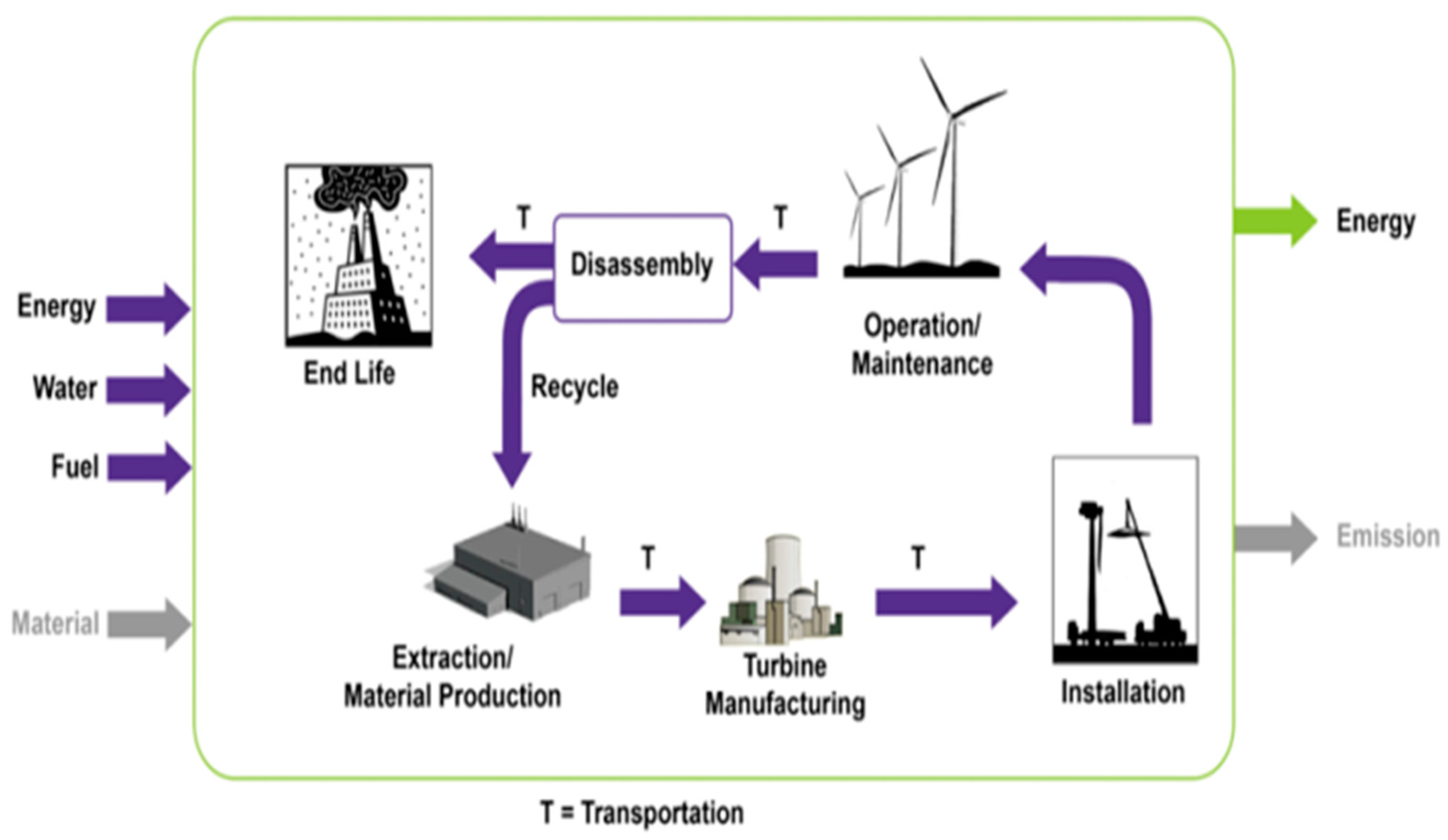
19]. The major stages in the life cycle of wind that were included in the system boundary of previously reported LCA studies include raw material extraction/processing, turbine manufacturing, transportation, installation, operation and maintenance and end-life/disassembly [
12,
13,
14,
15,
16,
17,
18,
19]. Offshore wind installations have an advantage in electricity production due to the higher wind speeds available at sea. However, this advantage is countered by a requirement for higher material input during construction of the foundation and transmission units, which causes higher energy and environmental emissions during the initial stages of the life cycle [
20]. Research is currently underway for the development of reliable and cost-effective foundations for offshore wind turbines and bottom-fixed foundations, such as monopile, gravity-based, or jacket foundations, are suited for shallow-water depths (less than 30 m), whereas floating wind turbines are preferred for deep-water locations [
21,
22,
23,
24,
25,
26]. Recent LCA studies on offshore wind farms suggest that the material used in installing the foundations would be a major contributor to environmental impact in categories such as fossil fuels and respiratory inorganics and direct-drive turbines have lower impact than geared turbines [
27,
28]. In order to optimize the environmental performance of wind systems, an analytical study identifying the critical stage and processes contributing the highest impact needs to be conducted for onshore and offshore locations. The objective of the current study is to estimate the contribution of individual stages toward the life cycle environmental impact of utility-scale wind turbines and identify the critical stage that can be redesigned to lower the impacts. In addition, a comparative analysis of onshore and offshore (shallow- and deep-water) wind systems in Texas and the gulf coast with respect to GHG emissions, impact on air, water, and land resources and payback times is conducted to facilitate better decision-making tools to environmental planners and policy makers.
5. Conclusions
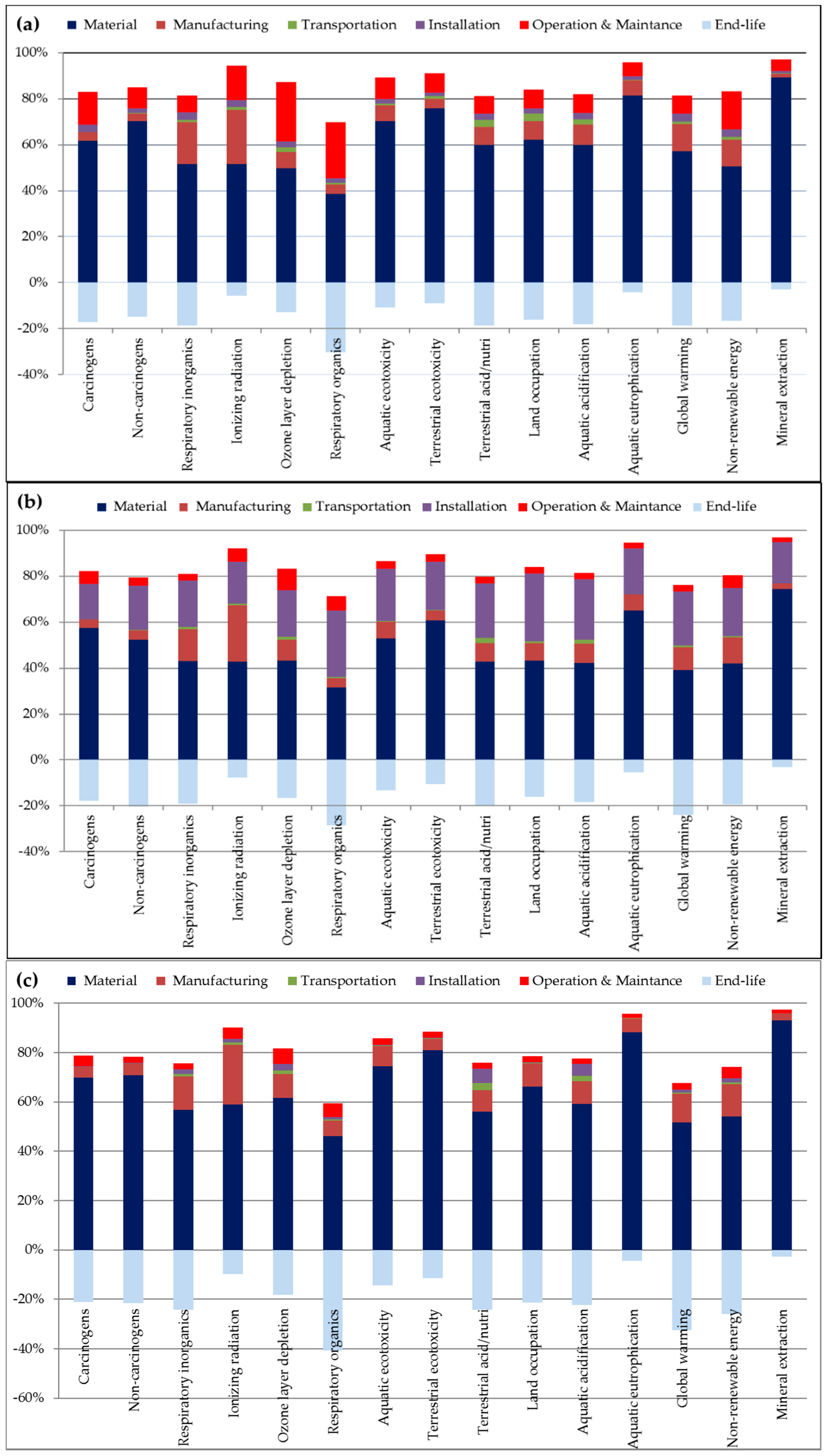
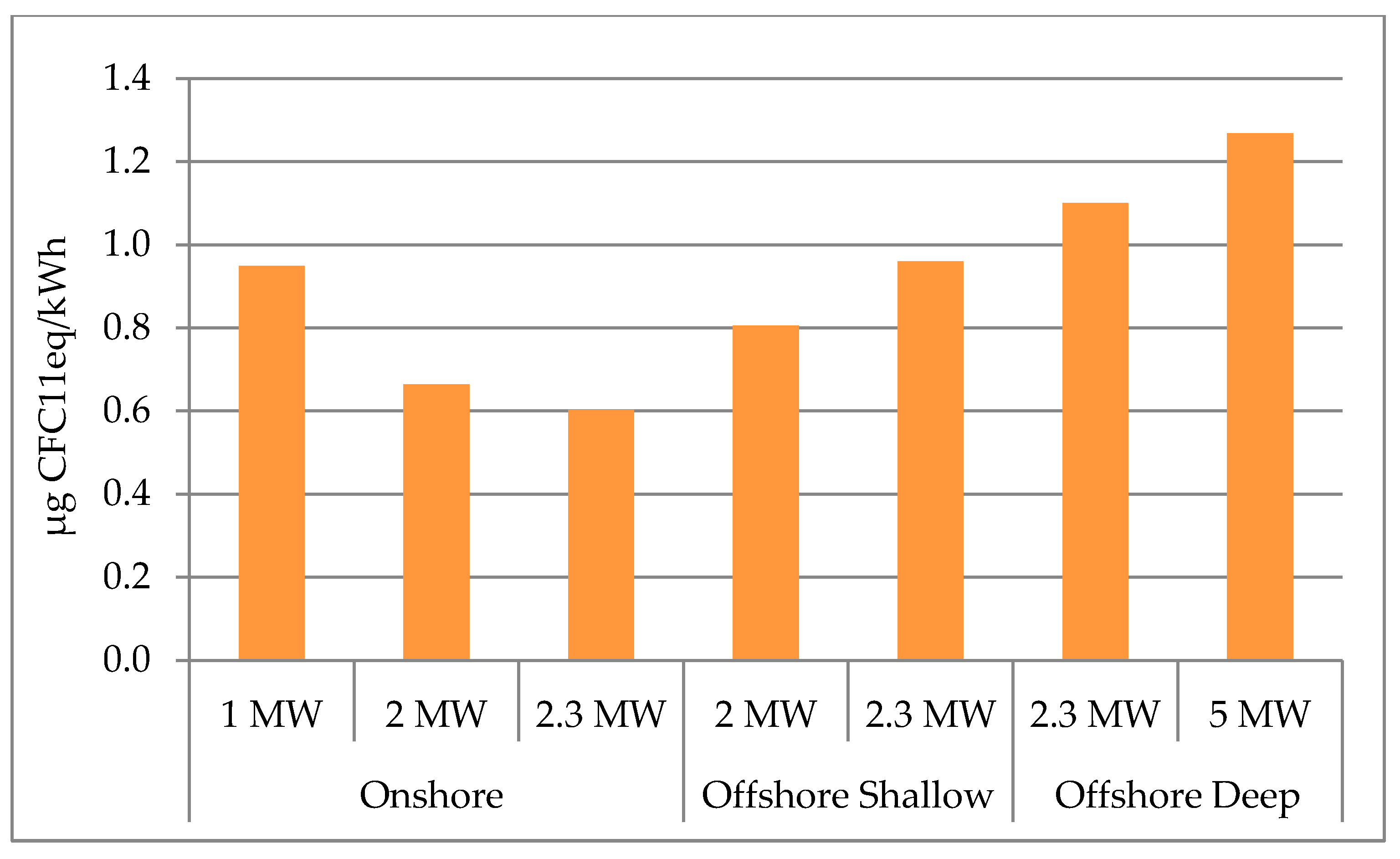
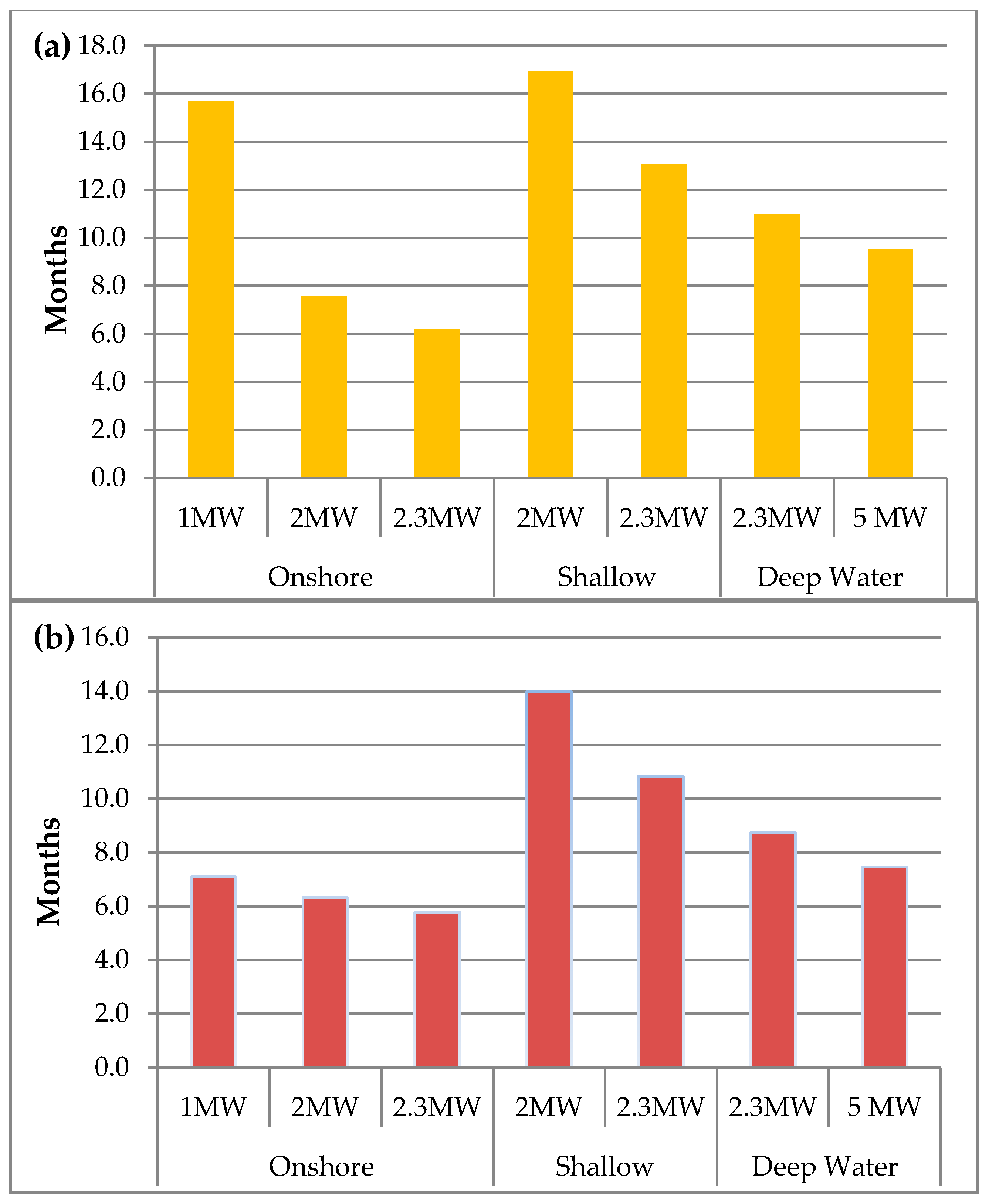
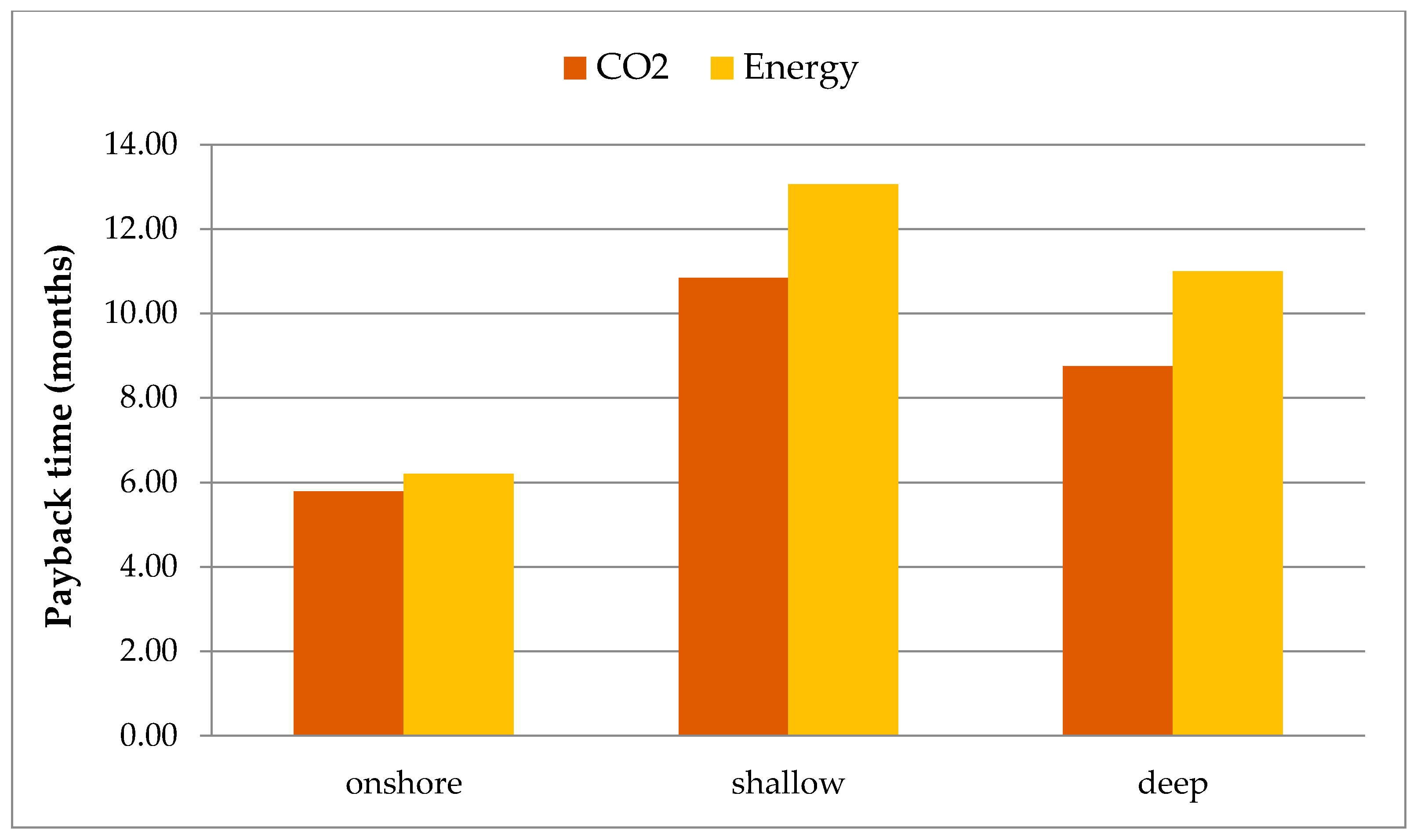
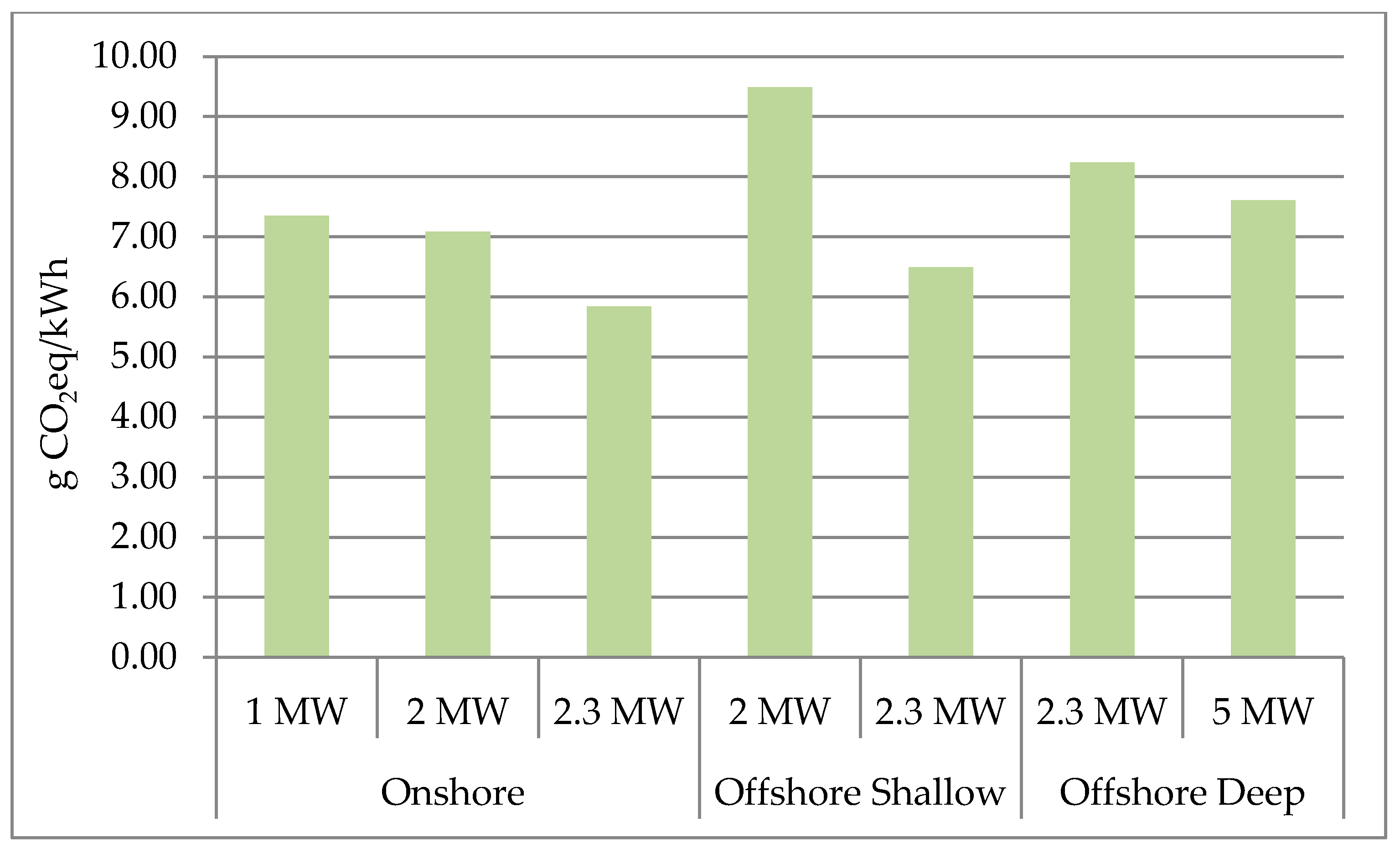
This study conducted an environmental life cycle impact assessment of three wind farms at onshore, shallow-, and deep-water locations in Texas and the adjoining gulf coast. The material extraction/processing stage was identified as the critical stage responsible for an average contribution of 72% of potential impact in onshore, 58% in shallow-water, and 82% in deep-water locations across 15 midpoint impact categories in the Impact 2002+ method. Results from the inclusion of recycling as an option for the disassembly of wind turbines suggests that recycling of steel could result in a lowering of 20% of the average impact across the 15 midpoint impact categories. For the operation and maintenance stage, onshore wind farms have higher emissions than offshore wind farms as a function of a relatively lower percentage of emissions resulting from a relatively streamlined installation process for onshore wind farms. The major parts, such as towers, foundations, and blades, consume more electricity during the fabrication period resulting in higher emissions. The installation and operation stages contributed less than 2% of emissions in the onshore and deep-water locations, whereas the shallow-water wind farms have a 30% contribution from installation. The overall emissions per kWh of electricity produced varies from 5.63 to 7.29 gCO2eq, suggesting an inverse relationship between turbine size and emissions. Onshore wind farms have shorter payback times for CO2 and energy compared to shallow- and deep-water wind farms, although offshore wind farms have lower GHG emissions per kWh than onshore wind farms. A sensitivity analysis of the material extraction/processing stage to the electricity sourcing stage indicates that the replacement of lignite coal with natural gas would lead to marginal improvements in midpoint impact categories and that replacement with wind offers better environmental performance.



 ,
,