
Cone-Specific Filter-Based Neuromodulation: A Proposed Clinical Framework for Amblyopia, Strabismus, and ADHD


Abstract
1. Introduction
2. Methods
2.1. Study Design and Integration
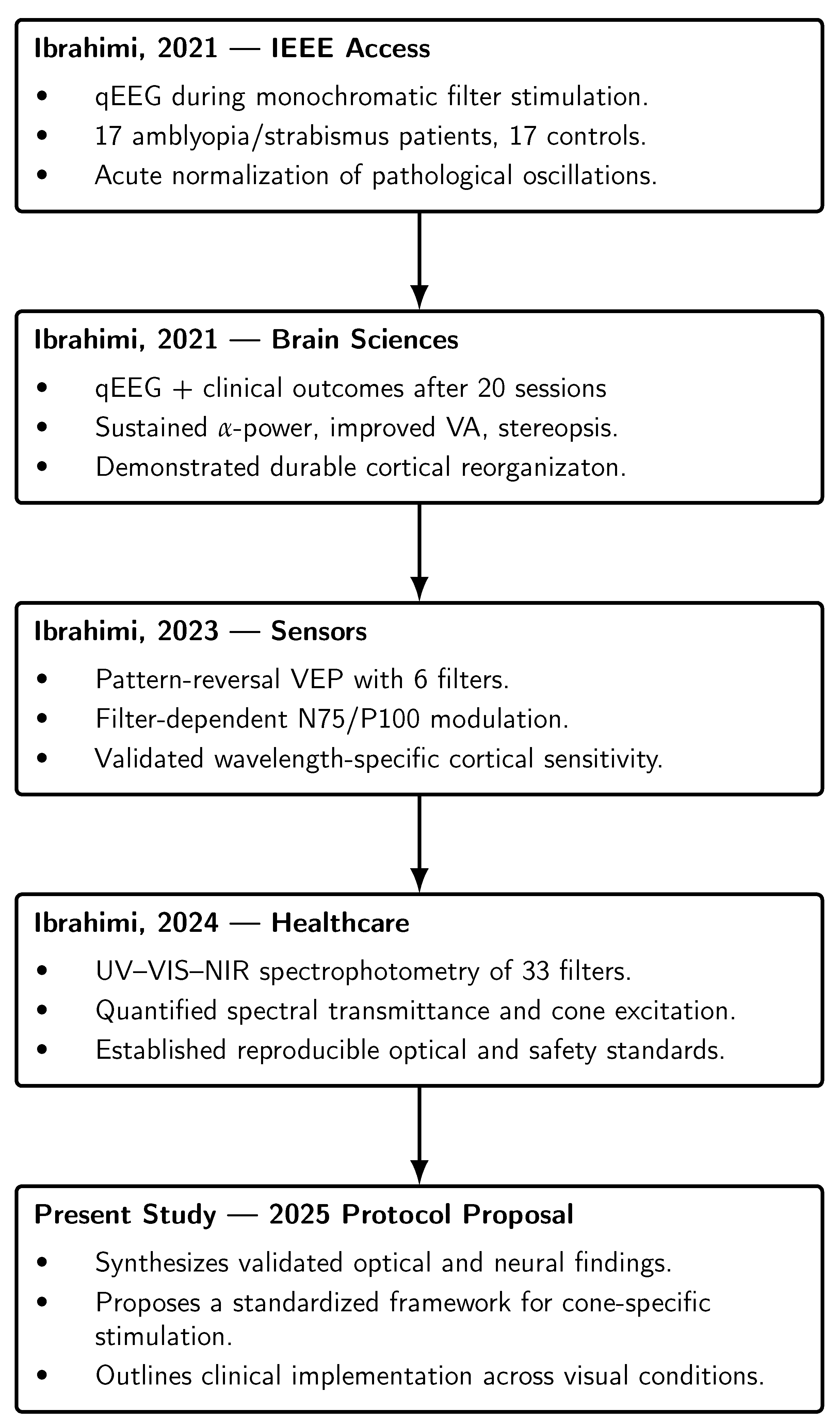
2.1.1. Experimental and Clinical Studies Providing the Basis for the Proposed Cone-Specific Neuromodulation Protocol
2.1.2. Protocol Rationale
2.2. Neurophysiological Foundations
2.2.1. S-Cone Pathways
2.2.2. M-Cone Pathways
2.2.3. L-Cone Pathways
2.2.4. Proposal: Cone-Targeted Stimulation Blueprint and Implementation Standards
Proposal: Measurement and Source Verification
Proposal: Temporal Design and Block Structure
Proposal: Timing and Circadian Hygiene
Proposal: Safety Guardrails and Scope
2.3. Filter Characterization
2.3.1. Monochromatic Filters
S-Cone Filters
- Omega. Provides the most selective S-cone activation (13.48%) with negligible M (0.04%) and L (0.16%) cross-talk. Despite low transmittance (19%), it is the most reliable option for isolating short-wavelength responses in diagnostic protocols and baseline assessments. Clinical use: best suited for short blocks (8 min total at 250–350 lx, morning/early-day) where precise S isolation is required.
- Lambda. Achieves higher drive (40.10% S) while maintaining minimal cross-talk, M (1.25%) and L (0.22%). With 50.87% transmittance, it balances selectivity and power, making it suitable for sustained therapeutic protocols. Clinical use: appropriate for therapy sessions requiring moderate S stimulation, using block design from Table 2 (2 min × 4, with rests) to prevent adaptation.
- Upsilon. Offers selective S stimulation (35.68%) with very low spillover M (1.55%), L (0.03%) and moderate transmittance (44.70%). Clinical use: useful for training programs where luminance control is critical; can be combined with gradual ramp-up and diffuser use to reduce glare.
- Neurasthenic. Provides modest S activation (25.31%) with low M spill (0.22%) but substantial L contamination (8.16%). Clinical use: not suitable for strict isolation but may be employed in exploratory or low-intensity protocols where L involvement is tolerable. Should be applied at lower illuminance, with short blocks and diffusers to limit L-driven luminance effects.
- Pi. Strong S activation (66.10%) with moderate M spill (13.14%) and negligible L (0.05%). High transmittance (76.05%) allows robust stimulation. Clinical use: appropriate for advanced training phases seeking strong S input, provided block durations and rests are respected to prevent over-adaptation.
- Depressant. Maximizes S activation (72.54%) but introduces high M (23.01%) and L (7.35%) cross-talk. Clinical use: only suitable for short-term experimental protocols where maximum S drive is required despite contamination; must remain within illuminance and timing guardrails and be carefully monitored for visual fatigue.
M-Cone Filters
- Mu. Provides the most selective M-cone stimulation (12.08%) with minimal S (0.49%) and L (0.01%) cross-talk. Its moderate transmittance (34.76%) limits absolute drive but ensures purity, making it the filter of choice for experimental paradigms requiring isolation and for clinical contexts where precise M-cone input is needed (e.g., vergence or visuomotor testing). Clinical use: apply under the M-cone operational window from Table 2 (400–500 lx, 16–20 min total, with rests) to maintain stability while avoiding L-driven confounds.
- Stimulant. Achieves very high M activation (60.83%) but at the cost of strong L contamination (34.06%) and minor S spillover (1.90%). With high transmittance (89.17%), it can drive robust responses but sacrifices specificity. Clinical use: suitable for dynamic training phases where strong magnocellular activation is desired and some parvocellular/L involvement is acceptable. Must be carefully timed and monitored to prevent over-stimulation.
- Delta. Delivers strong M excitation (51.26%) with significant L contamination (34.28%) and small S involvement (2.75%). High transmittance (87.99%) supports robust drive. Clinical use: appropriate in combined-filter protocols where luminance control is prioritized, but requires strict block timing and illuminance control to prevent L-cone dominance.
- Theta. Provides moderate-to-high M drive (47.12%) with comparable L contamination (34.30%) and negligible S spill (1.02%). Transmittance is high (86.57%). Clinical use: useful in intermediate therapy phases where pure isolation is not critical, but where sustained luminance input can support fixation and visuomotor stability.
L-Cone Filters
- Alpha. Provides the cleanest L-cone isolation (8.50%) with negligible S (0.22%) and M (0.01%) cross-talk. Its relatively low excitation amplitude limits robustness, but its high transmittance (81.80%) ensures good light throughput. Clinical use: best suited for diagnostic protocols or baseline measurements requiring selective L stimulation. Should be applied within the L-cone operational window (500–650 lx, 20 min total, with ramp-up) to maximize comfort and foveal response.
- Stimulant. Generates strong L activation (34.06%) but is heavily confounded by M spillover (60.83%) and minor S involvement (1.90%). High transmittance (89.17%) facilitates strong drive. Clinical use: may be considered in short, controlled sessions where enhanced long-wavelength responsivity is desired, but only under strict block and illuminance control due to lack of specificity.
- Delta. Produces L activation (34.28%) with significant M contamination (51.26%) and some S spill (2.75%). High transmittance (87.99%) supports efficient drive. Clinical use: suitable for brief, high-intensity protocols, where some cross-activation can be tolerated; requires monitoring to prevent luminance-driven adaptation effects.
- Theta. Yields comparable L activation (34.30%) with substantial M spill (47.12%) and minor S involvement (1.02%). With high transmittance (86.57%), it delivers strong output. Clinical use: appropriate for intermediate therapy phases where balanced stimulation across L and M pathways is acceptable, supporting acuity and fixation stability rather than strict isolation.
2.3.2. Combined Filters
- Upsilon–Neurasthenic. Provides attenuated S activation (9.72%) with near-null M (0.01%) and L (0.02%) cross-talk. Its low drive makes it unsuitable for sustained protocols but valuable as a sensitization block or diagnostic probe, particularly in patients where over-stimulation is a risk. Clinical use: morning/early-day exposure, short blocks at lower illuminance, useful as a gentle S-bias introduction.
- Omega–Pi. Yields similar S selectivity (9.39%) with minimal spillover, M (0.02%) and L (0.01%). Compared to monochromatic S filters, it sacrifices amplitude for purity. Clinical use: an alternative for diagnostic S isolation when the lowest possible contamination is required but not intended for high-drive therapeutic sessions.
- Mu–Delta. Produces selective M activation (6.40%) with negligible S (0.07%) and L (0.01%) cross-talk. This represents one of the rare near-isolating M conditions available. Clinical use: appropriate for research or clinical contexts targeting visuomotor coordination, applied at the standard M operational window (400–500 lx, 16–20 min total), though the weaker drive limits rehabilitative potency.
- Mu–Theta. Delivers a comparable M bias (5.22%) with almost no S (0.03%) or L (0.01%) involvement. Functionally interchangeable with Mu–Delta. Clinical use: selected based on patient tolerance or sequence design; offers flexibility in designing M-centric blocks without cross-contamination.
- Delta–Theta. Drives both M (36.87%) and L (30.58%) strongly, with cross-talk too pronounced for selective use. Clinical use: reserved for short, controlled “push blocks” when broad mid-to-long wavelength activation is justified (e.g., late-phase protocols seeking robust total cone engagement). Must be applied with strict duration and safety checks to prevent over-activation.
- Alpha–Delta. Provides a moderate L bias (7.70%) with negligible S (0.00%) and M (0.01%) cross-talk. Unlike high-power red filters, it minimizes M recruitment, giving a more controlled long-wavelength drive. Clinical use: suitable when selective L emphasis is needed (e.g., fixation or acuity tasks), although reduced amplitude limits its use to moderate-intensity contexts.
2.4. Condition-Specific Neuromodulation Protocols
2.4.1. Amblyopia
2.4.2. Esotropia
2.4.3. Exotropia
2.4.4. Hypertropia
2.4.5. Hypotropia
2.4.6. Attention-Deficit/Hyperactivity Disorder (ADHD)
2.4.7. Comparative Mechanistic Mapping
2.5. Duration Framework for Cone-Targeted Neuromodulation
- A 20-session core for amblyopia and strabismus, expandable to 12–16 weeks for amblyopia and 8–12 weeks for strabismus.
- A shorter 2–3-week core for ADHD, with extension up to 10 weeks when justified.
3. Results
3.1. Filter Selectivity
3.2. Light Parameters and Time Framework
3.3. Integrated Framework
- Alpha (L-cone): Primary filter to reinforce central fixation and acuity.
- Mu (M-cone): Supportive filter for visuomotor integration.
- Omega (S-cone): Optional, brief adjunct to enhance cortical responsiveness.
- Clinical logic: Use Alpha + Mu as the mainstay; add Omega sparingly in short morning blocks to avoid overstimulation.
- Omega (S-cone): Primary filter to lower accommodative load.
- Mu (M-cone): Secondary filter for vergence stability.
- Contraindicated: Alpha (L-cone), due to risk of accommodative overdrive.
- Clinical logic: S-first approach with optional Mu support; avoid any long-wavelength bias.
- Alpha (L-cone): Primary filter to stabilize fixation and promote convergence.
- Mu (M-cone): Secondary filter to support visuomotor control.
- Omega (S-cone): Restricted to brief morning exposures only.
- Clinical logic: Rely on Alpha + Mu for core treatment, with Omega limited to short blocks to prevent fusion disruption.
- Sequential Omega → Mu → Alpha for S-, M-, and L-cone activation, respectively.
- Combined options (e.g., Upsilon–Neurasthenic, Mu–Delta, Alpha–Delta) only when moderated drive is needed for tolerability.
- Clinical logic: Sequential pathway stimulation (≈44 min total) balances arousal, visuomotor integration, and sustained attention. Combined filters may reduce cross-talk but are not superior to monochromatics.
4. Discussion
Strengths, Limitations and Future Directions
Author Contributions
Funding
Institutional Review Board Statement
Informed Consent Statement
Data Availability Statement
Conflicts of Interest
List of Abbreviations
| ADHD | attention-deficit/hyperactivity disorder |
| ASD | autism spectrum disorder |
| -opic EDI | equivalent daylight illuminance using CIE S 026 receptor weightings |
| CCT | correlated colour temperature |
| cd/m2 | candela per square meter (luminance) |
| CIE | Commission Internationale de l’Éclairage |
| (International Commission on Illumination) | |
| CRI | colour rendering index |
| DC | direct current (steady illumination) |
| EDI | equivalent daylight illuminance |
| EEG | electroencephalography |
| EN | European Norm (standards body) |
| EW | Edinger–Westphal nucleus |
| fMRI | functional magnetic resonance imaging |
| HCs | healthy controls |
| Hz | hertz |
| ICNIRP | International Commission on Non-Ionizing Radiation Protection |
| IEC | International Electrotechnical Commission |
| IEEE | Institute of Electrical and Electronics Engineers |
| INC | interstitial nucleus of Cajal |
| ipRGCs | intrinsically photosensitive retinal ganglion cells |
| IRB | Institutional Review Board |
| ISO | International Organization for Standardization |
| kHz | kilohertz |
| L-cone | long-wavelength cone photoreceptor |
| LED | light-emitting diode |
| LGN | lateral geniculate nucleus |
| L > M > S | shorthand notation for cone weight emphasis |
| lx | photopic illuminance at the corneal plane (lux) |
| M-cone | medium-wavelength cone photoreceptor |
| min | minute |
| MST | medial superior temporal area |
| MT/V5 | middle temporal visual area |
| N75, P100 | visual evoked potential components (negative at 75 ms, positive at 100 ms) |
| NIR | near-infrared |
| nm | nanometer |
| NOEL | no-observable-effect level |
| OPN | olivary pretectal nucleus |
| PWM | pulse-width modulation |
| qEEG | quantitative electroencephalography |
| RCT | randomized controlled trial |
| RGB | red–green–blue primaries |
| RGW | red–green–white primaries |
| riMLF | rostral interstitial medial longitudinal fasciculus |
| SA | strabismus and amblyopia |
| S-cone | short-wavelength cone photoreceptor |
| SC | superior colliculus |
| SCN | suprachiasmatic nucleus |
| s | second |
| SPD | spectral power distribution |
| ssVEP | steady-state visual evoked potential |
| t½ | half-time (adaptation constant) |
| UV | ultraviolet |
| UV–VIS–NIR | ultraviolet–visible–near-infrared spectrum |
| VA | visual acuity |
| V1, V2, V4 | primary and extrastriate visual cortical areas |
| VEP | visual evoked potential |
| VF | visual field |
| VIS | visible spectrum |
| µm | micrometer |
| VR | virtual reality |
References
- Ibrahimi, D.; Mendiola-Santibañez, J.D.; Cruz Martinez, E.; Rodríguez-Reséndiz, J.; Pacheco, I.T. Cortical activity at baseline and during light stimulation in patients with strabismus and amblyopia. IEEE Access 2021, 9, 22430–22446. [Google Scholar] [CrossRef]
- Ibrahimi, D.; Mendiola-Santibañez, J.D.; Cruz-Martínez, E.; Gómez-Espinosa, A.; Torres-Pacheco, I. Changes in the brain activity and visual performance of patients with strabismus and amblyopia after a compete cycle of light therapy. Brain Sci. 2021, 11, 657. [Google Scholar] [CrossRef] [PubMed]
- Argilés, M.; Sunyer-Grau, B.; Arteche-Fernandez, S.; Peña-Gómez, C. Functional connectivity of brain networks with three monochromatic wavelengths: A pilot study using resting-state functional magnetic resonance imaging. Sci. Rep. 2022, 12, 16197. [Google Scholar] [CrossRef] [PubMed]
- Engel, S.; Zhang, X.; Wandell, B. Colour tuning in human visual cortex measured with functional magnetic resonance imaging. Nature 1997, 388, 68–71. [Google Scholar] [CrossRef]
- Kuriki, I.; Sun, P.; Ueno, K.; Tanaka, K.; Cheng, K. Hue selectivity in human visual cortex revealed by functional magnetic resonance imaging. Cereb. Cortex 2015, 25, 4869–4884. [Google Scholar] [CrossRef] [PubMed]
- Accornero, N.; Gregori, B.; Pro, S.; Scappini, G.; La Riccia, M. Chromatic modulation of luminance visual evoked potential latencies in healthy subjects and patients with mild vision disorders. Clin. Neurophysiol. 2008, 119, 1683–1688. [Google Scholar] [CrossRef]
- Spitschan, M.; Bock, A.S.; Ryan, J.; Frazzetta, G.; Brainard, D.H.; Aguirre, G.K. The human visual cortex response to melanopsin-directed stimulation is accompanied by a distinct perceptual experience. Proc. Natl. Acad. Sci. USA 2017, 114, 12291–12296. [Google Scholar] [CrossRef]
- Marmoy, O.R.; Pompe, M.T.; Kremers, J. Chromatic visual evoked potentials: A review of physiology, methods and clinical applications. Prog. Retin. Eye Res. 2024, 101, 101272. [Google Scholar] [CrossRef]
- Ibrahimi, D.; Crúz-Martínez, E.; Valencia Luna, G.; Romero Turrubiates, J.; Rodríguez-Reséndiz, J. The impact of the Wavelength and its transmittance on the visual evoked potentials, at Baseline, and under the Effect of six monochromatic filters used for visual treatments. Sensors 2023, 23, 5227. [Google Scholar] [CrossRef]
- Ibrahimi, D.; Aviles, M.; Valencia Luna, G.; Rodriguez Resendiz, J. Deciphering the Physical Characteristics of Ophthalmic Filters Used in Optometric Vision Therapy. Healthcare 2024, 12, 2177. [Google Scholar] [CrossRef]
- Mohamed, S.A.; Abdel-Wahab Khalil, A.M.; Aljaghmani, M.E.A. Syntonic phototherapy versus part time occlusion for treatment of refractive amblyopia. Sci. Rep. 2025, 15, 7001. [Google Scholar] [CrossRef]
- Thoreson, W.B.; Dacey, D.M. Diverse cell types, circuits, and mechanisms for color vision in the vertebrate retina. Physiol. Rev. 2019, 99. [Google Scholar] [CrossRef]
- Neitz, J.; Neitz, M. Evolution of the circuitry for conscious color vision in primates. Eye 2017, 31, 286–300. [Google Scholar] [CrossRef] [PubMed]
- Solomon, S.G.; Lennie, P. The machinery of colour vision. Nat. Rev. Neurosci. 2007, 8, 276–286. [Google Scholar] [CrossRef]
- Wool, L.E.; Packer, O.S.; Zaidi, Q.; Dacey, D.M. Connectomic identification and three-dimensional color tuning of S-OFF midget ganglion cells in the primate retina. J. Neurosci. 2019, 39, 7893–7909. [Google Scholar] [CrossRef] [PubMed]
- Baden, T.; Osorio, D. The retinal basis of vertebrate color vision. Annu. Rev. Vis. Sci. 2019, 5, 177–200. [Google Scholar] [CrossRef] [PubMed]
- Holmes, J.M.; Levi, D.M. Treatment of amblyopia as a function of age. Vis. Neurosci. 2018, 35, E015. [Google Scholar] [CrossRef]
- Mostofsky, S.H.; Lasker, A.; Cutting, L.; Denckla, M.; Zee, D. Oculomotor abnormalities in attention deficit hyperactivity disorder: A preliminary study. Neurology 2001, 57, 423–430. [Google Scholar] [CrossRef] [PubMed]
- Yu, M.; Gao, X.; Niu, X.; Zhang, M.; Yang, Z.; Han, S.; Cheng, J.; Zhang, Y. Meta-analysis of structural and functional alterations of brain in patients with attention-deficit/hyperactivity disorder. Front. Psychiatry 2023, 13, 1070142. [Google Scholar] [CrossRef]
- Noreika, V.; Falter, C.M.; Rubia, K. Timing deficits in attention-deficit/hyperactivity disorder (ADHD): Evidence from neurocognitive and neuroimaging studies. Neuropsychologia 2013, 51, 235–266. [Google Scholar] [CrossRef]
- Siraji, M.A.; Kalavally, V.; Schaefer, A.; Haque, S. Effects of daytime electric light exposure on human alertness and higher cognitive functions: A systematic review. Front. Psychol. 2022, 12, 765750. [Google Scholar] [CrossRef]
- Souman, J.L.; Tinga, A.M.; Te Pas, S.F.; Van Ee, R.; Vlaskamp, B.N. Acute alerting effects of light: A systematic literature review. Behav. Brain Res. 2018, 337, 228–239. [Google Scholar] [CrossRef]
- Baruth, J.M.; Casanova, M.F.; Sears, L.; Sokhadze, E. Early-stage visual processing abnormalities in high-functioning autism spectrum disorder (ASD). Transl. Neurosci. 2010, 1, 177–187. [Google Scholar] [CrossRef]
- Blume, C.; Garbazza, C.; Spitschan, M. Effects of light on human circadian rhythms, sleep and mood. Somnologie 2019, 23, 147–156. [Google Scholar] [CrossRef] [PubMed]
- Lunsford-Avery, J.R.; Davis, J.L.; Willoughby, M.T. Circadian rhythm dysfunction and clinical heterogeneity in pediatric ADHD: A critical need for innovation in assessment and treatment. JCPP Adv. 2025, 5, e12281. [Google Scholar] [CrossRef] [PubMed]
- Huang, Y.Y.; Chen, A.C.H.; Carroll, J.D.; Hamblin, M.R. Biphasic dose response in low level light therapy. Dose-Response 2009, 7, 358–383. [Google Scholar] [CrossRef]
- Hamblin, M.R. Mechanisms and applications of the anti-inflammatory effects of photobiomodulation. AIMS Biophys. 2017, 4, 337. [Google Scholar] [CrossRef] [PubMed]
- Guideline Development Panel for the Treatment of Depressive Disorders. Summary of the clinical practice guideline for the treatment of depression across three age cohorts. Am. Psychol. 2022, 77, 770–780. [CrossRef]
- Van Maanen, A.; Meijer, A.M.; van der Heijden, K.B.; Oort, F.J. The effects of light therapy on sleep problems: A systematic review and meta-analysis. Sleep Med. Rev. 2016, 29, 52–62. [Google Scholar] [CrossRef]
- Stockman, A.; Sharpe, L.T. The spectral sensitivities of the middle-and long-wavelength-sensitive cones derived from measurements in observers of known genotype. Vis. Res. 2000, 40, 1711–1737. [Google Scholar] [CrossRef]
- Hendry, S.H.; Reid, R.C. The koniocellular pathway in primate vision. Annu. Rev. Neurosci. 2000, 23, 127–153. [Google Scholar] [CrossRef]
- Sincich, L.C.; Horton, J.C. The circuitry of V1 and V2: Integration of color, form, and motion. Annu. Rev. Neurosci. 2005, 28, 303–326. [Google Scholar] [CrossRef]
- Conway, B.R. Color signals through dorsal and ventral visual pathways. Vis. Neurosci. 2014, 31, 197–209. [Google Scholar] [CrossRef] [PubMed]
- Hattar, S.; Liao, H.W.; Takao, M.; Berson, D.M.; Yau, K.W. Melanopsin-containing retinal ganglion cells: Architecture, projections, and intrinsic photosensitivity. Science 2002, 295, 1065–1070. [Google Scholar] [CrossRef] [PubMed]
- Berson, D.M.; Dunn, F.A.; Takao, M. Phototransduction by retinal ganglion cells that set the circadian clock. Science 2002, 295, 1070–1073. [Google Scholar] [CrossRef] [PubMed]
- Hannibal, J.; Kankipati, L.; Strang, C.; Peterson, B.; Dacey, D.; Gamlin, P. Central projections of intrinsically photosensitive retinal ganglion cells in the macaque monkey. J. Comp. Neurol. 2014, 522, 2231–2248. [Google Scholar] [CrossRef]
- Baver, S.B.; Pickard, G.E.; Sollars, P.J.; Pickard, G.E. Two types of melanopsin retinal ganglion cell differentially innervate the hypothalamic suprachiasmatic nucleus and the olivary pretectal nucleus. Eur. J. Neurosci. 2008, 27, 1763–1770. [Google Scholar] [CrossRef]
- Dacey, D.M.; Lee, B.B. The ’blue-on’opponent pathway in primate retina originates from a distinct bistratified ganglion cell type. Nature 1994, 367, 731–735. [Google Scholar] [CrossRef]
- Spitschan, M.; Jain, S.; Brainard, D.H.; Aguirre, G.K. Opponent melanopsin and S-cone signals in the human pupillary light response. Proc. Natl. Acad. Sci. USA 2014, 111, 15568–15572. [Google Scholar] [CrossRef]
- Kaplan, E. The M, P, and K pathways of the primate visual system. Vis. Neurosci. 2004, 1, 481–493. [Google Scholar]
- Nassi, J.J.; Callaway, E.M. Parallel processing strategies of the primate visual system. Nat. Rev. Neurosci. 2009, 10, 360–372. [Google Scholar] [CrossRef]
- Livingstone, M.; Hubel, D. Segregation of form, color, movement, and depth: Anatomy, physiology, and perception. Science 1988, 240, 740–749. [Google Scholar] [CrossRef]
- Johnson, E.N.; Hawken, M.J.; Shapley, R. Cone inputs in macaque primary visual cortex. J. Neurophysiol. 2004, 91, 2501–2514. [Google Scholar] [CrossRef]
- Johnson, E.N.; Hawken, M.J.; Shapley, R. The orientation selectivity of color-responsive neurons in macaque V1. J. Neurosci. 2008, 28, 8096–8106. [Google Scholar] [CrossRef]
- Gegenfurtner, K.R. Cortical mechanisms of colour vision. Nat. Rev. Neurosci. 2003, 4, 563–572. [Google Scholar] [CrossRef] [PubMed]
- Commission Internationale de l’Eclairage. CIE System for Metrology of Optical Radiation for ipRGC-Influenced Responses to Light; CIE S026/E; CIE: Vienna, Austria, 2018. [Google Scholar]
- Ziegelberger, G. ICNIRP guidelines on limits of exposure to incoherent visible and infrared radiation. Health Phys. 2013, 105, 74–96. [Google Scholar]
- IEC 62471:2006; Photobiological Safety of Lamps and Lamp Systems. IEC: Geneva, Switzerland, 2006. Available online: https://webstore.iec.ch/en/publication/7076 (accessed on 20 December 2025).
- IEEE Std 1789-2015; IEEE Recommended Practices for Modulating Current in High-Brightness LEDs for Mitigating Health Risks to Viewers. IEEE: New York, NY, USA, 2015.
- Schlangen, L.J.; Price, L.L. The lighting environment, its metrology, and non-visual responses. Front. Neurol. 2021, 12, 624861. [Google Scholar] [CrossRef] [PubMed]
- Lucas, R.J.; Peirson, S.N.; Berson, D.M.; Brown, T.M.; Cooper, H.M.; Czeisler, C.A.; Figueiro, M.G.; Gamlin, P.D.; Lockley, S.W.; O’Hagan, J.B.; et al. Measuring and using light in the melanopsin age. Trends Neurosci. 2014, 37, 1–9. [Google Scholar] [CrossRef] [PubMed]
- Brown, T.M.; Brainard, G.C.; Cajochen, C.; Czeisler, C.A.; Hanifin, J.P.; Lockley, S.W.; Lucas, R.J.; Münch, M.; O’Hagan, J.B.; Peirson, S.N.; et al. Recommendations for daytime, evening, and nighttime indoor light exposure to best support physiology, sleep, and wakefulness in healthy adults. PLoS Biol. 2022, 20, e3001571. [Google Scholar] [CrossRef]
- CIE. CIE Position Statement PS 001:2024: Integrative Lighting—Recommending Proper Light at the Proper Time, 3rd ed.; Technical Report; International Commission on Illumination: Vienna, Austria, 2024. [Google Scholar] [CrossRef]
- Dyble, M.; Narendran, N.; Bierman, A.; Klein, T. Impact of dimming white LEDs: Chromaticity shifts due to different dimming methods. In Proceedings of the Fifth International Conference on Solid State Lighting, San Diego, CA, USA, 31 July–4 August 2005; Volume 5941, pp. 291–299. [Google Scholar]
- Manninen, P.; Orreveteläinen, P. On spectral and thermal behaviors of AlGaInP light-emitting diodes under pulse-width modulation. Appl. Phys. Lett. 2007, 91, 181121. [Google Scholar] [CrossRef]
- Kessel, L.; Lundeman, J.H.; Herbst, K.; Andersen, T.V.; Larsen, M. Age-related changes in the transmission properties of the human lens and their relevance to circadian entrainment. J. Cataract Refract. Surg. 2010, 36, 308–312. [Google Scholar] [CrossRef]
- Artigas, J.M.; Felipe, A.; Navea, A.; Fandiño, A.; Artigas, C. Spectral transmission of the human crystalline lens in adult and elderly persons: Color and total transmission of visible light. Investig. Ophthalmol. Vis. Sci. 2012, 53, 4076–4084. [Google Scholar] [CrossRef]
- Watson, A.B.; Yellott, J.I. A unified formula for light-adapted pupil size. J. Vis. 2012, 12, 12. [Google Scholar] [CrossRef] [PubMed]
- Houser, K.W.; Wei, M.; David, A.; Krames, M.R.; Shen, X.S. Review of measures for light-source color rendition and considerations for a two-measure system for characterizing color rendition. Opt. Express 2013, 21, 10393–10411. [Google Scholar] [CrossRef] [PubMed]
- Souman, J.L.; Borra, T.; de Goijer, I.; Schlangen, L.J.; Vlaskamp, B.N.; Lucassen, M.P. Spectral tuning of white light allows for strong reduction in melatonin suppression without changing illumination level or color temperature. J. Biol. Rhythm. 2018, 33, 420–431. [Google Scholar] [CrossRef]
- ISO/CIE 8995-1:2025; Light and Lighting—Lighting of Work Places—Part 1: Indoor. ISO: Geneva, Switzerland, 2025.
- EN 12464-1:2021; Light and Lighting—Lighting of Work Places—Part 1: Indoor Work Places. European Committee for Standardization (CEN): Brussels, Belgium, 2021.
- Rinner, O.; Gegenfurtner, K.R. Time course of chromatic adaptation for color appearance and discrimination. Vis. Res. 2000, 40, 1813–1826. [Google Scholar] [CrossRef]
- Zhang, Y.; Valsecchi, M.; Gegenfurtner, K.R.; Chen, J. The time course of chromatic adaptation in human early visual cortex revealed by SSVEPs. J. Vis. 2023, 23, 17. [Google Scholar] [CrossRef]
- Shapley, R.; Hawken, M.J. Color in the cortex: Single-and double-opponent cells. Vis. Res. 2011, 51, 701–717. [Google Scholar] [CrossRef]
- Norcia, A.M.; Appelbaum, L.G.; Ales, J.M.; Cottereau, B.R.; Rossion, B. The steady-state visual evoked potential in vision research: A review. J. Vis. 2015, 15, 4. [Google Scholar] [CrossRef]
- Fisher, R.S.; Harding, G.; Erba, G.; Barkley, G.L.; Wilkins, A. Photic-and pattern-induced seizures: A review for the Epilepsy Foundation of America Working Group. Epilepsia 2005, 46, 1426–1441. [Google Scholar] [CrossRef] [PubMed]
- Herrmann, C.S. Human EEG responses to 1–100 Hz flicker: Resonance phenomena in visual cortex and their potential correlation to cognitive phenomena. Exp. Brain Res. 2001, 137, 346–353. [Google Scholar] [CrossRef] [PubMed]
- Pastor, M.A.; Artieda, J.; Arbizu, J.; Valencia, M.; Masdeu, J.C. Human cerebral activation during steady-state visual-evoked responses. J. Neurosci. 2003, 23, 11621–11627. [Google Scholar] [CrossRef]
- Chien, Y.Y.; Lin, F.C.; Zao, J.K.; Chou, C.C.; Huang, Y.P.; Kuo, H.Y.; Wang, Y.; Jung, T.P.; Shieh, H.P.D. Polychromatic SSVEP stimuli with subtle flickering adapted to brain-display interactions. J. Neural Eng. 2017, 14, 016018. [Google Scholar] [CrossRef] [PubMed]
- Miller, N.J.; Leon, F.A.; Tan, J.; Irvin, L. Flicker: A review of temporal light modulation stimulus, responses, and measures. Light. Res. Technol. 2023, 55, 5–35. [Google Scholar] [CrossRef]
- Noseda, R.; Kainz, V.; Jakubowski, M.; Gooley, J.J.; Saper, C.B.; Digre, K.; Burstein, R. A neural mechanism for exacerbation of headache by light. Nat. Neurosci. 2010, 13, 239–245. [Google Scholar] [CrossRef] [PubMed]
- Dijk, D.J.; Lockley, S.W. Integration of human sleep-wake regulation and circadian rhythmicity. J. Appl. Physiol. 2002, 92, 852–862. [Google Scholar] [CrossRef]
- Cajochen, C. Alerting effects of light. Sleep Med. Rev. 2007, 11, 453–464. [Google Scholar] [CrossRef]
- Revell, V.L.; Arendt, J.; Fogg, L.F.; Skene, D.J. Alerting effects of light are sensitive to very short wavelengths. Neurosci. Lett. 2006, 399, 96–100. [Google Scholar] [CrossRef]
- Vandewalle, G.; Maquet, P.; Dijk, D.J. Blue light stimulates cognitive brain activity in humans. PLoS Biology. Trends Cogn. Sci. 2009, 13, 429–438. [Google Scholar] [CrossRef]
- Holmes, J.M.; Clarke, M.P. Amblyopia. Lancet 2006, 367, 1343–1351. [Google Scholar] [CrossRef]
- Levi, D.M. Rethinking amblyopia 2020. Vis. Res. 2020, 176, 118–129. [Google Scholar] [CrossRef]
- Hess, R.F.; Thompson, B.; Baker, D.H. Binocular vision in amblyopia: Structure, suppression and plasticity. Ophthalmic Physiol. Opt. 2014, 34, 146–162. [Google Scholar] [CrossRef]
- Li, J.; Thompson, B.; Deng, D.; Chan, L.Y.; Yu, M.; Hess, R.F. Dichoptic training enables the adult amblyopic brain to learn. Curr. Biol. 2013, 23, R308–R309. [Google Scholar] [CrossRef]
- Gao, T.Y.; Guo, C.X.; Babu, R.J.; Black, J.M.; Bobier, W.R.; Chakraborty, A.; Dai, S.; Hess, R.F.; Jenkins, M.; Jiang, Y.; et al. Effectiveness of a binocular video game vs placebo video game for improving visual functions in older children, teenagers, and adults with amblyopia: A randomized clinical trial. JAMA Ophthalmol. 2018, 136, 172–181. [Google Scholar] [CrossRef]
- Gamlin, P.D.; McDougal, D.H.; Pokorny, J.; Smith, V.C.; Yau, K.W.; Dacey, D.M. Human and macaque pupil responses driven by melanopsin-containing retinal ganglion cells. Vis. Res. 2007, 47, 946–954. [Google Scholar] [CrossRef] [PubMed]
- Olitsky, S.E.; Chan, E.W. Strabismus: Accommodative Esotropia. Strabismus. 2016. Available online: https://www.aao.org/education/disease-review/strabismus-accommodative-esotropia (accessed on 20 December 2025).
- Searle, A.; Rowe, F.J. Vergence neural pathways: A systematic narrative literature review. Neuro-Ophthalmology 2016, 40, 209–218. [Google Scholar] [CrossRef] [PubMed]
- Griffin, J.R.; Borsting, E.J. Binocular Anomalies: Theory, Testing & Therapy. Volume 1: Theory & Testing, 5th ed.; Optometric Extension Program Foundation: Timonium, MD, USA, 2010. [Google Scholar]
- Hu, X.Q.; Shi, Y.D.; Chen, J.; You, Z.; Pan, Y.C.; Ling, Q.; Wei, H.; Zou, J.; Ying, P.; Liao, X.L.; et al. Children with strabismus and amblyopia presented abnormal spontaneous brain activities measured through fractional amplitude of low-frequency fluctuation (fALFF). Front. Neurol. 2022, 13, 967794. [Google Scholar] [CrossRef]
- Flitcroft, D. The interactions between chromatic aberration, defocus and stimulus chromaticity: Implications for visual physiology and colorimetry. Vis. Res. 1989, 29, 349–360. [Google Scholar] [CrossRef] [PubMed]
- Grant, S.; Conway, M.L. Deficits in reach planning and on-line grasp control in adults with amblyopia. Investig. Ophthalmol. Vis. Sci. 2023, 64, 45. [Google Scholar] [CrossRef]
- Hatt, S.R.; Gnanaraj, L. Interventions for intermittent exotropia. Cochrane Database Syst. Rev. 2006, 3, CD003737. [Google Scholar]
- Pang, Y.; Gnanaraj, L.; Gayleard, J.; Han, G.; Hatt, S.R. Interventions for intermittent exotropia. Cochrane Database Syst. Rev. 2021, 9, CD003737. [Google Scholar]
- Economides, J.R.; Adams, D.L.; Horton, J.C. Perception via the deviated eye in strabismus. J. Neurosci. 2012, 32, 10286–10295. [Google Scholar] [CrossRef]
- May, P.J. The mammalian superior colliculus: Laminar structure and connections. Prog. Brain Res. 2006, 151, 321–378. [Google Scholar]
- Leigh, R.J.; Zee, D.S. The Neurology of Eye Movements; Oxford University Press: Oxford, UK, 2015. [Google Scholar]
- Schiller, P.H.; Malpeli, J.G. Properties and tectal projections of monkey retinal ganglion cells. J. Neurophysiol. 1977, 40, 428–445. [Google Scholar] [CrossRef]
- Castellanos, F.X.; Proal, E. Large-scale brain systems in ADHD: Beyond the prefrontal–striatal model. Trends Cogn. Sci. 2012, 16, 17–26. [Google Scholar] [CrossRef]
- Cubillo, A.; Halari, R.; Smith, A.; Taylor, E.; Rubia, K. A review of fronto-striatal and fronto-cortical brain abnormalities in children and adults with Attention Deficit Hyperactivity Disorder (ADHD) and new evidence for dysfunction in adults with ADHD during motivation and attention. Cortex 2012, 48, 194–215. [Google Scholar] [CrossRef] [PubMed]
- Hanisch, C.; Radach, R.; Holtkamp, K.; Herpertz-Dahlmann, B.; Konrad, K. Oculomotor inhibition in children with and without attention-deficit hyperactivity disorder (ADHD). J. Neural Transm. 2006, 113, 671–684. [Google Scholar] [CrossRef] [PubMed]
- Lenartowicz, A.; Loo, S.K. Use of EEG to diagnose ADHD. Curr. Psychiatry Rep. 2014, 16, 498. [Google Scholar] [CrossRef] [PubMed]
- Baird, A.; Coogan, A.; Siddiqui, A.; Donev, R.; Thome, J. Adult attention-deficit hyperactivity disorder is associated with alterations in circadian rhythms at the behavioural, endocrine and molecular levels. Mol. Psychiatry 2012, 17, 988–995. [Google Scholar] [CrossRef]
- Sivertsen, B.; Harvey, A.G.; Reichborn-Kjennerud, T.; Torgersen, L.; Ystrom, E.; Hysing, M. Later emotional and behavioral problems associated with sleep problems in toddlers: A longitudinal study. JAMA Pediatr. 2015, 169, 575–582. [Google Scholar] [CrossRef]
- Rybak, Y.E.; McNeely, H.E.; Mackenzie, B.E.; Jain, U.R.; Levitan, R.D. An open trial of light therapy in adult attention-deficit/hyperactivity disorder. J. Clin. Psychiatry 2006, 67, 1527–1535. [Google Scholar] [CrossRef]
- Coogan, A.N.; McGowan, N.M. A systematic review of circadian function, chronotype and chronotherapy in attention deficit hyperactivity disorder. ADHD Atten. Deficit Hyperact. Disord. 2017, 9, 129–147. [Google Scholar] [CrossRef]
- Welberg, L. A REDD line from stress to depression. Nat. Rev. Neurosci. 2014, 15, 350. [Google Scholar] [CrossRef] [PubMed]
- Chellappa, S.L.; Steiner, R.; Blattner, P.; Oelhafen, P.; Götz, T.; Cajochen, C. Non-visual effects of light on melatonin, alertness and cognitive performance: Can blue-enriched light keep us alert? PLoS ONE 2011, 6, e16429. [Google Scholar] [CrossRef]
- Woelders, T.; Leenheers, T.; Gordijn, M.C.; Hut, R.A.; Beersma, D.G.; Wams, E.J. Melanopsin-and L-cone–induced pupil constriction is inhibited by S-and M-cones in humans. Proc. Natl. Acad. Sci. USA 2018, 115, 792–797. [Google Scholar] [CrossRef] [PubMed]
- Woelders, T.; Allen, A.E.; Lucas, R.J. Melanopsin enhances image persistence. Curr. Biol. 2023, 33, 5048–5056. [Google Scholar] [CrossRef]
- Meng, J.; Huang, X.; Ren, C.; Xue, T. Non-image-forming functions of intrinsically photosensitive retinal ganglion cells. Annu. Rev. Neurosci. 2025, 48, 211–229. [Google Scholar] [CrossRef]
- Jost, R.M.; Hudgins, L.A.; Dao, L.M.; Stager, D.R., Jr.; Luu, B.; Beauchamp, C.L.; Hunter, J.S.; Giridhar, P.; Wang, Y.Z.; Birch, E.E. Randomized clinical trial of streaming dichoptic movies versus patching for treatment of amblyopia in children aged 3 to 7 years. Sci. Rep. 2022, 12, 4157. [Google Scholar] [CrossRef]
- Fargason, R.E.; Fobian, A.D.; Hablitz, L.M.; Paul, J.R.; White, B.A.; Cropsey, K.L.; Gamble, K.L. Correcting delayed circadian phase with bright light therapy predicts improvement in ADHD symptoms: A pilot study. J. Psychiatr. Res. 2017, 91, 105–110. [Google Scholar] [CrossRef] [PubMed]
- Mayer, J.S.; Kohlhas, L.; Stermann, J.; Medda, J.; Brandt, G.A.; Grimm, O.; Pawley, A.D.; Asherson, P.; Sanchez, J.P.; Richarte, V.; et al. Bright light therapy versus physical exercise to prevent co-occurring depression in adolescents and young adults with attention-deficit/hyperactivity disorder: A multicentre, three-arm, randomised controlled, pilot phase-IIa trial. Eur. Arch. Psychiatry Clin. Neurosci. 2025, 275, 653–665. [Google Scholar] [CrossRef]
- van Andel, E.; Bijlenga, D.; Vogel, S.W.; Beekman, A.T.; Kooij, J.S. Effects of chronotherapy on circadian rhythm and ADHD symptoms in adults with attention-deficit/hyperactivity disorder and delayed sleep phase syndrome: A randomized clinical trial. Chronobiol. Int. 2021, 38, 260–269. [Google Scholar] [CrossRef]
- Gottlieb, R.L.; Wallace, L.B. Syntonic phototherapy. Photomed. Laser Surg. 2010, 28, 449–452. [Google Scholar] [CrossRef]
- Wessel, M.J.; Beanato, E.; Popa, T.; Windel, F.; Vassiliadis, P.; Menoud, P.; Beliaeva, V.; Violante, I.R.; Abderrahmane, H.; Dzialecka, P.; et al. Noninvasive theta-burst stimulation of the human striatum enhances striatal activity and motor skill learning. Nat. Neurosci. 2023, 26, 2005–2016. [Google Scholar] [CrossRef]
- Zhang, Z.; Beier, C.; Weil, T.; Hattar, S. The retinal ipRGC-preoptic circuit mediates the acute effect of light on sleep. Nat. Commun. 2021, 12, 5115. [Google Scholar] [CrossRef]
- Li, S.L.; Jost, R.; Morale, S.; Stager, D.; Dao, L.; Stager, D.; Birch, E. A binocular iPad treatment for amblyopic children. Eye 2014, 28, 1246–1253. [Google Scholar] [CrossRef]
- Roda, M.; Pellegrini, M.; Di Geronimo, N.; Vagge, A.; Fresina, M.; Schiavi, C. Binocular treatment for amblyopia: A meta-analysis of randomized clinical trials. PLoS ONE 2021, 16, e0257999. [Google Scholar] [CrossRef] [PubMed]
- Tsani, Z.; Ioannopoulos, D.; Androudi, S.; Dardiotis, E.; Papageorgiou, E. Binocular treatment for amblyopia: A systematic review. Int. Ophthalmol. 2024, 44, 362. [Google Scholar] [CrossRef] [PubMed]
- Wygnanski-Jaffe, T.; Moshkovitz, A.; Kushner, B.J.; Belkin, M.; Yehezkel, O.; Spierer, A.; Zitzer, N.; Cohen, D.; Shpigelman, A.; Hadash, M.; et al. Binocular home treatment for amblyopia: Gains stable for one year. Am. J. Ophthalmol. 2024, 262, 199–205. [Google Scholar] [CrossRef] [PubMed]
- Scheiman, M.; Gwiazda, J.; Li, T. Non-surgical interventions for convergence insufficiency. Cochrane Database Syst. Rev. 2011, 3, CD006768. [Google Scholar] [CrossRef]
- Mayer, J.S.; Hees, K.; Medda, J.; Grimm, O.; Asherson, P.; Bellina, M.; Colla, M.; Ibáñez, P.; Koch, E.; Martinez-Nicolas, A.; et al. Bright light therapy versus physical exercise to prevent co-morbid depression and obesity in adolescents and young adults with attention-deficit/hyperactivity disorder: Study protocol for a randomized controlled trial. Trials 2018, 19, 140. [Google Scholar] [CrossRef]
- Cervera-Sánchez, Z.; Cacho-Martínez, P.; García-Muñoz, Á. Efficacy of optometric phototherapy: A systematic review. J. Optom. 2023, 16, 305–314. [Google Scholar] [CrossRef]
- Cao, K.; Tian, L.; Ma, D.L.; Zhao, S.Q.; Li, A.; Jin, Z.B.; Jie, Y. Daily low-level red light for spherical equivalent error and axial length in children with myopia: A randomized clinical trial. JAMA Ophthalmol. 2024, 142, 560–567. [Google Scholar] [CrossRef]
- Xu, Y.; Cui, L.; Kong, M.; Li, Q.; Feng, X.; Feng, K.; Zhu, H.; Cui, H.; Shi, C.; Zhang, J.; et al. Repeated low-level red light therapy for myopia control in high myopia children and adolescents: A randomized clinical trial. Ophthalmology 2024, 131, 1314–1323. [Google Scholar] [CrossRef]
- Liao, X.; Yu, J.; Fan, Y.; Zhang, Y.; Li, Y.; Li, X.; Song, H.; Wang, K. Cone density changes after repeated low-level red light treatment in children with myopia. JAMA Ophthalmol. 2025, 143, 480–488. [Google Scholar] [CrossRef] [PubMed]
- Alkozei, A.; Smith, R.; Pisner, D.A.; Vanuk, J.R.; Berryhill, S.M.; Fridman, A.; Shane, B.R.; Knight, S.A.; Killgore, W.D. Exposure to blue light increases subsequent functional activation of the prefrontal cortex during performance of a working memory task. Sleep 2016, 39, 1671–1680. [Google Scholar] [CrossRef] [PubMed]
- Kaiser, J.; Mostafa, H.; Neftci, E. Synaptic plasticity dynamics for deep continuous local learning (DECOLLE). Front. Neurosci. 2020, 14, 424. [Google Scholar] [CrossRef] [PubMed]
- Surman, C.B.; Walsh, D.M. Managing sleep in adults with ADHD: From science to pragmatic approaches. Brain Sci. 2021, 11, 1361. [Google Scholar] [CrossRef]


| Study | Participants | Modality | Key Findings | Evidential Significance |
|---|---|---|---|---|
| [1] | 17 strabismus/amblyopia patients, 17 controls | qEEG during monochromatic filter stimulation | Pathological baseline oscillations (↑theta, ↓alpha, interhemispheric desynchrony) were acutely normalized during S-, M-, or L-biased stimulation (↑occipital alpha, restored interhemispheric synchrony) | Demonstrated that cone-targeted light can immediately reorganize pathological cortical activity, establishing causal capacity of wavelength-specific input to shift oscillatory dynamics |
| [2] | 17 patients, 11 controls | qEEG + clinical outcomes after 20 stimulation sessions | Sustained ↑alpha power, improved VA, stereopsis, binocular alignment, and expanded VF; controls showed mild deterioration in stereopsis/phoria | Provided longitudinal evidence that repeated cone-specific stimulation drives durable cortical reorganization with parallel improvements in visual function, confirming therapeutic feasibility |
| [9] | 12 participants (10 normal, 2 esotropia) | Pattern-reversal VEP with six monochromatic filters | Filter-dependent ↑N75/P100 latency and ↓amplitude; strongest modulation with Neurasthenic, Omega, and Mu | Confirmed wavelength-dependent modulation of early visual cortical responses, validating electrophysiological sensitivity of the visual system to monochromatic bias |
| [10] | Optical characterization (no patients) | UV–VIS–NIR spectrophotometry of 11 filters and 22 combinations | Quantified spectral transmittance, cone excitation percentages, and cross-talk for each filter configuration | Established the metrological standards required for reproducible and safe cone-specific stimulation, providing the technical foundation for proto |
| Parameter | S-Cone (Short-) | M-Cone () | L-Cone (Long-) |
|---|---|---|---|
| Spectral band/source | Narrowband LED 440 ± 15 nm (deep-blue; diffuser) | Narrowband LED 530 ± 15 nm (green; diffuser) | Narrowband LED 570 ± 15 nm (amber-red; diffuser) |
| Target corneal illuminance | 250–350 lx | 400–500 lx | 500–650 lx |
| -opic dose (CIE S 026) | S-opic EDI reported; melanopic EDI also reported | M-opic EDI reported; melanopic EDI also reported | L-opic EDI reported; melanopic EDI also reported |
| Block duration × repeats | 2 min × 4 | 4 min × 4 | 5 min × 4 |
| Rest between blocks | 30–60 s | 45–60 s | ≈60 s |
| Total exposure time | 8 min | 16 min | ≈20 min |
| Temporal modulation | DC or PWM ≥ 1 kHz; avoid 15–25 Hz; 32–40 Hz permitted only in controlled research (not clinical use). | Same | Same; gradual ramp-up first minute |
| Working distance & dose verification | Adjust geometry to meet targets; verify with lux meter + spectroradiometer; report distance/field/diffuser: children 40–50 cm/adults 50–60 cm/elderly 30–40 cm | Same | Same |
| Age adaptation | Children: lower lx (larger pupils). Older adults: slightly higher lx (lens absorption + smaller pupils): shorter blocks for <8 years old | Same | Same |
| Session timing | Morning/early day | Daytime/afternoon | Daytime; ramp-up |
| Filter | Cone | Role | Rationale | Cross-Talk | T (%) | Clinical Note |
|---|---|---|---|---|---|---|
| Omega | S | Maximum selectivity | Isolates S (13.48%) with almost no M/L | M ≈ 0.04%, L ≈ 0.16% | 19.00 | Best for pure S-isolation protocols or diagnostic purposes. |
| Lambda | S | Selectivity + moderate powery | Good S stimulation (40.10%) with very low spillover | M ≈ 1.25%, L ≈ 0.22% | 50.87 | Recommended for sustained S stimulation in therapy. |
| Upsilon | S | Alternative clean | S = 35.68% with excellent purity | M ≈ 1.55%, L ≈ 0.03% | 44.70 | Useful in training programs requiring fine luminance control. |
| Neurasthenic | S | Moderate selectivity; low M spill; notable L spill | S = 25.31% with minimal M contamination but elevated L 8.16% | M ≈ 0.22%, L ≈ 8.16% | 36.02 | Not recommended for strict isolation. Best applied at lower illuminance. |
| Pi | S | High drive, moderate selectivity | Strong S (66.10%) with tolerable M | M ≈ 13.14%, L ≈ 0.05% | 76.05 | Suitable for advanced phases seeking robust S activation. |
| Depressant | S | Maximum drive, low selectivity | Highest S (72.54%) but with significant M contamination | M ≈ 23.01%, L ≈ 7.35% | 79.57 | Only for short protocols where maximum S drive is needed. |
| Filter | Cone | Role | Rationale | Cross-Talk | T (%) | Clinical Note |
|---|---|---|---|---|---|---|
| Mu | M | Maximum selectivity | M drive (12.08%) with S and L almost null | S ≈ 0.49%, L ≈ 0.01% | 34.76 | Best choice for precise M isolation in research and therapy. |
| Stimulant | M | High power, less selective | Very high M (60.83%) but with strong L activation | S ≈ 1.90%, L ≈ 34.06% | 89.17 | For dynamic training requiring robust M drive despite spillover. |
| Delta | M | Alternative high power | Strong M (51.26%) with significant L activation | S ≈ 2.75%, L ≈ 34.28% | 87.99 | Consider in combined protocols with strict control of duration and luminance. |
| Theta | M | Moderate-high power | M = 47.12% with relevant L | S ≈ 1.02%, L ≈ 34.30% | 86.57 | Useful in intermediate phases where some spillover is acceptable. |
| Filter | Cone | Role | Rationale | Cross-Talk | T (%) | Clinical Note |
|---|---|---|---|---|---|---|
| Alpha | L | Maximum selectivity | Isolates L (8.50%) with negligible S and M | S ≈ 0.22%, M ≈ 0.01% | 81.80 | Best when selective L stimulation is required despite moderate amplitude. |
| Stimulant | L | High power | L = 34.06% but with strong M activation | S ≈ 1.90%, M ≈ 60.83% | 89.17 | For protocols prioritizing robust L activation under strict control. |
| Delta | L | Alternative strong option | L = 34.28% with high M contamination | S ≈ 2.75%, L ≈ 51.26% | 87.99 | To be used in short, high-intensity sessions with control. |
| Theta | L | Moderate-high power | L = 34.30% with relevant M | S ≈ 1.02%, L ≈ 47.12% | 86.57 | Appropriate for intermediate training phases with balanced stimulation. |
| Combined Filter | Cone (Target) | Role | Rationale (S/M/L %) | Cross-Talk | Clinical Note |
|---|---|---|---|---|---|
| Upsilon– Neurasthenic | S | Selective S-combined | S = 9.72/ M = 0.01/ L = 0.02 | M ≈ 0.01, L ≈ 0.02 (near-null) | Useful when an attenuated S stimulus is desired with minimal contamination; useful as a sensitization/diagnostic block or gentle S-bias start. |
| Omega–Pi | S | Selective S-combined (alt.) | S = 9.39/ M = 0.02/ L = 0.01 | M ≈ 0.02, L ≈ 0.01 (near-null) | Alternative S-combined option when you want S isolation with very low spillover but accept lower absolute drive vs monochromatic filters. |
| Mu–Delta | M | Selective M-combined | S = 0.07/ M = 6.40/ L = 0.01 | S ≈ 0.07 (very low), L ≈ 0.01 (near null) | M-centric combined block with excellent selectivity; suitable when you want M > 0 without dragging L. |
| Mu–Theta | M | Selective M-combined (alt.) | S = 0.03/ M = 5.22/ L = 0.01 | S ≈ 0.03 (near-null), L ≈ 0.01 (near-null) | Interchangeable with Mu–Delta; pick based on patient tolerance or sequence design; preserves M emphasis with minimal spillover. |
| Delta–Theta | M/L (non-selective) | High-drive long-band combined | S = 0.10/ M = 36.87/ L = 30.58 | High cross-talk (M & L both high) | Reserved for brief, controlled “push” blocks when robust long-band activation is justified, not for isolation due to cross-talk. |
| Alpha–Delta | L | Selective L-combined | S ≈ 0.00/ M = 0.01/ L = 7.70 | S ≈ 0, M ≈ 0.01 (near-null) | L-centric combined option that keeps S/M near zero; useful when you want L bias with more control than mono high-power reds. |
| Condition | Cone Emphasis | Mechanistic Rationale |
|---|---|---|
| Amblyopia | L > M > S | L: parvocellular/foveal acuity deficits [77,78,86]. M: binocular integration/fusion. S: modulation via arousal/non-visual pathways [79]. |
| Esotropia | S > M | S: ipRGC→OPN/EW parasympathetic–vergence coupling [83,84]. M: dorsal-stream fusional support [33,88]. L: minimized to reduce accommodative overdrive [71]. |
| Exotropia | L > M (+ limited S) | L: parvocellular/foveal fixation stability [91]. M: dorsal-stream vergence integration [33,88]. S: limited arousal facilitation via ipRGC pathways [82]. |
| Hypertropia | M > S | M: visuomotor/vergence timing via dorsal-stream inputs [33,88]. S: orienting/arousal via superior colliculus [92,93,94]. |
| Hypotropia | L > M (+ limited S) | L: foveal/parvocellular fixation support [14,65]. M: visuomotor calibration [92]. S: ipRGC–pulvinar–SC orienting modulation [7,82]. |
| ADHD | S + M + L combined | S: circadian/arousal regulation via ipRGC–SCN [7,101,102]. M: visuomotor/oculomotor tracking [33,88,97]. L: foveal/parvocellular fixation for sustained attention [18]. |
| Condition | Baseline Framework (Sessions) | Extended Framework (Weeks) | Evidence Base |
|---|---|---|---|
| Amblyopia | 20 sessions [1,2] | 12–16 weeks; sustained gains up to 1 year [80,81,108] | RCTs and digital/binocular therapy trials; classic patching often several months [77] |
| Strabismus | 20 sessions [1,2] | 8–12 weeks typical for orthoptic/binocular programs [89,90] | Cochrane reviews; no universal standard; other subtypes (eso-, hyper-, hypo-) remain investigational |
| ADHD | 2–3 weeks baseline [101] | Up to 10 weeks in pilot/prevention RCTs [101,109,110,111] | Open trials and pilot RCTs of bright-light therapy; short protocols most common |
| Condition | Cone Priority | Key Isolation Filters | Key Combined Options | Session Outline (per Cone) | Safety/Age/Distance | Total Framework (Sessions/Weeks) |
|---|---|---|---|---|---|---|
| Amblyopia | L > M > S | Alpha (L), Mu (M), Omega (S) | Alpha–Delta; Mu–Delta/Mu–Theta; Upsilon–Neurasthenic/ Omega–Pi | S: 2 min × 4; 250–350 lx (morning/early day); M: 4 min × 4; 400–500 lx; L: 5 min × 4; 500–650 lx | Use diffuser; children 40–50 cm; adults 50–60 cm; elderly 30–40 cm; shorter blocks for <8 years | ≈20 sessions baseline; extendable to 12–16 weeks |
| Strabismus (Esotropia) | S > M; avoid L | Omega (S), Mu (M) | Upsilon–Neurasthenic/ Omega–Pi; Mu–Delta/Mu–Theta | S: 2 min × 4; 250–350 lx (morning/early day); M: 4 min × 4; 400–500 lx; L avoided | Avoid glare; diffuser mandatory; children 40–50 cm; adults 50–60 cm; elderly 30–40 cm | ≈20 sessions baseline; extendable up to 8–12 weeks |
| Strabismus (Exotropia) | L > M (+S brief) | Alpha (L), Mu (M), Omega (S brief) | Alpha–Delta; Mu–Delta/Mu–Theta; Upsilon–Neurasthenic/ Omega–Pi | L: 5 min × 4; 500–650 lx; M: 4 min × 4; 400–500 lx; S: 2 min × 4; 250–350 lx (brief, morning) | Diffuser use recommended; S brief blocks only; children 40–50 cm; adults 50–60 cm; elderly 30–40 cm | ≈20 sessions baseline; extendable up to 8–12 weeks |
| ADHD | Integrated S + M + L | Omega (S), Mu (M), Alpha (L)) | Upsilon–Neurasthenic/ Omega–Pi; Mu–Delta/Mu–Theta; Alpha–Delta; Delta–Theta | If run sequentially, use S→M→L to align with the timing windows in Table 2; total ≈ 44 min (8 + 16 + 20).; DC or PWM ≥ 1 kHz | S in morning only; children 40–50 cm; adults 50–60 cm; elderly 30–40 cm; shorter blocks for <8 years | 2–3 weeks baseline; extendable up to 10 weeks |
| Cone | Isolation Filters | Moderate/High Drive Filters | Combined Options | Light Parameters | Safety/Age/Distance |
|---|---|---|---|---|---|
| L (primary) | Alpha | Stimulant/Delta/ Theta | Alpha–Delta | 570 ± 15 nm; 500–650 lx; 5 min × 4 (≈20 min); daytime; DC or PWM ≥ 1 kHz | Daytime; shorter blocks for children <8 years; children 40–50 cm; adults 50–60 cm; elderly 30–40 cm |
| M (support) | Mu | Stimulant/Delta/ Theta | Mu–Delta/ Mu–Theta | 530 ± 15 nm; 400–500 lx; 4 min × 4 (≈16 min); daytime; DC or PWM ≥ 1 kHz | Gradual ramps; caution in migraine prone; children 40–50 cm; adults 50–60 cm; elderly 30–40 cm |
| S (optional) | Omega | Lambda/Upsilon (moderate); Pi/Depressant (high drive) | Upsilon–Neurasthenic/ Omega–Pi | 440 ± 15 nm; 250–350 lx; 2 min × 4 (≈8 min); morning/early day; DC or PWM ≥ 1 kHz | Caution in epilepsy/ photosensitivity; use diffuser; slow ramps |
| Cone | Isolation Filters | Moderate/High Drive Filters | Combined Options | Light Parameters | Safety/Age/Distance |
|---|---|---|---|---|---|
| S (primary) | Omega | Lambda/Upsilon (moderate); Pi/Depressant (high drive) | Upsilon–Neurasthenic/ Omega–Pi | 440 ± 15 nm; 250–350 lx; 2 min × 4 (≈8 min); morning/early day; DC or PWM ≥ 1 kHz | Children 40–50 cm; adults 50–60 cm; elderly 30–40 cm; caution in epilepsy/ photosensitivity; diffuser required |
| M (secondary) | Mu | Stimulant/Delta/ Theta | Mu–Delta/ Mu–Theta | 530 ± 15 nm; 400–500 lx; 4 min × 4 (≈16 min); daytime; DC or PWM ≥ 1 kHz | Gradual ramps; avoid glare; children 40–50 cm; adults 50–60 cm; elderly 30–40 cm |
| L | — | — | Avoid | — | Contraindicated (risk of over accommodation and worsening esodeviation) |
| Cone | Isolation Filters | Moderate/High Drive Filters | Combined Options | Light Parameters | Safety/Age/Distance |
|---|---|---|---|---|---|
| L (primary) | Alpha | Stimulant/Delta/ Theta | Alpha–Delta | 570 ± 15 nm; 500–650 lx; 5 min × 4 (≈20 min); daytime; DC or PWM ≥ 1 kHz | Use diffuser if glare; children 40–50 cm; adults 50–60 cm; elderly 30–40 cm |
| M (secondary) | Mu | Stimulant/Delta/ Theta | Mu–Delta/ Mu–Theta | 530 ± 15 nm; 400–500 lx; 4 min × 4 (≈16 min); daytime; DC or PWM ≈ 1 kHz | Gradual ramps; caution in photophobia; children 40–50 cm; adults 50–60 cm; elderly 30–40 cm |
| S (brief optional) | Omega | Lambda/Upsilon (moderate); Pi/Depressant (high-drive) | Upsilon–Neurasthenic/ Omega–Pi | 440 ± 15 nm; 250–350 lx; 2 min × 4 (≈8 min); morning/early day; DC or PWM ≥ 1 kHz | Brief morning blocks only; caution in epilepsy/migraine; diffuser recommended |
| Cone | Isolation Filters | Moderate/High Drive Filters | Combined Options | Light Parameters | Safety/Age/Distance |
|---|---|---|---|---|---|
| S (arousal) | Omega | Lambda/Upsilon (moderate); Pi/Depressant (high-drive) | Upsilon–Neurasthenic/ Omega–Pi | 440 ± 15 nm; 250–350 lx; 2 min × 4 (≈8 min); morning/early day; DC or PWM ≥ 1 kHz | Morning/early day; avoid late evening; children 40–50 cm; adults 50–60 cm; elderly 30–40 cm; caution in epilepsy/ photosensitivity; diffuser recommended |
| M (visuomotor) | Mu | Stimulant/Delta/ Theta | Mu–Delta/ Mu–Theta | 530 ± 15 nm; 400–500 lx; 4 min × 4 (≈16 min); daytime; DC or PWM ≥ 1 kHz | Gradual ramps; observe oculomotor stability; children 40–50 cm; adults 50–60 cm; elderly 30–40 cm |
| L (fixation) | Alpha | Stimulant/Delta/ Theta | Alpha–Delta | 570 ± 15 nm; 500–650 lx; 5 min × 4 (≈20 min); daytime; DC or PWM ≥ 1 kHz | Adjust for glare; avoid evening; children 40–50 cm; adults 50–60 cm; elderly 30–40 cm |
| Multi-bias combined | — | — | S-bias: Upsilon–Neurasthenic/ Omega–Pi; M-bias: Mu–Delta/Mu–Theta; L-bias: Alpha–Delta; M + L: Delta–Theta | Sequential S→M→L ≈ 44 min total: (8 + 16 + 20); DC or PWM ≥ 1 kHz | Age-adapt dosing; shorter blocks for children < 8 years |
Disclaimer/Publisher’s Note: The statements, opinions and data contained in all publications are solely those of the individual author(s) and contributor(s) and not of MDPI and/or the editor(s). MDPI and/or the editor(s) disclaim responsibility for any injury to people or property resulting from any ideas, methods, instructions or products referred to in the content. |
© 2025 by the authors. Licensee MDPI, Basel, Switzerland. This article is an open access article distributed under the terms and conditions of the Creative Commons Attribution (CC BY) license.
Share and Cite
Ibrahimi, D.; García-Martínez, J.R. Cone-Specific Filter-Based Neuromodulation: A Proposed Clinical Framework for Amblyopia, Strabismus, and ADHD. Clin. Pract. 2026, 16, 3. https://doi.org/10.3390/clinpract16010003
Ibrahimi D, García-Martínez JR. Cone-Specific Filter-Based Neuromodulation: A Proposed Clinical Framework for Amblyopia, Strabismus, and ADHD. Clinics and Practice. 2026; 16(1):3. https://doi.org/10.3390/clinpract16010003
Chicago/Turabian StyleIbrahimi, Danjela, and José R. García-Martínez. 2026. "Cone-Specific Filter-Based Neuromodulation: A Proposed Clinical Framework for Amblyopia, Strabismus, and ADHD" Clinics and Practice 16, no. 1: 3. https://doi.org/10.3390/clinpract16010003
APA StyleIbrahimi, D., & García-Martínez, J. R. (2026). Cone-Specific Filter-Based Neuromodulation: A Proposed Clinical Framework for Amblyopia, Strabismus, and ADHD. Clinics and Practice, 16(1), 3. https://doi.org/10.3390/clinpract16010003