
Chemical Intolerance Is Associated with Autism Spectrum and Attention Deficit Disorders: A Five-Country Cross-National Replication Analysis

Abstract
1. Introduction
Autism Spectrum Disorder (ASD) and Attention Deficit Hyperactive Disorder (ADHD)
2. Materials and Methods
3. Results
4. Discussion
5. Conclusions
Supplementary Materials
Author Contributions
Funding
Institutional Review Board Statement
Informed Consent Statement
Data Availability Statement
Conflicts of Interest
List of Abbreviations
| CI | Chemical Intolerance |
| QEESI | Quick Environmental Exposure Survey Instrument |
| BREESI | Brief Environmental Exposure Survey Instrument |
| MCS | Multiple Chemical Sensitivity |
| ASD | Autism Spectrum Disorder |
| ADHD | Attention Deficit Hyperactive Disorder |
| IAQ | Indoor Air Quality |
| G × E | Gene–environment interactions |
References
- Ashford, N.A.; Miller, C.S. Chemical Exposures: Low Levels and High Stakes; Van Nostrand Reinhold: New York, NY, USA, 1991. [Google Scholar]
- Zucco, G.M.; Doty, R.L. Multiple chemical sensitivity. Brain Sci. 2022, 12, 46. [Google Scholar] [CrossRef]
- Rossi, S.; Pitidis, A. Multiple Chemical Sensitivity: Review of the State of the Art in Epidemiology, Diagnosis, and Future Perspectives. J. Occup. Environ. Med. 2018, 60, 138–146. [Google Scholar] [CrossRef]
- Steinemann, A. National prevalence and effects of multiple chemical sensitivities. J. Occup. Environ. Med. 2018, 60, e152–e156. [Google Scholar] [CrossRef]
- Young, E.; Stoneham, M.D.; Petruckevitch, A.; Barton, J.; Rona, R. A population study of food intolerance. Lancet 1994, 343, 1127–1130. [Google Scholar] [CrossRef]
- Rona, R.J.; Keil, T.; Summers, C.; Gislason, D.; Zuidmeer, L.; Sodergren, E.; Sigurdardottir, S.T.; Lindner, T.; Goldhahn, K.; Dahlstrom, J.; et al. The prevalence of food allergy: A meta-analysis. J. Allergy Clin. Immunol. 2007, 120, 638–646. [Google Scholar] [CrossRef]
- Macy, E. Chapter 16–Multiple Drug Intolerance Syndrome. In Drug Allergy Testing; Khan, D.A., Banerji, A., Eds.; Elsevier: Amsterdam, The Netherlands, 2018; pp. 165–168. ISBN 9780323485517. [Google Scholar] [CrossRef]
- Miller, C.S. The compelling anomaly of chemical intolerance. Ann. N. Y. Acad. Sci. 2001, 933, 1–23. [Google Scholar] [CrossRef]
- Genuis, S.J. Sensitivity-related illness: The escalating pandemic of allergy, food intolerance and chemical sensitivity. Sci. Total Environ. 2010, 408, 6047–6061. [Google Scholar] [CrossRef]
- Azuma, K.; Uchiyama, I.; Katoh, T.; Ogata, H.; Arashidani, K.; Kunugita, N. Prevalence and Characteristics of Chemical Intolerance: A Japanese Population-Based Study. Arch. Environ. Occup. Health 2015, 70, 341–353. [Google Scholar] [CrossRef] [PubMed]
- Bell, I.R.; Schwartz, G.E.; Peterson, J.M.; Amend, D. Self-reported illness from chemical odors in young adults without clinical syndromes or occupational exposures. Arch. Environ. Health 1993, 48, 6–13. [Google Scholar] [CrossRef] [PubMed]
- Caress, S.M.; Steinemann, A.C. Prevalence of multiple chemical sensitivities: A population-based study in the southeastern United States. Am. J. Public Health 2004, 94, 746–747. [Google Scholar] [CrossRef] [PubMed]
- Kreutzer, R.; Neutra, R.R.; Lashuay, N. Prevalence of people reporting sensitivities to chemicals in a population-based survey. Am. J. Epidemiol. 1999, 150, 1–12. [Google Scholar] [CrossRef]
- Hempel, S.; Zhang, D.; Robinson, K.A.; Yagyu, S.; Miles, J.; Motala, A.; Tolentino, D.; Akbari, O.; Danz, M.; Johnston, J. Multiple chemical sensitivity (MCS) validity, prevalence, tools and interventions: Systematic review protocol. BMJ Open 2025, 15, e088136. [Google Scholar] [CrossRef]
- Martini, A.; Iavicoli, S.; Corso, L. Multiple Chemical Sensitivity and the Workplace: Current Position and Need for an Occupational Health Surveillance Protocol. Oxidative Med. Cell. Longev. 2013, 2013, 351457. [Google Scholar] [CrossRef]
- Shillaker, J.; Gibson, C.; Churchill, J. Healthcare experiences of people living with medically unexplained symptoms: A systematic review. Br. J. Nurs. 2024, 33, 256–261. [Google Scholar] [CrossRef]
- Rometsch, C.; Mansueto, G.; Maas Genannt Bermpohl, F.; Martin, A.; Cosci, F. Prevalence of functional disorders across Europe: A systematic review and meta-analysis. Eur. J. Epidemiol. 2024, 39, 571–586. [Google Scholar] [CrossRef]
- Steinemann, A. International prevalence of chemical sensitivity, co-prevalences with asthma and autism, and effects from fragranced consumer products. Air Qual. Atmos. Health 2019, 12, 519–527. [Google Scholar] [CrossRef]
- Palmer, R.F.; Walker, T.; Kattari, D.; Rincon, R.; Perales, R.B.; Jaén, C.R.; Grimes, C.; Sundblad, D.R.; Miller, C.S. Validation of a Brief Screening Instrument for Chemical Intolerance in a Large U.S. National Sample. Int. J. Environ. Res. Public Health 2021, 18, 8714. [Google Scholar] [CrossRef]
- Hojo, S.; Mizukoshi, A.; Azuma, K.; Okumura, J.; Ishikawa, S.; Miyata, M.; Mizuki, M.; Ogura, H.; Sakabe, K. Survey on changes in subjective symptoms, onset/trigger factors, allergic diseases, and chemical exposures in the past decade of Japanese patients with multiple chemical sensitivity. Int. J. Hyg. Environ. Health 2018, 221, 1085–1096. [Google Scholar] [CrossRef]
- Driesen, L.; Patton, R.; John, M. The impact of multiple chemical sensitivity on people’s social and occupational functioning; a systematic review of qualitative research studies. J. Psychosom. Res. 2020, 132, 109964. [Google Scholar] [CrossRef] [PubMed]
- Ahrendt Bjerregaard, A.; Schovsbo, S.U.; Gormsen, L.K.; Skovbjerg, S.; Eplov, L.F.; Linneberg, A.; Cedeño-Laurent, J.G.; Jørgensen, T.; Dantoft, T.M. Social economic factors and the risk of multiple chemical sensitivity in a Danish population-based cross-sectional study: Danish Study of Functional Disorders (DanFunD). BMJ Open 2023, 13, e064618, Erratum in BMJ Open 2023, 13, e064618corr1. https://doi.org/10.1136/bmjopen-2022-064618corr1.. [Google Scholar] [CrossRef] [PubMed]
- American Psychiatric Association. Diagnostic and Statistical Manual of Mental Disorders, 5th ed.; American Psychiatric Association: Arlington, VA, USA, 2013. [Google Scholar]
- Bell, A.S. A critical review of ADHD diagnostic criteria: What to address in the DSM-V. J. Atten. Disord. 2011, 15, 3–10. [Google Scholar] [CrossRef]
- Maenner, M.J.; Warren, Z.; Williams, A.R.; Amoakohene, E.; Bakian, A.V.; Bilder, D.A.; Durkin, M.S.; Fitzgerald, R.T.; Furnier, S.M.; Hughes, M.M.; et al. Prevalence and Characteristics of Autism Spectrum Disorder Among Children Aged 8 Years—Autism andDevelopmental Disabilities Monitoring Network, 11 Sites, United States, 2020. MMWR Surveill. Summ. 2023, 72, 1–14. [Google Scholar]
- Li QLi YLiu BChen QXing, X.; Xu, G.; Yang, W. Prevalence of Autism Spectrum Disorder Among Children and Adolescents in the United States from 2019 to 2020. JAMA Pediatr. 2022, 176, 943–945. [Google Scholar] [CrossRef]
- Zeidan, J.; Fombonne, E.; Scorah, J.; Ibrahim, A.; Durkin, M.S.; Saxena, S.; Yusuf, A.; Shih, A.; Elsabbagh, M. Global prevalence of autism: A systematic review update. Autism Res. 2022, 15, 778–790. [Google Scholar] [CrossRef] [PubMed]
- Willcutt, E.G. The prevalence of DSM-IV attention-deficit/hyperactivity disorder: A meta-analytic review. Neurotherapeutics 2012, 9, 490–499. [Google Scholar] [CrossRef] [PubMed]
- Lecavalier, L.; McCracken, C.E.; Aman, M.G.; McDougle, C.J.; McCracken, J.T.; Tierney, E.; Smith, T.; Johnson, C.; King, B.; Handen, B.; et al. An exploration of concomitant psychiatric disorders in children with autism spectrum disorder. Compr. Psychiatry 2019, 88, 57–64. [Google Scholar] [CrossRef] [PubMed]
- Hanć, T. ADHD as a risk factor for obesity. Current state of research. Psychiatr. Pol. 2018, 52, 309–322. [Google Scholar]
- Tistarelli, N.; Fagnani, C.; Troianiello, M.; Stazi, M.A.; Adriani, W. The nature and nurture of ADHD and its comorbidities: A narrative review on twin studies. Neurosci. Biobehav. Rev. 2020, 109, 63–77. [Google Scholar] [CrossRef]
- Ronan, V.; Yeasin, R.; Claud, E.C. Childhood Development and the Microbiome-The Intestinal Microbiota in Maintenance of Health and Development of Disease During Childhood Development. Gastroenterology 2021, 160, 495–506. [Google Scholar] [CrossRef]
- Zeng, Y.; Tang, Y.; Yue, Y.; Li, W.; Qiu, X.; Hu, P.; Tang, J.; Wang, H.; Yang, X.; Qu, Y.; et al. Cumulative evidence for association of parental diabetes mellitus and attention-deficit/hyperactivity disorder. Neurosci. Biobehav. Rev. 2020, 117, 129–139. [Google Scholar] [CrossRef]
- Han, V.X.; Patel, S.; Jones, H.F.; Dale, R.C. Maternal immune activation and neuroinflammation in human neurodevelopmental disorders. Nat. Rev. Neurol. 2021, 17, 564–579. [Google Scholar] [CrossRef]
- Katzman, M.A.; Bilkey, T.S.; Chokka, P.R.; Fallu, A.; Klassen, L.J. Adult ADHD and comorbid disorders: Clinical implications of a dimensional approach. BMC Psychiatry 2017, 17, 302. [Google Scholar] [CrossRef] [PubMed]
- Faraone, S.V.; Banaschewski, T.; Coghill, D.; Zheng, Y.; Biederman, J.; Bellgrove, M.A.; Newcorn, J.H.; Gignac, M.; Al Saud, N.M.; Manor, I.; et al. The World Federation of ADHD International Consensus Statement: 208 Evidence-based conclusions about the disorder. Neurosci. Biobehav. Rev. 2021, 128, 789–818. [Google Scholar] [CrossRef]
- Hertz-Picciotto, I.; Delwiche, L. The rise in autism and the role of age at diagnosis. Epidemiology 2009, 20, 84–90. [Google Scholar] [CrossRef] [PubMed]
- Yoo, H.J. Recent increase in autism and ADHD: True or inflated? J. Korean Med. Sci. 2013, 28, 974–975. [Google Scholar] [CrossRef]
- Meng, Y.; Jia, J.; Ding, Y.; Wang, P.; Wang, Z.; Zhang, R.; He, Z.; Wang, Z.; Zhang, H.; Feng, L.; et al. Characterizing immune and metabolic profiles in autism spectrum disorder through combined transcriptomics-metabonomics analysis. J. Psychiatr. Res. 2025, 190, 92–101. [Google Scholar] [CrossRef] [PubMed]
- State, M.W.; Šestan, N. Neuroscience. The emerging biology of autism spectrum disorders. Science 2012, 337, 1301–1303. [Google Scholar] [CrossRef]
- Marcelli, I.; Capece, U.; Caturano, A. Bridging ADHD and Metabolic Disorders: Insights into Shared Mechanisms and Clinical Implications. Diabetology 2025, 6, 40. [Google Scholar] [CrossRef]
- Kaushal, P.S.; Saran, B.; Bazaz, A.; Tiwari, H. A brief review of limbic system anatomy, function, and its clinical implication. Santosh Univ. J. Health Sci. 2024, 10, 26–32. [Google Scholar] [CrossRef]
- Grace, A.A. Psychostimulant actions on dopamine and limbic system function: Relevance to the pathophysiology and treatment of ADHD. Stimul. Drugs ADHD Basic Clin. Neurosci. 2001, 5, 134–157. [Google Scholar]
- Liu, X.; Lin, J.; Zhang, H.; Khan, N.U.; Zhang, J.; Tang, X.; Cao, X.; Shen, L. Oxidative stress in autism spectrum disorder—Current progress of mechanisms and biomarkers. Front. Psychiatry 2022, 13, 813304. [Google Scholar] [CrossRef]
- Kuźniar-Pałka, A. The role of oxidative stress in autism spectrum disorder pathophysiology, diagnosis and treatment. Biomedicines 2025, 13, 388. [Google Scholar] [CrossRef] [PubMed]
- Heilbrun, L.P.; Palmer, R.F.; Jaen, C.R.; Svoboda, M.D.; Perkins, J.; Miller, C.S. Maternal chemical and drug intolerances: Potential risk factors for autism and attention deficit hyperactivity disorder (ADHD). J. Am. Board Fam. Med. 2015, 28, 461–470. [Google Scholar] [CrossRef]
- Palmer, R.F.; Kattari, D.; Rincon, R.; Miller, C.S. Assessing Chemical Intolerance in Parents Predicts the Risk of Autism and ADHD in Their Children. J. Xenobiotics 2024, 14, 350–367. [Google Scholar] [CrossRef]
- Miller, C.S.; Prihoda, T.J. The Environmental Exposure and Sensitivity Inventory (EESI): A standardized approach for measuring chemical intolerances for research and clinical applications. Toxicol. Ind. Health 1999, 15, 370–385. [Google Scholar] [CrossRef]
- Miller, C.S.; Prihoda, T.J. A controlled comparison of symptoms and chemical intolerances reported by Gulf War veterans, implant recipients and persons with multiple chemical sensitivity. Toxicol. Ind. Health 1999, 15, 386–397. [Google Scholar] [CrossRef]
- Couper, M. Web surveys: A review of issues and approaches. Public Opin. Q. 2000, 64, 464–494. [Google Scholar] [CrossRef]
- Biffignandi, S.; Bethlehem, J. Handbook of Web Surveys; John Wiley & Sons, Inc.: Hoboken, NJ, USA, 2021. [Google Scholar]
- Firth, D. Bias reduction of maximum likelihood estimates. Biometrika 1993, 80, 27–38. [Google Scholar] [CrossRef]
- Heinze, G.; Schemper, M. A solution to the problem of separation in logistic regression. Stat. Med. 2002, 21, 2409–2419. [Google Scholar] [CrossRef] [PubMed]
- JMPR Pro, Version 15.0.0 1989–2019; SAS Institute Inc.: Cary, NC, USA, 2019. Available online: https://www.scirp.org/reference/referencespapers?referenceid=2843737 (accessed on 17 February 2024).
- Hojo, S.; Kumano, H.; Yoshino, H.; Kakuta, K.; Ishikawa, S. Application of Quick Environment Exposure Sensitivity Inventory (QEESI) for Japanese population: Study of reliability and validity of the questionnaire. Toxicol. Ind. Health 2003, 19, 41–49. [Google Scholar] [CrossRef] [PubMed]
- Nordin, S.; Andersson, L. Evaluation of a Swedish version of the Quick Environmental Exposure and Sensitivity Inventory. Int. Arch. Occup. Environ. Health 2010, 83, 95–104. [Google Scholar] [CrossRef]
- Skovbjerg, S.; Berg, N.D.; Elberling, J.; Christensen, K.B. Evaluation of the quick environmental exposure and sensitivity inventory in a Danish population. J. Environ. Public Health 2012, 2012, 304314. [Google Scholar] [CrossRef]
- Hui, C.H.; Triandis, H.C. Effects of culture and response format on extreme response style. J. Cross Cult. Psychol. 1989, 20, 296–309. [Google Scholar] [CrossRef]
- Chun, K.-T.; Campbell, J.B.; Yoo, J.H. Extreme response style in cross-cultural research: A reminder. J. Cross-Cult. Psychol. 1974, 5, 465–480. [Google Scholar] [CrossRef]
- Clarke, I. Extreme response style in cross-cultural research. Int. Mark. Rev. 2001, 18, 301–324. [Google Scholar] [CrossRef]
- Wang, R.; Hempton, B.; Dugan, J.P.; Komives, S.R. Cultural Differences: Why Do Asians Avoid Extreme Responses? Surv. Pract. 2008, 1. [Google Scholar] [CrossRef]
- Cavalli, G.; Heard, E. Advances in epigenetics link genetics to the environment and disease. Nature 2019, 571, 489–499. [Google Scholar] [CrossRef]
- Bhandari, R.; Paliwal, J.K.; Kuhad, A. Neuropsychopathology of Autism Spectrum Disorder: Complex Interplay of Genetic, Epigenetic, and Environmental Factors. Adv. Neurobiol. 2020, 24, 97–141. [Google Scholar]
- Keil-Stietz, K.; Lein, P.J. Gene× environment interactions in autism spectrum disorders. Curr. Top. Dev. Biol. 2023, 152, 221–284. [Google Scholar]
- Lipkin, W.I.; Bresnahan, M.; Susser, E. Cohort-guided insights into gene–environment interactions in autism spectrum disorders. Nat. Rev. Neurol. 2023, 19, 118–125. [Google Scholar] [CrossRef]
- Carter, C.J.; Blizard, R.A. Autism genes are selectively targeted by environmental pollutants including pesticides, heavy metals, bisphenol A, phthalates and many others in food, cosmetics or household products. Neurochem. Int. 2016, 101, 83–109. [Google Scholar] [CrossRef]
- Frye, R.E.; Rincon, N.; McCarty, P.J.; Brister, D.; Scheck, A.C.; Rossignol, D.A. Biomarkers of mitochondrial dysfunction in autism spectrum disorder: A systematic review and meta-analysis. Neurobiol. Dis. 2024, 197, 106520. [Google Scholar] [CrossRef]
- Frye, R.E.; Cakir, J.; Rose, S.; Delhey, L.; Bennuri, S.C.; Tippett, M.; Melnyk, S.; James, S.J.; Palmer, R.F.; Austin, C.; et al. Prenatal air pollution influences neurodevelopment and behavior in autism spectrum disorder by modulating mitochondrial physiology. Mol. Psychiatry 2021, 26, 1561–1577. [Google Scholar] [CrossRef]
- Molot, J.; Sears, M.; Anisman, H. Multiple chemical sensitivity: It’s time to catch up to the science. Neurosci. Biobehav. Rev. 2023, 151, 105227. [Google Scholar] [CrossRef]
- Time for the exposome to shape policy. Nat. Med. 2025, 31, 2823. [CrossRef]
- Chun, H.; Leung, C.; Wen, S.W.; McDonald, J.; Shin, H.H. Maternal exposure to air pollution and risk of autism in children: A systematic review and meta-analysis. Environ. Pollut. 2020, 256, 113307. [Google Scholar] [CrossRef]
- Imbriani, G.; Panico, A.; Grassi, T.; Idolo, A.; Serio, F.; Bagordo, F.; De Filippis, G.; De Giorgi, D.; Antonucci, G.; Piscitelli, P.; et al. Early-Life Exposure to Environmental Air Pollution and Autism Spectrum Disorder: A Review of Available Evidence. Int. J. Environ. Res. Public Health 2021, 18, 1204. [Google Scholar] [CrossRef]
- Ojha, S.K.; Amal, H. Air pollution: An emerging risk factor for autism spectrum disorder. Brain 2024, 1, 4. [Google Scholar] [CrossRef]
- Yang, C.; Zhao, W.; Deng, K.; Zhou, V.; Zhou, X.; Hou, Y. The association between air pollutants and autism spectrum disorders. Environ. Sci. Pollut. Res. 2017, 24, 15949–15958. [Google Scholar] [CrossRef]
- Lin, C.-K.; Chang, Y.-T.; Lee, F.-S.; Chen, S.-T.; Christiani, D. Association between exposure to ambient particulate matters and risks of autism spectrum disorder in children: A systematic review and exposure-response meta-analysis Environ. Res. Lett. 2021, 16, 063003. [Google Scholar] [CrossRef]
- Schwartz, S. The fallacy of the ecological fallacy: The potential misuse of a concept and the consequences. Am J. Public Health 1994, 84, 819–824. [Google Scholar] [CrossRef] [PubMed] [PubMed Central]
- NIEHS. Available online: https://www.niehs.nih.gov/health/topics/agents/indoor-air (accessed on 1 December 2025).
- Maung, T.Z.; Bishop, J.E.; Holt, E.; Turner, A.M.; Pfrang, C. Indoor Air Pollution and the Health of Vulnerable Groups: A Systematic Review Focused on Particulate Matter (PM), Volatile Organic Compounds (VOCs) and Their Effects on Children and People with Pre-Existing Lung Disease. Int. J. Environ. Res. Public Health 2022, 19, 8752. [Google Scholar] [CrossRef]
- Salonen, H.; Salthammer, T.; Castagnoli, E.; Täubel, M.; Morawska, L. Cleaning products: Their chemistry, effects on indoor air quality, and implications for human health. Environ. Int. 2024, 190, 108836. [Google Scholar] [CrossRef] [PubMed]
- Vardoulakis, S.; Giagloglou, E.; Steinle, S.; Davis, A.; Sleeuwenhoek, A.; Galea, K.S.; Dixon, K.; Crawford, J.O. Indoor Exposure to Selected Air Pollutants in the Home Environment: A Systematic Review. Int. J. Environ. Res. Public Health 2020, 17, 8972. [Google Scholar] [CrossRef] [PubMed]
- Kumar, P.; Singh, A.B.; Arora, T.; Singh, S.; Singh, R. Critical review on emerging health effects associated with the indoor air quality and its sustainable management. Sci. Total Environ. 2023, 872, 162163. [Google Scholar] [CrossRef] [PubMed]
- Rincón, R.; Perales, R.; Palmer, R.F.; Forster, J.F.; Hernandez, J.F.; Bayles, B.; Grimes, C.; Jaén, C.R.; Miller, C.S. Environmental house calls can reduce symptoms of chemical intolerance: A demonstration of personalized exposure medicine. Prim. Health Care Res. Dev. 2024, 25, e53. [Google Scholar] [CrossRef]
- Perales, R.B.; Palmer, R.F.; Rincon, R.; Viramontes, J.N.; Walker, T.T.; Jaén, C.R.; Miller, C.S. Does improving indoor air quality lessen symptoms associated with chemical intolerance? Prim. Health Care Res. Dev. 2022, 23, e3. [Google Scholar] [CrossRef]



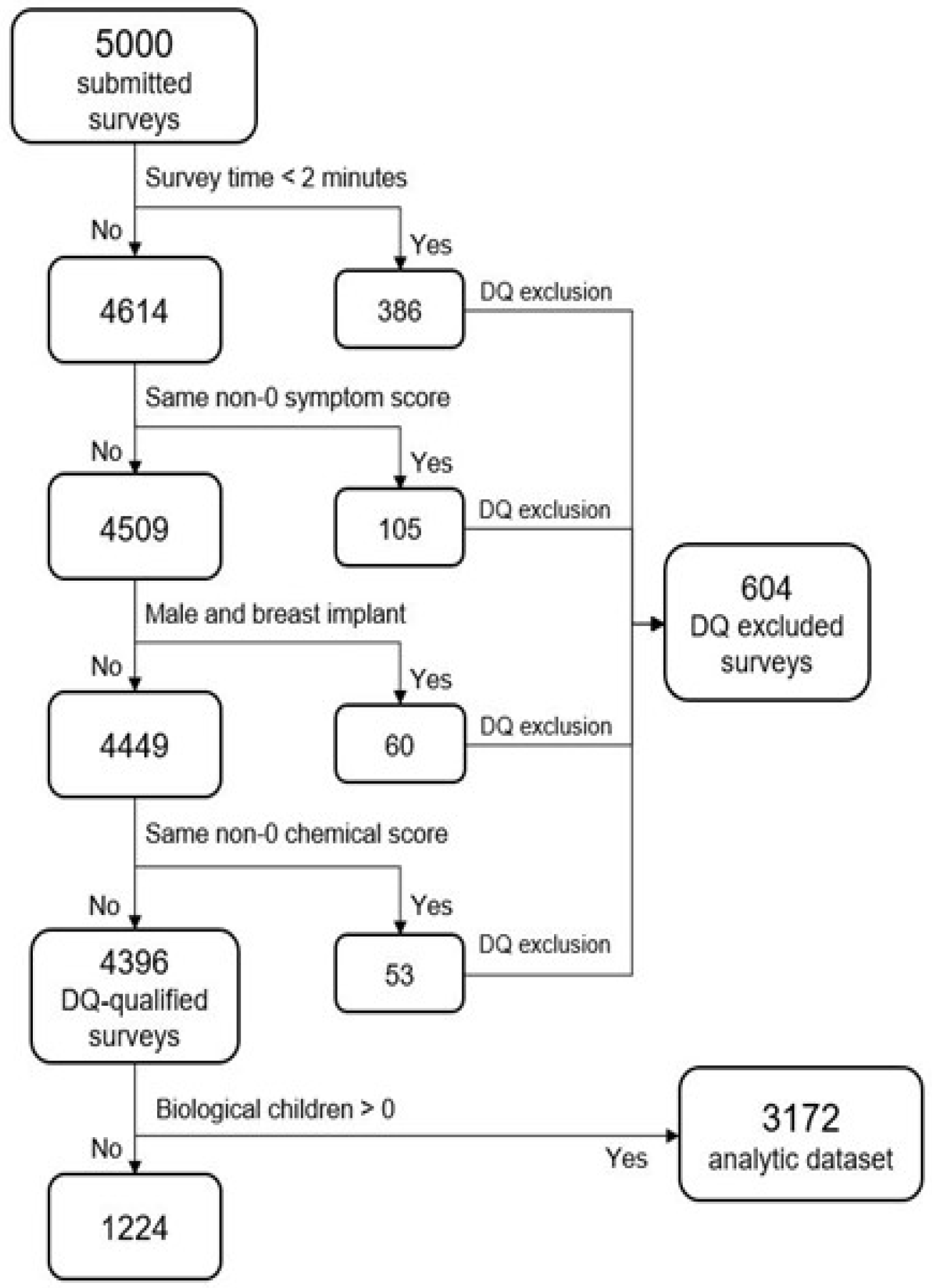
| Country | Exclusions | Percent |
|---|---|---|
| USA | 212/1000 | 21.2% |
| Japan | 155/1000 | 15.5% |
| Italy | 103/1000 | 10.3% |
| India | 97/1000 | 9.7% |
| Mexico | 37/1000 | 3.7% |
| Total Sample Percent | India | Japan | Italy | USA | Mexico | p ChiSq | ||
|---|---|---|---|---|---|---|---|---|
| Age | 18 to 34 | 32.2% | 44.2% | 24.7% | 21.5% | 25.0% | 43.2% | p < 0.0001 |
| 35 to 54 | 35.9% | 38.3% | 30.9% | 36.9% | 36.8% | 36.3% | ||
| 55+ | 31.9% | 17.5% | 44.4% | 41.6% | 38.2% | 20.5% | ||
| Sex | Male | 47.7% | 48.8% | 47.5% | 47.8% | 46.2% | 47.8% | p < 0.0537 |
| Female | 52.2% | 51.2% | 52.4% | 52.2% | 53.2% | 52.1% | ||
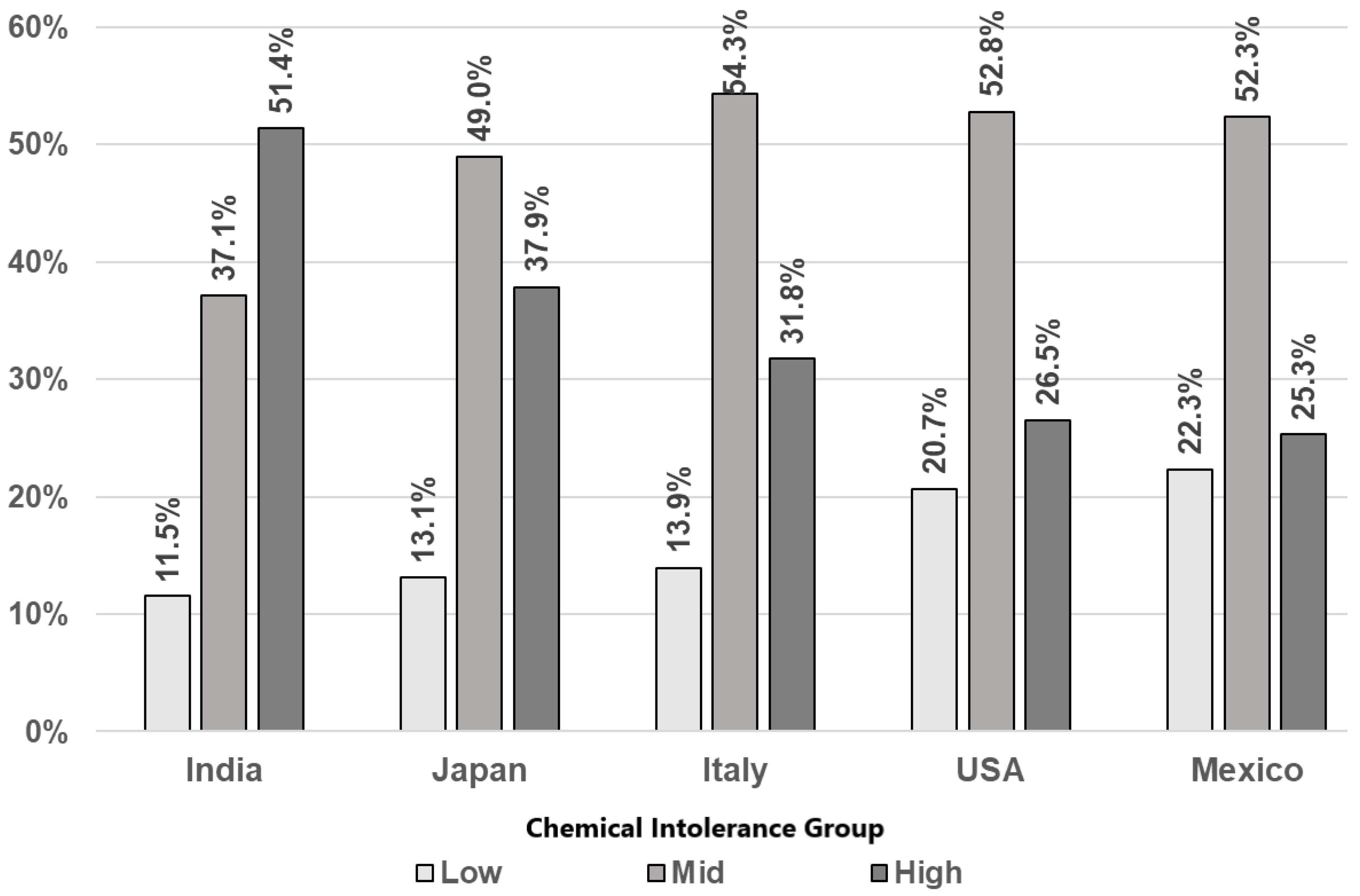
| CI Group | Low | 16.3% | 11.5% | 13.1% | 13.9% | 20.7% | 22.3% | p < 0.0001 |
| Medium | 49.0% | 37.1% | 49.0% | 54.3% | 52.8% | 52.3% | ||
| High | 34.6% | 51.4% | 37.9% | 31.8% | 26.5% | 25.3% | ||
| Children | Yes | 72.2% | 76.7% | 63.0% | 75.1% | 69.7% | 75.2% | p < 0.0001 |
| No | 27.8% | 23.3% | 37.0% | 24.9% | 30.3% | 24.8% | ||
| ASD a | Yes | 13.1% | 32.2% | 3.8% | 4.2% | 15.3% | 8.2% | p < 0.0001 |
| No | 87.0% | 67.8% | 96.2% | 95.9% | 84.7% | 91.9% | ||
| ADHD a | Yes | 18.0% | 34.6% | 2.6% | 9.2% | 18.6% | 21.3% | p < 0.0001 |
| No | 82.0% | 65.4% | 97.4% | 90.8% | 81.4% | 78.7% |
| Country | Cronbach’s Alpha | |
|---|---|---|
| QEESI Scale | ||
| Chemical Intolerance | Symptom Severity | |
| India | 0.93 | 0.95 |
| Japan | 0.94 | 0.94 |
| Italy | 0.93 | 0.92 |
| USA | 0.94 | 0.92 |
| Mexico | 0.92 | 0.90 |
| a Parental Self-Reported Family-Level ASD | |||||||||||
|---|---|---|---|---|---|---|---|---|---|---|---|
| India | Japan | Italy | Mexico | USA | |||||||
| N | % * | N | % * | N | % * | N | % * | N | % * | ||
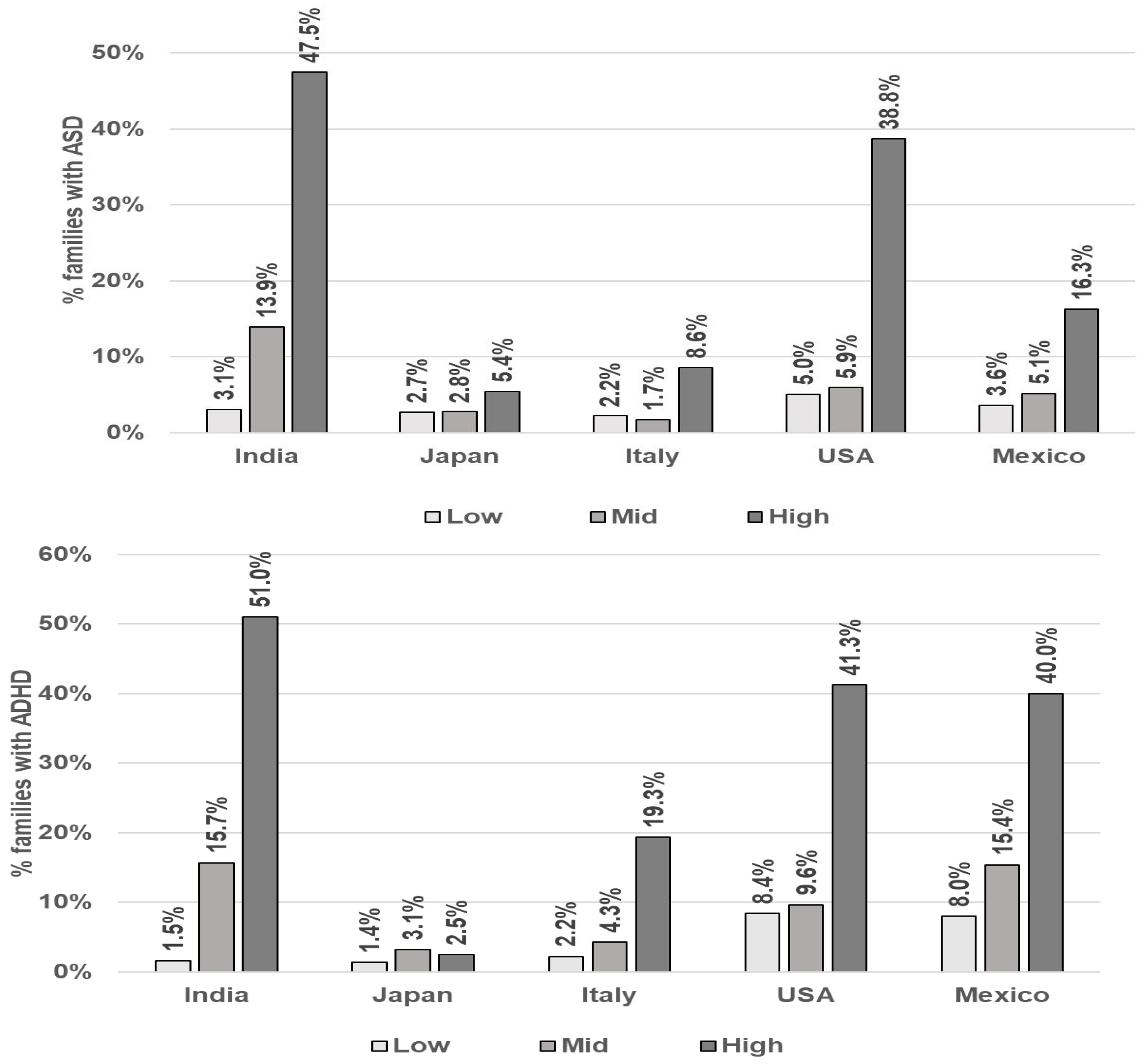
| High | yes | 189 | 47.5% | 11 | 5.4% | 20 | 8.6% | 35 | 16.3% | 62 | 38.7% |
| no | 209 | 193 | 213 | 180 | 98 | ||||||
| Mid | yes | 32 | 13.9% | 7 | 2.8% | 6 | 1.7% | 19 | 5.1% | 16 | 5.9% |
| no | 198 | 247 | 345 | 352 | 254 | ||||||
| Low | yes | 2 | 3.1% | 2 | 2.7% | 2 | 2.2% | 5 | 3.6% | 6 | 5.0% |
| no | 63 | 72 | 88 | 133 | 113 | ||||||
| CI Class | a Parental Self-Reported Family-Level ADHD | ||||||||||
| High | yes | 203 | 51.0% | 5 | 0.1% | 45 | 19.3% | 86 | 40.0% | 66 | 41.3% |
| no | 195 | 199 | 188 | 129 | 94 | ||||||
| Mid | yes | 36 | 15.6% | 8 | 3.1% | 15 | 4.3% | 57 | 15.4% | 26 | 9.6% |
| no | 194 | 246 | 336 | 314 | 244 | ||||||
| Low | yes | 1 | 1.5% | 1 | 1.3% | 2 | 2.2% | 11 | 8.0% | 10 | 8.4% |
| no | 64 | 73 | 88 | 127 | 109 | ||||||
| Effect | Country | ||||
|---|---|---|---|---|---|
| India (N = 693) * | Japan N = 532 * | Italy N = 674 * | Mexico N = 724 * | USA N = 549 * | |
| OR (95% CI) | OR (95% CI) | OR (95% CI) | OR (95% CI) | OR (95% CI) | |
| ASD | |||||
| High vs. Low CI a | 2.5 (2.0–3.0) *** | 1.4 (0.9–2.2) ns | 2.0 (1.3–3.0) ** | 1.9 (1.5–2.5) *** | 2.7 (2.1–3.6) *** |
| Age Group | 0.5 (0.4–0.6) *** | 0.6 (0.3–1.0) ns | 0.4 (0.3–0.8) ** | 0.7 (0.5–1.0) ns | 0.3 (0.2–0.5) *** |
| Female | 1.2 (1.0–1.4) ns | 1.5 (0.9–2.4) ns | 0.8 (0.5–1.2) ns | 0.7 (0.5–0.9) * | 0.9 (0.7–1.2) ns |
| ADHD | |||||
| High vs. Low CI a | 2.5 (2.1–3.1) *** | 0.9 (0.5–1.6) ns | 2.3 (1.7–3.1) *** | 2.0 (1.7–2.5) *** | 2.3 (1.8–2.9) *** |
| Age Group | 0.5 (0.4–0.6) *** | 0.6 (0.3–1.2) ns | 0.7 (0.5–1.0) * | 0.8 (0.6–1.1) ns | 0.5 (0.4–0.7) *** |
| Female | 1.2 (1.0–1.4) ns | 1.3 (0.7–2.2) ns | 1.0 (0.8 –1.3) ns | 1.0 (0.8–1.1) ns | 1.1 (0.9–1.4) ns |
Disclaimer/Publisher’s Note: The statements, opinions and data contained in all publications are solely those of the individual author(s) and contributor(s) and not of MDPI and/or the editor(s). MDPI and/or the editor(s) disclaim responsibility for any injury to people or property resulting from any ideas, methods, instructions or products referred to in the content. |
© 2026 by the authors. Licensee MDPI, Basel, Switzerland. This article is an open access article distributed under the terms and conditions of the Creative Commons Attribution (CC BY) license.
Share and Cite
Palmer, R.F.; Kattari, D. Chemical Intolerance Is Associated with Autism Spectrum and Attention Deficit Disorders: A Five-Country Cross-National Replication Analysis. J. Xenobiot. 2026, 16, 5. https://doi.org/10.3390/jox16010005
Palmer RF, Kattari D. Chemical Intolerance Is Associated with Autism Spectrum and Attention Deficit Disorders: A Five-Country Cross-National Replication Analysis. Journal of Xenobiotics. 2026; 16(1):5. https://doi.org/10.3390/jox16010005
Chicago/Turabian StylePalmer, Raymond F., and David Kattari. 2026. "Chemical Intolerance Is Associated with Autism Spectrum and Attention Deficit Disorders: A Five-Country Cross-National Replication Analysis" Journal of Xenobiotics 16, no. 1: 5. https://doi.org/10.3390/jox16010005
APA StylePalmer, R. F., & Kattari, D. (2026). Chemical Intolerance Is Associated with Autism Spectrum and Attention Deficit Disorders: A Five-Country Cross-National Replication Analysis. Journal of Xenobiotics, 16(1), 5. https://doi.org/10.3390/jox16010005