


Abstract
Background: Burnout and job satisfaction are widely studied phenomena within the field of occupational health, particularly among nursing professionals exposed to high work demands. Work engagement has been identified as a potential mediator that may buffer the negative effects of burnout on job satisfaction. However, in the Peruvian context, empirical evidence on this relational dynamic remains limited. Objective: The objective of this study is to examine the mediating role of work engagement in the relationship between burnout and job satisfaction among Peruvian nurses using a structural equation modeling (SEM) approach. Methods: An explanatory study was conducted with a sample of 230 Peruvian nurses (M = 41.22, SD = 11.65). Data were analyzed using structural equation modeling. Results: Burnout showed significant negative correlations with work engagement (r = −0.47, p < 0.01) and job satisfaction (r = −0.41, p < 0.01), while work engagement was positively associated with job satisfaction (r = 0.79, p < 0.01). The structural model demonstrated a good fit (CFI = 0.96, TLI = 0.95, RMSEA = 0.06, and SRMR = 0.04). The model also indicated solid overall fit and revealed a significant indirect effect of burnout on job satisfaction through engagement, accounting for approximately 24% of the variance in engagement and 80% of the variance in job satisfaction. Conclusions: The findings confirm that work engagement fully mediates the relationship between burnout and job satisfaction among Peruvian nurses, serving as a key protective psychosocial resource. These results reinforce the Job Demands–Resources (JD-R) model and highlight the importance of implementing organizational interventions aimed at strengthening work engagement as a strategy to improve satisfaction and well-being in demanding healthcare settings.
1. Introduction
Burnout and work engagement among nurses are topics of growing interest in occupational health research, particularly due to the intense demands and inherent stress of the profession. Burnout, or occupational burnout syndrome, is characterized by emotional exhaustion, depersonalization, and a reduced sense of personal accomplishment, and it emerges when job demands chronically exceed the individual’s available resources [1]. In contrast, work engagement is defined as a positive, persistent affective–cognitive state characterized by vigor, dedication, and absorption in one’s work [2]. The work environment of nurses—marked by long shifts, heavy workloads, and continuous exposure to emotionally demanding situations—is consistently associated with elevated levels of burnout and with variations in levels of work engagement [3,4]. During the COVID-19 pandemic, these factors intensified markedly. Several studies have documented substantial increases in emotional exhaustion, depersonalization, and turnover intention among nurses exposed to high care loads, resource shortages, and sustained infection risks [5,6,7]. At the same time, work engagement has been observed to function as a psychological resource that buffers the negative impact of job demands on health and well-being, insofar as it fosters positive emotions, a sense of purpose, and resilience in the face of stress [8,9].
The relationship between burnout and job satisfaction has been described as complex and multidimensional. In general, high levels of burnout are linked to lower job satisfaction, poorer organizational climate, increased absenteeism, and higher turnover intention [10,11,12]. From a classical perspective, job satisfaction is understood as a global or specific evaluation that employees make of their job and work context, integrating factors such as working conditions, interpersonal relationships, and rewards, which directly influence their motivation and their decision to remain in the organization [13]. Within this framework, different studies have shown that organizational resources such as structural empowerment, perceived fairness, supervisor support, and development opportunities are associated with lower burnout and higher job satisfaction [14,15,16].
Work engagement, in turn, has been shown to be closely and positively related to job satisfaction in various care settings. Nurses with higher levels of vigor, dedication, and absorption generally report greater satisfaction with their work and a lower likelihood of leaving the organization [17,18]. Studies in hospital and critical care services indicate that even in high-demand contexts, work engagement is associated with better indicators of well-being and lower professional burnout [12,19]. However, there are also reports of scenarios in which the relationship between engagement and satisfaction is not statistically significant, suggesting the influence of specific contextual factors such as the nature of the service or organizational policies [20,21].
In the Peruvian healthcare context, the relationship between burnout syndrome, work engagement, and job satisfaction among nurses presents a complex and multifaceted picture. Recent studies have shown that burnout and other job stressors negatively affect subjective well-being and perceived job satisfaction, whereas personal resources such as professional self-efficacy and organizational resources such as institutional support foster higher levels of engagement and better performance [22,23]. Likewise, research conducted with Peruvian nurses has shown that, despite limitations in administrative policies and benefits, personal development and task performance can constitute important sources of satisfaction; in fact, higher levels of life satisfaction have been found among substitute nurses compared to permanent staff, highlighting the role of interpersonal relationships and opportunities for professional growth [24]. Furthermore, it has been noted that in emergency and prehospital care services, levels of burnout do not always translate directly into lower job satisfaction, suggesting the presence of specific resources—such as sense of purpose or team support—that modulate this relationship in the Peruvian context [20]. Taken together, these national empirical findings indicate that Peruvian nurses constitute a group particularly exposed to high job demands, while also underscoring the central role of personal and organizational resources in shaping their work engagement and job satisfaction. However, despite these advances, empirical evidence that jointly examines burnout, work engagement, and job satisfaction within an explanatory mediation model among Peruvian nurses remains limited, especially when theoretical frameworks such as the Job Demands–Resources Model are considered. From a theoretical standpoint, the Job Demands–Resources (JD-R) Model provides a relevant framework for understanding these relationships. This model proposes that job demands (e.g., work overload, time pressure, emotional demands) tend to activate a strain process that leads to burnout, whereas job and personal resources (such as social support, autonomy, self-efficacy, or transformational leadership) promote a motivational process that enhances work engagement and produces positive outcomes, including higher performance and job satisfaction [25,26]. Consequently, burnout can be understood as the manifestation of a sustained imbalance between demands and resources, whereas work engagement reflects the capacity to appropriately mobilize available resources to maintain energy, involvement, and concentration in work tasks [27].
Applied to the nursing context, the JD-R model suggests that the high care demands inherent in hospital settings increase the risk of burnout, but that the presence of adequate resources (such as organizational support, professional recognition, and development opportunities) can strengthen work engagement and, through it, enhance job satisfaction [3,4]. From this perspective, work engagement is not only conceived as a desirable outcome but also as a psychological mechanism that mediates the relationship between environmental stressors (burnout) and positive work outcomes (job satisfaction), by transforming the work experience into one that is more meaningful and energizing [2,27]. In this way, the JD-R model offers a robust conceptual framework that allows integration of international and Peruvian evidence, articulating how the demands inherent to nursing work and the resources available in the national healthcare context converge to produce differing levels of burnout, engagement, and job satisfaction.
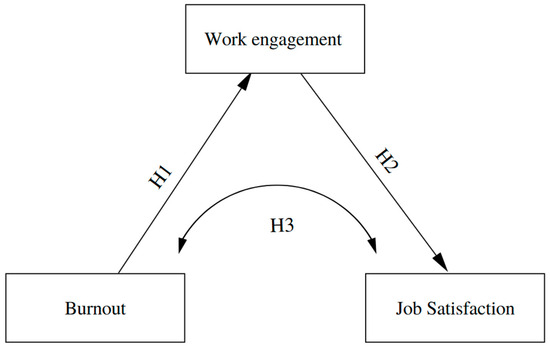
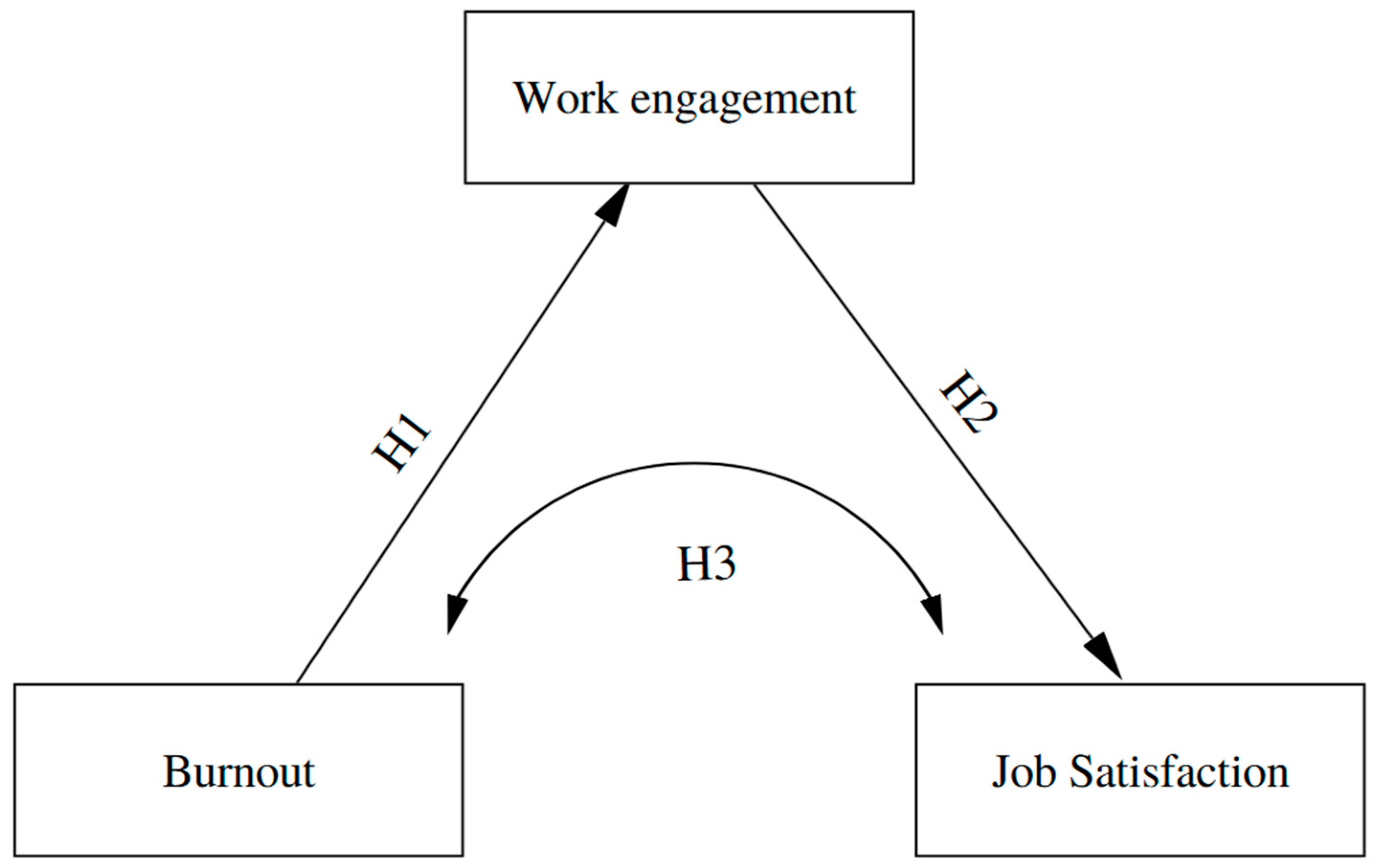
Both international and national literature allow us to anticipate that burnout is negatively related to work engagement, that engagement is positively associated with job satisfaction, and that, in line with the JD-R model, engagement may function as a key mediator in the relationship between burnout and satisfaction. Nevertheless, in the Peruvian context there are still few studies that explicitly test this full mediation model among nurses using structural equation modeling, which limits understanding of the psychosocial mechanisms that link job demands to affective and attitudinal outcomes in this professional group. Based on the foregoing, the following hypotheses are proposed (Figure 1):
Figure 1.
Theoretical model.
Hypothesis 1.
Burnout will have a negative effect on work engagement.
Hypothesis 2.
Work engagement will have a positive effect on job satisfaction.
Hypothesis 3.
Work engagement will mediate the relationship between burnout and job satisfaction.
2. Methods
2.1. Design and Population
A cross-sectional and explanatory study was designed, employing a structural equation modeling (SEM) approach to represent latent variables [28]. The sample size was estimated using the statistical calculation software developed by Soper [29] for structural equation models, which indicated a minimum required sample of 119 participants. This estimate considered the number of observed and latent variables, an anticipated effect size (λ = 0.30), a statistical power level (1 − β = 0.80), and a desired significance level (α = 0.05). Participants were recruited through non-probabilistic convenience sampling from public and private hospitals located in Lima Metropolitana (Peru). To preserve the institutional anonymity requested by the participating centers, the specific names of the hospitals are not reported; however, all are secondary and tertiary care facilities that provide inpatient services. The final sample consisted of 230 Peruvian nurses, aged between 22 and 68 years (M = 41.22, SD = 11.65). The majority were women (93.0%). Regarding marital status, most participants reported being single (48.3%). In terms of educational level, the majority had university-level education (79.6%). Regarding employment status, the highest proportion were employed under the CAS contract scheme (55.2%) (see Table 1).
Table 1.
Sociodemographic Characteristics.
2.2. Measures
Job Satisfaction: Job satisfaction was assessed using the Spanish version of the G_Clinic questionnaire, originally developed and validated with nursing professionals working in clinical management units of the Andalusian public healthcare system [30]. The instrument consists of 10 items distributed across four dimensions: work climate, work relationships, motivation, and recognition. In its original study, it showed adequate global fit indices and acceptable internal consistency (overall α = 0.75; dimensions ≥ 0.70) [30]. The scale uses a 5-point Likert-type response format, where 1 indicates lower agreement or satisfaction and 5 indicates higher agreement or satisfaction, such that higher scores reflect higher levels of job satisfaction. In the present study, a confirmatory factor analysis yielded a satisfactory fit for the four-factor model: χ2(29) = 48.24, p = 0.014, CFI = 0.98, TLI = 0.97, RMSEA = 0.05 (90% CI [0.03, 0.07]), and SRMR = 0.03. The internal consistency of the dimensions was excellent, with Cronbach’s alpha (α) coefficients of 0.92, 0.92, 0.83, and 0.94, and omega (ω) coefficients of 0.92, 0.92, 0.84, and 0.94 for work climate, work relationships, motivation, and recognition, respectively, supporting the reliability of the scale in this sample of nurses.
Work Engagement: Work engagement was assessed using the 9-item short version of the Utrecht Work Engagement Scale (UWES-9), previously validated among healthcare professionals in Mexico [31] and adapted to the Peruvian work context [32]. This scale measures a positive affective–cognitive state of connection with one’s work, comprising three dimensions: Vigor, Dedication, and Absorption. Items are rated on a 6-point Likert-type scale ranging from 0 (never) to 5 (always), where higher scores indicate higher levels of work engagement. In the present study, the three-factor model of the UWES-9 showed an acceptable fit to the data: χ2(24) = 59.48, p < 0.001, CFI = 0.97, TLI = 0.96, RMSEA = 0.08 (90% CI [0.06, 0.10]), and SRMR = 0.02. The internal consistency of the three dimensions was excellent, with Cronbach’s alpha (α) coefficients of 0.94, 0.97, and 0.92, and omega (ω) coefficients of 0.94, 0.97, and 0.92 for Vigor, Dedication, and Absorption, respectively, which supports the reliability of the instrument in this sample of nurses.
Burnout: The Single-Item Burnout Scale (Ítem Único de Burnout, IUB) was validated in a sample of Peruvian workers [33]. This scale consists of a single item that assesses burnout globally, without subdivision into dimensions, and uses a 5-point ordinal Likert-type scale ranging from “not feeling burned out” to “feeling completely burned out.”
2.3. Procedure
Authorization was subsequently obtained from the administrations of two hospitals to conduct the study. Data collection took place between January and February 2025, with voluntary participation from nurses who completed the survey via Google Forms, allowing for online distribution. Prior to data collection, ethical guidelines established in the Declaration of Helsinki were followed, ensuring data confidentiality. Each participant was informed of the study’s nature and provided informed consent. Finally, the completeness of the submitted questionnaires was verified, which are presented below.
2.4. Data Analysis
The theoretical model was analyzed using structural equation modeling (SEM), employing the MLR estimator, which is suitable for continuous variables and robust to deviations from inferential normality [34]. Model fit was evaluated using the following indices: Comparative Fit Index (CFI), Root Mean Square Error of Approximation (RMSEA), and Standardized Root Mean Square Residual (SRMR). Acceptable thresholds were set as follows: CFI and TLI > 0.90 [35], RMSEA < 0.080 [36], and SRMR < 0.080 [37].
For mediation analysis, the bootstrapping method was applied with 5000 iterations and a 95% confidence interval [38]. Regarding the reliability of the scales, internal consistency was assessed using Cronbach’s alpha (α) and omega (ω) coefficients, following McDonald’s recommendations [39].
The SEM analysis was conducted using R software (version 4.0.5) with the lavaan package [40].
3. Results
3.1. Preliminary Analysis
Table 2 presents descriptive statistics and correlations among job satisfaction, work engagement, and burnout. Overall, the three variables exhibited approximately normal distributions, with skewness (g1) and kurtosis (g2) values within acceptable ranges. Job satisfaction and work engagement were positively correlated (r = 0.79, p < 0.01). Conversely, burnout showed negative correlations with both job satisfaction (r = −0.41, p < 0.01) and work engagement (r = −0.47, p < 0.01).
Table 2.
Descriptive statistics and correlations.
3.2. Structural Model
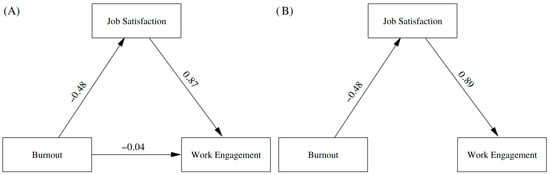
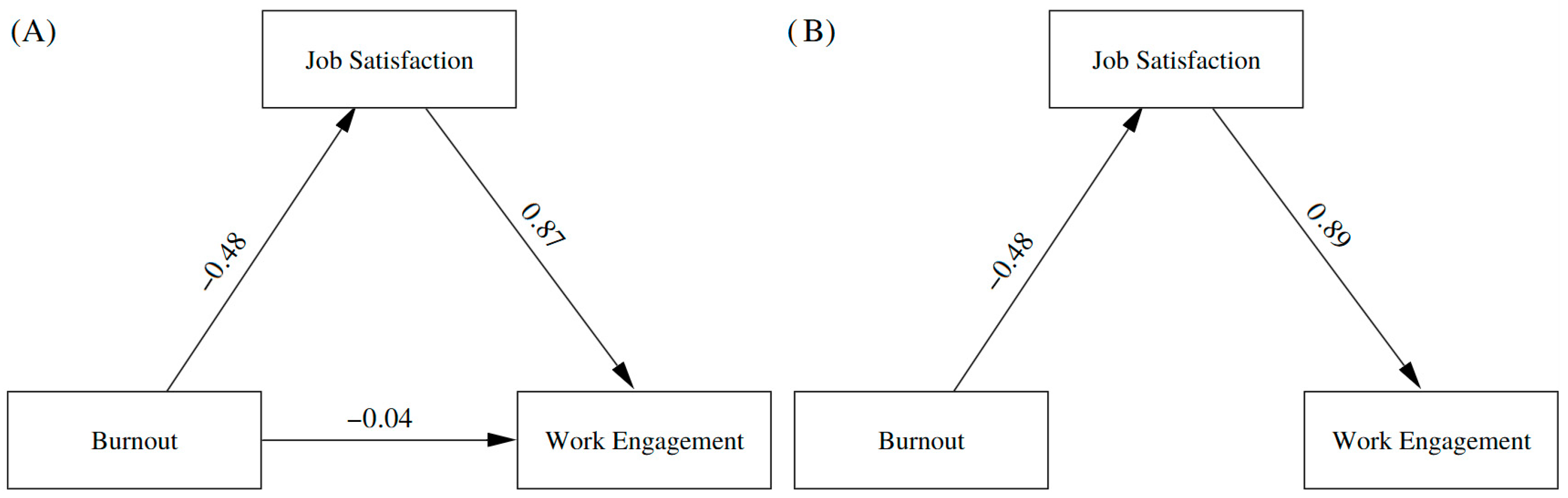
In the theoretical analysis of the model, an adequate fit was obtained: χ2 = 284.820, df = 161, p = 0.000; CFI = 0.96, TLI = 0.95, RMSEA = 0.06 (90% CI: 0.05–0.07), SRMR = 0.04. These results are reflected in the model on the left side of Figure 2 (Model A), where a significant indirect effect of burnout on job satisfaction through work engagement is observed. However, the direct effect of burnout on job satisfaction was very small (β = −0.04), suggesting that the relationship is fully mediated by work engagement. For reasons of parsimony, this direct effect was constrained to zero in Model B (right side of the figure), which also showed a good fit with identical fit indices (χ2 = 284.820, df = 161, p = 0.000; CFI = 0.96, TLI = 0.95, RMSEA = 0.06 [90% CI: 0.05–0.07], SRMR = 0.04). These findings support the hypothesis of full mediation, in which work engagement entirely explains the relationship between burnout and job satisfaction.
Figure 2.
Theoretical structural models. (A) Structural model including the direct and indirect effects of burnout on job satisfaction through work engage-ment (partial mediation model). (B) Structural model with the direct path from burnout to job satisfaction constrained to zero, representing the full mediation model through work engagement.
3.3. Mediation Analysis
Bootstrapping with 5000 resamples was used for the mediation analysis. Regarding H3, the mediating effect of work engagement in the relationship between burnout and job satisfaction was confirmed, with a significant indirect effect (β = 0.43, 95% CI [0.21, 0.44], p < 0.001). The model explained 23.7% of the variance in work engagement (R2 = 0.24) and 79.6% of the variance in job satisfaction (R2 = 0.80). Standardized effects are presented in Table 3.
Table 3.
Mediation model.
4. Discussion
The findings of this study confirmed Hypothesis 1, showing that higher levels of burnout are associated with lower work engagement among nurses, weakening their affective and cognitive connection to their work. This aligns with the Job Demands–Resources (JD-R) Model, which posits that excessive demands without sufficient resources erode engagement. This result is consistent with international evidence documenting that high emotional demands, workload, and care pressure increase burnout and reduce engagement, which in turn heightens turnover intention and the likelihood of leaving the profession [4,41]. In the Latin American context, the literature shows that nurses’ quality of work life often falls within medium or low ranges, with clear repercussions for their health and the quality of care [42]. In Peru, burnout has been linked to the intention of healthcare professionals to migrate, aggravating staffing shortages and destabilizing care teams [43]. Our results expand this landscape by demonstrating, through a structural model, that burnout not only impacts individual distress but also directly undermines work engagement—a key resource for sustaining performance and retention in care services. From a hospital management perspective, this implies that strategies to contain burnout (e.g., regulating workloads, adequate nurse-to-patient ratios, effective rest periods, and psychosocial support) are not merely well-being interventions, but structural actions to preserve engagement and, consequently, reduce turnover and the risk of losing specialized talent.
Regarding Hypothesis 2, the results showed that work engagement has a positive and significant effect on job satisfaction, confirming that nurses who feel vigorous, dedicated, and absorbed in their work report higher levels of job satisfaction. This finding reinforces the central premise of the JD-R model: job resources (autonomy, leadership support, positive climate, development opportunities) foster engagement and, through it, increase satisfaction and psychological well-being. Recent studies have shown that when nurses perceive a favorable work environment, including manageable workloads, clear task delegation, and less disruptive shifts, their satisfaction increases and their intention to leave decreases [44]. In the Peruvian context, job satisfaction among healthcare professionals has been strongly shaped by overload, contractual instability, and heightened pressure during and after the pandemic [45], and low satisfaction levels have been linked to greater intention to resign among Peruvian nurses [46]. The present study provides additional evidence by showing that even in a high-demand setting with limited resources, work engagement can function as a positive mechanism that channels organizational resources into greater satisfaction. This has direct implications for staff retention, continuity of care, and service quality. For hospital managers, this suggests that investing in transformational leadership practices, explicit recognition, training opportunities, and participation in decision-making not only improves the work climate but also translates into increased engagement and, ultimately, higher satisfaction and lower turnover intention.
Finally, Hypothesis 3 was confirmed by the finding that work engagement significantly mediates the relationship between burnout and job satisfaction, resulting in a full mediation model in which the effect of burnout on satisfaction is channeled through engagement. In practical terms, this means that burnout tends to reduce job satisfaction, but its impact can be mitigated when nurses maintain high levels of engagement—positioning engagement as a strategic leverage point for hospital management. This result aligns with recent meta-analyses showing that nurse burnout is associated with lower quality of care, more adverse events, and reduced patient satisfaction [47], as well as with evidence that healthier and more organized work environments reduce burnout and improve satisfaction and retention [44,48]. In the Latin American context, where medium-to-low levels of quality of work life and their impact on staff health have been documented [42], our findings add a relevant nuance: among Peruvian nurses, work engagement is not only associated with greater satisfaction but also acts as a buffer against strain, offering an explanatory mechanism for why some teams maintain acceptable satisfaction levels even under adverse conditions. From a policy and management standpoint, this underscores the need for comprehensive interventions that combine reducing job demands (e.g., excessive shifts, mandatory overtime, insufficient staffing) with strengthening resources that promote engagement (inspirational leadership, social support, well-being programs, recognition, and professional development). Such strategies could not only reduce burnout and improve satisfaction but also decrease turnover intention and nurse migration, contributing to workforce stability and to the quality and safety of care in Peruvian hospitals.
4.1. Implications
The findings of this study provide robust empirical evidence on the relationship between burnout, work engagement, and job satisfaction among nursing personnel, with direct implications for clinical practice, hospital management, and the design of organizational policies. First, the results support the need to design and implement training and development programs based on work engagement and aligned with the JD-R model, aimed at strengthening resources such as vigor, dedication, and absorption. These programs may include workshops on stress regulation, active coping strategies, communication skills, and the construction of meaning in work, integrated into the continuous professional development of nursing staff. Second, from a hospital management perspective, it is recommended to incorporate psychosocial well-being indicators (burnout, engagement, and job satisfaction) into institutional evaluation systems and human resources dashboards so that these indicators are periodically monitored alongside classic parameters such as turnover, absenteeism, adverse events, and quality of care. This would help identify units or services at risk and prioritize interventions aimed at reducing overload and improving working conditions (e.g., staffing adjustments, shift reorganization, access to psychological support). Third, the results suggest that organizational policies should emphasize strengthening key job resources: transformational and supportive leadership styles, structural empowerment (participation in decision-making, autonomy in practice), and explicit recognition of performance. Concrete actions include leadership training programs for nursing supervisors, recognition systems that are not only financial but also symbolic, and clear pathways for professional development. By increasing resources, work engagement is strengthened, which—according to the JD-R model and the findings of this study—can buffer the impact of burnout and foster satisfaction and staff retention. Finally, at the theoretical level, these results expand the evidence on the Job Demands–Resources Model in a Latin American context characterized by high care demands, showing that work engagement functions as a key mediator between burnout and job satisfaction. This reinforces the importance of considering engagement not only as a desirable outcome but also as a central mechanism through which management policies and practices can translate into well-being and sustainability in nursing work.
4.2. Limitations
This study has several limitations that should be considered when interpreting the results. First, the cross-sectional design prevents establishing causal relationships between burnout, engagement, and job satisfaction; therefore, the observed associations should be interpreted as correlational. Longitudinal or experimental studies would allow examination of the directionality of effects and the evolution of these variables over time. Second, a non-probabilistic sample of nurses from specific institutions was used, which limits the generalizability of the findings to the entire population of Peruvian nurses. It is possible that participants differed from non-respondents in relevant variables (e.g., motivation, availability of time, or satisfaction level), introducing potential selection bias. Future studies should consider probabilistic sampling strategies and larger multicenter samples. Third, all variables were measured through self-report, which may generate social desirability and common method biases, given that the information source is the same and responses may be influenced by mood or perceptions of the institution. Incorporating objective indicators (e.g., turnover and absenteeism rates, patient complaints) and hetero-reported evaluations (e.g., supervisor-rated performance) would help increase the validity of the results. Fourth, although the use of a unidimensional burnout measure based on a single item has prior evidence of acceptable validity and reliability for capturing the global experience of feeling “burned out,” it represents an important limitation in this study. This measure restricts analysis of the classical dimensions of the construct (emotional exhaustion, depersonalization, and reduced personal accomplishment) and may underestimate the complexity of the phenomenon, as well as limit the variance available for structural modeling. Future studies should employ multidimensional burnout scales (for example, abbreviated MBI versions or other instruments validated in the Peruvian context), which would allow for comparison with our findings, analysis of differentiated burnout profiles, and more precise exploration of its relationship with engagement and job satisfaction. Finally, reporting bias is possible (e.g., underreporting burnout symptoms due to fear of stigma or workplace repercussions), as is a potential healthy worker effect, given that those with the most severe levels of strain may have been absent or not have participated in the study. These limitations suggest interpreting the results with caution and reinforce the need to replicate the model in different contexts and with complementary methodologies.
5. Conclusions
The findings of this study provide solid empirical evidence on the relational dynamics between burnout, work engagement, and job satisfaction among nursing personnel, confirming a full mediation model in which work engagement acts as a protective mechanism against the negative impact of burnout on job satisfaction. This evidence strengthens the theoretical framework of the Job Demands–Resources (JD-R) Model and highlights the central role of engagement as a key psychosocial resource for well-being in highly demanding care settings. In practical terms, the results support the implementation of concrete organizational interventions that strengthen work engagement, such as (a) training and development programs based on engagement and aligned with the JD-R model, integrating demand management, resource strengthening, and transformational leadership development; (b) systematic incorporation of well-being indicators (burnout, engagement, and satisfaction) into institutional evaluations and human resource monitoring systems; and (c) structural empowerment and recognition policies that promote self-efficacy, participation in decision-making, and a sense of purpose at work. Taken together, these strategies may help not only reduce burnout and improve job satisfaction but also decrease turnover intention, stabilize nursing staffing, and ultimately enhance the quality and safety of care in Peruvian hospitals.
Author Contributions
Conceptualization, I.J.E.-Z., E.P.-F., M.T.C.-C. and W.C.M.-G. Methodology, I.J.E.-Z., E.P.-F. and L.Z.S.-S. Software, E.P.-F. Validation, W.C.M.-G., S.B.M.-G. and L.Z.S.-S. Formal analysis, I.J.E.-Z. and E.P.-F. Investigation, I.J.E.-Z., E.P.-F., M.T.C.-C., L.Z.S.-S. and O.R.-L. Resources, W.C.M.-G. and S.B.M.-G. Data curation, M.T.C.-C. and E.P.-F. Writing—original draft, I.J.E.-Z., E.P.-F. and M.T.C.-C. Writing—review & editing, W.C.M.-G., S.B.M.-G., L.Z.S.-S., O.R.-L. and I.J.E.-Z. Visualization, E.P.-F. and I.J.E.-Z. Supervision, W.C.M.-G. Project administration, I.J.E.-Z. and W.C.M.-G. All authors have read and agreed to the published version of the manuscript.
Funding
This research received no external funding.
Institutional Review Board Statement
The study was conducted in accordance with the Declaration of Helsinki and approved by the Ethics Committee of the Peruvian Union University (Approval Code No. 2025-CE-EPG-00011), approved on 5 January 2025.
Informed Consent Statement
Informed consent was obtained from all subjects involved in the study.
Data Availability Statement
The datasets generated and analyzed during the current study are not publicly available due to ethical and confidentiality restrictions but are available from the corresponding author on reasonable request.
Public Involvement Statement
No public involvement in any aspect of this research.
Guidelines and Standards Statement
This manuscript was drafted in accordance with the STROBE (Strengthening the Reporting of Observational Studies in Epidemiology) guidelines for observational research.
Use of Artificial Intelligence
AI or AI-assisted tools were not used in drafting any aspect of this manuscript.
Conflicts of Interest
The authors declare no conflicts of interest.
References
- Maslach, C.; Jackson, S.E. The measurement of experienced burnout. J. Organ. Behav. 1981, 2, 99–113. [Google Scholar] [CrossRef] [Scilit]
- Schaufeli, W.B.; Salanova, M.; González-romá, V.; Bakker, A.B. The Measurement of Engagement and Burnout: A Two Sample Confirmatory Factor Analytic Approach. J. Happiness Stud. 2002, 3, 71–92. [Google Scholar] [CrossRef] [Scilit]
- Yang, E.O.; Gu, M.O. A Structural Model for Burnout and Work Engagement of Nurses in Long-term Care Hospitals: Application of the Expanded Job Demand-Job Resources Model. J. Korean Gerontol. Nurs. 2022, 24, 108–121. [Google Scholar] [CrossRef] [Scilit]
- Vargas-Benítez, M.Á.; Izquierdo-Espín, F.J.; Castro-Martínez, N.; Gómez-Urquiza, J.L.; Albendín-García, L.; Velando-Soriano, A.; la Fuente, G.A.C.-D. Burnout syndrome and work engagement in nursing staff: A systematic review and meta-analysis. Front. Med. 2023, 10, 1125133. [Google Scholar] [CrossRef] [Scilit] [PubMed]
- Galanis, P.; Moisoglou, I.; Katsiroumpa, A.; Vraka, I.; Siskou, O.; Konstantakopoulou, O.; Meimeti, E.; Kaitelidou, D. Increased Job Burnout and Reduced Job Satisfaction for Nurses Compared to Other Healthcare Workers after the COVID-19 Pandemic. Nurs. Rep. 2023, 13, 1090–1100. [Google Scholar] [CrossRef] [Scilit] [PubMed]
- Mohamed, S.A.; Hendy, A.; Ezzat Mahmoud, O.; Mohamed, S.M. Mattering perception, work engagement and its relation to burnout amongst nurses during coronavirus outbreak. Nurs. Open 2022, 9, 377–384. [Google Scholar] [CrossRef] [Scilit]
- Talumepa, K.R.; Panggabean, H. Moderating impact of perceived organizational support toward burnout on work engagement in Nurses. J. Penelit. 2022, 19, 96–105. [Google Scholar] [CrossRef] [Scilit]
- Gillet, N.; Fernet, C.; Blechman, Y.; Morin, A.J.S. On the Combined Role of Work Engagement and Burnout Among Novice Nurses: A Longitudinal Person-Centered Analysis. J. Career Assess. 2023, 31, 686–714. [Google Scholar] [CrossRef] [Scilit]
- Van der Colff, J.J.; Rothmann, S. Occupational stress, sense of coherence, coping, burnout and work engagement of registered nurses in South Africa. SA J. Ind. Psychol. 2009, 35, a423. [Google Scholar] [CrossRef] [Scilit]
- Alzailai, N.; Barriball, L.; Xyrichis, A. Burnout and job satisfaction among critical care nurses in Saudi Arabia and their contributing factors: A scoping review. Nurs. Open 2021, 8, 2331–2344. [Google Scholar] [CrossRef] [Scilit]
- Bruce, J.; Sangweni, B. The relationship between burnout and job satisfaction among registered nurses at an academic hospital in Johannesburg, south Africa. Afr. J. Nurs. Midwifery 2012, 14, 89–104. [Google Scholar] [CrossRef] [Scilit]
- Friganović, A.; Selič, P. Where to look for a remedy? Burnout syndrome and its associations with coping and job satisfaction in critical care nurses—A cross-sectional study. Int. J. Environ. Res. Public Health 2021, 18, 4390. [Google Scholar] [CrossRef] [Scilit]
- Locke, E.A. The nature and causes of job satisfaction. In Handbook of Industrial and Organizational Psychology; Rand McNally & Co.: Chicago, IL, USA, 1976. [Google Scholar]
- Brohi, N.A.; Abdullah MMBin Dahri, A.M.K.A.S.; Ali, R.; Markhand, K.H. Communication Quality, Job Clarity, Supervisor Support and Job Satisfaction among Nurses in Pakistan: The Moderating Influence of Fairness Perception. Int. J. Acad. Res. Bus. Soc. Sci. 2018, 8, 1–7. [Google Scholar] [CrossRef] [Scilit]
- Orlowska, A.; Laguna, M. Structural and Psychological Empowerment in Explaining Job Satisfaction and Burnout in Nurses: A Two-Level Investigation. J. Nurs. Manag. 2023, 2023, 9958842. [Google Scholar] [CrossRef] [Scilit]
- Chung, M.; Han, S. Effects of Job Crafting, Burnout, and Job Satisfaction on Nurses’ Turnover Intention: A Path Analysis. J. Korean Acad. Fundam. Nurs. 2023, 30, 281–291. [Google Scholar] [CrossRef] [Scilit]
- Meliana, A.; Suratmi, S.; Hikmatul Qowi, N. Relationship between employee engagement and job satisfaction of nurses at Muhammadiyah Babat lamongan hospital. J. Vocat. Nurs. 2023, 4, 97–101. [Google Scholar] [CrossRef] [Scilit]
- Suardana, I.B.R.; Martini, L.K.B. The Effect of Employee Engagement, Job Satisfaction, and Superior-Subordinate Relationships on the Desire to Change Jobs and Its Implications in Employee Resignation. In Technology and Business Model Innovation: Challenges and Opportunities; Alareeni, B., Hamdan, A., Eds.; ICBT 2023. Lecture Notes in Networks and Systems; Springer: Cham, Switzerland, 2023; Volume 924. [Google Scholar] [CrossRef] [Scilit]
- Huhtala, M.; Geurts, S.; Mauno, S.; Feldt, T. Intensified job demands in healthcare and their consequences for employee well-being and patient satisfaction: A multilevel approach. J. Adv. Nurs. 2021, 77, 3718–3732. [Google Scholar] [CrossRef] [Scilit] [PubMed]
- Gabriel, V. Nivel de satisfacción laboral y Síndrome de Burnout en el profesional de enfermería en el Sistema de Atención Móvil de Urgencias. Rev. Enferm. Hered. 2021, 12, 26–32. [Google Scholar] [CrossRef] [Scilit]
- Treviño, R.; López, J.F. El impacto del empoderamiento en la satisfacción laboral, el compromiso organizacional y el burnout en docentes de México. Contad. Adm. 2022, 67, e351. [Google Scholar] [CrossRef] [Scilit]
- Bernales-Turpo, D.; Quispe-Velasquez, R.; Flores-Ticona, D.; Saintila, J.; Mamani, P.G.R.; Huancahuire-Vega, S.; Morales-García, M.; Morales-García, W.C. Burnout, Professional Self-Efficacy, and Life Satisfaction as Predictors of Job Performance in Health Care Workers: The Mediating Role of Work Engagement. J. Prim. Care Community Health 2022, 13, 21501319221101845. [Google Scholar] [CrossRef] [Scilit]
- Morales-García, W.C.; Vallejos, M.; Sairitupa-Sanchez, L.Z.; Morales-García, S.B.; Rivera-Lozada, O.; Morales-García, M. Depression, professional self-efficacy, and job performance as predictors of life satisfaction: The mediating role of work engagement in nurses. Front. Public Health 2024, 12, 1268336. [Google Scholar] [CrossRef] [Scilit]
- Duche-Pérez, A.B.; Galdos, G.L.R. Job satisfaction and happiness in Peruvian nurses. Enferm. Glob. 2019, 18, 353–373. [Google Scholar] [CrossRef] [Scilit]
- Bakker, A.B.; Demerouti, E. The Job Demands-Resources model: State of the art. J. Manag. Psychol. 2007, 22, 309–328. [Google Scholar] [CrossRef] [Scilit]
- Schaufeli, W.B.; Bakker, A.B. Job demands, job resources, and their relationship with burnout and engagement: A multi-sample study. J. Organ. Behav. 2004, 25, 293–315. [Google Scholar] [CrossRef] [Scilit]
- Hakanen, J.J.; Schaufeli, W.B.; Ahola, K. The job demands-resources model: A three-year cross-lagged study of burnout, depression, commitment, and work engagement. Work. Stress 2008, 22, 224–241. [Google Scholar] [CrossRef] [Scilit]
- Ato, M.; López, J.J.; Benavente, A. Un sistema de clasificación de los diseños de investigación en psicología. An. Psicol. 2013, 29, 1038–1059. [Google Scholar] [CrossRef] [Scilit]
- Soper, D. A-Priori Sample Size Calculator for Structural Equation Models. 2020. Available online: https://www.danielsoper.com/statcalc/calculator.aspx?id=89 (accessed on 2 December 2025).
- Porcel-Gálvez, A.M.; Martínez-Lara, C.; Gil-García, E.; Grao-Cruces, A. Construcción y validación del cuestionario G_Clinic para medir la satisfacción laboral en profesionales de enfermería de las unidades de gestión clínica. Rev. Esp. Salud Publica 2014, 88, 419–428. [Google Scholar] [CrossRef] [Scilit] [PubMed]
- Hernandez-Vargas, C.I.; Llorens-Gumbau, S.; Rodriguez-Sanchez, A.M.; Dickinson-Bannack, M.E. Validación de la escala UWES-9 en profesionales de la salud en México. Pensam. Psicol. 2016, 14, 89–100. [Google Scholar] [CrossRef] [Scilit]
- Merino-Soto, C.; Fernández-Arata, M.; Juárez-García, A. Validez de la Estructura Interna del Utrecht Work Engagement Scale (UWES) en trabajadores peruanos. Interdiscip. Rev. Psicol. Cienc. Afines 2021, 39, 7–25. [Google Scholar] [CrossRef] [Scilit]
- Merino-Soto, C.; Juárez-García, A.; Altamirano-Bringas, A.; Velarde-Mercado, B. Una medida muy breve del burnout: Evidencia de validez de constructo en trabajadores peruanos. Ansiedad Estrés 2018, 24, 131–135. [Google Scholar] [CrossRef]
- Muthen, L.; Muthen, B. MPlus User’ Guide, 8th ed.; Muthen & Muthen: Los Angeles, CA, USA, 2017. [Google Scholar]
- Bentler, P. Comparative fit indices in structural models. Psychol. Bull. 1990, 107, 238–246. [Google Scholar] [CrossRef] [Scilit]
- MacCallum, R.C.; Browne, M.W.; Sugawara, H.M. Power Analysis and determination of sample size for covariance structure modeling of fit involving a particular measure of model. Psychol. Methods 1996, 13, 130–149. [Google Scholar] [CrossRef]
- Browne, M.W.; Cudeck, R. Alternative ways of assessing model fit. Sociol. Methods Res. 1992, 21, 230–258. [Google Scholar] [CrossRef] [Scilit]
- Yzerbyt, V.; Muller, D.; Batailler, C.; Judd, C.M. New recommendations for testing indirect effects in mediational models: The need to report and test component paths. Pers. Soc. Psychol. 2018, 115, 929–943. [Google Scholar] [CrossRef] [Scilit] [PubMed]
- McDonald, R.P. Test Theory: A United Treatment; Lawrence Erlbaum: Mahwah, NJ, USA, 1999. [Google Scholar]
- Rosseel, Y. lavaan: An R Package for Structural Equation Modeling. J. Stat. Softw. 2012, 48, 1–93. [Google Scholar] [CrossRef] [Scilit]
- Van der Heijden, B.I.J.M.; Houkes, I.; Van den Broeck, A.; Czabanowska, K. “I Just Can’t Take It Anymore”: How Specific Work Characteristics Impact Younger Versus Older Nurses’ Health, Satisfaction, and Commitment. Front. Psychol. 2020, 11, 762. [Google Scholar] [CrossRef] [Scilit]
- Cueva-Pila, G.; Valenzuela Suazo, S.; Alvarado Alvarado, A.L.; Hidalgo Ortiz, J.P. Revisión integrativa de la calidad de vida en el trabajo de enfermeras latinoamericanas. Enferm. Cuid. Humaniz. 2022, 11, e2905. [Google Scholar] [CrossRef] [Scilit]
- Anduaga-Beramendi, A.; Beas, R.; Maticorena-Quevedo, J.; Mayta-Tristán, P. Association Between Burnout and Intention to Emigrate in Peruvian health-care Workers. Saf. Health Work. 2019, 10, 80–86. [Google Scholar] [CrossRef] [Scilit]
- Bae, S.H. Nurse Staffing, Work Hours, Mandatory Overtime, and Turnover in Acute Care Hospitals Affect Nurse Job Satisfaction, Intent to Leave, and Burnout: A Cross-Sectional Study. Int. J. Public Health 2024, 69, 1607068. [Google Scholar] [CrossRef] [Scilit]
- Ortiz, V.A.; Itusaca, N.N. Job satisfaction in crisis: The Impact of COVID-19 on health personnel. Rev. Fac. Med. Humana 2023, 23, 193. [Google Scholar] [CrossRef] [Scilit]
- Paredes, K.M.S.; Rodriguez, S.K.T.; Arévalo-Ipanaqué, J.M.; Chaparro, J.E.T.; Riva, M.E.M.-L.; Cabanillas-Chavez, M.T.; Polonia, A.d.C. Indicator of Job Satisfaction Related to Intention to Quit in Peruvian Nurses. Acad. J. Interdiscip. Stud. 2023, 12, 75. [Google Scholar] [CrossRef] [Scilit]
- Li, L.Z.; Yang, P.; Singer, S.J.; Pfeffer, J.; Mathur, M.B.; Shanafelt, T. Nurse Burnout and Patient Safety, Satisfaction, and Quality of Care. JAMA Netw. Open 2024, 7, e2443059. [Google Scholar] [CrossRef] [Scilit] [PubMed]
- Van Der Heijden, B.; Mahoney, C.B.; Xu, Y. Impact of job demands and resources on nurses’ burnout and occupational turnover intention towards an age-moderated mediation model for the nursing profession. Int. J. Environ. Res. Public Health 2019, 16, 2011. [Google Scholar] [CrossRef] [Scilit] [PubMed]

Disclaimer/Publisher’s Note: The statements, opinions and data contained in all publications are solely those of the individual author(s) and contributor(s) and not of MDPI and/or the editor(s). MDPI and/or the editor(s) disclaim responsibility for any injury to people or property resulting from any ideas, methods, instructions or products referred to in the content. |
© 2026 by the authors. Licensee MDPI, Basel, Switzerland. This article is an open access article distributed under the terms and conditions of the Creative Commons Attribution (CC BY) license.