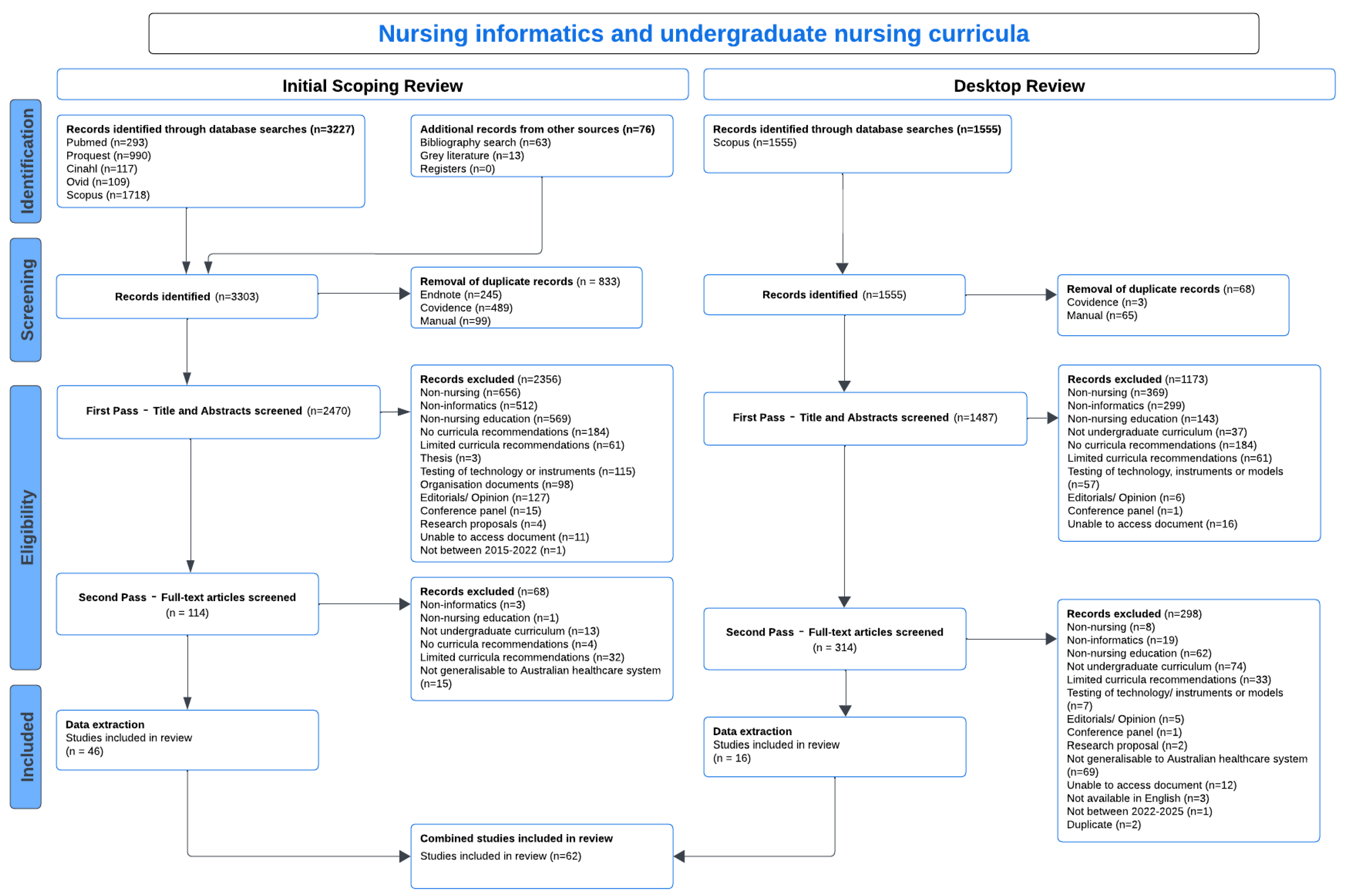

Nursing Informatics and Undergraduate Nursing Curricula: A Scoping Review

Abstract
1. Introduction
2. Materials and Methods
- Defining and aligning the objective/s and questions/s
- Developing and aligning the inclusion question/s
- Describing the planned approach to evidence searching, selection, data extraction, and presentation of the evidence
- Searching for the evidence
- Selecting the evidence
- Extracting the evidence
- Analysis of the evidence
- Presentation of the results
- Summarising the evidence in relation to the purpose of the review, making conclusions and noting any implications of the findings
2.1. Protocol and Registration
2.2. Review Question
- What are the benefits of nursing informatics?
- What are the barriers to the integration of nursing informatics in undergraduate nursing curricula?
- What are the enablers to the integration of nursing informatics in undergraduate nursing curricula?
2.3. Eligibility Criteria
2.4. Information Sources and Search Strategy
2.5. Data Extraction and Analysis
2.6. Subsequent Desktop Review
3. Results
3.1. Characteristics of Sources of Evidence
3.2. Benefits
3.2.1. Benefits of Nursing Informatics in the Clinical Setting
3.2.2. Benefits of Nursing Informatics in Undergraduate Nursing Education
3.3. Barriers
3.3.1. Understanding of Nursing Informatics
3.3.2. Infrastructure and Resources
3.3.3. Student Access to Digital Technologies
3.3.4. Digital Literacy of Students and Faculty
3.3.5. Evolving Nature of Nursing Informatics
3.3.6. Faculty Responses to Nursing Informatics
3.3.7. Nursing Informatics Competencies
3.3.8. Nursing Informatics Resources
3.4. Enablers
4. Discussion
Limitations
5. Recommendations
- Global definitions of nursing informatics and associated fields must be established; a global resource would provide educators and nurses with invaluable information to inform nursing informatics education and ongoing professional development. Within the Australian context, consensus of definitions should reflect current definitions supported by the Australian Digital Health Agency and the Australasian Institute of Digital Health, the peak bodies responsible for digital health in Australia.
- The development of university faculty digital health competency must be strengthened through the adoption of competency standards for educators, prioritised by the relevant professional nursing bodies, including the Australian Nursing and Midwifery Accreditation Council, the Nursing and Midwifery Board of Australia, the Australian College of Nursing, and the Australian Nursing and Midwifery Federation, and embedded as a requirement for employment.
- Development of a national open access repository for nursing informatics education would be a useful means of limiting siloed information and providing nurse educators with the opportunity to engage in self-directed professional development.
- It is essential that students have access to a range of digital health technologies. Whilst it is noted that the associated costs of these resources can be prohibitive, it is insufficient to solely rely on clinical settings to provide students with access to digital health technologies. Therefore, relationships should be established between key stakeholders, including vendors, healthcare facilities and universities, to provide fit-for-purpose digital health technologies, with a view to the sharing of resources and providing access to students within the safety of a simulation environment.
- The development of undergraduate nursing curricula be explicitly linked with relevant competency standards, against which educators and universities can measure their own competence and delivery of appropriate information. In the Australian context, this requires the Australian Nursing and Midwifery Accreditation Council to develop nursing informatics competency standards to inform the development of undergraduate nursing programs in Australia. In this way, the theoretical underpinnings of nursing informatics education can be more appropriately evaluated.
- Concerns regarding the digital literacy of students and faculty must be addressed to ensure that effective use of digital health technologies and associated data is realised. Therefore, baseline evaluation of digital literacy for students and faculty, with appropriate remediation provided as required, is an essential requirement and should include the embedding of a digital literacy framework.
6. Conclusions
Supplementary Materials
Author Contributions
Funding
Institutional Review Board Statement
Informed Consent Statement
Data Availability Statement
Public Involvement Statement
Guidelines and Standards Statement
Use of Artificial Intelligence
Acknowledgments
Conflicts of Interest
References
- Blažun Vošner, H.; Carter-Templeton, H.; Završnik, J.; Kokol, P. Nursing Informatics: A Historical Bibliometric Analysis. CIN Comput. Inform. Nurs. 2020, 38, 331–337. [Google Scholar] [CrossRef]
- Ahmad, M.; Hani, S.H.B.; Sabra, M.A.; Almahmoud, O. Big data can help prepare nurses and improve patient outcomes by improving quality, safety, and outcomes. Front. Nurs. 2023, 10, 241–248. [Google Scholar] [CrossRef]
- Mehta, N.; Pandit, A.; Shukla, S. Transforming healthcare with big data analytics and artificial intelligence: A systematic mapping study. J. Biomed. Inform. 2019, 100, 103311. [Google Scholar] [CrossRef]
- Stoumpos, A.I.; Kitsios, F.; Talias, M.A. Digital Transformation in Healthcare: Technology Acceptance and Its Applications. Int. J. Environ. Res. Public Health 2023, 20, 3407. [Google Scholar] [CrossRef] [PubMed]
- Cesnik, B.; Kidd, M.R. History of health informatics: A global perspective. In Health Informatics; Hovenga, E.J.S., Kidd, M.R., Garde, S., Cossion, C.H.L., Eds.; Studies in Health Technology and Informatics; IOS: Amsterdam, The Netherlands, 2010; Volume 151, pp. 3–8. [Google Scholar]
- Amer, B.; Ayed, A.; Malak, M.; Bashtawy, M. Nursing Informatics Competency and Self-Efficacy in Clinical Practice among Nurses in Palestinian Hospitals. Hosp Top. 2025, 103, 122–129. [Google Scholar] [CrossRef] [PubMed]
- Barbosa, S.d.F.F.; Abbott, P.; Dal Sasso, G.T.M. Nursing in the Digital Health Era. J. Nurs. Scholarsh. 2021, 53, 5–6. [Google Scholar] [CrossRef]
- Reid, L.; Button, D.; Brommeyer, M. Challenging the Myth of the Digital Native: A Narrative Review. Nurs. Rep. 2023, 13, 573–600. [Google Scholar] [CrossRef]
- Holt, K.A.; Overgaard, D.; Engel, L.V.; Kayser, L. Health literacy, digital literacy and eHealth literacy in Danish nursing students at entry and graduate level: A cross sectional study. BMC Nurs. 2020, 19, 22. [Google Scholar] [CrossRef]
- Reid, L.; Maeder, A.; Button, D.; Breaden, K.; Brommeyer, M. Defining Nursing Informatics: A Narrative Review. In Nurses and Midwives in the Digital Age; Honey, M., Ronquillo, C., Lee, T.-T., Westbrooke, L., Eds.; Studies in Health Technology and Informatics; IOS: Amsterdam, The Netherlands, 2021; Volume 284, pp. 108–112. [Google Scholar]
- Brown, J.; Pope, N.; Bosco, A.M.; Mason, J.; Morgan, A. Issues affecting nurses’ capability to use digital technology at work: An integrative review. J. Clin. Nurs. 2020, 29, 2801–2819. [Google Scholar] [CrossRef]
- Lapão, L.V. The Nursing of the Future: Combining Digital Health and the Leadership of Nurses. Rev. Lat. Am. De Enferm. Lat. Am. J. Nurs. 2020, 28, e3338. [Google Scholar] [CrossRef]
- Batran, A.; Al-Humran, S.M.; Malak, M.Z.; Ayed, A. The Relationship Between Nursing Informatics Competency and Clinical Decision-Making Among Nurses in West Bank, Palestine. CIN Comp. Inform. Nurs. 2022, 40, 547–553. [Google Scholar] [CrossRef]
- Ozbolt, J.G.; Saba, V.K. A brief history of nursing informatics in the United States of America. Nurs. Outlook 2008, 56, 199–205.e192. [Google Scholar] [CrossRef]
- Saba, V.K. Nursing informatics: Yesterday, today and tomorrow. Int. Nurs. Rev. 2001, 48, 177–187. [Google Scholar] [CrossRef]
- Marin, H.F.; Marques, E. Nursing informatics: Learning from the past to build a new future. Rev. Bras. De Enferm. [Braz. J.Nurs.] 2005, 58, 143–146. [Google Scholar] [CrossRef]
- Scholes, M.; Barber, B. The role of computers in nursing. Nurs. Mirror Midwives J. 1976, 143, 46–48. [Google Scholar]
- Cummins, M.R.; Gundlapalli, A.V.; Murray, P.; Park, H.A.; Lehmann, C.U. Nursing Informatics Certification Worldwide: History, Pathway, Roles, and Motivation. Yearb. Med. Inform. 2016, 1, 264–271. [Google Scholar] [CrossRef]
- Mihalas, G.I.; Kulikowski, C.A. Introduction. In International Medical Informatics and the Transformation of Healthcare; Kulikowski, C.A., Mihalas, G.I., Park, H.-A., Greenes, R.A., Yacubsohn, V., Eds.; Healthcare Computing & Communications Canada for IMIA, The International Medical Informatics Association: Edmonton, AB, Canada, 2021; pp. 10–14. [Google Scholar]
- Canadian Nursing Informatics Association (CNIA). History. Available online: https://cnia.ca/About-Us#history (accessed on 30 July 2021).
- Greenwood, K. ANI Connection: The Alliance for Nursing Informatics: A History. CIN Comp. Inform. Nurs. 2010, 28, 124–125. [Google Scholar] [CrossRef]
- O’Connor, S.; Hubner, U.; Shaw, T.; Blake, R.; Ball, M. Time for TIGER to ROAR! Technology Informatics Guiding Education Reform. Nurs. Educ. Today 2017, 58, 78–81. [Google Scholar] [CrossRef] [PubMed]
- O’Connor, S.; LaRue, E. Integrating informatics into undergraduate nursing education: A case study using a spiral learning approach. Nurs. Educ. Pract. 2021, 50, 1–6. [Google Scholar] [CrossRef] [PubMed]
- Raghunathan, K.; McKenna, L.; Peddle, M. Utilisation of academic electronic medical records in pre-registration nurse education: A descriptive study. Collegian 2022, 29, 645–653. [Google Scholar] [CrossRef]
- Hussey, P.A.; Kennedy, M.A. Instantiating informatics in nursing practice for integrated patient centred holistic models of care: A discussion paper. J. Adv. Nurs. 2016, 72, 1030–1041. [Google Scholar] [CrossRef]
- Boogerd, E.A.; Arts, T.; Engelen, L.; van de Belt, T.H. “What Is eHealth”: Time for An Update? JMIR Res. Protoc. 2015, 4, 1–4. [Google Scholar] [CrossRef]
- Friedman, C.P. What informatics is and isn’t. J. Am. Med. Inform. Assoc. 2012, 20, 224–226. [Google Scholar] [CrossRef]
- Fatehi, F.; Samadbeik, M.; Kazemi, A. What is Digital Health? Review of Definitions. In Integrated Citizen Centered Digital Health and Social Care; Värri, A., Delgado, J., Gallos, P., Hägglund, M., Häyrinen, K., Kinnunen, U., Pape-Haugaard, L.B., Peltonen, L., Saranto, K., Scott, P., Eds.; IOS: Amsterdam, The Netherlands, 2020; Volume 275, pp. 67–71. [Google Scholar]
- Cummings, E.; Shin, E.H.; Mather, C.; Hovenga, E.J.S. Embedding Nursing Informatics Education into an Australian Undergraduate Nursing Degree. In Nursing Informatics 2016; Sermeus, W., Procter, P.M., Weber, P., Eds.; Studies in Health Technologies and Informatics; IOS: Amsterdam, The Netherlands, 2016; Volume 225, pp. 329–333. [Google Scholar]
- Honey, M.; Skiba, D.; Procter, P.; Foster, J.; Kouri, P.; Nagle, L. Nursing Informatics Competencies for Entry to Practice: The Perspective of Six Countries. In Forecasting Informatics Competencies for Nurses in the Future of Connected Health: Proceedings of the Nursing Informatics Post Conference 2016; Murphy, J., Goossen, G., Weber, P., Eds.; Studies in Health Technology and Informatics; IOS: Geneva, Switzerland, 2017; Volume 232, pp. 51–61. [Google Scholar]
- Kinnunen, U.; Rajalahti, E.; Cummings, E.; Borycki, E.M. Curricula Challenges and Informatics Competencies for Nurse Educators. In Forecasting Informatics Competencies for Nurses in the Future of Connected Health 2016; Murphy, J., Goossen, W., Weber, P., Eds.; IOS: Geneva, Switzerland, 2017; Volume 232, pp. 41–48. [Google Scholar]
- Rowlands, D.; Digital Health Workforce Academy (DHWA); Health Informatics Society of Australia (HISA). What Is Digital Health? And Why Does it Matter. Available online: https://www.hisa.org.au/wp-content/uploads/2019/12/What_is_Digital_Health.pdf (accessed on 10 December 2024).
- Janes, G.; Chesterton, L.; Heaslip, V.; Reid, J.; Lüdemann, B.; Gentil, J.; Oxholm, R.-A.; Hamilton, C.; Phillips, N.; Shannon, M. Current nursing and midwifery contribution to leading digital health policy and practice: An integrative review. J. Adv. Nurs. 2024, 81, 116–139. [Google Scholar] [CrossRef]
- Hovenga, E.J.S. Nursing Informatics in Australia. M.D. Comput. Comput. Med. Pract. 1997, 14, 119–125. [Google Scholar] [PubMed]
- Health Informatics Society of Australia (HISA); Hovenga, E.J.S.; Kidd, M.R. HISA: About our history—Vision, Collaboration, Leadership. Available online: https://www.hisa.org.au/wp-content/uploads/2018/12/2018_HISA-BOOK_about-our-history.pdf (accessed on 10 December 2024).
- Australian Health Ministers’ Conference. National E-Health Strategy: Summary. Available online: https://www1.health.gov.au/internet/main/publishing.nsf/Content/69B9E01747B836DCCA257BF0001DC5CC/$File/Summary%20National%20E-Health%20Strategy%20final.pdf (accessed on 10 December 2024).
- Australian Digital Health Agency. About Us. Available online: https://www.digitalhealth.gov.au/about-us (accessed on 20 January 2026).
- Australian Digital Health Agency (ADHA). Safe, Seamless and Secure: Evolving Health and Care to Meet the Needs of Modern Australia—Australia’s National Digital Health Strategy. Available online: https://www.digitalhealth.gov.au/sites/default/files/2020-11/Australia%27s%20National%20Digital%20Health%20Strategy%20-%20Safe%2C%20seamless%20and%20secure.pdf (accessed on 10 December 2024).
- Australian Digital Health Agency (ADHA). National Nursing and Midwifery Digital Health Capability Framework. Available online: https://www.digitalhealth.gov.au/sites/default/files/2020-11/National_Nursing_and_Midwifery_Digital_Health_Capability_Framework_publication.pdf (accessed on 10 January 2023).
- Cummings, E.; Bichel-Findlay, J.; Procter, P.; Hübner, U.; Honey, M.; Day, K. Nursing Informatics Education: A Global Perspective. In Informatics Education in Healthcare: Lessons Learned; Berner, E.S., Ed.; Springer: Berlin/Heidelberg, Germany, 2020; pp. 153–166. [Google Scholar]
- Lokmic-Tomkins, Z.; Gray, K.; Cheshire, L.; Parolini, A.; Sharp, M.; Tarrant, B.; Hill, N.; Rose, D.; Webster, M.; Virtue, D.; et al. Integrating interprofessional electronic medical record teaching in preregistration healthcare degrees: A case study. Int. J. Med. Inform. 2023, 169, 104910. [Google Scholar] [CrossRef] [PubMed]
- Woods, L.; Janssen, A.; Robertson, S.; Morgan, C.; Butler-Henderson, K.; Burton-Jones, A.; Sullivan, C. The typing is on the wall: Australia’s healthcare future needs a digitally capable workforce. Aust. Health Rev. 2023, 47, 553–558. [Google Scholar] [CrossRef]
- Webb, C.; Dabkowski, E.; Allen, L.; Missen, K.; Dekker, E. Development and implementation of an electronic medical record (EMR) prototype for nursing students: A pilot study. Teach. Learn. Nurs. 2025. [Google Scholar] [CrossRef]
- Peters, M.D.J.; Godfrey, C.; McInerney, P.; Munn, Z.; Tricco, A.C.; Khalil, H. Scoping reviews (2024 Version). In JBI Manual for Evidence Synthesis—2024 Edition; Aromataris, E., Lockwood, C., Porritt, K., Pilla, B., Jordan, Z., Eds.; JBI: Adelaide, South Australia, 2024. [Google Scholar]
- Pham, M.T.; Rajić, A.; Greig, J.D.; Sargeant, J.M.; Papadopoulos, A.; McEwen, S.A. A scoping review of scoping reviews: Advancing the approach and enhancing the consistency. Res. Synth. Methods 2014, 5, 371–385. [Google Scholar] [CrossRef]
- Arksey, H.; O’Malley, L. Scoping studies: Towards a methodological framework. Int. J. Soc. Res. Methodol 2005, 8, 19–32. [Google Scholar] [CrossRef]
- Levac, D.; Colquhoun, H.; O’Brien, K.K. Scoping studies: Advancing the methodology. Implement. Sci. 2010, 5, 69. [Google Scholar] [CrossRef] [PubMed]
- Tricco, A.C.; Lillie, E.; Zarin, W.; O’Brien, K.K.; Colquhoun, H.; Levac, D.; Moher, D.; Peters, M.D.J.; Horsley, T.; Weeks, L.; et al. PRISMA Extension for Scoping Reviews (PRISMA-ScR): Checklist and Explanation. Ann. Int. Med. 2018, 169, 467–473. [Google Scholar] [CrossRef]
- Pollock, D.; Davies, E.L.; Peters, M.D.J.; Tricco, A.C.; Alexander, L.; McInerney, P.; Godfrey, C.M.; Khalil, H.; Munn, Z. Undertaking a scoping review: A practical guide for nursing and midwifery students, clinicians, researchers, and academics. J. Adv. Nurs. 2021, 77, 2102–2113. [Google Scholar] [CrossRef]
- Khalil, H.; Peters, M.D.J.; Tricco, A.C.; Pollock, D.; Alexander, L.; McInerney, P.; Godfrey, C.M.; Munn, Z. Conducting high quality scoping reviews-challenges and solutions. J. Clin. Epidemiol. 2021, 130, 156–160. [Google Scholar] [CrossRef]
- Davis, K.; Drey, N.; Gould, D. What are scoping studies? A review of the nursing literature. Int. J. Nurs. Stud. 2009, 46, 1386–1400. [Google Scholar] [CrossRef]
- Reid, L.; Button, D.; Breaden, K.; Brommeyer, M. Nursing informatics and undergraduate nursing curricula: A scoping review protocol. Nurs. Educ. Pract. 2022, 65, 1–6. [Google Scholar] [CrossRef] [PubMed]
- Peters, M.D.J.; Marnie, C.; Tricco, A.C.; Pollock, D.; Munn, Z.; Alexander, L.; McInerney, P.; Godfrey, C.M.; Khalil, H. Updated methodological guidance for the conduct of scoping reviews. JBI Evid. Synth. 2021, 19, 3–10. [Google Scholar] [CrossRef]
- Staggers, N.; Thompson, C.B. The Evolution of Definitions for Nursing Informatics: A Critical Analysis and Revised Definition. J. Am. Med. Inform. Assoc. 2002, 9, 255–261. [Google Scholar] [CrossRef]
- Australian College of Nursing (ACN); Health Informatics Society of Australia (HISA); Nursing Informatics Australia (NIA). Nursing Informatics Position Statement. Available online: https://www.hisa.org.au/wp-content/uploads/2017/04/NURSING-INFORMATICS-POSITION-STATEMENT_v.9-DRAFT.pdf?x97063 (accessed on 14 January 2019).
- Australian Health Practitioner Regulation Agency. Streamlined pathway to registration for internationally qualified registered nurses. Available online: https://www.ahpra.gov.au/News/2025-01-27-media-release-IQRN.aspx (accessed on 10 January 2026).
- The Law Library. Trans-Tasman Mutual Recognition Act 1997; CreateSpace Independent Publishing Platform: North Charleston, SC, USA, 1997. [Google Scholar]
- Veritas Health Innovation. Covidence: The World’s #1 Systematic Review Tool. Available online: https://www.covidence.org/ (accessed on 9 June 2022).
- Bengtsson, M. How to plan and perform a qualitative study using content analysis. NursingPlus Open 2016, 2, 8–14. [Google Scholar] [CrossRef]
- Krippendorff, K. Content Analysis: An Introduction to Its Methodology, 4th ed.; SAGE: Thousand Oaks, CA, USA, 2019. [Google Scholar]
- Graneheim, U.H.; Lindgren, B.-M.; Lundman, B. Methodological challenges in qualitative content analysis: A discussion paper. Nurs. Educ. Today 2017, 56, 29–34. [Google Scholar] [CrossRef]
- Queensland Government. Desktop Research. Available online: https://www.forgov.qld.gov.au/service-design-and-delivery/design-public-services/digital-service-design-playbook/all-plays/desktop-research (accessed on 14 January 2026).
- Almond, H.; Brice, S. Health Informatics Education Case Study: A Nurse Educator Perspective. In MEDINFO 2025—Healthcare Smart × Medicine Deep; Househ, M.S., Tariq, Z.U.A., Al-Zubaidi, M., Shah, U., Huesing, E., Eds.; IOS: Amsterdam, The Netherlands, 2025; Volume 329, pp. 2064–2065. [Google Scholar]
- Almond, H.; Brice, S. Health Informatics Education Case Study: A Graduate Nurse Perspective. In MEDINFO 2025—Healthcare Smart × Medicine Deep; Househ, M.S., Tariq, Z.U.A., Al-Zubaidi, M., Shah, U., Huesing, E., Eds.; IOS: Amsterdam, The Netherlands, 2025; Volume 329, pp. 2062–2063. [Google Scholar]
- Brunner, M.; McGregor, D.; Keep, M.; Janssen, A.; Spallek, H.; Quinn, D.; Jones, A.; Tseris, E.; Yeung, W.; Togher, L.; et al. An eHealth capabilities framework for graduates and health professionals: Mixed-methods study. J. Med. Internet Res. 2018, 20, e10229. [Google Scholar] [CrossRef]
- Cummings, E.; Whetton, S.; Mather, C. Integrating Health Informatics Into Australian Higher Education Health Profession Curricula. In Health Professionals’ Education in the Age of Clinical Information Systems, Mobile Computing and Social Networks; Shachak, A., Borycki, E.M., Reis, S.P., Eds.; Academic: Cambridge, MA, USA, 2017; pp. 323–343. [Google Scholar]
- Harerimana, A.; Wicking, K.; Biedermann, N.; Yates, K. Nursing informatics in undergraduate nursing education in Australia before COVID-19: A scoping review. Collegian 2022, 29, 527–539. [Google Scholar] [CrossRef]
- Hay, B.; Carr, P.J.; Dawe, L.; Clark-Burg, K. “iM Ready to Learn”: Undergraduate Nursing Students Knowledge, Preferences, and Practice of Mobile Technology and Social Media. CIN Comput. Inform. Nurs. 2017, 35, 8–17. [Google Scholar] [CrossRef] [PubMed]
- Hovenga, E.J.S.; Grain, H. Learning, Training and Teaching of Health Informatics and its Evidence for Informaticians and Clinical Practice. In Evidence-Based Health Informatics; Ammenwerth, E., Rigby, M., Eds.; Studies in Health Technology and Informatics; IOS: Amsterdam, The Netherlands, 2016; Volume 222, pp. 336–354. [Google Scholar]
- Lami, S.; Ayed, A. Predictors of Nurses’ Practice of Eye Care for Patients in Intensive Care Units. SAGE Open Nurs. 2023, 9. [Google Scholar] [CrossRef] [PubMed]
- Mather, C.; Cummings, E. Issues for Deployment of Mobile Learning by Nurses in Australian Healthcare Setting. In Nursing Informatics 2016; Sermeus, W., Procter, P.M., Weber, P., Eds.; Studies in Health Technology and Informatics; IOS: Amsterdam, The Netherlands, 2016; Volume 225, pp. 277–281. [Google Scholar]
- Mather, C.; Cummings, E. Empowering learners: Using a triad model to promote eHealth literacy and transform learning at point of care. Knowl. Manag. E-learn. 2015, 7, 629–645. [Google Scholar] [CrossRef]
- Mather, C.; Cummings, E.; Nichols, L. Social Media Training for Professional Identity Development in Undergraduate Nurses. In Nursing Informatics 2016; Sermeus, W., Procter, P.M., Weber, P., Eds.; Studies in Health Technology and Informatics; IOS: Amsterdam, The Netherlands, 2016; Volume 225, pp. 344–348. [Google Scholar]
- McGregor, D.; Keep, M.; Brunner, M.; Janssen, A.; Quinn, D.; Avery, J.; Togher, L.; Shaw, T. Preparing E-Health Ready Graduates: A Qualitative Focus Group Study. In Integrating and Connecting Care; Schaper, L.K., Whetton, S., Ryan, A., Eds.; Studies in Health Technology and Informatics; IOS: Amsterdam, The Netherlands, 2017; Volume 239, pp. 91–96. [Google Scholar]
- Mollart, L.; Stubbs, M.; Noble, D.; Koizumi, N.; Crowfoot, G. Student confidence and knowledge with electronic medical records through on-ward simulation: An evaluation study. Clin. Sim. Nurs. 2025, 106. [Google Scholar] [CrossRef]
- Raghunathan, K.; McKenna, L.; Peddle, M. Use of academic electronic medical records in nurse education: A scoping review. Nurs. Educ. Today 2021, 101, 104889. [Google Scholar] [CrossRef] [PubMed]
- Stunden, A.; Ginige, A.; O’Reilly, R.; Sanagavarapu, P.; Heaton, L.; Jefferies, D. Nursing students’ preparedness for the digitalised clinical environment in Australia: An integrative review. Nurs. Educ. Pract. 2024, 75, 1–11. [Google Scholar] [CrossRef]
- Zhao, L.; Abdolkhani, R.; Walter, R.; Petersen, S.; Butler-Henderson, K.; Livesay, K. National survey on understanding nursing academics’ perspectives on digital health education. J. Adv. Nurs. 2024, 80, 4888–4899. [Google Scholar] [CrossRef]
- Booth, R.G.; Sinclair, B.; Brennan, L.; Strudwick, G. Developing and implementing a simulated electronic medication administration record for undergraduate nursing education: Using socio technical systems theory to inform practice and curricula. CIN Comp. Inform. Nurs. 2017, 35, 131–139. [Google Scholar] [CrossRef]
- Booth, R.G.; Sinclair, B.; Strudwick, G.; Hall, J.; Tong, J.; Loggie, B.; Chan, R. Strategies Through Clinical Simulation to Support Nursing Students and Their Learning of Barcode Medication Administration (BCMA) and Electronic Medication Administration Record (eMAR) Technologies. In Health Professionals’ Education in the Age of Clinical Information Systems, Mobile Computing and Social Networks; Shachak, A., Borycki, E.M., Reis, S.P., Eds.; Academic: Cambridge, MA, USA, 2017; pp. 246–266. [Google Scholar]
- Chauvette, A.; Kleib, M.; Paul, P. Developing nursing students’ informatics competencies—A Canadian faculty perspective. Int. J. Nurs. Educ. Scholarsh. 2022, 19, 1–11. [Google Scholar] [CrossRef] [PubMed]
- Chauvette, A.; Paul, P.; Kleib, M. The impetus of COVID-19 in transforming nursing education through informatics. Quality Adv. Nurs. Educ. 2022, 8, 1–15. [Google Scholar] [CrossRef]
- Kleib, M.; Arnaert, A.; Nagle, L.; Sugars, R. Education About Digital Health and Artificial Intelligence and Learning Needs: Perspectives of Undergraduate Nursing Students. Quality Adv. Nurs. Educ. 2025, 11, 1–26. [Google Scholar] [CrossRef]
- Kleib, M.; Arnaert, A.; Nagle, L.M.; Ali, S.; Idrees, S.; Costa, D.d.; Kennedy, M.; Darko, E.M. Digital Health Education and Training for Undergraduate and Graduate Nursing Students: Scoping Review. JMIR Nurs. 2024, 7, e58170. [Google Scholar] [CrossRef]
- Kleib, M.; Olson, K. Evaluation of an informatics educational intervention to enhance informatics competence among baccalaureate nursing students. Knowl. Manag. E-Learn. 2015, 7, 395–411. [Google Scholar] [CrossRef]
- Rees, G.; Nowell, L.; Risling, T. Shaping the Future of Digital Health Education in Canada: Prioritizing Competencies for Health Care Professionals Using the Quintuple Aim. JMIR Med. Educ. 2025, 11, e75904. [Google Scholar] [CrossRef]
- Risling, T. Educating the nurses of 2025: Technology trends of the next decade. Nurs. Educ. Pract. 2017, 22, 89–92. [Google Scholar] [CrossRef]
- Subramanian, S.; Kleib, M. Leveraging Clinical Preceptorship to Enhance Nursing Students’ Readiness in Digital Health. Quality Adv. Nurs. Educ. 2023, 9. [Google Scholar] [CrossRef]
- Theron, M.J.; Astle, B.; Dixon, D.; Redmond, A. Beyond Checklists: A Nursing Informatics Education Strategy for Undergraduate Nursing Students Appraising Health Information on Social Networking Sites (SNS). Quality Adv. Nurs. Educ. 2019, 5, 1–18. [Google Scholar] [CrossRef]
- Theron, M.; Borycki, E.M.; Redmond, A. Developing Digital Literacies in Undergraduate Nursing Studies: From Research to the Classroom. In Health Professionals’ Education in the Age of Clinical Information Systems, Mobile Computing and Social Networks; Shachak, A., Reis, S.P., Borycki, E.M., Eds.; Elsevier: Amsterdam, The Netherlands, 2017; pp. 149–173. [Google Scholar]
- Theron, M.; Redmond, A.; Borycki, E.M. Nursing Students’ Perceived Learning from a Digital Health Assignment as Part of the Nursing Care for the Childbearing Family Course. In Building Capacity for Health Informatics in the Future; Lau, F., Bartle-Clar, J.A., Bliss, G., Eds.; Studies in Health Technology and Informatics; IOS: Amsterdam, The Netherlands, 2017; Volume 234, pp. 328–335. [Google Scholar]
- Honey, M.; Collins, E.; Britnell, S. Identifying How to Support Nurse Educators Nationally to Teach Nursing Informatics. In Nurses and Midwives in the Digital Age; Honey, M., Ronquillo, C., Lee, T., Westbrooke, L., Eds.; Studies in Health Technology and Informatics; IOS: Amsterdam, The Netherlands, 2021; Volume 284, pp. 124–129. [Google Scholar]
- Royal College of Nursing. Every Nurse an E-NURSE INSIGHts from a Consultation on the Digital Future of Nursing. Available online: https://cdn.ps.emap.com/wp-content/uploads/sites/3/2018/07/Every-Nurse-an-E-nurse-report.pdf (accessed on 9 June 2023).
- Topol, E. The Topol Review: Preparing the Healthcare Workforce to Deliver the Digital Future. An Independent Report on Behalf of the Secretary of State for Health and Social Care February 2019. Available online: https://topol.digitalacademy.nhs.uk/download/133/?tmstv=1769466903 (accessed on 5 December 2022).
- Angel, V.M.; Friedman, M.H.; Friedman, A.L. Integrating Bar-Code Medication Administration Competencies in the Curriculum: Implications for Nursing Education and Interprofessional Collaboration. Nurs. Educ. Perspect. 2016, 37, 239–241. [Google Scholar] [CrossRef]
- Baxter, P.M.; Andrew, L.A. Successful Integration of an Academic Electronic Health Record Into the Curriculum of an Associate Degree Nursing Program. Nurs. Educat. Perspect. 2018, 39, 250–252. [Google Scholar] [CrossRef]
- Bonnel, W.; Vogel Smith, K.; Hober, C. Teaching with Technologies in Nursing and the Health Professions: Strategies for Engagement, Quality, and Safety; Springer: New York, NY, USA, 2018. [Google Scholar]
- Bove, L.A.; Sauer, P. Nursing Faculty Informatics Competencies. CIN Comput. Inform. Nurs. 2023, 41, 18–23. [Google Scholar] [CrossRef]
- Brunel, M.; Allert, J. Integrating Experiential Informatics and Quality Improvement in Baccalaureate Education. Nurs. Educ. Perspect. 2025, 46, 124–125. [Google Scholar] [CrossRef]
- Burke, M.S.; Ellis, D.M. Electronic Health Records: Describing Technological Stressors of Nurse Educators. Nurs.Educ. 2016, 41, 46–48. [Google Scholar] [CrossRef]
- Clancy, T.R. National Nursing Informatics Deep Dive Program Integrating AACN Essentials for Information Management and Patient Care Technologies Across the Continuum. Available online: https://pdf4pro.com/view/national-nursing-informatics-deep-dive-program-44772e.html (accessed on 21 March 2020).
- Clever Together. A Vision for the Changing Faculty Role: Preparing Students for the Technological World of Health Care; National League for Nursing (NLN): Washington, DC, USA, 2015.
- Cross, L.; Kendrick, A. Artificial intelligence and the meta-paradigm. Teach. Learn. Nurs. 2025, 21, e257–e261. [Google Scholar] [CrossRef]
- Doerner, M.E.; Connerton, C.S.; Wijesuriya, U. Student growth in informatics competencies after a nursing informatics course. Teach. Learn. Nurs. 2025, 20, e1240–e1244. [Google Scholar] [CrossRef]
- Forman, T.M.; Armor, D.A.; Miller, A.S. A Review of Clinical Informatics Competencies in Nursing to Inform Best Practices in Education and Nurse Faculty Development. Nurs. Educ. Perspect. 2020, 41, E3–E7. [Google Scholar] [CrossRef] [PubMed]
- Forman, T.M.; Flores, D.; Miller, A.S. An Integrative Literature Review of the Use of Electronic Health Records for Clinical Nursing Education. J. Inform. Nurs. 2020, 5, 28–44. [Google Scholar]
- Foster, M.; Sethares, K. Current Strategies to Implement Informatics into the Nursing Curriculum: An Integrative Review. Online J. Nurs. Inform. 2017, 21, 4. [Google Scholar]
- Gambo, J.M.; Bahreman, N.T.; Watties-Daniels, D.; Neal, M.; Swoboda, S.M. Can Mobile Technology Enhance Learning and Change Educational Practice? CIN Comp. Inform. Nurs. 2017, 35, 375–380. [Google Scholar] [CrossRef]
- Hamilton, H.; Iradukunda, F.; Aselton, P. The Integration of Telehealth in Nursing Education: A New Frontier. J. Inform. Nurs. 2021, 6, 18–25. [Google Scholar]
- Hern, M.J.; Key, M.; Goss, L.K.; Owens, H. Facilitating adoption of informatics and meaningful use of electronic health records with nursing faculty. J. Nurs. Educ. Pract. 2015, 5, 118–126. [Google Scholar] [CrossRef]
- Luo, S.; Kalman, M. A technology training protocol for meeting QSEN goals: Focusing on meaningful learning. Nurs. Forum 2018, 53, 20–26. [Google Scholar] [CrossRef] [PubMed]
- Pobocik, T. Using an Educational Electronic Documentation System to Help Nursing Students Accurately Identify Patient Data. Int. J. Nurs. Knowl. 2015, 26, 26–34. [Google Scholar] [CrossRef]
- Repsha, C.; Morse, B.; Lee, S.E.; Katz, J.; Burrows, E.; Teates, J. Use of a Simulated Electronic Health Record to Support Nursing Student Informatics Knowledge and Skills. CIN: Comput. Inform. Nurs. 2020, 38, 55–59. [Google Scholar] [CrossRef]
- Sapci, A.H.; Sapci, H.A. The effectiveness of hands-on health informatics skills exercises in the multidisciplinary smart home healthcare and health informatics training laboratories. App. Clin. Inform. 2017, 8, 1184–1196. [Google Scholar] [CrossRef]
- Sorensen, J.; Campbell, L. Curricular path to value: Integrating an academic electronic health record. J. Nurs. Educ. 2016, 55, 716–719. [Google Scholar] [CrossRef] [PubMed]
- Vottero, B.A. Teaching Informatics to Prelicensure, RN-to-BSN, and Graduate Level Students. Nurs. Educ. 2017, 42, 22–26. [Google Scholar] [CrossRef]
- Wilbanks, B.A.; Watts, P.I.; Epps, C.A. Electronic Health Records in Simulation Education: Literature Review and Synthesis. Simul. Healthc. 2018, 13, 261–267. [Google Scholar] [CrossRef]
- Cummings, E.; Borycki, E.M.; Madsen, I. Teaching Nursing Informatics in Australia, Canada and Denmark. In Context Sensitive Health Informatics: Many Places, Many Users, Many Contexts, Many Uses; Borycki, E.M., Kushniruk, A.W., Kuziemsky, C.E., Nohr, N., Eds.; Studies in Health Technology and Informatics; IOS: Amsterdam, The Netherlands, 2015; Volume 218, pp. 39–44. [Google Scholar]
- O’Connor, S.; Andrews, T. Mobile Technology and Its Use in Clinical Nursing Education: A Literature Review. J. Nurs. Educ. 2015, 54, 137–144. [Google Scholar] [CrossRef]
- Lokmic-Tomkins, Z.; Raghunathan, K.; Almond, H.; Booth, R.G.; McBride, S.; Tietze, M.F.; Honey, M.; Procter, P.; Peddle, M.; McKenna, L. Integrating Health Informatics into Pre-Registration Nursing Education: Insights from a Participatory Workshop. In Innovation in Applied Nursing Informatics; Strudwick, G., Hardiker, N.R., Rees, G., Cook, R., Lee, Y.J., Eds.; Studies in Health Technology and Informatics; IOS: Amsterdam, The Netherlands, 2024; Volume 315, pp. 155–159. [Google Scholar]
- Raghunathan, K.; McKenna, L.; Peddle, M. Factors in integrating academic electronic medical records in nursing curricula: A qualitative multiple case studies approach. Nurs. Educ. Today 2023, 120, 105626. [Google Scholar] [CrossRef] [PubMed]
- Lam, M.; Hines, M.; Lowe, R.; Nagarajan, S.; Keep, M.; Penman, M.; Power, E. Preparedness for eHealth: Health Sciences Students’ Knowledge, Skills, and Confidence. J. Inform. Tech. Educ. Res. 2016, 15, 305–334. [Google Scholar] [CrossRef]
- Graves, J.R.; Corcoran, S. The study of nursing informatics. Image J. Nurs. Scholarsh. 1989, 21, 227–231. [Google Scholar] [CrossRef]
- Hoyos Muñoz, J.A.; Cardona Valencia, D. Trends and challenges of digital divide and digital inclusion: A bibliometric analysis. J. Inform. Sci. 2025, 51, 813–830. [Google Scholar] [CrossRef]
- Commonwealth Scientific and Industrial Research Organisation. The ‘Digital Divide’ Is Already Hurting People’s Quality of Life. Will AI Make It Better or Worse? Available online: https://www.csiro.au/en/news/all/articles/2024/march/digital-divide-ai (accessed on 9 June 2025).
- Raghunathan, K.; McKenna, L.; Peddle, M. Baseline evaluation of nursing students’ informatics competency for digital health practice: A descriptive exploratory study. Digit. Health 2023, 9, 1–15. [Google Scholar] [CrossRef]
- Prensky, M. Digital Natives, Digital Immigrants Part 1. Horizon 2001, 9, 1–6. [Google Scholar] [CrossRef]
- Prensky, M. Digital Natives, Digital Immigrants Part 2: Do They Really Think Differently? Horizon 2001, 9, 1–6. [Google Scholar] [CrossRef]
- Hariyati, R.T.; Handiyani, H.; Wildani, A.; Afriani, T.; Nuraini, T.; Amiruddin, M. Disparate Digital Literacy Levels of Nursing Manager and Staff, Specifically in Nursing Informatics Competencies and Their Causes: A Cross-Sectional Study. J. Healthc. Leadersh. 2024, 16, 415–425. [Google Scholar] [CrossRef]
- Brod, C. Technostress: The Human Cost of the Computer Revolution; Addison-Wesley: Cambridge, MA, USA, 1984. [Google Scholar]
- Kinnunen, U.-M.; Kuusisto, A.; Koponen, S.; Ahonen, O.; Kaihlanen, A.-M.; Hassinen, T.; Vehko, T. Nurses’ Informatics Competency Assessment of Health Information System Usage: A Cross-sectional Survey. CIN Comput. Inform. Nurs. 2023, 41, 869–876. [Google Scholar] [CrossRef]
- Kleib, M.; Nagle, L.M.; Furlong, K.E.; Paul, P.; Duarte Wisnesky, U.; Ali, S. Are Future Nurses Ready for Digital Health?: Informatics Competency Baseline Assessment. Nurs. Educ. 2022, 47, 98–104. [Google Scholar] [CrossRef] [PubMed]
- Morris, M.E.; Brusco, N.K.; Jones, J.; Taylor, N.F.; East, C.E.; Semciw, A.I.; Edvardsson, K.; Thwaites, C.; Bourke, S.L.; Raza Khan, U.; et al. The Widening Gap between the Digital Capability of the Care Workforce and Technology-Enabled Healthcare Delivery: A Nursing and Allied Health Analysis. Healthcare 2023, 11, 994. [Google Scholar] [CrossRef]
- Reid, L.; Button, D.; Breaden, K.; Brommeyer, M. Nursing Informatics: Competency Challenges for Nursing Faculty. In MEDINFO 2023—The Future Is Accessible; Bichel-Findlay, J., Otero, P., Scott, P., Huesing, E., Eds.; Studies in Health Technology and Informatics; IOS Press: Amsterdam, The Netherlands, 2024; Volume 310, pp. 1196–1200. [Google Scholar]
- Fennelly, O.; Grogan, L.; Reed, A.; Hardiker, N.R. Use of standardized terminologies in clinical practice: A scoping review. Int. J. Med. Inform. 2021, 149, 104431. [Google Scholar] [CrossRef] [PubMed]
- Hovenga, E.J.S. Integrating a Categorial Structure for Clinical Practice into EHRs. In MEDINFO 2023—The Future Is Accessible; Bichel-Findlay, J., Otero, P., ScotT, P., Huesing, E., Eds.; IOS: Amsterdam, The Netherlands, 2023; pp. 74–78. [Google Scholar]
- Monsen, K.A.; Heermann, L.; Dunn-Lopez, K. FHIR-up! Advancing knowledge from clinical data through application of standardized nursing terminologies within HL7® FHIR®. J. Am. Med. Inform. Assoc. 2023, 30, 1858–1864. [Google Scholar] [CrossRef]
- Batt, A.M.; Tavares, W.; Williams, B. The development of competency frameworks in healthcare professions: A scoping review. Adv. Health Sci. Educ. 2020, 25, 913–987. [Google Scholar] [CrossRef]
- Kleib, M.; Chauvette, A.; Furlong, K.E.; Nagle, L.M.; Slater, L.; McCloskey, R. Approaches for defining and assessing nursing informatics competencies: A scoping review protocol. JBI Database Syst. Rev. Implement. Rep. 2019, 17, 1071–1078. [Google Scholar] [CrossRef]
- Lozada-Perezmitre, E.; Ali, S.; Peltonen, L.M. Nursing Informatics Competencies for the Next Decade. In Nursing Education and Digital Health Strategies—Book 2, 3rd ed.; Delaney, C., Weaver, C., Sensmeier, J., Pruinelli, L., Weber, P., Eds.; Nursing and Informatics for the 21st Century—Embracing a Digital World, 3rd Edition; Productivity: Abingdon-on-Thames, UK, 2022; pp. 131–149. [Google Scholar]
- Bove, L.A. Integration of Informatics Content in Baccalaureate and Graduate Nursing Education: An Updated Status Report. Nurs. Educ. 2020, 45, 206–209. [Google Scholar] [CrossRef]
- Freeman, R.; Wilson, M.L. Starting at the top: Developing an informatics-competent and capable nursing workforce. Nurs. Manag. 2023, 54, 6–10. [Google Scholar] [CrossRef]
- Kavanagh, J.; Sharpnack, P. Crisis in Competency: A Defining Moment in Nursing Education. Online J. Issues Nurs. 2021, 26, 1–11. [Google Scholar] [CrossRef]
- Shen, M.; Feng, Z.; Shen, Y.; Shi, Z. Enhancing undergraduate nursing informatics literacy through design-based learning: A mixed-methods participatory action research study. BMC Nurs. 2025, 24. [Google Scholar] [CrossRef]
- Brommeyer, M.; Whittaker, M.; Mackay, M.; Ng, F.; Liang, Z. Building health service management workforce capacity in the era of health informatics and digital health—A scoping review. Int. J. Med. Inform. 2023, 169, 104909. [Google Scholar] [CrossRef]
- Shin, E.H.; Cummings, E.; Ford, K. A qualitative study of new graduates’ readiness to use nursing informatics in acute care settings: Clinical nurse educators’ perspectives. Contemp. Nurs. 2018, 54, 64–76. [Google Scholar] [CrossRef]
- Gonen, A.; Sharon, D.; Lev-Ari, L. Integrating Information Technology’s competencies into academic nursing education–An action study. Cogent Educ. 2016, 3, 1193109. [Google Scholar] [CrossRef]
- Ge, S.; Song, Y.; Hu, J.; Tang, X.; Li, J.; Dune, L. The development and impact of adopting electronic health records in the United States: A brief overview and implications for nursing education. Health Care Sci. 2022, 1, 186–192. [Google Scholar] [CrossRef]
- Peltonen, L.-M.; Pruinelli, L.; Ronquillo, C.; Nibber, R.; Peresmitre, E.L.; Block, L.; Deforest, H.; Lewis, A.; Alhuwail, D.; Ali, S.; et al. The current state of Nursing Informatics—An international cross-sectional survey. Finn. J. eHealth eWelfare 2019, 11, 220–231. [Google Scholar] [CrossRef]
- Agnew, T. Digital Engagement in Nursing: The Benefits and Barriers. Nurs. Times 2022, 118, 18–21. [Google Scholar]
- Al-Rawajfah, O.; Tubaishat, A. Barriers and facilitators to using electronic healthcare records in Jordanian hospitals from the nurses’ perspective: A national survey. Inform. Health Soc. Care 2019, 44, 1–11. [Google Scholar] [CrossRef]
- Kent, B.; Redley, B.; Wickramasinghe, N.; Nguyen, L.; Taylor, N.J.; Moghimi, H.; Botti, M. Exploring nurses’ reactions to a novel technology to support acute health care delivery. J. Clin. Nurs. 2015, 24, 2340–2351. [Google Scholar] [CrossRef]
- Robichaux, C.; Tietze, M.; Stokes, F.; McBride, S. Reconceptualizing the Electronic Health Record for a New Decade: A Caring Technology? Adv. Nurs. Sci. 2019, 42, 193–205. [Google Scholar] [CrossRef]
- Alanazi, B.; Butler-Henderson, K.; Alanazi, M. Perceptions of healthcare professionals about the adoption and use of EHR in Gulf Cooperation Council countries: A systematic review. BMJ Health Care Inform. 2020, 27, e100099. [Google Scholar] [CrossRef]
- Krahe, M.A.; Baker, S.; Woods, L.; Larkins, S.L. Factors That Influence Digital Health Implementation in Rural, Regional, and Remote Australia: An Overview of Reviews and Recommended Strategies. Aust. J. Rural Health 2025, 33, e70045. [Google Scholar] [CrossRef] [PubMed]
- Australian Digital Inclusion Index. Available online: https://digitalinclusionindex.org.au/case-study-digital-inclusion-and-the-changing-state-of-connectivity-in-regional-australia/ (accessed on 9 June 2025).
- Commonwealth of Australia. Data and Digital Government Strategy. Available online: https://www.dataanddigital.gov.au/ (accessed on 9 June 2025).
- Tertiary Education Quality and Standards Agency (TEQSA). Guidance Note: Facilities and Infrastructure. Available online: https://www.teqsa.gov.au/guides-resources/resources/guidance-notes/guidance-note-facilities-and-infrastructure (accessed on 9 June 2025).
- Grosman-Rimon, L.; Wegier, P. With advancement in health technology comes great responsibility—Ethical and safety considerations for using digital health technology: A narrative review. Medicine 2024, 103, e39136. [Google Scholar] [CrossRef]
- Bickford, C. Nursing Informatics: Scope and Standards of Practice. In Connecting Health and Humans; Tallberg, M., Park, H.-A., Saranto, K., Brennan, P.F., Ensio, A., Eds.; Studies in Health Technology and Informatics; IOS: Amsterdam, The Netherlands, 2009; Volume 146, p. 855. [Google Scholar]
- Rosales, N.R.B.; Tamayo, R.L.J. Navigating the Digital Shift: Review of Literature and Recommendations for Enhancing Nursing Informatics Education in the Philippines. Acta Medica Philipp. 2025, 59, 66–76. [Google Scholar] [CrossRef] [PubMed]
- Chu, C.H.; Siganevich, Y.; Donato-Woodger, S.; Nguyen, M.; Zavalunov, R.; Wang, J.; Beekhoo, Z.; Ronquillo, C.; Ibrahim, S.; Flaming, D.; et al. Teaching Informatics Competencies within Nursing Education: A Scoping Review of Teaching Strategies. Appl. Clin. Inform. 2025, 16, 911–929. [Google Scholar] [CrossRef] [PubMed]
- Sadd, R.; Collins, E.; Honey, M. Supporting Digital Health Integration in a National Curriculum: The New Zealand Experience. In Innovation in Applied Nursing Informatics; Strudwick, G., Hardiker, N.R., Rees, G., Cook, R., Lee, Y.J., Eds.; Studies in Health Technology and Informatics; IOS: Amsterdam, The Netherlands, 2024; Volume 315, pp. 488–493. [Google Scholar]
- Harerimana, A.; Wicking, K.; Biedermann, N.; Yates, K. Integrating nursing informatics into undergraduate nursing education in Africa: A scoping review. Int. Nurs. Rev. 2021, 68, 420–433. [Google Scholar] [CrossRef]
- Shen, H.; Chen, C.; Yan, S.; Hallensleben, C.; van der Kleij, R.; Li, M.; Dai, H.; Chavannes, N.; Zhou, Y. Online digital health and informatics education for undergraduate nursing students in China: Impacts and recommendations. BMC Med. Educ. 2024, 24, 803. [Google Scholar] [CrossRef]
- Chen, Y.; Feng, R.; Liu, M.; Yang, Y.; Liu, H.; Zheng, W.; Zhao, Y.; Luo, C. Effect of nursing simulation teaching information system based on HIS in comprehensive training course for senior nursing undergraduates: A randomized controlled trial. BMC Med. Educ. 2025, 25, 418. [Google Scholar] [CrossRef]
- Abbasi, R.; Ghafari, F.; Farrahi, R.; Ram, M.; Seghaleh, M.M. Evaluating the effect of hospital information system simulation-based training on nursing students’ informatics skills before internship: A quasi-experimental study. J. Med. Educ. Dev. 2025, 18, 46–54. [Google Scholar] [CrossRef]
- Mollart, L.; Noble, D.; Mereles, A.; Mallyon, J.; Irwin, P. The impact of using an academic electronic medical record program on first-year nursing students’ confidence and skills in using E-documentation: A quasi-experimental study. Aust. J. Adv. Nurs. 2023, 40, 12–19. [Google Scholar] [CrossRef]
- Han, S.; Kang, H.S.; Gimber, P.; Lim, S. Nursing Students’ Perceptions and Use of Generative Artificial Intelligence in Nursing Education. Nurs. Rep. 2025, 15, 68. [Google Scholar] [CrossRef]
- Liu, J.; Liu, F.; Zhang, F.; Fang, J.; Li, C.; Liu, S. Multidisciplinary-Based Design of a Nursing Informatics Curriculum. In Innovation in Applied Nursing Informatics; Liu, J., Liu, L., Zhang, F., Fang, J., Li, C., Liu, S., Eds.; Studies in Health Technology and Informatics; IOS: Amsterdam, The Netherlands, 2024; Volume 315, pp. 129–133. [Google Scholar]
- Shen, H.; Hallensleben, C.; Shi, H.; van der Kleij, R.; Dai, H.; Chavannes, N. International collaboration in an online digital health education for undergraduate nursing students in China: Results and recommendations for course development from World eHealth Living Lab. Clin. eHealth 2024, 7, 136–146. [Google Scholar] [CrossRef]
- Department of Education. Research Training Program—Frequently Asked Questions for Students. Available online: https://www.education.gov.au/research-block-grants/research-training-program/research-training-program-frequently-asked-questions-students (accessed on 20 February 2024).
- National Health and Medical Research Council. National Statement on Ethical Conduct in Human Research (2025); National Health and Medical Research Council: Canberra, Australia, 2025. [Google Scholar]


| Exclusion Criteria | Scoping Review Total Articles n = 3303 | Subsequent Desktop Review Total Articles n = 1555 | Total Sources Excluded (n = 3895) |
|---|---|---|---|
| Duplicate removal | n = 833 | n = 68 | n = 901 |
| First Pass—Title and Abstracts screened | |||
| Non-nursing | n = 656 | n = 369 | n = 1025 |
| Non-informatics | n = 512 | n = 299 | n = 811 |
| Non-nursing education | n = 569 | n = 143 | n = 712 |
| Not undergraduate curriculum | n = 0 | n = 37 | n = 37 |
| No curricula recommendations | n = 184 | n = 184 | n = 368 |
| Limited curricula recommendations | n = 61 | n = 61 | n = 122 |
| Thesis | n = 3 | n = 0 | n = 3 |
| Testing of technology or instruments | n = 115 | n = 57 | n = 172 |
| Organisation documents | n = 98 | n = 0 | n = 98 |
| Editorials/Opinion | n = 127 | n = 6 | n = 133 |
| Conference panel | n = 15 | n = 1 | n = 16 |
| Research proposals | n = 4 | n = 0 | n = 4 |
| Unable to access document | n = 11 | n = 16 | n = 27 |
| Not within date parameters | n = 1 | n = 0 | n = 1 |
| Second Pass—Full text articles screened | |||
| Non-nursing | n = 0 | n = 8 | n = 8 |
| Non-informatics | n = 3 | n = 19 | n = 22 |
| Non-nursing education | n = 1 | n = 62 | n = 63 |
| Not undergraduate curriculum | n = 13 | n = 74 | n = 87 |
| No curricula recommendations | n = 4 | n = 0 | n = 4 |
| Limited curricula recommendations | n = 32 | n = 33 | n = 65 |
| Testing of technology or instruments | n = 0 | n = 7 | n = 7 |
| Editorials/Opinion | n = 0 | n = 5 | n = 5 |
| Conference panel | n = 0 | n = 1 | n = 1 |
| Research proposals | n = 0 | n = 2 | n = 2 |
| Not generalisable to Australian healthcare system | n = 15 | n = 69 | n = 84 |
| Unable to access document | n = 0 | n = 12 | n = 12 |
| Not available in English | n = 0 | n = 3 | n = 3 |
| Not within date parameters | n = 0 | n = 1 | n = 1 |
| Duplicate | n = 0 | n = 2 | n = 2 |
| Data extraction | |||
| Articles for data extraction | n = 46 | n = 16 | n = 62 |
Disclaimer/Publisher’s Note: The statements, opinions and data contained in all publications are solely those of the individual author(s) and contributor(s) and not of MDPI and/or the editor(s). MDPI and/or the editor(s) disclaim responsibility for any injury to people or property resulting from any ideas, methods, instructions or products referred to in the content. |
© 2026 by the authors. Licensee MDPI, Basel, Switzerland. This article is an open access article distributed under the terms and conditions of the Creative Commons Attribution (CC BY) license.
Share and Cite
Reid, L.; Button, D.; Breaden, K.; Brommeyer, M. Nursing Informatics and Undergraduate Nursing Curricula: A Scoping Review. Nurs. Rep. 2026, 16, 42. https://doi.org/10.3390/nursrep16020042
Reid L, Button D, Breaden K, Brommeyer M. Nursing Informatics and Undergraduate Nursing Curricula: A Scoping Review. Nursing Reports. 2026; 16(2):42. https://doi.org/10.3390/nursrep16020042
Chicago/Turabian StyleReid, Lisa, Didy Button, Katrina Breaden, and Mark Brommeyer. 2026. "Nursing Informatics and Undergraduate Nursing Curricula: A Scoping Review" Nursing Reports 16, no. 2: 42. https://doi.org/10.3390/nursrep16020042
APA StyleReid, L., Button, D., Breaden, K., & Brommeyer, M. (2026). Nursing Informatics and Undergraduate Nursing Curricula: A Scoping Review. Nursing Reports, 16(2), 42. https://doi.org/10.3390/nursrep16020042