
Translation, Cross-Cultural Adaptation, and Psychometric Validation of the TeamSTEPPS® Teamwork Attitudes Questionnaire: A Methodological Study
 , ,
, ,  , ,
, ,  , and
, and
Abstract
1. Introduction
2. Materials and Methods
2.1. Design
2.2. Target Population, Sample, and Sampling Technique
2.3. Data Collection Instrument
2.4. Translation and Cross-Cultural Adaptation Process
2.5. Data Collection
- Sociodemographic characterization, with questions related to age, gender, academic qualifications, professional category, length of professional practice as a nurse or physician, and length of professional practice in the current service;
- Translated and adapted version of the Portuguese version of the scale.
2.6. Data Analysis
2.7. Ethical Considerations
3. Results
3.1. Sociodemographic Characteristics of the Sample
3.2. Psychometric Properties Analysis
3.2.1. Reliability
3.2.2. Content Validity
3.2.3. Construct Validity
- Exploratory factor analysis
- Effective Leadership Support: Included eight items (item 7 “It is important for leaders to share information with team members”; item 8 “Leaders should create opportunities for information sharing with team members”; item 9 “Effective leaders view mistakes as meaningful learning opportunities”; item 10 “It is the leader’s responsibility to model and influence appropriate team behavior”; item 11 “It is important that leaders devote time to discussing plans for each patient”; item 12 “Leaders should ensure that team members help one another when necessary”; item 13 “Individuals can be taught to analyze the context of situations in order to detect relevant cues”; and item 16 “It is important to monitor the emotional and physical state of team members”). This dimension assesses the ability of the nurse leader to provide effective support to the team, promoting cohesion, communication, and professional well-being, to strengthen trust and effectiveness in teamwork.
- Team Functional Performance: Included five items (item 22 “Offering help to a colleague is an effective strategy for improving team performance”; item 23 “It is appropriate to continue voicing a concern about patient safety until one is sure it has been heard”; item 27 “Adverse events can be reduced by maintaining information sharing with patients and their families”; item 28 “I prefer to work with team members who ask for clarification about the information I provide”; and item 29 “It is important to use a standardized method to communicate information during transitions of care (shift handover, unit transfer, hospital transfer and transfers between services)”). This factor encompasses the assessment of the team’s functional performance, considering how professionals interact, collaborate, and coordinate efforts in achieving common goals.
- Teamwork Coordination: Included seven items (item 1 “It is important to ask patients and their families for feedback about their care experience”; item 2 “Patients are fundamental members of the care team”; item 3 “The institution’s administration influences the success of care delivery teams”; item 6 “High-performing healthcare teams share common characteristics with high-performing teams in other sectors”; item 15 “Even staff who are not part of the direct care team should be encouraged to look for and report changes in a patient’s condition”; item 18 “Team members who monitor and manage their own emotional and physical state at work are more effective”; and item 19 “To be effective, team members should understand their colleagues’ working conditions”). This dimension reflects the team’s ability to coordinate efforts and articulate tasks to achieve common objectives, ensuring a balanced distribution of responsibilities, information sharing, and the promotion of a collaborative environment and mutual support. The leader is represented as a facilitator of this process by ensuring fair task distribution and fostering mutual assistance and attentiveness to others.
- Willingness to Engage in Teamwork: Included four items (item 20 “Asking a team member for help is a sign of being unable to perform one’s work adequately”; item 21 “Offering help to team members is a sign that one does not have enough work to do”; item 24 “Conflicts between team members do not affect patient safety”; and item 30 “It is almost impossible to train team members to become effective communicators”). This factor refers to professionals’ willingness to contribute to teamwork by developing communication skills, understanding their own role and those of colleagues, reducing interprofessional barriers, and benefiting from leader support, thereby enhancing team cohesion and performance.
- Team Functioning Supervision: Included six items (item 4 “A team’s mission takes precedence over the individual goals of each member”; item 5 “Effective team members anticipate the needs of other team members”; item 17 “When a team member is tired or anxious, it is appropriate to offer assistance”; item 25 “Teams that do not communicate effectively significantly increase their risk of making errors”; item 26 “Ineffective communication is the most common cause of reported errors”; and item 14 “Regular monitoring of patients is fundamental for effective team performance”). This factor refers to the role of the leader as the main authority in monitoring the achievement of objectives, identifying needs to be addressed, and verifying communication processes among professionals, ensuring team guidance, motivation, and empowerment, as well as the effective achievement of collective and individual outcomes.
- Confirmatory factor analysis
- The pentafactorial structure of the T-TAQ-PT was evaluated using confirmatory factor analysis, performed with IBM® SPSS® AMOS software (version 29), in accordance with the guidelines of Marôco [45].
- The normality of variables was assessed according to univariate and multivariate skewness (Sk) and kurtosis (Ku) coefficients. No severe violations of normal distribution were observed, as all variables showed Sk values below three and Ku values below ten [46]. To ensure the quality of the data under analysis, the presence of outliers was examined using the squared Mahalanobis distance (D2).
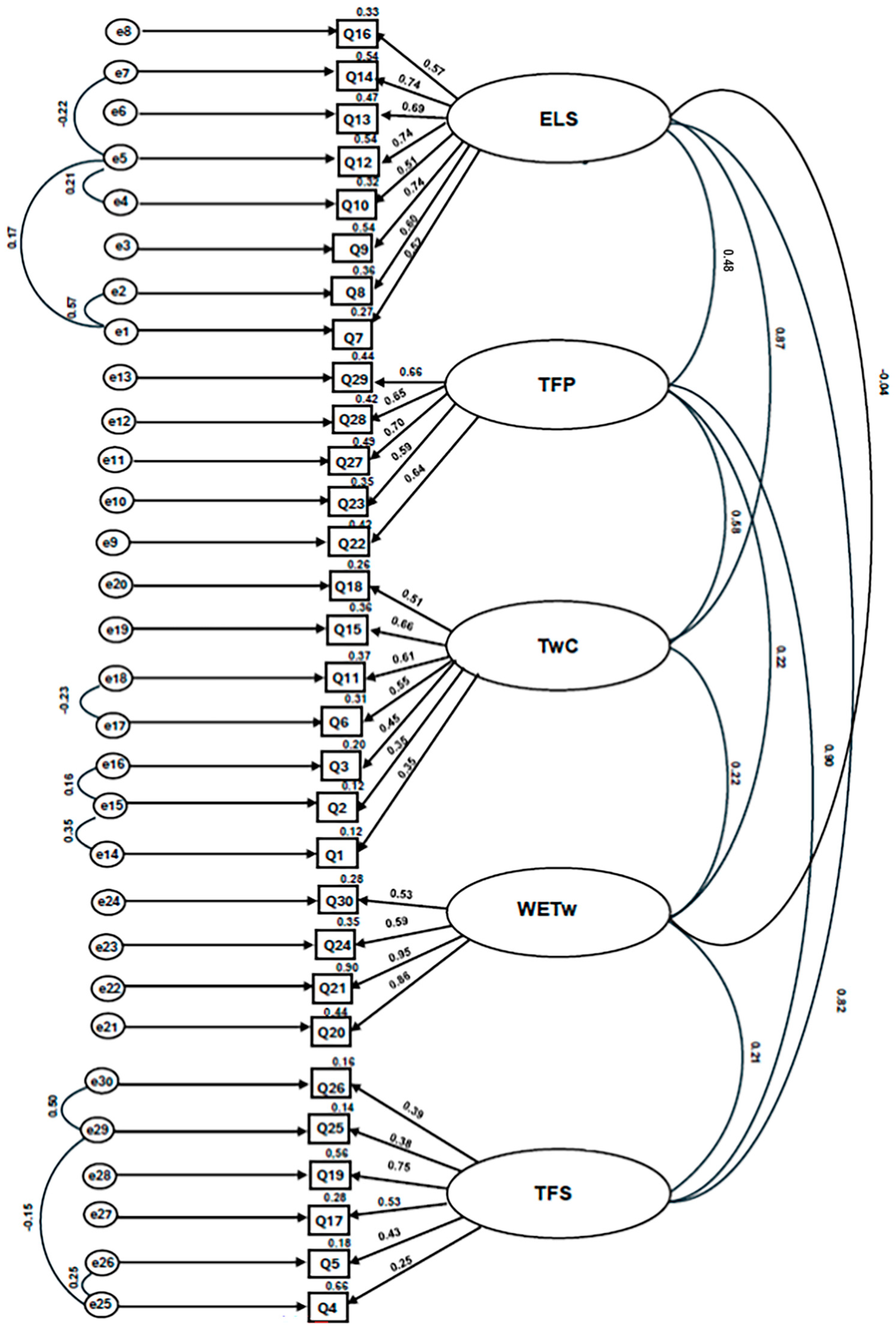
- The overall model fit quality was analyzed using several indices, which are considered improvable due to being marginal [45]. To adjust the model, pairs of error covariances between items were analyzed. The following pairs of covariances were corrected, with the following modification indices: e1-e2 (50.195), e1-e5 (6.738), e4-e5 (6.508), e5-e7 (7.032); e14-e15 (20.888), e15-e16 (5.840), e17-e18 (6.006); e23-e24 (25.373); e25-e26 (10.219), e25-e29 (6.333), e29-e30 (40.997). According to Marôco [45] these corrections should be made up to a value of 6 in the covariance modification indices. The minimum value we obtained was 5.840, which we still corrected because it was very close to 6 and to obtain better values in the adjustment of the final factorial model. Thus, eleven covariance corrections were performed, resulting in an improvement in the global fit indices. An overall acceptable model fit was obtained, with adequate incremental fit indices and marginal absolute fit indices: CMIN/DF =1.461 (≤3); RMR = 0.044 (≤0.05); GFI = 0.821 (≥0.90); AGFI = 0.783 (≥0.90); Delta2 = 0.903 (≥0.90); CFI = 0.900 (≥0.90); SRMR = 0.0748 (≤0.08); RMSEA = 0.054 (≤0.05) e MECVI = 4.731 (<5).
- Most items in the factor model have standardized factor loadings (λ) greater than 0.5. Thus, the final factor model demonstrated a good/very good quality of fit.
- The following figure (Figure 1) presents the final T-TAQ-PT model with standardized factor loadings and corrected covariances. The obtained configuration reflects a stable factor structure, confirming the robustness of the proposed model for application in the Portuguese population of health professionals.
4. Discussion
4.1. Implications for Practice
4.2. Limitations
5. Conclusions
Author Contributions
Funding
Institutional Review Board Statement
Informed Consent Statement
Data Availability Statement
Public Involvement Statement
Guidelines and Standards Statement
Use of Artificial Intelligence
Conflicts of Interest
Abbreviations
| AGFI | Adjusted Goodness of Fit |
| AHRQ | Agency Healthcare Research Quality |
| CFI | Comparative Fit Index |
| CMIN/DF | Chi-Square Minimum Discrepancy/Degrees of Freedom |
| GFI | Goodness of Fit Index |
| MECVI | Modified Expected Cross-Validation Index |
| RMR | Root Mean Square Residual |
| RMSEA | Root Mean Square Error of Approximation |
| SRMR | Standardized Root Mean Square Residual |
| T-TAQ | TeamSTEPPS® Teamwork Attitudes Questionnaire |
References
- Peduzzi, M.; Agreli, H.L.F.; da Silva, J.A.M.; de Souza, H.S. Trabalho Em Equipa: Uma Revista Ao Conceito e a Seus Desdobramentos No Trabalho Interprofissional. Trab. Educ. Saúde 2020, 18, e0024678. [Google Scholar] [CrossRef]
- Karlsen, T.; Hall-Lord, M.L.; Wangensteen, S.; Ballangrud, R. Bachelor of Nursing Students’ Attitudes toward Teamwork in Healthcare: The Impact of Implementing a TeamSTEPPS® Team Training Program: A Longitudinal, Quasi-Experimental Study. Nurse Educ. Today 2022, 108, 105180. [Google Scholar] [CrossRef] [PubMed]
- Wiedermann, C.J.; Barbieri, V.; Engl, A.; Piccoliori, G. Impact of Relational Coordination on Job Satisfaction and Willingness to Stay: A Cross-Sectional Survey of Healthcare Professionals in South Tyrol, Italy. Behav. Sci. 2024, 14, 397. [Google Scholar] [CrossRef] [PubMed]
- Hassan, A.E.; Mohammed, F.A.; Zakaria, A.M.; Ibrahim, I.A. Evaluating the Effect of TeamSTEPPS on Teamwork Perceptions and Patient Safety Culture among Newly Graduated Nurses. BMC Nurs. 2024, 23, 170. [Google Scholar] [CrossRef]
- Ballangrud, R.; Aase, K.; Vifladt, A. Longitudinal Team Training Programme in a Norwegian Surgical Ward: A Qualitative Study of Nurses’ and Physicians’ Experiences with Teamwork Skills. BMJ Open 2020, 10, e035432. [Google Scholar] [CrossRef]
- Meneses-La-Riva, M.E.; Fernández-Bedoya, V.H.; Suyo-Vega, J.A.; Ocupa-Cabrera, H.G.; Grijalva-Salazar, R.V.; Ocupa-Meneses, G.d.D. Enhancing Healthcare Efficiency: The Relationship between Effective Communication and Teamwork among Nurses in Peru. Nurs. Rep. 2025, 15, 59. [Google Scholar] [CrossRef]
- Silva, C.; Santos, D.; Morais, J.; Dias, R.; Oliveria, S.; Figueiredo, S. Impacto Das Estratégias de Comunicação Do Enfermeiro Gestor Nos Ambientes de Trabalho Em Enfermagem. Millenium J. Educ. Technol. Health 2025, 2025, e37492. [Google Scholar] [CrossRef]
- Minehart, R.D.; Gabrielle Foldy, E. Optimizing Diversity to Improve Perioperative Team Performance. Anesthesiol. Clin. 2025, 43, 157–171. [Google Scholar] [CrossRef] [PubMed]
- Pedrosa, A.R.C.; Ferreira, Ó.R.; Baixinho, C.R.S.L. Transitional Rehabilitation Care and Patient Care Continuity as an Advanced Nursing Practice. Rev. Bras. Enferm. 2022, 75, e20210399. [Google Scholar] [CrossRef]
- Vatnøy, T.K.; Dale, B.; Sundlisæter Skinner, M.; Karlsen, T. Associations between Nurse Managers’ Leadership Styles, Team Culture and Competence Planning in Norwegian Municipal In-patient Acute Care Services: A Cross-sectional Study. Scand. J. Caring Sci. 2022, 36, 482–492. [Google Scholar] [CrossRef]
- Zanetoni, T.C.; Cucolo, D.F.; Perroca, M.G. Interprofessional Actions in Responsible Discharge: Contributions to Transition and Continuity of Care. Rev. Esc. Enferm. USP 2023, 57, e20220452. [Google Scholar] [CrossRef] [PubMed]
- Costa, P.; Sousa, J.P.; Nascimento, T.; Cruchinho, P.; Nunes, E.; Gaspar, F.; Lucas, P. Leadership Development in Undergraduate Nursing Students: A Scoping Review. Nurs. Rep. 2025, 15, 160. [Google Scholar] [CrossRef]
- Teixeira, G.; Lucas, P.; Gaspar, F. International Portuguese Nurse Leaders’ Insights for Multicultural Nursing. Int. J. Environ. Res. Public Health 2022, 19, 12144. [Google Scholar] [CrossRef] [PubMed]
- Teixeira, G.; Cruchinho, P.; Lucas, P.; Gaspar, F. Transcultural Nursing Leadership: A Concept Analysis. Int. J. Nurs. Stud. Adv. 2023, 5, 100161. [Google Scholar] [CrossRef] [PubMed]
- Weller, J.M.; Mahajan, R.; Fahey-Williams, K.; Webster, C.S. Teamwork Matters: Team Situation Awareness to Build High-Performing Healthcare Teams, a Narrative Review. Br. J. Anaesth. 2024, 132, 771–778. [Google Scholar] [CrossRef]
- Tasbihi, N.; Moghri, J.; Ghavami, V.; Raesi, R.; Janghorban, A.; Tabatabaee, S.S. Patient Safety Competency and It Associated with Teamwork and Psychological Safety among Emergency Nurses in Iran. Sci. Rep. 2025, 15, 16602. [Google Scholar] [CrossRef]
- Katantha, M.N.; Strametz, R.; Baluwa, M.A.; Mapulanga, P.; Chirwa, E.M. Effective Interprofessional Communication for Patient Safety in Low-Resource Settings: A Concept Analysis. Safety 2025, 11, 91. [Google Scholar] [CrossRef]
- Hall-Lord, M.L.; Bååth, C.; Nordin, A. Patient Safety Culture and Teamwork in Hospital Wards: Registered Nurses’ and Nursing Assistants’ Perceptions and Attitudes. Nurs. Forum 2024, 2024, 9410721. [Google Scholar] [CrossRef]
- Dartiguelongue, J.B.; Cafiero, P.J. Communication in Health Care Teams. Arch. Argent. Pediatr. 2021, 119, E589–E593. [Google Scholar] [CrossRef]
- He, M.; Zhu, X.; Dong, Y.; Zhang, S.; Fang, S.; Wang, W.; Zhang, M.; Sun, J. Exploring the Role of Communication in Missed Nursing Care: A Systematic Review. J. Adv. Nurs. 2022, 78, 4019–4033. [Google Scholar] [CrossRef]
- Pacenko, C.d.L.; Figueiredo, K.C.; Nunes, E.; Cruchinho, P.; Lucas, P. Mapping Strategies for Strengthening Safety Culture: A Scoping Review. Healthcare 2024, 12, 1194. [Google Scholar] [CrossRef]
- Baker, D.P.; Amodeo, A.M.; Krokos, K.J.; Slonim, A.; Herrera, H. Assessing Teamwork Attitudes in Healthcare: Development of the TeamSTEPPS Teamwork Attitudes Questionnaire. BMJ Qual. Saf. 2010, 19, e49. [Google Scholar] [CrossRef]
- Matzke, C.M.; DeGennaro, R.; Howie-Esquivel, J. Incorporating TeamSTEPPS Training to Improve Staff Collaboration in an Academic Level I Emergency and Trauma Center. Int. Emerg. Nurs. 2021, 55, 100959. [Google Scholar] [CrossRef]
- Kohanová, D.; Solgajová, A.; Cubelo, F. The Association of Teamwork and Missed Nursing Care in Acute Care Setting: A Mixed-methods Systematic Review. J. Clin. Nurs. 2024, 33, 3399–3413. [Google Scholar] [CrossRef]
- Hall-Lord, M.L.; Bååth, C.; Ballangrud, R.; Nordin, A. The Swedish Version of the TeamSTEPPS® Teamwork Attitudes Questionnaire (T-TAQ): A Validation Study. BMC Health Serv. Res. 2021, 21, 105. [Google Scholar] [CrossRef] [PubMed]
- Bakht, K.; Mir, S.; Shah, S.A. Nursing Teamwork: An in-Depth Concept Analysis with Walker & Amp; Avant’s Framework. J. Health Rehabil. Res. 2024, 4, 1500–1505. [Google Scholar] [CrossRef]
- Janghorban, A.; Moghri, J.; Ghavami, V.; Raesi, R.; Tabatabaee, S.S. Understanding the Relationship between Care Quality Perception and Patient Safety Culture. Open Nurs. J. 2025, 19, e18744346365452. [Google Scholar] [CrossRef]
- King, H.; Battles, J.; Baker, D.; Alonso, A.; Salas, E.; Webster, J.; Toomey, L.; Salisbury, M. TeamSTEPPSTM: Team Strategies and Tools to Enhance Performance and Patient Safety. In Advances in Patient Safety: New Directions and Alternative Approaches; Henriksen, K., Battles, J., Keyes, M., Grady, M., Eds.; Agency for Healthcare Research and Quality (US): Rockville, MD, USA, 2008; Volume 3, pp. 5–20. [Google Scholar]
- Diep, A.N.; Paquay, M.; Servotte, J.-C.; Dardenne, N.; Istas, L.; Van Ngoc, P.; Charlier, M.; Ghuysen, A.; Donneau, A.-F. Validation of a French-Language Version of TeamSTEPPS® T-TPQ and T-TAQ Questionnaires. J. Interprof. Care 2022, 36, 607–616. [Google Scholar] [CrossRef]
- Beaton, D.E.; Bombardier, C.; Guillemin, F.; Ferraz, M.B. Guidelines for the Process of Cross-Cultural Adaptation of Self-Report Measures. Spine 2000, 25, 3186–3191. [Google Scholar] [CrossRef] [PubMed]
- Cruchinho, P.; Teixeira, G.; Lucas, P.; Gaspar, F. Evaluating the Methodological Approaches of Cross-Cultural Adaptation of the Bedside Handover Attitudes and Behaviours Questionnaire into Portuguese. J. Healthc. Leadersh. 2023, 15, 193–208. [Google Scholar] [CrossRef]
- Gray, J.; Grove, S. Burns and Grove′s the Practice of Nursing Research: Appraisal, Synthesis, and Generation of Evidence, 9th ed.; Elsevier: Amsterdam, The Netherlands, 2021. [Google Scholar]
- Kottner, J.; Audigé, L.; Brorson, S.; Donner, A.; Gajewski, B.J.; Hróbjartsson, A.; Roberts, C.; Shoukri, M.; Streiner, D.L. Guidelines for Reporting Reliability and Agreement Studies (GRRAS) Were Proposed. J. Clin. Epidemiol. 2011, 64, 96–106. [Google Scholar] [CrossRef]
- Lloret-Segura, S.; Ferreres-Traver, A.; Hernández-Baeza, A.; Tomás-Marco, I. El Análisis Factorial Exploratorio de Los Ítems: Una Guía Práctica, Revisada y Actualizada. An. Psicol. 2014, 30, 1151–1169. [Google Scholar] [CrossRef]
- Vilelas, J. Investigação: O Processo de Construção Do Conhecimento, 3rd ed.; Edições Sílabo: Lisboa, Portugal, 2020. [Google Scholar]
- Eremenco, S.L.; Cella, D.; Arnold, B.J. A Comprehensive Method for the Translation and Cross-Cultural Validation of Health Status Questionnaires. Eval. Health Prof. 2005, 28, 212–232. [Google Scholar] [CrossRef] [PubMed]
- Beatty, P.C.; Willis, G.B. Research Synthesis: The Practice of Cognitive Interviewing. Public Opin. Q. 2007, 71, 287–311. [Google Scholar] [CrossRef]
- MacCallum, R.C.; Widaman, K.F.; Zhang, S.; Hong, S. Sample Size in Factor Analysis. Psychol. Methods 1999, 4, 84–99. [Google Scholar] [CrossRef]
- MacCallum, R.C.; Widaman, K.F.; Preacher, K.J.; Hong, S. Sample Size in Factor Analysis: The Role of Model Error. Multivar. Behav. Res. 2001, 36, 611–637. [Google Scholar] [CrossRef]
- Baker, D.; Krokos, K.; Amodeo, A. TeamSTEPPS ® Teamwork Attitudes Questionnaire Manual; American Institutes for Research: Arlington, VA, USA, 2008. [Google Scholar]
- Cruchinho, P.; López-Franco, M.D.; Capelas, M.L.; Almeida, S.; Bennett, P.M.; Miranda da Silva, M.; Teixeira, G.; Nunes, E.; Lucas, P.; Gaspar, F. Translation, Cross-Cultural Adaptation, and Validation of Measurement Instruments: A Practical Guideline for Novice Researchers. J. Multidiscip. Healthc. 2024, 17, 2701–2728. [Google Scholar] [CrossRef]
- Beaton, D.; Bombardier, C.; Guillemin, F.; Ferraz, M. Recommendations for the Cross-Cultural Adaptation of the Dash & Quickdash Outcome Measures. Inst. Work Health 2007, 1, 1–45. [Google Scholar]
- Sousa, V.D.; Rojjanasrirat, W. Translation, Adaptation and Validation of Instruments or Scales for Use in Cross-cultural Health Care Research: A Clear and User-friendly Guideline. J. Eval. Clin. Pract. 2011, 17, 268–274. [Google Scholar] [CrossRef]
- Boateng, G.O.; Neilands, T.B.; Frongillo, E.A.; Melgar-Quiñonez, H.R.; Young, S.L. Best Practices for Developing and Validating Scales for Health, Social, and Behavioral Research: A Primer. Front. Public Health 2018, 6, 149. [Google Scholar] [CrossRef]
- Marôco, J. Análise de Equações Estruturais: Fundamentos Teóricos, Software e Aplicações, 3rd ed.; Report Number, Lda: Lisbon, Portugal, 2021. [Google Scholar]
- Marôco, J. Análise Estatística Com o SPSS Statistics, 8th ed.; Report Number, Lda: Lisbon, Portugal, 2021. [Google Scholar]
- World Medical Association. Declaration of Helsinki: Ethical Principles for Medical Research Involving Human Participants; World Medical Association: Ferney-Voltaire, France, 2024. [Google Scholar]
- Ordem Dos Enfermeiros Anuário Estatístico; Ordem dos Enfermeiros: Lisboa, Portugal, 2024.
- Ordem Dos Médicos Estatísticas Nacionais; Ordem dos Médicos: Lisboa, Portugal, 2024.
- Coluci, M.Z.O.; Alexandre, N.M.C.; Milani, D. Construção de Instrumentos de Medida Na Área Da Saúde. Cien Saude Colet. 2015, 20, 925–936. [Google Scholar] [CrossRef] [PubMed]
- Leech, N.; Barret, K.; Morgan, G. Exploratory Factor Analysis and Principal Components Analysis. In IBM SPSS for Intermediate Statistics: Use and Interpretation; Routledge: Oxfordshire, UK, 2015; p. 73. [Google Scholar]
- Karlsen, T.; Hall-Lord, M.L.; Wangensteen, S.; Ballangrud, R. Reliability and Structural Validity of the Norwegian Version of the TeamSTEPPS Teamwork Attitudes Questionnaire: A Cross-sectional Study among Bachelor of Nursing Students. Nurs. Open 2021, 8, 664–674. [Google Scholar] [CrossRef]


| Dimensions | ||||||
|---|---|---|---|---|---|---|
| Total Items | Items | Effective Leadership Support | Team Functional Performance | Teamwork Coordination | Willingness to Engage in Teamwork | Team Functioning Supervision |
| 8 | 7 | 0.828 | 0.021 | −0.084 | −0.003 | 0.069 |
| 8 | 0.769 | 0.106 | 0.036 | −0.060 | 0.146 | |
| 9 | 0.649 | 0.056 | 0.415 | −0.090 | 0.093 | |
| 10 | 0.496 | 0.270 | 0.405 | 0.010 | −0.240 | |
| 12 | 0.727 | 0.060 | 0.391 | 0.024 | −0.134 | |
| 13 | 0.533 | 0.161 | 0.388 | 0.068 | 0.161 | |
| 14 | 0.543 | 0.214 | 0.397 | −0.040 | 0.211 | |
| 16 | 0.552 | 0.246 | 0.099 | −0.140 | 0.294 | |
| 5 | 22 | 0.163 | 0.701 | −0.027 | −0.077 | 0.261 |
| 23 | 0.355 | 0.565 | −0.083 | 0.269 | 0.113 | |
| 27 | 0.139 | 0.668 | 0.133 | 0.133 | 0.055 | |
| 28 | 0.103 | 0.644 | 0.148 | 0.067 | 0.106 | |
| 29 | 0.033 | 0.763 | 0.147 | −0.050 | 0.034 | |
| 7 | 1 | 0.200 | 0.055 | 0.478 | −0.239 | −0.016 |
| 2 | 0.264 | 0.050 | 0.323 | −0.173 | 0294 | |
| 3 | 0.043 | 0.060 | 0.694 | −0.134 | 0.118 | |
| 6 | 0.108 | 0.175 | 0.569 | 0.072 | 0.296 | |
| 11 | 0.411 | 0.181 | 0.447 | 0.160 | −0.061 | |
| 15 | 0.310 | 0.147 | 0.550 | 0.129 | 0.100 | |
| 18 | 0.036 | 0.324 | 0.450 | 0.232 | 0.198 | |
| 4 | 20 | −0.018 | 0.110 | 0.104 | 0.829 | 0.015 |
| 21 | −0.087 | 0.123 | 0.100 | 0.835 | 0.070 | |
| 24 | 0.068 | 0.006 | −0.187 | 0.795 | 0.093 | |
| 30 | −0.055 | 0.021 | −0.062 | 0.744 | −0.069 | |
| 6 | 4 | 0.027 | −0.031 | 0.211 | 0.320 | 0.613 |
| 5 | 0.184 | 0.166 | 0.315 | 0.031 | 0.475 | |
| 17 | 0.363 | 0.356 | 0.132 | −0.174 | 0.478 | |
| 19 | 0.154 | 0.128 | 0.306 | 0.136 | 0.308 | |
| 25 | 0.007 | 0.157 | 0.153 | −0.004 | 0.335 | |
| 26 | −0.011 | 0.130 | 0.350 | 0.166 | 0.374 | |
| Cronbach’s alpha | 0.85 | 0.78 | 0.76 | 0.85 | 0.79 | |
| 0.86 | ||||||
| Versions | Domains/Dimensions | No. of Items | Items | Cronbach’s Alpha | |
|---|---|---|---|---|---|
| T-TAQ-PT | Effective Leadership Support | 8 | 7, 8, 9, 10, 12, 13, 14, 16 | 0.85 | 0.86 |
| Team Functional Performance | 5 | 22, 23, 27, 28, 29 | 0.78 | ||
| Teamwork Coordination | 7 | 1, 2, 3, 6, 11, 15, 18 | 0.76 | ||
| Willingness to Engage in Teamwork | 4 | 20, 21, 24, 30 | 0.85 | ||
| Team Functioning Supervision | 6 | 4, 5, 17, 19, 25, 26 | 0.79 | ||
| Baker et al. [22] | Team Structure | 6 | 1, 2, 3, 4, 5, 6 | 0.70 | Not calculated |
| Leadership | 6 | 7, 8, 9, 10, 11,12 | 0.81 | ||
| Situation Monitoring | 6 | 13, 14, 15, 16, 17, 18 | 0.74 | ||
| Mutual Support | 6 | 19, 20, 21, 22, 23, 24 | 0.41 | ||
| Communication | 6 | 25, 26, 27, 28, 29, 30 | 0.74 | ||
| Hall-Lord et al. [25] | Team Structure | 6 | 1, 2, 3, 4, 5, 6 | 0.87 | 0.70 |
| Leadership | 6 | 7, 8, 9, 10, 11,12 | 0.87 | ||
| Situation Monitoring | 6 | 13, 14, 15, 16, 17, 18 | 0.74 | ||
| Mutual Support | 6 | 19, 20, 21, 22, 23, 24 | 0.41 | ||
| Communication | 6 | 25, 26, 27, 28, 29, 30 | 0.63 | ||
| Diep et al. [29] | Team Structure | 6 | 1, 2, 3, 4, 5, 6 | 0.75 | Not calculated |
| Leadership | 6 | 7, 8, 9, 10, 11,12 | 0.75 | ||
| Situation Monitoring | 6 | 13, 14, 15, 16, 17, 18 | 0.58 | ||
| Mutual Support | 6 | 19, 20, 21, 22, 23, 24 | 0.55 | ||
| Communication | 6 | 25, 26, 27, 28, 29, 30 | 0.72 | ||
| Karlsen et al. [52] | Team Structure | 6 | 1, 2, 3, 4, 5, 6 | 0.46 | 0.79 |
| Leadership | 6 | 7, 8, 9, 10, 11,12 | 0.62 | ||
| Situation Monitoring | 6 | 13, 14, 15, 16, 17, 18 | 0.7 | ||
| Mutual Support | 6 | 19, 20, 21, 22, 23, 24 | 0.44 | ||
| Communication | 6 | 25, 26, 27, 28, 29, 30 | 0.56 | ||
Disclaimer/Publisher’s Note: The statements, opinions and data contained in all publications are solely those of the individual author(s) and contributor(s) and not of MDPI and/or the editor(s). MDPI and/or the editor(s) disclaim responsibility for any injury to people or property resulting from any ideas, methods, instructions or products referred to in the content. |
© 2026 by the authors. Licensee MDPI, Basel, Switzerland. This article is an open access article distributed under the terms and conditions of the Creative Commons Attribution (CC BY) license.
Share and Cite
Velez, L.; Costa, P.; Figueiredo, A.R.; Inácio, M.; Cruchinho, P.; Nunes, E.; Lucas, P. Translation, Cross-Cultural Adaptation, and Psychometric Validation of the TeamSTEPPS® Teamwork Attitudes Questionnaire: A Methodological Study. Nurs. Rep. 2026, 16, 26. https://doi.org/10.3390/nursrep16010026
Velez L, Costa P, Figueiredo AR, Inácio M, Cruchinho P, Nunes E, Lucas P. Translation, Cross-Cultural Adaptation, and Psychometric Validation of the TeamSTEPPS® Teamwork Attitudes Questionnaire: A Methodological Study. Nursing Reports. 2026; 16(1):26. https://doi.org/10.3390/nursrep16010026
Chicago/Turabian StyleVelez, Leonor, Patrícia Costa, Ana Rita Figueiredo, Mafalda Inácio, Paulo Cruchinho, Elisabete Nunes, and Pedro Lucas. 2026. "Translation, Cross-Cultural Adaptation, and Psychometric Validation of the TeamSTEPPS® Teamwork Attitudes Questionnaire: A Methodological Study" Nursing Reports 16, no. 1: 26. https://doi.org/10.3390/nursrep16010026
APA StyleVelez, L., Costa, P., Figueiredo, A. R., Inácio, M., Cruchinho, P., Nunes, E., & Lucas, P. (2026). Translation, Cross-Cultural Adaptation, and Psychometric Validation of the TeamSTEPPS® Teamwork Attitudes Questionnaire: A Methodological Study. Nursing Reports, 16(1), 26. https://doi.org/10.3390/nursrep16010026