1. Introduction
Tracheostomal stenosis is a frequent complication after total laryngectomy, but it is often distressing to the patients and surgeons as it commonly recurs despite stomaplasty or even with local flap reconstruction. The reported incidence is 4–44% depending on the criteria to define it [
1]. Tracheostomal stenosis may result in respiratory distress of the patient. The location of the stenosis could be in the orifice or rarely in the trachea. The latter is even more difficult to manage. Many factors have been identified to contribute to the development of tracheostomal stenosis, including excessive scar tissue formation, wound infection around the stoma, prolonged use of the endotracheal tube and radiation therapy [
2,
3,
4]. Stenosis typically arises following necrosis of the tracheal ring or skin edge caused by radiation injury and/or infection, leading to perichondritis of the tracheal ring, and finally to fibrosis and scarring [
2]. Despite understanding the factors that may predispose patients to the development of stenosis and taking preventive measures, tracheostomal stenosis is still inevitable and may require urgent management such as dilatation of the stoma.
Current therapeutic modalities for tracheostomal stenosis range from inserting a larger tracheostomy tube, using graduated dilatators and stomaplasty [
2,
3,
5,
6,
7]. Herein, we report a self-designed alternative method of dilatation using a Foley catheter under general anesthesia with and without high-frequency jet ventilation.
2. Case 1
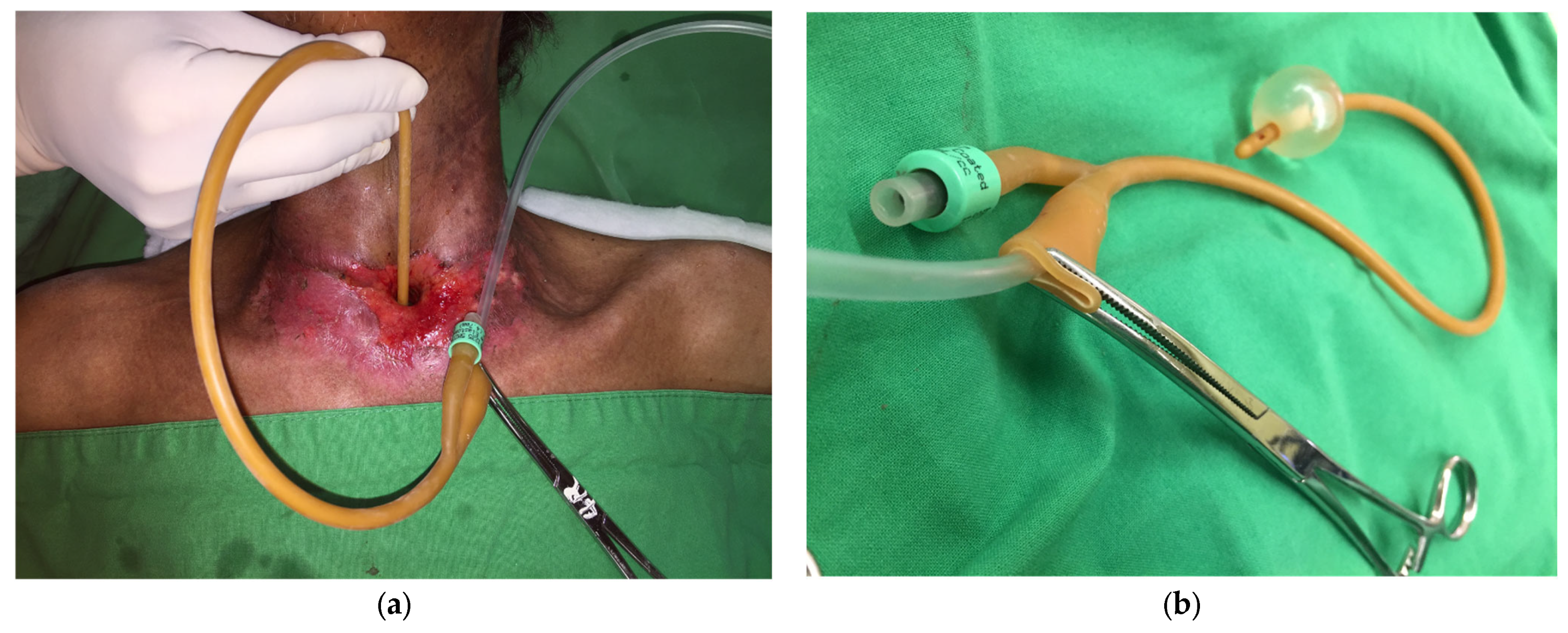
The first case involved a 60-year old T4N0M0 supraglottic cancer patient. He underwent an emergent tracheostomy because of dyspnea. Direct laryngoscopy and biopsy was performed along with tracheostomy. The pathology revealed moderately differentiated squamous cell carcinoma. Total laryngectomy, bilateral selective neck dissections, and anterolateral thigh free flap reconstruction for the pharyngeal defect was performed. The patient subsequently underwent adjuvant radiotherapy for 6800 rads. Six weeks after the start of radiation therapy, the patient developed symptomatic stomal stenosis and dyspnea, which warranted an urgent tracheostomal dilatation.
Apart from this, the patient sustained from Grade 1 radiation dermatitis and care was taken not to further aggravate the injury during dilatation (
Figure 1). A 14-Fr Foley catheter was used for dilation. The Foley catheter was connected to the jet ventilator (Acutronic Medical System AG, Hirzel, Switzerland) at a pressure of 5 psi and a frequency of 250 opportunities per minute. Low-volume, high-pressure pulses of air were delivered through the lumen of the Foley catheter into the lungs. When employing this technique, no apnea episodes were experienced during dilatation. After the airway was established, the lubricated Foley catheter was guided under fiberoptic endoscopy to pass gently until the balloon was placed immediately below the stenotic site. The Foley balloon was then inflated using approximately 10–15 mL of water, and the pressure exerted from the Foley balloon was ensured at the stenotic site. The Foley catheter was pulled out for approximately 2–5 mm and was secured in place. However, a progressive build-up in airway pressure may increase the risk of barotrauma; to reduce this risk, the Foley balloon was deflated every 2–4 min. A continuous monitor of SaO
2 was warranted to prevent desaturation throughout the procedure. Repeated dilatation was applied during each operation. Due to the elastic and soft material of the Foley catheter, as well as the balloon pressure, tracheal trauma could be rare.
The procedure was performed several times per week, during and after the radiation therapy, until the airway was wide enough for the patient.
3. Case 2
The second patient was a 59-year-old man initially diagnosed with a right glottic carcinoma. He underwent a temporary prophylactic tracheostomy followed by definitive radiation therapy, receiving a total dose of 4800 rads in 2021. Post-radiation surveillance was unremarkable until 2024, when he presented with progressive dyspnea and was found to have a right glottic bulging mass with bilateral vocal cord paralysis. An emergent tracheostomy was performed, and biopsy revealed bilateral vocal sarcomatoid carcinoma, which was suspected to be radiation-induced. A salvage total laryngectomy was subsequently performed.
Approximately six weeks postoperatively, the patient developed progressive dyspnea due to stomal stenosis. Several interventions were performed, including stoma debridement and stomaplasty with radial incisions; however, restenosis recurred. Subsequently, serial dilatations were attempted in the outpatient clinic using a Foley catheter, but only minimal and temporary improvement was achieved, as the procedure could be tolerated for only a short duration under local anesthesia. Due to persistent symptoms, further stomal dilatation was planned under general anesthesia.
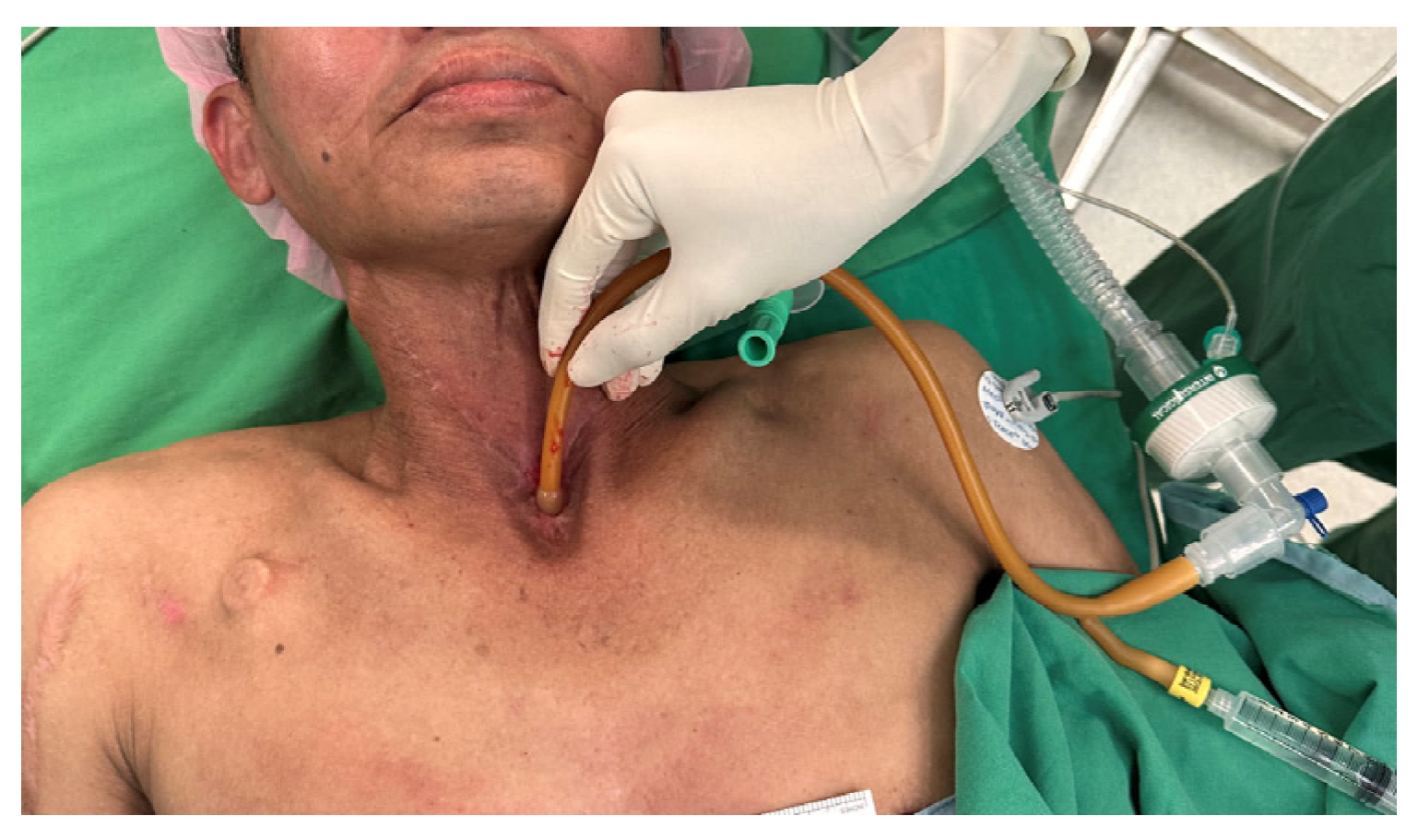
Under general anesthesia, the patient was placed in the supine position. Examination revealed tracheostomal stenosis located at the stomal orifice. A 20-Fr Foley catheter was used for dilatation (
Figure 2). The balloon was inflated with approximately 3–4 mL of water, ensuring that pressure was exerted directly at the stenotic site. Because the stenosis was located at the stomal orifice, inflating the balloon beyond 3–4 mL caused difficulty in maintaining effective dilation, as the balloon would easily become dislodged away from the stenotic site. This contrasted with the first case, where the stenosis was within the tracheal lumen, allowing for more aggressive dilation (up to 10 mL or more) since the balloon could be securely positioned without risk of displacement.
Another distinction from the first case was that jet ventilation was not utilized. Given the larger size of the Foley catheter, the anesthesiologist was able to connect it to the conventional anesthesia machine for ventilation. However, oxygen saturation occasionally decreased after balloon inflation at the stomal orifice. When this occurred, the balloon was deflated and repositioned deeper into the tracheal lumen, which allowed for more stable ventilation and normalization of oxygen saturation.
No intraoperative complications occurred aside from the transient episodes of desaturation. During the two-week follow-up, the patient reported improved breathing, and evaluation showed a slightly larger stoma.
4. Discussion
Tracheostomal stenosis requires urgent management by dilatation to establish an adequate airway. There are numerous methods to manage tracheostomal stenosis, either surgically or non-surgically, including methods such as dilatation. Various surgical techniques employing Z-plasty, double V, V-Y-plasty, and two circular incisions have been described to correct tracheostomal stenosis [
3,
6]. Sani described using a carbon dioxide laser to ablate triangular area lateral to the stoma to widen the tracheostomal stenosis. When it comes to tracheal stenosis after total laryngectomy, surgical management could be even more involved and difficult, possibly with tracheal ring resection which carries a major risk. The various surgical methods described indicate that none of the previous techniques are the ideal solution [
3]. The problem can be more difficult to manage during or after radiation therapy.
The non-surgical techniques involve dilatation of stenosis using various types of graduated dilators followed by the insertion of a larger tracheostomy tube or the constant use of a stoma “button”. However, this method is not useful in the long term, and repeated dilatation and stenting are usually required. Such repeated dilatation and stenting may lead to other problems, such as bleeding and excoriation, retained secretions and inability to use tracheoesophageal puncture (TEP) [
3,
8].
In cases of tracheostomal stenosis occurring during radiation therapy, dilatation is the preferred method. Most surgeons are reluctant to treat tracheostomal stenosis using reconstruction techniques in the presence of skin excoriation, erythema, mucositis or edema as a result of radiation therapy and a high risk of wound dehiscence. So far, no research has been published on the preferred method of treating tracheostomal stenosis occurring during radiotherapy. Most of the time, the patient would be reintubated with a larger sized endotracheal tube to bypass the stenotic area and secure the airway. However, this may inevitably worsen stenosis during or immediately after radiation therapy. Dilating the stenosis using graduated dilators causes shearing force and may lead to tissue injury, resulting in further inflammation, fibrosis, and restenosis [
9]. Apart from this, the airway is temporarily obstructed when a graduated dilator or balloon dilation system is used, and this is dangerous for patients.
Multiple authors have described several techniques to treat tracheostomal stenosis. Our technique uses a Foley catheter connected either to a high-frequency jet ventilator or a conventional anesthesia machine. In case 1, a 14-Fr Foley catheter was used for dilation, and jet ventilation was applied to deliver oxygen through its narrow lumen. Jet ventilation provides low-volume, high-frequency gas through a small-bore catheter but carries risks of air trapping and barotrauma if airway obstruction occurs [
10]. Continuous oxygen monitoring is essential. Although no complications were encountered, using a three-way Foley catheter may help reduce distal airway pressure and minimize these risks. In case 2, a larger Foley catheter allowed direct connection to the conventional anesthesia machine, avoiding concerns of air trapping. However, desaturation occurred during balloon inflation, likely due to partial dislodgement of the catheter from the tracheal lumen. The problem resolved after deflating the balloon and advancing the catheter deeper, restoring stable ventilation and normal oxygenation. Close cooperation with the anesthesiologist remained crucial for patient safety.
The Foley catheter is advantageous for its softness, atraumatic design, and small caliber, enabling insertion through narrow stenotic segments. Under fiberoptic guidance, its balloon exerts uniform circumferential force with lower pressure than standard balloon dilators. As MacKeith et al. noted, prolonged low-pressure dilation is sufficient to expand the stenotic lumen [
9].
Jet ventilation is indicated for short upper airway procedures requiring an unobstructed field, such as laryngeal or tracheal surgery. It delivers high-pressure gas pulses that achieve oxygenation through kinetic energy and air entrainment rather than fixed tidal volumes. Unlike conventional mechanical ventilation, expiration is passive, and airway pressure cannot be continuously monitored. Because the delivered volume may be smaller than the anatomical dead space, CO
2 elimination can be inefficient, predisposing the patient to hypercapnia or barotrauma [
10,
11]. In our technique, the Foley catheter is sufficiently small in diameter; therefore, in addition to enabling ventilation through its lumen, a space remains between the catheter and the airway wall, allowing passive egress of trapped air, which may help reduce the risk of air trapping during jet ventilation. Close collaboration with an experienced anesthesiologist is essential to adjust ventilation parameters and to promptly manage desaturation or hypercapnia. Compared with conventional ventilation, jet ventilation offers superior surgical exposure but demands careful monitoring and experience to ensure safety. In our first case, it was successfully applied through a small-caliber Foley catheter, demonstrating feasibility in narrow-lumen procedures.
This study includes only two cases; therefore, it is difficult to establish this technique as a definitive safe alternative. In addition, the stenosis occurred at different airway levels in the two patients, requiring modified techniques and different ventilation strategies according to individual clinical situations. Larger case series are needed to further evaluate the safety and applicability of this approach.
5. Conclusions
We described a self-designed alternative approach that can be repeatedly used to dilate tracheostomal stenosis safely using a Foley catheter while simultaneously providing oxygenation using high-frequency jet ventilation.
Author Contributions
Conceptualization, C.-Y.H. and S.-P.H.; methodology, C.-Y.H. and S.-P.H.; validation, C.-Y.H. and S.-P.H.; resources, C.-Y.H. and S.-P.H.; writing—original draft preparation, C.-H.C. and C.-Y.H.; writing—review and editing, C.-H.C., C.-Y.H., and D.E.A.; visualization, C.-H.C. and C.-Y.H.; supervision, C.-Y.H.; project administration, C.-Y.H. All authors have read and agreed to the published version of the manuscript.
Funding
This research received no external funding.
Institutional Review Board Statement
Not applicable.
Informed Consent Statement
Informed consent for publication was obtained from all identifiable human participants.
Data Availability Statement
No new data were created.
Acknowledgments
The authors would like to express their deepest thanks to the nurse practitioners, nurses, anesthesiologists, and anesthesia nurses who worked together with them in the outpatient clinic and operating room. During the preparation of this manuscript, the authors used ChatGPT (OpenAI, GPT-4—series model) for the purposes of grammar correction. The authors have reviewed and edited the output and take full responsibility for the content of this publication.
Conflicts of Interest
The authors declare no conflicts of interest.
References
- Capper, R.; Bradley, P.J. Etiology and management of tracheostomal stenosis. Curr. Opin. Otolaryngol. Head Neck Surg. 2002, 10, 123–128. [Google Scholar] [CrossRef]
- Levin, E.G.; Ritter, A.; Bachar, G.; Mizrachi, A.; Shoffel-Havakuk, H.; Kurman, N.; Popovtzer, A.; Hamzany, Y. Management of laryngeal chondroradionecrosis: A single-center experience. Head Neck 2025, 47, 300–308. [Google Scholar] [CrossRef] [PubMed]
- Myers, E.N.; Gallia, L.J. Tracheostomal stenosis following total laryngectomy. Ann. Otol. Rhinol. Laryngol. 1982, 91, 450–453. [Google Scholar] [CrossRef] [PubMed]
- Kuo, M.; Ho, C.M.; William, I.W.; Lam, K.H. Tracheostomal Stenosis After Total Laryngectomy: An Analysis of Prediposing Clinical Factors. Laryngoscope 1994, 104, 59–63. [Google Scholar] [CrossRef] [PubMed]
- Griffith, G.R.; Luce, E.A. Tracheal Stomal Stenosis after Laryngectomy. Plast. Reconstr. Surg. 1982, 70, 694–698. [Google Scholar] [CrossRef] [PubMed]
- Kamath, P.S.D.; Cherian, E.; Bhat, V.S. Widening techniques for stomal stenosis: Y-V advancement vs. two circular incisions technique. Int. J. Otorhinolaryngol. Head Neck Surg. 2016, 2, 263–266. [Google Scholar] [CrossRef][Green Version]
- Soo, G.; Tong, M.C.F. A simple method for re-dilatation of an acute tracheostoma stenosis. J. Laryngol. Otol. 2006, 120, 1059–1060. [Google Scholar] [CrossRef] [PubMed]
- Giacomarra, V.; Russolo, M.; Tirelli, G.; Bonini, P. Surgical treatment of tracheostomal stenosis. Laryngoscope 2001, 111, 1281–1284. [Google Scholar] [CrossRef] [PubMed]
- MacKeith, S.A.C.; Pankhania, M.; Hettige, R.; Gurr, P. Balloon dilatation of tracheostomal stenosis with cuffed tracheostomy tube. A novel approach to tracheostomal dilatation. Laryngoscope 2011, 121, 583–584. [Google Scholar] [CrossRef] [PubMed]
- Mausser, G.; Schwarz, G. Air entrainment during high-frequency jet ventilation. Br. J. Anaesth. 2008, 100, 418–419. [Google Scholar] [CrossRef] [PubMed][Green Version]
- Wiedemann, K.; Männle, C. Anesthesia and gas exchange in tracheal surgery. Thorac. Surg. Clin. 2014, 24, 13–25. [Google Scholar] [CrossRef] [PubMed]
| Disclaimer/Publisher’s Note: The statements, opinions and data contained in all publications are solely those of the individual author(s) and contributor(s) and not of MDPI and/or the editor(s). MDPI and/or the editor(s) disclaim responsibility for any injury to people or property resulting from any ideas, methods, instructions or products referred to in the content. |