
Interventions Aiming to Improve Breastfeeding Duration Among Primiparous Women: A Scoping Review

 , and
, and
Abstract
1. Introduction
2. Materials and Methods
2.1. Types of Sources of Evidence and Search Strategy
2.2. Eligibility Criteria
2.3. Screening Process
2.4. Quality Assessment
2.5. Data Extraction and Synthesis
2.6. Statistical Models
3. Results
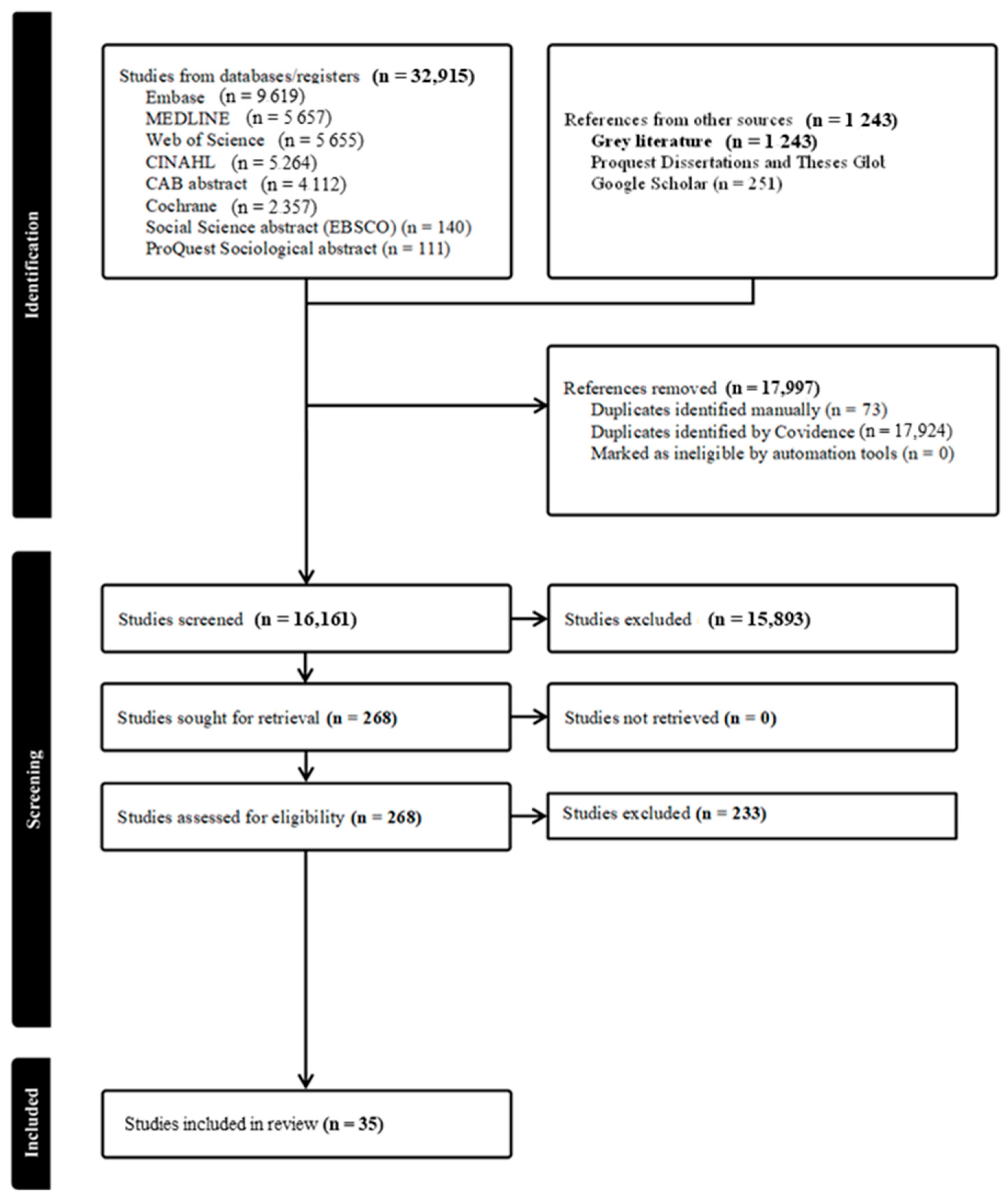
3.1. Study Selection
3.2. Study Characteristics
3.2.1. Study Design
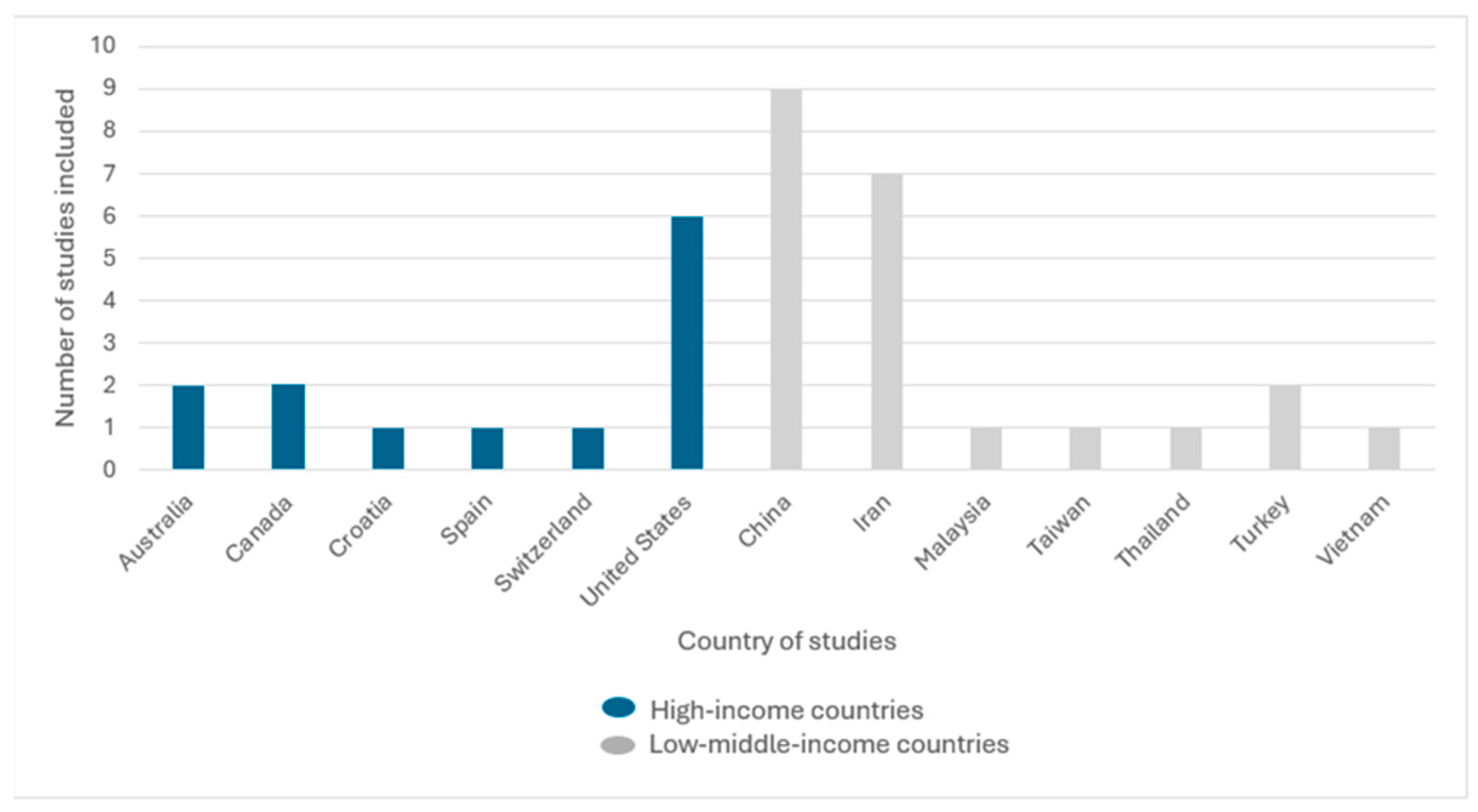
3.2.2. Country of Studies
3.2.3. Population Characteristics
3.2.4. Quality Assessment of Included Studies
4. Interventions During the Prenatal Period and Breastfeeding Duration
4.1. Group Interventions During the Prenatal Period

| Authors, Publication Date | Research Design; Study Location | Sociodemographic Characteristics | Sample Size, Interventions | Findings on Breastfeeding Duration | Funding Sources | Conflicts of Interest | Quality Assessment 2 |
|---|---|---|---|---|---|---|---|
| Ansari et al., 2014 [26] | Randomized controlled trial; Iran (Ahvaz) | Mean age: 26.6 ± 5.5 Education level: IG: Secondary (31.5%); CG: Diploma (non-specified) (46.7%) Income level: Between 180 and 455$ in majority (Every $ was equal to 1100 Tumans in 2014) Intention to breastfeed: NE Marital status: Married (IG: 66%; CG: 70%) Ethnicity: NE | IG: (n = 60) Standard care + Breastfeeding education sessions (2 × 2 h classes, 2 days apart) in group by a midwife and a breastfeeding coach during prenatal period + Support phone calls as needed + Breastfeeding guide CG: (n = 60) Standard care | EBF at 6 months: IG: 73.3% CG: 26.6% (p < 0.001) | University of Medical Sciences | None declared | − |
| Demirci et al., 2022 [30] | Randomized controlled trial (pilot study); United States (Pittsburgh) | Mean age: IG: 31.5 ± 4.5; CG: 31 ± 7.5 Education level: Attended university (Bachelor’s degree) (50%) Income level: NE (Employed at enrollment in majority) Intention to breastfeed: Yes Marital status: Married (IG: 78%; CG: 72%) Ethnicity: White (IG: 94%; CG: 83%) dd | IG: (n = 18) Antenatal milk expression training sessions with in-person sessions and video demonstrations on milk expression techniques weekly by an IBCLC + Milk expression by mothers individually (1–2 x/week) CG *: (n = 16) Educational breastfeeding documents provided weekly by researchers * IG and CG took place between 37 and 40 weeks of pregnancy (4 follow-ups) | EBF at 3–4 months *: IG: 78.0% CG: 69.0% * No information on significance of the results | American Nurses Foundation and Central Research Development Fund of Pittsburgh University | None declared | ++ |
| Naroee et al., 2020 [27] | Quasi-experimental design; Iran (Zahedan) | Mean age: IG: 22.4 ± 3.9; CG: 23.4 ± 5.0 Education level: High school diploma (IG: 34.3%; CG: 41.4%) Income level: >300 IRR (IG: 81.4%; CG: 74.3%) Intention to breastfeed: NE Marital status: Married or with a partner in majority Ethnicity: Baluch or Fars nationality in majority | IG: (n = 68) Standard care + 4 motivational group education sessions (45–60 min, 2 x/week) from 32 to 34 weeks of pregnancy CG: (n = 69) Standard care | Number of days of exclusive breastfeeding: IG: 137.68 ± 65.5 CG: 99.5 ± 80.6 (p = 0.003) | Office of Vice-President for Research and Information technology in Zahedan University of Medical Sciences. | None declared | ++ |
| Su et al., 2016 [28] | Quasi-experimental design; China (Wuhan) | Mean age: Mothers: IG: 28 ± 4.2; CG: 29 ± 2.9; Fathers: IG: 30 ± 4.7; CG: 31 ± 3.2 Education level: College or university (IG: 77.8%; CG: 66.7%) Income level: >3000 ¥ (IG: 52.8%; CG: 63.9%) Intention to breastfeed: NE Marital status: With a partner in majority Ethnicity: NE | IG: (n = 36 couples) One prenatal workshop in group with the partner (60–90 min) led by the researcher (nurse) + Breastfeeding brochure CG (n = 36 mothers): Same as IG without the partners (Certified with Baby-Friendly hospital Initiative) | EBF at 6 months: IG: 40.0% GC: 17.6% (p = 0.04) | None reported | None declared | ++ |
| Taheri et al., 2022 [31] | Randomized controlled trial; Iran (Babol) | Mean age: 26 ± 4.9 Education level: Attended university (IG: 55.6%; CG: 69.4%) Income level: Sufficiency of Income for expenses to some extent according to the authors (IG: 69.4%; CG: 63.9%) Intention to breastfeed: NE Marital status: With a partner in majority Ethnicity: NE | IG: (n = 34) Six virtual educational PDF via Telegram application from 32 to 37 weeks of pregnancy CG: (n = 35) Standard care | EBF at 6 months: IG: 81.8% CG: 57.1% (p = 0.03) | BABOL University of Medical Sciences Grant | None declared | − |
| Tseng et al., 2020 [29] | Single-blinded, randomized controlled trial; Taiwan (Taipei) | Mean age: 33.1 ± 4.2 Education level: College or above (86%) Income level: NE Intention to breastfeed: Yes (IG: 35.5% CG: 34.0%) Marital status: Married (94.6%) Ethnicity: NE | IG: (n = 50) Standard care (Breastfeeding group class available if needed) + 3 Breastfeeding workshops with the partner (90 min) at 34, 35 and 36 weeks of pregnancy by a breastfeeding educator CG: (n = 43) Standard care (Certified with Baby-Friendly hospital Initiative) | EBF at 6 months: IG: 32.0% CG: 13.9% OR 2.82, 95% CI [1.0–8.1] (p < 0.05) | Ministry of Science and Technology in Taiwan | None declared | − |
| Wong et al., 2014 [32] | Randomized controlled trial; China (Hong Kong) | Mean age: 31.4 ± 4.3 Education level: Attended university or above (43%) Income level: (HK$) 30,000 or above (56.3%) Intention to breastfeed: Yes (78.3%) Marital status: With a partner in majority Ethnicity: NE | IG: (n = 233) Standard care (breastfeeding group class during prenatal period + Breastfeeding support available PP if needed) + 1 individual breastfeeding educational and support session (30–45 min) by a nurse during prenatal period + Breastfeeding brochure CG: (n = 236) Standard care | EBF at 6 months: IG: 14.6% CG: 12.7% (p = 0.55) | University of Hong Kong Grant | None declared | − |
| Zhao et al., 2021 [33] | Longitudinal single-blinded, randomized, parallel-group trial; China (Shanghai) | Mean age: IG: 30.8 ± 3.5 CG: 30.2 ± 3.2 Education level: College (IG: 50% CG: 56%) Income level: ≥10,000 ¥/months (IG: 64.3%; CG: 60.7%) Intention to breastfeed: NE Marital status: Married Ethnicity: NE | IG: (n = 84) Standard care + 4 individual education sessions including 1 on breastfeeding workshop before delivery date by an IBCLC (70 min) with partner + Support phone call by researchers (nurse and IBCLC) if needed CG: (n = 84) Standard care | EBF at 6 months: IG: 50.0% CG: 50.0% (p = 0.02) | Fudan university Nursing Research Funding | None declared | − |
4.2. Individual Interventions During the Prenatal Period
4.3. Online Interventions During the Prenatal Period
5. Interventions During the Postnatal Period and Duration of Breastfeeding
5.1. Individual Interventions During the Postnatal Period
5.1.1. Face-to-Face Educational and Support Interventions
5.1.2. Face-to-Face Interventions Including Education and Distribution of Breastfeeding Materials During the Postnatal Period
5.2. Remote Interventions with Phone Calls and Online Platforms During the Postnatal Period
5.3. Combination of Interventions During the Postnatal Period
| Authors, Publication Date | Research Design; Study Location | Sociodemographic Characteristics | Sample Size, Interventions | Findings on Breastfeeding Duration | Funding Sources | Conflicts of Interest | Quality Assessment 2 |
|---|---|---|---|---|---|---|---|
| Abbass-Dick et al., 2015 [44] | Randomized controlled trial; Canada (Toronto) | Mean age: IG: 30.4 ± 3.7; CG: 30.7 ± 3.8 Education level: Attended university (IG and CG = 62.5%) Income level: >60,000 $ (IG: 81.3%; CG: 72%) Intention to breastfeed: Yes Marital status: Married (IG: 91.6%; CG: 87.9%) Ethnicity: Born outside of Canada (IG: 65.4%; CG: 72.5%) | IG: (n = 105 mothers) Standard care (Breastfeeding support in hospital and in the community) + Breastfeeding support provided face-to-face with the partner PP at hospital (discussion) with a lactation specialist (15 min) + Follow-ups by phone calls at 2 weeks and by e-mails at 1–3 weeks PP and through guide, videos, website, and/or e-mails) CG: (n = 104 mothers) Standard care | EBF at 3 months: IG: 67.3% CG: 60.0% (p = 0.27) Any breastfeeding at 3 months: IG: 96.2% CG: 87.6% (p = 0.02) | Canadian Institutes of Health Research/Canada Research Chair Program | None declared | − |
| Abbott et al., 2019 [35] | Randomized controlled trial; United States (Washington) | Mean age: IG: 25 ± 4.3; CG: 25.3 ± 4.5 Education level: College or more (IG: 56.3% CG: 60.8%) Income level: 25,000 to 40,000 $ (IG: 20.1%; CG: 20.5%) or not stated (IG: 34.3%; CG: 29.8%) Intention to breastfeed: Yes (IG: 66.9%; CG: 68.9%) Marital status: Married Ethnicity: White (IG: 58.6%; CG: 60.2%), Black (IG: 12.4%; CG: 9.4%), also Hispanic, Asian, Native American and others | IG: (n = 130) Early breastfeeding follow-ups (2–3 weeks PP) CG: (n = 135) Traditional breastfeeding follow-ups * (6–8 weeks PP) * With a midwife, nurse practitioner or physician at medical center (Certified with Baby-Friendly hospital Initiative) | EBF at 6 months: IG: 57.7% CG: 59.3% (p = 0.80) RR 0.97, 95% CI [0.79–1.19] Adjusted RR at 5–6 months 1.45, 95% CI [0.71–2.95] | Department of Clinical Investigation and Madigan Army Medical Center | None declared | + |
| Chegeni et al., 2022 [42] | Randomized controlled trial; Iran (Khorramabad) | Mean age: IG 1: 24.2 ± 5.2; IG 2: 23.6 ± 5.6; CG: 24.2 ± 5.6 Education level: Women: Housewife (under diploma or diploma non-specified); Husband: Nongovernmental job (diploma non-specified) in majority Income level: NE Intention to breastfeed: NE Marital status: Married in majority Ethnicity: NE | IG1 (n = 84): Standard care (education session at the hospital) + Educational package content validated by professionals + Follow-up phone calls by a nurse (Days 1,3,5 and 6 after hospital discharge PP) IG2 (n = 83): Same as IG 1, but support PP via text messages with an online mothers group supervised by a nurse CG (n = 82): Standard care | EBF at 4 months: IG 1: 77.4% IG 2: 79.5% GG: 44.8% (p < 0.001) | None reported | None declared | − |
| Chehreh et al., 2021 [39] | Single-blind randomized clinical trial; Iran (Ilam) | Mean age: IG: 25.9 ± 4.7; CG: 25.7 ± 5.2 Education level: ± diploma non-specified (IG: 51.7%; CG: 60%) or attended university (IG: 37.1%; CG: 34.7%) Income level: NE Intention to breastfeed: NE Marital status: NE Ethnicity: Kurdish (IG: 78.8%; CG: 93.7%) | IG (n = 95): Weekly breastfeeding motivational counseling phone calls with peers during 3 months PP (First call: 48 h post hospital discharge) + In-person follow-ups (debugging sessions) with peers and researchers (midwives, nurses) every 2 weeks until 12 weeks PP, if needed CG (n = 89): Standard care | EBF at 3 months: IG: 96.8% CG: 62.9% (p = 0.001) | None reported | None declared | + |
| Forster et al., 2019 [40] | Multicenter, unblinded, randomized controlled trial; Australia (Victoria) | Mean age: IG: 31.0 ± 5; CG: 31.2 ± 4.7 Education level: University degree or more (IG: 64%; CG: 70%) Income level: ($ AUD): Between 1000 and 2000$ or more (IG: 70%; CG: 71%) Intention to breastfeed: Yes Marital status: Married in majority Ethnicity: Born in Australia (IG: 48%; CG: 42%) | IG: (n = 501) Standard care (Access to a lactation consultant if needed at the hospital or 1–2 home visits PP by a midwife during week 1 + Participation in the program Maternal and Child Health Nurse if needed) + Ringing Up about breastfeeding—RUBY intervention: Support phone calls from peers until 6 months PP: (1) 24–48 h; (2) Days 4–6 every week for 12 weeks; (3) Every 3–4 weeks between week 12 and 6 months CG: (n = 515) Standard care | EBF at 6 months (may include foods or other liquids): IG: 54.0% CG: 48.0% Adjusted RR 1.10, 95% CI [1.02–1.18] | PhD scholarship from University of La Trobe | None declared | − |
| Gu et al., 2016 [41] | Prospective randomized controlled trial; China (Shanghai) | Mean age: IG: 29.6; CG: 29 Education level: Attended university (IG: 75.8%; CG: 66.4%) Income level: Between 100,000 and 300,000 ¥ (IG: 84.7%; CG: 83.6%) Intention to breastfeed: NE Marital status: Married in majority Ethnicity: Chinese women (According to inclusion criteria) | IG: (n = 157) Standard care (Breastfeeding education training session during prenatal period and PP + PP breastfeeding support by a nurse) + Theory of planned behavior’s program with nurse including: Individual support (Day 2–3 at hospital) + Educational group workshops in with the partner at hospital (30 min–1 h) (Day 2 + Week 6 PP) + Support phone calls: (1) Weeks 1–2 at 2x/week; (2) Week 3–6 at 1x/week; (3) Week 6 to Month 3 at 2x/months; (4) Months 3–6 according to work return CG: (n = 128) Standard care (Certified with Baby-Friendly hospital Initiative) | EBF at 4 months: IG: 56.7% CG: 15.6% (p < 0.001) EBF at 6 months: IG: 42.0% CG: 10.02% (p < 0.001) | Shanghai Science and Technology Committee grant | None declared | + |
| Hermanson et al., 2020 [38] | Prospective randomized controlled trial with parallel group design; Switzerland (Linköping) | Mean age: IG: 29.3; CG: 28.6 Education level: Attended university (IG: 81.6%; CG: 77.1%) Income level: NE Intention to breastfeed: Yes Marital status: Majority cohabiting with the father Ethnicity: Born in Switzerland (IG: 94.2%; CG: 89.8%) | IG: (n = 109) Recommendation of early pacifier use from the first day PP CG: (n = 100) Recommendation to avoid pacifier use for the first 2 weeks PP | EBF at 4 months: IG: 68.8% CG: 66.0% (p = 0.208) EBF at 6 months (Babies may have received small amounts of solid food): IG: 35.8% CG: 36.0% (p = 0.918) | None reported | None declared | + |
| Hoyt-Austin et al., 2023 [37] | Pilot randomized controlled trial; United States (California) | Mean age: 24 ± 5 Education level: Some college or associate’s degree or more (IG: 54%; CG: 52%) Income level: Low (Medicaid insurance in majority) Intention to breastfeed: NE Marital status: Married or live-in partner (IG + CG: 85%) Ethnicity: White (56%), Hispanic (36%) and Black (15%) | IG: (n = 29) Loan of a manual breast pump and educational training session on its use at the hospital PP CG: (n = 30) Educational session on shared reading with the child | EBF at 3 months: IG (n = 16): 31.0% CG (n = 15): 47.0% (p = 0.5) | Academic Pediatric Association in Underserved Communities young Investigator Grant 3 | None declared | ++ |
| Panahi et al., 2022 [34] | Randomized controlled trial; Iran (Karaj) | Mean age: Mothers: IG: 21.7 ± 6.7; CG: 22.3 ± 6.6; Fathers: IG: 29.3 ± 5.9; CG: 29.4 ± 8.0 Education level: Mothers: University (Academics) IG + CG mothers: 50.1; Fathers IG: 47.3%; CG: 34.2% Income level: Low as reported by the authors (IG: 76.3%; CG: 81.6%) Intention to breastfeed: NE Marital status: With a partner in majority Ethnicity: NE | IG: (n = 38 couples) Two individual support training sessions with the partner (40 min) during weeks 2–3 PP by the researcher (midwife) CG: (n = 38 couples): Same as IG without the partner | EBF at 4 months: IG: 84.2% CG: 21.1% (p < 0.001) | Research deputy of Shahid Beheshti University of Medical Sciences | None declared | − |
| Shariat et al., 2018 [43] | Randomized controlled trial; Iran (Tehran) | Mean age: IG: 28.6 ± 5.3; CG: 28.5 ± 5.6 Education level: Secondary diploma or less (IG: 79.7%; CG: 78.4%) Income level: NE Intention to breastfeed: Yes Marital status: Majority was married Ethnicity: NE | IG: (n = 64) One breastfeeding educational session (self-efficacy) + 1 education training session (audio set and brochures on breastfeeding and parenting) + Therapy in psychology if needed, all during PP CG *: (n = 65) Standard care * Missing information according to workshop modalities (in-person or remote and individually or in group) | EBF at 6 months: IG: 40.9% CG: 23.5% (p = 0.015) Breastfeeding duration until 2 years: IG: 33.8% CG: 7.8% (p = 0.001) | Research Deputy of the Tehran University of Medical Sciences | None declared | ++ |
| Yin et al., 2021 [36] | Randomized controlled trial; China (Guangzhou) | Mean age: IG: 32 ± 7; CG: 31 ± 7 Education level: NE Income level: NE Intention to breastfeed: Yes Marital status: NE Ethnicity: NE | IG: (n = 206) Standard care (breastfeeding education and text messages) + Baby-led self-attachment breastfeeding support by nurse before hospital discharge PP with partner if needed (missing information about the number of training sessions and whether they are conducted individually or in groups) CG: (n = 203) Standard care (Certified with Baby-Friendly hospital Initiative) | EBF at 6 months: IG: 61.7% CG: 43.8% Mean difference: 17.8%; 95% CI [8.3–27.4%] (p < 0.001) | None reported | None declared | + |
6. Interventions During a Combination of Prenatal and Postnatal Periods and Duration of Breastfeeding
6.1. Remote Interventions with Online Platforms and Phone Calls
| Authors, Publication Date | Research Design; Study Location | Sociodemographic Characteristics | Sample Size, Interventions | Findings on Breastfeeding Duration | Funding Sources | Conflicts of Interest | Quality Assessment 2 |
|---|---|---|---|---|---|---|---|
| Abbass-Dick et al., 2020 [45] | Randomized controlled trial; Canada (Ontario) | Mean age: >31 (IG: 65%; CG: 59%) Education level: Attended university (IG: 74.5%; CG: 74.8%) Income level: >60,000 $, annual income (IG: 54.7%; CG: 55.9%) Intention to breastfeed: Yes Marital status: Married (IG: 82.1%; CG: 78.9%) Ethnicity: Born in Canada (IG: 75.5%; CG: 74.8%) | IG (n = 56 couples): Website e-Health with breastfeeding education content + Available community resources PP CG (n = 56 couples): Available community resources only PP | EBF until 26 weeks: IG: 34.0% CG: 39.0% (p = 0.61) Any breastfeeding at 52 weeks: IG (n = 55 couples): 71.0% CG (n = 54 couples): 78.0% (p = 0.41) | Women’s Xchange Grant and Women’s College Hospital clinical trial | None declared | − |
| Bunik et al., 2022 [47] | Randomized controlled trial; United States, (sampling from 44 states) | Mean age: IG: 28.1 ± 5.2; CG: 28.2 ± 5.1 Education level: College (IG: 32%; CG: 29%) Income level: NE Intention to breastfeed: Yes Status marital: Married in majority (IG: 66%; CG: 59%) Ethnicity: White in majority | IG 1: (n = 154) Digital Milk messaging application: Sending daily messages or videos (last 3–4 weeks of pregnancy until 3 months PP) IG 2: (n = 156) Same as IG 1 + Educational content shared via a private Facebook group managed by a physician Combination of the 2 IGs (n = 310) CG: (n = 118) Preventive injury text messages sent on the cellphone | Estimated proportion of EBF at 3 and 6 months (95% CI) (IG1 and IG2 were combined): IG: 58% (49–67%) and 47% (38–56%) CG: 54% (42–66%) and 40% (29–53%) (p value for interaction = 0.79) | W.K. Kellogg Foundation | None declared | + |
| Cangol et al., 2017 [49] | Randomized controlled trial and experimental study; Turkey (Usak) | Mean age: IG: 22.6± 4.5; CG: 22.6 ± 4.3 Education level: ≤8 years in majority Income level: Moderate level, according to authors Intention to breastfeed: Yes Marital status: Married Ethnicity: NE | IG: (n = 34) Four breastfeeding educational and motivational sessions by the researcher (midwife): (1) Between 32 and 36 weeks of pregnancy; (2) Day 1 PP; (3) Between 4 and 6 weeks PP; (4) 4 months PP (by phone) CG: (n = 33) Breast self-examination training session | EBF at 4 months: IG: 61.8% CG: 57.6% (Difference not significant according to the authors) | None reported | None declared | − |
| Gonzalez-Darias et al., 2020 [46] | Randomized controlled trial; Spain (Canarias) | Mean age: 26–35 years old (IG: 60%; CG: 61%) Education level: Attended university (IG: 51%; CG: 48%) Income level: NE Intention to breastfeed: Yes Marital status: The majority have a life partner Ethnicity: NE | IG: (n = 75) Standard care + Access to a breastfeeding educational website + Individual support with a peer if needed CG: (n = 75) Standard care | EBF at 3 months: IG: 76.0% GC: 56.0% (p = 0.020) EBF at 6 months: IG: 60.0% CG: 44.0% (p = 0.019) | Canarian Research Foundation | None declared | + |
| Hans et al., 2018 [51] | Randomized controlled trial, United States (Chicago) | Mean age: IG: 18.3 ± 1.6; CG: 18.5 ± 2.0 Education level: Years of school completed (IG: 10.9; CG: 10.9) Income level: Mostly enrolled in the WIC Program 3 (IG: 87.8%; CG: 84.0%) Intention to breastfeed: NE Marital status: Partnered with baby’s father (IG: 68.6%; CG: 72.4%) Ethnicity: African American (45%), Latina (38%), White (8%) and others (9%) | IG: (n = 139) Prenatal classes by doulas + Weekly visits at home by a doula (in majority) during pregnancy, at birth and the firsts weeks PP and by a home visitor, in majority, (Family support worker or parent educator) at 6 weeks until 3 months PP CG: (n = 139) Information was given about case management services in the community | EBF at 3 months: IG: 16.9% CG: 21.8% OR: 0.85, 95% CI [0.45–1.60] | Maternal Infant Early Childhood Home Visiting Competitive grant program from the HRSA, IDHS | None declared | − |
| Huynh et al., 2018 [52] | Prospective, randomized, open-label, parallel-group, multicenter trial; Vietnam (Haiphong, Hanoï, Ninh Binh et Thai Nguyen) | Mean age: IG: 23.9 ± 2.7; CG: 24.1 ± 3.0 Education level: Secondary and High School (IG: 62%; CG: 60.2%) Income level: NE Intention to breastfeed: NE Marital status: NE Ethnicity: NE | IG: (n = 113) One group breastfeeding support workshop (60 min) during the 3rd trimester of pregnancy + Support visit within 48 h PP + 1 follow-up phone call after 1 week PP + 1 individual follow-up at week PP. All visits conducted by a lactation consultant. Nutritional supplementation offered to mothers CG: (n = 113) Standard care | EBF at 3 months: IG: 41.3% CG: 29.0% OR: 2.09, 95% CI [1.06–4.13] (p = 0.04) | Abbott Nutrition | A private company in nutrition | − |
| Jiang et al., 2014 [53] | Quasi-experimental design; China (Shanghai) | Mean age: 25–29 years old (59.5%) Education level: Diploma ≥ College (86.4%) Income level: (¥) ≥8000 (64.3%) Intention to breastfeed: NE Marital status: NE Ethnicity: NE | IG: (n = 281 from 2 Community health centers) Standard care + Weekly text messages about breastfeeding sent from the 3rd trimester of pregnancy up to 12 months PP CG: (n = 301 from 2 Community health centers) Standard care for 1 year PP | EBF at 6 months: IG (n = 265): 15.1% CG (n = 284): 6.3% RR 2.67, 95%CI [1.45–4.91] Breastfeeding duration at 12 months: IG (258): 20.2% CG (n = 261): 19.2% RR 1.03, 95%CI [0.65–1.63] | Nestle Foundation and Shanghai Municipal Health Bureau’s grant | None declared | + |
| Ke et al., 2018 [54] | Two-group quasi-experimental design; China (Wuhan) | Mean age: >20 (According to inclusion criteria) Education level: University or above (67.8%) Income level: >5000 ¥ (79.7%) Intention to breastfeed: NE Marital status: Life partner in majority Ethnicity: Han in majority | IG: (n = 29) Two prenatal breastfeeding education sessions including 2 brochures + 3 home visits during the first month PP + 8 support phone calls or text messages every 2 weeks between 2 and 6 months PP The partners and grandmothers were included CG: (n = 30) Standard care + follow-up at 14 days PP by a nurse | EBF at 6 months: IG: 48.3% CG: 16.7% OR = 0.44, 95% CI: [0.20–0.98] | None reported | None declared | + |
| Lewkowitz et al., 2020 [48] | Randomized controlled trial; United States (Washington) | Mean age: IG: 22.7 ± 4.9; CG: 21.6 ± 4.0 Education level: Secondary (IG: 50%; CG: 45.9%); College (without diploma) (IG: 25%; CG: 30.6%) Income level: <25,000% (IG: 56.0%; GC: 57.7%) Intention to breastfeed: Yes (IG: 51.2%; CG: 57.6%) Marital status: Married or with a partner (IG: 65.5%; CG: 60.2%) Ethnicity: Black (IG: 84.5%; GC: 78.8%), White (IG: 10.7%; CG: 11.8%) | IG: (n = 84) Standard care (Meeting with a lactation consultant at least once + Support group if needed PP) + Breastfeeding Friend (BFF) mobile application including educational and interactive content, on-demand videos about breastfeeding starting during the prenatal period * GC: (n = 85) Standard care + educational breastfeeding mobile application containing brochures usually provided electronically, during the prenatal period (Certified with Baby-Friendly hospital Initiative) * Lack of information on the duration of time mothers used the application PP | EBF at 6 months: IG (n = 60): 8.3% CG (n = 67): 10.4% RR: 0.80, 95% CI [0.27–2.38] (p = 0.7) | Washington University in St-Louis’s Institute of Clinical and Translational Sciences Grant | None declared | ++ |
| Meedya et al., 2014 [55] | Quasi-experimental design; Australia (Sydney) | Mean age: 26.6 ± 4.9 Education level: University or certificates (IG: 76%; CG: 65.1%) Income level: 50,000 AUD (IG: 52.8%; CG: 49.2%) Intention to breastfeed: Yes (83.6%) Marital status: Married (85.5%) Ethnicity: Born in Australia (IG: 44.2%; CG: 48.7%); Born outside Australia (IG: 48.4%; CG: 41.3%, Non-aboriginal in majority) | IG: (n = 149) Standard care (Follow-ups + 2 group workshops in prenatal period and PP by the obstetric medical team or midwives) + Milky Way program with 3 group workshops with the partner (90 min) during the 2nd trimester of pregnancy + Practical brochures + 2 support phone calls (1) 10 days PP and (2) 3 months PP CG: (n = 189) Standard care | EBF at 6 months: IG (n = 94): 19.1% CG (n = 61): 6.6% (p = 0.045) | None reported | None declared | + |
| Prasitwattanaseree et al., 2019 [56] | Randomized controlled trial; Thailand (Northern Thailand) | Mean age: IG: 27.9 ± 4.6; CG: 27.1 ± 4.7 Education level: Attended university (IG: 58.5%; GC: 50%) Income level: IG: 26,024 ± 10,607 ฿; CG: 22,269 ± 8230 ฿ Intention to breastfeed: Yes Marital status: Married Ethnicity: NE | IG: (n = 41) Standard care (1 educational training session during the prenatal period + 1 group workshop PP) + Breastfeeding education training sessions (45 min, 1 x/week for 2 weeks) from 36 to 37 weeks of pregnancy + Breastfeeding support at hospital by the researcher (nurse) with the partner if needed (Days 1, 2 and 3 and at week 6 PP) + 5 Support phone calls (10–20 min) (Day 7, at 1 month and 1 x/month from 3 to 6 months PP) CG: (n = 42): Standard care | EBF at 6 months: IG: 36.6% CG: 14.3% (p = 0.01) | None reported | None declared | − |
| Puharic et al., 2020 [50] | Single-centre, randomized controlled, three-arm, superiority study; Croatia (Split) | Mean age: 25–35 years old (IG: 71%; CGA: 70%; CG: 59%) Education level: Secondary (IG: 47%; CGA: 41%; CG: 45%), University (IG: 36%; CGA 39%; CG: 41%) Income level: 472–950 €/months (IG: 74%; CGA 68%: CG: 68%) Intention to breastfeed: Yes Marital status: With a partner Ethnicity: NE | IG: (n = 129) Breastfeeding guide + Pregnancy guide given during prenatal period + 4 follow-up phone calls by a nurse (1 prenatal and at weeks 2, 6 and 10 PP) Control group with attention (CGA): (n = 103) Pregnancy guide + 4 follow-up phone calls as IG CG: (n = 123) Standard care (No guide or phone calls) | EBF at 6 months (Imputed data): IG: 60.0% CGA: 32.0% CG: 17.0% (IG RR: 18.3, 95% CI [10.7–31.2]; CGA RR: 1.8, 95% CI [1.1–2.9]; CG: Reference) | None reported | None declared | − |
| Rosuzeita et al., 2018 [57] | Quasi-experimental design; Malaysia (Kelantan) | Mean age: 25.7 ± 4.1 Education level: Secondary school (51%), higher education (46.9%) Income level: 2696 ± 1799 MYR Intention to breastfeed: Yes Marital status: NE Ethnicity: Malay in majority | IG: (n = 48) Standard care + 1 breastfeeding workshop (breastfeeding guide and videos) 28th week of pregnancy + Breastfeeding support 1st week PP at the hospital by the researcher (nurse) CG: (n = 46) Standard care (Certified with Baby-Friendly hospital Initiative) | EBF at 4 months: IG: 54.3% CG: 29.5% (p = 0.02) EBF at 6 months: IG (n = 44): 27.3% CG (n = 42): 16.7% (p = 0.24) | University Teknologi MARA and Ministry of Higher Education | None declared | + |
| Yi et al., 2016 [58] | Longitudinal randomized controlled trial; China (Hong-Kong) | Mean age: IG: 32.6 ± 3.5; CG: 31.4 ± 4.2 Education level: Bachelor’s degree (IG: 45.7%; CG: 44.4%) Income level: (HK$) 15,000–25,000 (IG: 41.7%; GC: 45.7%) Intention to breastfeed: Yes Marital status: Married Ethnicity: Chinese mothers (95%) | IG: (n = 35) Standard care (Breastfeeding support at hospital by midwives, lactation consultant if needed + follow-ups by physician or midwives PP) + 1 breastfeeding workshop in group (90 min) between 28 and 38 weeks of pregnancy + 1 counseling phone call (30–60 min) at week 2 PP GC: (n = 36) Standard care | EBF at 6 months (included breast milk expression): IG: 11.4% CG: 5.6% (p = 0.34) | Association of Hong Kong Nursing Staff Grant | None declared | − |
| Yilmaz et al., 2021 [59] | Randomized controlled trial; Turkey (Kayseri) | Mean age: IG: 23 CG: 24.5 Education level: Secondary school and high school (IG: 67.7%; CG: 66.7%) Income level: Between 1400 and 1500 ₺ Intention to breastfeed: NE Marital status: With a partner in majority Ethnicity: NE | IG: (n = 34) One prenatal group breastfeeding workshop (90 min) + 1 education training session at hospital with the partner or family (30 min, day 1 PP) + Home visit by the researcher (Department of nutrition) (Week 1 PP) CG: (n = 30) Standard care (Certified with Baby-Friendly hospital Initiative) | EBF at 6 months: IG: 26.5% CG: 3.3% (p < 0.02) | Erciyes University Coordination of Scientific Research Projects | None declared | − |
| Zhang et al., 2021 [60] | Non-randomized controlled trial; China (Nantong) | Mean age: IG: 26.9± 4.5; CG: 26.6 ± 4.4 Education level: Secondary school or less (IG: 37.1%; CG: 38.6%), College or university (IG: 31.4%; CG: 32.9%) Income level: >4000 ¥ (IG: 95.7%; CG: 95.7%) Intention to breastfeed: NE Marital status: NE Ethnicity: NE | IG: (n = 70) One group prenatal breastfeeding educational session (based on the Theory of planned behavior) (30 min) + Weekly access to an online support group (WeChat) + Support session (15 min, 2 x/day) at hospital PP + Support phone calls (at hospital discharge and at 4 months) PP + Breastfeeding discussion groups in-person at 4 months, all provided by medical staff, with the partner or family CG: (n = 70) Standard care | EBF at 4 months: IG: 58.6% CG: 41.4% (p = 0.04) | None reported | None declared | ++ |
6.2. Combination of Interventions
7. Sociodemographic Factors and the Efficacy of Interventions
8. Discussion
9. Conclusions
Supplementary Materials
Author Contributions
Funding
Institutional Review Board Statement
Informed Consent Statement
Data Availability Statement
Acknowledgments
Conflicts of Interest
Abbreviations
| CI | Confidence interval |
| CG | Control group |
| EBF | Exclusive breastfeeding |
| IG | Intervention group |
| RCT | Randomized controlled trial |
| RR | Risk ratio |
| UNICEF | United Nations International Children’s Emergency Fund |
| WHO | World Health Organization |
References
- World Health Organization. Breastfeeding Recommendations; World Health Organization: Geneva, Switzerland, 2024; Available online: https://www.who.int/health-topics/breastfeeding#tab=tab_2 (accessed on 20 January 2025).
- World Health Organization. Exclusive Breastfeeding for Optimal Growth, Development and Health of Infants; World Health Organization: Geneva, Switzerland, 2023; Available online: https://www.who.int/tools/elena/interventions/exclusive-breastfeeding#:~:text=Exclusive%20breastfeeding%20means%20that%20the,of%20vitamins%2C%20minerals%20or%20medicines (accessed on 20 January 2026).
- Ahsan, S.; Jain, S.; Walters, D. The Global Cost of Not Breastfeeding; Nutrition International and Alive & Thrive: Washington, DC, USA, 2022; pp. 1–8. [Google Scholar]
- Sankar, M.J.; Sinha, B.; Chowdhury, R.; Bhandari, N.; Taneja, S.; Martines, J.; Bahl, R. Optimal breastfeeding practices and infant and child mortality: A systematic review and meta-analysis. Acta Paediatr. 2015, 104, 3–13. [Google Scholar] [CrossRef]
- Victora, C.G.; Bahl, R.; Barros, A.J.; França, G.V.; Horton, S.; Krasevec, J.; Murch, S.; Sankar, M.J.; Walker, N.; Rollins, N.C. Breastfeeding in the 21st century: Epidemiology, mechanisms, and lifelong effect. Lancet 2016, 387, 475–490. [Google Scholar] [CrossRef]
- Horta, B.L.; de Lima, N.P. Breastfeeding and Type 2 Diabetes: Systematic Review and Meta-Analysis. Curr. Diabetes Rep. 2019, 19, 1. [Google Scholar] [CrossRef]
- Horta, B.L.; Rollins, N.; Dias, M.S.; Garcez, V.; Pérez-Escamilla, R. Systematic review and meta-analysis of breastfeeding and later overweight or obesity expands on previous study for World Health Organization. Acta Paediatr. 2023, 112, 34–41. [Google Scholar] [CrossRef]
- Chowdhury, R.; Sinha, B.; Sankar, M.J.; Taneja, S.; Bhandari, N.; Rollins, N.; Bahl, R.; Martines, J. Breastfeeding and maternal health outcomes: A systematic review and meta-analysis. Acta Paediatr. 2015, 104, 96–113. [Google Scholar] [CrossRef] [PubMed]
- Global Breastfeed Collective, UNICEF and WHO. Rates of Breastfeeding Increase Around the World Through Improved Protection and Support; Global Breastfeed Collective, UNICEF and WHO: Geneva, Switzerland, 2023; pp. 1–9. [Google Scholar]
- Cohen, S.S.; Alexander, D.D.; Krebs, N.F.; Young, B.E.; Cabana, M.D.; Erdmann, P.; Hays, N.P.; Bezold, C.P.; Levin-Sparenberg, E.; Turini, M.; et al. Factors Associated with Breastfeeding Initiation and Continuation: A Meta-Analysis. J. Pediatr. 2018, 203, 190–196.e121. [Google Scholar] [CrossRef]
- Mangrio, E.; Persson, K.; Bramhagen, A.-C. Sociodemographic, physical, mental and social factors in the cessation of breastfeeding before 6 months: A systematic review. Scand. J. Caring Sci. 2018, 32, 451–465. [Google Scholar] [CrossRef] [PubMed]
- Wagner, S.; Kersuzan, C.; Gojard, S.; Tichit, C.; Nicklaus, S.; Thierry, X.; Charles, M.A.; Lioret, S.; de Lauzon-Guillain, B. Breastfeeding initiation and duration in France: The importance of intergenerational and previous maternal breastfeeding experiences—Results from the nationwide ELFE study. Midwifery 2019, 69, 67–75. [Google Scholar] [CrossRef] [PubMed]
- Huang, Y.; Ouyang, Y.Q.; Redding, S.R. Previous breastfeeding experience and its influence on breastfeeding outcomes in subsequent births: A systematic review. Women Birth 2019, 32, 303–309. [Google Scholar] [CrossRef]
- Schafer, E.J.; Campo, S.; Colaizy, T.T.; Mulder, P.J.; Ashida, S. Influence of Experiences and Perceptions Related to Breastfeeding One’s First Child on Breastfeeding Initiation of Second Child. Matern. Child Health J. 2017, 21, 1288–1296. [Google Scholar] [CrossRef]
- Buckland, C.; Hector, D.; Kolt, G.S.; Fahey, P.; Arora, A. Interventions to promote exclusive breastfeeding among young mothers: A systematic review and meta-analysis. Int. Breastfeed. J. 2020, 15, 102. [Google Scholar] [CrossRef]
- Patel, S.; Patel, S. The Effectiveness of Lactation Consultants and Lactation Counselors on Breastfeeding Outcomes. J. Hum. Lact. 2016, 32, 530–541. [Google Scholar] [CrossRef]
- Pezley, L.; Cares, K.; Duffecy, J.; Koenig, M.D.; Maki, P.; Odoms-Young, A.; Clark Withington, M.H.; Lima Oliveira, M.; Loiacono, B.; Prough, J.; et al. Efficacy of behavioral interventions to improve maternal mental health and breastfeeding outcomes: A systematic review. Int. Breastfeed. J. 2022, 17, 67. [Google Scholar] [CrossRef]
- Sinha, B.; Chowdhury, R.; Sankar, M.J.; Martines, J.; Taneja, S.; Mazumder, S.; Rollins, N.; Bahl, R.; Bhandari, N. Interventions to improve breastfeeding outcomes: A systematic review and meta-analysis. Acta Paediatr. 2015, 104, 114–134. [Google Scholar] [CrossRef]
- Kusvitasari, H.; Ismarwati, I.; Mahmudah, N. Factors affecting exclusive breastfeeding of primiparous mothers: Scoping review. Int. J. Health Sci. Technol. 2022, 3, 54–67. [Google Scholar] [CrossRef]
- Whittaker, X.; Meedya, S.; Capper, T. Factors and interventions that positively influence breastfeeding rates at six months postpartum: An integrative literature review. Women Birth 2025, 38, 101904. [Google Scholar] [CrossRef]
- Peters, M.D.J.; Marnie, C.; Tricco, A.C.; Pollock, D.; Munn, Z.; Alexander, L.; McInerney, P.; Godfrey, C.M.; Khalil, H. Updated methodological guidance for the conduct of scoping reviews. JBI Evid. Implement. 2021, 19, 3–10. [Google Scholar] [CrossRef] [PubMed]
- Tricco, A.C.; Lillie, E.; Zarin, W.; O’Brien, K.K.; Colquhoun, H.; Levac, D.; Moher, D.; Peters, M.D.J.; Horsley, T.; Weeks, L.; et al. PRISMA Extension for Scoping Reviews (PRISMA-ScR): Checklist and Explanation. Ann. Intern. Med. 2018, 169, 467–473. [Google Scholar] [CrossRef] [PubMed]
- Higgings, J. Revised Cochrane Risk-of-Bias Tool for Randomized Trials (RoB2), Current Version of RoB2. Cochrane Methods Bias. 2019. Available online: https://www.riskofbias.info/welcome/rob-2-0-tool/current-version-of-rob-2 (accessed on 22 January 2026).
- Sterne, J.A. The Risk of Bias in Non-Randomized Studies—Of Interventions (ROBINS-1)—Current Version of ROBINS-1. Cochrane Methods Bias. 2016. Available online: https://methods.cochrane.org/bias/risk-bias-non-randomized-studies-interventions (accessed on 20 January 2026).
- The World Bank Group. The World by Income and Region. The World Bank (IBRD-IDA). 2024. Available online: https://datatopics.worldbank.org/world-development-indicators/the-world-by-income-and-region.html (accessed on 20 January 2026).
- Ansari, S.; Abedi, P.; Hasanpoor, S.; Bani, S. The Effect of Interventional Program on Breastfeeding Self-Efficacy and Duration of Exclusive Breastfeeding in Pregnant Women in Ahvaz, Iran. Int. Sch. Res. Not. 2014, 2014, 510793. [Google Scholar] [CrossRef] [PubMed]
- Naroee, H.; Rakhshkhorshid, M.; Shakiba, M.; Navidian, A. The Effect of Motivational Interviewing on Self-Efficacy and Continuation of Exclusive Breastfeeding Rates: A Quasi-Experimental Study. Breastfeed. Med. 2020, 15, 522–527. [Google Scholar] [CrossRef]
- Su, M.; Ouyang, Y.Q. Father’s Role in Breastfeeding Promotion: Lessons from a Quasi-Experimental Trial in China. Breastfeed. Med. 2016, 11, 144–149. [Google Scholar] [CrossRef] [PubMed]
- Tseng, J.F.; Chen, S.R.; Au, H.K.; Chipojola, R.; Lee, G.T.; Lee, P.H.; Shyu, M.L.; Kuo, S.Y. Effectiveness of an integrated breastfeeding education program to improve self-efficacy and exclusive breastfeeding rate: A single-blind, randomised controlled study. Int. J. Nurs. Stud. 2020, 111, 103770. [Google Scholar] [CrossRef] [PubMed]
- Demirci, J.R.; Glasser, M.; Himes, K.P.; Sereika, S.M. Structured antenatal milk expression education for nulliparous pregnant people: Results of a pilot, randomized controlled trial in the United States. Int. Breastfeed. J. 2022, 17, 50. [Google Scholar] [CrossRef]
- Taheri, Z.; Bakouei, F.; Delavar, M.A.; Faramarzi, M.; Bakhtiari, A.; Amiri, F.N. Effectiveness of distance education program on mothers’ empowerment in exclusive breastfeeding: A randomized clinical trial. J. Educ. Health Promot. 2022, 11, 420. [Google Scholar] [CrossRef]
- Wong, K.L.; Tak Fong, D.Y.; Yin Lee, I.L.; Chu, S.; Tarrant, M. Antenatal education to increase exclusive breastfeeding: A randomized controlled trial. Obs. Gynecol. 2014, 124, 961–968. [Google Scholar] [CrossRef]
- Zhao, Y.; Lin, Q.; Zhu, X.; Wang, J. Randomized Clinical Trial of a Prenatal Breastfeeding and Mental Health Mixed Management Intervention. J. Hum. Lact. 2021, 37, 761–774. [Google Scholar] [CrossRef]
- Panahi, F.; Rashidi Fakari, F.; Nazarpour, S.; Lotfi, R.; Rahimizadeh, M.; Nasiri, M.; Simbar, M. Educating fathers to improve exclusive breastfeeding practices: A randomized controlled trial. BMC Health Serv. Res. 2022, 22, 554. [Google Scholar] [CrossRef]
- Abbott, J.L.; Carty, J.R.; Hemman, E.; Batig, A.L. Effect of Follow-Up Intervals on Breastfeeding Rates 5-6 Months Postpartum: A Randomized Controlled Trial. Breastfeed. Med. 2019, 14, 22–32. [Google Scholar] [CrossRef]
- Yin, C.; Su, X.; Liang, Q.; Ngai, F.W. Effect of Baby-Led Self-Attachment Breastfeeding Technique in the Postpartum Period on Breastfeeding Rates: A Randomized Study. Breastfeed. Med. 2021, 16, 734–740. [Google Scholar] [CrossRef]
- Hoyt-Austin, A.E.; Cheng, J.H.; Moua, H.; Tancredi, D.J.; Chantry, C.J.; Kair, L.R. Providing Low-Income Women With a Manual Pump: A Pilot Study. Hosp. Pediatr. 2023, 13, 115–124. [Google Scholar] [CrossRef] [PubMed]
- Hermanson, A.; Astrand, L.L. The effects of early pacifier use on breastfeeding: A randomised controlled trial. Women Birth 2020, 33, e473–e482. [Google Scholar] [CrossRef]
- Chehreh, R.; Zahrani, S.T.; Karamelahi, Z.; Baghban, A.A. Effect of peer support on breastfeeding self-efficacy in ilamian primiparous women: A single-blind randomized clinical trial. J. Fam. Med. Prim. Care 2021, 10, 3417–3423. [Google Scholar] [CrossRef]
- Forster, D.A.; McLardie-Hore, F.E.; McLachlan, H.L.; Davey, M.A.; Grimes, H.A.; Dennis, C.L.; Mortensen, K.; Moorhead, A.M.; Tawia, S.; Gold, L.; et al. Proactive Peer (Mother-to-Mother) Breastfeeding Support by Telephone (Ringing up About Breastfeeding Early [RUBY]): A Multicentre, Unblinded, Randomised Controlled Trial. eClinicalMedicine 2019, 8, 20–28. [Google Scholar] [CrossRef]
- Gu, Y.; Zhu, Y.; Zhang, Z.; Wan, H. Effectiveness of a theory-based breastfeeding promotion intervention on exclusive breastfeeding in China: A randomised controlled trial. Midwifery 2016, 42, 93–99. [Google Scholar] [CrossRef]
- Chegeni, M.F.; Valizadeh, F.; Ghasemi, S.F.; Changaee, F.; Anbari, K. Comparison of Different Virtual Follow-ups on Mother’s Lactation. J. Nurse Pract. 2022, 18, 988–994. [Google Scholar] [CrossRef]
- Shariat, M.; Abedinia, N.; Noorbala, A.A.; Zebardast, J.; Moradi, S.; Shahmohammadian, N.; Karimi, A.; Abbasi, M. Breastfeeding Self-Efficacy as a Predictor of Exclusive Breastfeeding: A Clinical Trial. Iran. J. Neonatol. 2018, 9, 26–34. [Google Scholar] [CrossRef]
- Abbass-Dick, J.; Stern, S.B.; Nelson, L.E.; Watson, W.; Dennis, C.L. Coparenting breastfeeding support and exclusive breastfeeding: A randomized controlled trial. Pediatrics 2015, 135, 102–110. [Google Scholar] [CrossRef] [PubMed]
- Abbass-Dick, J.; Sun, W.; Newport, A.; Xie, F.; Godfrey, D.; Goodman, W.M. The comparison of access to an eHealth resource to current practice on mother and co-parent teamwork and breastfeeding rates: A randomized controlled trial. Midwifery 2020, 90, 102812. [Google Scholar] [CrossRef]
- Gonzalez-Darias, A.; Diaz-Gomez, N.M.; Rodriguez-Martin, S.; Hernandez-Perez, C.; Aguirre-Jaime, A. ‘Supporting a first-time mother’: Assessment of success of a breastfeeding promotion programme. Midwifery 2020, 85, 102687. [Google Scholar] [CrossRef]
- Bunik, M.; Jimenez-Zambrano, A.; Solano, M.; Beaty, B.L.; Juarez-Colunga, E.; Zhang, X.; Moore, S.L.; Bull, S.; Leiferman, J.A. Mother’s Milk Messaging: Trial evaluation of app and texting for breastfeeding support. BMC Pregnancy Childbirth 2022, 22, 660. [Google Scholar] [CrossRef]
- Lewkowitz, A.K.; Lopez, J.D.; Carter, E.B.; Duckham, H.; Strickland, T.; Macones, G.A.; Cahill, A.G. Impact of a novel smartphone application on low-income, first-time mothers’ breastfeeding rates: A randomized controlled trial. Am. J. Obs. Gynecol. MFM 2020, 2, 100143. [Google Scholar] [CrossRef]
- Cangol, E.; Sahin, N.H. The Effect of a Breastfeeding Motivation Program Maintained During Pregnancy on Supporting Breastfeeding: A Randomized Controlled Trial. Breastfeed. Med. 2017, 12, 218–226. [Google Scholar] [CrossRef]
- Puharic, D.; Malicki, M.; Borovac, J.A.; Sparac, V.; Poljak, B.; Aracic, N.; Marinovic, N.; Luetic, N.; Zakarija-Grkovic, I. The effect of a combined intervention on exclusive breastfeeding in primiparas: A randomised controlled trial. Matern. Child. Nutr. 2020, 16, e12948. [Google Scholar] [CrossRef]
- Hans, S.L.; Edwards, R.C.; Zhang, Y. Randomized Controlled Trial of Doula-Home-Visiting Services: Impact on Maternal and Infant Health. Matern. Child. Health J. 2018, 22, 105–113. [Google Scholar] [CrossRef] [PubMed]
- Huynh, D.T.T.; Tran, N.T.; Nguyen, L.T.; Berde, Y.; Low, Y.L. Impact of maternal nutritional supplementation in conjunction with a breastfeeding support program on breastfeeding performance, birth, and growth outcomes in a Vietnamese population. J. Matern. Fetal Neonatal Med. 2018, 31, 1586–1594. [Google Scholar] [CrossRef] [PubMed]
- Jiang, H.; Li, M.; Wen, L.M.; Hu, Q.; Yang, D.; He, G.; Baur, L.A.; Dibley, M.J.; Qian, X. Effect of short message service on infant feeding practice: Findings from a community-based study in Shanghai, China. JAMA Pediatr. 2014, 168, 471–478. [Google Scholar] [CrossRef]
- Ke, J.; Ouyang, Y.Q.; Redding, S.R. Family-Centered Breastfeeding Education to Promote Primiparas’ Exclusive Breastfeeding in China. J. Hum. Lact. 2018, 34, 365–378. [Google Scholar] [CrossRef] [PubMed]
- Meedya, S.; Fahy, K.; Yoxall, J.; Parratt, J. Increasing breastfeeding rates to six months among nulliparous women: A quasi-experimental study. Midwifery 2014, 30, e137–e144. [Google Scholar] [CrossRef]
- Prasitwattanaseree, P.; Sinsuksai, N.; Prasopkittikun, T.; Viwatwongkasem, C. Effectiveness of Breastfeeding Skills Training and Support Program among First Time Mothers: A Randomized Control Trial. Pac. Rim Int. J. Nurs. Res. 2019, 23, 258–270. [Google Scholar]
- Rosuzeita, F.; Che Rabiaah, M.; Rohani, I.; Mohd Shukri, O. The Effectiveness of Breastfeeding Intervention on Breastfeeding Exclusivity and Duration among Primiparous Mothers in Hospital Universiti Sains Malaysia. Malays. J. Med. Sci. 2018, 25, 53–66. [Google Scholar] [CrossRef]
- Yi, C.H.; Yim, I.W.; Chow, C.K. The effect of a self-efficacy-based educational programme on maternal breast feeding self-efficacy, breast feeding duration and exclusive breast feeding rates: A longitudinal study. Midwifery 2016, 36, 92–98. [Google Scholar] [CrossRef]
- Yilmaz, M.; Aykut, M. The effect of breastfeeding training on exclusive breastfeeding: A randomized controlled trial. J. Matern. Fetal Neonatal Med. 2021, 34, 925–932. [Google Scholar] [CrossRef] [PubMed]
- Zhang, Y.; Yuan, R.; Ma, H. Effect of the theory of planned behavior on primipara breastfeeding. Ann. Palliat. Med. 2021, 10, 4547–4554. [Google Scholar] [CrossRef]
- Oberfichtner, K.; Oppelt, P.; Fritz, D.; Hrauda, K.; Fritz, C.; Schildberger, B.; Lastinger, J.; Stelzl, P.; Enengl, S. Breastfeeding in primiparous women—Expectations and reality: A prospective questionnaire survey. BMC Pregnancy Childbirth 2023, 23, 654. [Google Scholar] [CrossRef]
- Lumbiganon, P.; Martis, R.; Laopaiboon, M.; Festin, M.R.; Ho, J.J.; Hakimi, M. Antenatal breastfeeding education for increasing breastfeeding duration. Cochrane Database Syst. Rev. 2016, 12, CD006425. [Google Scholar] [CrossRef] [PubMed]
- Griffin, L.B.; Lopez, J.D.; Ranney, M.L.; Macones, G.A.; Cahill, A.G.; Lewkowitz, A.K. Effect of Novel Breastfeeding Smartphone Applications on Breastfeeding Rates. Breastfeed. Med. 2021, 16, 614–623. [Google Scholar] [CrossRef]
- Lewkowitz, A.K.; Lopez, J.D.; Werner, E.F.; Ranney, M.L.; Macones, G.A.; Rouse, D.J.; Savitz, D.A.; Cahill, A.G. Effect of a Novel Smartphone Application on Breastfeeding Rates Among Low-Income, First-Time Mothers Intending to Exclusively Breastfeed: Secondary Analysis of a Randomized Controlled Trial. Breastfeed. Med. 2021, 16, 59–67. [Google Scholar] [CrossRef] [PubMed]
- Hauck, Y.L.; Blixt, I.; Hildingsson, I.; Gallagher, L.; Rubertsson, C.; Thomson, B.; Lewis, L. Australian, Irish and Swedish women’s perceptions of what assisted them to breastfeed for six months: Exploratory design using critical incident technique. BMC Public Health 2016, 16, 1067. [Google Scholar] [CrossRef]
- Corkery-Hayward, M.; Talaei, M. Teleintervention’s effects on breastfeeding in low-income women in high income countries: A systematic review and meta-analysis. Int. Breastfeed. J. 2024, 19, 26. [Google Scholar] [CrossRef]
- Sun, Y.; Gao, Y.; Zhu, Z.; Zhu, L. Effect of online intervention mode on breastfeeding results: A systematic review and meta-analysis. Reprod. Health 2023, 20, 164. [Google Scholar] [CrossRef]
- Wong, K.L.; Tarrant, M.; Lok, K.Y. Group versus Individual Professional Antenatal Breastfeeding Education for Extending Breastfeeding Duration and Exclusivity: A Systematic Review. J. Hum. Lact. 2015, 31, 354–366. [Google Scholar] [CrossRef]
- Skouteris, H.; Nagle, C.; Fowler, M.; Kent, B.; Sahota, P.; Morris, H. Interventions designed to promote exclusive breastfeeding in high-income countries: A systematic review. Breastfeed. Med. 2014, 9, 113–127. [Google Scholar] [CrossRef] [PubMed]
- Zhao, Z.H.; Huang, Y.Y.; Qiao, J.; Huang, W.P.; Redding, S.R.; Wang, R.; Ouyang, Y.Q. Co-Parenting Impact on Breastfeeding: Systematic Review and Meta-Analysis. Breastfeed. Med. 2023, 18, 431–448. [Google Scholar] [CrossRef] [PubMed]
- Negin, J.; Coffman, J.; Vizintin, P.; Raynes-Greenow, C. The influence of grandmothers on breastfeeding rates: A systematic review. BMC Pregnancy Childbirth 2016, 16, 91. [Google Scholar] [CrossRef] [PubMed]
- Awelewa, T.; Murra, A.; Story, W.T. Developing a Framework for Culturally Sensitive Breastfeeding Interventions: A Community Needs Assessment of Breastfeeding Experiences and Practices in a Black Immigrant Community. Nutrients 2025, 17, 2094. [Google Scholar] [CrossRef]
- American Academy of Pediatrics. Cultural Differences in Infant Feeding. American Academy of Pediatrics. 2022. Available online: https://www.aap.org/en/patient-care/newborn-and-infant-nutrition/cultural-differences-in-infant-feeding/?srsltid=AfmBOorgEpvBddb2rimI2AewwUdxm_s2_0c_ocQy61ktdL8sjZgm2hiA (accessed on 1 September 2025).
- Nan, Y.; Zhang, J.; Nisar, A.; Huo, L.; Yang, L.; Yin, J.; Wang, D.; Rahman, A.; Gao, Y.; Li, X. Professional support during the postpartum period: Primiparous mothers’ views on professional services and their expectations, and barriers to utilizing professional help. BMC Pregnancy Childbirth 2020, 20, 402. [Google Scholar] [CrossRef]


Disclaimer/Publisher’s Note: The statements, opinions and data contained in all publications are solely those of the individual author(s) and contributor(s) and not of MDPI and/or the editor(s). MDPI and/or the editor(s) disclaim responsibility for any injury to people or property resulting from any ideas, methods, instructions or products referred to in the content. |
© 2026 by the authors. Licensee MDPI, Basel, Switzerland. This article is an open access article distributed under the terms and conditions of the Creative Commons Attribution (CC BY) license.
Share and Cite
Keurentjes, J.; Brault, L.-E.; Bégin, S.; Perreault, M.; Gingras, V. Interventions Aiming to Improve Breastfeeding Duration Among Primiparous Women: A Scoping Review. Pediatr. Rep. 2026, 18, 35. https://doi.org/10.3390/pediatric18020035
Keurentjes J, Brault L-E, Bégin S, Perreault M, Gingras V. Interventions Aiming to Improve Breastfeeding Duration Among Primiparous Women: A Scoping Review. Pediatric Reports. 2026; 18(2):35. https://doi.org/10.3390/pediatric18020035
Chicago/Turabian StyleKeurentjes, Jasmine, Laurie-Eve Brault, Stéphanie Bégin, Maude Perreault, and Véronique Gingras. 2026. "Interventions Aiming to Improve Breastfeeding Duration Among Primiparous Women: A Scoping Review" Pediatric Reports 18, no. 2: 35. https://doi.org/10.3390/pediatric18020035
APA StyleKeurentjes, J., Brault, L.-E., Bégin, S., Perreault, M., & Gingras, V. (2026). Interventions Aiming to Improve Breastfeeding Duration Among Primiparous Women: A Scoping Review. Pediatric Reports, 18(2), 35. https://doi.org/10.3390/pediatric18020035