
Copycat Behavior and Somatic Symptoms in Italian Children Exposed to a Violent TV Series: An Observational Study of Squid Game Viewers

 ,
,  ,
,  ,
,  , ,
, ,  ,
,  and
and 
Abstract
1. Introduction
- To describe the prevalence and characteristics of copycat behaviors related to Squid Game among Italian primary school children who reported watching the series.
- To compare CBCL-measured emotional and behavioral profiles—particularly somatic complaints—between children who did and did not engage in copycat behaviors.
- To explore the potential clinical relevance of somatic symptoms in this context, considering them as possible indicators of psychological distress in children exposed to violent media content.
2. Materials and Methods
2.1. Study Design and Setting
2.2. Participants and Recruitment
2.3. Child Questionnaire: Media Exposure and Copycat Behaviors
- -
- Sociodemographic items: age, gender, school class.
- -
- Media exposure items: average daily TV/screen time; preferred types of content (films, cartoons, TV series, YouTube videos, etc.); preferred genres (adventure, comedy, horror, etc.); typical viewing context (alone, with parents, with siblings, with friends).
- -
- Access to devices: number and type of media devices available at home.
- -
- Exposure to Squid Game: whether the child had seen Squid Game (yes/no), number of episodes watched, and how they first heard about the series (e.g., friends, internet, family, advertising).
- -
- Copycat behavior items: a set of yes/no questions asking whether the child had ever imitated specific games or scenes from Squid Game (e.g., “Red Light, Green Light” in a violent variant, simulated “eliminations” or punishments), and in which context (school, home, playground) and with whom (friends, siblings, classmates).
2.4. Copycat vs. Non-Copycat Group Classification
- -
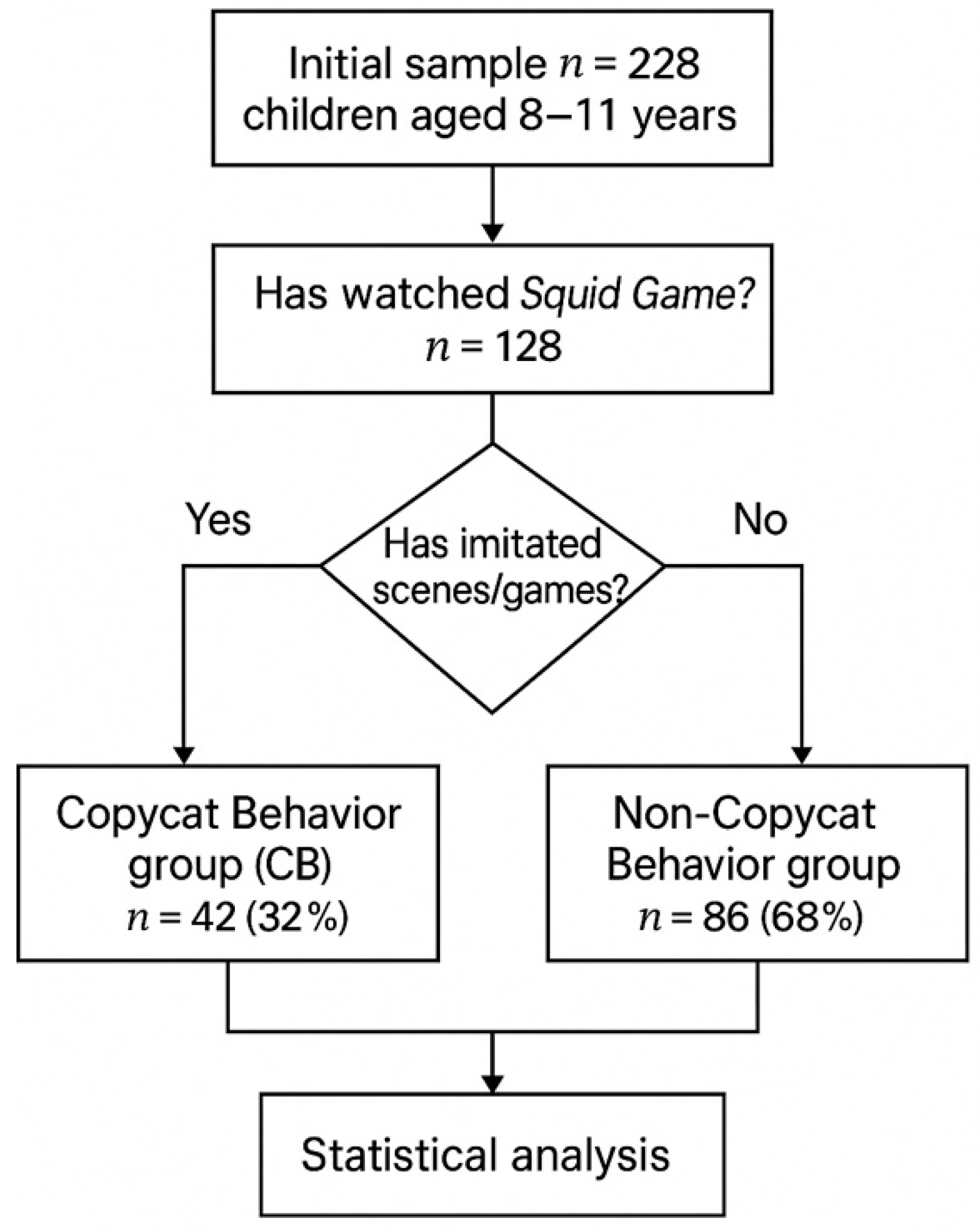
- The Copycat Behavior (CB) group included children who answered “yes” to at least one imitation item and described reenacting games or scenes from Squid Game (e.g., playing a violent version of “Red Light, Green Light,” simulating punishments or eliminations).
- -
- The Non-Copycat Behavior (NCB) group included children who reported having watched Squid Game but denied imitating any of its games or scenes.
2.5. Parent-Report Measure: Child Behavior Checklist (CBCL)
2.6. Statistical Analysis
- -
- Gender distribution (male/female) between CB and NCB groups was assessed using the Chi-square test.
- -
- Differences in CBCL T-scores between CB and NCB groups were examined using the Mann–Whitney U test, given the ordinal nature and non-normal distribution of CBCL data.
- -
- Significance level: The alpha level was set at p < 0.05 (two-tailed).
3. Results
3.1. Sample Characteristics
3.2. Copycat Behaviors Related to Squid Game
3.3. CBCL Scores and Somatic Complaints
4. Discussion
4.1. Main Findings
4.2. Copycat Behavior, Social Learning, and Somatization
- -
- well-defined, game-like structures based on familiar children’s games;
- -
- visually striking, repetitive scenes with strong emotional salience;
- -
- a competitive, survival-based logic where winners gain status and rewards;
- -
- a stylised but intense representation of violence embedded in “play”.
4.3. Context: Italian Media Environment and Parental Mediation
4.4. Methodological Considerations and Limitations
4.5. Implications and Future Directions
5. Conclusions
- -
- enforcement of age recommendations on streaming platforms;
- -
- media literacy initiatives for parents, teachers, and children, emphasizing critical analysis of violent content;
- -
- promotion of co-viewing and guided discussion, especially when children encounter disturbing material;
- -
- integration of questions about media use and somatic symptoms into pediatric and child mental health assessments.
Author Contributions
Funding
Institutional Review Board Statement
Informed Consent Statement
Data Availability Statement
Conflicts of Interest
References
- Villani, S. Impact of Media on Children and Adolescents: A 10-Year Review of the Research. J. Am. Acad. Child. Adolesc. Psychiatry 2001, 40, 392–401. [Google Scholar] [CrossRef]
- Gabbiadini, A.; Baldissarri, C.; Valtorta, R.R.; Durante, F.; Mari, S. Loneliness, Escapism, and Identification With Media Characters: An Exploration of the Psychological Factors Underlying Binge-Watching Tendency. Front. Psychol. 2021, 12, 785970. [Google Scholar] [CrossRef]
- Rubin, A.M. Television Use by Children and Adolescents. Hum. Commun. Res. 1979, 5, 109–120. [Google Scholar] [CrossRef]
- Escobar-Chaves, S.L.; Tortolero, S.R.; Markham, C.M.; Low, B.J.; Eitel, P.; Thickstun, P. Impact of the Media on Adolescent Sexual Attitudes and Behaviors. Pediatrics 2005, 116, 303–326. [Google Scholar] [CrossRef]
- Migliore, G.; Rizzo, G.; Schifani, G.; Quatrosi, G.; Vetri, L.; Testa, R. Ethnocentrism Effects on Consumers’ Behavior during COVID-19 Pandemic. Economies 2021, 9, 160. [Google Scholar] [CrossRef]
- Cohen, J. Audience Identification with Media Characters. In Psychology of Entertainment; Routledge: London, UK, 2013; pp. 183–197. [Google Scholar]
- Hoffner, C. Children’s Wishful Identification and Parasocial Interaction with Favorite Television Characters. J. Broadcast. Electron. Media 1996, 40, 389–402. [Google Scholar] [CrossRef]
- Krstić, S. “Binge-Watching”: The New Way of Watching TV Series. AM Časopis Za Stud. Umet. I Medija 2018, 15–23. [Google Scholar] [CrossRef]
- Montag, C.; Elhai, J.D. A New Agenda for Personality Psychology in the Digital Age? Personal. Individ. Differ. 2019, 147, 128–134. [Google Scholar] [CrossRef]
- Krahé, B.; Busching, R.; Möller, I. Media Violence Use and Aggression Among German Adolescents: Associations and Trajectories of Change in a Three-Wave Longitudinal Study. Psychol. Pop. Media Cult. 2012, 1, 152. [Google Scholar] [CrossRef]
- Ballard, M.E.; Hamby, R.H.; Panee, C.D.; Nivens, E.E. Repeated Exposure to Video Game Play Results in Decreased Blood Pressure Responding. Media Psychol. 2006, 8, 323–341. [Google Scholar] [CrossRef]
- Padilla-Walker, L.M.; Coyne, S.M.; Collier, K.M.; Nielson, M.G. Longitudinal Relations Between Prosocial Television Content and Adolescents’ Prosocial and Aggressive Behavior: The Mediating Role of Empathic Concern and Self-Regulation. Dev. Psychol. 2015, 51, 1317. [Google Scholar] [CrossRef]
- Mitchell, K.M.; Ellithorpe, M.E.; Bleakley, A. Sex and Violence in the Movies: Empathy as a Moderator of the Exposure-Behavior Relationship in Adolescents. J. Sex Res. 2021, 58, 322–330. [Google Scholar] [CrossRef] [PubMed]
- Huesmann, L.R.; Miller, L.S. Long-Term Effects of Repeated Exposure to Media Violence in Childhood. In The Plenum Series in Social/Clinical Psychology; Springer: Berlin/Heidelberg, Germany, 1994; pp. 153–186. [Google Scholar] [CrossRef]
- Vossen, H.G.; Fikkers, K.M. The Mediating Role of Sympathy in the Relationship Between Media Violence and Dutch Adolescents’ Social Behaviors. J. Child. Media 2020, 15, 389–409. [Google Scholar] [CrossRef]
- Khurana, A.; Bleakley, A.; Ellithorpe, M.E.; Hennessy, M.; Jamieson, P.E.; Weitz, I. Media Violence Exposure and Aggression in Adolescents: A Risk and Resilience Perspective. Aggress. Behav. 2018, 45, 70–81. [Google Scholar] [CrossRef]
- Slater, M.D.; Henry, K.L.; Swaim, R.C.; Cardador, J.M. How Sensation Seeking, Alienation, and Victimization Moderate the Violent Media Content-Aggressiveness Relation. Commun. Res. 2004, 31, 642–668. [Google Scholar] [CrossRef]
- Bryant, J.; Bryant, J.A. (Eds.) Television and the American Family, 2nd ed.; Routledge: London, UK, 2001; pp. 333–351. [Google Scholar]
- Desmond, R.J. Metacognition: Thinking about Thoughts in Children’s Comprehension of Television. Crit. Stud. Media Commun. 1985, 2, 338–351. [Google Scholar] [CrossRef]
- Ravens-Sieberer, U.; Kaman, A.; Erhart, M.; Devine, J.; Schlack, R.; Otto, C. Impact of the COVID-19 Pandemic on Quality of Life and Mental Health in Children and Adolescents in Germany. Eur. Child. Adolesc. Psychiatry 2022, 31, 879–889. [Google Scholar] [CrossRef]
- Ahmed, W.; Fenton, A.; Hardey, M.; Das, R. Binge Watching and the Role of Social Media Virality towards Promoting Netflix’s Squid Game. IIM Kozhikode Soc. Manag. Rev. 2022, 11, 222–234. [Google Scholar] [CrossRef]
- Siregar, N.; Angin, A.B.P.; Mono, U. The Cultural Effect of Popular Korean Drama: Squid Game. IDEAS J. Engl. Lang. Teach. Learn. Linguist. Lit. 2021, 9, 445–451. [Google Scholar] [CrossRef]
- De Jans, S.; Cauberghe, V.; Hudders, L. Red Light or Green Light? Netflix Series’ Squid Game Influence on Young Adults’ Gambling-Related Beliefs, Attitudes and Behaviors, and the Role of Audience Involvement. Health Commun. 2023, 38, 2640–2651. [Google Scholar] [CrossRef]
- Lissak, G. Adverse Physiological and Psychological Effects of Screen Time on Children and Adolescents: Literature Review and Case Study. Environ. Res. 2018, 164, 149–157. [Google Scholar] [CrossRef]
- Martinelli, A.; Ackermann, K.; Bernhard, A.; Freitag, C.M.; Schwenck, C. Hostile Attribution Bias and Aggression in Children and Adolescents: A Systematic Literature Review on the Influence of Aggression Subtype and Gender. Aggress. Violent Behav. 2018, 39, 25–32. [Google Scholar] [CrossRef]
- Smahel, D.; Wright, M.F.; Cernikova, M. The Impact of Digital Media on Health: Children’s Perspectives. Int. J. Public Health 2015, 60, 131–137. [Google Scholar] [CrossRef]
- Bozzola, E.; Spina, G.; Ruggiero, M.; Memo, L.; Agostiniani, R.; Bozzola, M.; Corsello, G.; Villani, A. Media Devices in Pre-School Children: The Recommendations of the Italian Pediatric Society. Ital. J. Pediatr. 2018, 44, 69. [Google Scholar] [CrossRef] [PubMed]
- Rescorla, L.A. Assessment of Young Children Using the Achenbach System of Empirically Based Assessment (ASEBA). Ment. Retard. Dev. Disabil. Res. Rev. 2005, 11, 226–237. [Google Scholar] [CrossRef] [PubMed]
- Achenbach, T.M.; Dumenci, L.; Rescorla, L.A. Ratings of Relations Between DSM-IV Diagnostic Categories and Items of the CBCL/6-18, TRF, and YSR; University of Vermont: Burlington, VT, USA, 2001; pp. 1–9. [Google Scholar]
- Sackl-Pammer, P.; Özlü-Erkilic, Z.; Jahn, R.; Karwautz, A.; Pollak, E.; Ohmann, S.; Akkaya-Kalayci, T. Somatic Complaints in Children and Adolescents with Social Anxiety Disorder. Neuropsychiatrie 2018, 32, 187–195. [Google Scholar] [CrossRef] [PubMed]
- Bandura, A.; Ross, D.; Ross, S.A. Transmission of Aggression through Imitation of Aggressive Models. J. Abnorm. Soc. Psychol. 1961, 63, 575–582. [Google Scholar] [CrossRef]
- Favieri, F.; Forte, G.; Tambelli, R.; Tomai, M.; Casagrande, M. I Feel Addicted to Watching TV Series: Association between Binge-Watching and Mental Health. PeerJ 2023, 11, e15796. [Google Scholar] [CrossRef]
- Ort, A.; Wirz, D.S.; Fahr, A. Is Binge-Watching Addictive? Effects of Motives for TV Series Use on the Relationship between Excessive Media Consumption and Problematic Viewing Habits. Addict. Behav. Rep. 2021, 13, 100325. [Google Scholar] [CrossRef]
- Costanza, C.; Vetri, L.; Carotenuto, M.; Roccella, M. Use and Abuse of Digital Devices: Influencing Factors of Child and Adolescent Neuropsychology. Clin. Pract. 2023, 13, 1331–1334. [Google Scholar] [CrossRef]
- Guerrero, M.D.; Barnes, J.D.; Chaput, J.P.; Tremblay, M.S. Screen Time and Problem Behaviors in Children: Exploring the Mediating Role of Sleep Duration. Int. J. Behav. Nutr. Phys. Act. 2019, 16, 105. [Google Scholar] [CrossRef] [PubMed]
- Strasburger, V.C.; Wilson, B.J. Television Violence: Sixty Years of Research. In Media Violence and Children: A Complete Guide for Parents and Professionals; Gentile, D.A., Ed.; Praeger/ABC-CLIO: Santa Barbara, CA, USA, 2014; pp. 135–177. [Google Scholar]
- Brown, J.D.; Witherspoon, E.M. The Mass Media and American Adolescents’ Health. J. Adolesc. Health 2002, 31, 153–170. [Google Scholar] [CrossRef]
- Anderson, C.; Gentile, D.; Rich, M. Media Violence and Children: A Complete Guide for Parents and Professionals; Bloomsbury Publishing: London, UK, 2014; pp. 1–496. [Google Scholar]
- Zhao, Z.; Zhu, L.; Liao, J.; Xia, J.; Pu, X. Parental Mediation, Digital Media Usage, and Health Literacy: An Exploration among Chinese Elementary School Students. Health Commun. 2025, 40, 1144–1156. [Google Scholar] [CrossRef]
- Wang, J.; Liu, R.-D.; Ding, Y.; Hong, W.; Liu, J. How Parental Mediation and Parental Phubbing Affect Preschool Children’s Screen Media Use: A Response Surface Analysis. Cyberpsychol. Behav. Soc. Netw. 2024, 27, 651–657. [Google Scholar] [CrossRef] [PubMed]
- Commodari, E.; Consiglio, A.; Cannata, M.; La Rosa, V.L. Influence of Parental Mediation and Social Skills on Adolescents’ Use of Online Video Games for Escapism: A Cross-Sectional Study. J. Res. Adolesc. 2024, 34, 1668–1678. [Google Scholar] [CrossRef] [PubMed]



| Domain | Item (Example Wording) | Response Format |
|---|---|---|
| Imitation of games | “Have you ever played a violent version of games seen in Squid Game (e.g., ‘Red Light, Green Light’)?” | Yes/No |
| Imitation of scenes | “Have you ever reenacted scenes or punishments from Squid Game while playing?” | Yes/No |
| Context of imitation | “Where did this happen?” (school/home/playground) | Multiple choice |
| Social context | “With whom did you imitate the scenes?” (friends/siblings/classmates) | Multiple choice |
| Male | Female | Mean Age | SD | |
|---|---|---|---|---|
| CB * | 26 | 16 | 9.69 | 0.643 |
| NCB * | 45 | 41 | 9.76 | 0.631 |
| Total | 71 | 57 | 9.73 | 0.634 |
| CBCL Scale | CB Group Mean | SD | NCB Group Mean | SD | Mann–Whitney U Test | Z-Score | p |
|---|---|---|---|---|---|---|---|
| Withdrawal/Depression | 54.12 | 5.361 | 54.35 | 7.284 | 1740.000 | −0.361 | 0.718 |
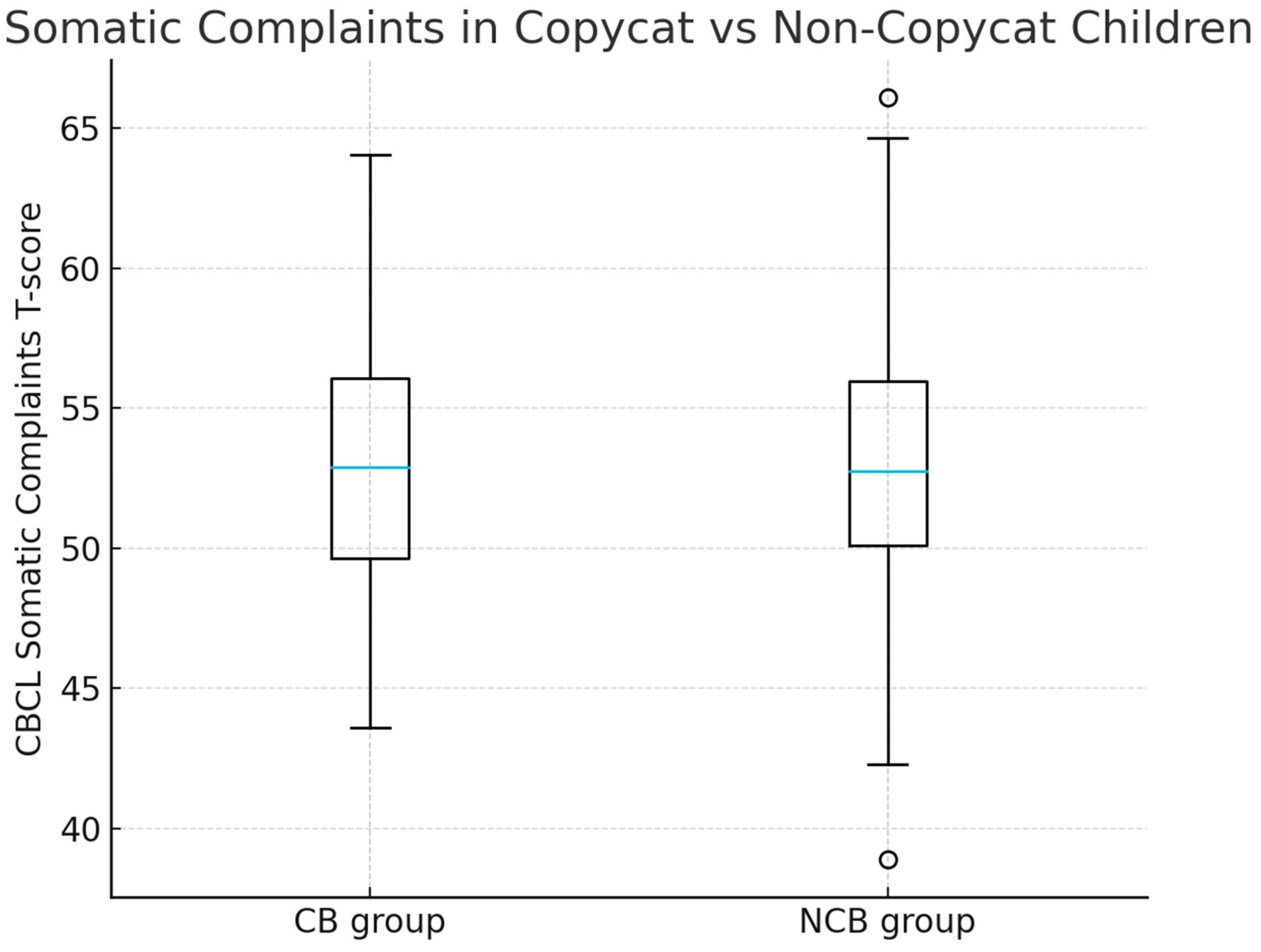
| Somatic Complaints | 54.12 | 5.375 | 52.92 | 5.354 | 1414.500 | −2.129 | 0.033 |
| Anxiety/Depression | 52.79 | 4.857 | 53.08 | 5.852 | 1724.500 | −0.448 | 0.654 |
| Social Issues | 52.83 | 4.054 | 51.98 | 3.643 | 1570.000 | −1.272 | 0.203 |
| Thought Disorders | 51.19 | 2.907 | 50.98 | 3.568 | 1581.500 | −1.557 | 0.119 |
| Attention Deficit | 52.98 | 4.453 | 52.30 | 4.853 | 1535.000 | −1.462 | 0.144 |
| Delinquent Behavior | 52.55 | 3.964 | 52.02 | 4.574 | 1672.000 | −0.711 | 0.477 |
| Aggressive Behavior | 54.21 | 5.594 | 53.42 | 6.685 | 1525.000 | −1.531 | 0.126 |
| Internalizing Problems | 49.05 | 9.518 | 46.40 | 11.713 | 1488.500 | −1.616 | 0.106 |
| Externalizing Problems | 49.10 | 9.141 | 47.47 | 10.101 | 1598.000 | −1.058 | 0.290 |
| Total Score | 45.48 | 10.353 | 43.06 | 12.094 | 1504.500 | −1.531 | 0.126 |
Disclaimer/Publisher’s Note: The statements, opinions and data contained in all publications are solely those of the individual author(s) and contributor(s) and not of MDPI and/or the editor(s). MDPI and/or the editor(s) disclaim responsibility for any injury to people or property resulting from any ideas, methods, instructions or products referred to in the content. |
© 2026 by the authors. Licensee MDPI, Basel, Switzerland. This article is an open access article distributed under the terms and conditions of the Creative Commons Attribution (CC BY) license.
Share and Cite
Gnazzo, M.; Bargiacchi, G.; Vetri, L.; Parisi, L.; Testa, D.; Smirni, D.; Maltese, A.; Baldini, V.; Pisanò, G.; Germanò, E.; et al. Copycat Behavior and Somatic Symptoms in Italian Children Exposed to a Violent TV Series: An Observational Study of Squid Game Viewers. Pediatr. Rep. 2026, 18, 17. https://doi.org/10.3390/pediatric18010017
Gnazzo M, Bargiacchi G, Vetri L, Parisi L, Testa D, Smirni D, Maltese A, Baldini V, Pisanò G, Germanò E, et al. Copycat Behavior and Somatic Symptoms in Italian Children Exposed to a Violent TV Series: An Observational Study of Squid Game Viewers. Pediatric Reports. 2026; 18(1):17. https://doi.org/10.3390/pediatric18010017
Chicago/Turabian StyleGnazzo, Martina, Giuditta Bargiacchi, Luigi Vetri, Lucia Parisi, Davide Testa, Daniela Smirni, Agata Maltese, Valentina Baldini, Giulia Pisanò, Eva Germanò, and et al. 2026. "Copycat Behavior and Somatic Symptoms in Italian Children Exposed to a Violent TV Series: An Observational Study of Squid Game Viewers" Pediatric Reports 18, no. 1: 17. https://doi.org/10.3390/pediatric18010017
APA StyleGnazzo, M., Bargiacchi, G., Vetri, L., Parisi, L., Testa, D., Smirni, D., Maltese, A., Baldini, V., Pisanò, G., Germanò, E., Gallai, B., Gagliano, A., Costanza, C., Roccella, M., & Carotenuto, M. (2026). Copycat Behavior and Somatic Symptoms in Italian Children Exposed to a Violent TV Series: An Observational Study of Squid Game Viewers. Pediatric Reports, 18(1), 17. https://doi.org/10.3390/pediatric18010017