Article

Shifts in Straw-Associated Functional Microbiomes Under Long-Term Soil Management

1
Department of Microbiology, Faculty of Agriculture, University of Agricultural Sciences and Veterinary Medicine Cluj-Napoca, Calea Mănăştur 3-5, 400372 Cluj-Napoca, Romania
2
Department of Grasslands and Forage Crops, Faculty of Agriculture, University of Agricultural Sciences and Veterinary Medicine Cluj-Napoca, Calea Mănăştur 3-5, 400372 Cluj-Napoca, Romania
*
Author to whom correspondence should be addressed.
Microbiol. Res. 2026, 17(3), 51; https://doi.org/10.3390/microbiolres17030051

Submission received: 26 January 2026 / Revised: 23 February 2026 / Accepted: 25 February 2026 / Published: 27 February 2026

Abstract

Long-term soil fertility is governed by the metabolic plasticity of microbial communities, particularly during the decomposition of crop residues. This study investigated the straw-associated functional microbial profile associated with straw decomposition under the influence of 62 years of continuous management with mineral fertilization and liming. Using the Biolog EcoPlateTM approach combined with a modified litter-bag protocol, we assessed shifts in metabolic activity patterns of functional guilds and groups. PERMANOVA results revealed that the interaction between liming and fertilization (p < 0.05) was the primary driver of divergence in functional communities, rather than the individual effect of factors. Long-term treatments induced a significant reconfiguration of the functional niche, shifting from the native, generalist microbiome to specialized communities in treated variants, with carbohydrate (CH) guilds as dominant and indicators of community performance. Moderate levels of liming (L1) stimulated metabolic activity and maintained higher functional diversity across amino acid (AA) and polymers (Px) guilds. Intensive liming (L2), in contrast, restricted the activity of most microbial functional groups and favored amine (AM) and carboxylic acid (CX) guilds. Shifts from a generalist microbiome in native soil to specialized communities in treated soils show the capacity of microorganisms to adapt efficiently under agronomic management.

1. Introduction

In modern agriculture, the use of mineral fertilizers is an essential element for obtaining high crop yields [1,2,3,4,5]. However, conventional farming often results in substantial nutrient loss, as crops only absorb 30–50% of applied inputs [6], while the excessive use of mineral fertilizers can degrade soils and compromise environmental sustainability [7,8,9,10,11,12].
The biological stability of these agroecosystems depends largely on the diversity and functional plasticity of microbial communities, which are highly sensitive and react rapidly to changes in pH, nutrient availability, and soil organic matter (SOM). As SOM is an indispensable indicator of soil ecosystem health [13], maintaining soil structure by promoting nutrient cycling and supporting the activity of microorganisms [14,15], the global loss of 50–70% of original soil carbon due to climate change and intensive farming represents a challenge for the future of this field [16,17,18,19,20]. The decomposition of organic matter is a biogeochemical process that directly affects ecosystems’ ability to adapt to climate change [21]. A complex network of fungi and bacteria are responsible for carbon (C) dynamics [22], while the diversity of microbial habitats determines the life strategies of microorganisms and influences organic matter mineralization [23]. Under stoichiometric imbalance, microorganisms adapt organic matter consumption to meet their energy and growth demands, with the carbon/nitrogen (C/N) ratio demonstrating a significant impact on microbial diversity [24,25]. Despite the importance of these processes, the specific response of microbial functional diversity involved in decomposition of organic matter under long-term management is insufficiently explored [26]. A significant global constraint of the C biogeochemical cycle is soil acidification, an existent phenomenon in approximately 30% of global arable land, limiting the bioavailability of essential nutrients to crops. The slightly acidic brown soil present in areas like Satu Mare, Romania, is an ideal environment for observing the interactions between fertilizer inputs and microbial metabolic activity. At the soil level, one complex effect of liming could be visible throughout the changes to the microbiome composition, along with a profound influence of soil biochemical processes, organic matter mineralization, and the essential elements available for plants [27,28]. Research on CaCO3 application indicates a shift in the relationships between soil microorganisms. Microbial habitats and niches could exhibit a potential diversity reduction or a shift toward a series of specialized groups. Thus, the fertilization type used for the long term becomes a determining factor in the functional modeling of the edaphic ecosystem, with direct implications for agroecosystem sustainability and crop productivity [29,30,31].
To mitigate the loss of C and improve soils structure, incorporating straw represents one of the key sustainable farming practices that works towards improving the soil’s health and fertility, besides promoting crop productivity [32]. Straw incorporated in soil acts as a direct energy source for heterotrophic decomposers, improving hydraulic conductivity and increasing moisture retention [33,34,35,36]. The efficiency of the straw decomposition process significantly influences the amount of mineralized SOC, being highly dependent on temperature and nutrient levels from the soil [37]. Based on these biotic and abiotic constraints, the choice of an appropriate method for straw decay acts as an efficient management strategy of available resources and promotes sustainable agriculture [38].
The long-term fertilization experiment established in 1961 [39] at Livada Agricultural Research and Development Station (ARDS Livada) and the continuous application of a liming and mineral fertilization combination provide a valuable experimental framework for studying functional changes in the soil microbiome. This study aims to investigate how the simultaneous application of liming and mineral fertilizers (N, P, and K) have reshaped the functional microbial communities responsible for organic matter decomposition in a 62-year field experiment (1961–2023) with the same management. This type of experiment is rare, in terms of continuous sustained management, and extremely valuable for highlighting the changes induced in time. The hypothesis of this research was that both treatment types and their combination have modified the microbial community of the soil and have produced an observable change in the straw-decomposing microbial functional profile. For a better assessment of changes produced by combined treatments, soils solely limed and untreated (native) soils were also analyzed to evaluate the differences between treated and untreated soils. To test this hypothesis, the research objectives were defined to provide a comprehensive analysis of (i) the potential use of functional microbiome assessment for scoring the community patterns in decayed-straw samples; (ii) to quantify the shifts in microbial functional guilds due to long-term application of fertilizers and liming; (iii) to determine the specific metabolic reaction of microbial functional groups to individual or combined treatments; and (iv) to identify the treatment-specific microbial associations and transition niches based on functional similarity patterns.

2. Materials and Methods

2.1. Experimental Design

The experiment was carried out in 2023 in a long-term fertilization experiment established in 1961 within the experimental field of the Livada Agricultural Research and Development Station (ARDS Livada) in Satu Mare county, Romania [40]. The region is defined by a moderate temperate continental climate with relatively warm summers and mild winters. Rainfall in this area varies between 600 and 1200 mm. Brown Luvisol is the type of soil on which the experiments were carried out and is specific to the region.
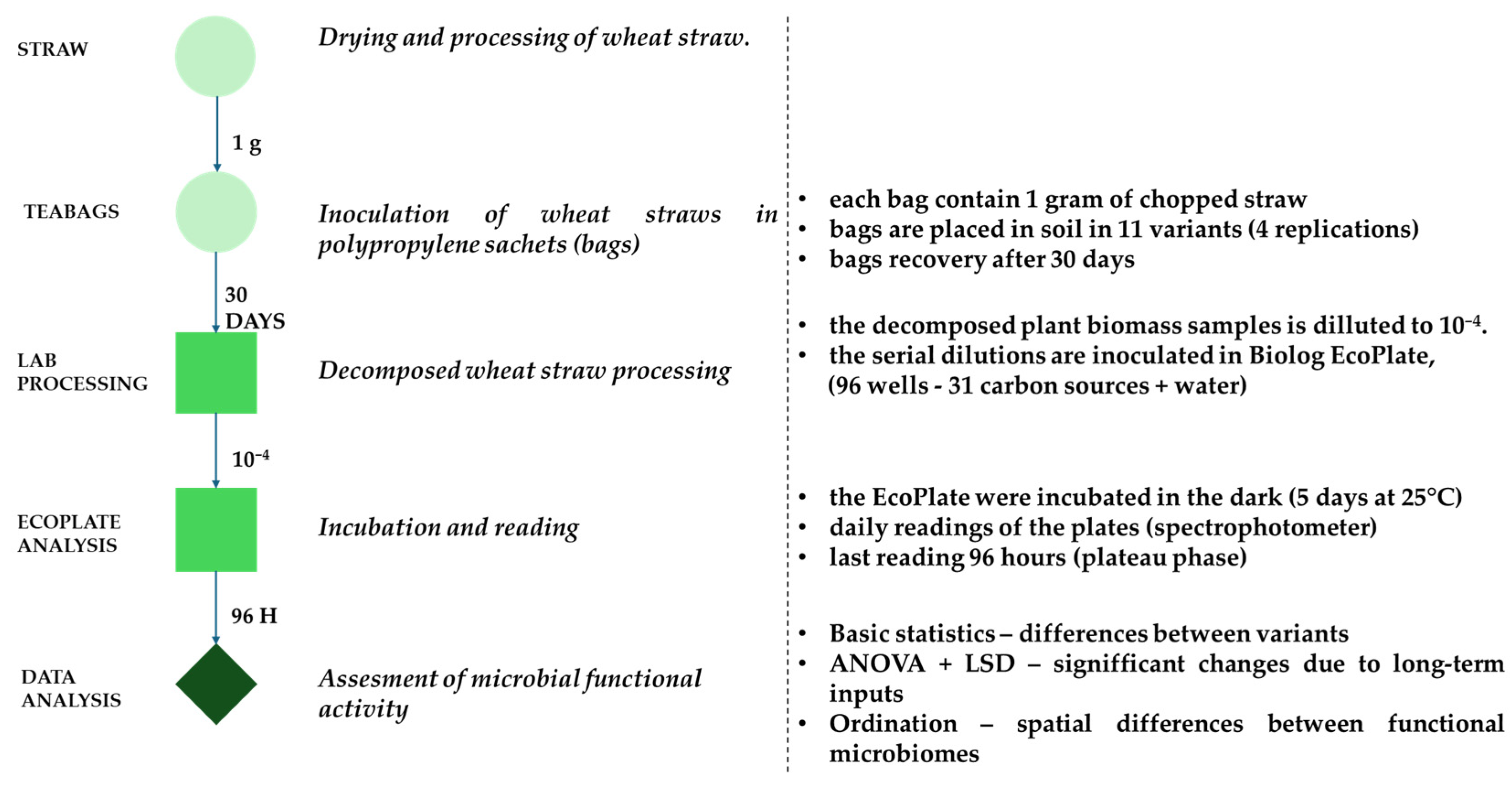
Our study focused on the extraction and analysis of functional microbial communities involved in straw decomposition, under the influence of long-term application of the same inputs (Figure 1). A modified litter-bag protocol was used to assess the functional profile of the microorganism from soil that migrates to the buried straw biomass in the soil. Dried and chopped straw stems were placed in litter bags made of polypropylene, 5 × 7 cm in size, and placed at a depth of 5–10 cm for a period of 30 days.
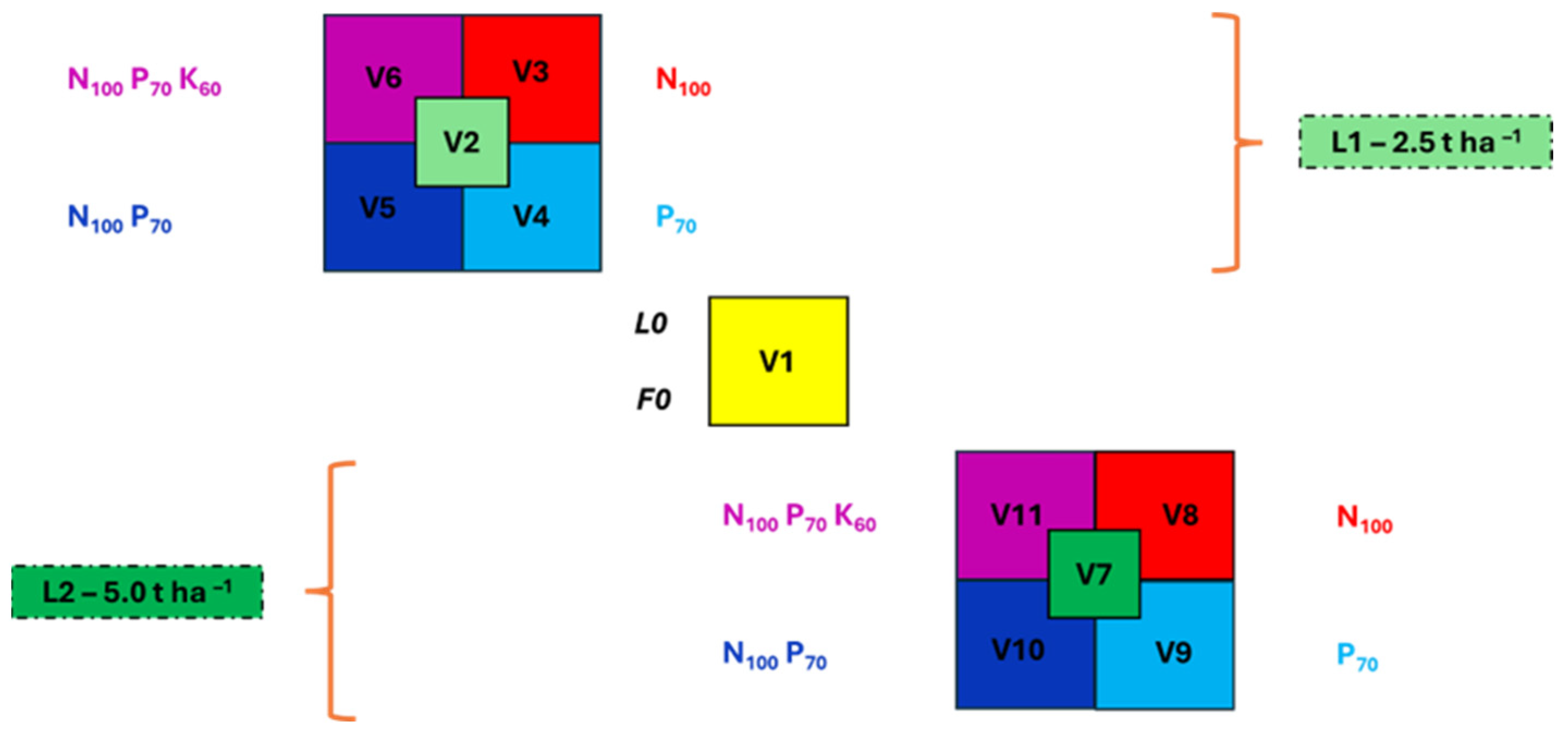
A bifactorial experimental design with liming and mineral fertilization was set up with 11 variants, each replicated four times. The experimental design followed a 2 × 5 factorial structure, to which V1 was added. Variant V1 represents the native soil, where no liming or fertilizer was applied since the beginning of the experiment, and served as a control. The first factor, the liming (L) quantity, had two gradations: L1—2.5 t ha−1 CaCO3 (moderate liming) and L2—5 t ha−1 CaCO3 (intensive liming). The second factor, mineral fertilization, included five gradations and was applied on limed variants: no fertilizers (V2 and V7), nitrogen only—N100 (V3 and V8), phosphorus only—P70 (V4 and V9), combined nitrogen and phosphorus—N100P70 (V5 and V10), complex mineral fertilization—N100P70K60 (V6 and V11) (Figure 2, Table A1).

2.2. Analysis of Soil Functional Microbiome Associated with Straw Decomposition

The traditional Biolog EcoPlate method is based on soil sampling, the extraction of heterogeneous microbiomes from samples, and incubation on different substrates, which can provide an image and the functional microbial community’s score. The system uses 96-well plates, each containing one of 31 different carbon sources together with a color reduction indicator. The 31 carbon substrate types in plates are grouped in main categories based on their unique biochemical characteristics. As they incubate, soil microorganisms consume substrates, causing color changes in the well. Based on the recorded activity, the functional diversity of soil microbial communities can be assessed by analyzing patterns of substrate use. Dominant groups and guilds were identified [41] to evaluate their response to the experimental conditions. To achieve the aim and the objectives proposed in this research, a modification of the classic Biolog protocol was performed with the decomposed plant material (wheat straw), collected from the experimental field instead of soil. This experimental setup enabled a detailed assessment of functional diversity and active microbial community for each treatment-specific ecosystem, providing insights into the temporal dynamics and microbial communities responses.
The protocol used, based on the work of Liu et al. [42] and Sofo et al. [43], began with the addition of decomposed biomass to sterile distilled water up to a dilution of 10−4. After shaking the suspension at 270 rpm for 30 min at 25 °C, the sample was kept for 10 min at 4–8 °C. After this treatment, 120 μL of the solution was inoculated to each of the 96 wells on the Biolog EcoPlate. To track the growth of microorganisms, optical density (OD) readings at 590 nm were made every 24 h using a Biotek Epoch spectrophotometer, up to 96 h until a plateau phase was recorded. The physiological profile method for community analysis was selected to highlight the large amount of information related to the continuous measurement of the growth rate. The well color changes provide important data about the overall activity of the substrate-associated microbiome [42,43].
Biolog Ecoplate includes 31 carbon sources in three replicates [44], organized into the following chemical categories (Table A2): ten carbohydrates (CH1–CH10), four polymers (P1–P4), nine carboxylic acids (CX1–CX9), six amino acids (AA1–AA6), two amines/amides (AM1 and AM2), and a control (WATER). Following the proposal for functional microbiome assemblage [41], each chemical category was considered as a guild, and within each category the substrates were considered groups. This approach enabled the detection of associative functional patterns shaped by long-term applied treatments and offered a more detailed analysis of the microbial response to inputs.

2.3. Data Analysis

All data analyses were carried out with packages in RStudio environment, version 2024.12.1 [45]. The first step was to extract all the basic statistics, with package “psych” to extract means and s.e. The entire database was further analyzed with ANOVA and Least Significant Differences test for multiple comparison; both tests performed with the “agricolae” package [46]. The combination of factors used was bifactorial: liming ×mineral fertilization. Within the text, data are presented as means ± s.e., followed by the letters that indicate the presence of significant differences at p < 0.05. The values recorded for each substrate were treated as a functional group, and all data for each treatment combination were assembled as a functional community. To these 31 datasets, the Ssum of activities was added, the value recorded in the well that contains only distilled water (representing the basal community). The AWCD parameter presents the general activity reported to the entire set of data. Based on substrate chemical similarity that composes a functional guild [47], the database was completed with another five datasets. For the assessment of functional microbiome similarity within the analyzed treatments, NMDS ordination from “vegan” package [48] was used, with the projection of functional guilds and groups as vectors. This approach enabled the visualization of guild-variant affinity and the distance between all the functional communities to be analyzed. To further analyze the significance of experimental treatments, a PERMANOVA (adonis2 function, 999 permutations) was performed. Subsequently, the “envfit” function was applied to map both the functional guilds and groups as vectors on the ordination space. This approach shows the metabolic potential associated with each type of treatment. Guild NMDS was used to analyze the general ecologic trend, which showed the macro-changes toward one type of substrate, while Group NMDS was used as a fine analysis that highlighted specialization and the mechanism of changes in the functional community. Cluster analysis (“ape” package [49]) was also used.
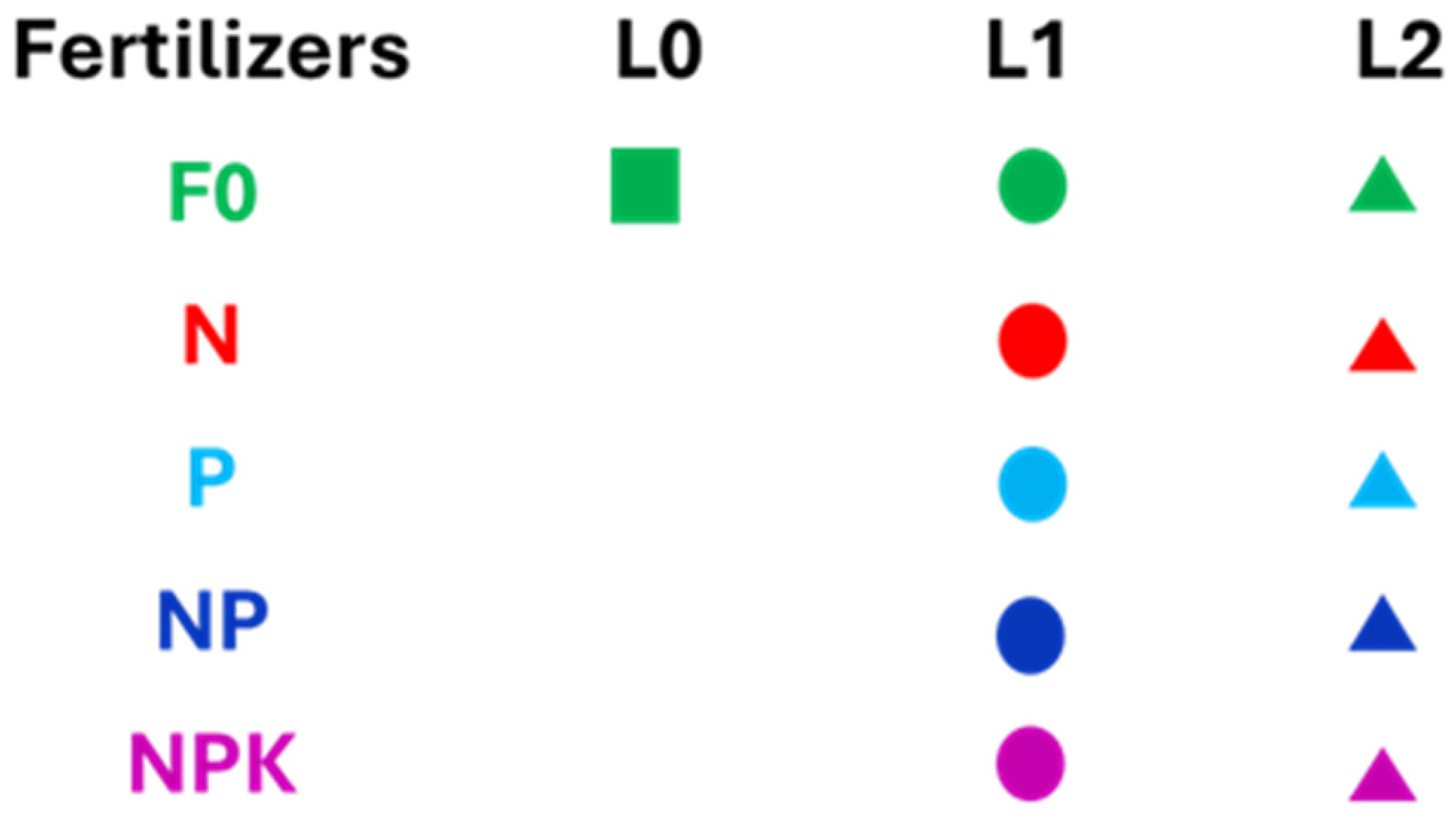
This study presents five mineral fertilizer types, each represented by a distinct palette of colors, and the amount of liming used is highlighted with symbols (Figure 3).
The NMDS projection uses a varied palette of colors to differentiate the types of fertilization applied in the experiments, thus providing a clear representation of the diversity of fertilization methods used. In addition, different symbols are used to represent varying amounts of CaCO3 applied in each case. A combination of distinct colors and graphical symbols provides a clear visualization of how the different inputs and levels influence the experimental results, facilitating the comparison of the effects of these data from the NMDS projection. The ordinations were used to illustrate the influence of the addition of different substrates for the entire composition of soil microbial communities. This method facilitates an understanding of the relationships between the distribution of carbon sources and how they interact with the soil microbiome, highlighting changes in microbial composition as a function of the treatments applied. To provide a more detailed perspective on the functional spatial distribution, the dataset from the NMDS was separated into four smaller databases depending on the position of each point in the general graph. Due to the high density of group/guild–vector–treatment associations, this additional analysis is provided in Supplementary Files. The entire procedure of NMDS and ENVFIT was run for these four databases which allowed us to analyze additional specific community–vector correlations within the metabolic niches.

3. Results

3.1. General Trends of Functional Guilds and Entire Microbial Community as Shaped by Applied Treatments

The microbial communities in native soil (V1) exhibited a medium level of basal metabolic activity with the absence of an external input, resulting in the lowest values across most functional guilds (Table 1). The overall sum of activities set the functional profile at 37.50 units, with an of 1.02. Within the functional groups, CH and CX were the predominant guilds, both exceeding 11 units.
The application of treatments maintained a robust metabolic profile for the CH guild, stimulating values ranging between 10 and 13 units. According to the LSD test, the values were statistically similar across all limed variants, indicating the existence of an active microbial community that remains stable, regardless of the presence of mineral inputs. A relatively similar pattern of metabolic activity was recorded for the CX guild, where the range varied between 9 and 11 units.
A significant treatment-specific variation was evident in the AM guild, where the combined application of L2 doses and NP fertilizer (V10) significantly stimulated this group, reaching a peak of 2.82, a significant increase compared to the 2.19 recorded in the control. Conversely, nitrogen-only inputs (V3, V8) tended to shift AM activity downward, indicating a combined sensitivity of this microbial guild to both pH adjustment and fertilizer type.
Regarding the Px guild, a distinct reaction was observed in the N fertilized variant (V3), where the activity accounted for only 4.40 units. The presence of phosphorus fertilizer in the recipe, (V4, V6, V11), increased the activity of this guild within the range of 0.58–0.98. Overall, while the sum of activities remains stable, the internal allocation of metabolic resources within functional guilds is shaped by the interaction with both liming and fertilizer.
The evaluation of the 10 CH functional groups (Table 2) revealed distinct activity patterns, with values ranging from a minimum of 0.25 units (CH10 in V1) to a maximum of 2.25 units (CH8 in V6). The lowest overall activity was consistently recorded in the control variant (V1), confirming that the absence of input produces a decrease in the microbial metabolic potential.
For several CH functional groups (CH1, CH2, CH3 and CH6), the LSD test showed no significant difference between tested treatments. The absence of variations suggests that these four microbiomes are highly stable across different soil treatment regimes. In contrast, P input in V4 led to an intensification of activity especially for CH4 and CH8 groups. The metabolic response of the other six CH groups followed distinct patterns. CH4 showed significantly increased activity (1.73) due to the application of P on high liming management (V9), compared to native state (1.16) CH8 which recorded maximum activity under medium liming combined with complex fertilizers, reaching 2.25 units. A notable trend was observed for CH7 where the liming solely in V2 increased activity (1.92) compared to the control (1.19). However, the increases in liming doses or combinations with fertilizers tended to reduce the activity of this group. The absence of inputs (V1) indicates a diminished functional activity within the entire CH guild, with a potential expansion due to treatments.
The activity in the four Px groups showed a higher degree of variability in the treated variants compared to the activity recorded in the native soil (Table 3). Overall, P4 was the most active group within this guild, maintaining high value across all treatments. A notable decrease in P4 activity was recorded in variant V3 (0.95), suggesting that the specific nitrogen–medium liming combination limits the metabolic potential of this group. Regarding the liming intensity, activities recorded within the Px guild indicate a general trend of increase; however, doubling the liming dose (from L1 to L2) does not produce significant variation in most analyzed cases. The metabolic stability indicates a resilience phenomenon in the tested liming range.
There were identified group-specific peaks in the medium liming variants (L1). For P1, the highest metabolic activity was scored in the solely limed variant (V2, 1.77), being the only variant that achieved a clear significant value. In a similar way, P2 maximum activity was also found in V2 (1.68), while for P3 the peak was recorded in a P-fertilized variant (V4, 1.42). These increases, localized particularly in variants without complex fertilization, could be attributed to a temporary stimulation of specialized microbial niches. At the guild level, the small-scale fluctuations show a high level of functional redundancy and stability of metabolic potential.
In the carboxylic acids (CX) guild (Table 4), the native soil show a general trend of low–medium activity, with values that ranged from 0.12 (CX4) to a peak of 2.10 (CX6). Overall, three functional groups (CX1, CX2 and CX5) showed no significant changes across all treatments, indicating a high degree of specific functional stability, regardless of the applied treatments. CX3 and CX4 showed a divergent response to treatments, with the synergistic effect of liming and NP fertilization on CX3 (V10, 2.08) and liming solely on CX4 (V2, 0.30). The most pronounced decrease in CX6 was associated with medium liming and NP fertilizer (V5, 1.29), which is in the trend of activity reduction due to treatments. Interestingly, high liming doses act to provide a buffer to mineral fertilization in CX6 group, as activity levels scored for V10 and V11 (1.89 and 1.90, respectively) were closer to control than those that were medium-limed. The same context was found for the CX7 group, where activity was stimulated by medium liming (L1) and suffered a significant reduction at high liming doses (L2). Specifically, for L1 doses the activity was enhanced by N, P or NP combinations but significantly inhibited by the presence of K in the recipe (V6, 1.41). In contrast to this phenomenon, under high-dose liming (V7-V11) the activity of CX7 remain statistically similar regardless of the fertilizer recipe.
Among the six amino acids analyzed in the AA guild (Table 5), the highest microbial diversity was observed for the AA1 group in variant V10 (2.37), indicating that intensive liming and NP fertilization favors the maintenance of an active microbiome in long-term treated agroecosystems. In both the AA1 and AA2 groups, high activity from the control variant was found (2.07 and 2.03, respectively), suggesting that untreated soils support these two microbiomes active even in the absence of external inputs. At guild level, group-specific responses were observed. For AA3, a similar level of activity in both solely moderate liming (V2) and liming with NPK (V6) variants was recorded, both being scored as peaks of activities (1.02 and 1.04, respectively). In contrast, the AA5 group showed activity sustained by NPK and liming combination form V6 (1.02), while AA3 was significantly stimulated by nitrogen-only fertilization at the L1 level (V3, 1.73). The AA6 group required a combination of NP and liming to reach peak activity (V5, 1.01).
Regarding the two AM groups, the dynamics of activities recorded showed distinct patterns. For AM1, only the high liming variant (V7, 1.19) and high liming + NP variant (V10, 1.48) exceeded the activity recorded in the control (V1, 1.17). In a similar manner, for AM2, the highest metabolic rates were observed at moderate liming solely (V2, 1.27) and intensive liming with NP (V10, 1.33), significantly higher compared to the other variants.
In the AA1 and AA2 groups, the native variant (V1) showed similar values, with a minor decrease of approximately 0.3 units. Undisturbed soil supports an active microbiome even in the absence of inputs, with microbial diversity being high due to the cooperation of microorganisms in maintaining coupled activity to the more efficient use of resources. For the AA3 group, the application of liming (V2) and liming + NPK (V6) lead to similar activity. As a comparison, for group AA5, only the NPK in addition to liming sustained higher activity (V6). The same amount of liming completed with N (V3) led to significant increases in AA4 activities, while an increase in the AA6 group required NP (V5) treatment.
By analyzing the values corresponding to the parameters for the AA3–AA6 range, more intense microbial activity was observed for medium liming. In particular, the values registered for V2–V6 variants indicated a significant increase in microbiome activity, followed by a gradual decrease in variants with intensive liming (V7–V11). The general trend showed that microorganisms involved in the decomposition processes and breaking off these substrates exhibit high metabolic efficiency at a moderate level of liming, compared to higher doses. Regarding activity intervals for AM1 and AM2 groups (Table 5), the dynamics of microbial activity appear to show multiple differences: the values in medium and intensive liming are relatively close, with small, not significant differences between them. Only two treatments increase the activities above the value recorded for untreated soil—high liming doses or with NP (V7, V10) for AM1, and high liming with NP or low liming (V10, V2) for AM2.

3.2. Trends of the Functional Community’s General Reaction to Long-Term Treatments

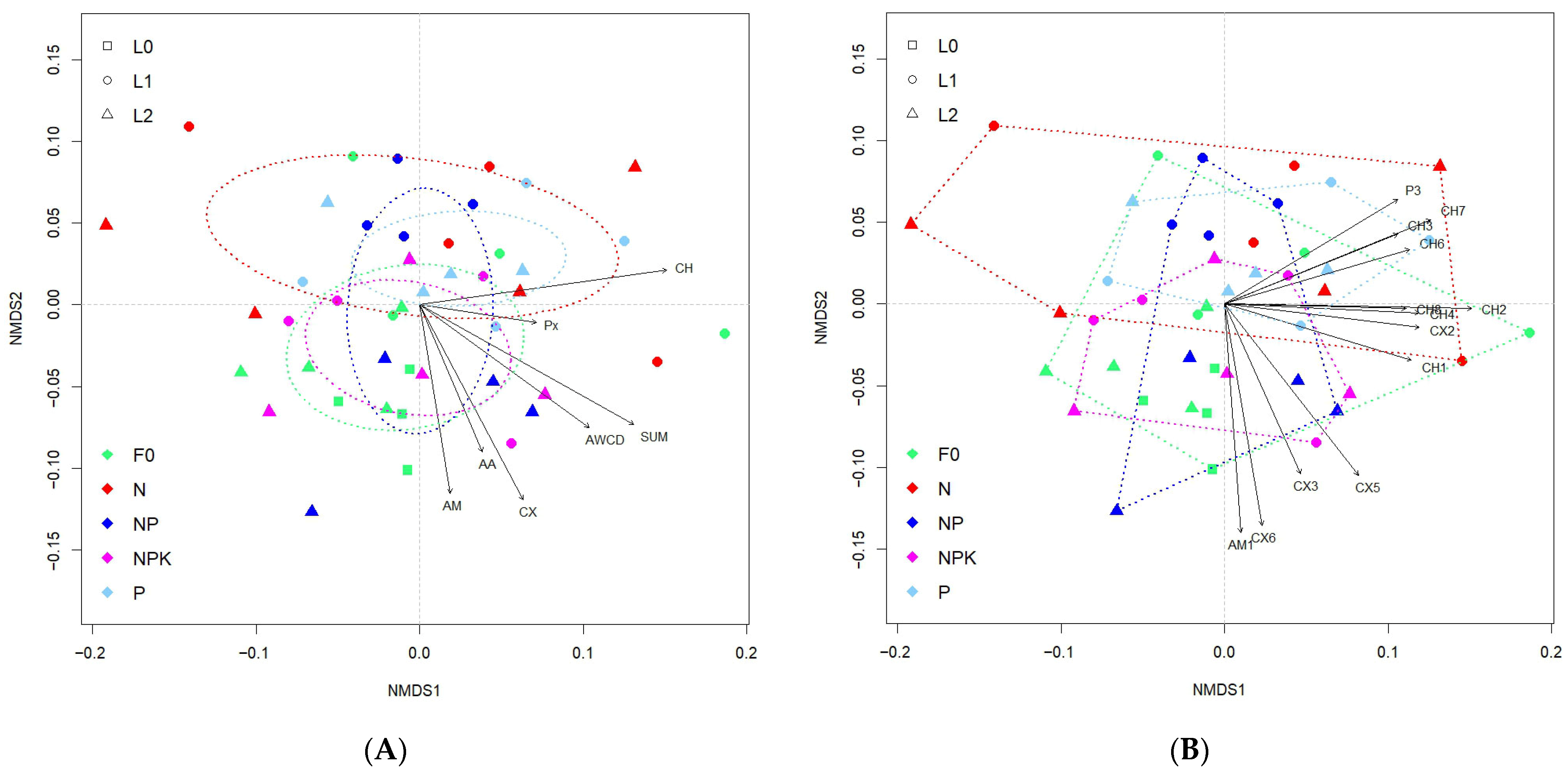
The NMDS ordination of the entire database showed a reduced difference between the global assemblage and activities of the analyzed functional microbiomes (Figure 4). There are visible partial difference trends of P and N treatments which are positioned in the upper quadrants of the ordination (Figure 4A). Compared to these, NPK treatments were in the down part of the graph, both indicating a high potential for inducing microbiome changes. The application of NP treatments, along with the absence of any inputs, occupies the central position of ordination, indicating a similarity in the pattern of recorded activities but also a shift in community composition from generalist to specialist. Based on guild, and activity (Sum and AWCD) and vector positioning, three directions can be observed and associated especially with fertilizers. The first direction was associated with CH and Sum/AWCD vectors that were oriented in the Axis 1 positive direction, indicating continuously increasing metabolic activity. The second direction, associated with specialization, was due to the position of CX, AM and AA vectors, associated with NP, NPK and lack of fertilization. All types of liming were positioned near these three vectors, and the direction of arrows shows a slightly different potential of guild activation. The position of AWCD and Sum, oriented in the area between CH and CX vectors, indicates that medium to intensive limed treatments will visibly alter the functionality of the entire microbial community.
Group projection on NMDS shows vectors in correlation with positive area determined by Axis 1 (Figure 4B). A mix of CH and CX groups is correlated with Axis 1, showing a competition between microorganisms to use these substrates and a grouped metabolic evolution. The presence of P3 along overlapped CH3 and CH7 groups indicates that the microbiome explores new secondary specialization and will further evolve to this direction and reduce the CH and CX general metabolism. AM1 and CX6 are oriented toward Axis 2 and near L0 points, highlighting that the untreated microbiome explores diverse metabolic niches which implies an unpredictable metabolic evolution.
The left part of the two NMDS show no vectors, indicating two possibilities of community reaction. The first one indicates the presence of a mix of functional groups that are not specific to the general trend of each treatment, their presence being related to an extreme specialization, while their AWCD place them outside the intensity vectors. To further explore the fine distribution of functional communities and their utilization patterns, a quadrant-based NMDS analysis was performed (Figures S1–S4). This approach enabled a supplementary analysis of a group treatment’s reaction and a fine resolution of potential metabolic niches.
Both PERMANOVA and ENVFIT functions (Table 6) confirm that liming and fertilizers act synergistically on changes within the metabolic pattern of each microbiome; liming produces the general context of shifting in the microbial metabolism, this being amplified and oriented by the type of applied fertilizer. The CH guild is visible near Axis 1, and the activity recorded separate in the ordination plants shows the types and metabolic potential of the communities, while the r2 values for SUM and AWCD confirm a trend of increasing activity for the communities in the right part pf the ordination, correlated with intensification in both guilds and groups. In terms of secondary metabolism, CX and AM guilds show a vertical orientation, highlighting that specialization occurs by intensification in the activities of less represented groups. Inside the community, treatment impact is visible in the activity value of CH2 and Ch5; these two groups act as indicators for treatment reaction. Specialization is indicated by CX6 activities, being relevant in the vertical assessment of NMDS, while N metabolism is associated with AA1 and AM groups.
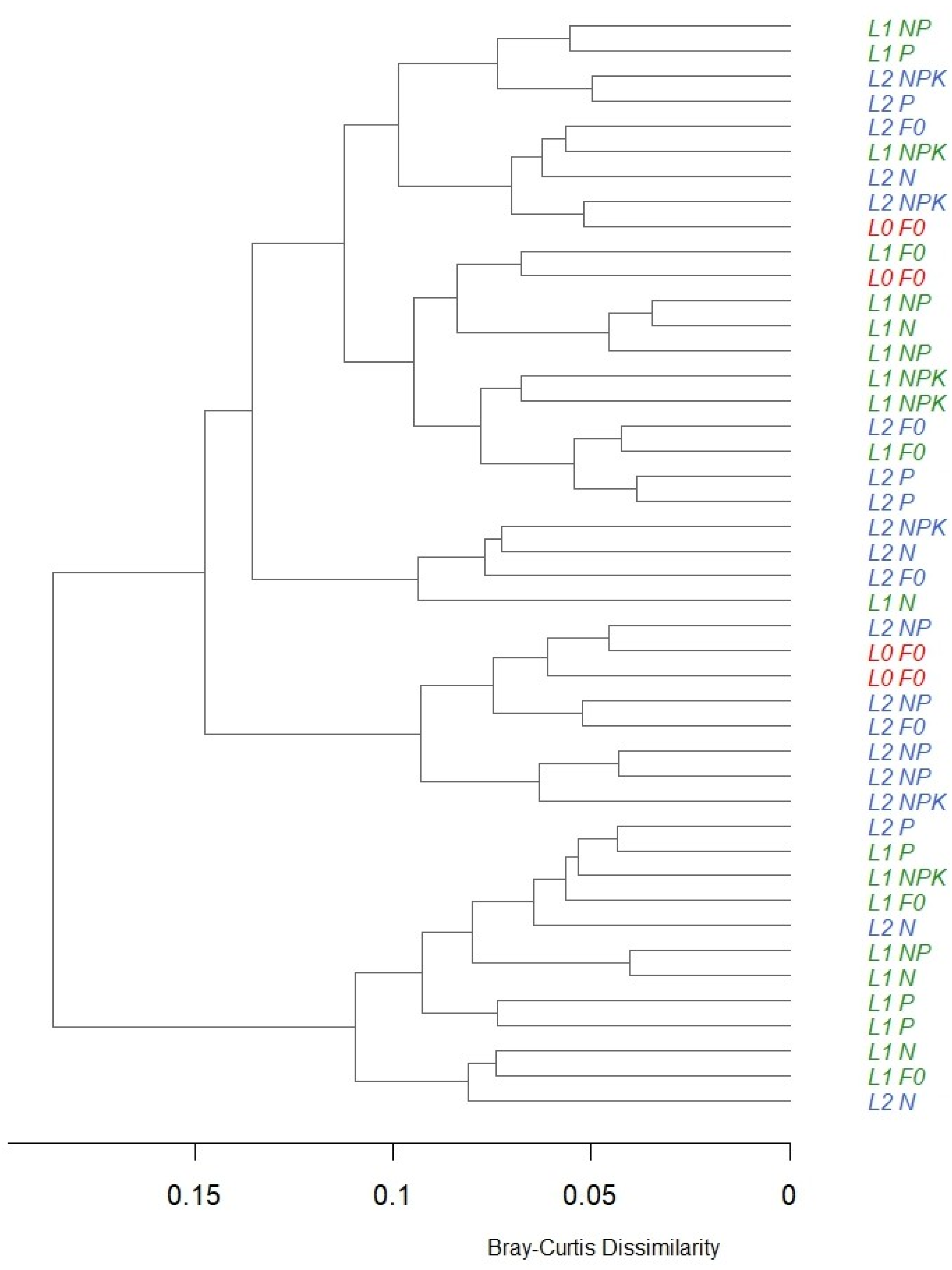
Cluster analysis (Figure 5) highlights the similarity of communities up to 80% (branches of the cluster are united at a distance < 0.2). This indicates the presence of resilient microbiomes that achieved stability in time and in which the treatments induced subtle changes instead of radical ones. The cluster groups are not perfectly separated by liming level but by the interaction between liming and fertilizers. This interaction reveals the presence of specialized niches driven by the long-term application of treatments, and the direction of changes in each microbiome is distinct.
The mix of L1 and L2 samples in the dendrogram confirm that liming dose does not produce a metabolic shift-point, while the absence of liming maintains these samples outside the dense regions. The absence of treatments in control soils does not sustain a clear metabolic pathway for the functional microbiome, the opportunist being present in the assemblage and with various patterns of activities. The native communities exhibited more similarities with L1/L2 NP-based treatments. At the general level, there are two large clusters that group most of L1 samples and are followed by two smaller clusters that combine L2 samples. The upper part of the dendrogram shows higher similarities and mixes the microbiomes shaped by both L1 and L2 doses, indicating the supplementary perturbative effect of fertilizer type.

3.3. Specific Cases of Dual Similarity in Functional Microbiome

The NMDS ordination (Figure 4) revealed three specific cases of functional overlap, where functional microbiomes exhibited shared characteristics between different metabolic profiles (Table A3). These specific cases present traits of transition niches and show different assemblage patterns in relation to applied long-term treatments.
The first niche represents the native soil (V1), positioned at the intersection of the upper functional space and the central ordination axes. The sum of activities shows more than 34 absorption units and AWCD of 0.91. The community is primarily defined by CH and CX guilds, with activity scored to more than 11 absorbance units. The allocation of activities between guilds and the number of functional microbiomes in each guild, both reported to the AWCD, indicate that undisturbed native soil can support a balanced microbiome. This observation is relevant for understanding the maintenance of soil integrity by the long-term microbiological adaptation and interaction.
The second transition point presents a community shaped by high liming doses in the absence of mineral fertilizer (V7), which aligns between native state and the specialized metabolic niches. The cumulative activity scored at 36.42 and AWCD of 0.88 reflect the direct impact of pH adjustment on functional diversity. Based on the ordination, this community shows an overlap with the CH guild vector and specific association with CH7 and P4. This shift indicates that intensive liming creates favorable conditions for a wider range of functional groups, even in the absence of mineral inputs.
The third niche represents a specific case of high-liming and NPK fertilization (V11), a complex combination that is located at the intersection of the middle ordination space. This variant reaches an AWCD of 1 in the context of a total activity scored as 34.47 units, marking a point of functional equilibrium. The position of the point is intersected by AA1 and CH8 group vectors, scoring a specific activity of 1.99 (AA1) and 2.04 (CH4). This position indicates a symmetry of distribution and a balanced metabolic potential, due to the buffer action of intensive liming for complex mineral inputs. This allows the microbial community to maintain high metabolic efficiency.

4. Discussion

4.1. Microbial Resource Harvesting by Substrate and Niche Specialization

The 62-year experimental framework from ARDS Livada demonstrates that continuous application of combined liming and fertilizers has reshaped the functional micro-biome and created distinct metabolic niches, shifting the generalist microbiome from the untreated soil toward specialized functional assemblages. Wheat straw decomposition reflects the impact of long-term agricultural practices and environmental conditions on soil microbiome ability to cycle nutrients and transform organic matter [50].
The functional groups of the CH guild provided a high-resolution map for the functional shifts [51], with these substrates being metabolized by bacteria and fungi involved in the process of organic matter decomposition. Based on our findings, it is highlighted that phosphorus fertilization has a metabolic booster role [52], especially for V9, where intensive liming was combined with 70 kg ha−1 P and sustained the peak values recorded by CH1 and CH4 groups. Furthermore, the highest metabolic potential was identified for CH3, CH6 and CH10 in V4, where medium liming was combined with P, suggesting that phosphorus optimization is an important factor for maintaining a balanced microflora associated with carbohydrate metabolism.
The Px guild activities were correlated with liming application, with different group reactions based on the treatment type. Liming solely stimulated the activity of P1 and P2, while the addition of phosphorus produced a shift toward more complex P3 and P4. Carboxylic acids represent (CX) a vital source of carbon for terrestrial microorganisms which metabolize them into organic and inorganic compounds [53]. Our data shows that V10 recorded the highest values for CX1 and CX3, confirming that intensive liming acts as a physiological buffer that neutralizes the acidifying potential of fertilizers [54]. In contrast, the native soil (V1) showed metabolic polarization, with high activities in CX6 but low CX4 levels, indicating the presence of functional limitations in undisturbed and nutrient-poor environments.
Overall, the untreated soils appear to have a more stable microbial diversity than soils that have been disturbed or that have been intensively fertilized [55], with mineral fertilization affecting the metabolic specialization and efficiency of the microbial community [56]. In th AA guild, the control from AA3 identifies the lowest activity for this group. Therefore, undisturbed soil may experience a slight reduction in the diversity of microbiomes, whereas managed soils will exhibit higher activity potential [57]. V4 treatment exhibited the lowest value in AA1 and AA2 groups, whereas V6 recorded the highest value in AA3 and AA5, indicating that diverse soil inputs promote diverse activity within the microbiome. The application of NPK fertilizers (V6) was essential for maintaining a balanced microbial ecosystem within soil [58]. Both AM1 and AM2 activities are good indicators of soil health and productivity, reflecting a microbiome directed toward the rapid cycling nitrogen-rich compounds [59].
The results interpreted in long-term fertilized soils give an understanding of the effect of such agricultural practice on soil biodiversity and their health. The use of Biolog EcoPlate as a microbial diversity assessment reveal that the 62 years of management have not only changed the community composition but have optimized the activities and meta-bolic affinities required for decomposition processes in the ecosystem [60].

4.2. Specialization of Functional Niche and Metabolic Potential

The investigation of the five microbial guilds reveals a clear partitioning of soil microbiome into functional niches driven by the 62 years of management. The lack of treatments (V1) maintains a generalist metabolic profile, characterized by a limited capacity to sustain a diverse and high microbial activity in the absence of external inputs. The metabolic activity values recorded in the control represent a good comparison standard for the variants where the application of treatments modified both the AWCD and sum of activities. The pattern of activity allocation within functional guilds and groups showed treatment-specific differences. The results indicate that the short-term reaction of the microbial community proves a certain affinity toward group similarities, even in the absence of external inputs. In contrast, the long-term treatments induced a shift toward specialist dominance [61]. Soil microorganisms respond rapidly to increased nutrient availability, especially carbon, intensifying their metabolic activity. At the same time, these resources are metabolized in a short period, reaching activity peaks and reflecting a temporary adaptation of microbial communities to environmental changes [62].
The composition and functionality of soil microbial communities are influenced by the nature of the substrate used, as well as by the chemical characteristics of the environment [63]. Certain types of substrates can lead to a significant reduction in microbial di-versity, thus limiting the ecosystem’s ability to support biological processes [64]. In this case, slightly acidic soil induces changes in the structure of microbial communities, affecting both taxonomic diversity and their associated ecological functions [65,66].
The AM guild showed the lowest value among the groups analyzed, a trend that may be attributed to the restricted diversity and abundance of the microorganisms capable of consuming these specific substrates. On the other hand, the CH microbial community highlights a well-adapted microbiome to exploit readily accessible compounds and shows a more efficient response [67,68]. The CH guild consistently demonstrated the highest activity values, particularly within the interval ranging from 10 to 13, confirming their role as primary energy sources for the straw-associated microbiome.
A notable finding was the high values of AA3, reaching approximately 2 units; this preference reflects a specialized microbiome capable of maintaining high activity even under the potential stress of acidic or managed soils [69,70]. While intensive liming (L2) acts as a buffer for mineral fertilizers, moderate liming (L1) still provides the conditions for an optimal functional equilibrium. In specific conditions, intensive liming slightly reduces CH activity, which can be assessed as a physiological constraint or even a shift in community toward a different metabolic equilibrium.
Our result indicates an ecological plasticity of soil microbiome that sustains functional resilience across different intensities of treatment and supports the emergence of specialized associations. This paradigm was demonstrated in recent studies on microbial specialization, based on the presence of specialized consortia that exhibit superior metabolic capacities for the decomposition of complex structures. In correspondence with our results and straw decomposition process, the observed microbiome assemblages suggest a selection induced by long-term treatments toward functional groups that are efficient in metabolizing provided substrates, regardless of the initial acidic constraints of the native soil [71].
The long-term application of medium liming doses (L1) appears to be the most beneficial management strategy for maintenance of the functional microbial balance in agroecosystems. The correction of acidity is sufficient to foster a diverse microbiome, avoiding the potential restrictions that high liming doses may impose and ensuring an efficient re-cycling of the nutrients from crop residues.

4.3. Input-Induced Pattern in Functional Microbiome

The NMDS projection revealed multiple distinct shifts in microbiome assemblage driven by long-term management strategies, with a clear separation observed between areas of the ordination. In the upper area there were variations produced by CH and Px guilds, while in the lower area there were more prominent AM, AA and CX guilds. This separation confirms that both liming and fertilization act as drivers for restructuring the functional microbiome associated with the straw-decaying process.
The similar distribution of N and the NP combinations indicate that N influences the activity of microorganisms. In contrast, the predominant distribution of P in the upper area of the ordination highlights its stabilizing role in the microbiome, rather than acting as a primary stimulant of metabolism. The NPK complex favors an opportunistic microbiome that responds rapidly to high nutrients available in the environment.
The application of the liming, whether at medium or high levels, showed a significant increase in activity and diversity compared to the native soil. This trend confirms that liming has a beneficial effect on microbial metabolism, contributing to the creation of a more favorable environment for the development of microorganisms, even if the difference between the two liming is not significant. Medium liming (L1) doses are associated with a more generalist microbiome, while intensive liming (L2) induces a specialist state in the microbiome.
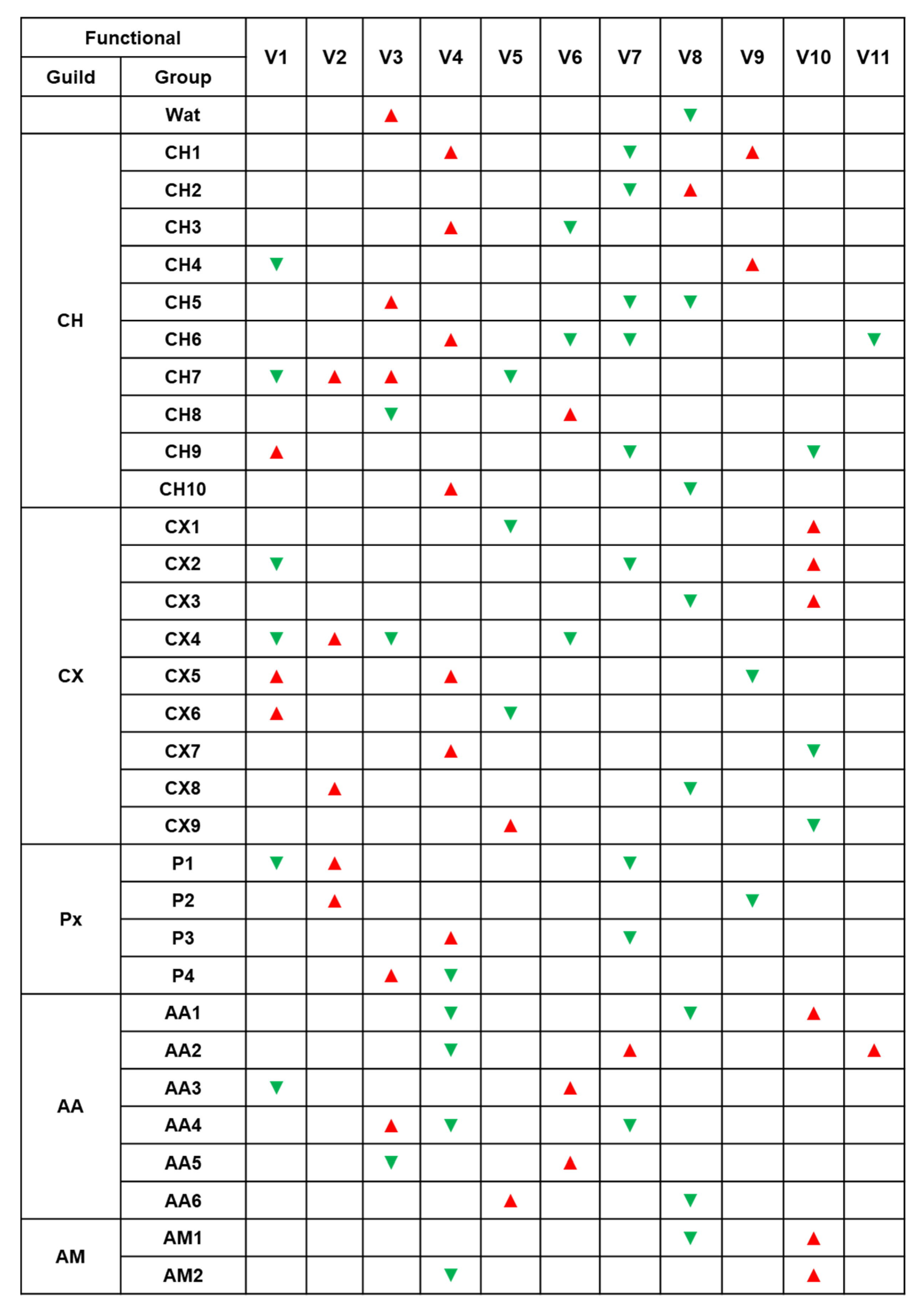
The functional microbiome in the native variant (V1) is reflected both by increased metabolic activity and by certain decreases in it (Figure 6). Within PX and AA guilds, the minimum values were recorded for P1 and AA3. In the case of CX, a relatively uniform distribution of the soil microbiome was observed, with two notable decreases (CX2 and CX4), contrasted by two peaks (CX5 and CX6). The native variant favors the maintenance of an active microbiome, but for the CH guild, the absences of inputs caused a reduction in the functional groups.
Based on NMDS projection, a general trend of microbial reaction was observed. The application of agronomic input induces new capacities in the functional microbiome, marking a shift from generalist toward specialists. On the other hand, untreated soil maintains a basal status, with interdependent functional groups to sustain the activity.
At medium liming levels, the general trend for CH, CX, and Px guilds was upward, with variants showing peaks of activities being predominant. For AA there was a general trend towards homogeneity, followed by a minor decrease in the metabolic activity of the microorganisms involved in the decomposition process. The microbiome’s preference for certain functional groups leads to a wide range of results where the differences are pronounced.
Functional diversity in the case of intensive liming shows a general downward trend in CH, CX, and P, which was the opposite behavior compared to medium-level liming, while in the case of AA, the general trend is moving in the direction of microbiome uniformity. Group AM shows the highest values in the context of intensive liming, suggesting a significant stimulation of metabolic activity. This activity was balanced, allocated in native soils, and shifted to treatment-specific fertilized soils, indicating the loss of general-ist resilience in the favor of efficiency specialization. These findings increase the under-standing of changes in soil functional microbiome due to long-term intensive management, showing that this type of management creates a microbial community dependent on the continuous application of inputs to maintain its activity levels.
Based on cluster analysis and multiple comparison tests, a different metabolic pattern was identified within the communities shaped by long-term application of treatments. The upper cluster was composed of communities dominated by the activity of the CH2 group, defined by the application of both L1 and L2 treatments. All untreated samples are relatively near L1 F0, due to their reduced AWCD and CH activity, and the specialized microbiome shows smaller values for P1 and P2. The lower cluster shows the presence of specialists in the community, with a higher performance for AM1 and CX6 groups. Overall, the liming is the base treatment that establishes the metabolism of fertilizers, with CH2 as separation groups between moderate- and high-limed variants, while niche specialization is visible in L2 NPK treatments based on AM2 activity.
The small dissimilarity between functional communities (based on cluster analysis) highlights that soil maintains a stable functional microbiome. This implies that the application of both liming and fertilizers induce changes but with producing an aggressive shift toward specialists, and the community adapts gradually without losing its functions and links between groups.

5. Conclusions

Long-term agricultural management altered the functional diversity of the soil microbiome responsible for the decomposition of wheat straw, favoring specialized metabolic activity over generalist resilience found in native soil.
Liming levels showed a strong impact on microbial functional diversity and com-munity assemblage. Medium liming boosts general metabolic activity, particularly in CH, CX, and Px guilds, even though AA remains constant. Intensive liming acted as a physiological saturation point and reduced activity in most guilds and groups, except for AM, which shows increased activities. The increase in liming doses was visible in the change in activity patterns, demonstrating that soil microbiomes were sensitive to this type of input.
The impact of long-term treatments applied over an extended period were clearly visible in the changes observed in the dynamics of specific functional community groups with a shift from a generalist state to a specialized one. These changes reflected the adaptations and responses of the microbial community to changes in their environment and available resources because of agricultural interventions.

Supplementary Materials

The following supporting information can be downloaded at: https://www.mdpi.com/article/10.3390/microbiolres17030051/s1, Figure S1. Partial NMDS ordination for Q1 dataset of soil decomposition microbiome; Figure S2. Partial NMDS ordination for Q2 dataset of soil decomposition microbiome; Figure S3. Partial NMDS ordination for Q3 dataset of soil decomposition microbiome; Figure S4. Partial NMDS ordination for Q4 dataset of soil decomposition microbiome.

Author Contributions

Conceptualization, R.V., A.G. and V.S.; methodology, V.S., A.G. and B.P.; software, V.S., A.G. and A.G.; validation, R.V., A.G. and V.S.; formal analysis, R.V., A.G. and V.S.; investigation, R.V., A.G. and V.S.; resources, R.V., A.G. and V.S.; data curation, R.V., A.G. and V.S.; writing—original draft preparation, R.V., A.G., A.P., A.G. and V.S.; writing—review and editing, R.V., A.G., A.P., B.P. and V.S. All authors have read and agreed to the published version of the manuscript.

Funding

This research received no external funding.

Institutional Review Board Statement

Not applicable.

Informed Consent Statement

Not applicable.

Data Availability Statement

The original contributions presented in this study are included in the article/supplementary material. Further inquiries can be directed to the corresponding author.

Acknowledgments

This paper is part of a PhD study in the thematic area of straw decomposition under the influence of long-term liming and mineral fertilization, conducted by the first author, A.G., under the supervision of R.V.

Conflicts of Interest

The authors declare no conflicts of interest.

Appendix A

Table A1. Experimental design and codes used for interpretation.
VariantLiming IntensityDescriptionFertilizer TypeDescriptionCode and Description Within the Text
V1 L00 t ha−1F00 kg ha−1Control, untreated soil, undisturbed soil, native soil
V2Medium limingL12.5 t ha−1F00 kg ha−1Medium liming, unfertilized soil
V3L12.5 t ha−1N100 kg ha−1Medium liming, nitrogen treated soil
V4L12.5 t ha−1P70 kg ha−1Medium liming, phosphorus treated soil
V5L12.5 t ha−1NP100 kg ha−1
70 kg ha−1
Medium liming, NP treated soil
V6L12.5 t ha−1NPK100 kg ha−1
70 kg ha−1
60 kg ha−1
Medium liming, complex treated soil
V7Intensive limingL25 t ha−1F00 kg ha−1Intensive liming, unfertilized soil
V8L25 t ha−1N100 kg ha−1Intensive liming, nitrogen treated soil
V9L25 t ha−1P70 kg ha−1Intensive liming, phosphorus treated soil
V10L25 t ha−1NP100 kg ha−1
70 kg ha−1
Intensive liming, NP treated soil
V11L25 t ha−1NPK100 kg ha−1
70 kg ha−1
60 kg ha−1
Intensive liming, complex treated soil
Table A2. Classification of substrates by guilds and identification codes (based on [39]).
GuildCodeSubstrateGuildCodeSubstrate
Distiled waterWWaterCH
Carbohydrates
CH1Pyruvic acid methyl ester
Px
Polymers
P1Tween 40CH2d-Cellobiose
P2Tween 80CH3α-d-Lactose
P3α-CyclodextrinCH4β-Methyl-d-glucoside
P4GlycogenCH5d-Xylose
CX
Carboxylic and acetic acids
CX1d-Glucosaminic acidCH6i-Erythritol
CX2d-Galactonic acid γ-lactoneCH7d-Mannitol
CX3d-Galacturonic acidCH8N-Acetyl-d-glucosamine
CX42-Hydroxy benzoic acidCH9Glucose-1-phosphate
CX54-Hydroxy benzoic acidCH10d,l-α-Glycerol phosphate
CX6γ-Hydroxy butyric acidAA
Amino acids
AA1l-Arginine
CX7Itaconic acidAA2l-Asparagine
CX8α-Keto butyric acidAA3l-Phenylalanine
CX9d-Malic acidAA4l-Serine
AM
Amines/amides
AM1PhenylethylamineAA5l-Threonine
AM2PutrescineAA6Glycyl-l-glutamic acid
Table A3. Functional microbiomes that showed activity patterns at the boundary between two quadrants.
VarLimingFert TypeWaterPxCHCXAAAMSUMAWCD
V1L0F00.2043.8411.38611.2886.3831.74534.6420.913484   
V7L2F00.2884.58811.89510.0777.792.07936.4290.887129   
V11L2NPK0.114.46612.4599.3017.4510.79434.4711.001968   
VarLimingFert typeCH1CH2CH3CH4CH5CH6CH7CH8CH9CH10 
V1L0F00.932.0850.6881.1831.0680.6251.5511.6381.3970.221 
V7L2F01.071.0730.7332.3231.1230.5131.3142.1831.1050.458 
V11L2NPK1.3081.2980.6551.4861.6890.5481.7862.0431.3650.281 
VarLimingFert typeCX1CX2CX3CX4CX5CX6CX7CX8CX9AM1AM2
V1L0F01.2190.691.8460.0931.4871.9621.4980.7031.791.0720.673
V7L2F01.040.9261.8230.2531.2941.5421.3420.7941.0631.3110.768
V11L2NPK1.0540.7461.2820.0791.5471.5761.3090.2761.4320.1570.637
VarLimingFert typeP1P2P3P4AA1AA2AA3AA4AA5AA6 
V1L0F01.1630.7771.1290.7711.9381.7720.2161.3160.6320.509 
V7L2F01.2520.6660.9211.7491.5712.1510.641.620.7341.074 
V11L2NPK1.210.6581.5121.0861.9912.1730.381.50.750.657 
VarLimingFert typeWaterPxCHCXAAAMSUMAWCD   
V1L0F00.2043.8411.38611.2886.3831.74534.6420.913484   
V7L2F00.2884.58811.89510.0777.792.07936.4290.887129   
V11L2NPK0.114.46612.4599.3017.4510.79434.4711.001968   

References

  1. Seleiman, M.F.; Almutairi, K.F.; Alotaibi, M.; Shami, A.; Alhammad, B.A.; și Battaglia, M.L. Nano-fertilization as an emerging fertilization technique: Why can modern agriculture benefit from its use? Plants 2020, 10, 2. [Google Scholar] [CrossRef] [PubMed]
  2. Selim, M.M. Introduction to the integrated nutrient management strategies and their contribution to yield and soil properties. Int. J. Agron. 2020, 2020, 2821678. [Google Scholar] [CrossRef]
  3. Gaga, I.; Pacurar, F.; Vaida, I.; Plesa, A.; Rotar, I. Responses of Diversity and Productivity to Organo-Mineral Fertilizer Inputs in a High-Natural-Value Grassland, Transylvanian Plain, Romania. Plants 2022, 11, 1975. [Google Scholar] [CrossRef] [PubMed]
  4. Ghețe, I.; Rotar, I.; Pleșa, A.; Ghețe, A.; Șerban, C.; Stoian, V. Effect of Mineral Fertilization on Vegetation of HNV Pastures in the Apuseni Mountains (Romania). Plants 2025, 14, 3564. [Google Scholar] [CrossRef]
  5. Cirebea, M.; Rotar, I.; Păcurar, F.; Vidican, R.; Pleșa, A.; Mălinaș, A. Influence of mineral fertilization with UAN on a natural meadow Festuca rubra with Agrostis capillaris. Rom. J. Grassl. Forage Crops 2015, 11, 25–30. [Google Scholar]
  6. de Lavôr, W.K.B.; da Silva, E.F.; de Almeida Ferreira, E.; Gondim, J.E.F.; Portela, J.C.; de Sousa Antunes, L.F.; Mendonça, V.; Fernandes, B.C.C. Vermicompost and millicompost as a resource in sustainable agriculture in semiarid: Decomposition, nutrient release, and microstructure under the action of nitrogen and organic-mineral fertilizers. Environ. Sci. Pollut. Res. 2024, 31, 33924–33941. [Google Scholar] [CrossRef] [PubMed]
  7. Leighton, P. The harms of industrial food production: How modern agriculture, livestock rearing and food processing contribute to disease, environmental degradation and worker exploitation. In The Palgrave Handbook of Social Harm; Springer International Publishing: Cham, Switzerland, 2021; pp. 199–225. [Google Scholar]
  8. De Corato, U. Agricultural waste recycling in horticultural intensive farming systems by on-farm composting and compost-based tea application improves soil quality and plant health: A review under the perspective of a circular economy. Sci. Total Environ. 2020, 738, 139840. [Google Scholar] [CrossRef]
  9. Michler, M.; Rotar, I.; Pacurar, F. Biodiversity and Conservation of Medicinal Plants: A Case Study in the Apuseni Mountains in Romania. Bull. Univ. Agric. Sci. Vet. Med. Cluj-Napoca Agric. 2006, 62, 86–87. [Google Scholar]
  10. Balázsi, Á.; Pacurar, F.; Mihu-Pintilie, A.; Konold, W. How Do Public Institutions on Nature Conservation and Agriculture Contribute to the Conservation of Species-Rich Hay Meadows? Int. J. Conserv. Sci. 2018, 9, 549–564. [Google Scholar]
  11. Vejan, P.; Khadiran, T.; Abdullah, R.; Ahmad, N. Controlled release fertilizer: A review on developments, applications and potential in agriculture. J. Control. Release 2021, 339, 321–334. [Google Scholar] [CrossRef]
  12. Kumar, R.; Kumar, R.; Prakash, O. Chapter-5 the impact of chemical fertilizers on our environment and ecosystem. In Research Trends in Environmental Sciences; AkiNik Publication: Delhi, India, 2019; Volume 35, pp. 1173–1189. [Google Scholar]
  13. Bhaduri, D.; Sihi, D.; Bhowmik, A.; Verma, B.C.; Munda, S.; Dari, B. A review on effective soil health bioindicators for ecosystem restoration and sustainability. Front. Microbiol. 2022, 13, 938481. [Google Scholar] [CrossRef]
  14. Feng, H.; Han, X.; Zhu, Y.; Zhang, M.; Ji, Y.; Lu, X.; Chen, X.; Yan, J.; Zou, W. Effects of long-term application of organic materials on soil water extractable organic matter, fulvic acid, humic acid structure and microbial driving mechanisms. Plant Soil 2024, 501, 323–341. [Google Scholar] [CrossRef]
  15. Ngatia, L.; Moriasi, D.; Grace, J., III; Fu, R.; Gardner, C.; Taylor, R. Land Use Change Affects Soil Organic Carbon: An Indicator of Soil Health; Intech Open: London, UK, 2021; pp. 1–15. [Google Scholar]
  16. Hussain, S.; Sharma, V.; Arya, V.M.; Sharma, K.R.; Rao, C.S. Total organic and inorganic carbon in soils under different land use/land cover systems in the foothill Himalayas. Catena 2019, 182, 104104. [Google Scholar] [CrossRef]
  17. Lal, R. Global potential of soil carbon sequestration to mitigate the greenhouse effect. Crit. Rev. Plant Sci. 2003, 22, 151–184. [Google Scholar] [CrossRef]
  18. Cheng, X.; Yang, Y.; Li, M.; Dou, X.; Zhang, Q. The impact of agricultural land use changes on soil organic carbon dynamics in the Danjiangkou Reservoir area of China. Plant Soil 2013, 366, 415–424. [Google Scholar] [CrossRef]
  19. Chenu, C.; Angers, D.A.; Barré, P.; Derrien, D.; Arrouays, D.; Balesdent, J. Increasing organic stocks in agricultural soils: Knowledge gaps and potential innovations. Soil Tillage Res. 2019, 188, 41–52. [Google Scholar] [CrossRef]
  20. Zheng, Y.; Jin, J.; Wang, X.; Kopittke, P.M.; O’Sullivan, J.B.; Tang, C. Disentangling the effect of nitrogen supply on the priming of soil organic matter: A critical review. Crit. Rev. Environ. Sci. Technol. 2024, 54, 676–697. [Google Scholar] [CrossRef]
  21. Raza, T.; Qadir, M.F.; Khan, K.S.; Eash, N.S.; Yousuf, M.; Chatterjee, S.; Manzoor, R.; Rehman, S.U.; Oetting, J.N. Unrevealing the potential of microbes in decomposition of organic matter and release of carbon in the ecosystem. J. Environ. Manag. 2023, 344, 118529. [Google Scholar] [CrossRef]
  22. Khatoon, H.; Solanki, P.; Narayan, M.; Tewari, L.; Rai, J.; Khatoon, H. Role of microbes in organic carbon decomposition and maintenance of soil ecosystem. Int. J. Chem. Stud. 2017, 5, 1648–1656. [Google Scholar]
  23. Condron, L.; Stark, C.; O’Callaghan, M.; Clinton, P.; Huang, Z. The role of microbial communities in the formation and decomposition of soil organic matter. In Soil Microbiology and Sustainable Crop Production; Springer: Dordrecht, The Netherlands, 2010; pp. 81–118. [Google Scholar]
  24. Schimel, J.P.; Weintraub, M.N. The implications of exoenzyme activity on microbial carbon and nitrogen limitation in soil: A theoretical model. Soil Biol. Biochem. 2003, 35, 549–563. [Google Scholar] [CrossRef]
  25. Wu, T.; Wichern, F.; Wiesmeier, M.; Buegger, F.; Shi, L.; Dippold, M.A.; Höschen, C.; Mueller, C.W. Organic carbon loading of soils determines the fate of added fresh plant-derived organic matter. Geoderma 2024, 443, 116816. [Google Scholar] [CrossRef]
  26. Dai, X.; Sun, J.; Li, H.; Zhao, Z.; Ma, R.; Liu, Y.; Shan, N.; Yao, Y.; Xue, Z. Microbial Role in Straw Organic Matter Depolymerization to Dissolved Organic Nitrogen Under Nitrogen Fertilizer Reduction in Coastal Saline Paddy Soil. Microorganisms 2025, 13, 2333. [Google Scholar] [CrossRef]
  27. Cha, S.; Kim, Y.S.; Lee, A.L.; Lee, D.H.; Koo, N. Liming alters the soil microbial community and extracellular enzymatic activities in temperate coniferous forests. Forests 2021, 12, 190. [Google Scholar] [CrossRef]
  28. Junior, E.C.; Gonçalves, A.C., Jr.; Seidel, E.P.; Ziemer, G.L.; Zimmermann, J.; Oliveira, V.H.D.D.; Schwantes, D.; Zeni, C.D. Effects of liming on soil physical attributes: A review. J. Agric. Sci. 2020, 12, 278. [Google Scholar] [CrossRef]
  29. Jia, R.; Zhou, J.; Chu, J.; Shahbaz, M.; Yang, Y.; Jones, D.L.; Zang, H.; Razavi, B.S.; Zeng, Z. Insights into the associations between soil quality and ecosystem multifunctionality driven by fertilization management: A case study from the North China Plain. J. Clean. Prod. 2022, 362, 132265. [Google Scholar] [CrossRef]
  30. Shang, Q.; Ling, N.; Feng, X.; Yang, X.; Wu, P.; Zou, J.; Shen, Q.; Guo, S. Soil fertility and its significance to crop productivity and sustainability in typical agroecosystem: A summary of long-term fertilizer experiments in China. Plant Soil 2014, 381, 13–23. [Google Scholar] [CrossRef]
  31. Khan, M.F. Microbial remediation of agrochemical-contaminated soils: Enzymatic mechanisms, quorum sensing, and emerging opportunities. Integr. Environ. Assess. Manag. 2025, 1–23. [Google Scholar] [CrossRef]
  32. Xu, J.; Han, H.; Ning, T.; Li, Z.; Lal, R. Long-term effects of tillage and straw management on soil organic carbon, crop yield, and yield stability in a wheat-maize system. Field Crops Res. 2019, 233, 33–40. [Google Scholar] [CrossRef]
  33. Wang, J.; Zhang, L.; Pang, H.; Zhang, J. Returning granulated straw for accelerating de-composition rate and improving soil fertility. Trans. Chin. Soc. Agric. Eng. 2017, 33, 177–183. [Google Scholar]
  34. Zhao, X.; Yuan, G.; Wang, H.; Lu, D.; Chen, X.; Zhou, J. Effects of full straw incorporation on soil fertility and crop yield in rice-wheat rotation for silty clay loamy cropland. Agronomy 2019, 9, 133. [Google Scholar] [CrossRef]
  35. Vaida, I.; Rotar, I.; Păcurar, F. The Cumulative Effect of Manure on a Festuca Rubra Grasslands for 15 Years. Bull. Univ. Agric. Sci. Vet. Med. Cluj-Napoca Agric. 2017, 1, 74. [Google Scholar] [CrossRef][Green Version]
  36. Rotar, I.; Păcurar, F.; Pleșa, A.; Balázsi, Á. Low mineral fertilization on grassland after 6 years. Lucr. Ştiinţifice 2015, 58, 2. [Google Scholar]
  37. Liu, J.; Zhong, Y.; Jia, X.; Yan, W.; Cao, J.; Shangguan, Z. Wheat straw decomposition patterns and control factors under nitrogen fertilization. J. Soil Sci. Plant Nutr. 2021, 21, 3110–3121. [Google Scholar] [CrossRef]
  38. Wang, X.; Jia, Z.; Liang, L.; Zhao, Y.; Yang, B.; Ding, R.; Wang, J.; Nie, J. Changes in soil characteristics and maize yield under straw returning system in dryland farming. Field Crops Res. 2018, 218, 11–17. [Google Scholar] [CrossRef]
  39. Rusu, M.; Mihai, M.; Tritean, N.; Mihai, V.; Moldovan, L.; Ceclan, O.A.; Russu, F.; Toader, C. Results of Long Term Fertiliser Experiments-Use in Sustainable Soil Fertility Protection Measures. Rom. Agric. Res. 2024, 41, 329–341. [Google Scholar] [CrossRef]
  40. Kurtinecz, P.; Ursan, P. Stationary experiences with amendment and fertilization of acid soils at the Livada Agricultural Research and Development Station. In 60 Years of Research and Performance in Agriculture; Editura Academia de Științe Agricole și Silvice “Gheorghe Ionescu Șișești”: Bucharest, Romania; ARDS: Livada, Romania, 2022; Volume 7, pp. 54–59. [Google Scholar]
  41. Stoian, V.; Vidican, R.; Florin, P.; Corcoz, L.; Pop-Moldovan, V.; Vaida, I.; Vâtcă, S.-D.; Stoian, V.A.; Pleșa, A. Exploration of soil functional microbiomes—A concept proposal for long-term fertilized grasslands. Plants 2022, 11, 1253. [Google Scholar] [CrossRef] [PubMed]
  42. Liu, B.; Li, Y.; Zhang, X.; Wang, J.; Gao, M. Effects of chlortetracycline on soil microbial communities: Comparisons of enzyme activities to the functional diversity via Biolog EcoPlates™. Eur. J. Soil Biol. 2015, 68, 69–76. [Google Scholar] [CrossRef]
  43. Sofo, A.; Ricciuti, P. A standardized method for estimating the functional diversity of soil bacterial community by Biolog® EcoPlatesTM assay—The case study of a sustainable olive orchard. Appl. Sci. 2019, 9, 4035. [Google Scholar] [CrossRef]
  44. Koner, S.; Chen, J.S.; Hsu, B.M.; Tan, C.W.; Fan, C.W.; Chen, T.H.; Hussain, B.; Nagarajan, V. Assessment of carbon substrate catabolism pattern and functional metabolic pathway for microbiota of limestone caves. Microorganisms 2021, 9, 1789. [Google Scholar] [CrossRef]
  45. R Core Team. R: A Language and Environment for Statistical Computing; R Foundation for Statistical Computing: Vienna, Austria, 2024; Available online: https://www.R-project.org/ (accessed on 5 December 2025).
  46. Revelle, W. Psych: Procedures for Psychological, Psychometric, and Personality Research; R Package Version 2.4.3; Northwestern University: Evanston, IL, USA, 2024; Available online: https://CRAN.R-project.org/package=psych (accessed on 5 December 2025).
  47. de Mendiburu, F. Agricolae: Statistical Procedures for Agricultural Research, R Package Version 1.3-7; 2023. Available online: https://CRAN.R-project.org/package=agricolae (accessed on 5 December 2025).
  48. Oksanen, J.; Simpson, G.; Blanchet, F.; Kindt, R.; Legendre, P.; Minchin, P.; O’Hara, R.; Solymos, P.; Stevens, M.; Szoecs, E.; et al. Vegan: Community Ecology Package, R Package Version 2.6-4; 2022. Available online: https://CRAN.R-project.org/package=vegan (accessed on 5 December 2025).
  49. Paradis, E.; Schliep, K. ape 5.0: An environment for modern phylogenetics and evolutionary analyses in R. Bioinformatics 2019, 35, 526–528. [Google Scholar] [CrossRef] [PubMed]
  50. Czúcz, B.; Keith, H.; Maes, J.; Driver, A.; Jackson, B.; Nicholson, E.; Kiss, M.; Obst, C. Selection criteria for ecosystem condition indicators. Ecol. Indic. 2021, 133, 108376. [Google Scholar] [CrossRef]
  51. Teng, Z.; Fan, W.; Wang, H.; Cao, X.; Xu, X. Monitoring soil microorganisms with community-level physiological profiles using Biolog EcoPlates™ in Chaohu lakeside wetland, East China. Eurasian Soil Sci. 2020, 53, 1142–1153. [Google Scholar] [CrossRef]
  52. Deng, L.; Fu, L.; Zhang, K.; Shen, Y.; Feng, G.; Zhang, L.; Li, H.; Liu, C. Effects of fertilizer and waterlogging on the diversity and functioning of the microbial community in greenhouse cultivation soil. Chem. Biol. Technol. Agric. 2022, 9, 31. [Google Scholar] [CrossRef]
  53. Tomás-Pejó, E.; Gonzalez-Fernandez, C.; Greses, S.; Kennes, C.; Otero-Logilde, N.; Veiga, M.C.; Bolzonella, D.; Müller, B.; Passoth, V. Production of short-chain fatty acids (SCFAs) as chemicals or substrates for microbes to obtain biochemicals. Biotechnol. Biofuels Bioprod. 2023, 16, 96. [Google Scholar] [CrossRef] [PubMed]
  54. Verma, R.C.; Singh, N.K.; Gangavati, A.R.; Ashoka, P.; Kesarwani, A.; Ali, I.; Pandey, S.K. A review of long-term effects of mineral fertilizers on soil microorganisms. Int. J. Plant Soil Sci. 2023, 35, 1145–1155. [Google Scholar] [CrossRef]
  55. Christel, A.; Prevost-Bouré, N.C.; Dequiedt, S.; Saby, N.; Mercier, F.; Tripied, J.; Comment, G.; Villerd, J.; Djemiel, C.; Ranjard, L.; et al. Differential responses of soil microbial biomass, diversity and interactions to land use in-tensity at a territorial scale. Sci. Total Environ. 2024, 906, 167454. [Google Scholar] [CrossRef]
  56. Classen, A.T.; Sundqvist, M.K.; Henning, J.A.; Newman, G.S.; Moore, J.A.; Cregger, M.A.; Moorhead, L.C.; Patterson, C.M. Direct and indirect effects of climate change on soil microbial and soil microbial-plant interactions: What lies ahead? Ecosphere 2015, 6, 1–21. [Google Scholar] [CrossRef]
  57. Davids, L. Microorganisms and Their Fundamentals and Applications of Bioremediation. Principles 2017, I, 283. [Google Scholar]
  58. Welbaum, G.E.; Sturz, A.V.; Dong, Z.; Nowak, J. Managing soil microorganisms to improve productivity of agro-ecosystems. Crit. Rev. Plant Sci. 2004, 23, 175–193. [Google Scholar] [CrossRef]
  59. Scotti, R.; Bonanomi, G.; Scelza, R.; Zoina, A.; și Rao, M.A. Organic amendments as sustainable tool to recovery fertility in intensive agricultural systems. J. Soil Sci. Plant Nutr. 2015, 15, 333–352. [Google Scholar] [CrossRef]
  60. Poyraz, N.; Sezen, S.; Mutlu, M.B. Potential of enzymatic methods and Biolog ecoplate analysis for investigation of microbial functionality in agricultural soils. J. Sci. Rep. A 2021, 047, 218–234. [Google Scholar]
  61. Ekschmitt, K.; Kandeler, E.; Poll, C.; Brune, A.; Buscot, F.; Friedrich, M.; Gleixner, G.; Hartmann, A.; Kästner, M.; Wolters, V.; et al. Soil-carbon preservation through habitat constraints and biological limitations on decomposer activity. J. Plant Nutr. Soil Sci. 2008, 171, 27–35. [Google Scholar] [CrossRef]
  62. Ni, H.; Jing, X.; Xiao, X.; Zhang, N.; Wang, X.; Sui, Y.; Sun, B.; Liang, Y. Microbial metabolism and necromass mediated fertilization effect on soil organic carbon after long-term community incubation in different climates. ISME J. 2021, 15, 2561–2573. [Google Scholar] [CrossRef]
  63. Sung, C.T.B.; Ishak, C.F.; Abdullah, R.; Othman, R.; Panhwar, Q.A.; Aziz, M.M.A. Soil properties (physical, chemical, biological, mechanical). Soils Malays. 2017, 22, 103–154. [Google Scholar]
  64. Müller, A.K.; Westergaard, K.; Christensen, S.; Sørensen, S.J. The diversity and function of soil microbial communities exposed to different disturbances. Microb. Ecol. 2002, 44, 49–58. [Google Scholar] [CrossRef]
  65. Bai, Y.; Wang, G.; Cheng, Y.; Shi, P.; Yang, C.; Yang, H.; Xu, Z. Soil acidification in continuously cropped tobacco alters bacterial community structure and diversity via the accumulation of phenolic acids. Sci. Rep. 2019, 9, 12499. [Google Scholar] [CrossRef] [PubMed]
  66. Anandakumar, J.; Swathi, B.; Patil, S.S.; Kujur, R.S. Nutrient Recycling. Tree Biol. Biotechnol. 2025, 67. [Google Scholar]
  67. Schutter, M.; Dick, R. Shifts in substrate utilization potential and structure of soil microbial communities in response to carbon substrates. Soil Biol. Biochem. 2001, 33, 1481–1491. [Google Scholar] [CrossRef]
  68. Lowe, L.E. Carbohydrates in soil. In Developments in Soil Science; Elsevier: Amsterdam, The Netherlands, 1978; Volume 8, pp. 65–93. [Google Scholar] [CrossRef]
  69. Feng, Z.; Xie, X.; Wu, P.; Chen, M.; Qin, Y.; Zhou, Y.; Zhu, H.; Yao, Q. Phenylalanine-mediated changes in the soil bacterial community promote nitrogen cycling and plant growth. Microbiol. Res. 2023, 275, 127447. [Google Scholar] [CrossRef] [PubMed]
  70. Sehgal, H.; Sharma, E.; Pant, C.; Malhotra, S.; Joshi, M. Impact of Climate Change on Soil Health and Nutrient Cycling. In Soil Health and Nutrition Management; CABI: Wallingford, UK, 2025; pp. 109–128. [Google Scholar] [CrossRef]
  71. Khan, M.F.; Rama, M.; Murphy, C.D. Biodegradation of fluorinated β-triketone herbicide tembotrione by a bacterial–fungal consortium. Biocatal. Agric. Biotechnol. 2025, 70, 103828. [Google Scholar] [CrossRef]
Figure 1. Methodological approach for microbiological analysis of wheat straw decomposition.
Microbiolres 17 00051 g001
Figure 2. Variants and inputs used in long-term field experiments. Legend: V1—control, V2–V6—L1, V7–V11—L2, V2/V7—0N, V3/V8—N100, V4/V9—P70, V5/V10—N100P70, V6/V11—N100P70K60; L1—2.5 t ha−1 calcium carbonate, L2—5 t ha−1 calcium carbonate.
Microbiolres 17 00051 g002
Figure 3. Symbols and color codes in NMDS ordination. Legend: F0—control; L1 + N, P, NP, NPK; L2 + N, P, NP, NPK; L1—2.5 t ha−1 calcium carbonate, L2—5 t ha−1 calcium carbonate.
Microbiolres 17 00051 g003
Figure 4. General NMDS ordination of functional microbiomes involved straw decomposition: (A) guild projection in relation to treatments; (B) group projection in relation to treatments. Legend: L0—no liming, L1—liming with 2.5 t ha−1 calcium carbonate, L2—liming with 5 t ha−1 calcium carbonate; F0—unfertilized, N—N100, P—P70, NP—N100P70, NPK—N100P70K60 (according to the detailed description in Section 2, Table A1); SUM—sum of activities, AWCD—average well color development, AA—amino acids, AM—amines/amides, CH—carbohydrates, CX—carboxylic and acetic acids, Px—polymers.
Microbiolres 17 00051 g004
Figure 5. Cluster analysis of functional microbiomes associated with liming×fertilization combinations. Legend: L0—no liming, L1—liming with 2.5 t ha−1 calcium carbonate, L2—liming with 5 t ha−1 calcium carbonate; F0—unfertilized, N—N100, P—P70, NP—N100P70, NPK—N100P70K60 (according to the detailed description in Section 2, Table A1).
Microbiolres 17 00051 g005
Figure 6. The general pattern of amplitude variation in functional microbial groups (red triangles indicates the maximum value recorded; green triangles indicate the minimum value recorded). Abbreviations: Water—basal community; Px—polymers; CH—carbohydrates; CX—carboxylic acids; AA—amino acids; AM—amines/amides; CH1—Pyruvic acid methyl ester, CH2—d-Cellobiose, CH3—α-d-Lactose, CH4—β-Methyl-d-glucoside, CH5—d-Xylose, CH6—i-Erythritol, CH7—d-Mannitol, CH8—N-Acetyl-d-glucosamine, CH9—Glucose-1-phosphate, CH10—d,l-α-Glycerol phosphate; CX1—d-Glucosaminic acid, CX2—d-Galactonic acid γ-lactone, CX3—d-Galacturonic acid, CX4—2-Hydroxy benzoic acid, CX5—4-Hydroxy benzoic acid, CX6—γ-Hydroxy butyric acid, CX7—It-aconic acid, CX8—α-Keto butyric acid, CX9—d-Malic acid; P1—Tween 40, P2—Tween 80, P3—α-Cyclodextrin, P4—glycogen; AA1—l-Arginine, AA2—l-Asparagine, AA3—l-Phenylalanine, AA4—l-Serine, AA5—l-Threonine, AA6—glycyl-l-glutamic acid, AM1—Phenylethylamine, AM2—putrescine.
Microbiolres 17 00051 g006
Table 1. Microbial guild functional diversity in long-term treated soils.
VLFWaterPxCHCXAAAMSUMAWCD
1000.18 ± 0.03 abc4.91 ± 0.54 ab11.00 ± 0.54 a11.70 ± 0.23 a7.66 ± 0.43 abc2.19 ± 0.26 b37.50 ± 1.02 ab1.02 ± 0.05 abc
2100.14 ± 0.02 c6.08 ± 0.72 a13.20 ± 1.31 a10.90 ± 0.58 ab7.52 ± 0.15 abc2.05 ± 0.17 b39.90 ± 2.64 a1.13 ± 0.08 a
31N1000.29 ± 0.05 a4.40 ± 0.47 b13.00 ± 1.67 a10.70 ± 0.81 abc7.66 ± 0.44 abc1.38 ± 0.20 cd37.30 ± 3.34 ab0.90 ± 0.14 bc
41P700.26 ± 0.02 ab5.38 ± 0.50 ab12.90 ± 1.31 a10.70 ± 0.69 abc6.75 ± 0.29 bc1.71 ± 0.19 bcd37.50 ± 2.16 ab0.94 ± 0.09 abc
51N100P700.22 ± 0.02 abc4.43 ± 0.26 b12.00 ± 0.52 a9.32 ± 0.28 c7.49 ± 0.11 abc1.39 ± 0.11 cd34.60 ± 0.47 ab0.89 ± 0.01 bc
61N100P70K600.18 ± 0.05 bc5.11 ± 0.17 ab12.20 ± 1.03 a10.30 ± 0.63 abc8.04 ± 0.60 a1.66 ± 0.09 bcd37.40 ± 2.04 ab1.02 ± 0.02 abc
7200.23 ± 0.03 abc4.40 ± 0.13 b10.20 ± 0.71 a10.50 ± 0.15 abc7.22 ± 0.27 abc1.98 ± 0.10 bc34.40 ± 0.85 ab0.87 ± 0.05 c
82N1000.13 ± 0.04 c4.51 ± 0.40 b11.60 ± 1.98 a9.51 ± 0.56 bc6.63 ± 0.42 c1.29 ± 0.11 d33.60 ± 2.74 b0.94 ± 0.06 abc
92P700.16 ± 0.01 bc4.83 ± 0.41 b13.00 ± 0.81 a9.69 ± 0.48 bc7.13 ± 0.36 abc1.64 ± 0.15 bcd36.30 ± 2.09 ab1.00 ± 0.05 abc
102N100P700.16 ± 0.03 bc4.33 ± 0.28 b12.10 ± 1.31 a11.50 ± 0.35 a7.89 ± 0.21 a2.82 ± 0.13 a38.70 ± 1.18 ab1.08 ± 0.04 ab
112N100P70K600.16 ± 0.05 bc5.08 ± 0.28 ab11.80 ± 1.24 a10.80 ± 0.58 abc7.71 ± 0.45 ab1.91 ± 0.48 bc37.40 ± 2.07 ab1.04 ± 0.01 abc
Notes: V1—control, V2–V6—liming L1 (2.5 t ha−1 calcium carbonate), V7–V11—liming L2 (5 t ha−1 calcium carbonate), V2/V7—without mineral fertilizer, V3/V8—with N100, V4/V9—with P70, V5/V10—with N100P70, V6/V11—with N100P70K60. Abbreviations: Water—basal community; Px—polymers; CH—carbohydrates; CX—carboxylic acids; AA—amino acids; AM—amines/amides; Sum—total microbial community; AWCD—average well color development. Different letters after means ± s.e. indicate significant differences at p < 0.05 based on LSD test.
Table 2. Evaluation of the 10-carbohydrate microbial functional profile in soils under long-term treatments.
VLFCH1CH2CH3CH4CH5CH6CH7CH8CH9CH10
1001.18 ± 0.13 a1.27 ± 0.27 a0.71 ± 0.03 a1.16 ± 0.02 b1.15 ± 0.29 bc0.58 ± 0.06 a1.19 ± 0.12 b1.79 ± 0.09 ab1.68 ± 0.27 a0.25 ± 0.02 bc
2101.26 ± 0.15 a1.65 ± 0.31 a0.91 ± 0.11 a1.68 ± 0.20 ab1.47 ± 0.25 abc0.64 ± 0.10 a1.92 ± 0.41 a2.00 ± 0.09 ab1.40 ± 0.17 ab0.30 ± 0.04 abc
31N1001.14 ± 0.27 a1.49 ± 0.31 a1.16 ± 0.26 a1.20 ± 0.14 ab2.22 ± 0.10 a0.57 ± 0.08 a1.91 ± 0.26 ab1.61 ± 0.31 b1.39 ± 0.14 ab0.33 ± 0.04 abc
41P701.28 ± 0.20 a1.64 ± 0.22 a1.19 ± 0.26 a1.29 ± 0.19 ab1.26 ± 0.38 bc0.77 ± 0.06 a1.71 ± 0.30 ab1.88 ± 0.11 ab1.43 ± 0.15 ab0.40 ± 0.09 a
51N100P701.11 ± 0.16 a1.25 ± 0.12 a0.98 ± 0.15 a1.23 ± 0.14 ab1.96 ± 0.15 ab0.69 ± 0.08 a1.20 ± 0.21 ab2.00 ± 0.34 ab1.30 ± 0.06 ab0.27 ± 0.03 abc
61N100P70K601.27 ± 0.15 a1.67 ± 0.14 a0.67 ± 0.17 a1.62 ± 0.22 ab1.12 ± 0.35 bc0.55 ± 0.05 a1.41 ± 0.04 ab2.25 ± 0.19 a1.27 ± 0.13 ab0.36 ± 0.06 ab
7200.93 ± 0.13 a0.94 ± 0.08 a0.74 ± 0.10 a1.43 ± 0.30 ab1.06 ± 0.40 c0.55 ± 0.05 a1.27 ± 0.14 ab1.78 ± 0.16 ab1.24 ± 0.13 b0.29 ± 0.06 abc
82N1001.03 ± 0.13 a1.74 ± 0.49 a1.01 ± 0.26 a1.24 ± 0.25 ab1.05 ± 0.36 c0.74 ± 0.18 a1.49 ± 0.27 ab1.79 ± 0.28 ab1.33 ± 0.13 ab0.19 ± 0.05 c
92P701.29 ± 0.09 a1.51 ± 0.16 a0.83 ± 0.09 a1.73 ± 0.15 a1.59 ± 0.25 abc0.75 ± 0.05 a1.46 ± 0.34 ab2.07 ± 0.15 ab1.47 ± 0.11 ab0.26 ± 0.04 abc
102N100P701.15 ± 0.10 a1.55 ± 0.37 a1.07 ± 0.20 a1.37 ± 0.12 ab1.49 ± 0.31 abc0.64 ± 0.05 a1.44 ± 0.24 ab1.86 ± 0.09 ab1.23 ± 0.06 b0.32 ± 0.02 abc
112N100P70K601.19 ± 0.11 a1.69 ± 0.34 a1.05 ± 0.30 a1.34 ± 0.23 ab1.18 ± 0.20 bc0.55 ± 0.03 a1.29 ± 0.16 ab1.85 ± 0.33 ab1.35 ± 0.15 ab0.36 ± 0.03 ab
Notes: V1—control, V2–V6—liming L1 (2.5 t ha−1 calcium carbonate), V7–V11—liming L2 (5 t ha−1 calcium carbonate), V2/V7—without mineral fertilizer, V3/V8—with N100, V4/V9—with P70, V5/V10—with N100P70, V6/V11—with N100P70K60. Abbreviations: CH1—pyruvic acid methyl ester, CH2—d-Cellobiose, CH3—α-d-Lactose, CH4—β-Methyl-d-glucoside, CH5—d-Xylose, CH6—i-Erythritol, CH7—d-Mannitol, CH8—N-Acetyl-d-glucosamine, CH9—glucose-1-phosphate, CH10—d,l-α-Glycerol phosphate. Different letters after means ± s.e. indicate significant differences at p < 0.05 based on LSD test.
Table 3. Evaluation of the four polymers’ microbial functional profiles in soils under long-term treatments.
VLFP1P2P3P4
1001.27 ± 0.04 c1.07 ± 0.15 b0.97 ± 0.10 ab1.59 ± 0.33 a
2101.77 ± 0.12 a1.68 ± 0.35 a1.07 ± 0.14 ab1.54 ± 0.18 a
31N1001.34 ± 0.06 bc0.86 ± 0.11 b1.23 ± 0.21 ab0.95 ± 0.34 a
41P701.37 ± 0.20 bc0.90 ± 0.22 b1.42 ± 0.19 a1.68 ± 0.16 a
51N100P701.31 ± 0.05 c0.66 ± 0.06 b1.24 ± 0.10 ab1.19 ± 0.30 a
61N100P70K601.60 ± 0.04 ab1.04 ± 0.10 b1.03 ± 0.11 ab1.44 ± 0.11 a
7201.28 ± 0.02 c0.92 ± 0.13 b0.87 ± 0.07 b1.32 ± 0.21 a
82N1001.52 ± 0.11 abc0.99 ± 0.17 b0.93 ± 0.09 b1.05 ± 0.37 a
92P701.37 ± 0.04 bc0.64 ± 0.03 b1.20 ± 0.19 ab1.61 ± 0.26 a
102N100P701.34 ± 0.05 bc0.91 ± 0.10 b1.03 ± 0.21 ab1.03 ± 0.28 a
112N100P70K601.38 ± 0.07 bc0.86 ± 0.12 b1.33 ± 0.23 ab1.49 ± 0.17 a
Notes: V1—control, V2–V6—liming L1 (2.5 t ha−1 calcium carbonate), V7–V11—liming L2 (5 t ha−1 calcium carbonate), V2/V7—without mineral fertilizer, V3/V8—with N100, V4/V9—with P70, V5/V10—with N100P70, V6/V11—with N100P70K60. Abbreviations: P1—Tween 40, P2—Tween 80, P3—α-Cyclodextrin, P4—glycogen. Different letters after means ± s.e. indicate significant differences at p < 0.05 based on LSD test.
Table 4. Evaluation of the nine carboxylic acids microbial functional profiles in soils under long-term treatments.
VLFCX1CX2CX3CX4CX5CX6CX7CX8CX9
1000.95 ± 0.10 a0.84 ± 0.08 a1.91 ± 0.21 ab0.12 ± 0.02 b1.63 ± 0.12 a2.10 ± 0.19 a1.47 ± 0.05 bc0.99 ± 0.28 ab1.67 ± 0.17 abcd
2101.01 ± 0.08 a1.14 ± 0.15 a1.79 ± 0.06 ab0.30 ± 0.10 a1.39 ± 0.22 a1.53 ± 0.08 abc1.45 ± 0.06 bcd1.11 ± 0.34 a1.24 ± 0.15 de
31N1000.98 ± 0.04 a1.24 ± 0.31 a1.67 ± 0.10 ab0.13 ± 0.02 b1.44 ± 0.28 a1.67 ± 0.39 abc1.52 ± 0.04 abc0.72 ± 0.09 abc1.37 ± 0.28 bcde
41P700.82 ± 0.14 a0.84 ± 0.09 a1.57 ± 0.25 ab0.21 ± 0.03 ab1.64 ± 0.32 a1.47 ± 0.12 bc1.67 ± 0.04 a0.74 ± 0.07 abc1.80 ± 0.18 abc
51N100P700.76 ± 0.11 a0.87 ± 0.10 a1.55 ± 0.24 ab0.14 ± 0.04 b1.23 ± 0.02 a1.29 ± 0.07 c1.61 ± 0.03 ab0.72 ± 0.07 abc1.11 ± 0.13 e
61N100P70K600.91 ± 0.13 a0.88 ± 0.16 a1.83 ± 0.35 ab0.13 ± 0.02 b1.45 ± 0.16 a1.74 ± 0.12 abc1.41 ± 0.08 cde0.49 ± 0.06 c1.50 ± 0.09 abcde
7201.03 ± 0.04 a0.83 ± 0.03 a1.83 ± 0.13 ab0.18 ± 0.03 ab1.47 ± 0.07 a1.82 ± 0.36 abc1.39 ± 0.01 cde0.59 ± 0.07 bc1.36 ± 0.26 bcde
82N1001.01 ± 0.19 a1.12 ± 0.23 a1.38 ± 0.14 b0.15 ± 0.02 b1.21 ± 0.08 a1.51 ± 0.20 abc1.38 ± 0.03 cde0.42 ± 0.10 c1.29 ± 0.17 cde
92P701.03 ± 0.12 a1.01 ± 0.18 a1.59 ± 0.03 ab0.17 ± 0.07 ab1.15 ± 0.09 a1.46 ± 0.12 bc1.28 ± 0.10 de0.60 ± 0.08 bc1.36 ± 0.13 bcde
102N100P701.05 ± 0.23 a0.89 ± 0.08 a2.08 ± 0.10 a0.15 ± 0.03 b1.48 ± 0.10 a1.89 ± 0.12 ab1.26 ± 0.05 e0.79 ± 0.22 abc1.93 ± 0.18 a
112N100P70K600.92 ± 0.11 a0.95 ± 0.11 a1.68 ± 0.15 ab0.16 ± 0.04 ab1.35 ± 0.11 a1.90 ± 0.15 ab1.39 ± 0.04 cde0.56 ± 0.10 bc1.89 ± 0.20 ab
Notes: V1—control, V2–V6—liming L1 (2.5 t ha−1 calcium carbonate), V7–V11—liming L2 (5 t ha−1 calcium carbonate), V2/V7—without mineral fertilizer, V3/V8—with N100, V4/V9—with P70, V5/V10—with N100P70, V6/V11—with N100P70K60. Abbreviations: CX1—d-Glucosaminic acid, CX2—d-Galactonic acid γ-lactone, CX3—d-Galacturonic acid, CX4—2-Hydroxy benzoic acid, CX5—4-Hydroxy benzoic acid, CX6—γ-Hydroxy butyric acid, CX7—itaconic acid, CX8—α-Keto butyric acid, CX9—d-Malic acid. Different letters after means ± s.e. indicate significant differences at p < 0.05 based on LSD test.
Table 5. Evaluation of the six amino acids and two amines microbial functional profiles in soils under long-term treatments.
VLFAA1AA2AA3AA4AA5AA6AM1AM2
1002.07 ± 0.19 ab2.03 ± 0.10 a0.47 ± 0.12 c1.44 ± 0.08 ab0.85 ± 0.07 ab0.77 ± 0.09 abcd1.17 ± 0.06 abc1.01 ± 0.19 ab
2101.36 ± 0.12 c1.96 ± 0.13 a1.02 ± 0.28 ab1.48 ± 0.07 ab0.78 ± 0.09 ab0.89 ± 0.07 abc0.77 ± 0.12 cde1.27 ± 0.25 a
31N1001.68 ± 0.14 bc1.95 ± 0.11 a0.67 ± 0.14 abc1.73 ± 0.24 a0.60 ± 0.04 b0.99 ± 0.06 ab0.62 ± 0.14 de0.75 ± 0.14 b
41P701.28 ± 0.17 c1.92 ± 0.02 a0.57 ± 0.06 c1.36 ± 0.15 ab0.74 ± 0.03 b0.85 ± 0.02 abc0.86 ± 0.06 bcde0.84 ± 0.15 b
51N100P701.46 ± 0.08 c1.99 ± 0.10 a0.73 ± 0.13 abc1.62 ± 0.02 ab0.65 ± 0.06 b1.01 ± 0.04 a0.75 ± 0.08 de0.64 ± 0.04 b
61N100P70K601.75 ± 0.39 bc1.99 ± 0.19 a1.04 ± 0.17 a1.46 ± 0.15 ab1.02 ± 0.11 a0.76 ± 0.09 bcd0.81 ± 0.11 bcde0.84 ± 0.09 b
7201.69 ± 0.23 bc2.16 ± 0.02 a0.59 ± 0.09 c1.35 ± 0.13 b0.66 ± 0.14 b0.75 ± 0.11 cd1.19 ± 0.06 ab0.78 ± 0.09 b
82N1001.28 ± 0.24 c2.02 ± 0.09 a0.57 ± 0.08 c1.46 ± 0.04 ab0.70 ± 0.16 b0.59 ± 0.08 d0.56 ± 0.09 e0.73 ± 0.03 b
92P701.35 ± 0.10 c2.04 ± 0.05 a0.61 ± 0.09 bc1.47 ± 0.07 ab0.74 ± 0.03 ab0.89 ± 0.15 abc0.85 ± 0.13 bcde0.79 ± 0.12 b
102N100P702.37 ± 0.10 a2.06 ± 0.07 a0.54 ± 0.08 c1.37 ± 0.14 ab0.77 ± 0.11 ab0.75 ± 0.04 bcd1.48 ± 0.07 a1.33 ± 0.10 a
112N100P70K601.77 ± 0.18 bc2.16 ± 0.16 a0.67 ± 0.16 abc1.49 ± 0.12 ab0.84 ± 0.05 ab0.75 ± 0.05 bcd0.98 ± 0.33 bcd0.93 ± 0.14 ab
Notes: V1—control, V2–V6—liming L1 (2.5 t ha−1 calcium carbonate), V7–V11—liming L2 (5 t ha−1 calcium carbonate), V2/V7—without mineral fertilizer, V3/V8—with N100, V4/V9—with P70, V5/V10—with N100P70, V6/V11—with N100P70K60. Abbreviations: AA1—l-Arginine, AA2—l-Asparagine, AA3—l-Phenylalanine, AA4—l-Serine, AA5—l-Threonine, AA6—Glycyl-l-glutamic acid, AM1—phenylethylamine, AM2—putrescine. Different letters after means ± s.e. indicate significant differences at p < 0.05 based on LSD test.
Table 6. The impact of long-term treatments on general assemblage of functional microbial communities and metabolic intensification within groups (synthetic image of significant guilds and groups).
PERMANOVAFp Value ENVFITGuilds
Liming1.600.056  NMDS1NMDS2r2p Value
Fertilizer1.200.176 Px0.961620.27440.14790.032
Liming × Fertilizer1.410.046  CH0.994230.107310.90580.001
ENVFITGroups   CX0.48828−0.872690.56060.001
 NMDS1NMDS2r2p ValueAA0.39493−0.918710.39770.001
CH10.95682−0.290680.34950.001AM0.15152−0.988450.43270.001
CH20.99883−0.048270.56440.001SUM0.89656−0.442920.79630.001
CH30.90340.428810.32410.001AWCD0.83507−0.550140.56850.001
CH40.99873−0.050440.34280.001ENVFITGroups   
CH50.934610.355680.30730.001 NMDS1NMDS2r2p Value
CH60.939290.343120.33340.001CX20.99088−0.134730.35650.001
CH70.946480.322760.46980.001CX30.41646−0.909150.29650.002
CH80.99592−0.090260.30930.003CX50.65786−0.753140.35110.001
CH90.93888−0.344240.23440.005CX60.17196−0.98510.52370.001
AA10.03955−0.999220.42290.001CX70.373310.927710.15620.031
AA20.53411−0.845410.3190.002P30.86880.495170.3810.001
AA30.97469−0.223560.07010.238AM10.03881−0.999250.39560.001
AA40.98853−0.151040.15210.042AM20.32262−0.946530.21630.013
Notes: SUM—sum of activities, AWCD—average well color development, AA—amino acids, AM—amines/amides, CH—carbohydrates, CX—carboxylic and acetic acids, Px—polymers. CH1—Pyruvic acid methyl ester, CH2—d-Cellobiose, CH3—α-d-Lactose, CH4—β-Methyl-d-glucoside, CH5—d-Xylose, CH6—i-Erythritol, CH7—d-Mannitol, CH8—N-Acetyl-d-glucosamine, CH9—Glucose-1-phosphate; CX2—d-Galactonic acid γ-lactone, CX3—d-Galacturonic acid, CX5—4-Hydroxy benzoic acid, CX6—γ-Hydroxy butyric acid, CX7—It-aconic acid; P3—α-Cyclodextrin; AA1—l-Arginine, AA2—l-Asparagine, AA3—l-Phenylalanine, AA4—l-Serine, AM1 – Phenylethylamine, AM2 – Putrescine.
Disclaimer/Publisher’s Note: The statements, opinions and data contained in all publications are solely those of the individual author(s) and contributor(s) and not of MDPI and/or the editor(s). MDPI and/or the editor(s) disclaim responsibility for any injury to people or property resulting from any ideas, methods, instructions or products referred to in the content.